WITHIN-HOST MICROBIAL INTERACTIONS AND PLANT PARASITES: FROM PAIRWISE INTERACTIONS TO THE MICROBIOME
Kayleigh Rose O’Keeffe
A dissertation submitted to the faculty at the University of North Carolina at Chapel Hill in partial fulfillment of the requirements for the degree of Doctor of Philosophy in the
Department of Biology.
Chapel Hill 2019
ii © 2019
Kayleigh Rose O’Keeffe ALL RIGHTS RESERVED
ABSTRACT
KAYLEIGH ROSE O’KEEFFE: Within-host microbial interactions and plant parasites: from pairwise interactions to the microbiome
(Under the direction of Charles E. Mitchell)
Multicellular organisms are often host to a diverse community of mutualistic,
commensal, and parasitic microbes, referred to collectively as the microbiome. The microbial community surrounding a parasite shapes both that parasite’s immediate phenotype and its evolutionary potential. This dissertation investigates this by focusing on how within-host interactions relate to disease at multiple levels, from interrogations of pairwise interactions to the microbiome. In this work, I used computational methods and lab- and field-based studies to examine the interactions between fungal species that coinfect plant host individuals and co-occur in plant host populations.
At the individual level, I explored how interactions among fungal symbionts in the same host leaf alter parasite growth and host responses. Within host leaves, the growth of a parasite, R. solani, was influenced by coinfection with another parasite. This effect was further mediated by a third, asymptomatic fungal symbiont, highlighting the potential for higher-order interactions occurring among symbionts within a shared host. Multiple infection by these three fungal symbionts also impacted leaf survival and host biomass. I also
iv
mechanisms underlying host-parasite interactions in non-model systems and proposed a workflow to follow to interrogate such systems.
Scaling up to the population level, I explored how interactions between parasite, R. solani, and a mutualist affect parasite spread through a host population. While host
vi
ACKNOWLEDGEMENTS
The completion of this dissertation would not have happened without the support of many mentors, collaborators, friends, and family. First, I would like to thank my committee members. Corbin Jones supported me as I explored a question that involved methods that were wholly out of my comfort zone and engaged with my research questions in ways that made me really consider how my research contributes to the field as a whole. Ignazio Carbone’s curiosity and passion for research is contagious, and he was someone I could rely on for methodological support, as well as conversations that would increase my excitement over my questions. James Umbanhowar was always willing to meet with me to provide statistical and theoretical advice. As the other members of my committee are all PIs on the same grant, Beth Shank was an important addition to my committee to give me a different perspective on my research and help me figure out how to most effectively communicate my findings to a broad academic audience. Charles Mitchell has been the most amazing mentor. He gave me the space to develop my own questions, even when they were in directions outside of his own expertise. He makes his trainees a top priority, and while he gave me space to grow, he was accessible in every way to work through questions and results. He also has been so supportive of both my long-term career goals and personal priorities, for which I am incredibly grateful.
(USDA-NIFA AFRI grant 2016-67013-25762). My research was also funded in part by Amherst College’s John Woodruff Simpson fellowship. The UNC Graduate School Dissertation Merit Assistantship provided tuition support and a stipend for my first year of graduate school. UNC’s Alma Holland Beers Scholarship provided summer funding which allowed me to perform full-time fieldwork in the summers of my first and second year of graduate school. The Triangle Center for Evolutionary Medicine provided tuition support and a stipend for Spring 2016. The NSF Graduate Research Fellowship Program provided three years of funding allowing me to focus entirely on my graduate studies. When not supported by fellowships, the Department of Biology provided a TA-ship to support me.
I have benefitted tremendously from my labmates. Fletcher Halliday, Rob Heckman, Miranda Welsh, and Julie Geyer provided important insight and feedback. They helped me develop my research questions, improve my writing, and get me re-excited about my research when I was in the weeds with fieldwork or statistics. Erin Mordecai and I only overlapped in the lab for a few months, but during that time, she helped me reflect on the questions I was considering pursuing, and since, has been someone I have been able to continue to discuss my work with and rely on for support. Fletcher Halliday has become a wonderful collaborator and friend, and I am so thankful that we were able to integrate our respective interests into a project that ultimately did not make it into this dissertation. I look forward to continuing to work with him in the future.
viii
Wheeler played an incredible role in the development and collection of data for the experiment described in a chapter of this dissertation, and I loved being able to mentor someone who is so passionate about plants and ecology.
My research benefitted from assistance from our incredible lab manager, Brooklynn Newberry, and seasonal field technicians. In particular, Charlie Muirhead, Storm Crews, and Julie Long helped set up the field experiment that was the focus of one of the chapters of this dissertation. Brooklynn Newberry has been a marvelous addition to the lab, and her
organization and willingness to help whenever I needed has been invaluable.
During graduate school, I have had the opportunity to develop both my teaching and science communication skills, both of which shaped how I think about science and will also be essential to reach my long-term career goals. Mara Evans has served as a role model for the type of instructor I would like to be and, in the process, has become a good friend. The ComSciCon community, has given me role models and peers within science communication, and my experiences attending and organizing the Research Triangle workshop were an important part of my graduate school career.
I want to thank my family and friends. My parents, Eva and Kevin O’Keeffe, were always a phone call away whenever I needed to talk and have always been incredibly supportive of my education. Much of my success and happiness is because of their
foundational support. My friends in the biology department, namely, Catie Alves, Catherine Chen, Sara Snell Taylor, Anaïs Monroy-Eklund, and Laura Mudge, became lunch
immensely with my transition to graduate school (and always had delicious baked goods to share)! Many of my closest friendships are with friends who live far away, and even with the distance, have been so important to me during my time in graduate school. Thank you especially to Fabiana Kreines, Kate Berry, and Catherine Schwartz.
x
TABLE OF CONTENTS
LIST OF TABLES ... xiv
LIST OF FIGURES ... xvi
CHAPTER 1: INTRODUCTION ... 1
CHAPTER 2-CHALLENGES AND SOLUTIONS FOR ANALYSING DUAL RNA-SEQ DATA FOR NON-MODEL HOST-PATHOGEN SYSTEMS ... 7
Introduction ... 7
Methods ... 10
Study system ... 10
RNA-seq simulations... 11
Dual RNA-seq analysis approaches ... 12
Evaluation of alignments ... 15
Applications to other host–pathogen systems ... 16
Results ... 16
Generation of simulated datasets ... 16
Comparison of raw read mapping... 16
Gene counts and differential expression analysis ... 18
Alternative mapping strategies may reduce mapping problems ... 19
Effect of sequencing parameters ... 21
Discussion ... 22
CHAPTER 3: HIGHER-ORDER INTERACTIONS BETWEEN PARASITES AND A SYSTEMIC GRASS ENDOPHYTE AFFECT PARASITE GROWTH AND HOST MORTALITY ... 36
Introduction ... 36
Methods ... 38
Study System... 38
Experimental Approach ... 40
Inoculation experiments ... 42
Data Analysis ... 46
Results ... 48
How is disease severity of R. solani affected by a systemic endophyte ? ... 48
How is disease severity of R. solani affected by coinfection with parasite, C. cereale? 49 How is disease severity of R. solani affected by the interaction between a systemic endophyte and parasite, C. cereale? ... 49
Discussion ... 51
CHAPTER 4: A SYSTEMIC ENDOPHYTE AFFECTS POPULATION DYNAMICS OF INFECTIOUS DISEASE ... 64
Introduction ... 64
Methods ... 66
Study System and Site ... 66
Experimental Design and Setup ... 67
Data Collection ... 69
xii
Results ... 72
Discussion ... 75
CHAPTER 5: THE FUNGAL LEAF MICROBIOME OF A GRASS HOST UNDER NATURAL INFECTIONS BY DIVERSE PARASITES ... 87
Introduction ... 87
Methods ... 90
Study System... 90
Study Site ... 91
Sample Collection ... 91
Sample Preparation, DNA extractions, and Sequencing ... 92
Fungal Community Analysis ... 93
Diversity ... 94
Community Composition ... 96
Results ... 98
Diversity ... 98
Community Composition ... 100
Discussion ... 101
CHAPTER 6: CONCLUSION ... 120
APPENDIX A: SUPPLEMENTARY MATERIAL FOR CHAPTER 2 ... 125
A1. Supplemental Figures ... 125
A2. Supplemental Tables ... 141
xiv
LIST OF TABLES
Table 2.1: Results of Sequential Approach. ... 28
Table 3.1: Experiment 1 Setup ... 43
Table 3.2: Experiment 2 Setup ... 45
Table 3.3: Experiment 3 Setup ... 46
Table 3.4: Experiment 1: E. coenophiala vs. R. solani ... 55
Table 3.5: Experiment 2: C. cereale vs. R. solani ... 56
Table 3.6: Experiment 3: Factorial Manipulation of E. coenophiala, C. cereale, and R. solani... 57
Table 3.7: Survival Analysis Results ... 58
Table 4.1: Endophyte-inoculated populations tended to have heavier disease over course of experiment, on average, though this difference had weak statistical support. ... 78
Table 4.2: There was no significant effect of endophyte inoculation on parasite prevalence over time. ... 78
Table 4.3: There was a significant effect of endophyte on peak prevalence ... 78
Table 4.4: Disease severity over time as determined by endophyte infection ... 78
Table 4.5:Endophyte infection increased host aboveground biomass. ... 78
Table 4.6: Aboveground biomass correlated with number of leaves at the individual plant- and population-level ... 79
Table 4.7: There was a significant effect of endophyte on modelled peak prevalence, even after accounting for effect of biomass on prevalence ... 79
Table 5.1 Biology and ecology of the focal fungal parasites ... 106
Table 5.2: Variation of Hill's series of diversity, explained by linear mixed models... 107
Table 5.4: Variation of Hill's series of diversity, explained by linear mixed models, for the subset of variants that do not place within
Ceratobasidiaceae... 108
Table 5.5: Variation in the composition of the fungal microbiome
explained by parasite and symptom. ... 108 Table A2.1: Schizosaccharomyces Species Information ... 141 Table A2.2: Species Information for Pathogens Included in simulations,
xvi
LIST OF FIGURES
Figure 2.1: Dual RNA-seq Simulation Study Workflow ... 27
Figure 2.2: Comparison of utility and accuracy of several aligners
for dual RNA-seq analysis... 29 Figure 2.3: Concatenated genome mapping (Place-to-go approach)
improve dual RNA-seq analysis. ... 31 Figure 2.4: The Assembly Approach improves alignment of dual RNA-seq reads. ... 33 Figure 2.5: Suggested Workflow for dual RNA-seq Experiments of
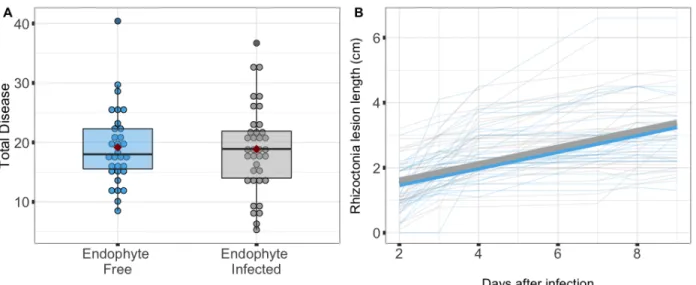
non-model host–pathogen systems ... 35 Figure 3.1: In Experiment 1, E. coenophiala had no effect on disease caused by R. solani. .. 59 Figure 3.2: Growth rate of R. solani was higher when in coinfection with
C. cereale than when inoculated on its own. ... 60
Figure 3.3: Growth rate of R. solani was higher when in coinfection with
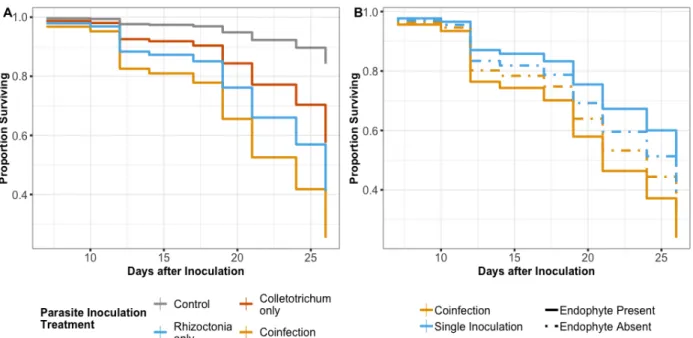
C. cereale than when inoculated on its own. ... 61 Figure 3.4: Parasite inoculation increased leaf mortality. ... 62
Figure 3.5: Endophyte-infected plants had lower biomass when
co-inoculated with C. cereale and R. solani than all other combinations of
endophyte and parasite treatments ... 63 Figure 4.1: Field Mesocosm Experimental Layout... 80 Figure 4.2 Endophyte-inoculated population tended to have heavier disease
over course of experiment, on average though this difference was not statistically
significant. ... 81 Figure 4.3 Endophyte inoculations did not affect parasite spread over time but
did affect peak parasite prevalence. ... 82 Figure 4.4: Longitudinal analysis of disease severity ... 83 Figure 4.5 Endophyte infection increased host aboveground biomass. ... 84 Figure 4.6 Number of leaves on a plant and in a population were correlated with
Figure 4.7 Peak Rhizoctonia Prevalence was significantly correlated with
dry aboveground biomass. ... 86 Figure 5.2. Hypothesized effects of sequencing depth and parasite symptom on
fungal diversity... 110 Figure 5.3 Leaf segments with symptoms of Rhizoctonia solani were associated
with less diverse foliar fungal communities. ... 111 Figure 5.4. Local diversity metrics for leaves observed with Rhizoctonia solani
symptoms estimated at the leaf segment level regressed against estimated disease
severity (area leaf damaged)... 112 Figure 5.5 Even when only considering variants that did not place within
Ceratobasidiaceae (the family of R. solani), leaf segments with symptoms of Rhizoctonia solani were generally associated with less diverse foliar fungal
communities ... 113 Figure 5.6. After excluding taxa placed within Ceratobasidiaceae,
leaf-associated fungal diversity and richness has positive correlation with
estimated disease severity (percent leaf damaged). ... 114 Figure 5.8. Estimated severity of damage caused by R. solani significantly
predicted fungal taxa composition, but only explained a modest amount of
variation. ... 116 Figure 5.9. Non-metric multidimensional scaling (NMDS) plots showing
similarity among samples based on composition of fungal taxa excluding
those taxa that placed within Ceratobasidiaceae ... 117 Figure 5.10. Estimated severity of damage caused by R. solani significantly
predicted fungal taxa composition excluding those taxa that placed within
Ceratobasidiaceae, but only explained a modest amount of variation. ... 118
Figure 5.11: 11 taxa, representing 10 genera, differed significantly in relative abundance between the asymptomatic and symptomatic segments of leaves
infected with R. solani. ... 119 Figure A2.1: Trinity assembly metrics. ... 125 Figure A2.2: K-mer counts of Sequencing Reads Included (A) or Excluded
(B) from Trinity Assembles of 76 single-end datasets. ... 126 Figure A2.3: Comparison of the utility and accuracy of several aligners for
xviii
Figure A2.4 Concatenated genome mapping improve dual RNA-seq
analysis with NextGenMap of datasets very low proportions of pathogen reads. ... 128 Figure A2.5 Assembling reads de novo first improves alignment of dual
RNA-seq datasets very low proportions of pathogen reads. ... 129 Figure A2.6 Comparison of the utility and accuracy of several aligners for
dual RNA-seq analysis in human-Candida system. ... 130 Figure A2.7 Mapping Reads to Host Genome to Filter Host Reads Does Not
Reduce Host Read Mismapping (Human-Candida) ... 131 Figure A2.8 Assembling reads de novo first improves alignment of dual RNA-seq
datasets of Human-Candida albicans. ... 132 Figure A2.9 Concatenated genome mapping improve dual RNA-seq analysis of
Human-Candida datasets. ... 133 Figure A2.10 Comparison of the utility and accuracy of several aligners for dual
RNA-seq analysis in human-E. coli system. ... 134 Figure A2.11 Comparison of the utility and accuracy of several aligners for dual
RNA-seq (150 single-end datasets) analysis. ... 135 Figure A2.12 Comparison of the utility and accuracy of several aligners for dual
RNA-seq (76 paired-datasets) analysis. ... 136
Figure A2.13 Assembling reads de novo first improves alignment of dual
RNA-seq 150 single-end reads... 137 Figure A2.14 Assembling reads de novo first improves alignment of dual
RNA-seq 76 paired-end reads. ... 138 Figure A2.15 Concatenated genome mapping improves dual RNA-seq
analysis of 150 single-end datasets. ... 139 Figure A2.16 Concatenated genome mapping improves dual RNA-seq
analysis of 76 paired-end datasets. ... 140 Figure B4.1 Tukey Simultaneous 95% Confidence Intervals for differences of
means for endophyte infection category ... 142 Figure C5.1 Leaf segments with symptoms of Rhizoctonia solani were associated
CHAPTER 1: INTRODUCTION
Species interactions are defined by the effects that two species have on one another and have been studied extensively in free-living species (Gause & Witt, 1935; Hairston, Smith, & Slobodkin, 1960; Holling, 1959). Those free-living species are often host to a diverse set of mutualistic, commensal, and parasitic microbes, referred to collectively as the microbiome. Within the microbiome, parasites are among the best-studied microbes due to their negative impacts on their hosts (Borer, Kinkel, May, & Seabloom, 2013). Infectious disease has historically been studied in a one host-one parasite framework, but the field is now appreciating the role and complexity of within-host microbial interactions. Within a shared host, parasites may interact by directly facilitating or interfering with each other, or indirectly, mainly via host resources or the host’s immune system (Alizon, de Roode, & Michalakis, 2013). Parasites may also interact with non-parasitic microbes within a host (Adame-Álvarez, Mendiola-Soto, & Heil, 2014; May & Nelson, 2014).
2
A key question in infection biology is how do these interactions shape parasites in both the near and long term. Within-host microbial interactions can alter disease severity, transmission rates, and host mortality. Near-term responses of parasites to microbial interactions can be observed in changes in parasite growth rates and subsequent disease severity under coinfection (Pieter T J Johnson & Hoverman, 2012; Pinna et al., 2016). Sequencing advances have facilitated the investigation of the mechanisms underlying these interactions, though have been limited to model systems with developed genomic resources (A J Westermann, Gorski, & Vogel, 2012).
In contrast to these near-term responses of parasites within host individuals, long-term responses of parasites to microbial interactions have included impacts on parasite transmission rates across host individuals (Susi, Barrès, Vale, & Laine, 2015), spatial and temporal patterns of parasite abundances (Halliday, Umbanhowar, & Mitchell, 2017), and species co-occurrence (P. A. Clay, Dhir, Rudolf, & Duffy, 2018). Such long-term
consequences of within-host microbial interactions have historically received less attention. As recent evidence suggests that coinfection can potentially lead to opposite outcomes at the host individual and population scales (Gorsich et al., 2018), it is critical that the
consequences of within-host microbial interactions be studied and integrated across levels. The microbial community surrounding a parasite shapes both that parasite’s
immediate phenotype and its evolutionary potential. This dissertation investigates this by focusing on within-host interactions on disease at multiple levels, specifically, the individual, population, and microbial community context. I performed four experiments. First, I
I investigated the near-term responses of parasites to within-host microbial interactions within a host individual in a series of inoculation experiments. Third, I investigated the long-term responses of parasites to within-host microbial interactions by quantifying effects on parasite spread through a population in a field mesocosm experiment. Fourth, I examined the community context of this system by examining how fungal diversity associates with disease symptoms in a metabarcoding survey of field-collected samples. The final three chapters investigate the same disease system across levels.
CHAPTER SUMMARIES
In Chapter 2, I explored the challenges of investigating the molecular mechanisms underlying host-parasite interactions in non-model systems (i.e. study systems in which genomic resources are limited). Dual RNA-seq simultaneously profiles the transcriptomes of a host and pathogen during infection and may reveal the mechanisms underlying
host-pathogen interactions. Dual RNA-seq is inherently a mixture of transcripts from at least two species (host and pathogen), so this mixture must be computationally sorted into host and pathogen components. Sorting relies on aligning reads to respective reference genomes, which may be unavailable for both species in non-model host-pathogen pairs. To investigate if using the genomic resources of species closely-related to a pathogen species of interest can facilitate the use of dual RNA-seq in non-model systems, I performed a simulated sequencing experiment in collaboration with Corbin Jones. Specifically, we simulated dual RNA-seq datasets of a host/pathogen system and assessed alignment accuracy of dual RNA-seq
4
mismapped transcripts originating from the host to the pathogen’s related reference genome. We ultimately provided evidence for a workflow for dual RNA-seq experiments with non-model systems that utilizes de novo assembly or concatenated reference information. This chapter was published in Methods in Ecology and Evolution (O’Keeffe and Jones 2019).
In Chapter 3, I focused on consequences of within-host microbial interactions on disease at the host individual-level. Microbes within a shared host can interact with each other, and when those microbes include parasites, such interactions can affect the diseases that they cause (O’Keeffe, Carbone, Jones, & Mitchell, 2017). Microbes may interact by directly facilitating or interfering with each other, or indirectly, mainly via host resources or the host’s immune system (Tollenaere, Susi, & Laine, 2016). These interactions between coinfecting microbes can also range, from synergistic to antagonistic (Larimer et al. 2010, Morris et al. 2010, Bordes and Morand 2011). In collaboration with Anita Simha and Charles Mitchell, I investigated the effect of higher-order interactions, indirect interactions among species through effects on intermediate species (Wootton, 1994), on disease; specifically, I considered the interactions among two coinfecting parasites, R. solani and C. cereale and a systemic endophyte, E. coenophiala within a shared host. We found that C. cereale
In Chapter 4, I focused on population-level consequences of within-host microbial interactions on disease. We hypothesized that infection with systemic grass endophyte, E. coenophiala, which has been shown to suppress growth of certain parasites, may also affect
spread of parasites between hosts. To determine the effect of E. coenophiala on spread of
fungal parasite, R. solani, through a host population, I set up a field mesocosm experiment in collaboration with Brandon Wheeler and Charles Mitchell. We set up contained
populations of host grass species, tall fescue, and each population was comprised of entirely E. coenophiala-inoculated plants or entirely E. coenophiala-free plants. A focal plant was inoculated with parasite, R. solani. Following inoculation, we quantified parasite prevalence within each plot over time, as well as disease severity on tracked leaves over
time. While parasite spread over time was unaffected by E. coenophiala, populations with E.
coenophiala present had a higher peak prevalence of the parasite, R. solani, than populations
that lacked E. coenophiala. Within plants, E. coenophiala conferred a benefit in growth, as
plants that had E. coenophiala had significantly higher aboveground biomass. While biomass
did significantly contribute to models of the peak parasite prevalence, E. coenophiala
affected peak parasite prevalence beyond the effect of biomass. Additionally, individuals
with E. coenophiala had slightly higher severity of parasite symptoms over time. Our results
suggest that while E. coenophiala is a mutualist of tall fescue, it may not be a defensive
mutualist in relation to R. solani.
next-6
generation sequencing technologies (Consortium et al., 2012; Lundberg et al., 2012). The microbiome may interact with parasites by competing for resources, releasing antimicrobial compounds, or altering a host immune response. Such interactions can lead to consequences for host health, making the host more susceptible to, tolerant of, or resistant to a parasite. At the same time, the microbiome is dynamic and the introduction of a parasite can lead to a disturbance in its diversity and composition. To determine how the within-host fungal community of a host plant associates with symptoms of three co-occurring fungal parasites, I conducted a high-throughput sequencing survey of the fungal community of a host
CHAPTER 2-CHALLENGES AND SOLUTIONS FOR ANALYSING DUAL RNA-SEQ DATA FOR NON-MODEL HOST-PATHOGEN SYSTEMS
Introduction
Viruses, bacteria and fungi can invade and parasitize eukaryotic host cells. Hosts may respond to infection by upregulating defense pathways. Pathogens, in turn, evade these host immune responses as they infect and cause disease. As this process unfolds and each
organism responds to the other, gene expression changes in both the host and the pathogen (Kawahara et al., 2012). Yet, despite the importance of host–pathogen interactions, the genetic mechanisms underlying host–pathogen interactions during infection remain poorly understood. (A J Westermann et al., 2012).
8
Dual RNA-seq data are inherently a mixture of transcripts from both host and
pathogen. Given this mixture, the host and pathogen reads need to be sorted from each other. This sorting is typically done by an alignment algorithm that maps the reads to the two reference genomes, that of the host and that of the pathogen. To increase the accuracy of sorting and limit the potential for reads to mismap to the wrong reference genome (i.e. pathogen reads mapped to the host genome and vice versa), dual RNA-seq studies have employed a variety of analytical approaches such as discarding reads that map to both the host and pathogen reference genomes (e.g. Alexander J Westermann et al., 2016) or
concatenating host and pathogen reference genomes into a composite for genome alignment (Aprianto, Slager, Holsappel, & Veening, 2016). However, both methods of read sorting rely on reference genomes, limiting their application to systems in which the host and/or pathogen species have developed genomic resources. As model species with sequenced and annotated reference genomes comprise a small fraction of total species
( https://www.ncbi.nlm.nih.gov/genome), many host–pathogen systems are potentially excluded from dual RNA-seq analysis.
For organisms without complete reference genomes, approaches to analyzing RNA-seq data include assembling reads de novo (i.e. assembling many small reads together into fewer longer fragments, Grabherr et al., 2011) and mapping reads to reference genomes of related species (Ekblom & Galindo, 2010). As dual RNA-seq contains a mixture of
species, could result in reads not mapping if the genetic distance between the target species and the reference species is too high. Alternatively, aligners that allow more mismatches between reads and the reference genome could mismap reads from the wrong species, which could lead to spurious inference of how gene expression is affected by infection. De novo assembly can alleviate some of these problems, by creating larger fragments with which to map, but de novo assembly may result in reads from the two species assembling into longer fragments, which would lead to inaccuracies in subsequent mapping. Furthermore, dual RNA-seq datasets vary in the proportion of pathogen reads to host reads in the datasets, depending on the system of interest (Baddal et al., 2015; Choi, Aliota, Mayhew, Erickson, & Christensen, 2014; Hayden et al., 2014), and this variation may affect the accuracy and biological interpretation of various analytical methods.
Despite the variety of analytical approaches and their potential influence on the interpretation of dual RNA-seq data, the accuracy of these methods has not been
systematically assessed. Here, we determined if and how dual RNA-seq can be utilized in non-model host–pathogen systems in which genomic resources are limited. Specifically, we
investigated if using the genomic resources of species closely related to the pathogen species of interest can facilitate the use of dual RNA-seq in non-model systems. To do this, we simulated dual RNA-seq datasets. Simulations allowed us to manipulate dataset
characteristics, like the proportion of pathogen to host reads, as well as facilitated
10
genome affected mapping accuracy. Additionally, we assessed how this effect was mediated by different alignment methods and the fraction of pathogen reads in the sample (Figure 2.1). We explored four different approaches: 1. aligning raw reads to the reference genome of the pathogen or a related species, 2. aligning reads to the host genome first and then mapping those reads that did not map to the host genome to the reference genome of the pathogen or a related species (referred to as the sequential approach), 3. aligning reads to a composite genome comprised of the genomes of the host species and pathogen or a related species (referred to as the place-to-go approach), and 4. assembling reads de novo prior to aligning (referred to as the assembly approach). This assessment provides guidance as to how to approach dual RNA-seq when studying organisms that do not have fully sequenced genomes.
Methods
Study system
Simulating RNA-seq relies on a reference genome and annotation file as inputs; therefore, we model dual RNA-seq using well-characterized genomes for both host and pathogen. Additionally, to investigate the effect of genetic distance between the pathogen of interest and the reference genome used for aligning reads, we needed to model a pathogen species for which closely related sister species were also fully sequenced. First, we
allowed us to assess if dual RNA-seq data could be analyzed by using the genomic
information of a related species as a reference when studying a species without a sequenced genome. Therefore, A. thaliana and S. octosporus allowed us to quantify how sensitive (or robust) different potential analysis methods were to increasing genetic distances between the focal pathogen and the reference genome. A. thaliana will be referred to as the host,
and S. octosporus will be referred to as the pathogen. RNA-seq simulations
Flux Simulator was used to generate simulated RNA-seq data (Griebel et al., 2012).
Flux Simulator produced sequencing reads from a reference genome according to annotated transcripts. RNA-seq data were simulated separately for the host and pathogen. For each, four datasets were simulated for a factorial combination of two read lengths (76-bp or 150-bp) and configuration (single end or paired end). Each dataset included 10 million reads, similar to the simulations used in Baruzzo et al., 2016. All other simulation parameters were run as default. Simulated datasets were output as FASTQ files. Reads within each dataset were labelled with unique species-identifying tags (either ‘HOST’ or ‘PATH’) to facilitate downstream assessments of alignments.
12
the percentages of pathogen reads. Some systems investigate simultaneous gene expression of host and pathogens by mechanically separating cells of each species prior to sequencing (Ellison, DiRenzo, McDonald, Lips, & Zamudio, 2017). Datasets with higher percentages of pathogen reads that still include host reads could represent sequencing from RNA extracted after imperfect cell sorting.
Dual RNA-seq analysis approaches
For each reference-based approach, the reference genomes and annotations
for S. octosporus (the target pathogen), S. cryophilus, S. japonicus and S. pombe were used, downloaded in April 2018 from Fungi Ensembl ((Rhind et al., 2011), Table A2.1).
As S. octosporus was simulated as the pathogen within the generated dual RNA-seq datasets, the genomic resources for the other species within the Schizosaccharomyces genus facilitated the investigation of how different levels of evolutionary distance between the genome of the target species and reference genome affect mapping accuracy. To generate a reference transcriptome, the BEDTools ‘getfasta’ utility version 2.25.0 was used to extract the
transcript sequences from each of these downloaded genomes as specified by coordinates in the complementing annotation files (Quinlan & Hall, 2010). These transcript sequences were used as reference transcriptomes for alignment of reads from each dual RNA-seq dataset.
Read mapping was conducted with four different aligners: TopHat2, STAR,
on a Maximal Mappable Prefix, is more robust to non-continuous reads and some mismatches. Default parameter settings were used for both methods.
In addition to these two splice-aware aligners, a de novo aligner, MapSplice2 (version
2.2.1) was used to map reads to a reference genome (Wang et al., 2010). MapSplice2 detects splice junctions without any dependence on splice site features (an annotation file). We also mapped reads with an unspliced aligner, NextGenMap (version 0.4.12) to map reads from each simulated dataset to each reference transcriptome (H. Li & Durbin, 2010; Sedlazeck, Rescheneder, & von Haeseler, 2013). The hash-based variable mismatch threshold algorithm of NextGenMap maximizes its ability to utilize divergent reads. Default parameter settings were used.
Using the genomic resources and aligners discussed above, we processed reads in four different approaches to investigate the effectiveness and accuracy of analytical methods for dual RNA-seq data, (Workflow in Figure 2.1):
1. Raw read mapping
First, we investigated the accuracy of mapping the raw sequencing reads that were comprised of both host and pathogen reads. We conducted alignments with the reference genome of the target pathogen species, S. octosporus, and those of species closely related to the target species. Each of the four alignment algorithms discussed above was utilized.
2. Sequential mapping approach: map to host genome first
14
datasets to the host genome, then took the reads left unmapped and mapped them to the genome of the target species and those of closely related species. Reads from each simulated dataset were mapped to the host genome using TopHat2 under default parameters. Following alignments, the output BAM files containing unmapped reads were converted to FASTA files using the ‘bam2fq’ function within Samtools version 1.3.1 (H. Li et al., 2009). These reads that did not map to the host genome were then mapped to each of
the Schizosaccharomyces genomes with NextGenMap and STAR. 3. Place-to-go approach: mapping to concatenated genome
We further investigated potential alignment methods when a host genome is available by mapping reads to concatenated genomes of the host genome and either the target pathogen genome or the genome of a species closely related to the target pathogen species. First, we investigated mapping accuracy with the composite genome of the host A. thaliana and of the target pathogen species S. octosporus, the two species used to simulate the dual RNA-seq datasets. Second, to assess the effectiveness and accuracy of this method when only the genomes of species closely related to the target pathogen species are available, we also created composite genomes of A. thaliana and each of the three other Schizosaccharomyces genomes. Read mapping was conducted with the four different aligners as described above.
4. Assembly approach: de novo assembly
contig, the contig was tagged ‘pathogen’. If only host reads mapped to a contig, the contig was tagged ‘host’. If both pathogen and host reads mapped to a contig, the contig was tagged ‘undetermined’. After Trinity assembly and tagging, contigs were mapped to each of
the Schizosaccharomyces genomes with NextGenMap and STARlong under default settings. Evaluation of alignments
SAM/BAM conversions, sorting and indexing were performed with SAMtools version 1.3.1 and Picard version 2.2.4 (H. Li et al., 2009). For each alignment, the number of mapped and unmapped reads originating from A. thaliana and S. octosporus was counted by parsing BAM files for the previously added unique tags for each species.
16 Applications to other host–pathogen systems
To investigate if patterns observed with the above approaches held across other host– pathogen systems, we also simulated dual RNA-seq involving another fungal
pathogen, Candida albicans, and a different host species, Homo sapiens. Additionally, we simulated a bacterial pathogen system with Homo sapiens and Escherichia coli. Many species within the Candida and Escherichia genera have reference genomes available. We utilized two sister species of each C. dubliniensis and C. parapsilosis, and E.
fergusonii and E. albertii as reference species to evaluate impact on dual RNA-seq analytical
methods (Table A2.2). Results
Generation of simulated datasets
We simulated dual RNA-seq datasets to investigate if and how dual RNA-seq can be utilized in host–pathogen systems in which genomic resources are limited. Simulated datasets represented a factorial combination of read length (76 bp vs. 150 bp), sequencing
configuration (paired or single ended), and 12 different ratios of host reads to pathogen reads. In total, 48 dual RNA-seq datasets, each with 10 million reads, were simulated. Similarly, we simulated dual RNA-seq datasets for Homo sapiens and Candida albicans, and Homo
sapiens and Escherichia coli, also with varying ratios of pathogen reads to host reads. We will first discuss the main results from the 76-bp single-end A. thaliana and S. octosporus datasets relegating the extensions and ancillary results to the supplement.
Comparison of raw read mapping
correct target genome. When mapping raw reads to the target genome of the pathogen of interest, the four aligners had comparable mapping rates of reads originating from the pathogen (Figure 2.2A). TopHat2 and MapSplice2 aligned c. 88% of pathogen reads; STAR and NextGenMap each aligned over 99% of pathogen reads to the target reference. Mapping rate of pathogen reads was unaffected by the percentage of pathogen reads in the sequencing datasets. While STAR and NextGenMap achieved a high mapping rate of pathogen reads, both aligners also mismapped host reads to the genome of the target pathogen species
(Figure 2.2B, A2.3). For STAR and NextGenMap alignments of datasets in which there were more host reads than pathogen reads, a common occurrence among real dual RNA-seq datasets, mismapped host reads comprised 25–98% of the total reads mapped. In sum, most pathogen reads from a dual RNA-seq experiment were aligned by common aligners, but the aligners that mapped the most pathogen reads to the source pathogen genome also incorrectly aligned the most host reads to the pathogen genome.
As many pathogen species do not have genomic resources, we investigated how each of the four aligners performed when mapping reads to the genome of a species closely related to the pathogen. TopHat2 and MapSplice2 performed poorly, mapping <0.5% of pathogen reads when mapping to any genome of a related species. STAR and NextGenMap were able to map pathogen reads when using the genomic information of a related species as a
18
pathogen reads mapped to the S. cryophilus transcriptome, 22% mapped to the S. pombe transcriptome and 28% mapped to the S. japonicus transcriptome (Figure 2.2A). For both STAR and NextGenMap, the percentage of pathogen reads mapped generally decreased as evolutionary distance between the target and reference genomes increased. Thus, there is a distinct bifurcation between aligners that can and cannot effectively map pathogen reads when only a related reference genome is available.
For STAR and NextGenMap, host reads mismapping to the incorrect genome
increased as the evolutionary distance between the target pathogen species and the reference species increased, while TopHat2 and MapSplice2 only mapped a few host reads (maximum of 19 reads) to any of the Schizosaccharomyces reference genomes under any sequencing parameters (Figure 2.2B, A2.3). When aligning with STAR, c. 21% of host reads mapped to the S. cryophilus and S. pombe genomes. Although only c. 1% of host reads mapped to the S. pombe genome, only 3% of pathogen reads mapped to the same genome, so overall mapping rate was very low. When aligning with NextGenMap, c. 25% of host reads mapped to the S. cryophilus and S. japonicus transcriptomes, and c. 15% of host reads mapped to S. pombe. The effects of evolutionary distance-related mismapping is greatest in datasets in which the proportion of pathogen reads was low, as host reads comprise the majority of total reads mapped.
Gene counts and differential expression analysis
dataset with highest proportion of host reads relative to pathogen reads (specifically, 99% host reads/1% pathogen reads). The vast majority of the mismapped host reads derived from repetitive parts of the genome. As determined by featureCounts, only 1.6%
of S. octosporus genes had more than 50 host reads mismap to them, and these genes varied in biological function (Table A2.3).
We compared two alignments of the same simulated dataset to the target genome of S. octosporus; one alignment was performed by mapping raw reads to the genome with TopHat2 (which did not mismap host reads) and the other was performed by mapping raw reads to the genome with STAR (which included host reads mismapping). 97.1% of genes that were expressed differently (above 0.1-fold change on the log2 scale) between alignments were overexpressed in the alignment in which host read mismapping occurred. This suggests that mismapping of reads to the wrong reference in dual RNA-seq can result in upward
biases in estimates of gene expression. Thus, compared to an uninfected control, these upwardly biased genes would appear to be ‘induced’ by infection.
Alternative mapping strategies may reduce mapping problems
We considered three alternative approaches that could reduce poor mapping and mismapping of dual RNA-seq data. We first investigated approaches that would be possible if a host genome was available. We tried to filter out host reads by first aligning dual
20
We investigated a second approach in which reads were mapped to concatenated genomes of the host and either the target pathogen or that of a closely related species to the pathogen (a ‘place-to-go’ design). The place-to-go method resulted in alignments using
STAR and NextGenMap having substantially fewer host reads mismapping to the genome of the pathogen or that of a species closely related to the pathogen compared to the alignments to genomes excluding the host genome. Furthermore, both aligners retained their ability to map pathogen reads to the genomes of closely related species to the target pathogen (Figure 2.3, Figure A2.4). Therefore, the place-to-go method may overcome some of the limitations of mapping to a related reference in dual RNA-seq.
Finally, we investigated a third approach in which reads were first assembled de novo into longer fragments, then those fragments were mapped to the genomes of the pathogen and species closely related to the pathogen (‘assembly’ approach). The majority of assembled contigs were comprised entirely of host reads or entirely of pathogen reads (Assembly
metrics in Figure A2.1). A small fraction of contigs were chimeras—that is, a mix of host and pathogen reads (labelled as ‘undetermined’). Alignments of these assembled transcripts to each of the reference genomes resulted in a substantial decrease in host read mismapping while preserving the ability to map pathogen contigs (Figure 2.4, Figure A2.5). Across all reference species and proportions of pathogen reads in the original datasets, <1% of contigs comprised of host reads mapped with NextGenMap. Furthermore, c. 99% of contigs
comprised of pathogen reads mapped to the target transcriptome of S. octosporus.
identified as comprised of pathogen or host reads mapped, they comprised a minority of the total number of mapped contigs, with a maximum of 2.5%. With such a reduction in host read mismapping, the majority of all mapped contigs originated from the pathogen. Given that a good de novo assembly is possible, the assembly approach also clearly reduced mismapping.
Effect of sequencing parameters
To investigate the effect of sequencing parameters—the size of sequencing read, paired-end vs. single-end reads—on the above approaches, we simulated dual RNA-seq datasets of the same system with a longer read length (150 bp) and with paired-end sequencing (Figure A2.11–A2.16). While the same patterns largely held—that raw read mapping resulted in host reads mismapping when aligning with STAR and NextGenMap and mapping reads to a concatenated genome or assembling reads de novo prior to mapping substantially reduced host read mismapping—there were some differences among the layouts. Specifically, longer read lengths not only resulted in overall lower host read
mismapping rates (which is consistent with the results of mapping assembled reads) but also resulted in lower pathogen read mapping rate, especially when mapping to the genomes of species closely related to the pathogen. Additionally, assembling 76 paired-end reads de novo
prior to mapping to the Schizosaccharomyces genomes resulted in more reads that could not be identified as from the host or pathogen (potentially chimeras) comprising the group of mapped reads. As expected, longer paired-end reads generally performed better than other
22 Similarities and contrasts in other taxa
The simulations above focused on a fungal ‘parasite’ infecting a plant host as we believe that this could be a particularly problematic scenario, as plants and fungi are both eukaryotes, while other host–pathogen systems involve more diverged species. To investigate if and how the patterns observed above extend to other systems, we simulated two more sets of dual RNA-seq datasets. We simulated datasets across the same range of proportion of pathogen reads for another host–fungal pathogen system, Homo sapiens and Candida albicans, as well as a bacterial pathogen system, Homo sapiens and Escherichia coli. While alignments of the Human-Candida raw reads to the genomes of the target species, C. albicans, and two closely related species, C. dublinensis and C. parapsilosis, did result in a comparable level of host read mismapping to the above analyses (Figure A2.6), alignments of Human-E. coli raw reads had minimal if any host read mismapping (Figure A2.10). We conducted the same three approaches described above to minimize host read mismapping with the Human-Candida alignments, and we observed the same results as described above—that mapping to concatenated genomes of the host and closely related species, as well as de novo assembly prior to aligning, substantially reduce host read mismapping while retaining the ability to map pathogen reads (Figure A2.7–9). Therefore, the mismapping problems in dual RNA-seq held, to varying degrees, across the systems we investigated.
Discussion
mapping reads to the genomes of each organism. Consequently, it was previously unknown whether and how dual RNA-seq could be applied to non-model host–pathogen systems, in
which there are limited or no genomic resources. Our analyses of simulated sequencing identified as problematic several approaches that might be encountered by researchers applying dual RNA-seq to non-model host–pathogen systems. However, our systematic
comparison of analytical approaches also revealed a workflow that can be used to identify the genetic mechanisms of host–parasite interactions for non-model organisms.
24
The difference in the performance of the alignment tools likely reflects the classic trade-off between precision vs. sensitivity in the underlying algorithms. TopHat2
underutilizes the dual RNA-seq data as it relies on a Burrows–Wheeler transform and FM-index to quickly search for matches between the reference genome and the RNA-seq reads. This emphasis on fast and exact (or nearly so) match alignment struggles to map reads that have divergent bases. MapSplice2, a splice-aware aligner, applies a metric based on Shannon maximum entropy as applied to a weighted de Bruijn graph. This approach can detect splice junctions without any dependence on splice site features—potentially a critical feature when applying dual RNA-seq to poorly annotated genomes or closely related species. However, the base alignment approach relies on Bowtie algorithm and as a result suffers from the same limitations as TopHat2. In contrast, the hash-based variable mismatch threshold algorithm of NextGenMap maximizes its ability to utilize divergent reads but makes more erroneous assignments. STAR, which uses a seed and anchor approach based on a Maximal Mappable Prefix, is robust to non-continuous reads and some mismatches. It performed almost as well
as NextGenMap in terms of data utilization, but again suffered from imprecision in the form of host reads mismapping to the wrong genome.
Host reads mismapping to the genome of the pathogen or the genome of a species closely related to the pathogen can have severe implications for the characterization of the gene expression profile of the pathogen during the infection process. Differential gene expression analyses between alignments of the same dual RNA-seq dataset that were
TopHat2. This highlights that biological insight gained from dual RNA-seq data can be inaccurate if certain steps are not taken. As real sequencing is unable to definitively identify the species origin of transcripts, neglecting to take measures to avoid host reads mismapping would result in inaccurate genetic mechanisms implicated in the infection process.
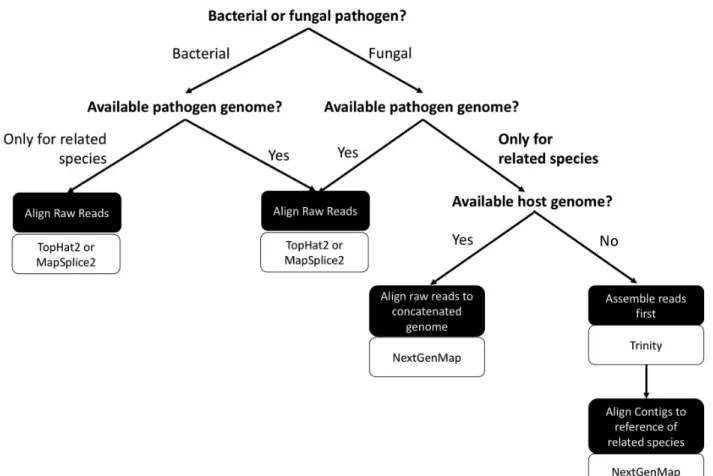
From our results, we propose a workflow that should be followed to determine the best approaches to extending the use of dual RNA-seq to a wider array of systems, including non-model systems (specifically, eukaryotic host–fungal pathogen systems) in which
genomic resources are available for the species closely related to the pathogen of interest (Figure 2.5).
• If a host genome is available, concatenating the genome of the host with the genome of species closely related to the pathogen of interest (place-to-go approach) results in more accurate alignments, in which host read mismapping is substantially reduced, with the aligners, STAR and NextGenMap.
• If a host genome is not available, assembling reads de novo, prior to aligning
with NextGenMap and STAR decreased host read mismapping while
retaining the ability to map pathogen reads. As expected, de novo assemblies do exclude some reads, which would consequently not be quantified. The reads excluded, however, were rare and a subset of them was low-complexity sequences (Figure A2.2).
26
pathogen reads affects dual RNA-seq studies. The methods we used here allowed us to assess the accuracy of alignment approaches of dual RNA-seq in non-model systems through simulated sequencing, but the biological truth of the origin of transcripts in real dual
Table 2.1: Results of Sequential Approach. Host mismapping rates (proportion of reads that mapped to pathogen genome or that of a closely-related species that originated from host) are shown for raw read approach in which sequencing reads were mapped without any prior steps and sequential approach, in which reads that did not map to an initial alignment to host genome were mapped. Results are shown for each factorial combination of reference species and the proportion of pathogen reads in the simulated dataset. Cells color indicates magnitude of host read mismapping rate: dark orange (>50% of total mapped reads are from host), intermediate orange (10-50%), light orange (<10%). When using NextGenMap, there are slight decreases when reads are first filtered by mapping to host genome first, but there is still a substantial amount of host mismapping with both methods. When using STAR, there is no effect of first filtering datasets by mapping to host genome first on host read mismapping.
30
Figure 2.3: Concatenated genome mapping (Place-to-go approach) improve dual RNA-seq analysis. Results are shown for aligners STAR and NextGenMap and four composite genomes comprised of the Arabidopsis thaliana (host) genome and each of
four Schizosaccharomyces reference genomes. (a) Bars indicate the proportion of pathogen reads that mapped to the part of the composite genome originating from the genome of the pathogen or closely related species to pathogen. Alignments to target genome of the pathogen species of interest are shown in black, and greyscale gradient indicates evolutionary distance from target. STAR is able to map almost all pathogen reads to target genome, and 27.7% of pathogen reads to the composite genome with genome of the most closely related genome to the target.
32
34
36
CHAPTER 3: HIGHER-ORDER INTERACTIONS BETWEEN PARASITES AND A SYSTEMIC GRASS ENDOPHYTE AFFECT PARASITE GROWTH AND HOST
MORTALITY
Introduction
Multicellular organisms are host to a diversity of microbes, and these microbes—whether they be bacteria, fungi, or viruses—can range in their relationship with their hosts, from parasitic to mutualistic. While these terms are rooted in the interaction between a given microbe and its host, microbes within a shared host can also interact with each other (O’Keeffe et al., 2017). Microbes may interact directly, via chemical secretion or physical interaction, or indirectly, mainly via host resources or the host’s immune system (Tollenaere, Susi, & Laine, 2016). These interactions between coinfecting microbes can range from antagonistic to synergistic. As the ubiquity of multiple infection has been realized, the interactions among coinfecting microbes and the effects of those interactions on each microbe, as well as the shared host, have gained a lot of attention (Larimer et al. 2010, Morris et al. 2010, Bordes and Morand 2011). Here, we focus on higher-order interactions, indirect interactions among species requiring an intermediary species in order to arise (Wootton, 1994); specifically, we consider the interactions among two
coinfecting parasites and a hypothesized mutualist within a shared host.
sequence of coinfecting parasites on a host can determine the direction and magnitude of these effects of these interactions within hosts (Adame-Álvarez, Mendiola-Soto, & Heil, 2014; Hood, 2003; Lohr, Yin, & Wolinska, 2010; Pathirana, Meegaskumbura, & Rajakaruna, 2019). These interactions within host individuals can impact population-level processes, as parasite
coinfections have major consequences for the spread of parasites in a population and epidemic dynamics (Halliday, Umbanhowar, et al., 2017; Telfer et al., 2010).
While interactions among parasites are increasingly studied in disease ecology, we have a more limited understanding of interactions of parasites with microbial mutualists (Hacquard and Schadt 2015, Johnson et al. 2015b). Microbial mutualists are ubiquitous among multicellular organisms and can confer a number of benefits to their hosts, including decreasing parasite infectivity (Haine, 2008). Microbial mutualists can limit parasite colonization and growth by altering nutrient availability or competing for metabolites within a shared host (Gerardo & Parker, 2014). They can also prime a host’s immune system, which can facilitate a rapid response to invading parasites (Belkaid & Hand, 2014). Some microbial mutualists can affect parasite success more directly as well, by producing antimicrobial compounds that can reduce parasite growth and consequent disease severity (Clay 1990, Panaccione et al. 2014).
38
by other co-infecting symbionts. For example, microbial mutualists can affect available host resources (Bronstein, 2001), which may modify the interaction between coinfecting parasite species that rely on these host resources (Wootton, 1994). Microbial mutualists could also be considered a shared enemy of coinfecting parasites, resulting in dynamics analogous to enemy-mediated apparent competition (Chaneton & Bonsall, 2000).
While the direct and indirect interactions that occur among species can shape ecological
communities, empirical evidence of these interactions within microbial communities is limited.
The detection of higher-order interactions can be difficult in ecological experiments because
responses may contain both direct and indirect effects. Such approaches are further complicated
in the context of microbial communities, in which the species can be difficult to detect and
isolate. Here, we used a series of controlled inoculation experiments to disentangle higher-order
interactions that act among fungal symbionts of a plant host. Specifically, we evaluated the
interactions among a microbial mutualist and two coinfecting parasites of grass host, tall fescue.
Methods
Study System
We investigated the interactions among three fungal symbionts of tall fescue (Lolium arundinaceum): two parasites, Colletotrichum cereale and Rhizoctonia solani, and an endophyte,
Epichloë coenophiala. C. cereale causes anthracnose in cool-season grasses. It is an obligate
Biotrophs often facilitate necrotrophs via immune-mediated crosstalk, and necrotrophs inhibit biotrophs via competition for host resources (Glazebrook, 2005). Given the
hemibiotrophic feeding strategy of C. cereale, we would expect C. cereale in its initial biotrophic phase to facilitate R. solani, and for that to change when C. cereale shifts to its necrotrophic phase. Investigations of these hypothesized interactions in a field population of tall fescue showed C. cereale to consistently inhibit the growth of R. solani (Halliday, Umbanhowar, et al., 2017).
E. coenophiala is a vertically transmitted systemic fungal endophyte that is considered a
mutualist under most ecological conditions (Kari Saikkonen, Young, Helander, & Schardl, 2016). E. coenophiala can increase its host’s tolerance of and recovery from drought
(Malinowski & Belesky, 2000) and produces bioactive alkaloids that can protect plants against herbivores (K. Saikkonen, Helander, Faeth, Schulthess, & Wilson, 1999). In the context of infectious diseases, E. coenophiala can facilitate or suppress infection by fungal parasites via production of toxins and changes in host immunity, depending on parasite feeding strategy (Potter 1980, 1982; Liu et al. 2006; Saikkonen et al. 2013). The salicylic acid pathway mediates plant defense against biotrophic parasites, and because endophytes like E. coenophiala may be derived from biotrophic parasites, E. coenophiala can induce or modulate this immune
response (Kari Saikkonen, Gundel, & Helander, 2013). Because the salicylic acid pathway may suppress the jasmonic acid pathway, which mediates plant defense against necrotrophic
40
with E. coenophiala inhibited C. cereale but had no effect on R. solani within a host. Given that the direction and magnitude of the effect of the endophyte exerted on each parasite can vary, we hypothesized that the endophyte could alter within-host interactions between these coinfecting parasites. Specifically, because E. coenophiala inhibits C. cereale, we hypothesized that the magnitude of any facilitation or inhibition of R. solani by C. cereale would be lower when E. coenophiala was present.
Experimental Approach
We investigated the effects of within-host microbial interactions on the disease severity caused by a fungal parasite by conducting a series of three inoculation experiments. For each experiment, we used plants that were propagated from seed in a greenhouse. For Experiment 1 and 2, plants were grown in 993 mL pots (Deepots, D60), and for Experiment 3, plants were grown in 656 mL pots (Deepots, D40). In all experiments, plants were grown in MetroMix 360 potting mix (Sun Gro Horticulture, Agawam, MA, USA). The greenhouse temperature was kept between 19.7-22.2ºC and light was supplemented between 9am and 7pm if natural light fell below 350 W/m2. Plants were relocated from the greenhouse to growth chambers (Percival PGC-6L; Perry, Iowa) 6 weeks after germination and given two days to acclimate. The plants were watered from the bottom of the pot during the course of the experiments. The experiments were conducted in two growth chambers with a 12-hour dark/12-hour light schedule and kept at 29°C.
Each experiment involved varying combinations of inoculations with endophyte, R. solani and/or C. cereale. We used endophyte-inoculated and endophyte-free seed of cultivar
KY-31, provided by Dr. Tim Phillips at the University of Kentucky.
Inoculations with R. solani involved placing a 0.6 cm PDA plug covered with actively-growing mycelia at the base of the oldest leaf of a random tiller of a plant. Successful infection of R. solani requires that the inoculation site be humid. To keep the inoculation site humid, we covered the PDA plug on the leaf with a piece of cotton wet with sterile water, and wrapped the base of the leaf with tin foil, which was then wrapped in parafilm. The plug, cotton, foil and parafilm were removed after two days. The R. solani strains used in these experiments was isolated from tall fescue in Duke Forest Research and Teaching Laboratory in summer 2015.
Inoculations with C. cereale occurred in one of two ways. In Experiment 2, we
inoculated with mycelia in the same way as described above for R. solani. In Experiment 3, we inoculated with C. cereale spores (as described in Beirn, Wang, Clarke, & Crouch, 2015). C. cereale was grown in culture on PDA plates under constant light for 10 days until the C. cereale
42
isolated from tall fescue in the Duke Forest Research and Teaching Laboratory in the fall of 2015 (Halliday, Heckman, Wilfahrt, & Mitchell, 2019).
Within each experiment, we also included mock-inoculated controls. When the
experiment involved inoculations with PDA plugs, mock-inoculated plants were treated in the same way with sterile PDA plugs. When the experiment involved inoculation with spore suspension of 10% PDB, mock-inoculated plants were sprayed with sterile 10% PDB.
Following all experiments, plants were harvested. For experiments in which endophyte was involved, one inch-long cross-section from each of two tillers per plant were collected and frozen. The cross-sections were used to confirm the presence of the endophyte in aboveground tissue with an immunoblot assay (Agrinostics Ltd. Co, Watkinsville, GA, USA). Aboveground biomass was harvested, dried, and weighed.
Inoculation experiments Experiment 1
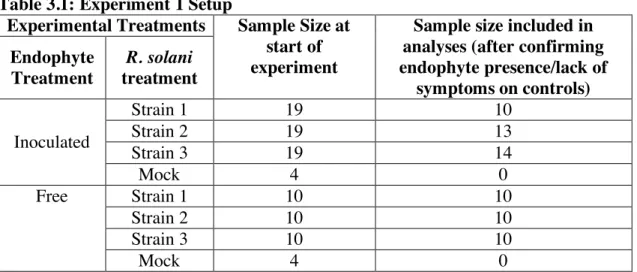
To test if and how the systemic endophyte, E. coenophiala, affects the within-host growth of R. solani, we conducted an inoculation experiment in which we factorially manipulated
mock inoculation instead of inoculation with either parasite (Table 3.1). Following inoculations, the presence/absence of disease symptoms, size of lesions, and survival of leaves were observed and measured.
Of the 57 plants inoculated from seed with the endophyte, 37 plants (64.9%) were successfully infected with the endophyte in aboveground tissue, as detected with an immunoblot assay. The 21 plants in which the endophyte was inoculated but not detected in aboveground tissue were excluded from analyses. Eight mock-inoculated control plants (4 endophyte-free and 4 endophyte-inoculated) did not exhibit symptoms of either parasite, and so were excluded from analyses. These exclusions left 30 endophyte-free plants and 37 endophyte-infected plants in our analyses (Table 3.1).
Table 3.1: Experiment 1 Setup
Experimental Treatments Sample Size at start of experiment
Sample size included in analyses (after confirming endophyte presence/lack of
symptoms on controls) Endophyte
Treatment
R. solani treatment
Inoculated
Strain 1 19 10
Strain 2 19 13
Strain 3 19 14
Mock 4 0
Free Strain 1 10 10
Strain 2 10 10
Strain 3 10 10
Mock 4 0
Experiment 2
44
sequential inoculation in which R. solani was inoculated first. Inoculation of C. cereale was performed with mycelia on PDA plugs as described above. Specifically, 10 plants each were randomly assigned into one of six inoculation treatments (60 plants total): 1. C. cereale alone, 2. R. solani alone, 3. Simultaneous inoculation of C. cereale and R. solani, 4. Sequential
co-inoculation: C. cereale first, then R. solani, 5. Sequential co-co-inoculation: R. solani first, then C. cereale, 6. Mock-inoculated control (Table 3.2).
For the sequential inoculations, the second inoculation occurred when symptoms of the first parasite appeared on all leaves in the relevant treatment. It took 10 days for Colletotrichum symptoms to be observed on all inoculated leaves and 2 days for Rhizoctonia symptoms to be observed on all inoculated. Two leaves per plant were inoculated according to the assigned treatment. Following inoculations, symptoms of R. solani were measured as lesion length for 2 weeks.
Ten mock-inoculated control plants did not exhibit symptoms of either C. cereale or R. solani, so were excluded from analyses. The sequential inoculation treatment in which R. solani
Table 3.2: Experiment 2 Setup
Experimental Treatment Sample Size
Sample Size Included in Analyses (unless
otherwise noted)
C. cereale alone 10 10
R. solani alone 10 10
Simultaneous co-inoculation 10 10
Sequential co-inoculation:
R. solani first 10 10
Sequential co-inoculation:
C. cereale first 10 10
Mock-inoculated Control 10 0
Experiment 3
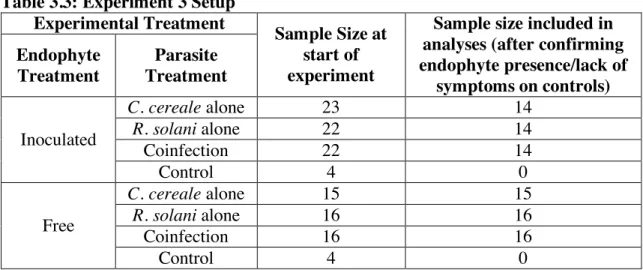
To test if and how a systemic endophyte will shift competitive outcomes of two coinfecting parasites, we conducted an inoculation experiment in which we factorially manipulated inoculation with E. coenophiala, C. cereale, and R. solani. In the coinfection treatment, both parasites were inoculated simultaneously because as further discussed below, in Experiment 2, C. cereale had the most impact on R. solani within-host growth when the
parasites were inoculated simultaneously. Inoculum of C. cereale was in the form of a spore suspension, as discussed above. This experiment involved 122 plants that were divided among 8 treatments that represented a factorial combination between endophyte inoculation (2 levels: endophyte-inoculated and endophyte-free) and parasite inoculation treatment (C. cereale alone, R. solani alone, co-inoculation of both parasites, mock-inoculated control) (Table 3.3).
46
Of the 67 plants in the experimental treatments that were inoculated from seed with the endophyte, 44 (65.6%) were confirmed to have endophyte in aboveground tissue. We excluded from analyses the 23 plants that had been grown from endophyte-inoculated seed but in which endophyte was undetected. Eight control plants (4 endophyte-free and 4 endophyte-inoculated) that received a mock inoculation instead of inoculation with either parasite did not exhibit symptoms of either parasite, and so were excluded from analyses. These exclusions left 47 endophyte-free plants and 44 endophyte-infected plants (split evenly among parasite inoculation treatments) in our analyses (Table 3.3).
Table 3.3: Experiment 3 Setup Experimental Treatment
Sample Size at start of experiment
Sample size included in analyses (after confirming endophyte presence/lack of
symptoms on controls) Endophyte
Treatment
Parasite Treatment
Inoculated
C. cereale alone 23 14
R. solani alone 22 14
Coinfection 22 14
Control 4 0
Free
C. cereale alone 15 15
R. solani alone 16 16
Coinfection 16 16
Control 4 0
Data Analysis