UNIVERSITY FACTORS THAT AFFECT COLLEGIATE FOOTBALL RECRUITING
Charles L. Herzog
A thesis submitted to the faculty at the University of North Carolina at Chapel Hill in partial fulfillment of the requirements for the degree of Masters of Arts in the Department of Exercise and
Sport Science (Sport Administration).
Chapel Hill 2016
iii ABSTRACT
Charles L. Herzog: University Factors that Affect Collegiate Football Recruiting (Under the direction of Nels Popp)
In the world of college athletics, recruiting is the lifeblood of any program. Prior research has firmly established better recruiting can mean more success on the field (Caro, 2012; Herda et al., 2009; Langelett, 2003). Team success, particularly in the revenue sports of football and men’s basketball, can lead to greater donations (Goff, 2000; Rhoads & Gerking, 2000; Tucker, 2004) and national notoriety (Caro, 2012) for a university and its athletics program. As such, the recruitment of elite high school football players is not only followed and scrutinized by rabid fan bases, but can have a major impact on entire athletic departments. Several researchers have examined the reasons why college sports recruits choose to attend particular institutions (Doyle & Gaeth, 1990; Huffman, 2011; Massey, 2013). The results of these studies have revealed a variety of factors influencing the college selection process for student-athletes, such as head coach, school location, level of competition, potential playing opportunities, and desired academic program (Gabert, Hale, & Montalvo, 1999). In addition to academic research on the topic, numerous college athletics administrators and coaches, media members, and even fans have made assumptions regarding what factors influence the college selection process of high school recruits. Several of them have publicly suggested things like winning, academics, successful recruiting, and professional alumni are persuasive to recruited student-athletes
iv
have apparel contracts with particular companies, or produce more National Football League (NFL) players will land better recruits, little empirical evidence exists to support such claims.
Much of the prior academic research on the college selection process of student-athletes has adopted an approach of surveying current student-athletes in order to ascertain which factors were personally most salient to them. Such methodology is susceptible to social desirability bias (Winrow, Reitmaier-Koehler, & Winrow, 2015); a theory suggesting subjects will give
researchers desired or politically correct responses. The purpose of the current study is to examine factors impacting the college selection process of student-athletes by developing a predictive regression model, using football recruiting rankings as the dependent variable, and university or athletic department related factors as the independent predictor variables. Such an approach will enable an empirical investigation into whether factors such as winning, athletic budget, and academic reputation have any relationship to the level of recruits enrolling at a particular university.
Specifically, the independent variables examined in this study included: (a) team performance, (b) university academic reputation, (c) prior recruiting success, (d) department budget, (e) apparel contracts, (f) alumni playing in the NFL, and (g) spectator attendance. Team performance was measured in several forms; previous season winning percentage, historical success measured as the lifetime win percentage of the program, and bowl game appearances and success. All team success data was collected from college football statistics websites. Academic reputation measures were derived from Forbes Magazine and The Center for College
v
below). It has been suggested overall athletic department budget positively impacts recruiting (Jessop, 2013). For the current study, budget figures were collected from the Equity in Athletics Database. Media accounts also suggest recruits can be influenced by the brand of apparel their program is contracted to provide (Sato, 2015). Apparel vendor contracts were obtained from the WinAD database and online news reports. NFL alumni are a very visible part of a program’s success and a team being viewed as a “pipeline to the pros” might influence a recruit’s decision, thus the number of alumni who play or have played in the NFL were collected from team and national media websites. Finally, attendance numbers were obtained from the NCAA’s statistical database.
vi
vii
ACKNOWLEDGEMENTS
First, I would like to thank my thesis committee for all the help and guidance they have given me in writing this thesis. A special thank you to Dr. Popp for being the source of
inspiration for this study and helping me every step of the way. My classmates, with whom I have spent two wonderful years, have been an enormous source of motivation to accomplish more than I have ever thought possible. Though we go our separate ways soon, know that you will always be a part of my life. I would like to thank my professors for teaching me the ins and outs of the college athletics universe. Lastly, I will be forever indebted to the Sport
viii
TABLE OF CONTENTS
LIST OF TABLES ... xi
CHAPTER 1: COLLEGE FOOTBALL RECRUITNING ... 1
Introduction ... 1
Statement of Purpose ... 2
Research Questions ... 2
Operational Definitions ... 2
Significance of Study... 3
CHAPTER 2: LITERATURE REVIEW ... 4
Recruiting and Team Success ... 4
Student-Athlete School Selection ... 6
Sport. ... 7
Other Key Variables. ... 9
Popular Beliefs about Recruiting ... 11
Winning. ... 11
Academics. ... 12
Successful Recruiting. ... 12
ix
Athletic Budget. ... 14
Other Factors. ... 14
CHAPTER 3: METHODOLOGY ... 16
Institution Factors ... 16
Recruiting Ranking ... 18
Data Analysis ... 18
CHAPTER 4: RESULTS ... 19
Descriptive Statistics ... 19
All Division-I FBS Programs... 19
“Power 5” and “Group of 5” schools. ... 21
Regression Analysis ... 23
All Division-I FBS Programs. ... 24
“Power 5” and “Group of 5” schools. ... 26
CHAPTER 5: SUMMARY AND DISCUSSION ... 28
All Division-I FBS Programs ... 28
Multicollinearity among factors. ... 29
“Power 5” and “Group of 5” schools ... 29
Conclusion ... 31
Future Research ... 32
x
xi
LIST OF TABLES
Table 1- Recruiting Service Scores ... 20
Table 2- Descriptive Statistics: All Division-I FBS Schools ... 20
Table 3- Categorical Variables ... 21
Table 4- Descriptive Statistics- "Power 5" Schools ... 22
Table 5- Descriptive Statistics- "Group of 5" Schools ... 23
Table 6- Rivals.com Model... 24
Table 7- 247Sports.com Model... 25
Table 8- Scout.com Model ... 25
Table 9- "Power 5" Model ... 26
Table 10- "Group of 5" Model ... 27
1
CHAPTER 1: COLLEGE FOOTBALL RECRUITNING
Introduction
Recruiting is the nexus of college football. Championships are won or lost, careers are made or ruined, and finances are black or red, depending upon the effectiveness of recruiting. Many parts make a team successful such as coaching, resources, and facilities, but those factors are not as potent without exceptional recruiting. There are many different philosophies about what works and what does not in recruiting. Many coaches would say it is more of an art than a science. That has not stopped researchers from trying to systematically discover exactly why a student-athlete chooses one school over another.
Much of the research on collegiate athletic recruiting has focused on the student-athlete perspective (Doyle & Gaeth, 1990; Gabert et al., 1999; Kraft & Dickerson, 1996; Letawsky, Schneider, Pedersen, & Palmer, 2003). That is, researchers have typically asked student-athletes why they chose to attend their school after they had already enrolled. Some of the most common responses given by student-athletes include academic reasons (Letawsky et al., 2003),
relationship with the head coach (Gabert et al., 1999), and career development (Huffman, 2011). These responses might display some measure of social-desirability bias. In other words, the student-athlete may have given an answer they thought the researcher wanted to hear or a politically correct response.
2
made in the high profile sport of college football about factors influencing school selection (Dienhart, 2003; Jessop, 2012; Sherman, 2012b), but no prior research has empirically or statistically examined the relationship between these factors and recruiting success. Some of the most discussed of these factors include school athletic tradition, academic reputation, playing time for the recruit, athletic facilities, and apparel contracts.
Statement of Purpose
The purpose of this study is to identify factors that affect the quality of a football recruiting class. Several sources predict level of recruit talent in college football
("247Sports.com," 2016; "ESPN.com Recruiting Nation- Football," 2016). However, no prior research has examined the relationship between quantifiable factors of NCAA Division I- FBS athletic departments and schools related to a national rankings football recruiting classes as determined from reputable college football recruiting services. Specifically, I seek to develop a statistical model to identify which factors affect the quality of a college football recruiting class. Research Questions
RQ1: What is the relationship between attributes of universities and athletic departments and the quality of a football team’s recruiting class?
RQ2: Are there statistically significant differences in the predictive ability of factors between student-athletes attending different levels of programs (“Power 5” and “Group of 5”)?
Operational Definitions
College football recruiting services- any organization that publishes yearly rankings of NCAA Division I FBS recruiting classes
3
Athletic department characteristics- the qualities of the institution’s athletic department as a whole (NCAA violations, apparel affiliation, and level of competition, and department budget) Institutional characteristics- factors of the institution as a whole (U.S. News and World Report ranking)
Team characteristics- factors of the football team (Win percentages, NFL alumni, previous recruiting class ranking, type of offense, and facilities)
Significance of Study
Much of the research on student-athlete recruiting focuses on self-identified factors among student-athletes. The responses collected in these studies may be tainted by social-desirability bias. The student-athletes may have given the researchers “preferred” or socially desirable answers during the study. This study will approach recruiting research from a predictive model utilizing secondary data to determine which quantifiable factors predict
4
CHAPTER 2: LITERATURE REVIEW
Recruiting and Team Success
College athletic departments are pouring enormous amounts of resources into recruiting (Caro, 2012). The traditional thinking is better recruits equal a greater chance of success (Herda et al., 2009). With the recent increase in coverage for collegiate football recruiting (Langelett, 2003), researchers have conducted studies to understand how much good recruiting is associated with on the field success (Caro, 2012; Herda et al., 2009; Langelett, 2003). Researchers have utilized various measures of success including: winning percentage, conference standings, end of season rankings, and revenue-generation (Bergman & Logan, 2014).
Many recruiting services rank football recruits using a system of stars from one to five (five stars being the highest). This ranking is determined by recruiting services based off players’ observed athletic ability and potential to have an impact in college (Bergman & Logan, 2014). Recruiting services generally rank a program’s class in two ways. Some take the total number of stars for the class divided by the number of recruits, while others have their own formula, which accounts for things like number of recruits, position need, and various other factors (Herda et al., 2009).
5
respectively. When the recruit is a two star, the number of wins is predicted to go down (-0.0103). Bergman and Logan hypothesized this may occur because a two-star recruit might displace a three, four, or five star recruit because of scholarship limits.
Conference standings have also been used as a measure of team success when measuring the impact of recruiting (Bergman & Logan, 2014). Since conference members play each other more than any other school and they tend to compete for the same recruits, the conference level is a good way to evaluate success among a program’s closest peers. Once again, higher rated recruits tend to increase the number of conference wins. Conferences are very different from one another, with different levels of success. Caro (2012) found between 63% and 80% of the
variance in the Big-12, SEC, and Big 10 team winning percentages within the conference could be attributed to recruiting success. There were no significant findings for the other three
conferences: ACC, Big East, and Pac 10. Caro (2012) hypothesized the Big-12, SEC, and Big 10 conferences showed significant impact from recruiting because those conferences had dominant teams and long histories of winning, while the other conferences lacked a traditional power or had more parity throughout the conference. Herda et al. (2009) examined the impact of recruiting on end-of-season rankings; he found recruiting ranking explained between 11% and 45% of the variance for the end of season rankings. In other words, the higher the ranking of a team’s recruits by the recruiting services, the higher that team’s end of season rankings.
6
chance to get to a BCS bowl game by .0428 (Bergman & Logan, 2014). A better chance to get to a BCS game would mean more money for the school. This increased likelihood of an
appearance in a BCS game means a five star recruit is worth about $150,000 to a school. These findings provided evidence a player’s recruiting ranking has value to the university.
Recruiting success may be tied bi-directionally with team success (Langelett, 2003). Teams that are successful in recruiting tend to be more successful on the field (Caro, 2012), and because they are more successful on the field, the college becomes more successful in recruiting. This leads to a negative-feedback loop which keeps the most successful programs at the top (Langelett, 2003). Other studies show similar trends. Herda et al. (2009) found a program’s end of season rankings were a good predictor of the quality of the next year’s recruiting class. The research shows not only do better recruiting classes increase the quality of play on the field, but also the indirect effects of success (student body graduation rates and university and athletic charitable contributions) are improved by a better recruiting class due to the increased success of the team (Caro, 2012). Having a successful football program has a positive impact on both the graduation rate and alumni-giving rate (Goff, 2000; Rhoads & Gerking, 2000; Tucker, 2004). A successful football program is thought to result in a more enjoyable college experience for the general student, thus “more students are unlikely to leave school, devote more time to studying and, therefore, the graduation rate rises” (Tucker, 2004, pp. 660-661).
Student-Athlete School Selection
7
question, with varying results. In one study conducted at a large university, all student-athletes rated (a) degree-program options, (b) head coach, (c) academic support services, (d) community, and (e) sports traditions as the top five factors that influenced their college decision (Letawsky et al., 2003). These findings contrast the “big-time college athletics” logic, as two of the top three factors were related to academics and only two of the top five were related to athletics. Another study saw (a) college head coach, (b) location of school, (c) opportunity to play, (d) degree programs, and (e) academic support services as the top five most influential factors (Gabert et al., 1999). As can be seen from these two large studies, the motivations for attending certain
colleges can vary widely depending on a number of factors, such as sport, gender, and level of competition.
Sport.
College sports vary in popularity, accessibility, and professional prospects. These variations may influence why student-athletes choose to compete collegiately in a particular sport. For example, relatively few NCAA Division I athletic departments sponsor ice hockey teams. In college hockey, the most influential factors affecting student-athletes’ decision to attend had to do with playing time and player development (Schneider & Messenger, 2012). This might indicate that due to the lack of opportunities, collegiate ice hockey programs are
concentrated with the very best talent, and that talent wants to play immediately and
8
can turn professional immediately out of high school. Essentially, college baseball coaches are not only recruiting against other schools, they are also recruiting against professional baseball for the top talent. It should not come as too much of a surprise that scholarships would be a highly ranked factor among baseball players (Doyle & Gaeth, 1990; Harmon, 2009). College baseball programs are limited to 11.7 scholarships and can have no more than 27 on scholarship (NCAA, 2015). This means a college baseball student-athlete could receive anything from a twenty-five percent scholarship to a complete scholarship. This might be a deciding factor when a recruit needs to choose between two schools or playing professionally.
Basketball and football are revenue-producing sports. These sports tend to make money for the athletic department, especially at the higher levels of competition. College basketball programs need to be successful in order to keep the revenue production going. Recruiting is an important part of attaining that success (Treme, Burrus, & Sherrick, 2011). Men’s basketball recruits identified coaches’ commitment to the program, player-coach relations, team’s style of play, scholarship money, and assistant coaches as the most influential factors when choosing a school (Cooper, 1996). In another study, the personality and philosophy of the head coach, a focus on player development, academic reputation, and fan support were all identified as very important factors in college selection (Glasby, 2014).
9
opportunity to win a conference championship, (d) reputation of the head coach, and (e) opportunity to play in a bowl game as the most influential factors in college choice among football players (Huffman, 2011). These results would seem to indicate student-athletes,
competing on the highest level of collegiate football, put stock in the athletic aspects of college, while still understanding their primary focus in college is to get an education. Another study, conducted at a Division II school, identified the program’s and university’s family atmosphere as the most influential factor, with academic programs, success, and location as secondary factors (Mirocke, 2012). Student-athletes that commit to play at Division II schools tend not to become professional players (Kacsmar, 2013), so they recognize the importance of feeling a part of their university and getting a good education.
Other Key Variables.
Males and females have much in common in regards to influential factors in deciding where to attend college. In a study by Gabert, Hale, and Montalvo (1999), male and female college athletes had very similar influential factors with both having head coach, degree
programs, location of school, and chance to play in their top five influential factors. Amount of financial aid was also an influential factor for both males and females (Doyle & Gaeth, 1990). The differences become evident when examining post-college objectives of males and females. Men have more opportunities to play their sport professionally, and thus are often focused on improving as much as possible. Women recognize the need for a good education, so they can excel after college (Davis, 2006).
10
funding also varies by level. Division I institutions are allowed to give student-athletes complete athletic scholarships; Division II is also allowed to give athletic scholarships, but fewer than Division I institutions. Division III institutions are not allowed to give any kind of athletic financial aid. Division I athletes ranked academic support services as their top influence, but of the next five factors, four of them are athletics related (head coach, chance to play, sports
tradition, and athletic facilities). In Division II, location of the school is the most important factor and only two of the top six factors are related to athletic participation. NAIA, a collegiate athletic association different from the NCAA, showed similar results, with only “two of the top seven factors related to athletic participation” (Gabert et al., 1999).
11
has the greatest influence on self-reported conduct (Randall & Fernandes, 1991). Student-athletes may be most similar to highly identified sports fans, conditioned by the idea that the primary reason for attending college is to get an education. Any other reason to attend a university, besides the noble pursuit of knowledge, could be interpreted as selfish or not politically correct. Thus, the student-athlete is very likely to display a social desirability bias towards their real reasons for attending college.
Popular Beliefs about Recruiting
In order to determine empirically what factors predict where a recruit will attend college, we first must examine some of the generally held beliefs about what influences a recruit’s decision. In the realm of recruiting, conventional wisdom dictates winning is the number one factor affecting a recruit’s choice of school. This perception is intensified by the media coverage surrounding college football recruiting. Winning is a zero sum game, meaning not every school can have a winning record, yet some schools do well in recruiting without winning and others win without being ranked highly in recruiting (Pettigrew, 2015). Therefore, other factors must contribute to a recruit’s choice in colleges. The following section outlines some of the popular beliefs surrounding recruiting, as held by coaches, administrators, student-athletes, and the media.
Winning.
12
has supported this idea (Caro, 2012; Dumond, Lynch, & Platania, 2008; Herda et al., 2009; Langelett, 2003). In Dumond, Lynch, & Platania (2008), schools with higher winning percentages and better rankings were more likely to attract recruits. Interestingly, winning a National Championship was not found to increase the likelihood of signing a recruit.
Academics.
Recruits frequently list academics as a major deciding factor for where they will attend school (Gabert et al., 1999; Letawsky et al., 2003). Many recruits, especially those not
considered elite, place special emphasis on the academics of a school. They know their chances of playing professionally are slim and they need to complete their degree to obtain an attractive career. Some recruits eliminate schools from consideration if their preferred major is not offered at the university (Wagner, 2015). Many recruits see athletics as the way to open the door to academic schools they may not have been able to attend otherwise. In 2012, a survey conducted at “The Opening,” an event for elite level football recruits, revealed that when asked to rank academics, football tradition, and facilities, 94% of respondents ranked academics first
(Sherman, 2012b). A university’s graduation rate, however, has been shown to have no effect on signing a recruit (Dumond et al., 2008), even though recruits frequently indicate education as an important factor in the college selection process (Gabert et al., 1999; Letawsky et al., 2003).
Successful Recruiting.
13 Facilities.
The quality of a program’s athletic facilities is another area often cited as an influential factor in a recruit’s college selection decision. Mississippi State’s athletic director, Scott Strickland, believes the athletic facilities of a university send a message to prospective student-athletes by demonstrating what is important to the university. Mark Stoops, the head football coach at Kentucky, believes cutting-edge facilities can help coaches recruit, but because the upper level programs have all leveled off in facility quality, the determining factor of the
facilities is more for players that are between levels. The head coach of Southern Miss echoes the idea of Coach Stoops. He believes facilities only matter when they are not impressive. Facilities are thought to have a larger impact on programs that are not considered elite programs (Jackson, 2013). After upgrading their facilities, University of South Dakota’s deputy athletic director has noticed a distinctive change in, not only the recruits, but also the coaches and student-athletes (Holsen, 2015). Gary Anderson, the head coach of Wisconsin, has an opposing view. He
downplays the glitz and glamour of his facilities, saying, “If you have nice facilities that may be all you have. Having a nice house and a nice car doesn’t mean you have a nice family” (Jackson, 2013). This was a similar philosophy shared by Jimmie Johnson when he was head coach at the University of Miami. In the 1980s, the school had some of the worst facilities in the country, yet he continued to recruit at a high level for other reasons (Dienhart, 2003).
14 Athletic Budget.
Universities are non-profit organizations, and many of them have enormous budgets. Conventional wisdom states the more money an athletic department has, the more money it can reinvest into its programs and help them succeed. More resources enable coaches to do more to attract better recruits, such as increasing their recruiting budget so they can cast a wider net for recruits (Trujillo, 2008), or upgrade facilities to attract a higher caliber of prospect (Landon, 2003). After all, schools that spend more on recruiting and operations are more likely to be ranked in national polls (Jessop, 2013), and being ranked is a significant factor in decision making for recruits (Dumond et al., 2008).
Money, by itself, does not lead to more successful recruiting. The right people need to be making the decisions to use that money in the most effective way. The University of Tennessee has the largest recruiting budget in the nation, but they lack the quality recruiting classes and wins on the field to show for it (Brady, 2015).
Other Factors.
Some of the most influential factors of college programs are the ones most fans do not notice or consider. One seemingly significant trend recruits say influence their decision is the apparel affiliation of the school. “Many recruits admit that the apparel they stand to receive as future college athletes can play a factor in deciding which school to attend” (Sato, 2015). A study conducted by FieldLevel, reveals Nike is by far the most preferred apparel brand by college recruits.
15
Some recruits are awed by famous and successful professional players that come from the school and want to follow in their footsteps (Anderson, 2002). Dumond et al. (2008) proposed that a recruit might choose a school based on the opportunity to improve his chances of pursuing a career in the NFL. Dumond went on to hypothesize that an institution’s ability to prepare a student-athlete for a career in the NFL can be indicated by the number of alumni sent to the NFL. Dumond’s findings did not back up this idea. Research showed the number of players taken in the NFL draft is not a significant determining factor for recruits. This may point to the idea that “recruits are less concerned about the prior athletic or academic success of prior student-athletes at the school and are instead rationally concerned with only their own abilities” (p. 79).
Coaching philosophy and type of offense run can be a deciding factor for a potential recruit (Dienhart, 2003; Kirpalani, 2013). It does not make much sense for an option quarterback to attend a school that runs a pro-style offense.
Other factors that members of the media see as influential to recruits are ones that deal with winning or exposure for the student-athlete. Winning championships and playing on television are often considered great attributes for a program (Dienhart, 2003). However,
television’s power as a recruiting tool may be waning as more and more games are broadcast on TV or over the internet (L. Fedora, personal communication, March 25, 2015).
16
CHAPTER 3: METHODOLOGY
The majority of past research on college athletics recruiting has centered on the student-athlete’s perspective; what they felt was important to them. The current research will focus on the institution and the measurable factors that have an effect on the quality of the program’s recruiting class. Specifically, the current study will examine the relationship between 17 independent variables on the outcome variable of recruiting class ranking. Multiple regression analysis will be employed to assess the amount of variance within recruiting class rankings attributable to each of the independent variables.
The subjects of this research will be all schools in the Division I Football Bowl Subdivision, a population of 127 schools.
Institution Factors
Based on the literature review, the variables examined in this study were selected based on the frequency with which they were listed as reasons why the student-athlete attended the university. All of the factors included in the study are quantifiable and could readily be found for all 127 institutions for the past four years. The factors are listed, along with their definitions, in Table 11. The identified factors can be separated into three basic categories: athletic department characteristics, institution characteristics, and team characteristics. Athletic department
17
institutional characteristic. Team characteristics are factors of the football team, such as winning percentage and recent recruiting class score.
Studies utilizing multiple regression are constrained by two important principles: multicollinearity and overfitting. Multicollinearity is “when two or more of the explanatory variables in a multiple regression analysis are very strongly correlated” (Nicholson, 2014). Certain factors of the institution would be directly impacted by other factors. For example, the size of an institution’s football recruiting budget is dependent upon that institution’s total athletic budget, thus recruiting budget was eliminated as a factor in the multiple regression.
Data was also a limiting factor in how many independent variables could be included. The data set was comprised of the previous three years of recruiting classes. With 127 FBS schools, 353 data points were collected. Based on the number of data points, the number of independent variables that could be tested was limited in order to avoid overfitting. Overfitting can occur in multiple regressions when too much is asked of the data (Babyak, 2004).
Essentially, “if you put enough predictors in a model, you are very likely to get something that looks important regardless of whether there is anything important going on in the population” (p. 415). Due to the issues of multicollinearity and overfitting, the list of independent variables was pared down to 17.
18
junior or senior year (Sander, 2008), therefore the recruits are most likely influenced during those two years.
Recruiting Ranking
In the first research question, the dependent variable was the scores of each institution from each of the three of the most widely accepted recruiting services: Rivals.com, Scout.com, and 247Sports.com. Each service uses its own formula to rank the teams. Rivals.com uses a formula based on the rating each recruit receives along with a bonus for each recruit ranked in their “Rivals250,” the top 250 football recruits in the country ("Rivals.com Football Team Recruiting Rankings Formula," 2013). Scout.com uses “a math formula that based on a player's rating and his rankings” to calculate the team ranking ("Scout.com: About Team Rankings," 2015). 247Sports.com uses a proprietary formula that weights rankings and rating from multiple media outlets to determine the recruiting class team ranking ("247Sports Rating Explanation," 2012). These three services are among the most widely cited in the football-recruiting world and provided a good indication of the quality of the school’s recruiting class. Each score was run in a separate regression model and the models were evaluated for consistent factors.
To answer the second research question, the dependent variable in the multiple
regressions was the institution’s average ranking amongst the three major recruiting services. In order to ensure a valid average, each score from the three recruiting services was converted into a T-score, and the T-scores of each recruiting service were averaged.
Data Analysis
19
CHAPTER 4: RESULTS
This studied utilized three years of data on measurable factors of Division-I universities. Starting with the recruiting class of February 2013 and concluding with the recruiting class of February 2015, data was collected on each institution for the previous two football seasons and the two values were averaged. In doing so, the data would reflect the institution from when the recruits would be most closely examining where they might want to continue their football career.
All of the information was collected through online sources and databases. In order to make data consistent across all recruiting services and schools, some statistical functions were used. For example, the three recruiting services use different scales to rate the recruiting class of each school. To ensure one score was not weighed more heavily when the scores were averaged, I normalized each score into a T-score. This put each score on the same scale with a high of 80, a low of 30, and a mean of 50.
Descriptive Statistics
All Division-I FBS Programs
The first question answered was which measureable factors of universities had an effect on recruiting. In answering this question, three popular recruiting sites were used for the
20
Table 1
Recruiting Service Scores
N Minimum Maximum Average σ
Rivals.com 353 30 3263 1300.12 628.05
247Sports.com 353 64.29 319.58 171.51 57.1 Scout.com 353 305 5222 1748.16 1153.66
σ- standard deviation
The independent factors for each of the three recruiting sites were all the same. They included measurable factors from all Division-I FBS schools from the 2011 football season through the 2014 football season. Schools were eliminated if they were not in the FBS all four seasons, or if more than one score was unavailable. In the end, 118 schools and 353 data points were used. Descriptions of each independent variable are located in the appendix in Table 11.
Table 2 lists the descriptive statistics for all of the non-categorical variables of all Division-I FBS Schools. The count of categorical variables is listed in Table 3.
Table 2
Descriptive Statistics: All Division-I FBS Schools
N Minimum Maximum Average σ
Recruiting Score* 353 37.46 76.89 50.03 9.23
Conference FPI* 353 -12.34 14.34 2.31 8.38
Winning Percentage* 353 0.0417 0.9643 0.5270 0.2039
Athletic Department
Expenses* 350 $8,845,434 $142,095,210 $55,396,352 $29,033,842 All-Time Win
Percentage* 353 0.2987 0.7841 0.5147 0.0970
All-Time Bowl Victories* 353 0 33.5 9.32 7.76
All Time- Bowl Win
Percentage* 353 0.0000 1.000 0.4680 0.1936
Forbes Academic Score* 344 22.90 91.09 49.58 15.74
Alumni on Active NFL
Rosters* 353 0 46.5 14.2 10.2
Average Attendance* 353 3987 112215.5 44199.28 25582.55
Run/Pass Play Selection* 353 -0.6901 0.5175 -0.0837 0.1530
Run/Pass Yards* 353 -0.5971 0.7964 0.1704 0.1924
Years Since Stadium
Expansion** 353 0 99 23.98 27.48
21
Table 3
Categorical Variables
Apparel Contract NCAA Infractions
Nike Adidas UA# N/A N/A Under Investigation NOA@ Under Penalty
Y-2* 221 85 33 15 294 7 10 43
Y-1** 218 85 37 14 302 4 11 37
*- two years prior to recruiting class, **- one year prior to recruiting class
#- Under Armor, @- Notice of Allegation
“Power 5” and “Group of 5” schools.
The second research question focused on the differences between “Power 5” schools, those schools belonging to the ACC, Big Ten, Big 12, Pac-12, and SEC conferences, and those in the Group of 5. Schools in the “Group of 5” belong to the American, C-USA, MAC, Mountain West, and Sun Belt conferences. For the purposes of my study, schools that did not belong to a conference, the so-called “Independents” were assigned to either the “Power 5” or “Group of 5” based on their traditional classification. Notre Dame and BYU were included in the “Power 5” group, while Navy was included in the “Group of 5.”
22
Table 4
Descriptive Statistics- "Power 5" Schools
N Minimum Maximum Average σ
Recruiting Score* 198 42.34 79.17 56.61 8.14
Previous 2 Years
Recruiting Score** 198 44.50 76.82 55.99 7.14
Conference FPI** 198 2.58 14.34 9.10 3.21
Years Winning
Percentage** 198 0.1250 0.9643 0.5752 0.1889
Athletic Department
Expenses** 198 $41,548,785 $142,095,210 $76,407,791 $19,887,773 All-Time Win
Percentage** 198 0.3908 0.7200 0.5544 0.0836
All Time- Bowl
Victories** 198 1.5 33.5 13.77 7.48
All Time- Bowl Win
Percentage** 198 0.1409 0.7738 0.4875 0.1037
Forbes Academic
Score** 198 29.83 91.09 57.07 13.39
Alumni on Active
NFL Rosters** 198 3.5 46.5 20.05 9.65
Average Attendance** 198 26281.5 112215.5 61400.4 21046.47 Run/Pass Play
Selection** 198 -0.6172 0.5175 -0.0916 0.1492
Run/Pass Yards** 198 -0.4148 0.7964 0.1671 0.1852
Stadium
Expansion*** 198 0 99 28.0 32.1
23
Table 5
Descriptive Statistics- "Group of 5" Schools
N Minimum Maximum Average σ
Recruiting Score* 155 34.43 51.79 41.62 3.53
Previous 2 Years Recruiting
Score** 155 36.43 59.01 42.45 3.85
Conference FPI** 155 -12.34 3.65 -6.37 3.47
Years Winning Percentage** 155 0.0417 0.8846 0.4654 0.2063 Athletic Department
Expenses** 152 $8,845,434 $67,229,780 $28,026,188 $9,965,512 All-Time Win Percentage** 155 0.2987 0.7841 0.4640 0.0892
All Time- Bowl Victories** 155 0 10 3.6 2.9
All Time- Bowl Win
Percentage** 155 0 1.0 0.4431 0.2660
Forbes Academic Score** 146 22.90 84.25 39.42 12.72
Alumni on Active NFL
Rosters** 155 0 19 6.72 4.08
Average Attendance** 155 3987 48512.5 22226.23 7932.38 Run/Pass Play Selection** 155 -0.6901 0.2194 -0.0737 0.1577
Run/Pass Yards** 155 -0.5971 0.5773 0.1745 0.2018
Stadium Expansion*** 155 0 75 18.85 19.0
σ- standard deviation, *-average across all three recruiting services, **-average of previous 2 year, ***-years since previous
Regression Analysis
24 All Division-I FBS Programs.
For RQ1, all three of the initial models included all 17 independent variables. Variables that did not improve the statistical significance of the model were eliminated, and each model was run again.
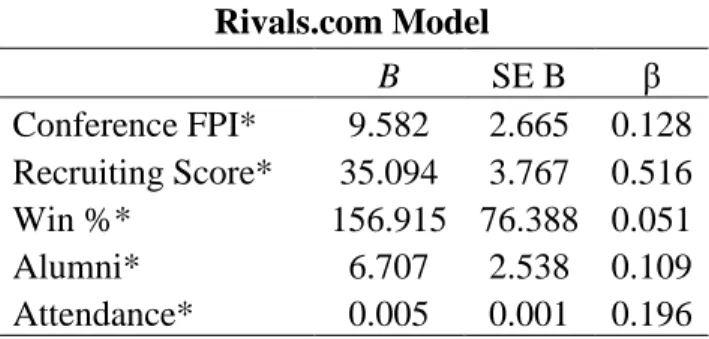
In the Rivals.com model, five variables were selected for the final model. The
combination of these five variables explained 84.2% of the variances. The p-value for this model was <0.0005. Of the independent variables in the model, five were statistically significant at the .05 level. They included Conference FPI, previous two years recruiting score, previous two years winning percentage, alumni in the NFL, and average attendance.
Table 6
Rivals.com Model
B SE B β
Conference FPI* 9.582 2.665 0.128 Recruiting Score* 35.094 3.767 0.516
Win %* 156.915 76.388 0.051
Alumni* 6.707 2.538 0.109
Attendance* 0.005 0.001 0.196 R2 =.842, Adjusted R2 = .840, F-Statistic = 370.538, and Sig. <.0005
*= p<.05
In the 247Sports.com model, four variables were selected for the final model. The
25
Table 7
247Sports.com Model
B SE B β
Conference FPI* 1.194 0.21 0.175 Recruiting Score* 3.464 0.263 0.56
Win %* 15.294 6.046 0.055
Attendance* 0.001 0 0.226
R2 =.880, Adjusted R2 = .878, F-Statistic = 635.772, and Sig. <.0005
*= p<.05
In the Scout.com model, five variables were selected for the final model. The
combination of these five variables explained 82.6% of the variances. The p-value for this model was <0.0005. Of the independent variables in the model, five were statistically significant at the .05 level. They included previous two years recruiting score, previous two years winning percentage, all-time bowl victories, average attendance, and years since the stadium had been expanded.
Table 8
Scout.com Model
B SE B β
Recruiting Score* 59.661 6.39 0.477
Win %* 340.815 144.989 0.06
Bowl Victories* 17.877 6.407 0.12 Attendance* 0.014 0.002 0.309 Stadium Exp.* 2.427 0.956 0.058 R2 =.826 Adjusted R2 = .823, F-Statistic = 328.768, and Sig. <.0005
*= p<.05
26
tolerance of less than 0.2 is an indicator the factor has significant multicollinearity.
Multicollinearity in a model indicates that two or more of the independent variables in the model are highly correlated.
“Power 5” and “Group of 5” schools.
To answer the second question of the differences in factors between “Power 5” and “Group of 5” schools that affect recruiting the three recruiting scores were converted to T-Scores and averaged, the data was split into respective groups, and a linear regression was run on each group.
In the “Power 5” model, five variables were selected for the final model. The
combination of these five variables explained 73.4% of the variances. The p-value for this model was <0.0005. Of the independent variables in the model, five were statistically significant at the .05 level. They included previous two years recruiting score, previous two years win percentage, all-time bowl victories, and average attendance.
Table 9
"Power 5" Model
B SE B β
Recruiting Score 0.497* 0.075 0.437
Win % 5.985* 1.966 0.139
Bowl Victories .172* 0.062 0.158
Attendance .000* 0 0.201
R2 =.734, Adjusted R2 = .727, F-Statistic = 105.862, and Sig. <.0005
*= p<.05
In the “Group of 5” model, four variables were selected for the final model. The
27
was <0.0005. Of the independent variables in the model, four were statistically significant at the .05 level. They included all-time win percentage, all-time bowl win percentage, and alumni in the NFL.
Table 10
"Group of 5" Model
B SE B β
All-Time Win % 12.188* 2.755 0.308 All-Time Bowl % 1.875* 0.813 0.141
Alumni 0.242* 0.061 0.279
R2 =.449, Adjusted R2 = .434, F-Statistic = 30.517, and Sig. <.0005
28
CHAPTER 5: SUMMARY AND DISCUSSION
All Division-I FBS Programs
In all three models run to determine the significance of measurable factors on the quality of the recruiting class, many of the same factors kept reappearing as significant. The previous two years recruiting score, the previous two years winning percentage, and the average attendance were all significant factors that had an effect on the quality of the recruiting class. This is consistent with the beliefs held with student-athletes, coaches, and the media: the belief that success breeds success. The success of great recruiting and the success of winning football games leads to the success of recruiting better student-athletes.
29
NFL Combine and college pro days are routinely covered by national sports and news outlets, further increasing the public’s awareness of the success of college programs sending their players to the NFL.
Scout.com had two additional factors that showed significance. Those factors, all-time bowl victories and years since stadium expansion, help to reinforce the idea that success on the national stage and the latest in facilities is important to recruits. Having one or both of these is likely to help a school increase the quality of their recruiting class.
Multicollinearity among factors.
As was mentioned in Chapter 4, the previous two years recruiting score and the average attendance in all three models was shown to have a significant amount of multicollinearity. The best example of this is the average attendance factor. It was significant for all three models looking at all Division-I FBS schools. This factor was shown to have a high level of
multicollinearity, most likely because success impacts average attendance as much as it does recruiting. Therefore, schools that are successful on the field, tend to be successful in recruiting and tend to have higher average attendance. A conclusion might be made that the average attendance does not affect recruiting, but is merely a byproduct of the team’s success. “Power 5” and “Group of 5” schools
30
Conversely, the “Group of 5” model shows vastly different factors have an effect on the quality of a school’s recruiting class. All-time win percentage and all-time bowl win percentage are shown to have a significant impact. This may be because the historical success of the school is a strong selling point to potential recruits. Another factor that has significance is the number of alumni in the NFL. The impact of this factor may have to do with the novelty of a player from a smaller “Group of 5” school making an NFL roster and having an impact on the team. For example, Ben Roethlisberger and Hall-of-Famer Marshall Faulk were both products of “Group of 5” schools and have had exceptional careers in the NFL. Looking at the descriptive statistics confirms the rarity a “Group of 5” player makes an NFL active roster as they averaged 6.7 alumni to the “Power 5’s” 20.
While the “Power 5” model was able to explain a large part of the variance (R2=0.734), the “Group of 5” model explain much less of the variance (R2=0.449). This suggests there is much more going on in recruiting at the “Group of 5” level than the factors that were tested. There may be a multitude of reasons for this. A coach’s ability to recruit may have more significance at the “Group of 5” because they are trying to attract talented student-athletes to come to less well-known or less successful schools. Coaching changes may also have an impact on recruiting in the “Group of 5” schools as many coaches view these schools as stepping stones to eventually coach at a “Power 5” school and the increased coaching turnover at “Group of 5” schools may impact recruiting.
student-31
athletes: the belief that a student-athlete’s primary focus is to play sports and not to receive an education. This belief supports the idea that social-desirability bias has an effect on how student-athletes respond to questions about their reasons for attending a certain college.
Furthermore, the apparel that the school provides seems to have little to no effect on the quality of a team’s recruiting class. Recruits, who are forbidden from signing contracts at the cost of their eligibility, do not seem to have any loyalty to a certain brand. They may prefer one brand’s look or feel over another, but it does not seem to affect where they choose to play college football. Knowing this will allow schools to chase lucrative apparel contracts without worrying about alienating recruits.
Lastly, one of the most surprising factors that did not affect recruiting was the amount of money spent by the athletic department. While a large budget alleviates many issues, it does not appear to help recruit better players. Effective recruiting is most likely tied to the quality of monetary expenditures as opposed to the quantity.
Conclusion
In tackling college recruiting, I hoped to test scientifically many of the anecdotal reasons put forth by student-athletes, coaches, and the media as to why college football recruits choose certain schools. This information might then be used to help athletic departments make decisions about where to allocate resources in order to improve their recruiting class, which would, in turn, lead to success on the field.
32
winning, the schools that were good at recruiting in the past tend to be good at recruiting in the future, and schools that win also tend to have higher average attendances and better recruiting classes. However, the most interesting information about this study was the insight into the validity of what stakeholders seem to think impacted recruiting.
Some of the most striking revelations were not necessarily what factors were shown to affect recruiting, but rather what factors were shown to not affect recruiting, despite the anecdotal evidence espoused by student-athletes, coaches, and the media. Academic quality of the institution, thought to be a deciding factor for student-athletes, was shown not to be a significant factor in any of the models. The same can be said for apparel affiliation, NCAA violations, athletic department expenses, and type of offense. Despite what is thought to be impactful on student-athlete college choice, none of these factors were shown to have an effect on the quality of a school’s recruiting class.
Future Research
33
Another widely cited factor for recruits is an athletic department’s facilities. Facilities are a hard factor to quantify. There is no universally accepted score or rating of athletic facilities like there is for recruiting class or academic quality. In addition, when evaluating facilities there are multiple factors that would need to be taken into account, such as renovation versus a new build, multi-use facilities versus football only facilities, and the number and location of these facilities. Since universities spend millions of dollars on facilities in the “arms race” of college athletics, knowing how much of an impact one facility had over another, or even if facilities have an impact at all would be valuable knowledge.
In my multiple regression models, I was limited to the number of factors that could be tested. There are many more measurable factors of universities. Not just of their athletic
34
APPENDIX 1: INDEPENDENT VARIABLES
Table 11
Independent Variables
Variable Definition
All-Time Bowl Victories The number of wins in a bowl game in the history of the program. This is an indicator of high-level success.
All-Time Bowl Win Percentage The number of wins in a bowl game divided by the number of bowl games played in the history of the program. This is an indicator of consistent high-level success.
Alumni in the NFL The number of former players that appeared on active NFL rosters. An indicator of the ability of players from the program to pursue a successful professional career.
Athletic Apparel Affiliation The contractual provider of athletic apparel for the institution’s athletic department
Athletic Expenses The total expenses of the institution for one academic year. A measure of the amount of resources an athletic department has to devote to the football program and recruiting.
Average Home Game Attendance The average number of fans that attended each home game during a season. This is an indicator of fan and community support for a team.
Conference Affiliation Which conference a team belongs to (ACC, American, Big 12, Big Ten, C-USA, Independent, MAC, Mountain West, Pac-12, SEC, or Sun Belt) Conference Football Power Index An average of the FPI for each of the teams in
their respective conference. A score of 0 would denote a team of average ability. This indicates the competitiveness of a conference.
Institution Score- Forbes Magazine The score of the institution in the Forbes
Magazine Annual America’s Top Colleges List. This score indicates the academic quality of the institution.
Level of Competition The conference in which the institution competes, either the “Power 5” or the “Group of 5.” The “Power-5” conferences are the ACC, BIG 10, BIG 12, PAC 12, and SEC. The “Group of 5”
conferences are the American Athletic
35
NCAA Violations Investigations, notices of allegations, and current and recent sanctions levied against the institution by the NCAA. Sanctions could mean an inability for a program to participate in the postseason, a reduction in scholarships, and probation, all factors that might hurt a program’s reputation and ability to recruit.
Recruiting Ranking The institution’s recruiting ranking from the previous year. A higher ranking would indicate that the team is stockpiling talent and thus would be more likely to be successful.
Run/Pass Play Selection The tendency of a team to call more running play or more passing plays. A number above zero indicates more passing plays, while a number below zero indicated more running plays. This indicates the type of offense a team runs.
Run/Pass Yardage The amount of yardage gained by either running or passing the ball. A number above zero indicates more passing yard, while a number below zero indicated more running yards. This indicates the explosiveness of an offense.
Stadium Expansion The time, in years, since the institution expanded the size of their stadium. This is a measure of the quality of the institution’s facilities.
Team Win Percentage- All-Time The number of wins divided by the total number of games played during the history of the program. This is an indicator of historic program success. Team Win Percentage- Previous Season The number of wins divided by the total number
36
REFERENCES
247Sports Rating Explanation. (2012). Retrieved from http://247sports.com/Article/247Rating-Explanation-81574
247Sports.com. (2016). Retrieved from http://www.247sports.com
Anderson, L. (2002). So You Wanna Play On Sunday? Sports Illustrated, 52. Babyak, M. A. (2004). What you see may not be what you get: A brief, nontechnical
introduction to overfitting in regression-type models. Psychosomatic medicine, 66(3), 411-421.
Bafaloukos, R. (2014). ASU Football: Why ASU keeps losing out on top local recruits. House of Sparky. Retrieved from HouseofSparky.com website:
http://www.houseofsparky.com/2014/12/19/7418941/asu-football-recruiting-arizona-kirk Bergman, S. A., & Logan, T. D. (2014). The Effect of Recruit Quality on College Football Team
Performance. Journal of Sports Economics. doi:10.1177/1527002514538266
Brady, E. K., John; Berkowitz, Steve. (2015). Schools in power conferences spending more on recruiting. USA Today. Retrieved from USAToday.com website:
http://www.usatoday.com/story/sports/ncaaf/recruiting/2015/02/03/college-football-recruiting-signing-day-sec-power-conferences/22813887/
Caro, C. (2012). College football success: The relationship between recruiting and winning. International Journal of Sports Science and Coaching, 7(1), 139-152. doi:10.1260/1747-9541.7.1.139
Cooper, K. (1996). What the basketball prospect wants to know about you]. Coach and Athletic Director, 65(7), 24.
Davis, G. R., Jr. (2006). Freshmen student-athletes: An examination of the decision-making process and satisfaction. (3207962 Ph.D.), Virginia Polytechnic Institute and State University, Ann Arbor. Retrieved from
http://libproxy.lib.unc.edu/login?url=http://search.proquest.com/docview/304968046?acc ountid=14244
Degnan, S. M. (2014, 12/18/2014). Brad Kaaya proving to be strong draw in UM’s football recruiting efforts. Miami Herald. Retrieved from
37
Doyle, C. A., & Gaeth, G. J. (1990). Assessing the institutional choice process of student-athletes. Research Quarterly for Exercise and Sport, 61(1), 85-92.
Dumond, J. M., Lynch, A. K., & Platania, J. (2008). An economic model of the college football recruiting process. Journal of Sports Economics, 9(1), 67-87.
doi:10.1177/1527002506298125
ESPN.com Recruiting Nation- Football. (2016). Retrieved from http://espn.go.com/college-sports/football/recruiting/index
Gabert, T. E., Hale, J. L., & Montalvo, G. P., Jr. (1999). Differences in College Choice Factors among Freshmen Student-Athletes. Journal of College Admission(164), 20.
Glasby, M. K., II. (2014). Factors Influencing the College/University Choice of High School boys' Basketball Players. (Dissertation/Thesis), ProQuest, UMI Dissertations Publishing. Retrieved from http://unc.summon.serialssolutions.com/2.0.0/link/0/eLvHCXMwnV1NS8NAEB3EkyhY 8bsqc_NUmna3SfckpDYoevBQBU9ls9kgGBJt48F_78xuggHpxWMIhCEJ77352DcAqK OcTfbsJEpDmxkzygknp0E6Vloo7Y5Gv8Ti8SGax3LRnODnsoD_tC0iOpjOKsMV8uEo HAdTKUgQ3Hx8DnhnFPdWmwUaBMCUaLks7LmrHdpUnRIu7hfRn9l4PLXX4g8AO 1ZJ9rvTH36cxPk2laYzZt3xa_x35D3Yve203Q9gy5aH8Jr4VTt43- wpIRJDkoPY1BKGvzMbOHurCFCwypHnQtBbd2Jafa-vMdbrd1unuijwqdCs4I_gKpkvZneDNtRlVhRLISlAYnpi9mPY0zxZX9buBF52CigsoQ CxVhiqiZRK02sjDRGxbU1gM6nO4GTD08433unDDgkP6UsZF7Bdr77sJZF7aX4ANA Ko_Q
Goff, B. (2000). Effects of University Athletics on the University: A Review and Extension of Empirical Assessment. Journal of Sport Management, 14(2), 85.
Harmon, B. (2009). Factors that effect collegiate baseball recruiting. (Dissertation/Thesis), ProQuest, UMI Dissertations Publishing Retrieved from
http://unc.summon.serialssolutions.com/2.0.0/link/0/eLvHCXMwnV1NS8NAEB1EQUR B68f6zf6BxDZNNtmTUG0Ram9VxEvZbDYohGhr-v- dmSQQkF48Lrns7oQ3OzNv5gFIE-c0ZM9FcapcZu0gR5xM-mmgzVAbbo1- HQ2fp_F4FM6bDn5KC9SmbRGRYTr7spQhvyMBatJc0-r-e- mRZhTVVhsBDQRgDLQ4Cnvpvh04VP-Dsew4JoddgkfNGOHRTKXtMKk7Ixn_vbkj2H_sVNZ7sOXKY5JkbugbJ4BgzMo6svow laxpHNJy2gCt4yS5s9QUhUQIXK0_iQ19CreT8fzhyWv3s8iKYhEojREnhwRncGCIIV9 W3EmXCdjJ8Xd2glyMwDsQsPump8nsPZjVy1679H- 43ctfVgI9Gp_Bi_zwHO2Kt5rkeegGyoSpCtLI6aSvbJziK8-E8QWIDfu53PjlCvbq-gwlNa5hu1qt3Q26-dL-AnwwqrM
38
Rankings and Jeff Sagarin End-of-Season Ratings in Collegiate Football. Journal of Quantitative Analysis in Sports, 5(4), 4-11. doi:10.2202/1559-0410.1200
Holsen, M. (2015). Two University Programs On The Rise. Retrieved from Keloland.com website: http://www.keloland.com/newsdetail.cfm/two-university-programs-on-the-rise/?id=182283
Huffman, L. T. (2011). A comparative analysis of the college-choice factors of NCAA football student-athletes at a southeastern university. (Dissertation/Thesis), ProQuest, UMI Dissertations Publishing. Retrieved from
http://unc.summon.serialssolutions.com/2.0.0/link/0/eLvHCXMwnV1dS8MwFA3ikyio- P0B-QN1-WybJ9nmhqD4NH0dSZrgQ2l16_7_btLWFcQXoS8hhNISTs69ufcchLDOfBDZczIzqSus pR5wMieGKc2Vjq3RHxP--pLNJmLRe5yOuh7thx4RI0wXtQ0Z8hHQepGHlpLHr- 8kWEaFq9XOPwPwF-KsGIS9D6lDjNT7caDxcHKxaBbEBJy7lLFO8qkfi194HA-Z- TFyu8xKW10SZZwqO6i6Hsg3_vdDTtDh0- AS_hTtueoMrcfY7oTAse60SnDtMVBEbNv8QgJgCciCO5eeMPs2HY-xr-vG6LLE61YqM4k1GsBisW6wxuvg0xdMgtyqwpufUpBztJjPFtPnpDNkSD6FpEDEiRcp 0aQgzHkGgV4qLWCEFTK3TFlplFM5hT0BQaGiVsMGoZ7lmjjvIO7iF- hIh_dVTezvK64QZlwZQYU1zqdCAnzQNJdG6wL2j-OEXKPL_j8ui7JcMp5xWAOs4ubPmVt00GZ-w3OH9pvVxt0DdajsFuI-xVk Jackson, D. (2013). Improving facilities builds recruiting, too. Rivals.com. Retrieved from
rivals.com website: https://footballrecruiting.rivals.com/content.asp?CID=1495950 Jessop, A. (2012). The Surprising Factors Driving College Football Recruits' College Decision.
Forbes. Retrieved from Forbes.com website:
http://www.forbes.com/sites/aliciajessop/2012/12/14/the-surprising-factors-driving-college-football-recruits-decision/ Retrieved from
Jessop, A. (2013). The Economics Of College Football: What The Top-25 Teams Spend On Recruiting. Forbes. Retrieved from Forbes.com website:
http://www.forbes.com/sites/aliciajessop/2013/08/31/the-economics-of-college-football-what-the-top-25-spend-on-recruiting/ Retrieved from
Kacsmar, S. (2013). Where Does NFL Talent Come From? Bleacher Report. Retrieved from bleacherreport.com website: http://bleacherreport.com/articles/1641528-where-does-nfl-talent-come-from
Kirpalani, S. (2013). College Football Recruiting: How 5-Star QBs Should Choose a School. Bleacher Report. Retrieved from bleacherreport.com website:
http://bleacherreport.com/articles/1600291-college-football-recruiting-how-5-star-qbs-should-choose-a-school
39
Landon, C. (2003, 07/17/2003 Jul 17). Can tight athletic budgets stifle recruiting?, Pruett manages to get the most for his money. Charleston Daily Mail. Retrieved from
http://libproxy.lib.unc.edu/login?url=http://search.proquest.com/docview/331930580?acc ountid=14244
Langelett, G. (2003). The Relationship between Recruiting and Team Performance in Division 1A College Football. Journal of Sports Economics, 4(3), 240-245.
doi:10.1177/1527002503253478
Letawsky, N. R., Schneider, R. G., Pedersen, P. M., & Palmer, C. J. (2003). FACTORS
INFLUENCING THE COLLEGE SELECTION PROCESS OF STUDENT-ATHLETES: ARE THEIR FACTORS SIMILAR TO NON-ATHLETES? College Student Journal, 37(4), 604.
Massey, T. (2013). What the recruit wants: An analysis of values in the recruiting process. (Dissertation/Thesis), ProQuest, UMI Dissertations Publishing. Retrieved from
http://unc.summon.serialssolutions.com/2.0.0/link/0/eLvHCXMwnV1NSwMxEA3iSRT8 _lbmDxSbTdbdeBGrrYIeq9eSTbJQKGltt_j3nclmISC9eFx2WQKBN29m3rxhDHRRk8 mey4vq3lljeI04WfarTGmhdBiN_hqIj_diOJDjOMFPZYH2ajtEDDBt54Yq5Hdc5shEkJ1 nj4vvHu2Mot5qXKCBAIyJVsjCPlPu0KXqBNOS2o08ejx1z-oPAIeoMtpP1R-tnCT4NnmTyKwTv8Z_n_yA7b4kbfdDtuX8Ee1rjtqOY_ZKDt6AXBAQAJfraQM_pI95 gCcPOtqWwLwGsgZ3K5j69FsMfrBo5w1O2O1oOH5-63WHnNjZbCIw2kukMIKLU7anSVPvmzB7Z8_xHvtG1U7qUlRImjJVcml1KWkjjMrx Li_Y2Ya_XW58c8V2srBQgooY12y7Wa7dDYZ1b34BwDqnKw
Mirocke, D. A. (2012). Factors That Influence Athletic Recruiting On Collegiate Football Athletes. (Dissertation/Thesis), ProQuest, UMI Dissertations Publishing. Retrieved from http://unc.summon.serialssolutions.com/2.0.0/link/0/eLvHCXMwnV1ZS8NAEB5EQUR B6xFv9g-k2M39JFYb1Fp8qSK-lM0eWAiJten_d2aTQED64uOQfZjsMec3MwBMRIaa7OkgykKtpBwYlJPxTcYT4SXCl ka_D72XcTQa-tOmgp_CAvXRthLRimlVSoqQ49vmSRwmAfdvvxcuzYyi3GozQAMFMDpa1gt769oOr as-4GFEXVC43_R4aungjwC2WiXd76I_ajiJ7dtUyA7MutOv8d-cH8DuQyft3oMNXRzSvOYG23EEz2k9dodNv0TFntrBJeyOoBZ4tRhZl6s5QaTZa8Hqa AMeqmZpWVaZyPNmqV4ew3U6mt4_ui2fM5XnMx6hgYBOEjqrJ7AnCFZfVLb8Tjm wZfANaIf0koN748D2RzKOJ598UpO9luwvbY1Yf1E5qAbtv7lB3z8FZvAyRLExGdfC9 5QvPJ5JxaWKDeWI-Rk4a_g5X_vlAnbQbuF1JOQSNquflb5C26CQv-kDuMw
NCAA. (2015) NCAA Division I manual. Indianapolis, IN: NCAA.
Nederhof, A. J. (1985). Methods of coping with social desirability bias: A review. European Journal of Social Psychology, 15(3), 263-280. doi:10.1002/ejsp.2420150303
40
Pauline, J. (2010). Factors Influencing College Selection by NCAA Division I, II, and III Lacrosse Players. The ICHPER-SD Journal of Research in Health, Physical Education, Recreation, Sport & Dance, 5(2), 62.
Pettigrew, S. (2015). After Signing Day, Wisconsin Makes The Best Of Its Recruits. fivethiryeight.com. Retrieved from fivethirtyeight.com website:
http://fivethirtyeight.com/datalab/after-signing-day-wisconsin-makes-the-best-of-its-recruits/
Potter, R. F., & Keene, J. R. (2012). The Effect of Sports Fan Identification on the Cognitive Processing of Sports News. International Journal of Sport Communication, 5(3), 348-367.
Randall, D. M., & Fernandes, M. F. (1991). The Social Desirability Response Bias in Ethics Research. Journal of Business Ethics, 10(11), 805.
Rhoads, T. A., & Gerking, S. (2000). Educational contributions, academic quality, and athletic success. Contemporary Economic Policy, 18(2), 248-258.
Rivals.com Football Team Recruiting Rankings Formula. (2013). Retrieved from https://footballrecruiting.rivals.com/content.asp?SID=880&CID=1364602
Robert, B. (2015). Major UK football recruiting weekend built to attract new players and bond the committed ones. Herald-Leader. Retrieved from KentuckySports.com website: http://www.kentucky.com/2015/06/05/3886577_major-uk-football-recruiting-weekend.html?rh=1
Sander, L. (2008). For College Athletes, Recruiting Is a Fair (but Flawed) Game. Chronicle of Higher Education, 55(17), A.1.
Sato, K. (2015). New Data Reveals Nike's Dominance Among Football Recruits. Huffington Post. Retrieved from HuffingtonPost.com website: http://www.huffingtonpost.com/kai-sato/new-data-reveals-nikes-do_b_6551198.html
Schneider, R., & Messenger, S. (2012). THE IMPACT OF ATHLETIC FACILITIES ON THE RECRUITMENT OF POTENTIAL STUDENT-ATHLETES. College Student Journal, 46(4), 805-811.
Scout.com: About Team Rankings. (2015). Retrieved from http://www.scout.com/3/about-team-rankings.html
Sherman, M. (2012a). Recruits don't fall for old tricks. ESPN. Retrieved from ESPN.com website:
41
Sherman, M. (2012b). What recruits really want. ESPN. Retrieved from ESPN.com website: http://espn.go.com/college-sports/recruiting/football/story/_/id/8156262/what-recruits-looking-school
Treme, J., Burrus, R., & Sherrick, B. (2011). The impact of recruiting on NCAA basketball success. Applied Economics Letters, 18(9), 795-798. doi:10.1080/13504851.2010.507171 Trujillo, T. (2008, 02/07/2008 Feb 07). College football Signing Day: Lobos get bang for extra
bucks, Long says: Budget boost helps UNM extend recruiting reach. McClatchy - Tribune Business News. Retrieved from
http://libproxy.lib.unc.edu/login?url=http://search.proquest.com/docview/462481814?acc ountid=14244
Tucker, I. B. (2004). A reexamination of the effect of big-time football and basketball success on graduation rates and alumni giving rates. Economics of Education Review, 23(6), 655-661.
Wagner, J. (2015). Football Recruits Making Academic Commitments. The Palm Beach Post. Retrieved from Athletic Business website:
http://www.athleticbusiness.com/college/football-recruits-making-academic-commitments-br.html