DATA-DRIVEN SERVICE OPERATIONS MANAGEMENT
Han Ye
A dissertation submitted to the faculty of the University of North Carolina at
Chapel Hill in partial fulfillment of the requirements for the degree of Doctor of
Philosophy in the Department of Statistics and Operations Research.
Chapel Hill
2014
ABSTRACT
Han Ye: DATA-DRIVEN SERVICE OPERATIONS MANAGEMENT
(Under the direction of Haipeng Shen)
This dissertation concerns data driven service operations management and
in-cludes three projects. An important aim of this work is to integrate the use of
rigorous and robust statistical methods into the development and analysis of service
operations management problems. We develop methods that take into account
de-mand arrival rate uncertainty and workforce operational heterogeneity. We consider
the particular application of call centers, which have become a major
communica-tion channel between modern commerce and its customers. The developed tools and
lessons learned have general appeal to other labor-intensive services such as
health-care.
The first project concerns forecasting and scheduling with a single uncertain
ar-rival customer stream, which can be handled by parametric stochastic programming
models. Theoretical properties of parametric stochastic programming models with
and without recourse actions are proved, that optimal solutions to the relaxed
pro-grams are stable under perturbations of the stochastic model parameters. We prove
that the parametric stochastic programming approach meets the quality of service
constraints and minimizes staffing costs in the long-run.
TABLE OF CONTENTS
LIST OF TABLES
. . . .
vii
LIST OF FIGURES
. . . .
ix
1
Introduction
. . . .
1
2
Stability Analysis on Stochastic Programming Models
. . . .
6
2.1
Background and Motivation . . . .
6
2.2
Model Stability Analysis . . . .
8
2.2.1
Simple Stochastic Program . . . .
9
2.2.2
Later Stage Recourse Program . . . .
13
2.2.3
Two-Stage Recourse Program . . . .
22
2.2.4
A More Generalized Model for the Simple Stochastic Program
27
2.3
Discussion and Future Work . . . .
37
3
Forecasting and Staffing Call Centers with Multiple Arrival Streams
38
3.1
Literature Review . . . .
39
3.2
Statistical Methodology
. . . .
41
3.2.1
Forecasting Model
. . . .
41
3.2.2
Forecasting Error . . . .
44
3.2.3
Forecasting Procedure . . . .
47
3.2.4
Distributional Forecast . . . .
50
3.2.5
Performance Measures . . . .
51
3.3
Staffing Algorithm
. . . .
51
.
.
.
.
.
.
.
. . . . . . . . . . .
.
.
.
.
. .
. .
3.3.1
The Chance Constraint Formulation
. . . .
52
3.3.2
Sampling Process . . . .
55
3.3.3
Performance Measures . . . .
56
3.3.4
Operational Staffing Algorithm Setup . . . .
56
3.4
Simulation Study . . . .
57
3.4.1
Simulation Set-up . . . .
57
3.4.2
Forecasting Comparison . . . .
58
3.4.3
Staffing Comparison . . . .
60
3.5
Real Call Center Data . . . .
66
3.5.1
Background of the Data . . . .
66
3.5.2
Numerical Comparison . . . .
70
3.5.3
Effects of System Designs
. . . .
75
3.5.4
Comparison with Existing Bivariate Forecasting Models . . . .
81
3.6
Discussion . . . .
84
3.6.1
Testing the Staffing Algorithm . . . .
84
3.6.2
Alternative Estimation Method . . . .
85
3.7
Conclusion and Future Work . . . .
87
4
Agent Heterogeneity
. . . .
89
4.1
Heterogeneity in Service Times: Agent Learning Curve Modeling . . .
90
4.1.1
Four Learning-Curve Models . . . .
90
4.1.2
Learning Patterns of Agents . . . .
92
4.1.3
Out-of-sample Prediction of Service Rate . . . .
95
.
.
.
.
.
.
.
.
.
.
.
.
.
.
.
.
.
.
.
.
.
LIST OF TABLES
3.1
Comparison of the staffing performance between MU1 and MU2. . .
63
3.2
Comparison between MU2 and MU1. . . .
66
3.3
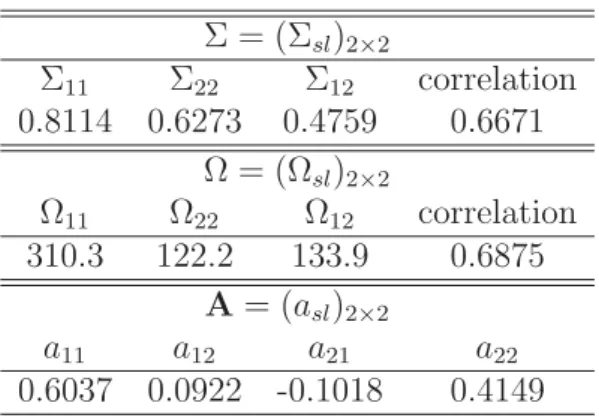
Some estimates of Model 3.2 on real data.
. . . .
70
3.4
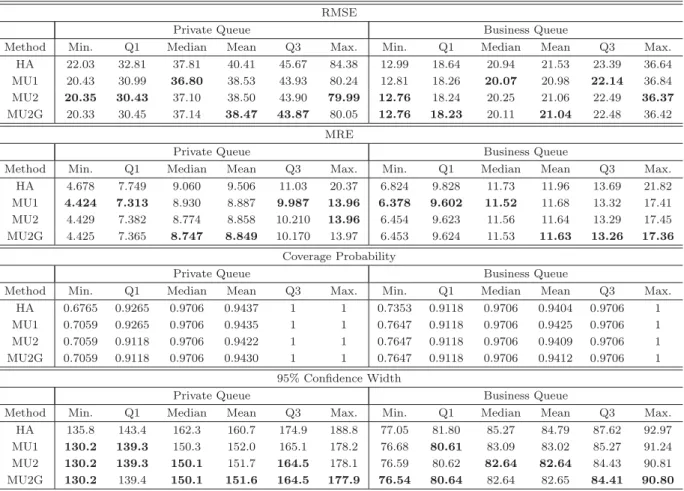
Comparison of 115 rolling forecasts of RMSE, MRE, Coverage
Prob-ability and Confidence Width.
. . . .
71
3.5
Paired t-test p-values. . . .
72
3.6
Results of two-sided paired t-test on daily statistics between method
MU2 and MU1. . . .
75
3.7
System parameter settings for the II-design, M-design and X-design.
78
3.8
Staffing comparison in violation probability between MU2 and BME2.
83
3.9
Computation time comparison in seconds. . . .
83
3.10 Violation probability and corresponding p-values for true multi-stream
distribution input and independent single-stream input. . . .
85
3.11 p-values of the paired t-tests. The alternative: additive linear mixed
model is better.
. . . .
87
4.1
Factors considered for the agent-release rate spikes . . . 107
4.2
Significant variables after variable selection. . . 108
.
.
.
.
.
.
. .
.
.
.
.
.
LIST OF FIGURES
3.1
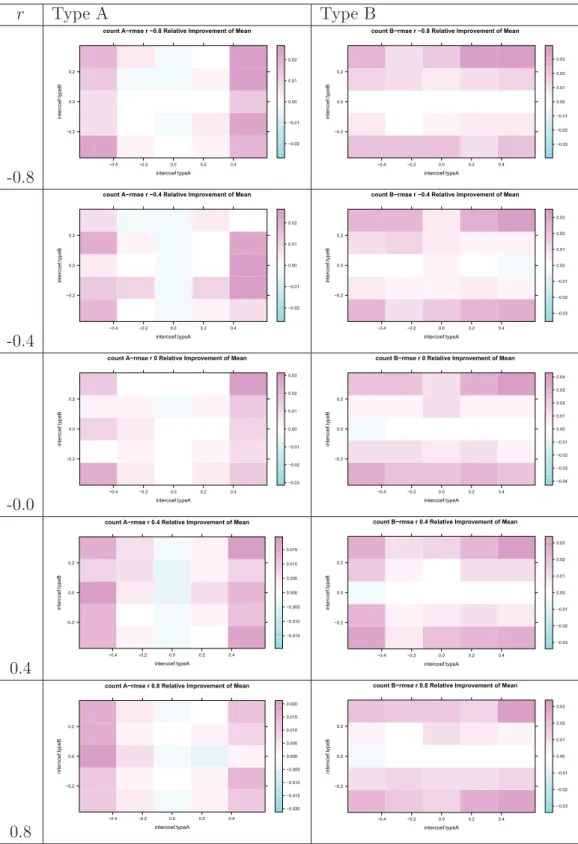
Simulation comparison on the count RMSE between MU2 and MU1.
Warm color indicates the superior of MU2 in forecasting accuracy of
the counts, and cold color indicates the inferior of MU2 in forecasting
accuracy of the counts. . . .
61
3.2
Simulation comparison on the rate RMSE between MU2 and MU1.
Warm color indicates the superior of MU2 in forecasting accuracy of
the rates, and cold color indicates the inferior of MU2 in forecasting
accuracy of the rates.
. . . .
62
3.3
Staffing performance comparison. Each panel is the scatter plot of
mean interval values between MU1(vertical) and MU2(horizontal).
Each row corresponds to a specific scenario, determined by (r, a
12, a
21).
Each column corresponds to a performance measure (see column titles). 64
3.4
Staffing performance comparison. Each panel is the scatter plot of
mean interval values between MU1(vertical) and MU2(horizontal).
Each row corresponds to a specific scenario, determined by (r, a12
, a21).
Each column corresponds to a performance measure (see column titles). 65
3.5
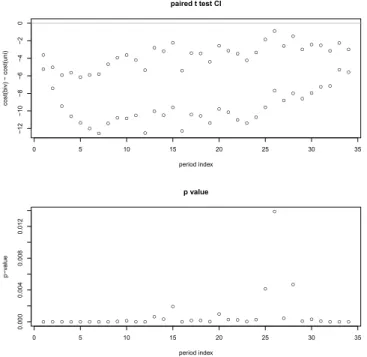
Upper: paired t-test C.I. between MU2 and MU1 for each interval.
Lower: paired t-test p-values.
. . . .
67
3.6
Plot for Private customers. Left: arrival volume profiles on
trans-formed scale. Middle: the mean arrival volumes for each day-of-week.
Right: Daily total arrivals on transformed scale.
. . . .
68
3.7
Plot for Business customers. Left: arrival volume profiles on
trans-formed scale. Middle: the mean arrival volumes for each day-of-week.
Right: Daily total arrivals on transformed scale.
. . . .
68
3.8
Dependence between Private and Business customers. Left: scatter
plot for daily totals on the transformed scale with day-of-week
ef-fect removed. Right: scatter plot of interval residual volumes on the
transformed scale with day-of-week and interval effect removed. . . .
69
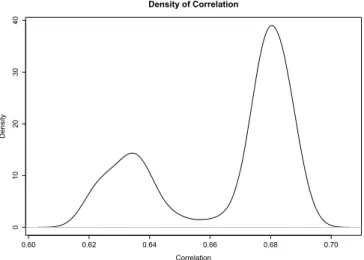
3.9
Density plot of the forecasting count correlation between the two
cus-tomer types.
. . . .
73
.
.
.
.
.
.
3.10 Staffing performance comparison in rolling experiments. Left: Mean
of cost for each time interval. Middle: mean of shortage for each time
interval. Right: violation probability for each tme interval. Horizontal
axis: multiple stream method. Vertical axis: single-stream method. .
75
3.11 Staffing designs. . . .
76
3.12 Real data: daily staffing comparison among the II-design and various
M-designs with different flexible server costs.
. . . .
80
3.13 Real data: daily staffing comparison among the II-design and various
X-designs with different cross service rates.
. . . .
80
3.14 Plot of violation probabilities against correlation for true distributions. 85
4.1
Learning curves for the optimistic case . . . .
93
4.2
Learning curves for the pessimistic case . . . .
94
4.3
Learning curves for the common case . . . .
95
4.4
Prediction errors for Agent 33146 . . . .
97
4.5
Prediction errors for Agent 33147 . . . .
98
4.6
Talk-time distribution. Left: agent-released calls (bimodal pattern is
unusual). Right: customer-released calls (expected pattern). . . 100
4.7
Left: within-day profile of total arrivals. Middle: within-day profile
of agent-released calls. Right: within-day profile of agent-released rate. 100
4.8
Graphic network model for estimating issue resolution rate. . . 102
4.9
Comparison between data-driven and survey-driven estimates. . . 103
4.10 Illustration of our spike detection method. . . 105
.
.
.
.
.
.
.
.
.
.
.
.
1 Introduction
In recent years, call centers have shared a vast industry and are experiencing
dramatic growth. It was estimated in 1999 that the U.S. had 1.55 million call center
agents (Gans et al. (2003)). In 2008, the number of call centers in the U.S. was
estimated to be 47,000 with 2.7 million employees (Aksin et al. (2007)). As a primary
customer-facing communication channel, call centers have become an integral part of
many businesses and are playing an increasingly significant role in bridging service
providers to their customers. It’s estimated that more than 70% of all
customer-business interactions are handled through call centers (Brown et al. (2005)).
The essential challenge for call center managers is to develop efficient staffing and
scheduling strategies to achieve both desired levels of service quality and operating
expenses. The staffing and scheduling process usually begins with forecasting arrival
demand volumes over a planning horizon, which ranges from a day to several weeks.
Call centers also need to evaluate the service quality and efficiency of their agents
during the planning horizon. With the demand forecasts and service evaluation, call
centers then determine the staffing and scheduling plan for short intervals (varying
from 15-min to 1-hour) within the horizon, which minimizes the operational costs
subject to a pre-specified Quality of Service (QoS) level. The final step is rostering
where agents are assigned to the planned schedules.
levels, and further causes the system performance to diverge from operational
tar-get. Recently, people in both statistics and operations management/research have
become aware of the arrival rate uncertainty and have begun to deal with the
prob-lem of the discrepancy between forecasts and realizations. Statistical papers try to
develop more accurate point forecasts and at the same time carefully characterize
the arrival rate forecasting distribution. On the other hand, operations
manage-ment researchers incorporate arrival rate uncertainty into the staffing and scheduling
methodologies. Papers are rare that integrate statistical forecasting process and
op-erational staffing/scheduling process to jointly cope with the arrival rate uncertainty
problem. The first two projects of the thesis aim to bridge the gap between existing
statistical and operational research. The first project concerns call centers with a
single arrival stream while the second one concerns call centers with multiple arrival
streams and investigates the benefits of incorporating inter-stream dependence.
to staff multiple-stream call centers in the short run.
In Chapter 3, we consider both forecasting and staffing together to solve a
com-plete multiple-stream call center staffing problem with uncertain arrival demands.
We evaluate our approach on a real call center data set. We also provide theoretical
assessment and simulation tests of our approach under various scenarios. Our study
demonstrates the importance of incorporating dependence structure among arrival
streams in both forecasting and staffing stages. We also show how the performance
of our multiple-stream approach varies by type and strength of dependence among
the streams. Our efforts naturally extend the work of Gans et al. (2012)., Ibrahim
and L’Ecuyer (2012) and Gurvich et al. (2010).
More specifically, we conduct the following analyses.
•
We develop statistical methods to generate simultaneous distributional
fore-casts of multiple arrival streams. In particular, we decompose within-day
ar-rival volumes of each stream into the product of daily-total rate and within-day
proportion profile. We then apply vector time series models to jointly forecast
multiple-stream daily-total arrival rates. Compared with the linear mixed
ef-fect models in Ibrahim and L’Ecuyer (2012), our method is more attractive in
two ways: it models the inter-stream and within-stream dependence in a more
general form; it’s more practicable and faster in computation.
•
We theoretically evaluate the forecasting benefits of incorporating dependence
among the streams under different type and strength of dependence. In
partic-ular, we derive the forecasting variance reduction of the multiple-stream
fore-casting method over the single-stream forefore-casting method, as a function of
inter-stream and within-stream correlations.
streams, we implement the chance-constraint staffing approach with the sample
based approximation of Gurvich et al. (2010). We demonstrate how the
per-formance of this algorithm varies by the direction and strength of dependence
among the streams.
•
We integrate our forecasting method and the chance-constraint staffing
ap-proach as an entire solution to staffing call centers with multiple uncertain
demand streams. We test our approach on a real call center data set.
Re-sults suggest that the multiple-stream approach provides more accurate
dis-tributional forecasts and the follow-up staffing algorithm is closer to meet the
quality-of-service constraint, compared with the single-stream approach which
ignores the inter-stream dependence. We also test our approach under 125
simulated scenarios of different type and strength of inter-stream dependence.
Our results show that: the stronger the dependence on the other streams’ past
information, the better the forecasting performance of the multiple-stream
ap-proach; for negatively correlated streams, the multiple-stream approach saves
money while at the same time provides the same service quality.
Such assumptions are imposed mainly for mathematical tractability. However they
rarely prevail in practice. The empirical analysis of Brown et al. (2005) reveals that
service-times are log-normally distributed (as opposed to being exponential). We
then perform a detailed analysis of agents’ learning-curves, and show various learning
patterns of agents.
2 Stability Analysis on Stochastic Programming Models
In this chapter we concern forecasting and staffing call centers with a single
un-certain arrival stream, regarding which Gans et al. (2012) developed and tested a
combined forecasting and parametric stochastic programming approach which takes
into account arrival rate uncertainty with inter-day and intra-day dependence. Our
work is an extension of Gans et al. (2012). More specifically, we conduct theoretical
analyses on their parametric stochastic programming models.
2.1
Background and Motivation
In this section, we first briefly review the forecasting and stochastic programming
scheduling approach by Gans et al. (2012) and then highlight our motivation.
particular, the main question of interest is: do their models minimize scheduling cost
and satisfy the QoS constraint in the long-run, theoretically? This big question can
be decomposed into three sub-problems:
•
P1) to show the consistency of the statistical parametric forecasts with or
with-out later stage Bayesian updates.
•
P2) to show the stability of the parametric stochastic programming models in
terms of small perturbations of the model parameters (statistical forecasts).
Since the parametric stochastic programming models are formulated as Integer
Programs (IP), the problem P2) is further decomposed to the following two
problems:
–
P2.1) to show the stability of the model IP’s in terms of relaxation to
Linear Programs (LP).
–
P2.2) to show the stability of the relaxed LP’s in terms of small
perturba-tions of the LP parameters (statistical forecasts).
This chapter provides detailed analyses to address problem P2.2).
In the following is a summary of the three parametric stochastic models proposed
in Gans et al. (2012). Regarding problem P2.2), we consider the LP relaxations to
the following three IP’s.
•
Integer Program (IP) (6) in Gans et al. (2012), that solves to get optimal
sched-ules for the planning horizon given the parametric forecasts for the horizon,
subject to the QoS constraint that expected abandonment rate in the planning
horizon less than a threshold.
updates, subject to the QoS constraint that expected later stage abandonment
rate less than a threshold.
•
IP (12) in Gans et al. (2012), that solves to get optimal schedules for the
planning horizon with recourse given the parametric forecasts for the horizon,
subject to the QoS constraint that expected abandonment rate in the planning
horizon less than a threshold. This model provides optimal schedule before the
planning horizon, consolidating all possible recourse actions for the later stage
before the early stage is observed, compared to (6) and (10) in Gans et al.
(2012).
All the LP relaxations to the above IP’s are driven by the arrival forecasts, in
particular the discretized forecasting distribution. It is non-trivial to substantiate the
existence of optimal solutions to the LP relaxations and that the optimal solutions
are stable with respect to small perturbations of the discretized forecast distribution,
as well as the way it’s discretized. We then address this problem in next section by
providing theoretical stability analysis for the LP relaxations of the above IP’s.
2.2
Model Stability Analysis
Theorem 1 (Robinson (1977), p.440)
The following are equivalent:
(a) The sets
S
Pand
S
Dof optimal solutions of (P) and (D) respectively, are
nonempty and bounded. Or equivalently, the conditions R1) and R2) are satisfied:
R1) for every vector
y
= 0,
y
≥
0,
Ay
≤
0 =
⇒
cy <
0, and
R2) for every vector
ρ
= 0,
ρ
≥
0,
ρA
≥
0 =
⇒
ρb >
0.
(b) There exists an
0
>
0
such that for any
A
,
b
and
c
with
≡
max
{||
A
−
A
||
,
||
b
−
b
||
,
||
c
−
c
||}
<
0,
the two dual problems (P
):
max
{
c
x
|
A
x
≤
b
;
x
≥
0
}
and (D
):
min
{
πb
|
πA
≥
c
}
are solvable.
If these conditions are satisfied, then there exist constants
1
∈
(0,
0]
and
γ
such
that for any
A
,
b
and
c
with
<
1, any optimal solutions
x
solving
(P
)
and
u
solving
(D
), one has d[(x
, u
), S
P×
S
D]
≤
γ
.
2.2.1
Simple Stochastic Program
α
k’s, that will be useful in our analysis.
min
j∈Jc
jx
jsubject to
(
j∈Ja
ijx
j)m
ikn+
b
ikn≤
α
iki
∈ I
, k
∈ K
, n
∈ N
ii∈I
α
ik≤
α
kk
∈ K
k∈K
p
kα
k≤
α
∗¯
λ
x
j∈
Z
+j
∈ J
α
ik≥
0
i
∈ I
, k
∈ K
α
k≥
0
k
∈ K
.
(2.1)
Note that, by construction,
m
ikn<
0 and
b
ikn>
0 for all
i,
k, and
n. To avoid
technical distractions, we’ll assume that
c
j>
0 for all
j
∈ J
,
λ
ik>
0 for all
i
∈
I
, k
∈ K
and that
p
k>
0 for all
k
∈ K
. That is, the cost of people working on any
schedule is strictly positive, as is the expected number of arrivals under any of the
problem’s scenarios and their probabilities.
We would like to prove the following proposition so that that the objective value
and
α
k’s obtained by the optimal solution to the above IP are continuous with respect
to perturbations of the parametric forecasts
p
k’s and
λ
ik’s.
a standard form:
min
j∈Jc
jx
jsubject to
(
j∈Ja
ijx
j)m
ikn−
α
ik≤ −
b
ikni
∈ I
, k
∈ K
, n
∈ N
ii∈I
α
ik−
α
k≤
0
k
∈ K
k∈K
p
kα
k≤
α
∗λ
¯
x
j≥
0
j
∈ J
α
ik≥
0
i
∈ I
, k
∈ K
α
k≥
0
k
∈ K
.
(2.2)
Here’s the vector-matrix form of the above LP
max
−
cx
+ 0α
1+ 0α
2subject to
⎡
⎢
⎢
⎢
⎢
⎣
A
11A
12A
13A
21A
22A
23A
31A
32A
33⎤
⎥
⎥
⎥
⎥
⎦
⎡
⎢
⎢
⎢
⎢
⎣
x
α
1α
2⎤
⎥
⎥
⎥
⎥
⎦
≤
⎡
⎢
⎢
⎢
⎢
⎣
−
b
0
α
∗¯
λ
⎤
⎥
⎥
⎥
⎥
⎦
x, α
1, α
2≥
0.
(2.3)
The decision variables are as follows:
•
x, a
|J |
-vector;
•
α
1, a
|I| · |K|
-vector of the
α
ik
’s; and
•
α
2, a
|K|
-vector of the
α
k
’s.
The right-hand-side has three parts:
•
α
∗λ, a scalar
¯
and the constraint matrix is made up of the following submatrices, each with
di-mensions that match the corresponding segments of the right-hand side and decision
variables:
1)
A
11, a matrix of 0’s and
m
ikn’s, where each slope
m
ikn<
0;
2)
A12, a matrix of
−
1’s and 0’s;
3)
A13, a matrix of 0’s;
4)
A
21, a matrix of 0’s;
5)
A
22, a matrix of 1’s and 0’s;
6)
A
23=
−
I, the negative of the identity matrix;
7)
A
31, a row vector of 0’s;
8)
A
32, a row vector of 0’s; and
9)
A
33, a row vector of
p
k’s.
For condition R1, we let
y
= (x, α
1, α
2) be such that
y
= 0 and
y
≥
0. We note
that only
α
2= 0 ensures that the left-hand side of the constraint
k∈K
p
kα
k≤
α
∗λ
¯
is
not positive. In turn, given
α
2= 0 only
α
1= 0 ensures that the left-hand sides of the
constraints
i∈Iα
ik−
α
k≤
0 (for all
k
∈ K
) are not positive. Thus if
y
= 0, there
must be an
x
j>
0 so that
−
c
jx
j<
0. Thus
cy <
0, and
y
satisfies the conditions of
R1.
since there will be an element
m
ikn<
0 of
A
11that is multiplied with
ρ
1iknand both
A21
and
A31
have all zeros. In this case, R2 is trivially satisfied. If
ρ
1= 0 and
ρ
3>
0,
then
ρ
3α
∗λ >
¯
0 implies that (ρ
1, ρ
2, ρ
3)(
−
b,
0, α
∗λ)
¯
>
0 and again R2 is satisfied. If
ρ
1= 0 and
ρ
3= 0, then there must be a
ρ
2k
>
0, and in this case
(ρ
1, ρ
2, ρ
3)
⎡
⎢
⎢
⎢
⎢
⎣
A
13A
23A
33⎤
⎥
⎥
⎥
⎥
⎦
<
0
since the
kth column of
A
13is all 0’s, and the
kth column of
A
23has a
−
1’s in the
kth row and 0’s elsewhere. Again, R2 is trivially satisfied in this case.
Thus the LP relaxation (2.2) satisfies R1 and R2 and, and the optimal solutions
are continuous with small but arbitrary perturbations of the LP 2.2.
2
2.2.2
Later Stage Recourse Program
max
−
j∈J
h∈Hj
d
jhz
jhsubject to
j∈J
h∈Hj
r
ijhm
iknz
jh−
α
ik≤ −
b
ikn−
(
j∈J
a
ijx
j)m
ikni
∈ I
l, k
∈ K
, n
∈ N
ii∈Il
α
ik−
α
k≤
0
k
∈ K
k∈K
p
kα
k≤
α
˜
h∈Hj
z
jh≤
x
jj
∈ J
z
jh∈
Z
+j
∈ J
, h
∈ H
j
α
ik≥
0
i
∈ I
l, k
∈ K
α
k≥
0
k
∈ K
(2.4)
Where ˜
α
=
k∈K
p
ki∈Il
(s
i·
m
iksi+
b
iksi) is the expected abandonment rate of the
later stage that would have been achieved by the original scheduling policy, and
s
i≡
j∈J
a
ijx
jdenotes the early stage staffing levels. Without loss of generality, we
assume that
x
j>
0 for all
j
∈ J
, otherwise, we could reorganize the schedule set
J
to exclude those
j’s with
x
j= 0. Notice that
f
(λ
ik, μ, θ, n) is non-increasing and
convex in
n
and positive. Then we have
n
∗·
m
ikn+
b
ikn≤
n
∗·
m
ikn∗+
b
ikn∗,
for all
i
∈ I
l, k
∈ K
, n, n
∗∈ N
i.
The LP relaxation of (2.4) is as follows,
max
−
j∈J
h∈Hj
d
jhz
jhsubject to
j∈J
h∈Hj
r
ijhm
iknz
jh−
α
ik≤ −
b
ikn−
(
j∈J
a
ijx
j)m
ikni
∈ I
l, k
∈ K
, n
∈ N
ii∈Il
α
ik−
α
k≤
0
k
∈ K
k∈K
p
k
α
k≤
α
˜
h∈Hj
z
jh≤
x
jj
∈ J
z
jh≥
0
j
∈ J
, h
∈ H
jα
ik≥
0
i
∈ I
l, k
∈ K
α
k≥
0
k
∈ K
(2.5)
modified LP of (2.5):
max
−
j∈J
h∈Hj
d
jhz
jhsubject to
j∈J
h∈Hj
r
ijhm
iknz
jh−
α
ik≤ −
b
ikn−
(
j∈J
a
ijx
j)m
ikni
∈ I
l, k
∈ K
, n
∈ N
ii∈Il
α
ik−
α
k≤
0
k
∈ K
k∈K
p
k
α
k≤
α
∗h∈Hj
z
jh≤
x
jj
∈ J
z
jh≥
0
j
∈ J
, h
∈ H
jα
ik≥
0
i
∈ I
l, k
∈ K
α
k≥
0
k
∈ K
,
(2.6)
and prove the stability of the optimal solution to the LP (2.6). We would like to
make the following proposition:
Proposition 2.2
There exist optimal solutions to the LP (2.6), and the optimal
solutions are stable under small perturbations of the LP (2.6).
Proof
Denote the matrix form of (2.6) by
max
−
dz
subject to
j∈J
|H
j|
|I
l| × |K
|
|K
|
⎛
⎜
⎜
⎜
⎜
⎜
⎜
⎜
⎜
⎜
⎜
⎜
⎜
⎜
⎜
⎜
⎜
⎜
⎜
⎜
⎜
⎝
⎞
⎟
⎟
⎟
⎟
⎟
⎟
⎟
⎟
⎟
⎟
⎟
⎟
⎟
⎟
⎟
⎟
⎟
⎟
⎟
⎟
⎠
i∈Il
|K
||N
i
|
(m
iknr
ijh)
−
I
K⊗
1
N1. ..
−
I
K⊗
1
NIl
|K
|
I
K
. . .
I
K−
I
K1
p
1. . .
p
K|J |
1
T H1. ..
1
T HJ⎡
⎢
⎢
⎢
⎢
⎣
z
α
(1)α
(2)⎤
⎥
⎥
⎥
⎥
⎦
≤
⎡
⎢
⎢
⎢
⎢
⎢
⎢
⎢
⎢
⎢
⎢
⎢
⎢
⎢
⎢
⎢
⎢
⎢
⎢
⎢
⎢
⎣
⎤
⎥
⎥
⎥
⎥
⎥
⎥
⎥
⎥
⎥
⎥
⎥
⎥
⎥
⎥
⎥
⎥
⎥
⎥
⎥
⎥
⎦
g
0
α
∗x
z
,
α
(1),
α
(2)≥
0
(2.7)
Where
d
= (d11, . . . , d1
H1, . . . , d
J1, . . . , dJ HJ),
z
= (z11, . . . , z1
H1, . . . , z
J1, . . . , zJ HJ)
T,
α
(1)= (α
11
, . . . , α
1K, . . . , α
Il1, . . . , α
IlK)
T
,
α
(2)= (α
1
, . . . , α
K)
T. Further denote the
matrix form as
max
−
dz
subject to
⎡
⎢
⎢
⎢
⎢
⎢
⎢
⎢
⎣
A
11A
12A
13A
21A
22A
23A
31A
32A
33A41
A42
A43
⎤
⎥
⎥
⎥
⎥
⎥
⎥
⎥
⎦
⎡
⎢
⎢
⎢
⎢
⎣
z
α
(1)α
(2)⎤
⎥
⎥
⎥
⎥
⎦
≤
b
z
,
α
(1),
α
(2)≥
0.
(2.8)
For condition R1), let
y
=
⎡
⎢
⎢
⎢
⎢
⎣
z
α
(1)α
(2)⎤
⎥
⎥
⎥
⎥
⎦
, and
y
≥
0.
(A
41, A
42, A
43)
y
≤
0
⇒
z
= 0.
(A
31, A
32, A
33)
y
≤
0
⇒
α
(2)= 0,
(A
21, A
22, A
23)
y
≤
0
⇒
α
(1)= 0,
Then
y
= 0 and R1) holds.
For condition R2), the proof is more complex. Firstly LP (2.7) is feasible. In
particular,
z
jh= 0,
α
ik=
s
i·
m
iksi+b
iksi,
α
k=
i∈Il
α
ikform a feasible solution to (2.7).
Let
z
jh,
α
ik, and
α
kdenote any feasible solutions to (2.7). Let
ρ
= (
ρ
(1),
ρ
(2), ρ
(3),
ρ
(4))
such that
ρ
≥
0,
ρ
= 0 and
ρ
A
≥
0. Notice that
ρ
A
≥
0 is equivalent to the following
three inequalities.
ikn
ρ
(1)iknm
iknr
ijh+
ρ
(4)j≥
0,
j
∈ J
(2.9)
−
n
ρ
(1)ikn+
ρ
(2)k≥
0,
i
∈ I
l, k
∈ K
(2.10)
−
ρ
(2)k+
p
kρ
(3)≥
0,
k
∈ K
.
(2.11)
To show that R2) holds, we consider four situations:
4)
ρ
(1)= 0 and
ρ
(2)= 0.
Firstly, by (2.11) we have
ρ
(3)>
0.
Notice in the primal that
x
j≥
h
z
jh, then
ρ
b
=
i
k
n
ρ
(1)ikn−
b
ikn−
(
j
a
ijx
j)m
ikn+
ρ
(3)α
∗+
j
ρ
(4)jx
j≥
i k nρ
(1)ikn−
b
ikn−
(
j
a
ijx
j)m
ikn+
ρ
(3)α
∗+
j
h
ρ
(4)j(2.12)
z
jh,
where equality holds if and only if
ρ
(4)jx
j=
ρ
(4)jh
z
jh, j
∈ J
.
In the primal,
j
a
ijx
j+
jh
r
ijhz
jhm
ikn+
b
ikn≤
α
ik, then
(2.12)
≥
i,k,n
ρ
(1)iknj,h
r
ijhm
iknz
jh−
α
ik+
ρ
(3)α
∗+
j,h
ρ
(4)jz
jh,
(2.13)
where equality holds if and only if
ρ
(1)iknj
a
ijx
j+
j,h
r
ijhz
jhm
ikn+
b
ikn=
ρ
(1)iknα
ik,
i
∈ I
l, k
∈ K
, n
∈ N
i.
By (2.9), we have
(2.13) =
j,h
z
jhρ
(4)j+
i,k,n
ρ
(1)iknm
iknr
ijh+
ρ
(3)α
∗−
i,k,n
ρ
(1)iknα
ik≥
ρ
(3)α
∗−
i,k,n
ρ
(1)iknα
ik,
(2.14)
where equality holds if and only if
z
jhρ
(4)j+
i,k,n
ρ
(1)iknm
iknr
ijh= 0, j
∈ J
, h
∈
H
j.
By the second and third constraints in the primal, we have
(2.14)
≥
ρ
(3)k
p
kα
k−
i,k,n
ρ
(1)iknα
ik≥
ρ
(3)k,i
p
kα
ik−
i,k,n
where equality holds if and only if
α
∗=
k
p
kα
kand
i
α
ik=
α
k, k
∈ K
.
By (2.10) and (2.11), we have
(2.15)
≥
0,
where equality holds if and only if
α
kρ
(2)k=
α
kp
kρ
(3), k
∈ K
and
α
ik
ρ
(2)k=
α
ikn
ρ
(1)ikn, i
∈ I
l, k
∈ K
.
Hence,
ρ
b
≥
0 and equality holds if and only if the following equalities hold at
the same time.
ρ
(4)jx
j=
ρ
(4)jh
z
jh,
j
∈ J
.
(2.16)
ρ
(1)iknj
a
ijx
ij+
j,h
r
ijhz
jhm
ikn+
b
ikn=
ρ
(1)iknα
ik, i
∈ I
l, k
∈ K
, n
∈ N
i.
(2.17)
z
jhρ
(4)j+
ikn
ρ
(1)iknm
iknr
ijh= 0,
j
∈ J
, h
∈ H
j(2.18)
k
p
kα
k=
α
∗.
(2.19)
α
k=
i
α
ik,
k
∈ K
.
(2.20)
α
ikρ
(2)k=
α
ikn
ρ
(1)ikn,
i
∈ I
l, k
∈ K
.
(2.21)
Multiply both sides of (2.19) by
ρ
(3)which is positive:
ρ
(3)α
∗(2.19)
=
ρ
(3)k
p
kα
k(2.22)
=
k
ρ
(2)kα
k(2.20)
=
i,k
ρ
(2)kα
ik(2.21)
=
i,k,n
ρ
(1)iknα
ik(2.17)
=
i,k,n
ρ
(1)ikn(
j
a
ijx
j)m
ikn+
b
ikn+
i,k,n
ρ
(1)iknj,h
r
ijhz
jhm
ikn(2.18)
=
i,k,n
ρ
(1)ikn(
j
a
ijx
j)m
ikn+
b
ikn−
j,h
z
jhρ
(4)j(2.16)
=
i,k,n
ρ
(1)ikn(
j
a
ijx
j)m
ikn+
b
ikn−
j
ρ
(4)jx
j≤
ikn
ρ
(1)ikn(s
im
iksi+
b
iksi)
−
j
ρ
(4)jx
j≤
ikn
ρ
(1)ikn(s
im
iksi+
b
iksi)
(2.10)
≤
i,k
(s
im
iksi+
b
iksi)ρ
(2)
k
(2.11)
≤
ρ
(3)i,k
(s
im
iksi+
b
iksi)p
k.
=
ρ
(3)α
˜
which contradicts the definition of
α
∗. Hence there must be
ρ
b
>
0.
2
Remark 1
By the proof of Proposition (2.2), we have the following properties for
the LP (2.5) under perturbations of the arrival rate forecasts.
•
For any perturbation of the arrival forecast distribution such that the
p
k’s
re-main positive:
R1) holds. Then by Theorem 1 in Williams (1963), the dual is feasible.
Apply-ing Theorem 2 in Williams (1963), there exist optimal solutions to both the
pri-mal and dual. The optipri-mal solution set of the pripri-mal is bounded and the optipri-mal
solution set of the dual is unbounded. In particular, the
ρ
= (
ρ
(1),
ρ
(2), ρ
(3),
ρ
(4))
defined as follows satisfies
ρ
≥
0,
ρ
= 0
,
ρ
A
≥
0
and
ρ
b
= 0:
⎧
⎪
⎪
⎪
⎪
⎪
⎪
⎪
⎪
⎪
⎪
⎪
⎪
⎪
⎪
⎨
⎪
⎪
⎪
⎪
⎪
⎪
⎪
⎪
⎪
⎪
⎪
⎪
⎪
⎪
⎩
ρ
(1)ikn=
⎧
⎪
⎪
⎨
⎪
⎪
⎩
p
kn
=
s
i,
0
n
=
s
i,
i
∈ I
l, k
∈ K
,
ρ
(2)k=
p
k,
k
∈ K
,
ρ
(3)= 1,
ρ
(4)j= 0,
j
∈ J
.
2.2.3
Two-Stage Recourse Program
is useful in our analysis.
max
−
j
c
jx
j−
k
p
kj,h
d
jhz
jhksubject to
(
j
a
ijx
j)m
ikn−
α
ik≤ −
b
ikn,
i
∈ I
e, n
∈ N
i(
j
a
ijx
j+
j,h
r
ijhz
jkh)m
ikln−
α
ikl≤ −
b
ikln, i
∈ I
l, k
∈ K
, l
∈ L
k, n
∈ N
ii∈Ie
α
ik+
i∈Il
l∈Lk
p
klα
ikl−
α
k≤
0
k
∈ K
k
p
kα
k≤
α
∗λ
¯
h
z
jkh−
x
j≤
0
j
∈ J
, k
∈ K
x
j∈
Z
+j
∈ J
z
jkh∈
Z
+j
∈ J
, k
∈ K
, h
∈ H
jα
ik≥
0
i
∈ I
e, k
∈ K
α
ikl≥
0
i
∈ I
l, k
∈ K
, l
∈ L
kα
k≥
0
k
∈ K
.
Then consider the LP relaxation of (2.23)
max
−
j
c
jx
j−
k
p
kj,h
d
jhz
jhksubject to
(
j
a
ijx
j)m
ikn−
α
ik≤ −
b
ikn,
i
∈ I
e, n
∈ N
i(
j
a
ijx
j+
j,h
r
ijhz
jkh)m
ikln−
α
ikl≤ −
b
ikln, i
∈ I
l, k
∈ K
, l
∈ L
k, n
∈ N
ii∈Ie
α
ik+
i∈Il
l∈Lk
p
klα
ikl−
α
k≤
0
k
∈ K
k
p
kα
k≤
α
∗λ
¯
h