The Impact of International Criminal Court Arrest Warrants on Peace Processes By Anna Sturkey
A Thesis submitted to the faculty of the University of North Carolina in partial fulfillment of the requirements
of a degree with Honors in Political Science
2014
Approved by:
_______________________________
_______________________________
Table of Contents
I. Introduction……….3
II. Literature Review………...4
III. Theory………...8
IV. Empirical Analysis………...15
V. Case Illustration………23
VI. Conclusion………..33
VII. Appendix………36
Introduction
On July 17, 1998, the international community created the Rome Statute, the document outlining the creation of the ICC. The Rome Statute was ratified by 60 countries by July 1, 2002, making the ICC a legitimate and operating institution (About the Court). The ICC is able to prosecute four categories of crime – genocide, crimes against humanity, war crimes, and crimes of aggression (Schabas 2011, 88) – for which it has temporal jurisdiction, personal jurisdiction, and territorial jurisdiction. Temporal jurisdiction limits the court to only considering crimes that occurred after the Rome Statute was ratified (Schabas 2011, 69). Personal jurisdiction allows the court to consider crimes where the accused is a national of a state party regardless of where the crimes occurred (Schabas 2011, 76). Finally, territorial jurisdiction empowers the ICC to
exercise jurisdiction over crimes that occur within the territory of a state party to the ICC or where the United Nations Security Council gives jurisdiction to crimes occurring in a particular territory (Schabas 2011, 81). The ICC was created to end impunity for
international criminals, and to subsequently stop and prevent international atrocities (Rome Statute of the International Criminal Court 2002, 1).
justice. The question this thesis grapples with is the whether the ICC does pursue justice to the detriment of a peace process.
States join the ICC to show a credible commitment to the prosecution of international crimes. However, there are times when states need to show a credible commitment to not prosecute (e.g. times when states need to be able to grant an amnesty) to achieve other goals, such as peace process resolution (Ginsburg 2009, 500). Because the ICC makes the credible promise of amnesties difficult (if not impossible) (Ginsburg 2009, 500), many scholars argue that peace is sacrificed for justice. This thesis will investigate the peace versus justice debate by looking specifically at the implications of ICC arrest warrants on the peace process bargaining model. This thesis looks at the impact of introducing a third party – with set, unmoveable preferences – into a typical two party bargaining model.
This thesis is divided into five parts: part one will engage in a literature review to provide background on the current state of the peace versus justice literature; part two will introduce the theory this thesis proposes; part three will engage in an empirical test of the theory; part four will be a case illustration; and part five will offer conclusions and recommendations for future research.
Part One: Literature Review
the Juba Peace Process in Uganda and the concurrent ICC arrest warrants. There was an outcry from civilians and NGO activists that the ICC arrest warrants would prevent a peace deal. Betty Bigombe, the head of peace negotiations in Uganda, felt so strongly that the ICC would harm peace processes that she threatened to abandon the peace process (Branch 2007, 183-184). The peace versus justice debate was brought to the public’s attention with many arguing that the ICC’s goal of ending impunity sacrifices
the opportunity for peace.
The opinions on this debate vary. In an interview on June 8, 2012, Christopher Hall of Amnesty International expressed that the ICC may stall peace but ending impunity is the most important goal. Other scholars such as Adam Branch (2009) argue that, as in the case in Uganda, the arrest warrants absolutely prevent a peace deal from being reached because of the removal of amnesty from the bargaining table. Branch explains that this occurs despite popular demand for an amnesty and conclusion to the war from the people most affected by the war (184). The existing literature on the peace versus justice debate presents theoretical arguments based on credible commitments and the politics of intervention in ongoing conflicts to argue that the ICC will stall or inhibit peace in the international crusade to end impunity.
Danner identified two main reasons states would join the ICC: 1) they did not anticipate that their government would ever engage in activity that would fall under the jurisdiction of the ICC (i.e. Scandinavian countries); or 2) the signing governments want to use the ICC in a calculated way to credibly commit to reducing violence by promising to prosecute and to be prosecuted (231-232). Under reason two, countries with recent histories of war but weak internal prosecuting institutions could gain significantly from ICC involvement if the government were threatened by rebels (234-235). Therefore the countries that may most need to be able to offer amnesties in the future could be the same countries that were making a credible commitment to prosecute. This shows that
answering the peace versus justice debate is important and relevant as the ICC continues to develop as an institution and its docket continues to grow.
will pursue prosecution (Ginsburg 2009, 509-510). Ginsburg (2009) argues that “by taking the power to give effective amnesties away from government, we may in fact exacerbate some of the worst human rights abuses” (507). However, at the same time,
Ginsburg recognizes the need to prosecute. Without a real threat of prosecution, amnesty would not be a meaningful negotiation tool (508). Amnesty and prosecution are
interconnected, and the ICC creates a commitment problem that brings this relationship to the forefront.
The ICC’s case against Uganda provided the opportunity to view the
interconnected role of amnesty and prosecution. Scholars started to look pragmatically at the impact of ICC arrest warrants on peace processes. Adam Branch (2007) applied his peace versus justice argument to the case of Uganda and Sarah Nouwen (2012) used the Uganda case study to challenge the ideology around the ICC of “no peace without justice” (Nouwen 2012, 172). Other scholars and supporters of the ICC have used the
Uganda case study to argue that the ICC encourages peace. For example, they argued that because the Juba Peace talks began just months after the ICC arrest warrants were issued, the ICC can help bring about peace (Nouwen 2012, 180). Thus, theoretical arguments began to be grounded in case studies.
The peace versus justice debate has included theoretical debates, case studies, credible commitment theory, political analysis of the nature of the ICC, and now empirical analysis. The literature is missing an analysis of the impact of ICC arrest warrants grounded in bargaining model theory. Therefore, I will theorize about the introduction of the ICC to a bargaining model built around two actors. Through
quantitative analysis, I will test the results I expect to see from my theory and I will apply my theory to a case illustration.
Part 2: Theory
In peace agreements, amnesty is often offered as a bargaining chip to induce a rebel actor to sign an agreement. However, in “The Amnesty Exception to the
Jurisdiction of the International Criminal Court”, Michael Scharf (1999) explains that it is
not realistic to expect a rebel actor to sign an agreement if he or she can reasonably expect to be prosecuted shortly after signing the agreement (508). This would clearly be acting against the rational self-interest of the rebel leaders. In case studies of Haiti, South Africa, and the Dayton Accords, Scharf demonstrated that an “amnesty may be a
necessary bargaining chip to induce human rights violators to agree to peace and
relinquish power” (508-509). Ginsburg (2009) explains that when facing prosecution, an
international criminal might refuse to give up rather than compromise (502).
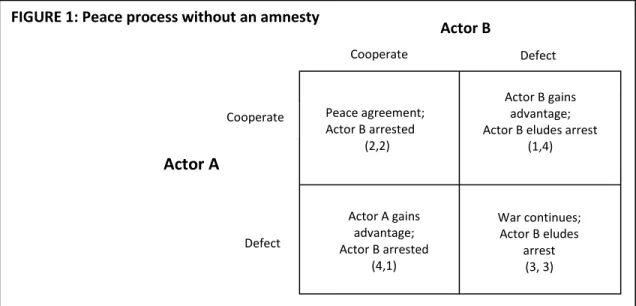
In Figure 1, cooperate means to sign and honor a peace agreement and defect means to not agree to and/or not honor a peace agreement. In this case, Actor B has two choices. If Actor B cooperates, Actor B will be arrested, resulting in Actor B will losing all of their resources, facing prosecution, and – most likely – facing some sort of
sentence. The value of cooperation is thus any concessions gained for a peace agreement minus the loss of freedom and resources. If Actor B defects, Actor B will be able to elude arrest – even if only temporarily. The value of defecting is thus the value of retaining freedom or resources, any potential further profit to be gained from continuing the war, minus the probability of losing the war and not having any of the concessions offered in the peace agreement. Thus, for a rational Actor B, choosing to cooperate would have a payoff of 1 or 2, and defecting – or not agreeing to a peace resolution – has a payoff of 3 or 4. Although Actor B may have incentives to participate in a peace process, ultimately, without the promise of an amnesty, Actor B is incentivized to defect.
For Actor A, it is possible that due to pressure from constituents, Actor A may genuinely want to reach a peace agreement. However, Actor A must respond to Actor B’s
FIGURE 1: Peace process without an amnesty
Cooperate Cooperate Defect Actor B Actor A Defect Peace agreement; Actor B arrested
(2,2)
Actor A gains advantage; Actor B arrested
(4,1)
Actor B gains advantage; Actor B eludes arrest
(1,4)
War continues; Actor B eludes
clear, dominant strategy. As established, Actor B’s dominant strategy is to defect. Thus, with the expectation that Actor B will defect, Actor A sets their own strategy. I assume that Actor A does not want to cooperate if Actor B is going to defect; Actor A would not want to be on the receiving end of a first-strike breaking a stalemate or be caught
unprepared if Actor B does not honor portions of the agreement. Thus, cooperating has a payoff of 1 or 2 for Actor A and defecting has a payoff of 3 or 4. Actor A would much rather fall into the bottom right corner of the dilemma than the top right corner of the dilemma. The relative payoffs incentivize both Actor A and Actor B to defect, resulting in a nash equilibrium that continues the status quo (i.e. the war).
Figure 2 shows the choices Actor B would face if the promise of an amnesty were a possible outcome of a peace negotiation.
In this case, Actor A signals their strategy first by offering an amnesty. The offering of an amnesty signals that Actor A is willing to cooperate rather than defect. This willingness to cooperate is likely from constituent pressure to reach a peace
FIGURE 2: Peace process with amnesty
Cooperate Cooperate Defect Actor B Actor A Defect Peace agreement; Actor B not
arrested (4, 4)
Actor A gains an advantage; Actor B not arrested
(3, 1)
Actor B gains advantage; Actor B not arrested
(1, 3)
Conflict continues; Actor B not
agreement. In this case, Actor A’s preferences are: peace agreement (4) > Actor A gains advantage (3) > status quo (2) > Actor B gains an advantage (1).
Actor B responds to this strategy. Once again, Actor B has two choices – continue the war or accept the peace agreement. If Actor B continues the war, Actor B could achieve additional profit, but Actor B risks being caught in the future and not having the option of amnesty. If Actor B accepts the peace agreement, Actor B would forgo any additional profit from continuing the war but would be guaranteed his freedom and current resources. Actor B could still choose to defect, but the payoff for cooperation has changed. So long as the risk of continuing the war is greater than the profit expected from continuing the war, Actor B’s new preferences are: peace agreement (4) > Actor B
gaining an advantage (3) > status quo (2) > Actor A gaining an advantage (1). In this case, both actors prefer to cooperate if the other will cooperate and defect if the other defects. Therefore, with amnesty on the table, cooperate-cooperate is the nash
equilibrium and a peace agreement resolution can be reached.
As shown in Figure 1 and Figure 2, Actor A and Actor B’s strategy – cooperate or defect – depends on the deal being offered. In all peace negotiations there exists a
bargaining range – a set of deals that both parties prefer to the returning to war (Frieden, Lake, and Schultz 2010, 92). The bargaining range is composed of the individual
preferences of the two actors. Figure 3 shows Actor A’s preferences.
Figure 3: Preferences for Actor A Actor A
P1-a Actor A Ideal
Outcomes A prefers to war A prefers war
As demonstrated in Figure 3, P is the predicted outcome of the war. There is a cost to A for continuing the war (diminishing returns for continuing the war); this cost is labeled P1-a. Actor A would be willing to accept anything to the right of P1-a because the cost is less than the cost of continuing the war. Actor A is unwilling to accept anything to the left of P1-a because it is more costly to Actor A than the cost of continuing the war (Frieden, Lake, and Schultz 2010, 91-93). Similarly, Actor B has preferences, which are shown in Figure 4.
As demonstrated in Figure 4, there is also a cost to B for continuing the war; this cost is labeled P1+b. Actor B would be willing to accept anything to the left of P1+b because the cost is less than the cost of continuing the war. Actor B is unwilling to accept anything to the right of P1+b because it is more costly to Actor B than the cost of continuing the war (Frieden, Lake, and Schultz 2010, 91-93).
Figure 5 shows the combination of Actor A and Actor B’s preferences.
As shown, there is an overlap among the outcomes Actor A would accept over war and the outcomes Actor B would accept over war (Frieden, Lake, and Schultz 2010, 91-93). Figure 4: Preferences for Actor B
Actor B Ideal
Actor B
P1+b
Outcomes B prefers to war B prefers war
Figure 5: Bargaining Range for Actor A and Actor B
Actor B
P1+b P1-a
Outcomes Actor a and B would both agree to Actor A
Thus, an organic bargaining range develops is which a resolution is possible. There is a range of outcomes that both actors would accept, and a successful peace negotiation occurs when a deal is negotiated that falls within this mutually agreeable range.
I make several key assumptions about Actor A and Actor B’s bargaining ranges.
First, the bargaining ranges are representative of a zero sum game. Shifts within the bargaining range result in moving closer to one party’s ideal point and further away from another party’s ideal point. Thus, shifts result in making one party better off and one
party worse off (Frieden, Lake, and Schultz 2010, 52). Second, I assume that – even though it is a zero sum game – the two actors can move with fluidity within the range in which they both agree; there are no issues of indivisibility within the mutually agreeable range. Third, I assume that the actors involved are rational; they make predictable decisions based on positive and negative incentives.
Combining the bargaining ranges with the preferences detailed in the prisoner’s
dilemmas, I theorize that Actor B will not accept a peace deal without the promise of an amnesty and could accept a peace deal with the promise of amnesty. Returning to Figure 5, I assume that everything to the left of P1+b includes some sort of promise of amnesty in the deal, and everything to the right of P1+b does not include a promise of amnesty. Accordingly, Actor B will not accept a peace deal without a promise of amnesty. Because this theory also assumes that the Actors do have overlapping preferences, a successful peace deal (found in range P1-a, P1+b) could include an amnesty for Actor A.
problems by offering a guarantee of implementation or compliance (Walter 2009, 255). Many studies have found that “civil wars are significantly more likely to end in a negotiated settlement if an outside state or international organization has sent peacekeepers to help with implementation” (Walter 2009, 255). However, the ICC
brings in a new type of third-party influence. Unlike peacekeepers who are neutral and monitor the compliance of a deal agreed upon by the negotiating parties, the ICC can only support certain deals. Because the ICC arrest warrants serve as a credible promise to prosecute, they cannot support a peace deal that contains the promise of an amnesty. Furthermore, the ICC has sent a strong signal of their credible promise to prosecute through the arrest warrants and through former Prosecutor Moreno Ocampo’s responses to critics. Ocampo operated the ICC under the vision of prosecuting each case whenever there is jurisdiction for ICC regardless of local politics (Ginsburg 2005, 510). Therefore, the presence of the ICC alters the bargaining range by adding a third party with set preferences. The new bargaining range is shown in Figure 6.
The ICC has a minimum deal they would be willing to accept; one in which they would still act on their arrest warrants and prosecute Actor B. Thus, the ICC will not comply with any peace deal to the left of its minimum deal point and will only comply with peace deals to the right of the minimum deal point. However, the ICC’s minimum deal point is Figure 6: Bargaining Range for Actor A, Actor B, and the ICC
Actor B
P1+b P1-a
Actor A
ICC
outside of the organic bargaining range created by the overlap of Actor A and Actor B’s preferences; the ICC’s minimum deal point is in the range within which Actor B prefers
war to any other outcome. Accordingly, Actor A cannot offer Actor B a deal within their mutually agreed upon bargaining range; thus, Actor B will not accept a peace deal. Consequently, the presence of ICC arrest warrants eliminates the possibility of a successful peace deal.
This theory predicts that the ICC renders the resolution of a peace process impossible by introducing a third party who mandates a certain kind of peace agreement outside of an organic bargaining range. Thus, this theory can be tested by looking at cases in which the ICC is involved to see if a peace process was reached. If peace process resolutions are reached, then support for my theory is not found; however, if peace process resolutions are not reached, then I do find support for my theory. Accordingly, the hypothesis I will test is: ICC arrest warrants prevent the successful resolution of a peace process (measured by the signing and implementation of a peace agreement).
However, as a peace processes could fail for many other reasons, I will need to ensure that any testing controls for other possibilities, so that I can conclude – as confidently as possible – that the lack of a successful peace process resolution is correlated with the ICC arrest warrants rather than another factor.
Part Three: Empirical Analysis
Set Up
Non-State Actor dataset for the years 2002-2010 and expanded on their work. In their codebook, Cunningham, Salehyan, and Gleditsch explain that they define a civil conflict using the Uppsala Armed Conflict Data (1). According to the Armed Conflict Codebook, conflict is defined as concerning a government and/or territory where there is a use of armed force between two parties and at least 25 battle-related deaths (1). In Prorok’s database, five dyads in four countries – Uganda, Democratic Republic of the Congo, Sudan, and the Central African Republic – within the data set received an ICC arrest warrant (see Appendix for context of all seven of the ICC’s active cases).
I selected this database because Prorok coded for several important variables related to the ICC – warrant at the country level, warrant at the dyad level, ICC active on country level, and ICC active on dyad level. The database includes data for all civil conflicts that occurred from 2002-2010. Each year of conflict for a particular dyad in a particular country is listed, and the data are coded as time dummy variables. A 0 is listed if the conflict did not terminate in that year and a 1 is listed if the conflict terminated in that year. The same is true for ICC arrest warrants (i.e. if a warrant was in place in the year) and ICC involvement (i.e. if the ICC was involved in that year) (Prorok 2014 1).
ways: 1) One side loses or 2) an agreement is reached. Because this dependent variable covers both options, I will control for one side losing.
My independent variable of interest is ICC arrest warrants at the dyad level. Specifically, I am looking to see if ICC arrest warrants at the dyad level have a positive or negative association with conflict termination. Based on my hypothesis, I anticipate that ICC arrest warrants at the dyad level will be negatively associated with conflict termination by preventing the successful resolution of a peace process, and consequently termination of the conflict. Based on my theory, I hypothesize that I will see this result at the dyad level because the ICC arrest warrant will impose set preferences in that specific dyad’s actor’s bargaining range.
In my analysis I will consider six controls. I used control variables to help isolate and analyze the effect of ICC arrest warrants on conflict termination. To fully test my hypothesis, I want to ensure I am seeing just the impact of ICC arrest warrants, and not ICC arrest warrants and another factor. Accordingly, I used control variables to control for other obvious alternative explanations (for example, the strength of one of the sides leading to the termination of a war).
obviously a subjective variable as there is no perfectly objective way to measure relative strength. However, Prorok coded this variable using Cunningham, Salehyan, and
Gleditsch Non-State Actor dataset (Prorok 2014, 1), which is a well-respected dataset.
Second, I control for intervention in the conflict. Often, third party involvement can enhance the relative strength of one side in combat or in peace negotiations. For example, the involvement of the United States/United Nations in the conflict in Bosnia in the early 1990s led to an expedited termination of the conflict. Accordingly, I included the variable “Balanced Intervention” which is coded 0 if only one side is receiving third
party support and coded 1 if both sides are receiving third party support (Prorok 2014, 2).
Third, I control for the country’s financial position. Paul Collier and Anke Heffler’s work (2002) on conflict theory highlights the importance of “greed” – or the
role of financial opportunity – in starting and continuing civil conflict (1). Therefore, I used the variable “GDP” – the natural log of GDP per capita (Prorok 2014, 2) – to control for the rebel’s financial opportunities of engaging in and continuing the war.
Fourth, I controlled for whether or not the rebel group controlled territory using a dummy variable “Rebel Territory”. This variable was created by Prorok (2014) using the
NSA dataset (1). I included it because this variable, combined with “Relative Strength” and “Duration” (explained below), tested for an alternative hypothesis articulated by
Although there is a robust sample size – 398 observations – these observations come from 111 dyads in 42 countries for the years 2002-2010. In this data set, the observations are not independent across time because each year of a conflict is not separated from each other. For example, in the previous year, one side could have been substantially weakened leading to conflict termination in the subsequent year.
Accordingly, I control for time. To do so, this model uses the method advocated for by David Carter and Curtis Signorino – including duration, duration^2, and duration^3 in the model – to control for the time dependency (Carter and Signorino 2010, 271).
Finally, I control for the fact that the observations are not dependent across space. In this data, there are obvious groups within the data that make the data not perfectly random. Once conflict occurs in one country, all the observations of conflict (e.g. conflict in that country in 2002, 2003, and 2004) are selected. Accordingly, the observations are clustered. I control for this lack of separation by using Stata’s cluster tool on country
code.
Test
For this test, my null hypothesis is that warrants at the dyad level should not have an impact on conflict termination. My alternative hypothesis is that warrants at the dyad level do have an impact on conflict termination (thus, this is a two-sided t-test). However, based on my theory, I would expect that if I am able to accept the null hypothesis, the impact would be negative (i.e. it is associated with a decrease in conflict termination).
Terminate Coef. Robust Std. Err.
Z P>|z| 95% Confidence
Interval
Warrant at Dyad Level -1.525 .365 -4.18 .000 -2.241, -.809
Balanced Intervention .155 .535 0.29 .771 -.893, 1.205
Duration -.344 .134 -2.55 .011 -.607, -.080
Duration^2 .023 .013 1.74 .082 -.003, .050
Duration^3 -.000 .000 -1.52 .129 -.001, .000
GDP -.210 .129 -1.62 .105 -.465, .044
Relative Strength .259 .299 .86 .387 -.328, .847
Rebel Territory .333 .268 1.24 .214 -.192, .859
Constant 1.148 1.056 1.09 .277 -.922, 3.218
N = 398
Based on my analysis, I am able to reject the null hypothesis that warrants at the dyad level do not have an impact on conflict termination and accept the alternative hypothesis that warrants at the dyad level do have an impact on conflict termination. Specifically, warrants at the dyad level should have a negative impact on conflict termination with an impact on the slope of negative 1.525; this finding is statistically significant with a p-value of .000.
of Congo, the Central African Republic, Uganda, Sudan, Kenya, Libya, and the Cote d’Ivoire (“All Cases”). Thus, I expect that over time, as the sample of arrest warrants at
the dyad level grows, these findings will grow in strength and robustness.
To test the dependency of my model, I used the logit test and included other independent variables coded by Prorok such as the natural log of the country’s
population, the natural log of the number of dyads fighting the state, and the country’s polity score (coded 1 if between -6 and 6) (Prorok). As Table 2 shows, even when including these other variables, the p-value for warrants at the dyad level was .000.
Terminate Coef. Robust Std.
Err.
Z P>|z| 95% Confidence
Interval
Warrant at Dyad Level -1.731 .427 -4.05 .000 -2.569, -.892
Balanced Intervention -.282 .679 -0.42 .678 -1.613, 1.049
Duration -.317 .134 -2.36 .018 -.580, -.053
Duration^2 .022 .012 1.75 .080 -.002, .047
Duration^3 -.000 .000 -1.61 .108 -.001, .000
GDP -.216 .138 -1.56 .119 -.487, .055
Relative Strength .333 .300 1.11 .266 -.254, .922
Rebel Territory .215 .289 0.75 .456 -.350, .782
Population -.244 .100 -2.43 .015 -.442, -.047
# of Dyads fighting .622 .265 2.35 .019 .103, 1.142
Polity Score .086 .419 .21 .836 -.734, .908
constant 3.231 1.620 1.99 .046 .055, 6.408
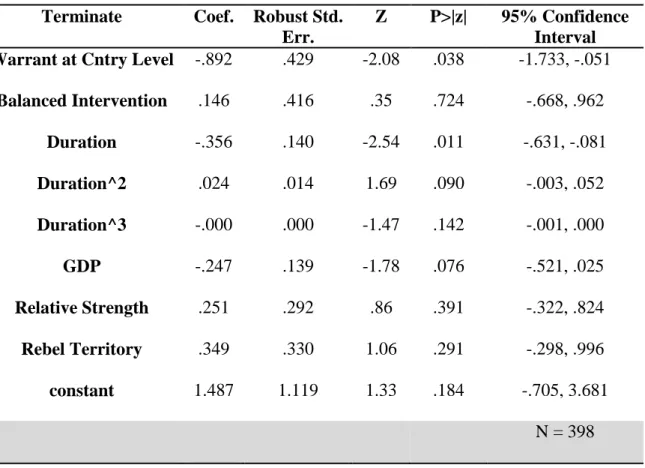
I also tried substituting warrants at the dyad level with warrants at the country level and clustering around dyad i.d.. In this logit analysis, the coefficient for warrants at the country level was -.8923 with a statistically significant p-value of .038. Thus, as shown in Table 3, I was still able to – with 95% confidence – reject the null hypothesis that ICC arrest warrants did not have an impact on conflict termination.
Terminate Coef. Robust Std.
Err.
Z P>|z| 95% Confidence
Interval
Warrant at Cntry Level -.892 .429 -2.08 .038 -1.733, -.051
Balanced Intervention .146 .416 .35 .724 -.668, .962
Duration -.356 .140 -2.54 .011 -.631, -.081
Duration^2 .024 .014 1.69 .090 -.003, .052
Duration^3 -.000 .000 -1.47 .142 -.001, .000
GDP -.247 .139 -1.78 .076 -.521, .025
Relative Strength .251 .292 .86 .391 -.322, .824
Rebel Territory .349 .330 1.06 .291 -.298, .996
constant 1.487 1.119 1.33 .184 -.705, 3.681
N = 398
Additionally, I deliberately excluded many variables such as ICC involvement at the dyad level or ICC involvement at the country level because of multicollinearity. I assumed that an arrest warrant would not be present at the dyad level or the country level if the ICC was not involved at the dyad or country level. Accordingly, including both Table 3: Logit model clustering around dyad i.d. rather than country code
variables increased the standard errors which in turn increased the p-values as it was difficult to tell which variable was having which effect due to the overlap.
Some weaknesses of the model include the inability to test my exact dependent variable (i.e. termination due to a peace process resolution rather than any termination), the dependency of the observations (although this was controlled for), and the relatively small sample size. However, my findings were significant even when controlling the relative strength of side b, time, the financial opportunity of the war, the impact of third party intervention, and dependency of the observations around country groupings which allows me to be confident in my conclusions.
Based on this data analysis, I find that ICC warrants are negatively correlated with conflict termination. However, I would like to attempt to move beyond just correlation, and see if I can find a causal link for ICC arrest warrants preventing or prolonging
conflict termination. Thus, I will use a case illustration to perform an in-depth analysis of one of the data points included in Prorok’s database – the case against the Lord’s
Resistance Army in Uganda. I will apply my theory to the actual reality of the situation in the Uganda to see if I can logically trace the lack of a successful peace process resolution to the arrest warrants served by the ICC.
Part Four: Case Illustration
As stated, for my case illustration, I have selected the Juba Peace talks of 2006-2008 in which the participating parties were the government of Uganda (led by President Museveni) and the Lord’s Resistance Army (led by Joseph Kony). In addition to being a data point in Prorok’s database, the peace process for this case was well documented with
reflections and updates on the process; thus, a lot of resources are available for analysis. Concerning these talks, a local leader, Father Carlose Rodriguez of the Acholi Religious Leaders’ Peace Initiative, stated, “Obviously, nobody can convince the leaders of a rebel
movement to come to the negotiating table and at the same time tell them that they will appear in courts to be prosecuted” (Branch 2009, 183). Clearly, these talks exhibit the
relationship between peace and justice that I want to examine.
President Yoweri Museveni came to power in January 1986 after fighting the Uganda National Liberation Army (UNLA) (Allen 2005, 10). In response to the conflict following Museveni’s rise to power, many “nebi” – people who claimed to have been
endowed with power from spirits – began to emerge (Allen 2005, 11-13). The largest cult developed around a woman named Alice Lakenwa, and she created The Holy Spirit Movement (HSM). In October 1987 the HSM was defeated by Museveni’s forces, the National Resistance Army (NRA) (Allen 2005, 13-15).
While the HSM was active, Joseph Kony claimed that he was Alice’s cousin and
that he was possessed by spirits too (Allen 2005, 16). While Alice recruited in Kitgum, Kony recruited followers in Gulu. In 1988, Museveni signed a peace agreement with leaders of the Ugandan People’s Democratic Army (UPDA). UPDA forces that were unwilling to surrender joined Kony (Allen 2005, 16). Kony named his movement the Lord’s Resistance Army (LRA). Since 1988, the LRA has been engaged in a guerilla
campaign against the government of Uganda (Allen 2005, 17). The LRA has engaged in “massacres, maimings, and the forced recruitment of thousands of Acholi” (Branch 2007,
In 1991, the government launched Operation North, an intense insurgency attempting to end the conflict. The LRA responded aggressively and hundreds were killed (Allen 2005, 20). However, despite the conflict of Operation North, in 1994 Bigombe was able to engage the LRA and, during peace talks, arranged a cease fire (Branch 2005, 20). Ultimately, the peace talks ended when Museveni issued a seven day ultimatum to the LRA requiring them to turn themselves over to the government (Allen 2005, 21). Then, in the mid-1990s, the Sudanese Government provided support to the LRA in return for the LRA assisting Sudanese President Omar Al Bashir in fighting the Sudan People’s Liberation Army (SPLA) (Allen 2005, 21). Following this new support,
in 1996, the LRA agreed to ceasefire and offered a permanent ceasefire if Museveni was not reelected (Allen 2005, 22).
In 2000, the Uganda Amnesty Act was created (Allen 2005, 32) at the request of the Acholi people – those most impacted by the violence (Branch 2007, 184). They lobbied for the creation of the Act because, according to Branch, they understood “that the war [would] not end until the LRA leadership abandon[ed] the rebellion” and wanted to provide an incentive for them to do so (2007, 184). In 2002, Museveni launched Operation Iron Fist in which the Ugandan Army, renamed to the Uganda Peoples
Defence Force (UPDF) partnered with the SPLA to eliminate the LRA (Allen 2005, 22).
In 2003, President Museveni referred “the Situation Concerning the Lord’s Resistance Army” to the ICC. The Ugandan government explained,
“Having exhausted every other means of bringing an end to this terrible suffering,
global justice. Uganda pledges its full cooperation to the Prosecutor in the investigation and prosecution of LRA crimes, achievement of which is vital not only for the future progress of the nation, but also for the suppression of the most serious crimes of concern to the international community as a whole” (Branch
2007, 182-183).
In July 2004 the Office of the Prosecutor officially opened an investigation and in
October 2005 arrest warrants were issued against Joseph Kony and four top commanders of the Lord’s Resistance Army. They were charged with both war crimes and crimes
against humanity (Branch 2007, 179). These arrest warrants overruled the Uganda Amnesty Act (Branch 2007, 184). Also in 2004, Museveni launched a second Iron Fist offensive (Allen 2005, 23).
Adam Branch argues that the government of Uganda was set to gain from ICC intervention. By labeling his opponent as a criminal, Museveni was able to legitimize his side of the war, and use the ICC for his own benefit (Branch 2007, 183). Nouwen (2012) emphasized the importance of referring the “situation regarding the LRA” and not the “situation in Uganda” (176). Branch explains that this referral was on purpose; Museveni
The reactions to the arrest warrants were highly polarized. Many celebrated the ICC’s involvement and supported the ending of impunity for Kony to achieve “justice”.
However, many Ugandans, especially the leaders of the Acholi Religious Leaders Peace Initiative, were outspoken in condemning the warrants (Allen 2005 42-43). Father Carlos Rodriguez stated, “The issuing… of international arrest warrants would practically close once and for all the path to peaceful negotiation as a means to end this long war…”
(Allen 2005, 43). Even Ugandan government officials, such as the Amnesty Commission spokesperson, recognized that excluding Kony and other LRA leaders from the Amnesty Act would make ending the war more difficult (Allen 2005, 43). Allen (2005) conducted a group interview with people at Awere IDP camp. One man stated, “The ICC is going to
make the war continue because those commanders who will be willing to come back will be discouraged and continue fighting” (50-51).
Surprisingly, however, only a few months after the arrest warrants were issued, the LRA agreed to enter into peace talks with the Ugandan government. Thus, the Juba Peace talks began in 2006 (Nouwen 2012, 180). Many advocates for the ICC claimed that the arrest warrants served as the catalyst that brought Kony to the negotiating table. Although perhaps the international pressure that an ICC arrest warrant carries is what spurred Kony to reach out, Nouwen (2012) argues that perhaps the effect was less direct. Nouwen points to the fact that the ICC’s arrest warrants caused the government of Sudan
actors will follow the incentives that help them to survive. Thus, for Kony, agreeing to participate in peace negotiations could have been an attempt to temporarily survive.
The Juba Peace talks officially began on July 16, 2006 (Machar 2008, 1). In analyzing these peace talks, I assume that, despite the fact that Kony claims to be
possessed by a spirit, Kony is a rational actor who can respond predictably to incentives. This is assumption backed by Tim Allen, who in an interview on July 7, 2012, explained that he has personally met with Kony. Allen (2005) points to the LRA’s political agenda
to suggest that this movement is motivated by more than just the voice of a religious spirit. Allen names ten political demands that Kony and the LRA have publicized through manifestos and pamphlets (19). Examples of these political goals include “education for all” and “relocation of Uganda’s administrative capital to Kigumba in Masindi District”
(Allen 2005, 19). Allen also suggests that Kony’s use of the “spirits” has been
purposeful; “terror has been a strategy of choice” (20). In this paper, I assume that Allen is correct; Kony is not just a deranged lunatic who hears voices from “spirits” but rather
makes deliberate choices – such as killing LRA members in front of other LRA members or by claiming to be possessed by spirits to instill fear in his troops and thus command them.
In an interview between Allen and a young LRA soldier who had escaped, the LRA soldier describes rational, intentional decisions by Kony. He explains that “Kony
fears to come by himself (in reference to peace talks) so he would rather send his
concrete examples as to why he (Kony) did not trust the government’s intention, such as
the 2002 peace deal (Allen 2005, 35).
For the Juba Peace talks, Riek Machar was mutually agreed upon to be the chief mediator (Hendrickson and Tumutegyereize 2012, 6). Machar (2008) explained that representation for the LRA was a challenge from the start as Kony and other LRA leaders refused to go to Juba in person because of the ICC arrest warrants. Thus, they sent
representatives on their behalf or communicated through phone or planned visits outside of the Juba Peace talks (2). Because the arrest warrants challenged Kony and Museveni’s ability to communicate, it was difficult for Kony and Museveni to make clear to each other what their individual bargaining models looked like.
However, despite the communication challenge, six agenda items were discussed, and official agreements were signed. These agreements included: agreement on cessation of hostilities, agreement on comprehensive solutions, agreement on accountability and reconciliation, agreement on a permanent ceasefire, agreement on disarmament, demobilization, and reintegration, and agreement on implementation and monitoring mechanisms (Machar 2008, 2). The fact that these agreements were reached implies that Kony and Museveni did have overlapping bargaining ranges resulting in a bargaining model in which they could find places of agreement. Figure 7 illustrates this model.
For example, in the agreement on accountability and reconciliation, it was agreed that the LRA would be removed from the list of Terrorist Organizations upon disarmament by the
Figure 7: Bargaining Range for Museveni and Kony
Museveni Outcomes Kony and Museveni would both agree to Kony
LRA (“Agreement on Accountability and Reconciliation” 2007, 10). It was also agreed
that the government of Uganda would develop new legislation providing for alternative penalties and sanctions for human rights violations committed by non-state actors
(“Agreement on Accountability and Reconciliation” 2007, 7). Thus, there were items that
Kony and Museveni could agree to in principle that they favored over the continuation of war.
However, Kony and Museveni were not the only actors in the Juba Peace talks. The ICC – through the arrest warrants – acted an external actor. Thus, Figure 8 represents the true bargaining range for the Juba Peace talks.
In this bargaining model, the ICC imposes a set preference outside of the organic bargaining range that exists between Kony and Museveni. This models assumes: 1) that the ICC will not accept a deal that does not include prosecution by the ICC; 2) that Museveni would be willing to accept either outcome (prosecution by the ICC or amnesty); and 3) that Kony will not accept any deal that results in prosecution by the ICC.
The ICC has made a clear signal to Uganda and the international community that they are not willing to accept any deal in which they do not prosecute Kony and the other LRA commanders facing ICC arrest warrants. As Ginsburg (2008) explained, the ICC – as a new institution – is currently trying to build its own credibility. The ICC needs to Figure 8: Bargaining Model for Museveni, Kony, and the ICC
Actor A Outcomes Kony and Museveni would both agree to Actor B
P1+b
P1-a ICC
signal to the world that it is a court with “a role to play” (510). ICC Prosecutor Moreno Ocampo has explained “that he regularly obtains communications from states, NGOs,
and parties to various conflicts asking him to refrain from initiating prosecutions so that a peace deal can be worked out” (Ginsburg 2008, 509). However, despite these
communications, Prosecutor Ocampo has stated, “I apply the law without political
consideration. But the other actors have to adjust to the law.” (Nouwen and Werner 2010, 942). As the first case initiated by the ICC, and considering the fact that the ICC is still pursuing the charges, it seems unlikely that the ICC – which is still trying to build its credibility – would be willing to accept an outcome where they do not prosecute Kony. Thus, I assume that the location of the ICC’s preferences in Figure 8 is in fact reflective of the situation in Juba.
Although the ICC would not accept any deal which does not involve prosecution, it is likely that Museveni would be willing to accept either amnesty or prosecution. Because Museveni referred the situation to the ICC, it is easy to conclude that he will be willing to accept prosecution (assuming that he does understand the role and functions of the ICC). As examined earlier, Branch (2007) argues that Museveni referred the situation to justify a military end to the war (185-186). As a military solution would end with prosecution, there is support for this assumption.
Kony that giving himself up was in his interest – a game that necessitated taking the real talks outside the formal Juba framework” (12). In an interview, Tumutegyereize and colleague Caesar Poblicks, explained that informal negotiations began to occur outside of the public negotiations. These informal negotiations were composed of a small team of Kony and Museveni’s most trusted advisors and focused on finding a solution acceptable
to Kony. This was confirmed in the reflections by Tumutegyereize and Hendrickson (2012) as they explained that Museveni began to communicate directly with Kony over the phone about Kony’s personal situation to find a resolution (24). Thus, the fact that
Museveni discussed other options directly with Kony at the least implies that he was willing to consider another option than prosecution. Furthermore, Tumutegyereize and Hendrickson (2012) wrote that a “gentleman’s agreement” was in fact reached. In this agreement, the Ugandan government would ask the United Nation’s Security Council to suspend the ICC’s involvement. In return for the suspension, the government of Uganda would create a Special Court to try Kony. Kony would be “imprisoned” in Uganda but he would maintain some freedoms and be spared “the humiliation of formal incarceration”
(24). While it is clear this agreement ultimately failed, it does show that Museveni was willing to accept some version of amnesty. Thus, it is reasonable to conclude that Museveni was willing to accept anything to the right of p1-a in Figure 7.
Museveni developed. However, Hendrickson and Tumutegyereize (2012) commented that these negotiations fell apart because Kony refused to sign any agreement without the ICC arrest warrants being dropped first (24). In explaining this refusal to sign, Kony has referenced Charles Taylor, the former Liberian president who was promised asylum and ultimately prosecuted by the Special Court for Sierra Leone (Nouwen 2012, 181). Thus, Kony is aware and hesitant of promises of amnesty without credible proof; consequently, Kony is unwilling to accept any deal that does not satisfactorily convince him he would not be prosecuted by the ICC (i.e. any deal that he is not convinced is fully within the mutually agreeable range). Finally, this theory is supported by the fact that although the LRA delegation signed the different Juba Peace talk agreement, Kony has – to date – refused to sign the final document (Nouwen 2012, 181). As shown in the prisoner’s dilemma in Figure 1, without the promise of an amnesty, Kony’s dominant strategy was
to defect.
Based on the supporting evidence I conclude that the ICC is unwilling to accept a deal that does not include prosecution, that Museveni is willing to accept a deal with or without prosecution, and that Kony is unwilling to accept a deal that includes
prosecution. Accordingly, the model developed in my theory holds true in this case illustration.
Part Four: Conclusion
ICC intervenes. Currently, the literature has remained broad and theoretical, debating topics like the merits of ending impunity. This thesis hopes to contribute to and shift the dialogue in the peace versus justice debate by looking at the impact of the ICC arrest warrants on peace processes in the traditional two party bargaining model. By grounding my argument in bargaining model theory, I shift the discussion to predicting actors’ actions through game theory and incentives.
I theorized that the ICC imposes set preferences in the bargaining model between the two actors. Because I assume that Actor B (the accused Actor) is unwilling to accept a deal without an amnesty, and the ICC is unwilling to accept a deal with an amnesty, a peace agreement will not be able to be reached. In testing my theory, I found that ICC arrest warrants at the dyad level did have a statistically significant impact on conflict termination. In line with my prediction, this impact was negative, meaning that ICC arrest warrants did decrease the probability of conflict termination. Additionally, I applied my theory to the case study of Uganda and found that my assumptions were supported by the events that occurred; Kony did not sign a peace agreement and he cited the ICC as the main reason why.
In an interview with Dapo Akende at Oxford University on June 14, 2012, it was pointed out that this research could be expanded by looking at the changing “landscape”
Appendix 1:
ICC Country Involvement
Currently, the ICC has cases open in seven different countries. The seven
countries where arrests have occurred are the Democratic Republic of Congo, the Central African Republic, Uganda, Sudan, Kenya, Libya, and the Cote d’Ivoire (“All Cases”).
The ICC initiated six arrest warrants against individuals from the Democratic Republic of the Congo (“All Cases). Although various peace processes have occurred
during the conflict within the Democratic Republic of the Congo, only one of the agreements involved one of the six individuals indicted by the ICC after the arrest
warrants had been confirmed. Bosco Ntaganda was involved in a peace agreement signed on March 23, 2009 (almost three years after his ICC arrest warrant was issued). This peace agreement – signed by the government and by leaders of the National Congress for the Defense of the People (CNDP) – incorporated the CNDP rebels into the Congolese army and Ntaganda was promoted to the role of general in the army. Ntaganda defected by forming a new rebel group, M23, named for the peace agreement he defected from (Human Rights Watch 2013, 1).
Initially, the ICC issued one arrest warrant in the Central African Republic for Jean-Pierre Bemba Gombo (“All Cases”). He was arrested by the Belgian authorities on the same day that Pre-Trial Chamber III issued the arrest warrant (“Central African Republic”). Since that time, a second case has been opened with arrest warrants for
In Uganda, the ICC issued five arrest warrants for top leaders in the Lord’s Resistance Army (LRA) (“All Cases”). After the issuance, a major peace process – the
Juba Peace Talks – began between the LRA and the Uganda. Ultimately, the LRA’s top commander, Joseph Kony, failed to sign the peace agreement.
In Sudan, the ICC issued charges for Ahmad Muhammad Harun, Ali Muhammad Ali Abd-Al-Rahman, Omar Hassan Ahmad Al Bashir, Abdel Raheem Muhammad Hussein, Bahar Idriss Abu Garda, and Abdallah Banda Abakaer Nourain (“All Cases”). As president of Sudan, Omar Al Bashir has been involved in many peace processes. For example, in 2011, the Government of Sudan signed the “Doha Document for Peace in Darfur” with Liberation and Justice Movement leaders (such as Bahar Abu Garda who is
also facing ICC arrest warrants) which established the framework for a comprehensive peace process in Darfur (UNAMID) (“Signing of Doha Agreement prompts mixed reactions”). However, it is important to note that none of the peace processes Bashir has
engaged in call for him to step down from office and that much of the violence in Sudan is still ongoing.
In Kenya, the ICC is pursuing charges against William Samoei Ruto, Joshus Arap Sang, Uhur Muigai Kenyatta, and Walter Osapiri Barasa (“Kenya”). The peace deal ending the violence in Kenya was signed in 2008 (Gettleman 2008); thus, a peace agreement was reached before ICC arrest warrants were issued.
In Libya, the ICC issued three arrest warrants (“All Cases”). A peace agreement
leaders insisted that Gaddafi and his sons be removed from power (“What peace deal?”
2011).
Appendix 2: Conflicts included in Prorok’s dataset (2013)
Conflict ID Years Included Side B Country
191 2002-2003 GIA Algeria
191 2002-2010 AQIM Algeria
131 2002 UNITA Angola, Namibia
90 2002-2003 CNDD-FDD Burundi
90 2002-2008 Palipehutu-FNL Burundi
91 2002 MDJT Chad
214 2002 Ntsiloulous Congo-Brazzaville,
Angola, Chad
133 2002-2010 ONLF Ethiopia
219 2002-2010 OLF Ethiopia
225 2002 MPCI Cote D’Ivoire
225 2002-2003 MPIGO Cote D’Ivoire
146 2002-2003 LURD Liberia
179 2002 Opposition Rwanda
179 2009-2010 FDLR Rwanda
180 2002-2003 MFDC Senegal
118 2002-2010 LRA Uganda
192 2002-2009 FLEC-FAC Angola
192 2002 FLEC Angola
141 2002 SRRC Somalia
10 2002-2010 Communist Philippines
95 2007-2010 Sendero Peru
92 2002-2010 FARC Colombia
112 2002-2010 MILF Philippines
157 2002-2009 LTTE Sri Lanka
225 2002-2003 MJP Cote D’Ivoire
112 2002-2010 Abu Philippines
112 2002 MNLF Philippines
139 2002-2006 NLFT India
222 2002 Faction Central African Republic,
Libya
170 2002-2010 ULFA India
198 2004 Republic Georgia
198 2008 Republic Georgia
227 2002-2004 BDSF/NDFB India
152 2004-2006 PLA India
137 2003-2010 Taliban Afghanistan
159 2002-2010 PKK/Kadek Turkey
152 2002-2009 UNLF India
92 2002-2010 ELN Colombia
92 2004 EPL Colombia
171 2002-2005 GAM Indonesia
72 2002-2006 CPN-M/UPF Nepal
146 2003 MODEL Liberia
169 2002-2010 Kashmir India
224 2002-2010 Al-Qaida USA, Australia, France,
Germany, Italy, Japan, Jordan, Netherlands, Poland
193 2005 Republic Azerbaijan
37 2002-2007 Fatah Israel
37 2002-2010 PIJ Israel
37 2002-2010 Hamas Israel
29 2002-2004 Naxalites/PWG India
29 2002-2004 MCC India
137 2008-2010 Hezb-i-Islami Afghanistan
37 2002-2004 AMB Israel
37 2002 PNA Israel
113 2003-2010 SLM/A Sudan
113 2003-2010 JEM Sudan
130 2003 EIJM Eritrea
225 2004 FN Cote D’Ivoire
186 2004 FLRN Haiti
186 2004 OP Haiti
62 2004-2008 Al-Mahdi Iraq
62 2004-2007 Ansar iraq
221 2004 JIG Uzbekistan
249 2004 Ahlul Nigeria
62 2004-2010 ISI/Jama’at Iraq
29 2005-2010 CPI-Maoist India
54 2005-2007 NSCN India
91 2005-2005 FUCD Chad
188 2005 MKP Turkey
143 2005-2010 PJAK Iran
248 2003-2010 Patani Thailand
250 2004 NDPVF Nigeria
62 2005-2007 RJF/Al-Jaysh Iraq
222 2006 UFDR Central African Republic
37 2006 Popular Israel
113 2006 NRF Sudan
113 2006 SLM/A Sudan
141 2006-2008 ARS/UIC Somalia
91 2006 RAFD Chad
91 2006-2007 UFDD Chad
129 2005-2006 Baluch Pakistan
129 2004-2010 BLA/Baluchistan Pakistan
143 2006-2010 Jondullah Iran
251 2006 Hezbollah Israel
86 2006-2008 CNDP Democratic Republic of
Congo
112 2007 MNLF Philippines
113 2007-2008 SLM/A-Unity Sudan
177 2007-2009 ATNMC Mali
254 2007-2008 BDK Democratic Republic of
Congo
209 2007 TNSM Pakistan
255 2007-2008 MNJ Niger
152 2008-2009 KCP India
258 2008 DHD India
152 2008-2009 PREPAK India
91 2008 AN Chad
209 2008-2010 TTP Pakistan
141 2008-2010 Al-Shabaab Somalia
141 2008 Harakat Somalia
259 2008 PULF India
257 2007-2010 Forces Russia
129 2008-2009 BRA/Baluchistan Pakistan
222 2009-2010 CPJP Central African Republic
91 2009 UFR Chad
33 2009-2010 AQAP Yemen
227 2009-2010 NDFB India
100 2009-2010 Boko Nigeria
141 2009-2010 Hizbul-Islam Somalia
267 2010 AQIM Mauritania
91 2010 PFNR Chad
113 2010 Forces Sudan
Works Cited Akende, Dapo. Personal Interview. 14 June 2012. Allen, Tim. Personal Interview. 7 July 2012.
Allen, Tim. 2005. "War and Justice in Northern Uganda: An Assessment of the
International Criminal Court's Intervention." Independent Report. Draft. London School of Economics, 2005
Branch, Adam. 2007. “Uganda’s Civil War and the Politics of ICC Intervention.”
Ethics & International Affairs 21 (2): 179-198.
Carter, David B. and Curtis S. Signorino. 2010. “Back to the Future: Modeling Time Dependence in Binary Data.” Political Analysis 18:271-292.
Collier, Paul and Anke Hoeffler. 2002. Greed and Grievance in Civil War. CSAE WPS/2002-01. http://economics.ouls.ox.ac.uk/12055/1/2002-01text.pdf
i
Cunningham, David E., Kristian Skrede Gleditsch, and Idean Salehyan. “Codebook for the Non-State Actor Data.” Version 3.3 (24 January 2012).
http://privatewww.essex.ac.uk/~ksg/data/NSAEX_codebook.pdf
Daily Mail Reporter. "What peace deal? Gaddafi's troops batter rebel city despite dictator 'accepting ceasefire'." Last modified April 11, 2011. Accessed November 30, 2013. http://www.dailymail.co.uk/news/article-
1375584/Libya-ceasefire-Gaddafi-agrees-deal-end-bloodshed-says-Jacob- Zuma.html.
Frieden, Jeffry A., David A. Lake, and Kenneth A. Schultz. World Politics: Interests, Interactions, Institutions. New York: W. W. Norton & Company, Inc, 2010. Gettleman, Jeffrey. The New York Times, "Kenya Rivals Reach Peace Agreement." Last
modified February 29, 2008. Accessed November 30, 2013.
http://www.nytimes.com/2008/02/29/world/africa/29kenya.html?pagewanted=all &_r=1&.
Ginsburg, Tom. 2009. “The Clash of Commitments at the International Criminal Court.”
Chicago Journal of International Law 9 (1): 499-685.
Hall, Christopher. Personal Interview. 8 June 2012. Amnesty International, London, UK. Hendrickson, Dylan, and Kennedy Tumutegyereize. Dealing with complexity in peace
Human Rights Watch, "World Report: Democratic Republic of Congo." Last modified 2013. Accessed October 22, 2013.
http://www.hrw.org/world-report/2013/country-chapters/democratic-republic-congo?page=1. International Criminal Court, “About the Court.” Accessed January 2014.
http://www.icc-cpi.int/en_menus/icc/about%20the%20court/Pages/about%20the%20court.aspx International Criminal Court, “All Cases.” Accessed November 2013.
http://www.icc-cpi.int/en_menus/icc/situations%20and%20cases/cases/Pages/cases%20index.asp x
International Criminal Court, “Central African Republic.” Accessed April 9 2014.
http://www.icc-cpi.int/en_menus/icc/situations%20and%20cases/situations/
situation%20icc%200105/Pages/central%20african%20republic.aspx
International Criminal Court, “Kenya.” Accessed November 2013.
http://www.icc-cpi.int/en_menus/icc/situations%20and%20cases/situations/ situation%20icc%200109/Pages/situation%20index.aspx
International Criminal Court, "Rome Statute of the International Ciminal Court." Last modified January 16, 2002. Accessed December 2, 2013. http://www.icc-
cpi.int/NR/rdonlyres/EA9AEFF7-5752-4F84-BE94-0A655EB30E16/0/Rome_Statute_English.pdf.
Juba Agenda Item No. 3 Agreement, "Agreement on Accountability and Reconciliation." Last modified June 29, 2007. Accessed December 1, 2013.
http://www.beyondjuba.org/BJP1/peace_agreements/Agreement_on_Accountabili ty_And_Reconcilition.pdf.
Machar, Riek. "Report and Recommendations of the Chief Mediator of the Peace Process Between the Government of the Republic of Uganda and the Lord's Resistance Army." Last modified June 16, 2008. Accessed November 30, 2013.
http://www.beyondjuba.org/BJP1/peace_agreements/Machar_Report_1.pdf. Nouwen, Sarah M. H. and Wouter G. Werner. 2010. “Doing Justice to the Political:
The International Criminal Court in Uganda and Sudan. ” The European Journal of International Law 21. 4 (2010): 941-965.
Africa?” In Peacebuilding, Power, and Politics in Africa. eds. Devon Curtis and Gwinyayi A. Dzinesa. Athens: Ohio University Press, 171-192.
Poblicks, Caesar and Kennedy Tumutegyereize. Personal Interview. 2 July 2012. Conciliation Resources, London, UK.
ii
Prorok, Alyssa K. 2013. “The (In)compatibility of Peace and Justice? The International Criminal Court and Civil Conflict Termination.” Presentation, Peace
Science Society Conference, October 25, 2013.
Prorok, Alyssa K. 2014. “Variable List.” Emailed on 19 January 2014.
RadioDabanga, "Signing of Doha Agreement prompts mixed reactions." Accessed November 2013. https://www.radiodabanga.org/node/16328.
Schabas, William A. 2011. An Introduction to the International Criminal Court. Fourth Edition. Cambridge: Cambridge University Press.
Scharf, Michael. 1999. “The Amnesty Exception to the Jurisdiction of the International Criminal Court.” Cornell International Law Journal 32 (3): 507-535.
Simmons, Beth A. and Allison Danner. 2010. “Credible Commitments and the International Criminal Court.” International Organization 64 (02): 225-256.
iiiThemner, Lotta. 2013. “UCDP/PRIO Armed Conflict Dataset Codebook.” Uppsala
Conflict Data Program. Center for the Study of Civil Wars, International Peace Research Institute, Oslo (PRIO). Version 4-2013.
http://www.pcr.uu.se/digitalAssets/167/167198_codebook_ucdp_prio-armed-conflict-dataset-v4_2013.pdf
UNAMID, “Doha Document For Peace in Darfur.” Accessed October 23, 2013. http://unamid.unmissions.org/Default.aspx?tabid=11060
Walter, Barbara F. 2009. “Bargaining Failures and Civil War.” Annual Review of Political Science 12: 243-261.
i
Citation for data (only codebook was used): Cunningham, David E.; Kristian Skrede Gleditsch, & Idean
Salehyan. 2009. "It Takes Two: A Dyadic Analysis of Civil War Duration and Outcome", Journal of
Conflict Resolution 53 (4): 570-597.
ii Because Prorok has not yet published her data, this was the citation used for her data (when it was
presented) iii