Emma K. Evans. Semantic Interoperability of Moving Image Records in Aggregating Digital Repositories: A Comparative Study of Dublin Core and PBCore Descriptive Metadata Schemas. A Master’s Paper for the M.S. in L.S degree. April, 2019. 44 pages. Advisor: Melanie Feinberg
This study examines the Dublin Core and PBCore metadata schemas as they are applied to publicly-accessible moving image records in four aggregating digital repositories. This research was conducted to determine which schema is optimal for moving image
description based on the schemas’ level of semantic interoperability. In the context of this analysis, semantic interoperability is defined as the complete and consistent interpretation of elements across records.
Twenty-five records were sourced from each repository. Each record was mapped to the metadata schema employed by its repository. The selected records and their crosswalks were then analyzed for completeness and consistency. Upon comparing the analyses of the Dublin Core-based records and the PBCore-based records respectively, it can be determined that both schemas face interoperability issues in the description of moving image records. Thus, optimality of a particular schema for moving image description must be discerned within the context of each particular use.
Headings:
Metadata Mapping
Dublin Core
PBCore
Cataloging of Motion Pictures
Cataloging of Audiovisual Materials
SEMANTIC INTEROPERABILITY OF MOVING IMAGE RECORDS IN AGGREGATING DIGITAL REPOSITORIES: A COMPARATIVE ANALYSIS OF
DUBLIN CORE AND PBCORE DESCRIPTIVE METADATA SCHEMAS
by Emma K. Evans
A Master’s paper submitted to the faculty of the School of Information and Library Science of the University of North Carolina at Chapel Hill
in partial fulfillment of the requirements for the degree of Master of Science in
Library Science.
Chapel Hill, North Carolina April 2019
Approved by
TABLE OF CONTENTS
Introduction ... 3
Literature Review... 6
The Challenges of Audiovisual Description and the Profession’s Response... 6
Current Metadata Standards for Describing Audiovisual Collections ... 8
Dublin Core ... 9
PBCore... 10
The Importance of Interoperable Schemas for Moving Image Collection Records ... 10
Methodology ... 13
Selection of Institutional Sample ... 14
Dublin Core-based Institutions ... 14
PBCore-based Institutions ... 15
Selection of Record Sample ... 16
Element Analysis... 17
Dublin Core Elements Analyzed ... 17
PBCore Elements Analyzed ... 18
Data Compilation ... 22
Table 1 ... 22
Interoperability Criteria ... 23
Results ... 24
Dublin Core-based Institutional Records ... 24
Table 2 ... 24
Table 3 ... 25
Mountain West Digital Library Record Analysis ... 26
Completeness ... 26
Consistency ... 26
Table 4 ... 27
Completeness ... 28
Consistency ... 28
Table 5 ... 29
Analysis of Dublin Core as a whole ... 30
PBCore-based Institutional Records ... 30
Table 6 ... 31
Table 7 ... 32
California Revealed Record Analysis ... 33
Completeness ... 33
Consistency ... 34
Table 8 ... 34
Table 9 ... 34
WGBH Open Vault Record Analysis ... 35
Completeness ... 35
Consistency ... 36
Analysis of PBCore as a whole ... 36
Comparison of Dublin Core and PBCore Semantic Interoperability ... 37
Conclusion ... 39
Introduction
In recent years, many archives and cultural heritage institutions have opted to digitize and
provide online access to their film and video collections. While the digitization of these
materials is often intended as an act of preservation and access in and of itself, many
institutions choose to partner with large digital repositories to make these audiovisual
collections accessible to a wider audience. For these projects and partnerships to be
successful, however, appropriate metadata must be supplied with the audiovisual objects.
Though many types of metadata are used to contextualize audiovisual objects, descriptive
metadata is especially useful for record discovery and identification. Descriptive
metadata schemas from standards such as Dublin Core have proven effective in the description of digital film and video records, as asserted in Weagley, Gelches, and Park’s
2010 article “Interoperability and Metadata Quality in Digital Video Repositories: A
Study of Dublin Core.” However, several metadata standards have been created to
accommodate for the description of digital moving images, including PBCore, the
audiovisual-specific Public Broadcasting Metadata Dictionary Project.
The success of these schemas can be evaluated and compared according to a number of
factors, including their semantic interoperability. In the context of this study, semantic
across records that are created using the same descriptive schema. The complete and
consistent interpretation of metadata elements provides better record description overall,
as it allows for the information to be identified and shared more efficiently and facilitates
the interconnection of records from multiple sources across subject areas (Llanes-Padrón
& Pastor-Sánchez, 2017).
In order to conduct further research regarding the semantic interoperability of these
schemas, I initially explore current practices and forming issues in audiovisual collection
description. Then I analyze the descriptive schemas of the Dublin Core and PBCore
metadata standards used to describe moving image records in aggregating digital
repositories. Finally, I look at the ways in which interoperability has been studied in the
context of moving image descriptive metadata and why semantic interoperability has
evolved into a necessary feature of these metadata standards. After a thorough analysis of
current research, I then conduct my own research with a goal of answering the following
research questions:
1. How do aggregating digital repositories’ descriptions of moving images
created with Dublin Core interpret the Dublin Core elements in their
publicly available records?
2. How do aggregating digital repositories’ descriptions of moving images
created with PBCore interpret the PBCore elements in their publicly
3. How semantically interoperable are the element sets among records in
repositories that base their moving image collection description on the
Dublin Core standard?
4. How semantically interoperable are the element sets among records in
repositories that base their moving image collection description on the
PBCore standard?
5. Which schema is more optimal for moving image description currently
Literature Review
This literature review analyzes current description practices specific to audiovisual
collections, the history and use of Dublin Core and PBCore standards, and the importance of interoperability of these schemas for digital film and video collecting institutions. This information will place the following research study in context.
The Challenges of Audiovisual Description and the Profession’s Response
The description of audiovisual materials has always been much different than the
description of bibliographic materials. A cataloger cannot look directly at an audiovisual object and determine all the information stored within the object. Audiovisual materials are equipment dependent -- in order to hear or view the information present on
According to Matusiak and Johnston, digitization is now considered to a be a popular,
key preservation strategy for audiovisual collections. Furthermore, they argue that
“metadata creation represent[s] a significant part of the digitization...to provide access
points...and to extend [audiovisual objects’] usefulness as information resources”
(Matusiak & Johnston, 2014). The rush to digitize audiovisual materials and create object
metadata has catalyzed the development of the audiovisual archives field. This
development includes an increase in audiovisual archivist jobs, professional development
programs, funding opportunities, and the development of metadata standards for
audiovisual collections (Real, 2013; Dirig, 2011).
In light of the success of many audiovisual digitization and preservation efforts, some
institutions have sought to expand access to these collections. One way in which
institutions have provided collection access to a wider audience is by making their
collections available in digital repositories that aggregate records from multiple
institutions into one online catalog. Aggregating digital repositories have served as a way
to expand access to text materials for a number of years. However, the aggregation of
digitized or digital film and video records comes with a unique set of obstacles, as “the
metadata required by these materials is quite distinct from that of digitized text [and] little
work has been done on direct experiences with applying [audiovisual] standards to digital
library collections” (Clair, 2008). Nevertheless, further analysis of the some of the
current standards provides some insight into the successes and failures of film and video
Current Metadata Standards for Describing Audiovisual Collections
The expansion of earlier metadata standards as well as the development of new ones has
greatly influenced the current description practices for moving image collections.
Standards have been introduced by a variety of institutions, and many professional
organizations concerned with audiovisual preservation have created brand new metadata
standards with archival description best practices in mind. Metadata standards that have
been created or expanded for audiovisual collections include but are not limited to
Multimedia Content Description Interface (MPEG-7), Metadata Object Description
Schema (MODS), Visual Resources Association (VRA) Core, and Audio Engineering
Society (AES) standard, among others.
In many cases, institutions have created their own metadata application profiles. An
application profile is defined by Heery and Patel as “[a] schema which consist[s] of data
elements drawn from one or more namespaces, combined together by implementers, and
optimized for a particular local application” (2000). The use of application profiles is
especially common in audiovisual archives, as formats and contents can be extremely
varied across collections. According to Clair, “dealing with collections in which the
materials contain a great diversity of forms or genres, or with audiovisual files of such a
duration that segmentation may be required for simple findability, unqualified Dublin
Core is no longer sufficient for descriptive purposes, and it becomes necessary to employ a more diverse set of metadata fields in each item record” (2008). Ultimately, metadata
application profiles allow audiovisual archives to best meet the description needs of their
Despite the variety of standards and institutional application profiles, some metadata
standards have remained or emerged as a top choice for audiovisual description. Two of
these predominantly-used metadata standards are the Dublin Core Metadata Initiative
(DCMI) -- usually referred to as simply “Dublin Core” -- and PBCore, or the Public
Broadcasting Metadata Dictionary Project.
Dublin Core
The Dublin Core element set is one of the most popular descriptive metadata schemas
used in the information and library science field today. The Dublin Core Metadata
Initiative is “an open organization supporting innovation in metadata design and best
practices across the metadata ecology” (“About the Dublin Core Metadata Initiative,”
n.d.). DCMI published its Dublin Core Metadata element set in 1998, and the 15 elements
in the unqualified descriptive schema eventually became ISO 15836. The elements are as
follows: Title, Creator, Subject, Description, Publisher, Contributor, Date, Type, Format,
Identifier, Source, Language, Relation, Coverage, and Rights. Since its conception, the
element set has been applied to a variety of different materials, including a variety of
audiovisual items. In recent years, archivists have used the element set to describe
audiovisual formats including but not limited to audio discs, audio reels, audio cassettes, compact discs, magnetic video, and digital video. In the article “Interoperability and
Metadata Quality in Digital Video Repositories: A Study of Dublin Core” Weagley,
Gelches and Park analyze the use of Dublin Core to describe digital moving image
objects, noting that “The Dublin Core metadata as harvested for [digital video]
ambiguities (2010). Although it is not audiovisual-specific in nature, its simplicity and
widespread use makes it a common choice among audiovisual archivists.
PBCore
PBCore was developed by the American Archive of Public Broadcasting in response to
the need for better metadata description for public broadcasting audiovisual materials in
the United States. Though initially developed as an application profile of Dublin Core,
the latest version of PBCore, PBCore 2.1, includes 82 elements with 49 XML attributes that “further qualify or describe the elements and their values” (PBCore Schema, n.d.). In
a 2009 case study on the development of a media content model for the WGBH Media
Library and Archives, institutional researchers determined that PBCore served as a better
descriptive metadata schema for their broadcasting collections, as Dublin Core “[lacked]
the precision and depth” needed for broadcasted content (Beer, Pinch, Cariani 2009).
Despite its targeted collection type, however, PBCore is not limited to public
broadcasting collections. Many audiovisual archivists outside of the realm of public
broadcasting use the PBCore element set due to its precision in both audiovisual-specific
elements and hierarchical structure.
The Importance of Interoperable Schemas for Moving Image Collection Records
When choosing a metadata standard to use or incorporate into an application profile for
audiovisual collections, many institutions choose the schema that will be the most
interoperable, or shareable across platforms and programs while retaining meaning.
access to multiple distributed and autonomous media repositories in domains such as
digital libraries or enterprise content management (2010). This demand has only
increased for audiovisual collections in recent years, apparent in the number of emerging
standards that promote institutional sharing of collection records.
Both audiovisual archivists and users often discover that the application of metadata can
be quite complex due to semantic interpretation. Despite intentions of standardizing
audiovisual description, some metadata schemas are not always implemented uniformly
across institutional records due to diverse custodial interpretation of metadata elements.
Furthermore, the rapid change in culture lends itself to eventual obsolescence of
description, creating a potential divergence between institutional interpretation and user
interpretation as well. Consequently, semantic interoperability, or the complete and
consistent interpretation of elements across records that are created using the same
descriptive schema, has become a main goal for metadata standards in recent years.
While the concepts can be interpreted in several ways, “complete” can be defined as a
having the elements to provide “ full access capacity to individual local objects,” and
“consistent” can be defined as “the degree to which the same data values or elements are
used for delivering similar concepts in the description of a resource” for the purposes of
this paper (Park 2009; Weagley et al., 2010). Both the Dublin Core and PBCore schemas
attempt to bridge these interpretation gaps in the name of semantic interoperability,
Semantically interoperable metadata is also key for user access of records.
Alipour-Hafezi et al. assert that “[the] goal of interoperability factually is to build coherent
services for users, from components that are technically different and managed by
different organizations” (2010). One of these technical differences is the variety of
metadata standards used by institutions in the front-end record intended for user access.
Aggregating repositories’ implementation of mandated metadata standards for all
institutions that contribute records to the repository is an attempt to build this coherence
and negate any confusion that users may have finding or comparing records across the
Methodology
For the purpose of my research, I conducted a content analysis of the metadata elements
and their values provided in the public-facing records of four different digital repositories
that aggregate digital film and video records. My methods are based on the research
methods outlined by Weagley, Gelches, and Park in their 2010 article “Interoperability
and Metadata Quality in Digital Video Repositories: A Study of Dublin Core.” In this
article, the authors study the interoperability of Dublin Core by analyzing records across
six repositories of varying sizes. For my research, I also study the interoperability of
Dublin Core-based records, but my analysis is only conducted across the records of two
large digital repositories that specifically aggregate digital film and video records from
other institutions. This sample gave me an updated view of the Dublin Core schema’s
semantic interoperability specific to aggregating institutions.
I further expanded upon Weagley, Gelches, and Park’s research methods by conducting
the same analysis on a set of PBCore-based records. These records were also sourced
from two large digital repositories that aggregate digital film and video records from
other institutions or broadcast partners. The inclusion of PBCore records in my research
allowed for a deeper analysis of the interoperability of this newer metadata standard
Core and PBCore-based records, I was able to make an informed comparison between the
two schemas in an effort to make suggestions on use based on semantic interoperability.
Selection of Institutional Sample
Regionally-based digital video repositories were chosen as the research sample based on
the public availability of records as well as the ability to clearly identify the descriptive
schema on which the item records are based. Identification of the repository’s chosen
metadata schema was confirmed with institutional reports available online. The exception
to this rule is the WGBH Archive. Since WGBH was used as a case study for PBCore
implementation upon the schema’s creation, it was assumed that WGBH records were
presented in PBCore.
Dublin Core-based Institutions
1. Mountain West Digital Library – Utah, USA
Mountain West Digital Library is an aggregated catalog with records from the Mountain
West region of the United States, namely Utah, Nevada, Idaho, Montana, Hawaii, and
other areas of the Western US. Formed in 2001, the library is a portal for “over 960,000
resources from universities, colleges, public libraries, museums, historical societies, and
government agencies, counties, and municipalities” (Mountain West Digital Library
Home page, n.d.). The website unifies records from approximately 79 partnering
institutions and puts them into one catalog in an effort to provide simplified access to the
Mountain West’s rich history. According to its 2011 application profile report, the digital
Library Dublin Core Application Profile, 2011). As of March 2019, the catalog indicates
that the repository has approximately 3,973 movie and animation records from 11
partnering institutions. These partners primarily consist of universities, community
colleges, and the Utah State Library.
2. South Carolina Digital Repository - South Carolina, USA
South Carolina Digital Repository is an aggregated repository that provides public access
to materials related to the history and culture of the state of South Carolina. Based at the
University of South Carolina, the repository aggregates digitized materials from
approximately 40 institutions. According to the repository’s “Metadata Schema and
Guidelines” report, the metadata schema for the repository is partially-based on the
Dublin Core Metadata Initiative in order to “ensure maximum interoperability of
descriptive materials across institutions throughout the state” (2016). As of March 2019,
the repository hosts approximately 560 digitized film and video materials from 6 different
institutions.
PBCore-based Institutions
1. California Revealed – California, USA
California Revealed is a state, National Endowment for the Humanities (NEH), and
Institution of Museum and Library Services (IMLS) co-funded program to digitize,
preserve, and provide access to California historical and cultural materials (California
Revealed - About, n.d.). Its partners include over 200 California libraries, archives, and
museums. One way California Revealed collection materials are made available to the
Metadata Guidelines for Audiovisual Objects,” PBCore is used as the metadata schema
for audiovisual objects (2018). As of March 2019, the project has provided access to
5,529 moving image materials via its partnership with the Internet Archive.
2. WGBH Media Library and Archives Open Vault - Massachusetts, USA
WGBH Broadcasting station went on the air in October 1951 and broadcasted its first
television show in May 1955. In order to save the historic legacy of WGBH
programming, WGBH formed an archive in 1979. The WGBH Media Library and Archives preserves and “makes WGBH’s historic materials accessible to producers,
scholars, researchers, educators, students, lifelong learners and the public” (“Media
Library and Archives - What We Do,” n.d.). The Media Library and Archives makes
digitized materials available in Open Vault, its online repository. Collections publicly
available in the repository are sourced from local PBS programming, the Boston TV
News Digital Library, WGBH stock sale materials, and the American Archive of Public
Broadcasting. As of March 2019, WGBH Library and Archives Open Vault provided
public access to video content from 22 different collecting areas from these four content
sources.
Selection of Record Sample
Records were deliberately selected from each aggregated repository in order to ensure
variety in the institutional source of the record as well as to ensure that each record would
have enough core metadata elements available for comparison. All records are in English
aggregating repository, resulting in fifty records being compared for semantic
interoperability within both descriptive schemas. One hundred records will be analyzed in
total. In order to avoid additional conflicts, all records selected were for film or video
records currently available for online viewing.
Element Analysis
Before determining the semantic interoperability of the elements in each record, I
determined the elements from the Dublin Core and PBCore schemas that I planned to
analyze for my research purposes. The elements and definitions subject to my analysis
are provided below.
Dublin Core Elements Analyzed
Like Weagley, Gelches, and Park, I analyzed the 15 unqualified Dublin Core elements as
defined by the Dublin Core Metadata Initiative. The descriptive elements and their
definition as provided by the DCMI Usage Board in 2012 are as follows:
- Contributor: An entity responsible for making contributions to the resource.
- Coverage: The spatial or temporal topic of the resource, the spatial applicability of the resource, or the jurisdiction under which the resource is relevant.
- Creator: An entity primarily responsible for making the resource.
- Date: A point or period of time associated with an event in the lifecycle of the resource.
- Description: An account of the resource.
- Format: The file format, physical medium, or dimensions of the resource.
- Language: A language of the resource.
- Publisher: An entity responsible for making the resource available.
- Relation: A related resource.
- Rights:Information about rights held in and over the resource.
- Source: A related resource from which the described resource is derived.
- Subject: The topic of the resource.
- Title: A name given to the resource.
- Type: The nature or genre of the resource.
I used these definitions to identify the values provided in each record analyzed for this
research. In the case of some records, not all values matching these definitions were assigned to an element. For example, a “name given to the resource” was clearly
identified at the top of the record, but it was not specifically labeled as “Title.” In such
instances, I inferred that the value was a Title element. Furthermore, in instances where
an element listed on the record did not have an associated value that aligned with the
DCMI definition, I made the decision to disregard the element. For example, some
institutions interpreted the “Contributor” element as the partnering institution from which
the record came rather than “An entity responsible for making contributions to the
resource.” In those instances, I did not count the “Contributor” element in my
quantitative data collection.
PBCore Elements Analyzed
While PBCore consists of 82 elements total, I chose to focus on 13 asset elements and 6
elements “represent information about the Intellectual Content and Intellectual Property
of the work,” while instantiation elements consist of “technical metadata about the
physical or digital representation of the AV asset” (Elements Defined, n.d.). I chose these
19 elements due to their descriptive nature. Moreover, I found that these 21 elements
were frequently included in the publicly available records, whereas the other 59 elements
were usually not provided to the public. Furthermore, I chose not to include an analysis
of PBCore sub-elements or attributes in my analysis – any sub-elements or attributes
were simply grouped with the core asset element as I compiled data. The elements
analyzed and their definitions and stipulations as recorded on the schema home page for
PBCore standard 2.1 (n.d.) are as follows:
Asset Elements:
- Asset Type: a broad definition of the type of intellectual content being described
- Asset Date: intended to reflect dates associated with the Intellectual Content
- Identifier: an identifier that can apply to [all instantiations of] the asset
- Title: a name or label relevant to the asset.
- Subject: used to assign topic headings or keywords that portray the intellectual content of the asset. A subject is expressed by keywords, key phrases, or even specific classification codes
- Description: uses free-form text or a narrative to report general notes, abstracts, or summaries about the intellectual content of an asset. The information may be in the form of an individual program description, anecdotal interpretations, or brief content reviews. The description may also consist of outlines, lists, bullet points, rundowns, edit decision lists, indexes, or tables of content.
- Relation: contains the pbcoreRelationType and pbcoreRelationIdentifier elements. In order to properly use these two elements they must be nested with the
pbcoreRelation element, and pbcoreRelation must contain both pbcoreRelationType and pbcoreRelationIdentifier if it is included.
- Coverage: a container for subelements coverage and coverageType.
o coverage: refers to either the geographic location or the time period covered by the asset’s intellectual content
o coverageType: used to identify the actual type of keywords that are being used by its companion metadata element coverage (spatial or temporal)
- Creator:a container for sub-elements creator and creatorRole.
o creator: identifies the primary person, people, or organization(s) responsible for creating the asset
o creatorRole: used to identify the role played by the person, people or organization(s) identified in the companion descriptor creator
- Contributor: a container for sub-elements contributor and contributorRole.
o contributor: identifies a person, people, or organization that has made substantial creative contributions to the asset
o contributorRole: used to identify the role played by the person, people or organizations identified in the companion element contributor
- Publisher: a container for sub-elements publisher and publisherRole.
o publisher: identifies a person, people, or organization primarily responsible for distributing or making the asset available to others
o publisherRole: used to identify the role played by the specific publisher or publishing entity identified in the companion descriptor publisher
- Rights Summary: a container for sub-elements ‘rightsSummary’, ‘rightsLink’ and ‘rightsEmbedded’ used to describe Rights for the asset.
instantiation, whether they are open access or restricted in some way. If dates, times and availability periods are associated with a right, include them.
o rightsLink: a URI pointing to a declaration of rights
o rightsEmbedded: allows the inclusion of xml from another rights standard, e.g. ODRL, METS, etc.
Instantiation Elements:
- Rights: a container for sub-elements rightsSummary, rightsLink and rightsEmbedded to describe rights particular to this instantiation.
- Identifier: contains an unambiguous reference or identifier for a particular instantiation of an asset.
- Duration: provides a timestamp for the overall length or duration of a time-based media item. It represents the playback time.
- Color: indicates the overall color, grayscale, or black and white nature of the presentation of an instantiation, as a single occurrence or combination of occurrences in or throughout the instantiation.
- Language: identifies the primary language of the tracks’ audio or text. Languages must be indicated using 3-letter codes standardized in ISO 639-2 or 639-3
- Date: a date associated with an instantiation
For the purposes of this research, elements were identified in the record based on the
element definitions provided above. Like my analysis of Dublin Core records, I inferred
the presence of an element when a value was included in the record but not attributed to
the element. The records analyzed did not break elements down into sub-elements, but
attributed sub-element values to the container element. For example, these records would
lump the “Rights Summary,” “Rights Link,” and “Rights Embedded” sub-elements as a
Summary” core element in totality. However, I have included the sub-element definitions
above to demonstrate the definitions of the value attributed to the container element.
Data Compilation
I compiled my data by visiting the webpage for each selected record and analyzing the
elements and their values provided on the page alongside the digitized film or video. I
navigated to each webpage from the repository catalog. Like Weagley, Gelches, and
Park’s methodology, an element was considered to be present in the record “if [its
existence] could be inferred from the content on the site” (2010). In order to get an
accurate view of elements used in each record, I created an Excel spreadsheet in which I
recorded the existence of each element provided in the record as well as the value that
was provided for the element. For example, if a title was provided within the record, I
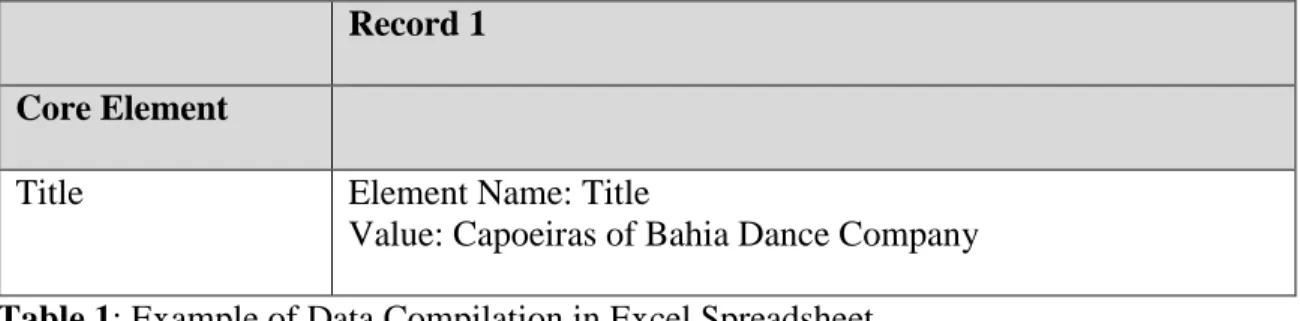
would record its existence in the particular record in the spreadsheet, as seen in Table 1.
Table 1: Example of Data Compilation in Excel Spreadsheet
After mapping presented elements to the schema upon which the repository’s application
profile was based, I was then able to analyze the semantic interoperability of each set of
records using pre-determined criteria. Record 1 Core Element
Title Element Name: Title
Interoperability Criteria
In order to make conclusions regarding the semantic interoperability of a schema, I
evaluated each record by its completeness and consistency in use. The level of
completeness of a record was determined based on the presence of the core elements in
the record. I also noted whether the element was given a clear label in the record, or if the
value was merely listed in the record but not attached to an element.
Consistency in use was determined based on the consistency in the formatting and
content of the element’s given value. For example, for the date value to be considered to
be structurally consistent across all records, the date values would be written in the same
numeric format. On the other hand, semantic consistency in use was evaluated by
Results
Dublin Core-based Institutional Records
The tables below summarize the data collected in my analysis of digital video and film
records from the Mountain West Digital Library and the South Carolina Digital Library.
Both of these repositories require the use of the Dublin Core schema as the basis for the
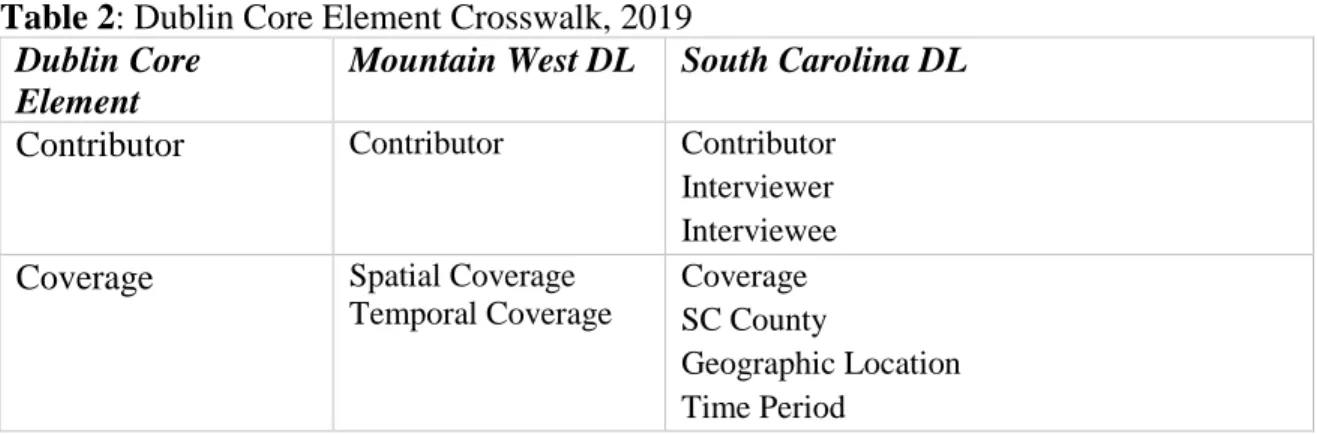
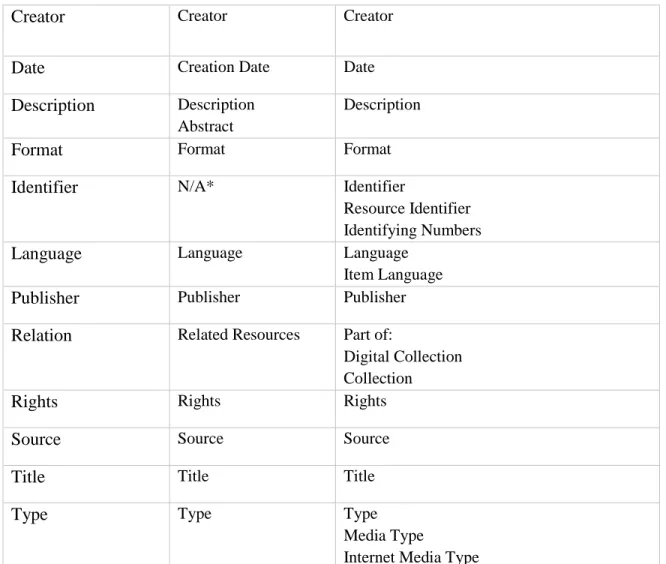
records in their repositories. Table 2 is a crosswalk of the official Dublin Core elements matched with the corresponding element names used in the record samples analyzed from
each repository, respectively. In many cases, more than one element name was used
across the records analyzed to represent a Dublin Core element. All element names used
in repository records are listed in the table.
Table 3 indicates the number of records at each institution that used a form of each Dublin Core element. This table also notes what percentage of all fifty Dublin Core-based
records analyzed across the institutions used an element.
Table 2: Dublin Core Element Crosswalk, 2019 Dublin Core
Element
Mountain West DL South Carolina DL
Contributor Contributor Contributor Interviewer Interviewee Coverage Spatial Coverage
Temporal Coverage
Coverage SC County
Creator Creator Creator
Date Creation Date Date
Description Description Abstract
Description
Format Format Format
Identifier N/A* Identifier
Resource Identifier Identifying Numbers
Language Language Language
Item Language
Publisher Publisher Publisher
Relation Related Resources Part of:
Digital Collection Collection
Rights Rights Rights
Source Source Source
Title Title Title
Type Type Type
Media Type
Internet Media Type *no records from this institution use this element or provide relevant values
Table 3: Usage Totals For Dublin Core Elements Across Aggregating Digital Repositories, 2019
Element Mountain West DL South Carolina DL Percent Used
Contributor 11 3 28%
Coverage 10 11 42%
Creator 19 10 58%
Date 25 25 100%
Description 25 25 100%
Identifier 0 23 46%
Language 19 25 76%
Publisher 20 2 44%
Relation 12 25 37%
Rights 25 22 47%
Source 7 18 50%
Title 25 25 100%
Type 25 25 100%
Mountain West Digital Library Record Analysis
Completeness
The records evaluated from Mountain West Digital Library included 14 out of 15 Dublin
Core elements. An Identifier element was never provided for any record. Elements
provided in every record include Title, Type, Date, Description, Format and Rights.
Elements used in less than half of the records included Contributor, Coverage, Relation,
and Source. It is unclear as to whether elements that were missing in a record were not
provided due to an unknown value or whether they were deliberately chosen to be left out
of the public record. However, there was one case in which a Format element was listed
and the value was listed as “unknown,” further muddling the criteria for an element’s
presence or absence in the public record.
Consistency
In my analysis, I found that the format of an element value was rarely consistent.
variety of forms including YYYY-MM-DD, MM-DD-YYYY, and simply YYYY.
Moreover, when the value of elements such as Creator and Contributor were given
personal names as values, these formats varied. Names were listed as either firstname lastname (e.g. “John Smith”) or lastname, firstname (e.g. “Smith, John”). Additionally,
when the value of any element had two or more values provided, those values were
separated by a comma in some records, by a semicolon in others, and sometimes the
values were separated spatially by putting items on separate lines.
While element titles were mostly congruent to the element titles listed in the DCMI
guide, semantic inconsistencies existed throughout the element values. The values given
to the Description element were especially varied. Some values included description of
the intellectual content of the material while others discussed the physical format of the
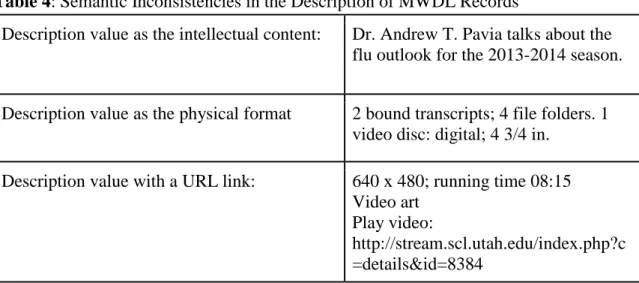
material, and others included a link to the video on an external page. An example of these
differences is seen in Table 4.
Table 4: Semantic Inconsistencies in the Description of MWDL Records
Description value as the intellectual content: Dr. Andrew T. Pavia talks about the flu outlook for the 2013-2014 season.
Description value as the physical format 2 bound transcripts; 4 file folders. 1 video disc: digital; 4 3/4 in.
Description value with a URL link: 640 x 480; running time 08:15 Video art
Play video:
Moreover, the Coverage element was interpreted in a number of ways. Some records
used broad values for temporal coverage (e.g. “20th century”) while others used a date
range (e.g. “1900-2000”). For spatial coverage, some records included city names, others
included states, and one even provided latitude and longitude coordinates. When it is
included, the duration or run time of a video is placed in the Description element in some
records and in the Format element of others. This demonstrates the schema’s need for
further guidance on elements and values pertaining to time-based media.
South Carolina Digital Library Record Analysis
Completeness
The South Carolina Digital Repository included all of the 15 Dublin Core elements in
some capacity across the records analyzed. Elements used across all records included
Date, Description, Language, Relation, Title, and Type. Elements used across the
majority of records included Format, Identifier, Rights, and Source. Elements used
sparingly across records included Contributor, Coverage, Creator, and Publisher. It is
unclear as to whether elements that were missing in a record were not provided due to an
unknown value or whether they were chosen to be left out of the record.
Consistency
Like the Mountain West Digital Library records, the South Carolina Digital Library
records had several inconsistencies in the semantics of values assigned. Similar
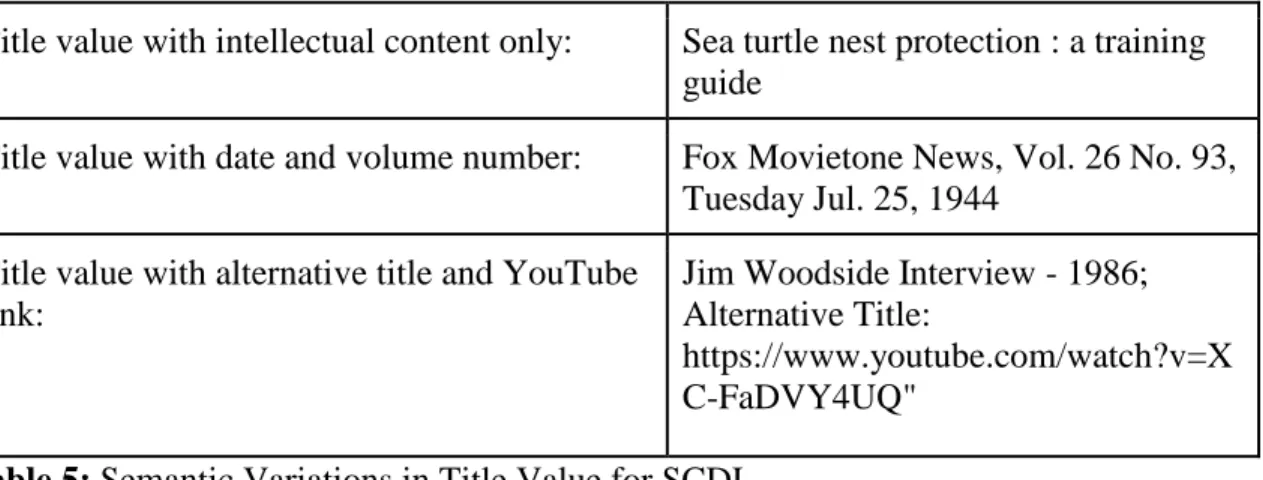
inconsistencies included the variations in title and date values. Examples of some title
Table 5: Semantic Variations in Title Value for SCDL
A large portion of the value inconsistencies could possibly be traced back to the variance
in element. Though the element names used in the records could map back to the DCMI
standard more broadly, I found that the South Carolina Digital Library records often
tailored their element name to the collection information. For example, some of the
records that cataloged video or film material set in South Carolina used the element name
“S.C. County” to denote spatial coverage of a record. While this particular element and
its provided values did fall into the broader DCMI Coverage definition, its specificity to
the materials being described possibly negates its interoperability across institutions.
“S.C. County” cannot apply to all materials across all institutions -- not every video at
every institution is set spatially in a South Carolina county. Nevertheless, it is important
to note that the element’s specificity can be helpful in the context of South Carolina
Digital Library users’ research, as they are more than likely conducting research related
to South Carolina history.
Title value with intellectual content only: Sea turtle nest protection : a training guide
Title value with date and volume number: Fox Movietone News, Vol. 26 No. 93, Tuesday Jul. 25, 1944
Title value with alternative title and YouTube link:
Jim Woodside Interview - 1986; Alternative Title:
Unlike the Mountain West Digital Library, the South Carolina Digital Library does not
choose to include Duration or any other time-based media values in any of its element
fields.
Analysis of Dublin Core as a whole
Despite the missing elements and semantic inconsistencies, data collected from this
record analysis indicated that eight of the Dublin Core elements -- namely Creator, Date,
Description, Format, Language, Source, Title, and Type -- were used in the majority of
all records. In fact, Date, Description, Title, and Type elements were used in all 50
records across the institutions.
The inconsistencies that are present in the records are the same or similar to those
described in Weagley, Gelches, and Park’s 2010 study and are therefore unsurprising.
However, the lack of guidance for the placement of “duration” for time-based media is a
concern that Dublin Core could address in future iterations to improve its description of
these digital film and video items in aggregating repositories.
PBCore-based Institutional Records
The tables below summarize the data collected in my analysis of digital video and film
records from California Revealed and WGBH Open Vault. Both of these repositories
require the use of the PBCore schema as the basis for the records in their repositories.
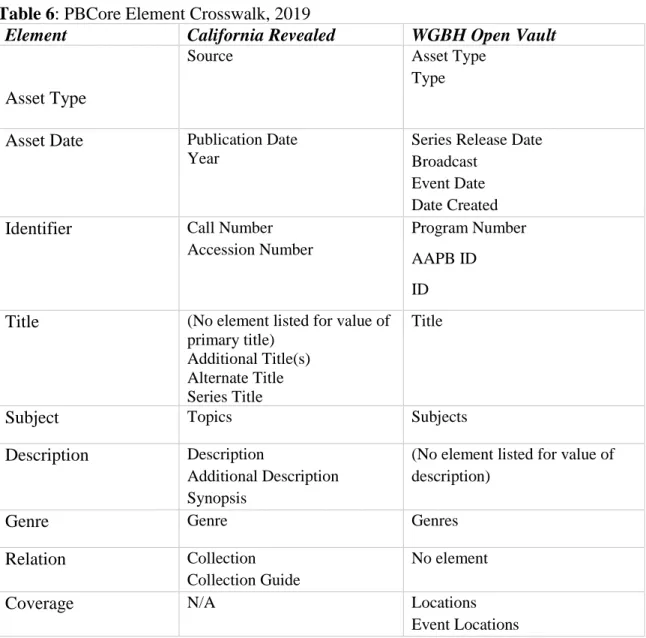
cases, more than one element name was used across the records analyzed to represent a
PBCore element. All element names used in repository records are listed in the table.
Table 7 indicates the number of records at each institution that used a form of each PBCore element. This table also notes what percentage of all fifty PBCore-based records
analyzed across the institutions used an element.
Table 6: PBCore Element Crosswalk, 2019
Element California Revealed WGBH Open Vault
Asset Type
Source Asset Type
Type
Asset Date Publication Date Year
Series Release Date Broadcast
Event Date Date Created Identifier Call Number
Accession Number
Program Number
AAPB ID
ID
Title (No element listed for value of primary title)
Additional Title(s) Alternate Title Series Title
Title
Subject Topics Subjects
Description Description
Additional Description Synopsis
(No element listed for value of description)
Genre Genre Genres
Relation Collection
Collection Guide
No element
Coverage N/A Locations
Creator (No element listed for value of primary creator)
Creators
Contributor Credits
Director Cast Speaker Interviewee Interviewer Contributor Contributors Director Guest Host Producer Producing Organization
Publisher Digitized by
Uploaded by
Publication Information
Rights Summary Rights Rights Summary
Rights
Instantiation Duration Run time Duration
Length
Instantiation Colors Color Color
Instantiation Rights Rights (Separate paragraph from the RightsSummary element)
N/A
Instantiation Identifier Identifier Project Identifier
Program Number Identifier
Instantiation Date (no element listed for value of instantiation date element)
N/A
Instantiation Language Language N/A
Table 7: Usage Totals for PBCore Elements Across Aggregating Digital Repositories, 2019 Element California Revealed WGBH Open Vault Percent Used
Asset Type 24 24 96%
Asset Date 22 22 88%
Identifier 17 20 74%
Subject 25 13 76%
Description 22 25 94%
Genre 4 12 32%
Relation 25 20 90%
Coverage 0 4 8%
Creator 13 15 56%
Contributor 10 20 60%
Publisher 25 19 88%
Rights Summary 24 11 70%
Instantiation Duration 25 19 88%
Instantiation Colors 25 1 52%
Instantiation Rights 25 0 50%
Instantiation Identifier 25 2 54%
Instantiation Date 25 0 50%
Instantiation Language 25 0 50%
California Revealed Record Analysis
Completeness
The records evaluated from California Revealed indicated that 12 asset elements and six
instantiation elements were used to describe their video materials in the Internet Archive.
Four asset elements -- Title, Subject, Relation, and Publisher -- were provided in all 25
records. The six instantiation elements evaluated in this study -- Duration, Colors, Rights,
elements that were missing in a record were not provided due to an unknown value or
whether they were chosen to be left out of the record.
It is notable that the California Revealed records do employ a PBCore instantiation
element specific to time-based media, namely Duration.
Consistency
Like the other institutions in this study, there are structural and semantic inconsistencies
in the records of California Revealed. The most notable formatting inconsistencies occur
in the Asset Date and Identifier fields. Examples of their structural variance can be seen
in Table 8.
Table 8: Structural Inconsistencies in Asset Date and Identifier Element Values within CR records
Asset Date Value Variations: YYYY; MM-DD-YYYY; YYYY-MM-DD Identifier Value Variations: V0742; Box 3 / Item 36; Video 3899
Alternatively, semantic inconsistencies are mainly present in the Title and Description
fields. Values listed as a part of the Title element in addition to the title of the film or
video include locations, dates, and genres. Some examples in semantic variation of the
Description element are displayed below, in Table 9.
Table 9: Semantic Inconsistencies of Description Values within California Revealed records
Description Value with list of other related materials:
“Tape 1: Introduction -- Scandia Dances
Tape 2: Clog Dances -- Fiddle …”
Description Value with a review of the media “...His desire for a media discourse in which
representations of African Americans in the media are “read” using critical analysis, and questioned rather than passively accepted, pervades this interview as it does the larger body of his work.
-- review by Jennine Scarboro”
WGBH Open Vault Record Analysis
Completeness
The records evaluated from WGBH Open Vault indicated that the 13 asset elements and
2 instantiation elements are used to describe the archival film and video materials at this
institution. Of the 13 asset elements, Description was the only element used across all
records. However, Asset Type, Asset Date, Identifier, Title, Subject, Relation, Creator,
Contributor, and Publisher are included in the majority of records. Instantiation elements
included in the records were Duration, Color, and Identifier, with Duration present in the
majority of records. Instantiation Color and Identifier are used sparingly. No other
instantiation elements being analyzed in this study were used in the Open Vault records.
It is unclear as to whether elements that were missing in a record were not provided due
Consistency
Despite general understanding that WGBH implemented PBCore early in the standard’s
existence, I found that there were more structural and semantic inconsistencies in the
publicly available records than expected. Structural inconsistencies occurred primarily in
the date field. Structural variations occurred in the following permutations:
MM-DD-YYYY, YYYY-MM-DD, MM-MM-DD-YYYY, and “approximate date: YYYY.”
Overall, it seemed that most elements included in the publicly available records were
semantically consistent, with the exception of a few Asset Type values. Some Asset
Types were interpreted as a genre (e.g. “Broadcast Program”), while others were
interpreted as a format (e.g. “Beta SP”). Other than these exceptions, semantic
consistency was the norm for WGBH Vault records.
Analysis of PBCore as a whole
The overall analysis of PBCore records indicated that more than half of the records
collected across both institutions used the asset elements examined in this study, with the
exception of the Coverage and Genre elements. The institutions chose to employ one
instantiation element specific to time-based media in their public-facing records:
Duration. This element value was both semantically and structurally consistent
throughout all PBCore-based records analyzed.
Nevertheless, structural and semantic inconsistencies were still present in many of the
cause of these inconsistencies, it is notable that the records aggregated by these
repositories had a wide variety of element names they used to represent the PBCore
elements. Therefore, the semantic inconsistencies could be traced back to the semantic
differences in element name.
Comparison of Dublin Core and PBCore Semantic Interoperability
Completion of this analysis provided me with results that allow me to confidently answer
my initial research questions. Overall, I found that all the aggregating digital repositories
analyzed in this study made an effort to accurately interpret the elements based on the
official standard definitions, regardless of the metadata schema upon which their
application profile was based. Both the Dublin Core and PBCore-based institutional
records used a majority of the core elements from their respective schema in each record,
and values provided indicated that most records were interpreted with official element
definitions in mind. Nevertheless, my analysis did indicate that both the Dublin Core and
PBCore-based records suffered from structural and semantic inconsistencies when it
came to the interpretation of element values, which affects the interoperability of the
element sets overall.
Based on these record samples, both descriptive schemas suffered from structural
inconsistencies primarily in Title and Date fields. Further breakdowns in Dublin Core’s
semantic interoperability are evident in the variations in interpretation of location for
for such values, Dublin-Core based records placed Duration values in a variety of
element fields, further inhibiting interoperability.
Before completing this analysis, I hypothesized that the PBCore asset and instantiation
elements viewed in this record would prove to be more complete and consistent than
Dublin Core, making it a better choice for the public records of aggregating digital film
and video repositories overall. While my analysis did indicate that PBCore elements
specific to time-based media were more clearly and consistently defined in PBCore based
records, I found that the other core elements had a similar number of structural and
semantic interoperability concerns. Therefore, the existence of audiovisual specific
elements such as Duration did not make up for the fact that core elements such as Title
and Description varied in structure and semantics across records and institutions.
Ultimately, both sets of records suffered from interoperability issues. Though the source
of interoperability sometimes differed between schemas, I concluded that both suffer
from the same amount of interoperability issues. Therefore, the semantic interoperability
Conclusion
Weagley, Gelches and Park noted that “consistency within the individual collections in
these [contributing] repositories appears to be high. It is when they become part of an
aggregate that interoperability becomes a problem” (2010). After an analysis of the
completeness and consistency of both the Dublin Core and PBCore records, it is notable
that schemas still suffer from the structural and semantic interoperability problems that
plagued Dublin Core records nine years ago.
This conclusion supports the idea that both Dublin Core and PBCore have their
advantages and disadvantages for the purposes of describing digital video records and
making them accessible. Ultimately, the optimality of one of these standards over the
other would likely depend on an institution’s needs in relation to these advantages and
disadvantages. Moreover, it is important to note that these advantages and disadvantages
were based on publicly accessible records, so the advantage and disadvantages of schema
use outlined in this paper cannot be applied to contexts of internal use that do not
contribute to the public-facing records. Nevertheless, these findings may be useful to
institutions in the process of choosing or customizing a schema to describe moving
images for public access. This audience should carefully consider the interoperability
Overall, this analysis proved that there is much more work to be done regarding the
interoperability of the external records of aggregating digital film and video repositories.
While the introduction of audiovisual-specific schemas such as PBCore are paving the
way for better description and conversation surrounding the preservation and access of
audiovisual materials, interoperability of audiovisual material records is yet to be
mastered. In the meantime, digitization and description of these materials is still integral
to their preservation and access, and the Dublin Core and PBCore schemas are currently
Bibliography
About the Dublin Core Metadata Initiative. (n.d.). Retrieved October 21, 2018, from http://www.dublincore.org/about/
Alipour‐Hafezi, M., Horri, A., Shiri, A., & Ghaebi, A. (2010) "Interoperability models in digital libraries: an overview", The Electronic Library 28(3), 438-452.
Beer, C.A., Pinch, P.D., Cariani, K. (2009). Developing a flexible content model for media repositories: a case study. JCDL '09Proceedings of the 9th ACM/IEEE-CS joint conference on Digital libraries, 97-100.
California Revealed 2018 Metadata Guidelines For Audiovisual Objects (2018). Retrieved March 1, 2018, from https://californiarevealed.org/sites/default/files/CA-R-Metadata-Guidelines-audiovisual-2018.pdf
California Revealed - About. (n.d.). Retrieved October 22, 2018, from https://archive.org/details/californiarevealed&tab=about
Clair, K. (2008). Developing an audiovisual metadata application profile: A case study. Library Collections, Acquisitions, and Technical Services 32(1), 53-57. Retrieved October 22, 2018, from ScienceDirect database.
DCMI Usage Board. (2012). Dublin Core Metadata Element Set, Version 1.1: Reference Description. Retrieved March 1, 2019, from
http://www.dublincore.org/specifications/dublin-core/dces/
Dirig, R. (2011). How the AMIA Scholarships and Fellowships Program Helped Pave the Way for a New Generation of Moving Image Archivists. The Moving Image 11(1), 132-138. University of Minnesota Press. Retrieved October 22, 2018, from Project MUSE database.
Elements Defined (n.d.) Retrieved March 1, 2019, from https://pbcore.org/elements.
Heery, R. & Patel, M. (2000). Application profiles: mixing and matching metadata schemas. Ariadne, 25. Retrieved from http://www.ariadne.ac.uk/issue25/app-profiles
Llanes-Padrón, D., & Pastor-Sánchez, J-A. (2017). "Records in contexts: the road of archives to semantic interoperability". Program 51(4), 387-405.
https://doi-org.libproxy.lib.unc.edu/10.1108/PROG-03-2017-0021
Matusiak, K., & Johnston, T. (2014). Digitization for Preservation and Access: Restoring the Usefulness of the Nitrate Negative Collections at the American Geographical Society Library. The American Archivist,77(1), 241-269. Retrieved from
http://www.jstor.org/stable/43489592
Media Library and Archives - What We Do. (n.d.). Retrieved October 22, 2018, from https://www.wgbh.org/foundation/what-we-do/media-library-and-archives
Mountain West Digital Library – Home (n.d.) Retrieved January 22, 2018 from https://mwdl.org/
Mountain West Digital Library Dublin Core Application Profile (July 20, 2011). Retrieved January 22, 2018 from
https://mwdl.org/docs/MWDL_DC_Profile_Version_2.0.pdf
Park, J.-R. (2009). Metadata quality in digital repositories: A survey of the current state of the art. In M. S. Babinec & H. Mercer (Eds.), Special issue on Metadata and Open Access Repositories. Cataloging and Classification Quarterly, 47(3), 213–228
PBCore Schema. (n.d.) Retrieved October 21, 2018, from http://pbcore.org/schema/
Real, B. (2013). From Colorization to Orphans: The Evolution of American Public Policy on Film Preservation. The Moving Image 13(1), 129-150. University of Minnesota Press. Retrieved October 22, 2018, from Project MUSE database.
South Carolina Digital Library Metadata Schema and Guidelines (2016). Retrieved October 22, 2018, from
http://scmemory.org/wp-content/uploads/2016/08/SCDLMetadataSchema_2016.pdf