TRADING IN NOTIONS OF NATIVE: TOURIST ART AND AUTHENTICITY AT CAMERON TRADING POST
Kelsey Elizabeth Moen
A thesis submitted to the faculty at the University of North Carolina at Chapel Hill in partial fulfillment of the requirements for the degree of Master of Arts in the Department of Art
and Art History in the College of Arts and Sciences
Chapel Hill 2018
Approved by:
Carol Magee
Cary Levine
Mary Pardo
ii
iii
ABSTRACT
Kelsey Moen: Trading in Notions of Native: Tourist Art and Authenticity at Cameron Trading
Post (Under the direction of Carol Magee)
Cameron Trading Post, on the Navajo reservation in AZ, is a major tourist destination
that draws thousands of visitors monthly. Comprised of a restaurant, Fine Art Gallery, gift shop,
and hotel, Cameron sells viewers the chance to experience Southwest Native American culture by advertising an “authentic experience.” Through the lens of visual culture theories, this paper
examines the role notions of authenticity play at Cameron, the specific objects being sold,
especially the kachina and the narratives of authenticity that are used to sell them, and the
economic-historical contexts surrounding the objects and their creators. Scholars working in the
field of material culture have challenged the perception that tourist art is a benign, dismissible genre. Cameron’s tourist art provides a case study to consider the dynamic and impactful role
tourist art can have in the political and social power dynamics of encounters with Native
iv
ACKNOWLEDGEMENTS
My sincerest thanks to my advisor, Dr. Carol Magee, who not only guided me
through this paper but through my entire UNC experience. You are what every mentor should
strive to be. Thank you also to my committee members, Dr. Cary Levine and Dr. Mary Pardo,
for their invaluable insights and contributions to this paper. To my thesis cohort, Mary, Aaron,
and Erin, I am forever indebted to you for keeping things real throughout this process.
My first and favorite editor, Scott Reynolds, thank you for accepting my Oxford comma
addiction with grace. Finally, this paper would not have happened without the endless support
v
TABLE OFCONTENTS
ABSTRACT ... iii
INTRODUCTION ... 1
CHAPTER ONE: THE AUTHENTIC EXPERIENCE AT CAMERON ... 8
CHAPTER TWO: THE KACHINAS OF CAMERON ... 19
CHAPTER THREE: THE HISTORY AND ECOMONICS OF CAMERON ... 30
FIGURES ... 39
APPENDIX A ... 46
vi
LIST OF FIGURES
Figure 1: Cameron Billboard ... 39
Figure 2: 4” Kachinas For Sale ... 39
Figure 3: Headdress in Atrium ... 39
Figure 4: Harvey Co. Map ... 40
Figure 5: Santa Fe Railway Poster ... 40
Figure 6: Postcard Rack at Cameron ... 40
Figure 7: Edward Curtis Postcard (reverse) ... 41
Figure 8: Cameron Atrium ... 41
Figure 9: Elsie Gander’s Loom ... 41
Figure 10: Rug Weaving Area Sign in Rug Area ... 42
Figure 11: Sign in Rug Area Jewelry for Sale at Cameron ... 42
Figure 12: Jewelry for Sale at Cameron ... 42
Figure 13: Jewelry for Sale at Cameron Gallery ... 43
Figure 14: Sign in Fine Art Gallery ... 43
Figure 15: 4” Kachinas for Sale (detail) ... 43
Figure 16: Nasafotie Hemis ... 44
Figure 17: Nasafotie Hemis (side view) ... 44
Figure 18: Nasafotie Purification ... 44
Figure 19: Fine Art Gallery ... 45
1
INTRODUCTION
Suddenly interrupting the sandstone hues of the Southwest desert,a large billboard with
eight-foot-tall red letters urges travelers “DON’T MISS CAMERON TRADING POST” [Fig.1]
On the side of AZ 64 in Arizona, this is the highway many visitors travel on their way to and
from the Grand Canyon, before heading south and west back to the major travel hubs in Las
Vegas and Phoenix. Visited by some 4.5 million people a year, Grand Canyon is one of the seven
natural wonders of the world, attracting audiences from all over the world.1 This billboard on 64
(and others like it, if one is on AZ 89 heading north toward Cameron) is the traveler’s first
preparation for what to expect at Cameron Trading Post, either on their way to or from Grand
Canyon. The words “GIFT SHOP-ART GALLERY-MOTEL” and a Shell Oil logo are the only
indicators of what the offerings at the Post might be. The letters that make up “Cameron Trading Post” are in a font classified as Slab Serif, suggesting the ‘Wild West’, a bold and thick typeface
typically associated with 19th-century Western saloons and wanted posters. It signals the
theoretical space the traveler will enter at Cameron Trading Post, a place where Native (mainly
Navajo and Hopi) culture is presented largely through the lens of 20th century narratives and
conceptions.
In the online world, the introduction to Cameronis slightly subtler: the Google results
tagline promises “we provide an authentic, historical experience, with Native American art,
2
lodging, dining, and gifts.” 2 This short sentence is the business’s best chance to represent itself,
to advertise what the owner thinks will most effectively draw people in. What is this ‘authentic experience’ and why do the proprietors of Cameron Trading Post believe people will want it? It
seems one of the most important elements of this experience is “gifts/art” – since it is featured
prominently on both the Highway 64 billboard and in the online tagline. ‘Gifts’ in this case refers
to the Native American tourist art for sale at Cameron Trading Post, the focus of this paper.
Scholars working in the field of material culture have challenged the perception that tourist art is
a benign, dismissible genre. Using various visual culture theories, this paper aims to examine the
vital role of the notion of authenticity at Cameron, the specific objects being sold as part of the
narrative of authenticity, and the economic and historical contexts informing that narrative. Cameron’s tourist art plays a dynamic and impactful role in the political and social power
dynamics of encounters with Southwest Native American culture.
Cameron’s owners are of EuroAmerican descent, yet 95% of Cameron’s employees are
either Navajo or Hopi, and the art labelled “Native American made” is made by members of a
Native American tribe, as mandated by law. Cameron the township, whose population is 95%
Native American,3 revolves around the trading post, and the trading post relies on the Navajo
Nation for its legal and civic needs. Such demographics highlight a complexity here – who is really manufacturing the ‘authentic experience’ for visitors to Cameron? How does one
understand the Native peoples’ participationin the creation of narratives that can be read as false
or as undermining goals of recognition and validity as a living culture? Or is it more complex
2Hereafter the title “Cameron” will refer to Cameron Trading Post, not the township of Cameron. When the township is discussed it will be noted as “Cameron the township.” Technically Cameron is not a township or city,
rather a “census-designated place,” but the term township is employed for ease of use.
3
than that, Native artists leveraging historically lucrative, if inaccurate, branding to sell their art
successfully? To examine these questions, this paper draws on the work of scholars in the fields
of postcolonial theory, art history, visual and material culture studies, including Ruth B. Phillips’
discussion of Native art and the history of its relationship to the Western audience, Bruce Bernstein’s examination of Native tourist art, and Margaret Jolly’s work on authenticity and its
role in the tourist experience.
To discuss tourist art, one must start with defining the tourist. It was a term first used in
1800, but it was not until the 1850s that the current understanding of the term was formed,
negative connotations included.4 Bennetta Jules-Rosette, a scholar of tourist art, explains that
tourists are “often viewed as ill-informed and gullible,” assumed to be passive consumers who
have no real aim besides their own pleasure.5 The objects collected by these consumers also
carry negative associations; tourist arts have traditionally been viewed as mass-produced,
inauthentic, kitschy knick-knacks, objects not worthy of the title ‘art’ and certainly not of serious
art historical scholarship. This began to change with the 1976 publication of Dean MacCannell’s
The Tourist: A New Theory of the Leisure Class, in which the sociologist uses structuralist theory
to seriously examine the construction of the tourist experience. That same year Arthur Graburn
published Ethnic and Tourist Arts: Cultural Expressions from the Fourth World which focuses
specifically on tourist art, arguing that these objects had much to say about both their producers
and their consumers. Currently scholars such as Jules-Rosette continue the work of analyzing
tourist art, which she defines as “objects valued …because of their importance as markers and
4Ruth B. Phillips, Christopher Steiner, “Art, Authenticity, and the Baggage of Cultural Encounters,” inUnpacking Culture: Art and Commodity in Colonial and Postcolonial Worlds (Berkeley: University of California Press, 1999), 4.
5 Benetta Jules-Rosette, The Messages of Tourist Art : An African Semiotic System in Comparative Perspective (New
4
mementos of the tourist’s journey.”6 Today we might add the element commercialization, one
could consider a rock picked up on the side of the road a memento of a journey, but that rock could become “tourist art” if it was displayed for sale alongside other similar objects. This
definition allows for an extraordinarily broad class of pieces representing countless cultures.The
makers of these mementos and markers are part and parcel of the process, ranging from the
singular, named artist, to commercial, assembly-line productions. These and every type between
are present at Cameron.
If tourist arts are difficult to classify then in that sense they are comparable to Native
American art in general, which Phillips notes often exists at the intersection of art, artifact, and
commodity.7 Most of the objects sold at Cameron Trading Post shift between these categories,
becoming doubly confounding as both tourist art and Native art and embodying the often
contradictory, inconsistent modern discourses surrounding their distinctions. In particular, the
kachina dolls for sale are a fascinating case study forthe historically problematic and complex
notions of authenticity at play at Cameron.8 The artistic form began as very tribal-specific,
physical embodiment of spiritual practices. The pieces sold today have been transformed into
objects only vaguely resembling their original forms, cleverly designed to appeal to and perhaps
affirm a non-Native conception of Native spiritual practice. [Fig. 2] The Cameron kachina dolls
do not do this affirming work alone, the spaces they inhabit, the narratives referenced, and
histories celebrated around them are all part of a programmatic assemblage of imagery
reinforcing non-Native perspectives on what it means to be Native American. The physical
6 Ibid.
7 Ruth B. Phillips, Christopher Steiner, “Art, Authenticity, and Baggage.”3-19.
8 Throughout this paper the terms kachina dolls, kachina figurines, and kachinas are used interchangeably and
5
distance at Cameron between the fine art gallery and the main building (see Appendix A for a map of Cameron’s layout), the historic Western paraphernalia hanging in the atrium of the main
building, the Navajo woman weaving on a loom in a fenced-off space of the main building; when
viewed by the visitor each of these sights play into a visual culture that relies on an authenticity
created by placing Native culture firmly within a romanticized past, a vision authored by and for
non-Native audiences.
Cameron’s own history is one of the most celebrated and highlighted narratives authored
in this space, appealing to nostalgic notions of the store as a key player in a Wild West drama. In
1911, a suspension bridge was built over the Little Colorado River near Cameron, Arizona, and
for the first time the Grand Canyon was accessible from the southeast. Five years after the bridge
was built, two brothers, Hubert and C.D. Richardson established Cameron Trading Post. For a
time, the trading post was only visited by Navajo and Hopi people trading amongst themselves and for government supplies. The Cameron website states that the brothers “were trusted by local
Native American people in matters concerning confusing new American legal & social
systems.”9 ‘Confusing’ is putting it mildly. Beginning with the Indian Removal Act of 1830,
which forced many eastern tribes westward, the United States federal government began to
legislate the culture of Native American peoples. In 1887 the Dawes Act (General Allotment
Act) revoked tribal sovereignty, part of a forced assimilation project; not until 1924 were Native
Americans granted full citizenship by Congress.10 In 1868 the Navajo Reservation was officially
established through a treaty between the Navajo people and the US government, granting the
9“History of Cameron Trading Post”, Cameron Trading Post, 2017.
https://www.camerontradingpost.com/history.html
10“Seven Time Periods of Federal Indian Policy” (Institute for Native Justice, n.d.),
6
Navajo Nation sovereignty. When Cameron Trading Post opened in 1916 it outside the border of
the reservation, however when the borders were expanded in 1934, Cameron was absorbed by
the reservation. The Trading Post itself remained technically on the fee land the Richardson’s
had purchased, and the implications of this, along with more of the early history of Cameron and
the reservation, will be further discussed in Chapter 3.
As the mid-century approached Cameron began to see more and more tourists as
travel-based businessescapitalized on the emerging middle-class by advertising the West as a tourist
destination, accessible first by train and later by automobile. Today Cameron serves hundreds of
thousands of tourists every year, most of them on their way to or from Grand Canyon. 11 For the
vast majority of these visitors, this will be their main exposure to the Navajo Nation, the only
time they will spend on a Native reservation, and even though there is a Native presence at
Grand Canyon, Native culture is not central in the way it appears at Cameron. People hve
historically beenwilling to pay for a novel experience, the main tenet of tourism, and the Native
cultures of the Southwest remain a marketable experience. The marketing of both the Southwest
and Native people has changed little at Cameron since it was first employed to draw in railway
customers in the 1920s. One notices this particularly upon encountering popular 20th century
narratives in the atrium of Cameron’s main building, such as the ‘Vanishing Indian’ narrative in
the Edward Curtis postcard display,portraying Native people as a disappearing element of the
American landscape whose existence needed to be documented before it was gone forever; or the ‘Noble Savage’ narrative connotated by the headdress hanging on a mannequin display-head on
the wall [Fig. 3], iconic symbol of “Nativeness” thought to be worn by all chiefs and warriors when it’s actual use was limited to only a few specific tribes, not including any Southwest tribes.
7
These narratives have been capturing the imagination of EuroAmerican audiences since the age
of Manifest Destiny and some consider them to have a deeply troubling history, at times
employed as propaganda to support the US government’s genocide of Native populations in the
1800s.
These narratives are based notions of authenticity. This paper will start by examining
in-depth the ideas of authenticity at Cameron, the construction of this authenticity, its historical
origins and its current role. The second chapter will examine a specific tourist art genre for sale
at Cameron, the Hopi kachina doll, and will explore the tourist/fine art binary at play in
Cameron’s various spaces, what that means for the perceived authenticity of these objects. The
final chapter will look at the economics ofCameron, and what role Cameron plays in the
economy of both the Navajo reservation and the larger Southwest Native art market. Nearly
every object and practice at Cameron is informed by its perceived authenticity, and so this paper
8
CHAPTER ONE: THE AUTHENTIC EXPERIENCE AT CAMERON
Central to the commercial success of Cameron is its perceived authenticity. Authenticity
at Cameron works to both validate the narratives presented and assure the consumer that the
objects for sale represent some ‘real’ and consumable truth about their makers. Whether or not
the tourist is concerned with having a meaningful experience with Native culture (and many may not be), the visual context surrounding the experience of the purchase of one of Cameron’s
objects is one that assures the visitor that they are in fact, having a meaningful exchange with
another culture. This aura of authenticity is created in the objects and re-enforced by the experience surrounding the objects’ consumption. To understand the role authenticity plays at
Cameron, it is important to first understand the history of the tourist experience in the Southwest.
Cameron Trading Post was not a unique phenomenon, at one time there were over one hundred
trading posts operating in the Four Corners region.12 While many of these functioned as simple
mercantile enterprises, places for travelers to re-supply, some were far more ambitious in their
scope. Perhaps the most historically significant of these were the businesses created by the Fred
Harvey Company. The influence of this company on the history of the region and the tourist market cannot be overstated. Novelist Frank Waters once said: “perhaps more than any single
12 Johnny D. Boggs, “On the Trading Post Trail: From Ganado, Arizona to Tohatchi, New Mexico,” True West, March
9
organization, the Fred Harvey system introduced America to Americans;”13 an America, one
might argue;manufactured for the express purpose of attracting tourist dollars.
A savvy businessman, Fred Harvey had the entrepreneurial foresight to create America’s
first chain of restaurants and hotels, all of which were connected to the rapidly growing railroad
system. By the turn of the century the Fred Harvey Company and the Santa Fe Railway had
formed a partnership that included sixteen hotels and restaurants along the line to California. The
Harvey family began catering in the early 20th centuryto the emerging middle-class by touting
the Southwest as an “exotic” tourist destination. Central to this marketing campaign were images
of Native peoples.14 [Fig. 4,5] One of the more popular destination packages offered was called
“Indian Detours,” offered first as part of railway travel packages, and beginning in 1926 as
automobile tours in the Harvey Cars. In Figure 4, the route of the tour is marked upon a color
rendering of a panoramic Southwestern landscape,foregrounded by a group of Native figures.
Many of the figures appear in ceremonial garb. Of note is the seatedfigure on the right wearing a
full war-bonnet headdress, a style originally only used by Plains tribes (none of which would
appear in the geographic area of tour), but adopted by some members of Southwest tribes
specifically to appeal to the tourist trade.15 To the right of this figure are Natives who appear to
be engaging in Hopi ceremonial dances, events often commercialized against the wishes of the
13 Kathleen Howard, and Diana F. Pardue, Inventing the Southwest : The Fred Harvey Company and Native American Art (Flagstaff, AZ: Northland Pub., 1996), 1.
14 Ibid., 9
10
tribe.16 In Figure 5a 1925 poster advertising the Grand Canyon railway line train called "The
Chief," the warbonnet makes another appearance,the man’s distinctive features, sharp
cheekbones and aquiline nose, along with the bronze color of his skin and proud carriage, all
combine to present a by then familiar image of the “Noble Savage,” a narrative character
portrayed as proud and worthy of admiration while remaining exotic. The text exclaims “the
Chief is still the Chief,” substituting the railway line for the exemplar of a vanishing race, offering
an experience that would presumably prolong his existence in the modern era, safely taking you
places where you can see other “real” Natives. In this campaign, one sees all tropes of Nativnesss
working at once, in the same way they would and continue toat Cameron. The ‘Harvey Houses’
(the name given to the hotels/dining establishments) in the 1920s in Albuquerque and at Grand
Canyon were filled with Native American objects and imagery, continuing to build these
narratives. Each of these narratives reinforced the tourists feeling and expectation of authenticity,
presenting them with a reassuring and familiar visual program.
One of the main forces behind the Southwest Harvey House operation was Herman
Schweizer (the man considered “Harvey’s anthropologist”), who wrote in a letter to the U.S.
Indian Service (under the Department of the Interior, later becoming the Bureau of Indian
Affairs) that “the Santa Fe Railway, when this place was built, considered it [the Harvey House]
first of all as an advertisement of the Southwest Indians …the commercial part was only
considered incidental.” 17 He believed this enterprise to be a net gain not only for the company
but for the Native peoples as well, noting that before the Harvey Houses no formally established
16 Ceremonies could be performed by individuals away from the pueblos without permission of the tribes, or
sometimes even in the pueblos themselves where monetary concerns outweighed cultural objections.
11
economy for Native arts, such as pottery and blankets, existed. When discussing the layout of the hotels he says “the major part of the Indian Building here was arranged in the form of exhibits,
cozy corners, etc. to illustrate to people how these things can be utilized to best advantage.” 18
“Utilized” here meaning placed into the modern home as décor, an appeal that extended to and
even expanded in the post-WWI market. The connection between Native American items as
home décor and narratives of primitivism will be discussed in the next chapter. For now, suffice
to say that tourists were being presented with an experience at the Harvey House that used an
aura of authenticity to give validity to the objects for sale.
Art historian Christopher Steiner parses the work of authenticity in tourist art by
grounding it in Benjamin’s “The Work of Art in the Age of Mechanical Reproduction.” Steiner
notes that for Benjamin if a work is to be authentic it must be produced as a response to the
demands of tradition, as close to “ritual, the location of its original use value” as possible.19 This
of course becomes an issue when multiples of an object are mass-produced. Benjamin’s other
focus is on the perception of these works, which Steiner argues might be better called the
consumption of the objects. Steiner describes the way tourist objects are often presented, in rows
and rows of nearly identical forms (as one finds with Cameron’s Navajo kachinas) [Fig. 2], is not
in fact an error of the part of the seller, but rather a technique to prove that there is no ambiguity
in the canonical validity of these pieces; these are obviously not “unique” as they “fit the mold,”
reiterating traditional forms. Steiner is discussing African tourist art and believes that “tourists
come to Africa with a perspective and a story in mind” and therefore seek images that “evoke
18 Ibid.
12
recognition and an easy sense of familiarity.” 20 Tourists at Cameron are likewise presented with
a visual program of the Southwest and Nativeness that appears to be unchangedsince the 20th
century.21
One such example of 20th century narrative at Cameron can be found in some of the
postcards for sale in the atrium area of the store. [Fig. 6 &7] One rack of postcards features an entire series of Edward Curtis’ portraits. The text on the back of the postcards calls the
photographer Edward Curtis a documenter of “the fading ways of the native North American.” Curtis’ work is still perhaps the most recognizable portrayal of Native people. His images played
a foundational role in constructing the vanishing Indian narrative. He was not above posing
Native individuals in ways that exoticized them further by removing clothes they were wearing
or adding elements like warbonnets. While some of his portraits appear free of such
manipulation, (including some on the rack at Cameron), it is generally accepted today that he
was an artist more often concerned with his notions of what Native culture should be rather than
faithfully documenting what he was encountering.None of the problematic constructive context
about Curtis' work is found in or around the postcards indeed, right above the postcard stand
there is a bust with a feathered warbonnet for sale. [Fig. 8] Here are the objects tourists have
been expecting, familiar, because they appear to exist as they always have, reinforced through
the postcards on sale right next to them.
The “Vanishing Indian” however, never in fact vanished. Curtis’ portraits capture a
nostalgia for a past that the visual culture at Cameron seems to suggest is still accessible, still
20 Ibid, 99.
21The second part of Steiner’s argument, that this prescribed format for tourist art also limits innovation, will be
13
present. This need to identify some essentialized and uniform past culture that represents a
simple past, untouched by things like social progress and economic development (these
introduced by contact with western European values, industry, and culture), a pure and
de-historicized narrative (and thus still accessible), what scholar Margaret Jolly refers to as “a true tradition” is the subject of her scholarly work. In it she calls attention to the anxiety surrounding
the validity of tourist art, an anxiety generated through a desire for authenticity, noting there is “a persistent specter of inauthenticity” haunting Western perspectives on tourist art (in her case,
Pacific Islander art, but applicable to Native arts of any type), stemming from a position where
unless Native art is a result of “true tradition,” it is not authentic and therefore suspect. Jolly
describes the dangers inherent in this focus on a singular authenticity, problematizing it by
noting it posits cultures as homogenous, unified and essentialized; and it denies Native peoples a
history before the West brought change and progress.22 She notes that even if scholarship has
moved past essentializing and de-historicizing these people and their works (at which one could
argue, Cameron has made some attempt, see chapter two), holding on to authenticity via “true tradition” does not allow for discussion about the construction of the past, nor colonizing and
decolonizing relations. If scholars could let go of the preoccupation with “whether tradition is genuine or spurious” it would shift focus to the relational and historical situatedness of Native
peoples and Western society. 23 At Cameron, as in many Curtis portraits, Nativeness is staged,
presented as genuine with the underlying condition that “genuine” is in fact attainable. Essential to this notion of authenticity at Cameron is the belief that there is only one “true” authenticity,
22Margaret Jolly, “Specters of Inauthenticity,” in Voyaging Through the Contemporary Pacific, ed. David Hanlon
and Geoffrey M. White (Lanham: Rowan & Littlefield Publishers, 2000), 274.
14
with no space for the complex and relational narratives argues Jolly argues. Cameron’s constant
attempts to banish the ever-present specter of inauthenticity obscure the complex power
dynamics at play in this space, the economic forces at work, and the relevance of the Native
people in contemporary society at large.
Some of the complexity inherent in these types of tourist experiences is discussed by anthropologists Katie Johnson and Tamara Underiner during their visit to “Tillicum Village” a
tourist experience on Blake Island, Puget Sound where, like Cameron, visitors are promised an ‘authentic experience.’ Like Cameron, Tillicum Village employs Native peoples, members of the
tribes whose cultures are being represented there. Johnson and Underiner investigate whether the experience is of one culture sharing with another (as advertised), or “a form of cultural
commodification, appropriation, and consumption,”24 or perhaps a combination of both. At
Tillicum Village visitors attend a dinner-theater with a traditional salmon dinner and
performances by Native peoples. One of the largest draws at Cameron is the restaurant, located
in the rear of the main building with beautiful views of the Little Colorado river snaking behind
the property. While Cameron serves a hybridized menu, a “pleasant mingling of American,
Mexican, and local cuisine,” the restaurant page of the website choses to highlight the “Navajo
taco,” described as an “adventurous culinary experience.” 25 Again, the word “experience,” this
taco is an event.While there are no obvious theater elements at the Cameron restaurant, the
website spends almost two full paragraphs describing the setting of the dining room, assuring
24Katie N. Johnson and Tamara Underiner, “Command Performances: Staging Native Americans at Tillicum
Village,” in Selling the Indian: Commercializing and Appropriating American Indian Cultures, ed. Carter Jones Meyer and Diana Royer (Tucson: University of Arizona Press, 2001), 45.
25“Native American Restaurant and Dining”, Cameron Trading Post, 2017.
15
visitors that it is filled with Native art and artifacts. The menu itself features Navajo words and
names for dishes. Johnson and Underiner discuss the notion of authenticity as an illusion meant
to cater to “Western fascination with otherness”26 and whether the salmon dinner fits that
description. The Navajo Taco, while surrounded by a mix of other cuisines, is the one
highlighted at Cameron because it is one of the only menu items that is distinctly Native (and
specifically Navajo). Certainly, both the salmon dinner and the Navajo taco are commodified
events, but what complicates both is the direct participation of the respective tribes in the
production of these events/commodities.
Another seeming example of implication through participation through participation is
described by Johnson and Underiner when they note that while on the way to the dinner event,
the tour group passes “employees engaged in crafts such as woodcarving and beadwork.”27
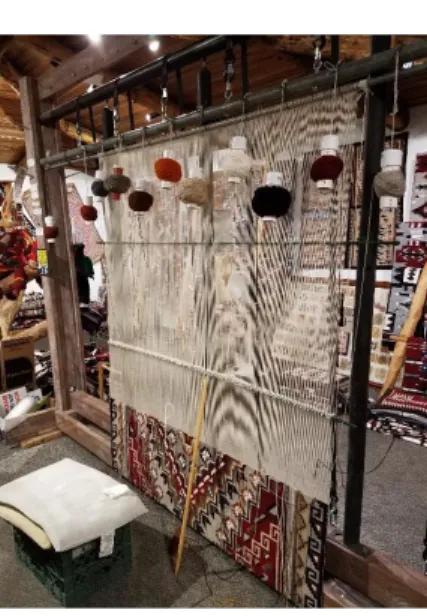
Although not staging an entire village, Cameron visitors can “visit our rug room and witness the
art of rug weaving in action with rug weaver Elsie Gander as she weaves Navajo rugs.” Gander,
like the workers at Tillicum, is performing her craft for a tourist audience.28 [Fig. 9] To Johnson
and Underiner the displays at Tillicum call to mind the troubling history of ethnographic
displays, exhibitional and living-history in its aspect. They also note that the Tillicum employees
work on a raised platform, clearly separated from the passing tourist. They feel this serves to
“reify the distance, and thus the power imbalance, between observers and observed.”29 At
26Katie N. Johnson and Tamara Underiner, “Command Performances: Staging Native Americans at Tillicum Village.” 51.
27 Ibid, 48.
16
Cameron, Gander does her work in an area separated by a low fence, [Fig. 10] seemingly
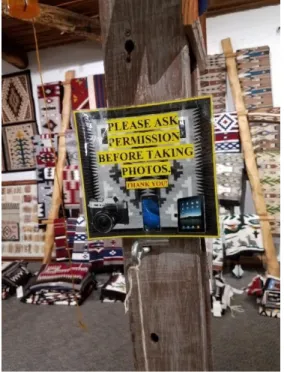
inviting observation rather than exchange. When you enter her space, a sign demands that one
ask before taking a photograph [Fig. 11]. Native employees creating in front of visitors has
historically beena part of the Southwest tourist market; Schwiezer explicitly implemented it as
part of the original Harvey house. It was also part of the seminal 1941 Museum of Modern Art exhibit “Indian Art of the United States.” This show, curated by Rene D’Harnoncourt was meant
to introduce “good Indian work, done without the interference of the whites” as fine art, suitable
for refined tastes and modern sensibilities.30 Unlike art typically displayed at MoMA, this
exhibit featured Native artists creating the art in-situ, weaving on looms and even creating
sandpaintings for audiences. It established once again the importance of perceived authenticity to
the existence (and resultant consumption) of Native art, and with the same phenomenon
occurring as recently as 1989,31 it cannot be dismissed as a strictly historical problem. Perhaps
Gander’s positioning at Cameron today might not appear immediately problematic, but it refers
back to an exhibitionary impulse and tradition of performative authenticity that historically has
been seen as damaging.
In Tillicum, Johnson and Underiner note that there is no mention or indication of the establishment’s white owners. At Cameron, on the “History” page of the website the founding
brothers are mentioned, however at the site itself, their role and the role of the current owner (Joe
Atkinson, grand-nephew of the Richardson brothers), is never discussed. Even the “famous
30Frederic H. Douglas and Rene d’Harnoncourt, Indian Art of the United States (New York: The Museum of Modern
Art, 1941), 199.
17
Navajo taco” so highlighted at the Cameron restaurant, comes from a fry bread recipe that was
developed from military rations given to the Navajo people during the Long Walk of 1864, the
Navajo version of the Trail of Tears, when they were forcibly marched to northern New Mexico
by the US government. Fry bread has become an integral part of Navajo culture but while its
painful origin is respected and remembered within the indigenous community, this context is
seemingly neglected at Cameron. Noted Navajo author Sherman Alexie believes “frybread is the
story of our survival.” 32None of that complicated history is hinted at the paragraph Cameron
devotes to the star menu item, privileging an uncomplicated, romanticized past over reality, a
reality that could instead celebrate the innovation and determination of the Navajo people.
Given the active presence of Native peoples at Tillicum, the sale of the art and food, and
performance of their culture, Johnson and Underiner end their trip by reflecting that Native
peoples should be considered co-producers of the cultural experiences that take place there. These ‘authentic’ portrayals of their customs certainly make both Cameron and Tillicum
commercial successes (although Cameron’s role is more complex due to its context as a trading
post and not a village),but at what cost to the cultures themselves? The noble savage, the
vanishing Indian, these are all narratives that deny Native peoples a voice and a presence as
living, contemporary people worthy of being heard.For example, Elsie Gander (the weaver) is
performing her craft in the same physical and visual space as these narratives, seemingly
working against her existence as a relevant, celebrated contemporary artist. The narratives
surrounding her allow tourists to interpret her in line with those narrative, nothing encouraging
them to view her as exception to the “frozen in time” 20th century narratives and the tip jar adds
to the sense that she is an experience (and thus product) for the tourist to consume. The
18
authenticity created by and around the cultural objects for sale at Cameron and centered on
Native populations in the region is similarly problematic; these objects and their authenticity are
19
CHAPTER TWO: THE KACHINAS OF CAMERON
Walking from the parking lot into the main building at Cameron one is immediately
overwhelmed by the sheer number of objects, colorful and bright, crowded into every available
space. Dream catchers, rattlesnake eggs, potted cacti, woven baskets, and turquoise jewelry share
space with convenience store items, and brightly dyed yarn. The stands and displays are arranged
without any immediately discernable order and it is easy to get lost in the bewildering layout. It
is not only objects that crowd the space, people of every nationality wander about, standing in
one spot one is able to hear no less than 5 languages spoken in the span of a couple minutes by
people examining the wooden dreamcatchers. It is everything one expects of a tourist market.
Yet only a hundred feet from the sprawling main building, its entrance partially hidden from the
big parking lot, is a small ivy-covered building “Fine Art Gallery.” The Gallery structure is built
with sandstone and malapai rock, in an architectural style strongly reminiscent of the buildings
seen at Grand Canyon. This space is quiet, only a few visitors talking in hushed tones in the two
white-walled rooms. Here are a similar genre of objects as those present in the main building,
but now they have been designated “art.” Cameron uses many subtle staging techniques to make
the binary between fine art and tourist art clear; for example, much of the jewelry in the main
building is displayed in typical glass cases, the pieces resting on velvet surfaces, but in the
Gallery the jewelry cases have actual sand in place of velvet and the pieces are draped across
driftwood and stones. (Fig. 12 & 13). This emphasizes the romanticized connections between the
20
Gallery are often lit, on pedestals, recalling those in typical gallery spaces. There is an upstairs
area cordoned off with a velvet rope and a sign declaring the space open only to the
“discriminating buyer.” (Fig. 14). This is an important phrase. It delineates one type of tourist
from another, presumably based on the amount of money they are willing to spend.
The Fine Art gallery is catering to a different class of tourist from those in the main
building, one who is willing to spend more money and who expects higher value, quality objects
in exchange. However, these gallery visitors are not typically connoisseurs of Native Art; that
crowd generally goes to the Santa Fe Market or more prestigious art shows to collect
highly-regarded pieces.33 This has implications for how authenticity is constructed, and therefore,
consumed. The gallery space does not have potted live cacti and rattlesnake eggs like the main
space, but it has many of the same genre of objects. The baskets, pottery, rugs, and kachinas in
the Fine Art gallery appear to observe a much stricter notion of authenticity, according to
Steiner’s discussion of tourist art. This close adherence to traditional formats is a method Steiner
argues isused to justify the higher price points. In the main building at Cameron, there is a
reliance on at least some suspension of disbelief on the part of the tourist; the objects labelled “handmade” and “authentic” are placed alongside items with clear “made in China” stickers.
These objects work together in a recognition that this is a tourist space and with the implications
that the Native made objects are authentic to the local regions and that the Chinese made objects
are not authentically Native. This creates a hierarchy of economic and spiritual value for
objects.34
33 The Santa Fe Indian Market and its audience will be discussed in greater depth in the next chapter.
34 It does not deny that objects made in China are authentically Chinese, simply that at Cameron, that authenticity
21
In both the Gallery and in the maze of aisles and displays of the main building there is
one particularly colorful form that crops up over and over: the kachina doll. One of the most
recognizable and iconic genres of Southwest Native art, the kachina doll has captivated the
Western audience for over a century. The history of the Kachina is a complex one, and one that
highlights the painful origins shared by many tourist arts. The kachina dolls at Cameron are
made by both Hopi and Navajo artists, a situation that relies on especially convoluted
constructions of authenticity. Kachinas are marketed and sold as both high-end fine art objects
worth thousands of dollarsin the gallery, and as kitschy souvenirs worth much less in main
building. The line between the two categories is presented at Cameron as clear and defined,
staged in two entirely different spaces. At first glance the spaces appear to follow defined notions of what a gallery should be versus a gift shop, but small instances such as the ‘cozy corner’ in the
gallery work to destabilize these constructions. Ultimately the presence of the kachina dolls in
both spaces rely on two different but equally complex perceptions of authenticity.
The history of the Hopi and Pueblo people of the Southwest and their spiritual practices
is a particularly tragic one. The Hopi people believe the world is inhabited with hundreds of
nature spirits, known as katsinas, whose forms and associations vary from pueblo to pueblo.35
The kiva is a building in the heart of the village, featuring a half-submerged altarknown as a
sipapu, representing the exchange/entry point between the spirit world and the village. Major
religious ceremonies involve annual dances where dancers wear masks representing specific
katsina. In addition to the masks, small figurines of the katisinas arecarved from cottonwood and
used to teach children about the various spirits, with the belief that each kachina holds a piece of
35 Throughout this paper katsina will be used to refer to the religious deity, and kachina (the Westernized spelling)
22
the katsina whose form it takes. This practice continued until the late 1500s when the Spanish,
led by Francisco Vázquez de Coronado, established a hold over the Pueblos. The Spanish
quickly set about destroying kivas and katsina figures, replacing them with Catholic crosses and
churches. The Pueblos united and revolted in 1680, but their freedom was short-lived, and
Spanish rule continued into the 19th century.36 By the time the Pueblos and Hopi people became
part of the United States, they were long accustomed to using secrecy to protect their religion
and keep cultural information, practices, and objects to themselves.
Today, most Pueblos do not permit photography of their katsina dances and do not
believe that their religious practices and objects are ‘art’ for consumption by outsiders. How then
are there figures labelled “authentic kachina dolls” for sale at Cameron?Western fascination
with kachinas and Hopi ceremonies began as soon as they were exposed to them. Early
anthropologist were eager collectors. Leigh Kuwanwisiwma, from the Hopi Cultural
Preservation Office, tells the story of a drought in the early 20th century that hit Hopi pueblo
hard. “Collector Henry Voth from the Field Museum arrived with seven wagons of commodities,
and he left with seven wagons of artifacts—an altar was traded for four sacks of flour.” 37 This
story is typical and resulted in sacred items filling the collections of many museums (the Field
did not even want all the kachinasVoth brought back, and presumably sold the extra into private
hands). The Hopi people are currently fighting for the return of historic kachinas under cultural
36 Janet C. Berlo and Ruth B. Phillips, Native North American Art, 1st ed. (Oxford: Oxford University Press, 1998)
48-52.
37Frances Madeson, “NAGPRA fails to stop loss of sacred objects in Paris”, Indain Country News, April 27, 2016
23
patrimony laws.38 Anthropologists also recorded sacred ceremonies, often without the consent of
the tribe, and that information is also still circulating. In their anthology Native North American
Art Janet Berlo and Ruth Phillips make a point of not including any photographic images of
Kachina masks or ceremonies, a mark of respect seemingly undercut in the larger popular world
of information, since the Wikipedia entry for “Kachina Doll” contains several such photographs
of masks and ceremonies. In any case, by the turn of the 20th century the Kachina figure had
entered the public consciousnessas a sacred item worth collecting, and the Hopi people
responded by created kachina dolls specifically for the tourist and fine art markets, trade in
kachina dolls has continued unabated. It remains one of the most iconic and popular forms of
Southwest tourist art, evidenced by its prevalence at Cameron.
Kachinas at Cameron range in price from under twenty dollars to thousands of dollars.
Like many items on the tourist market these Kachinas are altered significantly from their sacred,
original form and hybridized to appeal to a broad market. However, at Cameron one also
encounters “Hopi Kachina Dolls” made by Navajo artists. Cameron attempts to explain this
strange occurrence on the website in a section titled “History of the Kachina Doll.” The
convoluted phrasing in theparagraph describes how kachina dolls have evolved from simple
cottonwood carvings used didactically into elaborate carvings featuring wool, feathers, and other
items. The author of the pagemakes a distinction between what they call “Native American
Kachina dolls” and “Hopi dolls,” the former defined as carvings that contain elements other than
wood (feathers, etc.), possibly done by non-Hopi artists and the latter as strictly done by Hopi
artists. They make the argument that “Kachina dolls” done by Navajo artists are as valuable as
38“Hopi Indian sacred objects sold in Paris auction despite protests”, Reuters, URL:
24
“Hopi dolls” but end the paragraph by stating that only a hand-carved, cottonwood Hopi doll
“can be called a true Kachina.” All this appears to be Cameron’s attempt at attaching the cultural
cachetof the historic kachina doll to these newforms and giving the Navajo-made figures the
same authenticity as the historic Hopi form.
Some of the least expensive kachinas are presented in the main building as an
overwhelming display of hundreds of little figures in rows upon rows. The sign in the middle of
the display [Fig. 2] declares these are “Navajo Handmade Dolls: Replica of the Hopi Kachina Doll.” The middle doll in [Fig. 15] is a typical example. It rests one foot on a juniper disk,
serving as the base. One leg is raised as if the doll is mid-dance. This “action figure” style began
to appear in the fine art and tourist marketsin the late 20th century.39 The head and neck feature
downy white and brown feathers. There are two pieces of red and green yarn tied around the
figure’s waist. His skirt is painted with a geometric pattern in reds and white. The body is one
rectangular piece of wood, with the arms, legs and head attached separately. At first glance his
regalia and mask seem entirely unique but studying the dolls as a group reveals each artist uses
common patterns with slight variations per doll. This center doll is very similar to the doll on the
far left. The piece seems to be constructed using standardized forms which are then hand-painted
based on templates of color and design. Still one feels that each doll is a separate character in its
own right, which is largely the appeal of the genre as a whole. It is also still following the
recognizable format of a kachina doll which is ultimately important for the tourist who is
purchasing it. This allows the buyer to feel as if they are bringing a piece of Hopi spiritual
practice into their own home, a playful little deity to keep watch on the mantle. Although these
particular figurines are not explicitly connected to specific katsina deities, they are suggestive of
25
the figurines who do have distinct spiritual meanings. Or perhaps the kachina figure is simply a
colorful reminder of time spent in the Southwest. In this case, even though their label identifies
them as “Kachina dolls” in an attempt to establish their authenticity, so too does their formal
adherence to a template. The geometric designs on the figurines’ skirts and the colors used signal
more generalized Native motifs rather than any specific kachina figure. This level of generic
authenticity is acceptable in these objects because they are not exorbitantly priced and the
replication within the group reaffirms their authenticity, in the same way Steiner’s rows of
African masks are validated in their repetition. The figurines’ Navajo origins, as opposed to
Hopi, are shifted to the background, no longer threatening the validity of the figures.
The most expensive kachina doll for sale currently on the Cameron website is titled “Hemis Kachina” by Hopi artist Adrian Nasafotie, listed for $7,900. The 18” tall figure is
entirely carved from cottonwood root. [Fig. 16 &17] The Hemis kachina is a well-known figure
and Nasafotie has incorporated the traditionallarge headdress, putting his own twist on the
stair-step form featuring feathers and phallic symbols.40 The figure carries a bunch of cattails in his
left hand while his right holds a basket of fruit and vegetables (Hemis is a kachina of good
harvest), while various other elements such as the woven belt and animal tail are also expected
but executed in bright, brilliant colors. As a piece that would be displayed in the Fine Art gallery
rather than the main building, the individuality of Nasafotie’s carving would be highlighted in
the gallery, through its elevation on a podium, lit and placed as a singular object. The differences between the two expressions of the same form, Nasafotie’s kachina and the 4” Navajo kachinas;
40 Jonathan S. Day, Traditional Hopi Kachinas: A New Generation of Carvers (Flagstaff: Northland Publishing, 2000).
Much of the information about the art of kachina carving is pulled from this source, another valuable source for those looking for more context about the religion behind the kachina is Polly Schaafsma, Kachinas in the Pueblo
World (Albuquerque: University of New Mexico Press, 1994), which includes essays by both Anglo and Native
26
the specific Hopi elements versus more generic Native motifs, the quality of the materials and
work, the attention to detail and craftsmanship are clear. Both objects are navigating a complex
notion of authenticity which must encompass both types of kachinas without discrediting either.
Steiner might consider Nasafotie’s piece to be the flip side of the earlier method of
authentication by repetition. Although talking about African art, he argues that the tourist market
does not allow for what Benjamin would call avant-garde work because the “canons of
authenticity” as set by outsiders are such that the styles and forms of the past take precedence
over developments that may arise in the present or future.”41 Nasafotie is a well-regarded Hopi
artist, one of his pieces taking Best in Show at the Santa Fe Indian Market in 2016. The piece
[Fig. 18] that won shows a certain playfulness, the traditional Hemis forming the center, but with
another kachina soaring above, supported by impossibly thin ribbons, and even smaller human
figures at the base. His piece at Cameron in contrast, is still beautiful but follows more closely
the traditional form. Certainly, the same could be said of the Native American tourist art market,
where forms such as basketry, pottery, weavings, and representational painting are favored over
more contemporary forms. Native artists working in postcolonial, postmodern modes, such as
Greg Deal, Wendy Red Star, and Nicholas Galanin produce works that challenge and play with
traditional forms, but these original works would seem to complicate the narrative of authenticity
presented by the visual culture of the Cameron Fine Art Gallery, because they do not “imitate an
agreed-upon style.”42 Benjamin claims that systems of mass production (which Steiner is reading
as systems of tourist art) create their own standards of authenticity, Benjamin’s “exemplars of
41 Christopher B., Steiner. “Authenticity, Repetition, and the Aesthetics of Seriality: The Work of Tourist Art in the
Age of Mechanical Reproduction,” 102.
27
reality.” This reality becomes a limited, bounded one, with no space for perceived outliers, such as Nasafotie’s less traditional pieces.
As another example of the bounded space in the Fine Art Gallery at Cameron there is a
strange little scene in the corner of one of the rooms, an alcove of sorts under the stairs leading to
the second floor [Fig. 19]. It features a small iron wood-burning stove, a rug and woven mat
hanging on the wall, a miniature loom with atwo-foot tall doll in the act of weaving, hanging
above her is a portrait. It may appear as simply a quirky little display, but it emulates a historic home décor method, called the “cozy corner.” This phenomenon of “cozy corners,” more
specifically “Indian corners” (cozy corners encompassed several non-European cultures) is
analyzed by scholar Mary Hutchinson, who argues that the Indian corner in particular was meant to ameliorate “the increasing alienation brought on by industrialized work, urban life, and
international trade.”43 Interestingly, Hutchinson points out that typically the objects in these
corners were themselves a result of modernity, mass-produced in assembly line environments
and shipped internationally. In the early 1900s major department stores such as Wanamakers and
Macys in New York created elaborate displays as part of what Bennett calls the “exhibitionary
complex,” the 19th century impulse to collect, organize and then display knowledge.44 With
Native American objects this evolved into the phenomenon of the “Indian corner”, a small space
in the EuroAmerican home filled with Native objects, typically an animal skin or rug on the
ground, basketry or pottery on a shelf, and a portrait (painting or photograph) of a “real” Native
person, all arranged in the manner of an inhabitable natural history diorama. As the 20th century
43 Elizabeth Hutchinson, The Indian Craze: Primitivism, Modernism, and Transculturation in American Art, 1890-1915 (NC: Duke University Press, 2009), 19.
28
progressed into the 40s and 50s, the Indian Corner thrived while other similar formats (such as the
Oriental cozy corner, fell out of fashion. Hutchinson argues that as Native objects and people
were increasingly romanticized as spiritual beings uniquely connected to some elemental
America, they provided the antidote to overly- sterile and reductive modernist design.
The cozy corner was part of the design at some of the original southwest Harvey Houses.
Herman Schweizer, mentioned earlier in this paper, was selling Native-made objects as home décor. Schweizer stated “the major part of the Indian Building here was arranged in the form of
exhibits, cozy corners, etc. to illustrate to people how these things can be utilized to best
advantage.” 45 The inclusion of this cozy corner in the Fine Art Gallery, where the aim appears to
be framing these objects as fine art to be displayed, illustrates the adherence of Cameron’s visual
culture to 20th century narratives.
Ultimately both spaces in Cameron, the Gallery and the main building, present a
consistent visual narrative. It appears to offer visitors the opportunity to experience and consume
authentic Native culture. Yet in the midst of celebrating stories and art of the past, there is no
room left for narratives of the present. Certainly, many of the current truths of contemporary
Native Americans are uncomfortable and complex, and most tourists are not going to enjoy an
experience that leaves them feeling uneasy about their purchases. However, the damage done by
presenting these static, romanticized narratives is not insignificant, as noted by Gregg Deal in his
piece “The Last American Indian On Earth”,46 and one has to imagine that the complexities can
be explored in both a sensitive and positive way, educating while also entertaining the tourist.
45 Ibid.
46A performance piece where” an unsuspecting public is confronted with the flesh-and-blood version of a
29
Perhaps allowing for more of the Native voice would allow the tourist to feel an even greater
connection to the local community, assuming they do not want any of this context does the
30
CHAPTER THREE: THE HISTORY AND ECOMONICS OF CAMERON
Previous chapters discussed the visual culture tourists are presented with at Cameron.
From the first glimpse of the billboard to the war bonnets on the wall to browsing at the Fine Art
Gallery, a tourist is surrounded by narratives that are little changed since the 20th century.This
paper has examined the visual programs at Cameron that reinforce these narratives, but this
chapter expands the analysis to look at the ways these visual programs of authenticity can
potentially obscure harmful economic truths. The origins of Cameron, its apparent relationship
with the Navajo reservation, and its role in constructing a particular type of authenticity
regarding Native culture, a constrained and limited authenticity.
The very first Navajo trading post was established in 1896 by George Richardson (father
of Cameron founders C.D. and Hubert) at Bosque Redondo, in eastern New Mexico. Bosque
Redondo, also known at the time as Fort Sumner, was where the Navajo people had been forced to relocate to after “The Long Walk” from Arizona. Like the more well-known “Trail of Tears,”
the Long Walk was a forced march of some 300 miles, a relocation of the Navajo people by the
US government in 1864. However, two years later the Navajo became one of the only few tribes
allowed to return to their homeland. Trading posts began to appear across Arizona and northern
31
Long Walk of 1896.”47 This was Cameron’s original function, providing dry goods to Navajo
who came to barter and trade with livestock and weavings. So-called “Indian Traders” were
licensed by the Bureau of Indian Affairs, and in the Southwest a network of trading posts was
quickly established. These posts were run almost exclusively by white men (occasionally by their
wives for short periods), and the traders became the middlemen between the government and the
tribes. Despite often being well-intentioned, the traders created an economy wherein the Native
peoples relied on them as financial intermediaries and by extension these traders became cultural
brokers as well. Ultimately this left little room for the tribes to establish their own successful
commerce, a situation that in part has contributed to the poor economic state of the Navajo
reservation today.
President Bill Clinton once famously compared the Oglala Lakota reservation in South Dakota (the nation’s second largest reservation behind the Navajo) he visited to third world
countries.48 The facts seem back Clinton up. In 2010, the midst of the Great Recession in the
United States, unemployment in Detroit, Rhode Island, and Oregon reached nearly 11 percent
and these worrying numbers made national news.49 However, according to the US Department of
Treasury in 2001 - on average the unemployment rate across US reservations was 50 percent,
with some reservations as high as 80 percent.50 While those worrying statistics do not make
national news, it should come as no surprise that these numbers are accompanied with the
47“Trading Posts”, Navajo Tourism Department, accessed 6.7.2018:
http://www.discovernavajo.com/trading-posts.aspx
48 Robert Miller, Reservation Capitalism: Economic Development in Indian Country (Santa Barbara: Praeger, 2012),
3.
32
highest infant death rates, malnutrition rates, and lowest levels of formal education in the nation.
In 2000 1.4 percent of US households did not have access to electricity - on reservations that
number jumps to 14.2 percent.51 All of this indicates the economics of reservations, and the
lifestyles they support, are not ideal.
Technically, Cameron is not on Navajo land, it is built on fee land, land surrounded by
the reservation but not owned by the tribe. When the land was sold by the government to the
Richardsons in 1916 it was on the western border of the reservation, but a 1934 westward
expansion of the reservation led to the land’s status as fee land. This fact became important in
2000 when the Navajo Nation passed a law raising the tax on hotel occupancy. Cameron (as
parent company Atkinson Trading Co.) sued, arguing that they were not required to pay the new
tax based on their fee land status. The case was argued in front of the Supreme Court. Chief Justice William Rehnquist and the rest of the court voted unanimously that “Navajo Nation's
imposition of a hotel occupancy tax upon nonmembers on non-Indian fee land within its
reservation is invalid.”52 In an earlier Supreme Court case, Montana v. United States, the court
ruled “Indian tribes lack civil authority over the conduct of nonmembers on non-Indian land
within a reservation”53 however, there were two exceptions established in this earlier ruling:
(1) a tribe may regulate the activities of nonmembers who enter consensual relationships with the tribe or its members; and (2) a tribe may exercise civil authority over the conduct of non-Indians on fee lands within its reservation when that conduct threatens or has some direct effect on the tribe's political integrity, economic security, or health or welfare.
51 Ibid, 3.
33
The Navajo argued that the hotel tax fell under both these exemptions. Cameron is reliant on the
tribe for their emergency services, police force, and fire protection. The hotel, restaurant, and
shops employ over 100 tribal members, constituting 80 percent of their workforce. The
Richarsons’ (now Atkinson’s) retention of their Indian Trader license was viewed by the Navajo
as a “consensual relationship.” The Supreme Court’s decision implies that the commerce of
Cameron has no major impact on the economy of the reservation, indicating no major portion of Cameron’s profit goes to the Navajo people. This profit is presumably a healthy one (tour groups
are often booked up to two years in advance) and Cameron’s decision to sue over the tax
indicates a disinclination to share any of the monetary gain with the people whose culture they
are commodifying for that gain. 54
The economic situation on the reservations is the result of many historical factors, but
there is cause for hope. Economist Robert J. Miller describes the economic challenges on
reservations as not entirely dissimilar from past challenges faced by other rural areas. He
believesone of the keys to creating functioning economies within reservations is to encourage
entrepreneurship, to focus on creating more small businesses on tribal lands. Native Americans “own private businesses at the lowest rate per capita of any ethnic or racial group in the United
States.”55 Cameron employs mainly Native workers, and there are no images of either the
Richardson brothers or the current owners featured, so one could not be blamed for assuming
that the trading post is Native-owned and operated. This allows tourists to assume that their
experience is the product of decisions by the Navajo tribe rather than the Atkinson Trading
Company.
34
Camron celebrates its history, particularly recently with their centennial in 2016, but it is
a carefully crafted history, only showing one side of the story. In the atrium of the main building many objects from the trading post’s past are displayed: rusted tools, equestrian tack, wooden
signage, etc., alongside kitschy items from a romanticized past such as feathered headdresses,
one a particularly bright shade of neon orange. [Fig. 3] The fonts on the signage, the use of terms like “parlor” “rooming house” [Fig. 20] keep the visitor firmly in the ideological realm of the
“Old West”, a type of romanticized Hollywood cowboys and Indians 20th century visual culture.
There are no mentions of the Long Walk, the reason for Cameron’s establishment, and also no
sign of the contemporary Native story or relevance. Immersed in an experience mediated and
situated by this atmosphere, it allows tourists feel comfortable spending their money on the
objects here; they have been inserted into a world where their experience (and thus consumption)
of Native culture is not only authentic, but also unproblematic. For example, in a TripAdvisor review titled “Authentic Indian Souvenirs” Jerome M. from Gary, Indiana says he spent over one
hundred and fifty dollars and felt happy about it because Cameron was “a great place to
experience Native American culture.”56 Participating in a highly idealized interaction, they might
walk away feeling as if their time and money were spent truly understanding the Navajo (and
other Native) people. There is no need for any further investigation, they have had their
authentic experience; “Travelingrhonda”, from Tennessee, feels as if Cameron “captures the
Native American way of life.”57 Many of the reviews acknowledge that this place is a “tourist
56Jerome M. on “Cameron Trading Post” Trip Advisor, January 29, 2018.
https://www.tripadvisor.com/ShowUserReviews-g31180-d2442560-r557003627-Cameron_Trading_Post-Cameron_Arizona.html
57Travelingrhonda on “Cameron Trading Post” Trip Advisor, June 30, 2016.
35
trap”, but for most that does not necessarily make it a negative experience. Many reviews note
that there are made-in-China objects but encourage others to “look for the real stuff.”58 Overall
Cameron has many positive reviews and a four (out of five) star rating.
The visual culture of Cameron seems to be positioning two different audiences in its
spaces, assuming some are simply wanting a small token or gift to take home, and others are
those willing to spend serious money on an art piece to display. Both audiences are presumably
arriving with similar preconceived notions about Native art and culture, both in the US and
internationally, Native peoples are often presented in essentializing and historicizing terms. As
discussed previously, the visual culture of Cameron does nothing to dispel or challenge these
misleading notions, rather it reinforces them.
In contrast to the situation at Cameron is the Santa Fe Indian Market. Held every August
since 1922, it is the largest gathering of Native artists and collectors, items classified as both fine
art and tourist art are sold side-by-side in a festival that takes over nearly the entirety of Santa Fe,
New Mexico. In his history of the event, art historian Bruce Bernstein chronicles the beginnings of the Market, a result of one man’s (Edgar L. Hewett, then director of the Museum of New
Mexico) desire to promote tourism in the Southwest. As in Cameron, the railway was bringing in throngs of tourists, eager to experience the real Southwest. Hewett himself conceived of a “Santa
Fe” style of pottery for the artists at the nearby pueblos to produce (white EuroAmericans
creating designs for Native artists to produce was not uncommon), and the Market became a way
to promote this pottery. As the Market grew through the decades, changes came quickly. In the
1970s the show, (run by the Southwestern Association for Indian Arts, SWAIA) became juried,
58Chris L on “Cameron Trading Post” TripAdvisor, July 2018.