THE TESTING EFFECT UNDER DIVIDED ATTENTION: EDUCATIONAL APPLICATION
Zachary L. Buchin
A thesis submitted to the faculty at the University of North Carolina at Chapel Hill in partial fulfillment of the requirements for the degree of Master of Arts in the Department of
Psychology and Neuroscience (Cognitive Psychology)
Chapel Hill 2018
ABSTRACT
Zachary L. Buchin: The Testing Effect Under Divided Attention: Educational Application (Under the direction of Neil W. Mulligan)
TABLE OF CONTENTS
LIST OF TABLES ... vi
LIST OF FIGURES ... vii
LIST OF ABBREVIATIONS ... viii
CHAPTER 1: INTRODUCTION ...1
CHAPTER 2: EXPERIMENT 1 ...17
Methods ...18
Participants ...18
Materials and Design ...19
Procedure ...20
Results ...21
Phase 2 Cued Recall...21
Phase 3 Cued Recall...22
Phase 2 Digit Classification Task ...25
Discussion ...25
CHAPTER 3: EXPERIMENT 2 ...28
Methods ...29
Participants ...29
Materials, Design, and Procedure ...29
Phase 2 Cued Recall...30
Phase 3 Cued Recall...30
Phase 2 Digit Classification Task ...32
Discussion ...32
CHAPTER 4: EXPERIMENT 3 ...36
Methods ...36
Participants ...36
Materials and Design ...37
Procedure ...38
Scoring ...40
Results ...41
Phase 2 Cued Recall...41
Phase 3 Cued Recall...41
Phase 2 Digit Classification Task ...42
Discussion ...42
CHAPTER 5: GENERAL DISCUSSION ...44
TABLES ...50
FIGURES ...51
APPENDIX A: CONDITIONALIZED ANALYSES ...54
APPENDIX B: EXPERIMENT 3: ALL-OR-NOTHING SCALE RESULTS ...63
LIST OF TABLES
Table 1 – Phase 2 Cued-Recall Proportion Correct: Mean (SD) ...50 Table 2 – Phase 2 Digit Classification Task Proportion Correct: Mean (SD) ...50 Table A.1 – Retrieval Condition: Phase 3 Final Cued-Recall Proportion
LIST OF FIGURES
Figure 1 – Experiment 1: Phase 3 Results ...51
Figure 2 – Experiment 1: Testing Effect ...51
Figure 3 – Experiment 2: Phase 3 Results ...52
Figure 4 – Experiment 2: Testing Effect ...52
LIST OF ABBREVIATIONS
FA Full Attention
CHAPTER 1: INTRODUCTION
Although the idea of both administering and taking frequent tests in the classroom may raise thoughts of student anxiety and lost time for new instruction, research has shown that tests not only assess but also enhance learning (e.g. Roediger & Karpicke, 2006). This widely documented finding, known as the testing effect, is revealed when retrieving information on a test improves later memory compared to simply restudying the same material (Chan & McDermott, 2007; Roediger & Butler, 2011; Roediger & Karpicke, 2006). The memory enhancement produced by testing has been observed in various situations, including lab studies, skill learning, multi-media stimuli tests, and classroom settings (Johnson & Mayer, 2009; Kromann, Jensen, & Ringsted, 2009; McDaniel, Anderson, Derbish, & Morrisette, 2007; Roediger & Butler, 2011; Roediger & Karpicke, 2006).
Researchers exploring the testing effect typically use a three-phase paradigm to compare a restudy to a retrieval condition (e.g. Reodiger & Butler, 2011). In the first phase, participants are instructed to study material (e.g. words, word pairs, educational text) for a later memory test. In the critical second phase of the paradigm, participants either restudy the material or take a practice memory test. In the third phase, a final test is administered to compare memory for material restudied or retrieved during phase two. As discussed above, the material retrieved during phase two is generally better remembered than material restudied (i.e. the testing effect).
pairs (experiments 2 – 4). In phase 2, participants restudied some of the cue-target pairs and practiced retrieving the targets when shown the cue for other pairs. Results from a final cued-recall test (phase 3) demonstrated an advantage for items retrieved during phase 2 compared to items restudied during phase 2. Critically, this retrieval advantage was found for both nonsense-word/number pairs as well as more externally valid, foreign language word pairs. Overall, these results, along with other similar findings, demonstrate that testing a person’s memory enhances later recall relative to restudying the same material (e.g. Carpenter, Pashler, Wixted, & Vul, 2008; Cull, 2000; Roediger & Butler, 2011; Roediger & Karpicke, 2006; Zaromb & Roediger, 2010).
Despite the typical use of tests as measurement tools of memory, it is clear that retrieval does more than simply reveal the contents of memory; it also modifies memory representations (Buchin & Mulligan, 2017; Bjork & Bjork, 1992; Mulligan & Picklesimer, 2016; Roediger, & Butler, 2011; Roediger & Karpicke, 2006). The memory enhancement caused by retrieval (produced in the second phase of the typical paradigm and revealed on the final memory test) shows that retrieval has encoding (or perhaps, re-encoding) effects. Unlike the general testing effect itself, the mechanisms behind these retrieval-induced encoding effects have not been as widely studied. Determining exactly how the mnemonic benefits of retrieval operate, as well as their similarities to typical encoding processes (i.e. those that operate during periods of study or restudy), could be an important factor when persuading educators and students of the power of repeated testing.
it enhances elaborative processing (Carpenter, 2009, 2011). According to this account, when retrieving a target memory, participants elaborate on the memory trace by activating
semantic associates of the cue and to-be-retrieved target. These elaborations then serve as additional retrieval routes for accessing the target memory on later memory tests (Carpenter & Yeung, 2017; Rawson, Vaughn, & Carpenter, 2015).
A second, somewhat similar account, argues that the benefits of retrieval (as compared to encoding) are due to more effortful processing of the target stimulus (e.g., Endres & Renkl, 2015; Kang, McDermott & Roediger, 2007; McDaniel, Roediger & McDermott, 2007; Pyc & Rawson, 2009; Stenlund, Sundstrom & Jonsson, 2016; also see Roediger & Butler, 2011; van den Broek et al., 2016). In other words, it is the increased mental effort brought on by memory retrieval that drives the testing effect (e.g. Endres & Renkel, 2015). For example, Pyc and Rawson (2009) found that increasing the number of items between an item and its practice trial (i.e. inter-stimulus interval) resulted in higher levels of later test performance. Additionally, requiring more successful retrieval practice (i.e. higher criterion levels) resulted in lower levels of later test performance (Pyc & Rawson, 2009).
If the memory benefit produced by testing is caused by greater elaboration or effort, then conditions that disrupt these processes should decrease the size of the testing effect. Attention offers an interesting domain in which to assess these accounts because of its differing effects on encoding and retrieval. Dividing attention during encoding usually produces substantial negative effects on memory, whereas the effects of dividing attention during retrieval are typically quite modest (Anderson, Craik, & Naveh-Benjamin, 1998;
Murdock, 1965; see Mulligan, 2008, for review). Before discussing the possible impact of attention on the testing effect, I will first review relevant empirical results concerning attention and general memory processes.
When assessing the effects of attention on memory in laboratory studies, researchers typically compare a divided attention (DA) condition, in which participants perform a memory task while also carrying out a secondary distractor task, to a full attention (FA) condition, in which only the memory task is performed (e.g. Craik et al., 1996; Lozito & Mulligan, 2010). As noted above, when attention is divided during encoding, later memory accuracy is greatly reduced (e.g. Anderson et al., 1998). However, if attention is divided during the memory test, there is typically little or no decrement in accuracy (e.g. Craik et al., 1996). Additionally, even when DA during retrieval does produce a significant reduction in test performance (e.g., Fernandes & Moscovitch, 2000; Hicks & Marsh, 2000; Mulligan & Lozito, 2006), the reduction is consistently smaller than the reduction found from DA during encoding (e.g. Anderson et al., 1998; Craik et al., 1996; Naveh-Benjamin, Craik, Perretta, & Tonev, 2000).
Critically, although engaging in a secondary task during retrieval produces little effect on memory accuracy, performance on the secondary task itself is impaired by retrieval and to a greater degree than when the secondary task is paired with encoding (e.g. Anderson et al., 1998; Craik et al., 1996; Naveh-Benjamin et al., 2000). For example, Craik and colleagues (1996) compared performance on a continuous reaction-time (CRT) task when performed alone to performance when performed alongside a memory task. Although the authors found that CRT performance decreased when paired with either encoding or retrieval, the
Therefore, Craik et al. (1996) concluded that although retrieval is resilient to distraction, it is not automatic, because it exacts attentional costs as shown by the reduced performance on the concurrent CRT. Consequently, Craik et al. (1996) characterized retrieval as attention-demanding but obligatory, arguing that retrieval takes precedence over other ongoing cognitive operations (e.g., the operations required by the concurrent task like the CRT).
Because of DA’s differential effects on encoding and retrieval, it would be
informative to examine the effects of DA on the encoding effects of retrieval. If the encoding effects of retrieval are similar to typical encoding, then attentional manipulations should reduce the benefit of retrieval practice on later memory. That is, dividing attention during the critical second phase of the standard testing effect paradigm should substantially reduce final memory recall similarly to DA during general encoding, or perhaps, to an even greater degree. This latter possibility is consistent with the predictions of the elaborative and effortful accounts of the testing effect discussed above. Research not only shows that DA generally disrupts memory encoding, but is especially disruptive of elaborative processing (Craik & Broadbent, 1983; Craik et al., 1996; Hasher & Zacks, 1979; McDowd & Craik, 1988; Mulligan, 2008). Likewise, testing effect accounts that focus on effort predict a similar net decrease, due to the importance of attention when exerting mental effort (Craik et al., 1996; Mulligan, 2008). Therefore, if testing effects are driven by greater elaboration or effort in the retrieval than restudy condition, DA should produce greater impairments to the
Alternatively, it may be that the encoding effects of retrieval are more similar to retrieval success itself. As noted above, DA during retrieval has much less impact on memory performance than DA during encoding, raising the possibility that the subsequent mnemonic effects of retrieval are also largely protected from the effects of distraction
relative to a restudy condition. This prediction seems consistent with the idea that retrieval is attention-demanding but obligatory, and that it takes precedence over other ongoing tasks (e.g., in dual-task situations) whereas encoding typically does not (Anderson et al., 1998; Craik et al., 1996; Naveh-Benjamin et al., 2000). It is possible that one of the benefits of retrieval-based learning is that it is relatively protected from distraction compared to restudy (Buchin & Mulligan, 2017; Mulligan & Picklesimer, 2016). This possibility implies the opposite pattern of results than do the elaborative and effortful accounts of the testing effect. If the encoding effects of retrieval are resilient in the face of distraction, the size of the testing effect should increase under divided attention, as the restudy condition is more greatly harmed by distraction than the retrieval condition.
A similar study was conducted to test if dividing attention during retrieval would act as a desirable difficulty thereby increasing later memory performance (Gaspelin, Ruthruff, & Pashler, 2013). First, participants studied Swahili-English word pairs (phase 1) and then took a cued-recall test (phase 2) under either FA or DA. Two days later, a final cued-recall test (phase 3) demonstrated that both attention conditions exhibited the same amount of forgetting. This finding led the authors to conclude that although DA does not impair the encoding effects of retrieval, it also does not act as a beneficial, desirable difficulty (Gaspelin et al., 2013).
Kessler et al. (2014) found a third conflicting result when assessing the effects of divided attention on retrieval. Participants studied pictures (phase 1) and then took a
recognition memory test (under FA or DA) on half of the previously studied pictures (phase 2). Based on the results of a final recognition test (phase 3), the authors argued that DA during retrieval actually enhanced later memory for those pictures (Kessler et al., 2014).
Overall, the above experiments variously suggest that the encoding effects of retrieval are diminished, unaffected, or benefited by DA. However, none of the studies actually
and Kessler et al. (2014) used untested study items, rather than items restudied during phase 2, as their control condition.
Furthermore, Dudukovic et al. (2009) and Kessler et al. (2014) employed recognition tests during phase 2 retrieval, posing additional problems. First, there is inherent ambiguity when determining successful retrieval via recognition tests because “hits” are influenced by response bias as well as actual memory accuracy. This ambiguity in retrieval success is consistent with the substantial false alarm rates for new items exhibited in the two studies. Typically, recall tests are used for retrieval practice because they increase the power of the testing effect, while also providing a more direct measure of retrieval success (Rowland, 2014). A second issue with the use of recognition tests during retrieval practice is that each item is fully presented before a retrieval attempt can occur. This means that all items are re-experienced during phase 2, even if they are not successfully retrieved. Therefore, these retrieval practice conditions actually combined retrieval and restudy, making it difficult to attribute effects of DA to the encoding consequences of retrieval or to the encoding
consequences of restudy (see Buchin & Mulligan, 2017, for additional detail on all of these points).
Attention was divided using a concurrent task that required participants to classify aurally-presented digits as either even or odd. Performance on the final recall test revealed both a testing effect, such that retrieval practice produced better memory than restudy, and an effect of attention, such that FA during phase 2 led to better performance compared to DA during phase 2. Critically, the two factors interacted, such that DA during restudy was more detrimental to final performance compared to DA during retrieval. In turn, this interaction caused the testing effect to increase in size when phase 2 was conducted under DA. In other words, the relative benefits of testing increased under distraction.
Mulligan and Picklesimer (2016) interpreted this finding as support for the idea that both retrieval itself and the encoding effects of retrieval are resilient to distraction, possibly due to the obligatory nature of retrieval, compared to the sort of encoding that occurs in the restudy condition (Craik et al., 1996; Naveh-Benjamin et al., 2000). Their findings are also at odds with the predictions of the elaborative and effortful accounts of the testing effect, which propose that because the testing advantage stems from greater elaboration or effort, DA should negatively impact the benefits of retrieval practice.
Although the findings from Mulligan and Picklesimer (2016) are essential in
To answer the first question, it is first helpful to understand the difference between material-general interference and material-specific interference (Fernandes & Moscovitch, 2000; see Mulligan, 2008, for review). The former refers to competition for general processing resources, produced when the materials of the dual-tasks are of different types (e.g., words for the memory task and digits for the secondary task). The latter refers to competition within the same representational system, produced when the materials of dual-tasks are drawn from the same category (e.g., both dual-tasks use words). Prior research has shown that material specific-interference can produce more detrimental effects on memory retrieval compared to material-general interference (e.g. Fernandes & Moscovitch, 2000, 2002, 2003).
The experiments conducted by Mulligan and Picklesimer (2016) used different types of materials in the memory and secondary tasks: words in the former and digits in the latter. Therefore, their results demonstrated that material-general interference had a substantial effect on restudy but very little effect on the encoding consequences of retrieval. To answer the question of how the encoding effects of retrieval respond to material-specific
each trial. Critically, the secondary task in both experiments used words, instead of digits, promoting material-specific interference (e.g. Fernandes & Moscovitch, 2000, 2002, 2003).
In general, the results replicated what was found by Mulligan and Picklesimer (2016) by revealing an interaction between attention and phase-2 learning condition (retrieval vs. restudy). As before, the testing effect increased in size under DA, compared to FA,
demonstrating that the resilience of the encoding consequences of retrieval generalize over secondary-task materials (Buchin & Mulligan, 2017). Additionally, this finding appears inconsistent with the notion that the encoding effects of retrieval produce their benefits through enhanced elaboration or effort, which imply that DA should reduce this advantage.
The second question discussed above relates to secondary task performance and task prioritization. As noted earlier, secondary tasks typically impair encoding more than
retrieval, but the costs to the secondary task are greater when paired with retrieval than encoding. This is part of the reason that Craik et al. (1996; Naveh-Benjamin et al., 2000) characterized retrieval as obligatory, arguing that it typically takes precedence over other ongoing activities, but not automatic, given that retrieval exacts large costs to ongoing secondary tasks. Additionally, manipulating task emphasis between the memory and
However, the differences in secondary task performance between the encoding and retrieval conditions could simply reflect strategic task prioritization by the participants. Specifically, participants may be treating the retrieval task as more important (e.g., in the context of the digit-classification task) than the restudy task. If so, the mnemonic benefits of retrieval may arise from controlled, strategic processing, rather than an inherent obligatory retrieval process. This strategic variation in attentional allocation would be seen in poorer secondary task performance in the retrieval than restudy condition.
To assess this issue, I first return to the results of Mulligan and Picklesimer (2016), who replicated the usual phase 2 findings discussed above. The authors found that phase 2 retrieval success was minimally affected by the secondary task, producing only small and non-significant differences between the FA and DA conditions, but retrieval produced greater secondary task costs than did restudy. Specifically, secondary task performance was much more accurate in the restudy than retrieval conditions (i.e. 85% vs. 55% in experiment 1 and 87% vs. 64% in experiment 2). Although this phase 2 pattern was expected based on prior research, ambiguity remains regarding whether it is due to a necessary consequence of the obligatory nature of retrieval or due to differences in prioritization between encoding and retrieval in the face of distraction. To fairly assess the predictions of the elaborative and effortful accounts of the testing effect, strategic task prioritization must be assessed as a possible confounding factor.
task performance between the restudy and retrieval conditions. Additionally, although the basic design of experiment 3 was the same as experiments 1 and 2, the secondary task used digits, instead of words. This manipulation was conducted in order to match the material-general interference caused by the materials of the secondary task in Mulligan and Picklesimer (2016). In general, both experiments found a similar pattern in final memory performance in that the word-pairs retrieved under DA during phase 2 were much less affected than word-pairs restudied under DA during phase 2, resulting in a larger testing effect in the DA compared to FA condition.
Returning to the secondary task, both experiments successfully increased secondary task performance and greatly reduced the difference in performance between restudy and retrieval. Specifically, the mean accuracies on the secondary task in the restudy and retrieval conditions were 87.8% and 84.4% (experiment 2) and 97% and 93% (experiment 3),
respectively. These differences in secondary task performance are much smaller than those obtained in Mulligan and Picklesimer (2016) and suggest that the obligatory nature of retrieval, rather than strategic attentional allocation, drives the mnemonic benefit of retrieval (Buchin & Mulligan, 2017).
secondary task performance between the retrieval and restudy conditions is large or minimal (Buchin & Mulligan, 2017).
Overall, the results support the idea that the encoding effects of retrieval are largely resilient and obligatory in the face of distraction, like retrieval success itself. It should be noted, however, that this research used materials and methods typical of basic research in memory, methods which have limited ecological validity with respect to educational application. As stated earlier, much of the interest in the testing effect is motivated by its apparent applicability to real-world learning. In natural settings, learners are often challenged by varying amounts of distraction arising from external sources (e.g. the ambient distractions arising in the environment) and internal sources (e.g. mind wandering, and other off-topic internally-generated thoughts; Calderwood, Ackerman, & Conklin, 2014; Jacobesen & Forste, 2011; Smallwood, McSpadden, & Schooler, 2008; Szpunar, Khan, & Schacter, 2013). Consequently, it is important to examine the testing effect, and its relation to attention, with materials and methods more typical of educational settings.
superficially similar to simple paired-associate tasks, learning novel foreign vocabulary is different (and more difficult; Caprneter et al., 2008) on several dimensions (e.g., mapping existing semantic representations onto a new symbol, learning new phonology, etc.). Consequently, it is important to know that the benefits of testing over restudy generalize to this type of real-world information.
Other educationally relevant materials and tests have been used in both laboratory and classroom experiments. Roediger and Karpicke (2006) asked participants to read short
passages for a later memory test. Then, participants either reread the passage for additional study or recalled (and wrote down) all they could remember about the passage. On a final recall test, participants who practiced recalling the passage during phase 2 remembered more than participants who simply reread the passage. This testing effect was found in delayed final tests (2 days and 1 week) but not in an immediate test. Overall, these results show that recalling information from a passage leads to lower rates of forgetting on a final delayed test than rereading a passage (Roediger & Karpicke, 2006).
Classroom studies have revealed a similar memory benefit for retrieved compared to restudied materials (Butler & Roediger, 2007; McDaniel, Anderson et al., 2007). These studies found that short-answer practice tests were more effective than multiple-choice practice tests as well as simply restudying the material. Overall, testing effect studies that use more educationally-relevant materials and procedures replicate the usual finding that retrieval practice leads to better memory than restudy (Butler & Roediger, 2007; Carpenter et al., 2008; McDaniel, Anderson et al., 2007; Roediger & Karpicke, 2006). However, it remains to be seen if the mnemonic benefits of retrieval will remain resilient to DA while using
To assess this question, two types of educational materials were used:
Swahili-English word pairs (Experiments 1 and 2) and short prose passages (Experiment 3). Because
these educationally-relevant materials are more complex than the simple word-pairs used
previously (e.g. Buchin & Mulligan, 2017; Carpenter et al., 2008; Mulligan & Picklesimer,
2016), the detrimental effects of DA on memory may be more pronounced. Attention was
divided using a digit classification task during the critical learning phase (i.e. phase 2) of the
typical testing effect paradigm. Additionally, Experiment 2 was designed to assess the
potential ambiguity discussed earlier regarding task prioritization between the restudy and
retrieval conditions. Specifically, the continuous digit classification task was made easier in
an attempt to equate secondary task performance between the two groups (similar to the task
used by Buchin and Mulligan (2017), Experiment 3).
As with the prior experiments, both the elaborative and effortful accounts predict a
decrease in the size of the testing effect under DA, compared to FA. Because elaborative and
effortful processing are both susceptible to distraction (Craik et al., 1996; Mulligan, 2008), dividing attention during retrieval practice should reduce the mnemonic benefits of retrieval.
However, if the encoding effects of retrieval remain resilient to distraction, like retrieval
success itself, then dividing attention during retrieval practice should have little impact on
later memory performance. Consequently, this would lead to an unchanged or larger testing
effect in the DA, compared to the FA, condition. Although prior research suggests the latter
pattern of results (i.e. Buchin & Mulligan, 2017; Mulligan & Picklesimer, 2016), the
complexity of educational materials may increase the reliance of retrieval on attentional
CHAPTER 2: EXPERIMENT 1
Experiment 1 used Swahili-English word pairs and cued recall for both retrieval practice and for the final memory test. Phase 1 consisted of presenting the full word pairs for initial study. In phase 2, the word pairs were presented again for additional restudy or for retrieval practice. During retrieval practice, only the first (cue) word of the pair was
presented and the participants were instructed to recall the second (target) word. Regardless of the participant’s answer, the full cue-target pair was shown afterwards as feedback. During phase 2, the word pairs were either presented once or three times, although the learning condition (i.e. restudy or retrieval) was the same for each of the repeated presentations. Prior research on attention and the testing effect used only one presentation during phase 2 (Buchin & Mulligan, 2017; Mulligan & Picklesimer, 2016), however the increased difficulty of foreign language learning may require repeated restudying and retrieving. Therefore, repetition was varied such that half the pairs were presented once for restudy or retrieval during phase 2 (1-rep) and half were presented three times during phase 2 (3-rep).
in the real world and because a testing effect does not always emerge with an immediate final test (e.g. Roediger & Karpicke, 2006).
As stated above, if the encoding effects of retrieval are similar to typical encoding processes, one might expect a marked reduction in final recall in the DA retrieval condition, perhaps equal to the expected reduction in final recall for the DA restudy condition. In contrast, the elaborative and effortful accounts of the testing effect go even further, predicting that the effects of DA should be greater in the retrieval than restudy condition. This in turn predicts a smaller testing effect under DA compared to FA. Alternatively, the mnemonic benefits of retrieval may remain resilient to distraction, even when using a more complex memory task (i.e. foreign-language learning). If so, this would replicate the findings by Buchin and Mulligan (2017) and Mulligan and Picklesimer (2016) who reported that the testing effect became significantly larger under DA, compared to FA.
Methods
compromise between the power analysis and the prior research. The study received research ethics committee (Instructional Review Board) approval
Materials and Design. The memory task used sixty-four Swahili-English word pairs (e.g. somo-friend, farasi-horse, gereza-jail) that were assembled from Carpenter et al. (2008) and Pyc and Rawson (2009). According to Wilson’s (1988) norms, the English words were all nouns that ranged between three and seven letters, one and three syllables, occurred with a frequency of greater than 20 per million, and ranged in concreteness from 400 to 700. The Swahili equivalents were originally obtained from the Kamusi Project Web site (Yale University, 2005) as well as from Nelson and Dunlosky (1994).
Phase 2 learning condition (restudy vs. retrieval), attention (full vs. divided), and repetition (1-rep vs. 3-rep) were manipulated within-subjects. The word pairs were randomly divided into eight sets of eight and assigned to the eight possible condition combinations (FA-restudy rep, FA-restudy 3-rep, FA-retrieval rep, FA-retrieval 3-rep, DA-restudy 1-rep, DA-restudy 3-1-rep, DA-retrieval 1-1-rep, DA-retrieval 3-rep). Phase 2 was organized into four acquisition blocks, one each for the FA-restudy, FA-retrieval, restudy, and DA-retrieval conditions. The order of the blocks was counterbalanced across participants. Within each block, 8 word pairs were presented once (1-rep) and 8 word pairs were presented three times (3-rep) in an intermixed order, totaling 32 trials per block. The items were ordered such that the average list position of the word pairs presented once (1-rep) was equal to the
consisting of randomly presented digits (1-9) played over the headphones which participants categorized as even or odd.
Procedure. The experiment consisted of three phases. Phase one was a study phase in which participants were shown each of the 64 Swahili-English word pairs. Each study trial began with a 250 ms blank screen, followed by the full cue-target word pair for 6,000 ms. There was no distraction during this initial study phase and each pair was presented a single time. Before beginning the study phase, participants were told that they should try to learn the pairs for a later memory test in which the first word from each pair will be presented and the second word should be recalled.
The second phase consisted of presenting the word pairs for additional learning under four consecutive acquisition blocks that each began immediately after the prior block was completed. A block consisted of 16 word pairs that were each presented either once (1-rep) or three times (3-rep), totaling 32 trials per block. Participants were told that some of the word pairs would be repeated within a block and some pairs would be presented only once.
was instructed to try to recall the answer in the first 4,500 ms, and then look at the feedback, saying the correct answer aloud if they either failed to answer or recalled an incorrect answer.
The DA-restudy and DA-retrieval blocks were the same as their FA counterparts, with the addition of the secondary task. Participants were told that the secondary task and restudying/retrieving the word pairs (i.e. the memory task) were equally important. During the DA blocks, participants heard a series of digits (1-9) over the headphones, at a rate of one digit every 1500 ms, for a total of 4 digits per memory trial (the first digit was presented as the word pair appeared on the computer screen). Participants were instructed to listen to the digits and use the keyboard to indicate if the digit was odd (i.e. press the “o” button) or even (i.e. press the “e” button). If the answer was correct, no feedback was given, but if the
participant responded incorrectly or took too long to respond (i.e. no response after 1500 ms), they heard a buzzer noise.
After completing all four phase 2 acquisition blocks, participants left the lab and were instructed to return two days later. Upon returning, participants began the final cued-recall test for all of the Swahili-English word pairs (phase 3). Each cue word was presented for 6 s. followed by a blank screen for 250 ms. Participants were instructed to recall aloud the English word associated with each Swahili word presented within the 6 seconds. Results
FA than DA conditions. Second, a main effect of repetition was also found, F(1, 39) = 112.872, MSe = .014, p < .001, η2p = .743, indicating higher recall rates for pairs that were repeated three times during phase 2. Third, the interaction between phase 2 attention and repetition was also significant, F(1, 39) = 10.967, MSe = .011, p = .002, η2p = .219.
Follow-up tests were conducted to further investigate the significant interaction. Dividing attention during phase 2 significantly reduced recall in the 3-rep condition, t(39) = 6.544, SE = .025, p < .001, d = 0.937, and was trending towards significance in the 1-rep condition, t(39) = 2.01, SE = .026, p = .051, d = 0.362. As one would expect, repetition enhanced recall under FA, t(39) = -9.455, SE = .026, p < .001, d = 1.467, and under DA, t(39) = -6.17, SE = .023, p < .001, d = 0.94.
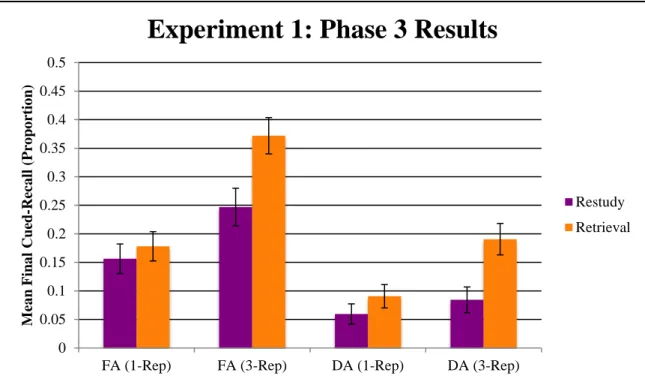
Phase 3 Cued Recall. The critical final recall results were measured as the proportion of target words recalled1. The final recall scores were analyzed with a 2 x 2 x 2 ANOVA, using phase 2 attention (FA vs. DA), phase 2 condition (restudy vs. retrieval), and phase 2 repetition (1-rep vs. 3-rep) all as within-subjects factors (Figure 1). All three main effects were significant, indicating: (1) a detrimental effect of phase 2 DA, F(1, 39) = 68.09, MSe = .02, p < .001, η2p = .636; (2) a benefit of phase 2 retrieval practice (i.e. a testing effect), F(1, 39) = 35.416, MSe = .011, p < .001, η2p = .476; and (3) a benefit of phase 2 repetition, F(1, 39) = 43.804, MSe = .019, p < .001, η2p = .529. Additionally, two of the three two-way interactions were significant, specifically: (1) the interaction between phase 2 attention and repetition, F(1, 39) = 8.626, MSe = .015, p = .006, η2p = .181, indicating that the negative
effect of DA was greater in the 3-rep than 1-rep condition; (2) the interaction between phase
2 condition and repetition, F(1, 39) = 6.214, MSe = .026, p = .017, η2p = .137, indicating that the testing effect was larger in the 3-rep than 1-rep condition. The interaction between phase 2 attention and condition was non-significant, F(1, 39) = 0.024, p = .878, as was the three-way interaction, F(1, 39) = 0.317, p = .577.
The significant two-way interactions both involved the repetition condition and so are not of primary concern. Regardless, further analyses were conducted and are briefly
discussed below. First, the significant interaction between phase 2 attention and repetition indicates that the disruptive effect of DA was greater in the 3-rep than 1-rep condition. To fully evaluate this interaction, a separate 2 (attention) x 2 (phase 2 condition) ANOVA was conducted for each level of phase 2 repetition (1-rep vs. 3-rep). For the 1-rep condition, the effect of attention was significant, F(1, 39) = 28.289, MSe = .012, p < .001, η2p = .42, the testing effect was significant, F(1, 39) = 2.353, p = .133, and the interaction was non-significant, F(1, 39) = 0.067, p = .797. For the 3-rep condition, the effect of attention was significant, F(1, 39) = 50.961, MSe = .023, p < .001, η2p = .566, the testing effect was significant, F(1, 39) = 21.434, MSe = .025, p < .001, η2p = .355, and the interaction was
non-significant, F(1, 39) = 0.198, p = .659. Taken together, the results indicate that the disruptive effect of DA was larger in the 3-rep, than 1-rep, condition, although the effect was significant in both.
.021, p < .001, η2p = .494, and the interaction was significant, F(1, 39) = 4.285, MSe = .025, p = .045, η2p = .099. For the DA condition, the testing effect was significant, F(1, 39) = 15.029, MSe = .013, p < .001, η2p = .278, the effect of repetition was significant, F(1, 39) = 12.381, MSe = .013, p < .001, η2p = .241, and the interaction was significant, F(1, 39) = 4.267, MSe = .013, p = .046, η2p = .099. Therefore, although the benefit of repetition was larger in the FA
than DA condition, the effect of repetition was significant in both attention conditions. Finally, the significant two-way interaction between phase 2 condition and repetition indicates that the testing effect was larger in the 3-rep than 1-rep condition. The prior
analyses found that the testing effect was significant only in the 3-rep but not 1-rep condition. This can be clearly seen in Figure 2, which plots the testing effect (the difference in recall between the retrieval and restudy conditions) as a function of attention and repetition. The condition-by-repetition interaction can also be interpreted as an increased benefit of phase 2 repetition for words retrieved compared to words restudied. To investigate this interpretation, a 2 (attention) x 2 (repetition) ANOVA was conducted at each level of phase 2 condition (restudy vs. retrieval). For the restudy condition, the effect of attention was significant, F(1, 39) = 29.105, MSe = .023, p < .001, η2p = .427, the effect of repetition was significant, F(1, 39) = 6.273, MSe = .021, p = .017, η2p = .139, and the interaction was non-significant, F(1, 39) = 3.162, p = .083. For the retrieval condition, the effect of attention was significant, F(1, 39) = 45.901, MSe = .016, p < .001, η2p = .541, the effect of repetition was significant, F(1, 39) = 36.959, MSe = .023, p < .001, η2p = .487, and the interaction was significant, F(1, 39) =
Phase 2 Digit Classification Task. The proportion of correctly classified digits during phase 2 (Table 2) was analyzed using a 2 (phase 2 condition) x 2 (repetition)
ANOVA. Only the main effect of condition was significant (other F’s < 1), indicating greater accuracy when paired with restudy than retrieval, F(1, 39) = 186.549, MSe = .008, p < .001, η2p = .827. Although it may seem like digit task accuracy was near chance in the retrieval
condition, this is due to omissions rather than incorrect responses. To investigate this, the same 2 x 2 ANOVA was used to analyze only those trials with actual responses (i.e.
excluding omissions), which increased the proportion of correct responses in both conditions (Table 2). Specifically, the proportion correct in the restudy condition increased by about 10% and the retrieval condition increased by about 20%. Despite the larger increase for the retrieval condition, the main effect of phase 2 condition remained significant, F(1, 39) = 65.12, MSe = .003, p < .001, η2p = .625, again indicating higher performance on the digit task when paired with restudy, than with retrieval. As with the unrestricted analysis above, only the main effect of condition was significant (other Fs < 1.5).
Discussion
Because the attention manipulation had the same effect on the retrieval and restudy condition, the size of the testing effect was similar under DA and FA, which does not support the predictions of the effortful and elaborative accounts of the testing effect. Specifically, both effortful and elaborative processing are attention demanding (i.e. Craik & Broadbent, 1983; Craik et al., 1996; Hasher & Zacks, 1979; McDowd & Craik, 1988; Mulligan, 2008), which indicates that if the encoding effects of retrieval did depend on greater effort or elaboration, then the disruption caused by DA during phase 2 would be greater for retrieval than restudy.
The lack of support for the predictions of the effortful and elaborative accounts of the testing effect is in line with prior research (Buchin & Mulligan, 2017; Mulligan &
Picklesimer, 2016), but the specific pattern of results does differ. Specifically, prior research found that the disruptive effect of DA was significant in the restudy condition but non-significant in the retrieval condition. Alternatively stated, the testing effect was larger in the DA than FA condition (Buchin & Mulligan, 2017; Mulligan & Picklesimer, 2016). However, the results of Experiment 1 revealed testing effects of similar size regardless of attention
condition. This difference between experiments may reflect the importance of the memory
task materials. The complexity and difficulty of these educational materials (e.g. Carpenter et
al., 2008) may have increased the reliance of retrieval on attentional resources (I return to
this issue in the General Discussion).
condition. Third, although the benefit of repetition was larger in the FA, than DA, condition as well as in the retrieval, than restudy, condition, the effect was significant in all possible condition combinations. This pattern likely reflects the difficulty in novel foreign language learning, especially if given only one restudy or retrieval practice opportunity. It is likely that these interactions are at least partly due to the relatively low recall in the 1 rep condition.
Although the phase 2 results are not the primary concern of the current study, two aspects of the results deserve mention. First, phase 2 recall performance was significantly reduced under DA compared to FA. Although DA during retrieval is usually less disruptive than DA during encoding, it can produce modest, sometimes significant, reductions in retrieval success (e.g. Craik et al., 1996). Additionally, negative effects of DA on memory generally increase as task difficulty increases (e.g. McDowd & Craik, 1988) and the memory task used in the current experiment (i.e. recall of Swahili-English word pairs) has been characterized as difficult (e.g. Carpenter et al., 2008). This may be why significant reductions in phase 2 recall were found in the present experiment. Second, performance on the
CHAPTER 3: EXPERIMENT 2
Prior research on attention and memory has demonstrated differential effects on secondary task performance when attention is divided during encoding and retrieval (e.g. Craik et al., 1996). Specifically, secondary task performance is more greatly affected by retrieval compared to restudy. Consequently, it was expected that Experiment 1 would produce a similar pattern in secondary task performance. Not only was this pattern expected, but it also appears to reflect participant’s natural inclinations when confronted with a dual-task situation. Given that this set of experiments is designed to emphasize real-world learning and ecological validity, it is important to let participants behave in an unconstrained manner when coordinating multiple cognitive demands.
Although important for ecological validity, differences in secondary task performance introduce a potential ambiguity in interpreting the results. That is, this pattern may reflect the obligatory nature of retrieval or it might reflect task prioritization differences between
encoding and retrieval (an ambiguity discussed in the introduction; see Buchin and Mulligan, 2017, for more detail). Therefore, because Experiment 1 revealed the usual pattern of
between restudy and retrieval, the results would no longer reflect participant’s natural inclinations when coordinating multiple cognitive demands. Therefore, in a continued effort to emphasize real-world learning, a different method was used to better equate secondary task performance.
To achieve this, the secondary task was changed from a continuous classification task to a somewhat easier, cumulative classification task. This new task was based on the
secondary task used by Buchin and Mulligan (2017, Experiment 3), which minimized differences in secondary task performance between restudy and retrieval. Specifically, instead of requiring participants to immediately classify digits, the task now required them to keep track of the number of odd digits presented during a single trial. This task also features enhanced feedback as described below. All other aspects of the experiment were the same as Experiment 1.
Methods
Participants. Forty participants from UNC at Chapel Hill were recruited in exchange for course credit.
response (0 – 4) using the keyboard. If the response was correct, the screen displayed “Correct!” and the participant would press the space bar to advance to the next trial. If the response was incorrect, the screen displayed “Incorrect!” and a buzzer sound played over the headphones before the participant pressed the space bar to advance to the next trial. This change was designed to better equate performance on the secondary task between the restudy and retrieval conditions while still allowing participants to behave in an unconstrained
manner. All other aspects of Experiment 2 were identical to Experiment 1. Results
Phase 2 Cued Recall. As in Experiment 1, the proportion of correctly recalled targets during phase 2 (Table 1) was analyzed using a 2 x 2 ANOVA, with phase 2 attention (full vs. divided) and phase 2 repetition (1-rep vs. 3-rep) as within-subjects factors. Replicating Experiment 1, all effects were significant, specifically: (1) a main effect of attention, indicating greater recall under FA, than DA, F(1, 39) = 11.461, MSe = .015, p = .002, η2p = .227; (2) a main effect of repetition, revealing higher recall for repeated pairs, than pairs presented only once during phase 2, F(1, 39) = 17.372, MSe = .021, p < .001, η2p = .548; and
(3) an interaction between phase 2 attention and repetition, F(1, 39) = 27.137, MSe = .011, p < .001, η2p = .41. Follow-up tests indicated that the effect of attention was significant for the repeated pairs, t(39) = 6.154, SE = .025, p < .001, d = 0.92, but not for pairs presented only once, t(39) = -0.713, p = .48. Additionally, the benefit of repetition was found under FA, t(39) = -9.025, SE = .027, p < .001, d = 1.578, as well as under DA, t(39) = -2.512, SE = .029, p = .016, d = 0.521.
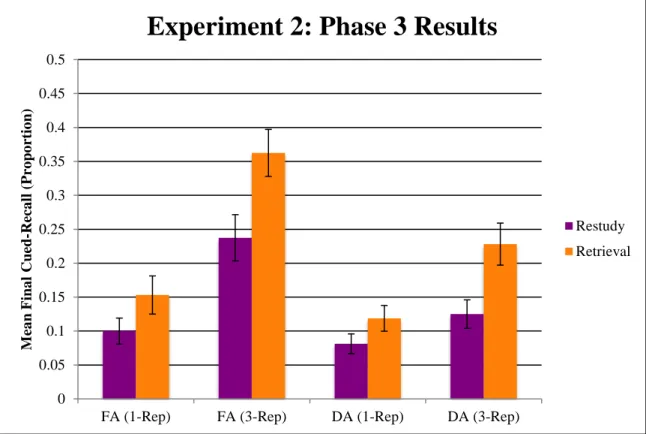
retrieval), and phase 2 repetition (1-rep vs. 3-rep) all as within-subjects factors (Figure 3). All main effects were significant indicating that: (1) DA during phase 2 disrupted later recall compared to FA, F(1, 39) = 20.075, MSe = .022, p < .001, η2p = .34; (2) retrieval practice during phase 2 enhanced final recall compared to restudying (i.e. a testing effect), F(1, 39) = 18.314, MSe = .028, p < .001, η2p = .32; and (3) repetition during phase 2 benefited later
memory, F(1, 39) = 61.478, MSe = .02, p < .001, η2p = .612. The two-way interaction
between phase 2 attention and repetition was also significant, F(1, 39) = 13.886, MSe = .014, p = .001, η2p = .263, indicating that the disruptive effect of phase 2 DA was greater in the 3-rep than 1-3-rep condition. The two-way interaction between phase 2 condition and 3-repetition approached significance, F(1, 39) = 3.647, MSe = .026, p = .064, η2p = .086, suggesting that
the testing effect was larger in the 3-rep than 1-rep condition. All other interactions were non-significant (ps > .05).
To fully assess the attention-by-repetition interaction, a 2 (attention) x 2 (phase 2 condition) ANOVA was conducted at each level of phase 2 repetition (1-rep vs. 3-rep). For the 1-rep condition, the effect of attention was non-significant, F(1, 39) = 1.786, p = .189, the testing effect was significant, F(1, 39) = 4.457, MSe = .018, p = .041, η2p = .103, and the interaction was non-significant, F(1, 39) = 0.225, p = .638. For the 3-rep condition, the effect of attention was significant, F(1, 39) = 30.277, MSe = .02, p < .001, η2p = .437, the testing effect was significant, F(1, 39) = 14.77, MSe = .035, p < .001, η2p = .275, and the interaction was non-significant, F(1, 39) = 0.239, p = .628. The results indicate that phase 2 DA
significantly disrupted later recall in the 3-rep but not 1-rep condition.
(repetition) ANOVA was conducted at each level of phase 2 attention (FA vs. DA). For the FA condition, the testing effect was significant, F(1, 39) = 10.16, MSe = .031, p = .003, η2p = .207, the effect of repetition was significant, F(1, 39) = 76.528, MSe = .016, p < .001, η2p = .662, and the interaction was non-significant, F(1, 39) = 2.049, p = .16. For the DA
condition, the testing effect was significant, F(1, 39) = 13.13, MSe = .015, p = .001, η2p =
.252, the effect of repetition was significant, F(1, 39) = 12.935, MSe = .018, p = .001, η2p = .249, and the interaction was non-significant, F(1, 39) = 3.308, p = .077. Taken together, the results show that although the benefit of phase 2 repetition was significant across all
conditions, it was larger under FA than DA.
Phase 2 Digit Classification Task. The proportion of correct answers on the digit classification task (Table 2) was analyzed using a 2 (phase 2 condition) x 2 (repetition) ANOVA. Similar to the results of Experiment 1, only the main effect of condition was significant (other Fs < 1), revealing greater accuracy in the secondary task when paired with restudy than retrieval, F(1, 39) = 57.34, MSe = .013, p < .001, η2p = .595. Because of the methodological change in the secondary task, all trials now required responses, which renders a separate analysis excluding omissions (as in Experiment 1) unnecessary. Discussion
retrieval were similarly disrupted by DA. Alternatively stated, the size of the testing effect was similar between the phase 2 FA and DA conditions. This can be seen in Figure 4, which plots the size of the testing effect as a function of attention and repetition.
Similar to prior research (Buchin & Mulligan, 2017; Mulligan & Picklesimer, 2016)
and Experiment 1, the testing effect did not decrease in size under DA. Therefore, the encoding effects of retrieval, as compared to restudy, do not seem to rely on greater effortful or elaborative processing, which are both highly susceptible to DA (e.g., Craik & Broadbent, 1983; Craik et al., 1996; Hasher & Zacks, 1979; McDowd & Craik, 1988; Mulligan, 2008). However, the testing effect also did not increase in size under DA, compared to FA, as it did in prior research (Buchin & Mulligan, 2017; Mulligan & Picklesimer, 2016). Experiment’s 1 and 2 in the current study both used novel foreign language word pairs and both found a significant effect of DA on the retrieval condition, whereas the effect was non-significant in the prior research (Buchin & Mulligan, 2017; Mulligan & Picklesimer, 2016). One
reasonable speculation consistent with these results concerns the complexity of the memory task materials. Specifically, the complexity of the current materials (e.g., Carpenter et al., 2008) may have increased attentional demands during retrieval practice to a greater degree than the materials used in prior studies (i.e. Buchin & Mulligan, 2017; Mulligan &
Picklesimer, 2016; I return to this issue in the General Discussion).
interaction is likely due to the relatively low level of recall in the 1-rep condition.
Consequently, because final recall in the 1-rep condition was near floor, the disruptive effects of phase 2 DA may not have had room to emerge.
Lastly, the phase 2 recall and digit task performance results are discussed. The pattern of the phase 2 recall results was similar to Experiment 1, except for a slight difference in the 1 rep condition. Specifically, in this condition, DA had a marginally significant effect in Experiment 1 (p = .051) whereas the effect was non-significant in Experiment 2 (p = .48). The current DA task might be somewhat easier than in Experiment 1, which may explain the slight discrepancy in results. But more generally, the finding that DA generally disrupted phase 2 recall may also reflect the enhanced difficulty of the current memory task (e.g. Carpenter et al., 2008; McDowd & Craik, 1988).
More relevant to Experiment 2 is that performance on the digit classification task continued to suffer to a greater degree when paired with retrieval than with restudy. Although the obligatory and attention-demanding nature of retrieval is well documented (e.g.,
Anderson et al., 1998; Craik et al., 1996; Naveh-Benjamin et al., 2000) and in line with the results of Experiment 1, it is still interesting that the modifications to the secondary task did not fully equate digit task performance between restudy and retrieval. However, the
modifications did result in two important differences between the experiments and between the conditions. First, digit task performance between restudy and retrieval was better equated in Experiment 2 than 1 (i.e. the difference in digit task accuracy between restudy and
restudy condition (i.e. the difference in digit task accuracy between Experiments 1 and 2 was larger in the retrieval than restudy condition)2.
Overall, the attention-demanding nature of retrieval continued to impact secondary task performance to a greater degree than restudy, although the modifications in Experiment 2 did reduce that difference. Importantly, secondary task performance was better equated without coming at a large cost to ecological validity (i.e. participants’ behavior was much less constrained than it would be if a specific level of accuracy was required and constantly monitored).
2 Digit task accuracy in the restudy and retrieval condition was compared between experiments using a 2 x 2 x 2 ANOVA, with phase 2 condition and repetition as within-subjects factors and experiment number (1 vs. 2) as a between-subjects factors. Only three effects were significant (other F’s < 1.1), including the typical main effect of condition, F(1, 78) = 207.677, MSe = .069, p < .001, η2
p = .727, as well as the main effect of experiment, F(1,
78) = 21.783, MSe = .044, p < .001, η2
p = .218, indicating higher digit task accuracy in Experiment 2 than 1.
Critically, the interaction between condition and experiment was also significant, F(1, 78) = 6.406, MSe = .0.011, p = .013, η2
p = .076, which indicates that the effect of condition was smaller in Experiment 2, than 1.
CHAPTER 4: EXPERIMENT 3
The main purpose of Experiment 3 was to generalize the results of the prior experiments to other materials that are educationally relevant and even more complex.
Experiment 3 used prose passages instead of foreign-language word pairs as the memory task material. In phase 1, participants read a passage of educational text (under full attention). In phase 2, participants either studied seven key concepts extracted from the passage (restudy condition) or were presented with seven similar fill-in-the-blank short answer questions (retrieval condition). As before, phase 2 was conducted either under FA or DA. Attention was divided using the same continuous digit task used in Experiment 1, which was chosen over the cumulative digit task used in Experiment 2 for two reasons. First, performance on the cumulative task was not fully equated between the restudy and retrieval conditions. Second, the cumulative task would require participants to keep track of more digits per trial than in Experiment 2 (4 vs. 9) at the same time as they read sentences, instead of word pairs. This would increase the difficulty of the cumulative task and likely eliminate (or even
reverse) its advantage relative to the continuous digit task. Participants repeated phases 1 and 2 with four different educational passages, such that each of the possible combinations of attention and phase 2 conditions was experienced. Participants then left the lab and returned two days later for the final tests for each of the passages.
Methods
Materials and Design. Four prose passages were adapted from Agarwal et al., (2008). The passages originally came from an educational textbook (Cooper et al., 1996). Each passage was approximately 1000 words in length (M = 1008), covered a single topic (‘Earthquakes’, ‘Fossils’, ‘Voyager’, and ‘Wolves’), and the average Flesch Reading Ease score for the four passages was 71.4 (Flesch, 1948). Each passage also had seven
corresponding fill-in-the-blank, short answer questions based on facts and ideas contained in each passage3. The fill-in-the-blank questions were adapted from the short answer, free-response questions used by Agarwal et al. (2008). For example, the following excerpt is from the ‘Earthquakes’ passage:
‘… Sand sometimes bubbles up during earthquakes, gushing water and soil like miniature mud volcanoes. These “sand boils” are particularly dangerous to buildings. In places where water is close to the surface, sandy layers turn into quicksand and structures crumble. …’
The corresponding fill-in-the-blank question asked, ‘Miniature mud volcanoes that
bubble up during earthquakes are called _____’. The answer was, “sand boils.” Each
fill-in-the-blank question had a corresponding restudy sentence with the correct answer in place of
the blank, for example, ‘Miniature mud volcanoes that bubble up during earthquakes are
called sand boils’. The test questions were identical on the initial and final tests, similar to the
format used in prior studies assessing the testing effect with educational materials (e.g.
Agarwal et al., 2008; Kang et al., 2007; McDaniel, Anderson et al., 2007; Roediger, &
Karpicke, 2006; see Wooldridge, Bugg, McDaniel, & Liu, 2014 for a cautionary note). Questions appeared on each test in the order in which the facts/concepts occurred in the
passage.
As in Experiment 1 and 2, phase 2 learning condition (restudy vs. retrieval) and attention during phase 2 (full vs. divided) was manipulated within-subjects and
counterbalanced for order. Unlike in the prior experiments, there was no phase 2 repetition condition because each key concept was either restudied or tested once during phase 2. Each set of seven sentences corresponding to one passage was assigned (and counterbalanced) to each of the four possible condition combinations (FA-restudy, FA-retrieval, DA-restudy, and DA-retrieval). As in Experiment 1, attention was divided in the two DA conditions by
requiring participants to continually classify digits (1 – 9) as even or odd.
Procedure. Before beginning the experiment, participants were told that they would read four passages for a memory test two days later. In phase 1, participants were asked to read the first prose passage at their own pace. All passages were presented on paper. After finishing, the passage was taken away and phase 2 began.
In Phase 2, the seven key concept sentences related to the just-read passage were presented for additional learning. Each sentence was presented on the computer one at a time. In the retrieval condition, participants were presented with the fill-in-the-blank versions and instructed to provide the answer for each. Specifically, in the FA-retrieval condition,
their response, the correct answer was displayed as feedback for 6 seconds. Participants were told to read the correct response out loud if it did not match their response or if no response was given. A blank screen then appeared for 1 second. The next fill-in-the-blank sentence was shown immediately after the blank screen and the process was repeated for all seven questions.
In the FA-restudy condition, participants saw the same key concept used in the retrieval condition, but with the correct response in place of the blank. Participants were told that this would provide an additional opportunity to learn material from the passage. They had 18 seconds to read the sentence silently and study it for the later memory test. As before, a blank screen appeared afterwards for 1 second before the next sentence was displayed, until all seven concepts had been presented.
The DA-restudy and DA-retrieval conditions followed the same procedure, with the addition of the secondary task. The task was similar to the digit-task used in Experiment 1, but with timing-modifications to reflect the longer phase 2 time limits and the more complex memory task. Specifically, digits (1-9) were played at a rate of 1 every 2 seconds for a total of 9 digits per sentence, starting with the onset of the sentence. As in Experiment 1,
participants were told to use the keyboard to indicate if the digit was odd (i.e. press the “o” button) or even (i.e. press the “e” button). Again, buzzer feedback was used for incorrect or late responses. The task was continually performed throughout the entire set of seven sentences.
counterbalanced across participants such that each passage was equally distributed among the four possible conditions (i.e. FA-restudy, FA-retrieval, DA-restudy, and DA-retrieval).
After completing the first session, participants left the lab and were instructed to return two days later for the final test. Upon returning, participants took the final test (phase 3), consisting of the same four sets of seven questions each used during phase 2, now written on a sheet of paper. The sentences were all in fill-in-the-blank format and presented under FA. Participants were told that they had 12 minutes to answer all of the questions by writing the correct response in the blank space.
Scoring. Responses on the fill-in-the-blank questions were scored using two different methods, adapted from the free-response scale used by Agarwal et al. (2008). Because the
current study used more constrained fill-in-the-blank questions, the scales did not cover as
wide of a range as the scale Agarwal et al. (2008) used (i.e. 4 possible scoring options).
Specifically, the all-or-nothing scale gave 1 point for correct and complete answers and 0
points for incorrect, incomplete, or missing answers (i.e. 2 possible scoring options).
However, because many of the answers contained multiple words, another scale was used
that allowed for more lenient grading. Specifically, the partial-credit scale gave 2 points for
correct and complete answers, 1 point for correct, but not fully complete answers, and 0
points for incorrect, very incomplete, or missing answers (i.e. 3 possible scoring options). For
example, if a participant gave the answer “sand bubblers” to the question described above,
their score would be 0 for the all-or-nothing scale and 1 for the partial-credit scale. Likewise,
if their response were “sand boils”, their score would be 1 for the all-or-nothing scale and 2
for the partial-credit scale. Finally, and similar to Agarwal et al. (2008), two raters
scores was calculated after a subset of tests (i.e. the first 13 subjects). Because the inter-rater
reliability was higher than .9, the acceptable cutoff value used in Agarwal et al. (2008), one
rater scored the remaining tests. Specifically, the inter-rater reliability values were 1.00 for
the all-or-nothing scale and 0.96 for the partial-credit scale.
Results
On average, participants spent 263.7 s reading a single passage during phase 1. The average time (s) spent reading each specific passage was roughly equivalent (i.e.
Earthquakes: M = 258.88, SD = 58.08; Fossils: M = 261.6, SD = 62.25; Voyagers: M = 277.25, SD = 68.05; Wolves: M = 257.08, SD = 58.33).
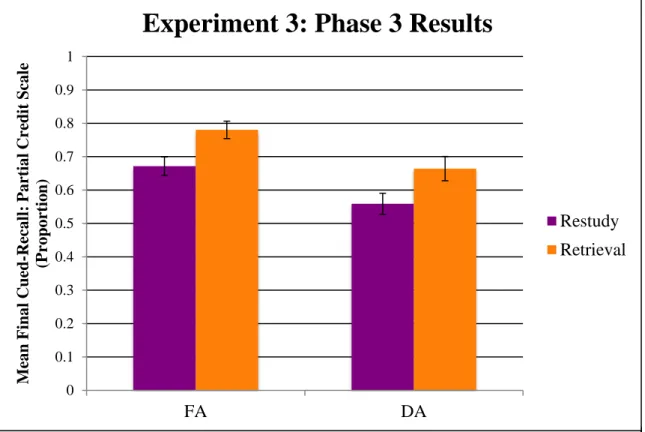
All phase 2 (i.e. initial) and phase 3 (i.e. final) recall results were scored twice, once using the all-or-nothing scale and once using the partial-credit scale. Although this resulted in different descriptive statistics, all of the inferential tests produced identical conclusions. Therefore, the results using the all-or-nothing scale are reported in Appendix B and the results using the partial-credit scale are reported below.
Phase 2 Cued-Recall. The proportion of correctly answered fill-in-the-blank
questions during phase 2 was M = .52 (SD = .24) and M = .49 (SD = .23), in the FA and DA conditions, respectively. Dividing attention during phase 2 did not significantly reduce phase 2 recall, t(39) = .489, p = .628.
17.821, MSe = .029, p < .001, η2p = .314, with higher recall in the FA than DA condition; (2) the main effect of condition was significant, F(1, 39) = 16.44, MSe = .028, p < .001, η2p = .297, with retrieval practice producing greater final recall than restudy (i.e., a testing effect); and (3) the interaction between attention and condition was non-significant, F(1, 39) = .354, p = .555.
Phase 2 Digit Classification Task. Accuracy on the digit classification task was compared between the restudy and retrieval groups (Table 2). When assessing all trials, the restudy condition had significantly higher accuracy on the secondary task than the retrieval condition, t(39) = 9.117, SE = .051, p < .001, d = 2.039. This pattern remained when restricted to only those trials with actual responses, t(39) = 6.043, SE = .008, p < .001, d = 1.131.
Discussion
In general, the pattern of results in Experiment 3, using fill-in-the-blank, short answer questions, was similar to the pattern of results in Experiment’s 1 and 2, which used Swahili-English word pairs. First, a benefit of retrieval practice compared to restudy emerged under both attention conditions. Second, phase 2 DA similarly impaired final recall in the restudy and retrieval conditions. Third, the interaction between phase 2 attention and condition was non-significant, as in Experiment’s 1 and 2.
Picklesimer, 2016). As with Experiment’s 1 and 2, this important difference may reflect the change in memory task materials (I return to this issue in the General Discussion).
One difference between the results of Experiment 3 and Experiment’s 1 and 2 is that DA during phase 2 did not significantly disrupt phase 2 recall as it did in the prior
experiments. This may be due to the change in the memory task materials. Specifically, the current task is easier in several ways than the task in Experiment’s 1 and 2 – in particular, it does not require novel language learning, it provides fairly complete retrieval cues, and the syntactic structures of the sentences may scaffold learning. However, the resilience of retrieval under DA found in Experiment 3 does replicate prior research on the differential effects of DA on encoding and retrieval (e.g. Craik et al., 1996). Finally, the digit
CHAPTER 5: GENERAL DISCUSSION
The primary goal of the current study was to assess the impact of DA on the encoding effects of retrieval while using materials more similar to those used in real-world learning. Prior research on DA and the encoding effects of retrieval support the idea that the encoding effects of retrieval are largely resilient to distraction, like retrieval success itself (Buchin & Mulligan, 2017; Mulligan & Picklesimer, 2016). Specifically, the prior research found that the testing effect actually increased in size under DA compared to FA. Alternatively stated, DA disrupted the encoding effects of restudy to a much greater degree than the encoding effects of retrieval. These prior findings conflict with predictions of testing effect accounts that hinge on effortful or elaborative processing, which are both disrupted by distraction (e.g., Craik & Broadbent, 1983; Craik et al., 1996; Hasher & Zacks, 1979; McDowd & Craik, 1988; Mulligan, 2008). Specifically, if the mnemonic benefits of retrieval did depend on greater effortful or elaborative processing than restudy, DA during phase 2 should have greatly reduced the size of the testing effect, although this was not the case.
Although prior research does not support these predictions, both studies (Buchin & Mulligan, 2017; Mulligan & Picklesimer, 2016) used materials and methods typical of basic research in memory and are therefore limited in ecological validity and educational
major goal behind studying the testing effect is to convince educators and students of the mnemonic benefits of testing, even with distraction, then it is important to do so using materials similar to those used in the classroom.
The critical results of the current study provide no support for the predictions of the effortful and elaborative accounts of the testing effect but also do not fully replicate the pattern found in the prior research. Specifically, across all 3 experiments the amount of disruption caused by DA during phase 2 was similar when paired with either restudy or retrieval. This similarity is not likely due to low power, as the current experiments each tested 40 participants and the power analysis discussed in Experiment 1 found that 24
participants were required to observe a significant interaction at .95 power (Faul et al., 2007). This in turn means that the size of the testing effect in the DA condition was similar to the size in the FA condition. However, prior research generally found that the testing effect increased in size under DA, compared to FA (Buchin & Mulligan, 2017; Mulligan &