THE LISTENING MOMENT: LUDIC WIT IN HAYDN’S STRING QUARTETS
David VanderHamm
A thesis submitted to the faculty of the University of North Carolina at Chapel Hill in partial fulfillment of the requirements for the degree of Master of Arts in Musicology in the Department of Music.
Chapel Hill 2013
Approved by: Mark Evan Bonds Tim Carter
Abstract:
DAVID VANDERHAMM: The Listening Moment: Ludic Wit in Haydn’s String Quartets
(Under the direction of Mark Evan Bonds)
TABLE OF CONTENTS
List of Figures...iv
Introduction: The Moment of Musical Wit...1
Chapter 1. Wit, Humor, and the Phenomenology of a Joke Quartet...5
2. Wit as a Phenomenon in the op. 76 Quartets...27
3. Metaphors of Music, the Composer as Genius, and the Rhetorical Listener...43
Conclusion: Hearing Haydn as Homo Rhetoricus... 58
List of Figures
1. Op.33 no. 2, 4th movement... 20
2. Op. 76 no. 2, 2nd movement... 29
3. Op. 76 no. 2, 2nd movement, continued... 32
4. Op. 76 no. 4, 2nd movement... 34
5. Op. 76 no. 4, 2nd movement, continued... 36
6. Op. 76 no. 5, 4th movement... 37
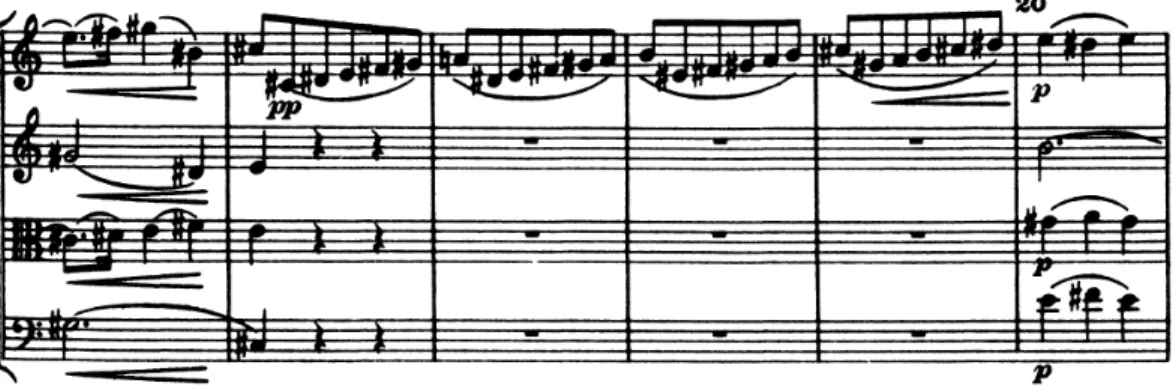
7. Op. 76 no. 6, 2nd movement... 40
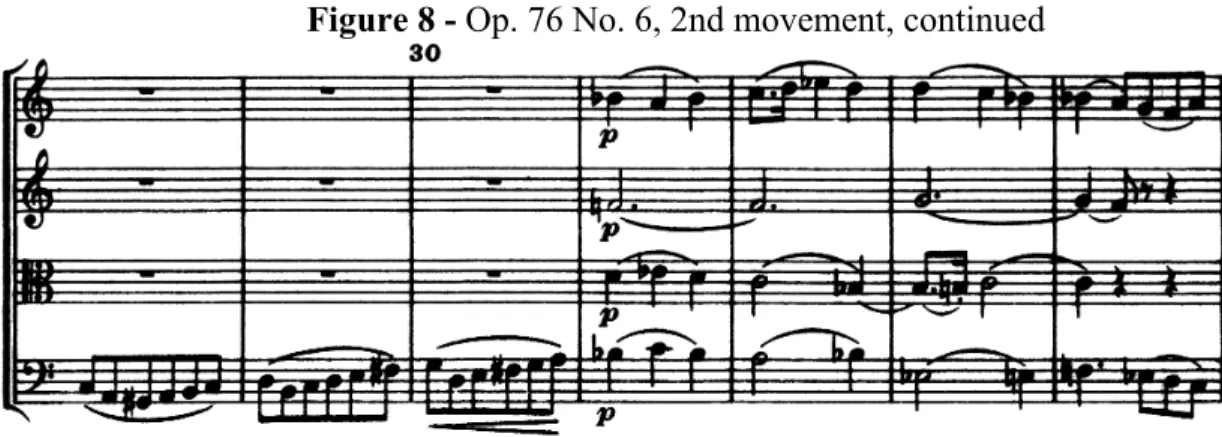
8. Op. 76 no. 6, 2nd movement, continued... 41
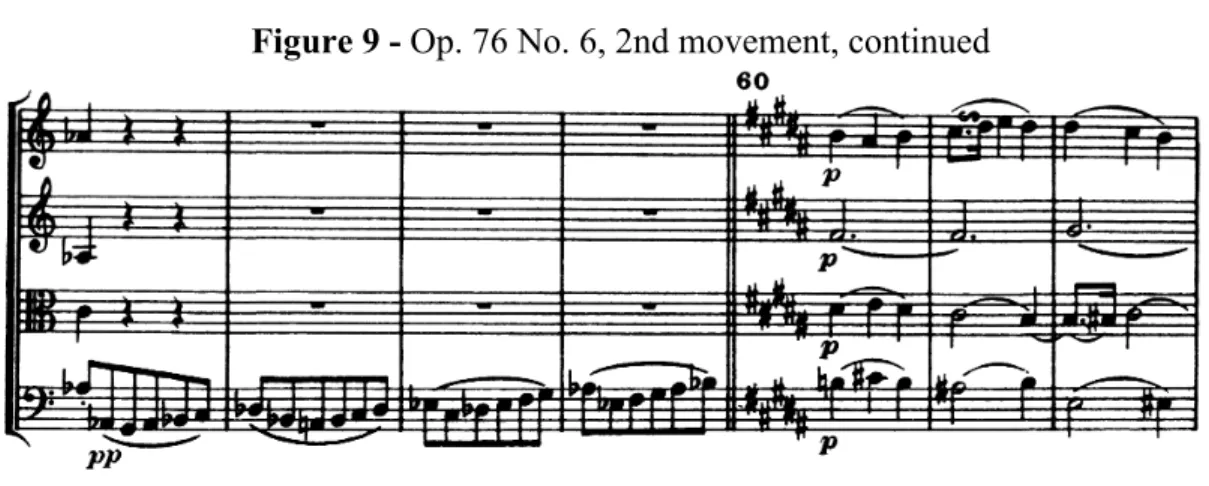
9. Op. 76 no. 6, 2nd movement, continued... 42
INTRODUCTION
THE MOMENT OF MUSICAL WIT
Since Haydn’s own time audiences have noted a characteristic feature of his music, one that came to be called, simply, wit. His instrumental music and string quartets in particular garnered this label, and the term became a gloss for diverse musical events. The specifics of the wit we casually reference in Haydn’s music—where and why it occurs, and precisely whose it is—seem to have been lost in a slew of generalities.
This thesis seeks to reposition musical wit both as a meaningful musical event and as term useful for describing that experience. Specific analyses are drawn from the
“Joke” Quartet, the second of the op. 33 set, as an extended and overt example, and from the more understated events of slow movements in the op. 76 quartets. Two lines of inquiry organize this study: 1) What does it mean to experience wit within Haydn’s string quartets; and 2) Why is musical wit so easily viewed not necessarily as a vice, but as a lesser virtue?1
To answer these questions, I treat wit as a temporal phenomenon. Wit is a result of “perceptual engagement with music” as it unfolds over time, even if the span of time is
quite short. This is distinct from experiences that arise from “imagining, remembering, or reflecting upon music.”2 In short, wit occurs in the listening moment. My approach to wit is phenomenological in a broad sense, in that I am interested in the way musical wit occurs within the lived experience of a perceiving subject. Wit is not a property of a work, or even a reading of a “text,” but is located within the interaction between the listener and the music in time. It is an “experience” in the specific sense that Thomas Clifton means it, as “an individual living-through of some event.”3
Rather than imagining an aesthetically and ideologically unbiased starting point as in true Husserlian phenomenology, I deal directly with the ways that preconceptions frame the experience of musical wit.4 For while “immediacy” may be an aspect of aesthetic experience, such experience cannot claim a “naiveté that transcends itself by proclaiming itself naïve.”5 For this reason, I uphold Carolyn Abbate’s distinction between drastic and gnostic modes of experience, even while rejecting the idea that they can (or should be) independent of each other. 6 Indeed, their interdependence makes Abbate’s
2 Eric Clarke, “Music Perception and Musical Consciousness,” in Music and Consciousness: Philosophical, Psychological, and Cultural Perspectives (Oxford: Oxford University Press, 2011), 195.
3 Thomas Clifton, Music as Heard: A Study in Applied Phenomenology (New Haven, CT: Yale University Press, 1983), 7.
4 Husserlian phenomenology attempts to perform a “phenomenological reduction,” whereby one can “detach from all forms of conventional opinion, including our commonsense psychology….and all philosophical and metaphysical theorising.” Dermot Moran, Introduction to Phenomenology (London: Routledge, 2000), 146. Subsequent philosophers within the phenomenological tradition have critiqued the notion that one could shed all such presuppositions, however they value “the idea of reduction as a ‘leading-back’ to the well-springs of our experience.” Maurice Merleau-Ponty approaches it this way, saying, “the most important lesson which the reduction teaches us is the impossibility of a complete reduction.” See Merleau-Ponty, Phenomenology of Perception, trans. by Taylor Carman (London: Routledge, 2012), xiv.
5 Carl Dahlhaus, Esthetics of Music, trans. William Austin, (Cambridge: Cambridge University Press, 1982), 72.
critique regarding one’s dominance over the other even more salient to the present argument: there is a perceptual bias that attends primarily to those aspects of lived “drastic” musical experience that best translate to the “gnostic” mode of reflection. This may begin to explain wit’s often precarious position within scholarly accounts of Haydn’s music.
Chapter 1 begins with a discussion of the terms that can be used to describe the experience of musical wit. The “Joke” Quartet provides an extreme example that clearly demonstrates the interpretive differences communicated by these terms. Chapter 2
utilizes this vocabulary in exploration of some of the more subtle moments of musical wit in second movements of some of the op. 76 quartets. Chapter 3 completes the circle by reflecting the experience back onto its metaphorical and perceptual framing, examining how the presuppositions of a contemporary Western listener may shape—or preclude— an experience of musical wit.
I describe the listening framework as a tripartite cluster of beliefs pertaining to the music as work, the composer as author, and the self as listener. Each of these beliefs addresses questions of identity, which is why responses to music often reflect deep-held convictions about oneself and the nature of the world one lives in. It is also why wit can be valued as a richness of the moment, or dismissed as ephemeral and unimportant. Experiencing wit within Haydn’s quartets raises complex issues regarding musical meaning. Is music to be valued for those qualities and impressions that persist after its
occurrence, or for those experiences that are uniquely provided within the moment? How are we to reconcile the two?
These questions are not solely musical but apply to meaning in general. Claude Levi-Strauss defines “to mean” as “the ability of any kind of data to be translated in a different language,”7 placing highest value on the stability that persists despite
transformation. Jean-Jacques Nattiez leaves room for the shifting nature of meaning, claiming simply that meaning arises when an individual places something “in relation to…lived experience.”8 This maintains the possibility that meanings may not be entirely stable—just as a person’s sense of his or her lived experience may shift— and it is this relational sense of meaning that I reference throughout this thesis. As such, the conflict between wit and more “serious” musical experiences in Haydn’s music has less to do with what music means, and more to do with when it should convey that meaning.
The listening experience for which I attempt to provide an account is that of a contemporary listener in the early 21st century. My own perceptions serve as the starting point, placed into dialogue with those communicated by various scholars. While
historical understandings of Haydn and musical wit in general make up an important part of my argument, they are read with regard to the practices of contemporary listeners. Though it is hoped that this theorization of musical wit might be capable of extending to other music, the present argument is aimed at understanding the phenomenon particularly as it arises in relation to Haydn’s string quartets.
7 Claude Levi-Strauss, Myth and Meaning: Cracking the Code of Culture (New York: Schocken Books, 1979), 9.
CHAPTER 1
WIT, HUMOR, AND THE PHENOMENOLOGY OF A “JOKE’ QUARTET
In this chapter, I offer a definition of musical wit, distinguishing it from three terms that often accompany it within the scholarly discourse: humor, irony, and jokes.9 Differentiating among these terms will allow for a more accurate description of musical wit as a phenomenon. The terms are undoubtedly related, but they are not roughly equivalent, nor are they subsets of a single stylistic or generic marker.10 My definition does not intend to section them off from each other for the sake of convenience, but at understanding how each term communicates subtle differences of experience.
Discussions of musical wit have generally taken verbal wit as their model, for it is widely recognized that the concept of wit did not originate in music, but in language. Prior even to this verbal understanding, however, were conceptions of wit as a perceptual ability. Used in reference to Shakespeare or John Donne, wit was an intelligence that
9 See, for example, Laurie-Jeane Lister, Humor as a Concept in Music: A Theoretical Study of Expression in Music, the Concept of Humor, and Humor in Music, with an Analytical Example, W.A. Mozart, Ein Musikalischer Spass, KV 522 (Frankfurt am Main, New York: P. Lang, 1994), 84-90. Lister uses humor as an umbrella term of which wit is a subtype. See also, Scott Burnham, “Haydn and Humor,” In The Cambridge Companion to Haydn, edited by Caryl Clark (Cambridge, UK: Cambridge University Press, 2005), 62. In a single paragraph, Burnham references the same passage as “humorous,” “funny,” “comic,” a “practical joke,” and finally “a subtle, ironic joke.” James Webster attempts briefly to clarify some of these terms in “Haydn’s Aesthetics,” In The Cambridge Companion to Haydn, edited by Caryl Clark
(Cambridge, UK: Cambridge University Press, 2005), 41.
bordered on eccentricity.11 Writers in the seventeenth and early eighteenth century used “wit” to describe the specific ability to perceive similarities in ideas and objects that were not entirely obvious.12 Speaking or writing provided the proof of wit, but wit was
necessarily perceptual before it could be linguistic. Declaring a person’s comment to be witty, then, simultaneously described that person’s perceptions, his or her language regarding those perceptions, and the way that those comments transformed the listener’s own perceptions.
The importance of communicating and thereby sharing witty perceptions led to wit’s near equivalence with “rhetorical ingenuity.”13 In 1711, Alexander Pope asserted the importance of communication over perception by describing wit’s ability to convey “What oft was thought, but ne’er so well express’d.”14 For Pope, the perceptions need not be unusual, but their presentation must be quite novel. This rhetorical quality of wit persisted, though later writers also insisted on the corresponding ability to see hidden similarities. The difference between this and the earliest conceptions of wit was that the relational similarities were now hidden to the point that the objects were considered in many ways dissimilar.15 Eventually, it became ambiguous where the emphasis rested—on the similarity or the dissimilarity of the elements joined together in the witty remark. The
11 Murray Roston, The Soul of Wit: A Study of John Donne (Oxford: Clarendon Press, 1974) 107. 12 Francis Hutchison, “Reflections on Laughter,” Dublin Journal no. 11 (12 June 1725) reprinted in Eighteenth-Century Critical Essays, ed. Scott Elledge (Ithaca, NY: Cornell University Press, 1961), 383.
13 Gretchen Wheelock, Haydn’s Ingenious Jesting with Art: Contexts of Musical Wit and Humor (New York: Schirmer Books, 1992), 24.
14 Alexander Pope, Essay on Criticism (London: 1711) quoted in Wheelock, Haydn’s Ingenious Jesting with Art, 22.
performative aspect of wit was made clear by William Jackson’s colorful description of 1798 of wit as “the dextrous performance of a legerdemain trick, by which one idea is
presented and another substituted.”16 Perhaps the relationships communicated by wit
were not trustworthy; perhaps they were fabricated by the remark rather than communicated by it.
For these reasons, wit has long been viewed with occasional suspicion, either as a potentially misleading rhetorical influence or as an untrustworthy mental faculty.17 John Locke contrasted wit and reason as opposite mental functions—wit puts things together while reason separates—leaving little doubt which side of the dichotomy he preferred.18 While potentially dismissive, his binary opposition remains useful in that it presents the two poles of rationality and randomness between which wit must exist. The relationships created within wit should never be wholly expected nor wholly justifiable rationally, but neither can wit be a complete non sequitur, bearing no relation whatsoever to its musical surroundings. To interpret anything as witty—whether perception, speech, or music —is to hold it ambivalently between that which makes perfect sense and that which makes no sense.
Wit’s general lack of specificity19 has not been alleviated in its musical application. Often relegated to passing remarks, the term seems to mean very little, or
16 William Jackson, “On Wit,” in The Four Ages, Together with Essays on Various Subjects (London, 1798; facsimile reprint, New York: Garland, 1970), 122.
17 Wheelock, Haydn’s Ingenious Jesting with Art, 21.
18 John Locke, Essay Concerning Human Understanding (London: 1690) Quoted in William Jackson, “On Wit,” 4.
perhaps far too many things. References to “Haydn’s wit” invoke the term as an
intellectual faculty of the composer while also referencing the presentation of his ideas in particularly clever ways. Moving away from this focus on the composer as originator and communicator, my definition emphasizes wit as the moment when relationships between elements are produced within the listener’s perceptual engagement with the music.
Musical wit is a phenomenon that occurs in a singular moment formed by the
interaction between listener and music, establishing unusual or surprising relationships
between seemingly incongruous elements. Wit is neither completely contained in the
music, nor completely outside of it, but is created by the listener’s perceptual relationship
to the music. Haydn’s music is witty in the sense that it creates opportunities for the
experience of wit, and these moments are realized only in relationship to the listener.20 This definition is modeled on one by Friedrich August Weber, the only
contemporary of Haydn to provide a thorough description of musical wit. Weber defines musical wit in action, claiming it “depends on the discovery of unexpected similarities between two musical ideas, and on the surprise of their facile and appropriate
combination.”21
Leonard Ratner quotes Weber further:
Just as poetic and descriptive wit depends upon the tasteful connection of one clever idea to another similar idea, so does musical wit depend as well upon the unexpected similarity between two musical ideas and their tasteful and proper
narrower modern idea of amusing verbal cleverness. In its literary uses, the term has gone through a number of shifts: it was associated in the Renaissance with intellectual keenness and a capacity of ‘invention’ by which writers could discover surprisingly appropriate figures and conceits, by perceiving resemblances between apparently dissimilar things. It took on an additional sense of elegant arrangement in the 17th and 18th centuries.” Chris Baldick, Oxford Dictionary of Literary Terms, 3d edition (Oxford: Oxford University Press, 2008), s.v. “wit.”
connection as delivered by means of surprise.22
While my definition is consistent in many respects with Weber’s—especially his emphasis on the action of wit and “unexpected similarities”—it differs on two important points. First, Weber states that the unexpected similarities must occur between
specifically musical ideas. While this might seem a reasonable assertion, it suggests that musical wit might primarily consist of issues concerning melodic character or style, and this is precisely how Leonard Ratner applies the definition. Writing of Mozart’s Quintet in D Major, K. 593, Ratner describes the “rapid succession of military, peasant, brilliant, brusque and singing manners”23 as the source of wit. While I have no doubt that one might experience wit through such contrast, this seems too narrow a way to define the phenomenon. By utilizing “elements” as an intentionally broad term within my
definition, I leave room for the possibility that they may be musical units (as Weber and Ratner believe), abstract concepts (as I will explain in chapter 2), or even competing perceptions of the same musical event.
The second distinction I wish to make between my understanding of musical wit and Weber’s involves wit’s location and time-scale. Weber and Ratner attempt to locate wit within the musical structures, which subsequently places an emphasis on large-scale relations rather than quick moments. One can assume that these musical structures must be encountered by a perceiving subject, but they take this step for granted. For them, wit is a compositional device or an analytical fact of the music that will presumably be discovered at some point by a listener.
This fails to address the basic problem of how wit might move from a category of relations present in the music to its perception by a listener. Why should juxtapositions of melodic character be experienced as witty rather than dramatic, or simply confusing? Weber believes the composer’s intervention to be a lamentable necessity, calling it “a pity that musical wit that is present in pure instrumental music almost always requires a commentary, which only the composer himself can provide.”24 I would argue conversely that the music is both more and less self-sufficient than Weber allows. It is more so in that it need not necessarily have express verbal guidance in order to give rise to an experience of wit, and less so in that it cannot possibly give rise to such an experience outside of the relation to a perceiving subject.
Since Haydn’s own time, discussions of musical wit have almost always included humor as a terminological companion. While Gretchen Wheelock’s Haydn’s Ingenious Jesting with Art has contributed a great deal to a historical understanding of wit within
Haydn’s music, it perpetuated the lack of specificity regarding wit’s functional meaning. The book begins by setting aside any distinctions between wit, humor, and jokes
“temporarily,” and though Wheelock quotes voluminous sources that occasionally attempt to make terminological distinctions, she tends to treat the three as
interchangeable throughout her work.25 While it is in some ways against the spirit of wit to draw such fine lines, distinguishing between these terms can illustrate an interpretive difference, even if not necessarily an ontological one. Wit and humor as categories may
24 Weber, “Ueber komische Charakteristik and Karrikatur in praktischen Musikwerken,” 137, quoted and translated in Ratner, The Classical Style, 387.
not always be obviously separate from one another, but the use of one term over another communicates a different perception of an experience by a listener.
Etymology can help separate wit and humor. Wit, from an Anglo-Saxon root, is linked with the mind; humor, originally a medical term, with “the fluids of the body.”26 Wit is more directly tied to intelligent thought (so much so that it can be used to mean quickness of mind), while humor is primarily linked to the body (to the extent that it can be used to mean “mood”). This difference of emphasis is why it would be inappropriate to characterize a slapstick routine (pie in the face!) as witty.
Unlike wit, humor’s ties to the body imply a kind of biological necessity. Humor’s usage as a term in medieval medicine linked it to a subsequent belief that the fluids in the body left one predisposed toward humor; its expression was nearly an imperative. Wit, with its correlation to the mind and conscious perception, implies a greater degree of intentionality. Perhaps the most famous of Haydn quotations can illuminate this distinction, as the German word, Laune, maintains the same double-meaning as humor:
I sat down, began to improvise, sad or happy according to my mood [Laune]. Once I had seized upon an idea, my whole endeavor was to develop and sustain it in keeping with the rules of art.27
Haydn’s mood (humor) established the initial characterization of a theme. The
opportunities for wit are produced by the intentional turning of the composer’s powers toward his material—the developing and sustaining. Thus the two remain related but
26 Harry Levin, Playboys and Killjoys: An Essay on the Theory and Practice of Comedy (Oxford: Oxford University Press, 1987), 11.
distinct, with differences drawn by degrees rather than clear separations, and they ultimately comprise a continuum.
If wit and humor are not equivalent, the question arises: is wit necessarily comedic?28 The recognition that wit need not be “funny” has led to a discussion of wit alongside the more serious category of irony. One similarity between the two is that they both create an aspect of distance by drawing attention “to the stylistic surface, to the artifice of the work.”29 Wit and irony similarly point to and play off of the artifice of art. This creates a self-reflexive experience—an awareness of oneself as a perceiver in the act of perceiving—that directly contrasts with the prescribed self-forgetting of disinterested, aesthetic contemplation.
Rather than composing “in such a way that one notices no art at all,”30 experiences of musical wit call attention to the composer as the creative force that manipulates the music. This further explains why discussions of Haydn’s music often refer to the composer himself as witty. Using a composer’s name as a metonym for his music is common, as is the tendency to assume that the composer’s personality is somehow reflected in his compositions. Yet beyond these commonplaces of language is the fact that wit makes the composer conspicuous.31 An experience of wit places Haydn in the foreground as the artist who pushes all the buttons and pulls all the strings. There is
28 This is the subject of Fabian Kolb,“Wie witzig sind Haydns Streichquartette?: “Witz” und "Laune" im klassischen Satz,” in Musik und Humor: Scherz, Satire, Ironie und tiefere Bedeutung in der Musik (Laaber: Laaber, 2010), 111-128.
29 Mark Evan Bonds, “Haydn, Laurence Sterne, and the Origins of Musical Irony,” Journal of the American Musicological Society 44, no. 1 (1991): 69.
30 Johann Gebhard Ehrenreich Maas, “Ueber die Instrumentalmusik,” Neue Bibliothek der schonen Wissehschaften 48 (1792): 23. Quoted and translated in Bonds, “Haydn, Laurence Sterne, and the Origins of Musical Irony,” 83.
an effort, if not a slight strain, perceived in wit that draws attention to itself. By creating openings for an experience of musical wit, Haydn invites the listener to stop and take notice not just of the music, but of what is being done to the music.
There are important differences between wit and irony as well. Douglas Muecke distinguishes wit as the ability to perceive “resemblances in things apparently unlike,” whereas a sense of irony enables a person to perceive “incompatibilities within a total situation and to see a ‘victim’ confidently unaware of them.”32 One difference arises between the time-scales of each category. Both speed and brevity are essential features of wit, whereas irony is used to suggest a perspective of a “total situation.” The quickness of the moment in which musical wit occurs does not generally allow for such a view from outside.
In her dissertation on irony in the string quartets of Haydn and Beethoven, Tamara Balter emphasizes both the scale and ultimate outcome of musical irony:
In the finales of Haydn’s Op. 76/1 and Beethoven’s Op. 95 the codas seem to mock the lofty and poignant sentiment projected earlier in the movement (Op. 76/1) or throughout the entire quartet (Op. 95). Both codas share a debunking effect.33
Irony in Balter’s characterization performs a highly rational function in that it separates and determines a singular, dominant meaning.34 In reconfiguring Muecke’s theory of irony to suit music, Balter determines that the “victims” are not “human agents but
32 Douglas Muecke, The Compass of Irony (London: Methuen, 1969), 94.
33 Tamara Balter, “A Theory of Irony in Music: Types of Irony in the String Quartets of Haydn and Beethoven,” PhD diss. Indiana University, 2009, 55.
musical events,”35 though it seems that listeners are likewise duped. For Balter, the poignancy of previous sections is revoked by the codas that follow.
In his discussion of aesthetic annihilation, Mark Evan Bonds suggests an outcome that is more compatible with my understanding of musical wit. Drawing on aestheticians contemporaneous with Haydn, he suggests that “the juxtaposition of the great and small” might ultimately leave both intact.36 If these moments of juxtaposition are experienced as witty, the music may not undermine itself, but instead annihilate the expectation that a fundamental priority of great over small could be found. Such an experience, if
maintained, might give rise to a perspective of Romantic irony, the “recognition that two wholly contrasting points of view could be equally valid and mutually reinforcing.”37 Thus while wit and irony are not equivalent, wit could occur as the sudden moment that initiates an ironic viewpoint that then extends past the moment of wit.
Wit’s concentration within a specific moment remains one of its defining features. Wit is a single instance, whereas humor exhibits a “faintly comic aura”38 that permeates a larger section of music, and musical irony perceives incompatibilities that are likewise temporally expansive. But this emphasis on wit as a “quick” experience does not demand that it occur within a “knife-edged moment.”39 Jerrold Levinson utilizes the
35 Balter, “A Theory of Irony in Music,” footnote 44, 13.
36 Bonds, “Haydn, Laurence Sterne, and the Origins of Musical Irony,” 63-64.
37 Mark Evan Bonds, Music as Thought: Listening to the Symphony in the Age of Beethoven (Princeton, NJ: Princeton University Press, 2006), 58.
concept of “quasi-hearing” to describe how one might experience a longer period of time as a unified moment of experience. Quasi-hearing is the listener’s ability to have a “vivid apprehension of a musical unit” that goes beyond the literal acoustic stimulation of the ear in a single point in time, but “stops well short of merely intellectual contemplation of a recollected event.”40 Put in different terms by David Clarke, “if I hear a note A
followed by a note B, at the moment B sounds (becomes present) A does not disappear from consciousness even though it is no longer present as a sensory percept.”41 This seems to imply that the quasi-hearing must be of consecutive and contiguous sounds, but the Husserlian concept of retention augments this understanding.
Husserl’s concept is closely related to William James’ description of “a sort of saddle-back of time with a certain length of its own, on which we sit perched, and from which we look in two directions.”42 Husserl developed this tripartite model of temporal consciousness, arguing that all consciousness necessarily involves the past, present, and future. Naming retention as the mode of present experience that includes aspects of the past, Husserl distinguishes it from recollection. While retention seems to be a type of memory, it is not an active reflection on the past and its events, but an “unconsidered
40 Jerrold Levinson, Music in the Moment (Ithaca, NY: Cornell University Press, 1997), 15.
41 David Clarke, “Music, Phenomenology, Time Consciousness: Meditations after Husserl,” in Music and Consciousness: Philosophical, Psychological, and Cultural Perspectives (Oxford: Oxford University Press, 2011), 4.
holding them as presence.”43 Retention colors the current moment, whereas recollection fills that moment with “a re-presented present.”44
The term “protention” has the same function and features of retention, but with a future orientation. Protention is not equivalent to active expectation—the filling of one’s present consciousness with ruminations about the future. It is instead “the fringe of expectation” that colors current experience by the passive anticipation of the just-to-come.45 Protention helps explain why wit is experienced as a sudden or unexpected event: in wit, what transpires in the musical present does not coincide entirely with what one passively anticipates through protention.
These theories of temporal experience are significant for theorizing musical wit because one does not have to consciously predict the next turn of phrase in order to be surprised by it, nor must the listener “recollect” a familiar feature of one of Haydn’s previous themes in order to presently perceive the way he is playing with it at any given moment. For a reasonably competent listener, the most prominent and oft-repeated features of a melody are retained and thus passively brought to mind when listening to later sections that reference them. The prominent role of repetition and variation in Haydn’s music facilitates the quasi-hearing of a musical moment that retains themes that may actually be far-removed from the literal “now.”
Wit’s temporal concentration remains one of the strongest grounds for
distinguishing it from humor and irony. When Scott Burnham likens the entire theme of
43 Clarke, “Music, Phenomenology, Time Consciousness,” 5.
44 Edmund Husserl, The Phenomenology of Internal Time-consciousness, trans. James S. Churchill (Bloomington: Indiana University Press, 1964), 38.
the finale of Haydn’s Symphony No. 102 to a “clown stepping onstage,” it is aptly described as humorous, as its length precludes a quasi-hearing of a single musical moment.46 When Tamara Balter discusses the frustration of formal expectations in Haydn’s op. 54/ii quartet, she takes a view of musical irony that essentially steps outside of musical time, turning “to a higher level, to the general musical idea.”47 But how are we to understand references to joking in Haydn, as in the op. 33/ii quartet?
The joke is marked by its relative formal regularity; it is intentionally set off from normal language, consisting as it does of an extended set up, or digression, followed by a punch-line. Neither wit nor humor must be contained in a joke, though they are often encountered there. The same joke may give rise to an experience that falls anywhere along the wit-humor continuum, though certain types of jokes encourage one or the other experience. To experience a joke as humorous is to recognize the joke as such from the beginning and thus to anticipate the punch-line. Jokes that reference well-known comic figures, comedic tropes, or absurd images are especially likely to produce a humorous effect. In such instances, the humor is spread throughout the joke, though it arrives in full force at the punch-line. Witty jokes are less overt, and they are often intentionally
disguised by the joke-teller. There are no clowns or talking dogs in the witty joke, as the joke is meant to build to a sudden and unexpected punch-line. An experience of wit only occurs at the end of the joke, even though the digressions were building to it all along. The less formal the joke’s structure, the more likely it might be experienced as witty; wit
46 Scott Burnham, “Haydn and Humor,” in Clark, ed. The Cambridge Companion to Haydn (Cambridge, UK: Cambridge University Press, 2005), 61.
in general could be described as a punch line existing outside the formal constraints of a joke.
It is a truism that a joke depends on “good timing.” Indeed, the content of the joke is in some way subsidiary to the presentation of that content within time. The unfortunate failure of the “good” joke told with poor timing is just as common as the success of the “bad” joke told exceedingly well. Simon Critchley provides an approachable
phenomenology of joking that explains the events of a joke while also performing one. Suppose that someone starts to tell you a joke: ‘I never left the house as a child. My family were so poor that my mother couldn’t afford to buy us clothes.’ First, I recognize that a joke is being told and I assent to having my attention caught in this way. Assenting to having my attention caught is very important and if
someone interrupts the joke-teller or simply walks away in the middle of the joke, then the tacit social contract of humour has been broken...In thus assenting and going along with the joke, a certain tension is created in the listener and I follow along willingly with the story that is being recounted. When the punch-line kicks in, and the little bubble of tension pops, I experience an affect that can be
described as pleasure, and I laugh or just smile: ‘When I was ten, my mother bought me a hat so that I could look out of the window.’48
The punch-line creates a sudden richness of moment in which time accelerates, “where the digressive stretching of the joke suddenly contracts into a heightened
experience of the instant.”49 Rather than emphasizing traditional formulations regarding the surprising difference between “what one believes to be the case”50 and what actually comes to pass, Critchley makes the “coming to pass” itself primary, pointing to the “suddenness of the conceptual and rhetorical shift.”51 The joke is not strictly about
48 Simon Critchley, On Humour (London: Routledge, 2002), 5. 49 Ibid., 6.
constructing humor through linguistic content, but about altering the experience of time. Critchley emphasizes this temporal “happening” of a joke by performing one even as he describes its unfolding.
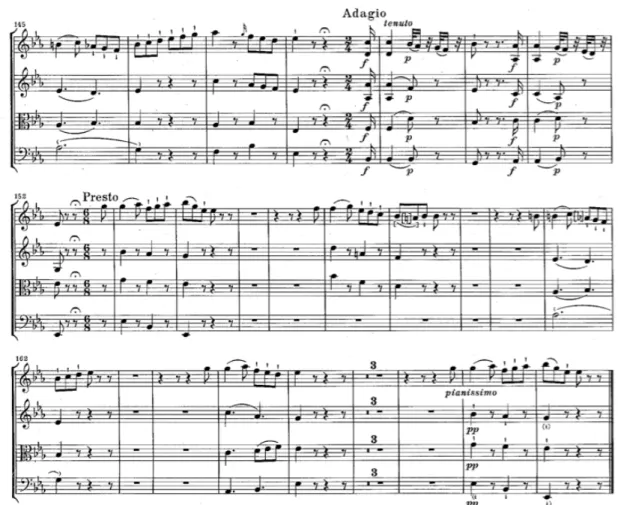
As with the joke, music occurs in time, but “time also unfolds in music.”52 Nowhere is this overtly temporal element of musical wit more extreme than in the finale of Haydn’s Op. 33 Quartet, No. 2, “The Joke” (Figure 1), and perhaps no other rests have gained such notoriety. With a few notable exceptions, however, the function of these rests—and the fulcrum of the joke—has been viewed in terms that are primarily social. This interpretation essentially holds that these rests are really a joke on the listeners, meant to call them out for failing to understand the halting close of the quartet. My formulation of wit as a phenomenon that is essentially temporal allows for a reading that is more inclusive, combining a musical and social understanding of the moment.
The digression preceding the joke is lengthy: as the rondo moves along toward closure (as a proper rondo-form ought to), the flow is interrupted in m. 148 by a fermata and a brief Adagio. We then hear the eight-bar opening theme, parsed into four two-measure sections, each separated by two two-measures’ rest. Finally, after a four-two-measure Grand Pause, the opening two measures of the theme are restated, pianissimo. The movement thus ends with its opening material and perhaps the most discussed rests in music.
How might we map the waning moments of this finale onto Critchley’s account in order to create a phenomenology of this particular (musical) joke? First we must deal with the insistence that recognition is a necessary precursor to the joke. While standard
opening lines (“knock, knock” or “A guy walks into a bar”) often signal that a verbal joke is being told, there are also jokes that are only recognized as such after the fact. These jokes are ones that are generally experienced as witty, for the formal aspect of the joke is less overt and thus the digressions less clear (or very short). In such cases, the punch-line is experienced as sudden or unprepared. In the musical joke of Op. 33/ii the Adagio section often referred to as a “warning” is understood as such only after the joke has occurred. The listener is perhaps warned that something out of the ordinary is about to transpire, though there is little clue that it will be a joke. Instead, it serves a more basic function—that of interrupting the traditional flow of the rondo in order to draw the listener further into the unique closing.
Critchley’s opening reference to recognition is a way of formulating a particular type of joke: ludic rather than ridiculous. A “ridiculous” joke is one that derives its effectiveness from “satisfaction with oneself over the infirmities or the misfortunes of others.”53 It is this negative conception which Plato would have precluded entirely from his ideal city,54 and which is most readily demonstrated in music by Mozart’s Ein musikalischer Spaß, commonly translated as “A Musical Joke” or “Some Musical Fun.”
This piece ridicules “bad musicianship on all levels of competence and taste—most especially bad composing.”55 I would also characterize it as humorous rather than witty, as it consists not so much of a series of sudden punch-lines, but of a general comic atmosphere. While Critchley wants to avoid this type of ridiculous humor, ridiculous jokes are beloved by pragmatists, for they serve an obvious purpose. By ridiculing poor musicianship, Ein musikalischer Spaß communicates the superiority of the accepted standards of true art.
Ludic, by contrast, comes from the Latin word meaning play. Unlike what we hear in Ein musikalischer Spaß, ludic wit steps outside typical norms and standards and finds this a position of enjoyment rather than a site for mockery. Indeed, ludic wit may be seen to question the assumptions that underlie “what we know or expect to be the case.”56 Ridiculous wit allows those who are in on the joke the pleasure of being superior to those on the outside, while ludic wit laughs (or winks) at the distinction between inside/outside,
53 Levin, Playboys and Killjoys, 10.
54 Critchley, On Humour, 3. Critchley refers to this as “the incongruity theory of humor,” tracing it to Frances Hutcheson’s Reflections on Laughter from 1750, and mentioning its subsequent treatment by Kant, Schopenhauer, and Kirkegaard.
for “to share the fun with others is to play.”57 It is this ludic quality that best describes the events of the “Joke” Quartet. Indeed, ludic wit illuminates the general characterization of Haydn as a composer of wit.
While ludic wit can rarely include everyone, such exclusion is merely incidental. Why then should the listener not be forewarned of the musical joke? In practical terms, because it is nearly impossible. Musical jokes are far less codified than verbal jokes, hence the lack of stock indicators that might initiate the formal musical joke. Even more difficult is distinguishing a joke within a movement that is otherwise serious. Unless a piece is humorous in the sense that it possesses that “faintly comic aura” which permeates throughout, it is difficult for the listener to recognize. “Both brevity and speed are the soul of wit,”58 because wit must catch the listener in the moment. The witty joke is sprung on the listener, but this does not mean that the joke is necessarily on the listener, or at his or her expense.
A ridiculous conception of wit keeps the listener safe on the outside, and any humor results from the foolishness of those who fail to remain so detached. Donald Tovey describes the “Joke” Quartet as Haydn’s wager that “the ladies will always begin talking before the music is finished.”59 Paul Griffiths similarly claims that Haydn uses his wit to put the listener “to scorn.”60 Both position the listener as an outsider, making ridiculous wit the only option. The relationship between music and listener within
57 Levin, Playboys and Killjoys, 12. 58 Critchley, On Humour, 6.
59 Donald Francis Tovey, “Haydn’s Chamber Music,” in The Mainstream of Music and Other Essays (Oxford: Oxford University Press, 1949), 52.
ridiculous wit is oddly adversarial—one never knows when wit might turn vicious—so the listener remains anxious regarding his or her potential victimization by the joke.
Rather than standing outside the joke, careful to preserve the safety of detachment, the listener stands at the center of ludic wit. As with Clifford Geertz’s famous discussion of the burlesqued wink, so with musical wit: “the thing to ask…is not what [its] ontological status is.”61 Meaning is the thing to ask, but before considering what is meant by such a gesture, there must be one to whom the gesture is meant—a
perceiver who can place the gesture in relation to lived experience.62 This drastically alters the role of the performers in the “Joke” Quartet, as they are allowed to be perceivers as well. They are no longer tricksters trying to target unwary listeners, but players who can enjoy their part as listener-performers.
In her discussion of the “Joke” Quartet, Wheelock cleverly expands the common metaphor of the string quartet as a conversation amongst players to include the audience. Listeners are not overhearing a conversation in which they take interest but have no role; instead, “the audience of contingently present listeners is also engaged in dialogic
interaction with the work in progress.”63 The music is not self-contained, but is entirely directed toward listeners (including the players themselves), and dependent on that interaction. When understood this way, there is no dearth of meanings to be interpreted in the “Joke” Quartet. Witty associations abound regarding the relationships between
61 Clifford Geertz, “Thick Description,” in The Interpretation of Cultures: Selected Essays (New York: Basic Books, 1973), 10.
supposed opposites of beginning and ending, music and silence, closure and continuance.64
The finale of the “Joke” Quartet is aptly called a joke not because it is
unimportant or frivolous nonsense, but because of the way in which it shapes and plays with time over an extended period. Each rest stretches time, heightening the listener’s expectation. Each continuance of the phrase moves toward an oddly separated closure, but instead, time is stretched even further before the theme begins again. What is most amazing is that at the very point at which the music stops, the listener is certain that it must continue. The repetition of the rondo theme has taught the listener the rules of causality in this musical world. The first two measures of the theme have been heard often enough to know that the next two must follow, until the entirety of the theme is stated. The two measures of rest had delayed this necessity, though the theme’s insistence on re-entrance seems to confirm that no gap of silence can break the chains of causality. Only extended silence can convince us that the musical fact of which we were most certain—the rondo theme—was in fact fabricated. The ending of the piece is perceived “not when the sound ceases but rather somewhat later,”65 likely at least two, four, or even six non-existent measures later, when those necessary fragments of the theme never materialize. The moment of wit, set up through a section formally extensive enough to be
64 I am indebted to Tim Carter for pointing out to me that this ending might be experienced quite differently if the listener hears the measures of rest as part of the hypermeter and not as pauses outside of metrical time. The constant interruptions cause the cadence in mm. 165-166 to fall in the incorrect location hypermetrically, meaning that it could not be a true final cadence. The additional Grand Pause not only delays closure, it also ensures that the closure comes at the end of a hypermetric cycle. For those that hear the music this way, the wit is still quite strong: what seems on the surface to be obviously irregular is actually quite regular, and the joke that seems to radically depart from standards of closure actually enacts deep principles of closure on a hypermetrical level.
considered a joke, occurs in the silence where the punch-line should have been, as much as in the belated statement of the theme fragment. This is “the sudden evaporation of expectation into nothing,” or at least something very far from what was expected.66 The applause is likely begun by one who has previously experienced the piece.
This last insight broaches the topic of the second listening experience, for the phenomenology of a joke seems less clear the second time around. Wheelock wonders if the enjoyment of subsequent listening might not generate primarily from one’s position inside the ridiculous joke. Once initiated, listeners can “delight in these set-ups that ambush unwary, first-time listeners” while reminiscing about their own, previous foolishness.67 Such a characterization fails to take into account the role of performers who certainly know what is transpiring, but might allow themselves to act as if they did not.
Critchley’s discussion of the joke’s temporal play means that listeners are not required to revert to an understanding of this moment as ridiculous. The way the music stretches and plays with time is an engaging experience regardless of previous
knowledge. Unless the listener is familiar with the piece to the point of boredom, the experience of musical wit is less dependent on our knowledge of the proceedings, and more dependent on our willingness to be carried along in each moment that the music occupies and creates. If we engage the work as listeners who understand that its wit is not self-justified, but directed toward and occurring in us, the second hearing may be even more rewarding. This is not to say that the first encounter with the music will not be in
66 Immanuel Kant, The Critique of Judgement, trans. J. C. Meredith (Oxford: Oxford University Press: 1952), 196.
some way different than subsequent ones, but that the first encounter need not be the yardstick by which all others are judged. Indeed, subsequent hearings might alter the experience of the joke from one of wit to that of humor. Instead of experiencing the punch-line as a sudden moment of wit that comes after a series of digressions that were only recognized as a joke after the fact, the listener may find the entire coda exuding a playfulness that permeates throughout—ludic humor.
The definition of terms in this chapter demonstrates the aptness of the “Joke” Quartet’s name, in that its finale includes a series of digressions that lead to a punch-line. Because those digressions are not easily recognized and there is no general humor
permeating throughout, listeners are likely to have a compact experience of wit as a punch-line that is surprising not only in its content, but in its very occurrence. Each listener is ultimately free to reject my description and choose words that best describe the nature of his or her specific listening experience, but only if we do not allow the
CHAPTER 2
WIT AS A PHENOMENON IN HAYDN’S OP. 76 QUARTETS
While the joke of op. 33/ii might provide an experience of musical wit in Haydn’s quartets, it is also an outlier. Joking as a series of digressions followed by a punch-line is unique to that quartet, and the wit that occurs elsewhere in Haydn’s music is far less overt, standing outside the framework of a joke. In this chapter, I turn to the op. 76 quartets in search of a more subtle wit. Unlike Haydn’s earlier quartets, these have not often been treated as sites for the experience of musical wit, as they are Haydn’s final complete set of quartets, a product of his later years, and widely regarded as his greatest accomplishment within the genre.
Much of the scholarly work on wit and humor in Haydn’s music locates it in opening and closing movements, where Allegro tempi and bouncing melodies lend themselves to such “humorous” interpretations. Wheelock extends this focus to Haydn’s minuets, but it seems that most scholars have presumed the “quickness” of wit involves an association with fast tempi rather than a sudden or unprepared punch-line. Following Dean Sutcliffe’s work on “expressive ambivalence” in Haydn’s symphonic slow
movements, this chapter describes musical wit within three of the second movements of the op. 76 quartets.68
As Sutcliffe notes, tradition indicates that the slow second (or occasionally third)
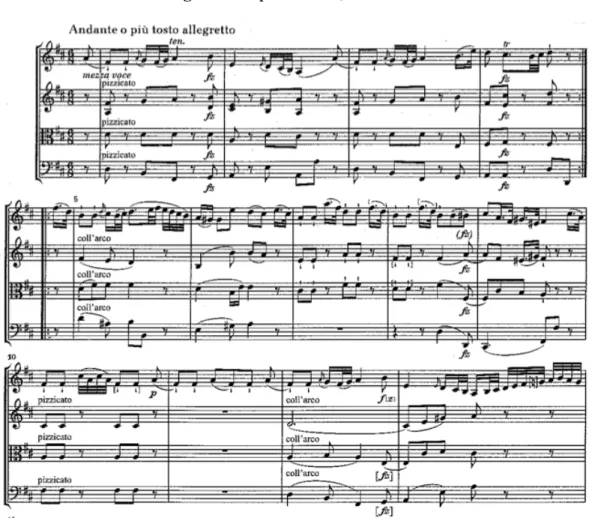
movement in any four-movement piece should be a place for “expressive warmth,”69 and this seems a particularly reasonable expectation for the second movement of op. 76/ii. Cast in the parallel major of the only minor-mode quartet in the opus, the movement occurs between the dramatic plunging fifths of the Allegro, and the vigorous minor-key canon of the Minuet. The movement does indeed begin with a beautiful D major theme, marked mezza voce and accompanied by discreet pizzicato accompaniment. After two statements of the theme, the piece begins modulating, first to B minor, and then to A major, then F-sharp minor. In the upbeat to m. 10, the opening gesture of a falling minor third, A-F#, is widened to include the C# above, and reinterpreted as 5-3-1 of the new key. Then the bottom drops out, so to speak (Figure 2). Measure 11 finds the violin stating simply A-F#-F# in eighth notes—the same three notes which began the piece— twice in a row. After a measure of this, an ornamented version of the theme picks up in m. 12, back in the original key of D major.
Figure 2 - Op. 76 No. 2, 2nd movement
modulation is too mild to be dramatic and lacks the proper harmonic drive to be anything else. It is almost as if the measure fell in by mistake, three notes repeated by accident.
Yet these are the notes that begin the piece! How could they possibly be heard as out of place? This is the subversive side of Haydn, wherein he puts the most necessary of figures to the least necessary of uses. These three simple notes create the same sort of stretching of time that the rests in the “Joke” Quartet do, though on a more local scale. The listener is suspended in what is almost the feigned forgetfulness of the composer, muttering “Where was I, Where was I?” to the tune of the movement. Like the “Joke” Quartet, it seems to question the causality of the theme as well. While the notes do eventually form the melody that we know they should, its artificial nature is also brought to the fore.
The wit that is sprung upon listeners draws them into the moment. For all intents and purposes, the music pauses in m. 11. It draws listeners into a suspended state and then drops them once again into the melody. Doing so with the opening figure of the theme draws attention not necessarily to the constructed features of the theme, but to its very constructedness. It flows forward only at the composer’s command and highlights this fact. As Dean Sutcliffe observes, “Haydn seems above all else to be interested in perception: in what it means to sit and listen.”70 One can imagine Haydn asking a student or colleague while thinking of this movement, “Have you ever really listened to a minor third?”
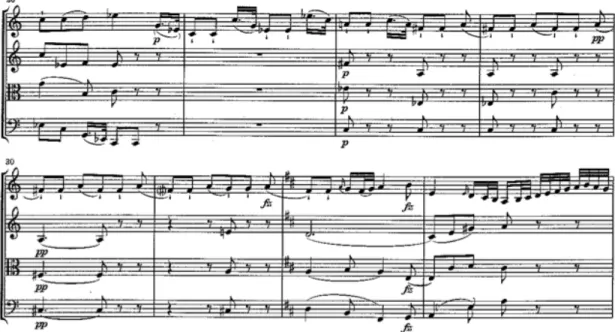
Haydn is by no means finished with his materials, for in m. 29, the A-F#-F# figure takes an even firmer hold (Figure 3). This time, however, it comes on the heels of a section in C minor, where the minor third has been transposed to E♭-C. In m. 28, the C
continues to fall another minor third to A, which in turn lands on F#, so that the
symmetrical fullly-diminished seventh chord is heard in full in the first violin. The figure persists as the harmony progresses to F-sharp minor in second inversion, and then,
familiarly, the bottom drops out at the end of m. 30. As the listener is left suspended once more, the figure is altered to A-G-G over an A dominant chord in first inversion, leading to a highly ornamented version of the theme.
The violin’s multiple statements of the theme fragment point to the play that is happening both between and for the sake of the performers. It is not only that performers are listeners themselves, but also that such false cues from the first violinist become a game of good-natured deception. The stretching of time is even more intense for those players who hear the music as listeners suspended in time even as they avoid the danger of the wrong entrance that the first violin tempts them towards.
This obsession over a single interval suggests a secondary title: “Ode to a Minor Third.” Haydn seems intent on showing both the simplicity and multiplicity of such a basic musical unit. The second ludic treatment of the interval is both more extensive and less obvious than the first. Stating the interval over a fully-diminished seventh and chromatic passing chord distracts from the fact that this is the same minor third so naïvely stated in m. 11. Only when it occurs again on its own in mm. 30-31 does it become abundantly clear that this same interval has been reiterated without respite since m. 28. The constant repetition creates the wit of the moment in the seemingly obvious realization that while this figure is the beginning of the theme, it is also most definitely not the theme. The listener is waiting for something that in a literal sense is already
the listener waits for that theme to truly begin. Likewise, the minor third in these
measures exists in relationship to two other events, the experience of which may be more or less retained in the listener’s mind: that of the actual opening theme and that of the previous minor-third play in m. 11. All are different, yet all are the same.
Figure 3 - Op. 76 No. 2, 2nd movement, continued
When Haydn relents by altering the F# to G in m. 31, the incessant repetition of the previous measures might lead a listener to expect a reiteration of this interval as well. Instead, another A-F#-F# enters, this time as the true vanguard of the theme. The same three notes, previously heard as practically outside of both music and time, are now heard as propulsive. The listener experiences the theme of m. 32 in a way drastically altered by Haydn’s play in the preceding four measures.
hardly call the crossing of voices in it subtle. Befitting a moment of wit, however, it is quick.
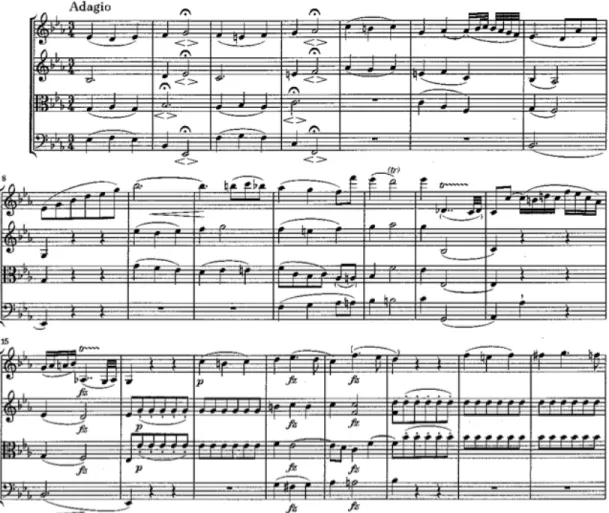
The utter simplicity of the opening five-note melody is touching, especially in the earnestness of the fermata in only the second measure—carefully marked crescendo-decrescendo in order to ensure it is properly shaped. The repetition of the melodic pattern
beginning on the second scale-degree in the following two measures reinforces this impression, as does the brief tonicization of the minor supertonic chord. In measure 8-9, the first violin climbs to a high B-flat just as the second violin begins the opening theme an octave above its original statement. It seems that the first violin will willingly cede melodic control as it holds its high note, though it begins to assert primacy again in measure 10, even as the second violin continues its statement of the theme.
The movement continues chromatically until m. 15. As it approaches the most important cadence thus far, everything seems to be in order until the second beat, wherein the first violin leaps down a ninth to A♭3, while the second violin moves down by step to D4. Other places in the opus where the first violin dips below the second, it is without fail part of an arpeggiation or scalar passage. These lead the ear rather easily and the
momentarily bewildering. If the leap and the trill are not convincing, the forzando
marked on both violins and viola make clear that no attempt should be made to soften the moment.
Figure 4 - Op. 76 No. 4, 2nd movement
the melody pass between voices and the two parts suddenly flipped, the listener is presented with a melodic duck-rabbit—the musical version of the famous image that can be perceived as the head of either animal.71 While the duck-rabbit is usually used as an example of the perceiver’s ability to choose one image over the other—a question of either/or—I would suggest that a fleeting perception of both/and is also possible.72 Even if in any literal moment one can only perceive one or the other, the viewer’s retention of the previous perception means that switching back and forth between perceptions might create this sort of momentary doubleness.
The experience of wit in op. 76/iv is the moment of perceptual doubleness in which both violins assert melodic primacy, in which both “duck” and “rabbit” are perceptually present. This is necessarily an extremely concentrated instance of wit, wherein the listener is left hanging for the slightest part of a second, wondering where the melody has gone, or potentially even what it is. It is here, but not where one thought it would be. Even on most recordings this displacement comes through, as does the momentary oddity of the trill on the lower note. In live performance, it is even more striking to witness the first violinist leaping downward to material that seems to belong to another part entirely. Through this sudden gesture, Haydn catches the listener in a
moment where closure is both provided and displaced. The earnestness of the moment is not revoked, but suddenly held in tension between clarity and opacity.
71 Ludwig Wittgenstein, Philosophical Investigations, 4th edition (Malden, MA: Wiley-Blackwell, 2009), 165-167.
Lending further credence to an understanding of this section as a withholding of closure is the later appearance of the same anomaly in m. 51: a massive leap to a trill on A♭3 in the first violin, together with a D4 approached by step in the second violin. The result? A sudden rest, leaving the A♭, which functions as the 7th of the dominant chord, hanging until the viola resolves it at the end of m. 52.
Figure 5 - Op. 76 No. 4, 2nd movement, continued
Both my descriptions thus far have drawn the conditions for the experience of musical wit from within the piece and the listener’s perception of it. This is in contrast to Wheelock’s stance throughout Ingenious Jesting with Art that Haydn’s various “jesting strategies” depend on the listener’s familiarity with external stylistic norms.73 Wheelock is no doubt correct in some cases, such as in the Finale of op. 76/v (Figure 6). Here, Haydn goes far beyond the common silencing gesture of the first movement of op. 76/i, and instead imitates a rather emphatic cadence. The movement begins with a gesture that
the experienced listener recognizes as a rather decisive closing statement. Eric Clarke’s ecological theory of musical perception would posit that the cadential gesture is learned as part of a musical environment and that a listener recognizes similar stimuli in
subsequent encounters.74 This aspect of Clarke’s theory works well with my description of musical wit, as such recognition does not entail a listener pausing to remember what such an emphatic V-I alternation might mean, but a more retention-like act of memory activated in the act of perception. The nearly incongruous application of a familiar formula in its opposite context creates a doubleness of perception that could be aptly described as musical wit.
Figure 6 - Op. 76 No. 5, 4th movement
Still, like the “Joke” Quartet, this example fails to provide a general model of musical wit. It would require one to share vast amounts of cultural and musical
background with Haydn himself in order to experience wit in his music. The necessary knowledge is not so much extra-musical as trans-musical, as it depends on experiences culled from extensive familiarity within a particular genre. I have no doubt extensive stylistic familiarity or historical knowledge will sometimes open aspects of musical
experience that are not available to the less informed. However, it seems that these moments are more often produced by engagement with the music and then deepened through the external knowledge, not based entirely upon that external knowlege. While I have no desire to universalize the wit that occurs in Haydn’s music—Wheelock is correct that some basic familiarity is needed—I also resist the idea that wit is an experience that is only (or mostly) available to connoisseurs. A dependence on trans-musical
referentiality gives musical wit a ridiculous edge that operates through the establishment of boundaries and the joys of one’s own inclusion compared to the exclusion of others.75
Returning to the sudden voice-crossing of op. 76/iv, the wit created therein is dependent on a listener’s experience of the stratified relationship of voices prior to the point that they cross, not upon knowledge of external rules of voice-leading. Still, internal and external causes of musical wit need not be mutually exclusive. An understanding that this voice-crossing transgresses a basic rule of part-writing may enrich the moment, though it is not required. Such a characterization strikes a surprisingly difficult balance: it neither exalts theoretical training as the only avenue to engagement, nor does it chastise theory for burdening the perceptions of a competent listener. Whether or not one is an expert, Haydn’s music teaches listeners the rules to the game as he plays it.
While witty reference to external musical conventions occasionally takes place in Haydn’s music, the majority of wit in op. 76 is ludic and dependent on references to specific events within a movement. In this way, the “Joke” Quartet and op. 76/ii can serve as general models, for they create musical wit by manipulating the melodies that