Lysyl Hydroxylase 2 Is Secreted by Tumor Cells and Can
Modify Collagen in the Extracellular Space
*
Received for publication, September 22, 2016, and in revised form, October 28, 2016 Published, JBC Papers in Press, November 1, 2016, DOI 10.1074/jbc.M116.759803
Yulong Chen‡1, Houfu Guo‡1, Masahiko Terajima§, Priyam Banerjee‡, Xin Liu‡, Jiang Yu‡, Amin A. Momin¶, Hiroyuki Katayama¶, Samir M. Hanash¶, Alan R. Burns储, Gregg B. Fields**, Mitsuo Yamauchi§2,
and Jonathan M. Kurie‡3
From the‡Department of Thoracic/Head and Neck Medical Oncology, University of Texas MD Anderson Cancer Center, Houston, Texas 77030,§Oral and Craniofacial Health Sciences, School of Dentistry, University of North Carolina at Chapel Hill, Chapel Hill, North Carolina 27599, the¶Department of Clinical Cancer Prevention, University of Texas MD Anderson Cancer Center, Houston, Texas 77030, the储College of Optometry, University of Houston, Houston, Texas 77004, and the**Department of Chemistry and Biochemistry, Florida Atlantic University, Jupiter, Florida 33458
Edited by Amanda Fosang
Lysyl hydroxylase 2 (LH2) catalyzes the hydroxylation of lysine residues in the telopeptides of fibrillar collagens, which leads to the formation of stable collagen cross-links. Recently we reported that LH2 enhances the metastatic propensity of lung cancer by increasing the amount of stable hydroxylysine alde-hyde-derived collagen cross-links (HLCCs), which generate a stiffer tumor stroma (Chen, Y.,et al.(2015)J. Clin. Invest.125, 125, 1147–1162). It is generally accepted that LH2 modifies pro-collagen ␣ chains on the endoplasmic reticulum before the formation of triple helical procollagen molecules. Herein, we report that LH2 is also secreted and modifies collagen in the extracellular space. Analyses of lung cancer cell lines demon-strated that LH2 is present in the cell lysates and the conditioned media in a dimeric, active form in both compartments. LH2 co-localized with collagen fibrils in the extracellular space in human lung cancer specimens and in orthotopic lung tumors generated by injection of a LH2-expressing human lung cancer cell line into nude mice. LH2 depletion in MC3T3 osteoblastic cells impaired the formation of HLCCs, resulting in an increase in the unmodified lysine aldehyde-derived collagen cross-link (LCC), and the addition of recombinant LH2 to the media of LH2-deficient MC3T3 cells was sufficient to rescue HLCC for-mation in the extracellular matrix. The finding that LH2 modi-fies collagen in the extracellular space challenges the current view that LH2 functions solely on the endoplasmic reticulum and could also have important implications for cancer biology.
Collagens are the main component of the extracellular matrix and the most abundant protein in mammals (1). Of the 29 types of collagen identified, fibrillar type I collagen is the most abundant and important in providing tissues and organs with form and mechanical strength. Type I collagen biosynthe-sis involves a series of post-translational modifications of nas-cent procollagen␣chains on the endoplasmic reticulum; for example, specific lysine (Lys) and proline (Pro) residues undergo hydroxylation, and hydroxylysine (Hyl) residues undergo mono- and di-glycosylation. In the extracellular space, telopeptidyl Lys and Hyl residues on collagen molecules are oxidatively deaminated by lysyl oxidases (LOXs),4producing
the reactive aldehydes Lysaldand Hylald, respectively, which
ini-tiates a series of condensation reactions to form various cova-lent intermolecular cross-links involving juxtaposed Lys, Hyl, and histidine (His) residues on the neighboring molecules, resulting in the formation of Hylald-derived collagen cross-links
(HLCCs) (2).
HLCCs are generated through a series of intermediate steps involving multiple enzymatic reactions. For example, HLCCs are produced through the divalent iminium cross-links dehydro-hydroxylysinonorleucine (deH-HLNL) when paired with a juxtaposed Lys residue (i.e.HylaldXLys) on a neighboring
molecule, and deH-dihydroxylysinonorlecine (deH-DHLNL) with a Hyl residue (i.e.HylaldXHyl). These are then
spontane-ously rearranged to form the stable ketoamines by Amadori rearrangement then mature into the formation of the trivalent pyridinium cross-links, pyridinoline (Pyr) (i.e. HylaldXHylald
XHyl) and deoxypyridinoline (d-Pyr) (i.e.HylaldXHylaldXLys).
This pathway is predominant in skeletal tissues such as bone and cartilage. The Lysald-derived cross-linking pathway, on the
other hand, is predominant in soft connective tissues. Telopep-tidyl Lysaldcan condense with another Lysaldresidue within the
same molecule to form an intramolecular aldol, which then
*This work was supported, in whole or in part, by National Institutes of Health Grants R21AR060978 (NIAMS; to M. Y.) and R01CA105155 (NCI; to J. M. K. and M. Y.). This work was also supported by the Elza A. and Ina S. Freeman Professorship in Lung Cancer (to J. M. K.) and MD Anderson Cancer Center Support Grant CA016672. The authors declare that they have no conflicts of interest with the contents of this article. The content is solely the respon-sibility of the authors and does not necessarily represent the official views of the National Institutes of Health.
1Both authors contributed equally to this work.
2To whom correspondence may be addressed. Tel.: 537-3217; Fax:
919-966-3683; E-mail: [email protected].
3To whom correspondence may be addressed: Dept. of Thoracic/Head and
Neck Medical Oncology, Unit 432, The University of Texas MD Anderson Cancer Center, 1515 Holcombe Blvd., Houston, TX 77030. Tel.: 713-745-6747; Fax: 713-792-1220; Email: [email protected].
eventually leads to a tetravalent intermolecular cross-link, deH-histidinohydroxymerodesmosine (deH-HHMD) (i.e. Lysald
XLysaldXHisXHyl) (3). In skin and cornea, the Lysald-derived cross-linking pathway can also lead to a non-reducible, triva-lent cross-link, histidinohydroxylysinonorleucine by involving the divalent, iminium cross-link, deH-HLNL (LysaldXHyl), and
a His residue (i.e.LysaldXHylXHis) (4).
Lys hydroxylation is catalyzed by lysyl hydroxylases 1–3 (LH1–3; EC 1.14.11.4) in -X-Lys-Gly- sequences in a reaction that requires Fe2⫹, 2-oxoglutarate, O
2, and ascorbate (5). In
addition to the Gly- sequence, Ala-and -X-Lys-Ser- sequences present in the telopeptides (both N and C ter-mini) of fibrillar collagens can be hydroxylated. It has been reported that LH2 catalyzes Lys hydroxylation in the telopep-tides (6 – 8) and thereby drives the Hylald-derived collagen
cross-linking pathway (9). Altered LH2 expression has a pro-found impact on the collagen matrix (10). Although all LH fam-ily members (LH1–3) appear to be capable of hydroxylating helical Lys residues, only LH2 modifies the telopeptidyl Lys residues (8, 11). Inherited skeletal disorders caused by inacti-vating mutations in the gene that encodes LH2 and a putative LH2 foldase, FKBP10 (12–14) demonstrate the importance of telopeptidyl Lys hydroxylation in normal collagen biosynthesis and function (15, 16).
It has been reported that LH3, a multifunctional enzyme pos-sessing both LH and glycosyltransferase activities, can be secreted and modifies Lys residues on native proteins and pos-sibly “microfolded” mature collagen molecules in the extracel-lular space (17). Further studies showed that the glucosyltrans-ferase activity site is required for LH3 to be secreted into the extracellular space (18, 19). These findings are the basis of the current paradigm that LH3 is the only LH isoform with an extracellular function. However, whether other LH members are secreted and capable of modifying Lys residues in the extra-cellular space has not been thoroughly explored.
In breast cancer, lung cancer, sarcoma, and other tumor types, high LH2 expression increases tumor stiffness, promotes tumor cell invasion and metastasis, and is a predictor of poor clinical outcome (20 –22). In lung cancer, high LH2 expression increases the amount of HLCCs in tumor stroma (21). More-over, LH2 has been detected in the secretome of breast cancer cells (23), which raises the possibility that LH2 has an extracel-lular function. In this study we demonstrate that LH2 is associ-ated with extracellular collagen fibrils in lung cancer tissue specimens and is secreted into the extracellular space in an active dimeric form. Importantly, our data strongly indicate that secreted LH2 is capable of hydroxylating telopeptidyl Lys residues of collagen in the extracellular space, thereby produc-ing stable HLCCs. This implies that extracellular LH2 modifies telopeptidyl Lys residues before their LOX-catalyzed conver-sion to aldehyde, which challenges the current paradigm that LH2 modifies only intracellular nascent procollagen␣chains.
Results and Discussion
LH2 Is Secreted—We initially performed stable isotope label-ing of amino acids in cell culture on a panel of lung cancer cell lines (n⫽52). By mass spectrometric sequencing of proteins, 27 cell lines had detectable LH2 in both cell lysates and
condi-tioned media (Table 1). In the remaining 25 cell lines, LH2 was detected in only the cell lysates (n⫽4) or conditioned media (n⫽4) or neither fraction (n⫽17) (Table 1). In contrast, LOX was detected in 21 cell lines and was almost exclusively in the conditioned media fraction (Table 1). Across the cell line panel, LH2 levels in the cell lysate and conditioned media were signif-icantly correlated (Spearman correlation coefficient ⫽ 0.77, p⫽1.31⫻10⫺11). Stable transfection of H1299 lung cancer
cells, which have low endogenous LH2 levels (Table 1), with a vector that expresses FLAG-tagged full-length LH2 or an N-terminally truncated mutant LH2 that lacks the signal pep-tide showed that the full-length ectopic LH2 was present in both the cell lysate and conditioned media, whereas the signal TABLE 1
LH2 and LOX levels in total cell lysate (Cell lysates) and conditioned media (Media) collected from the indicated cell lines subjected to SILAC and mass spectrometry
Each value represents the total number of spectral counts within each cellular com-partment from one biological sample in a single experiment.
Cell line LH2 LOX Cell lysates Media Cell lysates Media
DFC1024 56.82 259.34 0 0 H2030 28.97 130.94 0 0 H1355 16.79 124.78 0 0 H1568 10.77 112.29 0 0 H1993 2.31 94.24 0 0 HCC827 35.96 87.03 0 0 H1651 27.05 70.13 0 0.91 DFC1032 34.27 61.69 0 13.11 H1437 5.28 46.34 0 0 H1563 28.15 38.02 0 0 H820 36.10 36.90 0 0
H2342 0 30.39 0 0
PC9 1.28 18.22 0 12.53 H2228 5.88 17.57 1.60 35.15 HCC2279 9.48 17.28 1.90 35.52 H1395 0 14.70 1.32 54.38 H1373 34.60 12.53 0 13.43 H1792 16.63 11.49 2.02 42.13 H2291 7.15 10.78 0 3.59 HCC4017 4.47 7.73 0 5.16 H1944 30.25 7.46 0 0
H969 1.21 7.23 0 0
H2122 0 6.56 0 0
H650 12.40 6.13 0.77 18.39 H1650 8.71 5.75 0 7.67
H647 1.99 5.15 0 0
H1573 2.53 3.64 0 0
H69AR 8.51 1.95 0 9.76
H69 4.51 1.82 0 1.82
HCC4006 4.59 1.31 0 7.86
HCC1833 0 1.03 0 0
DMS79 0 0 0 1.35
H1299 1.28 0 0 0
H1385 0 0 0 0
H1435 0 0 0 0
H1693 0 0 0 0
H1703 0.48 0 0 0
H1755 0 0 0 0
H1793 0 0 0 9.03
H1838 0 0 0 0
H1975 0 0 0 0
H2009 0 0 0 0
H23 0 0 0 0
H2405 0 0 0 0
H3255 0 0 0 2.79
H522 0 0 0 0
H82 0 0 0 0
H838 1.95 0 0 5.74
H920 0 0 0 0.66
HCC2935 0 0 0 0
HCC4011 4.16 0 1.19 9.10
peptide-deficient LH2 was detected only in the cell lysate (Fig. 1A). On the basis of the lower molecular weight of the signal peptide-deficient LH2 (Fig. 1A,left panel), we speculated that aberrant trafficking of the mutant LH2 led to a reduced level of glycosylation, as there are nine potential glycosylation sites in human LH2 (24). Supporting this possibility, treatment of the total cell lysates with peptideN-glycosidase F decreased the wild-type LH2 protein to a size similar to that of the mutant LH2 protein but had no effect on the size of the mutant LH2 protein (Fig. 1B). We then examined human lung cancers to determine if LH2 is localized in the extracellular space by con-focal microscopic analysis. In a region of the tumor stroma containing dense collagen fibers (Fig. 2A), co-staining with antibodies against LH2 and type I collagen showed that LH2 and collagen indeed co-localized in the extracellular space. In a different region of the same tumor specimen, spatial overlap-ping between collagen and LH2 was also confirmed by plotting intensity of LH2 and collagen staining along a linear region of the tumor stroma (Fig. 2B). Quantification of LH2 and collagen I staining within multiple fields of tumor stroma showed that a fraction of LH2 co-localized with collagen I (Fig. 2C). Fur-thermore, staining of tumors derived from DFC1024 human lung cancer cells, which secreted LH2 in culture (Table 1), with immunogold-labeled anti-LH2 antibodies demon-strated that most, if not all, of extracellular LH2 was closely associated with type I collagen fibrils in the extracellular space (Fig. 3A), and LH2 was also detectable in the cytoplasm of tumor cells (Fig. 3B). Although we cannot determine if LH2 binds to collagen directly or indirectly through colla-gen-binding proteins such as small leucine-rich
proteogly-cans (25), these findings raised the possibility that LH2 directly binds to collagen and modifies telopeptidyl Lys res-idues in the extracellular space.
Extracellular LH2 Is Functional—LH family members form homodimers and homodimerization is critical for LH enzy-matic activity (26). To ascertain the presence of LH2 homodi-meric complexes in the extracellular space, we utilized a protein-fragment complementation assay (27) in which the full-length LH2 protein is fused to the N- or C-terminal frag-ments of Gaussia luciferase (LH2-G1 and LH2-G2, respec-tively, Fig. 4A). As an initial validation step, we transfected the LH2-G1 and LH2-G2 reporters singly or in combination into 293F cells and measured luciferase activity in cell lysates. Compared with that achieved with transfection of either construct alone, co-transfection of the LH2-G1 and LH2-G2 constructs increased luciferase activity by ⬃ 200-fold (Fig. 4B), and reconstitution of luciferase activity was abrogated by removal of LH2’s putative dimerization motif (amino acids 562–568) (Fig. 4C). Using this assay, we mea-sured luciferase activity in conditioned media samples and cell lysates, which showed the presence of dimeric, active LH2 in both compartments (Fig. 4,DandE).
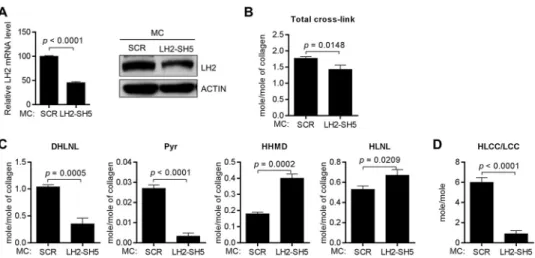
To determine whether LH2 can modify collagen in the extra-cellular space, we performed a rescue experiment on MC3T3 (MC) cells, which are murine calvaria-derived osteoblasts that have high LH2 expression and produce a matrix that is enriched in HLCCs and low in the LCC HHMD (9). After stable trans-fection of LH2-specific shRNAs to deplete LH2 in MC cells (Fig. 5A), LH2-deficient and scrambled control-transfected MC cells were cultured, and cell/matrix layers were collected and sub-jected to amino acid and cross-link analyses 2 weeks after the cells had achieved confluence. In all samples analyzed, d-Pyr levels were at the lower limits of detection and were, therefore, excluded from the analysis. In contrast to the total collagen cross-link concentrations, which were only minimally de-creased by LH2 depletion (Fig. 5B), the LH2-deficient samples had sharply reduced DHLNL and Pyr (both HLCCs) and increased HHMD (LCC) (Fig. 5C), with a corresponding reduc-tion in the HLCC-to-LCC ratio (5.998⫾0.4661versus0.5094⫾ 0.3050) (Fig. 5D). Because HLNL can be derived from either Lysaldor Hylaldby pairing with Hyl or Lys, respectively, HLNL
was excluded from the calculation of the HLCC-to-LCC ratio. However, in the context of the changes in other cross-links, the moderate increase in HLNL concentrations observed in LH2-depleted samples was likely due to the decrease in the telopep-tidyl Hylaldlevels. To rescue LH2 activity in the extracellular
space of LH2-deficient MC cells, we added 45 nM(final
concen-tration) recombinant LH2 proteins (wild-type or DA inactive mutant; Fig. 6A) to the media when the cells reached conflu-ence. The wild-type recombinant LH2 hydroxylated a synthetic collagenous substrate, IKGIKGIKG ((IKG)3) (Fig. 6B),
indicat-ing that the protein has enzymatic activity. As a comparison to the recombinant LH2 protein treatments, LH2-deficient MC cells were rescued by stable transfection with a vector that expresses LH2 (wild-type or DA mutant) (Fig. 6C). The matri-ces were collected and subjected to collagen cross-link anal-ysis 2 weeks after confluence. Reconstitution with wild-type LH2 by either approach had no effect on total collagen cross-FIGURE 1.LH2 underwent glycosylation and was secreted.A, anti-FLAG
Western blotting of total cell lysates or conditioned media isolated from H1299 cells that had been stably transfected with empty vector (Vec) or FLAG-tagged wild-type (WT) or mutant LH2 lacking the N-terminal signal peptide (⌬N). Actin was used as a loading control for the total cell lysates.B, anti-FLAG Western blotting of lysates from H1299 cells that had been stably transfected with FLAG-tagged wild-type (WT) or mutant LH2 lacking the N-terminal signal peptide (⌬N) after a 5-h incubation of the lysates with (NFG) or without (Mock)
link concentrations (Fig. 6D) but significantly increased the concentration of HLCCs (DHLNL and Pyr) and decreased LCCs (HHMD) (Fig. 6E), resulting in an increase in the HLCC-to-LCC ratio (Fig. 6F), whereas reconstitution with the mutant LH2 did not have this effect (Fig. 6,D–F). Treat-ment with recombinant LH2 also reversed the reduction in HLNL levels induced by LH2 depletion (Fig. 6E). These find-ings show that reconstitution of extracellular LH2 rescued the LH2-induced collagen cross-link switch, suggesting that LH2 is capable of hydroxylating collagen in the extracellular matrix.
The results shown here demonstrate for the first time that LH2 is secreted and modifies collagen in the extracellular space. These findings raise many important questions, such as the way in which LH2 secretion is regulated, the sites on which LH2 binds type I collagen, and whether LH2 has extracellular sub-strates other than collagen telopeptidyl Lys residues. These
(31, 32) may be effectively treated with anti-LH2 neutralizing antibodies that can inhibit extracellular LH2.
Experimental Procedures
Plasmids—To create the pLVX-Puro2 plasmid, we modified the pLVX-Puro plasmid (Clontech, Mountain View, CA) by adding the SbfI and NotI cutting sites after the XbaI site. The C-terminal 3⫻ FLAG-tagged WT LH2 cDNAs were cloned into the XbaI and NotI sites on pLVX-Puro2 to generate the LH2–3FLAG-WT expression plasmid. The LH2–3FLAG cDNA without the signal peptide was amplified by PCR and cloned into the XbaI and NotI sites on pLVX-Puro2 to generate the LH2–3FLAG-⌬N expression plasmid. The N terminus (G1, amino acids 1⬃93) or the C terminus (G2, amino acids 94⬃169) of Gaussia luciferase were fused to the WT LH2 C terminus with the polypeptide linker (Gly-Gly-Gly-Gly-Ser)2
and cloned into the XbaI and NotI sites on pLVX-Puro2 to generate the LH2-G1 and LH2-G2 expression plasmids. The dimerization motif (amino acids 562⬃568) on LH2 was deleted by overlapping PCR to generate the DD-G1 and LH2-DD-G2 expression plasmids. The pLKO.1_scramble and pLKO.1_LH2-SH5 plasmids were constructed as de-scribed previously (21). To create the pEF-bsr plasmid for the rescue experiment, we modified the pLVX-Puro plasmid by replacing the CMV promoter with the EF1␣ promoter, replacing the puromycin-resistant gene with the blasticidin-resistant gene, and adding the SbfI and NotI cutting sites
after the XbaI site. The WT LH2 cDNA was released from the pLVX-Puro2-LH2–3FLAG and subcloned into the XbaI and NotI sites on the pEF-bsr plasmid. The D689A mutant was generated by site-directed mutagenesis using overlap-ping PCR.
Cell Culture—All cells were obtained from ATCC and grown in a humidified atmosphere with 5% CO2at 37 °C. LH2-defi-cient MC3T3-E1 (MC) cells were cultured in minimum essen-tial medium ␣supplemented with 10% FBS. 293T and 293F were cultured in a 1:1 mixture of DMEM and Ham’s F-12 medium supplemented with 10% FBS. Human lung cancer cells were grown in RPMI 1640 with 10% FBS and 1% penicillin/ streptomycin. Stable isotope labeling by amino acids in cell cul-ture (SILAC) was done as described previously (33). Briefly, cells were grown for seven passages in RPMI 1640 supple-mented with [13C]lysine and 10% dialyzed FBS according to the
standard SILAC protocol (34).
Proteomic Analysis of Human Lung Cancer Cells—For pro-tein fractionation, we used a Shimadzu HPLC system equipped with 2 LC-20AD pumps, 1 dual-wavelength SPD-20A UV detector (220 nm and 280 nm), 1 FRC-10A fraction collector, 1 CTO-20A column oven, and 1 SCL-10 controller. The whole system was controlled with an EZ Start work station (version 7.4 SP3). Protein samples from the total cell extract or the frac-tion secreted in media were reduced and alkylated with acryl-amide, loaded onto an RPGS reversed-phase column (4.6 mm FIGURE 3.LH2 co-localized with extracellular collagen in tumors generated by subcutaneous injection of DFC1024 lung cancer cells into nude mice. Representative electron microscopic images of a DFC1024 tumor tissue section stained with gold particle-labeled IgG or anti-LH2 antibodies. Gold particles that localize on extracellular collagen fibers (A) and in the cytoplasm of tumor cells (B) are indicated (arrows).Dashesindicate location of nuclear membrane (B).
(inner diameter)⫻150 mm, 15m, 1000 Å, Column Technol-ogy Inc., Fremont, CA), and subjected to desalting with 95% mobile-phase A (0.1% TFA in 95% H2O) at a flow rate of 3
ml/min for 5 min. Proteins were eluted from the column at a flow rate of 2.1 ml/min with gradient elution that included an increase from 5% to 70% mobile phase B (0.1% TFA in 95% acetonitrile) over 25 min, 70% to 95% mobile phase B for 3 min, a wash step to hold at 95% mobile phase B for 2 min, and a re-equilibration step at 95% mobile phase A for 5 min. Fractions were collected in 1.1-ml microtubes (Dot Scien-tific Inc., Burton, MI) at 20-s intervals and stored at⫺80 °C until use.
The lyophilized protein samples were dissolved in 100 mM
NH4HCO3(pH 8.5) followed by overnight in-solution digestion
with trypsin at 37 °C. before LC-MS/MS analysis, the digestion was quenched by adding 5 l of 1.0% formic acid solution. Briefly, peptides were separated by reversed-phase
chromatog-raphy using a nano-HPLC system (Eksigent, Dublin, CA) cou-pled online with an LTQ-Orbitrap mass spectrometer (Thermo Fisher Scientific, Inc., Waltham, MA). Mass spectrometer parameters were as follows: spray voltage, 2.5 kV; capillary tem-perature, 200 °C; FT resolution, 100,000; FT target value, 8⫻ 105; LTQ target value, 1⫻104; 1 FT microscan with 850-ms
injection time; 1 LTQ microscan with 100-ms injection time. Mass spectra were acquired in a data-dependent mode with the m/z range of 400 –2000. The full mass spectrum (MS scan) was acquired by the FT, and the tandem mass spectrum (MS/MS scan) was acquired by the LTQ with 35% normal-ized collision energy. The acquisition of each full mass spec-trum was followed by the acquisition of MS/MS spectra for the 5 most intense⫹2 or⫹3 ions within a 1-s duty cycle. The minimum signal threshold (counts) for triggering an MS/MS scan for a precursor occurring during an MS scan was set at 1000.
The acquired LC-MS/MS data were processed by the Computational Proteomics Analysis System (18). Briefly, LC-MS/MS data were first converted to mzXML format using ReAdW software (version 1.2) to generate the peak list for pro-tein database searching. The X!Tandem search engine (version 2005.12.01) parameters included cysteine alkylated with acryl-amide (71.0371@C) as a fixed modification and methionine oxidation (15.99491@M) as a variable modification. Data were searched against the International Protein Index human pro-tein knowledgebase (version 3.57), which contains entries for 76,542 proteins. The minimum criterion for peptide matching was a Peptide Prophet Score of ⱖ0.2. Peptides meeting this criterion were grouped to protein sequences using the Protein Prophet algorithm at an error rate ofⱕ5%. The total peptide count in each fraction was used as a measure of protein concen-tration within that fraction.
The proteomic search results from lung cancer cell lines was obtained and combined in a MySQL database application. The total number of spectral counts for each protein group within each sample from the total cell extract and the secreted media compartment was normalized to total spectral count set at 50,000 using R (v3.0.1)/RStudio (v0.97.551; RStudio, Inc). The data were further used for differential protein analysis between cell lines.
Generation of Stable Cell Lines—Parental MC cells were infected with lentiviruses carrying LH2-SH5 shRNA or the scramble control that had been packaged in 293T cells using the pMD2.G and psPAX2 plasmids. After 48 h, the cells were selected with puromycin (10g/ml) for 2 weeks to generate LH2-deficient MC cells (MC_LH2-SH5 cells). To restore LH2 expression, the MC_LH2-SH5 cells were infected with lentivi-ruses carrying the cDNA of WT LH2 or inactive LH2 (D689A) and selected with blasticidin (10g/ml) for 2 weeks.
Protein Complementation Assay—Plasmids with the LH2 and Gaussia luciferase fusions were co-transfected at a 1:1 ratio into 293F or H1299 cells plated on 24-well plates using the FuGENE 6 transfection reagent (Promega, Madison, WI). After
48 h, the cells were washed with PBS, 400l of passive lysis buffer (Promega) was added to each well, and the plate was shaken for 15 min at room temperature. Then, 100l of the lysate was mixed with 100l of native coelenterazine (Nanoli-ght Technology) stock solution. Native coelenterazine was used at a final concentration of 20 M. The signal intensities of
the reaction were read using a Synergy 2 microplate reader (BioTek, Winooski, VT).
Quantitative Real-time PCR—Quantitative real-time PCR (Q-PCR) was done as described previously (21). Briefly, total RNA was isolated from the cells using TRIzol Q-PCR assays and reverse-transcribed into cDNA with qScript cDNA SuperMix (Quanta BioSciences, Gaithersburg, MD). The mRNA level was analyzed using a SYBR Green-based system (Applied Biosys-tems, Waltham, MA). mRNA levels were normalized on the basis of mRNA for ribosomal protein L32 (Rpl32). The primers for Q-PCR of Lh2 and Rpl32 have been described previously (21).
Western Blotting—Western blotting was performed as described previously (21). Briefly, cells were washed with PBS and lysed with cell lysis buffer (Cell Signaling Technology, Dan-vers, MA) to extract total proteins. Cell lysates were separated by SDS-PAGE, transferred onto nitrocellulose transfer mem-brane (GE Healthcare), and then incubated with primary antibodies and horseradish peroxidase-conjugated second-ary antibodies (GE Healthcare). Protein bands were visual-ized with Pierce ECL Western blotting substrate (Thermo Fisher Scientific).
Purification of Recombinant LH2 Protein—Human LH2b recombinant proteins (residues 33–758, WT and inactive D689A mutant) were produced from FreeStyle CHO-S cells (Invitrogen) via large-scale transient transfection with polyeth-yleneimine as described previously (35, 36). The recombinant LH2b proteins were then purified from CHO-S cell-condi-tioned media utilizing immobilized metal affinity chromatog-raphy and gel filtration chromatogchromatog-raphy.
FIGURE 5.LH2 depletion decreased HLCCs and increased LCCs.A, thebar graphillustrates the results of Q-PCR analysis of LH2 mRNA levels in MC cells stably transfected with vectors expressing LH2 shRNA (SH5) or scrambled control shRNA (SCR). The results are expressed as the means⫾S.D. of triplicate samples. The mRNA levels of the indicated transfectants are relative to those of the control transfectants, which were set at 100%. Theblots on the right
LH2 Activity Assay—An LH2 activity assay was performed in reaction buffer (20 mMHEPES buffer (pH 7.4), 150 mMNaCl) at 37 °C for 1 h with 1 MLH2 enzyme, 50MFeSO4, 100M
␣-ketoglutarate, 500 M ascorbate, 1 mM peptide substrate
((IKG)3), and 1.5Mcatalase as described previously (37).
Pep-tide substrate hydroxylation was measured directly by amino acid analysis (see below).
Recombinant LH2 Protein Treatment—MC_LH2-SH5 cells were cultured in 20-cm culture plates, and the treatment started when the cells reached confluence. Recombinant LH2-WT and LH2-DA protein were added every other day with fresh medium supplemented with 100 g/ml ascorbic acid (Sigma). The final concentration for the recombinant protein was 45 nM. The cells were treated for 2 weeks, and then cell
matrixes were collected for the collagen cross-linking analysis. Amino Acid Analysis—The peptide substrates with or with-out LH2 treatment were hydrolyzed with 6NHCl and subjected
to amino acid analysis as described (38). The % of Lys hydrox-ylation was calculated by Hyl/(Lys⫹Hyl). Amino acid analysis of the reduced collagen from cell/matrix layer was also per-formed in the same manner to determine the amount of Hyp (22).
NIS Elements software (Nikon). For quantitative colocalization analysis, confocal images were acquired with Nyquist sampling criteria using a 40⫻(0.95 NA) objective on a Nikon A1⫹ con-focal microscope using NIS Elements software. Raw images were iteratively deconvolved with CMLE algorithm in Huygens Professional version 15.05 (Scientific Volume Imaging, The Netherlands). Colocalization was estimated with colocalization analyzer plugin in Huygens Pro. Intensity plots of signal inten-sity (yaxis) against distance in microns (xaxis) were generated from 8-bit thresholded images with RGB profile plot in ImageJ (National Institutes of Health, Bethesda, MD).
Immunogold Labeling and Transmission Electron Micro-scopy—Two million DFC1024 human lung cancer cells were injected subcutaneously into nude mice to generate tumors. Tumors were fixed for 2 h at room temperature in phosphate-buffered saline (PBS) containing 2% paraformaldehyde. Fixed tissues were washed in PBS and then blocked overnight in PBS containing 1% bovine serum albumin and 0.1% Triton X-100 at 4 °C. This was followed by overnight incubation in blocking buffer containing anti-LH2 antibody (10 g/ml) or control non-immune isotyped matched IgG2b antibody (10 g/ml).
After incubation with the primary antibody, the samples were washed in PBS and incubated overnight in NanogoldTM
-anti-mouse secondary antibody (Nanoprobes, catalog #2002, 1.4 nm Nanogold威particle) diluted 1:40 in blocking buffer. After a PBS wash, the samples were incubated in GoldEnhance EMTMtoner
(Nanoprobes, catalog #2113) for 7 min and then washed in deionized water before fixing in 0.1Msodium cacodylate buffer
containing 2.5% glutaraldehyde for 60 min. The samples were then post-fixed in 1% osmium, dehydrated through an acetone series, infiltrated, and embedded in Embed-812 (Electron Microscopy Sciences, Hatfield, PA), sectioned (80 –100 nm), and stained with lead and uranyl acetate. Sections were viewed on an FEI Tecnai 12 transmission electron microscope operat-ing at 80 keV.
Collagen Cross-link Analysis—For the collagen cross-link analysis, MC_LH2-SH5 cells treated or non-treated with recombinant LH2 or inactive LH2 (n⫽3/group) were cultured for 2 weeks as described (9, 40). The cell/matrix layer was first washed with cold PBS, scraped, and collected by centrifugation at 10,000 rpm for 30 min. The pellets were pulverized in liquid nitrogen using a Spex Freezer Mill (Spex, Metuchen, NJ), washed with cold PBS and cold distilled water, lyophilized, and weighed. Aliquots were reduced with standardized NaB3H4
and hydrolyzed with 6N HCl. The hydrolysates were then
subjected to amino acid and cross-linking analyses as described previously (38). Upon reduction, the reducible cross-links,i.e.deH-DHLNL/ketoamine (HylaldX Hyl),
deH-HLNL/ketoamine (HylaldX Lys or LysaldX Hyl), and
deH-HHMD (LysaldX LysaldX His X Hyl) are reduced to DHLNL,
HLNL, and HHMD, respectively. Hereafter, the terms DHLNL, HLNL, and HHMD will be used for both the unre-duced and reunre-duced forms. These reducible cross-links were identified and measured as their reduced forms. The mature trivalent cross-links, Pyr and d-Pyr, were simultaneously analyzed by their fluorescence. All cross-links were quanti-fied as the mol/mol collagen based on the value of 300 resi-dues of Hyp per collagen molecule.
Author Contributions—Y. C., H. G., and M. T. conducted the exper-iments, including generation of stable cell lines, purification of the recombinant proteins, and performance of in vitro hydroxylase activity assays, biochemical and mass spectrometric analyses, and analysis of and interpretation of the data. A. A. M., H. K., and S. M. H. conducted and interpreted the stable isotope labeling of amino acids in cell culture analyses. P. B. performed the immunoflu-orescent staining and colocalization analysis. A. R. B. conducted the immunogold labeling and transmission electron microscopy exper-iment. G. B. F., J. Y., and X. L. provided technical assistance. J. M. K., M. Y., and Y. C. conceived the project, interpreted all of the data, and wrote the paper with other co-authors. All authors reviewed the results and approved the final version of the manuscript.
References
1. Di Lullo, G. A., Sweeney, S. M., Korkko, J., Ala-Kokko, L., and San Antonio, J. D. (2002) Mapping the ligand-binding sites and disease-associated mu-tations on the most abundant protein in the human, type I collagen.J. Biol. Chem.277,4223– 4231
2. Yamauchi, M., and Sricholpech, M. (2012) Lysine post-translational mod-ifications of collagen.Essays Biochem.52,113–133
3. Tanzer, M. L., Housley, T., Berube, L., Fairweather, R., Franzblau, C., and Gallop, P. M. (1973) Structure of two histidine-containing crosslinks from collagen.J. Biol. Chem.248,393– 402
4. Yamauchi, M., London, R. E., Guenat, C., Hashimoto, F., and Mechanic, G. L. (1987) Structure and formation of a stable histidine-based trifunc-tional cross-link in skin collagen.J. Biol. Chem.262,11428 –11434 5. Kivirikko, K. I., and Pihlajaniemi, T. (1998) Collagen hydroxylases and the
protein disulfide isomerase subunit of prolyl 4-hydroxylases.Adv. Enzy-mol. Relat. Areas Mol. Biol.72,325–398
6. Uzawa, K., Grzesik, W. J., Nishiura, T., Kuznetsov, S. A., Robey, P. G., Brenner, D. A., and Yamauchi, M. (1999) Differential expression of human lysyl hydroxylase genes, lysine hydroxylation, and cross-linking of type I collagen during osteoblastic differentiationin vitro.J. Bone Miner. Res.14,
1272–1280
7. Mercer, D. K., Nicol, P. F., Kimbembe, C., and Robins, S. P. (2003) Identi-fication, expression, and tissue distribution of the three rat lysyl hydroxy-lase isoforms.Biochem. Biophys. Res. Commun.307,803– 809
8. van der Slot, A. J., Zuurmond, A. M., Bardoel, A. F., Wijmenga, C., Pruijs, H. E., Sillence, D. O., Brinckmann, J., Abraham, D. J., Black, C. M., Verzijl, N., DeGroot, J., Hanemaaijer, R., TeKoppele, J. M., Huizinga, T. W., and Bank, R. A. (2003) Identification of PLOD2 as telopeptide lysyl hydroxy-lase, an important enzyme in fibrosis.J. Biol. Chem.278,40967– 40972 9. Pornprasertsuk, S., Duarte, W. R., Mochida, Y., and Yamauchi, M.
(2004) Lysyl hydroxylase-2b directs collagen cross-linking pathways in MC3T3-E1 cells.J. Bone Miner. Res.19,1349 –1355
10. Pornprasertsuk, S., Duarte, W. R., Mochida, Y., and Yamauchi, M. (2005) Overexpression of lysyl hydroxylase-2b leads to defective collagen fibril-logenesis and matrix mineralization.J. Bone Miner. Res.20,81– 87 11. Takaluoma, K., Lantto, J., and Myllyharju, J. (2007) Lysyl hydroxylase 2 is
a specific telopeptide hydroxylase, while all three isoenzymes hydroxylate collagenous sequences.Matrix Biol.26,396 – 403
12. Kelley, B. P., Malfait, F., Bonafe, L., Baldridge, D., Homan, E., Symoens, S., Willaert, A., Elcioglu, N., Van Maldergem, L., Verellen-Dumoulin, C., Gil-lerot, Y., Napierala, D., Krakow, D., Beighton, P., Superti-Furga, A., De Paepe, A., and Lee, B. (2011) Mutations in FKBP10 cause recessive osteo-genesis imperfecta and Bruck syndrome.J. Bone Miner. Res.26,666 – 672 13. Schwarze, U., Cundy, T., Pyott, S. M., Christiansen, H. E., Hegde, M. R., Bank, R. A., Pals, G., Ankala, A., Conneely, K., Seaver, L., Yandow, S. M., Raney, E., Babovic-Vuksanovic, D., Stoler, J., Ben-Neriah, Z.,et al.(2013) Mutations in FKBP10, which result in Bruck syndrome and recessive forms of osteogenesis imperfecta, inhibit the hydroxylation of telopeptide lysines in bone collagen.Hum. Mol. Genet.22,1–17
syndrome and isolated osteogenesis imperfecta in humans.Am. J. Med. Genet. A155A,1448 –1452
15. Puig-Hervás, M. T., Temtamy, S., Aglan, M., Valencia, M., Martínez-Glez, V., Ballesta-Martínez, M. J., López-González, V., Ashour, A. M., Amr, K., Pulido, V., Guillén-Navarro, E., Lapunzina, P., Caparrós-Martín, J. A., and Ruiz-Perez, V. L. (2012) Mutations in PLOD2 cause autosomal-recessive connective tissue disorders within the Bruck syndrome: osteogenesis im-perfecta phenotypic spectrum.Hum. Mutat.33,1444 –1449
16. Ha-Vinh, R., Alanay, Y., Bank, R. A., Campos-Xavier, A. B., Zankl, A., Superti-Furga, A., and Bonafé, L. (2004) Phenotypic and molecular char-acterization of Bruck syndrome (osteogenesis imperfecta with contrac-tures of the large joints) caused by a recessive mutation in PLOD2.Am. J. Med. Genet. A131,115–120
17. Salo, A. M., Wang, C., Sipilä, L., Sormunen, R., Vapola, M., Kervinen, P., Ruotsalainen, H., Heikkinen, J., and Myllylä, R. (2006) Lysyl hydroxylase 3 (LH3) modifies proteins in the extracellular space, a novel mechanism for matrix remodeling.J. Cell Physiol.207,644 – 653
18. Wang, C., Ristiluoma, M. M., Salo, A. M., Eskelinen, S., and Myllylä, R. (2012) Lysyl hydroxylase 3 is secreted from cells by two pathways.J. Cell Physiol.227,668 – 675
19. Salo, A. M., Sipilä, L., Sormunen, R., Ruotsalainen, H., Vainio, S., and Myllylä, R. (2006) The lysyl hydroxylase isoforms are widely expressed during mouse embryogenesis, but obtain tissue- and cell-specific patterns in the adult.Matrix Biol.25,475– 483
20. Gilkes, D. M., Bajpai, S., Wong, C. C., Chaturvedi, P., Hubbi, M. E., Wirtz, D., and Semenza, G. L. (2013) Procollagen lysyl hydroxylase 2 is essential for hypoxia-induced breast cancer metastasis. Mol. Cancer Res. 11,
456 – 466
21. Chen, Y., Terajima, M., Yang, Y., Sun, L., Ahn, Y. H., Pankova, D., Puperi, D. S., Watanabe, T., Kim, M. P., Blackmon, S. H., Rodriguez, J., Liu, H., Behrens, C., Wistuba, I. I., Minelli, R.,et al.(2015) Lysyl hydroxylase 2 induces a collagen cross-link switch in tumor stroma.J. Clin. Invest.125,
1147–1162
22. Eisinger-Mathason, T. S., Zhang, M., Qiu, Q., Skuli, N., Nakazawa, M. S., Karakasheva, T., Mucaj, V., Shay, J. E., Stangenberg, L., Sadri, N., Puré, E., Yoon, S. S., Kirsch, D. G., and Simon, M. C. (2013) Hypoxia-dependent modification of collagen networks promotes sarcoma metastasis.Cancer Discov.3,1190 –1205
23. Blanco, M. A., LeRoy, G., Khan, Z., Alekovic´, M., Zee, B. M., Garcia, B. A., and Kang, Y. (2012) Global secretome analysis identifies novel mediators of bone metastasis.Cell Res.22,1339 –1355
24. Valtavaara, M., Papponen, H., Pirttilä, A. M., Hiltunen, K., Helander, H., and Myllylä, R. (1997) Cloning and characterization of a novel human lysyl hydroxylase isoform highly expressed in pancreas and muscle. J. Biol. Chem.272,6831– 6834
25. Kalamajski, S., and Oldberg, A. (2010) The role of small leucine-rich pro-teoglycans in collagen fibrillogenesis.Matrix Biol.29,248 –253 26. Heikkinen, J., Risteli, M., Lampela, O., Alavesa, P., Karppinen, M., Juffer,
A. H., and Myllylä, R. (2011) Dimerization of human lysyl hydroxylase 3 (LH3) is mediated by the amino acids 541–547.Matrix Biol.30,27–33
27. Remy, I., and Michnick, S. W. (2006) A highly sensitive protein-protein interaction assay based on Gaussia luciferase.Nat. Methods3,977–979 28. Suokas, M., Myllyla, R., and Kellokumpu, S. (2000) A single C-terminal
peptide segment mediates both membrane association and localization of lysyl hydroxylase in the endoplasmic reticulum. J. Biol. Chem. 275,
17863–17868
29. Siegel, R. C. (1974) Biosynthesis of collagen crosslinks: increased activity of purified lysyl oxidase with reconstituted collagen fibrils.Proc. Natl. Acad. Sci. U.S.A.71,4826 – 4830
30. Sada, M., Ohuchida, K., Horioka, K., Okumura, T., Moriyama, T., Miya-saka, Y., Ohtsuka, T., Mizumoto, K., Oda, Y., and Nakamura, M. (2016) Hypoxic stellate cells of pancreatic cancer stroma regulate extracellular matrix fiber organization and cancer cell motility. Cancer Lett. 372,
210 –218
31. van der Slot, A. J., van Dura, E. A., de Wit, E. C., De Groot, J., Huizinga, T. W., Bank, R. A., and Zuurmond, A. M. (2005) Elevated formation of pyridinoline cross-links by profibrotic cytokines is associated with en-hanced lysyl hydroxylase 2b levels.Biochim. Biophys. Acta1741,95–102 32. Remst, D. F., Blaney Davidson, E. N., Vitters, E. L., Blom, A. B., Stoop, R., Snabel, J. M., Bank, R. A., van den Berg, W. B., and van der Kraan, P. M. (2013) Osteoarthritis-related fibrosis is associated with both elevated pyr-idinoline cross-link formation and lysyl hydroxylase 2b expression. Osteo-arthritis Cartilage21,157–164
33. Schliekelman, M. J., Taguchi, A., Zhu, J., Dai, X., Rodriguez, J., Celiktas, M., Zhang, Q., Chin, A., Wong, C. H., Wang, H., McFerrin, L., Selamat, S. A., Yang, C., Kroh, E. M., Garg, K. S., Behrens, C.,et al.(2015) Molecular portraits of epithelial, mesenchymal, and hybrid States in lung adenocar-cinoma and their relevance to survival.Cancer Res.75,1789 –1800 34. Ong, S. E., and Mann, M. (2006) A practical recipe for stable isotope
labeling by amino acids in cell culture (SILAC).Nat. Protoc.1,2650 –2660 35. Cao, Y., Hoeppner, L. H., Bach, S., Guanni, E., Guo, Y., Wang, E., Wu, J., Cowley, M. J., Chang, D. K., Waddell, N., Grimmond, S. M., Biankin, A. V., Daly, R. J., Zhang, X., and Mukhopadhyay, D. (2013) Neuropilin-2 pro-motes extravasation and metastasis by interacting with endothelial␣5 integrin.Cancer Res.73,4579 – 4590
36. Longo, P. A., Kavran, J. M., Kim, M. S., and Leahy, D. J. (2013) Transient mammalian cell transfection with polyethylenimine (PEI).Methods Enzy-mol.529,227–240
37. Kivirikko, K. I., and Myllylä, R. (1982) Posttranslational enzymes in the biosynthesis of collagen: intracellular enzymes. Methods Enzymol.82,
245–304
38. Yamauchi, M., and Shiiba, M. (2008) Lysine hydroxylation and cross-linking of collagen.Methods Mol. Biol.446,95–108
39. Robertson, D., and Isacke, C. M. (2011) Multiple immunofluorescence labeling of formalin-fixed paraffin-embedded tissue.Methods Mol. Biol.
724,69 –77
40. Sricholpech, M., Perdivara, I., Nagaoka, H., Yokoyama, M., Tomer, K. B., and Yamauchi, M. (2011) Lysyl hydroxylase 3 glucosylates galactosylhy-droxylysine residues in type I collagen in osteoblast culture.J. Biol. Chem.