IDENTIFYING CODE INJECTION AND REUSE PAYLOADS IN MEMORY ERROR EXPLOITS
Kevin Z. Snow
A dissertation submitted to the faculty of the University of North Carolina at Chapel Hill in partial fulfillment of the requirements for the degree of Doctor of Philosophy in the Department of
Computer Science.
Chapel Hill 2014
ABSTRACT
KEVIN Z. SNOW: Identifying Code Injection and Reuse Payloads In Memory Error Exploits (Under the direction of Fabian Monrose)
Today’s most widely exploited applications are the web browsers and document readers we use every day. The immediate goal of these attacks is to compromise target systems by executing a snippet of malicious code in the context of the exploited application. Technical tactics used to achieve this can be classified as either code injection – wherein malicious instructions are directly injected into the vulnerable program – or code reuse, where bits of existing program code are pieced together to form malicious logic. In this thesis, I present a new code reuse strategy that bypasses existing and up-and-coming mitigations, and two methods for detecting attacks by identifying the presence of code injection or reuse payloads.
Fine-grained address space layout randomization efficiently scrambles program code, limiting one’s ability to predict the location of useful instructions to construct a code reuse payload. To expose the inadequacy of this exploit mitigation, a technique for “just-in-time” exploitation is developed. This new technique maps memory on-the-fly and compiles a code reuse payload at runtime to ensure it works in a randomized application. The attack also works in face of all other widely deployed mitigations, as demonstrated with a proof-of-concept attack against Internet Explorer 10 in Windows 8. This motivates the need for detection of such exploits rather than solely relying on prevention.
ACKNOWLEDGEMENTS
I have been supported and encouraged over the last five years by a great number individuals. Foremost, I would like to express sincere gratitude to my advisor, Fabian Monrose, for his guidance and mentorship. I am truly fortunate to have had the opportunity to leverage his knowledge and experience on this journey from beginning to end.
I would also like to express appreciation to my committee members, Don Smith, Montek Singh, Michael Bailey and Niels Provos, for their support in thoughtful discussion, suggestions and diligent proofreading. Similarly, I thank my fellow doctoral students—Srinivas Krishnan, Teryl Taylor and Andrew White—and collaborators—Lucas Davi, Alexandra Dmitrienko, Christopher Liebchen, Nathan Otterness, Ahmad-Reza Sadeghi, Blaine Stancill and Jan Werner—for engaging conversations, constructive criticism, technical contributions and overall friendship.
My research would not have been possible without the generous support of a Google Research Award and National Science Foundation grants CNS-0915364 and OCI-1127361.
PREFACE
TABLE OF CONTENTS
LIST OF TABLES . . . xii
LIST OF FIGURES . . . xiii
LIST OF ABBREVIATIONS . . . xv
1 Introduction . . . 2
1.1 A Brief History of Exploitation and Mitigation . . . 4
1.2 Just-in-Time Code Reuse . . . 5
1.3 Detecting Code Reuse Payloads . . . 6
1.4 Detecting Code Injection Payloads . . . 7
1.5 Contributions . . . 7
2 Background . . . 10
2.1 Memory Errors . . . 12
2.2 Code Reuse . . . 20
2.3 Code Injection . . . 25
3 Just-in-Time Code Reuse . . . 28
3.1 Literature Review . . . 29
3.2 Assumptions and Adversarial Model . . . 30
3.3 Method . . . 32
3.3.1 Mapping Code Page Memory . . . 33
3.3.2 API Function Discovery . . . 37
3.3.3 Gadget Discovery . . . 38
3.3.4 Just-In-Time Compilation . . . 40
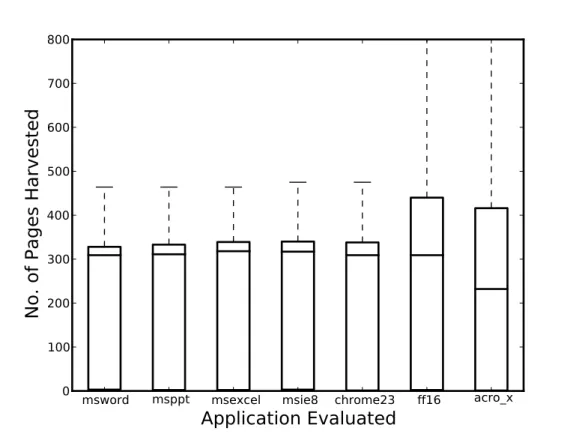
3.5 Evaluation . . . 45
3.5.1 On Code Page Harvesting . . . 45
3.5.2 On Gadget Coverage. . . 47
3.5.3 On API Function Discovery . . . 49
3.5.4 On Runtime Performance . . . 49
3.6 Real-world Applications . . . 52
3.6.1 Drive-by Downloads . . . 52
3.6.2 Remotely Leaking Password Manager Credentials. . . 52
3.7 Discussion . . . 55
4 Detecting Code Reuse Payloads . . . 58
4.1 Literature Review . . . 59
4.2 ROP Payload Example . . . 60
4.3 Method . . . 61
4.3.1 Unpacking Payload Containers . . . 62
4.3.2 Efficient Scanning of Memory Snapshots . . . 64
4.3.3 Gadget Candidate Profiling . . . 65
4.3.4 ROPChain Profiling . . . 66
4.4 Evaluation . . . 68
4.4.1 On Payload and Gadget Space . . . 68
4.4.2 On Gadgets and Runtime Performance. . . 69
4.4.3 On Accuracy . . . 70
4.5 Diagnostics . . . 72
4.6 Limitations in Face of a Skilled Adversary . . . 73
4.7 Architecture and OS Specificity . . . 75
4.8 Discussion and Lessons Learned . . . 75
5 Detecting Code Injection Payloads . . . 77
5.2 Method . . . 80
5.2.1 Leveraging Hardware Virtualization . . . 80
5.2.2 Custom Kernel Requirements . . . 82
5.2.3 Detection . . . 84
5.3 Optimizations . . . 86
5.4 Evaluation . . . 88
5.4.1 Comparison with Emulation . . . 88
5.4.2 On Document Snapshot Performance . . . 93
5.4.3 On Accuracy . . . 100
5.5 Limitations in Face of a Skilled Adversary . . . 102
5.6 Architecture and OS Specificity . . . 103
5.7 Discussion and Lessons Learned . . . 103
6 Diagnosing Code Injection Payloads . . . 105
6.1 Literature Review . . . 105
6.2 Method . . . 106
6.2.1 Detecting API Calls from Injected Code . . . 107
6.2.2 Call Completion and Tracing . . . 108
6.3 Results . . . 109
6.3.1 On Payload Polymorphism . . . 111
6.3.2 On API Call Patterns . . . 112
6.4 Operational Benefits . . . 114
6.5 Discussion and Lessons Learned . . . 115
7 Discussion . . . 117
7.1 On the Security Landscape and Alternative Attacks . . . 117
7.2 On the Inadequacy of Mitigations . . . 119
7.3 Way Forward . . . 121
LIST OF TABLES
3.1 JIT-ROPGadget Types . . . 40
3.2 Module Distribution of Pages Harvested byJIT-ROP. . . 47
4.1 ROP-filterRules Impacting Accuracy . . . 71
5.1 ShellOSvs Emulation Accuracy . . . 89
LIST OF FIGURES
1.1 “Drive-by” download attack. . . 3
2.1 Overview of attack phases. . . 11
2.2 Spatial and Temporal Memory Errors . . . 13
2.3 Buffer Overflow . . . 13
2.4 Use-After-Free . . . 14
2.5 Opportunities for control-flow hijacking. . . 15
2.6 Stack Smashing Attack . . . 15
2.7 Script-assisted web document based exploit. . . 17
2.8 Basic overview of code reuse attacks. . . 21
2.9 Address Space Layout Randomization (ASLR) . . . 23
2.10 Fine-Grained Memory and Code Randomization . . . 24
3.1 JIT-ROPArchitecture . . . 34
3.2 Direct vs. Indirect Page Disclosure . . . 35
3.3 HarvestCodePagesAlgorithm . . . 36
3.4 VerifyGadgetAlgorithm . . . 38
3.5 JIT-ROPImplementation. . . 42
3.6 JIT-ROPProof-of-Concept Exploit . . . 44
3.7 No. of Code Pages Harvested byJIT-ROP . . . 46
3.8 No. of Gadgets Discovered byJIT-ROP. . . 48
3.9 End-to-End Runtime Performance ofJIT-ROP. . . 51
4.1 ROP Payload Example . . . 60
4.2 ROP-filterArchitecture . . . 61
4.3 ROP-filterPayload and Gadget Space Size . . . 69
4.5 A 2-GadgetROPPayload . . . 72
4.6 ROP-filterDiagnostics . . . 73
5.1 ShellOSArchitecture . . . 81
5.2 Unsafe Optimization Example . . . 86
5.3 ShellOSvs Emulation Runtime Performance . . . 90
5.4 Network Testbed . . . 91
5.5 Network Runtime Performance Comparison . . . 92
5.6 CDF of the average packet queue size as the number ofShellOSCPU cores is scaled.ShellOSruns without optimizations in this experiment. . . 94
5.7 ShellOSperformance on document snapshots without using optimizations. . . 95
5.8 Runtime performance of optimization steps. . . 97
5.9 ShellOSmemory snapshot performance withstart-byteoptimization. . . 98
5.10 ShellOSmemory snapshot performance withalloptimizations. . . 99
6.1 Timeline of Malicious Documents. . . 109
6.2 CVE’s Present Per Document . . . 110
LIST OF ABBREVIATIONS
API Application Programming Interface ASLP Address Space Layout Permutation ASLR Address Space Layout Randomization
AS ActionScript
CDF Cumulative Distribution Function CFI Control-Flow Integrity
CISC Complex Instruction Set Computer COTS Commercial Off-the-Shelf
COW Copy-On-Write
CPU Central Processing Unit
CVE Common Vulnerabilities and Exposures DEP Data Execution Prevention
DLL Dynamically Loaded Library DOC Microsoft Word Document EAT Export Address Table
ELF Executable and Linkable Format EOI End-of-Interrupt
EXE Executable File FPU Floating-Point Unit FP False Positive
ILR Instruction Location Randomization
IO Input/Output
ISR Instruction Set Randomization
JIT Just-In-Time
JS JavaScript
KVM Kernel-based Virtual Machine LLVM Low Level Virtual Machine
NOP No Operation
NX No-eXecute
ORP In-place Binary Code Randomizer
OS Operating System
PCI Peripheral Component Interconnect PDF Adobe Portable Document Format PE Portable Executable
PEB Process Environment Block PIT Programmable Interval Timer PPT Microsoft PowerPoint Document QEMU Quick EMUlator
ROP Return-Oriented Programming
SEHOP Structured Exception Handler Overwrite Protection SEH Structured Exception Handler
STIR Self-Transforming Instruction Relocation
SWF ShockWave Flash
TCP Transmission Control Protocol TEB Thread Environment Block
TP True Positive
TSS Task State Segment URL Uniform Resource Locator
VMM Virtual Machine Monitor
VM Virtual Machine
CHAPTER 1: INTRODUCTION
Interconnected devices like personal computers, phones, and tablets increasingly play a central role in our daily lives. As a result, our private information (e.g., taxes, addresses, phone numbers, photos, banking accounts, etc.) and activities (e.g., browsing habits, webcams, GPS, etc.) are commonly accessible in digital form. Businesses not only house client information en-mass, but also their own trade secrets. It comes as no surprise then that unsavory individuals and organizations have clear motivation for pursuing access to this information. Once the domain of curiosity and bragging rights, the impact of “hacking” continues to escalate, now raising concern over national security. Indeed, the US Department of Justice recently indicted five Chinese military hackers for cyber espionage, the first charges of this kind against nation-state actors1. The information leaked in these campaigns, for example, is used for theft, blackmail, political motives, or to gain a competitive edge in business. Further, even systems completely devoid of exploitable information hold value as a stepping stone in gaining access to more systems.
The past two decades bare witness to a constantly changing computer security landscape. This holds true in terms of the tactics of both attacker and defender. Today, the wide-spread proliferation of document-based exploits distributed via massive web and email-based attack campaigns is an all too familiar strategy. Figure 1.1 illustrates a common adversarial tactic dubbed adrive-by download. The adversary compromises existing web sites and inserts a hidden snippet of code that directs victim browsers to automatically load a secondary web page. Hence, a policy of only browsing to well-known “safe” web sites only serves to give one a false sense of security that depends on those sites being secured. The secondary page serves a “weaponized” document with embedded malicious code. End-user document readers automatically load these files with, for example, Adobe Acrobat, Flash Player, the Microsoft Office Suite, Silverlight, the Java Runtime, and other applications installed on the victim’s machine. These document readers provide fertile ground for adversaries— support for dynamic content like JavaScript and ActionScript significantly eases the exploitation
1Indictment against members of China’s military in May of 2014: http://www.justice.gov/iso/opa/
of vulnerabilities found in their sizable, complex code bases. Largely, the immediate goal of these attacks is to compromise target systems by executing arbitrary malicious code in the context of the exploited application. Loosely speaking, the technical tactics used in these attacks can be classified as eithercode injection— wherein malicious instructions are directly injected into the vulnerable program — orcode reuseattacks, which opt to inject references to existing portions of code within the exploited program. In either case, these tactics are frequently used to subsequently download malware from another web site, or extract the malware from embedded data within the weaponized document.
Web Browser
Compromised Website
<iframe src='...' />
Exploit Kit Landing Page
Plugin Detection
Malware Distribution Site
Malicious Document
Executable
➊
➋
➌
RedirectFigure 1.1: “Drive-by” download attack.
other means, is to buildsignaturesof a key element that embodies malicious nature of a particular activity or content. These signatures are often expressed as large regular expression databases used by anti-virus software. These approaches are invaluable when one has concrete a-priori knowledge of benign or malicious activities, but require constant re-assessment in the quickly evolving security landscape.
Beyond detecting invasive code and activity, a plethora of literature exists on strategies for reducing the overall attack surface through compiler techniques, programming language paradigms, instruction-set architectures, operating system mitigation, improved access control primitives, cryp-tography, and reducing human error through training and more intuitive interfaces, among others. For the most part, detection is complimentary to these techniques, as non-ubiquitous mitigations reduce, but do not eliminate all attacks. Even ubiquitously deployed mitigations do not necessarily dissuade a capable adversary. Code injection and reuse mitigations, for example, are deployed across all major operating systems to-date, yet the use of these tactics is still widespread.
Thesis Statement
Static and dynamic analysis techniques offer an effective and long-lasting strategy for
detecting the code injection and reuse payloads used in the exploitation of application
memory errors in “weaponized” documents.
To support this assertion, the content of this dissertation first motivates the problem setting with a new attack paradigm that demonstrates how code reuse can be leveraged to defeat deployed and proposed defenses, then elaborates on novel methods to detect both code reuse and injection while providing empirical evidence that these methods have effectively detected such attacks from 2008 to 2014 with minimal effort to keep pace with the changing attack landscape.
1.1 A Brief History of Exploitation and Mitigation
function epilogues that terminates programs when the canary is modified. As was to be expected, attackers quickly adapted their exploits by overwriting alternative control-flow constructs, such as structured exception handlers (SEH).
In response, ano-execute(NX) bit was introduced into thex86architecture’s paging scheme that allows any page of memory to be marked as non-executable. Data Execution Prevention (DEP) (Microsoft, 2006) in Microsoft Windows XP SP2, and onward, leverages the NX bit to mark the stack and heap as non-executable and terminates a running application if control flow is redirected to injected code. Thus, it seemed that conventional code injection attacks had been rendered ineffective by ensuring the memory that code is injected into is no longer directly executable. Instead, attackers then added code reuse attacks to their playbook. This new strategy utilizes code already present in memory, instead of relying on code injection. The canonical example isreturn-to-libc(Solar Designer, 1997), in which attacks re-direct execution to existing shared-library functions. More recently, this concept was extended by (Shacham, 2007) to chain together short instruction sequences ending with aretinstruction (calledgadgets) to implement arbitrary program logic. This approach was dubbedreturn-oriented programming(ROP). To date, return-oriented programming has been applied to a broad range of architectures (including Intel x86, SPARC, Atmel AVR, ARM, and PowerPC).
This early form of code reuse, however, relies on gadgets being located at known addresses in memory. Thus, address-space layout randomization (ASLR) (Forrest et al., 1997), which randomizes the location of both data and code regions, offered a plausible defensive strategy against these attacks. Code region layout randomization hinders code reuse in exploits; data randomization impedes the redirection of control-flow by making it difficult to guess the location of injected code. Not to be outdone, attackers soon reconciled with an oft neglected class of vulnerabilities: thememory disclosure. Indeed, disclosing a single address violates fundamental assumptions in ASLR and effectively reveals the location of every piece of code within the address region, thus re-enabling the code reuse attack strategy.
1.2 Just-in-Time Code Reuse
the deficiencies of ASLR (e.g., low entropy and susceptibility to information leakage attacks). In particular, fine-grained randomization defenses are designed to efficiently mitigate the combination of memory disclosures and code reuse attacks; a strategy used in nearly every modern exploit. Chapter 3 introduces the design and implementation of a framework based on a novel attack strategy, dubbedjust-in-time code reuse, that undermines the benefits of fine-grained ASLR. Specifically, it exploits the ability to repeatedly abuse a memory disclosure to map an application’s memory layout on-the-fly, dynamically discover API functions and gadgets, and JIT-compile a target program using those gadgets—all within a script environment at the time an exploit is launched. The power of this framework is demonstrated by using it in conjunction with a real-world exploit against Internet Explorer, and also by providing extensive evaluations that demonstrate the practicality of just-in-time code reuse attacks. The findings suggest that fine-grained ASLR is not any more effective than traditional ASLR implementations. This work serves to highlight that despite decades of work to mitigate exploitation of memory errors, the ability to inject payloads to perform a code reuse attack still persists. Further, there are no proposed defenses on the horizon that will completely eliminate these attacks without significant architectural changes or unacceptable performance losses (Szekeres et al., 2013).
1.3 Detecting Code Reuse Payloads
Return-oriented programming (ROP) and Just-in-Time ROP (JIT-ROP) offer a powerful tech-nique for undermining state-of-the-art security mechanisms, including non-executable memory and address space layout randomization. DEP, ASLR, and fine-grained ASLR, however, are all in-built defensive mechanisms that benefit the most from ubiquitous deployed across machines and appli-cations. Further, they do not necessarily detect attacks. Instead, these mitigations simply result in application failure (i.e. a “crash”) with no insight into whether an attack took place or a bug was encountered. The work in Chapter 4 instead focuses on detection techniques that do not require
application, then those snapshots are efficiently transferred back to the host system. Operating on the memory snapshots, novel static analysis and filtering techniques are used to identify and profile chains of code pointers referencing ROP gadgets (that may even reside in randomized libraries). An evaluation of over 7,662 benign and 57 malicious documents demonstrate that one can perform such analysis accurately and expeditiously — with the vast majority of documents analyzed in about 3 seconds.
1.4 Detecting Code Injection Payloads
The vast majority of modern memory error exploits require one to employ some form of code reuse (be itret-to-libc,ROP, orJIT-ROP) to bypass DEP, which effectively prevents direct execution of injected code. However, the use of code injection payloads still persists inhybrid
payload attacks. That is, the relative difficulty in crafting reliable code reuse payloads is high compared to crafting code injection payloads. Thus, it is not uncommon for code reuse payloads to consist of only enough gadgets to “turn off” DEP and redirect execution to a second payload — injected code. One promising technique for detecting code injection payloads is to examine data (be that from network streams or buffers of a process) and efficientlyexecuteits content to find what lurks within. Unfortunately, past approaches (Zhang et al., 2007; Polychronakis et al., 2007, 2006; Cova et al., 2010; Egele et al., 2009) for achieving this goal are not robust to evasion or scalable, primarily because of their reliance on software-based CPU emulators. Chapter 5 provides a novel approach based on a new kernel, calledShellOS, built specifically to address the shortcomings of previous analysis techniques. Unlike those approaches, the new design takes advantage of hardware virtualization to allow for far more efficient and accurate inspection of buffers by directly executing instruction sequences on the CPU, without the use of software emulation. In doing so, one also reduces exposure to evasive attacks that take advantage of discrepancies introduced by software emulation. Chapter 6 further evolves this new kernel to provide diagnostics of code injection payload
intent in addition to mere detection. The diagnostics provide the insights that enable network operators to generate signatures and blacklists from the exploits detected. This chapter also presents the results of a large-scale case study of those intents over several years.
1.5 Contributions
1. Chapter 3 presents a new method of constructing code reuse payloads, dubbed JIT-ROP.
JIT-ROPis an evolution of the return-oriented programming (Shacham, 2007) paradigm that eliminates “offline” computation of code snippets by leveraging a memory disclosure vulnerability to construct the payload “on-the-fly”. It concretely demonstrates that code reuse payloads are viable in face of widely deployed mitigations and proposed fine-grained ASLR schemes. An early version of this work appeared in:
• Snow, K. Z., Davi, L., Dmitrienko, A., Liebchen, C., Monrose, F., and Sadeghi, A.-R. (2013). Just-In-Time Code Reuse: On the Effectiveness of Fine-Grained Address Space Layout Randomization. IEEE Symposium on Security and Privacy.
2. Chapter 4 presents a new method for statically detecting code reuse payloads, including JIT-ROP. First, the content within documents is “pulled apart”, enabling one to expose code injection and reuse payloads for analysis. To do so, documents are launched with their designated reader program (e.g. Adobe Acrobat, Internet Explorer, etc) to allow the program itself to do the unpacking. Then, static code analysis “profiles” snippets of code in the payload and identifies the combinations of profiles that enable meaningful computation. It provides a practical method of detecting attacks that require code reuse for memory error exploitation. An early version of this work appeared in:
• Stancill, B., Snow, K. Z., Otterness, N., Monrose, F., Davi, L., and Sadeghi, A.-R. (2013).
Check My Profile: Leveraging Static Analysis for Fast and Accurate Detection of ROP
Gadgets. Symposium on Recent Advances in Intrusion Detection.
3. Regarding code injection, Chapter 5 describes an evolution of the emulation-based detection approach (Polychronakis et al., 2006) that improves runtime performance and reduces generic evasion strategies, dubbedShellOS. These benefits are realized by foregoing emulation altogether and directly executing instruction sequences on the CPU by taking advantage of hardware virtualization. It provides a practical method of detecting attacks that require code injection for memory error exploitation. An early version of this work appeared in:
4. Chapter 6 presents a novel tactic for diagnosing the intent of code injection payloads as well as a large-scale case study of those intents. The diagnostics provide the insights that enable network operators to generate signatures and blacklists from the exploits detected. An early version of this work appeared in:
CHAPTER 2: BACKGROUND
This chapter reviews the basics of important concepts that are vital to understanding the remainder of this dissertation. It covers the logistics of memory error vulnerabilities, control-flow hijacking, and constructing payloads (be it code injection or reuse) to perform arbitrary actions during the exploitation phase. Before drilling down to these topics, however, one can benefit from familiarity with their place relative to the ecosystem of attacks on client machines. Figure 2.1 presents an overview of attack phases used to compromise a client.
Thereconnaissance phaseconsists of a multitude of activities ranging from technical network scans to contacting an organization over the phone to learn of the existence of machines and how they are most likely to be compromised. Attacks targeting specific individuals or organizations make use of extensive reconnaissance. Attacks that cast a wide net are more likely to simply target the most popular applications for exploitation. The outcome of this phase, from the adversarial perspective, are decisions about how to approach the exploitation phase.
Inbound Network Service Attack
Browser "Drive-By" Attack
Email Attack (Attachment,
Link) Exploit Phase
Social Engineering Technical Exploit
"Egg" Execution Step
Download Extract
Reconnaissance Phase
and
or or
or
and Run
Infection Phase
Persist andor Hide
and Collect Local Info or
and
Command & Control Phase
Receive Updates Attack Other
Machines Misc. Activities
Information Exfiltration Phase
Figure 2.1: Overview of attack phases.
and document readers. While these exploits do enablearbitrarycode execution, the most widespread code simply bootstraps running a so-called “egg” (i.e. an executable that defenders typically label as malware, spyware, trojan, or a virus). To deliver data that exploits these vulnerabilities on a victim machine the adversary canpushexploit packets directly to exposed network services, force the user topulla file with embedded exploit when visiting a web site, or use a combination of pushing so-calledspamemail en-mass which the user then pulls to open attachments or visit web links. The widespread use of operating system memory protections and firewalls on network boundaries makes exploiting network services far less effective than it was in the past. Thus, this dissertation primarily focuses on “documents” (including web pages, spreadsheets, browser plug-ins, etc.) that contain embedded exploits.
running on the system. Information may also be collected on the compromised system at this time. While these events are commonplace, there exist innumerable possibilities for the adversary at this point. Command and Control(C&C) is communication with external servers (e.g. via web, chat, newsgroups, peer-to-peer protocols, etc.) that is used for notifying the adversary of success, receiving malware updates, tunneling interactive remote sessions, exploring systems interconnected with the victim, and a plethora of other activities. The heighten level of access is used by the adversary to automatically (or interactively) collect desired information, archive it into one or more files, then exfiltrate it all at once or slowly to avoid being noticed.
2.1 Memory Errors
A memory error is one type of software bug introduced, for instance, when the bounds of a buffer are improperly handled. As a result, memory outside of the buffer may be read or written. The infamousHeartBleed(CVE-2014-0160) bug in OpenSSL is one such memory error. In that case, the OpenSSL service erroneously copies a buffer using a length specified by the client. The client can supply a length value greater than the size of this buffer. As a result, the memory contents located immediately after the buffer are sent back to the client. Memory errors that leak memory contents of the exploited application are calledmemory disclosures. In the case of HeartBleed, the memory error enables one to read adjacent memory, but does not enable reading arbitrary memory locations or to write to memory. The capabilities endowed to an adversary are highly dependent on the specific code containing the vulnerability.
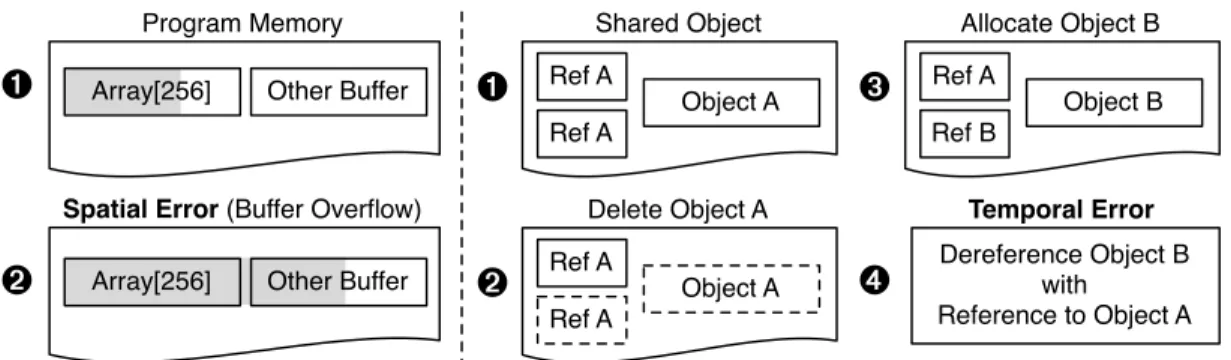
In general, there are two types of memory error. This section uses the nomenclature given by Szekeres et al. (2013). Heartbleed is an example of a so-called spatialmemory error, while the other type is called atemporalerror. Figure 2.2 illustrates the contents of memory during the execution of the two types of memory errors.
Program Memory
Other Buffer
Array[256]
Spatial Error (Buffer Overflow)
Other Buffer Array[256] Shared Object Object A Ref A Ref A
Delete Object A
Object A Ref A
Ref A
Allocate Object B
Object B Ref A Ref B
➊
➋
➌
➊
➋
➍
Temporal ErrorDereference Object B with
Reference to Object A
Figure 2.2: Spatial memory error (left) and temporal memory error (right).
char src[] = "Buffer Overflow"; 1
char dest[5]; 2
memcpy(dest, src, strlen(src)); // spatial error 3
Figure 2.3:Csource code with aspatialmemory error.
and written to when it iterates past the end bound of the destination buffer. If the source buffer were supplied by the adversary in this example, one could write arbitrary values into the memory adjacent to the destination buffer.
Temporal errors, on the other-hand, result in dangling pointers,i.e.pointers to deleted objects. Figure 2.2 (right) shows the memory of an object with several references in step¶. Keeping multiple references to a single object is a common practice, for example, when sharing an object across different parts of the code, or even with basic data structures like doubly-linked lists. In step·the object is deleted with one of the references, but the other reference to the object remains in use. A different type of object is instantiated in step¸, which happens to get allocated at the same address the deleted object used to reside. At this point, dereferencing the dangling pointer of the original object (Ref A),e.g.by accessing a member function or attribute, will erroneously access Object B instead of the intended Object A. To further highlight the problem, consider theC++source code snippet in Figure 2.4. In this snippet of code a string is used after it was freed (called ause-after-free). The ‘s2’ pointer is dangling after the delete because the underlying object memory has been freed. However, ‘s2’ still points to the memory location where it resided and is later used to access the object. Instead of calling the string object’s append method, a method of theC++map will be called.
std::string *s1, *s2; 1
s1 = s2 = new std::string("Shared String"); 2
delete s1; 3
s1 = new std::map<int, int>; 4
s2->append("use-after-free"); // temporal error 5
Figure 2.4:C++source code with atemporalmemory error.
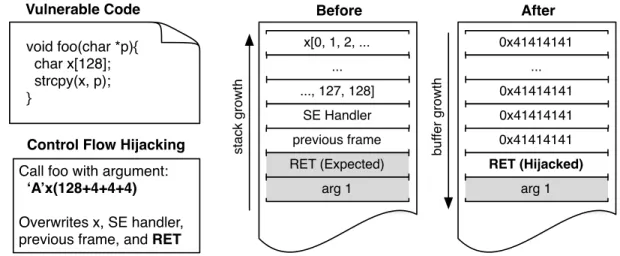
program stack stores function return addresses and structured exception (SE) handlers (SEH). Local function variables are allocated on the stack. Thus, if a memory error involves a local buffer overflow, one can write a new value into the return address or exception handler. When the function returns, or an exception is triggered, control-flow is directed to wherever this new value points. Figure 2.6 shows this entire process in detail. The vulnerable code has a similar spatial memory error as that in Figure 2.3. Any string with a length greater than 128 overflows the stack-allocated memory buffer (variablex). More precisely, calling the function with a 140 byte string hijacks program control flow by overwriting the return address of functionfoowith the address encoded by the last 4 bytes of the string. For example, a string ending in ‘AAAA’ encodes the address0x41414141since0x41is the hexadecimal representation of theASCIIencoded letter ‘A’. To arrive at this 140 byte string, one can either derive the exploit input by examining the program memory layout, or deduce it through multiple test inputs (calledfuzzing). Taking the approach of examining program memory, Figure 2.6 depicts the stack memory layout before and after the call tostrcpy. The gray portion of the diagram represents data pushed to the stack by the code callingfoo. The compiled function call translates to a
pushinstruction for argument passing and acallinstruction to both store the returning address and jump to the function code. The white portion is data pushed byfooitself by the compiler-generated
prologue. The prologue saves the calling function’s stack frame address on the stack, as well as any exception handlers, then allocates 128 bytes of stack space for the local variablex. The “before” diagram indicates precisely how one should structure an exploit buffer. For this example, 128 bytes fills the space allocated forx, then 4 bytes for the SE handler address, 4 more bytes for the saved stack frame address, then the next 4 bytes take the place of the return address pushed by the caller of
foo. When the function returns, control flow is redirected to whichever address is located in theRET
Function Stack Frame local variable local variable SE Handler previous frame return address
function arg 1
function arg 2
Program Heap
Ptr to Virtual Table B
Object B:
Object A: Ptr to Virtual Table A Member Variable: string buffer Member Variable: event handler Member Variable: integer
Program Static Data
Member Func 1
Member Func 2
Member Func 1
Member Func 2
Member Func 3
st a ck g ro w th
Figure 2.5: Opportunities for control-flow hijacking.
Overwriting function return addresses, however, is just one of several strategies to hijack control flow. Global objects,e.g.those allocated withnewormalloc, are created on the heap. C++ Objects on the heap each have a virtual method table (orvtable) that points to a lookup table of virtual methods for that object. Exploits that target memory errors on the heap commonly overwrite the vtable pointer, replacing it with a pointer to a new vtable controlled by the adversary. Control-flow is hijacked when a method of that object is called and the overwritten vtable is used to perform the method lookup. Further, all the aforementioned issues and techniques to exploit them are present across all prominent operating systems,e.g.Windows, OSX, Linux, iOS, and Android, albeit with slightly varying specifics.
Before
x[0, 1, 2, ...
...
..., 127, 128]
SE Handler previous frame RET (Expected) arg 1 st a ck g ro w th After 0x41414141 ... 0x41414141 0x41414141 0x41414141 RET (Hijacked) arg 1 b u ff e r g ro w th
void foo(char *p){ char x[128]; strcpy(x, p); }
Call foo with argument: ‘A’x(128+4+4+4)
Overwrites x, SE handler, previous frame, and RET
Vulnerable Code
Control Flow Hijacking
Exploiting Web Browsers and Document Readers: Memory errors may appear to be problem-atic for only low-level services coded in languages without memory-safety primitives (like in-built bounds checking). However, memory errors are routinely found and exploited using JavaScript, ActionScript, and Java byte-code running in the context of document readers and web browsers. For instance, CVE-2014-1776 is a use-after-free temporal memory error affecting Microsoft’s Internet Explorer versions 6-11 and CVE-2013-2551 is a spatial memory error affecting versions 6-10. Both of these vulnerabilities enable one to both read and write memory, which is used to hijack program control flow. Further, all of this can be achieved with a single JavaScript supplied by the adversary and interpreted in the victim’s browser.
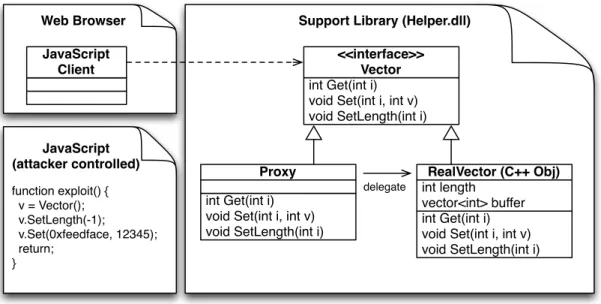
This raises the question of how a memory error can occur in a “memory-safe” scripting language like JavaScript. Indeed, memory safety (i.e. bounds checking) in JavaScript should prevent buffer overflows, thus preventing an adversary from trivially supplying a script that exploits itself. However, there are several instances where the memory safety of JavaScript (and the other “safe” languages) does not apply. One such case results from the use of a design pattern called theproxy pattern. Consider the use of the proxy pattern in Figure 2.7. The web browser uses a library to share some core functionality between the HTML parser and JavaScript interpreter. Any JavaScript code that manipulates the vector is transparently proxied to this library code, which is not within the scope of the JavaScript interpreter. Thus, bugs in proxied interfaces become exploitable from JavaScript. Internet Explorer, for example, shares more than 500 object interfaces between the HTML parser and JavaScript interpreter1. Similarly, Java provides this functionality through the Java Native Interface (JNI). From January to April of 2014 alone, Oracle reports that the standard edition of Java experienced 37 vulnerabilities, 11 of which enabled arbitrary code execution2. Further, most languages including Python, Ruby, PHP, and C# can access native interfaces through the Simplified Wrapper and Interface Generator (SWIG)3or other in-built mechanisms.
On the Longevity Memory Error Exploits: Beyond the anecdotal evidence given in this chapter, Veen et al. (2012) provide a comprehensive overview of the past, present, and projected
1Proxied interfaces are enumerated in the documentation for the MSHTML library athttp://msdn.microsoft.
com/en-us/library/hh801967(v=vs.85).aspx
2http://www.oracle.com/technetwork/topics/security/cpuapr2014verbose-1972954.
html#JAVA
3
<<interface>> Vector
int Get(int i) void Set(int i, int v) void SetLength(int i)
int Get(int i) void Set(int i, int v) void SetLength(int i)
Proxy
int Get(int i) void Set(int i, int v) void SetLength(int i)
RealVector (C++ Obj)
int length vector<int> buffer
delegate
JavaScript Client
Support Library (Helper.dll) Web Browser
JavaScript (attacker controlled) function exploit() { v = Vector(); v.SetLength(-1);
v.Set(0xfeedface, 12345); return;
}
Figure 2.7: Script-assisted web document based exploit.
future of memory error exploits. They analyzed the trend in both vulnerabilities reported and concrete exploits made available publicly. The number of memory error vulnerabilities increased linearly from 1998 to 2007, at which point the trend completely reversed with an equally linear decline through the end of the study in mid-2010. However, this data-point is misleading. One should not draw the conclusion that less memory bugs exist. In fact, the study goes on to show that the number of
On The State of Memory Error Mitigation: Unfortunately, the work of Veen et al. (2012) offers little insight into why the torrent of mitigations proposed by industry and academia alike fall short of preventing new exploits. Prior to exploring this topic, one should consider that CPU instruction sets (be it on a CISC,e.g. x86-32 and x86-64, or RISC,e.g. ARM, architecture, etc.) are designed to be versatile,i.e.they enable construction of arbitrary logic. Thus, the conditions in which memory errors arise and are exploited are inherently enabled at the lowest levels of computing. Mitigating memory errors is therefore an exercise in both educating developers to avoid mistakes leading to memory errors, as well as standardizing aspects of higher level language design, compiler primitives, and the way in which operating systems load and use programs. The ultimate goal would be to ubiquitously permeate these mitigations throughoutallapplications, libraries, and operating systems without incurring penalties in performance or functionality that are perceived as unacceptable. The challenge of quantifying this insight is taken on by Szekeres et al. (2013). The authors evaluate both deployed and proposed mitigations through the lens of the strength of protectionafforded, thecostin terms of memory and performance, andcompatibility(e.g.applicability to source code, binaries, and shared libraries). The results of their analysis suggest that the lack of strong protections is not biggest problem. In fact, Microsoft provides a package called the “Enhanced Mitigation Experience Toolkit” (EMET) that bundles a selection of these strong protections4. Instead, the authors point to performance cost and the lack of compatibility as the widest barriers to adopt newly proposed mitigations. Of the 15 approaches examined, only 4 are widely deployed (i.e.enabled by default by major OS vendors)—stack canaries, ASLR, and read and execute page permissions (DEP). These defenses are binary and library compatible (except for canaries, which require source code) and all have 0% average performance overhead. In contrast, 9 of the 11 remaining mitigations have compatibility problems with binaries and widely varying performance overheads from 5% to 116% on average.
It may come as a surprise that several “classical” hardware-supported protections are not mentioned in the study by (Szekeres et al., 2013)—memory segmentation and protection rings, for example. Memory segmentation divides memory into data, code, and stack sections, with some implementations (e.g. the Intel 80286 onwards) supporting memory protection (hence the term
4
“protected mode”). This scheme protects against code injection for “free” as the adversary cannot write new code into the code segment or execute code injected into the data segment, similar to the protection DEP provides with apagedmemory scheme. However, segmented memory is now an unused legacy model. All major operating systems simply segment memory as one all-encompassing flat region with no protection5, and the Intel x86-64 architecture has started to phase-out the ability to perform memory segmentation altogether. Thus protection using memory segmentation is no longer relevant in practice. Protection rings, on the other-hand, are still relevant, but generally only provide separation between “user” and “kernel” layers as well as a hypervisor layer where hardware virtualization is supported. The exploitation of vulnerabilities discussed in this chapter, however, has solely focused on exploitation within the “user” layer. That is, rings are designed to separate between different levels of privilege, but the memory errors discussed in this dissertation occur within asingle
privilege level, thus making rings an ineffective mitigation. Another way to think about this is that an unprivileged user can check their email, browse, and read and write documents, etc., but an adversary can also do all these actions with their user-level injected code running in the context of one of the user’s applications. The rings do, however, prevent one from directly modifying the OS kernel (e.g.
installing a rootkit). To do so, the adversary would need to either compromise a user with sufficient privileges, such as the “Administrator” or “root” accounts, or perform a so-calledprivilege escalation
exploit. Privilege escalation exploits are like any other memory error, except the vulnerable code is running in the kernel instead of a user-level application, and the subsequently injected code must be structured to run within that kernel environment. Thus, rings provide an additional barrier for an adversary attempting to gain full system access, but is not a mitigation against the exploitation of memory errors in and of itself.
Shadow stacks (Vendicator, 2000) are another well-known mitigation. The idea here is to protect sensitive data, such as function return addresses, that usually reside on the stack by created a separate ’shadow’ stack. Function return addresses are pushed to this secondary stack, ensuring that other operations do not overwrite them. Unfortunately, shadow stacks have a performance penalty of 5% on their own, which degrades to a 10x slowdown when adding protection for the shadow stack itself (Szekeres et al., 2013). Further, shadow stacks only protect against stack-based exploits that
5
overwrite the return address, are not compatible with all programs, and do not work with exceptions as-is.
In the 25 years that memory errors have been actively exploited, only a few mitigations have stood the test of time. These protections stand, however, not for their superior protection, but because they offer limited protection at a negligible cost. Stack canaries, unfortunately, only impact a sub-class of spatial errors that take place on the program stack. Even then, they are only applied under specific conditions (e.g.a certain compiler is used, a function contains a local buffer exceeding a predefined length, etc.). DEP and ASLR, on the other-hand, do not directly prevent hijacking control-flow, but rather hinder the successful execution of injected code and code reuse payloads, respectively. Unfortunately, these mitigations also have limitations, even when fully deployed across all applications and libraries.
The next sections detail how one translates a memory error into the execution of arbitrary code despite these mitigations. Hijacking control flow is only the first step, which allows one to point the program instruction pointer (IP) to a new (arbitrary) location. To execute arbitrary code after hijacking the IP, one can either reuse snippets of existing code, or inject new buffers of code.
2.2 Code Reuse
“Beware of the Turing tar-pit in which everything is possible but nothing of interest is easy.” -Alan Perlis inEpigrams on Programming(1982)
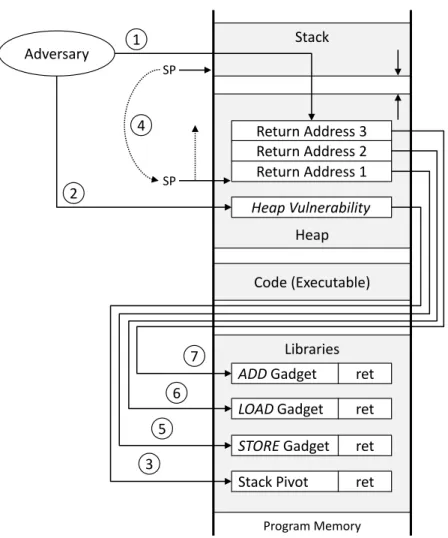
Program Memory Adversary
Stack
Heap
Code (Executable)
Libraries ADD Gadget ret
LOAD Gadget ret
STORE Gadget ret Return Address 3 Return Address 2 Return Address 1
Stack Pivot ret Heap Vulnerability SP
SP 1
2
3 4
5 6
7
Figure 2.8: Basic overview of code reuse attacks.
Loosely speaking, stack pivot sequences change the value of the stack pointer (esp) to a value stored in another register. Hence, by controlling that register6, the attacker can arbitrarily change the stack pointer. The most common strategy is to use a stack pivot sequence that directs the stack pointer to the beginning of the payload (Step¯). A concrete example of a stack pivot sequence is thex86assembler code sequencemov esp,eax; ret7. The sequence changes the value of the stack pointer to the value stored in registereaxand afterwards invokes a return (ret) instruction. Thex86 retinstruction simply loads the address pointed to byespinto the instruction pointer and incrementsespby one word. Hence, the execution continues at the first gadget (STORE) pointed to by Return Address 1 (Step°). In addition, the stack pointer is increased and now points to Return Address 2.
A gadget represents an atomic operation such asLOAD,ADD, orSTORE, followed by aret instruction. For example, on thex86, aLOADgadget can take the form ofpop eax; ret, hence loading the next value present on the stack into theeaxregister. Similarly, anADDgadget could be implemented withadd eax,ebx; ret, among other possibilities. It is exactly the terminating
retinstruction that enables the chained execution of gadgets by loading the address the stack pointer points to (Return Address 2) in the instruction pointer and updating the stack pointer so that it points to the next address in the payload (Return Address 3). Steps°to²are repeated until the adversary reaches her goal. To summarize, the combination of different gadgets allows an adversary to induce arbitrary program behavior.
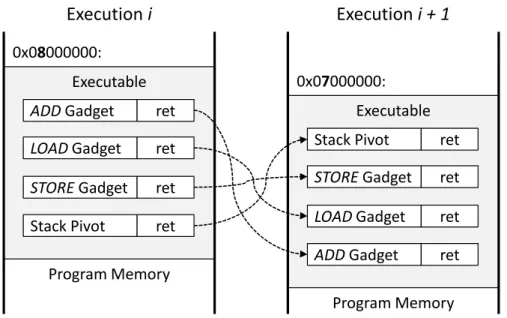
Randomization for Exploit Mitigation: As noted in the last section, a well-accepted counter-measure against code reuse attacks is the randomization of the application’s memory layout. The basic idea of address space layout randomization (ASLR) dates back to Forrest et al. (1997), wherein a new stack memory allocator was introduced that adds a random pad for stack objects larger than 16 bytes. Today, ASLR is enabled on nearly all modern operating systems such as Windows, Linux, iOS, or Android. For the most part, current ASLR schemes randomize the base (start) address of segments such as the stack, heap, libraries, and the executable itself. This basic approach is depicted in Figure 2.9, where the start address of an executable is relocated between consecutive runs of
6To control the register, the adversary can either use a buffer overflow exploit that overwrites memory areas that are
used to load the target register, or invoke a sequence that initializes the target register and then directly calls the stack pivot.
7
the application. As a result, an adversary must guess the location of the functions and instruction sequences needed for successful deployment of a code reuse attack. The intent of ASLR is to hinder such guessing schemes to a point wherein they are probabilistically infeasible within a practical time-frame.
Program Memory Executable
ADD Gadget ret
LOAD Gadget ret
STORE Gadget ret
Stack Pivot ret
Program Memory Executable
ret
ret
ret
ret
Execution
i
Execution
i + 1
0x08000000:
0x07000000:
ADD Gadget
LOAD Gadget
STORE Gadget
Stack Pivot
Figure 2.9: Address Space Layout Randomization (ASLR)
To confound these attacks, a number of fine-grained ASLR and code randomization schemes have recently appeared in the academic literature (Bhatkar et al., 2005; Kil et al., 2006; Pappas et al., 2012; Hiser et al., 2012; Wartell et al., 2012). These techniques are elaborated on later (in Chapter 3 §3.1), but for now it is sufficient to note that the underlying idea in these works is to randomize the data and code structure, for instance, by shuffling functions or basic blocks (ideally for each program run (Wartell et al., 2012)). As shown in Figure 2.10, the result of this approach is that the location of all gadgets is randomized. The assumption underlying all these works is that the disclosure of a single address no longer allows an adversary to deploy a code reuse attack.
Program Memory Executable
ADD Gadget ret
LOAD Gadget ret
STORE Gadget ret
Stack Pivot ret
Program Memory Executable Stack Pivot ret
STORE Gadget ret
LOAD Gadget ret
ADD Gadget ret
Execution
i
Execution
i + 1
0x08000000:
0x07000000:
Figure 2.10: Fine-Grained Memory and Code Randomization
Chapter 3 thoroughly examines the benefits and limitations of fine-grained ASLR. In short, however, these new mitigations offer no substantial benefit over existing ASLR schemes so long as one can construct payloads “online” rather than rely on manually crafting ROP prior to exploitation.
2.3 Code Injection
The basic idea of code injection is straight-forward: bytes representing pre-compiled machine code are placed into an executable (and writable) memory region of a running process. The instruction pointer is then loaded with the address of the bytes via a control-flow hijack and it executes.
On the No-Execute Bit for Exploit Mitigation: DEP (Microsoft, 2006) was introduced to prevent code injection attacks. This is done by leveraging the “no-execute” bit in the memory management unit (MMU). Like the “read” and “write” bits that control which per-page chunks of virtual memory can be accessed by the application, the no-execute bit controls which pages can be executed. DEP, by default, allocates application stack and heap regions without the execute permission, while application code has the execute permission, but not write permission. Without DEP, one could replace the string of ‘A’s in Figure 2.6 with bytes representing instructions and replace the expectedRETwith the starting address of that string. The function would return to that injected code rather than the function that called it. DEP mitigates this exploit due to the fact that the program stack will not be granted the execute permission.
This seemingly fool-proof mitigation, however, is defeated by several methods and circumstances. First, application developers are not required to adhere to the default policy, creating a gap in protection wherein end-users may be protected for one application, but not another. For example, early just-in-time (JIT) compilers for JavaScript, ActionScript, and Java would allocate chunks of memory as writable (to write the newly compiled code) and executable (to allow it to then run) without subsequently removing the write permission. DEP is essentially “turned off” in those regions. Continuing with the JIT example, another method of bypassing DEP is the so-called JIT-spray
Due to the wide-spread adoption of DEP the most practiced method of executing code after a control-flow hijack is ROP. However, the difficulty and specificity of ROP has led adversaries to leverage code reuse merely for allocating a writable and executable region of memory to facilitate a secondary code injection payload. Although not strictly required, this approach decreases the adversary’slevel-of-effort. Minimal, application specific, ROP payloads are used to disable DEP and load platform-independent, reusable, code injection payloads. In turn, these code injection payloads download and execute malware or perform other malicious actions (see Chapter 6).
Challenges Unique to Code Injection: When constructing code injection payloads, there are several considerations that make their development difficult. One challenge stems from the fact that injected code lacks the standard procedure of being loaded by the operating system loader routines. These routines normally handle mapping of code and data virtual addresses, code and data relocation fix-ups, and dynamic linking. Developers of code injection payloads must handle these problems by managing their own code and data sections with custom schemes, using position-independent code (PIC), and performing their own resolution of dynamic libraries and functions. Since no widely used compiler supports all of these requirements, code injection payloads must be developed in assembly language or with custom tools. Another challenge lies in the fact that, depending on the specifics of a particular vulnerability, the content of the buffer of bytes may be restricted in which bytes are “allowed”. The canonical example of this restriction are buffer overflow vulnerabilities that involve a
example, demonstrate that fully functional arbitrary code injection payloads can take the form of English text.
CHAPTER 3: JUST-IN-TIME CODE REUSE
In light of the code reuse payload paradigm, whether return-oriented (Shacham, 2007), jump-oriented (Bletsch et al., 2011), or some other form of “borrowed code” (Krahmer, 2005), skilled adversaries have been actively searching for ever more ingenious ways to leverage memory disclo-sures as part of their arsenal (Sotirov and Dowd, 2008b; Serna, 2012a; VUPEN Security, 2012; Larry and Bastian, 2012). At the same time, defenders have been busily working to fortify perimeters by designing “enhanced” randomization strategies (Bhatkar et al., 2005; Kil et al., 2006; Pappas et al., 2012; Hiser et al., 2012; Wartell et al., 2012; Giuffrida et al., 2012) for repelling the next generation of wily hackers. This chapter questions whether this particular line of thinking (regarding fine-grained code randomization) offers a viable alternative in the long run. In particular, this chapter examines the folly of recent exploit mitigation techniques, and shows that memory disclosures are far more damaging than previously believed. Just as the introduction of SEH overwrites bypassed protection provided by stack canaries, code reuse undermines DEP, and memory disclosures defied the basic premise of ASLR, this chapter assails the assumptions embodied by fine-grained ASLR.
The primary contribution of this chapter is in showing that fine-grained ASLR for exploit mitigation, even considering an ideal implementation, is not any more effective than traditional ASLR implementations. Strong evidence for this is provided by implementing a framework wherein one can automatically adapt an arbitrary memory disclosure to one that can be used multiple times to reliably map a vulnerable application’s memory layout, then just-in-time compile the attacker’s program, re-using (finely randomized) code. The workflow of the framework takes placeentirelywithin a single script (e.g., as used by browsers) for remote exploits confronting application-level randomization, or a single binary for local privilege escalation exploits battling kernel-level randomization.
this work spurs discussion and inspires others to explore more comprehensive defensive strategies than what exists today.
3.1 Literature Review
As discussed in the previous chapter, exploit mitigation has a long and storied history. For brevity, this section highlights the work most germane to the discussion at hand; specifically reviewed are fine-grained memory and code transformation techniques. In general, these techniques can be categorized into binary instrumentation-based or compiler-based approaches.
As the name suggests, binary instrumentation-based approaches operate directly on an application binary. In particular, Kil et al. (2006) introduced an approach called address space layout permutation (ASLP), that performs function permutation without requiring access to source code. Their approach statically rewrites ELF executables to permute all functions and data objects of an application. Kil et al. (2006) show how the Linux kernel can be instrumented to increase the entropy in the base address randomization of shared libraries, and discuss how re-randomization can be performed on each run of an application. However, a drawback of ASLP is that it requires relocation information, which is not available for all libraries. To address this limitation, several proposals have emerged (Pappas et al., 2012; Hiser et al., 2012; Wartell et al., 2012). Pappas et al. (2012), for example, present an in-place binary code randomizer (ORP) that diversifies instructions within a basic block by reordering or replacing instructions and swapping registers.
In contrast, instruction location randomization (ILR) (Hiser et al., 2012) randomizes the location of each instruction in the virtual address space, and the execution is guided by a so-calledfall-through map. However, to realize this support, each application must be analyzed and re-assembled during a static analysis phase wherein the application is loaded in a virtual machine-like environment at runtime—resulting in high performance penalties that render the scheme impractical. Additionally, neither ORP nor ILR can randomize an application each time it runs. That limitation, however, is addressed by Wartell et al. (2012), wherein a binary rewriting tool (called STIR) is used to perform permutation of basic blocks of a binary at runtime.
ASLR solution that performs live re-randomization allowing a program module to be re-randomized after a specified time period. Unfortunately, re-randomization induces significant runtime overhead,
e.g., nearly 50% overhead when applied every second, and over 10% when applied every 5 seconds. A bigger issue, however, is that the approach of Giuffrida et al. (2012) is best suited to micro-kernels, while modern operating systems (Windows, Linux, Mac OSX) still follow a monolithic design.
With regard to compiler-based approaches, several researchers have extended the idea of software diversity first put forth by Cohen (1993). Franz (2010) explored the feasibility of a compiler-based approach for large-scale software diversity in the mobile market. An obvious downside of these approaches is that compiler-based solutions typically require access to source code—which is rarely available in practice. Further, the majority of existing solutions randomize the code of an application only once,i.e., once the application is installed it remains unchanged. Finally, Bhatkar et al. (2005) present a randomization solution that operates on the source code,i.e., they augment a program to re-randomize itself for each program run.
More distantly related is the concept of JIT-spraying (Blazakis, 2010; Rohlf and Ivnitskiy, 2011) which forces a JIT-compiler to allocate new executable memory pages with embedded code; a process which is mitigated by techniques such as JITDefender (Chen et al., 2011). Also note that because scripting languages do not permit an adversary to directly program x86 shellcode, the attacker must carefully construct a script so that it contains useful ROP gadgets in the form of so-called unintended instruction sequences,e.g., by using XOR operations (Blazakis, 2010). In contrast, the method presented in this chapter does not suffer from such constraints, as it does not require the injection of new ROP gadgets.
3.2 Assumptions and Adversarial Model
(i.e., exploitable vulnerabilities still exist). Thus, one assumes the adversary is able to exercise one of these pre-existing vulnerable entry points. Hence, a full discussion of the first stage of attack is out of scope for this chapter. The interested reader is referred to (Johnson and Miller, 2012) for an in-depth discussion on stack and heap vulnerability mitigations.
In what follows, the target platform is assumed to use the following mechanisms (see §2) to mitigate the execution of malicious computations:
• Non-Executable Memory:The security model of non-executable memory (also called NX or DEP) is applied to the stack and the heap. Hence, the adversary is not able to inject code into the program’s data area. Further, the same mechanism is applied to all executables and native system libraries, thereby preventing one from overwriting existing code.
• JIT Mitigations: A full-suite of JIT-spraying mitigations, such as randomized JIT pages, constant variable modifications, and random NOP insertion. As just-in-time code reuse is unrelated to JIT-spraying attacks, these mitigations provide no additional protection.
• Export Address Table Access Filtering: Code outside of a module’s code segment cannot access a shared library’s export table (i.e. as commonly used by shellcode to lookup API function addresses). As the approach described in this chapter applies code-reuse from existing modules for 100% of malicious computations, this mitigation provides no additional protection.
• Base Address Randomization:The target platform deploys base address randomization by means of ASLR and all useful, predictable, mappings have been eliminated.
• Fine-Grained ASLR:The target platform enforces fine-grained memory and code random-ization on executables and libraries. In particular, a strong fine-grained randomrandom-ization scheme, which (i) permutes the order of functions (Bhatkar et al., 2005; Kil et al., 2006) and basic blocks (Wartell et al., 2012), (ii) swaps registers and replaces instructions (Pappas et al., 2012), (iii) randomizes the location of each instruction (Hiser et al., 2012), and (iv) performs randomization upon each run of an application (Wartell et al., 2012).
thereby allowing an adversary to leverage the non-randomized code parts for a conventional code reuse attack. Further, current systems do not enforce fine-grained randomization. That said, there is a visible trend toward enabling ASLR for all applications, even for the operating system kernel (as deployed in Windows 8). Furthermore, current thinking is that fine-grained randomization has been argued to be efficient enough to be considered as a mechanism by which operating system vendors can tackle the deficiencies of base address randomization.
Nevertheless, even given all these fortified defenses, one can show that the framework for just-in-time code reuse attacks readily undermines the security provided by these techniques. In fact, an adversary utilizing this framework— whether bypassing ASLR or fine-grained mitigations—will enjoy a simpler and more streamlined exploit development process than ever before. As will become apparent in the next section, the framework frees the adversary from the burden of manually piecing together complicated code reuse payloads and, because the entire payload is built on-the-fly, it can be made compatible with all OS revisions. To perform the attack, one must only assume that the adversary can (1) use a memory disclosure vulnerability to repeatedly reveal values at targeted absolute addresses, and (2) discover a single code pointer, e.g., as typically found via function pointers described by a heap or stack-allocated object. These assumptions are quite practical, as existing exploits that bypass standard ASLR have nearly identical requirements (Serna, 2012a).
Recall from §2.1 that a memory disclosure vulnerability occurs when one leverages a memory error to read outside the bounds of a buffer. One strategy to enable repeatable disclosures is to firstwriteoutside the bounds of a buffer to modify an existing object’s properties. For example, overwriting thelengthproperty of a JavaScript string object allows one to subsequently disclose memory beyond the end of the string by indexing into it with a large value. Specific addresses can be targeted by first using the relative disclosure to determine the address of the string itself, then offsetting absolute addresses with that address. A concrete example of a targeted, repeatable memory disclosure is given in §3.4.
3.3 Method
for all necessary gadgets on-the-fly, regardless of the granularity of code and memory randomization. One could reasonably conjecture that if fine-grained exploit mitigations became common-place, then attackers would simply modularize, automate, and incorporate a similar approach into existing exploitation toolkits such asMetasploit(Maynor, 2007).
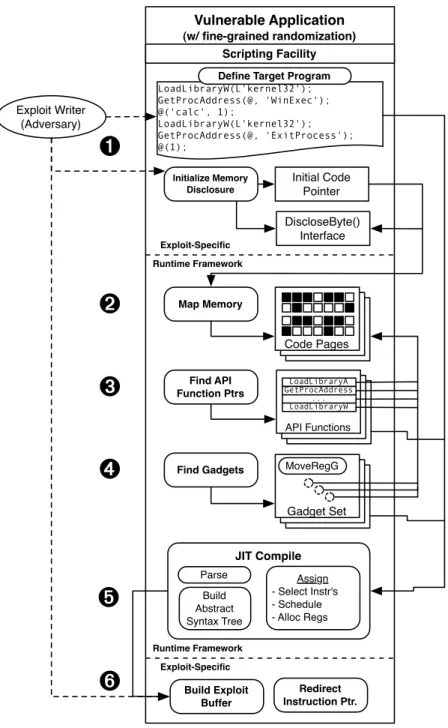
To evaluate the hypothesis that multiple memory disclosures are an effective means to bypass fine-grained exploit mitigation techniques, a prototype exploit framework is designed and built that aptly demonstrates one instantiation (calledJIT-ROP) of the idea. The overall workflow of an exploit using this framework is given in Figure 3.1. An adversary constructing a new exploit need only conform their memory disclosure to the framework’s interface and provide an initial code pointer in Step¶, then let the framework take over in Steps·toºto automatically (and at exploit runtime) harvest additional code pages, find API functions and gadgets, and just-in-time compile the attacker’s program to a serialized payload usable by the exploit script in Step».
The implementation is highly involved, and successful completion overcomes several challenges. With that in mind, note that the current implementation of the framework represents butone instan-tiation of a variety of advanced techniques that could be applied at each step,e.g., one could add support for jump-oriented programming (Bletsch et al., 2011), use more advanced register allocation schemes from compiler theory, etc. Nevertheless, §4.4 shows that the implementation ofJIT-ROP is more than sufficient for real-world deployment, both in terms of stability and performance. The remainder of this section elaborates on the necessary components of the system, and concludes with a concrete example of an exploit using the framework.
3.3.1 Mapping Code Page Memory
Vulnerable Application
(w/ fine-grained randomization)
Find Gadgets Initialize Memory Disclosure DiscloseByte() Interface Map Memory Initial Code Pointer Code Pages Gadget Set MoveRegG Find API Function Ptrs LoadLibraryW(L'kernel32'); GetProcAddress(@, 'WinExec'); @('calc', 1); LoadLibraryW(L'kernel32'); GetProcAddress(@, 'ExitProcess'); @(1);
Define Target Program
Exploit-Specific Runtime Framework JIT Compile API Functions LoadLibraryA GetProcAddress ... LoadLibraryW Parse Build Abstract Syntax Tree Assign - Select Instr's - Schedule - Alloc Regs
Exploit-Specific Runtime Framework Build Exploit Buffer Redirect Instruction Ptr.
!
"
#
$
%
&
Exploit Writer (Adversary) Scripting FacilityImport Address Table
Code Page A ...
CALL [-0xFEED] ...
JMP +0xBEEF ...
Code Page B Code Page C
Lookup
Near-by Page
Directly Disclosed
Indirectly Disclosed
DLL Page
Figure 3.2: Pages pointed to by relative control flow instructions are directly queued for the next linear sweep, while indirect control flow instructions point to the Import Address Table (IAT), where a memory disclosure is used to resolve the page of the function pointer.
addresses, which would be unreliable to obtain in face of fine-grained ASLR and non-continuous memory regions.
To overcome this hurdle, one may note that knowledge of a single valid code pointer (e.g., gleaned from the heap or stack) reveals that an entire 4 kilobyte-aligned page of memory is guaranteed to be mapped. Step¶requires the exploit writer to conform the single memory disclosure to an interface namedDiscloseBytethat, given an absolute virtual address, discloses one byte of data at that address (see §3.4). One approach, therefore, is to use theDiscloseBytemethod to implement aDisclosePagemethod that, given an address, discloses an entire page of memory data. The challenge then is to enumerate any information found in this initial page of code that reliably identifies additional pages of code.
One reliable source of information on additional code pages is contained within the control-flow instructions of the application itself. Since code spans hundreds to thousands of pages, there must be control-flow links between them. In Step·, the framework applies static code analysis techniques (in this case, at runtime) to identify both direct and indirectcallandjmpcontrol-flow instructions within the initial code page. New code pages are gathered from instructions disassembled in the initial code page. As depicted in Figure 3.2, direct control-flow instructions yield an immediate hint at another code location, sometimes in another page of memory.