DO INTERGOVERNMENTAL ORGANIZATIONS PACIFY OR FACILITATE SANCTIONING BEHAVIOR?
Menevis Cilizoglu
A thesis submitted to the faculty of the University of North Carolina at Chapel Hill in partial fulfillment of the requirements for the degree of Master of Arts in the Department of Political Science.
Chapel Hill 2014
ABSTRACT
MENEVIS CILIZOGLU: Do Intergovernmental Organizations Pacify or Facilitate Sanctioning Behavior?
(Under the direction of Mark Crescenzi.)
TABLE OF CONTENTS
LIST OF TABLES . . . vi
LIST OF FIGURES . . . vii
Introduction . . . 1
Literature Review . . . 2
What Do We Know about The Impact of IGOs in Bilateral Relations? . . . 3
What Do We Know About Sanctions? . . . 4
Theory: Intergovernmental Organizations and Sanctions . . . 6
Sanction Threats and IGOs . . . 7
Sanction Imposition and IGOs . . . 10
Passive Involvement of IGOs Prior to Sanction Episodes . . . 10
Active Involvement of IGOs Prior to Sanction Episodes . . . 12
Accounting for the Variation Among IGOs and Sanctions . . . 15
Data and Research Design . . . 16
Dependent Variables . . . 17
Explanatory Variables . . . 19
Control Variables . . . 21
Methodology . . . 23
Results . . . 24
Results for H1: Threat Stage of Sanctions . . . 24
Results for H2 - Imposition Stage of Sanctions . . . 25
Analyzing the Control Variables . . . 30
LIST OF TABLES
Table
LIST OF FIGURES
Figure
1 Marginal Effects of Joint Membership on Sanction Impositions . . . 36 2 Marginal Effects of Joint Membership in Security Institutions on
Security-Related Sanction Impositions . . . 36 3 Marginal Effects of Joint Membership in Economic Institutions on
Introduction
Sanctions and threats of sanctions have become frequent foreign policy tools in world pol-itics. There has been a recent surge in interest and scholarly research in the area of sanctions. The main focus of the sanctions literature has been on the effectiveness of sanctions and the conditions under which sanctions succeed or fail. However, far too little attention has been devoted to the reasons why sanctions emerge in the first place. The question of sanction ef-fectiveness can neither be analyzed theoretically nor tested empirically independent from the states’ decision to impose them. Therefore, this paper aims to take a step back and identify the reasons why states resort to sanctions or threats of it as a foreign policy tool. What prompts the initial attempt at economic coercion? What factors shy states away from imposing sanctions, and what factors make sanctions a viable option to resolve contentious issues?
I turn to the effect of intergovernmental organizations (IGOs) to answer these questions. The literature on the ability of international institutions to promote peace among their members is rich, and the pacifying effect of shared membership in IGOs in militarized disputes is well established (Boehmer, Gartzke and Nordstrom 2004; Oneal and Russett 2001; Shannon, Morey and Boehmke 2010). What is not yet clear is the role of IGOs in lower intensity conflicts. We have abundant evidence suggesting that shared membership in IGOs decreases the probability of fighting, but we do not know if IGOs also discourage states from engaging in lower intensity conflicts, such as economic sanctions. One of the main purposes of this study is to find out whether or not IGOs influence state decisions with regards to sanction episodes1? I will try to find out shared membership in intergovernmental organizations pacify sanctioning behavior or facilitate it?
I differentiate IGOs based on their primary mandates and sanctions based on the issue under
contention. Furthermore, I match sanction episodes with relevant IGOs, assuming that IGOs do not influence state decisions on sanctions outside their mandates. I find that the states with higher levels of shared IGO membership are more likely to threaten one another with sanctions. This relationship is not very clear for threats on security issues channeled through security IGOs; however, it is evident for trade-related sanction threats. At the imposition stage, I find that the pacifying effect of IGOs in sanction episodes is only limited to IGOs with a security mandate. Security IGOs do a good job in preventing their members to sanction each other for security issues. The results suggest that economic IGOs fail to pacify states in solving their trade related disputes.
These findings have important implications for the literature on intergovernmental orga-nizations. The literature has been dominantly focused on the role of IGOs in high-intensity conflicts; however their influence is also evident in low-intensity conflicts. Moreover, the re-sults reinforce the commonly accepted finding that equating IGOs, as well as sanctions, and not accounting for the variation among them will lead to misleading results.
Literature Review
Hafner-Burton and Montgomery (2008) look explicitly at the impact of institutions on sanc-tion onset, but they limit their focus to Preferential Trade Agreements (PTA). This line of re-search also offers contradictory findings. Some argue that states that are connected through PTAs shy away from imposing sanctions, because they are basically two opposing policy op-tions (Hufbauer 2000). However, some argue that mutual memberships in PTAs has no effect on the propensity of states to sanction each other (Gallarotti 1991). Despite the lack of a con-clusive answer about the impact of shared memberships in PTAs on sanctioning behavior, the literature reveal the importance of exploring the impact of institutions on sanction onset. I aim to go beyond their limited scope on PTAs, and focus on security and economic institutions that are relevant to sanction episodes, to find out whether they facilitate or pacify the sanctioning behavior of their member states.
What Do We Know about The Impact of IGOs in Bilateral Relations?
The interest in intergovernmental organizations has a longer history in the field of interna-tional relations than the interest in sanctions. The role of IGOs in internainterna-tional relations has been subject to contentious debates within the field and the traditional paradigms offer clashing interpretations.2 However, there is no doubt that IGOs are influential actors in international relations that attract significant scholarly attention.
One of the main focuses of the more recent literature on IGO influence in bilateral state relations is the question of whether or not IGOs promote peace. Oneal and Russett (2001) find that joint institutional membership decreases the probability of militarized interstate dispute initiation. Studies that follow them try to specify the characteristics of IGOs that are influential on this decision. Boehmer, Gartzke and Nordstrom (2004) and Bearce and Bondanella (2007) find that only highly institutionalized IGOs and IGOs with cohesive member state preferences are capable of having a pacifying impact on dispute initiation decisions; whereas Pevehouse and Russett (2009) argue that densely democratic IGOs are far more likely to foster peaceful relations among members. Haftel and Thompson (2006) attempt to differentiate IGOs based
on their level of independence from states and Leskiw (2002) differentiates between IGOs that are regional and global in scale. He finds that regional organizations perform much better in pacifying states than global organizations.
The literature is very rich and diverse in terms of the paths chosen to differentiate between IGOs. A single measure to account for the variation among IGOs does not exist, however there has been a consensus in the literature that IGOs are not equal and each study has to account for this variation. This is also the path that I choose in this paper. I start with the assumption that equating IGOs is likely to generate misleading results. Therefore, I analyze IGOs based on their relevancy to a given sanction episode, and by matching the issue under contention in the sanction episode with the primary mandate of the institution.
The focus of the IGO literature is not only on militarized conflict initiation, but also on the influence of IGOs on the duration of disputes (Shannon, Morey and Boehmke 2010), settlement of disputes (Shannon 2009) as well as the likelihood of compliance with negotiated settlements (Mitchell and Hensel 2007). However; to my knowledge, there has been no scholarly work done in the area of IGO influence on the decision of states to threaten another state with sanctions or their imposition. This study aims to fill this gap.
What Do We Know About Sanctions?
Economic sanctions are often characterized as imperfect substitutes for military action and ruled by similar dynamics as war (Drezner 1999; Marinov 2003). They are often designed to alter targets’ behavior through inflicting economic harm or signal discontent. The literature on sanctions mainly focus on three aspects of sanctions: its initiation, duration3and effectiveness.4 Here, I will explicitly focus on the literature on sanction onset and how to explore the decision to impose sanctions given the level of connectedness between the sender and the target through shared IGO memberships. Hafner-Burton and Montgomery (2008) suggest that “to the extent that international institutions are believed to matter for economic sanctions, they are important
3See Bolks and Al-Sowayel (2000) and McGillivray and Stam (2004) for the duration literature.
in determining success rather than onset under conditions of multilateralism.” Contrary to their claim, I aim to show that IGO involvement is equally influential in the decision of the senders to initiate sanction episodes as a foreign policy tool.
The early literature on sanctions had often been criticized because of its failure to account for the threat stage of sanctions. Scholars have identified the selection bias problem associated with this failure (Drezner 2003; Lacy and Niou 2004; Whang, Mclean and Kuberski 2013). Treating threats as an integral part of the interaction between the sender and the target is a remedy for this problem. Similar to the sanction onset literature, the literature on the threats of sanctions primarily focus on the effectiveness of threats and try to uncover the conditions under which the target is more likely to comply with the demands of the sender before sanctions are imposed (Whang, Mclean and Kuberski 2013). Some argue that economic coersion is more likely to succeed at the threat stage (Eaton and Engers 1992; Smith 1996); whereas others argue that some types of impositions are likely to succeed than threats (Krustev 2010). What received relatively less attention is the factors that facilitate threats. In this paper, I will account for the threat stage of sanctions and try to uncover the role of IGOs as an intermediary between the sender and the target at the threat stage.
The literature at the imposition stage is more extensive than the threat stage. There are substantial findings about the factors that makes a sanction imposition more or less likely. For instance, findings prove that democracies are less likely to sanction each other (Lektzian and Souva 2003; Cox and Drury 2006). The literature relating regime type and domestic institutions to sanction onset concludes that the democratic peace theory holds not only for militarized inter-state disputes, but also for lower intensity conflicts, such as economic sanctions. It has also been well-established that democracies resort to sanctions more frequently than non-democracies.
but rather the effect of factors may depend on the particular issues under dispute.” Following this logic, I will analyze the sanctions separately based on the issues under contention and try to uncover if IGO influence works the same way in different sanction cases.
It is evident that sanctions do not only hurt the target, but the sender. Therefore, the extent to which the sender is capable of tolerating the losses associated with the sanctions is central to the sanction onset literature (Hafner-Burton and Montgomery 2008). High levels of trade dependence between the sender and the target raises costs of sanctions for both actors and thus the likelihood of sanction onset decreases. I propose joint institutional membership as a mechanism through which this process works, given the fact that institutional membership increases trade gains and dependencies.
The literature also goes beyond conceptualizing sanctions as disputes between the govern-ments. Sanctions also affect the firms and the individuals in the sender and the target (Morgan and Schwebach 1996; Morgan and Bapat 2003). There are a substantial amount of scholarly work focusing on domestic actors and their impacts on the decision to impose sanctions as well as the effectiveness of them, which is promising for the field.
Theory: Intergovernmental Organizations and Sanctions
How do intergovernmental organizations influence the sanctioning behavior of the partici-pating states? Does the involvement of IGOs have a pacifying effect on the participants sanc-tioning behavior or does it facilitate sanctions? What are the mechanisms through which IGOs influence decision making prior to sanction episodes? I will answer these questions by focus-ing on the threat and imposition stage of sanctions separately.5 I argue that at the threat stage IGOs serve as an intermediary channel through which the threats are sent and connectedness through IGOs facilitates threats of sanctions. I propose the opposite mechanism for the imposi-tion stage. I expect to see that IGOs pacify the sancimposi-tioning behavior and lower the probability of economic coercion as a foreign policy tool.
The second pillar of the theory linking IGOs and sanctions is to take the way different IGOs work on different types of sanctions into consideration. I focus on the relevance of IGOs to a given sanction episode to understand the extent to which they are influential in sanctioning behavior. Differentiating between IGOs based on their mandates, and differentiating sanctions based on their issue under contention are steps at the right direction to capture the dynamic relationship between IGOs and sanction episodes.
Sanction Threats and IGOs
Without incorporating the prior stage of sanction threats into our theories and empirical analysis, we cannot capture the sanctioning behavior of states in a comprehensive manner. Focusing only on imposed sanctions and leaving threats of sanctions out of analysis are likely to cause selection bias (Nooruddin 2002), which may be preventing the current literature from evaluating the determinants of sanctions and their effectiveness (Bapat et al. 2013). Many recent theories acknowledge this problem and suggest that threats are an integral part of sanction episodes, and a focus on threats together with imposition is a remedy for the selection bias
problem (Drezner 2003; Lacy and Niou 2004; Krustev 2010).
Sanctions are costly both for the sender and the target; thus the impositions of sanctions are not desirable for the sender if there is a less costly option. Threats of sanctions are in fact a less costly option to demand policy concessions from the target. Understanding the causal mechanisms behind the decision to send threats of sanctions is essential in understanding the effectiveness of threats as well as the reasons why states proceed to the imposition stage. I argue that states with high levels of interconnectedness through IGOs are more likely to threaten one another with sanctions.
First of all, threats of sanctions can be conceptualized as a source of information and a sig-nal about the likelihood of sanction imposition. IGOs can serve as a channel through which this information is conveyed and the signal is sent. If the sender shares a high number of joint memberships with the target, the signal sent by the sanction threat is more likely to be credible. Sanction threats increase the target’s belief that the sender will impose sanctions if they do not comply with the demands, if the threat is considered as credible by the target. The signaling literature has established that threats need to be costly in order to be credible (Fearon 1997). However, the costliness of threat of sanctions, thus the credibility of it is questionable.6 The targets may not change their behavior when they face with a sanction threat, simply because they may not learn additional information about the consequences of non-compliance. How-ever, when the threats are publicized through the channels of IGOs, it is more likely that the target will update beliefs on the likelihood of a sanction imposition if they do not comply. Thus, I argue that IGOs serve as an arbiter of credibility at the threat stage of sanctions.
Secondly, the audience of sanction threats is not only the target, but the other member states of the IGOs. When a threat is made and not followed through, a reputational cost is attached to backing down. Such a behavior has an impact on the credibility of future threats of sanctions made to different targets, as well. When we introduce the reputational costs attached to incredible sanction threats, we can conceptualize sanction threats as costly signals and argue
that IGOs help the senders to generate reputational costs that contribute to the effectiveness of sanction threats. If the targets expectation about the effectiveness of threats is high, threats become a more viable option. In other words, high numbers of joint IGO memberships between the sender and the target help the sender to send more credible threats to the target, therefore threats become a desirable way to push the target to make policy concessions.
Furthermore, other member states can help the sender to exert pressure on the target through making threats complementing the threat of the sender, or they can create issue linkages to exert pressure on the target. Cooperation at the threat stage can be facilitated through IGOs which in return increases the expectations of the sender about the effectiveness of sanction threats. Slantchev (2003) argues that the power to hurt through economic coercion helps states to succeed at the threat level and this power often comes from the sender’s ability to turn a unilateral action into a multilateral one, which is easier to achieve through IGOs.
The third audience of the sanction threats is the IGO itself. Once a threat is made, the issue under contention is also brought to the attention of the international institutions that both the sender and the target belong to. Threat of sanctions is also a signal to the international institutions suggesting that they have to address the issue through their enforcement and dispute settlement mechanisms before a sanction is imposed. Given the costs attached to sanctions, senders prefer to change the policy of the target through less costly ways, and dispute settlement mechanisms offer an alternative route to exert pressure on the target, which makes threats a more desirable policy option for the sender. Moreover, if the IGO concludes that the target is not cooperating by the rules and norms of the institution, they can strengthen the threat of the sender by backing the decision of sanction imposition if the policy concessions are not made by the target. The possibility of being backed up by an IGO and receiving a stamp of approval from an institutions are also among the reasons why senders may prefer to threaten targets with sanctions, when they belong to the same set of institutions.
and Nordstrom 2008); thus the target can refrain from imposing sanctions to the other member states of the IGOs that they belong to. Under those circumstances, threat of sanctions becomes a viable policy option for the sender that is dissatisfied by the certain policies of the target.
Interestingly, not all sanctions aim to change target’s behavior or assume that it will suc-ceed. Sometimes governments use sanctions for reputational purposes and to signal discontent (Lektzian and Sprecher 2007). In a lot of cases, the audience of the threats is not the target, but the domestic audiences of the sender (Smith 1998; Whang 2011). As a matter of fact, not all states want to incur the costs of sanctions and they send threats with no intention of following through on them. Under those circumstances, threats are often a viable and less costly alterna-tive for the sender. It is hard to differentiate threats based on the motivations behind making them; therefore I assume that the sender aims to change the policies of the target to a certain extent.
This theoretical discussion linking threats of sanctions to intergovernmental organization leads to the first testable hypothesis:
Hypothesis 1 - Threat Stage: As the number of joint membership in IGOs
creases, the probability that the sender will threaten the target with sanctions
in-creases.
Sanction Imposition and IGOs
Sanctions are imposed if the target fails to comply at the threat stage. There are also a substantial amount of sanction impositions that is not preceded by sanction threats.7 In this paper I do not differentiate between the sanctions following a threat and the sanctions imposed without a threat, however I acknowledge that it is an interesting dynamic to explore. Here, I will focus on the mechanisms through which IGOs influence states’ decisions to impose sanctions.
Following Mitchell and Hensel (2007), I argue that IGOs influence sanctioning behavior of states both passively and actively. Passive involvement of IGOs refers to the joint membership
of states in regional or global IGOs and accounts for one of the legs of the Kantian tripod of peace; democracy and economic interdependence being the other two (Russett, Oneal and Davis 1998). Providing credible information and transparency, reducing transaction costs, facilitating cooperation, communication, as well as norm and interest convergence and lengthening shadow of future are among the passive roles of IGOs in bilateral relations. Active involvement of IGOs, on the other hand, refers to the cases in which IGOs actively shape state behavior through enforcement and dispute settlement mechanisms.
Passive Involvement of IGOs Prior to Sanction Episodes
Sanctions are often conceptualized as lower intensity conflicts falling between diplomacy and militarized disputes and often resembles low-intensity militarized disputes (Lektzian and Sprecher 2007). Similar to the logic of militarized disputes, economic sanctions can also be seen as a manifestation of bargaining problems, where the informational asymmetries are at the core (Fearon 1995). IGOs play a crucial role in mitigating bargaining problems by providing credible information to the sides of the conflict. I assume that sanctions would not be imposed and conflicts would be solved latest at the threat stage if the sides of the conflict had complete information about the behavior and consequences of their policy choices.
IGOs provide transparency regarding the preferences and behaviors of participating states, as well as the consequences of their foreign policy actions (Keohane 1984; Thompson 2006). For instance, the sender is uncertain about whether the sanction will be effective in extracting policy concessions from the target or not. The target can ignore the sanction, reciprocate it or escalate it with issue linkages. The sender is also not aware of the response that they will receive from other potential interested countries. It can be the case that the sanction will be reciprocated not just by the target, but by a group of other countries with ties to the target. More importantly, the sender is not certain about whether or not the same desired policy concession can be extracted by a less costly way than sanction imposition. (Smith 1996; Lacy and Niou 2004; Whang, Mclean and Kuberski 2013)
other states, and how long will the sanction be in place. Sanction effectiveness is higher when domestic firms comply with the sanction (Morgan and Bapat 2003) and when the sanctions can attract multilateral cooperation (Bapat and Morgan 2009). In the absence of those pieces of information, the effectiveness of sanctions is harder to predict. Under those circumstances sanction impositions often seems like a viable option. One explanation to the puzzle of why states resort to sanctions despite its ineffectiveness can be the lack of information prior to sanction imposition.
Passive involvement of IGOs informs both the sender and the target about the preferences of their opponents, reactions and future behaviors of third parties as well as the potential out-come of the sanctions. This information is often transparently conveyed through the formal and informal channels of communication and consultation that IGOs provide to its members. Routinized interactions and trust built through those interactions facilitate information flows among members and have a pacifying effect through greater understanding of and more credi-ble information about others’ policy positions, intentions and preferences (Bearce 2005; Volgy, Grant and Rodgers 2008).
Secondly, IGOs lengthen the shadow of future and increase dependencies among member states. For instances IGOs with an economic mandate increase trade among members and dis-courage actions that may impose damages on this relationship. One of the reasons why states become members of IGOs in the first place is their expectation of substantial gains from the interdependencies created by IGOs (Boehmer and Nordstrom 2008). Therefore, impositions of sanctions has costly opportunity costs for the sender (Mansfield and Pevehouse 2000). The same logic applies to the target, because targets refrain from engaging in non-cooperative be-havior that may risk being sanctioned and losing the benefits of interdependencies.
socialization (Bearce and Bondanella 2007). Furthermore IGOs cause convergence in domestic politics, either by coercing states to adopt certain policies or through emulation (Cao 2009). It is true that states with similar interests create and join IGOs in the first place (Oneal and Russett 2001), there is also evidence to demonstrate that IGOs promote similarities and convergences among member states (Mitchell and Hensel 2007).
Through the mechanisms discussed in detail above, IGOs encourage member states to co-operate with one another and shy states away from sanctioning each other. The increased levels of information, shared norms and interests and expectations about the future can eradicate the need and incentive to impose sanctions in many conflictual cases. Thus, passive involvement of IGOs can be a remedy for the bargaining problems that is assumed to lead to sanction impo-sition and pacify sanctioning behavior.
Active Involvement of IGOs Prior to Sanction Episodes
Although the passive involvement of IGOs through joint membership is expected to in-fluence member states decision-making on sanctions; the theory will be lacking without ac-counting for active involvement of IGOs. Active involvement of IGOs generates information instead of passively facilitating it. I conceptualize active involvement as the rulings of IGOs through dispute settlement and enforcement mechanisms. Only well-institutionalized organiza-tions capable of being actively involved in bilateral relaorganiza-tionships of participating members have a pacifying effect on militarized interstate disputes (Boehmer, Gartzke and Nordstrom 2004). A similar dynamic should be expected to be in place for economic sanctions and IGOs that are capable of being actively involved in bilateral decision-making are the likely candidates of pacifiers of sanctioning behavior.
The active involvement of IGOs works through two separate but related mechanisms. First, IGOs deter member states from engaging in behavior that is likely to trigger a sanction episode. They simply do so by facilitating interdependencies among member states, as well as raising the costs of defection. Secondly, once a conflict arises, IGOs settle disputes among members that would otherwise lead to sanctions.
the norms of reciprocity (Keohane 1986; Mansfield and Pevehouse 2000; Dorussen and Ward 2008). Behaviors violating institutional rules and norms have a possibility of being punished by the dispute settlement mechanisms and retaliatory actions against such a defection can be allowed and legitimized by the organization. In addition to the threat of being reciprocated, dispute settlement and enforcement mechanisms pose threats of imposing multilateral or in-stitutional sanctions as a way of punishing defection (Shannon, Morey and Boehmke 2010). Sanctions imposed and backed up by intergovernmental organizations are more likely to be effective and successful in changing the policies of the target (Bapat and Morgan 2009). There-fore, such sanctions can qualify as the worst case scenarios for the potential targets. Thus, IGOs deter states from engaging in non-cooperative behavior, which in return decreases the likelihood of sanction impositions. The threat of appealing to the dispute settlement mecha-nisms of an international institutions can be evaluated as a part of the bargaining process (Fang 2010) and acts as a strong deterrence mechanism for the potential targets of sanctions.
However, those mechanisms are not always effective in assuring cooperation. There are many instances in which states depart from the rules of the game set by international insti-tutions, despite the potential retaliatory consequences. However, even in such cases where IGO deterrence is not effective, IGOs preserve their active pacifying role in bilateral relations. Sanctions are imposed when there are no other ways to solve the disputes. IGOs offer states an alternative and often less costly way to solve bilateral conflicts through dispute settlement mechanisms.
The transformation of the GATT into the WTO is a good illustrative case of the institution-alization of IGOs and how it contributes to the pacification of sanctioning behavior among the member states. Following the Uruguay Round in 1994, the WTO dispute settlement procedures became better integrated, more precise and efficient (Kim 2008; Zangl 2008). Such a transfor-mation provided an effective way for states to solve their trade-related disputes, without having the need to resort to sanctions. It is true that initiating dispute settlement in the WTO is also a costly and a time-consuming process (Sevilla 1999); however, such costs can be preferable to the costs attached to sanctions. The sharp decrease in the frequency of trade-related sanctions in 19958can be due to the effectiveness of the dispute settlement mechanisms and the ability of the WTO to offer an alternative solution to the conflictual cases.
Lastly, many IGOs have rules that prohibit sanctions, unless they are authorized by the international organization itself. For instance, the WTO formally restricts members from sanc-tioning other members except in some cases, defined by Article 20 or for some security reasons detailed in Article 21. However, this mechanism is not as strong as the first two mechanisms through which IGOs are actively involved in bilateral relations; because according to the char-ters of many institutions, the majority of the imposed sanctions are illegal.
Passive and active involvement of IGOs work together to influence states’ sanctioning be-havior. They are not mutually exclusive, but they complement one another. IGO involvement encourages cooperation among members, deters non-cooperative behavior and solves disputes that would otherwise lead to sanctions. The theoretical discussion above leads to the second testable hypothesis:
Hypothesis 2 - Imposition Stage: Highly interconnected dyads through shared
membership in intergovernmental organizations are less likely to experience
sanc-tion imposisanc-tions compared to dyads that are less interconnected.
Accounting for the Variation Among IGOs and Sanctions
It is an over-simplification to assume that the theoretical discussion presented above holds for each and every IGO. It should be acknowledged that there are some IGOs that are able to encourage cooperation, deter defection, provide information and settle disputes; whereas there are some IGOs that fail to influence state decisions and bilateral relations. In order to test the theory on the pacifying effect of IGOs in sanctioning behavior, we have to account for the variation among IGOs and take their capabilities into consideration.
There are a multiple ways that we can classify IGOs and measure the extent to which they are capable of influencing state decisions. Here, I aim to answer the question of whether IGOs pacify sanctioning behavior or facilitate it; therefore I evaluate IGOs based on how relevant they are to a given sanction case. IGO effectiveness is confined by their mandates and it is wrong to assume that they have a pacifying effect on sanctions, where the issue under contention is beyond their mandates. For instance, NATO is an intergovernmental military organization as a system of collective defense and it may not necessarily be influential in a decision about sanc-tions on a trade dispute between its members. It’s enforcement mechanisms cannot solve trade disputes or the organization cannot require states to share information on their trade practices and preferences. Similarly, NAFTA, as a trade institution may not be able to facilitate infor-mation flow on military preferences and future behaviors of its member states on a military realm. Therefore, we can only come to conclusions about the effectiveness of IGOs in paci-fying sanctioning behavior, if we match the IGOs with the sanctions, where the issue under contention is relevant to their area of expertise. It would be wrong to conclude that NATO fails to pacify sanctioning behavior of its members; just because it cannot solve the bargaining problems between the member states on trade matters.
imply that an economic IGO fails to pacify sanctioning behavior.
Differentiating the types of IGOs based on their mandate as well as sanction episodes based on the issue under contention help to refine the second hypothesis:
Hypothesis 2(a): As the number of joint membership in IGOs with an economic
mandate increases within a dyad, the probability of the onset of trade-related
sanc-tions decreases.
Hypothesis 2(b):As the number of joint membership in IGOs with a security
man-date increases within a dyad, the probability of the onset of security-related
sanc-tions decreases.
Hypothesis 2(c):IGOs have no effect on sanctions beyond their mandates.
The next section will outline the data and the methodological choices made to test the hypotheses.
Data and Research Design
The unit of analysis is the directed-dyad-year9 for the years 1950-200010, with all dyads consisting of two states meeting the criteria for membership in the international system as defined by the Correlates of War (COW) project. The first country represents the sender and the second country represents the target of sanctions.
Dependent Variables
I use several different dependent variables to test my hypotheses. All of them are coded using the Threat and Imposition of Sanctions (TIES) Data11 Version 4.0 (Morgan, Bapat and
9I used Eugene Version 3.204 to generate my sample (Scott and Stam 2000).
10Sanctions and IGO data are also available for the years 1945 to 1950 and 2000 to 2005, however, the availability of data on other variables in the model limited the temporal domain of this study.
Krustev 2009). It is the most complete account for sanction onset and the only dataset available that identifies the threat stage of economic sanctions. Furthermore, the data identifies the is-sue(s) involved in the sanction episodes, which allows me to differentiate sanctioning behavior based on the issue under contention. Sanction episodes is identified by the dataset as all identi-fied sanction cases which are assumed to begin when the sender either makes a threat about the possibility of sanctions or imposes sanctions with no previous threat.
Before the TIES Dataset became available, the literature on sanctions had been heavily re-lied on Haufbauer et al. (2009)’s data (HSEO), which is highly focused on high profile sanction episodes where the issue under contention is mostly security related and the United States is a unique sender (Morgan, Bapat and Kobayashi 2014). The replications of findings based on HSEO data using the TIES data reveal that several findings no longer hold (Bapat and Morgan 2009; Wallace 2013). Unlike HSEO, TIES data provides a wide a range of sanction episodes, which enables researchers to reach conclusions closer to the true sanctioning process.
To test the first hypothesis, I code sanction threats as the dependent variable. It is coded as 1 if there is a sanction threat and 0 otherwise. I exclude the threat cases where the sender or the target of the sanction threats was an international organization. I also coded security related threats and trade related threats, to be able to conduct robustness checks that accounts for the variation among threats and to achieve comparability with the models testing the extensions of the second hypothesis.
The second hypothesis on the relation between sanction onsets and joint IGO membership is tested by using sanction imposition as the dependent variable which is coded as 1 for the first year of sanction imposition, and 0 otherwise. I made this coding decision, because I am solely interested in the decision to impose a sanction. However, it can also be rightly argued that whether or not there is an ongoing sanction between the sender and the target will have a direct impact on the decision to impose further sanctions or not.12 Fortunately, most of the sanctions are short lived13, which mitigates the extent to which this decision may introduce bias to the
12I will extend my analysis in the paper by either adding a dummy variable to the models indicating whether or not there is an ongoing sanction imposed by the sender on the target or by dropping all those overlapping sanctions out of analysis.
results. I also exclude sanction episodes where the sender or the target of the sanctions was an international organization, because the focus of this study is not on the sanctioning behavior of international organizations, but on their impact on the unilateral state decisions about sanctions. In order to test the extensions of the second hypothesis based on the issue under contention, I code security sanctions as 1 if they are security-related and 0 if the issue is economic or trade-related. Similarly, I code economic sanctions as 1 if they are trade-related and 0 otherwise. I test H2(a) and H2(b) by using security-related sanction onsets and trade-related sanction onsets as the dependent variables, respectively. For H2(c), I use the dependent variable that does not differentiate between the types of sanctions based on the issue under contention.
I code a sanction as security-related if the issue under contention is one of the following: containing political influence, containing military behavior, destabilizing the regime, releasing citizens, property or material, solving territorial disputes, denying strategic material, retaliating for an alliance or alignment choice, improving human rights, ending weapons/materials pro-liferation or terminating support for non-state actors. Sanctions are coded as economy-related related if the issue under contention is related to drug trafficking, environmental policies, trade policies or implementation of economic reforms.
Usually there are multiple issues involved in a single sanction case. If a sanction is imposed to solve both security and non-security related issues, I allowed both security and economy-related sanction onset to be coded as 1. Issues of some sanctions are coded as ’other’ in the TIES Dataset and the issue is described. In those cases I code the issue under contention based on my judgment. 14
(Morgan, Bapat and Kobayashi 2014).
TABLE1: The Frequency of Threats and Sanctions - Issue under Contention
Security Economic Total
Threat 288 407 670
Imposition 288 352 621
Table 1 shows that in the majority of sanction episodes the issue under contention is eco-nomic or trade-related. It also demonstrates that threats are an integral part of sanction episodes; in fact, threats have a higher frequency than the impositions. Assuming that all sanctions are the same will be a mistake and differentiating them by the issue under contention will help us to have a better and a more nuanced understanding of the dynamics of sanctions.
Explanatory Variables
To measure the main explanatory variable of the first two hypotheses, I need a variable to capture the extent to which states share membership in IGOs. Joint Membershipis a count of all IGOs to which both states in the dyad belong to. This measure is constructed by using The Correlates of War Intergovernmental Organization Data, version 2.1 (Pevehouse, Nordstrom and Warnke 2004). The dataset records membership in IGOs in five years period for the years before 1965. Following recent studies using this variable as an explanatory variable, I use linear interpolation between observed values of each dyad to fill in membership information in missing years.
The extensions of the second hypothesis aim to have a more nuanced approach to IGOs, in line with the distinction that I made for sanctions based on the issue under contention. The IGO Dataset of Correlates of War (version 2.1) identifies 495 IGOs; however, arguing that all of them facilitate cooperation, provide information or settle disputes are not realistic. For instance, the influence of the North American Plant Protection Organization is likely to be negligible compared to the influence of the North American Free Trade Agreement in any given sanction case. First, I leave all IGOs that are not likely to have an impact on the decision to make sanction threats or impose them out of the analysis. Second, I divide the relevant IGOs into two groups based on their primary mandates: IGOs with a security mandate and IGOs with an economic mandate. The main explanatory variables for H2(a) and H2(b) are joint membership in security organizations and joint membership in economic organizations, respectively. The aim of this differentiation is to acknowledge that organizations with different mandates and
raison d’etreare likely to vary in their abilities to influence states’ sanctioning behavior. The theory predicts that IGOs are only influential on sanction cases that are within the boundaries of their mandate.
I code the variableJoint Membership-Securityas a count of all security IGOs to which both states in the dyad belong to. I identified 19 IGOs with an explicit security mandate.15 Similarly, I have identified IGOs with an explicit economic mandate to codeJoint Membership-Economic
variable as a count of all economic IGOs to which both states in the dyad belong to.16 Boehmer, Gartzke and Nordstrom (2004) code all IGOs with a security mandate until 1992. Ingram, Robinson and Busch (2005) also has a data set that differentiates IGOs based on their functions. I consulted to both datasets and their procedures of identifying IGO mandates.
15The list of security organizations can be found in the appendix.
TABLE2: Descriptive Statistics for the Main Explanatory Variables
Variable Mean Std. Dev. Min. Max.
Joint Membership 21.467 11.389 0 107
Joint Membership - Security 0.209 0.485 0 5 Joint Membership - Economic 4.844 3.44 0 30
Table 2 helps us to have a closer look at the main explanatory variables. The dyad with the highest level of connectedness through security IGOs share membership in five security IGOs.17 Overall, the total number of economic IGOs is significantly higher than the number of security IGOs, and the dyad with the highest economic interconnectedness through economic IGOs share 30 memberships.18
I acknowledge that differentiating of IGOs based on their mandate is not satisfactory enough to account for the variation in IGOs and the extent to which they influence sanctioning behavior of their members. However, there is no commonly accepted way to account for such a variation. Nierop (1994) rightly claims that “designing a simple, unambiguous, and satisfactory classifi-cation of IGOs as to ‘political weight’ or strength of political link proves virtually impossible.” I agree with him and think that every study has to come up with theories to differentiate IGOs based on the phenomenon that they are interested in exploring. In this paper, the most plausible way to do so is to match the IGOs with the sanctions based on the relevancy criteria discussed above.
Control Variables
In addition to states’ connectedness to one another through IGOs, I expect other factors to influence the decision to impose sanctions. Therefore, I control for variables that are expected to influence the sanctioning behavior. A number of studies indicate that states with higher GDP are more likely to impose sanctions, and more so if they are relatively wealthier than their targets (Cox and Drury 2006). The relative economic power within the dyad is measured by the
17France and Italy from 1993 to 2000.
ratio of GDP in current-year US dollars between the sender and the target, taken from Gleditsch (2002). As relative economic power increases in favor of the sender, the costs of sanctions on the sender becomes more tolerable, therefore the sign of this variable is expected to be positive. Most of the studies on sanctions using Gleditsch’s data measure relative economic power through the ratio of GDP per capita between the sender and the target, however, the results can be misleading due to the outliers such as China or India; which are relatively common states in the dataset either as a sender or a target.19 Therefore, I preferred to use relative GDP instead of using relative GDP per capita.
Trademeasures the senders total trade in constant 2000 dollars, taken from Oneal and Rus-sett (2001). The majority of studies use a trade variable measured by the total trade divided by the GDP of the sender, taken from Gleditsch (2002); however including this measure along with a different measure of relative GDP in the model is problematic. The relative size of the economy is accounted byRelative GDPvariable and it is redundant to measure trade as a percentage of the sender’s GDP. It is argued that high levels of trade reduce the incentive to impose sanctions. When senders have more to lose from sanctions, it becomes more costly and less desirable to impose sanctions. However, it can also be rightly argued that high volumes of trade imply a highly interconnected dyad that may experience more sanctions than a dyad with no trade ties, because the latter simply has a lower probability to disagree over trade matters.
I also includeForeign Policy Similarity into models, assuming that the states with similar foreign policy preferences are less likely to sanction each other. To operationalize this variable I use the S-score adapted from the Affinity of Nations Index (Gartzke 2006), which is assembled from UN General Assembly votes. I omit a commonly used alliance measure from the analysis, assuming that it has an overlap with the foreign policy similarity variable.
Regime type is also an important determinant of sanction imposition. It has been commonly argued that democracies are more likely to use sanctions as a foreign policy tool (Kaempfer and Lowenberg 1992; Wallace 2013). In order to control for this finding, I operationalize regime type using the Polity IV score, which ranges from -10 to +10, with higher values indicating a
greater level of democracy (Marshall and Gurr 2013). I code Democratic Sender as 1 if the sender has a Polity score greater than or equal to 6 and 0 otherwise.20
Finally, I add a dummy variable, which is equal to 1 if the United States is the sender, and 0 if not. 256 of 621 sanctions in the years 1950-2000 had been imposed by the US. Similarly the US had been the sender of the 352 sanction threats out of the total of 670. Controlling for the US behavior will make sure that the results are not driven by the US sanctions only.
Methodology
The sanction literature has dominantly employed rare events logistic regression (King and Zeng 2001), because using logistic regression with the data on sanction onset and sanction threats as dependent variables assumed to underestimate the probability of them due to the excessive number of 0s (indicating no sanction imposition or no threat of sanctions within a dyad in a given year) and a very low frequency of 1s. Both models give very similar results, except the magnitudes of the coefficient estimates. Therefore I will present logistic regression results.21
Following Carter and Signorino (2010), I also include a variable counting the number of years since the last economic sanction threat and imposition, its square and its cube for each model.22 The data with a dichotomous dependent variable and temporal dependence are likely to violate the independence assumption of ordinary logistic models. We should always be cautious for temporarily related data and we cannot ignore the fact that the yearly observations for a dyad are not independent from one another (Farber and Gowa 1997). If we fail to account for the temporal dependence, it is highly likely that we will get wrong standard errors, which will bias the results (Poirier and Ruud 1988).
Lastly, all independent variables are lagged one year to avoid simultaneity bias.
20As a robustness check I ran the models by using a polity score of 7 as a democracy cutoff, but the results did not change substantially.
21Logistic regression will also allow me to report measures of fit such as PseudoR2and log-likelihood; however
such options are not available by default in rare events logistic regression package of Stata.
Results
Results for H1: Threat Stage of Sanctions
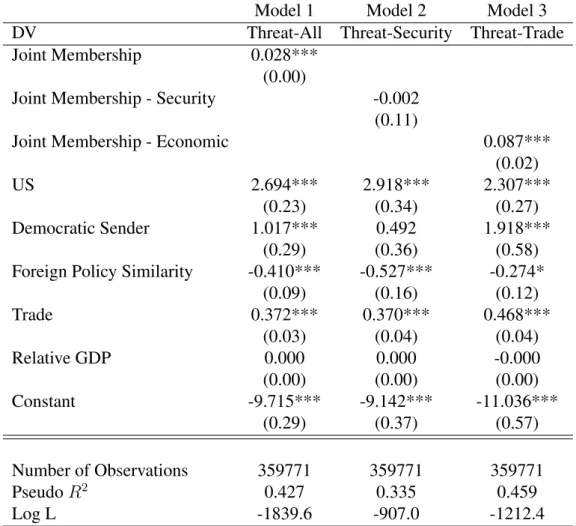
TABLE3: Logit: Threat of Sanctions, Joint Membership and Issue under Contention
Model 1 Model 2 Model 3
DV Threat-All Threat-Security Threat-Trade
Joint Membership 0.028***
(0.00)
Joint Membership - Security -0.002
(0.11)
Joint Membership - Economic 0.087***
(0.02)
US 2.694*** 2.918*** 2.307***
(0.23) (0.34) (0.27)
Democratic Sender 1.017*** 0.492 1.918***
(0.29) (0.36) (0.58)
Foreign Policy Similarity -0.410*** -0.527*** -0.274*
(0.09) (0.16) (0.12)
Trade 0.372*** 0.370*** 0.468***
(0.03) (0.04) (0.04)
Relative GDP 0.000 0.000 -0.000
(0.00) (0.00) (0.00)
Constant -9.715*** -9.142*** -11.036***
(0.29) (0.37) (0.57)
Number of Observations 359771 359771 359771
PseudoR2 0.427 0.335 0.459
Log L -1839.6 -907.0 -1212.4
***p <0.001,**p <0.01,*p <0.05 Standard errors in parentheses.
t,t2,t3are excluded from the table for simplicity
presented in Table 4.
The empirical findings confirm the first hypothesis and suggest that as the number of joint membership in a dyad increases, the likelihood of observing a sanction threat increases signif-icantly, at the 0.001 level. It can be suggested that senders prefer to threaten other states with sanctions that they share a high number of IGO memberships with, because they assume that such a connectedness will make the threat more credible and increase the probability that the threat will succeed.
The examination of the IGOs based on their relevancy to a given sanction threat reveals an interesting mechanism. The results suggest that the theoretical framework conceptualizing IGOs as a facilitator of the threat of sanctions hold only for IGOs with an economic mandate, but not for security IGOs. The last two models in Table 3 suggest that the facilitating impact of joint membership on the threat of sanctions works only for economic IGOs and security IGO has no impact on the sanction threats, where the issue under contention is security related. The analysis does not tell us whether security IGOs has a pacifying or a facilitating impact on the decision to threaten other states with sanction on security issue. It is important to think about the reasons why the results change when we match the IGOs with the threats that are relevant to their mandates.
Results for H2 - Imposition Stage of Sanctions
Table 4 presents the results testing the second hypothesis and its extensions. More specif-ically, Model 1 tests the relationship between joint membership on sanction impositions, by neither disaggregating the sanction type nor the mandate of IGOs. Model 2 tests the impact of interconnectedness through security IGOs on sanction episodes where the issue under con-tention is security-related. Model 3 explores the relationship between shared membership in economic IGOs and senders’ likelihood of imposing economy-related sanctions. Lastly, Model 4 presents the results of the model testing whether or not the impact of security IGOs is gener-alizable to all types of sanctions.
increases, the likelihood of sanction onset in that dyad decreases and states become less likely to resort to sanctions to change their targets’ behavior. However, the empirical results of the first model strongly suggest the otherwise. The main causal mechanism behind my expecta-tion on the pacifying role of joint IGO membership is the passive and active involvement of IGOs through information provision, deterrence of non-cooperative behavior and solving dis-putes through dispute settlement mechanisms that would otherwise lead to sanctions. However, the positive and statistically significant coefficient estimate reveals that highly interconnected dyads are indeed more likely to experience a sanction imposition.
Despite the lack of statistical support to my hypothesis, the causal mechanism that it is based upon should not be disregarded completely. The data used to measure the variableJoint Membership may not be a perfect measure to capture the extent to which states are intercon-nected through shared IGO memberships. Correlates of War Intergovernmental Organizations Dataset identifies 495 IGOs and most of the IGOs in the dataset are not necessarily related to sanction cases. They are neither structured to facilitate information flow nor to solve disputes among member states. Keeping those IGOs that have no capability to influence state decision is likely to have an impact on the results of the model.
It may wrong to assume that institutions such as the Asia-Pacific Institute for Broadcast-ing Development or International Commission for Air Navigation are influential in bilateral relations. They neither set requirements for their members to share information on the issues relevant to sanctions, nor are capable of solving issues under contention. Allowing them to be counted towards the measure of joint membership can generate misleading results. Therefore, a more fine-grained sample of IGOs can be a better measure to capture the causal mechanisms proposed by this study. That is indeed the motivation behind the second and the third model presented in Table 4. The next step is to analyze the results of the models differentiating IGOs based on their mandates and matching them with the relevant sanction cases.
for security-related issues. It also suggests that security institutions fulfill their reason d’etre, perform well in providing information, solving bargaining problems and settling disputes in security-related conflicts. Boehmer, Gartzke and Nordstrom (2004) find that security IGOs are more effective in promoting peace than those with non-security objectives and interests. This study proves that their findings on the militarized interstate disputes also hold for sanction impositions as an example of lower-intensity conflict.
TABLE4: Logit: Joint Membership, Sanction Onset and Issue Under Contention
Model 1 Model 2 Model 3 Model 4
DV Sanction-All Sanction-Security Sanction-Trade Sanction-All
Joint Membership 0.015**
(0.00)
Joint Membership-Security -0.234* 0.068
(0.12) (0.08)
Joint Membership-Economic 0.056**
(0.02)
US 1.888*** 2.344*** 1.728*** 1.769***
(0.23) (0.36) (0.27) (0.24)
Democratic Sender 0.602** 0.485 0.720* 0.665**
(0.23) (0.29) (0.34) (0.23)
Foreign Policy Similarity -0.380** -0.540** -0.023 -0.337**
(0.13) (0.20) (0.16) (0.12)
Trade 0.438*** 0.398*** 0.522*** 0.493***
(0.03) (0.04) (0.03) (0.03)
Relative GDP -0.000 -0.000 0.000 -0.000
(0.00) (0.00) (0.00) (0.00)
Constant -8.501*** -8.701*** -9.290*** -8.355***
(0.26) (0.32) (0.41) (0.25)
Number of Observations 359771 359771 359771 359771
PseudoR2 0.356 0.277 0.410 0.355
Log L -1951.3 -1008.3 -1164.7 -1955.5
***p <0.001,**p <0.01,*p <0.05 Standard errors in parentheses
t,t2,t3are excluded from the table for simplicity.
the opposite way as the security institutions do prior to sanctions. The results suggest that economic institutions have no pacifying effect on economic sanctions; moreover, they facilitate sanction imposition and make it more likely.
One of the reasons for this might be that high levels of connectedness through IGOs with an economic mandate imply a high level of trade-connectedness. States that share membership in IGOs are inherently more likely to interact. This interaction can be cooperative, but it can also be competitive and even violent. Following this logic, states that trade heavily with each other are more likely to join in the same set of institutions (Boehmer and Nordstrom 2008) and the intensity of trade ties among the members of a trade IGO increases the likelihood that an economic dispute will arise within the dyad. It may also be the case that states join into trade institutions as a remedy for already existing contentious issues and to create interdependencies that will pacify the existing contentious issues.
If this is the case, the results show that economic IGOs do not perform well in fulfilling this expectation. Furthermore, unlike the way that the security institutions perform, it does not seem like economic institutions are doing a good job in solving disputes through enforcement and effective dispute settlement mechanisms. Lastly, it can be argued that some trade institutions are highly asymmetrical and can increase direct competition between the member states, which in return increases the likelihood of trade disputes (Gilpin 1987).
Evaluating the results of the first model together with the coefficient estimates of Joint Membership - Securityand Joint Membership - Economyuncovers an interesting an dynamic about the influence of IGOs in bilateral relations. It seems like the positive coefficient onJoint Membership is likely to be driven by the trade related sanctions and IGOs with an economic mandate. The frequency of sanction impositions, where the issue under contention is trade-related and the IGOs with an economic mandate have a higher frequency than security-trade-related impositions and IGOs with a security mandate. It is evident that the pacifying effect of IGOs is limited to security institutions and economic disputes are not successfully handled by the economic IGOs.
first three models in Table 4. 23 It is important to note that the predicted probabilities are very small, given the rarity of sanction impositions in the sample; therefore it is more informative to focus on relative predicted probabilities, instead of the absolute magnitudes, and the trends revealed by the figures.
Figure 2 shows that a dyad with no joint membership in security institutions is 25% more likely to experience a sanction imposition than a dyad with one joint membership in security organizations. Interestingly, the impact of an each additional security IGO on the probability of sanction imposition is decreasing marginally and concavely. It makes sense, because each additional security IGO is not expected to facilitate unique information, but there will be a significant overlap in the information provided by each security institutions.
Figure 3 reveals an opposite pattern. It graphically shows that the increase in the number shared membership in economic institutions increase the probability of sanction onset. When we compare Figure 2 with Figure 3, it is proven that the marginal effect of an increase in the number of shared membership in economic IGOs is significantly less than the marginal effect of an increase in the number of shared membership in security IGOs.
Model 4 in Table 4 tests the third extension of the second hypothesis (H2(c)). The model examines the impact of joint membership in security institutions on the probability of sanction impositions, irrespective of the issue under contention. The model reveals that the findings about the pacifying effect of security IGOs are not generalizable to the sanctions that are beyond the mandate and expertise of security institutions. The pacifying effect of security IGOs found in the second model appears to be limited to the sanctions, where the issue under contention is security related. The results confirm my expectation about the centrality of relevancy to the effectiveness of IGOs in pacifying sanctioning behavior. The lack of significant coefficient estimate on the variableJoint Membership-Securityreveals that security IGOs have no impact on the probability of sanctions, other than the security-related ones.
Analyzing the Control Variables
Looking across the models in Table 3 and 4, most of the control variables perform as ex-pected and the differences across the models worth attention. First of all, it is important to note that all the control variables act the same way both in the models with threats as the dependent variable and sanctions as the dependent variable. In this paper, I evaluate the two stages as separate; however, I have found that they got affected by similar factors in a similar way, which strengthens the need for future work that conceptualizes the two stages as integral parts of the same process, instead of treating them separately.
Across all models, USvariable is positive and highly significant, which is in line with the conventional wisdom and the literature given the fact that the majority of sanction episodes are initiated by the US against a broad range of target countries. Despite the inclusion of low profile sanction cases in the TIES Data, the United States remains the most prolific user of sanctions. As stated above, 256 of 621 sanctions during the years 1950-2000 had been imposed by the United States. Some scholars present a domestic politics story and argue that American policymakers use sanctions as a way to display strong leadership during international crises (Whang 2011); whereas others focus on the country’s dominant market power and preferred use of sanctions to promote democracy and human rights abroad (Wallace 2013). However, the discussion of sanctions as an American foreign policy tool is out of the scope of this paper.
In line with the existing literature, the results confirm that democracies are more likely to use sanctions as a foreign policy tool. The literature exploring the reasons why present mixed findings. Some argue that the domestic and institutional constraints on democracies restricts the use of military power, therefore sanctions appear to be a viable option either to change target’s behavior or show discontent with policies of the target (Cox and Drury 2006). Others argue that sanctions are designed specifically to benefit some interest groups in the sender country, therefore democracies tend to impose sanctions more often as a response to the pressures coming from interest groups (Kaempfer and Lowenberg 2013). The variable for
The coefficient estimate of Foreign Policy Similarity is negative across all models, as ex-pected; however it does not attain statistical significance in the third model. This is interesting, because it indicates that having similar foreign policy interests does not necessarily imply that economic interests will also converge. It is evident that the level of affinity does not have an impact on the senders’ decision to impose trade-related sanctions. I think this finding also re-inforces the finding suggesting that the joint membership in economic IGOs does not decrease the probability of sanction imposition in that dyad.
The results forTradeare very similar across all models and as the volume of trade within the dyad increases, the probability of sanction onset increases, independent from the issue under contention. This finding is in contradiction with some of the previous literature indicating that states that are highly dependent on one another shy away from sanctioning, because the sanctions cause welfare losses not only in the target’s, but also in the sender’s economy. It is also a plausible explanation to suggest that higher levels of trade dependence create greater opportunities for friction between the sides. For instance, despite the fact that Canada is highly dependent on the US in terms of trade, Canada imposes sanctions on the US very frequently. It may also be the case that the reasons why states trade with one another are the same as the reasons why they share membership in IGOs.
Conclusion and Future Direction
This paper explores the extent to which intergovernmental organizations influence state decisions on sanctions. While many studies on IGOs analyze their influence in militarized in-terstate disputes, I aim to shift the attention towards lower levels of conflicts, which are more frequent than militarized disputes in the international system. I find that IGOs are facilitators of sanction threats; whereas they pacify sanctioning behavior at the imposition stage, conditional on the issue of the sanction and the mandates of IGOs. Interestingly, I find that the facilitator effect of IGOs is only present for trade-related IGOs on trade-related sanction and the pacifying effect of IGOs at the imposition stage is only present for IGOs with a security mandate on sanc-tions where the issue under contention is also security related. The findings on the pacifying effect of security IGOs is in line with the findings of Boehmer, Gartzke and Nordstrom (2004), where they show that not all IGOs, but IGOs with a security mandate promote peace among its members.
The results of this study also reveal the importance of having a closer look at and a more nuanced approach to IGOs. The literature has to move beyond a simple count of shared mem-bership as a measure of the level of connectedness between states and account for the variation among different IGOs. It may be the fact that it is almost impossible to come up with a single classification of IGOs that will be used for all studies on IGOs, however it is important for every study to come up with their own classifications based on the question that they are asking and the theory they propose. The same need is evident for the sanctions literature, too. Not all sanctions are the same and the underlying mechanisms of each sanction are different from another. Here, I propose a classification based on the issue under contention, following some of the existing literature on sanctions; but different typologies are also possible, depending on the question being asked.
facilitate credible information among the member states in order to render sanction imposi-tions unnecessary. The results show that economic IGOs should find ways to strengthen their information provision and dispute settlement mechanisms. The increase in the frequency of trade-related sanctions and the decrease in the frequency of security sanctions are also indica-tive of such a contrast between the institutions and the extent to which they succeed in pacifying relations among their member states.
One of the problems that this paper suffers from is its treatment of the threat stage and the imposition stage of sanctions separately. I acknowledge that it is a much better approach to conceptualize two stages as a part of the same process. This paper fails to account for the reasons why some sanction threats succeed and others fail and why some sanction cases move to the imposition stage; whereas others do not. Or, why are some sanction episodes initiated by an imposition without being preceded by threats? Those questions have to be addressed in future work in order to fully comprehend sanctioning behavior of states.
Another potential way to build on this paper is to go beyond the dyadic analysis and focus on the systemic level. One of the mechanisms with which IGOs influence decisions on sanctions is informational. Instead of looking at the information generated and facilitated by the IGOs in a given dyad, we can examine the information provided by the IGOs as well as international regimes to the international system as a whole. Periods of institutional stability and the domi-nance of an international regime can be evaluated as periods characterized by the availability of credible information; whereas institutional changes and international regime shifts can be seen as breaks in information flow. Therefore, the former should be associated with a decrease in the frequency of the sanctions; whereas the latter should necessitate more sanctions as a means to solve the disputes. The end of the Bretton Woods era, the GATT’s transformation to the WTO, the institutional changes during the European integration, the end of the Cold War, 9/11 and the 2008 financial crises can be identified as instances of breaks in informational flow. I think there is a room in literature to identify the patterns of sanctions and to theorize about the systemic reasons behind those patterns.
Appendix
List of IGOs with Security Mandate
1. Agency for the Prohibition of Nuclear Weapons in Latin America 2. ANZUS Council
3. Baltic Peacekeeping Battalion 4. Central Treaty Organization 5. Euro Atlantic Partnership Council 6. European Union
7. Far East Commission
8. Imperial Defense Committee
9. Inter-Allied Rhineland High Commission 10. Inter-American Defense Board
11. League of Arab States
12. Multinational Force and Observers 13. North Atlantic Treaty Organization 14. Organization for African Unity
15. Organization for Security and Cooperation in Europe 16. Southeast Asia Treaty Organization
Marginal Effects of Joint Membership on Sanction Imposition
0
.001
.002
.003
.004
Pr(Impose)
0 15 30 45 60 75 90 105
Shared_Membership
Predictive Margins with 95% CIs
FIG. 1: Marginal Effects of Joint Membership on Sanction Impositions
0
.0002
.0004
.0006
Pr(Impose_Sec)
0 1 2 3 4 5
Shared_Membership_Security
Predictive Margins with 95% CIs
0
.001
.002
.003
Pr(Impose_Nonsec)
0 3 6 9 12 15 18 21 24 27 30
Shared_Membership_Economy
Predictive Margins with 95% CIs
REFERENCES
Allen, Susan H. 2005. “The Determinants of Economic Sanctions Success and Failure.” Inter-national Interactions31(2):117–138.
Bapat, Navin A, Yoshiharu Kobayashi, Tobias Heinrich and T. Clifton Morgan. 2013. “De-terminants of Sanction Effectiveness: Sensitivity Analysis Using New Data.”International Interactions39(1):79–98.
Bapat, Navin and Clifton Morgan. 2009. “Multilateral versus Unilateral Sanctions Reconsid-ered: A Test Using New Data.”International Studies Quarterly53(7):1075–1094.
Bearce, David H. Sawa Omori. 2005. “How Do Commercial Institutions Promote Peace?”
Journal of Peace Research42(6):659–678.
Bearce, David H. and Stacy Bondanella. 2007. “Intergovernmental Organizations, Socialization and Member-State Interest Convergence.”International Organization61(4):703–733.
Beck, Nathaniel, Jonathan N Katz and Richard Tucker. 2013. “Taking time seriously: Time-series-cross-section Analysis with a Binary Dependent Variable.”American Journal of Polit-ical Science42(4):1260–1288.
Boehmer, Charles, Eric Gartzke and Timothy Nordstrom. 2004. “Do Intergovernmental Orga-nizations Provide Peace?”World Politics57(1):1–38.
Boehmer, Charles and Timothy Nordstrom. 2008. “Intergovernmental Organization Member-ships: Examining Political Community and the Attributes of International Organizations.”
International Interactions34(2):282–309.
Bolks, Sean M and Dina Al-Sowayel. 2000. “How Long Do Economic Sanctions Last? Exam-ining the Sanctioning Process through Duration.”Political Research Quarterly 53(2):241– 265.
Cao, Xun. 2009. “Network of Intergovernmental Organizations and Convergence in Domestic Economic Policies.”International Studies Quarterly53(4):1095–1130.