EFFECT OF MINOR SNPs ON ENZYMATIC ACTIVITY REGULATED BY COMMON HUMAN HAPLOTYPES OF THE CATECHOL-O-METHYLTRANSFERASE GENE
by
Jason E. Lambert, DDS
A thesis submitted to the faculty of the University of North Carolina at Chapel Hill in partial fulfillment of the requirement for the degree of Master of Science in the School of Dentistry.
Chapel Hill 2007
Approved by:
ABSTRACT
Jason E Lambert DDS
Effect of Minor SNPs on Enzymatic Activity Regulated by Common Human Haplotypes of the Catechol-O-methyltransferase Gene
(Under the direction of Dr. Luda Diatchenko, Dr. Linda Levin, Dr. William Maixner, Dr. Andrea Nackley Neely, Dr. Timothy Wright)
ACKNOWLEDGMENTS
This work was funded by the NIH/NICHHD K12 MCRCD HD052191 to AG Neely. and NIH/NIDCR R01 DE016558 awarded to L. Diatchenko.
I would like to take this opportunity to recognize:
Dr. Linda Levin for her knowledge, guidance and friendship at all levels of my dental education. I will always be grateful for the opportunities she provided to me as a dental student to help me become a part of the endodontic profession and community.
Dr. Andrea Neely for her tireless spirit, kind encouragement and thorough knowledge. Dr. Luda Diatchenko for her vast knowledge – and always making time to share it. Dr. William Maixner for his reassurance, guidance and insight during my time at UNC. Dr. Timothy Wright for his knowledge and wit, which always made learning a fun experience.
Dr. Martin Trope for his unmatched vision and enthusiasm. I am grateful for his support throughout my residency.
Dustin Gibson and Matt Conrad for their many helpful efforts in the lab. Ching and Jose-Luis for their support and friendship throughout our residency. My fellow residents – my colleagues and friends.
My family for their support and encouragement to achieve my goals.
TABLE OF CONTENTS
Page
LIST OF FIGURES……….vii
LIST OF ABBREVIATIONS………viii
I. INTRODUCTION A. Pain as a Protective Mechanism………...9
B. Idiopathic Pain Disorders………..….10
i. Mechanisms Contributing to IPDs……….11
ii. Pain Amplification as a Determinant of IPD Onset and Persistence…….12
iii. Psychological Distress as a Determinant of IPD Onset and Persistence...13
iv. Genetic and Environmental Contribution to Pain Amplification and Psychosocial Distress………...14
1. Genetics………..15
2. Environment………...16
C. Temporomandibular Joint Disorder ………..…17
i. Pain Amplification in TMJD Patients………17
ii. Psychosocial Distress in TMJD Patients………18
iii. Genetic Variants of COMT Associated with Pain Perception and TMJD.19 1. A Role for COMT in the Modulating Pain………20
2. Genetic Variants of COMT ………....…...21
b. Haplotypes……….22
c. COMT Haplotypes Associated with TMJD Onset………22
D. Catechol-O-Methyltransferase………...22
i. The COMT Gene and Protein………22
1. One Gene, Two Proteins………22
2. COMT Polymorphisms………..24
3. A Nonsynonymous Polymorphism Affects COMT Activity…....25
ii. COMT Polymorphisms Associated with Disease Phenotypes…………..26
iii. COMT Polymorphisms Associated with Pain Sensitivity……….27
1. Val158Met and Pain………27
2. Haplotypes and Pain………..27
a. Haplotypes and val158met Differentially Influence Pain Perception………..28
i. Resting Nociceptive Sensitivity……….29
ii. Temporal Integration of Pain……….30
3. Mechanisms of COMT Haplotypes………...30
a. mRNA Secondary Structures……….30
b. Thermostability………..33
II. PURPOSE OF THE PRESENT STUDY………..35
i. Minor COMT SNPs………...36
ii. Potential Functional Effects of Minor SNPs on Existing Haplotypes……….37
2. SNP rs6267………37
3. SNPs rs740602 and rs769224………....39
iii. Summary………39
III. MATERIALS AND METHODS………...40
A. Confirmation of COMT Variants………...40
B. Transient Transfection of COMT cDNA Clones………...40
C. Enzymatic Assay………40
D. Western Blot………..41
E. Real-Time PCR………..41
IV. RESULTS………..43
A. COMT RNA Abundance………43
B. COMT Protein Expression……….44
C. COMT Enzymatic Activity………45
V. DISCUSSION………46
VI. CONCLUSION……….49
VII. SUMMARY……….50
LIST OF FIGURES
Figure
1. COMT Gene Locus………..…….………...………24
2. Summary of Haplotypic Analysis from Diatchenko (2005)………...29
3. Local mRNA 2º Structures of COMT Haplotypes………..….…33
4. SNPs of COMT Haplotypes…………...………..………37
5. SNP rs8192488………37
6. COMT enzymatic activity associated with Codons 72 and 158, Lee (2005)..38
7. COMT RNA abundance………...43
8. COMT protein level……….44
9. COMT enzymatic activity………45
LIST OF ABBREVIATIONS
APS Average Pain Sensitivity
βAR Beta Adrenergic Receptor
CNS Central Nervous System COMT Catechol-O-methyltransferase EST Expressed Sequence Tag IPD Idiopathic Pain Disorder HPS High Pain Sensitivity
LD Linkage Disequilibrium
LPS Low Pain Sensitivity
QRT-PCR Quantitative Real-Time Polymerase Chain Reaction
SAM S-Adenosyl Methionine
SNP Single Nucleotide Polymorphism TMJD Temporomandibular Joint Disorder UTR Untranslated Regions
INTRODUCTION
PAIN AS A PROTECTIVE MECHANISM
Pain is defined as “an unpleasant sensory and emotional experience associated with actual or potential tissue damage, or described in terms of such damage” (Merskey, 1994). Pain perception occurs before tissue damage begins, thus serving as a protective mechanism. It helps the individual avoid dangerous situations by moving away from noxious stimuli, so as to not experience the unpleasant sensation.For example, classic experiments have shown that the threshold for thermal pain corresponds to the temperature at which tissue damage begins (Hardy et al., 1952).
Pain also promotes the healing process through prompting the individual to recognize the injury and protect the area from further damage, thereby minimizing the experience of more pain. Congenital insensitivity to pain is a medical condition in which persons are born without the ability to perceive pain (Nagasako et al., 2003). This condition gives compelling evidence that pain is critical for the protection and survival of an individual. During
Pain has sensory-discriminative and affective-motivational components that are processed in multiple distinct cortical regions of the brain (Treede et al., 1999). The sensory-discriminative component can be considered a sensory modality similar to taste or vision, giving information such as stimulus location, intensity and quality discrimination. The affective-motivational portion accounts for the emotional reaction to pain, which is subjective and depends upon arousal level and behavior programming. The typical unpleasantness or ‘suffering from pain’ provides motivation to remove oneself from the stimulus. Above all else, the overriding evolutionary reason for the existence of pain is to aid in the survival of the individual.
IDIOPATHIC PAIN DISORDERS
Pain has a definite protective role that benefits the individual, but in conditions where chronic pain persists in the absence of a noxious stimulus, pain becomes the disease itself. Complex medical conditions referred to as idiopathic pain disorders (IPDs) share a common trait wherein the patient reports a pain level that is greater than would be expected by a physical examination (Diatchenko et al., 2006c). Such examples of IPDs include temporomandibular joint disorder (TMJD), fibromyalgia syndrome, irritable bowel
syndrome, chronic headaches, chronic pelvic pain, chronic tinnitus, and whiplash-associated disorders.
pain. Currently, there is an incomplete understanding of the pathophysiology of the nature of chronic pain conditions.
All IPD patients do not exhibit the same pattern of altered function in pain amplification or psychological distress. It is therefore plausible that the phenotypes associated with IPDs are the result of multiple genes interacting with each other under the influence of the environment. The subclassification of IPDs based on the specific network of genetic variations in each individual will allow better and more informed individual-based treatments.
Mechanisms Contributing to IPDs
Chronic pain results from the dysfunction or dysregulation of normal pain
mechanisms and pathways. Melzack (Melzack, 1999) proposed a mechanism by which pain persists in the absence of tissue damage. The theory states that neural pathways link multiple regions of the brain responsible for integrating inputs and creating a pattern-generating process that is distinct from the environment and perception of pain. These activity patterns are determined genetically and modified by sensory and pathologic inputs, activity from the endocrine, immune, and autonomic systems, medullary descending activity, CNS plasticity, attention, and cognitive and emotional states. Therefore, any factor within this matrix can bring about a change in pain transmission or modulation, which will have consequences in pain perception and behavior. It was proposed that certain alterations of the pathways within the matrix have the ability to bring about the onset of chronic pain.
risk of developing an IPD in individuals with enhanced pain amplification (Sarlani and Greenspan, 2003; Verne and Price, 2002; Von Korff et al., 1988) and persons with higher levels of psychological distress (McBeth et al., 2001). Diatchenko and colleagues
(Diatchenko et al., 2006c) suggested that these two factors represent distinct primary pathways through which IPDs may develop. Exposure to environmental elements may initiate or further accentuate disturbances in pain perception or psychosocial disposition, which is ultimately determined at the genetic level. When an individual has both enhanced pain sensitivity and higher levels of distress, then the vulnerability to developing an IPD is synergistically compounded.
Pain Amplification as a Determinant of IPD Onset and Persistence
The most consistent predictor of developing a chronic pain disorder is the presence of another chronic pain condition(Von Korff et al., 1988); thus, factors that influence pain sensitivity may contribute to the development of a variety of chronic pain conditions.
response to otherwise non-noxious stimuli, may result from prolonged exposure to any number of inflammatory mediators (Levine and Taiwo, 1994).
Pain amplification can also result from the dysregulation within any portion of the afferent neural pathway. Normally, the descending neural inhibitory control releases endogenous opioids to attenuate nociceptive signals before reaching the cortical level of brain (Gebhart, 2004) . When functioning abnormally, however, the descending neural inhibitory control can be switched off , which would act to increase pain sensitivity (Vanegas and Schaible, 2004).
Pain regulatory systems within the CNS may be affected by the carotid sinus baroreceptors activation (Dworkin et al., 1994) as exemplified in the relationship between resting arterial blood pressure and pain threshold. Maixner (Maixner et al., 1997) found an association between blood pressure and pain threshold in healthy, pain-free subjects, but a similar relationship was not present in patients with an IPD. This result is consistent with the view that IPDs are associated with an impaired pain regulatory system.
It has also been reported that the presence of widespread, as opposed to localized, pain in individuals with an IPD is an indicator for a poorer treatment response, and
consequently morbidity of longer duration (Raphael and Marbach, 2001). Taken as a whole, individuals with a high state of pain amplification have a greater propensity to develop an IPD.
Psychological Distress as a Determinant of IPD Onset and Persistence
more likely to seek medical care (Kersh et al., 2001). Somatization, the general tendency to perceive and endorse physical symptoms, is another major psychosocial risk factor for developing chronic widespread pain in IPD patients (McBeth et al., 2001; Wilson et al., 1994). Widespread pain, as discussed in the previous section, has been implicated as an indicator for poorer treatment prognosis in IPD patients. It was not only associated with poorer treatment outcomes in a five-year study (Ohrbach and Dworkin, 1998), but patients actually had increased pain following treatment (McCreary et al., 1992). Somatization was also found to be predictive for pain progressing from an acute state to a chronic state
(Garofalo et al., 1998). Higher levels of psychological distress manifest through the complex interaction of genetic and environmental factors to influence the vulnerability of an
individual to developing an IPD. Among these, depression, anxiety, stress and somatization are the most recognized traits.
Genetic and Environmental Contribution to Pain Amplification and
Psychosocial Distress
individual variability in gene expression and resulting biochemical interactions suggests a myriad of possible interactions at multiple levels of gene regulation and protein activity. The current theory states that an individual is at risk for developing an IPD when environmental events cause injury or stress of a particular level to an individual with a predisposed
phenotype (Diatchenko et al., 2006c).
Genetics. The degree of genetic influence on nociception and analgesic sensitivity is unknown, but has been estimated in mice to fall within a range of 28 to 76% (Mogil, 1999). Singe-gene pain disorders that follow Mendelian inheritance patterns exist but are extremely rare. The best known example is the group of single genetic mutations of the NTRK1 gene that result in congenial insensitivity to pain (Mogil and Max, 2004), discussed previously. The NTRK1 gene codes for a receptor for nerve growth factor (NGF), which induces neuronal growth and promotes survival of embryonic sensory and sympathetic neurons.
However, most pain disorders are multifactorial. Given the complex nature of the IPD phenotypes, a single mutation is neither sufficient nor necessary for developing the IPD phenotype. Instead, these genetic factors are highly prevalent polymorphic genes. It has been reported that polymophisms of specific genes involved in pain pathways can be associated with behavior-level variability (Mogil et al., 2003; Zubieta et al., 2003).
In terms of psychosocial traits, it is established that genetic factors are significantly involved. Specifically, there is an estimated 40% to 70% heritability of unipolar depression (Lesch, 2004), while evidence from twin studies suggest that 30% to 50% of risk of
A list of genes previously associated with both enhanced pain sensitivity and high levels of psychosocial distress, while not intended to be exhaustive, is used here to demonstrate the diverse genetic field that contributes to pain perception: catechol-O -methyltransferase (COMT) (Diatchenko et al., 2005), adrenergic receptor β2 (ADRB2)
(Diatchenko et al., 2006a), serotonin transporter (Gordon and Hen, 2004) , D2 dopamine receptor (Lawford et al., 2003), and interleukins 1 α and β (Yu et al., 2003).
A prospective-longitudinal study by Caspi and colleagues (Caspi et al., 2003) was the first to report that an individual's response to environmental events is controlled by genetics. A specific alteration present in the serotonin transporter gene was found to
moderate the influence of stressful life events on depression, leading to a higher prevalence of depression and suicide.
TEMPOROMANDIBULAR JOINT DISORDER
Painful temporomandibular joint disorder (TMJD) is a common IPD and the most common chronic orofacial pain condition (Dworkin and LeResche, 1992). Myogenous TMJD is the most common form and is associated with persistent pain in the temporomandibular joint, the area around the ear, and the muscles of the head and neck that can lead to impaired oral function (Von Korff et al., 1993). The estimated prevalence within the United States is approximately 12% of the adult population, with a female-to-male ratio of 8:1. Females of reproductive age represent the largest portion of the afflicted (Dworkin et al., 1990). The estimated health costs of TMJD is one billion dollars per year. TMJD is a complex disorder that is induced and influenced by environmental events and multiple genetic variants. Given the nature of this complex disorder, twin and familial studies would require many thousands of cases in order to determine the heritability (Risch, 2000). To date, studies designed to identify and characterize polymorphisms in specific genes that are associated with pain processing and risk of myogenous TMJD development have been successfully employed (Diatchenko et al., 2005; Diatchenko et al., 2006a; Herken et al., 2001). TMJD onset and persistence is associated with a heightened state of pain amplification and psychosocial traits.
Pain Amplification in TMJD Patients
that sufferers have a lower pain threshold to pressure on both the more-painful and less-painful sides of their faces. This was confirmed by Maixner (Maixner et al., 1998). It was found that TMJD patients have reduced experimentally-induced pressure pain thresholds at both painful and pain-free sites across the body as compared to normal subjects. It has further been reported that TMJD patients also have diminished pain tolerance to thermal and
ischemic noxious stimuli (Maixner et al., 1995; Maixner et al., 1998). The conclusions suggest that TMJD arises due to imbalances in the pain transmitting and regulatory
pathways. Kashima and colleagues (Kashima et al., 1999) tested the ischemic pain threshold and tolerance of female TMJD patients and healthy control subjects. They too concluded that individuals with TMJD have increased pain sensitivity at remote sites, and suggested that endogenous opioid systems are impaired in TMJD patients.
An additional finding of Maixner (Maixner et al., 1998) was that TMJD patients were more sensitive to repeated applications of heat pulses applied to various skin sites than control subjects, but that TMJD patients exhibited no difference in their ability to discriminate small increments of noxious heat. The test whereby perceived thermal pain intensity is measured when a constant-intensity noxious stimulus is delivered repeatedly is a test of temporal summation of pain. This process of pain is mediated by the CNS, with a resulting increase in excitability of the CNS nociceptors (Price et al., 1977). Increased local and global pain sensitivity as well as increased sensitivity to temporal summation of pain in TMJD patients suggests that TMJD pain has a centrally mediated component.
Psychosocial Distress in TMJD Patients
were the first to report the personality profiles of orofacial pain patients. Each noted that patients had high levels of anxiety and stress. Since then, multiple studies have confirmed these findings as TMJD patients score significantly higher on tests for depression (Bassett et al., 1990), anxiety (Carlson et al., 1993; Goss et al., 1990), somatization (Wilson et al., 1994), anger (Herken et al., 2001), and perceived stress (Beaton et al., 1991) as compared to control subjects. In addition to anxiety, Vassend (Vassend et al., 1995) reported that general somatic complaints are also key predictors for future TMJD pain, response to treatment, and persistence. TMJD patients with somatization are less likely to experience relief following treatment (McCreary et al., 1992) and more likely to have widespread painful areas (Wilson et al., 1994). A five-year TMJD outcome study reported that clinical signs were poor
predictors of pain while somatization was closely related to pain improvement. Only those patients who exhibited significant psychosocial improvement were represented in the group with the greatest relief of TMJD facial pain (Ohrbach and Dworkin, 1998). Similarly, TMJD patients with an adaptive coping profile improved significantly relative to those with a dysfunctional coping profile (Epker and Gatchel, 2000).
Genetic Variants of COMT Associated with Pain Perception and TMJD
TMJD has been associated with variants of genes previously implicated in
modulating pain perception. Of these, catechol-O-methyltransferase (COMT), a key enzyme that metabolizes epinephrine, norepinephrine, and other catecholamines, is the primary focus here. Genetic variants of COMT affect the normal mechanism by which epinephrine is physiologically modulated.
influence pain perception (Levine et al., 1988). In fact, persistent pain states are possible to induce experimentally by elevating levels of epinephrine, whereby the increased
bioavailability of epinephrine stimulates βARs, leading to the increased pain (Coderre et al., 1990). Furthermore, epinephrine sensitizes bradykinin receptors, which have been implicated in contributing to IPDs (Khasar et al., 2003).
A Role for COMT in the Modulating Pain. The first evidence
suggesting that altered catecholamine metabolism was associated with a painful facial condition similar to TMJD was reported by Marbach and Levitt (Marbach and Levitt, 1976). This study showed that pain patients had higher urinary levels of catecholamine metabolites with concomitant lower enzymatic activity of COMT. Given the significant evidence inversely relating COMT activity to pain sensitivity (Diatchenko et al., 2005), a series of experiments by Nackley and colleagues (Nackley et al., 2006b) sought to elucidate the method by which such elevated catecholamine levels lead to heightened response to noxious stimuli. In order to identify this pathway, rats were injected with COMT inhibitor to produce a high levels of epinephrine and norepinephrine, which quickly leads to significant
hyperalgesia (Diatchenko et al., 2005). Testing to mechanical and thermal stimuli confirmed a significant increase in sensitivity. This effect was blocked by either propranolol, a
nonselective beta-adrenergic receptor (βAR) antagonist, or the combined use of selective β2-
and β3-AR antagonists. Thus, through the use of an animal model designed to produce
persistent pain states similar to those in humans suffering from TMJD or fibromyalgia, COMT-dependent pain sensitivity was found to be derived through β2/3-AR signaling
adrenergic system. Additionally, polymorphisms of β2AR have been associated with
increased vulnerability to TMJD (Diatchenko et al., 2006a).
Genetic variants of COMT. Genetic variants of COMT are known to impact the two main pathways of IPD development in human: amplified pain experience (Rakvag et al., 2005; Zubieta et al., 2003) and psychosocial distress (Funke et al., 2005). It is necessary here to specifically discuss the broad aspect of these genetic variants in more detail along with their modes of impact as a basis for the next chapter.
Single Nucleotide Polymorphisms.Single nucleotide polymorphisms (SNPs) are
common variations in the DNA sequence whereby one nucleotide differs between paired chromosomes within an individual or between members of the same species (Stephan and Glueck, 2002). SNPs that impact the gene expression or protein functionality are termed functional. These can occur in either the coding or the non-coding portion of the gene. This functionality may be deleterious, neutral or beneficial to the individual.
Haplotypes.Haplotypes, which are collections of SNPs, have been shown to explain functional outcomes better than individual SNPs (Davidson, 2000). Determining the
functionality of synonymous and non-coding SNPs can be difficult and often times
confounded as linkage disequilibrium, or the likelihood of two SNPs being inherited together due to proximity within the DNA sequence, increases. Tactics such as analyzing groups of SNPs through haplotypic analysis has been successfully used to resolve such regulatory SNPs (Knight, 2005). Furthermore, with direct respect to COMT, combinations of
synonymous and nonsynonymous SNPs are known to have functional consequences that are different from those expected by the sum of each functional allele’s individual contribution to predict COMT activity (Diatchenko et al., 2005).
COMT haplotypes associated with TMJD onset. Recently, a
prospective study reported that COMT haplotypes based on subjects’ pain sensitivity were associated with TMJD. The study followed 202 healthy females over three years and found that a specific COMT haplotype was associated with increased pain sensitivity and risk for developing TMJD (Diatchenko et al., 2005). This study is discussed in greater detail in the following chapter.
CATECHOL-
O
-METHYLTRANSFERASE
The COMT Gene and Protein
COMT are the catecholamines epinephrine, norepinephrine and dopamine, which are hormones and neurotransmitters derived from tyrosine. COMT also metabolizes
catecholestrogens, catechol-containing flavonoids, ascorbic acid and L-dopa (Mannisto and Kaakkola, 1999). Degradation begins with COMT transferring a methyl group donated by S-adenosyl methionine (SAM) to the catechol. The liver contributes the highest level of enzymatic activity, but COMT is found in all human tissues (Mannisto et al., 1992).
One gene, two proteins. A single gene (Fig. 1) found on human chromosome 22 codes for two protein isoforms: soluble COMT (S-COMT) and membrane-bound COMT (MB-COMT) (Grossman et al., 1992). Two distinct promoters are responsible for transcribing the two proteins (Lundstrom et al., 1991). S-COMT is comprised of 221 amino acids. MB-COMT contains an additional 50 amino acids, some of which anchor the molecule to the cytoplasmic face of intracellular membranes (Mannisto and Kaakkola, 1999). S-COMT is the dominant form expressed in the periphery; moderate to high concentrations are present in the liver, kidney, spleen, and adrenal gland (Tenhunen et al., 1994). MB-COMT is the exclusive form expressed in the central nervous system (CNS), where
The kinetic properties of S-COMT and MB-COMT vary greatly and are dependent upon the substrate. For example, MB-COMT is found within interstitial neurons postsynaptic to dopaminerigic neurons, where relatively low concentrations of dopamine occur. MB-COMT is better suited for this condition since it has higher affinity for dopamine at this concentration (Rivett et al., 1983). S-COMT is found mostly in glial cells outside of the CNS and is present in greater abundance than MB-COMT by a factor of at least 3 (Tenhunen et al., 1994). In the periphery, dopamine concentration is greater, which matches the enzymatic profile of S-COMT. The high-capacity nature of S-COMT compensates for the lower affinity for dopamine of S-COMT as compared to MB-COMT (Malherbe et al., 1992).
Differences in COMT activity have been reported among ethnic groups (Ameyaw et al., 2000; McLeod et al., 1998). For example, Caucasians have relatively lower COMT activity as compared to Orientals (Rivera-Calimlim and Reilly, 1984) and African-Americans (McLeod et al., 1994). Differences also exist between genders, where females have a 20 to 30% lower COMT activity than males (Boudikova et al., 1990).
COMT polymorphisms. There are over 120 SNPs in the COMT gene as detailed by the National Center for Biotechnology Information (NCBI) database
5´ 3´
S-COMT promoter MB-COMT promoter
(http://www.ncbi.nlm.nih.gov/SNP/snp_ref.cgi?locusId=1312&chooseRs=all). Eleven SNPs have a minor allele frequency of at least 35%, with seven more having at least a 3% minor allele frequency. The most commonly researched SNP, designated rs4680, is
nonsynonymous and occurs at codon 158 of MB-COMT. Here a transition of guanine (G) to adenine (A) results in an amino acid change from valine (val) to methionine (met) (Lotta et al., 1995). Palmatier (Palmatier et al., 1999) reported that valine is the ancestral allele in humans. The study also reported the allelic frequencies of this SNP as genotyped from some 1,300 individuals representing 30 world-wide populations. Ethnic differences were distinct, with individuals of European ancestry having nearly equal frequencies of the two alleles. All other populations had a much lower prevelance of methionine. Recent studies have
associated the presence of the met158substitution with variations in pain perception (Zubieta et al., 2003) and psychosocial traits such as anxiety (Enoch et al., 2003) and panic disorders (Domschke et al., 2004).
A nonsynonymous polymorphism Affects COMT Activity.
MB-COMT (Lachman et al., 1996b; Lotta et al., 1995). The met158substitutionis associated with the lower thermostability and resulting decreased enzymatic activity.
COMT Polymorphisms Associated with Disease Phenotypes
COMT has been implicated in regulating dopamine and norepinephrine levels in the brain, which have an effect on mood and cognitive abilities (Weinberger et al., 2001) as well as Parkinson’s (Kunugi et al., 1997; Yoritaka et al., 1997) and Alzheimer’s (Zhu, 2002) diseases. Velocardiofacial syndrome (VCFS) is a genetic disorder that is associated with the deletion of a portion of chromosome 22q11, including the region containing the COMT gene. Patients inflicted with VCFS have increased prevalence of psychosis (Murphy et al., 1999) and schizophrenia (Lachman et al., 1996a).
Numerous studies have reported modest associations between the val158met
substitution and various complex phenotypes including schizophrenia (Egan et al., 2001), late-onset alcoholism (Tiihonen et al., 1999), fibromalgia syndrome (Gursoy et al., 2003), obsessive-compulsive disorder (Karayiorgou et al., 1997), anorexia nervosa (Frisch et al., 2001), and cognitive function (Egan et al., 2001; Gallinat et al., 2003; Winterer et al., 2006). However, numerous studies also exist that report no association between the met allele and disease phenotype: schizophrenia (Lee et al., 2005; Munafo et al., 2005) and obsessive-compulsive disorder (Azzam and Mathews, 2003) are examples.
detected when both minor alleles at codons 72 and 158 were present as compared to the presence of each individually. This study is further discussed later in this chapter.
COMT Polymorphisms Associated with Pain Sensitivity
Studies have found that a sustained increase in catecholamine levels has been associated with chronic musculoskeletal pain conditions such as fibromyalgia syndrome (Torpy et al., 2000) and myofascial pain condition (Evaskus and Laskin, 1972). Experimental trial evidence implicates catecholamines levels in modulating pain sensitivity (Bie et al., 2003). An experimentally-induced decrease in available COMT, via an inhibitor, heightens pain sensitivity in rats comparable to that achieved with carrageenan (Diatchenko et al., 2005), a well-characterized nociceptor-sensitizing chemical (Hedo et al., 1999).
Val158Met and Pain. Conflicting clinical data exist regarding whether the val158met substitution has a significant effect on pain sensitivity. Zubieta (Zubieta et al., 2003) reported that subjects homozygous for the met158 allele had great pain responsiveness. In contrast, Kim (Kim et al., 2004) found that gender, ethnicity, a polymorphism in an opioid receptor gene, and temperament all have effects on pain sensitivity, but failed to identify the met158 allele as a contributing risk factor. Rakvåg (Rakvag et al., 2005) reported that cancer patients with the Val/Val genotype at codon 158 used more morphine as compared to the Val/Met and Met/Met groups. There is not a definitive relationship between pain sensitivity and val158met.
Haplotypes and pain. Diatchenko and colleagues demonstrated that three common haplotypes of the human COMT gene account for pain perception and the likelihood of developing TMJD (Diatchenko et al., 2005). Data were collected from 202 healthy
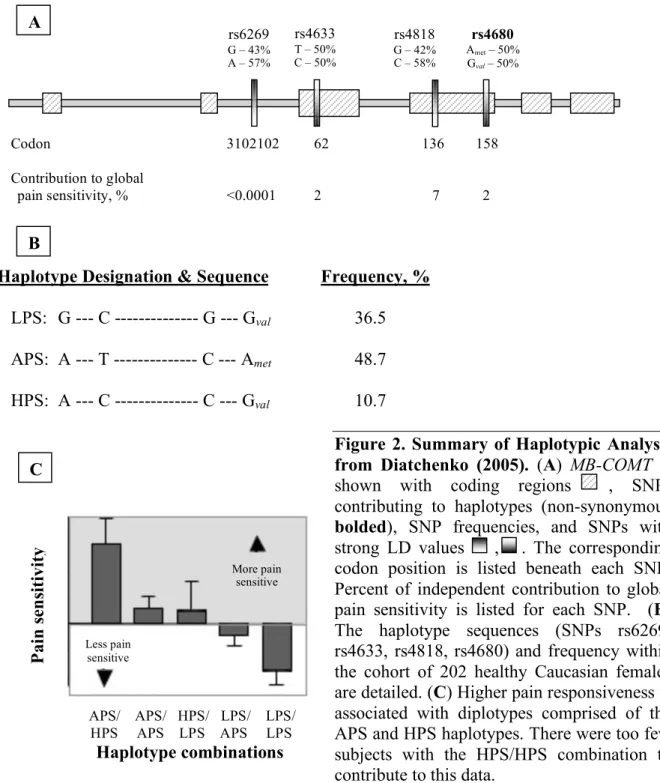
genotyped for SNPs within the COMT gene locus. Six SNPs with at least a 40% prevalence of polymorphism within humans were genotyped. Linkage disequilibrium (LD) analysis determined three haploblocks within the COMT gene, consistent with previous LD analyses (Li et al., 2000; Shifman et al., 2002). Three major haplotypes, which accounted for 95.9% of all detected haplotypes, were formed by four SNPs: one located in the S-COMT promoter region (A/G; rs6269) and three in the S- and MB-COMT coding region at codons His62His (C/T; rs4633), Leu136Leu (C/G; rs4818), and Val158Met (A/G; rs4680). Strong LD
associations exist between SNPs rs6269 and rs4818 (D′= 0.94, R2= 0.88) and SNPs rs4633 and 4680 (D′= 0.96, R2= 0.91).
Subjects homozygous for the GCGG haplotype had the lowest pain sensitivity (LPS), homozygous for the ATCA haplotype had average pain sensitivity (APS), and heterozygous for ATCA and ACCG haplotypes had the highest pain sensitivity (HPS; = ACCG haplotype). Each haplotype effected pain sensitivity (P<0.01) and accounted for ~11% of the variation in pain sensitivity. APS and HPS haplotypes were associated with high pain sensitivity and increased TMJD risk (Fig. 2).
Haplotypes and val158met differentially influence pain
Codon 3102102 62 136 158
Contribution to global
pain sensitivity, % <0.0001 2 7 2
Haplotype Designation & Sequence Frequency, %
LPS: G --- C --- G --- Gval 36.5
APS: A --- T --- C --- Amet 48.7
HPS: A --- C --- C --- Gval 10.7
Figure 2. Summary of Haplotypic Analysis
from Diatchenko (2005). (A) MB-COMT is shown with coding regions , SNPs
contributing to haplotypes (non-synonymous
bolded), SNP frequencies, and SNPs with strong LD values , . The corresponding codon position is listed beneath each SNP. Percent of independent contribution to global pain sensitivity is listed for each SNP. (B) The haplotype sequences (SNPs rs6269, rs4633, rs4818, rs4680) and frequency within the cohort of 202 healthy Caucasian females are detailed. (C) Higher pain responsiveness is associated with diplotypes comprised of the APS and HPS haplotypes. There were too few subjects with the HPS/HPS combination to contribute to this data.
modalites: pressure, thermal, and ischemic pain and thermal temporal summation (Diatchenko et al., 2006b)
Resting nociceptive sensitivity.Thermal pain stimuli was the only stimuli
significantly related to COMT haplotypes and diplotypes. Individuals with the APS/HPS
rs6269
G – 43% A – 57%
rs4633
T – 50% C – 50%
rs4818
G – 42% C – 58%
rs4680
Amet – 50% Gval – 50%
A B C P ai n s en si ti vi ty
APS/ APS/ HPS/ LPS/ LPS/ HPS APS LPS APS LPS
Haplotype combinations
More pain sensitive
diplotype were the most responsive to painful thermal stimuli, while individuals with the LPS/LPS diplotype were the least responsive. There were too few HPS/HPS individuals to include in the analysis. Neither mechanical nor ischemic pain were found to be significantly related to diplotype. As previously shown, the val158met SNP rs4680 could not be used to explain the observed differences in resting nociceptive sensitivity.
Temporal integration of pain.Although the mean responses to repeated application of heat pulses were related to diplotypes, the rate of temporal summation was not. The rate was significantly associated with the val158met polymorphism. Individuals homozygous for met158 had steeper pain response rates as compared to val/val homozygous individuals, strongly suggesting that SNP rs4680 accounts for variability in temporal summation of thermal pain. Therefore, the val158met allele can explain the differences in pain sensitivity experienced between individuals with the APS versus LPS haplotype. This conclusion is supported by Zubieta (Zubieta et al., 2003), who reported an association between prolonged experimentally-induced muscle pain sensitivity and the met158 polymorphism. COMT
haplotypes were not associated with the CNS-mediated pain process of temporal summation.
Mechanisms of COMT Haplotypes
mRNA secondary structures. Interestingly, both LPS and HPS haplotypes code for identical amino acid sequences, yet are associated with the greatest difference in pain responsiveness. Since both LPS and HPS haplotypes code for the more thermostable val variant, clearly SNP rs4680 cannot explain the observed variation in pain sensitivity among the study subjects.
expression would explain the difference in enzymatic activity. Quantitative real-time polymerase chain reaction (QRT-PCR) measurements detected no difference in COMT mRNA abundance among the three haplotypes. Therefore, haplotype-specific differences were dependent upon only the three coding-region SNPs [rs4633, rs4818, and rs4680 (val158met)] to explain the mechanism by which the functional outcome of lower enzymatic activity is derived. Additional testing of the mRNA degradation rate revealed that HPS showed the most stable mRNA, effectively eliminating mRNA instability as a possible explanation for the low protein level associated with the HPS haplotype.
Attention was focused to the nuances of mRNA secondary structure. Synonymous SNPs for the most part are neutral or ‘silent,’ however they still contain the potential to cause functional consequences at the level of mRNA. Polymorphic alleles can alter mRNA
secondary structures (Duan et al., 2003; Shen et al., 1999), which can influence mRNA stability, ultimately affecting the rate of mRNA degradation (Puga et al., 2005). Alterations in mRNA secondary structure may also affect protein translation efficiency (Mita et al., 1988; Schmittgen et al., 1994; Shalev et al., 2002). A more stable secondary structure requires greater energy to unfold during translation, thereby reducing efficiency. Secondary structures may alter protein levels as a direct result of impeded ribosome binding or
interactions with specific intracellular binding proteins that transport mRNA transcripts to the site of translation (Carlini et al., 2001). In COMT mRNA, SNP rs4818 is positioned in at the base of a hairpin formation, which is a location known to have an increased potential to alter the confirmation (Bonnefoy et al., 2001).
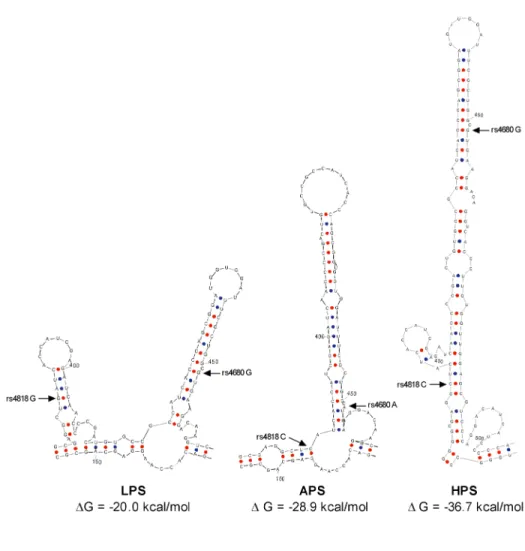
structure that minimizes Gibbs free energy (ΔG) (Mathews et al., 1999; Ogurtsov et al., 2006;
Zuker, 2003). LPS, APS, and HPS haplotypes differed with respect to local mRNA
secondary structure for both S- and MB-COMT (Nackley et al., 2006a). Here in the region of SNPs rs4818 and rs4680, LPS codes for the shortest, least stable local stem-loop structure (ΔG = -20.0 kcal/mol), while HPS codes for the longest, most stable structure (ΔG = -36.7
kcal/mol) (Fig. 3).
LPS, APS, and HPS haplotypes also differed in enzymatic activity for both S- and MB-COMT. Compared to the LPS haplotype, the HPS haplotype showed a 25- and 18-fold reduction in enzymatic activity for S- and MB-COMT, respectively. This was reflected in the marked reductions in S- and MB-COMT protein expression also. The APS haplotype
exhibited a much less dramatic 2.5- and 3-fold reduction in enzymatic activity for S- and MB-COMT, respectively. Protein levels for LPS and APS haplotypes were equivalent.
In order to confirm that the mRNA secondary structure contributed to these results, site-directed mutagenesis was employed to convert the stable stem-loop structure of HPS to a LPS-like conformation. The resulting HPS mutant had identical enzymatic activity and protein levels compared to the LPS haplotype, verifying that the local stem-loop structure of mRNA was responsible for the decreased enzymatic activity of the HPS haplotype.
Thermostability. APS produced protein levels equivalent to those of the LPS haplotype. However, the enzymatic activity was reduced by 2.5 to 4.8 fold compared, which is within the range that has been previously attributed to the met158 substitution in the
earlier-designated COMTL alleles. The decrease is relatively moderate compared to that of the HPS
codon 158. Nackley and colleagues (Nackley et al., 2006a) performed site-directed mutagenesis of the HPS haplotype, which resulted in an APS haplotype-like secondary structure while maintaining the val158 allele. Enzymatic activity and protein levels were equivalent to that of the LPS haplotype. The APS construct lacking 5’ and 3’ UTRs necessary for formation of stable mRNA secondary structures, had equivalent levels of protein, but maintained a decreased enzymatic activity level compared to the HPS and LPS constructs lacking 5’ and 3’ UTRs. It was concluded that the observed reduction in
enzymatic activity of the APS haplotype was solely attributed to the decreased
PURPOSE OF THE PRESENT STUDY
Kimura’s (Kimura, 1985) model of compensatory evolution states that individual deleterious mutations may be neutralized by a secondary compensatory mutation. The model specifically addresses secondary mutations aimed at maintaining the native confirmation of RNA stem-loop structures. The enzymatic activity of COMT haplotypes containing specific secondary SNPs has not been measured. The possibility exists that any secondary SNP may be either neutral or complicit in the decreased COMT activity already known to exist for the APS and HPS haplotypes. However, the presence of a compensatory secondary SNP would act to increase COMT activity via partially or completely annulling the effect of the common SNPs.
There are several examples of beneficial compensatory secondary mutations in animals. Gao and Zhang (Gao and Zhang, 2003) reported that rodents possess the mutation that is linked to Parkinson’s disease, but that it is rendered phenotypically inert due to an accompanying compensatory change. Another study analyzed the mitochondrial sequences of nonhuman primates for those containing disease-associated mutations found in humans. Some of those sequences related to human pathology were carried by the nonhuman primates without consequence due to the simultaneous presence of a secondary compensatory
likelihood that a secondary SNP is able to attenuate the deleterious nature of an SNP
increases with the closer physical proximity of the two SNPs (Stephan and Kirby, 1993). The selected minor frequency SNPs studied here have the potential to exert a functional effect due in part to their location in the central haploblock. Thus, the purpose of the present study was to characterize the potential functional effects of additional SNPs within the central haploblock of the S-COMT gene.
Minor
COMT
SNPs
Four minor SNPs of COMT, which were not previously genotyped for the original haplotype construction, were identified. Manual tabulation of expressed sequence tags (ESTs), which are incomplete transcribed sequences from a gene containing coding and non-coding regions, concluded that each SNP was associated with either the APS or HPS
haplotype. Three SNPs were found to occur with the HPS haplotype: one non-synonymous in exon 3 (ala72ser;G/T; rs6267), one synonymous in exon 3 (gln73gln; G/A; rs740602), and one synonymous in exon 4 (ala146ala; C/T; 8192488). The minor allele of these three SNPs was found in ESTs containing the rs4633 C and rs4818 alleles. One SNP was associated exclusively with the APS haplotype in exon 5 (pro158pro; G/A; rs769224), such that the
Figure 4. SNPs of COMT Haplotypes. MB-COMT is depicted with coding regions . The relative locations of major and minor SNPs are represented for each haplotype. Common SNPs are color-coded in black, while minor SNPs are color-coded in gray. The associated amino acids and codon positions are italiczed. Non-synonomous SNPs and resulting amino acid substitutes are bolded.
Potential Functional Effects of Minor SNPs on Existing Haplotypes
SNP rs8192488. The synonymous SNP rs8192488 alters the secondary structure of COMT mRNA in the proximity of rs4680 (Fig. 5). The resulting conformation,
as calculated by folding prediction software, shows that the large, stable stem-loop structure of the HPS haplotype is disrupted, so that it resembles the secondary structure corresponding to the LPS haplotype.
SNP rs6267. The non-synonymous SNP rs6267 at codon 72 produces a change in amino acid from alanine to serine, which may alter the activity of the COMT enzyme. It is
APS 769224 A T C A A
HPS 6267 A C T C G
HPS 740602 A C A C G
HPS 8192488 A C C T G
LPS G C G G
rs6269 rs4633
His62His Leurs4818 136Leu Valrs4680 158Met
rs6267
Ala72Ser rs740602 Gln73Gln rs8192488Ala146Ala Prors769224 199Pro
Common SNP
also possible that the ser72 allele is a marker of the HPS haplotype. Alternatively, rs6267 and rs4680 could produce a synergistic effect on enzymatic activity.
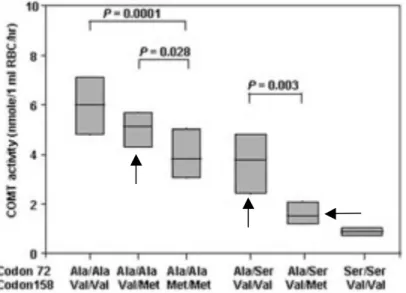
Lee (Lee et al., 2005) recently screened 17 known polymorphisms spanning the entire length of COMT in Koreans with and without schizophrenia to evaluate for an association with the mental disorder. The three minor SNPs associated with the HPS haplotype were included in the study. The ser72 allele of the non-synonymous SNP rs6267 was significantly associated with both schizophrenia and reduced COMT enzymatic activity. However, effects caused by synonymous SNPs rs740602 and rs8192488 could not be determined due to their monomorphic presence within the Korean-based population. The study did not seek to determine the individual contribution of each SNPs to COMT enzymatic activity.
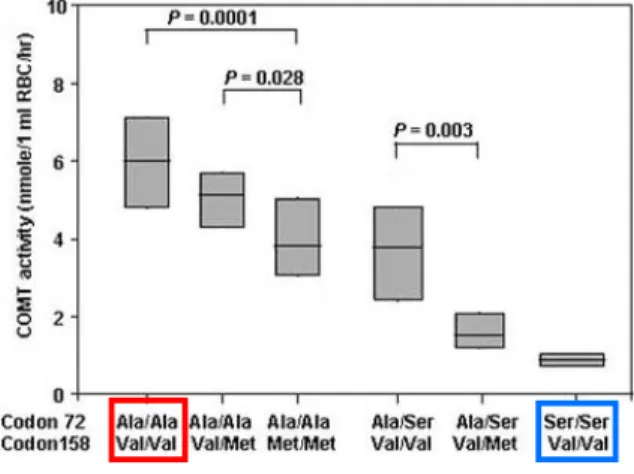
Neither protein level nor enzymatic activity was tested for individual SNPs, however COMT activity was associated with SNP rs6267 and rs4680 (Fig. 6). The highest activity was obtained from individuals with ala72ala and val158val, which agrees with previous studies (Diatchenko et al., 2005; Lotta et al., 1995). COMT activity continued to decrease with heterozygous and homozygous diplotypes of the met158 allele. Heterozygotes and
homozygotes of the ser72 allele show decreased COMT activity even in the presence of val158val, which, as previously discussed, is a marker for both the LPS and HPS haplotypes.
SNPs rs740602 and rs769224.The synonymous SNPs rs740602 and rs769224 are associated with HPS and APS haplotypes, respectively. Folding analysis did not predict a change in the mRNA secondary structure from the parent haplotypes. Either minor SNP may ultimately impact enzymatic activity of COMT by enhancing or diminishing mRNA stability or altering binding to translocation proteins or ribosomes.
Summary
The individual functional contribution of these four minor SNPs of COMT has not been previously characterized. In order to determine positive, neutral or negative
consequences, parent haplotypes were mutated to create four new mutants, each of which contained only one of the minor SNPs.
The purpose of this study was to determine the individual effects of specific minor SNPs associated with APS (rs769224) and HPS (rs6267, rs740602, rs8192488) S-COMT constructs through quantifying mRNA abundance, protein expression, and enzymatic activity.
MATERIALS AND METHODS
Confirmation of COMT variants. Previously constructed identical-length cDNA clones of the three S-COMT haplotypes (LPS, APS, and HPS) were used in this study. Site-directed mutagenesis via the Quickchange II XL Site-Directed Mutagenesis Kit (Stratagene, LaJolla, CA, USA) was previously employed to create four additional mutants corresponding to the SNPs presently studied: APS haplotype (G→A, rs769224); HPS haplotype (G→T,
rs6267; G→A, rs740602; C→T, 8192488). Plasmid DNA was purified using the EndoFree
Plasmid Maxi purification kit (Qiagen, Germantown, MD, USA). Once plasmids were isolated, DNA sequences were confirmed by double sequencing at the UNC core sequencing facility.
Transient transfection of COMT cDNA clones. A rat adrenal cell
line (PC-12) was transiently transfected in six-well plates using FuGENE 6 Transfection Reagent (Roche) in accordance in manufacture’s recommendations. The amount of plasmid was kept at 1 µg/well. The amount of control cDNA plasmid for transfection efficiency (pSV-βGalactosidase vector; Promega, Madison, WI, USA and SEAP; Clonetech, Mountain View, CA, USA) was kept at 0.1 µg. Transfection with the vector lacking the insert was done for each experiment. Cell lysates were collected approximately 48 hours post-transfection.
lysate collected in 1.7 ml tubes. The tubes were centrifuged at 2000 g for 10 min and filtrate removed. The enzymatic COMT assay was based on the method described by Masuda’s group (Masuda et al., 2002). Purified lysates (8 µl) were incubated with 200 µM Sadenosyl-L-methionine (SAMe; ICN Chemicals, Aurora OH, USA), 7.5 mM L-norepinephrine (NE; Sigma Chemical Co., St. Louis MO, USA) and 2mM MgCl2 in 50 mM phosphate buffered saline for 60 min in the final volume of 22 µl. The reaction was terminated using 20 µl of 0.4 M hydrocholoric acid and 1 µl of 330 mM EDTA. The same reaction in the presence of 15 mM EDTA was carried out in pararlel for each lysate to bind Mg ions required for COMT activity. COMT activity was assessed as measurement of normetanephrine (NMN) by Normetanephrine ELISA kit (IBL, Hamburg, Germany) in accordance with manufacture’s recommendations using 10 µl of above reaction mixture. COMT activity was determined after subtracting the amount of NMN produced by endogenous enzymatic activity
(transfection with empty vector). The non-specific background was determined in parallel assays performed in the presence of EDTA and then subtracted from each reading. COMT activity was then normalized for transfection efficiency by measuring the β-galactosidase activity for each lysate. βgalactosidase activity was determined using β-galactosidase enzyme systems (Promega), according to the supplier protocol.
washed with PBST for 10 min at RT, exposed to chemiluminescence reagent (Pierce, Milwaukee, WI, USA), and developed. Blots were then stripped using Restore western stripping buffer (Pierce) and equal loading of samples verified by β-actin staining. Blots were incubated with β-actin polyclonal 1° antibody (1:10,000; Santa Cruz Biotechnology, Santa Cruz, CA, USA) for 1 hr at RT followed by Goat Anti-Rabbit IgG HRP polyclonal 2° antibody (1:10,000; Chemicon) for 1 hr at RT and chemiluminescent reagent.
Real-time PCR. Total RNA was isolated using the Trizol reagent (Invitrogen,
Carlsbad, CA, USA). The isolated RNA was treated with RNase free-DNase I (Promega) and reverse transcribed by Superscript III (Invitrogen). The cDNA for COMT and SEAP was amplified with DyNAmo-SYBRGreen qPCR kit (MJ Research) using forward and reverse PCR primers (TGAACGTGGGCGACAAGAAAGGCAAGAT and
TGACCTTGTCCTTCACGCCAGCGAAAT, respectively, for COMT and
GCCGACCACTCCCACGTCTT and CCCGCTCTCGCTCTCGGTAA, respectively, for SEAP). Opticon-2 Real Time Fluorescence Detection System. Mastercycler ep (Eppendorf AG, Hamburg, Germany) was used for measuring fluorescence.
RESULTS
COMT
RNA Abundance
Total RNA levels were calculated from duplicate Real-Time PCR experiments (Fig. 7). Analysis shows that the RNA abundance was approximately the same for cells transfected with clones corresponding to the LPS, APS and HPS haplotypes, as well as the additional haplotype constructs containing individual minor SNPs (F6,13 = 1.405, P = 0.3308).
Figure 7.COMT
RNA abundance.
No difference in total RNA was observed for cells transfected with the parent LPS, APS, and HPS constructs or APS/HPS minor SNP constructs.
Specifically, the inclusion of the rs769224 minor allele in the APS haplotype did not result in significant change of total RNA relative to the APS haplotype. Similarly, in
COMT Protein Expression
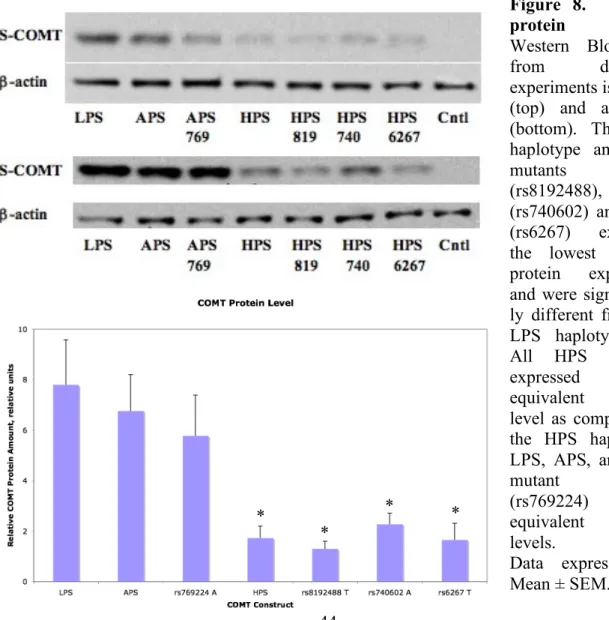
COMT protein levels obtained from duplicate experiments were normalized to corresponding
β-actin levels and statistically analyzed (Fig. 8). Similar to previous studies, the HPS
haplotype exhibited reduced protein expression levels relative to LPS haplotype (F6,13 =
6.133, P < 0.02), while the APS haplotype exhibited protein levels that did not differ from those corresponding to the LPS haplotype. However, no differences in protein expression were observed between the APS and APS + rs769224 A constructs or between the HPS and HPS + rs8192488, HPS + rs740602, or HPS + rs6267 constructs.
Figure 8. COMT protein level.
Western Blot data from duplicate experiments is shown (top) and averaged (bottom). The HPS haplotype and HPS
mutants 819
(rs8192488), 740 (rs740602) and 6267 (rs6267) exhibited the lowest COMT protein expression and were significant-ly different from the LPS haplotype (*). All HPS mutants expressed an equivalent protein level as compared to the HPS haplotype. LPS, APS, and APS
mutant 769
(rs769224) showed equivalent protein levels.
Data expressed as *
*
COMT Enzymatic Activity
ELISA results showed that COMT enzymatic activity varied among COMT haplotypes and haplotype mutants (Fig. 9). Compared to the LPS haplotype, the APS and HPS haplotypes exhibited a 5- and 18-fold reduction in activity, respectively. The APS + rs769224 A yielded a similar decrease in activity as the APS haplotype. Similarly, the magnitude of reduction for HPS + rs8192488 T, HPS + rs740602 A, and HPS + rs6267 T was comparable to that associated with the HPS haplotype.
Figure 9. COMT enzymatic activity.
DISCUSSION
The objective of this study was to evaluate the functional effect of select lower-frequency, naturally-occurring SNPs within the central haploblock of the human COMT gene locus on protein expression and enzymatic activity of the previously characterized APS and HPS pain-related COMT haplotypes.
The data for total RNA abundance, protein expression, and enzymatic activity for the pain-related haplotypes agreed with previous studies (Diatchenko et al., 2005; Nackley et al., 2006a). As in previous studies, total RNA abundance did not differ between any of the APS or HPS parent or minor SNP constructs. For the APS haplotype, a less dramatic, but still significant, decrease in enzymatic activity was associated with near equivalent levels of total RNA and protein as compared to the LPS haplotype. A similar result was found for the APS mutant (rs769224). Statistically, there was no difference for any of the measures between the haplotype constructs containing the minor alleles of the minor SNPs and their respective parent haplotype.
A disruption of the local stable stem-loop structure of the HPS mRNA was predicted in the presence of the minor allele for SNP rs8192488. The rs8192488 effect on the
conformation of HPS appears to be substantial, however the resulting Gibb’s free energy value was not calculated. Thus, it is unknown how similar to the LPS haplotype
Evidence of functionality, both beneficial and deleterious, exist for synonymous SNPs (Duan et al., 2003). The results for the two minor synonymous SNPs assessed in this study suggest that rs769224 and rs740602 have a neutral effect on RNA abundance, protein expression, and enzymatic activity for the APS and HPS haplotypes, respectively.
As for the nonsynonymous SNP rs6267, no difference was detected when compared to the HPS haplotype for any of the measures. The individual contribution to phenotype measures such as pain sensitivity, however, cannot be determined from this study. Still, when comparing these results with those of Lee and colleagues (Lee et al., 2005), an interesting relationship is discovered. Lee reported that human subjects displaying both the highest and lowest red blood cell COMT activity were homozygous for the val158 allele, which
corresponds to SNP rs4680, one of the four common SNPs in the parent haplotypes. LPS and HPS haplotypes have the same amino acid sequence, and therefore both code for the val158 allele. The SNP rs6267 minor allele, which codes for ser72, exclusively occurs within the HPS haplotype as found from EST data. This is highly suggestive that rs6267 is a marker of the HPS haplotype (Fig. 10).
Figure 10. rs6267 as a marker for HPS.
LPS and HPS code for the val158 allele,
CONCLUSION
From a subset of less-frequently occurring SNPs, a group of four minor SNPs exclusively present in either the APS or HPS haplotype were selected for this study. Data were in agreement with previous studies, showing that the COMT pain-related haplotypes did not vary significantly in mRNA abundance, but that the APS and HPS haplotypes exhibited a decrease in enzymatic activity of five- and 18-fold, respectively. Furthermore, the HPS haplotype showed a significant decrease in protein level compared to the LPS haplotype.
SUMMARY
The leading question in this study was to determine whether naturally occurring SNPs present within the central haplobock of the human COMT gene locus would impact the protein level and/or enzymatic activity of the pain-related APS and HPS haplotypes
previously described (Diatchenko et al., 2005). A line of evidence was assembled to justify the rationale that the inclusion of a secondary SNP may effect a functional consequence in the presence of an otherwise deleterious SNP (de Magalhaes, 2005; Duan et al., 2003; Kimura, 1985; Stephan and Kirby, 1993). Herein lied the possibility of identifying a beneficial compensatory effect relating to a minor SNP within COMT.
SNPs within coding or non-coding regions have the potential to effect functional consequences. Site-directed mutagenesis was used to construct single point mutations: one in the APS construct (G/A; rs769224) and three in the HPS construct (C/T; rs8192488, G/A; rs740602, or G/T; rs6267). Rat adrenal (PC-12) cells were transiently transfected with each of the four constructs. COMT mRNA abundance, protein expression, and enzymatic activity were measured and analyzed.
One-way ANOVA and, when appropriate, subsequent post hoc tests were completed for total RNA and protein expression. Results were compared to data of previous studies using the same parent haplotypes. The significance level was set at 0.05 for all tests.
the minor alleles of SNPs rs769224, rs8192488, rs740602, or rs6267 were individually compared to their respective parent haplotypes. Therefore, the minor SNPs studied here have a neutral effect on the pain-related APS and HPS haplotypes.
REFERENCES
Ameyaw MM, Syvanen AC, Ulmanen I, Ofori-Adjei D, McLeod HL (2000).
Pharmacogenetics of catechol-O-methyltransferase: frequency of low activity allele in a Ghanaian population. Hum Mutat 16(5):445-6.
Axelrod J, Tomchick R (1958). Enzymatic 0-methylation of epinephnine and other catechols. J Biol Chem 233(702-705.
Ayoub MA (1990). Ergonomic deficiencies: I. Pain at work. J Occup Med 32(1):52-7. Azzam A, Mathews CA (2003). Meta-analysis of the association between the catecholamine-O-methyl-transferase gene and obsessive-compulsive disorder. Am J Med Genet B
Neuropsychiatr Genet 123(1):64-9.
Bassett DL, Gerke DC, Goss AN (1990). Psychological factors in temporomandibular joint dysfunction: depression. Aust Prosthodont J 4(41-5.
Beaton RD, Egan KJ, Nakagawa-Kogan H, Morrison KN (1991). Self-reported symptoms of stress with temporomandibular disorders: comparisons to healthy men and women. J
Prosthet Dent 65(2):289-93.
Berry D (1969). Mandibular dysfunction, pain and chronic minor illness. Br Dent J 127). Bie B, Fields HL, Williams JT, Pan ZZ (2003). Roles of alpha1- and alpha2-adrenoceptors in the nucleus raphe magnus in opioid analgesia and opioid abstinence-induced hyperalgesia. J Neurosci 23(21):7950-7.
Bonnefoy N, Bsat N, Fox TD (2001). Mitochondrial translation of Saccharomyces cerevisiae COX2 mRNA is controlled by the nucleotide sequence specifying the pre-Cox2p leader peptide. Mol Cell Biol 21(7):2359-72.
Boudikova B, Szumlanski C, Maidak B, Weinshilboum R (1990). Human liver catechol-O-methyltransferase pharmacogenetics. Clin Pharmacol Ther 48(4):381-9.
Bradley LA, McKendree-Smith NL (2002). Central nervous system mechanisms of pain in fibromyalgia and other musculoskeletal disorders: behavioral and psychologic treatment approaches. Curr Opin Rheumatol 14(1):45-51.
Burton A (1997). Back Injury and Work Loss: Biomechanical and Psychosocial Influences. . Spine 22(21):2575-2580.
Carlson CR, Okeson JP, Falace DA, Nitz AJ, Curran SL, Anderson D (1993). Comparison of psychologic and physiologic functioning between patients with masticatory muscle pain and matched controls. J Orofac Pain 7(1):15-22.
Caspi A, Sugden K, Moffitt TE, Taylor A, Craig IW, Harrington H, et al. (2003). Influence of life stress on depression: moderation by a polymorphism in the 5-HTT gene. Science 301(5631):386-9.
Chen Y, Carlini DB, Baines JF, Parsch J, Braverman JM, Tanda S, et al. (1999). RNA secondary structure and compensatory evolution. Genes Genet Syst 74(6):271-86. Coderre TJ, Basbaum AI, Dallman MF, Helms C, Levine JD (1990). Epinephrine
exacerbates arthritis by an action at presynaptic B2-adrenoceptors. Neuroscience 34(2): 521-3.
Coderre TJ, Katz J, Vaccarino AL, Melzack R (1993). Contribution of central neuroplasticity to pathological pain: review of clinical and experimental evidence. Pain 52(3):259-85. Davidson S (2000). Research suggests importance of haplotypes over SNPs. Nat Biotechnol 18(11):1134-5.
de Magalhaes JP (2005). Human disease-associated mitochondrial mutations fixed in nonhuman primates. J Mol Evol 61(4):491-7.
Diatchenko L, Slade GD, Nackley AG, Bhalang K, Sigurdsson A, Belfer I, et al. (2005). Genetic basis for individual variations in pain perception and the development of a chronic pain condition. Hum Mol Genet 14(1):135-43.
Diatchenko L, Anderson AD, Slade GD, Fillingim RB, Shabalina SA, Higgins TJ, et al. (2006a). Three major haplotypes of the beta2 adrenergic receptor define psychological profile, blood pressure, and the risk for development of a common musculoskeletal pain disorder. Am J Med Genet B Neuropsychiatr Genet 141(5):449-62.
Diatchenko L, Nackley AG, Slade GD, Bhalang K, Belfer I, Max MB, et al. (2006b). Catechol-O-methyltransferase gene polymorphisms are associated with multiple pain-evoking stimuli. Pain 125(3):216-24.
Diatchenko L, Nackley AG, Slade GD, Fillingim RB, Maixner W (2006c). Idiopathic pain disorders--pathways of vulnerability. Pain 123(3):226-30.
Dougherty PM, Lenz FA (1994). Plasticity of the samatosensory system following neural injury. Touch, Temperature, and Pain in Health aand Disease: Mechanisms and
Assessments. Progess in Pain Research and Mangament.:439-460.
Duan J, Wainwright MS, Comeron JM, Saitou N, Sanders AR, Gelernter J, et al. (2003). Synonymous mutations in the human dopamine receptor D2 (DRD2) affect mRNA stability and synthesis of the receptor. Hum Mol Genet 12(3):205-16.
Dworkin BR, Elbert T, Rau H, Birbaumer N, Pauli P, Droste C, et al. (1994). Central effects of baroreceptor activation in humans: attenuation of skeletal reflexes and pain perception. Proc Natl Acad Sci U S A 91(14):6329-33.
Dworkin SF, Huggins KH, LeResche L, Von Korff M, Howard J, Truelove E, et al. (1990). Epidemiology of signs and symptoms in temporomandibular disorders: clinical signs in cases and controls. J Am Dent Assoc 120(3):273-81.
Dworkin SF, LeResche L (1992). Research diagnostic criteria for temporomandibular
disorders: review, criteria, examinations and specifications, critique. J Craniomandib Disord 6(4):301-55.
Egan MF, Goldberg TE, Kolachana BS, Callicott JH, Mazzanti CM, Straub RE, et al. (2001). Effect of COMT Val108/158 Met genotype on frontal lobe function and risk for
schizophrenia. Proc Natl Acad Sci U S A 98(12):6917-22.
Ektor-Andersen J, Janzon L, Sjolund B (1993). Chronic pain and the sociodemographic environment: results from the Pain Clinic at Malmo General Hospital in Sweden. Clin J Pain 9(3):183-8.
Enoch MA, Xu K, Ferro E, Harris CR, Goldman D (2003). Genetic origins of anxiety in women: a role for a functional catechol-O-methyltransferase polymorphism. Psychiatr Genet 13(1):33-41.
Epker J, Gatchel RJ (2000). Coping profile differences in the biopsychosocial functioning of patients with temporomandibular disorder. Psychosom Med 62(1):69-75.
Evaskus DS, Laskin DM (1972). A biochemical measure of stress in patients with myofascial pain-dysfunction syndrome. J Dent Res 51(5):1464-6.
Finishing the euchromatic sequence of the human genome. (2004). Nature 431(7011): 931-45.
Funke B, Malhotra AK, Finn CT, Plocik AM, Lake SL, Lencz T, et al. (2005). COMT genetic variation confers risk for psychotic and affective disorders: a case control study. Behav Brain Funct 1(19.
Gallinat J, Bajbouj M, Sander T, Schlattmann P, Xu K, Ferro EF, et al. (2003). Association of the G1947A COMT (Val(108/158)Met) gene polymorphism with prefrontal P300 during information processing. Biol Psychiatry 54(1):40-8.
Gao L, Zhang J (2003). Why are some human disease-associated mutations fixed in mice? Trends Genet 19(12):678-81.
Garofalo JP, Gatchel RJ, Wesley AL, Ellis E, 3rd (1998). Predicting chronicity in acute temporomandibular joint disorders using the research diagnostic criteria. J Am Dent Assoc 129(4):438-47.
Gebhart GF (2004). Descending modulation of pain. Neurosci Biobehav Rev 27(8):729-37. Gold S, Lipton J, Marbach J, Gurion B (1975). Sites of psychophysiological complaints in MPD
patients: II. Areas remote from the orofacial region. J Dent Res 54 (Special Issue A, Abstract 480)).
Gordon JA, Hen R (2004). Genetic approaches to the study of anxiety. Annu Rev Neurosci 27(193-222.
Goss AN, Bassett DL, Gerke DC (1990). Psychological factors in temporomandibular joint dysfunction: anxiety. Aust Prosthodont J 4(35-9.
Grossman MH, Emanuel BS, Budarf ML (1992). Chromosomal mapping of the human catechol-O-methyltransferase gene to 22q11.1----q11.2. Genomics 12(4):822-5.
Gursoy S, Erdal E, Herken H, Madenci E, Alasehirli B, Erdal N (2003). Significance of catechol-O-methyltransferase gene polymorphism in fibromyalgia syndrome. Rheumatol Int 23(3):104-7.
Hagberg M (1983). Occupational musculoskeletal stress and disorders of the neck and shoulder: a review of possible pathophysiology. International Archives of Occupational and Environmental Health 53(3):269-278.
Hardy JD, Wolff HG, Goodell H (1950). Experimental evidence on the nature of cutaneous hyperalgesia. J Clin Invest 29(1):115-40.