Combining multi-mutant and modular thermodynamic
cycles to measure energetic coupling networks
in enzyme catalysis
Charles W.Carter, Jr.,Srinivas NiranjChandrasekaran,ViolettaWeinreb, LiLi,and TishanWilliams
Department of Biochemistry and Biophysics, University of North Carolina at Chapel Hill, Chapel Hill, North Carolina 27599-7260, USA
(Received 7 November 2016; accepted 21 December 2016; published online 26 January 2017)
We measured and cross-validated the energetics of networks inBacillus stearother-mophilus Tryptophanyl-tRNA synthetase (TrpRS) using both multi-mutant and
modular thermodynamic cycles. Multi-dimensional combinatorial mutagenesis showed that four side chains from this “molecular switch” move coordinately with the active-site Mg2þion as the active site preorganizes to stabilize the transition state for amino acid activation. Amodularthermodynamic cycle consisting of full-length TrpRS, its Urzyme, and the Urzyme plus each of the two domains deleted in the Urzyme gives similar energetics. These dynamic linkages, although unlikely to stabilize the transition-state directly, consign the active-site preorganization to domain motion, assuring coupled vectorial behavior.VC 2017 Author(s). All article content, except where otherwise noted, is licensed under a Creative Commons Attribution (CC BY) license (http://creativecommons.org/licenses/by/4.0/).
[http://dx.doi.org/10.1063/1.4974218]
INTRODUCTION
One of our oldest and most inclusive insights about proteins is that protein folding coordi-nates the behavior of the amino acids linked together in the polypeptide chain. Proposals impli-cating the resulting cooperative protein motions, or “dynamics,” in enzyme catalysis are com-monplace.1–11 A central notion underlying such proposals is that low frequency motions—loop closing, domain motion, etc.—transmit the kinetic energy along directions aligned with chemi-cal changes, thereby contributing to the overall rate acceleration.
Such proposals have been challenged, however, for three main reasons.12 (i) Frequencies of domain motions are many orders of magnitude slower than those of the chemical reactions. (ii) Forces that can be imposed with such motions are substantially weaker than those necessary to stabilize the transition states. (iii) In order to definitively implicate motions in catalysis, it is necessary to map the accurate free energy landscapes of chemical reactions and how they inte-grate with the protein-dynamical changes, and cases where these have been done do not reveal a significant catalytic contribution.
Nonetheless, many enzymes, especially NTP (nucleotide triphosphate)-dependent motors, synthetases, polymerases, and signaling GTPases, exhibit multi-state, vectorial behavior13–19 in which biological function depends critically on coupling catalysis to conformational changes. Purposes served by such coupling include many of the most interesting aspects of biology. For this reason, the creation of, and transitions between, these multiple states are biologically rele-vant. It is therefore important to determine the mechanisms by which conformational transitions can be coupled to active-site chemistry.13,14,20
Our work on Bacillus stearothermophilus tryptophanyl-tRNA synthetase (TrpRS) occupies a specialized niche amidst these questions. We try to answer such questions as:
(i) What remote parts of a protein exert a substantive influence on catalysis? (ii) What techniques are necessary to verify these effects?
(iii) What is the magnitude of these influences? (iv) How cooperative are they?
(v) What is their functional significance?
TrpRS furnishes an attractive laboratory model for exploring long-range coupling comprehensively.
Our interest in these questions was initially stimulated by communications with Arieh Warshel, who has argued forcefully that the essence of catalysis is electrostatic stabilization of the transition state21–23 and cannot arise from dynamical effects. Reviewing an earlier paper of ours,24 he challenged our contention that long-range forces might be involved in catalysis, and argued that the TrpRS rate acceleration was due primarily to electrostatic stabilization by the single Mg2þion.
Testing that idea experimentally, we found that only about a third of the overall transition-state stabilization could be attributed to the Mg2þion.25This posed two questions:
(i) What accounts for the metal-independent two-thirds of the transition-state stabilization? (ii) How does metal-protein coupling work if Mg2þdoes not interact with the protein, has very
little effect on the rate in water, but accelerates the rate 105-fold in the presence of TrpRS?
The first question remains to be answered, although we have taken some steps26,27 in that direction. We tentatively answer the second question here. We conclude that Warshel is correct that domain movements themselves cannot directly stabilize transition states. However, what he calls the “active site pre-organization”28 appears to occur only during the domain movement, which has the effect of synchronizing catalysis with domain movement. The resulting condi-tional dependence of catalysis is what couples catalysis to domain movements,20,29,30 enabling the vectorial behavior. Readers may wish to refer to Figs. 10 and 11, which are discussed in detail later on, and provide a useful visualization of the proposed reaction path.
RESULTS
TrpRS uses Adenosine 50 triphosphate (ATP) to activate the carboxyl group of the amino acid tryptophan to form Trp-50 adenylate plus pyrophosphate (PPi). This reaction is the sine qua non of protein synthesis, and therefore of fundamental biological significance. Domain movements along the TrpRS structural reaction profile were elucidated by solving the crystal structures of TrpRS without ligands31 and complexed to substrates—tryptophan, ATP;32 non-reactive substrate analog combinations—tryptophanamide plus ATP;32 tryptophan plus Adenosine-50 monophosphate (AMP) plus PPi;33 a transition-state analog—adenosine-50tetraphosphate;34 and products—trp-50AMP,35,36 trp-50sulfoamyl-AMP, trp-methenyl-AMP;37 representing different states along the reaction path. These crystal structures group into three distinct, narrowly defined conformations that correspond to nodes connected by the three canon-ical stages of enzyme catalysis: induced-fit active-site assembly, catalysis, and product release.38 In this respect, the three resulting “states”—open, pre-transition state (PreTS), and Products—correspond functionally and structurally to the three conformations observed in the successive stages of the chemical reactions of the ATP by the catalytic F1-ATPaseb-subunit.39 Specifically, an open conformation is associated with the unliganded state, a closed, twisted conformation is associated with the ATP bound state, and a closed, untwisted conformation is associated with the aminoacyl-AMP-bound state. We previously commented on the possible relationship between the three-state behavior and free energy transduction.38
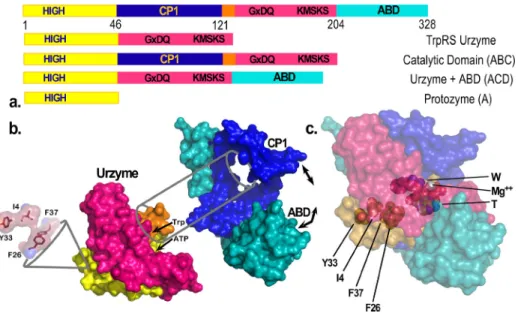
Seeking to understand the evolutionary sources of TrpRS catalysis, we have experimentally deconstructed the monomer (Fig. 1) into three nested, catalytically active components— Protozyme (46 residues), Urzyme (130 residues), and Catalytic Domain (204 residues)—which, together with the anticodon-binding domain (ABD) form the full-length TrpRS monomer.26 The Protozyme and Urzyme retain a considerable catalytic activity and hence likely represent ances-tral forms of contemporary aminoacyl-tRNA synthetases. Full-length synthetases combine the Urzyme with two additional modules added later in evolution: connecting peptide 1 (CP1), which completes the catalytic domain and provides the context for editing domains in the larger synthetases specific for aliphatic side chains; and the anticodon-binding domain, which enables recognition of the tRNA anticodon (Fig. 1(a)). The CP1 module does not actually move as a rigid body with the Urzyme, but moves relative to it. We, and others, have used computational methods to identify the correlated motions of the ABD domain and CP1 in several of the Class I synthetases.40,43
CP1 and the ABD together form a “cone” that is fitted around the Urzyme (Fig.1(b)). The active-site opening is accessible only through this cone, which therefore appears to physically constrain the relative positions of the Urzyme’s modular ATP and amino acid binding sites. The active site is thus sensitive to the configuration of the CP1 and ABD modules in full-length TrpRS. We have measured the impact of these interactions on catalysis20,25,29 and specificity.30,44
Thermodynamic cycles measure the coupling energies
A key concept underlying this work is that of “energetic coupling.” Coupling implies the existence of sources of free energy that enforce joint behaviors; such joint behaviors enable new, higher levels of functionality. It is generally true that coupling energies across a very broad spectrum of circumstances can be assessed from the non-additivity of expected contribu-tions. A useful example is that the intrinsic proton angular momentum, or spin, cannot be explained using only the intrinsic properties of its three constituent quarks, but instead requires an energetic coupling between them and the gluons that hold them together.45 In nuclear phys-ics, the data come from an inelastic electron and proton scattering experiments.46 In structural
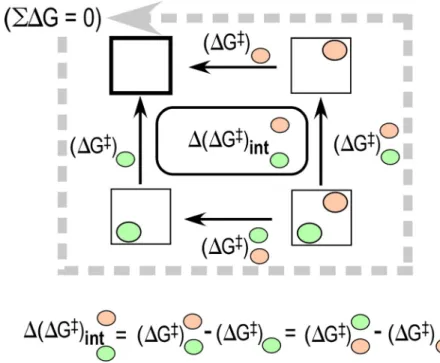
biology, non-additivities are evaluated quantitatively for combinatorial perturbations using a device that in a biophysical context is called a thermodynamic cycle (Fig.2).
A thermodynamic cycle is a 2N factorial experiment that tests all possible combinations of specific perturbations for their impact on kinetic or thermodynamic behavior. Perturbations that have non-additive effects in contexts of other perturbations imply coupled interactions. Use of multi-mutant cycles was introduced in biochemistry by Jencks47,48and exploited by Fersht soon after the development of directed mutagenesis enhanced their feasibility.49–51 High-order ther-modynamic cycles have demonstrated three-dimensional coupling interactions capable of chang-ing the direction of conformational equilibria by up to 105-fold.52
The 32PPi exchange reaction used to assay the aminoacyl-tRNA synthetases is done under equilibrium conditions, so both KM and kcat are related to the thermodynamic values, DGKM
andDGkcat. Free energies are additive, so linear regression methods can solve the simultaneous
equations necessary to estimate and assess the statistical significance of coefficients for main and higher-order interaction effects.20The latter represent the accessible coupling energies for a given experimental design. Experimental perturbations according to a full-factorial design can thus be used to estimate both the strength and significance of energetic coupling between parts of a protein during enzyme-catalyzed reactions.
In the course of this work, we were led to investigate a series of apparently unrelated com-binatorial perturbations. To our surprise, three qualitatively quite different thermodynamic cycles give the same quantitative energetic coupling during TrpRS catalysis.
The TrpRS/Mg21cycle; Mg21ion accelerates amino acid activation105-fold in the TrpRS-catalyzed reaction, but only 5-fold in water
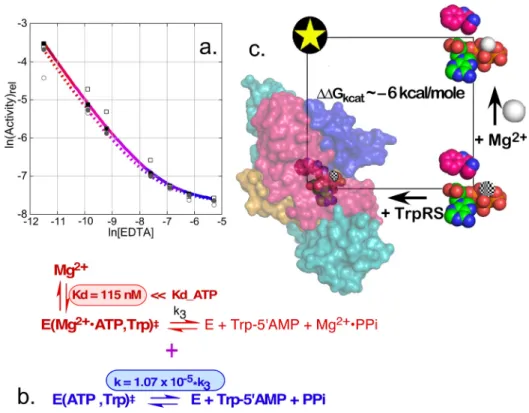
Prompted by the suggestion that the TrpRS catalysis should be essentially eliminated in the absence of Mg2þ ion, we prepared extensively depleted stocks of enzyme, assay buffer, and reagents.25 The resulting assays exhibited reduced, but still substantial rate accelerations over the uncatalyzed rate, which we initially attributed to residual remaining Mg2þ ion (Fig. 3(b)).
Titration of the assays with increasing amounts of ethylene diamine tetraacetate (EDTA) caused an additional rate reduction, but that reached a plateau beyond which there was, surprisingly, no further decrease.25
Iterated solution of the simultaneous binding equilibria using known dissociation constants for the Mg2þATP and Mg2þEDTA equilibria allowed us to fit the activity data at two TrpRS concentrations to a nonlinear model with two parameters: the proportional decrease in rate in the absence, relative to that in the presence of Mg2þion (1.1105) and the dissociation con-stant of Mg2þ from the transition-state complex (120 nM)25 (Fig. 3(c)). The former result implies that the metal accounts for only about 33% of the transition-state stabilization free energy, and is unexpected for several reasons: (i) It implies that the TrpRS active site alone is capable of 12 kcal/mole of transition-state stabilization free energy, even in the absence of the metal; (ii) Mg2þion accelerates ATP-dependent reactions in water by only5-fold.53 The two-factor thermodynamic cycle mapping the effects of TrpRS and Mg2þ ion thus exhibits a non-additivity of 6.4 kcal/mole, implying that the metal and protein are coupled by that energy in the transition state for ATP-dependent tryptophan activation.25
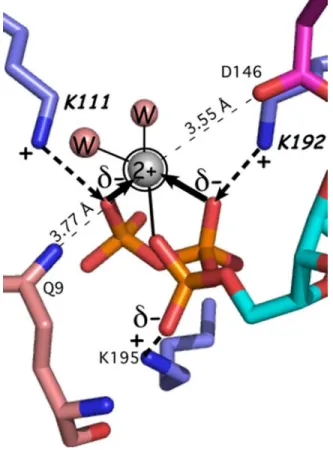
Mg2þ has been observed in crystal structures only of the PreTS state. In those structures (1MAU, 1M83), it interacts directly only with three phosphate oxygen atoms and two water molecules, and not with any TrpRS functional groups. The absence of protein-metal contacts necessarily implied that the energy coupling them together arises from as yet unidentified sour-ces that, in turn, interact with the Mg2þion indirectly, via the ATP phosphate oxygens. We first sought to identify these unknown coupling interactions within the active site, via combinatorial mutagenesis of the active-site lysine residues that are physically coupled to the metal because
FIG. 3. The TrpRSMg2þcycle. (a) Experimental data supporting the conclusion that TrpRS induces a limiting rate acceler-ation in the absence of Mg2þ, achieved by adding increasing amounts of EDTA to remove residual metal. Red coloring of the decay curve indicates residual catalytic assist by Mg2þion; Blue coloring indicates a plateau of catalysis by metal-free TrpRS. (b) Nonlinear fitting of the [EDTA]-dependence of the logarithm of TrpRS activity yields two parameters, KD
‡ , the dissociation constant for Mg2þion from the transition state (highlighted in red) and the maximum rate acceleration given by saturating Mg2þconcentrations (highlighted in blue) (adapted with permission from Weinreb and Carter, Jr., J. Am, Chem. Soc.130, 1488–1494 (2008). Copyright 2008 American Chemical Society). (c) Tryptophan activation is accelerated to very different extents by the addition of either TrpRS (109-fold) or Mg2þ(5-fold). The two together induce an overall acceleration of 1014-fold. TheDG
they compete with the metal for electrostatic interactions with phosphate oxygen atoms (Fig. 4).29 Those experiments showed that the Mg2þprotein interactions within the active-site actually retard the reaction,29 forcing us to look further afield for the sources of catalytic assist by Mg2þ.
Identification of the D1 switch
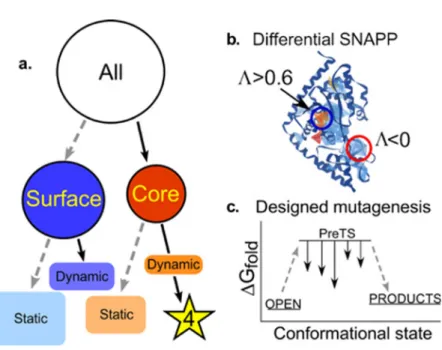
To locate these distant interactions, we used a combination of two bioinformatic filters—one geometric, the other energetic—to identify side chains likely to influence conformational equilib-ria (Fig. 5).24First, we quantitatively identified the local packing interactions that were invariant throughout the conformational cycle using Delaunay tessellation.54–56Eliminating from consider-ation all invariant tetrahedra of nearest neighbors—those within rigid bodies—greatly reduced the number of such simplices that are “dynamic” and change during catalysis. Then, we used Rosetta57–59to identify point mutants that might stabilize the high-energy PreTS state, relative to the OPEN and PRODUCTS ground states. The intersection of Venn diagrams identified by both Delaunay tessellation and by the multi-state design algorithm was surprisingly small,24consisting of one large, centrally located dynamic packing motif and three smaller peripheral motifs. We called these dynamic motifs “Switches” D1–D4, from “Delaunay.”
These bioinformatic filters are discussed further in the Methods section. Their combined effects reduced the number of candidate residues to a small enough number that experimental perturbation was feasible. The majority of the residues that survived this two-stage filter were all part of the D1 switch, a packing motif at the C-terminus of the first alpha helix of the Rossmann fold. We subsequently identified this packing motif as one of the most widely dis-tributed motifs in the proteome.42 The widespread phylogenetic distribution and key location of
this motif in the first crossover connection of the Rossmann fold reinforced our surmise that the residues engaged in dynamic switching in this region might be responsible for the long-range coupling to the active-site Mg2þion. Although the D1 Switch motif consists of seven residues, we decided to mutate only four, because we sought a full factorial design, and 15 variants was an accessible number to construct and assay. Moreover, because the Rosetta multi-state design algorithm had given us the specific mutations for each site—I4V, F26L, Y33F, F37I—and because these mutations all consistently reduced differences between the Rosetta scores of the PreTS and Product structures, we used these specific residues, rather than alanine mutations.
Combinatorial mutagenesis of D1 switch residues; long-range coupling to the catalytic Mg21ion
Alan Fersht used the term “multi-mutant cycle analysis” to describe the factorial directed point mutagenesis designs.51 Such experiments measure the coupling energy between individual residues and/or active site ligands. Extensive combinatorial multi-mutant cycle analysis of active-site functional groups subsequently showed that none of these coupling energies between protein and metal resides in the active-site residues,29 creating a strong argument for function-ally relevant effects arising from parts of the protein distant from the active-site.
In order to detect coupling to the active-site metal, we first verified that the catalytic assist by Mn2þion was a suitable perturbation by showing that the metal substitution reduced activity to 15% of that with Mg2þ and that the concentration dependencies of catalysis by the two metals were very similar over a 105-fold range of metal concentrations, both exhibiting a max-imal effect at approximately the same concentrations.29 All possible combinations of the four D1 mutations were constructed, purified, and their active fractions were determined by active-site titration.60
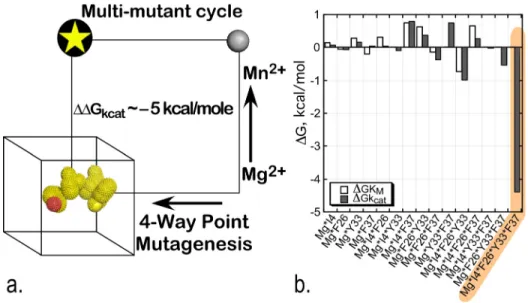
The resulting experimental design involved 32 separate combinations of point mutant and metal (Mg2þvs. Mn2þ) and was thus perhaps the most ambitious of its kind yet attempted.19,61 All variants were assayed by ATP-dependent Michaelis-Menten steady-state kinetic analysis. Approximately, three-fold replication of the experimental data afforded a fit in which essentially all the main and higher-order interaction free energies of transition-state stabilization could be estimated with high statistical significance.20Overall, the regression model forDGkcathas
coef-ficients with only modest magnitudes, of both signs, for the main effects and intermediate-order interactions. The 5-way interaction between the four permuted sites and the metal ion, however, contributes 5 kcal/mole. The 5-dimensional multi-mutant cycle showed that 85% of the catalytic effect of Mg2þ ion can be attributed to the 5-way interaction between the metal and four residues that mediate the shear during domain movement (Fig.6).
The regression model is a variant of principle component analysis, and its coefficients fur-nish a detailed histogram of contributions to transition-state stabilization (Fig. 6(b)). The domi-nant five-way interaction term has a definitive interpretation: at the moment of transition state stabilization, motions of all four D1 switch side chains and the active-site Mg2þion are tightly coupled, such that their simultaneous movement can reduce the free energy of the transition state.20 This interpretation implies that the change in side-chain packing that occurs during domain motion occurs essentially simultaneously with some, as yet undocumented, change in the configuration of the Mg2þion in Mg2þATP and that this configurational change allows the metal ion to interact more tightly with the transition state. Thus, this multi-mutant cycle is in substantial quantitative agreement with the conclusions drawn from the two-way thermody-namic cycle involving the intact TrpRS enzyme and the Mg2þ ion described in the section on Identification of the D1 switch.
A novel, modular thermodynamic cycle
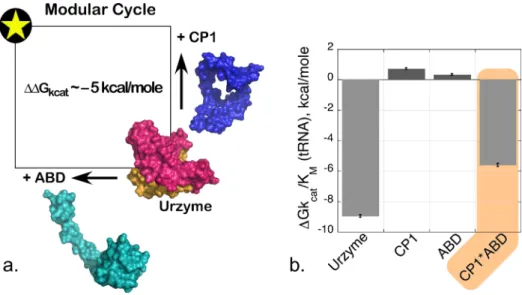
If the interpretation of high-order coupling described in the section on Combinatorial muta-genesis is correct, then it should also be the case that the two domains that rotate relative to the active site should also be coupled together in the transition state by similar free energies.44 We recently confirmed the prediction quantitatively, by constructing and carrying out a modular
FIG. 6. Combinatorial mutagenesis of four D1 Switch residues identify a strong, 5-way interaction (shaded amber) imply-ing that all four mutated residues move coordinately with the active-site Mg2þion in the transition state for tryptophan acti-vation.20(a) Schematic of the 5-way thermodynamic cycle. (b) The combinatorial mutagenesis of the D1 residues, I4, F26,
thermodynamic cycle.44 Modular cycles are enabled for TrpRS by the characterization of Urzymes62–64 (and potentially of protozymes26). As the CP1 and ABD domains are definitively deleted, the TrpRS Urzyme itself plays the role of a molecular knockout. Its remaining catalytic activity thus measures the impact of simultaneously losing both modules. We therefore con-structed each modular perturbation necessary to complete the cycle by adding back either CP1 or the ABD to measure the effects of each modular deletion separately (refer to Fig.1).
Combinatorial domain perturbation (Fig. 7) reveals that neither CP1 nor the ABD contrib-ute materially to transition state stabilization by the Urzyme alone, yet the presence of both modules together in full length TrpRS boosts the catalytic effect by 105-fold! Non-additivity in the resulting modular thermodynamic cycle measured the free energy coupling between the two mobile domains to be 5 kcal/mole in aminoacylation of tRNATrp. This coupling energy closely matched that obtained in the five-way multi-mutant cycle.20,44
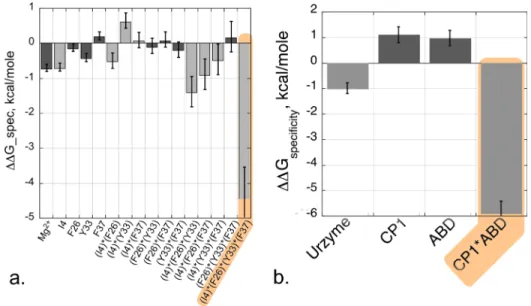
Multi-mutant and modular models validate one another in specificity as well as in catalysis. The 4-way interaction between I4, F26, Y33, and F37 also makes a similar contribution to the specific recognition of Tryptophan vs. Tyrosine (kcat/KM)Trp/(kcat/KM)Tyr in tryptophan
activa-tion.30 Simultaneous motions of CP1 and the ABD are necessary in order to achieve a fully functional TrpRS catalysis and specific tryptophan recognition: in the absence of either domain, the overall rate acceleration falls by 105-fold, almost exactly to that of the Urzyme alone, and the free energy of discriminating between tryptophan and tyrosine falls from 6 kcal/mole to 1 kcal/mole (Fig.8).30,44
TrpRS multi-state behavior is coupled to catalysis and hence functionally relevant
The coupling evident in Fig. 6(b)is notable for several reasons. First, it is contrary to that expected for higher order factorial experiments65 in which intrinsic effects normally dominate, and higher order interactions diminish in magnitude. That expected behavior has been verified in a comparable five-dimensional full factorial analysis of the catalytic roles of residues in the active site of alkaline phosphatase61 (Fig. 9) whose catalytic side chains link only into small clusters that are themselves dominated by the intrinsic effects of individual side chains. Here (Fig. 6(b)), the dominant effect, by a substantial margin, is the highest order interaction term. Second, the highly cooperative nature of protein tertiary structures suggests the possibility that
any sufficiently high-dimensional combinatorial mutagenesis would result in high-order cou-pling. The pattern in alkaline phosphatase serves as an important “negative control” by showing that high-order interactions do not necessarily result from any high-dimensional mutagenesis experiment. Finally, as discussed by Sunden et al., an evolutionary argument holds that high-order coupling is indeed unexpected, and hence represents the product of a complex series of selected properties.61 We also have advanced similar arguments regarding the conundrum
FIG. 8. Energetic coupling between D1 side chains and between domains contribute equally to specificity and catalysis. (a) Histogram comparable to that for the combinatorial mutant cycle in Fig.6(b). (b) Histogram comparable to that for the modular cycle in Fig.7. In both (a) and (b), the dependent variable is the specificity for tryptophan vs. tyrosine, DG(kcat/KM_Trp)/DG(kcat/KM_Tyr). R2¼0.99 for the specificity model, with P(F) and all Student t-test probabilities <0.0001.
evident in Fig. 7(b), which suggests that the full-length enzyme could not have evolved by a simple process of accumulating first one, then other of the two domains missing in the Urzyme.44
The stunning quantitative agreement between the coupling energies estimated from multi-mutant and modular combinatorial experiments with those anticipated from the characterization of metal-free catalysis25reinforces our earlier suggestions32,34,38,66that domain motions are nec-essary to form the TrpRStransition state complex, and hence that differences observed between TrpRS crystal structures are relevant to the catalytic cycle. Thus, the different TrpRS crystal structures probably approximate those states connected by motions necessary for transition-state stabilization. Because the coupling energies contribute to DGkcat, and hence to transition-state
stabilization, they represent the transient interactions that occur only in the transition state. Hence, movement of parts of TrpRS—the D1 switch residues, the CP1 and ABD domains, and the catalytic Mg2þ ion—relative to one another is required to generate them, as Fersht noted when interpreting his early directed mutagenesis of the TyrRS active site50,67–69 which had to be done without reference to multiple crystal structures.
In view of the recent critique of the functional relevance of domain motions12 it is worth discussing these results cautiously. The concluding sections address separate aspects of this question.
Multi-state behavior is imposed by conformational transition states
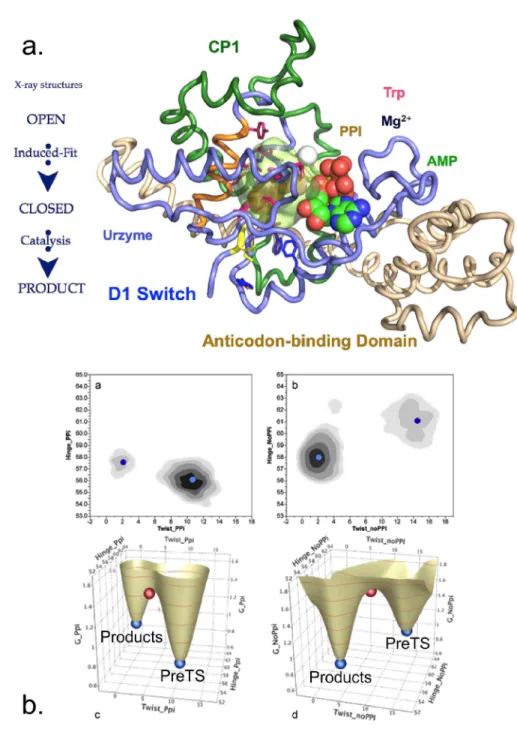
In order for a protein to exhibit the multistate behavior, its conformation must have mul-tiple distinct potential energy wells, separated by passes of high conformational free energy. We have used a minimum action path algorithm (PATH)70 to characterize how the three TrpRS conformational states connect to one another via such conformational transition states (Fig. 10(a) (Multimedia view)).30,33,41 Replica exchange discrete molecular dynamics71 showed that the conformational transition state for TrpRS catalytic transition is narrowly defined structurally, and that it coincides with a saddle point in the respective conformational free energy landscape41 (Fig. 10(b)). Importantly, that landscape refutes the contention72 that the saddle point in the free energy surface between multiple states of a protein is relatively flat in the direction normal to the path, and hence helps assure that the most probable path does result from minimizing the Onsager-Machlup action functional expressing the energy dissipation for a stochastic, overdamped system.73
In the same study, we also compared the conformational transition states of the TrpRS Induced-Fit transition to those associated with the Pre-power stroke to rigor transition of the myosin VI converter domain74and calcium release by calmodulin. These three transition states are remarkably similar: each entails re-packing of multiple aromatic side chains, which is much slower than other types of repacking. These results, together with our observation that the vol-ume of the tryptophan binding site assvol-umes a minimum just prior to the conformational transi-tion state for the catalytic transitransi-tion, and hence is likely the moment at which a decision is made regarding whether or not the correct amino acid is bound30 all reinforce the conforma-tional transition state as a real, funcconforma-tionally relevant conformation.
Energetic coupling renders the catalytic NTP hydrolysis contingent on the domain motion
Although TrpRS dynamic behavior appears to be closely linked to catalysis by long-range energetic coupling influences on kcat, the domain movement itself probably does not actually
lower the energy of the transition state. As noted,12 the time frame of the motions is too slow, and the molecular forces generated are too weak to couple directly to transition-state stabiliza-tion. Several apparently unrelated observations suggest a novel, perhaps counterintuitive inter-pretation of the relationship between domain motion and catalysis.
chemical transition states. The active site is properly configured only transiently, because it coincides with the maximum rate of conformational change and hence exists only for a brief portion of the domain motion. Because preorganization occurs transiently and with a low fre-quency, the overall chemical reaction may effectively proceed more slowly than it would if the active-site remained pre-organized throughout the substrate residence time.
If this hypothesis is correct, then it would account for three observations that previously seemed unrelated:
FIG. 10. Computational studies relevant to inferences about the relevance of coupling energies.41(a) PATH trajectory
(i) Active-site titration experiments show that the chemical step occurs in about the same time frame as the domain motions, i.e., milliseconds (Fig.12(a)). Thus, the chemical reaction itself may actually be controlled by, i.e., retarded, by reduced time during which the active-site retains the catalytically active configuration.
(ii) The free energy of activation for the chemical step measured in single-turnover active site titration experiments,DGkchem, is closely correlated to the D1 Switch mutations and
their higher-order interactions in almost identical fashion to that observed for theDGkcat
values (Figs.12(b)and12(c)). Turnover itself, estimated from the steady-state rate from such an experiment is, however, uncorrelated with the pattern of mutations. This result is unexpected in light of the evident correlation between mutant sites andDGkcat values
from steady-state experiments. It can be understood, however, by recognizing that differ-ences in a small fraction of the total reaction time in the latter context are amplified many fold by turnover. The significance of this correlation, evidenced by the very small t-test P-values (P<0.0001), is that structural perturbations influence primarily the chemical step of the reaction, supporting the conclusion that acceleration of the chemical step itself is tightly coupled to the domain motion.
(iii) Studies of the mechanism by which indolmycin inhibits bacterial TrpRSs75,76 show that indolmycin affinity for TrpRS is enhanced by the presence of Mg2þATP, but not by ATP alone. We have argued elsewhere75,76that this unusual effect can be attributed to a small shift in the crystallographically observed metal position, which moves it from a high-energy (and catalytically competent) position to a low-energy (and catalytically inactive) conformation.
Coupling catalysis to conformational changes creates vectorial behavior
Enzyme mechanisms, especially those that couple NTP hydrolysis to work and/or informa-tion, use sophisticated dynamic networks to transduce the active-site chemistry into domain motions that change the macromolecular binding affinities. The dual energetic coupling of catalysis to domain motion and D1 switch repacking with Mg2þion movement renders catalytic utilization of ATP conditional, or contingent upon the domain motion. TrpRS domain motions apparently constitute a timing mechanism.
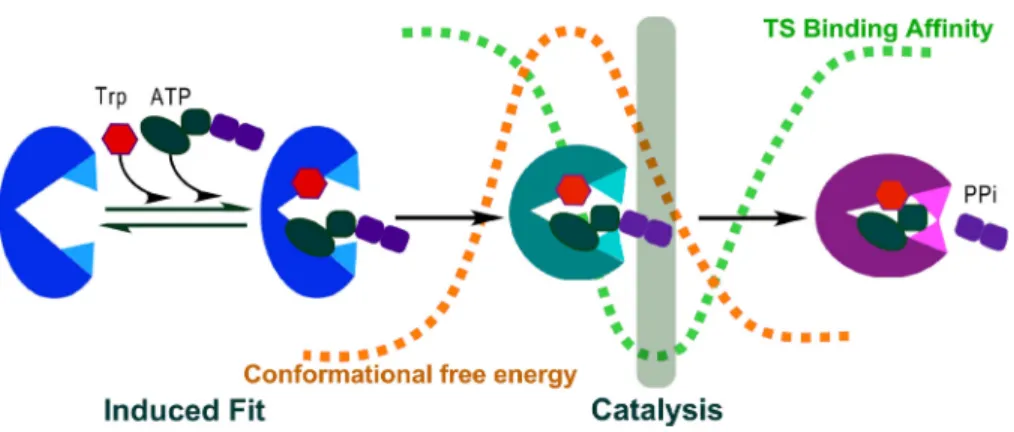
The variety of different TrpRS X-ray structures has identified each conformation with a distinctive spectrum of ligand affinities,32–34 including those ligand configurations associ-ated with the transition state. Decelerating the chemical step from what it might be in a more static active site, synchronizing chemical and mechanical events and thereby
FIG. 11. Conformational coupling renders ATP utilization conditional to domain motion. Tryptophan activation by ATP is illustrated schematically, coloring the Open, PreTS, and Products conformations blue, teal, and magenta, respectively. The brown dashed curve reflects transition in conformational free energy; evidence supporting the qualitative aspects of this curve derives from both computational24,33,40,86and experimental32,34studies. The green dashed curve reflects the evolution of
optimizing the efficiency of free energy transfer. Controlling the pre-organization of the catalytic metal ion can thus be seen as part of an orchestrated sequence that couples these differential binding changes associated with ATP binding, hydrolysis, and product release, to the domain configuration, ensuring that ATP hydrolysis occurs if and only if the confor-mation changes.20
FIG. 12. (a) Measurement of the rate of the chemical step of TrpRS-catalyzed tryptophan activation by active-site titration.60,89The fitted line, y
Our recent demonstration that the equilibrium for this catalytic domain movement is driven only by the release of pyrophosphate41 appears to be an additional mechanism ensuring that catalysis is coupled to (subsequent) domain movement, presumably regulated by tRNA binding. Using PPi release to change the overall conformational equilibrium resembles the behavior observed for myosin, for which the power stroke is initiated by orthophosphate release, whereas the release of adenosine-diphosphate happens only as the power stroke proceeds toward the rigor state.77–79As both orthophosphate and pyrophosphate are much more strongly solvated by water than is ATP,80 an early release of the phosphoryl group may be more widely used to orchestrate the vectorial domain motion in transducing enzymes.
Serial conditionality furnishes qualitatively new insights into the mechanism of chemical free energy transduction and vectorial processes. Perhaps the clearest discussion of these under-lying issues is that by Jencks,13,14who outlined how sequential changes in ligand-binding affin-ity lead to profound changes in the overall free energy of ATP hydrolysis, and recognized the necessity for understanding what he called the “coupling rules.” As the structural landscape of transducing enzymes was as yet unknown, Jencks was mute about what mechanisms actually linked conformational changes to catalysis, and this issue remains unresolved.81 Identifying24,40 and mutating29key residues associated with the conformational transition state(s), together with modular thermodynamic cycles44to measure energetic coupling between domains, now enhance the understanding of how idiosyncratic structural and mechanistic details implement the cou-pling rules. These methods should also be useful in studying a large number of other transduc-ing NTPases.
The accompanying paper82describes an improved analysis of TrpRS conformational transi-tion states whose computatransi-tionally derived thermodynamic and kinetic parameters correlate strongly with structures and kinetic data for all sixteen D1 switch variants, unifying and further validating the results summarized here.
METHODS
Identifying potential couples
A full-length enzyme has almost innumerable separate interactions. Consider only 2N experiments obtained by constructing all possible combinations of mutations for one type of substitution per residue in TrpRS (328 residues). This amounts to 2328¼e1900different variants. Clearly, the number of variants must be massively reduced in order even to begin to evaluate long-range energetic coupling in an enzyme. Fortunately, several aspects of domain motion simplify the problem if sufficient structural information is available for the conformational var-iations along the reaction path.
Many conformational changes consist of rigid-body motions. As these rigid bodies preserve their internal structure, amino acid residues within them can be ignored to a first approximation in designing the combinatorial cycles. Delaunay tessellation discriminates the invariant tertiary interactions from those that change during the structural reaction profile. The remaining, dynamic, interactions constitute a far smaller reservoir of candidates for permutation studies. Rigid body changes therefore entail either hinge-bending or shear, both of which impact small numbers of residues, reducing the number to be considered for combinatorial point mutagenesis.
Algorithms developed for multistate protein design57–59 furnish a second, complementary source of useful, residue-specific estimates of free energies associated with the domain motion when crystal structures are available for multiple states. Multi-state design identifies the side chain mutations that alter the relative conformational energies. Dynamic residues identified as potential sites of mutation to alter conformational equilibria form an overlapping, but distinct set of residues.
Finally, the Rosetta energy function identifies the specific point mutants that have the great-est impact. This contribution cannot be ignored, because it greatly reduces the number of possi-ble mutations at each site to a single amino acid. The process described here thus identifies spe-cific mutations to a sufficiently small number of sites, to compose a sensible set of combinatorial experiments.
Regression modeling simplifies the data analysis
Regression analysis of experimental results recorded in a factorial design is implemented in most statistics programs. We use JMP statistical discovery software (JMP),83which combines a wide range of state-of-the-art statistical and presentation modules from the SAS system with a very user-friendly interface. Linear models require the use of free energies, which are additive. Thus, all rates and equilibrium constants must be converted first into Gibbs energies. Then, the Gibbs energies contributing either to kcat, KM, or kcat/KMcan be expressed as the linear
combi-nation (1)84
DGobs¼CþRmainDGi½i þR2wayDGij½i½j þR3wayDGijk½i½j½k
þDGijkl½i½j½k½l þRmainDGi M½i½M þR2wayDGij M½i½j½M
þR3wayDGijk M½i½j½k½M þDGijkl M½i½j½k½l½M; (1)
where il are either 1 or 1 depending on whether the residue at position i is wild-type or mutant, and M is 1 or1 depending on whether the catalytic metal is Mg2þor Mn2þ.
A decisive advantage of this approach to the analysis is that coefficients for main effects and interaction terms furnish intrinsic energetic contributions and coupling free energies from the cross terms in units of kcal/mole. A detailed example, clarifying various questions about the method as an alternative to manual calculation of all quantities was described previously51 is discussed in the supplementary material for Ref.84.
ACKNOWLEDGMENTS
We are grateful to B. Kuhlman, J. Hermans, J. Das, R. Wolfenden, and N. Dokholyan for advice and assistance. This work was supported by NIGMS (78227 and 40906).
1T. Kern, P. Schanda, and B. Brutscher, “Sensitivity-enhanced IPAP-SOFAST-HMQC for fast-pulsing 2D NMR with
reduced radiofrequency load,”J. Magn. Reson.190, 333–338 (2008). 2
M. Deniziak, C. Sauter, H. D. Becker, C. A. Paulus, R. Giege, and D. Kern, “Deinococcus glutaminyl-tRNA synthetase is a chimer between proteins from an ancient and the modern pathways of aminoacyl-tRNA formation,”Nucleic Acids Res. 35, 1421–1431 (2007).
3
P. E. Wright and H. J. Dyson, “Linking folding and binding,”Curr. Op. Struct. Biol.19, 31–38 (2009).
4D. D. Boehr, D. McElheny, H. J. Dyson, and P. E. Wright, “The dynamic energy landscape of dihydrofolate reductase
catalysis,”Science313, 1639–1641 (2006). 5
E. Rennella, R. Huang, A. Velyvis, and L. E. Kay, “13CHD2–CEST NMR spectroscopy provides an avenue for studies of conformational exchange in high molecular weight proteins,”J. Biomol. NMR63, 187–199 (2015).
6P. Vallurupalli, G. Bouvignies, and L. E. Kay, “Studying ‘invisible’ excited protein states in slow exchange with a major
state conformation,”J. Am. Chem. Soc.134, 81488161 (2012). 7
K. M. Flaherty, S. M. Wilbanks, C. DeLuca-Flaherty, and D. B. McKay, “Structural basis of the 70-kilodalton heat shock cognate protein ATP hydrolytic activity,” J. Biol. Chem.269, 12899–12907 (1994).
8D. McElheny, J. R. Schnell, J. C. Lansing, H. J. Dyson, and P. E. Wright, “Defining the role of active-site loop
fluctua-tions in dihydrofolate reductase catalysis,”Proc. Nat. Acad. Sci. U. S. A.102, 5032–5037 (2005). 9
J. R. Schnell, H. J. Dyson, and P. E. Wright, “Structure, dynamics, and catalytic function of dihydrofolate reductase,” Annu Rev. Biophys. Biomol. Struct.33, 119–140 (2004).
10E. Z. Eisenmesser, O. Millet, W. Labeikovsky, D. M. Korzhnefv, M. Wolf-Watz, D. A. Bosco, J. J. Skalicky, L. E. Kay,
and D. Kern, “Intrinisic dynamics of an enzyme underlies catalysis,”Nature438, 117–137 (2005). 11
B. Schuwirth, M. A. Borovinskaya, C. W. Hau, W. Zhang, A. Vila-Sanjurjo, J. Holton, and J. H. Doudna Cate, “Structures of the bacterial ribosome at 3.5 A˚ resolution,”Science310, 827–833 (2005).
12A. Warshel and R. P. Bora, “Perspective: Defining and quantifying the role of dynamics in enzyme catalysis,”J. Chem.
Phys.144, 180901 (2016). 13
W. P. Jencks, “Reaction mechanisms, catalysis, and movement,”Protein Sci.3, 2459–2464 (1994). 14
15
W. P. Jencks, “The utilization of binding energy in coupled vectorial processes,” Adv. Enzymol. Relat. Areas Mol. Biol. 51, 75–106 (1980).
16R. D. Astumian, “Stochastic conformational pumping: A mechanism for free-energy transduction by molecules,”Annu.
Rev. Biophys.40, 289–313 (2011). 17
R. D. Astumian, “Thermodynamics and kinetics of molecular motors,”Biophys. J.98, 2401–2409 (2010). 18
V. Ovchinnikov, B. L. Trouta, and M. Karplus, “Mechanical coupling in myosin V: A simulation study,”J. Mol. Biol. 395, 815–835 (2010).
19E. Sadovsky and O. Yifrach, “Principles underlying energetic coupling along an allosteric communication trajectory of a
voltage-activated K channel,”Proc. Nat. Acad. Sci. U. S. A.104(50), 19813–19818 (2007). 20
V. Weinreb, L. Li, and C. W. Carter, Jr.,Structure20, 128–138 (2012).
21A. Warshel, P. K. Sharma, M. Kato, Y. Xiang, H. Liu, and M. H. M. Olsson, “Electrostatic basis for enzyme catalysis,”
Chem. Rev.106, 3210–3235 (2006).
22J. A˚ qvist, K. Kolmodin, J. Florian, and A. Warshel, “Mechanistic alternatives in phosphate monoester hydrolysis: what
conclusions can be drawn from available experimental data?,”Chem. Biol.6, R71–R80 (1999). 23
J. A˚ qvist and A. Warshel, “Free energy relationships in metalloenzyme-catalyzed reactions. calculations of the effects of metal ion substitutions in staphylococcal nuclease,”J. Am. Chem. Soc.112, 2860–2868 (1990).
24
M. Kapustina, V. Weinreb, L. Li, B. Kuhlman, and C. W. Carter, Jr., “A conformational transition state accompanies tryptophan activation byB. stearothermphilustryptophanyl-tRNA synthetase,”Structure15, 1272–1284 (2007). 25V. Weinreb and C. W. Carter, Jr., “Mg2þ-freeB. stearothermophilustryptophanyl-tRNA synthetase activates
trypto-phan with a major fraction of the overall rate enhancement,”J. Am. Chem. Soc.130, 1488–1494 (2008). 26
L. Martinez, M. Jimenez-Rodriguez, K. Gonzalez-Rivera, T. Williams, L. Li, V. Weinreb, S. Niranj Chandrasekaran, M. Collier, X. Ambroggio, B. Kuhlman, O. Erdogan, and C. W. J. Carter, “Functional class I and II amino acid activating enzymes can be coded by opposite strands of the same gene,”J. Biol. Chem.290(32), 19710–19725 (2015).
27
P. J. Sapienza, L. Li, T. Williams, A. L. Lee, and C. W. Carter, Jr., “An ancestral tryptophanyl-tRNA synthetase precursor achieves high catalytic rate enhancement without ordered ground-state tertiary structures,” ACS Chem. Biol. 11, 16611668 (2016).
28
B. R. Prasad and A. Warshel, “Prechemistry versus preorganization in DNA replication fidelity,”Proteins: Struct., Funct. Bioinf.79, 2900–2919 (2011).
29
V. Weinreb, L. Li, L. S. Kaguni, C. L. Campbell, and C. W. Carter, Jr., “Mg2þ-assisted catalysis byB. stearothermophi-lusTrpRS is promoted by allosteric effects,”Structure17, 1–13 (2009).
30V. Weinreb, L. Li, S. N. Chandrasekaran, P. Koehl, M. Delarue, and C. W. Carter, Jr., “Enhanced amino acid selection in
fully-evolved tryptophanyl-tRNA Synthetase, relative to its urzyme, requires domain movement sensed by the D1 switch, a remote, dynamic packing motif,”J. Biol. Chem.289, 4367–4376 (2014).
31V. A. Ilyin, B. Temple, M. Hu, G. Li, Y. Yin, P. Vachette, and C. W. Carter, Jr., “2.9 A˚ crystal structure of ligand-free
tryptophanyl-tRNA synthetase: Domain movements fragment the adenine nucleotide binding site,” Protein Sci. 9, 218–231 (2000).
32
P. Retailleau, X. Huang, Y. Yin, M. Hu, V. Weinreb, P. Vachette, C. Vonrhein, G. Bricogne, P. Roversi, V. Ilyin, and C. W. Carter, Jr., “Interconversion of ATP binding and conformational free energies by Tryptophanyl-tRNA Synthetase: Structures of ATP bound to open and closed, pre-transition conformations,”J. Mol. Biol.325, 39–63 (2003).
33
P. Laowanapiban, M. Kapustina, C. Vonrhein, M. Delarue, P. Koehl, and C. W. Carter, Jr., “Independent saturation of three TrpRS subsites generates a partially-assembled state similar to those observed in molecular simulations,”Proc. Natl. Acad. Sci. U. S. A.106, 1790–1795 (2009).
34
P. Retailleau, V. Weinreb, M. Hu, and C. W. Carter, Jr., “Crystal structure of tryptophanyl-tRNA synthetase complexed with adenosine-50tetraphosphate: Evidence for distributed use of catalytic binding energy in amino acid activation by class I aminoacyl-tRNA synthetases,”J. Mol. Biol.369, 108–128 (2007).
35
S. Doublie, G. Bricogne, C. J. Gilmore, and C. W. Carter, Jr., “Tryptophanyl-tRNA synthetase crystal structure reveals an unexpected homology to Tyrosyl-tRNA synthetase,”Structure3(1), 17–31 (1995).
36
P. Retailleau, Y. Yin, M. Hu, J. M. Roach, G. Bricogne, C. Vonrhein, P. Roversi, E. Blanc, R. M. Sweet, and C. W. Carter, Jr., “High resolution experimental phases for Tryptophanyl-tRNA synthetase (TrpRS) complexed with Tryptophanyl-50AMP,” Acta Crystallogr.D57, 1595–1608 (2001).
37
Y. Yin, Ph.D. thesis, University of North Carolina at Chapel Hill, 1995. 38
C. W. Carter, Jr., V. Ilyin, Y. Yin, X. Huang, and P. Retailleau, paper presented at the Using Crystallography to Understand Enzyme Mechanism, St. Paul, 2001.
39
J. P. Abrahams, A. G. W. Leslie, R. Lutter, and J. E. Walker, “Structure at 2.8 A˚ resolution of F1-ATPase from bovine heart mitochondria,”Nature370, 621–628 (1994).
40M. Kapustina and C. W. Carter, Jr., “Computational studies of tryptophanyl-tRNA synthetase ligand binding and
confor-mational stability,”J. Mol. Biol.362, 1159–1180 (2006).
41S. N. Chandrasekaran, J. Das, N. V. Dokholyan, and C. W. Carter, Jr., “A modified PATH algorithm rapidly generates
transition states comparable to those found by other well established algorithms,”Struct. Dyn.3, 012101 (2016). 42
S. Cammer and C. W. Carter, Jr., “Six Rossmannoid folds, including the class I aminoacyl-tRNA synthetases, share a par-tial core with the anticodon-binding domain of a class II aminoacyl-tRNA synthetase,”Bioinformatics26(6), 709–714 (2010).
43
M. Budiman, M. H. Knaggs, J. S. Fetrow, and R. W. Alexander, “Using molecular dynamics to map interaction networks in an aminoacyl-tRNA synthetase,”Proteins: Struct., Funct. Bioinf.68, 670–689 (2007).
44L. Li and C. W. Carter, Jr., “Full implementation of the genetic code by tryptophanyl-tRNA synthetase requires
intermod-ular coupling,”J. Biol. Chem.288, 34736–34745 (2013).
45N. Goldenfield, inThis Idea Must Die, edited by J. Brockman (The Edge Foundation/HarperCollins, New York, 2015),
pp. 25–28. 46
R. Jaffe, “Where does the proton really get its spin?,”Phys. Today48(9), 24–30 (1995).
47W. P. Jencks, “Binding energy, specificity, and enzymatic catalysis: The circe effect,” Adv. Enzymol. Relat. Areas Mol.
48
W. P. Jencks, “On the attribution and additivity of binding energies,”Proc. Nat. Acad. Sci. U. S. A.78, 4046–4050 (1981).
49E. A. First and A. R. Fersht, “Mutational and kinetic analysis of a mobile loop in tyrosyl-tRNA synthetase,”
Biochemistry32(49), 13658–13663 (1993). 50
E. A. First and A. R. Fersht, “Analysis of the role of the KMSKS loop in the catalytic mechanism of the tyrosyl-tRNA synthetase using multimutant cycles,”Biochemistry34(15), 5030–5043. (1995).
51
A. Horovitz and A. R. Fersht, “Strategy for analyzing the co-operativity of intramolecular interactions in peptides and proteins,”J. Mol. Biol.214, 613–617 (1990).
52C. W. Carter, Jr., “High-dimensional mutant and modular thermodynamic cycles, molecular switching, and free energy
transduction,” Annu. Rev. Biophys. (in press).
53R. B. Stockbridge and R. Wolfenden, “The intrinsic reactivity of ATP and the catalytic proficiencies of kinases acting on
glucose, N-acetylgalactosamine, and homeserine: A thermodynamic analysis,”J. Biol. Chem.284(34), 22747–22757 (2009).
54
C. W. Carter, Jr., B. C. LeFebvre, S. A. Cammer, A. Tropsha, and M. H. Edgell, “Four-body potentials reveal protein-specific correlations to stability changes caused by hydrophobic core mutations,” J. Mol. Biol.311(4), 625–638. (2001).
55
S. Cammer, C. W. Carter, Jr., and A. Tropsha, inLecture Notes in Computational Science and Engineering, edited by T. Schlick and H. H. Gan (Springer Verlag, New York, 2002), Vol. 24, pp. 477–494.
56
A. Tropsha, C. W. J. Carter, S. Cammer, and I. I. Vaisman, “Simplicial neighborhood analysis of protein packing (SNAPP): A computational geometry approach to studying proteins,”Methods Enzymol.374, 509–544 (2003). 57Y. Liu and B. Kuhlman, “RosettaDesign server for protein design,”Nucleic Acids Res.34, 235–238 (2006).
58
B. Kuhlman and D. Baker, “Exploring folding free energy landscapes using computational protein design,”Curr. Opin. Struct. Biol.14, 89–95 (2004).
59A. Leaver-Fay, R. Jacak, P. B. Stranges, and B. Kuhlman, “A generic program for multistate protein design,”PLoS One
6(7), e20937 (2011).
60A. R. Fersht, J. S. Ashford, C. J. Bruton, R. Jakes, G. L. E. Koch, and B. S. Hartley, “Active site titration and aminoacyl
adenylate binding stoichiometry of amionacyl-tRNA synthetases,”Biochemistry14(1), 1–4 (1975). 61
F. Sunden, A. Peck, J. Salzman, S. Ressl, and D. Herschlag, “Extensive site-directed mutagenesis reveals interconnected functional units in the alkaline phosphatase active site,”eLife4, e06181 (2015).
62
C. W. Carter, Jr., “Urzymology: Experimental access to a key transition in the appearance of enzymes,”J. Biol. Chem. 289(44), 30213–30220 (2014).
63L. Li, V. Weinreb, C. Francklyn, and C. W. Carter, Jr., “Histidyl-tRNA synthetase urzymes: Class I and II
Aminoacyl-tRNA synthetase urzymes have comparable catalytic activities for cognate amino acid activation,”J. Biol. Chem.286, 10387–10395 (2011).
64Y. Pham, B. Kuhlman, G. L. Butterfoss, H. Hu, V. Weinreb, and C. W. Carter, Jr., “Tryptophanyl-tRNA synthetase
urzyme: A model to recapitulate molecular evolution and investigate intramolecular complementation,”J. Biol. Chem. 285, 38590–38601 (2010).
65
G. E. P. Box, W. G. Hunter, and J. S. Hunter,Statistics for Experimenters(Wiley Interscience, New York, 1978). 66Y. Yin and C. W. Carter, Jr., “Quantitative analysis in the characterization and optimization of protein crystal growth,”
Acta Crystallogr. D50, 572–590 (1994).
67E. A. First and A. R. Fersht, “Involvement of threonine 234 in catalysis of tyrosyl adenylate formation by tyrosyl-tRNA
synthetase,”Biochemistry32(49), 13644–13650 (1993). 68
A. R. Fersht, J. W. Knill Jones, H. Bedouelle, and G. Winter, “Reconstruction by site-directed mutagenesis of the transi-tion state for the activatransi-tion of tyrosine by the tyrosyl-tRNA synthetase: a mobile loop envelopes the transitransi-tion state in an induced-fit mechanism,”Biochemistry27(5), 1581–1587 (1988).
69
A. R. Fersht, “Dissection of the structure and activity of the tyrosyl-tRNA synthetase by site-directed mutagenesis,” Biochemistry26(25), 8031–8037 (1987).
70J. Franklin, P. Koehl, S. Doniach, and M. Delarue, “MinActionPath: Maximum likelihood trajectory for large-scale
struc-tural transitions in a coarse-grained locally harmonic energy landscape,”Nucl. Acids Res.35, W477–W482 (2007). 71D. Shirvanyants, F. Ding, D. Tsao, S. Ramachandran, and N. V. Dokholyan, “Discrete molecular dynamics: An efficient
and versatile simulation method for fine protein characterization,”J. Phys. Chem. B116, 8375–8382 (2012). 72
P. J. Malsom and F. J. Pinski, “Role of Ito’s lemma in sampling pinned diffusion paths in the continuous-time limit,” Phys. Rev. E94, 042131 (2016).
73
L. Onsager and S. Machlup, “Fluctuations and irreversible processes: Systems with kinetic energy,”Phys. Rev.91(6), 1512–1515 (1953).
74V. Ovchinnikov, M. Karplus, and E. Vanden-Eijnden, “Free energy of conformational transition paths in biomolecules:
The string method and its application to myosin VI,”J. Chem. Phys.134, 085103 (2011). 75
T. L. Williams and C. W. J. Carter, “Both ATP and Mg2þare required for high-affinity binding of indolmycin to human mitochondrial tryptophanyl-tRNA synthetase,” J. Biol. Chem. (submitted).
76
T. Williams, W. Y. Yin, and C. W. Carter, Jr., “Selective inhibition of bacterial tryptophanyl-tRNA, synthetases by indol-mycin is mechanism based,”J. Biol. Chem.291(1), 255–265 (2015).
77R. W. Lymn, “Kinetic analysi of myosin and actomyosin ATPase,”Ann. Rev. Biophys. Bioeng.8, 145–163 (1979).
78
R. W. Lymn and E. W. Taylor, “Transient state phosphate production in the hydrolysis of nucleoside triphospahes by myosin,”Biochemistry9, 2975–2983 (1970).
79
R. W. Lymn and E. W. Taylor, “Mechanism of adenosine triphosphate hydrolysis by actomyosin,”Biochemistry10, 4617–4624 (1971).
80R. Wolfenden and R. Williams, “Affinities of phosphoric acids, esters and amides for solvent water,”J. Am. Chem. Soc.
105, 1028–1031 (1983). 81
C. Khosla, “Quo vadis, enzymology?,”Nat. Chem. Biol.11, 438–441 (2015).
82S. N. Chandrasekaran and C. W. J. Carter, “Adding torsional interaction terms to the Anisotropic Network Model
83
SAS Institute, “SAS,” Cary, NC, 2007. 84
V. Weinreb, L. Li, and C. W. Carter, Jr.,Structure20, 128–138 (2012), see Supplementary Information. 85
J.-C. Liao, S. Sun, D. Chandler, and G. Oster, “The conformational states of Mg•ATP in water,”Eur. Biophys. J.33, 29–37 (2004).
86M. Kapustina, J. Hermans, and C. W. Carter, Jr., “Potential of mean force estimation of the relative magnitude of the
effect of errors in molecular mechanics approximations,” J. Mol. Biol.362, 1177–1180 (2006). 87
V. Weinreb, B. Kuhlman, and C. W. Carter, Jr., inAmerican Crystallographic Association Annual Meeting, edited by R. Angel (American Crystallographic Association, Chicago, 2010).
88
V. Weinreb, L. Li, L. S. Kaguni, C. L. Campbell, and C. W. Carter, Jr., “Mg2þ-assisted catalysis byB. stearothermophi-lusTrpRS is promoted by allosteric effects,”Structure17, 952–964 (2009).
89C. S. Francklyn, E. A. First, J. J. Perona, and Y.-M. Hou, “Methods for kinetic and thermodynamic analysis of