Crizanlizumab for the Prevention of Pain Crises in Sickle Cell
Disease
K.I. Ataga, A. Kutlar, J. Kanter, D. Liles, R. Cancado, J. Friedrisch, T.H. Guthrie, J. Knight-Madden, O.A. Alvarez, V.R. Gordeuk, S. Gualandro, M.P. Colella, W.R. Smith, S.A. Rollins, J.W. Stocker, and R.P. Rother
Abstract
BACKGROUND—The up-regulation of P-selectin in endothelial cells and platelets contributes to the cell–cell interactions that are involved in the pathogenesis of vaso-occlusion and sickle cell– related pain crises. The safety and efficacy of crizanlizumab, an antibody against the adhesion molecule P-selectin, were evaluated in patients with sickle cell disease.
METHODS—In this double-blind, randomized, placebo-controlled, phase 2 trial, we assigned patients to receive low-dose crizanlizumab (2.5 mg per kilogram of body weight), high-dose crizanlizumab (5.0 mg per kilogram), or placebo, administered intravenously 14 times over a period of 52 weeks. Patients who were receiving concomitant hydroxyurea as well as those not receiving hydroxyurea were included in the study. The primary end point was the annual rate of sickle cell–related pain crises with high-dose crizanlizumab versus placebo. The annual rate of days hospitalized, the times to first and second crises, annual rates of uncomplicated crises (defined as crises other than the acute chest syndrome, hepatic sequestration, splenic sequestration, or priapism) and the acute chest syndrome, and patient-reported outcomes were also assessed.
RESULTS—A total of 198 patients underwent randomization at 60 sites. The median rate of crises per year was 1.63 with high-dose crizanlizumab versus 2.98 with placebo (indicating a 45.3% lower rate with high-dose crizanlizumab, P = 0.01). The median time to the first crisis was significantly longer with high-dose crizanlizumab than with placebo (4.07 vs. 1.38 months, P = 0.001), as was the median time to the second crisis (10.32 vs. 5.09 months, P = 0.02). The median rate of uncomplicated crises per year was 1.08 with high-dose crizanlizumab, as compared with 2.91 with placebo (indicating a 62.9% lower rate with high-dose crizanlizumab, P = 0.02).
Adverse events that occurred in 10% or more of the patients in either active-treatment group and at a frequency that was at least twice as high as that in the placebo group were arthralgia, diarrhea, pruritus, vomiting, and chest pain.
Address reprint requests to Dr. Ataga at the Comprehensive Sickle Cell Program, Division of Hematology–Oncology, University of North Carolina at Chapel Hill, 3rd Fl., Physicians’ Office Bldg., Chapel Hill, NC, 27599-7305, or at [email protected]. The authors’ full names, academic degrees, and affiliations are listed in the Appendix.
A complete list of investigators and participating centers in the Phase 2, Multicenter, Randomized, Placebo-Controlled, Double-Blind, 12-Month Study to Assess Safety and Efficacy of Crizanlizumab (SelG1) with or without Hydroxyurea Therapy in Sickle Cell Disease Patients with Sickle Cell–Related Pain Crises (SUSTAIN) is provided in the Supplementary Appendix, available at NEJM.org. The views expressed in this article are solely the responsibility of the authors and do not necessarily represent the official views of the National Institutes of Health.
HHS Public Access
Author manuscript
N Engl J Med
. Author manuscript; available in PMC 2017 August 02.Published in final edited form as:
N Engl J Med. 2017 February 02; 376(5): 429–439. doi:10.1056/NEJMoa1611770.
A
uthor Man
uscr
ipt
A
uthor Man
uscr
ipt
A
uthor Man
uscr
ipt
A
uthor Man
uscr
CONCLUSIONS—In patients with sickle cell disease, crizanlizumab therapy resulted in a significantly lower rate of sickle cell–related pain crises than placebo and was associated with a low incidence of adverse events. (Funded by Selexys Pharmaceuticals and others; SUSTAIN ClinicalTrials.gov number, NCT01895361.)
Sickle cell disease is characterized by the presence of sickle hemoglobin (HbS), chronic hemolysis, recurrent pain episodes (called sickle cell–related pain crises or vaso-occlusive crises), multiorgan dysfunction, and early death. Sickle cell–related pain crises are the
primary cause of health care encounters in patients with sickle cell disease.1 These crises
result in a decrease in quality of life2 and an increase in the risk of death.3 Crises are thought
to be caused by vascular occlusion in the microcirculation, increased inflammation, and
alterations in nociception.4 The prevention of crises could minimize or prevent tissue and
organ damage and decrease the subsequent risk of death among patients with sickle cell disease.
Although polymerization of deoxygenated HbS is the primary event in the pathophysiology
of sickle cell disease,5 the pathogenesis of vasoocclusion is complex. Vaso-occlusion is
caused by the adhesion of sickle erythrocytes and leukocytes to the endothelium, which
results in vascular obstruction and tissue ischemia.6 The degree of sickle erythrocyte
adhesion correlates with vaso-occlusion and increased severity of disease.7 Activated and
adherent leukocytes are the likely drivers of vaso-occlusion in collecting venules, whereas
sickle erythrocytes may contribute to the occlusion of smaller vessels.8 In addition, platelets
can bind to erythrocytes, monocytes, and neutrophils to form aggregates, 9,10 which
contribute to abnormalities of blood flow in patients with sickle cell disease.11
Although the adhesion of leukocytes to the endothelium during inflammation can involve
multiple molecules, the process is initiated by P-selectin.12 P-selectin is found in storage
granules of resting endothelial cells and platelets and is rapidly transferred to the cell membrane on activation of the cell during processes such as inflammation. P-selectin that is expressed on the surface of the endothelium mediates abnormal rolling and static adhesion
of sickle erythrocytes to the vessel surface in vitro.13,14 Translocation of endothelial
P-selectin to the cell surface results in the prompt adhesion of sickle erythrocytes to vessels
and the development of vascular occlusion in transgenic mice with sickle cell disease.15
Furthermore, activated platelets bind to neutrophils to form aggregates in a P-selectin–
dependent manner in mice and humans with sickle cell disease.16
Transgenic mice with sickle cell disease that are deficient in P-selectin and E-selectin have
defective leukocyte recruitment to the vessel wall and are protected from vaso-occlusion.17
In addition, the adherence of sickle erythrocytes and leukocytes to the endothelium is substantially reduced when P-selectin is blocked in transgenic mice expressing human HbS.15,18 Furthermore, doses of heparin that are sufficient to block P-selectin increase
microvascular blood flow in patients with sickle cell disease.19 These data support the
concept that blockade of P-selectin could reduce the risk of vaso-occlusion, inflammation, and sickle cell–related pain crises.
A
uthor Man
uscr
ipt
A
uthor Man
uscr
ipt
A
uthor Man
uscr
ipt
A
uthor Man
uscr
Crizanlizumab is a humanized monoclonal antibody that binds to P-selectin and blocks its interaction with P-selectin glycoprotein ligand 1 (PSGL-1). Here we report the results of SUSTAIN (Phase 2, Multicenter, Randomized, Placebo-Controlled, Double-Blind, 12-Month Study to Assess Safety and Efficacy of Crizanlizumab (SelG1) with or without Hydroxyurea Therapy in Sickle Cell Disease Patients with Sickle Cell–Related Pain Crises), a multicenter, randomized, double-blind, placebo-controlled, phase 2 trial to assess the safety and efficacy of crizanlizumab, with or without hydroxyurea therapy, in patients with sickle cell disease. The primary goal of the trial was to determine the effect of crizanlizumab therapy on the rate of sickle cell–related crises during 52 weeks of treatment.
Methods
PATIENTS
Patients with sickle cell disease (homozygous hemoglobin S [HbSS], sickle hemoglobin C
disease [HbSC], sickle β0-thalassemia [HbSβ0-thalassemia], sickle β+-thalassemia [HbSβ+
-thalassemia], or other genotypes) who were 16 to 65 years of age and who had had 2 to 10 sickle cell–related pain crises in the 12 months before enrollment in the trial were eligible. Patients who were receiving hydroxyurea therapy were required to have been receiving the drug for at least 6 months, including taking a stable dose for at least the most recent 3 months, and they were not allowed to have any dose alteration during the 52-week treatment phase of the study, except for safety reasons. If patients were not receiving hydroxyurea, it could not be initiated. Patients who were undergoing long-term red-cell transfusion therapy were excluded. The full list of eligibility criteria is provided in the Supplementary
Appendix, available with the full text of this article at NEJM.org. All the patients provided written informed consent before enrolling in the trial.
TRIAL DESIGN
The trial consisted of a 30-day screening phase, a 52-week treatment phase, and a 6-week follow-up evaluation phase. Randomization was performed centrally on the basis of a block design, with stratification according to the number of crises in the preceding year (2 to 4 or 5 to 10) and concomitant hydroxyurea use (yes or no). Patients were assigned, in a 1:1:1 ratio, by an interactive Web-or voice-response system to receive low-dose crizanlizumab (2.5 mg per kilogram of body weight), high-dose crizanlizumab (5.0 mg per kilogram), or placebo. The participants, care providers, and those assessing outcomes were unaware of the group assignments. Patients received two doses of crizanlizumab or placebo 2 weeks apart (loading doses) and then received a dose every 4 weeks (maintenance dosing) through week 50 for a total of 14 doses administered. Each dose was administered intravenously over a period of 30 minutes.
During the treatment phase, the efficacy, safety, and pharmacokinetic and pharmacodynamic assessments were completed for each patient on the day of receipt of the initial dose, 2 weeks later, every 4 weeks through week 50, and at week 52, for a total of 15 visits. For the follow-up evaluation phase, patients returned for an assessment 6 weeks after the end of the treatment phase (8 weeks after receipt of the last dose) (see the protocol, available at NEJM.org).
A
uthor Man
uscr
ipt
A
uthor Man
uscr
ipt
A
uthor Man
uscr
ipt
A
uthor Man
uscr
CLINICAL EFFICACY
The primary efficacy end point was the annual rate of sickle cell–related pain crises, which was calculated as follows: total number of crises × 365 ÷ (end date − date of randomization + 1), with the end date defined as the date of the last dose plus 14 days. Annualized rates were used for the comparisons because they take into account the duration that a participant was in the trial.
Sickle cell–related pain crises were defined as acute episodes of pain, with no medically determined cause other than a vaso-occlusive event, that resulted in a medical facility visit and treatment with oral or parenteral narcotic agents or with a parenteral nonsteroidal antiinflammatory drug. The acute chest syndrome, hepatic sequestration, splenic
sequestration, and priapism were also considered to be crisis events. All the crises that were identified by trial investigators were adjudicated in a blinded fashion by an independent crisis-review committee.
Secondary efficacy assessments included the annual rate of days hospitalized, the times to first and second crises, the annual rate of uncomplicated crises (defined as crises other than the acute chest syndrome, hepatic sequestration, splenic sequestration, or priapism), the annual rate of the acute chest syndrome, and the Brief Pain Inventory questionnaire (Long-Form with 1-Week Recall; see the protocol). All the efficacy analyses were performed on the data collected during the 52-week treatment phase. Serum concentrations of crizanlizumab (pharmacokinetics) and the percent inhibition of P-selectin binding to PSGL-1
(pharmacodynamics) were assessed before dosing at baseline and at subsequent trial visits.
SAFETY
Safety assessments were performed during the screening phase, before and after the administration of crizanlizumab or placebo during the treatment phase, and during the follow-up evaluation phase. Safety assessments included physical examination, vital signs (blood pressure, pulse rate, respiratory rate, oxygen saturation, and oral body temperature), clinical laboratory tests (chemistry panel, complete blood count with reticulocyte count, urinalysis, prothrombin time and international normalized ratio, activated partial-thromboplastin time, and pregnancy tests), 12-lead electrocardiogram, and assessment of immunogenicity. Reported adverse events were coded with the use of preferred terms from the Medical Dictionary for Regulatory Activities, version 16.1. An independent data and safety monitoring committee reviewed safety during the trial.
TRIAL OVERSIGHT
The academic authors and the authors who are employees of the sponsor (Selexys Pharmaceuticals) were jointly responsible for the trial design. The first author, the authors who are employees of the sponsor, and a clinical research organization (Quintiles, paid by the sponsor) prepared the trial protocol. Data were collected, maintained, and analyzed by the Quintiles Biostatistics division. The first draft of the manuscript was prepared by the first author, with substantial review and comments by the other authors. The first author, in consultation with the other authors, made the decision to submit the manuscript for publication. All the authors had access to the data and signed confidentiality agreements
A
uthor Man
uscr
ipt
A
uthor Man
uscr
ipt
A
uthor Man
uscr
ipt
A
uthor Man
uscr
with the sponsor regarding the data. The authors take responsibility for the veracity and completeness of the data reported and for adherence to the trial protocol. No one who is not an author contributed to the manuscript.
STATISTICAL ANALYSIS
We calculated that a sample of at least 50 patients per group would provide the trial with a statistical power of greater than 90%, at an alpha level of 0.05, to detect a 40% lower annual rate of crises with crizanlizumab than with placebo, with the use of a stratified Wilcoxon rank-sum test, assuming a median rate of crises per year in the placebo group of 3.0 with a predicted standard deviation of 1.7. For the primary end point, the analysis included all 198 patients who underwent randomization, according to the intention-to-treat principle.
The crisis rate for every patient was annualized to 12 months. The annual crisis rate was imputed for patients who did not complete the trial. The difference in the annual crisis rate between the high-dose crizanlizumab group and the placebo group was analyzed with the use of the stratified Wilcoxon rank-sum test, with the use of categorized history of crises in the previous year (2 to 4 or 5 to 10 crises) and concomitant hydroxyurea use (yes or no) as strata. A hierarchical testing procedure was used (alpha level of 0.05 for high-dose crizanlizumab vs. placebo, and if significant, low-dose crizanlizumab vs. placebo).
The annual crisis rates in the per-protocol population (i.e., all the patients who underwent randomization, received at least 12 of the 14 planned doses of crizanlizumab or placebo, and had no major protocol violations that would affect the efficacy assessments), the crisis rates in all subgroups, the rates of uncomplicated crises and the acute chest syndrome, and the annual rates of days hospitalized were analyzed with the use of the same method as that for the primary end point. The log-rank test was used to compare the times to the first and second crises. The change from baseline in responses on the Brief Pain Inventory questionnaire was analyzed with the use of a mixed linear model with repeated measures.
RESULTS
PATIENTS
From August 2013 through January 2015, a total of 198 patients at 60 sites in the United States (151 patients), Brazil (40), and Jamaica (7) met the eligibility criteria and were randomly assigned to receive high-dose crizanlizumab (67 patients), low-dose crizanlizumab (66), or placebo (65) (Fig. S1 in the Supplementary Appendix). Of the patients who
underwent randomization, 129 completed the trial. The numbers of patients who
discontinued early from the trial were balanced among the three groups (24 patients in the high-dose crizanlizumab group, 21 in the low-dose crizanlizumab group, and 24 in the placebo group). The characteristics and baseline values of the patients in the three groups were generally similar (Table 1). An expanded list of characteristics and baseline values is provided in Table S1 in the Supplementary Appendix.
A
uthor Man
uscr
ipt
A
uthor Man
uscr
ipt
A
uthor Man
uscr
ipt
A
uthor Man
uscr
CLINICAL EFFICACY
Primary End Point—At the end of the treatment phase, the median crisis rate per year in the intention-to-treat population was 1.63 in the high-dose crizanlizumab group, as
compared with 2.98 in the placebo group (indicating a 45.3% lower rate with high-dose crizanlizumab, P = 0.01) (Table 2). The median crisis rate per year in the low-dose
crizanlizumab group was 2.01 (indicating a 32.6% lower rate than in the placebo group, P = 0.18). A total of 24 of 67 patients (36%) in the high-dose crizanlizumab group, 12 of 66 (18%) in the low-dose crizanlizumab group, and 11 of 65 (17%) in the placebo group had a crisis rate of zero during the treatment phase.
The primary end-point findings were supported by a sensitivity analysis of the annual crisis rate among the 125 patients in the per-protocol population. The median crisis rate per year in the per-protocol population was 1.04 in the high-dose crizanlizumab group, as compared with 2.18 in the placebo group (indicating a 52.3% lower rate with high-dose crizanlizumab, P = 0.02). The median crisis rate per year in the low-dose crizanlizumab group was 2.00 (indicating a 8.3% lower rate than in the placebo group, P = 0.13). The number of patients who had a crisis rate of zero was 15 of 40 patients (38%) in the high-dose crizanlizumab group, 7 of 44 (16%) in the low-dose crizanlizumab group, and 5 of 41 (12%) in the placebo group.
Analyses of the annual rates of sickle cell–related pain crises in the intention-to-treat population were performed in subgroups defined according to concomitant hydroxyurea use, categorized history of crisis frequency, and sickle cell disease genotype. The median crisis rate per year among patients receiving concomitant hydroxyurea therapy was 2.43 in the high-dose crizanlizumab group, as compared with 3.58 in the placebo group (indicating a 32.1% lower rate with high-dose crizanlizumab). The median crisis rate per year among patients who were not receiving concomitant hydroxyurea therapy was 1.00 in the high-dose crizanlizumab group, as compared with 2.00 in the placebo group (indicating a 50.0% lower rate with high-dose crizanlizumab).
The median crisis rate per year among patients who had had 2 to 4 crises in the previous 12 months was 1.14 in the high-dose crizanlizumab group, as compared with 2.00 in the placebo group (indicating a 43.0% lower rate with high-dose crizanlizumab). The median crisis rate per year among patients who had had 5 to 10 crises in the previous 12 months was 1.97 in the high-dose crizanlizumab group, as compared with 5.32 in the placebo group (indicating a 63.0% lower rate with high-dose crizanlizumab).
The median crisis rate per year among patients with the HbSS genotype was 1.97 in the high-dose crizanlizumab group, as compared with 3.01 in the placebo group (indicating a 34.6% lower rate with high-dose crizanlizumab). The median crisis rate per year among
patients with genotypes other than HbSS (i.e., those with HbSC, HbSβ0-thalassemia,
HbSβ+-thalassemia, and other genotypes) was 0.99 in the high-dose crizanlizumab group, as
compared with 2.00 in the placebo group (indicating a 50.5% lower rate with high-dose crizanlizumab).
A
uthor Man
uscr
ipt
A
uthor Man
uscr
ipt
A
uthor Man
uscr
ipt
A
uthor Man
uscr
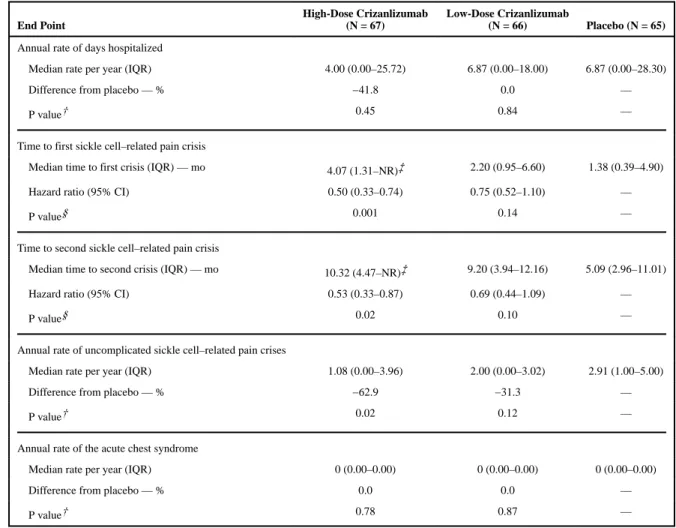
Secondary End Points—The median rate of days hospitalized was 4.00 per year in the high-dose crizanlizumab group and 6.87 per year in the placebo group. This rate was 41.8% lower with high-dose crizanlizumab than with placebo, although the difference was not significant (P = 0.45) (Table 3).
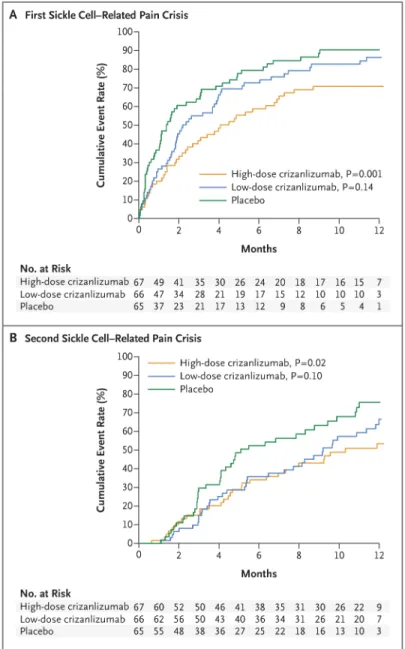
The median time to the first crisis was significantly longer among patients receiving high-dose crizanlizumab than among those receiving placebo (4.07 vs. 1.38 months, P = 0.001), as was the median time to the second crisis (10.32 vs. 5.09 months, P = 0.02) (Table 3). The lower crisis frequency with high-dose crizanlizumab was evident within 2 weeks after the start of the 52-week treatment phase and was maintained throughout this phase (Fig. 1A). The median times to the first and second crises among patients receiving low-dose crizanlizumab did not differ significantly from the times among patients receiving placebo (Fig. 1A and 1B and Table 3).
The rate of uncomplicated crises per year was 62.9% lower in the high-dose crizanlizumab group than in the placebo group (median rate, 1.08 vs. 2.91; P = 0.02). In this trial, the acute chest syndrome, hepatic sequestration, splenic sequestration, and priapism were rare (median rate, 0.00 in all groups), and there were no significant differences between either of the active-treatment groups and the placebo group.
Assessment of quality of life was performed with the Brief Pain Inventory questionnaire. Changes in the pain-severity domain and the pain-interference domain of the Brief Pain Inventory over the course of the trial tended to be small. There were no significant changes from baseline in the least-squares means during the trial.
Measures of Hemolysis—To investigate whether crizanlizumab had an effect on hemolytic variables in patients with sickle cell disease, changes in hemoglobin, lactate dehydrogenase, number of reticulocytes, haptoglobin, and indirect bilirubin were assessed during the study. No significant differences were observed in any of these variables between patients receiving crizanlizumab and those receiving placebo (data not shown).
PHARMACOKINETICS, PHARMACODYNAMICS, AND IMMUNOGENICITY OF CRIZANLIZUMAB
The serum concentrations of crizanlizumab reached steady-state levels after the loading doses, were maintained throughout the 52-week treatment period, and were
dose-proportional (Fig. S2A in the Supplementary Appendix). The mean trough concentrations of crizanlizumab during the maintenance phase (weeks 6 to 50) ranged from 2.8 to 6.8 μg per milliliter with low-dose crizanlizumab and from 10.5 to 15.0 μg per milliliter with high-dose crizanlizumab. High-dose crizanlizumab effectively blocked P-selectin binding to PSGL-1 throughout the treatment phase, whereas low-dose crizanlizumab was associated with only partial blockade (Fig. S2B in the Supplementary Appendix). Antibodies against
crizanlizumab were not detected.
SAFETY
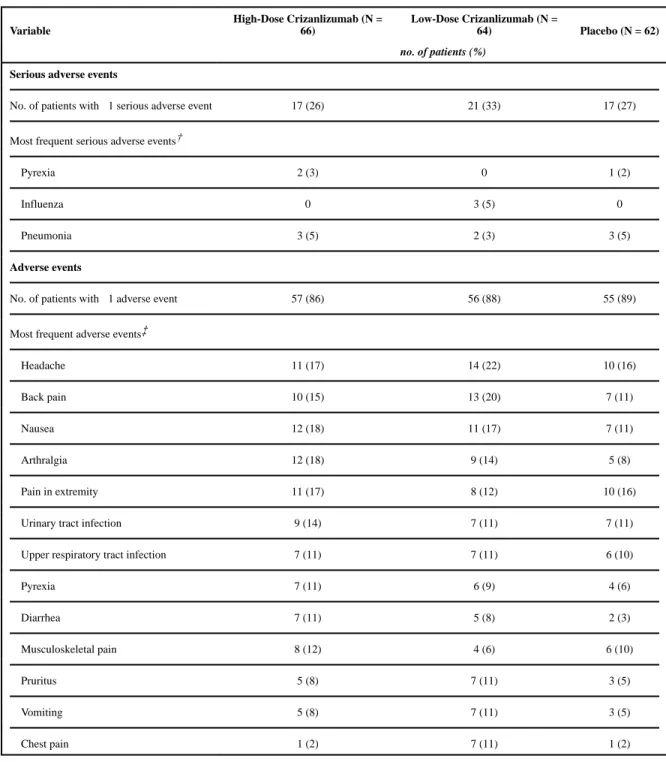
Serious adverse events were reported in 55 patients, including 17 patients in the high-dose crizanlizumab group, 21 in the low-dose crizanlizumab group, and 17 in the placebo group
A
uthor Man
uscr
ipt
A
uthor Man
uscr
ipt
A
uthor Man
uscr
ipt
A
uthor Man
uscr
(Table 4). The serious adverse events that occurred in at least 2 patients in either active-treatment group and at a higher frequency than in the placebo group were pyrexia and influenza. A total of 5 patients died during the trial, including 2 patients in the high-dose crizanlizumab group (1 patient from the acute chest syndrome, and 1 from endocarditis and sepsis), 1 in the low-dose crizanlizumab group (from the acute chest syndrome, aspiration, respiratory failure, and progressive vascular congestion), and 2 in the placebo group (1 from right ventricular failure, and 1 from vaso-occlusive crisis, ischemic stroke, coma, sepsis, and venous thrombosis of the right lower limb).
Three additional single-occurrence adverse events that were considered to be both serious and life-threatening but that did not result in death included sepsis (in the placebo group), anemia (in the low-dose crizanlizumab group), and intracranial hemorrhage (in the low-dose crizanlizumab group). The patient with intracranial hemorrhage was being treated with
ketorolac, which is associated with an increased risk of hemorrhagic stroke,20,21 at the time
of the event. No other clinically significant bleeding events were observed in the trial. Adverse events that occurred in 10% or more of the patients in either active-treatment group were headache, back pain, nausea, arthralgia, pain in upper and lower limbs, urinary tract infection, upper respiratory tract infection, pyrexia, diarrhea, musculoskeletal pain, pruritus, vomiting, and chest pain.
DISCUSSION
Despite an increased understanding of the pathophysiology of sickle cell disease, the treatment options for disease-related complications, including sickle cell–related pain crises, remain limited. Hydroxyurea, which was approved by the Food and Drug Administration in 1998, is the only drug that has been shown to modify the natural history of sickle cell
disease.22 However, many patients who receive hydroxyurea therapy continue to have crises,
end-organ damage, and a decreased life expectancy.23 In addition, adherence to the
hydroxyurea regimen remains a challenge. 24 Trials of new drugs for the prevention of crises
have not shown significant or clinically meaningful results.25,26
In this randomized, phase 2 trial, we observed that treatment with high-dose crizanlizumab resulted in an annual rate of sickle cell–related pain crises that was 45.3% lower than the rate with placebo. In addition, the median times to the first and second crises were two to three times as long in patients receiving high-dose crizanlizumab as in those receiving placebo. These treatment effects were significant.
In this trial, we enrolled patients who were receiving concomitant hydroxyurea as well as those who were not receiving hydroxyurea. The annual crisis rate was 32.1% lower with high-dose crizanlizumab than with placebo among patients receiving hydroxyurea and 50.0% lower among patients who were not receiving hydroxyurea.
Patients with all the common sickle cell disease genotypes were enrolled in this trial. Genotypes other than HbSS were observed in 29% of the patients who underwent
randomization. The annual crisis rate was 34.6% lower with high-dose crizanlizumab than
A
uthor Man
uscr
ipt
A
uthor Man
uscr
ipt
A
uthor Man
uscr
ipt
A
uthor Man
uscr
with placebo among patients with the HbSS genotype and 50.5% lower among those with a genotype other than HbSS.
No significant differences were observed in markers of hemolysis (hemoglobin, lactate dehydrogenase, haptoglobin levels, number of reticulocytes, and indirect bilirubin) between patients receiving crizanlizumab and those receiving placebo (data not shown). This finding suggests that the observed clinical benefit derived from P-selectin inhibition did not involve a reduction in hemolysis.
The overall incidences of adverse events and serious adverse events among the patients treated with crizanlizumab were similar to the incidences among patients who received placebo. A detectable antibody response against crizanlizumab did not develop in any patient during the trial. Longer follow-up and monitoring are necessary to ensure that late neutralizing antibodies do not emerge that might limit the ability to administer
crizanlizumab on a long-term basis.
In conclusion, the P-selectin inhibitor crizanlizumab was associated with a significantly lower frequency of sickle cell–related pain crises than placebo among patients with sickle cell disease, and crizanlizumab appeared to be associated with a low rate of adverse effects. Clinically meaningful lower rates of crises were observed with high-dose crizanlizumab than with placebo, regardless of concomitant hydroxyurea use or sickle cell disease genotype.
Supplementary Material
Refer to Web version on PubMed Central for supplementary material.
Acknowledgments
Supported by Selexys Pharmaceuticals and by grants to Selexys Pharmaceuticals from the National Heart, Lung, and Blood Institute of the National Institutes of Health (award number, 5R44HL093893) and the Orphan Products Grant Program of the Food and Drug Administration (award number, R01FD004805).
Dr. Gordeuk reports receiving grant support from Pfizer, Emmaus Life Sciences, Mast Therapeutics, GlycoMimetics, Hema-Quest Pharmaceuticals, and ApoPharma; and Drs. Rollins, Stocker, and Rother, being employees of and owning stock in Selexys Pharmaceuticals at the time of the study; Drs. Rollins and Rother also report holding patents related to methods of treating inflammatory or thrombotic conditions with anti-P-selectin antibodies (U.S. patent number, 8945565) and anti-P-selectin antibodies (U.S. patent number, 9068001), both assigned to Selexys Pharmaceuticals.
References
1. Ballas SK, Lusardi M. Hospital readmission for adult acute sickle cell painful episodes: frequency, etiology, and prognostic significance. Am J Hematol. 2005; 79:17–25. [PubMed: 15849770] 2. van Tuijn CF, van Beers EJ, Schnog JJ, Biemond BJ. Pain rate and social circumstances rather than
cumulative organ damage determine the quality of life in adults with sickle cell disease. Am J Hematol. 2010; 85:532–5. [PubMed: 20575034]
3. Platt OS, Brambilla DJ, Rosse WF, et al. Mortality in sickle cell disease — life expectancy and risk factors for early death. N Engl J Med. 1994; 330:1639–44. [PubMed: 7993409]
4. Ballas SK, Gupta K, Adams-Graves P. Sickle cell pain: a critical reappraisal. Blood. 2012; 120:3647–56. [PubMed: 22923496]
5. Bunn HF. Pathogenesis and treatment of sickle cell disease. N Engl J Med. 1997; 337:762–9. [PubMed: 9287233]
A
uthor Man
uscr
ipt
A
uthor Man
uscr
ipt
A
uthor Man
uscr
ipt
A
uthor Man
uscr
6. Rees DC, Williams TN, Gladwin MT. Sickle-cell disease. Lancet. 2010; 376:2018–31. [PubMed: 21131035]
7. Hebbel RP, Boogaerts MA, Eaton JW, Steinberg MH. Erythrocyte adherence to endothelium in sickle-cell anemia — a possible determinant of disease severity. N Engl J Med. 1980; 302:992–5. [PubMed: 7366623]
8. Manwani D, Frenette PS. Vaso-occlusion in sickle cell disease: pathophysiology and novel targeted therapies. Blood. 2013; 122:3892–8. [PubMed: 24052549]
9. Wun T, Paglieroni T, Tablin F, Welborn J, Nelson K, Cheung A. Platelet activation and platelet-erythrocyte aggregates in patients with sickle cell anemia. J Lab Clin Med. 1997; 129:507–16. [PubMed: 9142047]
10. Zarbock A, Polanowska-Grabowska RK, Ley K. Platelet-neutrophil-interactions: linking hemostasis and inflammation. Blood Rev. 2007; 21:99–111. [PubMed: 16987572]
11. Frenette PS. Sickle cell vasoocclusion: heterotypic, multicellular aggregations driven by leukocyte adhesion. Microcirculation. 2004; 11:167–77. [PubMed: 15280090]
12. Lawrence MB, Springer TA. Leukocytes roll on a selectin at physiologic flow rates: distinction from and prerequisite for adhesion through integrins. Cell. 1991; 65:859–73. [PubMed: 1710173] 13. Matsui NM, Borsig L, Rosen SD, Yaghmai M, Varki A, Embury SH. P-selectin mediates the
adhesion of sickle erythrocytes to the endothelium. Blood. 2001; 98:1955–62. [PubMed: 11535535]
14. Matsui NM, Varki A, Embury SH. Heparin inhibits the flow adhesion of sickle red blood cells to P-selectin. Blood. 2002; 100:3790–6. [PubMed: 12393591]
15. Embury SH, Matsui NM, Ramanujam S, et al. The contribution of endothelial cell P-selectin to the microvascular flow of mouse sickle erythrocytes in vivo. Blood. 2004; 104:3378–85. [PubMed: 15271798]
16. Polanowska-Grabowska R, Wallace K, Field JJ, et al. P-selectin-mediated platelet-neutrophil aggregate formation activates neutrophils in mouse and human sickle cell disease. Arterioscler Thromb Vasc Biol. 2010; 30:2392–9. [PubMed: 21071696]
17. Turhan A, Weiss LA, Mohandas N, Coller BS, Frenette PS. Primary role for adherent leukocytes in sickle cell vascular occlusion: a new paradigm. Proc Natl Acad Sci U S A. 2002; 99:3047–51. [PubMed: 11880644]
18. Gutsaeva DR, Parkerson JB, Yerigenahally SD, et al. Inhibition of cell adhesion by anti-P-selectin aptamer: a new potential therapeutic agent for sickle cell disease. Blood. 2011; 117:727–35. [PubMed: 20926770]
19. Kutlar A, Ataga KI, McMahon L, et al. A potent oral P-selectin blocking agent improves microcirculatory blood flow and a marker of endothelial cell injury in patients with sickle cell disease. Am J Hematol. 2012; 87:536–9. [PubMed: 22488107]
20. Chang CH, Shau WY, Kuo CW, Chen ST, Lai MS. Increased risk of stroke associated with nonsteroidal anti-inflammatory drugs: a nationwide case-crossover study. Stroke. 2010; 41:1884– 90. [PubMed: 20671253]
21. Chuang SY, Yu Y, Sheu WH, et al. Association of short-term use of nonsteroidal anti-inflammatory drugs with stroke in patients with hypertension. Stroke. 2015; 46:996–1003. [PubMed: 25737315] 22. Charache S, Terrin ML, Moore RD, et al. Effect of hydroxyurea on the frequency of painful crises
in sickle cell anemia. N Engl J Med. 1995; 332:1317–22. [PubMed: 7715639]
23. Steinberg MH, Barton F, Castro O, et al. Effect of hydroxyurea on mortality and morbidity in adult sickle cell anemia: risks and benefits up to 9 years of treatment. JAMA. 2003; 289:1645–51. [PubMed: 12672732]
24. Candrilli SD, O’Brien SH, Ware RE, Nahata MC, Seiber EE, Balkrishnan R. Hydroxyurea adherence and associated outcomes among Medicaid enrollees with sickle cell disease. Am J Hematol. 2011; 86:273–7. [PubMed: 21328441]
25. Ataga KI, Reid M, Ballas SK, et al. Improvements in haemolysis and indicators of erythrocyte survival do not correlate with acute vaso-occlusive crises in patients with sickle cell disease: a phase III randomized, placebo-controlled, double-blind study of the Gardos channel blocker senicapoc (ICA-17043). Br J Haematol. 2011; 153:92–104. [PubMed: 21323872]
A
uthor Man
uscr
ipt
A
uthor Man
uscr
ipt
A
uthor Man
uscr
ipt
A
uthor Man
uscr
26. Heeney MM, Hoppe CC, Abboud MR, et al. A multinational trial of prasugrel for sickle cell vaso-occlusive events. N Engl J Med. 2016; 374:625–35. [PubMed: 26644172]
Appendix
The authors’ full names and academic degrees are as follows: Kenneth I. Ataga, M.B., B.S., Abdullah Kutlar, M.D., Julie Kanter, M.D., Darla Liles, M.D., Rodolfo Cancado, M.D., Ph.D., João Friedrisch, M.D., Ph.D., Troy H. Guthrie, M.D., Jennifer Knight-Madden, M.B., B.S., Ph.D., Ofelia A. Alvarez, M.D., Victor R. Gordeuk, M.D., Sandra Gualandro, M.D., Ph.D., Marina P. Colella, M.D., Ph.D., Wally R. Smith, M.D., Scott A. Rollins, Ph.D., Jonathan W. Stocker, Ph.D., and Russell P. Rother, Ph.D.
The authors’ affiliations are as follows: the Division of Hematology–Oncology, University of North Carolina, Chapel Hill (K.I.A.), and the Division of Hematology–Oncology, East Carolina University, Greenville (D.L.) — both in North Carolina; the Sickle Cell Center, Medical College of Georgia, Augusta University, Augusta (A.K.); the Division of Pediatrics, Medical University of South Carolina, Charleston (J.K.); the Department of Hematology– Oncology, Santa Casa Medical School of São Paulo (R.C.), and the Division of Hematology, University of São Paulo (S.G.), São Paulo, the Hematology and Bone Marrow
Transplantation Service, Hospital de Clínicas de Porto Alegre, Porto Alegre (J.F.), and the Hematology and Hemotherapy Center, University of Campinas, Campinas (M.P.C.) — all in Brazil; the Baptist Cancer Institute, Baptist Medical Center, Jacksonville, FL (T.H.G.); the Sickle Cell Unit, University of the West Indies, Mona, Jamaica (J.K.-M.); the Division of Pediatric Hematology–Oncology, University of Miami, Miami (O.A.A.); the Department of Medicine, University of Illinois at Chicago, Chicago (V.R.G.); the Division of General Internal Medicine, Virginia Commonwealth University Medical Center, Richmond (W.R.S.); and Selexys Pharmaceuticals, Oklahoma City (S.A.R., J.W.S., R.P.R.).
A
uthor Man
uscr
ipt
A
uthor Man
uscr
ipt
A
uthor Man
uscr
ipt
A
uthor Man
uscr
Figure 1. Kaplan–Meier Curves for the Median Times to the First and Second Sickle Cell– Related Pain Crises, According to Trial Group
P values are for the comparison of the high-dose or low-dose crizanlizumab group with the placebo group and were calculated with the use of the log-rank test.
A
uthor Man
uscr
ipt
A
uthor Man
uscr
ipt
A
uthor Man
uscr
ipt
A
uthor Man
uscr
A
uthor Man
uscr
ipt
A
uthor Man
uscr
ipt
A
uthor Man
uscr
ipt
A
uthor Man
uscr
ipt
Table 1
Characteristics and Baseline Values of the Patients in the Intention-to-Treat Population.*
Characteristic
High-Dose Crizanlizumab (N = 67)
Low-Dose Crizanlizumab (N
= 66) Placebo (N = 65)
Age — yr
Median 29 29 26
Range 16–63 17–57 16–56
Sex — no. (%)
Male 32 (48) 30 (45) 27 (42)
Female 35 (52) 36 (55) 38 (58)
Race — no. (%)†
Black 60 (90) 62 (94) 60 (92)
White 4 (6) 2 (3) 3 (5)
Other 3 (4) 2 (3) 2 (3)
Sickle cell disease genotype — no. (%)
HbSS 47 (70) 47 (71) 47 (72)
Other‡ 20 (30) 19 (29) 18 (28)
Concomitant hydroxyurea use — no. (%)
Yes 42 (63) 41 (62) 40 (62)
No 25 (37) 25 (38) 25 (38)
Sickle cell–related pain crises during previous 12 mo — no. (%)
2–4 crises 42 (63) 41 (62) 41 (63)
5–10 crises 25 (37) 25 (38) 24 (37)
*
The high-dose crizanlizumab group received 5.0 mg of crizanlizumab per kilogram of body weight, and the low-dose crizanlizumab group 2.5 mg per kilogram. There were no significant between-group differences in the characteristics listed here. HbSS denotes homozygous hemoglobin S. †
Race was self-reported. ‡
A
uthor Man
uscr
ipt
A
uthor Man
uscr
ipt
A
uthor Man
uscr
ipt
A
uthor Man
uscr
ipt
Table 2
Annual Rates of Sickle Cell–Related Pain Crises.*
Variable High-Dose Crizanlizumab Low-Dose Crizanlizumab Placebo
Primary end point: annual rate of crises in the intention-to-treat population
No. of patients 67 66 65
Median rate of crises per year (IQR) 1.63 (0.00–3.97) 2.01 (1.00–3.98) 2.98 (1.25–5.87)
Difference from placebo — % −45.3 −32.6 —
P value 0.01 0.18 —
No. of patients with crisis rate of zero at end of trial 24 12 11
Annual rate of crises in the per-protocol population
No. of patients 40 44 41
Median rate of crises per year (IQR) 1.04 (0.00–3.42) 2.00 (1.00–3.02) 2.18 (1.96–4.96)
Difference from placebo — % −52.3 −8.3 —
P value 0.02 0.13 —
No. of patients with crisis rate of zero at end of trial 15 7 5
Subgroup analyses in the intention-to-treat population
According to concomitant hydroxyurea use
Use
No. of patients 42 41 40
Median rate of crises per year (IQR) 2.43 (0.00–4.01) 2.00 (1.00–3.93) 3.58 (1.13–6.23) Difference from placebo — % −32.1 −44.1
No use
No. of patients 25 25 25
Median rate of crises per year (IQR) 1.00 (0.00–2.00) 2.16 (1.89–3.98) 2.00 (1.63–3.90)
Difference from placebo — % −50.0 8.0 —
According to no. of crises in previous 12 mo
2–4 crises
No. of patients 42 41 41
Median rate of crises per year (IQR) 1.14 (0.00–3.96) 2.00 (1.00–3.02) 2.00 (1.00–3.90)
Difference from placebo — % −43.0 0.0 —
5–10 crises
No. of patients 25 25 24
A
uthor Man
uscr
ipt
A
uthor Man
uscr
ipt
A
uthor Man
uscr
ipt
A
uthor Man
uscr
ipt
Variable High-Dose Crizanlizumab Low-Dose Crizanlizumab Placebo
Difference from placebo — % −63.0 −43.2 —
According to sickle cell disease genotype
HbSS
No. of patients 47 47 47
Median rate of crises per year (IQR) 1.97 (0.00–3.96) 2.05 (1.00–4.96) 3.01 (1.01–6.00)
Difference from placebo — % −34.6 −31.9 —
Other
No. of patients 20 19 18
Median rate of crises per year (IQR) 0.99 (0.00–4.01) 2.00 (1.00–3.03) 2.00 (1.86–5.00)
Difference from placebo — % −50.5 0.0 —
*
The primary end point was the annual rate of crises in the high-dose crizanlizumab group versus the placebo group. The intention-to-treat population included all patients who underwent randomization. The per-protocol population included all the patients who underwent
A
uthor Man
uscr
ipt
A
uthor Man
uscr
ipt
A
uthor Man
uscr
ipt
A
uthor Man
uscr
ipt
Table 3
Secondary End Points in the Intention-to-Treat Population.*
End Point
High-Dose Crizanlizumab (N = 67)
Low-Dose Crizanlizumab
(N = 66) Placebo (N = 65)
Annual rate of days hospitalized
Median rate per year (IQR) 4.00 (0.00–25.72) 6.87 (0.00–18.00) 6.87 (0.00–28.30)
Difference from placebo — % −41.8 0.0 —
P value† 0.45 0.84 —
Time to first sickle cell–related pain crisis
Median time to first crisis (IQR) — mo 4.07 (1.31–NR)‡ 2.20 (0.95–6.60) 1.38 (0.39–4.90)
Hazard ratio (95% CI) 0.50 (0.33–0.74) 0.75 (0.52–1.10) —
P value§ 0.001 0.14 —
Time to second sickle cell–related pain crisis
Median time to second crisis (IQR) — mo 10.32 (4.47–NR)‡ 9.20 (3.94–12.16) 5.09 (2.96–11.01)
Hazard ratio (95% CI) 0.53 (0.33–0.87) 0.69 (0.44–1.09) —
P value§ 0.02 0.10 —
Annual rate of uncomplicated sickle cell–related pain crises
Median rate per year (IQR) 1.08 (0.00–3.96) 2.00 (0.00–3.02) 2.91 (1.00–5.00)
Difference from placebo — % −62.9 −31.3 —
P value† 0.02 0.12 —
Annual rate of the acute chest syndrome
Median rate per year (IQR) 0 (0.00–0.00) 0 (0.00–0.00) 0 (0.00–0.00)
Difference from placebo — % 0.0 0.0 —
P value† 0.78 0.87 —
*
CI denotes confidence interval. †
P values are for the comparison between the active-treatment group and the placebo group and were calculated with the use of a stratified Wilcoxon rank-sum test.
‡
The 75% value for the interquartile range was not observed within the 52-week trial and was considered to be not reportable (NR). §
A
uthor Man
uscr
ipt
A
uthor Man
uscr
ipt
A
uthor Man
uscr
ipt
A
uthor Man
uscr
ipt
Table 4
Adverse Events in the Safety Population.*
Variable
High-Dose Crizanlizumab (N = 66)
Low-Dose Crizanlizumab (N =
64) Placebo (N = 62)
no. of patients (%)
Serious adverse events
No. of patients with ≥1 serious adverse event 17 (26) 21 (33) 17 (27)
Most frequent serious adverse events†
Pyrexia 2 (3) 0 1 (2)
Influenza 0 3 (5) 0
Pneumonia 3 (5) 2 (3) 3 (5)
Adverse events
No. of patients with ≥1 adverse event 57 (86) 56 (88) 55 (89)
Most frequent adverse events‡
Headache 11 (17) 14 (22) 10 (16)
Back pain 10 (15) 13 (20) 7 (11)
Nausea 12 (18) 11 (17) 7 (11)
Arthralgia 12 (18) 9 (14) 5 (8)
Pain in extremity 11 (17) 8 (12) 10 (16)
Urinary tract infection 9 (14) 7 (11) 7 (11)
Upper respiratory tract infection 7 (11) 7 (11) 6 (10)
Pyrexia 7 (11) 6 (9) 4 (6)
Diarrhea 7 (11) 5 (8) 2 (3)
Musculoskeletal pain 8 (12) 4 (6) 6 (10)
Pruritus 5 (8) 7 (11) 3 (5)
Vomiting 5 (8) 7 (11) 3 (5)
Chest pain 1 (2) 7 (11) 1 (2)
*
Adverse events were coded with the use of preferred terms from the Medical Dictionary for Regulatory Activities. The safety population included patients who underwent randomization and received at least one dose of crizanlizumab or placebo.
†
The most frequent serious adverse events were those that occurred in at least two patients in either active-treatment group. ‡