Australian Journal of Basic and Applied Sciences
2019 March; 13(4): pages 18-28 DOI: 10.22587/ajbas.2019.13.4.4
Original paper AENSI Publications Journal home page: www.ajbasweb.com
Australian Journal of Basic and Applied Sciences ISSN: 1991-8178, EISSN: 2309-8414
Design and Implementation of Task Scheduling Model for Cloud
Computing Using Simevents
1
Dr.Mohammed Younis Thanoun, 2Hanan Luqman AL_Sawaf
1
Dr.Mohammed Younis Thanoun, Department of Electrical Engineering, College of Engineering, University of Mosul, Mosul/IRAQ.
2Hanan Luqman AL_Sawaf, Department of Electrical Engineering, College of Engineering, University of Mosul, Mosul/IRAQ.
Correspondence Author: Dr.Mohammed Younis Thanoun, Department of Electrical Engineering, College of Engineering, University of Mosul, Mosul/IRAQ E-mail: [email protected]
Received date: 28 January 2019, Accepted date: 13 March 2019, Online date: 28 April 2019
Copyright: © 2019 Dr.Mohammed Younis Thanoun et al, This is an open-access article distributed under the terms of the Creative Commons Attribution License, which permits unrestricted use, distribution, and reproduction in any medium, provided the original author and source are credited.
Keywords: Task scheduling Algorithm, Cloud Computing, Cloudsim, Simevents
INTRODUCTION
The term (Cloud Computing) refers to the possibility of sharing services provided by the service provider to customers online to exploit the capabilities of the high-service provider without having to purchase expensive hardware. In the sense that the service provider shares considerable potential and reliable to provide its servers with a variety of services to the customer. The cloud computing is accepted widely in the world because it offers a range of information technology services to users with vision facilities and network computing, as users can exploit network resources in exchange for paying a simple wage (J.Kok Konjaang et al. ,2016).
Scheduling Model: Is the process of distributing the tasks required by users to the resources available in the cloud to ensure the rapid completion of tasks and the optimal use of available resources, taking into account ensuring fairness between users as much
as possible (Ekta Rani and Harpreet Kaur ,2017;Bhavika Mulia and Rikin Thakkar,2016). Scheduling tasks effectively are one of
the critical challenges to be solved in a cloud computing environment (Elhossiny Ibrahim et al.,2015), since resources must be appropriately used to get the minimum time to perform tasks. This is the primary purpose of scheduling algorithms in a cloud computing environment (Bhavika Mulia and Rikin Thakkar,2016).
Simulation Program CloudSim: Is a particular simulation program in cloud computing. The program is open source, allowing simulations and experiments on cloud computing. CloudSim aims to facilitate and accelerate the process of empirical studies using cloud computing. Note that conducting such empirical studies using real cloud infrastructure may take a long time due to their large size and complexity. CloudSim mitigates these challenges by providing a platform where each component's strategies
Abstract
can be tested in a controlled and replicable way. A set of scheduling algorithms can be tested andstudied in a convenient and easy way. This program supports the simulation of data centers, servers and hosts and controlling their properties, the process of simulating different algorithms in the distribution of host resources between virtual machines and testing of different models at the lowest costs, while providing the ability to measure the performance of the infrastructure of any simulated system in terms o f time taken by the system to implement services and Energy consumed by data centers (http://www.cloudbus.org/cloudsim/) (Rodrigo N. Calheiros, et al. ,2011).
Simulation program SimEvents : The Simevents simulation program was used to simulate cloud computing. Simulation models were designed and implemented using this program and results were compared with the results of the Cloudsim simulation program. It is worth mentioning that this program (simevents) is developed by MathWorks, which adds a library of graphical building blocks to modelling queuing systems for the Simulink environment (Prof. H. C Inyiama et al., 2012).
RELATED WORK
(Prof. H. C Inyiama et al.,2012) Designed a model using event-based simulation as a simplified approach to the development of complex event-based engineering systems. Explains the steps to develop a simulation model and analyze it using the Simevents MATLAB software package. (Dr. Mohammed Younis and Dr.AIA Jabbar, 2014) designed an Ethernet network using simevents based on the proposed NIC card and compared its performance with any similar Ethernet based on the OPNET program, simulating the two systems through affected performance results Production and delay performance. (Medhat Tawfiq et al. ,2015) Compared the Ant Colony Optimization (ACO) task scheduler with different scheduling algorithms.
Gibet Tani Hicham and El Amrani Chaker, (2016) Presented several experiments based on the CloudSim Toolkit for consideration and evaluation Performance scheduling of these algorithms in cloud computing such as infrastructure. Also, the design, work and proposal of the CloudSim device were introduced, and two new algorithms were introduced to identify and enhance the scheduling of existing algorithms and to highlight the vulnerabilities and effectiveness of these algorithms. JKok Konjaang et al., (2016) studied to improve the efficiency of resource allocation in the cloud by exploiting the Max-Min scheduling algorithm and enhancing it to increase efficiency in the time of completion (makepan), as used (CloudSim) to compare the effectiveness of Max Min's algorithm with traditional effectiveness. (Bhavika Mulia and Rikin Thakkar, 2016) conducted a comparative study of the task scheduler algorithm to reduce task execution time. (Vatsal Gajera et al. ,2016) Also introduced a task scheduling algorithm based on the commonly used Min-Max data mining technology and the proposed Min-Min Max-Min (NMOMXS) algorithm. Through simulations.
The proposed algorithm illustrates two well-known time-making algorithms (makepan) and use of resources. Paul Moggridge et al., (2017) Proposed a new approach to scheduling in the context of Cloud Computing. The Maxmin Fast Track (MXFT) algorithm reviews the Max-min algorithm to support smaller tasks better through SLAs, making them more suitable for cloud computing. (MXFT) Is inspired by supermarket queues where there is a fast lane for customers with fewer items. The algorithm outperforms Max-min in task execution times and exceeds Min-min in the overall ranking. One of the by-products of this algorithm was the development of a simulator called ScheduleSim which makes it easier to demonstrate a scheduling algorithm before committing to a specific scheduling problem in cloud computing, and thus may be a useful introduction to experiments using CloudSim. Elhossiny Ibrahim et al. ,(2017) proposed a timetable for the cloud environment. The proposed algorithm is to assign the task given to the best resource during the run time of some functions based on the measurement of the current state of each support in relation to the availability level according to the processing power, cost and number of operational tasks to see how well it is received to receive the incoming task. And evaluating the performance of the proposed algorithm, by conducting a comparative study between the results of the algorithms with the proposed algorithm. Mir Salim Ul Islam and Bhawana Rana, 2017) proposed a credit-based scheduling algorithm based on length and priority, taking into account the quality of the service requirements of the user. Mohammed Suleiman and Dr Saad Ahmed Ayoub, (2015) discussed the comparison of the five scheduling algorithms using the Vienna Semimolar program. Such a round robin, the relative exposition and maximum productivity.
METHODOLOGY
In this research, models were designed and implemented to simulate cloud scheduling algorithms using the cloudsim program, implemented by Eclipse and using one of the scheduling algorithms, FCFS. These models were re-implemented using the SimEvents program, and then the results of each simulator were compared.
SIMULATION1
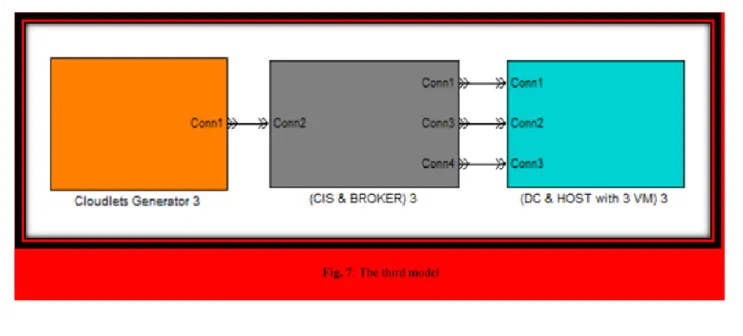
In the third model, two policies were implemented: the first policy is the time shared policy. The last two tasks were executed concurrently because they are time-shared on the same VM and result in a delay in time. The second policy is the space sharing policy, which reduces time, where one task is performed (cloudlet), and the last task remains in wait for the VM.
Figure (1) shows the basic structure of cloud computing, where this model consists of six essential parts:
1. Cloud Information Service (CIS): It stores all information about all data centres in the cloud environment.
2. Datacenter (DC): A group of hosts or servers that provide infrastructure service.
3. Broker: A vital component that communicates with (CIS) and retrieves (DC) information and decides which VM will perform the task.
4. Host: Is a physical entity that contains essential information such as the amount of memory and storage and contains a sharing policy to distribute the processing power between VMs, strategies to show the VM bandwidth and provide memory.
5. VM: They are virtual machines located within the host. It can be controlled by a (DC).
6. Cloudlets: The tasks or requests of the user we want to implement within the (DC) (Elhossiny Ibrahim et al.,2015) (Ekta Rani and Harpreet Kaur,2017).
A simulation model of Figure (1) was also constructed using the Simevents program and as described in the following form Figure (2) to Figure (7) and according to the model mentioned above. The results of these models were compared with the results of the Cloudsim simulation program and the results of the reference (Ekta Rani and Harpreet Kaur,2017). The results were as follows:
The contents of a sub-system (1) of the first model are shown in Figure (3).
The contents of a sub-system (3) of the first model are shown in Figure (5).
The figure (6) illustrates the second simulation model.
RESULTS AND DISCUSSION
The following figures show how these results are close to each other, indicating the success of the design using Simevents. Therefore, the other scenario simulate using simevents also. Figure (8) shows the execution time of the first proposed model. Two cloudlets implemented on 2VM possessing the same characteristics and speed.
While Figure (10) shows the execution time of the third proposed model when time is shared by implementing 4cloudlet, by three virtual machines (VM), with different speeds.
SIMULATION 2
Another model was used to compare the First Come First Serve (FCFS) algorithm, which performs the tasks according to their access sequence so that the first task is executed and then the second task and so on with the Shortest-Job-First algorithm (SJF) where the selection of short-time task to be implemented first.
The comparison was made in terms of the time of implementation of the tasks, and through the two programs Cloudsim and Simevents and the following assumptions were adopted:
Where this code was added to the main code of the datacenter broker, and then the code reorder these lengths ascending order to pass the shorter task first and as shown in Figure (13).
The block (FIFO Queue) was used to perform the function of DatacenterBroker in the FCFS and block (Priority Queue) algorithm and to install its specification in ascending order to complete the same DatacenterBroker function in the SJF algorithm as shown in Figure (15).
RESULTS AND DISCUSSION 2
CONCLUSION AND FUTURE WORK
1. The results of the research show that it is possible to design a simulation model for cloud computing systems using the Simevents program easily and exploit the possibilities of this program in testing different types of algorit hms, as this program proved efficient in obtaining results matching the results of the program Cloudsim.
2. We observe the superiority of the SJF algorithm on the FCFS algorithm.
3. It is possible to design and study the status of change of tasks during the implementation of (dynamic) in future research.
REFERENCES
J.Kok Konjaang, J.Y.Maipan-uku and Kumangkem Kennedy " An Efficient Max-Min Resource Allocator and Task Scheduling Algorithm in Cloud Computing Environment" International Journal of Computer Applications (0975 – 8887) Volume 142 – No.8, May 2016.
Ekta Rani and Harpreet Kaur "Study on Fundamental usage of Cloudsim Simulator and Algorithms of Resource Allocation in Cloud Computing" 8th ICCCNT 2017 July 3-5, 2017, IIT Delhi, Delhi, India IEEE – 40222.
Bhavika Mulia and Rikin Thakkar "A Comparative Study of Task Scheduling Algorithms to Reduce The Task Execution Time" December 2016 | IJIRT | Volume 3 Issue 7 | ISSN: 2349-6002.
Elhossiny Ibrahim, Nirmeen A. ElBahnasawy and Fatma Omara " Job Scheduling based on Harmonization between the Requested and Available Processing Power in The Cloud Computing Environment" International Journal of Computer Applications (0975 – 8887) Volume 125 – No.13, September 2015.
The Cloudsim Program http://www.cloudbus.org/cloudsim/
Rodrigo N. Calheiros, et al.," CloudSim: A Toolkit for Modeling and Simulation of Cloud Computing Environments and Evaluation of Resource Provisioning Algorithms", Software: Practice and Experience, Volume 41, Number 1, Pages: 23-50, ISSN: 0038-0644, Wiley Press, New York, USA, January 2011.
Prof. H. C Inyiama , Udeze Chidiebele. C, Dr C.C Okezie ,and Okafor Kennedy. C. "MATLAB Simevent: A Process Model Approach for Event-Based Communication Network Design, (A Case for Reengineered DCN)" J. Basic. Appl. Sci. Res., 2(5)5070-5080, 2012© 2012, TextRoad Publication.
Dr.Mohammed Younis, and Dr.A. I. A. Jabbar "Design and Validation of Ethernet Network Interface Card using Simevents Technique"International Journal of Computer Applications (0975 – 8887) Volume 87 – No.10, February 2014.
Medhat Tawfeek, Ashraf El-Sisi, Arabi Keshk and Fawzy Torkey "Cloud Task Scheduling Based on Ant Colony Optimization" The International Arab Journal of Information Technology, Vol. 12, No. 2 , March 2015.
Gibet Tani Hicham and El Amrani Chaker "Cloud Computing CPU Allocation and Scheduling Algorithms Using CloudSim Simulator" International Journal of Electrical and Computer Engineering (IJECE)Vol. 6, No. 4, August 2016, pp. 1866~1879 ISSN: 2088-8708, DOI: 10.11591/ijece.v6i4.10144.
Vatsal Gajera, Shubham, Rishabh Gupta, and Prasanta K. Jana " An Effective Multi-Objective Task Scheduling Algorithm using Min-Max Normalization in Cloud Computing" 978-1-5090-2399-8/16/$31.00c 2016 IEEE.
Paul Moggridge, Na Helian, Yi Sun, Mariana Lilley, and Vito Veneziano"Revising Max-min for Scheduling in a Cloud Computing Context" 2017 IEEE ,26th International Conference on Enabling Technologies: Infrastructure for Collaborative Enterprises.
Elhossiny Ibrahim, Nirmeen A. El-Bahnasawy and Fatma A. Omara "Dynamic Task Scheduling in Cloud Computing Based on the Availability Level of Resources"International Journal of Grid and Distributed Computing Vol. 10, No. 8 (2017), pp.21-36 http://dx.doi.org/10.14257/ijgdc.2017.10.8.03.
Mir Salim Ul Islam and Bhawana Rana"Task Scheduling in Cloud Computing"International Journal of Advance Research, Ideas and Innovations in Technology © 2017, www.IJARIIT.com All Rights Reserved.