AUSTRALIAN JOURNAL OF BASIC AND
Open Access Journal
Published BY AENSI Publication
© 2016 AENSI Publisher All rights reserved
This work is licensed under the Creative Commons Attribution International License (CC BY). http://creativecommons.org/licenses/by/4.0/
To Cite This Article: N. H. Abdurahman and Olalere, O. A Piperine from Black Pepper (Piper nigrum). Aust. J. Basic & Appl. Sci.,
Taguchi-Based Optimization Technique in
Piperine from Black Pepper (
N. H. Abdurahman and Olalere, O. A
Faculty of Chemical and Natural Resources Engineering, University Malaysia Pahang
Address For Correspondence:
N. H. Abdurahman, Faculty of Chemical and Natural Resources Engineering, University Malaysia Pahang E-mail: [email protected]
A R T I C L E I N F O Article history: Received 13 April 2016 Accepted 21 May 2016 Published 28 May 2016
Keywords:
Black pepper, Piperine, Extraction, Microwave,
Reflux,Taguchi,Optimization.
Many researchers have investigated and established black pepper(piper nigrum) constituents
industries (Viktorija, M., et al., 2014;
important component responsible for the pungency solubility increases at elevated temperature treatment of gastrointestinal disorder, shingles, and microbial related ailments Gilani, 2010; et al. Dr. MAGEED, 2000
the bioavailability enhancing capacity of Piperine as anti-apoptotic and anti-cancer agents
Piperine and capsaicicoids content in different cultivars of pepper is determined by variety, climate, geographical location, maturity, and the method of processing. The combine effect of these therefore shows that, no one particular pepper is rich in all nutrients, hence the need
nutritional benefits (Emmanuel-Ikpeme, C., 2014
AUSTRALIAN JOURNAL OF BASIC AND
APPLIED SCIENCES
ISSN:1991-8178 EISSN: 2309-8414 Journal home page: www.ajbasweb.com
© 2016 AENSI Publisher All rights reserved
This work is licensed under the Creative Commons Attribution International License (CC BY). http://creativecommons.org/licenses/by/4.0/
N. H. Abdurahman and Olalere, O. A., Taguchi-Based Optimization Technique in Reflux Microwave Extraction of Aust. J. Basic & Appl. Sci., 10(9): 293-299, 2016
Based Optimization Technique in Reflux Microwave Extraction of
Black Pepper (Piper nigrum)
Resources Engineering, University Malaysia Pahang-UMP
Faculty of Chemical and Natural Resources Engineering, University Malaysia Pahang-UMP
A B S T R A C T
In recent times, major concern had been placed on the medicinal and clinical use of Piperine; amajor component of black pepper. The need then arises to qualitatively extract Piperine using an extraction method with a minimal sample
irradiation time, lower solvent consumption, reduced solvent contamination and a higher extraction yield, among other factors. Microwave reflux extraction is such method which united the microwave and traditional solvent extraction with the merit of shorter extraction time, low solvent consumption and higher extraction rate.
based orthogonal optimization design was therefore employed using Minitab 17® to investigate the combined effects of four numerical factors on the extraction of Piperine from black pepper under the reflux microwave extraction
obtained, the optimum conditions revealed that irradiation time,
level, feed particle size, and solvent-to-feed ratio has an optimum value of 90 mins,350W,0.105mm, and 10mL/g respectively ranked in concordant to their extremum(Delta) differences. At this point the optimum conditions were validated to have a Piperine yield of 2.058% w/w. Moreover, the Relative Standard deviations of 0.62% and 0.30% from the confirmatory and spectrometric repeatability respectively indicated a better prediction of a good precision for the robust parametric Taguchi experimental designs. Hence, the optimized setting from this study offered a pragmatic approach in the industrial scaling up of Piperine from black pepper via reflux microwave method.
INTRODUCTION
Many researchers have investigated and established the economical, nutritional and medicinal benefits constituents to food, traditional medicine, agricultural, defense and
., 2014; Nwokem, C., et al., 2010; Adkins, L.D., 2002). Piperine is responsible for the pungency in black pepper. It is slightly soluble in water at 18
temperatures. Numerous studies elucidated the therapeutic uses of Piperine gastrointestinal disorder, rheumatism, joint/toothaches, sore throats, arthritis, asthma, coughs, and microbial related ailments (Vasavirama, K. and M. Upender, 2014; Mehmood, M.H. and A.H.
. Dr. MAGEED, 2000; Length, F., 2015). (Vasavirama, K. and M. Upender, 2014 ancing capacity of Piperine as anti-inflammatory, anti-oxidant, analgesic, anti
cancer agents. (Montoya-Ballesteros, L.C., et al., 2014) Opined
content in different cultivars of pepper is determined by variety, climate, geographical location, maturity, and the method of processing. The combine effect of these therefore shows that, no one particular pepper is rich in all nutrients, hence the need to consume the pepper as combinations for
Ikpeme, C., 2014).
Based Optimization Technique in Reflux Microwave Extraction of
Microwave Extraction of
UMP
In recent times, major concern had been placed on the medicinal and clinical use of need then arises to qualitatively minimal sample usage, shorter irradiation time, lower solvent consumption, reduced solvent contamination and a among other factors. Microwave reflux extraction is such method which united the microwave and traditional solvent extraction with the merit of shorter extraction time, low solvent consumption and higher extraction rate. A Taguchi-onal optimization design was therefore employed using Minitab 17® to factors on the extraction of Piperine reflux microwave extraction method. From the results imum conditions revealed that irradiation time, microwave power feed ratio has an optimum value of 90 mins,350W,0.105mm, and 10mL/g respectively ranked in concordant to their At this point the optimum conditions were validated to have a Piperine yield of 2.058% w/w. Moreover, the Relative Standard deviations of 0.62% and 0.30% from the confirmatory and spectrometric repeatability tests of a good precision for the robust parametric Hence, the optimized setting from this study offered a pragmatic approach in the industrial scaling up of Piperine from black pepper via reflux
The microwave reflux extraction is such a method in which the rate of heat and mass transfer is uniform throughout the heating medium (homogeneity). Here the heat is volumetrically dispersed within the irradiate medium, unlike the conventional method of extraction in which heat is transfer from the region of higher temperature to a lower region (M.A. Surat, et al., 2012; Tatke, P. and Y. Jaiswal, 2011). (Ballard, T.S., et al., 2010), opined that the conventional solid-liquid extraction can generate unwanted residuals with plant matrix and the extract experiencing oxidative quantitative change during the solvent removal stage. However, various scientific studies revealed the microwave assisted extraction’s relevance to obtaining pure extracts from natural products, without undesirable residues. Microwave reflux extraction is therefore a new approach which united the microwave and traditional solvent extraction with the merit of shorter extraction time, low solvent consumption and higher extraction rate (Paunović, D.Đ., et al., 2014).
The identification of various important parameters affecting the extraction of Piperine from black pepper was considered. This was achieved by keeping all other parameters constant and varying a single parameter from a series of batch experiment iteratively performed using water as an extracting solvents. The quality of extracts is therefore determined and normalized from the actual percentage of Piperine calculated from peak area the Gas Chromatography Mass Spectrometric determination rather than the quantitative yield (Durmaz, E., et al., 2015; Centre, C.S., 2006; Gupta, M., et al., 2013).
MATERIAL AND METHOD
2.1 Sample Preparation and Experimental Procedures:
The standard grade black pepper was identified and purchased from the Malaysian Pepper Board located in Sarawak Malaysia. The initial moisture content of the black pepper was 3-4%. A 5g of the pepper was then oven dried at 400Covernight, pulverized into a fine spice powder and preserved in an airtight sealed nylon. This was latter clarified into five different particle sizes of 0.105mm, 0.154mm,0.30 mm, 0.45mm and 0.9mm.
A 2ml of the sample is taken from the reactor at 30mins interval and then centrifuged (eppendorf 5810R 7.5V -model) at 40C using 6000rpm.The clear liquid is filtered out using nylon micro-filter(0.45µm model).2 ml of the solvent is replaced back into the reactor to account for the one taken for analysis. A small quantity of anhydrous sodium sulphate was added into the extract to remove any trace of water. This was stored in a vial and refrigerated at 40C subsequent to the spectrometric qualitative analysis to determine the extractable Piperine content.
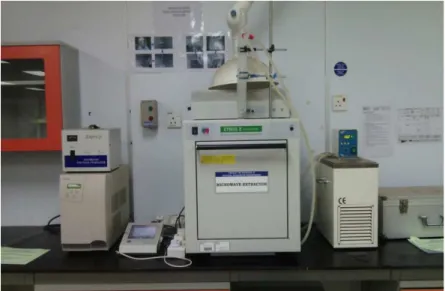
Fig. 1: Experimental Set-up of Milestone Ethos Microwave Extraction System
2.2 Spectrometric Determination of Total Piperine in Piper nigrum:
An Agilent Gas Chromatography-Mass Spectrometer (5973N Wilmington, DE, UAS) fitted with a capillary column (30m length, internal diameter 0.25mm and film thickness 0.25lm) and UV mass detector(70eV-electorn mode) was used to assay and determine the composition of the Piperine in the black pepper sample at different parameter settings. This technique provides an accurate qualitative analysis of organic volatile and semi-volatile bioactive compounds a capillary column controlled by temperature. An initial temperature of 500C and final 2400C was set at 5min and 30C per min respectively before a subsequent 3000C was initiated. A column cleaning-up was then performed for a final hold of 3min (Ranitha, M., et al., 2014).
Piperine percentage composition was obtained from the comparative fingerprinting of the measured spectrum to a registered reference spectra from NIST05a.Library database. The percentage of Piperine component was then calculated from the measured peak area in relation to the total peak area of 100% using the normalization method.
The actual Piperine content in the black pepper was then estimated as the percentage of the qualitative composition respect to the quantity of dried pepper loading using the Eq.1 below.
Actual Piperine Yield (w/w %) = % (1)
RESULTS AND DISCUSSION
3.1 Effect of Irradiation Time Variation:
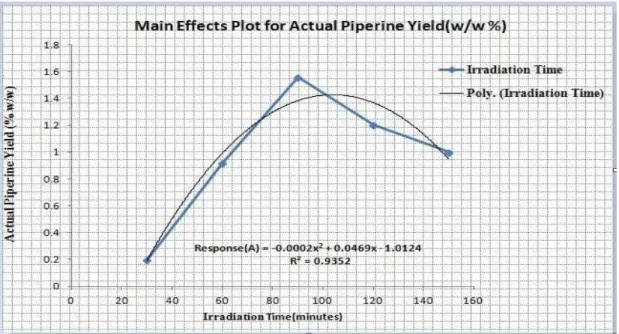
The Fig.2 shows the effects of irradiation time on the Piperine yield at constant temperature (600C), feed particle size (0.30mm), microwave power level(200W) and solvent to feed ratio(6mL/g).From the trend line obtained, it can be seen that as the extraction time increases progressively from 30min to 90mins there was a sharp increase in the amount of Piperine extracted from the pepper matrix, indicating an increase in the rate of extraction (Rouatbi, M., et al., 2007). However the amount of extractable Piperine becomes depleted as the irradiation time increases .In addition to this; the coefficient of determination was estimated to be R2 =0.9352 which suggests that the data obtained from time variation is statistically fit into the quadratic polynomial model as shown in Eq. 2. Also, the calculated p-value is a pointer to the fact that the irradiation time as a factor is statistically significant and therefore has an higher contribution to the reflux microwave extraction of the bioactive Piperine in the black pepper.
Fig. 2: Effect of Irradiation Time
3.2 Effect of Microwave Power Level Variation:
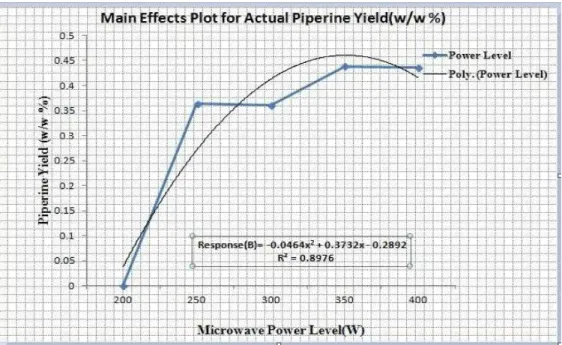
The Fig.2 demonstrated the effect of microwave power level on the Piperine yield at constant irradiation time (30mins), temperature (600C), feed particle size (0.30mm) and solvent to feed ratio (6mL/g).The power level set under this study were 200W, 250W,300W, 350W and 400W.At the initial microwave power of 200W and 250W the Piperine yield experienced a sharp increase which later plummeted slightly before dramatic recovery hitting a peak value of 0.4374 w/w %.This sudden increase is due to the breaking of the cell wall of the pepper matrix and therefore resulting in the release of more microwave energy to the extracting medium (Raman, G. and V. Gaikar, 2002; Chan, C.-H., et al., 2011).
Fig. 3: Effect of Microwave Power Level
3.3 Effect of Feed Particle Size Variation:
The Fig.4 shows the effects of particle size variation on the amount of Piperine yield obtainable from black pepper sample at constant irradiation time (30mins), temperature (600C), solvent to feed ratio (6mL/g) and microwave power level (200W).On the overall, the highest amount of Piperine content increases steadily and peaked at 1.3214w/w% which later plunged to a near negative value. The negative value is an indicant of Piperine depletion inside the sample as the time of extraction increases. This suggests that a particle of smaller sizes, offer homogeneity and large contact surface area between the plant matrix and solvent and thereby allowing for a better solvent penetration and hence an increase in the extraction of the bioactive Piperine (Huie, C.W., 2002).
The p-value estimation (0.376774) clearly shows that the pepper particle size is not significant in the extraction of the Piperine from black pepper. However the R2 value shows a near satisfactory index of data fitness into the quadratic polynomial model when compared to the other design models(cubic, linear, power and exponential etc).
Fig. 4: Effect of Particle Size Distribution
3.4 Solvent-to-Feed Ratio Effect Variation:
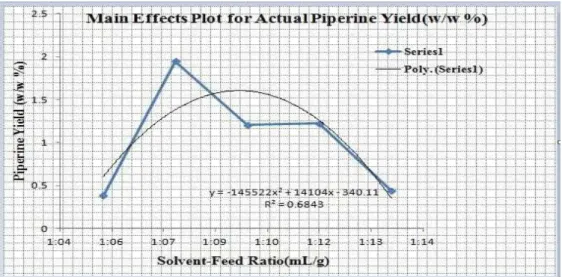
sample matrix. The R2 value of 1.000 is a pointer that the data is perfectly fitted into the quadratic polynomial model. However a higher p-value of 0.009507 above 0.05 indicated that the solvent-to-feed ratio contribution to Piperine extraction is significant.
Fig. 5: Effect of Solvent-Feed Ratio
3.5 Taguchi-Based Optimization:
The Taguchi based optimization tools was employed to estimate the effects of extraction parameters(irradiation time, microwave power level, feed particle size, and solvent-feed ratio) on the mean and variation of the response/signal (Piperine yield) factor. This is an experimental design methodology which permits a higher level of logical uniformity of the extraction parameters employed in the process of extracting bioactive compounds. This design is of immense benefits due to the minimum number of experiments involved, and thus reducing the extraction time and the cost of the sample procurement (Yang, L.J., 2001).Compared to other design, the Taguchi optimization method allows for independent investigation of each factors among others. It acknowledges that not all the extraction parameters with a higher variability can be controlled in real life extraction process. This variability is called noise factor which are taken into consideration in order to obtain optimal control factor settings (Steinberg, D.M. and D. Bursztyn, 1998).
In this research work, our main effects were irradiation time (A), microwave power level (B), feed particle size(C), and solvent-feed ratio (D). The optimization of the Piperine yield (% w/w) from black pepper was therefore achieved using a 3-level L9 orthogonal design (Du, H.Y., et al., 2013; Mandal, V., et al., 2008).
The factors and levels for the orthogonal design designated with A, B, C, and D were presented in table 1and analyzed using Minitab 17® experimental design software (Minitab, 2014).
Table 1: 3-Level L9 (3^4) Factors and Levels for the Orthogonal Design Level A:Irradiation Time(min)
A
B:Microwave Power Level(W) B
C:Feed Particle Size(mm) C
E:Solvent-Feed Ratio(mL/g) D
1 A1 30 B1 300 C1 0.105 D1 1:6
2 A2 60 B2 350 C2 0.154 D2 1:8*
3 A3 90* B3 400* C3 0.30* D3 1:10
*Represent the peak(exhaustive) extraction parameter at which the extractable Piperine is highest in one factor-at-a-time(OFAT) experimentation.
The Piperine yield obtained from the nine experiments runs performed using the 3orthogonal designs were shown in Table 2.All the experiments were carried out in randomized order to avoid bias and minimize the variability inherent in the response obtained.
Table 2: Results and Analysis of an Taguchi Based L9(3^4) Design for Optimality
Run
Irradiation Time(min) A:A
Microwave Power Level(W) B:B
Feed Particle Size(mm) C:C
Solvent-Feed Ratio(mL/g) D:D
Spectrometric Peak Area of Piperine Yield
Actual Piperine Yield%(w/w) in 5g sample
1 1 1 1 1 6.99 1.3972
2 1 2 2 2 3.49 0.6984
3 1 3 3 3 3.58 0.7160
4 2 1 2 3 5.97 1.1944
5 2 2 3 1 5.56 1.1118
7 3 1 3 2 2.93 0.5862
8 3* 2* 1* 3* 10.29* 2.0586*
9 3 3 2 1 3.83 0.7668
*Represents the optimal conditions for an optimal yield
The actual Piperine content in the black pepper was estimated as the percentage of the qualitative composition with respect to the amount of dried pepper used (5g) as shown in the Eq.1 above.
Table 3: Response matrix for Means,p-values and R2 Irradiation Time(min)
Microwave Power(W)
Feed Particle Size(mm)
Solvent-Feed Ratio(mL/g)
Means of Level 1 0.9372 1.0593 1.4412 1.0919
Means of Level 2 1.0580 1.2896 0.8865 0.7175
Means of Level 3 1.1372 0.7835 0.8049 1.3230
R-Square 0.9623 0.8610 0.9454 1.0000
p-value probability <0.002918m* <0.001726m* 0.376774n <0.009507m*
F-value 17.80472 71.83469 0.005368 0.683394
Df 9 9 9 5
MS 1125.031 3125.022 0.291102 0.738317
SS 9000.248 25000.17 2.328815 2.953268
Delta(Extremum Difference)
0.2000 0.5061 0.6365 0.6055
Ranking of Optimal Level
4 3 1 2
For a ‘p-value’ <0.0500,is an indication that the model terms are significant. m* Significantn Not significant.
From Table 4, the extremum difference (delta) is the measure used in Minitab to find the optimal settings of combination of factors. The optimal settings of each of the extraction parameters were obtained as a function of the extremum (Delta) difference which was later used in ranking the extraction parameters according to their order of contribution (Maghsoodloo, S., et al., 2004; Dame, N., 2015). As can be seen from Table 3, the optimum extraction conditions for Piperine extraction from black pepper (piper nigrum)are irradiation time (A) at 90mins, microwave power level (B) at 350W, feed particle size(C) at 0.105mm, and solvent-feed ratio(D) at 10mL/g(10:1).The Piperine yield under this optimal conditions is 2.0586 w/w %.
The influence of these four factors decreases in the order C>D>B>A.A triplicate confirmatory test were carried out under the optimal condition of 2.058 w/w% generated from Taguchi design and the results indicated a relative standard deviation (R.S.D.) value of 0.62% was obtained when compared with the percentage mean of 2.076 w/w% obtained from the confirmatory tests. Also, a repeatability spectrometry process was performed in triplicate using the same GC-Mass spectrometric conditions. This accounts for the deviation inherent in the repeated use of the GC-MS. Piperine yield from the re-analysis were 2.058 w/w%, 2.061 w/w% and 2.070 w/w% with a relative standard deviation(R.S.D.) of 0.30%.This result is therefore a better predictor that the experimental optimal condition has a satisfactory precision.
Conclusions
The extremum (Delta) difference determines the optimal combination of extraction parameter settings. The objective of this is to find the input parameters that will maximize the Piperine yield.
From the results of analysis obtained from the orthogonal optimization design, it can be clearly seen that the effect of…….is more pronounced and therefore has a higher contribution to the extraction of Piperine from black pepper. The optimum condition from Delta analysis revealed the optimum condition as ….for irradiation time (A)…for microwave power level (B), for feed particle size(C), and …. For solvent-feed ratio (D).The optimized setting obtained from this study therefore offered a pragmatic approach in scaling up of microwave extraction process for the industrial production of Piperine from black pepper.
ACKNOWLEDGEMENT
Olalere Olusegun Abayomi wishes to acknowledge the financial support and sponsorship from the Doctoral Scholarship Scheme of the Malaysian Ministry of Education (MOE) through the Universiti Malaysia Pahang (UMP),Malaysia.
REFERENCES
Viktorija, M., K.G. Liljana, R. Tatjana and G. Rubin, 2014. “Antioxidative effect of Capsicum oleoresins compared with pure capsaicin,” IOSR J. Pharm., 4(11): 44-48.
level of five different peppers grown in Nigeria,” NY Sci J, 3(9): 17-21.
Adkins, L.D., 2002. “Oleoresin Capsicum: an Analysis of the Implementation of Pepper Spray into the Law Enforcement Use of Force Continuum in a Selected Police Department,” Electron. Theses Diss., p: 86.
Vasavirama, K. and M. Upender, 2014. “Piperine: A valuable alkaloid from piper species,” Int. J. Pharm. Pharm. Sci., 6(4): 34-38.
Mehmood, M.H. and A.H. Gilani, 2010. “Pharmacological basis for the medicinal use of black pepper and piperine in gastrointestinal disorders.,” J. Med. Food, 13(5): 1086-96.
et al. Dr. MAGEED, 2000. “The medicinal uses of pepper,” Int. Pepper News, XXV(1): 1-9.
Length, F., 2015. “Phytochemical screening and antibacterial properties of selected Nigerian long pepper ( Capsicum frutescens ) fruits,” 9(38): 2067-2078.
Montoya-Ballesteros, L.C., A. González-León, M.A. García-Alvarado and G.C. Rodríguez-Jimenes, 2014. “Bioactive Compounds During Drying of Chili Peppers,” Dry. Technol., 32(12): 1486-1499.
Emmanuel-Ikpeme, C., 2014. “Comparative Evaluation of the Nutritional, Phytochemical and Microbiological Quality of Three Pepper Varieties,” J. Food Nutr. Sci., 2(3): 74.
M.A. Surat, S. Jauhari and K.R. Desak, 2012. “A brief review : Microwave assisted organic reaction,” Appl.
Sci. Res., 4(1): 645-661.
Tatke, P. and Y. Jaiswal, 2011. “An Overview of Microwave Assisted Extraction and its Applications in Herbal Drug Research,” Research Journal of Medicinal Plant, 5(1): 21-31.
Ballard, T.S., P. Mallikarjunan, K. Zhou and S. O’Keefe, 2010. “Microwave-assisted extraction of phenolic antioxidant compounds from peanut skins,” Food Chem.,120(4): 1185-1192.
Paunović, D.Đ., S.S. Mitić, D.A Kostić and M.N. Mitić, 2014. “Kinetics and Thermodynamics of the
Solid-Liquid Extraction Process of Total Polyphenols From Barley,” 3(2): 58-63.
Durmaz, E., G. Sumnu and S. Sahin, 2015. “Microwave-Assisted Extraction of Phenolic Compounds from Caper,” Sep. Sci. Technol., 6395: 150527095459001.
Centre, C.S., 2006. “Qualitative and Quantitative Analysis in GC and GCMS,”.
Gupta, M., S. Thakur, A. Sharma and S. Gupta, 2013. “Qualitative and quantitative analysis of phytochemicals and pharmacological value of some dye yielding medicinal plants,” Orient. J. Chem., 29(2): 475-481.
Ranitha, M., A.H. Nour, Z.A. Sulaiman, A.H. Nour and S. Thana Raj, 2014. “A comparative study of lemongrass (Cymbopogon Citratus) essential oil extracted by microwave-assisted hydrodistillation (MAHD) and conventional hydrodistillation (HD) method,” Int. J. Chem. Eng. Appl., 5(2): 104-108.
Rouatbi, M., A. Duquenoy and P. Giampaoli, 2007. “Extraction of the essential oil of thyme and black pepper by superheated steam,” J. Food Eng., 78(2): 708-714.
Raman, G. and V. Gaikar, 2002.“Microwave-assisted extraction of piperine from Piper nigrum,” Ind. Eng. Chem. Res., 41: 2521-2528.
Chan, C.-H., R. Yusoff, G.-C. Ngoh and F.W.-L. Kung, 2011. “Microwave-assisted extractions of active ingredients from plants,” J. Chromatogr. A, 1218(37): 6213-6225.
Gao, M.B., Z. Song and C.Z. Liu, 2006. “Dynamic microwave-assisted extraction of flavonoids from Saussurea medusa Maxim cultured cells,” Biochem. Eng. J., 32(2): 79-83.
Huie, C.W., 2002. “A review of modern sample-preparation techniques for the extraction and analysis of medicinal plants.,” Anal. Bioanal. Chem., 373(1-2): 23-30.
Yang, L.J., 2001. “Plasma surface hardening of ASSAB 760 steel specimens with Taguchi optimisation of the processing parameters,” J. Mater. Process. Technol., 113(1-3): 521-526.
Steinberg, D.M. and D. Bursztyn, 1998.“Noise Factors, Dispersion Effects, and Robust Design,” Stat. Sin., 8: 67-85.
Du, H.Y., Z.J. Shen and Y. Li, 2013. “Microwave-Assisted Extraction of Capsaicin from Chili Pepper Powder,” Adv. Mater. Res., 634-638: 1591-1594.
Mandal, V., Y. Mohan and S. Hemalatha, 2008.“Microwave assisted extraction of curcumin by sample-solvent dual heating mechanism using Taguchi L9 orthogonal design,” J. Pharm. Biomed. Anal., 46(2): 322-327.
Minitab, Getting Started with Minitab 17. 2014.
Maghsoodloo, S., G. Ozdemir, V. Jordan and C.-H. Huang, 2004. “Strengths and Limitations of Taguchi’s Contributions to Quality, Manufacturing, and Process Engineering,” J. Manuf. Syst., 23(2): 73-126.