ISSN: 2147-611X
International Journal of Education
in Mathematics, Science and
Technology (IJEMST)
www.ijemst.com
Theoretical Framework of Researcher
Knowledge Development in Mathematics
Education
Igor’ Kontorovich
The University of Auckland
To cite this article:
Kontorovich, I. (2016). Theoretical framework of researcher knowledge development in
mathematics education.
International Journal of Education in Mathematics, Science and
Technology, 4
(2), 101-111. DOI:10.18404/ijemst.90629
This article may be used for research, teaching, and private study purposes.
Any substantial or systematic reproduction, redistribution, reselling, loan, sub-licensing,
systematic supply, or distribution in any form to anyone is expressly forbidden.
Authors alone are responsible for the contents of their articles. The journal owns the
copyright of the articles.
Volume 4, Number 2, 2016
DOI:10.18404/ijemst.90629
Theoretical Framework of Researcher Knowledge Development in
Mathematics Education
Igor’ Kontorovich
Article Info
Abstract
Article History
Received: 26 February 2015
The goal of this paper is to present a framework of researcher knowledge development in conducting a study in mathematics education. The key components of the framework are: knowledge germane to conducting a particular study, processes of knowledge accumulation, and catalyzing filters that influence a researcher decision making. The components of the framework originated from a confluence between constructs and theories in Mathematics Education, Higher Education and Sociology. Previously published interviews with professor Jeremy Kilpatrick and professor Michèle Artigue are used for illustrating how the framework can be utilized in data analysis. Criteria for framework evaluation are discussed.
Accepted: 17 August 2015
Keywords
Research knowledge Mathematics education research
Introduction
Since its establishment in the second half of the previous century, the mathematics education (ME) community has invested a considerable effort in situating itself as an independent research field (e.g., AMTE, 2001; Bass, 2005; Fried & Dreyfus, 2014). A significant part of this effort has been put into instilling traditions of research excellence to graduate students. This is done through programs, courses and other activities aimed at developing students’ knowledge and proficiency in conducting studies in ME.
There are three important issues that bear mentioning regarding the above situation: First, ME graduate programs significantly diverse in their goals, components and expectations all over the world (AMTE, 2001; Andžāns, Bonka & Grevholm, 2008). Thus, the consensus is lacking on the core professional knowledge and on the ways this knowledge should be obtained. Second, while in the some fields, such as medicine, research knowledge and its development among graduate students are studied systematically (e.g., Burke, Schlenk, Sereika, Cohen, Happ & Dorman, 2005), empirical research on this topic does not exist in ME (Feldon, Maher & Timmerman, 2010; Boaler, Ball & Even, 2003). Third, experienced scholars from various research areas in ME are engaged in education of prospective researchers. However, research on professionalism and expertise repeatedly shows that experts excel in their core practices, but not necessarily in their analysis and communication of these practices (e.g., Van Someren, Barnard & Sandberg, 1994).
The above perspective is in-line with Shulman (2010), who said:
“Our practices in doctoral education are a combination of longstanding traditions, replications of how we ourselves were trained, administrative convenience, and profound inertia. We do not subject our programs to the kinds of experimental, skeptical, adventurous innovations and tests that we claim to value in our scholarly work” (ibid, p.9).
Shulman’s position is also shared by Boaler et al. (2003), who suggested that “Many of the components of successful research remain implicit and are left to new researchers to glean from finished products” (ibid, p. 489).These positions can be interpreted as an open call for empirical exploration of practicing researchers who, in our case, conduct studies in the field of ME. The insights that emerge from this exploration will be useful for the refinement of the current approaches used in educating prospective researchers and for consolidating the ME community around new approaches to developing knowledge of ME researchers.
development of researcher knowledge through carrying out a study in ME. The next section contains the considerations underpinning the design of the proposed framework. Then the theoretical background for the framework is presented. It is followed by the presentation of the framework and illustrations of how the framework can be utilized in data analysis. The aim of the illustrations is to demonstrate how such analysis illuminates various paths of development of researcher knowledge. The illustrations are taken from the self-reflective interviews with professor Jeremy Kilpatrick and professor Michèle Artigue, who are acknowledged as coryphaei in ME. The concluding section of the paper provides initial evaluation of the framework with respect to the set criteria.
Framework Design Considerations
For designing a framework of researcher knowledge in conducting a study in ME, the methodology of modified analytic induction is used (Bogdan & Biklen, 1998). This methodology requires identification of a phenomenon of interest and a descriptive initial hypothesis or a theoretical framework, which often emerges from the literature. In our case the phenomenon of interest is researcher knowledge that is engaged in conducting a study in ME and initial hypothesis addresses its possible trajectories of development. In the further stages, the theoretical framework is systematically refined based on the analysis of the collected data. This paper is focused on the emergence of the initial framework based on the selected literature.
When selecting literature for constructing a framework of researcher knowledge development, I draw on socio-constructivist approaches to learning mainly coming from Sociology, Higher Education and ME. By and large, these bodies of knowledge complement each other in the following way: Many sociological theories are concerned with knowledge development as a participation process in a community of practice (e.g., scientific community), but they rarely attend to the particular specifications of these communities (Wenger, 1998). Higher Education addresses the specifications of scientific communities, but the discipline (e.g., mathematics education) is rarely taken into consideration (Clarke, Hyde & Drennan, 2013). Mathematics Education is concerned with students’ mathematical knowledge and teachers’ pedagogical content knowledge, but it is in its infancy regarding researcher knowledge (Boaler et al. 2003). Thus, I attempt to address the aforementioned issues by constructing a confluence framework drawn on multiple research fields.
Theoretical Background
Knowledge
Shulman (2010) argues that conducting a study demands a highly complex set of understandings and skills. Boaler et al. (2003) conceptualize research as an active process of investigation when knowledge is mobilized into practice. The constructs of knowledge and practices are adopted in the framework. The choice to use the literature on teacher knowledge as a starting point is driven by two reasons: First, practicing researchers are the ones to teach graduate students, and consequently, they possess teacher knowledge. The literature on teacher knowledge, in its turn, continuously acknowledges the role of content (e.g., Ball, Thames & Phelps, 2008; Leikin & Zazkis, 2010; Shulman, 2010). In our case, the content is ME research. Second, literature on the development of teacher knowledge highlights the idea of “learning thought teaching” (Leikin & Zazkis, 2010). Similarly, the proposed framework acknowledges the development of researcher knowledge as “learning through research”.
In the summary of extensive literature on teacher knowledge, Leikin and Zazkis (2010) rely on Kennedy (2002), Scheffler (1965) and Shulman (1986), and propose to decode knowledge of a mathematics teacher according to three dimensions: sources, forms and kinds. Following Kennedy (2002), sources refer to systematic, craft and prescriptive knowledge. Systematic knowledge has been acquired through courses and reading research papers and professional books. Craft knowledge is developed through experience or practice. Prescriptive knowledge is the one acquired from institutional policies, accountability systems and texts of diverse nature. Following Scheffler (1965), forms of knowledge distinguish between knowing, which has a “propositional and procedural nature”, and believing, which is “construable as solely propositional” (ibid, p. 15). Scheffler argues that believing is a necessary condition for knowing.
Pedagogical knowledge consists of broad principles and strategies of classroom management and organization (e.g., group work), educational purposes and values, etc. Pedagogical content knowledge emerges in the intersection of pedagogy and mathematical subject matter (Ball et al., 2008). Pedagogical content knowledge is knowing how students approach mathematical tasks, the ability to design tasks fitted to students’ learning styles and needs, and knowing of the learning setting. In the proposed framework Leikin and Zazkis’es (2010) notion of dimensions of knowledge are borrowed and adjusted, switching from teacher knowledge to researcher knowledge in ME.
Practices
In their self-reflective paper Boaler et al. (2003) unpack the competent performance of a researcher in ME by exposing research practices in which accomplished researchers engage. By research practices, Boaler et al. (2003) refer to specific and recurrent professional activities of a ME researcher that require mobilization of knowledge in different situations. Eventually, they suggest a list of the following practices: reading, formulating a research question, using data carefully to make and ground claims, moving from the particular to the general, considering mathematics, and communicating research findings. Boaler et al. (2003) suggest designing opportunities for prospective researchers to engage in the aforementioned practices during their doctoral studies, as a part of preparation for an academic career in ME. The importance of these practices is unquestionable for conducting a study in ME. However, when focusing on the doing component, the scholars do not explicitly attend to the knowledge which is needed for executing these practices and the knowledge that is being developed as the result of their recurrent execution. In addition, the list seems rather unbalanced: For instance, the practice of formulating a research question is much more focused than considering mathematics. It is also relevant only to particular research stages, when reading is fundamental at all research stages. Nevertheless, the identified practices from this list are used to exemplify possible paths of researcher knowledge development.
Chance
In an ideal world possessing a broad and deep knowledge combined with a rich repertoire of practices is sufficient for professional excelling. However, more pragmatic approaches suggest that chance or luck have an important role in a person’s career. Indeed, in the Gagné’s (2004) and Tannenbaum’s (2003) models of giftedness and talent, chance is one of the factors responsible for self-realization. Moreover, Gagné (2004) argues that chance is embedded in other factors, such as genetics and environment. This is because being born in a particular family or attending a school with a program for talented students is also a matter of chance.
In a study with twenty five mathematicians, Liljedahl (2013) found that many of them perceive that chance has a large role in their work, especially in illumination and insight. The researcher distinguishes between intrinsic
and extrinsic chance. Intrinsic chance relates to a successful combination of a mathematician’s ideas that result in an insight. Extrinsic chance is all about exposure to the knowledge that is helpful for resolution of the problem that a mathematician is working on. Extrinsic chance is featured in the proposed framework.
Community of Practice
Wenger (1998) refers to community of practice as a group of people who share a concern or a passion, do and learn as they interact regularly. The common characteristics of a community of practice are: a shared domain of interest, which is ME in our case; mutual learning and knowledge sharing, which is research and finding dissemination in our case; and shared resources, that can be conceptualized as a body of knowledge accumulated by the community as a whole. Participation in a community of practice demands awareness of its concepts, facts and structure as well as realization of this knowledge in practice (Burkitt, Husband, McKenzie, Torn & Crew, 2001). As such, researcher’s knowledge of the ME community of practice is reflected in the proposed framework.
Professional Identity
publication, etc. On the other hand, professional identity reflects personal attributes, such as values, worldviews and perceptions (Clarke et al., 2013).
In the case under consideration, the construct of professional identity is in particularly complex because of the variety of communities of practices in which a ME researcher participates. Indeed, a professional identity of a ME researcher reflects many issues, such as mathematics curriculum and teaching methods in school and university, mathematics education curriculum and teaching methods for promoting prospective teachers and researchers, or research methods in ME. Thus, the construct of professional identity is also taken into consideration in the proposed framework.
The Proposed Framework
The proposed framework of researcher knowledge development in conducting a study in ME consists of three key components: Germaneknowledge, Accumulationprocesses and Catalyzing filters.
Germane Knowledge
The knowledge of a researcher is associated with an elastic organism that dynamically changes as a response to the decision-making that is involved in conducting a study in ME. For exploring its structure, I focus on a particular element and analyze it in three dimensions: source, kind and depth. Source is a modification of Kennedy’s (2002) categorization, which indicates from what community of practice a particular element of knowledge has originated. I differentiate between three types of sources: research setting, research group and
public outlets. Research setting is an environment of the study that was chosen and/or established by the researcher(s) for data collection (e.g., a mathematics classroom). Research group is a closely-knit community of practice unified by a common goal - conducting a particular study. Public outlets, such as the World Wide Web, books, research journals and conferences, enable access to knowledge of a particular community of practice. Apparently, it is easier to recall the source of an element in researcher’s knowledge when it is new.
Researcher knowledge contains enormous amount of elements of different kinds. Noting a quote by Alfred Hitchcock that “ideas come from everything”, I distinguish between three kinds of knowledge, which are in particular relevant for a study in ME: mathematical knowledge, pedagogical knowledge and methodological knowledge. Mathematical knowledge and pedagogical knowledge are adopted from Shulman (1986) and Ball et al. (2008). These types of knowledge can be in the focus of the conducted study (e.g., Mitchelmore, 1998 focused on students’ understanding of the mathematical concept of angle; Kapur, 2015 explored the effectiveness of the problem-posing pedagogy) as well as serve as an intellectual resource of the researcher for crafting a special task or a teaching method (e.g., see the tasks that Zazkis & Mamolo, 2012 propose for exploring teachers’ horizon knowledge and the problems that Levav-Wainberg & Leikin, 2012 used for promoting students’ creativity).
Methodological knowledge refers to everything related to carrying out a study: from philosophical and epistemological conceptions of research, through research paradigms and approaches, to designs, stages and techniques. Methodological knowledge also includes ethics as an inseparable research component, and technological methods for data collection and analysis. This type of knowledge is especially dominant when planning a study.
By depth, I refer to a qualitative level of a researcher’s understanding of a particular element at the time of depth
evaluation. For instance, a researcher may have heard about the Soul conjecture in Riemann geometry, without knowing the details. The depth of this knowledge-element can be quickly increased by searching the web and discovering that the conjecture was proved by Grigori Perelman in 1994.
Knowledge Accumulation Processes
study. This can happen when reading professional literature or listening to a conference lecture. In consolidation processes a researcher focuses on the relations between various elements of her knowledge and looks for connections, similarities, differences, evidences and contradictions. These processes lead to (re)organization, systematization and refinement, when researcher’s knowledge functions as a self-contained system. In sharing processes a researcher is concerned with communicating her knowledge to others, for instance, when writing a paper for a research journal, preparing a presentation for a conference or teaching. Searching ways for sharing knowledge such that it is accessible to others may also lead to clarification and gaining new insights.
Catalyzing Filters
Conducting a study can be seen as a continuous process of decision making that has a direct impact on absorbing, consolidating and sharing knowledge: What papers should one choose to read when entering a new field? What ideas should be developed first? In what journals can particular results get published? I put forward three modalities that influence researcher’s decision making:
Norms and standards, Professional agenda and Opportunities: Norms and standards are socio-cultural contracts within a particular community of practice that reflect a common understanding regarding absorbing, consolidating and sharing knowledge. It is an aggregate of traditions, rituals, trends and fashions of the community. Some of the norms and standards can be in consensus of various communities of practices in which a researcher participates. For instance, a structure of a standard empirical research paper is a variation on “Introduction – Research goal(s) and question(s) – Theoretical background – Method(ology) – Results – Discussion” format. Some of the norms and standards vary significantly even in relatively close communities of practice. For example, in the call for papers to the 13th International Conference on Higher Education of 2015 the
authors were instructed to “Do not publish “preliminary” data or results”. In the call for papers to the 9th
International Conference on Mathematical Giftedness and Creativity of 2015, reports on research in progress were welcomed. Thus, when participating in a particular community of practice a researcher should be fluent with the specificity of its standards and norms.
Professional agenda is a part of professional identity of a researcher consisting of values and goals in regard to self-capacity and the ability to make a difference in ME. It also involves preferences and beliefs with respect to teaching mathematics and research approaches.
Opportunities refer to a concatenation of circumstances in the career of a researcher. It is a sequence of events that are partially controlled by a researcher and partially depend on chance. Examples of opportunities – that can be seized or missed – are an access to a rich research setting, exposure to a useful theory, or collaboration with a resourceful colleague.
The presented modalities have a dual nature: on the one hand, they prescribe particular decision making and, accordingly, limit the researcher. On the other hand, an adequate analysis of the opportunities and norms of the community of practice can be exploited by a researcher for promoting her knowledge development. Thus, I refer to these modalities as catalyzing filters.
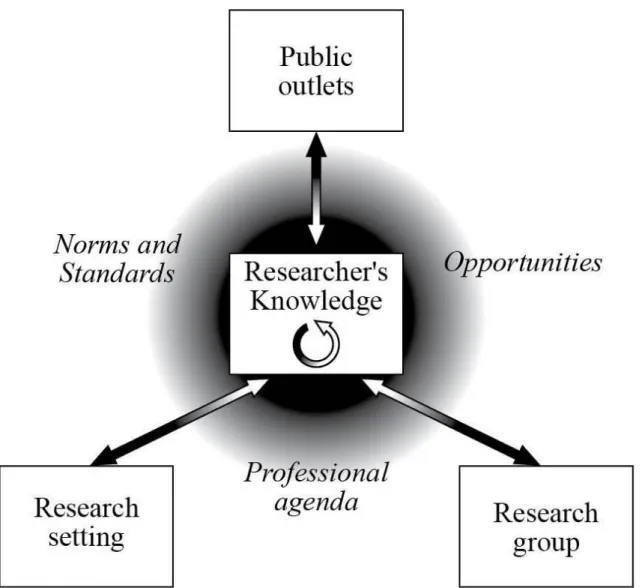
Figure 1 schematically summarizes the proposed framework: The rectangles indicate sources of knowledge, from which research ideas can be absorbed by the researchers and with which they can also be shared (straight arrows) as a result of consolidation processes (a round arrow). The dim rings around researcher knowledge symbolize the dual nature of catalyzing filters that presumably, have an impact on the ways a researcher absorbs, consolidates and shares research idea.
Illustrations
Figure 1. A proposed framework of researcher knowledge development in conducting a study in ME. The illustrations are taken from the interviews with professor Jeremy Kilpatrick and professor Michèle Artigue. The interviews are published in Karp (2014) and they were conducted by Alexander Karp and David Lindsay Roberts. The decision to use Karp’s (2014) book as a source of data is driven by the fact that the book comprises interviews with the leading ME researchers that elaborate on their past research experience. The interviews of Kilpatrick and Artigue are particularly informative with respect to research knowledge development and contain detailed elaborations on some of the studies in which the researchers took part. Thus, these interviews were chosen for the analysis in terms of the framework. The particular parts of the interviews were chosen to illustrate possible paths of researcher knowledge development.
Jeremy Kilpatrick is a Regents Professor in the University of Georgia and he significantly contributed to ME development through various projects around the world. He holds a Lifetime Achievement Award from the National Council of Teachers of Mathematics and the Felix Klein Medal awarded to him in 2007. Michèle Artigue is a Professor emeritus in the Université de Paris and a leading figure in the field of ME. In 2013 she was awarded the Felix Klein Medal by the International Commission on Mathematical Instruction (ICMI) for outstanding lifetime achievements in ME research and development. The analysis of the illustrations was guided by the following question: How can the development of Kilpatrick’s and Artigue’s research knowledge in conducting studies in ME be characterized in terms of the proposed framework?
Jeremy Kilpatrick
students. The study was led by Kilpatrick’s academic supervisor professor Edward Begle, when Kilpatrick was a PhD student.
Excerpt 1: Pedagogical mathematical lesson learned from NLSMA
“I don’t know where he got it, but I think that the most original thing that Begle brought to that study was to look at mathematics abilities in the plural, and to try to have multiple measure of mathematical outcomes at each grade level. That, of course, took a lot of testing and a lot of fancy designs, and there were a lot of elaborate statistics that came out of that. I think it was an original thing because, up to that point, people were just giving standard ETS [Educational Testing Service] Cooperative Algebra Tests and that sort of thing to determine whether one curriculum was doing something different from another. I think it was Begle’s idea that we’d look at lots of different pieces of mathematics and see where the different curricula were doing better or worse. Now, maybe that idea came from elsewhere, I don’t know, but it was certainly a feature of the Longitudinal Study that set it apart from some of the earlier efforts to compare curricula” (Karp, 2014, p. 106).
Analysis and Remarks
This excerpt illustrates how norms and standards of the ME community can shape the researcher’s processes of absorbing, consolidating and sharing a piece of pedagogical mathematical knowledge: NLSMA, to which Kilpatrick refers in this excerpt, can be seen as a reflection of the norms and standards of the ME community of the second half of the previous century: First, the study was led by Edward Begle, who was a research mathematician. The phenomenon of a mathematician engaging in ME of school students is not unique to that time, see George Pólya, Hans Freudenthal and Morris Kline for examples. Second, the study was focused on comparing mathematical outcomes of students who learned according to different curricula: traditional and “New Math”. By that, the study contributed to the prominent community discourse frequently referred to as “math wars” (see Bass, 2005 for details).
In this excerpt Kilpatrick reflects on the new pedagogical mathematical approach that he learned, when working in the NLSMA research team. Kilpatrick says that the key idea—to look at mathematical abilities as a multiple-facet concept—was absorbed by him from Edward Begle. Kilpatrick also took and integral part in the creation of forty four reports on NLSMA (Wilson, 2015). These reports evident for his processes of consolidating and sharing.
Excerpt 2: Methodological lessons learned from NLSMA
“There was also this kind of belief of Begle’s that if you just had a large enough data pool, you could dip into that pool and pull out the information you needed. One of the lessons that I think all of us learned who participated in that study was that there is no substitute for designing the thing ahead of time. You can’t rely on having a huge data pool in which you’ll find answers to your questions if you haven’t thought about your questions before you start. That’s been a motto that I’ve tried to get across to graduate students ever since, because I think there is this naïve belief that a big pool of data has the answers in it.
That research project was really a gigantic training effort for a lot of people, not just in math education, but also in statistics. People like Dave [David E.] Wiley and others actually learned quite a bit about how to handle large data sets and what needed to be done if you’re going to put all that in a computer. [...I]f you’re going to engage in this kind of analysis, which isn’t experimental, then you have to be able to handle various complicated multivariate designs. A lot of us got an education pretty fast in how to do that, so much so that most of us didn’t do any of that later [laughs].” (Karp, p.106)
Analysis and Remarks
research groups and realized in other research settings. Indeed, as a result of his participation in NLSMA, Kilpatrick learned three pieces of methodological knowledge: (1) On the importance of a well-planned research design; (2) on working with large data sets; and (3) having large data sets cannot compensate for ill-planned research design. Kilpatrick says that he relied on this knowledge in his later career and it became his motto, which he also passed to his students.
Michèle Artigue
Excerpt 3: Rock climbing as an opportunity for a new research direction
“[...] I was in contact with Adrien Douady, who was a specialist in dynamic systems. [...D]uring the weekends, we used to climb rocks in the forest of Fontainebleau and Andrien was a member of our group of climbers. He was trying to introduce third year students at the University to the qualitative study of differential equations, and helped me discover this domain. At the IREM, we had very good computer equipment [...]. Adrien and his sister Véronique Gautheron [...] used it for drawing phase portraits and exploring the behavior of dynamic systems. I joined them and with Véronique prepared an exhibition of phase portraits of autonomous systems of order 2 and wrote a book presenting an elementary vision of the qualitative study of differential equations. I began to use it in a course for second year students specializing in biology and earth sciences. Then, with Marc Rogalski, who was creating an experimental section at the University of Lille and his colleagues, I developed a didactical engineering for first year students on the topic. It was implemented during several consecutive years, and systematically investigated. This is how I began to work on the didactic of analysis” (Karp, 2014, p. 18).
Analysis and Remarks
This excerpt illustrates how seizing a sequence of opportunities can lead to a significant development in the career of a researcher and in her knowledge. In the case of Artigue, this sequence consisted of participation in a rock climbing club, working in a well-equipped university and networking. Artigue’s decision to engage in exploration of undergraduate mathematics can be explained by a careful reading of the emerging flow in norms and standards of the ME research community. Indeed in those years (early 1980s) the research on undergraduate mathematics education started to grow.
In research groups Artigue absorbed a new (for her) mathematical knowledge related to differential equations. The book that she wrote as a result of this collaboration, reflects mathematical and pedagogical knowledge that she consolidated on teaching and learning of this topic. Using the book in her pedagogical practice turned to a rich research setting for herself and for other scholars. Thus, this excerpt also illustrates Artigue’s capacity to craft new research opportunities for herself and other researchers.
Excerpt 4: From disagreement with the Ministry of Education to a funded research-project
“[...] I was asked by the Ministry of Education to join a group that was reflecting on the change that would be necessary if computer algebra systems (CAS) entered the secondary education. [...] I was not at all expert in CAS. [...] I observed their [group] work for about months and then we began working together. [...]After one year, we wrote a report for the Ministry of Education [basing on empirical data], showing that CAS technology had clear potential for mathematical learning, but that this potential was not easily actualized [...].
Analysis and Remarks
This excerpt shows how as the result of extensive increase in the depth of her pedagogical mathematics knowledge regarding CAS, Artigue succeeded to contribute to an already formed research group. The knowledge that was absorbed and consolidated from the research setting did not correspond to the expectations of the Ministry of Education. Nevertheless the group succeeded in sharing it in a way that fit the norms and standards of the Ministry and in such promoted research agenda of the group. Indeed, additional funding was granted and resulted in new research opportunities.
Summary and Discussion
This paper is stimulated by the calls arguing that the ME community has not been adequately concerned with the human endeavor of conducting a study in ME; a concern which is crucial for nurturing prospective researchers in the field (e.g., Shulman, 2010). Indeed, Boaler et al. (2003) wrote: “Because the preparation of mathematics education researchers has rarely been the object of systematic investigation, our field’s discussions of learning to do research tend to lack a theoretical frame” (p. 492). In this paper I presented a framework that can be considered as a nominee for such a frame. The key components of the framework are: (1) knowledge germane to conducting a particular study, (2) processes of knowledge accumulation, and (3) catalyzing filters that influence researchers’ decision making.
The framework is targeted at characterization of researcher knowledge, as well as its development when conducting a study. Knowledge characterizations can be addressed by the framework’s first component which provides the terminology of knowledge types, sources and depth. The development of researcher knowledge when conducting a study can be addressed by examining the processes of knowledge accumulation as a response to interactions with public outlets, research groups and settings.
Boaler et al. (2003) wrote that “Research, after all, is not knowledge. Research, whether empirical, theoretical or philosophical, is an active process of investigation, one that relies on strategic use of knowledge, in context” (p.
495, italics in original). The third component of the framework—catalyzing filters can be considered as an evident extension of Boaler et al.’s approach, and I consider this component as the central innovation of the framework. This is because it extends the perspective on researcher knowledge beyond “what a researcher knows or does” in the investigation; catalyzing filters take into account the community of practice in which a researcher participates. In this perspective, the active process of investigation is considered as a dialogue between a researcher and the community of practice, when the professional agenda of the former and the norms and standards of the latter shape each other. Accordingly, the cases when a researcher uses the opportunities provided by the community of practice to promote her professional agenda, can be accounted for as researcher knowledge in practice.
Dubinsky and McDonald (2001) offer a system of six criteria for evaluating a theory (or a framework) in ME from a theoretical and practical perspectives. They suggest that, “Theories in mathematics education can: (a) support prediction, (b) have explanatory power, (c) be applicable to a broad range of phenomena, (d) help organize one’s thinking about complex, interrelated phenomena, (e) serve as a tool for analyzing data, and (f) provide a language for communicating ideas that go beyond superficial descriptions.” (ibid, p. 275, letters are added). Evaluation of the framework according to these criteria demands an extensive empirical base, accumulation of which is a further research venue. Accordingly, at this point I can ponder the potential of the framework to meet the above criteria based on the analysis of several illustrative episodes.
conducted with secondary data collected by other researchers for another project. The fact that the proposed framework turned out to be useful is an argument in favor of its research convenience and its power to capture the central components of the explored phenomenon.
Pedagogical and research implications of the framework intertwine. A possible avenue of research is to explore research competency and its development in ME among experienced researchers and doctoral students. The framework can also be useful in designing courses for doctoral students. While many doctoral ME courses and programs are concerned with professional knowledge and practices (e.g., AMTE, 2001; Boaler et al., 2003), the ability to read the undocumented norms of the community, to identify research opportunities, and to be aware and promote professional agenda are rarely discussed. Accordingly, I suggest addressing these illusive issues in attempt to meet criterion (a) from the list of Dubinsky and McDonald (2001).
Acknowledgements
This research was supported by a small SSHRC grant (31-631962) internal Simon Fraser University Fund. I am grateful to Professor Rina Zazkis for her insightful comments on the earlier drafts of the paper, to Annette Rouleau for proofreading, and to Nir Schnapp for his help with graphics.
References
AMTE - Association of Mathematics Teachers Education (2001). Principles to guide the design and implementation of doctoral programs in mathematics education. AMTE Publications. Retrieved on February 2nd, 2015 from http://amte.net/publications.
Andžāns, A., Bonka, D., & Grevholm, B. (Eds.), (2008). Selected Papers of the ICME 11 Discussion Group 12: Rethinking Doctoral Programs in Mathematics Education. Riga: University of Latvia.
Ball, D., Thames, M., & Phelps, G. (2008). Content knowledge for teaching: what makes it special? Journal of Teacher Education, 59(5), 389-407.
Bass, H. (2005). Mathematics, mathematicians and mathematics education. Bulletin of the American Mathematics Society, 42(4), 417-430.
Boaler, J., Ball, D. L., & Even, R. (2003). Preparing researchers for disciplined inquiry: Learning from, in, and for practice. In A. Bishop & J. Kilpatrick (Eds.), International Handbook of Mathematics Education
(pp. 491-521). Dordrecht: Kluwer.
Bogdan, R. C., & Biklen, S. K. (1998). Qualitative research in education: An introduction to theory and methods. Needham Heights, MA: Allyn & Bacon.
Burke, L. E., Schlenk, E. A., Sereika, S. M., Cohen, S. M., Happ, M. B., & Dorman, J. S. (2005). Developing research competence to support evidence-based practice. Journal of Professional Nursing, 21(6), 358-363.
Burkitt, I., Husband, C., McKenzie, J., Torn, A., & Crew, S. (2001). Nurse Education and Communities of Practice. London: ENB.
Clarke, M., Hyde, A., & Drennan, J. (2013). Professional identity in High Education. In B. M. Kehm and U. Teichler (Eds.), The Academic Profession in Europe: New Tasks and New Challenges (pp. 7-21). London New York: Springer.
Dubinsky, E., & McDonald, M. (2001). APOS: A constructivist theory of learning in undergraduate mathematics education research. In D. Holton (Ed.), The teaching and learning of mathematics at university level: An ICMI study (pp. 275-282), Kluwer.
Gagné, F. (2004). Transforming gifts into talents: the DMGT as a developmental theory. High Ability Studies,
15, 119-147.
Feldon, D. F., Maher, M. A., & Timmerman, B. E. (2010). Performance-based data in the study of STEM Ph.D. education. Science, 329, 282-283.
Fried, N., & Dreyfus, T. (2014) Mathematics and mathematics education: Searching for common ground. New York, London: Springer.
Kapur, M. (2015). The preparatory effects of problem solving versus problem posing on learning from instruction. Learning and Instruction, 39, 23-31.
Karp, A. (2014). Leaders in mathematics education: Experience and vision. Rotterdam: Sense Publisher. Kennedy, M. M. (2002). Knowledge and teaching. Teacher and Teaching: Theory and Practice, 8, 355-370. Lave, J., & Wenger, E. (1991). Situated learning: Legitimate peripheral participation. Cambridge university
Leikin, R., & Zazkis, R. (2010). Teachers’ opportunities to learn mathematics through teaching. In R. Leikin and R. Zazkis (Eds), Learning Through Teaching Mathematics (pp. 3-21). Dordrecht: Springer. Levav-Wainberg, A., & Leikin, R. (2012). The role of multiple solutions tasks in developing knowledge and
creativity in geometry. Journal of Mathematical Behavior, 31, 73-90. Liljedahl, P. (2013). Illumination: an affective experience? ZDM, 45, 253-265.
Mitchelmore, M. C. (1998). Young students' concepts of turning and angle. Cognition and Instruction, 16(3), 265-284.
Scheffler, I. (1965). Conditions of Knowledge. An introduction to epistimology and education. Glenview, IL: Scott, Foresman & Company.
Shulman, L. S. (1986). Those who understand: Knowledge growth in teaching. Educational Researcher, 15(2), 4- 31.
Shulman, L. S. (2010). Doctoral education shouldn't be a marathon. The Chronicle of Higher Education: The Chronicle Review.
Tannenbaum, A. J. (2003). Nature and nurture of giftedness. In N. Colangelo and G. Daves (Eds.), Handbook of Gifted Education (2nd ed., pp. 41-53), Needham Heights, MA: Allyn & Bacon.
Van Someren, M. Y., Barnard, Y. F., & Sandberg, J. A. C. (1994). The think aloud method: A practical guide to modeling cognitive processes. London: Academic Press.
Wenger, E. (1998). Communities of Practice: learning, meaning and identity. Cambridge: Cambridge University Press.
Wilson, J. W. (2015). Fifty years and counting: Working with Jeremy Kilpatrick. In E. Silver and C. Keitel -Kreidt (Eds.), Pursuing excellence in mathematics education: Essays in honor of Jeremy Kilpatrick
(pp. 3-16). Switzerland: Springer.
Zazkis, R., & Mamolo, A. (2012). Continuing conversations towards the horizon. For the Learning of Mathematics, 32(1), 22-25.
Author Information
Igor’ KontorovichThe University of Auckland
Private Bag 92019, 38 Princes street, Auckland 1010, New Zealand