Developmental Experiences in the Prediction of Thought Action Fusion: Contribution of Religious, Familial, and Stress Factors
Noah C. Berman, M.A.
A dissertation submitted to the faculty of the University of North Carolina at Chapel Hill in partial fulfillment of the requirements for the degree of Doctor of Philosophy in the Department of Psychology (Clinical Psychology).
Chapel Hill 2013
Approved By:
Jonathan Abramowitz, Ph.D. Carol Cheatham, Ph.D.
ABSTRACT
NOAH C. BERMAN, M.A.: Developmental Experiences in the Prediction of Thought Action Fusion: Contribution of Religious, Familial, and Stress Factors
(Under the direction of Jonathan S. Abramowitz, Ph.D.)
Cognitive biases, such as TAF, play a crucial role in the cognitive-behavioral model of anxiety disorders and have been shown to prospectively increase the risk of developing future psychopathology. However, little research has examined the risk factors for this theoretically important construct. Therefore, the current study examined the
developmental correlates of TAF using a multi-method approach. Using both a self-report (N =407) and in vivo measure of TAF (N = 107), results indicated that religious-related variables predicted the moral bias of TAF, whereas parenting strategies and childhood trauma were associated with the likelihood bias. Distinct mediation pathways were observed, with intrinsic motivation mediating the relationship between religiosity and the moral bias; and psychological control mediating the relationship between
TABLE OF CONTENTS
LIST OF TABLES………vi
LIST OF FIGURES………...vii
LIST OF ABBREVIATIONS………...…viii
DEVELOPMENTAL EXPERIENCES IN THE PREDICTION OF THOUGHT ACTION FUSION: CONTRIBUTION OF RELIGIOUS, FAMILIAL, AND STRESS FACTORS ………....1
TAF and Psychopathology………..3
TAF and OCD ...3
TAF and Other Disorders ………...4
Rigid Rules ……….7
Religious Affiliation and Religiosity………...8
Motivation for Religion ……….…12
Guilt Induction ………....…..14
Psychological Control ………...……….……..17
Negative Life Events ……….…………19
Present Study ………20
Methods ……….………22
Participants ……….,….…22
Measures ……….…..…23
Procedure ……….….…23
LIST OF TABLES Table
1. Demographic Characteristics for the Self-Report Sample ………68
2. Demographic Characteristics for the In Vivo Sample ………..……69
3. Descriptive Statistics for the Self-Report Sample ………70
4. Zero-Order Correlations in Self-Report Sample …………..………... 71
5. Paired and Independent Sample t-tests Evaluating the Severity of Inductions… 72 6. Descriptive statistics for In Vivo TAF Induction …………...………. 73
7. Correlation between TAFS and In Vivo TAF Measure...74
8. Descriptive Measures for the In Vivo Sample ………..75
9. Zero-Order Correlations for In Vivo Sample ………...76
10. Separate Regression Analyses Predicting TAFS-Likelihood ……….. 77
11. Separate Regression Analyses Predicting TAFS-Moral ………...78
12. Separate Regression Analyses Predicting In Vivo TAF-Likelihood ………79
LIST OF FIGURES
Figure
1. Scatterplot Between TAFS-Moral and Religiosity in Christians ………..81
2. Scatterplot Between TAFS-Moral and Religiosity in Atheists/Agnostics ………82
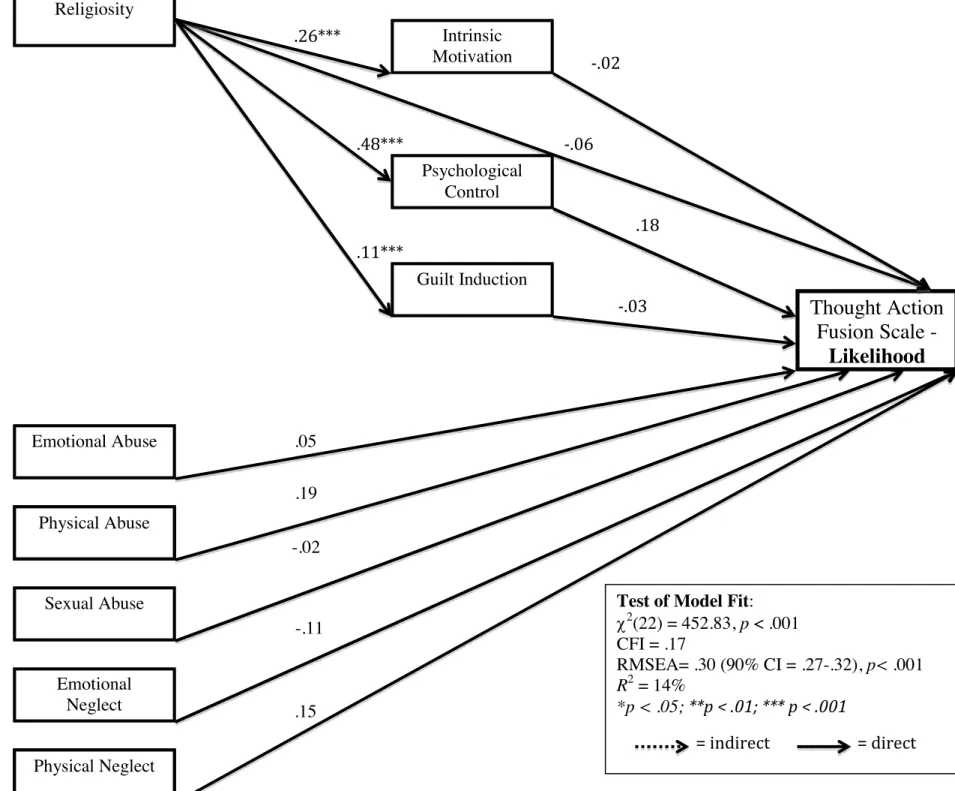
3. Comprehensive Model Predicting TAFS-Likelihood ………...83
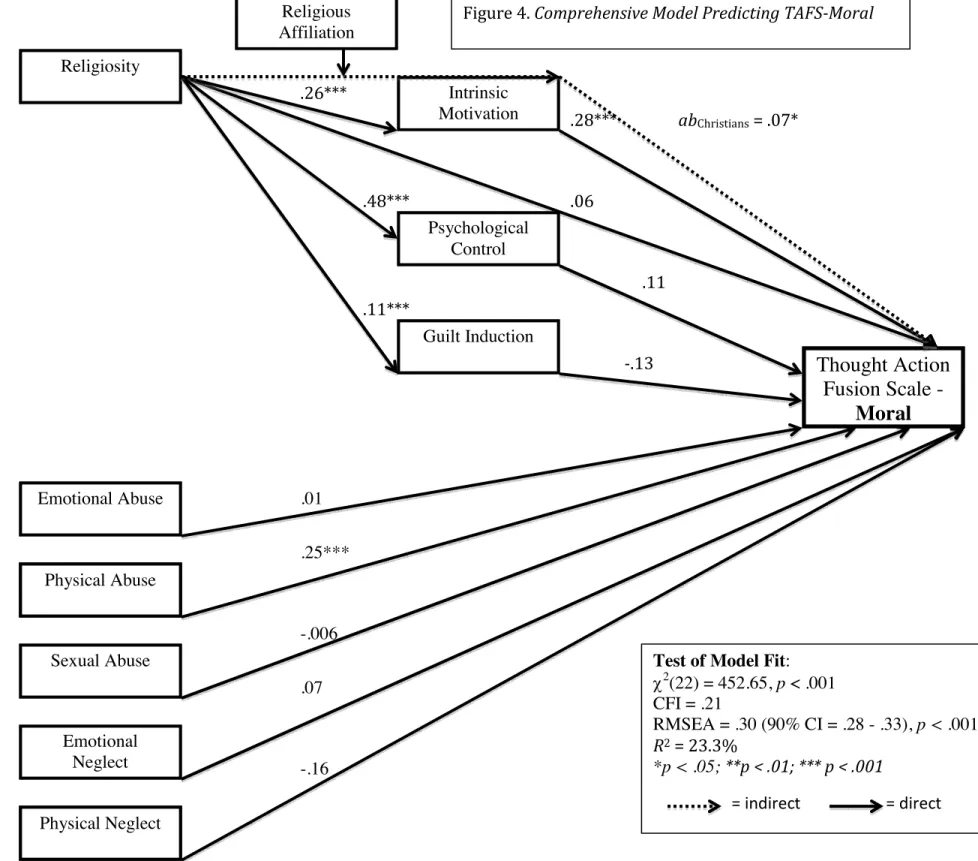
4. Comprehensive Model Predicting TAFS-Moral ………...84
5. Comprehensive Model Predicting In Vivo TAF-Likelihood ………85
LIST OF ABBREVIATIONS
OC Obsessive Compulsive
OCD Obsessive Compulsive Disorder TAF Thought Action Fusion
TAFS Thought Action Fusion Scale
TAF-M Thought Action Fusion – Moral Bias TAF-L Thought Action Fusion – Likelihood Bias SCRFS Santa Clara Religious Faith Scale
PsyC Psychological Control Int M Intrinsic Motivation
Ext-S Extrinsic Motivation - Social Subscale Ext-P Extrinsic Motivation – Personal Subscale
MGI-D Maladaptive Parental Guilt Induction-Disparagement Subscale MGI-SS Maladaptive Guilt Induction – Self-Serving Elicitation Subscale CTQ-EA Childhood Trauma Questionnaire - Emotional Abuse
Developmental Experiences in the Prediction of Thought Action Fusion: Contribution of Religious, Familial, and Stress Factors
The role of dysfunctional beliefs in the cognitive-behavioral model of anxiety and mood disorders is widely accepted. Cognitive theories, most notably Beck’s cognitive specificity theory (1976), argue that emotional disorders develop from the
misinterpretation of stimuli and events. In social phobia, one might misinterpret an external stimulus (e.g., crowd’s laughter) and assume to be the target of negative evaluation (Clark & Wells, 1995). In obsessive-compulsive disorder (OCD), it is
common to misinterpret normal intrusive thoughts and overestimate their significance or dangerousness (Rachman, 1997, 1998; Rachman & de Silva, 1978; Salkovskis, 1985). Rachman (1998), for example, proposed that when one perceives a normally occurring intrusive thought (e.g., an unacceptable violent image) as highly significant (e.g.,
“Having this thought means its important”) or dangerous and threatening (e.g., "Thinking this thought means I'm immoral"), it leads to anxiety and a preoccupation with the
unwanted thought.
Longitudinal research suggests that the presence of certain dysfunctional beliefs and cognitive biases (e.g., the belief that thinking of doing something bad is equivalent to the corresponding action) prospectively increases the risk of developing future
psychopathology, such as obsessive-compulsive symptoms (Abramowitz, Khandker, Nelson, Deacon, & Rygwall, 2006). Thus, cognitive biases represent distinct
2011). Given the important role of cognitive biases in the development and maintenance of emotional disorders, better understanding factors that contribute to their development is critical for designing effective prevention and intervention programs (Kraemer, Stice, Kazdin, Offord, & Kupfer, 2001; Rachman, 1997; Salkovskis, Shafran, Rachman, & Freeston, 1999).
Although a number of cognitive biases have shown a relationship with anxiety and mood disorders, the current study will focus upon one cognitive factor, Thought Action Fusion (TAF), that has been implicated in Generalized Anxiety Disorder (Hazlett-Stevens, Zucker, & Craske, 2002), Panic, Social Anxiety, and Post-Traumatic Stress Disorder (Rachman & Shafran, 1999; Rassin, Diepstraten, Merckelbach, & Muris, 2001; Rassin, Merkelbach, Muris, & Schmidt, 2001), and most often, Obsessive Compulsive Disorder (Abramowitz, Storch, Keeley, & Cordell, 2007; Rassin, Muris, Schmidt, & Merckelbach, 2000; Rassin, Diepstraten, et al., 2001; Rassin, Merkelbach, et al, 2001; Rassin & Koster, 2003; Shafran, Thordarson, & Rachman, 1996; Smari &
have shown a moderate correlation (r’s=.32 to .44; Rassin, Merkelbach, et al., 2001; Shafran et al., 1996), suggesting that they might be unique constructs, yet can co-occur.
TAF and Psychopathology
Salkovskis (1985) initially documented the construct of TAF, noting that patients with OCD had a tendency to assume that a “thought is like an action” (p. 574). Later researchers investigated the concept and developed a validated measure, the Thought Action Fusion Scale (TAFS; Shafran et al., 1996). Contemporary research efforts have used the TAFS, as well as in vivo behavioral paradigms, to study TAF as it relates to various psychopathological constructs.
TAF and OCD. Cognitive-behavioral models of obsessions have implicated TAF in some presentations of OCD. Rachman (1998), for instance, argued that interpreting a harmless unwanted thought (e.g., stealing from the grocery store) as morally unacceptable (e.g., equivalent to stealing) or as likely to lead to the feared outcome (e.g., shoplifting), might result in increased anxiety and an obsessional preoccupation with the thought, as well as attempts to suppress the thought or reduce anxiety (e.g., compulsive rituals or neutralizing behaviors). Using self-report measures, such as the Maudsley Obsessive-Compulsive Inventory (MOCI; Hodgson & Rachman, 1977), the Padua-Revised (Van Oppen, Hoekstra, & Emmelkamp, 1995), and the Padua Inventory –Washington State University Revision (Burns, Keortge, Formea, &
Sternberger, 1996), a weak to moderate relationship between TAF and OCD symptoms has been found (r’s between .20 and .65; Gwilliam, Wells, & Cartwright-Hatton, 2004; Rassin, Diepstraten, et al., 2001; Yorulmaz, Karanci, Bastug, Kısa, & Goka, 2007).
to assess the relationship between TAF and OCD. These behavioral paradigms have been conceptualized as an analogue for OCD, in that one experiences an intrusive thought, which results in increased anxiety and a desire to reduce distress. The first TAF induction was conducted by Rachman, Shafran, Mitchell, Trant, and Teachman (1996), in which participants were asked to think of a beloved relative and then write a sentence indicating that they hoped the relative would be in a car accident. Results indicated that after
participants contemplated this negative event, they reported increased levels of distress, feelings of responsibility, guilt, and urges to neutralize (i.e., cancel the effects of thinking the thought). Rachman et al. argued that TAF could be inferred from participants’ distress and the neutralizing behaviors associated with thinking the negative thought about the relative. Bocci and Gordon (2007) similarly examined participants’ response to thinking about a relative being in a car accident (i.e., likelihood TAF). Participants reported an increase in anxiety after writing the sentence, and 75% of participants engaged in a neutralizing behavior (e.g., crossing out the relative’s name) following the TAF induction. Bocci and Gordon concluded that neutralization was a frequent behavior in response to the activation of likelihood TAF beliefs. A number of other researchers have also experimentally induced TAF in a nonclinical sample using Rachman et al.’s (1996) paradigm, finding elevated ratings of anxiety, likelihood, and urges to neutralize following the induction (Berman, Abramowitz, Pardue, Wheaton, 2010; Berman, Abramowitz, Wheaton, Pardue, & Fabricant, 2011; Marcks & Woods, 2007; Rassin, Merckelbach, Muris, & Spaan, 1999; van den Hout, Kindt, Weiland, & Peters, 2002; van den Hout, van Pol, & Peters, 2001; Zucker, Craske, Barrios, & Holguin, 2002).
number of other anxiety disorders. Due to the similarity between pathological worry and obsessive thoughts, researchers have hypothesized that TAF plays a role in the
development and maintenance of the meta-cognitive beliefs associated with Generalized Anxiety Disorder (GAD; Hazlett-Stevens, et al., 2002). Hazlett-Stevens, et al. (2002) found that the scores of individuals with GAD on the TAFS likelihood subscale, but not moral subscale, were positively associated with scores on the Penn State Worry
Questionnaire (PSWQ; Meyer, Miller, Metzger, & Borkovec, 1990). Given these
findings, Hazlett-Stevens, et al. suggested that individuals with GAD might overvalue the powerfulness of their worries, such that he/she might believe that worrying affects the likelihood that a feared outcome will occur (e.g., “If I worry about my mother’s health, that will decrease the likelihood of her getting sick”).
A similar set of TAF-like beliefs regarding the likelihood bias have also been studied in relation to social anxiety disorder, panic disorder, and post-traumatic stress disorder (Rachman & Shafran, 1999; Rassin, Diepstraten, et al., 2001; Rassin,
Merkelbach, et al, 2001). In social anxiety disorder, an individual might overvalue the powerfulness of his/her thoughts on external events and might believe that having judgmental thoughts increases the likelihood of social rejection. In panic disorder, an individual might believe that thinking about physiological symptoms that are associated with panic attacks (e.g., racing heart, dizziness) will increase the likelihood of the symptoms occurring. Finally, in post-traumatic stress disorder, an individual might be fearful that thinking about the traumatic experience increases the likelihood of
recurrence.
similar in their overestimation of likelihood, however, Berle and Starcevic (2005) note that the response to the triggering TAF thoughts differs between patients with OCD and other anxiety disorders. Those with OCD tend to respond with neutralizing behaviors (e.g., compulsions), whereas those with other anxiety disorders tend to respond with avoidance (e.g., avoiding public places where a panic attack might occur). Although behavioral responses to TAF-like thoughts might differ, research suggests that individuals with anxiety disorders tend to experience the likelihood TAF bias, when compared to nonanxious and depressed individuals (Abramowitz, Whiteside, Lynam, & Kalsy, 2003). On the other hand, the moral bias might be specifically related to
depressive concerns, as indicated by small to medium correlations (r’s = .10 to .42) between the moral subscale of TAFS and self-report measures of depression
(Abramowitz et al., 2003; Rassin, Merkelbach, et al, 2001; Shafran et al., 1996).
Additionally, mediational models have indicated that only the TAFS moral subscale, but not the likelihood subscale, is associated with depressive symptoms when measures of trait anxiety are controlled for (Abramowitz et al., 2003). It is hypothesized that
individuals’ tendency to engage in self-blame and personalization, as well as experience feelings of excess guilt explains the relationship between the moral bias and depressive symptoms (Berle & Starcevic, 2005).
cognitive bias? To date, very little research has investigated this question. The current study, therefore, aims to elucidate religious, familial, and stress-related factors (i.e., developmental experiences) in childhood and adolescence that might predict TAF.
Given the lack of research in this domain, it is informative to draw from
Salkovskis et al.’s (1999) proposed developmental pathways for OCD-related cognitions more broadly. Salkovskis et al.’s theoretical work can direct the current study’s
identification of relevant developmental experiences. Of their proposed pathways, two are particularly relevant to TAF: (1) exposure to rigid or extreme rules of conduct and duty and (2) experiencing a misfortunate negative event (Salkovskis et al., 1999). These two possible “pathways” to TAF are reviewed next.
Rigid Rules
Although Salkovskis et al. (1999) theorized how a number of factors give rise to rigid rules of moral conduct and behavior, no research has investigated how these developmental experiences compare to one another in the prediction of TAF. Therefore, the following factors that Salkovskis et al. (1999) implicated in the origin of rigid rules will be reviewed: type of religion, strength of religiosity, and parenting strategies. I will also highlight each construct’s demonstrated or potential relationship to TAF.
Subsequently, I will present extant research supporting Salkovskis et al.’s (1999) second pathway, that negative or traumatic experiences influence TAF.
Religious affiliation and religiosity. Before presenting research evaluating the relationship between religion and TAF, it is necessary to review: the definition of religion, the difficulties inherent in studying the relationship between religion and psychopathology, and the methodological approaches commonly taken when assessing religion and religiosity. For the purposes of this study, religion will refer to an
“organized system of beliefs, rituals, practices, and community, which is oriented toward the sacred” (Dew, Daniel, Armstrong, Goldstron, Triplett, & Koenig, 2008, p. 382). By adopting this definition, a religious group is considered distinct if the organization espouses a purportedly unique set of belief systems and accompanying ritual practices.
The measurement of religiosity, as it relates to TAF (or OCD symptoms more generally), has varied considerably across studies. Many researchers have constructed self-report indices to assess religiosity, with questions evaluating religious service attendance, affiliation, and/or subjective strength of religiosity (Abramowitz, Deacon, Woods, & Tolin, 2004; Abramowitz, Huppert, Cohen, Tolin, & Cahill, 2002;
Steketee, Quay, & White, 1991; Yorulmaz, Gencoz, & Woody, 2009). Each study’s unique and self-constructed measure of religiosity reduces the reliability and
generalizability of the results, and moreover, it is likely that the measures are not
thoroughly assessing the complexity of the construct (Shreve-Neiger & Edelstein, 2004). Although recent studies in this field (e.g., Berman et al., 2010) have utilized validated self-report questionnaires to assess religiosity, other methodological limitations limit the external validity of the results. For instance, Berman et al. (2010) dichotomized Protestant participants into “high” and “low” religious categories, which decreases power (MacCallum, Zhang, Preacher, & Rucker, 2002) and limits the generalizability to other religions or samples (Allison, Gorman, & Primavera, 1993). Given the methodological and statistical weaknesses present in the various studies that have assessed the
relationship between religiosity and TAF, it is difficult to generalize their findings. Therefore, future studies examining this relationship should use a validated measure of religiosity that is frequently employed and consider religiosity to be a continuous variable (Marino, Lunt, & Negy, 2008).
found that after controlling for strength of religiosity, religious Christians (both Catholics and Protestants) scored higher than Jews on moral TAF. Additionally, Siev et al. (2010) demonstrated a positive relationship between religiosity and moral TAF in a Christian sample.
In addition to self-report questionnaires, in vivo behavioral paradigms have been used to demonstrate religious group differences in TAF. For instance, Berman et al. (2010) asked highly religious Protestants and Atheists/Agnostics to insert their most beloved relative into the following two sentences: “I hope ________ gets into a car accident today” (likelihood TAF) and “I hope I have sex with ___________” (moral TAF). Participants were instructed to contemplate these thoughts, write them down on a note card, and then answer a variety of follow-up questions (e.g., anxiety, likelihood of event occurring, and moral wrongness of thinking the thought). Results indicated that highly religious Protestants, compared to nonreligious participants, more strongly
believed that thinking about a loved one being in a car accident influenced the likelihood of such an accident occurring. Moreover, the highly religious Protestants believed that it was more morally unacceptable to think about and write down the thought about incest. Finally, acts to neutralize or “undo” the effects of thinking about and writing down the two target thoughts were more common among the religious participants, relative to the nonreligious group. Thus, results from both the self-report and in vivo measures suggest that certain religious groups perceive the presence and meaning of negative unwanted thoughts to be more personally significant, influential, and immoral.
et al., 1999; Siev & Cohen, 2007; Yorulmaz et al., 2009). In Christianity, instructive Bible verses that reference “sin by thought” are considered to be religious directives that might promote TAF-like beliefs. For instance, in Jesus’ Sermon on the Mount, he states, “I say to you that everyone who looks on a woman to lust for her has committed adultery already in his heart” (Matthew 5:27–28; New American Standard Version). This verse implies that thinking about something immoral is comparable to engaging in immoral behavior (i.e., moral TAF).
Given that Muslims have also exhibited a relationship with TAF (Yorulmaz et al., 2004; Yorulmaz et al., 2009), it is important to highlight the elements of Islamic religious doctrine that might influence this phenomenon. In Islam, there are strict religious rules (e.g., regular prayer) and behaviors (e.g., cleanliness) that must be followed to achieve salvation (Ghassemzadeh, Mojtabai, Khamseh, Ebrahimkhani, Issazadegan, & Saif-Nobakht, 2002). Moreover, intrusive thoughts and doubts about religious practices (termed “vesvese/waswas”) are considered to be evil forces (Al-Issa & Qudji, 1998). Thus, in Islam, the control one is expected to maintain over thoughts and the negative association related to doubting one’s religion might affect how strongly one perceives the moral importance of thoughts (Yorulmaz et al., 2009).
to be neutralized, “undone,” or “dealt with.” However, these results do not suggest that religious teachings cause TAF beliefs; it might be that individuals who experience TAF are drawn towards certain religions or to strengthen their religiosity (Berle & Starcevic, 2005; Berman et al., 2010; Rassin & Koster, 2003). Additionally, because not all highly religious Christians and Muslims experience TAF-like beliefs that cause clinical distress, it might be that more important than one’s religion is an overly rigid interpretation of the belief system and disproportionate fear of punishment (Salkovskis et al., 1999). Given past research, in the present study, I will examine the hypothesis that religiosity will positively predict both the moral and likelihood biases of TAF across all participants affiliating with a religion. Additionally, depending on the sample’s variability in religious affiliation, I will examine whether religious affiliation moderates the relationship
between religiosity and TAF, such that individuals affiliating with Christianity and/or Islam will possess a stronger relationship between religiosity and TAF.
Motivation for religion. In addition to religious affiliation and degree of
religiosity, research suggests that one’s motivation for religion can also influence mental health outcomes (Luyten, Corveleyn, & Fontaine, 1998). Allport and Ross (1967) initially identified intrinsic and extrinsic motivation as two types of orientations toward religion. Individuals with high levels of intrinsic motivation find their “master motive in religion” (Allport & Ross, 1967, p. 434), perceive it to be a vital and guiding factor in their life, and believe that religion offers a foundational set of appropriate moral and personal values. Individuals with high levels of extrinsic motivation, on the other hand, are motivated by external forces and perceive religion to be a tool to strengthen one’s political status or social relationships. In essence, an extrinsically motivated person can be seen as utilitarian, assessing the importance of his/her religious beliefs based on its relationship to an external reward system (Ellison, 2008; Meek, Albright, & McMinn, 1995). Gorsuch and McPherson (1989) further deconstructed motivational orientation, finding that extrinsic motivation contained two components, social (i.e., religion used to gain social status or power) and personal (i.e., religious used to bolster feelings of
comfort or safety). Research suggests that when the extrinsic components are combined, intrinsic and extrinsic motivation are independent constructs (Donahue, 1985), possessing a weak negative correlation (Ellison, 2008; Gorsuch & McPherson, 1989; Sheldon, 2006).
difficult. It might be that intrinsically motivated individuals internalize religious directives, such as “sin by thought”, more strongly, therefore contributing to greater TAF-like beliefs. Extrinsic individuals, on the other hand, might not internalize religious doctrine to the same extent since their religiosity is motivated by social, personal, and political factors. In the present study, I will examine the hypotheses that intrinsic, but not extrinsic motivation for religion, will predict both the moral and likelihood subscale of TAF and that intrinsic motivation will mediate the relationship between religiosity and both TAF biases in Protestants and Catholics.
Guilt induction. Salkovskis et al. (1999) also proposed that family factors, such as parenting, influence the development of rigid rules. Certain parenting strategies, such as guilt induction, might contribute to a child’s understanding of which thoughts and feelings are appropriate or moral and which are not. Similar to motivational orientation, parental guilt induction might account for variance in TAF that has been attributed to religiosity in previous research. In order to demonstrate how this construct potentially influences TAF, I will (1) define the construct of guilt, (2) discuss the relationship between guilt and religiosity, (3) describe how parenting practices can influence guilt, and (4) relate research on guilt induction to TAF.
Guilt can be defined as remorse in response to the perceived violation of a moral principle (Klass, 1987). Thus, to experience guilt, one must be aware of a moral law and subjectively measure one’s thoughts and behaviors against this standard (Faiver, O’Brien, & Ingersoll, 2000). But how do children come to understand these moral laws?
For some, religious beliefs are influential in the formation of moral principles (Ellis, 1980). Research has demonstrated positive correlations between religiosity and general guilt, guilt related to immoral thoughts, and shame-free guilt (Luyten, et al., 1998; Fehr & Stamps, 1979; Albertsen, et al., 2006, respectively). Although, religiosity does not fully explain one’s tendency to feel and experience guilt (Luyten et al., 1998), suggesting that other factors (e.g., parenting) are influential in children’s understanding of moral principles and their violation (Albertsen, et al., 2006). Parents might rely upon maladaptive guilt-inducing tactics to mold children’s moral fiber and their understanding of social expectations within and outside of the family system. As a result, guilt induction might mimic the effect of religiosity on TAF.
Two forms of parental guilt-induction have been identified (Donatelli, Bybee, & Buka, 2007): self-serving elicitation, in which the parent over-emphasizes the sacrifices he/she has made for the child while simultaneously limiting the child’s autonomy; and
disparagement, in which the parent perseverates over the child’s previous and minor transgressions and inappropriately places blames on the child when he/she was not at fault (Donatelli et al., 2007). Research suggests that chronic exposure to high levels of parental guilt induction interferes with the child’s autonomy, emotional and social growth, and management of interpersonal conflicts (Rakow, Forehand, McKee, Coffelt, Champion, Fear, et al., 2009). Consequently, parental guilt induction has been associated with the development of childhood internalizing symptoms, even when traditional
Children’s problem solving abilities might explain the development of
internalizing symptoms as a result of parental guilt induction (Rakow et al., 2009). At a young age, if unwarranted blame and responsibility are placed upon the child, he/she might not possess the cognitive capabilities to differentiate between problems that he/she has caused from problems that were a result of forces beyond his/her control (Rakow et al., 2009). Consequently, in difficult to control situations, the child might bear the onus of blame and ruminate over his/her role in the outcome (Bybee, Zigler, Berliner, & Merisca, 1996). Rakow et al. (2009) argued that despite improved problem solving capabilities, acceptance of blame can continue into adolescent years.
Clear similarities can be drawn between TAF and the consequential effects of guilt induction. Parental guilt induction leads to, and TAF involves, a misappropriation of one’s role in external events that are beyond his/her control (likelihood TAF) and an overvaluation of the moral wrongness associated with certain thoughts, wishes, or beliefs (moral TAF). Additionally, parental guilt induction has demonstrated a positive
relationship with childhood internalizing symptoms (Donatelli et al., 2007; Rakow et al., 2009) and TAF has been implicated in the development and maintenance of anxiety and mood problems (e.g., Hazlett-Stevens, et al., 2002; Rachman, 1998; Rachman & Shafran, 1999).
No research has yet examined how parental guilt induction and TAF are related. Rather, investigators have only examined how guilt can be a product of TAF. For
feelings of guilt. Given the reviewed research, the current study hypothesizes that
parental guilt induction will predict both the moral and likelihood biases of TAF, and that this parenting strategy will mediate the previously documented relationship between religiosity and TAF.
Psychological control. Parental psychological control – attempts to control a child’s psychological and emotional development by intruding upon and limiting the child’s thinking processes, emotional expression, autonomy, and attachment (Barber, 1996) – is a parenting strategy that promotes rigid rules of conduct and duty. Therefore, it seems that developmental experiences with psychological control are consistent with Salkovskis et al.’s (1999) “rigid rules” pathway. A critical element of psychological control is the parents’ management of children’s mental processes (e.g., thoughts and emotions). For instance, if a child yells, “My sister is so annoying! I wish she would just die,” the psychologically controlling parent responds by telling him that he “should never
think or wish such terrible things!” Research suggests that mothers, as compared to fathers, employ psychological control more often (Barber, 1996; Barber & Harmon, 2002), but that adolescent’s perceive both parents to engage in this parenting strategy at comparable rates (Rogers, Buchanan, & Winchell, 2003). However, Barber, Stolz, and Olsen (2005) documented that in a longitudinal cross-national study, no gender
differences in psychological control were found in parents or children. Barber et al. (2005) argued that the absence of gender differentiation highlights the universal effect of parents’ emotionally intrusive behaviors.
al., 2003). However, research has demonstrated that both psychological and behavioral control significantly predict youth problem behaviors (Albrecht, Galambos, & Jansson, 2007; Barber, 1996; Barber, Stolz, & Olsen, 2005; Rogers, et al., 2003), with
psychological control possessing a unique relationship with internalizing symptoms (Albrecht et al., 2007; Barber, 1996; Barber, et al., 2005; Petit, Laird, Dodge, Bates, & Criss, 2001; Rogers et al., 2003). Moreover, the relationship between psychological control and adolescents’ psychosocial development has been consistently demonstrated in various cultures and socioeconomic statuses (Barber, et al., 2005).
Based upon the reviewed literature, the maladaptive effect of parental psychological control on children’s thinking processes and autonomy seeking is a possible contributor to TAF-like beliefs. If children are made to feel dependent on their parents for management of their thoughts and emotions, they might not develop
appropriate skills to independently discern their role in the occurrence of external events or differentiate moral from immoral thoughts. Moreover, psychologically controlling parents might exert control (e.g., “thinking is as bad as doing”) over their children’s moral processes, thereby shaping children’s perception of the moral wrongness of certain thoughts.
Unlike parental guilt induction, little research has examined the relationship between religion and parental psychological control. This is surprising given the potential overlap between psychological control and certain religious directives to control one’s thoughts and resultant emotions and behaviors. Barber’s (1996) study incorporated religion into analyses and demonstrated that Mormon youth reported less parental
research examining the relationship between religious affiliation, religiosity, and parental psychological control, it might be that psychological control accounts for variance in TAF that had previously been accounted for by religiosity. Thus, the current study hypothesizes that psychological control will predict both the moral and likelihood biases of TAF and mediate the relationship between religiosity and TAF.
An important caveat is that some research suggests that parental guilt induction is a component of psychological control (Barber & Harmon, 2002), thus, it will be
important to critically evaluate the relationship between these two parenting strategies to ensure that unique constructs are being considered in the prediction of TAF. It is also important to note that both parental guilt induction and psychological control are factors of parenting styles and are not, in and of themselves, parenting typologies, such as those studied by Baumrind (1967). Research has demonstrated that elements of parenting style predict psychopathology outcomes over and above traditional parenting typology
measures (Donatelli et al., 2007; Rakow, 2009; Zahn-Waxler et al., 1990). Moreover, Barber (1996) highlights the need to disaggregate parenting typologies in order to show how specific components of parenting (e.g., guilt induction) relate to both positive and negative outcomes. Thus, in the current study, no measure of parenting typologies was included.
Negative Life Events
cognitive distortions pertaining to oneself, others, the environment, and the future (self-trauma model; Briere, 1996). More specifically, Briere (1996) reported that three types of cognitive distortions are associated with childhood trauma: (1) safety (e.g.,
preoccupied by the prospect of danger) (2) controllability (e.g., perceived helplessness) and (3) internal attribution (e.g., self-blame). These cognitive distortions are then
maintained by attending to internal and external cues that support the maladaptive beliefs (Browne & Winkelman, 2007). The development and maintenance of cognitive
distortions following childhood trauma might explain the increased prevalence rate of internalizing disorders following early life stress (Heim & Nemeroff, 2001). As can be seen, the cognitive distortions associated with childhood trauma overlap with the biases associated with TAF (e.g., responsibility over external events and being preoccupied by the likelihood of danger). Thus, the current study hypothesizes that childhood trauma will predict one’s experience of moral- and likelihood-TAF.
Present Study
Given the limited research examining developmental experiences associated with cognitive biases, the current study aims to evaluate how theoretically relevant religious, familial, and stress-related factors predict TAF beliefs. After reviewing previous
research, six factors emerged as potential predictors of TAF: (1) religious affiliation, (2) strength of religiosity, (3) motivational orientation toward religion (i.e., intrinsic and extrinsic), (4) parental guilt induction, (5) parental psychological control, and (6) childhood trauma. The chosen constructs are meant to assess possible pathways
parental guilt induction, and parental psychological control might mediate the consistently demonstrated relationship between religiosity and TAF. Understanding other factors, besides religion, that influence TAF can assist clinicians in developing prevention programs that target therapeutically appropriate topics, such as parenting strategies. In doing so, possible developmental factors could be addressed early in life (i.e., prior to the development of TAF beliefs).
In order to examine how these various factors predict TAF, the current study employs a multi-method approach with a non-treatment seeking undergraduate sample. A student sample is appropriate for this study since TAF is not a clinical symptom per se, but rather a vulnerability factor that occurs along a continuum and is widely distributed in the general population (e.g., Beck, 1976; Rassin, Merkelbach, et al, 2001; Shafran et al., 1996). Moreover, given ample research suggesting that increased stress can lead to the development of cognitive biases and subsequent psychopathology (Finlay-Jones & Brown, 1981; Maina, Albert, Bogetto, Vaschetto, & Ravizza, 1999; McLaughlin, Kubzansky, Dunn, Waldinger, Vaillant, & Koenan; 2010; Striegel-Moore, Silberstein, Frensch, & Rodin; 1988), the naturalistic stress students experience in the beginning of their undergraduate career makes this sample ideal.
Participants will first complete self-report questionnaires that assess each
assessment modalities. Based upon previous theory and empirical research, the following hypotheses are proposed:
(1) Religiosity will significantly and positively predict both moral and likelihood TAF across all participants affiliating with a religion. Depending on the variability of the sample’s religious affiliation, religious affiliation will be examined as a moderator of the relationship between religiosity and TAF. It is hypothesized that religiosity will more strongly predict both TAF biases in a Christian and Muslim sample.
(2) Parental guilt induction, psychological control, and childhood trauma will significantly and positively predict both the moral and likelihood subscale of TAF. (3) Intrinsic, but not extrinsic motivation for religion, will significantly and positively predict both the moral and likelihood subscale of TAF.
(4) Given the likely high prevalence of Christians in the study sample (based on previous sampling from the UNC Psychology Participant Pool), it is hypothesized that parental guilt induction, parental psychological control, and intrinsic motivation will mediate the relationship between religiosity and both TAF biases in a Protestant and Catholic sample. It is predicted that of these potential mediators, intrinsic motivation will account for the greatest amount of variance between religiosity and TAF.
(5) A comprehensive model that includes all indicators (religious affiliation, religiosity, intrinsic motivation, parental psychological control, guilt induction, and childhood trauma) in the prediction of moral and likelihood TAF will fit the data well.
Methods
Self-report sample. Four hundred and seven undergraduate students in
introductory psychology and research methods classes at University of North Carolina at Chapel Hill completed an online questionnaire battery. Participants received course credit (introduction to psychology) or extra credit (research methods) for their
participation. Table 1 outlines the demographic characteristics for this sample. As can be seen, a majority of the participants were female (68.31%) and were approximately 19-years-old. Both of these demographic measures were expected given that recruitment efforts targeted undergraduate psychology courses. Moreover, participants most
frequently identified themselves as Caucasian (71.25%) and Christian (65.11%). A small number of ethnic (e.g., African-American; 11.79%) and religious minorities (e.g., Jewish; 1.4%) participants also completed study measures.
In vivo sample. One hundred and seven undergraduate students (82.24% female) completed an experimental laboratory session subsequent to completing the online “screening” questionnaire battery (see above). Demographic characteristics for this sample are outlined in Table 2. Akin to the self-report sample, the majority of participants were female (82.24%), Caucasian (79.40%), and Christian (77.5%).
Measures
The following measures were completed by participants via an online survey tool (see Procedure section):
Demographics. At the onset of the online questionnaire, participants were asked to report their gender, age, and their identified racial or ethnic group and religious
similar,” 2 = “Moderately similar,” 3= “Moderately dissimilar,” 4= “Very much dissimilar”).
Childhood trauma questionnaire – short form (CTQ-SF; Bernstein et al., 2003). The CTQ-SF is a 28-item self-report questionnaire that uses retrospective report to assess for child maltreatment. Participants rate responses on a 5-point Likert-type scale (0 = Never True to 4 = Very Often True). Five subscales are included in this measure (reported reliabilities are based on community samples) with five items per subscale: physical abuse (e.g., “People in my family hit me so hard that it left me with bruises or marks,” α = .83) and emotional abuse (e.g., People in my family said hurtful or insulting things to me,” α = .87), emotional neglect (e.g., “There was someone in my family who helped me feel that I was important or special,” reverse coded, α = .91),
sexual abuse (e.g., “Someone threatened to hurt me or tell lies about me unless I did something sexual with them,” α = .92), and physical neglect (e.g., “I had to wear dirty clothes growing up,” α = .61). Additionally, three items represent the minimization scale
that is meant to detect the underreporting of maltreatment. As reported, the subscales possess moderate to high internal consistency. Although, the physical neglect subscale demonstrates weak internal consistency and should be interpreted with caution.
Depression anxiety stress scale - 21 (DASS-21; Henry & Crawford, 2005).
that I had nothing to look forward to”; α = .88), the Anxiety subscale measures symptoms of physical arousal and fear (“I experienced trembling”; α = .90), and the Stress subscale
measures symptoms such as tension, irritability, and overreaction to stressful events (“I tended to over-react to situations”; α = .90).
Dimensional obsessive-compulsive scale (DOCS; Abramowitz et al., 2010). The DOCS is a 20-item self-report measure that assesses the severity of the four most consistently replicated OCD symptom dimensions (which correspond to four DOCS subscales): (1) contamination, (2) responsibility for harm and mistakes, (3)
symmetry/ordering, and (4) unacceptable thoughts. To accommodate the heterogeneity of OCD symptoms and the presence of obsessions and rituals within each symptom
dimension, each subscale begins with a description of the symptom dimension along with examples of representative obsessions and rituals. Within each symptom dimension, five items (rated 0 to 4) assess the following parameters of severity (over the past month): (a) time occupied by obsessions and rituals, (b) avoidance behavior, (c) associated distress, (d) functional interference, and (e) difficulty disregarding the obsessions and refraining from the compulsions. The DOCS subscales have excellent reliability in student samples (α = .83 - .93) and the measure converges well with other measures of OC symptoms
(Abramowitz et al., 2010).
is comfort in times of trouble and sorrow”). Each item is rated on a 5-point Likert scale (1=strongly disagree, 5 =strongly agree). Using a sample of college students, Gorsuch and McPherson (1989) demonstrated that the intrinsic, social extrinsic, and personally extrinsic subscales had the following reliability scores: .83, .58, .57, respectively. When the extrinsic subscales are combined, an alpha of .65 was obtained. It is recognized that the reliabilities of the extrinsic scales are not strong, but this measure of religious motivation best assesses the constructs of interest.
Maladaptive guilt-induction measure (MGIM; Donatelli et al., 2007). MGIM is a 12-item self-report questionnaire assessing youth’s perceived experiences with parental guilt induction. Respondents are presented with several statements regarding guilt induction and are asked to rate the truthfulness of each statement on a Likert scale from 1 (not at all true) to 7 (very true). The MGIM has two empirically demonstrated subscales. The disparagement subscale assesses child directed criticism and blame (e.g., “[My primary caregiver] makes me feel guilty even when its not my fault”; α = .84). The
self-serving elicitation subscale assesses the frequency that parents’ exaggerate sacrifices that they have made for the child (e.g., [My primary caregiver] always reminds me of favors and sacrifices he/she has made”; α = .77). As demonstrated, both subscales have
good internal consistency.
Parental psychological control – youth self report (PPC-YSR; Barber, 1996). The PPC-YSR contains eight items that assess a primary caregiver’s invalidation of feelings, restriction of verbal expression, personal attack, and love withdrawal (e.g., “[My primary caregiver] is always trying to change how I feel or think about things”).
caregiver (1= “Not like him/her,” 2= “Somewhat like him/her,” 3= “A lot like him/her”). Cronbach’s alphas for the four possible dyads in the family were calculated, indicating adequate internal consistency: mother/son (α = .83), mother/daughter (α = .83), father/son (α = .80), and father/daughter (α = .83; Barber et al., 1996). Barber et al.
(1996) demonstrated that the PPC-YSR is a unidimensional measure that reliably assesses psychological control regardless of the parent’s gender, youth’s gender, or the income, and race of the family. It is important to note that items assessing guilt induction as a form of parental psychological control were eliminated from the PPC-YSR after factor analytic study.
Santa clara religious faith scale (SCRFS; Plante & Boccaccini, 1997). The SCRFS is a 10-item self-report scale, which provides a reliable and valid measure of one’s strength of religiosity (e.g., “I pray daily”; “My relationship with God is extremely
important to me”). Total scores range from 10-40, with higher scores indicating greater religiosity. Psychometric research demonstrates that scoring at or above 33 indicates “high religiosity” (Plante & Boccaccini, 1997). The SCRFS has good reliability (α = .92-.95) and
converges with other valid measures of religiosity (Plante & Boccaccini, 1997).
Thought action fusion scale (TAFS; Shafran et al., 1996). This is a 19-item self-report measure of beliefs about the importance of thoughts. It contains three subscales:
Moral (e.g., "Having a blasphemous thought is almost as sinful to me as a blasphemous action," α = 0.90), Likelihood-other (e.g. "If I think of a relative/friend losing their job, this increases the risk that they will lose their job," α = .92), and Likelihood-self (e.g. "If I think of myself having an accident, it increases the risk that I will have an accident," α =
on the TAFS have good face validity and the measure shows good internal consistency (Shafran et al., 1996).
In vivo measure of TAF. Participants who completed the online measures, agreed to be contacted by a research assistant, and identified with either a major branch of Christianity (e.g., Protestants or Catholic) or Agnosticism or Atheism were invited to participate in the in vivo (behavioral) measure of TAF based on that developed by Berman, Abramowitz, et al. (2011). This inclusion method and the in vivo protocol was reviewed and approved by the IRB.
In this paradigm, the participant was first asked to indicate his or her current (baseline) level of distress/anxiety from 0 (not at all) to 100 (extremely anxious), by dragging the cursor across a visual analogue scale on the screen. Next, participants were asked to think of a close (and beloved) relative such as a parent or sibling and to write the person’s full name on a provided note card. The participant was also shown a picture of a stranger (which matched the gender of the chosen relative) and told the individual’s “name” and that he/she was a student at UNC. The participant was asked to write the strangers’ name on a provided note card as well. The experimenter then placed both note cards next to the desktop monitor. Participants were then presented with four sentences and were instructed to write the sentence on the provided note card and insert either the close relative’s or stranger’s name (depending on the counterbalanced order) into the blank. The sentences were completed one at a time and the order of the four sentences was also counterbalanced:
(3) “I hope ______________ goes blind soon.” (4) “I hope ______________ contracts HIV soon.”
After writing each sentence, the participant was asked to close his or her eyes and think about the situation. The participant was then asked to read the sentence out loud. Before moving to the next sentence, the participant was asked to rate the following items on the 0-100 scale:
1. How much anxiety do you feel right now? 2. How much guilt do you feel right now? 3. What is the likelihood of the event occurring?
4. How much control do you have over the event occurring? 5. How responsible would you feel if the event did occur? 6. How morally wrong was it to write out the sentence? 7. How upsetting would it if this event happened?
8. How strong is your urge to reduce or cancel the effects of writing the sentence?
The experiment proceeded through these steps until this process occurred for each of the 4 sentences. If the participant refused to write any of the sentences, the
experimenter noted that this is OK (i.e., “I understand this is difficult for you”).
Procedure
collected using Qualtrics, an online web survey development tool.1 Upon accessing the secure project website, participants were presented with an “instructions page.” A demographic questionnaire and the study questionnaires (see Measures section) then appeared on subsequent pages. At the end of the last questionnaire, a debriefing statement was presented. On the debriefing form, the contact information for the
principal investigator and the faculty supervisor was provided. Additionally, information regarding the UNC Anxiety and Stress Disorders Clinic was given in case any participant “wanted help for anxiety or other stress-related problems.” The study was reviewed and approved by the University IRB.
For the 107 participants who also completed the in vivo TAF measure, testing occurred individually in the Anxiety and Stress Disorders laboratory in Davie Hall. Once the participant arrived for the experiment, the experimenter obtained informed consent. If the participant consented, the experimenter initiated the in vivo tasks as described above. At the end of the experiment, the participant was given a debriefing form, which again provided the contact information for the principal investigator and the faculty supervisor. Information regarding the UNC Anxiety and Stress Disorders Clinic was also given in case any participant “wanted help for anxiety or other stress-related problems.” The study was reviewed and approved by the University IRB.
Results
Data Management
It is possible that college students change their religious practices upon
matriculating and moving (often for the first time) out of their parents’ home. Given that the current study is, in part, concerned with how developmental experiences impact the relationship between religiosity and TAF, it is important that only participants whose religiosity has not changed over time be included in certain analyses. Thus, when testing religious-related hypotheses, only those participants who reported that their strength of religiosity was “moderately similar” or “very similar” to their religiosity 5 years ago (i.e., period of adolescence since most participants are first-year undergraduates) were
included. If participants reported that their religiosity had moderately or drastically changed in the past 5 years, then their current ratings would not accurately reflect their developmental experience with religion. Therefore, these participants were not included in religious-related analyses.
Power analyses
Given our sample size and 10 parameter estimates, we conducted a number of power analyses for the comprehensive model. Using G*Power 3.1, power was calculated using the “Linear multiple regression: Fixed model, R2 deviation from zero,” which is part of the “F-test” family. For the self-report sample, 240 participants (excludes participants whose religiosity changed over the past 5 years) were included in the path analysis to test the comprehensive model. With an error probability rate (α) of .05, 10
10 predictors, and a sample size of 79, the power is .19 for a small effect size (.05), .57 for a medium effect size (.15), and .95 for a large effect size (.35). As can be seen from the power analyses, the sample size for the self-report sample provides adequate power to detect a medium and large effect; however, for the in vivo sample, we can only detect a large effect size. Consequently, certain pathways might not emerge as significant if their effect size is small. In order to obtain sufficient power to detect a small effect size for either sample, we would need at least 425 participants (i.e., approximately 350 more participants for the in vivo sample).
Descriptive Statistics and Zero-Order Correlations
Self-report. We first investigated the relationship between the indicators and TAF using the self-report measure, TAFS, as the dependent variable. Descriptive statistics were calculated for the subscales and total scores for: strength of religiosity, motivational orientation toward religion (intrinsic and extrinsic), parental guilt induction (self-serving elicitation and disparagement), parental psychological control, childhood trauma (physical and emotional abuse, emotional neglect, sexual abuse, and physical neglect), and TAF (moral and likelihood). Table 3 presents the mean, standard deviation, and range for each study measure.
As can be seen, for religious-related variables, descriptive statistics were calculated separately for participants affiliating with Christianity and with
Atheism/Agnosticism. Christians scored moderately high on measures of religiosity and intrinsic motivation, whereas Atheists/Agnostics’ scores on these measures were
surprisingly, Atheists/Agnostics scored significantly lower than Christians on all religious-related measures (p < .05).
Figures 1 and 2 highlight that on measures of religiosity, the range of scores for Christians was much wider than the range for Atheists/Agnostics. Moreover,
Atheists/Agnostics’ scores were restricted in range, a consequence of their expectedly low levels of religiosity. A similar pattern of religious group differences was found on measures of religious motivation (Table 3). It was expected that Atheists/Agnostics would score low on these measures given that many of the religiosity (e.g., “I pray daily” and “My relationship with God is important to me”) and religious motivation items (e.g., “I go to religious services because it helps me make friends” and “What religion offers me most is comfort in times of trouble and sorrow”) do not apply to individuals without religious faith. Moreover, these measures were not validated in an Atheist/Agnostic sample. In the analyses that follow, rather than exclude Atheists/Agnostics, religious affiliation (or lack thereof) was considered a moderator variable. Consequently, Atheist/Agnostic participants were included in path analyses that tested the
comprehensive model. However, for religious-related analyses, only results for Christian participants could be interpreted since the religious questionnaires do not accurately or reliably measure the strength or motivation for religiosity in Atheists/Agnostics.
the self-report measure of TAF, participants reported moderate levels of moral TAF and low levels of likelihood TAF, both within the range of typical responses for a nonclinical sample (Rassin, Merkelbach, et al., 2001).
Next, we evaluated zero-order correlations among the indicators and the
dependent variable (TAFS). Table 4 displays the correlation matrix. For these analyses, all correlations involving religious-related variables excluded individuals whose
religiosity had changed in the past 5 years (shaded region of the correlation matrix). As expected, correlations indicated that most religious-related variables were positively associated with one another. However, a distinct relationship emerged between the subscales of TAFS and religious-related variables: All four religious-related measures possessed a significant, moderate, and positive relationship with TAFS-Moral, but only the extrinsic motivation subscales possessed a significant and positive relationship with TAFS-Likelihood.
Beyond religious-related variables, strong relationships were observed between the self-serving and disparagement types of parental guilt induction. Given the strength of this relationship (r = .87, p < .001), subsequent analyses combined the subscales to create a total guilt induction score. In doing so, the number of parameters needing to be estimated in path analyses was minimized.
Surprisingly, both types of maladaptive guilt induction and psychological control possessed a significantly moderate and positive relationship with each type of childhood trauma. Moreover, correlations between psychological control and both types of guilt induction were significant, moderate, and positive. Given the strength of these
latent variable was not appropriate. It seems that psychological control and guilt
induction measure a similar type of parenting strategy (Barber & Harmon, 2002), but are independent constructs and were treated as such in subsequent regression and path analyses. Lastly, all types of childhood trauma were significantly and positively correlated with each other, with the magnitude of the relationship ranging from weak (sexual abuse and emotional neglect; r = .25, p < .001) to moderately strong (physical abuse and emotional abuse, r = .68, p < .001).
The relationship between parenting strategies, childhood trauma and the subscales of the TAFS indicated that all constructs were significantly and positively related to TAFS-Likelihood (r’s range from .11 - .31); however, only emotional and physical abuse possessed a significant, positive, and weak relationship with TAFS-Moral (significant r’s range from .13 - .20). The associations between these constructs and TAF are further evaluated in regression and path analyses.
analyses. Because of the random assignment and counterbalancing of the target subject in the induction, each participant only contemplated a relative for 2 out of the 4
sentences. For relative sentences, if ratings of severity were not significantly different, then participants’ follow-up responses could be averaged across all inductions (e.g., each participant would end up with one score for his/her rating of likelihood). If significant differences emerged, then the sentence(s) that were rated as most upsetting would be averaged and used as the DV.
To determine whether the inductions significantly differed on ratings of severity, independent and paired samples t-tests were conducted. Different types of t-tests were needed given the counterbalanced order of the inductions and the randomization of the target subject (i.e., relative or stranger). Paired samples t-tests were used when the two inductions being compared (e.g., HIV-Deaf) both involved thinking about a “relative.” Independent samples t-tests were used when the two inductions being compared (e.g., HIV-Blind) involved thinking about a stranger in one and a relative in the other. In this case, responses for the relative condition needed to be compared between subjects, rather than within.
As can be seen in Table 5, thinking about a relative being diagnosed with cancer or HIV was considered to be similarly upsetting or severe (p > .05). However, a
ratings. Many of the in vivo ratings were fairly low given the range of scores, but these findings are consistent with previous in vivo TAF inductions using a nonclinical sample (Berman et al., 2010). For future analyses, the in vivo rating of likelihood represents TAF-Likelihood and the in vivo rating of moral wrongness represents TAF-Moral.
As a manipulation check on the validity of our TAF induction, zero-order correlations between the subscales of the TAFS and the in vivo TAF ratings were conducted. Table 7 presents the bivariate correlations, which indicate that the
relationships between the self-report scale and the in vivo measure, on the whole, were weak. However, significant and positive correlations between the variables of interest (TAFS-Moral and in vivo Moral: r = .18, p < .05; TAFS-Likelihood and in vivo
Likelihood: r = .18, p < .05) were observed, which demonstrate that the TAFS and the in vivo ratings are assessing distinct constructs that can co-occur.
Zero-order correlations between the indicators and in vivo ratings of TAF are presented in Table 9. Comparing these statistics to those obtained with the self-report sample, the correlations among the predictors are nearly identical in direction, magnitude, and significance. Minor differences between the self-report and in vivo sample include a loss of significance between religious motivation variables and the types of childhood trauma. More importantly, the relationship between the predictors and in vivo ratings of TAF were considerably different than those found with the TAFS. Only the in vivo moral rating was found to be significantly correlated with emotional neglect (r = -.23, p < .05). This observed relationship is stronger than the correlation observed in the self-report sample between emotional neglect and TAFS-Moral (r = -.05, p > .05). It is important to highlight that the pattern found in the self-report sample between the
predictors and TAFS (i.e., all religious-related variables were positively and significantly related to TAFS-Moral; whereas parenting strategies and childhood trauma were
positively and significantly related to TAFS-Likelihood) was not observed with in vivo ratings of TAF.
Hypothesis 1
Hypothesis 1 proposed that religiosity would significantly and positively predict both the moral and likelihood biases of TAF across all participants affiliating with a religion. Due to the limited variation of religious affiliation (see Table 1), participants not affiliating with Christianity or Atheism/Agnosticism were excluded. First,
analyses with the Santa Clara Religious Faith Scale (SCRFS) were conducted for both TAF-Moral and TAF-Likelihood.
TAFS. Independent samples t-tests indicated that Christian participants (M = 9.82, SD = 8.42)were significantly higher on TAFS-Moral compared to
Atheists/Agnostics (M = 4.71, SD = 6.05; t(202) = -3.83, p < .001). Conversely, no religious group differences were found between Christians (M = 1.77; SD = 3.23) and Atheists/Agnostics (M = 1.73, SD = 3.55) on TAFS-Likelihood (t(202) = -.07, p > .05).
For strength of religiosity, the SCRFS (Table 10; Model 1a) was not a significant predictor of TAFS-Likelihood among Christians (F(1, 155) = .94, p > .05) or
Atheists/Agnostics (F(1, 42) = 3.71, p > .05). However, for TAFS-Moral (Table 11), strength of religiosity (Model 1b) was a significant predictor among Christians (F(1, 155) = 14.57, p < .001) and Atheists/Agnostics (F(1, 43) = 13.25, p < .01). To determine whether religious affiliation moderated the relationship between SCRFS and TAFS-Moral, a dummy variable (Rel_Affil) was created that coded affiliation with Christianity as (0) and affiliation with Atheism/Agnosticism as (1). An interaction term was
calculated that multiplied SCRFS (as a standardized variable) by Rel_Affil. A
hierarchical regression was then conducted with SCRFS and Rel_Affil in Step 1 and the interaction term (SCRFS_Standard*Rel_Affil) in Step 2. Results indicated that a
significant amount of variance in TAFS-Moral was accounted for when the interaction term was added to the predictor and moderator variables (∆R2 change = .04, F(1, 97) =
In vivo ratings. For in vivo ratings of TAF-Moral, independent samples t-tests indicated that Christian participants (M = 40.66, SD = 36.73)did not significantly differ from Atheists/Agnostics (M = 31.47, SD = 30.57; t(77) = .35, p > .05). Similarly, no religious group differences were found between Christians (M = 9.87; SD = 20.65) and Atheists/Agnostics (M = 9.12, SD = 11.11) for TAF-Likelihood (t(76) = .14, p > .05).
For strength of religiosity, the SCRFS did not significantly predict TAF-Likelihood (Table 12; Model 1c) for Christians (F(1, 60) = .96, p > .05) or
Atheists/Agnostics (F(1, 14) = .001, p > .05). Similarly, the SCRFS did not significantly predict TAF-Moral (Table 13; Model 1d) for Christians (F(1, 60) = .001, p > .05) or Atheists/Agnostics (F(1, 15) = .29, p > .05). Moreover, religious affiliation was not found to moderate the relationship between religiosity and TAF-Likelihood or –Moral.
Summary. For the TAFS, affiliation with Christianity was associated with higher scores of TAF-Moral. Furthermore, a stronger degree of Christian religiosity significantly and positively predicted TAF-Moral. The same relationships, however, were not found with in vivo ratings of TAF-Moral; rather, no significant religious-related differences were obtained. For TAF-Likelihood, neither the TAFS nor the in vivo ratings yielded significant religious-related differences.
Hypothesis 2
Hypothesis 2 proposed that parental guilt induction, psychological control, and childhood trauma would significantly and positively predict both the moral and
predicted both TAF biases. Given that these analyses do not involve religious-related constructs, participants were not excluded if they reported a change in their strength of religiosity in the past 5 years.
TAFS. For TAFS-Likelihood (Table 10), psychological control (Model 4a; F(1, 251) = 5.70, p < .05), parental guilt induction (Model 5a; F(1, 242) = .10.58, p < .001), and childhood trauma (Model 6a; F(5, 220) = 4.45, p < .001) were all significant and positive predictors. Of the childhood trauma subscales, emotional abuse and physical neglect emerged as unique predictors. For TAFS-Moral (Table 11), psychological control (4b; F(1, 251) = 2.29, p > .05) and guilt induction (Model 5b; F(1, 241) = .001, p > .05) were not found to be significant predictors. However, childhood trauma (Model 6b; F(5, 219) = 4.00, p < .01) accounted for a significant amount of variance in TAFS-Moral, with physical abuse emerging as a unique predictor.
In vivo ratings. For TAF-Likelihood (Table 12), psychological control (Model 4c; F(1, 101) = .07, p > .05), parental guilt induction (Model 5c; F(1, 104) = .50, p >
.05), and childhood trauma (Model 6c; F(5, 73) = .48, p > .05) were not found to be significant predictors. For TAF-Moral (Table 13), psychological control (Model 4d; F(1, 102) = .10, p > .05), parental guilt induction (Model 5d; F(1, 105) = .69, p > .05), and childhood trauma (Model 6d; F(5, 74) = 1.68, p > .05) were also not found to be significant predictors.
indicators were significant predictors. For TAF-Moral, childhood trauma, specifically physical abuse, was found to significantly predict the TAFS. However, none of the indicators were significant predictors for in vivo ratings of TAF-Moral.
Hypothesis 3
Hypothesis 3 proposed that intrinsic, but not extrinsic motivation for religion, would significantly and positively predict both the moral and likelihood biases of TAF in participants affiliating with a religion. Given that these analyses do involve religious-related constructs, participants were excluded if they reported a change in their strength of religiosity in the past 5 years. To test this hypothesis, separate regression analyses were conducted with intrinsic and extrinsic (social and personal subscales) motivation.
TAFS. For TAFS-Likelihood (Table 10), intrinsic motivation (Model 2a) was not a significant predictor for Christians (F(1,156) = .22, p > .05) or Atheists/Agnostics (F(1,42) = .02, p > .05). However, for Atheists/Agnostics, extrinsic motivation (Model 3a) accounted for a significant amount of variance in TAFS-Likelihood (F(2, 42) = 5.09,
p < .05), with the extrinsic-personal subscale emerging as a unique predictor. For Christians, extrinsic motivation was not a significant predictor for TAFS-Likelihood (F(2,156) = 2.39, p > .05).
For TAFS-Moral (Table 11), intrinsic motivation (Model 2b) predicted a significant amount of variance for Christians (F(1, 155) = 16.31, p < .001) and
religious affiliation moderated the relationship between intrinsic or extrinsic motivation and TAFS-Moral, the dummy coded variable (Rel_Affil) and interaction terms (e.g., Standard_Intrinsic*Rel_Affil) were entered into hierarchical regression analyses. Religious motivation (intrinsic and extrinsic were conducted separately) and Rel_Affil were entered into Step 1 and the interaction terms were entered into Step 2. Results indicated that religious affiliation did not moderate the effects of religious motivation on TAFS-Moral or –Likelihood.
In vivo ratings. For TAF-Likelihood (Table 12), intrinsic motivation (Model 2c) was not a significant predictor for Christians (F(1, 60) = 1.69, p > .05) or
Atheists/Agnostics (F(1, 14) = 2.67, p > .05). Moreover, neither subscale of extrinsic motivation (Model 3c) was found to significantly predict TAF-Likelihood for Christians (F(2, 59) = .52, p > .05) or Atheists/Agnostics (F(2, 13) = 1.14, p > .05). For TAF-Moral (Table 13), a similar pattern of results was obtained. Intrinsic motivation (Model 2d) did not significantly predict TAF-Moral for Christians (F(1, 60) = .49, p > .05) or
Atheists/Agnostics (F(1, 15) = .34, p > .05) and neither subscale of extrinsic motivation predicted TAF-Moral (Model 4d) for Christians (F(2, 59) = .83, p > .05) or
Atheists/Agnostics (F(2, 14) = .07, p > .05). Not surprisingly, religious affiliation was not found to moderate the relationship between religiosity and Moral or TAF-Likelihood.