DATA
COMMUNICATION
Recap of Lecture 13
Signals
Analog and Digital Data & Signals
Periodic & Aperiodic Signals
Sine Waves and its Characteristics
Time and Frequency Domain
Frequency Spectrum and
Bandwidth
Overview of Lecture 14
Introduction to the Encoding
Techniques
Digital-To-Digital Encoding
Introduction
Information must be transformed
into signals before it can be
transformed across the
communication media
How this information is
transformed depends upon its
Digital-to-Digital Conversion
Digital-to-Digital conversion/encoding is
the representation of digital information by digital signal
For Example:
When you transmit data from
Computer to the Printer, both original and transmitted data have to be
4.8
DIGITAL-TO-DIGITAL CONVERSION
we see how we can represent digital data by using digital signals. The conversion involves three techniques:
line coding,
block coding,
scrambling.
Line coding is always needed; block coding and scrambling may or may not be needed.
Line Coding
Line Coding Schemes Block Coding
Scrambling
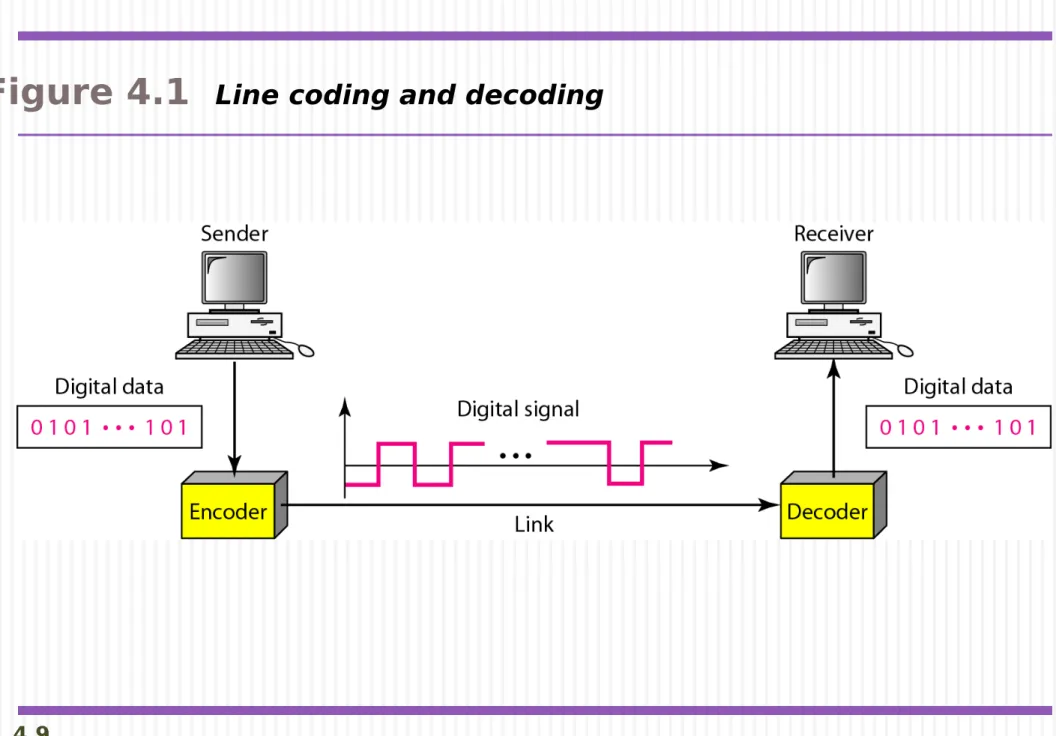
4.9
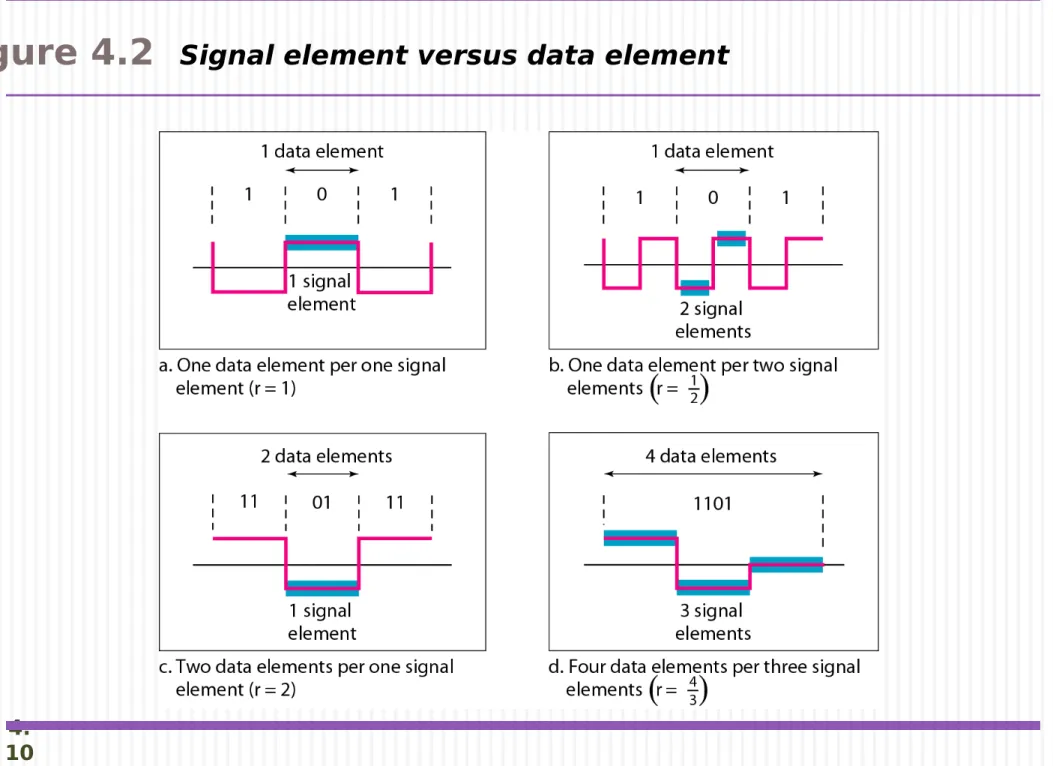
4. 10
A signal is carrying data in which one data element is encoded as one signal element ( r = 1). If the bit rate is 100 kbps, what is the average value of the baud rate if c is between 0 and 1?
Solution
We assume that the average value of c is 1/2 . The baud rate is then
4. 12
Although the actual bandwidth of a digital signal is infinite, the effective
bandwidth is finite.
4. 13
4. 14
In a digital transmission, the receiver clock is 0.1 percent faster than the sender clock. How many extra bits per second does the receiver receive if the
data rate is
1 kbps? How many if the data rate is 1 Mbps?
Solution
At 1 kbps, the receiver receives 1001 bps instead of 1000 bps.
Example 4.3
Types of Digital-to-Digital
Encoding
Digital/Digital Encoding
Unipolar Encoding
Simple and Primitive
Almost Obsolete Today
Study provides introduction to
concepts and problems involved
with more complex encoding
Pros and Cons of Unipolar Encoding
PROS
Straight Forward and Simple Inexpensive to Implement
CONS
Synchronization Example
Bit Rate = 1000 bps
1000 bits --- 1 second
1 bit --- = 0.001 sec
Positive voltage of 0.005 sec means
five 1’s
Sometimes it stretches to 0.006
seconds and an extra 1 bit is read by the Receiver
Polar Encoding
Polar encoding uses two voltage
levels
One positive and one negative
Average voltage level on the line is
reduced
DC Component problem of Unipolar
Non Return to Zero (NRZ)
The level of signal is either
positive or negative
NRZ
4. 25
4. 26
In NRZ-L the level of the voltage determines the value of the bit.
In NRZ-I the inversion or the lack of inversion
determines the value of the bit.
NRZ-L and NRZ-I both have an average signal rate of N/2 Bd.
Summary
Introduction to the Encoding
Techniques
Digital-To-Digital Encoding
Types of Digital-To-Digital Encoding
UniPolar Encoding
Polar Encoding
Suggested Reading
Section 5.1, “Data
DATA
COMMUNICATION
Recap of Lecture 14
Introduction to the Encoding
Techniques
Digital-To-Digital Encoding
Types of Digital-To-Digital
Encoding
UniPolar Encoding
Polar Encoding
Overview of Lecture 15
Types of Digital-To-Digital Encoding
Polar Encoding
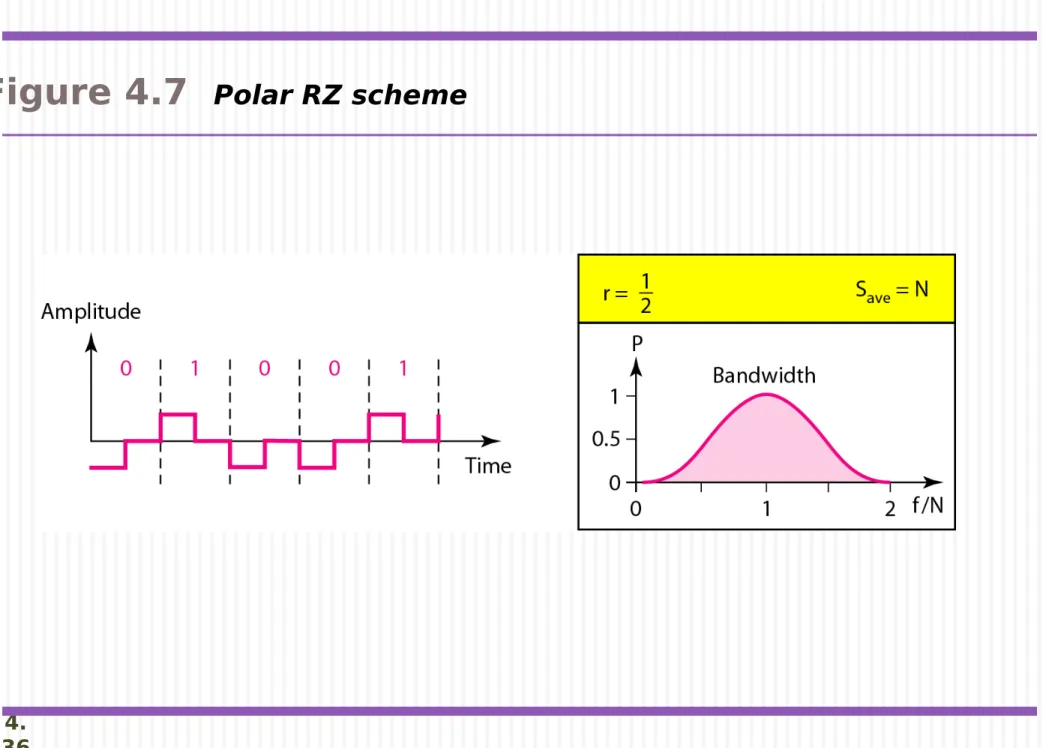
Return to Zero (RZ)
Encoding
Biphase Encoding
Types of Digital-to-Digital
Encoding
Digital/Digital Encoding
4. 36
Biphase Encoding
Best existing solution to the
problem of Synchronization
Signal changes at the middle of
Biphase Encoding
Biphase Encoding
4. 41
4. 42
In Manchester and differential
Manchester encoding, the transition at the middle of the bit is used for
synchronization.
The minimum bandwidth of Manchester and differential Manchester is 2 times
4. 43
Bipolar Encoding
Like RZ, it uses three voltage
levels:
Unlike RZ, zero level is used to
represent binary 0
Binary 1’s are represented by
Bipolar Encoding
Bipolar Schemes
Alternate Mark Inversion
(AMI)
Simplest type of Bipolar
Encoding
Mark
Comes from Telegraphy
(1)
Alternate Mark Inversion means
The bipolar scheme was developed as an alternative to NRZ. The bipolar scheme
has the same signal rate as NRZ, but there is no DC component. The NRZ scheme has most of its energy concentrated near zero frequency, which makes it unsuitable for transmission over channels with poor
No DC Component Problem
If we have a long sequence of 1s, the voltage level alternates between positive
and negative; it is not constant. Therefore, there is no DC component. For a long
sequence of Os, the voltage remains constant, but its amplitude is zero, which is the
Alternate Mark Inversion
(AMI)
A common bipolar encoding scheme is called bipolar alternate
mark inversion (AMI). In the term alternate mark inversion, the word mark comes
from telegraphy and means 1. So AMI means alternate I inversion. A neutral zero voltage
represents binary O. Binary Is are represented by alternating positive and negative
Alternate Mark Inversion
(AMI)
A variation of AMI encoding is called pseudoternary in which the 1 bit is
encoded as a zero voltage and the 0 bit is encoded as alternating positive and
Multilevel Schemes
The desire to increase the data speed or decrease the required bandwidth has
resulted in the creation of many schemes. The goal is to increase the number of bits per baud by encoding a pattern of m data elements into a pattern of n signal
elements.
We only have two types of data elements (Os and Is),
which means that
a group of m data elements can produce a combination of 2m data patterns.
Multilevel Schemes
If we have L different levels, then we can produce Ln combinations of signal patterns.
If 2m =Ln, then each data pattern is encoded into one
signal pattern.
If 2m < Ln, data patterns occupy only a subset of signal
patterns.
The subset can be carefully designed to prevent baseline wandering, to provide
synchronization, and to detect errors that occurred during data transmission. Data
encoding is not possible if 2m > Ln because
mBnL
The code designers have
classified these types of coding
as
mBnL,
where
m
is the length of the binary
pattern,
B
means binary data,
n
is the length of the signal
pattern, and
mBnL
A letter is often used in place
of
L: B(binary) for L =2, T (ternary)
for L =3, and Q (quaternary) for L
=4.
Note that the first two letters
define the data pattern, and the
second two define the signal
pattern.
In mBnL schemes, a pattern of m
data elements is encoded as a
Block Coding Schemes
We need redundancy to ensure
synchronization and to provide some kind of inherent error detecting.
Block coding can give us this redundancy and improve the performance of line coding.
In general, block coding changes
a block of m bits into a block of n bits, where n is larger than m.
Block coding is referred to as an mB/nB encoding
Block Coding Schemes
Block coding is normally
Block Coding
Block coding normally involves
three steps: division, substitution, and combination.
In the division step, a sequence of bits is divided into groups of m bits. For example, in 4B/5B encoding, the original bit sequence is divided into 4-bit groups. The heart of
block coding is the substitution step. In this step, we substitute an m-bit group for an n-bit group.
For example, in 4B/5B encoding we
substitute a 4-bit code for a 5-bit group. Finally, the n-bit groups are combined
Scrambling
Biphase schemes that are suitable for
dedicated links between stations in a LAN are not suitable for long-distance communication because of their wide bandwidth requirement.
The combination of block coding and NRZ line coding is not suitable for long-distance
encoding either, because of the DC component.
Scrambling
If we can find a way to avoid a long sequence
of Os in the original stream, we can use bipolar AMI for long distances.
We are looking for a technique that does not increase the number of bits and does provide synchronization.
We are looking for a solution that
substitutes long zero-level pulses with a combination of other levels to provide synchronization.
Bipolar 8 Zeros Substitution (B8ZS)
High Density Bipolar 3
(HDB3)
The HDB3 code is a bipolar signaling technique (i.e. relies on the
transmission of both positive and negative pulses). It is based on Alternate Mark Inversion (AMI), but extends this by inserting violation codes
Summary
Types of Digital-To-Digital Encoding
Polar Encoding
Return to Zero (RZ)
Encoding
Biphase Encoding
Suggested Reading