1-2016
From Share Value to Shared Value: Exploring the
Role of Accountants in Developing Integrated
Reporting in Practice
Delphine Gibassier
University of ToulouseMichelle Rodrigue
Université LavalDiane-Laure Arjaliès
Ivey Business School, [email protected]
Follow this and additional works at:
https://ir.lib.uwo.ca/iveypub
Part of the
Business Commons
Citation of this paper:
Gibassier, Delphine and Rodrigue, Michelle and Arjaliès, Diane-Laure, From Share Value to Shared Value: Exploring the Role of Accountants in Developing Integrated Reporting in Practice ( January 1, 2016). IMA (Institute of Management Accountants) – ACCA (The Association of Chartered Certified Accountants) Joint Research Report, January 2016 .
advancing the management accounting profession. Globally, IMA supports the profession through research, the CMA®
continuing education, networking and advocacy of the highest ethical business practices. IMA has a global network of more than 75,000 members in 140 countries and 300 professional and student chapters. Headquartered in Montvale, N.J., USA, IMA provides localized
services through its four global regions: The Americas,
information about IMA, please visit www.imanet.org.
© January 2016
The Association of Chartered Certified Accountants The Adelphi
1-11 John Adam Street London WC2N 6AU www.accaglobal.com Institute of Management Accountants
10 Paragon Drive, Suite 1 Montvale, NJ 07645
www.imanet.org/thought_leadership
About ACCA
®is the global body for professional accountants. We aim to
application, ability and ambition around the world who seek
We support our 178,000 members and 455,000 students in 181 countries, helping them to develop successful careers in accounting and business, with the skills required by employers.
than 7,110 Approved Employers worldwide, who provide high standards of employee learning and development. Through our public interest remit, we promote appropriate regulation of accounting and conduct relevant research to ensure
www.accaglobal.com
IMA-ACCA Joint Research
at Toulouse Business School. She teaches carbon accounting and environmental accounting and has been published in several academic journals and books. She is a former professional
management accountant for multinationals including GE, Syngenta, and Danone. You can contact her at [email protected].
Michelle Rodrigue, CPA (Canada), Ph.D., is an
associate professor of accounting at Université Laval in Québec, Canada. Her research interests include sustainability accounting, particularly governance and disclosure of sustainability performance and relationships with stakeholders. Her work has been published in various accounting academic journals. You can reach her at
Diane-Laure Arjaliès, Ph.D., is an assistant
professor at the Ivey Business School. She also has several years of experience in responsible
investments at an asset management company. Her research interests include the introduction of nonfinancial performance measures in management control systems, particularly in the financial markets. You can reach her at [email protected].
Table of Contents
Executive Summary ...5
Keywords ...5
Introduction ... 6
Overview of IR and Its Context ... 6
What Is Integrated Reporting? ...7
Origins of IR ... 10
Integrated Reporting Today ... 13
The Benefits of IR for Companies ... 17
IR: A Leverage Mechanism Toward Sustainability ... 17
IR: A Leverage Mechanism Toward Holistic Thinking ... 18
IR: A Leverage Toward a Stakeholder-Inclusive Approach ... 19
IR: A Leverage Toward Long-Term Thinking ... 20
The Role of Accountants in Implementing an Integrated Report... 21
Participating in the Different “Content” Elements of an Integrated Report ... 22
The Six Capitals and Their Integration ... 24
Management Accounting and IR ...30
Internal Auditing and IR ...30
Corporate Reporting and IR... 31
External Auditing and IR ... 31
The Governance of IR ... 31
Existing Challenges and Potential Solutions ... 32
The Materiality Matrix ... 32
The IR Project and Company Culture ...33
Integrating Information Systems ...33
The Legal and Economic Environments ... 34
Conclusion ... 34
Appendix ... 36
Acronyms ... 36
Additional References ... 36
The corporate reporting landscape has evolved in the last 20 years from financial reporting to
sustainability reporting to “integrated reporting.” The corporate reporting history abounds with different attempts at integrating sustainability accounting with financial accounting (e.g., the Corporate Report 1975 and the “Triple Bottom Line” concept) and thereby attempting to report in an integrated manner. The first corporate integrated reports appeared in 2002, but the new trend remained in the margins. Since 2010, the IIRC (International Integrated Reporting Council) has led the work on building the first Integrated Reporting (IR) framework, published in December 2013.
The accounting profession has played a crucial role in pushing the idea of integrated reporting forward. Now it is looking at how it can best participate in IR corporate practice.
This report is aimed at accountants who would like to get involved more closely, or even drive, the IR efforts within their company. We begin with an overview of the origins of IR combined with calls for its development, emphasizing the role of the accounting profession in the development of this new corporate reporting framework. Then we discuss the benefits of IR, centered on the holistic thinking it can foster in companies, enabling them to reconsider sustainability challenges and leveraging a stakeholder-inclusive approach to corporate reporting. We then focus on the involvement of
accountants within the implementation of IR. Finally, we elaborate on today’s challenges for IR, which include developing a materiality matrix, designing a project mode for the first IR publication process, designing integrated information systems, and navigating the legal environment surrounding IR. The report is based on participative observation within a leading multinational company—pilot of the IIRC—semi-structured interviews with international experts and other multinational companies on their IR journey, as well as documentary evidence collected from 2011 to 2015.
Keywords
• Integrated Reporting • Corporate reporting • Sustainability • Materiality • Capitals • Integrated thinking • Shared value • Business model • Accounting practicesExecutive Summary
Introduction
Integrated Reporting (IR) gained incredible momentum in recent years. Since the movement is still in its infancy, limited experience and practice are available on the matter. This report aims to guide
accountants in the new area of corporate reporting. Our main focus is on the role of accounting and accountants in the implementation of IR within companies. Accountants are central to the IR process, and the chief financial officer (CFO) is often the initiator and champion of the IR project.
“I believe the adoption of IR will not reach its full potential, including in the U.S., unless we, as an accounting community, take several actions to lay the groundwork for a transformation in external corporate reporting.” —Jeff Thomson, President and CEO of IMA® (Institute of
Management Accountants)
“The global tide is turning in favor of integrated reporting, and accountants have a
fundamental role to play. They must equip themselves with new skills to help steer integrated reporting properly.” —Robert Bruce, Journalist
“Accountants have a major role to play…They are experts in the measurement and reporting of financial information. They need to broaden their content knowledge to include
nonfinancial information.” —Bob Eccles, Senior Lecturer at Harvard Business School “Integrated reporting is the domain of the accountant more than other professions…The judgment and analytical skills inherent in the accountancy profession are the key.” —Paul Druckman, CEO of the IIRC (International Integrated Reporting Council)
These guidelines are based on the results of five years of research that includes participant
observations in a multinational pilot of the International Integrated Reporting Council (IIRC), interviews with international experts, and interviews with other multinationals on the IR journey. The report covers the origins of IR, its potential benefits, the role of accountants in the implementation process, and the challenges of implementing an IR project.
Overview of IR and Its Context
Over the past few decades, sustainability issues have slowly become mainstream, and there is a shift from the creation of share value to the generation of shared value. Through shared value creation, a company links its operations to generating long-term value both for its business and for society as a whole and defines its success in terms of internal financial returns and external social and economic
results.1 Ultimately, creating shared value acknowledges both the work that corporations need to do to
reduce negative impacts on society as well as, and more fundamentally, how they can be part of progress on global challenges, such as climate change and the enforcement of human rights. Following this shift, there is a new trend of corporate reporting: the integration of financial and nonfinancial concerns into one accounting tool, known as IR.
What Is Integrated Reporting?
IR has been defined by the IIRC as “a concise communication about how a company’s strategy,
governance, performance and prospects, in the context of its external environment, lead to the creation
of value over the short, medium and long term.”2 The IIRC states that IR differs from previous accounting
by aiming to:3
• “Improve the quality of information available to providers of financial capital to enable a more
efficient and productive allocation of capital.
• Promote a more cohesive and efficient approach to corporate reporting that draws on different
reporting strands and communicates the full range of factors that materially affect the ability of a company to create value over time.
• Enhance accountability and stewardship for the broad base of capitals (financial, manufactured,
intellectual, human, social and relationship, and natural) and promote understanding of their interdependencies.
• Support integrated thinking, decision-making and actions that focus on the creation of value over
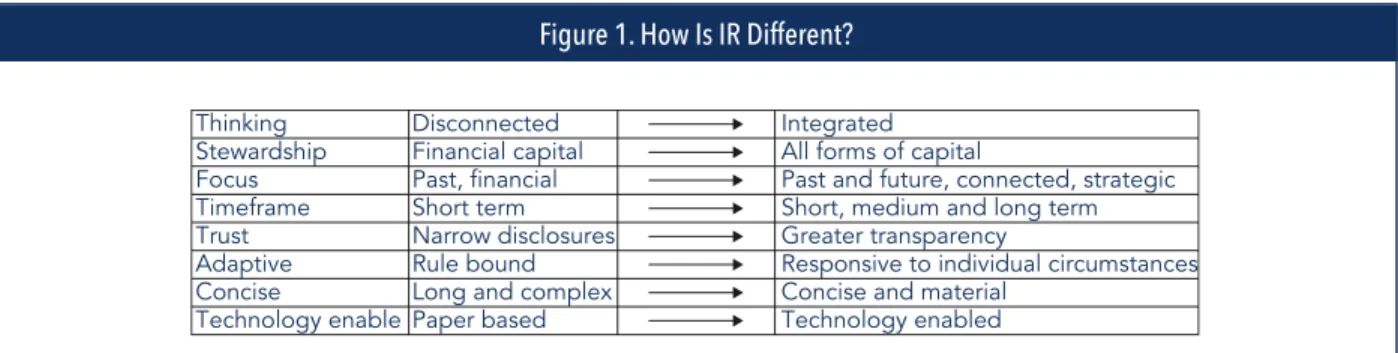
the short, medium and long term.” (See Figure 1 for more details.)
1 Michael E. Porter and Mark R. Kramer, “Creating Shared Value,” Harvard Business Review, January-February 2011, pp. 62–77,
https://hbr.org/2011/01/the-big-idea-creating-shared-value.
2 Copyright © December 2013 by the International Integrated Reporting Council (‘the IIRC’). All rights reserved. Used with permission of the IIRC.
Contact the IIRC ([email protected]) for permission to reproduce, store, transmit or make other uses of this document.
3 Ibid., p.2.
Figure 1. How Is IR Different?
In December 2013, the IIRC published its International <IR> Framework, which explains the IR funda-mental concepts and outlines an integrated report in terms of guiding principles and content elements. The Framework lists seven guiding principles underlying the development of an integrated report:
• Strategic focus and future orientation: How the business strategy enables the company to create value in the short, medium, and long term and how that impacts the capitals.
• Connectivity of information: The informational content of an integrated report should present a holistic picture of the interrelated and interdependent factors affecting the company’s ability to create value over time.
• Stakeholder relationships: Understanding, considering, and responding to key stakeholders’ legitimate needs and interests through a portrayal of stakeholder relationships.
• Materiality: Information about “matters that substantively affect the company’s ability to create value over the short, medium and long term.”
• Conciseness: “An integrated report should be concise.”
• Reliability and completeness: For all material matters, report on positive and negative issues without material error.
• Consistency and comparability: Presenting the informational content on a consistent basis over time and in a way that allows comparisons with other companies (to the extent that it is material to
its value-creation process).4
The Framework then presents the eight elements that should be included in an integrated report. Emphasis is placed on how these elements are “fundamentally linked to each other and are not mutually exclusive”:
• Company overview and external environment
• Governance
• Business model (including the six capitals: financial, manufactured, intellectual, human, social and
relationship, and natural)
• Risks and opportunities
• Strategy and resource allocation
• Performance
• Outlook
• Basis of preparation and presentation5
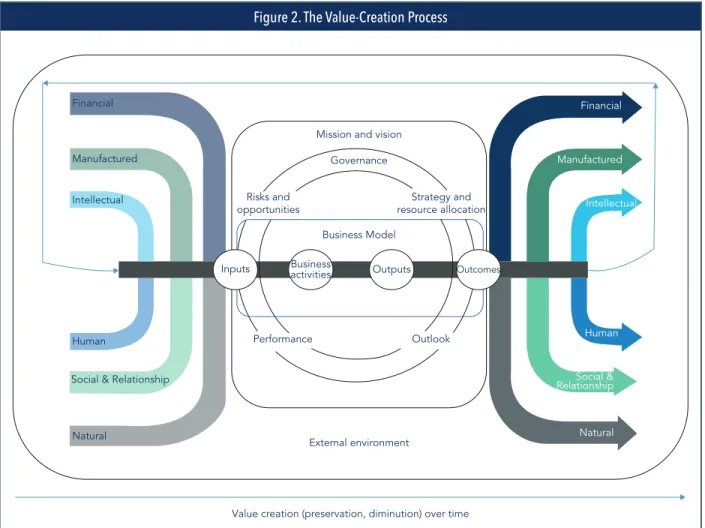
Central to IR is the value-creation process. The objective of an integrated report is to expose how a company creates value over time, taking into consideration that this process is influenced by the
4 The International Integrated Reporting Committee (IIRC), “The International <IR> Framework,” December 2013, p. 5,
www.theiirc.org/international-ir-framework.
5 The International Integrated Reporting Committee (IIRC), “The International <IR> Framework,” December 2013, p. 5,
company’s external environment, as well as its stakeholders, and relies on multiple resources. Increases, decreases, and transformation of the capitals triggered by the company’s operations are displays of its
value-creation process.6 The IIRC illustrates the value-creation process in Figure 2.
The distinctive features of IR can be summarized along three main dimensions:
• IR should measure and help create shared value for stakeholders: It is, therefore, both a reporting
and a management tool.
• IR should include management’s expectations for the future: This implies setting strategic
objectives and strategies to achieve these objectives.
• IR should provide reliable information that is material to assessing and sustaining value in the short,
medium, and long term at the business model level: This means that key drivers for creating value need to be identified throughout the company.
6 The International Integrated Reporting Committee (IIRC), “The International <IR> Framework,” December 2013, p. 5,
www.theiirc.org/international-ir-framework.
Figure 2. The Value-Creation Process
Origins of IR
The Shift in Value Creation
Physical and financial assets do not explain the market value of a company anymore. In 1975, they would
explain 83% of a company’s value, but today they only explain 19%.7 Market valuations are now based
on intangibles such as intellectual, social, and relationship and human capitals. Management of
environmental issues and social license to operate are also central to valuation.8 The economy is
knowledge-driven, and financial statements do not transcribe the entire value of a company since they are mostly focused on historical performance and do not provide information on the long-term, broader,
value-creation potential of a corporation.9 In this context, there is a crucial need for a broader
information set.
The Evolution of Corporate Reporting
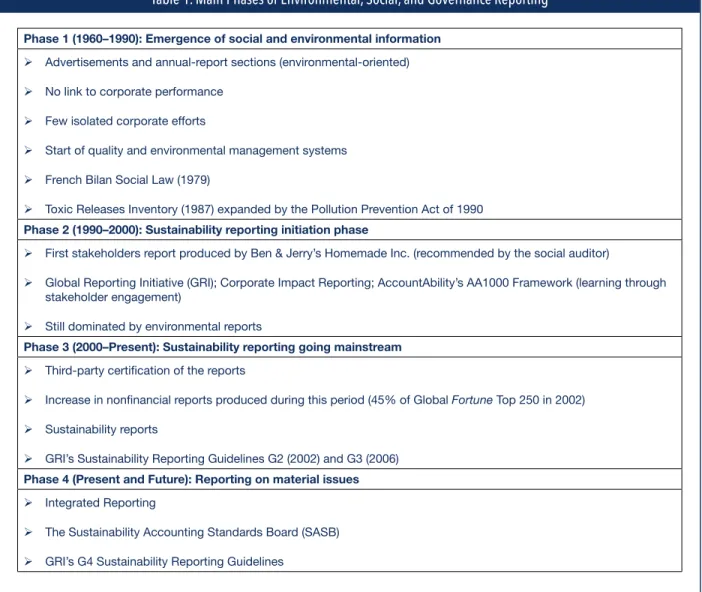
IR finds its roots in a constantly evolving movement of corporate reporting that goes back to the early 1960s. Recognizing both the impact of societal issues on corporate activities and performance and the information needs of a broad range of stakeholders, this movement stimulated the inclusion of
environmental, social, and governance information in corporate publications (Table 1). It evolved from the limited disclosure of environmental elements to a broader coverage of social and environmental issues. Disclosure also became more structured with the development of voluntary reporting frameworks that offer guidance to companies on the matter. While sustainability reporting has certainly improved since its inception, it was initially criticized because the “proliferation of lengthy sustainability reports that fail to focus on the sustainability impacts that are of most significance to the stakeholders or are directly
relevant to the business.”10 As a result, disclosure on social, environmental, and governance issues now
turns to reporting on material aspects of corporate impacts and activities. Among this shift toward materiality, IR aims to fulfil information needs for concise and material information about the
multifaceted nature of corporate activities and the process through which it creates value (in terms of different capitals) over the long term.
7 The IIRC, Towards Integrated Reporting Discussion Paper (2011) and
http://www.oceantomo.com/2013/12/09/Intangible-Asset-Market-Value-Study-Release/
8 Deloitte, “Navigating the Evolving Sustainability Disclosure Landscape,” September 2014, http://www2.deloitte.com/content/dam/
Deloitte/us/Documents/risk/us-aers-sustainability-reporting-landscape.pdf.
9 Ibid. 10 Ibid.
Table 1. Main Phases of Environmental, Social, and Governance Reporting
Phase 1 (1960–1990): Emergence of social and environmental information Ø Advertisements and annual-report sections (environmental-oriented) Ø No link to corporate performance
Ø Few isolated corporate efforts
Ø Start of quality and environmental management systems
Ø French Bilan Social Law (1979)
Ø Toxic Releases Inventory (1987) expanded by the Pollution Prevention Act of 1990 Phase 2 (1990–2000): Sustainability reporting initiation phase
Ø First stakeholders report produced by Ben & Jerry’s Homemade Inc. (recommended by the social auditor)
Ø Global Reporting Initiative (GRI); Corporate Impact Reporting; AccountAbility’s AA1000 Framework (learning through stakeholder engagement)
Ø Still dominated by environmental reports
Phase 3 (2000–Present): Sustainability reporting going mainstream Ø Third-party certification of the reports
Ø Increase in nonfinancial reports produced during this period (45% of Global Fortune Top 250 in 2002)
Ø Sustainability reports
Ø GRI’s Sustainability Reporting Guidelines G2 (2002) and G3 (2006)
Phase 4 (Present and Future): Reporting on material issues Ø Integrated Reporting
Ø The Sustainability Accounting Standards Board (SASB)
Ø GRI’s G4 Sustainability Reporting Guidelines
Integrated Reporting History and the Birth of the IIRC
IR pervades the history of corporate reporting. In June 1992, visionary Robert K. Elliott stated in
Accounting Horizons, “Third-wave entities have external accountabilities that go beyond financial information...Much of what users want to know is non-financial.”
In 2005, Allen L. White, vice president and senior fellow at the Tellus Institute, stated that a new generation of nonfinancial reporting would establish a “new standard of transparency unimaginable even
a decade ago.”11 He went on to say, “Integrated reporting is a fluid, fast-moving work in progress. New
norms and measurement methods appear on a regular basis.” He believed that nonfinancial reporting
11 Allen L. White, “New Wine, New Bottles: The Rise of Non-Financial Reporting,” BusinessWire, June 2005, www.businesswire.com/portal/binary/
offered stakeholders “what financial reporting alone fails to offer: a window on the character and competency of the reporting company.”
The Prince of Wales’s Accounting for Sustainability Project (A4S) developed the Connected Reporting Framework in 2007. Precursor of the IR movement led by the IIRC, this Framework aims to expose how business activities can be reported in a connected way that reflects corporate strategy and
management.12 A range of companies, including Aviva, BT Group, EDF Energy, HSBC Bank,
Hammerson, and Northern Foods, have adopted it.
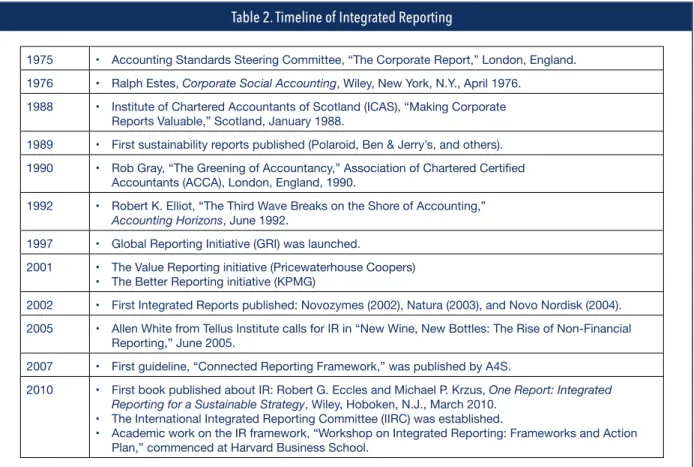
The IIRC was founded in 2010 by the Prince of Wales’s A4S, the Global Reporting Initiative (GRI), and the International Federation of Accountants (IFAC). Its mission is to establish recognition and acceptance of IR and integrated thinking. Second, the IIRC disseminates and promotes standardized IR, thereby contributing to the use of IR as a potential reporting standard in both the public and private sectors. Table 2 provides an overview of the development of IR over time.
12 For more details, visit www.accountingforsustainability.org/wp-content/uploads/2011/10/Connected-Reporting.pdf.
Table 2. Timeline of Integrated Reporting
1975 • Accounting Standards Steering Committee, “The Corporate Report,” London, England. 1976 • Ralph Estes, Corporate Social Accounting, Wiley, New York, N.Y., April 1976.
1988 • Institute of Chartered Accountants of Scotland (ICAS), “Making Corporate Reports Valuable,” Scotland, January 1988.
1989 • First sustainability reports published (Polaroid, Ben & Jerry’s, and others). 1990 • Rob Gray, “The Greening of Accountancy,” Association of Chartered Certified
Accountants (ACCA), London, England, 1990.
1992 • Robert K. Elliot, “The Third Wave Breaks on the Shore of Accounting,”
Accounting Horizons, June 1992.
1997 • Global Reporting Initiative (GRI) was launched.
2001 • The Value Reporting initiative (Pricewaterhouse Coopers) • The Better Reporting initiative (KPMG)
2002 • First Integrated Reports published: Novozymes (2002), Natura (2003), and Novo Nordisk (2004). 2005 • Allen White from Tellus Institute calls for IR in “New Wine, New Bottles: The Rise of Non-Financial
Reporting,” June 2005.
2007 • First guideline, “Connected Reporting Framework,” was published by A4S.
2010 • First book published about IR: Robert G. Eccles and Michael P. Krzus, One Report: Integrated
Reporting for a Sustainable Strategy, Wiley, Hoboken, N.J., March 2010.
• The International Integrated Reporting Committee (IIRC) was established.
• Academic work on the IR framework, “Workshop on Integrated Reporting: Frameworks and Action Plan,” commenced at Harvard Business School.
Table 2. (Continued)
2011 • South Africa required integrated reports from listed companies. • IIRC launched white paper and pilot program.
• The Sustainability Accounting Standards Board (SASB) was founded with Robert G. Eccles as a board member.
2012 • 80 companies in total were part of the IIRC’s pilot program. 2013 • The <IR> framework was launched in December.
2014 • The Corporate Reporting Dialogue initiative was launched.
2015 • Robert G. Eccles and Michael P. Krzus, The Integrated Reporting Movement: Meaning, Momentum,
Motives, and Materiality, Wiley, Hoboken, N.J., November 2014.
Integrated Reporting Today
The South African Experience
South Africa requires all listed companies on the Johannesburg Stock Exchange (JSE) to produce an integrated report under the King III Report code of corporate governance or to explain why the company does not issue such a report. Specifically, this integrated report—dedicated to all corporate stakeholders—calls for disclosure of governance, strategy, and sustainability issues as well as financial disclosures.
Listed companies in South Africa now publish a significant portion of integrated reports being
produced worldwide.13 The regulation appears to have motivated a commitment toward IR, with reports
being increasingly integrated and concise over the 2010–2012 period.14 A broader range of companies
in South Africa have implemented IR: most of the JSE top 100 companies, other (smaller) listed
companies, some large state-owned companies, and even some unlisted corporations.15 South Africa
endorsed the IIRC framework following its publication at the end of 2013.
The Converging Forces Toward IR
Multiple forces are at play at the international and the national levels to highlight the relevance of IR. Here are a few examples of these forces.
13 KPMG International, “The KPMG Survey of Corporate Responsibility Reporting 2013,” 2013, www.kpmg.com/Global/en/IssuesAndInsights/
ArticlesPublications/corporate-responsibility/Documents/corporate-responsibility-reporting-survey-2013-exec-summary.pdf.
14 Global Reporting Initiative (GRI), “The Sustainability Content of Integrated Reports – A Survey of Pioneers,” GRI Research and Development Series,
2013, www.globalreporting.org/resourcelibrary/GRI-IR.pdf.
15 The Integrated Reporting Committee (IRC) of South Africa, “Preparing an Integrated Report: A Starter’s Guide,” December 2014,
Paragraph 47 of the United Nations Conference on Sustainable
Development
In June 2012, the U.N. Conference on Sustainable Development issued a statement known as
“Paragraph 47.” It shows the importance of corporate sustainability reporting and the need to “encour-age companies, where appropriate, especially publicly listed and large companies, to consider
integrat-ing sustainability information into their reportintegrat-ing cycle.”16
The “Group of Friends of Paragraph 47” is a government-led initiative formed by Brazil, Denmark, France, and South Africa in June 2012. Its charter declares: “Their shared belief that corporate
transparency and accountability are key elements of a well-functioning market economy.”17
“We acknowledge the importance of corporate sustainability reporting and encourage companies, where appropriate, especially publicly listed and large companies, to consider integrating sustainability information into their reporting cycle. We encourage industry, interested governments and relevant stakeholders with the support of the United Nations system, as appropriate, to develop models for best practice and facilitate action for the integration of sustainability reporting, taking into account the experiences of already existing frameworks and paying particular attention to the needs of developing countries, including for capacity-building.” —Paragraph 47, Rio Outcome Document
Europe
The social and environmental impacts of companies in Europe are under the spotlight of the European Union (EU). The EU has made sustainability disclosure mandatory for companies with more than 500 employees. According to the new EU regulation, approximately 6,000 companies will be required to disclose in their management reports information on policies, risks, and outcomes regarding
environmental, social, and employee issues, human rights, and anticorruption and bribery topics as well
as the diversity of their board of directors.18
16 United Nations, “Resolution 66/288: The future we want,” September 2012, p. 9, www.un.org/ga/search/view_doc.asp?symbol=A/
RES/66/288&Lang=E.
17 United Nations Environmental Programme (UNEP), “Group of Friends of Paragraph 47,” www.unep.org/resourceefficiency/Business/Sustainableand
ResponsibleBusiness/CorporateSustainabilityReporting/GroupofFriendsofParagraph47/tabid/105011/Default.aspx.
Several sustainability reporting requirements are also implemented in different European countries. For instance, in the United Kingdom, companies listed on the London Stock Exchange are required to
disclose their levels of greenhouse gas emissions. In addition, all medium and large companies are expected to disclose in their annual review the necessary employee, environmental, social, and community information for the understanding of the activities and performance under the U.K.
Companies Act of 2006. France’s Nouvelles Regulations Economiques (New Economic Regulations) law of 2001 was reinforced in Grenelle II of 2010, and a carbon reporting article was added that requested companies with more than 500 employees to report on their greenhouse gas emissions every three years. United States
Increasingly aware that climate change may significantly affect business activities, the U.S. Securities & Exchange Commission (SEC) published interpretive guidance on existing disclosure requirements as they apply to business or legal developments relating to climate change. These disclosures should be
integrated in the SEC filings. Although to a lesser extent, environmental and social issues are again required to be integrated with financial information.
In the public sector, President Barack Obama’s Executive Order 13514 requires all federal agencies to measure and report on their sustainability performance. This requirement includes supply chain
assessments and is expected to have a domino effect on all businesses supplying or working for the
federal agencies.19
Founded in 2011, the Sustainability Accounting Standards Board (SASB) focuses on developing industry-specific sustainability disclosure standards for listed companies in the United States. These disclosures are meant to be included in mandatory 10-K or 20-F SEC filings. Centered on identifying material environmental and social issues within each industry, the standards developed by the SASB
intend to “provide investors with a complete view of material financial and sustainability information.”20
The standards are composed of qualitative information and industry-specific performance metrics. Novo Nordisk, an IR pioneer company based in Denmark, participated in the development of its industry’s
standard, emphasizing the void the SASB intends to fills in the U.S. reporting landscape.21
Most Recent Calls for IR
Different actors from the finance and accounting worlds recently issued calls for IR. For instance, KPMG
positions IR as a dominant future trend in corporate reporting.22 In addition, various stock exchanges
19 The White House, “Executive Order—Planning for Federal Sustainability in the Next Decade,” March 2015,
www.whitehouse.gov/the-press-office/2015/03/19/executive-order-planning-federal-sustainability-next-decade.
20 Sustainability Accounting Standards Board (SASB), “The Need for SASB,” www.sasb.org/sasb/need.
21 Susanne Stormer, “Compliant by Choice: How Disclosure Guidelines Can Get You Ahead of the Curve,” Pharmaceutical Compliance Monitor,
September 2013, www.pharmacompliancemonitor.com/compliant-by-choice-how-disclosure-guidelines-can-get-you-ahead-of-the-curve/5546.
22 KPMG International, “The KPMG Survey of Corporate Responsibility Reporting 2013,” 2013, www.kpmg.com/Global/en/IssuesAndInsights/
around the world are now part of a sustainability initiative that aims to promote the environmental, social, and governance transparency of listed companies. IR is presented as instrumental in this process: “Reorientation of financial markets also requires integrated reporting. This is a fundamental tool for investors to make informed decisions on responsible allocation of capital, and it is at the heart
of Sustainable Stock Exchanges.”23 Similarly, the Association of Chartered Certified Accountants (ACCA)
underlined how IR has the potential to improve reporting since it will provide to “investors and other stakeholders a more complete and interconnected view of the entity and its prospects over a longer time
frame than is usually covered in traditional corporate reporting.”24
The Corporate Reporting Dialogue Initiative
The Corporate Reporting Dialogue was officially launched in June 2014 and was introduced by the IIRC. It aims to foster the alignment of corporate reporting frameworks and standards in order to support the reduction of the reporting burden caused by the multiplications of voluntary disclosure initiatives alongside increased mandatory reporting requirements. IR is intended to serve as the umbrella under which “greater coherence, consistency and comparability between corporate reporting frameworks,
standards and requirements” will be promoted.25 This dialogue could yield the additional benefits
needed to reduce confusion among information users with respect to the differences between the standards and to mitigate the risk of decline in reporting or in reporting quality that could derive from
the multiplication of reporting standards.26
The initiative brings together companies that have significant international influence on the corporate reporting landscape, at both the financial and the sustainability levels—namely, the CDP, Climate Disclosure Standards Board, Financial Accounting Standards Board (FASB), GRI, International Accounting Standards Board (IASB), IIRC, International Organization for Standardization (ISO), and SASB.
The Corporate Reporting Dialogue recently published The Corporate Reporting Landscape Map. It illustrates the similarities and differences among different reporting standards. Specifically, the map is composed of three levels. The first level describes the purpose of each reporting initiative, the second level details how each initiative relates to the six capitals, and the third level explains how each initiative relates to the content elements of the IIRC framework.
23 United Nations Conference on Trade and Development (UNCTAD), “World Investment Report 2014: Investing in the SDGs: An Action Plan,” 2014,
p. XXI, http://unctad.org/en/PublicationsLibrary/wir2014_en.pdf.
24 Association of Chartered Certified Accountants (ACCA), “Sustainability Matters: ACCA Policy Paper,” April 2014, p. 9,
www.accaglobal.com/content/dam/acca/global/PDF-technical/sustainability-reporting/tech-tp-smapp.pdf.
25 For more, see http://corporatereportingdialogue.com and www.cdsb.net/strategic-alliances/corporate-reporting-dialogue. 26 Jo Confino, “Why Collaboration Is Top of the Agenda for the Global Reporting Initiative,” The Guardian, July 2013,
The Benefits of IR for Companies
IR: A Leverage Mechanism Toward Sustainability
There is growing acknowledgment that financial performance and sustainability performance are linked. A 2012 working paper, “The Impact of a Corporate Culture of Sustainability on Corporate Behavior and Performance,” explained that the denominated high-sustainability firms out-performed the low-sustainability firms in terms of both stock market and accounting measures over a period of
18 years.27
While not explicitly emphasized by the IR framework, firms may choose to orient their IR
project toward improved sustainability. In this case, the sustainability “leverage effect” of IR results from the progressive integration/reinforcement of sustainable issues among operational practices. In this regard, the implementation of IR could act as a support for learning and transforming practices toward sustainability. By moving to IR, companies might move from a somewhat reactive conception of sustainability reporting to an explorative and proactive approach.
“I think the best surprise actually is the fact that we’ve been working with so many people internally on preparing the annual report means that we have different kinds of conversations around sustainability now than we had before.” —Interviewee 21
In order to do so, the corporate value system of a company and its culture must include
sustainability and ethics. The board and executive managers must exhibit strong commitment to adopt sustainability as well as the move to IR. Often, companies that embark in an integrated reporting and thinking journey will not need corporate social responsibility/sustainability as a separate function since sustainability is gradually embraced by the company’s different functions—from commercial to
marketing, from logistics to finance. Through the development of an integrated report, “stakeholders will gain a better understanding of the quality and sustainability of performance through insight into external
influences, strategic priorities and the dynamics of the chosen business model.”28 An integrated report
indeed often reveals if sustainability is indeed really integrated into the business strategy of the company.
27 Robert G. Eccles, Ioannis Ioannou, and George Serafeim, “The Impact of Corporate Sustainability on Organizational Process and Performance,”
working paper, Harvard Business School, 2012.
28 Pricewaterhouse Coopers, “Integrated Reporting: The Future of Corporate Reporting,” May 2012, p. 5,
Finally, the evolution of IR in the last five years has pushed the development of newer sustainability reporting frameworks (such as the GRI G4 Sustainability Reporting Guidelines and the SASB’s industry provisional standards), natural capital accounting, and sustainability accounting (such as the
Environmental Profit and Loss (E P&L)). (For more details, see “The Six Capitals and Their Integration.”) These frameworks can be employed to provide more information on corporate sustainability
performance to interested stakeholders.
IR: A Leverage Mechanism Toward Holistic Thinking
At the strategic level, the companies we studied repeatedly mentioned that IR allows them to stimulate holistic thinking within their business. The need to consider multiple capitals in the
value-creation process contributes to broadening the conception of their company and its operations. It promotes a multifaceted approach to information gathering and decision making that companies consider beneficial. According to the South Africa Institute of Chartered Accountants (SAICA) “Integrated Thinking: An Exploratory Survey” report, more than 70% of responding executives and
nonexecutive directors felt that decision making had improved as a result of integrated thinking efforts.29
At the operational level, managers were prompt to identify with the IR movement because it makes sense to them to have a more complete picture of their business. Such identification with IR entails corporations to drive greater employee motivation toward and involvement in IR implementation, which significantly facilitates the changes required by the IR journey.
“In terms of narrative, I have always thought that having an overall story to tell about the company is the way it should be, a story that integrates all the different facets.” —Interviewee 1
Integrate: Doing Business in the 21st Century shows that integrated thinking is achieved when:
• Nonfinancial and financial performances are no longer separated, and the entire company accepts
that one affects the other.
• The company’s strategy is shared by all functions and divisions.
• Decision making is carried out with a longer-term view on value creation.30
Operationally, holistic thinking can be observed when accounting for capitals is developed to sustain long-term value creation, when the boundaries of capital accounting extend along the entire supply
29 The South African Institute of Chartered Accountants (SAICA), “Integrated Thinking: An Exploratory Survey,” 2014,
www.integratedreportingsa.org/Portals/0/Documents/SAICAIntegratedThinkingLandscape.pdf.
chain to encompass the broad responsibility mind-set, and when companies create value for a wide range of stakeholders. Holistic thinking is observed in integrated information technology systems (see “Integrating Information Systems”) and when boards and management start to use sustainability measures (e.g., human capital, natural capital-related key performance indicators (KPIs)) for decision
making and developing a strategy.31
IR: A Leverage Toward a Stakeholder-Inclusive Approach
“Our target—for the integrated report—isn’t just the investors. It’s all the stakeholders.” —Interviewee 7
In terms of stakeholders, investors and providers of financial capital are the target audience for the IIRC framework. In the same vein, it also alludes to stakeholder engagement being informative through the IR process but does not provide specific guidance on stakeholder engagement. Other observers see
the integrated report as a means to meet broader stakeholder expectations.32 Some individuals more
heavily emphasize the importance of continuous dialogue between the company and its stakeholders to ensure responsiveness to stakeholder views and interests and to integrate their views into the IR process
when material.33 Being an emerging phenomenon, companies that have implemented IR have the
opportunity to appropriate it and make the most of its possibilities. It is up to each company to develop its own IR approach, keeping in mind the needs of its multiple stakeholders.
In addition to shaping the content of the report in terms of material issues relevant to stakeholders,
broadly engaging your company’s stakeholders enables a more in-depth leverage of holistic thinking.34
Such engagement allows you to embed stakeholder views and interests in the conduct of the company’s day-to-day operations and to consider the company’s strategy, risks, and opportunities in light of
stakeholder feedback.35
In addition to integrating stakeholder views into their understanding of the value-creation process, IR offers benefits in terms of accountability to stakeholders. A survey of companies in South Africa that issued mandatory integrated reports reveals that the majority of companies perceive an improved trust
31 The South African Institute of Chartered Accountants (SAICA), “Integrated Thinking: An Exploratory Survey,” 2014, www.integratedreportingsa.org/
Portals/0/Documents/SAICAIntegratedThinkingLandscape.pdf.
32 Maxi Steyn, “Organisational Benefits and Implementation Challenges of Mandatory Integrated Reporting,” Sustainability Accounting, Management and Policy Journal, 2014, pp. 476–503.
33 The Integrated Reporting Committee (IRC) of South Africa, “Framework for Integrated Reporting and the Integrated Report: Discussion Paper,”
January 2011, www.sustainabilitysa.org/Portals/0/IRC%20of%20SA%20Integrated%20Reporting%20Guide%20Jan%2011.pdf.
34 The International Integrated Reporting Committee (IIRC), “The International <IR> Framework,” December 2013,
www.theiirc.org/international-ir-framework.
35 The Integrated Reporting Committee (IRC) of South Africa, “Preparing an Integrated Report: A Starter’s Guide,” December 2014,
relationship with their stakeholders following the publication of their report. They also strongly highlight how issuing an integrated report helped them develop improved and/or meaningful stakeholder
engagement practices.36
“We have produced financial reports for the longest time and we have never quite had that stakeholder engagement process until we needed to start doing integrated reporting. And that stakeholder engagement process just from the experience last week, it’s valuable not just in terms of shaping the next report but also allows us to share voices from the ground in a very qualitative way.” —Interviewee 22
IR: A Leverage Toward Long-Term Thinking
“From an investor’s perspective, they are coming in and investing in the company’s future, not the past.” —Interviewee 22
IR provides companies the opportunity to embrace long-term thinking, meaning envisioning the future of the company in 5, 10, or even 20 years. The idea is to reverse the trend from the past few decades to shorten strategic time horizons by allowing managers to reflect on the company’s future challenges. This could be done both within the company by offering an arena for discussing how it could sustain in the future and outside the company while engaging its stakeholders throughout the IR process. By adopting IR, a company encourages its employees and stakeholders to shift toward sustainability by
offering a forward-looking report (e.g., target settings in terms of CO2 and also the use of prospective
exercises about what the business could be in 5, 10, or 20 years) that could also include qualitative data.
Interestingly, both companies and investors show great interest in focusing more on long-term strategy and less on quarterly earnings reports. For instance, an investor with a long-term horizon, as opposed to one who trades on a daily basis, is going to evaluate companies differently and reward long-term thinking. On one hand, IR can become a means for companies to attract long-term investors who are more likely to work in a partnership with companies and support the transformation toward the inclusion of the six capitals—although the latter takes time. On the other hand, IR helps investors integrate nonfinancial concerns into their valuation processes and more deeply exchange with the
36 Maxi Steyn, “Organisational Benefits and Implementation Challenges of Mandatory Integrated Reporting,” Sustainability Accounting, Management and Policy Journal, 2014, pp. 476–503.
company about their strategic choices when it comes to the company’s license to operate
(e.g., controversial issues)—an increasing concern for investors whether they are holders of equity or debt. By bearing in mind the wealth of future generations and adopting a multistakeholder view, this approach is more aligned with the vision of sustainability as well as with the long-term horizon of the company and the fiduciary duty of institutional investors who commit themselves to providing benefits for the coming 20 or 30 years. In doing so, IR could become a way to enable both organizations and investors to reward long-termism after the period of extreme volatility that has dominated the economy since the financial crisis of 2008.
The Role of Accountants in Implementing an Integrated Report
IR both refers to the necessity to be “accountable” and to provide stakeholders with reliable information. These two elements contribute to assimilate IR to accounting. This parallel, reinforced by the presence of many accountants in institutions like the IIRC, has encouraged the design of IR according to accounting pattern. IR implies placing social accounting at the forefront, with the measurement of the six capitals central to value creation. The companies we studied envisioned this opportunity as a way to use accounting to better tie the multiple facets of their activities to a single report. With this in mind, accountants have the opportunity to play a significant role in the development of an integrated report project.
An accountant’s role is not confined to the production of the integrated report but rather starts at the outset of the IR project. Accountants can be the triggers of the IR journey, the “champions” of IR projects, and they can help structure integrated thinking in the strategy and value-creation process with their knowledge of multiple accounting tools. Accountants can act as the vector of IR into the
organization, and the CFO is often the champion of the IR process within the company.
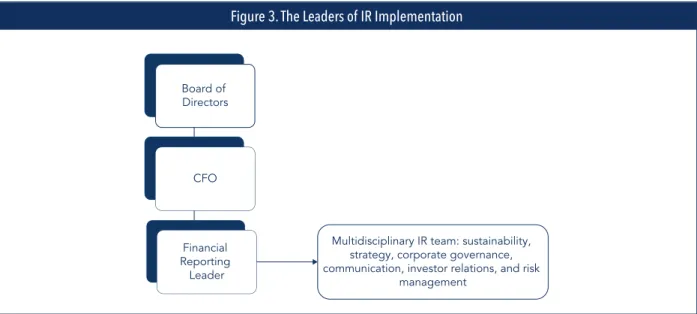
With a value-creation process organized around six capitals at IR’s center, the IR journey can be long and complex. Therefore, it’s important that the board of directors supports IR implementation, since “close involvement of CEOs and other board members is essential to reach ‘one view’ of the business,
consensus on one set of material issues and one combined business strategy.”37 Leveraging this tone at
the top, a committed multidisciplinary team can successfully implement integrated thinking. (See Figure 3 for a graphic representation of the leaders of IR.)
37 KPMG International, “The KPMG Survey of Corporate Responsibility Reporting 2013,” 2013, www.kpmg.com/Global/en/IssuesAndInsights/
Given the significant changes that IR can bring about in a company, embarking on the journey of integrated reporting implies a careful monitoring of the evolution of the project. Constant feedback is necessary to ensure that all move in the same and right direction. In this context, adjustments in operations (and maybe even in the strategy) are likely to be warranted. Accountants can contribute to the identification of these areas for improvement as well and the development of solutions.
Participating in the Different “Content” Elements of an Integrated Report
Within the different “content” elements of an integrated report, accountants can provide key elements for all sections. In the report’s “company overview and external environment,” “business model,” “strategy and resource allocation,” and “outlook” sections, accountants can provide quantitative
information that supports market data, for example. In the “governance,” “risks and opportunities,” and “performance” sections, however, accountants are central to identifying and compiling the information.
Performance
The Performance section describes the company’s progress in terms of strategic objectives for the given period and the outcomes in terms of the capitals. The accounting team in charge of financial
capital and involved in the progress of measuring the other capitals will be the main provider of data for the Performance section. Accountants are able to prepare and include the KPIs relating to the
value-creation process and the capitals. They also can link past, current, and future performance. Finally, accountants will be key actors in integrating the performance data of the different capitals, showing how the company creates value for multiple stakeholders.
Risks and Opportunities Assessment
In this section, accountants have the opportunity to communicate strategic priorities and the impact of corporate activities in terms of risks and opportunities. For instance, accountants can quantify and frame the risks linked to sustainability, such as the impacts and dependencies of natural capital.
Governance
Accountants can be particularly active in reporting on the governance structure, including the leadership structure, the processes used to make strategic decisions, the company’s attitude toward risk, and mechanisms for addressing integrity and ethical issues. They can also reflect on how the company’s
cul-ture, ethics, and values are reflected in the use of the different capitals.38
Strategy and Resource Allocation
Accountants can also assist top management and the board of directors in developing a strategy based on integrated thinking. Such a strategy takes into consideration the different types of capital set forth by IR to identify corporate priorities, set the tone in the company, and assess the risks that arise from the use of and reliance on the different capitals.
Company Overview and External Environment
In the company overview, accountants can provide key quantitative information such as revenue and the number of countries in which the company operates. They’re able to highlight the significant changes
from prior periods.39 Through their work on risks and opportunities, accountants contribute to the
analysis of the external environment (legal, commercial, social, environmental, and political context) that will affect the company’s ability to create value in the future.
The Business Model
Business Model is defined by the IIRC as “an organization’s system of transforming inputs through its business activities into outputs and outcomes that aims to fulfil the organization’s strategic purposes and
create value over the short, medium and long term.”40 Accountants can identify value-added activities
and nonvalue-added activities from an integrated perspective by using their expert knowledge of the accounting for capitals.
Outlook
The Outlook section presents the challenges and uncertainties the company will face to pursue its performance in the long term. Accountants can contribute to evaluate the ability of the company to continue to deliver on the opportunities and also assess the risks the business might face, including the
impact on the availability, quality, and affordability of the capitals.41
38 The International Integrated Reporting Committee (IIRC), “Navigating the Corporate Reporting Landscape,” 2015,
http://corporatereportingdialogue.com/wp-content/uploads/2015/05/CRD-Mapping-Document_website_070515.pdf.
39 The International Integrated Reporting Committee (IIRC), “The International <IR> Framework,” December 2013,
www.theiirc.org/international-ir-framework.
40 Ibid., p.33. 41 Ibid.
The Six Capitals and Their Integration
It is important for accountants within businesses to understand and monitor the six capitals of accounting because they will:
• Strengthen their decision-making skills, resulting in long-term sustainable value creation (e.g., price
risks on natural raw material linked to scarcity).
• Enhance risk management within the company.
• Identify new business opportunities.
• Enable the business to keep its license to operate.42
The Six Capitals
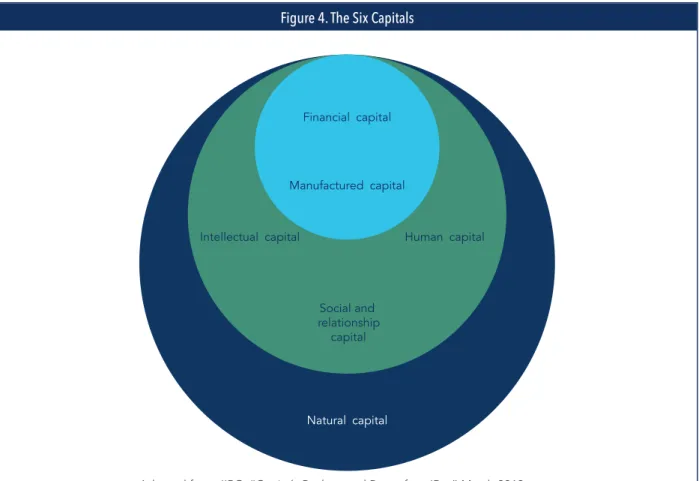
According to the IIRC, there are six capitals that businesses depend on as “stores of value.” The capitals are the basis of a company’s value creation process that needs to be described in the content of an integrated report (Figure 4).
42 Accounting for Sustainability (A4S), “Natural and Social Capital Accounting: An Introduction for Finance Teams,” 2014,
www.accountingforsustainability.org/wp-content/uploads/2015/03/A4S-natural-and-social-capital-accounting-Mar15v2.pdf. Figure 4. The Six Capitals
Financial capital
43
•
• Valuing intangible assets and integrating their contribution in the value creation process.
• Internalizing environmental and social value creation through monetization.44
Manufacturing capital 45
It is not limited to infrastructure owned, leased, or controlled by the company. It also includes, for example, public road networks available to the company.
By managing manufacturing capital, companies can avoid value depletion in natural capital. Here are some more ways companies can enhance their manufactured capital by:
• Applying biomimicry in industrial processes and systems design.
Improving product manufacturing systems’ ecoefficiency and ecoconception.
•
• Applying sustainable construction techniques when they invest in new infrastructure
• Implementing modular and closed-loop manufacturing systems.
• Using reverse logistics to reduce logistic costs and impact on natural capital.
•
accounting standard ISO 14051).
• Developing industrial ecology concepts such as synergizing one company’s waste streams to become another’s raw materials (e.g., wood chips to be used in cogeneration).46
(enhanced used of manufacturing capital), human capital (less injuries), and natural capital (less emissions or waste).
Intellectual capital includes “organizational, knowledge-based intangibles.”47 It can include
competencies of employees, customer relationships, intellectual property, company culture,
43 The International Integrated Reporting Council (IIRC), “Capitals Background Paper for <IR>,” March 2013, p. 6,
http://integratedreporting.org/wp-content/uploads/2013/03/IR-Background-Paper-Capitals.pdf.
44 The Sigma Project, “Financial Capital,” www.projectsigma.co.uk/Guidelines/Principles/Capitals/FinancialCapital.asp. 45 The International Integrated Reporting Council (IIRC), “Capitals Background Paper for <IR>,” March 2013, p. 6,
http://integratedreporting.org/wp-content/uploads/2013/03/IR-Background-Paper-Capitals.pdf.
46 The Sigma Project, “Manufactured Capital,” www.projectsigma.co.uk/Guidelines/Principles/Capitals/ManufacturedCapital.asp. 47 The International Integrated Reporting Committee (IIRC), “The International <IR> Framework,” December 2013, p. 13,
procedures and programs, brand, image, and software. For instance, Sasol, an
international integrated energy and chemicals company, defines its intellectual capital in its 2014 integrated report: “Our organisational, knowledge-based intangible assets include not only our intellectual property and patents, but also our internal knowledge and management systems and our
company culture, which are all critical to our ability to sustain and grow our business.”48 It creates value
by combining material (e.g., research and development (R&D) infrastructure), financial (e.g., R&D spending), and human resources (e.g., researchers).
Human capital is composed of individuals’ competencies, capabilities, and experience. It also includes employee alignment with a company’s governance, risk management approach, ethical values, loyalty,
and the ability to lead, manage, and collaborate.49 Finally, it includes the elements needed for
employ-ees to engage in productive work and the creation of wealth.50
An example of a candid human capital KPI is the one produced by American Electric Power (AEP) in its
2011 report: “81,000 years of experience & knowledge lost as a result of work force restructuring.”51
Social capital and relationship capital is “any value added to the activities and economic outputs of
an organisation by human relationships, partnerships and co-operation.”52 Social and relationship capital
includes: the strength and efficacy of supply chain relationships, networks, communication channels, families, communities, customer loyalty, government relations, relationships with competitors, trade unions, schools and volunteer groups, as well as cultural and social norms, values, and trust. An entity’s relationship with its stakeholders needs to retain its social license to operate.
As an example, Royal Bafokeng Platinum, a producer of platinum group metals (PGMs), discussed its “approach to adding value and creating a stable society in which to operate through our social
responsibility and our approach to transparency and accountability” in its 2012 integrated report.53
Several accounting tools have been tested to calculate the value created from projects, such as the social return on investment (SROI). For example, British Land, one of the largest property development and investment companies in the United Kingdom, used SROI to calculate the value created from its
Source Skills Academy training center.54 (See Appendix for more reference materials). Table 3 provides
other examples of methodological resources for accountants to help you implement IR in practice.
48 Sasol, “Annual Integrated Report,” June 2014, www.sasol.com/investor-centre/publications/integrated-report-1. 49 The International Integrated Reporting Council (IIRC), “Capitals Background Paper for <IR>,” March 2013,
http://integratedreporting.org/wp-content/uploads/2013/03/IR-Background-Paper-Capitals.pdf.
50 The Sigma Project, “Human Capital,” www.projectsigma.co.uk/Guidelines/Principles/Capitals/HumanCapital.asp.
51 American Electric Power (AEP), “2011 Corporate Accountability Report,” 2011, p. 33,
www.aepsustainability.com/fastfacts/docs/2011_AEP_CAReport.pdf.
52 The Sigma Project, “Social Capital,” www.projectsigma.co.uk/Guidelines/Principles/Capitals/SocialCapital.asp.
53 Royal Bafokeng Platinum, “Integrated Report 2012: More than Mining,” 2012, p. 98, www.bafokengplatinum.co.za/pdf/annual-reports/ar-2012.pdf.
54 Accounting for Sustainability (A4S), “Natural and Social Capital Accounting: An Introduction for Finance Teams,” 2014,
Natural capital
ecosystem services (e.g., climate regulation or the carbon cycle).
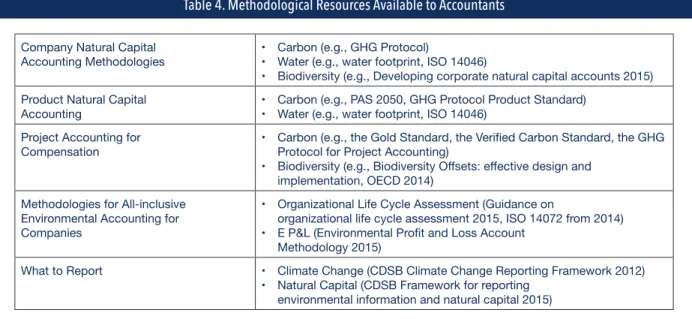
Natural capital has seen a number of accounting methodologies over the last 15 years, which have developed around three levels: company, products, and projects (for compensation). Table 4
provides other examples of methodological resources for accountants to help them implement IR in practice.
Table 3. Methodological Resources Available to Accountants
Social Return on Investment • The Social Value U.K. network provides a guide to SROI (2015)
Social Life Cycle Assessment • The Life Cycle Initiative (2009)
Social Impact Assessment Methodologies • The International Association for Impact Assessment (2015)
Table 4. Methodological Resources Available to Accountants Company Natural Capital
Accounting Methodologies •• Carbon (e.g., GHG Protocol) Water (e.g., water footprint, ISO 14046)
• Biodiversity (e.g., Developing corporate natural capital accounts 2015) Product Natural Capital
Accounting •• Carbon (e.g., PAS 2050, GHG Protocol Product Standard) Water (e.g., water footprint, ISO 14046) Project Accounting for
Compensation • Protocol for Project Accounting)
•
implementation, OECD 2014) Methodologies for All-inclusive
Environmental Accounting for Companies
• Organizational Life Cycle Assessment (Guidance on
organizational life cycle assessment 2015, ISO 14072 from 2014)
•
Methodology 2015)
What to Report • Climate Change (CDSB Climate Change Reporting Framework 2012)
• Natural Capital (CDSB Framework for reporting environmental information and natural capital 2015)
Implementing the Accounting Methodologies
Implementing different capital accounting methodologies requires designing guidelines and processes for how to proceed. First, the accounting function should review the company’s current sustainability performance measures and systems related to legal or voluntary commitments. KPIs, such as the ones developed by the GRI, or physical accounting systems, such as carbon accounting, can serve as a foundation for further methodologies. During this process, consulting company stakeholders is helpful for reviewing methodologies or deciding which of the capitals to prioritize.
Second, the accounting team needs to explore and choose the most appropriate methodologies and standards for measuring and valuing each of the capitals. Depending on the standard-setter and the principles behind the accounting standard chosen, one on carbon might not be compatible with another one on natural capital or water. While reviewing the methodologies, accountants have to ensure their results are based on the same principles and boundaries (see Table 4 for a review of accountants’ core competencies to account for the capitals).
Third, the scope and boundaries of measurement and valuation will need to be defined. One of the most well-known and most used boundary-setting exercise is the Greenhouse Gas Protocol— specifically Chapter 3, “Setting Organizational Boundaries,” and Chapter 4, “Setting Operational Boundaries.” The Climate Disclosure Standards Board (CDSB) also proposes a guide, “Proposals for Boundary Setting in Mainstream Reports.” Other boundary-setting work has been performed by the IIRC, GRI, and SASB.
Fourth, accountants will need to review data available for capital accounting methodologies. They will need to design a corporate inventory program that specifies collection procedures.
Fifth, accountants will need to review existing calculation tools and decide on which ones to use as the calculation center for each of the capitals implemented. Finally, accountants will need to think about assurance of results, internal audit, and documenting the whole process.
One of the difficulties of reaching out to all six capitals in accounting is finding the right resource. Accountants working in business today were not trained in business school for sustainability accounting. To strengthen and hybridize knowledge, new sustainability accounting teams are often built from both environmental engineers and certified chartered (management) accountants.
Another challenge is that, although you have standards for financial reporting, you don’t really have standards for the nonfinancial reporting. So you’re integrating two things that are starting from an uneven space.” —Interviewee 21
In “Natural and Social Capital Accounting,” the A4S recommends six principles for implementing the capitals:
• “Boundaries: Determine the scope of what is measured attributing accountability, control and
influence.”
• “Materiality: Identify the issues that have a significant influence on your organization or decision.”
(See “The Materiality Matrix.”)
Integrating the Different Capital Accounting Methodologies
By dividing their value process into about six capitals, companies on the IR journey still run the risk of maintaining silos between the topics. Therefore, accountants need to work on integration through the processes, principles, and management of each capital. They also need to work on integrated KPIs and make connections between how the capitals impact each other. Accounting for each capital will have to be integrated into common or connected accounting systems, too.
For example, in the “Manufactured Capital” section of its integrated report, DRDGold, a gold producer based in South Africa, talks about how its infrastructure actually reduces impact on natural capital: “Slurry material is transported in pipelines designed to reduce power consumption by up to
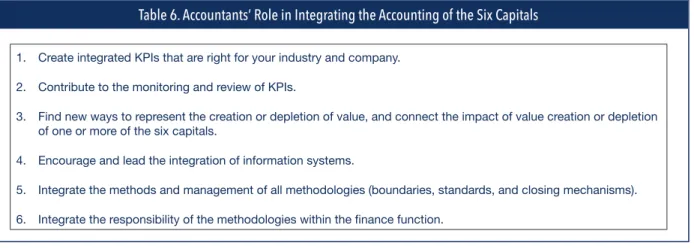
25%. In FY2013 DRDGOLD managed to reduce pipeline power consumption by 18%.”55 Table 6
summarizes accountants’ role in integrating accounting for the six capitals.
55 DRDGold, “Integrated Report 2013,” http://drdgold.integrated-report.com/2013.
• “Time: Consider the most appropriate timescale.”
• “Valuation: Understand the full value of your decision to your organization and to society.”
• “Confidence: Demonstrate transparency and recognize uncertainty” in your methodologies and
results.
Table 5. Core Competencies of Accountants for Accounting for Capitals Metrics Advising on which types of metrics will be applied
Reliability Ensuring the metrics developed are reliable and replicable
Collection of data Developing efficient data collection processes for the chosen metrics
Source: Accounting for Sustainability (A4S), “Natural and Social Capital Accounting: An Introduction For Finance Teams,” 2014, www.accountingforsustainability.org/wp-content/uploads/2015/03/A4S-natural-and-social-capital-accounting-Mar15v2.pdf.
Table 6. Accountants’ Role in Integrating the Accounting of the Six Capitals 1. Create integrated KPIs that are right for your industry and company.
2. Contribute to the monitoring and review of KPIs.
3. Find new ways to represent the creation or depletion of value, and connect the impact of value creation or depletion of one or more of the six capitals.
4. Encourage and lead the integration of information systems.
5. Integrate the methods and management of all methodologies (boundaries, standards, and closing mechanisms). 6. Integrate the responsibility of the methodologies within the finance function.
Management Accounting and IR
Aligning internal and external reporting facilitates the management of the IR project. Management accountants can thus contribute to the development of systems to monitor and report progress on the IR project and can support decision making by highlighting the links between social, environmental, and financial performance from both quantitative and qualitative perspectives.
Sustainability along the value chain can be emphasized through IR. Implicitly, a company’s suppliers are requested to embark on the journey. Management accountants can help suppliers improve their social and environmental accounting in terms of measurement, controls, and disclosure. Additionally, management accountants can develop compensation schemes tied to integrated
performance to motivate employees to cultivate integrated thinking. Pricewaterhouse Coopers cites an example of RWE, an electric utilities company based in Germany, in a 2012 report: “RWE partially links the remuneration given to members of its executive board to the group’s sustainable success. In order to motivate the board to manage the company sustainably, payment of 25% of the bonus earned is
withheld for three years. Furthermore, 45% of the bonus is determined on the basis of an index which reflects the group’s success in environmental and social activities. Another 10% of the bonus is
determined by a motivation index which measures employee satisfaction and motivation.”56
This example shows that long-term, natural, and human capitals can be combined into one compensation scheme to enhance shared value creation.
Internal Auditing and IR
Because of their particular stance in companies, internal auditors can play a significant role in IR. The Institute of Internal Auditors (IIA) underlined how “internal audit’s role and positioning is closely aligned with <IR> objectives, such as:
• Holistic understanding of the business strategy and performance;
• Engagements regarding the different types of capitals;
• Close interactions with a broad range of internal and external stakeholders;
• Connectivity and reliability of information.”57
As such, internal auditors are well positioned to contribute to the materiality and risk assessments required by IR. They also play a central role in developing IR reporting systems at both the operational and strategic levels. At the operational level, internal auditors can ensure that the remodeled reporting system encompasses all the necessary internal controls and that the nonfinancial information produced
56 Pricewaterhouse Coopers, “Integrated Reporting: The Future of Corporate Reporting,” May 2012,
www.pwc.de/de_DE/de/rechnungslegung/assets/integrated_reporting.pdf.
57 The Institute of Internal Auditors (IIA), “Enhancing Integrated Reporting: Internal Audit Value Proposition,” 2015, p.9,