University of Massachusetts Amherst
ScholarWorks@UMass Amherst
Ethics in Science and Engineering National
Clearinghouse Science, Technology and Society Initiative
2-19-2010
RCR for Postdocs: Promoting Ethical Professional
Development
Kathleen Flint
National Postdoctoral Association
Follow this and additional works at:https://scholarworks.umass.edu/esence
Part of theEngineering Commons,Life Sciences Commons,Physical Sciences and Mathematics Commons, and theSocial and Behavioral Sciences Commons
This Presentation is brought to you for free and open access by the Science, Technology and Society Initiative at ScholarWorks@UMass Amherst. It has been accepted for inclusion in Ethics in Science and Engineering National Clearinghouse by an authorized administrator of ScholarWorks@UMass Amherst. For more information, please [email protected].
Recommended Citation
Flint, K. (2010, February 19). RCR for postdocs: Promoting ethical professional development. AAAS Annual Meeting. National Science Foundation and Ethics Education in Science and Engineering presentation at the AAAS Annual Meeting, San Diego, CA.
RCR for Postdocs: Promoting Ethical
Professional Development
Kathleen Flint, Ph.D. NPA Project Manager AAAS 2010 Annual Meeting
Do Postdocs Need RCR Training?
• Most Postdocs have not had training in RCR
• Sigma Xi: 64% no formal ethics training
• Postdocs typically unaware of standard practices, rarely discuss with mentor
• Most postdocs (>60%) are international
• Can have different research & behavioral norms
• Most formal training focuses on students, not
postdocs
• Postdocs have unique needs
• Increasing requirements for such training
• NIH, NSF, some institutional requirements
Bring RCR Home Project
• NPA project to foster RCR programs for postdocs (2007-2008)
• Funded by Office of Research Integrity
• Activities:
• RCR Toolkit: www.nationalpostdoc.org/rcr-toolkit
• Annual Train-the-Trainers Workshops – slides available • Technical Assistance in designing programs
• Two rounds of $1000 seed grant competitions to support program development (2007 & 2008)
• Recommendations here based on our findings
What should a program cover?
• Satisfying NIH, NSF requirements?
• NIH very specific – topic areas, hours, format
•
http://www.grants.nih.gov/grants/guide/notice-files/NOT-OD-10-019.html
• NSF not specific
• Try to go beyond Misconduct, or FFP
• FFP: Falsification, Fabrication and Plagiarism
• RCR is about Conducting Research Responsibly, or
everyday behavior
• e.g. Deciding who to include on a paper • Modifying an image for publication
Unique Concerns for Postdocs
• Short-term appointments
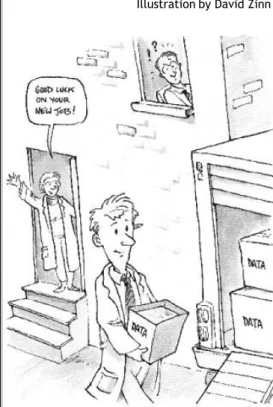
• Take data/project upon leaving lab/group?
• Competition with mentor?
• Lack of official standing and
sole reliance upon mentor
• Authorship issues – who’s work is it?
• Can postdocs start collaborations outside the group?
• The difficulties of whistle blowing
Unique Concerns for Postdocs
• Dual roles: mentor and mentee,
collaborator and apprentice
• Most postdocs are international
• Diversity of research cultures
• English not always first language
• Difficult communication skills
General Approaches
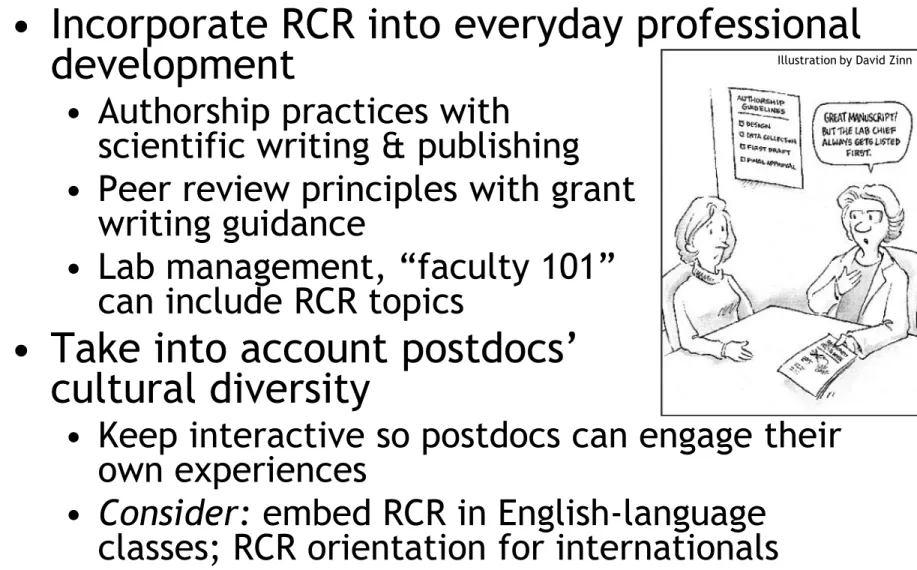
• Incorporate RCR into everyday professional
development
• Authorship practices with scientific writing & publishing
• Peer review principles with grant writing guidance
• Lab management, “faculty 101” can include RCR topics
• Take into account postdocs’
cultural diversity
• Keep interactive so postdocs can engage their own experiences
• Consider: embed RCR in English-language classes; RCR orientation for internationals
General Approaches
• Focus on problem-solving & application over
knowledge acquisition
• When issues arise, want postdocs to make ethically sound judgments
• Provide them a toolkit for sticky situations
• Develop “Just in Time” Resources
• Clear guidance on where to go with questions
• Consider anonymous, informal avenues
Program Ideas
• Offer informal opportunities to discuss RCR:
• E.g. RCR topics during group meetings
• Train postdocs to teach others about RCR
• Postdocs get that elusive teaching experience
• Carefully balance in-person interaction vs. technology
• Clickers, teleconferencing, video recording: good
• Online training: good if supplemented with in-person sessions
• Use pre- and post-surveys (see toolkit for samples)
• Examine incoming knowledge and pre-conceptions • Assess program impact
Tips for Boosting Attendance
• Make clear career relevance
• Most successful programs have a clear career advantage for postdocs -- What’s in it for me?
• Use catchy titles that emphasize usefulness
• Require attendance (…hey, it works!)
• Charge a fee, pre-register
• Engage postdocs in advance by soliciting topics/info for discussion with their RSVP
• Schedule at postdoc-friendly times: lunchtime or weekend
• Many have families
RCR Resources
• RCR Toolkit for program ideas, sample materials, case studies, agendas:
www.nationalpostdoc.org/rcr-toolkit
• ORI's RCR Education Materials Clearinghouse:
http://ori.dhhs.gov/education/products/
• Children's Hospital of Philadelphia resources:
• A Guidebook for Teaching Selected RCR Topics to Culturally Diverse Trainee Groups.
http://ori.dhhs.gov/documents/Alexander.RCR%20Guideb ook.BW.pdf
• Mentoring International Postdocs: Working to Advance Science & Careers
http://www.ori.hhs.gov/education/products/chop_mento ring/
Take Away Points
• Tailor your programs to the needs & interests of postdocs
• Integrate RCR training with everyday research skills, e.g. lab management, grant writing,
“faculty 101,” scientific writing & publishing • Consider multiple venues for reinforcing info
e.g. programs + “just in time” resources
• Take into account postdocs’ cultural diversity • Visit NPA RCR Toolkit: