University of North Dakota
UND Scholarly Commons
Theses and Dissertations Theses, Dissertations, and Senior Projects
1-1-2015
Development Of A High Performance Mosaicing
And Super-Resolution Algorithm
Debabrata Ghosh
Follow this and additional works at:https://commons.und.edu/theses
Part of theElectrical and Computer Engineering Commons
This Dissertation is brought to you for free and open access by the Theses, Dissertations, and Senior Projects at UND Scholarly Commons. It has been accepted for inclusion in Theses and Dissertations by an authorized administrator of UND Scholarly Commons. For more information, please contact [email protected].
Recommended Citation
Ghosh, Debabrata, "Development Of A High Performance Mosaicing And Super-Resolution Algorithm" (2015).Theses and Dissertations. 1896.
DEVELOPMENT OF A HIGH PERFORMANCE MOSAICING AND SUPER-RESOLUTION ALGORITHM
by
Debabrata Ghosh
A Dissertation
Submitted to the Graduate Faculty
of the
University of North Dakota
in partial fulfillment of the requirements
for the degree of
Doctor of Philosophy
Grand Forks, North Dakota December
ii
iii
This dissertation, submitted by Debabrata Ghosh in partial fulfillment of the requirements for the Degree of Doctor of Philosophy from the University of North Dakota, has been read by the Faculty Advisory Committee under whom the work has been done and is hereby approved.
__________________________________________ Naima Kaabouch, PhD __________________________________________ Saleh Faruque, PhD __________________________________________ William Semke, PhD __________________________________________ Wen-Chen Hu, PhD __________________________________________ Ronald Fevig, PhD
This dissertation is being submitted by the appointed advisory committee as having met all of the requirements of the School of Graduate Studies at the University of North Dakota, and is hereby approved.
_______________________________________________ Wayne Swisher,
Dean of the Graduate School
_______________________________________________ Date
iv PERMISSION
Title Development Of A High Performance Mosaicing And Super-resolution
Algorithm
Department Electrical Engineering
Degree Doctor of Philosophy
In presenting this dissertation in partial fulfillment of the requirements for a graduate degree from the University of North Dakota, I agree that the library of this University shall make it freely available for inspection. I further agree that permission for extensive copying for scholarly purposes may be granted by the professor who supervised my dissertation work or, in his absence, by the chairperson of the department or the dean of the Graduate School. It is understood that any copying or publication or other use of this dissertation or part thereof for financial gain shall not be allowed without my written permission. It is also understood that due recognition shall be given to me and to the University of North Dakota in any scholarly use which may be made of any material in my dissertation.
Debabrata Ghosh 07/03/2015
v
TABLE OF CONTENTS
LIST OF FIGURES ... viii
LIST OF TABLES ... xii
ACKNOWLEDGEMENTS ... xiii
ABSTRACT ... xiv
CHAPTER 1. INTRODUCTION ... 1
2. STATE-OF-THE-ART OF IMAGE MOSAICING METHODS ... 5
2.1 Introduction ... 5
2.2 Classification of image mosaicing methods based on registration ... 7
2.2.1 Spatial domain image mosaicing methods ... 9
2.2.1.1 Normalized Cross Correlation (NCC)-based mosaicing ... 10
2.2.1.2 Mutual Information (MI)-based mosaicing ... 12
2.2.1.3 Harris corner detector-based mosaicing ... 13
2.2.1.4 FAST corner detector-based mosaicing... 15
2.2.1.5 SIFT feature detector-based mosaicing ... 16
2.2.1.6 SURF feature detector-based mosaicing ... 19
2.2.1.7 Contour-based mosaicing ... 21
2.2.2 Frequency domain image mosaicing methods ... 22
2.3 Classification of image mosaicing methods based on blending……….………24
vi
2.3.1.1 Mosaicing algorithms using feathering-based blending ... 26
2.3.1.2 Mosaicing algorithms using pyramid-based blending ... 27
2.3.1.3 Mosaicing algorithms using gradient-based blending ... 28
2.3.2 Mosaicing methods using optimal seam-based blending ... 29
3. STATE-OF-THE-ART OF IMAGE SUPER-RESOLUTION METHODS. ... 31
3.1 Introduction ... 31
3.2 Image observation model ... 33
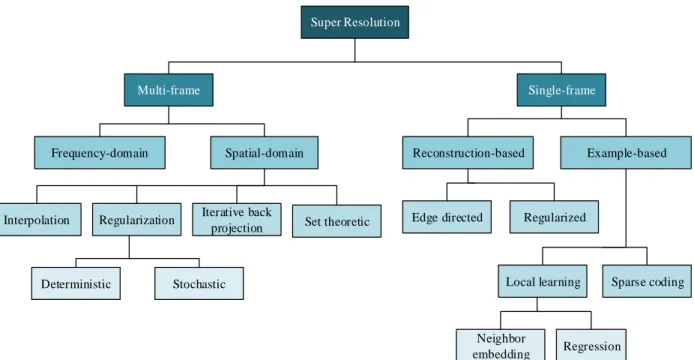
3.3 Classification of image super-resolution methods ... 35
3.3.1 Multi-frame super-resolution methods ... 36
3.3.1.1 Frequency-domain super-resolution methods ... 38
3.3.1.2 Interpolation-based super-resolution methods ... 40
3.3.1.3 Deterministic regularization-based super-resolution methods ... 41
3.3.1.4 Stochastic regularization-based super-resolution methods ... 42
3.3.1.5 Set theoretic super-resolution methods ... 45
3.3.1.6 Iterative back projection-based super-resolution methods ... 47
3.3.2 Single-frame super-resolution methods ... 49
3.3.2.1 Edge directed super-resolution methods ... 50
3.3.2.2 Regularization-based super-resolution methods ... 51
3.3.2.3 Neighbor embedding-based super-resolution methods ... 52
3.3.2.4 Regression-based super-resolution methods ... 54
vii
4. MOSAICING SYSTEM ... 59
4.1 Methodology ... 59
4.2 Evaluation ... 61
4.3 Results and discusssion ... 65
5. SUPER-RESOLUTION MOSAICING SYSTEM ... 76
5.1 Methodology ... 76
5.2 Evaluation ... 85
5.3 Results and discusssion ... 89
5.3.1 Results of simulted data experiments ... 91
5.3.2 Results of real data experiments ... 96
6. CONCLUSIONS ... 104
viii
LIST OF FIGURES
Figure Page
1.1 Applications of super-resolution mosaicing ... 1
2.1 Different steps of image mosaicing ... 6
2.2 Classification of mosaicing based on registration ... 9
2.3 Candidate feature detection for FAST algorithm... 15
2.4 Scale space formation and extrema finding ... 18
2.5 Approximation of Gaussian second order partial derivatives ... 20
2.6 Use of cross-power spectrum to detect transformation... 23
2.7 Classification of mosaicing based on blending ... 25
2.8 Image blending results ... 27
2.9 Pyramid formation for blending... 28
3.1 A framework of multi-frame super-resolution ... 33
3.2 Observation model relating LR image with HR image ... 35
3.3 Taxonomy of super-resolution algorithms ... 37
3.4 Interpolation-based super-resolution reconstruction ... 40
3.5 Iterative back projection ... 48
4.1 Flowchart of the mosaicing algorithm ... 59
4.2 Schematic of the mosaicing algorithm’s evaluation process ... 63
4.3 Matching performance vs distance threshold at different values of BBF NN bins for an example image pair ... 65
ix
4.4 Matching performance vs number of BBF NN bins at different distance
threshold values for an example image pair ... 66
4.5 Performance vs computation of the RANSAC algorithm at a constant distance threshold value for an example image pair ... 67
4.6 Distance threshold vs computation of the RANSAC algorithm at a constant probability of model corruption for an example image pair ... 68
4.7 Input frames for the mosaicing algorithm ... 68
4.8 SIFT features extracted from the input frames ... 69
4.9 SIFT features matching from pair of input frames ... 69
4.10 Projection of frames into common coordinate ... 70
4.11 Step-by-step stitching process... 71
4.12 Mosaicing using an example 2D scene dataset ... 72
4.13 Mosaicing using an example 3D scene dataset ... 73
4.14 Mosaicing using an example UAV dataset ... 73
5.1 Flowchart of super-resolution algorithm ... 84
5.2 Regularization parameter vs number of iterations ... 91
5.3 SR result using simulated balloon data ... 92
5.4 Detailed regions cropped from SR results using simulated balloon data ... 93
5.5 SR result using simulated UAV data ... 95
5.6 Detailed regions cropped from SR results using simulated UAV data ... 96
5.7 SR result using real UAV data ... 97
x
5.9 Behavior of performance metrics in the presence of blur ... 100
5.10 Behavior of performance metrics in the presence of noise ... 101
5.11 Output CPBD values for five real datasets using different
super-resolution mosaicing algorithms ... 102
5.12 Reciprocal singular value curves for a single dataset
xi
LIST OF TABLES
Table Page
2.1 Comparative overview of different categories of mosaicing methods
based on image registration ... 24
2.1 Comparative overview of different categories of mosaicing methods based on image blending ... 30
3.1 Comparative overview of different multi-frame super-resolution algorithms ... 49
3.2 Comparative overview of different single-frame super-resolution algorithms ... 58
4.1 Mosaicing algorithm assessment ... 75
5.1 MSE, PSNR, SVD, and SSIM values of different super-resolution mosaicing results using high-altitude balloon frames ... 94
5.2 MSE, PSNR, SVD, and SSIM values of different super-resolution mosaicing results using blurry UAV frames ... 96
5.3 CPBD and RSV values of different super-resolution mosaicing results using real UAV frames ... 99
xii
ACKNOWLEDGEMENTS
First and foremost I want to thank my advisor Dr. Naima Kaabouch. I appreciate all her
contributions of time, ideas, and funding to make my Ph.D. experience productive and stimulating.
I am also thankful to the other members of my advisory committee:Dr. Saleh Faruque, Dr. William
Semke, Dr. Wen-Chen Hu, and Dr. Ronald Fevig for their helpful feedback and support during
this process.
Lastly, I would like to thank my parents and brother for all their love and encouragement.
I am grateful to my loving, supportive, encouraging, and patient wife Soumita Ghosh whose
xiii ABSTRACT
In this dissertation, a high-performance mosaicing and super-resolution algorithm is described.
The scale invariant feature transform (SIFT)-based mosaicing algorithm builds an initial mosaic
which is iteratively updated by the robust super resolution algorithm to achieve the final
high-resolution mosaic. Two different types of datasets are used for testing: high altitude balloon data
and unmanned aerial vehicle data. To evaluate our algorithm, five performance metrics are
employed: mean square error, peak signal to noise ratio, singular value decomposition, slope of
reciprocal singular value curve, and cumulative probability of blur detection. Extensive testing
shows that the proposed algorithm is effective in improving the captured aerial data and the
1
CHAPTER 1
INTRODUCTION
There are various applications of super-resolution mosaicing, including surveillance,
disaster management, and urban mapping. Example results of super-resolution mosaicing relevant
to the aforementioned applications are shown in Figure 1.1. The two-fold benefit of
super-resolution mosaicing is obvious: 1) instead of processing each and individual frames to analyze a
certain scene, this technique gives the advantage of processing a single integral frame, thus it saves
significant processing time and 2) higher spatial resolution output of this technique provides the
advantage of better content visualization, which is critical in all of the aforementioned applications.
Figure. 1.1: Applications of super-resolution mosaicing. (a) Application in surveillance; (b) Application in disaster management; (c) Application in urban mapping.
(a) (b)
2
Higher the quality of the images, better the spatial resolution. The sensor size and detector
density primarily determine the spatial resolution of the captured images. Larger the size of the
sensor, and/or the higher the density of the detectors, the better the spatial resolution of the acquired
images. The most direct hardware-based approach of increasing the spatial resolution is to reduce
the detector size or, equivalently, to increase the detector density. Alternatively, the sensor size
can also be increased. However, smaller detectors have lower dynamic range, lower fill factor,
lower light sensitivity, higher dark signal, higher diffraction sensitivity, and higher non-uniformity
[1]. In addition, the hardware cost increases with both the increase of detector density and sensor
size. Thus, the aforementioned hardware-based approach often restricts the maximum achievable
resolution of the captured images. Besides the sensor-imposed restriction, there are several other
factors that limit the quality of the captured images, including lens and atmospheric blurs, finite
shutter speed, finite aperture, movement of objects in the scene, sensor noise, and media turbulence
[2]. Similarly, the frames lose spatial resolution during video acquisition due to sensor array
sampling. Some of these limitations can be overcome by employing computationally intensive
image processing algorithms that require high processing time and high-power computers, making
them unsuitable for low to medium budget systems.
In order to overcome the limitations inherent in the commercially available affordable
electronics, an approach that combines the available optics and a resolution-enhancement
algorithm can be used. This technique would overcome the final specification restrictions of the
commercial optics. The aim of this dissertation is to develop an efficient, robust and automated
3
computational resources. Other than increasing the field of view of commercial imagers, the
mosaicing algorithm will add further benefit of eliminating redundant data from overlapping
frames, which are required as input for the high-resolution algorithm. The essential steps required
for the proposed super-resolution mosaicing are image mosaicing and super-resolution.
Super-resolution reconstruction algorithm (SR) creates a high-resolution (HR) image from
a sequence of correlated low-resolution images of the same scene taken from different viewpoints.
Since super-resolution increases the spatial resolution by taking advantage of more samples than
those found in any single low-resolution image, the presence of motion among the low-resolution
images is compulsory for the success of this method. The reconstruction primarily relies on the
ability to estimate the aforementioned motion between frames to recover details that are finer than
the sampling grid. Simultaneously the effects of blur, noise, and other artifacts are eliminated in
the reconstruction process.
Image mosaicing, on the other hand, is the alignment of multiple correlated images into a
wider composition. Mosaicing is a special case of scene building where the images are related by
planar homography only. This is a reasonable assumption if the images exhibit no parallax effects,
i.e. when the scene is approximately planar or the camera purely rotates about its optical center.
Using mosaicing, it is possible to extend the field of view of a camera by preserving the original
resolution and without introducing undesirable lens deformation.
Combining image mosaicing and super resolution becomes a powerful means to represent
all the information on multiple overlapping images and obtain a high-resolution panoramic view
4
simultaneously generate mosaic output with an improved spatial resolution. This method is
referred to as super-resolution mosaicing. The stability of a super-resolution mosaicing method
necessitates that the overlapping images are correlated solely by planar homography, which is
fulfilled readily in small satellite applications since the captured images from high altitude do not
suffer from parallax effects.
In this dissertation, we will describe a super-resolution mosaicing algorithm and compare
its performance with those of other well-known state-of-the-art algorithms. The dissertation is
organized as follows: Chapter 2 presents an introduction to image mosaicing framework and
reviews the state-of-the-art of image mosaicing techniques. A classification of the techniques is
also proposed, highlighting the benefits and drawbacks of different methods. Chapter 3 presents
an introduction to super-resolution framework along with the image observation model that has
been used in most resolution algorithms. A detailed survey of the state-of-the-art
super-resolution techniques by classifying them into several categories is also presented. Chapter 4
details the proposed mosaicing technique. All the steps involved, including registration,
reprojection, and stitching are described. Finally, some experimental results, based on large
datasets, are presented. Chapter 5 presents the proposed super-resolution mosaicing approach in
detail. Some experimental results are also discussed and compared to results obtained by other
state-of-the-art approaches. Chapter 6 presents the conclusions of this work, and identifies some
5
CHAPTER 2
STATE-OF-THE-ART OF IMAGE MOSAICING METHODS
2.1 IntroductionImage mosaicing is the alignment of multiple overlapping images into a large composition
which represents a part of a 3D scene [3]. Mosaicing could be regarded as a special case of scene
reconstruction where the images are related by planar homography only [4]. This is a reasonable
assumption if the images exhibit no parallax effects, i.e. when the scene is approximately planar
or the camera purely rotates about its optical center [5]. Using mosaicing it is possible to extend
the field of view (FOV) of a camera by preserving the original resolution and without introducing
undesirable lens deformation [6]. There have been a variety of new additions to the classic
applications of image mosaicing that primarily aim to augment the FOV. Mosaic construction is
finding its practices in many computer vision and computer graphics applications, such as motion
detection and tracking [7-9], mosaic-based localization [10,11], resolution enhancement [12-14],
augmented reality [15, 16] etc. Furthermore, video compression [17], video indexing [18], and
image stabilization [19] are some of the prominent areas where mosaicing is creating significant
impacts.
As shown in Figure 2.1, mosaicing involves various steps of image processing: registration,
reprojection, stitching, and blending. Registration refers to the establishment of geometric
correspondence between a pair of images depicting the same scene. In order to register a set of
6
respect to a reference image within that set. The set may consist of two or more images taken of a
single scene at different times, from different viewpoints, and/or by different sensors. The most
general case of the transformation is the 8 degree of freedom planar homography [3]. The next
step, following the registration, is reprojection which refers to the alignment of the images into a
common coordinate system using the computed geometric transformations. The goal of the
stitching step is to overlay the aligned images on a larger canvas by merging pixel values of the
overlapping portions and retaining pixels where no overlap occurs. Errors propagated via
geometric and photometric misalignments often result in undesirable object discontinuities and Figure. 2.1: Different steps of image mosaicing. Here H are the homography matrices between source images.
7
seam visibility in the vicinity of the boundary between two images. Thus, a blending algorithm
needs to be used during or after the stitching step in order to minimize the discontinuities in the
global appearance of the mosaic.
Image mosaicing is an attractive research area, which has resulted in the development of
many algorithms in the literature [12,20-34]. A comprehensive review of the existing algorithms
will undoubtedly be a valuable guide to researchers and developers for selecting a suitable image
mosaicing method for a specific application. The continuous emergence of new algorithms in
recent years further reinforce the necessity of such a comprehensive review. In the following
sections, we classify the past and current mosaicing techniques based on image registration as well
as image blending. For each of these classifications, we provide a comprehensive review of the
major categories of the image mosaicing methods. In addition, this review highlights the evolving
paths of those methods by providing the modifications that have been made to those basic methods
by different researchers.
Both registration and blending directly influence the performance of image mosaicing.
Being the first and last step of image mosaicing, it is almost impossible to build a successful
mosaicing algorithm without correctly implementing registration and blending algorithms. Though
attempts have been made to overcome the registration errors by utilizing sophisticated blending
algorithms, the significance of accurate registration in image mosaicing remains unquestionable.
In this chapter, we focus on the classification of the existing image mosaicing algorithms based on
their registration methods, as well as based on their blending methods.
8
Image registration is not only an important step of image mosaicing, but also is the
foundation of it. Registration of multi-source images, which are focused on the same target but
produced from different sensors, different perspective, and different times, computes the optimal
geometric transformation by looking into the correspondences between each pair of images. This
process makes the multi-source images aligned into a common reference frame using the estimated
geometric transformations. To the extent that corresponding points from multi-source images are
aligned together, the registration is successful [41]. The aforementioned correspondences can be
established by matching templates between images, or by matching features extracted either from
images, or by utilizing the phase correlation property in the frequency domain.
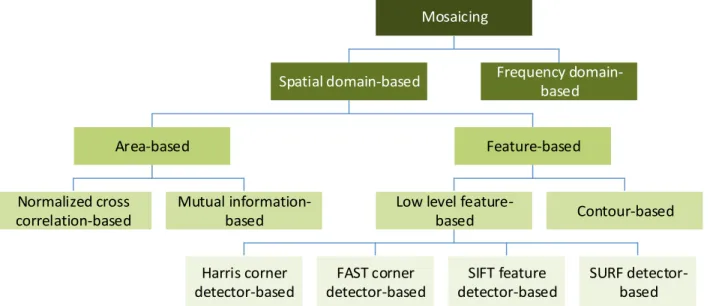
As shown in Figure 2.2, based on image registration methods, image mosaicing algorithms
can be spatial domain-based or frequency domain-based. Spatial domain-based image mosaicing
can further be grouped into area-based image mosaicing and feature-based image mosaicing.
Feature-based image mosaicing can again be subdivided into low-level feature-based image
mosaicing and contour-based image mosaicing. Low-level feature-based mosaicing can be divided
into four classes: Harris corner detector-based mosaicing, FAST corner detector-based mosaicing,
SIFT feature detector-based mosaicing, and SURF detector-based mosaicing. Different classes of
9 Mosaicing Frequency domain-based Spatial domain-based Area-based Feature-based Normalized cross correlation-based Mutual information-based
Low level
feature-based Contour-based Harris corner detector-based FAST corner detector-based SIFT feature detector-based SURF detector-based
2.2.1 Spatial domain image mosaicing methods
Algorithms in this category use properties of pixels to perform registration, and, thus they
are the most direct methods of image mosaicing. Majority of the existing image mosaicing
algorithms fall into this category. Spatial domain-based image mosaicing can be either area-based
or feature-based. Area-based image mosaicing algorithms rely on computation between “windows” of pixel values in the two images, which need to be mosaicked [42]. The fundamental
approach is to shift the “windows” of the images relative to each other and see how much the
pixels match. Subsequently, transformation parameters are obtained and used to warp and stitch
the images. Unlike area-based image mosaicing, feature-based mosaicing methods use
feature-to-feature matching in order to compute the geometric transformation between a pair of images. Thus,
these methods rely primarily on feature extraction algorithms which can detect salient features Figure 2.2: Classification of mosaicing based on registration.
10
from the images. Salient features are subsets of the image domain, often in the form of isolated
points, continuous curves or connected regions [49]. Since the features are used as the starting
point, the overall algorithm will often be as good as the feature extraction algorithm is.
Two of the most commonly used area-based image mosaicing algorithms are normalized
cross correlation-based mosaicing and mutual information-based mosaicing. Based on the types of
features extracted, based mosaicing methods can also be classified into low-level
feature-based mosaicing and contour-feature-based mosaicing. Again, feature-based on popular low-level feature
extraction methods, low-level feature-based mosaicing can be subdivided into the following
categories: Harris corner detector-, Features from Accelerated Segment Test (FAST)-, Scale
Invariant Feature Transform (SIFT)-, Speeded Up Robust Feature (SURF)-based mosaicing
methods. These above-mentioned classes of mosaicing algorithms are described below.
2.2.1.1 Normalized Cross Correlation (NCC)-based mosaicing
This method computes similarity between the “windows” in the two images for each shifts.
It is defined as [43]: ( ) ( ) ( ) 2 2 ( ) ( ) U x U V x u V i i i NCC u U x U V x u V i i i (2.1) where U 1 U x( ) i N i (2.2) V 1 V x( u) i N i (2.3)
11
where U and V are the mean images of the corresponding “windows”, U and V for the first
and second images respectively. N is the number of pixels in the “window”,xi ( , )x yi i is the pixel coordinate in the “windows”, u( , )u v is the displacement or shift where NCC coefficient is
calculated. The NCC coefficient values are always within the range [-1, 1]. The shift parameter
corresponding to the peak NCC value represents the geometric transformation between the two
images. Once geometric transformations are obtained between the image pairs, images are warped
in the reference frame, and finally stitching is performed to generate the final mosaic. Methods
within this category have the advantage of being computationally simple, however, at the cost of
being particularly slow. Moreover, they perform accurately only when there are significant
overlapping between the source images.
Several techniques [22,44-46] have been proposed to tackle the above mentioned problems.
In order to make the computation faster, Berberidis et al. [44] proposed an iterative algorithm for
the spatial cross correlation in order to compute the displacements between the source images. Yet
another method based on adjusting the correlation windows according to the scale and orientation
of extracted interest-points from the source images was proposed by Zhao et al. [45] to increase
the computation speed. In order to improve the performance of the algorithm in the presence of
non-rigid deformation, Vercauteren et al [46] suggested the use of Riemannian statistics along with
a scattered data fitting-based mosaicing. Nasibov et al. [22] employed a brightness correction
matrix before the registration step in order to make the algorithm less sensitive to the illumination
12
2.2.1.2 Mutual Information (MI)-based mosaicing
Unlike NCC, which computes similarity based on image intensity values, mutual
information measures similarity based on the quantity of information shared between two images.
MI between two images I1 and I2 is expressed in terms of entropy as:
1 2 1 2 1 2
( , ) ( ) ( ) ( , )
MI I I E I E I E I I (2.4)
where E I( )1 and E I( 2) are the entropies of I1 andI2, respectively. And E I I( ,1 2) represents the joint
entropy between the two images. Entropy is a measure of variability of a random variable. Thus
variability of I1 is expressed as:
1 1 1 ( ) I( ) log( I ( )) g E I
p g p g (2.5)wheregare the possible gray level values of I1, and accordingly pI1( )g is the probability
distribution function ofg. Similarly, the joint variability of I1and I2 is expressed as:
1 2 1 2 1 2 , , , ( , ) I I ( , ) log( I I ( , )) g h E I I
p g h p g h (2.6)wherehindicates the possible gray level values of I2. pI I1,2( , )g h is the joint probability distribution
function of gand h. Typically, the joint probability distribution between two images is measured
as normalized joint histogram of the gray level values. It is observed that better the alignment
between two images, higher the MI between them. Thus, two images are geometrically aligned by
a transformation if the MI between them is maximum for that transformation. After the appropriate
transformations are obtained between the image pairs, they are reprojected and stitched to get the
13
occlusion changes between source images. However, similar to NCC-based methods, these
techniques have the disadvantages of being computationally slow, and requiring high degree of
overlapping between input images.
A number of techniques [24,47,48] have been proposed to address its shortcomings. To
increase the computation speed, Dame et al. [47] employed a B-spline function for normalized
mutual probability density, in combination with Newton’s method for optimizing the MI cost
function. Another method presented by Luna et al. [24]uses a stochastic gradient optimization
along with MI-based similarity measure in order to make the algorithm faster. Concerning the
drawback of MI-based mosaicing algorithms for low overlapping images, Césare et al. [48]
proposed a template matching approach capable of explicitly acknowledging the plausibility of
similarity between distant neighborhoods, and delaying definite block-to-block association to a
step that globally evaluates their collective likelihood.
2.2.1.3 Harris corner detector-based mosaicing
Harris corner detector detects corner points as robust low-level features from source
images. Initially a local detection window in an image is chosen. Subsequently the variation in
intensity that results by shifting the window by a small amount in different direction is determined
as below [39]: 2 , ( , ) ( , ) [ ( , ) ( , )] x y E u v
w x y I x u y v I x y (2.7)14
where w x y( , )is the window function, I x y( , )is the image intensity value at pixel location( , )x y ,
( , )
I x u y v is the shifted intensity with ( , )u v shift, is the convolution operator. The local texture
around pixel ( , )x y is expressed as autocorrelation matrix Cas below:
2 2 , ( , ) x x y x y x y y I I I C w x y I I I
(2.8)where Ixand Iyare the first derivative of I x y( , ). Two large eigenvalues for the matrix C
corresponds to a corner point. The center point of the window is characterized as a corner point. For more robustness, a “cornerness” measure Ris used to eliminate the edge points as below [25]:
2
( ) ( )
RDet C Tr C (2.9)
where Tr C( )is the trace of Cand is within the range 0.04 0.06. Corner points are detected
as local maxima of Rabove a predefined threshold T. After the Harris corner points are detected
from both the images, correspondences are established either by NCC or by any other Sum of
Squared Difference (SDD) method. Subsequently, the geometric motion parameters are calculated
and images are warped into a global reference frame in order to stitch them all. Mosaicing
algorithms using Harris corner detector are computationally simple and accurate.
One major problem with the Harris corner detector-based mosaicing methods is that large
changes in rotation often generates ghosting in the mosaic output. [25] dealt with this by utilizing
a luminance center-weighting algorithm which is used following a slope clustering algorithm for
Harris corner point matching. Another problem related to the uncertainty in choosing a local
15
matching in order to limit the search window to potential homologous points. Harris corner
detector almost always finds closely crowded feature points. However, this can be overcome by
counting the number of feature points in the neighborhood and then accordingly exclude some of
the points, as has been done in [26].
2.2.1.4 FAST corner detector-based mosaicing
FAST algorithm is a corner detection algorithm which is computationally more efficient
and faster than most of the other low-level feature extraction methods; thus mosaicing methods
based on this algorithms are particularly suitable for real-time image processing applications.
Initially a circle of sixteen pixels is considered around each corner candidate. According to the
FAST algorithm, the candidate is a corner if there exists a set of n contiguous pixels in the circle
which are all brighter than the intensity of the candidate pixel plus a threshold, or all darker than
the intensity of the candidate pixel minus the threshold, as shown in Figure 2.3. The numbernis
usually chosen twelve. In order to increase the computational speed of FAST algorithm, a corner
response function (CRF) is used. CRF gives the numerical value of the “cornerness” of a corner Figure 2.3: Candidate feature detection for FAST algorithm.
16
point based on image intensities in the local neighborhood [39]. Corners are detected as local
maxima for the CRF function computed over the entire image. Following the detection, corner
point matching is performed for each pair of frames. Sometimes a Bag-of-Words (BoW) algorithm
is used to represent each image as a set of corner descriptors to speed up the matching process as
in [27]. Then, homography matrices are computed and finally the images are projected into a
common coordinate to get the final mosaic.
Choosing an optimal threshold is often a fundamental challenge of the FAST corner
detector-based algorithms. However, it can be addressed by incorporating a robust threshold
selection algorithm as in [53]. For matching the corner points from successive frames, they further
proposed a threshold learning method together with a region-based gray correlation. Another major
issue of the FAST-based algorithms is that they are not particularly robust to increased degree of
variations. For that, extending the sampling area beyond the sixteen pixels around each candidate
point [52] could be considered as a promising approach, since it gives the FAST corner points
more distinctiveness and, in turn, makes them invariant to larger variations.
2.2.1.5 SIFT feature detector-based mosaicing
SIFT algorithm is a low-level feature detection algorithm which detects distinctive features (also called “keypoints”) from images. The SIFT descriptor is invariant to translations, rotations
and scaling transformations in the image domain and robust to moderate perspective transformations and illumination variations. SIFT’s operation is based on five major steps:
scale-space construction, scale-scale-space extrema detection, keypoint localization, orientation assignment,
17
repeatedly using a Gaussian filter with changing scales and grouping the outputs into octaves as
[54]:
( , , ) ( , , )* ( , )
L x y G x y I x y (2.10)
where * is the convolution operator, G x y( , , ) is a Gaussian filter with variable scale , and I x y( , )
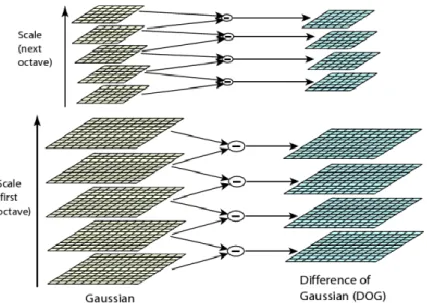
is the input image. After the scale space construction is complete, difference-of-Gaussian (DoG)
images are computed from adjacent Gaussian-blurred images in each octave as [54]:
( , , ) ( , , ) ( , , )
D x y L x y k L x y (2.11)
Following that, candidate keypoints are identified as local extrema of DoG images across
the scales. The scale space and DoG scale space construction as well as extrema detection in DoG
scale space is illustrated in Figure 2.4. In the next step, low contrast keypoints and edge response
points along the edges are discarded using accurate keypoint localization. The keypoints are then
assigned one or more orientations based on local image gradient directions as [54]:
1
( , )x y tan (( ( ,L x y 1) L x y( , 1)) / ( (L x 1, )y L x( 1, )))y
(2.12)
where ( , )x y represents the gradient direction for L x y( , , ) . A set of orientation histograms is
formed over the neighborhoods of each keypoint. Finally, a normalized 128-dimensional vector is
18
from two images, nearest neighbor of a keypoint in the first image is identified from a database of
keypoints for the second image [54, 55]. Following the initial matching, RANSAC algorithm is
used to remove the outliers and to compute the transformation parameters between a pair of frames.
Finally, images are warped using the transformation parameters and stitched to generate the mosaic
image. SIFT based image mosaicing algorithms are particularly suitable for stitching high
resolution images under variety of changes (rotation, scale, affine etc.), however, at the cost of
high processing time.
Several researchers have made variations to the above mentioned SIFT-based mosaicing
method in order to further improve its performance. For example, in [12] the authors proposed
switching between Kanade-Lucas-Tomasi (KLT) tracker and SIFT matching to find the
correspondences between successive frames depending on their amount of overlapping. In [28], Figure 2.4: Scale space formation and extrema finding. (a) Scale space and DoG scale space construction; (b)
19
the author exploited a deformation vector propagation algorithm in the gradient domain to reduce
the intensity discrepancy between the mosaiced images. Similarly, a bundle adjustment algorithm
along with a modified-RANSAC algorithm capable of developing a probabilistic model is used in
[56] to eliminate registration error and make the matching process more accurate.
2.2.1.6 SURF feature detector-based mosaicing
SURF algorithm is a scale and rotation invariant local feature detector. Like SIFT, this
algorithm is also based on scale space theory. However, SURF uses Hessian matrix of the integral
image to estimate local maxima across different scale spaces [57]. The Hessian matrix of an image
I with scale at any point X( , )x y is defined as [58]:
( , ) ( , ) ( , ) ( , ) ( , ) xx xy xy yy L X L X H X L X L X (2.13)
where Lxx( , )X , Lyy(X, ) , and Lxy(X, ) are the convolutions of I in point Xwith Gaussian second
order filters 2 2G( ) x , 2 2G( ) y , and 2 ( ) G x y
respectively. While computing Hessian matrix at
each pixel, the Gaussian filter operations are approximated by operations using box filters as
shown in Figure 2.5. The response at each pixel is computed as the determinant of the Hessian
matrix. Following that, a thresholding and a 3 x 3 x 3 local maxima detection window are used for
non-maxima suppression. The local maxima are then interpolated in scale space to achieve
keypoints with their location and scale values. In order to assign orientation for each keypoint,
20
vector is formed by summing up all the responses within 60-degree window. The longest vector is
assigned as orientation to the keypoint. In order to assign descriptor vector to each keypoint, a
square neighborhood region around the keypoint is selected. It is then split into smaller
sub-regions. Sum of the Haar-wavelet responses from all the sub-regions are then used to generate a
64 dimensional descriptor vector [50]. After finding the matching keypoints from a pair of images,
RANSAC algorithm is used to eliminate false matches as well as to calculate the homography
matrices. Once homography matrices are achieved, images are warped and stitched to get the final
mosaic. SURF based mosaicing techniques are faster than SIFT based techniques. However, they
perform poorly under certain variations (particularly color, illumination, some affine
transformation).
The process of determining the SURF descriptors as mentioned above has sometimes been
modified by some authors. For example, in [59] the local maxima is searched beyond a 3 x 3 x 3
neighborhood in the present scale and two immediately adjacent scales in order to make the feature
descriptors more distinctive. In [60], the authors proposed dividing the SURF descriptor window
into eight sub-regions while assigning descriptor vector. This technique increases the matching Figure 2.5: Approximation of Gaussian second order partial derivatives. (a) Approximation in x direction; (b)
Approximation in y direction; (c) Approximation in xy direction.
21
speed at the cost of increased false matches. However, the authors show that the use of RANSAC
guarantees elimination of most of those incorrect matches.
Often multiple low-level feature extraction methods are used together in image mosaicing
algorithms in order to use their respective benefits. Joshi et al. [61] propose a mosaicing algorithm
which uses both Harris corner detector and SURF detector for extracting distinctive features from
source images. Feature-based mosaicing algorithm proposed by Bind et al. [62] use both SIFT and
SURF based feature detector to detect interest points from images. Kang et al. [63] and Zhu et al.
[64] use Harris corner detector and SIFT detector in their feature-based mosaicing algorithm.
2.2.1.7 Contour-based mosaicing
This type of mosaicing algorithms is based on extraction of high-level features from
images. Unlike the low-level features, these features are more natural to human perception and
therefore they are high-level. High-level feature extraction mostly concerns finding the shapes or
textures in an image. Shape extraction implies finding their position, orientation and their size [49].
Usually regions of different structures are extracted as high level image features. Then these
features are matched to find correspondences, which are later used to compute the transformation
parameters. Different techniques can be used to eliminate the false matches. Finally, warping and
blending are performed to generate the mosaic output. The use of high-level features significantly
increase the computation in these types of mosaicing algorithms. However, they are particularly
suitable to work under larger and complicated motion parameters, and even under multi-layer
22
Some of the notable contributions in high-level feature-based mosaicing include [65-67].
In [65], the authors used a wide baseline algorithm together with an adaptive region expansion
method to achieve robust registration using high-level features. Prescott et al. [66] proposed
extracting regions of image structures using a threshold technique and then computing area-based
similarity matching for registration. Contour extraction using a segmentation algorithm, followed
by finding their centroids for image registration was used in [67].
2.2.2 Frequency domain image mosaicing methods
Unlike spatial domain-based image mosaicing algorithms, methods classified in this
category require computation in the frequency domain in order to find the optimal transformation
parameters between a pair of images. These algorithms use the property of phase correlation for
registering images. Let I x y1( , )and I2( , )x y are two images having some overlapping areas. Let’s
further assume that (x0,y0) is the translation between the images. Thus,
2( , ) 1( 0, 0)
I x y I xx yy (2.14)
The corresponding Fourier transforms F u v1( , )and F u v2( , )are related by:
0 0
( )
2( , ) 1( , ).
j ux vy
F u v F u v e (2.15)
The cross-power spectrum of the two images is defined as: [Ref 54]
0 0 * ( ) 1 2 * 1 2 ( , ) ( , ) ( , ) ( , ) j ux vy F u v F u v e F u v F u v (2.16)
where F1*( , )u v is the complex conjugate of F u v1( , ). The shift theorem guarantees that the phase of
23
be solved in two different ways. One way is to work directly in frequency domain. However, this
technique is very sensitive to noise. A better approach is to take inverse Fourier transform of the
above equation and get an impulse function (x x y0, y0), which is approximately zero
everywhere except at the displacement (x y0, 0) as shown in Figure 2.6. With the displacement
(translational) parameters the two images are warped and finally stitched to get a mosaic.
Mosaicing algorithms based on this technique are usually efficient because of the use of shift
property of Fourier transform and the use of Fast Fourier Transform (FFT). However, they suffer
from being overly sensitive to noise. Additionally, accurate registration often requires significant
overlapping between source images.
The above explained method of image mosaicing has sometimes, as in [30,68,69], been
modified to make it suitable for handling transformations other than translation. A two-step
method is proposed in [68]. The first step computes the rotation angle by finding the maximum
peak by rotating the target image with an incremental angle. Using the computed rotation angle
and phase correlation, the second step determines the translational displacement. A log-polar
transformation is utilized in [30] to find the scale and translational parameters. In [69], the authors Figure 2.6: Use of cross-power spectrum to detect transformation. (a), (b) Source images with displacement between them; (c), (d) Corresponding spectrum; (e) Impulse function indicating displacement between the images.
24
suggested changing the rotation and scale parameters to translational parameters using
Fourier-Mellin transform.
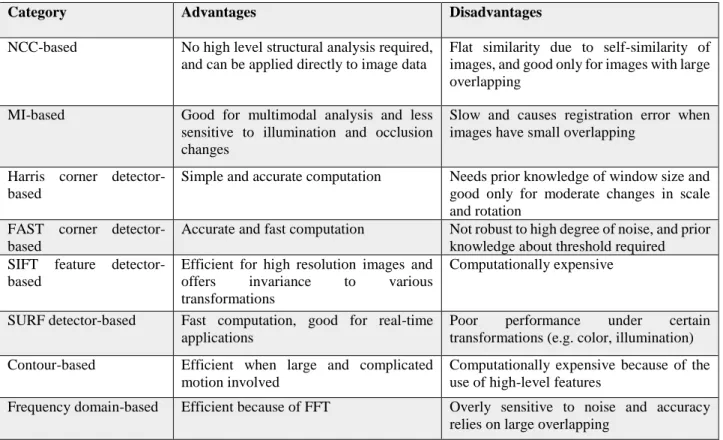
The comparative overview of different categories of mosaicing algorithms based on image
registration is presented in Table 2.1.
Table 2.1: Comparative overview of different categories of mosaicing methods based on image registration
Category Advantages Disadvantages
NCC-based No high level structural analysis required, and can be applied directly to image data
Flat similarity due to self-similarity of images, and good only for images with large overlapping
MI-based Good for multimodal analysis and less sensitive to illumination and occlusion changes
Slow and causes registration error when images have small overlapping
Harris corner detector-based
Simple and accurate computation Needs prior knowledge of window size and good only for moderate changes in scale and rotation
FAST corner detector-based
Accurate and fast computation Not robust to high degree of noise, and prior knowledge about threshold required SIFT feature
detector-based
Efficient for high resolution images and offers invariance to various transformations
Computationally expensive
SURF detector-based Fast computation, good for real-time applications
Poor performance under certain transformations (e.g. color, illumination) Contour-based Efficient when large and complicated
motion involved
Computationally expensive because of the use of high-level features
Frequency domain-based Efficient because of FFT Overly sensitive to noise and accuracy relies on large overlapping
2.3 Classification of image mosaicing methods based on blending
Similar to registration, image blending is also a significant step for successful
implementation of mosaicing. Stitching multiple images together to create a seamless mosaic
25
registration, which is vital to equalize color and luminance appearance in a composite image. There
are several reasons (differences in camera exposure, scene illumination, or presence of moving
objects between frames or geometric misalignments) which may lead to image inconsistencies in
the final mosaic. The visibility of such inconsistencies can be minimized by choosing appropriate
blending algorithm. This way, the final mosaic would be visibly free of annoying seams, giving it
a more consistent global appearance. Figure 2.7 shows that based on the image blending,
mosaicing algorithms can be transition smoothening-based and optimal seam-based. Transition
smoothening-based mosaicing can be further grouped into feathering-based, pyramid-based, and
gradient-based mosaicing. Different classes of image mosaicing algorithms based on the image
blending methods are discussed below.
Mosaicing
Optimal seam-based Transition
smoothening-based
Feathering-based Pyramid-based Gradient-based
2.3.1 Mosaicing methods using transition smoothing-based blending
Mosaicing algorithms within this category attempt to minimize the visibility of seams by
smoothing the common overlapping regions of the combined images. The information of the
overlapping region between two images is fused in such a way that the boundaries of the images
involved become imperceptible. Even though a totally indistinguishable transition may be Figure 2.7: Classification of mosaicing based on blending.
26
achieved, the content and coherency of the overlapping region is not guaranteed, as the information
is fused without taking into account the content of the scene [70]. Thus, most often, these
mosaicing methods generate mosaic with blurry transitions in the boundary regions. Popular
methods which use transition smoothing for their blending operation include feathering, pyramid
blending, and gradient-based blending. Mosaicing algorithms based on these techniques are
discussed briefly as follows:
2.3.1.1 Mosaicing algorithms using feathering-based blending
Mosaicing algorithms within this category perform blending operation by taking an
average value in each pixel of the overlapping region. However, the simple average method fails
when exposure differences, misalignments, and presence of moving object are very obvious in the
input images. A better approach to the averaging method is to use weighted averaging along with
a distance map. Pixels near the center of an image are weighted heavily and those near the edges
are weighted lightly. This is done by computing a distance map in terms of Euclidean distance of
each valid pixel (mask) from its nearest invalid pixel as [43].
~ ( ) arg min{ ( ) } k k y w x yy I xy is invalid (2.17) where ~ ( ) k
I x are the warped images and w xk( )
are the weights of the images. Finally, the mosaic
image is generated as a weighted combination of the input images. Examples of composite images
formed of six color images using simple average blending and feathering are shown in Figure 2.8.
27
exposure differences. However, it is difficult in practice to achieve a balance between smoothing
out low-frequency exposure differences and preserving sharp enough transitions to prevent
blurring. Furthermore, these methods suffer from ghosting effect.
Examples of mosaicing methods using feathering-based blending include [56] [71] and
[60]. [56] and [71] used alterations of the above mentioned method for finding the weights of
images in the overlapping region. In [56]. the aforementioned weight is measured by computing
the distance of the overlapping pixels from the borders of the left and the right images. In [71], the
authors used weighted average of the pixel color values in the overlapping region.
2.3.1.2 Mosaicing algorithms using pyramid-based blending
In an attempt to perform the blending operation in a more robust way, these mosaicing
algorithms convert the input images into band-pass pyramids as shown in Figure 2.9. Mask image
associated with each source image is then created. Mask creation can be made automatic by using
grassfire transform as used in [72]. Then the mask image is converted into a low-pass pyramid by
using a Gaussian kernel [43]. The resultant blurred and subsampled masks are treated as weights
to perform per-level feathering. The final mosaic is then achieved by interpolating and summing
the results from per-level feathering as:
Figure 2.8: Image blending results. (a) Blending using simple averaging; (b) Blending using feathering. (a) (b)
28
1 2
( , ) ( , )* ( , ) (1 ( , ))* ( , )
LO x y GM x y LI x y GM x y LI x y (2.18)
where LI x y1( , )and LI2( , )x y are the Laplacian pyramids of the warped source images I1and I2.
( , )
GM x y is the Gaussian pyramid of the mask image M x y( , )and LO x y( , )is the Laplacian pyramid
of the output image O x y( , ). Sometimes, all the strips are combined in a single blending step when
it needs building pyramids for multiple narrow strips as proposed in [31]. Algorithms using the
above method achieve reasonable balance between smoothing out low frequency components and
preserving sharp enough transitions to prevent blurring [74]. Edge duplication is also eliminated
noticeably. However, double contouring and ghosting effects become significant when the
registration error is significant.
2.3.1.3 Mosaicing algorithms using gradient-based blending
Another group of transition smoothening method are those based on gradient domain
blending. These methods are based on the idea that by suitably mixing the gradient of images, it is
possible to mosaic image regions convincingly. In general the gradients across seams are set to
zero for smoothing out the color differences. Since humans are more sensitive to gradients than
image intensities, mosaicing methods using this technique generate visually more pleasant results (a) (b)
29
compared to the other two techniques discussed before. However, working exclusively in the
gradient domain requires higher computational resources to deal with large data sets. Furthermore,
for best performance, the alignment of images through registration needs to be almost perfect.
Notable work in this group was developed by [32], [75], and [76]. In [75], the authors used
a gradient domain object moving and region filling algorithm to eliminate the visible artifacts
arising from moving objects in the scene. Algorithm based on assigning low resolution offset map to each source image followed my Poisson’s blending was proposed by Szeliski et al. [76]. In [32],
the authors developed two approaches called GIST (gradient domain image stitching). One of the
approaches is based on minimizing a cost function that evaluates the dissimilarity measure between
the derivatives of the mosaic and the derivatives of the source images. The other approach is based
on inferring a mosaic by optimization over image gradients.
2.3.2 Mosaicing methods using optimal seam-based blending
This type of mosaicing algorithms attempt to minimize the visibility of seams by looking
for optimal seams in the joining boundaries between the images. The objective of optimal seam
technique is to allocate the optimal location of a seam line by looking into the overlapping region
between a pair of images. The seam line placement should be such that it minimizes the
photometric differences between the two sides of the line. At the same time the seam line should
be able to determine the contribution of each of the images in the final mosaic. Once the placement
and the contribution information are obtained, each image is copied to the corresponding side of
the seam. When the difference between the two images on the seam line is zero, no seam gradients
30
blending, optimal seam-based mosaicing algorithms consider the information content of the scene
in the overlapping region, allowing to deal with problems like moving objects or parallax.
However, no information is fused in the overlapping region, thus the transition between the images
can be easily noticeable when there are global intensity or exposure difference between the frames.
Different optimal seam finding methods have been used in mosaicing literature. For
example, in [33] a modified region-of-difference method is used.[77] proposed the use of an
algorithm based on watershed segmentation and graph cut optimization. Another method based on
dynamic programming and grey relational analysis is used in [78].
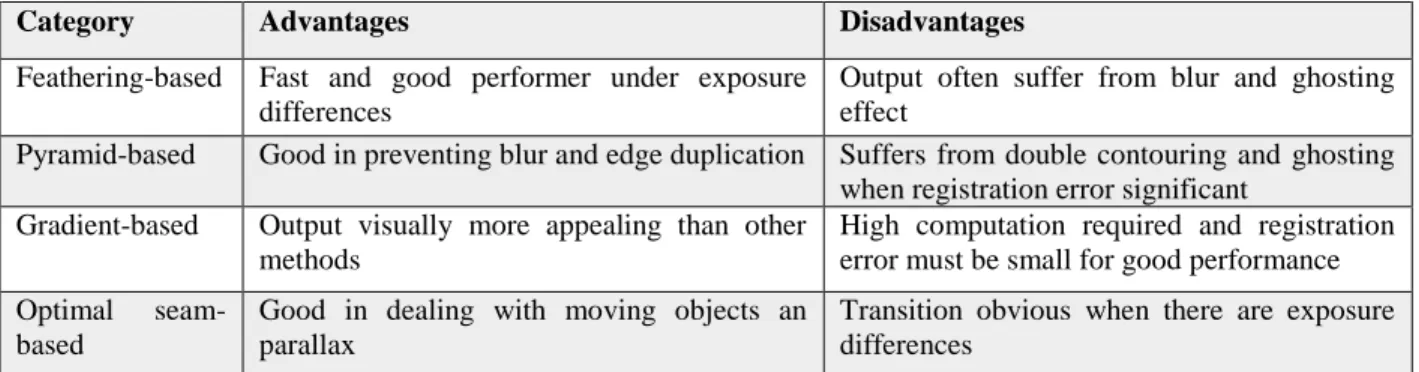
A general comparison of different categories of mosaicing algorithms based on image
blending is presented in Table 2.2.
Table 2.2: Comparative overview of different categories of mosaicing methods based on image blending
Category Advantages Disadvantages
Feathering-based Fast and good performer under exposure differences
Output often suffer from blur and ghosting effect
Pyramid-based Good in preventing blur and edge duplication Suffers from double contouring and ghosting when registration error significant
Gradient-based Output visually more appealing than other methods
High computation required and registration error must be small for good performance Optimal
seam-based
Good in dealing with moving objects an parallax
Transition obvious when there are exposure differences
31
CHAPTER 3
STATE-OF-THE-ART OF IMAGE SUPER-RESOLUTION METHODS
3.1 IntroductionSuper-Resolution (SR) is the process of achieving a high-resolution (HR) image from a
single low-resolution (LR) observation or a sequence of LR observations of a scene taken at
different viewpoints. It aims to overcome the limitations of the image capturing devices to produce
a high resolution image. In SR context, HR means higher spatial resolution and hence higher
information content. HR images are not only visually appealing, but also valuable in several
practical applications for extracting additional details. SR has been an active research area over
the last two decades and most recently it is gaining growing interests in the image processing
community for its potential derivatives. Application areas of SR include but not limited to satellite
imaging [79, 80], astronomical image processing [81], medical image processing [82-84], HDR
imaging [85], automatic image mosaicing [13], fingerprint and face image enhancement [14],
target recognition [86], video surveillance [87], and converting video standards [88].
The sensor size and the density of detectors that form the sensor primarily determines the
spatial resolution of the captured images. Larger the size of the sensor, and/ or higher the density
of the detectors, better the spatial resolution of the acquired images. The most direct
hardware-based approach of increasing the spatial resolution is to reduce the detector size or equivalently
increase the detector density. Alternatively, the sensor size can also be increased. However, smaller
detectors have lower dynamic range, lower fill factor, worse low light sensitivity, higher dark
32
increases with the increase of both detector density as well as sensor size. Thus, the above
mentioned hardware-based approaches often restricts the maximum achievable resolution of the
captured images. Besides the sensor-imposed restriction, there are several other factors that limits
the capture of high resolution images, for example lens and atmospheric blurs, finite shutter speed,
finite aperture, movement of objects in the scene, sensor noise, and media turbulence.
Consequently, a software-based approach (like SR) to obtain images with improved spatial
resolution from one or more LR observations becomes an attractive proposition [13].
Single-frame SR increases the spatial resolution by utilizing one or more learning models.
In contrast, multi-frame SR increases the spatial resolution by taking advantage of more samples
than that found in any single LR observation. Thus, each LR observation must exhibit either
sub-pixel shift, or change in illumination, or variation in blur from the other. The physical size of the
SR output may be same as the size of one of the LR observations or larger depending on the image
interpolation method used [90]. Two closely related techniques of SR are interpolation and
restoration. Image interpolation increases the size of an image, however, it does not improve the
quality of it. Image restoration, on the other hand, improves (by deblurring and denoising) the
quality of an image without changing its physical dimensions. Thus SR must not be confused with
either interpolation or restoration, rather it could be seen as a combination of these two techniques.
33
Being an attractive research area, SR has resulted in the development of numerous
algorithms. Thus, it would be extremely difficult for someone interested in this research area to
select a suitable method without having a comprehensive survey. In this chapter, we classify the
past and the newly emerging SR techniques into several categories. The basics of all the categories
are discussed. Furthermore, the improvements over the basic methods made by different
researchers are also highlighted. However, before going into the detailed classification, we will
discuss an image observation model which is used by almost all reconstruction-based SR methods.
3.2 Image observation model
The first strategic step to understand SR imaging is to formulate an observation model that
establishes the relationship between desired HR image and a set of LR images. During the
acquisition process, the captured scene undergoes a series of transformations to generate the LR
images. For simplicity in the formulation of the observation model, these transformations are
limited to the following four operations: 1) geometric transformation, 2) blurring, 3)
down-sampling, and 4) addition of white Gaussian noise. Geometric transformation includes global or
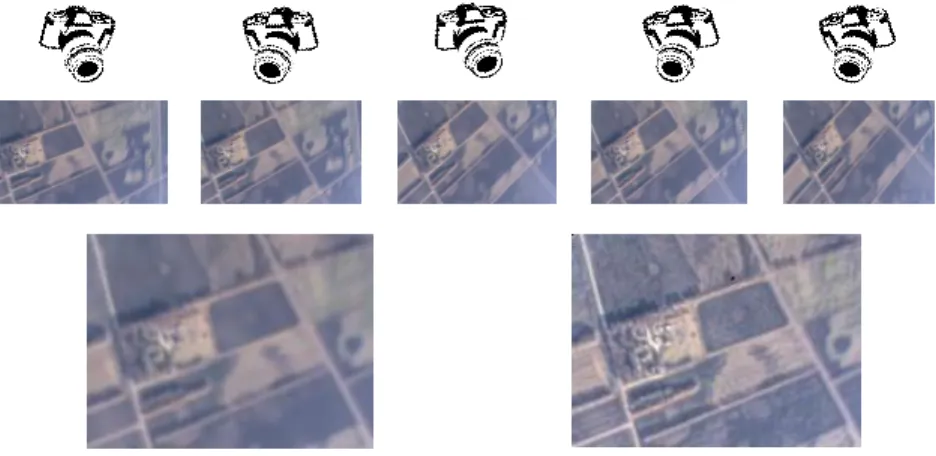
local translation, rotation, and scaling that are responsible for scene motion. Since these Figure 3.1: A framework of multi-frame super-resolution.
34
information are usually unknown, a warp operator can be modeled that can estimate the scene
motion for each image with reference to one particular image. Blur includes any blurring effect for
example optical blur (related to lens and/or sensor), motion blur, atmospheric blur etc. For
reconstruction-based SR methods, the characteristics of the blur are assumed to be known. Hence
blurs are usually modeled as a point spread function (PSF) kernel. Different downsampling
operators can be used to generate LR images of different size. However, for simplicity we would
restrict the observation model to generate LR images of same size. Furthermore, we would
consider the down-sampling factors for the vertical and horizontal directions to be equal.
To formulate the model, let’s assume that 𝑥 is the desired HR image of size 𝑁1× 𝑁2, which
is derived from a bandlimited continuous scene. Considering 𝑞 to be the down-sampling factor in
both directions, each of the 𝐾 LR images (𝑦𝑘, 𝑘 = 1 𝑡𝑜 𝐾) is of size 𝑀1× 𝑀2, where 𝑁1 = 𝑞𝑀1
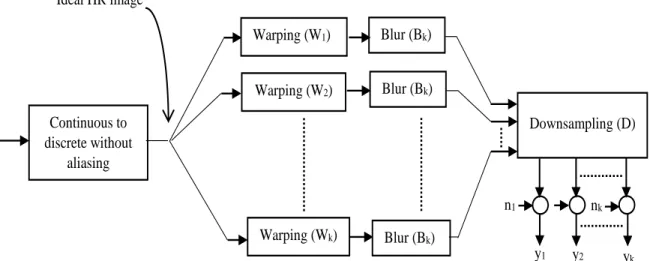
and 𝑁2 = 𝑞𝑀2. If the LR images are generated by warping, blurring, down-sampling, and addition
of white Gaussian noise to the HR image 𝑥, we can represent the observation model as:
𝑦𝑘 = 𝐷𝐵𝑘𝑊𝑘𝑥 + 𝑛𝑘 𝑓𝑜𝑟 𝑘 = 1 𝑡𝑜 𝐾 (3.1)
= 𝑀𝑘𝑥 + 𝑛𝑘
where both 𝑦𝑘 and 𝑥 are represented in lexicographically ordered vectors having a size of 𝑀1𝑀2×
1 and 𝑁1𝑁2 × 1, respectively. 𝐷, 𝐵𝑘, and 𝑊𝑘 are the decimation operator, blur operator, and the
warp operator expressed in matrix form. 𝑀𝑘 is the matrix which represents all the above mentioned
degradation factors. Figure 3.2 shows a graphical representation of the observation model of Eq.
(1). Alternation in the order of blur and warp operators in the above mentioned observation model