Copyright © 2013 Scientificia
THE ROLE OF FINANCE IN THE DEVELOPMENT OF
TECH-NOLOGY-BASED SMES: EVIDENCE FROM NEW ZEALAND
David Deakins1, David North2
1New Zealand Centre for SME Research, Massey University, Wellington, New Zealand 2Middlesex University Business School, The Burroughs, London NW4 4BT
E-mails: [email protected] (corresponding author)
Received May 2013; accepted July 2013
Abstract
Purpose- In this paper we discuss an exploratory study that involved face to face, qualitative inter-views with 20 technology-based small firms (TBSFs) and seven qualitative interinter-views with key in-formants and funders. The TBSFs were all located in New Zealand (NZ), a small open economy with a limited domestic market, a population of 4.3 million, current GDP per capita of US$32,260 (2010) and arguably an immature and limited financial infrastructure. The central research question for this study was whether TBSFs can raise appropriate finance that allows them to start, develop and remain in NZ?
Design/methodology/approach- An exploratory study has involved a programme of 20 in-depth, face to face qualitative interviews with the founders and chief executives of TBSFs drawn from three contrasting locations in New Zealand and from across different technology-based sectors. A further seven interviews have been conducted with key informants drawn from the three locations.
Findings- As might be expected from theory, there was a heavy reliance on internal funding and bootstrapping methods, although a number of TBSFs had in addition managed to raise additional private capital through their own contacts and networks. All the sample had relied upon internal fund-ing to some extent. However, a total of 13 (65 per cent) either relied totally on internal fundfund-ing (from the initial start-up) or relied upon a combination of internal funding, bootstrapping and private inves-tors. Context was important with New Zealand being a small open and relatively remote economy when compared to the UK; where the EU provides a significant market for TBSF development. In contrast, NZ TBSFs, of necessity were heavily involved in distant overseas markets.
Research Implications- There was evidence of a distinct finance gap in the external equity market in New Zealand. For amounts below NZ$1m, these could be sought from networks of business angels, even though such sources were limited and restricted. If the funding sought was in the range NZ$1m -$5m; this was likely to fall between the informal and formal venture markets. Associated with this was a distinct preference for relying on internal funding by NZ TBSFs.
Originality/value- This paper provides a contribution by being the first serious study of TBSF devel-opment in New Zealand, specifically focusing on the role of finance. The example of TBSF
develop-ment in New Zealand’s small, open economy is significant and comparisons are drawn with the extent of funding gaps and similar issues in TBSF development from a UK based study. These comparisons enable the findings to be set in context and implications developed.
Research paper
Keywords: Technology-based small firms, Finance, IPR, Venture finance, Entrepreneurial develop-ment
Reference to this paper should be made as follows: Deakins, D., and North, D. (2013). “The Role of Finance in the Development of Technology-based SMEs: Evidence from New Zealand”, Journal of Entrepreneurship, Business and Economics, Vol. 1 No. 1/2, pp. 82–100.
Introduction
A number of official reports have investigated what appears to be a symptomatic failure in New Zealand; to develop, fund and retain the development of R&D in-tensive, high value, technology-based small firms (TBSFs). This under-development has often been seen as one of the factors behind New Zealand’s rela-tively low rate of productivity per capita by international comparisons, for exam-ple, being some 25% lower than that of Australia’s (Mai, et al. 2010)1
. A report on high value manufacturing for the Ministry of Science and Innovation (MSI, 2011a, page 19) commented that:
“The New Zealand high value manufacturing and services sector is under-developed, and could contribute substantially more to the economy than it currently does, particularly through growth in high productivity advanced technology industries.”
It is arguable that a small, open economy like New Zealand (NZ), remote from major world markets, will not have the resources and infrastructure capable of supporting TBSFs through to maturity. A population of 4.3 million is coupled with remoteness and a long distance from major overseas markets. NZ has proportion-ately a high business population per capita with over 457,000 registered businesses (MED, 2009)2. However, with 98 percent of firms employing fewer than 50 em-ployees, 89 percent employing 5 or fewer and 68 percent having no emem-ployees, the proportions of small firms in NZ are broadly comparable internationally.
In the World Bank’s annual ‘Doing Business’ surveys, New Zealand ranks third behind Singapore and Hong Kong as one of the easiest nations in which ‘to
1
NZ had a current GDP per capita of US$32,260 in 2010, compared to a current GDP per capita for Australia of US$50.746 in 2010 (World Bank, 2012b)
2 By comparison, for example, Scotland, with a population of just under 5.2 million, recorded less than 291,838 registered businesses in 2009 (http://www.scotland.gov.uk) (0.11 compared to 0.06 registered businesses per head of the population respectively).
do business’ (World Bank, 2012a)3
. Frederick and Monsen (2010) report GEM da-ta that indicate that Early Entrepreneurial Activity rates as one of the highest in the GEM panel data set. However, this benign regulatory environment has created an entrepreneurial paradox. Although NZ has a relatively high business rate formation by international comparisons, it has a relatively low proportion of high growth firms (MED, 2010). Shangqin, et al (2009) state that the “local ---environment for entrepreneurship--is excellent (yet) innovation remains a problem” (p 3). The New Zealand Treasury’s 2008 report claims that whilst entrepreneurship start-up rates are high, competitive forces are relatively low (partly due to the size of the home market)4. The OECD review on innovation policy in New Zealand commented that a lack of investment in business R&D was a weakness of the innovation system in New Zealand (OECD, 2007). These levels have recently been confirmed in a recent report by Statistics New Zealand (2010b).
Theoretically, the role of finance is a crucial factor that can determine whether there is successful development for TBSFs and their technology-based entrepreneurs. TBSFs, by their nature, are perceived as more risky than other small firms by potential funders and may not have the collateral required by banks to fund long term projects (Bank of England, 2001). The technology-based entrepre-neur is likely to exhaust personal financial resources during R&D and early stage development and will need to rely upon staged external investor funding (Oakey, 2003). Access to such sources of external and patient capital are often problematic and difficult to source, even assuming that a match can be made between the aspi-rations of the technology-based entrepreneur and those of the individual or corpo-rate investor (Mason and Harrison, 2004). Classic venture capital is provided in a number of staged deals with planned exits through an IPO or trade sale (Mason and Harrison, 2004). Such funding ‘escalators’ may only exist where there are suffi-cient networks of individual and corporate investors. Well known examples include Silicon Valley, Massachusetts (USA) and Cambridge (UK). With such examples relatively rare, the lack of adequate funding sources for TBSFs can be viewed as market failure leading to state intervention either through direct grant schemes or through attempts to stimulate the market through co-investment schemes. Both have provided the basis for interventions in NZ, through direct technology grants, vouchers and co-investment (NZVIF, 2011, http://www.nzvif.com; MSI, 2011b).
The current New Zealand Government has introduced a range of measures, including R&D grants, technology vouchers and tax cuts, targeted at raising busi-ness levels of R&D (Key, 2010). At the centre of these recent measures, the tech-nology transfer vouchers have been targeted at techtech-nology transfer particularly
3
As an economy in which to start a business, New Zealand does even better being ranked as the easiest nation in which to start a new business (World Bank, 2010)
4 This is supported by the World Economic Forum’s Global Competitiveness Index (Schwab, 2009) which indicates that New Zealand has improved to 20th place overall for 2009, but still performs lower on business sophistication and innovation (36th).
aimed at trying to improve spin-out commercialisation from NZ’s HEIs and aimed at lifting the relatively low levels of business R&D spend. During 2011 the thresh-old levels were reduced making vouchers and grants available for smaller TBSFs.
The aim of this exploratory study is to examine the role of finance in the de-velopment of TBSFs against this unique entrepreneurial and environmental context in NZ. In particular our central research question is stated as:
RQ Whether TBSFs can raise appropriate finance that allows them to start, develop and remain in NZ? Subsidiary research questions included:
- RQa. How does the role of finance affect the development of TBSFs in NZ?
- RQb. How do NZ TBSFs acquire other resources?
- RQc. What are their main challenges in the NZ environment?
The remaining sections of this paper cover a review of literature and theory relevant to the role of finance in TBSFs; research methods and data sources; results and analysis from the qualitative interviews and we conclude with a discussion and implications section.
Review of Literature and Relevant Theoretical Background
The relevant literature on the role of finance in TBSFs can be divided into theoretical concepts and previous research evidence. The classic theory on the fi-nance of TBSFs stems from the economics of information. Applied to SMEs gen-erally, this holds that the existence of asymmetric information between potential funders and SME owners produces credit rationing because information held by SMEs is opaque, for example, held through knowledge of the entrepreneur and not readily available or disclosed. The relationship between SME owners and potential funders is seen as a transactional one (Stiglitz and Weiss, 1981). It is assumed that credit rationing will result, although de Meza (2002) argues that credit is over sup-plied because over optimistic entrepreneurs exaggerate returns.
For TBSFs at an early stage, information is limited and not always transpar-ent (Schmid, 2001) and assets are often knowledge based and intangible, being ex-clusively associated with the founding entrepreneur (Hsu, 2004). In such circum-stances, entrepreneurs may be reluctant to provide full information about the op-portunity because of concerns that disclosure may make it easier for others to ex-ploit (Shane and Cable, 2002). A more modern development of this theory has moved away from a transaction cost based to a relationship based approach (Berger and Udell, 2004) Relationships have, of course, always been more important for venture capitalists and business angels who will make their investment decisions at least as much on management and entrepreneurial abilities as on financial projec-tions and business plans (Feeney, et al 1999; Mason and Stark, 2004).
Most of the theory described so far has been applied to the finance of SMEs in general. When considering TBSFs, a special set of circumstances can be applied.
- Extensive R&D periods for product development. This necessitates raising finance for R&D and the development of prototypes, that is, distinctive requirements for seed capital due to large sunk costs (Geroski, 1995).
- TSBFs will face a period of negative cash flow and losses during the R&D period, this can vary from a few months (say with software providers) to 10 years or more (say with bio-technology applica-tions). Entrepreneurs will exhaust private savings/internal sources and need to rely on raising external capital.
- Although patents can be used to protect new products/processes, they are intangible assets and banks may be unwilling to accept them as security.
- Developing cash-flow forecasts for the business plan can be prob-lematic since, with new technology products, markets may not exist. Consequently banks are unwilling to lend against forecasts.
Despite the importance of TBSFs for economic development in advanced industrial economies, there has been remarkably little systematic research into the nature of their development. One of the reasons for this is that TBSFs are subject to definitional discrepancies (no standard definition is applied) and, therefore, panel data sets are problematic and expensive to compile. Where studies do exist, they can be difficult to compare because of the difference in sampling techniques which are used. Revest and Sapio (R&S) in a review of evidence on financing TBSFs in Europe mention limited studies in the UK, Italy and France (R&S 2010). Work has been conducted in the US (Carpenter and Peterson, 2002), but R&S (page 7) claim that “the robustness of the results, however, is under question due to a number of methodological limitations”. R&S give four main findings: that European TBSFs finance new investments by relying primarily on internal funds, due to asymmetric information; that the European venture capital industry is caught up with that of US and amounts are too large to be viable for TBSFs; that alternative stock markets, such as EASDAQ, have proved unviable and, as a consequence, European gov-ernments are actively involved in supporting TBSFs’ needs for finance.
The work reviewed by R&S was conducted before the Global Financial Cri-ses (GFC), Post GFC it is arguable that TBSFs will be even more financially con-strained. One study on which this research builds has been undertaken in the UK post GFC (Baldock, et al 2011). This study conducted a telephone-based survey with a sample of 100 TBSFs to examine the extent to which their external finance requirements had been met from various sources, since the onset of the financial crash. They concluded that financial constraints prevented a “substantial number of TBSFs from achieving their full growth potential with 36 per cent of TBSFS re-porting access to finance issues constraining their growth” (page 22)
Other studies with TBSFs have tended to be very selective and targeted at particular sub-groups such as samples from technology incubators and science
parks, partly because of the convenience afforded by such samples. These studies confirm the importance of TBSFs for local economic development (Jones and Par-ry, 2011) and have rather mixed results for the role of technology incubators (Al-sos, et al 2011).
NZ is no exception to the rarity of academic studies on the development of TBSFs. Case study investigations with bio-technology firms have pointed to the increased need for strategic alliances for small biotechnology firms (Ahn, et al 2011; Davenport, 2005). The increased trend towards agglomeration might suggest that the NZ economy is too small and the infrastructure insufficiently developed to support strategic alliances. What is relevant is that such strategic alliances need to be global in nature. Davenport (2005), in a study of innovative SMEs in NZ, has also pointed to the importance of global, rather than local, sources and networks for knowledge acquisition, implying the need for policy recognition of the diversity of knowledge acquisition sources and strategic alliances for TBSFs. From the existing literature and evidence we can expect that in NZ, TBSFs are likely to rely on inter-nal sources for finance, although they may seek exterinter-nal sources, that they will be in global markets and seeking to secure strategic alliances.
Research Method and Data Sources
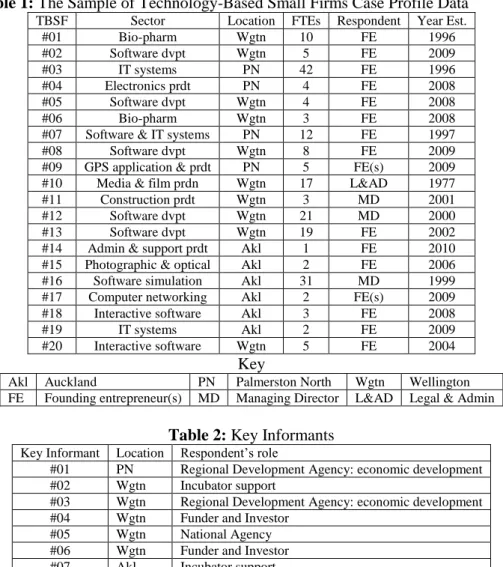
The fieldwork for this exploratory study was carried out in NZ with TBSFs recruited from the nation’s two main urban centres: Auckland and Wellington to-gether with a third location at Palmerston North. New Zealand has only three main urban centres, the third being Christchurch. As the interviews were completed in 2011, it was felt that TBSFs located in New Zealand’s only other large urban area, Christchurch, will have been affected by the earthquakes of February and June that year which caused widespread disruption to local businesses, hence the focus has been on TBSFs located in NZ’s other urban centres. The study has involved a pro-gramme of 20 in-depth, face to face qualitative interviews with the founders and chief executives of TBSFs drawn from different technology-based sectors (table 1). A further seven interviews have been conducted with key informants drawn from the three locations (table 2). The sample of 20 TBSFs were recruited from the New Zealand Centre for SME Research existing database and contacts according to a number of carefully developed criteria. Each TBSF had to be involved in R&D, developing technology and employing less than 100 employees. The coverage of different stages in TBSFs development, or staged life cycle model (Berger and Udell, 1995), was ensured by including respondents from start-up, early stage, de-veloping and more mature firms. A range of industry sectors was represented in-cluding bio-tech, IT and creative/media sectors.
The authors undertook the fieldwork over three months between September and November 2011.5 The interviews were conducted using an open-ended inter-view guide which was used to investigate the role of finance in the context of is-sues and challenges faced by the respondents. Interviews have been coded against themes drawn from the literature. However, it was important for the interviews to be sufficiently open-ended to allow for the exploration of additional themes from the data.
Recruitment of the sample was undertaken using the existing networks and contacts and through approaches made to incubator managers. To avoid potential bias from TBSFs engaged with agency and incubator support, 50 per cent were recruited independently. A couple of comments are warranted regarding the sector bias. The relatively large proportion of firms that have been classified in IT/digital were in a range of different software development or digital applications such as web design and open-source software applications. The small number of firms in biotech or pharmaceutical sectors reflects the generally low proportion of firms in this sector that could be recruited, especially from the Wellington and Palmerston North localities. The sample of cases represents a purposeful sample recruited to meet the objectives of this exploratory study. It should be noted that these summary tables hide considerable diversity. For example, of the early stage firms, three had completed a period of R&D and were about to embark on an expansion stage if sufficient funding and resources could be secured. Although a number of firms could be described as mature, in a small number of cases this comprised a period of non-technological development as they were still engaged in R&D for new prod-ucts6.
The key informant interviews were drawn from key players and actors in the three locations which gave additional perspectives and provided a means to verify and validate data, views and experience from the TBSF respondents. Individual researcher bias was avoided through having at least two researchers, with a couple of exceptions, at all of the interviews. This allowed extensive notes to be made dur-ing the interview and these were shared, added to and agreed as a valid record by all the members of the research team. All data has been anonymised and low risk ethical approval for the research was obtained from Massey University.
Content analysis has been undertaken using thematic coding from theory discussed in the literature review, this was used as the basis for identifying signifi-cant patterns to emerge as they cut across heterogeneous cases (Patton 2002). However, due to the unique contextual nature of the study, additional themes were
5 With research support from Mark van Dijken, a visiting international research student from the University of Groningen whilst at the New Zealand Centre for SME Research during the time of the fieldwork
6 The illustrates the difficulty of applying terms such as ‘early stage and ‘mature’ to TBSFs as their stages of development can differ and are not necessarily correlated with the age of the business.
considered based on the propositions regarding the nature of the limited domestic market and remote location identified in our introduction. Our approach and pro-cess to the interpretation of results from cases is based upon that recommended by Eisenhardt and Graebner (2007) (E&G). They argue for theoretical sampling where cases are selected because they are particularly illuminating or illustrative or chosen because they will have theoretical insight. Multiple case studies provide a strong base for conceptual development (Yin, 2003). E&G argue that cases should be selected for their capacity to shed light on contrasting ability and experience. The multiple case study approach has enabled ‘replication logic’ to be applied to build concepts and interpret findings.
Table 1: The Sample of Technology-Based Small Firms Case Profile Data
TBSF Sector Location FTEs Respondent Year Est. #01 Bio-pharm Wgtn 10 FE 1996 #02 Software dvpt Wgtn 5 FE 2009 #03 IT systems PN 42 FE 1996 #04 Electronics prdt PN 4 FE 2008 #05 Software dvpt Wgtn 4 FE 2008 #06 Bio-pharm Wgtn 3 FE 2008 #07 Software & IT systems PN 12 FE 1997 #08 Software dvpt Wgtn 8 FE 2009 #09 GPS application & prdt PN 5 FE(s) 2009 #10 Media & film prdn Wgtn 17 L&AD 1977 #11 Construction prdt Wgtn 3 MD 2001 #12 Software dvpt Wgtn 21 MD 2000 #13 Software dvpt Wgtn 19 FE 2002 #14 Admin & support prdt Akl 1 FE 2010 #15 Photographic & optical Akl 2 FE 2006 #16 Software simulation Akl 31 MD 1999 #17 Computer networking Akl 2 FE(s) 2009 #18 Interactive software Akl 3 FE 2008 #19 IT systems Akl 2 FE 2009 #20 Interactive software Wgtn 5 FE 2004
Key
Akl Auckland PN Palmerston North Wgtn Wellington FE Founding entrepreneur(s) MD Managing Director L&AD Legal & Admin
Table 2: Key Informants
Key Informant Location Respondent’s role
#01 PN Regional Development Agency: economic development #02 Wgtn Incubator support
#03 Wgtn Regional Development Agency: economic development #04 Wgtn Funder and Investor
#05 Wgtn National Agency #06 Wgtn Funder and Investor #07 Akl Incubator support
Findings and Analysis
The discussion of findings is organised against the main themes that have arisen from the analysis of the interview data. These include: the pattern of funding and attitudes to external funding, the role of government grants, access to other resources including IP and perspectives on the NZ environment for funding. The pattern of funding and attitudes to external funding
As might be expected from theory, there was a heavy reliance on internal funding and bootstrapping methods, although a number of TBSFs had managed to raise additional private capital through their own contacts and networks. All our sample had relied upon internal funding to some extent, however, 13 (65 percent) TBSFs either relied totally on internal funding (from the initial start-up) or relied upon a combination of internal funding, bootstrapping and private investors7.
There was evidence that the entrepreneurs would prefer to fund internally, using bootstrapping techniques where possible, even if it meant a slower and per-haps more paced development:
“We have bootstrapped from the start; you have really got to know what you are doing with your cashflows and that is challenging” ----“Money earned was put back in the business to grow step by step”. (TBSF # 13)
However, it would be incorrect to indicate that there was total aversion to raising external funding, but only a small number had raised venture capital (two companies) or had undertaken a search procedure for business angels. Even allow-ing for the normal owner desire that would be expected of a reluctance to dilute equity, this was overlain by a strongly held perception that the informal and formal venture capital (VC) markets in NZ were perceived to be very limited and lack suf-ficient numbers of high net worth individuals with experience of investing in tech-nology-based companies. For example, one respondent had sought VC funds in Australia and NZ and commented that
“We focus on highly worth individuals in Australia and NZ, that is the target market at the moment, because they are more likely to support a business in this part of the world. (However) the depth of capital markets is limited in NZ. The amount of risk capital is very low—and-- the pool for funding tech-nology firms in NZ is incredibly low.” (TBSF # 06)
A further illustrative comment was made by one respondent that had raised some VC funds, but also pointed to the difficulty of raising funding offshore for amounts less than NZ$5 million:
7 Six firms were totally reliant on internal funding; four firms mentioned bootstrapping techniques, 11 firms relied upon a combination of internal funds and private investors, six firms using internal funds and government grants and only three firms were using either bank loans or overdrafts.
“It is hard work to get funding in NZ, because there are not many places to go. It is difficult to get funding outside NZ because we are typically too small. For a lot of VC organizations (who are looking to invest $5+million) the company is too small. Other opportunities are offshore but that is also harder, because we are not US based. So we are restricted to where we can go”. (TBSF # 16)
It is arguable that for TBSFs located in incubators, the access to investors, especially business angels, is increased due to the network established via the incu-bator. Incubators had sought to establish Funds with money from their network of private investors through which applications could be made by early stage and start-up companies. Location in an incubator raises credibility and is likely to im-prove access to VC and equity. However, there was still a time consuming process to raise external individual business angel investment due the matching process and the stages required before final investment might be secured.
“The good news about using angels linked to the incubator is that it’s a real opportunity, so they do invest, but it’s a long hard process to get their atten-tion and over the line”. (TBSF # 16)
The result of the difficulty in raising VC funding locally in NZ meant that those that were actively seeking such funding were looking overseas, especially to the US
“The first round capital raising (NZ$500K) was needed for marketing and sales side of the business. The company got the funding but it was long, slow and distracting process. Second capital raising round (18 months later) the company was cashflow positive and achieved the prior goal and raised NZ$1.1 million for employing sales people. We were too small for the VCs, and the second time just too big to rely on angel investment.
For raising further funds, the VC market in the US will be approached in-stead of looking for funds in NZ, because it is for a bigger amount of money. An-gels will not be interested, but VC’s might become as we hit the low end of the VC market, but the US gives us greater opportunities for diversifying across the mar-ket”. (TBSF # 16)
The extent of adversity to approaching external equity providers was very strongly reinforced with perceptions that this was a relatively expensive way to raise funding.
“To start a company making a product in NZ is practically impossible, you need someone who gives you a whole pool of money, to hire all the people and all the work in the marketing, to get the finance will cost you a huge amount of equity and equity is always the most expensive form of finance”
(TBSF # 13)
Similar to external equity, there was a distinct reluctance to raise external debt finance. Only a small number of TBSFs had sought and raised finance from the commercial banks. There was a view that banks are not willing to value
intel-lectual property (IP). One respondent from a mature company8 commented: “ [Ob-taining] debt financing is nearly impossible and we can’t even get a bank overdraft facility” (TBSF # 03). Where bank finance had been secured, not surprisingly, it
was property that had been used for collateral.
“The business was funded by a bank loan, as much money as possible, house as collateral. Nearly spent all that money (on product development), but made it back after the product launch”. (TBSF # 15)
Overall, for raising both external equity and debt, technology-based entre-preneurs’ perceptions of cost, time and difficulties, combined with the well known reluctance to dilute ownership, meant that there was trade off between avoidance of such external sources and acceptance of limiting their own company’s business development. The following comment being representative:
“You might be wanting to grow faster than your capital will let you do so. You have to constrain your growth because you don’t have the finance”. (TBSF # 13)
The limited nature of external equity markets was supported by views from the key informants:
“We have definitely got a funding gap over here. Public money needs to step up, especially in the tech-sector. Moreover, NZ struggles with a lack of skilled and experienced people who are able to take a leading role as lead investors. Problem is the early stage where there is still a high risk, not later stage. There is a need for more experience, the learning process yet to happen in NZ”. (KI # 03)
“There is a particular gap in NZ with early stage TBSFs, Ministry of Eco-nomic Development consider that this market has been sorted by the pri-vate sector and by Business Angels, but BAs need investor ready compa-nies and there is a role that needs to be fulfilled through support.” (KI #
04)
There is a very thin pool of capital (in NZ), there is not the depth in in-vestment funds as there is in the US or UK and we do not have the depth of larger companies, so less experienced in understanding how bigger com-panies look like”. (KI #06)
There was also verification of the perspectives given on access to bank fi-nance. It was recognised that in the post GFC era, raising bank finance required collateral in the form of property (rather than through securing intangible assets in IP).
“Before the recession two banks were interested in investing money with-out (private) property as collateral. It is less these days, you need at least to bring in tangible assets as collateral.’ (KI # 02)
The role of government grants
8
Not surprisingly, there was a uniform and consistent welcome from the tech-nology-based entrepreneurs for support from government grants in the form of technology vouchers and direct grant funding. Grants and technology vouchers were effectively free money which could be obtained in a series of stages or rounds. In one case the entrepreneurs commented that this source of funding was “critical for their business” (TBSF #09). Further there was comment that the grants
had made a difference to the TBSFs’ capability and speed of development. For ex-ample, one respondent commented that:
“It is a huge help, it could be financed internally but the opportunity wouldn’t be exploited because the project is money intensive. It was im-mensely useful” (TBSF # 16)
Several respondents mentioned a series of staged applications for grants which ranged from $10k to over $100k. However, some applications were for very substantial funding and one respondent said that they had received $7m from gov-ernment sources with ‘no strings attached’9
. Access to other resources including IP
For the majority of our respondents, recruitment of skilled labour or obtain-ing and retainobtain-ing staff was not seen as a significant problem or barrier to expan-sion. However, in a number of cases companies relied on immigrants and workers who were on temporary visas. These issues were exacerbated where a company had undergone a period of growth.
“In the last 12-15 months we have doubled up our employee numbers—[and] --recruitment has been an issue in obtaining the skilled workforce that we need, one-third of them being immigrants from all over the world”. (TBSF
#03)
For companies in IT systems and software development, providing the right working environment was seen to be important in securing and retaining staff. For example for one respondent they were able to attract the right staff because: “We are known as a fun place to work in the geek community” (TBSF #10). Obtaining
skilled labour was not seen to be an issue in the current economic climate.
In our discussion of funding and related issues, we have already mentioned the important role of networks and of those associated with incubators. With up to half our sample of TBSFs either located in incubators, or having been previously located in an incubator, it was not surprising that the initial formation of networks had an important role in TBSFs development. With incubator tenants, a common factor mentioned by respondents was the importance of advice on business
9
In comparison to UK equivalents, such as SMART, the application process in NZ was much less rigorous. Once eligibility criteria had been met, technology grants and vouchers were awarded. The raises the issue of the risk of grant dependency in NZ, which may have an unintended effect of displacing private investors in an already narrow and immature early stage VC market.
opment rather than any technical assistance. For example one respondent in this group commented:
“The incubator plays an important role in regard to advice and business development. The technical side of the idea is covered, but which steps to take for developing a business is lacking, so the incubator is helpful for that”. (TBSF #17)
Incubators provide important business advice and mentoring support, but this needs to be tailored to the changing needs of TBSFs as they develop. Changing advice needs was illustrated by one respondent as follows:
“The first mentor assigned was great for market validation, but rather dif-ferent skills were needed for working in a web-based business. We changed to a new mentor and the new one sets direction and focus, --[a sounding board] as a voice of reason”. (TBSF #14)
External contacts and networks were obviously important for accessing markets, especially for those in overseas markets. As one respondent commented:
“Networking is huge for us—if being overseas for business, at least three telephone calls are made for networking purposes (that is, separate from the purpose of the visit to develop additional contacts) with--- the best overseas contacts are ex-pat Kiwis. (TBSF #03)
Only two of our respondent technology-based entrepreneurs were pursuing patent protection. For the majority of respondents, patents were seen as too expen-sive or were able to protect IP by alternative means, for example, in one case by controlling a combination of hardware and software. In other cases by continuous improvement and refinement of the product. In another case, it was about maintain-ing complexity of the product so that the threat of competition was reduced, alt-hough greater complexity meant a need to educate the market:
“We have no patents, they are too costly, the IP is about product complexity [but]—there is a huge amount of time we need to invest to educate the mar-ket”. (TBSF #16)
One respondent in the media sector was concerned with copyright where it was considered to be important and “very tightly controlled”; but even in this sec-tor patents (for new applications) were considered too expensive:
“Occasionally we will contact IP lawyers, but most of the time it is too ex-pensive to protect our products”. (TBSF #10)
A further two respondents were involved in using open source software and providing specific applications which meant that copyright could not be applied. Even where copyright might be relevant, it was still considered to have limitations and be relatively costly. One respondent commented that:
“Copyright [is] only as strong as much money as you can out into it, you can only protect IP by so much, real R&D is in the refining of the product and technology to meet market requirements”. (TBSF #09)
There were frustrations expressed at the nature of the funding environment, particularly the fragmented nature of funding sources and the small pool of equity in capital markets. Thus, some companies inevitably looked to locate and develop off shore. A lack of critical mass was seen to compound the narrowness and frag-mented nature of sources. Although there is evidence of the development of some clusters of activity, such as the digital sector in Wellington, the limited nature of such technology-based clusters was seen as restrictive. For example, comments were made about the “lack of critical mass” and “lack of experience”.
“There are not many people to talk to, there is a very small group of people investing in IT and software and those who do invest are quite conservative”. (TBSF # 19)
However, by far the biggest challenge was seen as securing external invest-ment in their companies, especially over the longer term. It was perceived that there is a lack of investors willing to take a long term approach, this partly due to the lack of exit routes that could allow staged financial development.
“Investors want a return on their investment, and the way they are forced to do that in New Zealand is to see you being acquired, it is unfortunate but that is because investors here can’t see long term value in staying with you long term. They do not get the share/return, whereas the only way they suc-ceed their return is for you to be bought out by someone else”. (TBSF # 19)
Although we have indicated, that NZ has a high rate of entrepreneurship and business start-up rates, this does not translate into the high value start-ups charac-terised through new TBSFs. Starting a new technology-based firm and growing a high value company was still seen as problematical and particularly challenging in NZ by our respondents. This was expressed by one of our respondents as follows:
“It is very difficult for a [TBSF] start-up here in New Zealand, because your building something here for somewhere else and often you do not have the awareness or networks of the other markets around how to become success-ful there. These are challenges and that means there is a higher failure rate [than elsewhere]”. (KI #07)
There was some agreement that TBSFs that do manage to start leave too ear-ly, representing a loss of opportunity for the economy. For example, one respond-ent commrespond-ented that the lack of a technology-based community contributed to this tendency.
“There is a need to deepen and strengthen the community locally as tech SMEs leave because of lack of technology community, there is a need for some type of technology park and greater economies and benefits that this would bring.” (KI #01)
Discussion and Implications
In this section we discuss our results in the light of our research questions. The central research question was whether TBSFs can raise appropriate finance
that allows them to start, develop and remain in NZ? The evidence presented sug-gests that there is a very strong preference for and reliance on internal sources with evidence of discouraged technology entrepreneurs in relation to both debt and VC funding. This was supported by the views of the key informants who were con-sistent in pointing to a number of problems in NZ:
1. A narrow base of BAs and VC funding
2. A lack of maturity and hence learning and experience 3. Fatigue arising from the smallness of the equity markets.
4. Angel investors and founders that were being increasingly ‘screwed down’ by VCs in terms of valuations10.
Although the role of government grants was seen to be positive, both in start-up and speeding up development phases, this was not sufficient to overcome some of the deficiencies in the funding environment in NZ, indicating the lack of a funding escalator process. Indeed this was reflected with a number of respondents seeking larger sources of funding overseas, particularly in the US. The role of debt finance could at best be seen to be marginal with marked reluctance of entrepre-neurs to seek debt finance, giving further support to discouraged borrower effects.
There are a number of implications which arise from our first subsidiary re-search question on how this affects TSBF development. It may encourage a ten-dency to eschew IP protection since this was not needed to raise external equity. The relative lack of IP protection is not surprising given the high costs of patent protection and the imperfect nature of the protection of IP that can be secured whether through patents or through copyright. For most technology-based entre-preneurs issues such as being first to the market or developing customer loyalty relationships were more important than seeking protection. Alternatively our tech-nology-based entrepreneurs had found other methods of protection and securing competitive advantage, which, for example, was through ensuring continuous re-finement or advances in technological nature of the product. There is also a com-plementary tie into the lack of venture capital. Only where VC funding is involved is there likely to be pressure on the technology-based entrepreneurs to patent.
A further implication, supported by the views of key informants was that TBSFs would keep the value of IP too low and ‘sell out early’.
“Most companies sell out too early to a foreign company. You should make sure that you keep the IP over here in NZ, we should become smarter in keeping the IP in NZ. –(and)-- IP has been sold too early, we should licence the IP”. (KI #04)
“You run out of customers real quickly [here], there is a physical constraint, If NZ firms go overseas, they do it at a very early stage and gain a lot of ex-perience/knowledge of that process in dealing with issues which arise by
10 That is low valuations on early stage angel investor funded companies due to the limited and fragmented VC market.
ing in a foreign market, compared to start ups who currently serve their do-mestic market; so that is a challenge and an opportunity”. (KI #06)
“The value of IP is kept too low; there is a lack of understanding of valua-tion and investors look at the saleability of companies rather than their IP value.” (KI #05).
These circumstances meant there was evidence of a distinct finance gap in the external equity market in New Zealand. For amounts below $1m these could be sought from networks of business angels, even though such sources were limited and restricted. If the funding sought was in the range $1m -$5m, this was likely to fall between the informal and formal venture markets.
The second subsidiary RQ is concerned with how TBSFs acquire resources. Apart from the difficulty in raising finance and reliance on internal sources and bootstrapping techniques, acquiring human capital and skilled labour was not seen to be barrier to development. In addition, the ability to attract skilled immigrants who were relatively flexible was important. In such cases, obtaining a work visa was not seen to be problematic, although such qualified workers would meet crite-ria on the Long Term Skill Shortages List (Department of Labour, 2011). However, networks and social capital could be seen to be more limited. The narrowness and limitations of networks being a further restrictive issue to the development of TBSFs.
The third subsidiary RQ is concerned with the challenges of the NZ envi-ronment. In the introduction to this paper, we mentioned the reported symptomatic failure of NZ to provide an environment in which TBSFs can thrive. Our findings have indicated that there are significant challenges to the development of TBSFs, including the existence of finance gaps, very limited VC and equity capital mar-kets, the challenge of retaining IP and the lack of a significant technological base and community. Although TBSFs can be considered, from a theoretical perspec-tive, to face more challenges, particularly in raising finance, than SMEs from non-technological sectors, it can be argued that these are greater challenges than exist in other developed nations. It may be inevitable that the successful development of TBSFs will lead them to locate abroad, but one implication is that those that are successful are becoming take-over targets for overseas investors, whether corporate or individuals. This has been encouraged by a lack of an adequate financial infra-structure.
Ackowledgement
The authors acknowledge the research assistance of Mark van Dijken, University of Groningen, an international visiting research student at the New Zealand Centre for SME Research at the time that the fieldwork was conducted.
References
1. Ahn, M.J., Meeks, M., Davenport, S. And Bednarek, R. (2010). “Exploring technology ag-glomeration patterns for multinational pharmaceutical and biotechnology firms” Journal of Commercial Biotechnology, Vol. 16, pp 17-32
2. Alsos, G.A., Hytti, U. and Ljunggren, E. (2011) “Stakeholder theory approach to technolo-gy incubators, International Journal of Entrepreneurial Behaviour and Research, Vol. 17, No. 6, pp 607-25.
3. Baldock, R, North, D. and Ullah, (2011). “The financing and growth of UK Technology-Based Small Firms in the financial crisis: Demand and supply-side perspectives”, Paper presented to the ISBE Conference, Sheffield, UK
4. Bank of England (2001). The Financing of Technology-based Small Firms, London, Bank of England.
5. Berger, A.N. and Udell, G.F. (1995). ‘Relationship banking and lines of credit in small firm finance’, Journal of Business Venturing, Vol. 68, No. 3, pp. 351-81.
6. Berger, A. F. and Udell, G.F. (2004). “A more complete conceptual framework for SME fi-nance”, paper to the World Bank Conference on SMEs: Overcoming Growth Constraints, World Bank, Washington, October.
7. Davenport, S. (2005). Exploring the role of proximity in SME knowledge acquisition. Re-search Policy, Vol. 34, No. 5, pp. 683-701.
8. de Meza, D. (2002). “Overlending?” Economic Journal, 112, No.477, F17-F31.
9. Eisenhardt, K.E. and Graebner, M.E. (2007). “Theory building from cases: opportunities and challenges”, Academy of Management Journal, Vol. 50, No. 1, pp. 25-32.
10. Feeney, L., Haines, G.H. and Riding, A. (1999). “Private investors’ investment criteria: in-sights from qualitative data”, Venture Capital, Vol. 1, No. 1, pp. 121-146.
11. Frederick, H. and Monsen, E. (2010). New Zealand’s perfect storm of entrepreneurship and economic development. Small Business Economics, Vol. 43, No. 4, retrieved from http://www.springerlink.com/content/4106517747428046/fulltext.pdf.
12. Geroski, P. (1995). “What do we know about entry?” International Journal of Industrial Or-ganisation, Vol. 13, No. 4, pp. 421-440.
13. Hsu D. (2004). "What do entrepreneurs pay for venture capital affiliation?" The Journal of Finance, LIX, 1805-1844.
14. Key, J. (2010). Pre-Budget Announcement 11 May 2010 http://www.beehive.govt.nz 15. Jones, R. And Parry, S. (2011). “Business support for new technology-based firms: a study
of entrepreneurs in North Wales”, International Journal of Entrepreneurial Behaviour and Research, Vol. 17, No. 6, pp. 645-662.
16. Mai, B., Janssen, J, Lewis, G., and McLoughlin, S (2010). “Taking on the West Island. How Does our productivity stack up?”, Statistics New Zealand and New Zealand Treasury paper prepared for New Zealand Association of Economists’ Annual Conference, Auck-land.
17. Mason, C.M. and Harrison, R.T. (2004). “Does investing in high technology-based firms involve higher risk? An exploratory study of the performance of technology and non-technology investments by business angels”, Venture Capital Vol.6 No.4, pp.313-332. 18. Mason, C. and Stark, M. (2004). “What do investors look for in a business plan?: A
com-parison of the investment criteria of bankers, venture capitalists and business angels”, Inter-national Small Business Journal, Vol. 22 No. 3, pp. 227-248.
19. MED (2009). SMEs in New Zealand: Structure and Dynamics 2009. Wellington, New Zea-land: Ministry of Economic Development.
20. MED (2010). Management Matters in New Zealand – How Does Manufacturing Measure Up? Findings from the New Zealand Practices and Productivity Global Benchmarking Pro-ject, Ministry of Economic Development, Wellington.
21. Ministry of Research, Science and Technology. (2009). Idea to Impact: Profiles of Success-ful R&D Developments. Ministry of Research, Science and Technology, Wellington. 22. Ministry of Science and Innovation (2011a). Powering Innovation: Improving Access to
and uptake of R&D in the high value manufacturing and services sector, Report for Minis-try of Science and Innovation, Wellington
23. Ministry of Science and Innovation (2011b). Technology Development Grants Announce-ment, August, Ministry of Science and Innovation, Wellington
24. New Zealand Treasury. (2008). Enterprise and Productivity: Harnessing Competitive Forc-es. Productivity Paper 04/08, New Zealand Treasury, Wellington.
25. NZVIF (2011). http://www.nzvif.com/ (accessed December 2011)
26. Oakey, R. (2003). Funding innovation and growth in UK new technology-based firms: Some observations on contributions from the public and private sectors. Venture Capital, Vol. 5, No. 2, pp. 161-180.
27. OECD. (2007). OECD Reviews of Innovation and Policy: New Zealand. OECD, Paris. 28. Patton, M. (2002). Qualitative Evaluation and Research Methods. London: Sage.
29. Revest, V. and Sapio, S. (2010). Sources of Finance for Technology-based Small Firms: A review of the empirical evidence, FINNOV project document, European Union, Brussels 30. Schmid F. (2001). Equity financing and the entrepreneurial firm, Federal Reserve Bank of
St Louis Review, Vol. 83, pp. 15-28.
31. Schwab, K. (2009). The Global Competitiveness Report 2009-2010. World Economic Fo-rum. Geneva.
32. Shane, S. and Cable, D. (2002). Network ties, reputation, and the financing of new venture, Management Science, Vol. 48, pp. 364-382.
33. Shangqin, H., McCann, P. & Oxley, L (2009). Innovation in New Zealand: Issues of firm size, local market size and economic geography. Working Paper, Department of Econom-ics, University of Canterbury, Christchurch.
34. Statistics New Zealand (2010a). New Zealand’s Population, Wellington: Statistics New Zealand. (http://www.statistics.govt.nz)
35. Statistics New Zealand (2010b). Innovation in New Zealand: 2009, Wellington Statistics New Zealand.
36. Stiglitz, J. and Weis, A. (1981). Credit rationing in markets with imperfect information, American Economic Review, Vol. 71, pp. 393–410.
38. World Bank (2012b). Economic Indicators, http://data.worldbank.org/indicator/NY.GDP.PCAP.CD Website accessed 12/11/12 39. Yin, R.K. (2003). Case Study Research: Design and Methods, London, Sage.
David DEAKINS holds a Chair in Small Business in the School of Management, Massey University and is Director of the New Zealand Centre for SME Research (NZSMERC). He joined the Centre in September 2009 after spending 15 years at the former University of Paisley in Scotland, where his research interests covered many aspects of small firm innovation, growth and development, but fo-cused on access to finance and ethnic minority entrepreneurship. He has a successful textbook on Entrepreneurship and Small Firms with co-author Mark Freel currently in a sixth edition. While at Paisley he set up the Paisley Enterprise Research Centre and completed projects for the Scottish Government on women’s enterprise, minority ethnic enterprise and SMEs’ access to bank finance. At NZSMERC he is currently leading a major project on Internationalisation of NZ Businesses for the New Zealand Government. During 2011 he completed a project on technology-based small firms and access to finance in collaboration with David North.
David NORTH is Professor of Regional Development at Middlesex University in London and former Head of the University’s Centre for Enterprise and Economic Development Research (CEEDR) which he co-founded with Professor David Smallbone over 20 years ago. During a forty year career, his interests have focused on regional and local economic development, particularly the problems facing deprived localities, and on small business research, including work on innovation and growth, entre-preneurship in rural areas, business support policy and access to finance. Much of this research has had an applied focus and informed national and regional policy in the UK. His most recent work has focused on the financing of technology based small firms since the financial crisis and on government venture capital initiatives to fund new and early stage innovative businesses. In 2011 David visited the New Zealand Centre for SME Research at Massey University where he collaborated with David Deakins on researching the financing of new, innovative businesses.