MONEY AS INFRASTRUCTURE
Morgan Ricks*
Traditional infrastructure regulation—the law of regulated industries—rests atop three pillars: rate regulation, entry restriction, and universal service. This mode of regulation has typically been applied to providers of network-type resources: resources that are optimally supplied as integrated systems. The monetary system is such a resource; and money creation is the distinctive function of banks. Bank regulation can therefore be understood as a subfield of infrastructure regulation. With few exceptions, modern academic treatments of banking have emphasized banks’ intermediation function and downplayed or ignored their monetary function. Concomitantly, in recent decades U.S. bank regulation has strayed from its infrastructural roots. This regulatory drift has been unwise.
I. Introduction ... 758
II. Rate Regulation and the Transformation of Monetary Policy ... 772
A. The Institutional Setting ... 773
B. Scarce Reserves ... 779
C. Administered Rates ... 786
D. An Infrastructure Perspective ... 801
III. Entry Restriction and the Optimal Number of Banks ... 808
A. Regulatory “Arbitrage” and the Money Substitute Problem ... 809
* Professor of Law, Vanderbilt Law School. For helpful comments I thank Mehrsa Baradaran, John Crawford, Amias Gerety, Sam Hanson, Dick Herring, Kate Judge, Ganesh Sitaraman, Jeremy Stein, Rory Van Loo, Yesha Yadav, Luigi Zingales, and participants at the Vanderbilt University–Ghent University Symposium on Corporate Law and Financial Regulation, the Indira Gandhi Institute of Development Research’s 8th Annual Emerging Markets Finance Conference, the 2018 Wharton Conference on Financial Regulation, and the 2018 ETH / NYU / SAFE Law & Banking/Finance Conference.
B. The Bipolar History of U.S. Bank Chartering
Standards ... 816
C. An Infrastructure Perspective ... 821
IV. Universal Service and the Un- and Under-banked .. 828
A. Access to the Mainstream Payment System ... 828
B. Bypassing Bank-Based Payments? ... 833
C. An Infrastructure Perspective ... 836
V. Conclusion ... 851
I. INTRODUCTION
Two competing paradigms have long dominated understandings of banking and its regulation. One paradigm sees banking first and foremost as a species of financial intermediation. Under this intermediation paradigm—which has reigned supreme for decades—banks are understood to be primarily in the business of “taking funds” from depositors and then “lending them out.” Banks thereby connect savers and borrowers.1 “‘[B]anking’ [has] become virtually
synonymous with financial intermediation,” writes Richard Posner, in a typical example from this vein.2 “I . . . use the
words ‘bank’ and ‘banking’ broadly, to encompass all financial intermediaries[.]”3
The other paradigm can be called the money paradigm. It views banks as distinctly monetary institutions. This means something more than offering payment services, though that is certainly part of it.4 The money paradigm recognizes that
claims on banks are, in a real sense, money, and that banks 1 For a recent, broad critique of this paradigm, see Robert C. Hockett & Saule T. Omarova, The Finance Franchise, 102 CORNELL L.REV. 1143,
1144–67 (2017).
2 RICHARD A.POSNER,AFAILURE OF CAPITALISM:THE CRISIS OF ‘08 AND THE DESCENT INTO DEPRESSION 46 (2009).
3 Id. at xvi.
4 Hence defining banks as “financial intermediaries that offer payment
services” doesn’t quite capture it. See RICHARD SCOTT CARNELL,JONATHAN
R.MACEY &GEOFFREY P.MILLER,THE LAW OF FINANCIAL INSTITUTIONS 65
thus augment the money supply. Rather than seeing banks as taking funds that are then lent out, the money paradigm sees banks primarily as issuers of “funds.”5 (Needless to say, taking
and issuing are opposites.) On this view, banks are an integral part of the overall monetary framework, a status that justifies a unique relationship with the state.
The two paradigms are not strictly incompatible; most banking experts would probably find truth in both of them.6
But they coexist in uneasy tension. While the intermediation paradigm emphasizes the similarities between banks and other financial institutions, the money paradigm stresses their differences. While the intermediation paradigm tends to focus more on the left side of banks’ balance sheets (i.e., their
5 This point is sometimes conveyed by “loans create deposits” and
similar expressions. See, e.g., IRVING FISHER,THE PURCHASING POWER OF
MONEY 39 (rev. ed. 1920) (“A bank depositor . . . has not ordinarily ‘deposited
money’[.]”); JOHN MAYNARD KEYNES,THE PURE THEORY OF MONEY 25 (1930)
(“Practical bankers . . . have [concluded] . . . that the banks can lend no more than their depositors have previously entrusted to them. But economists cannot accept this as being the common-sense which it pretends to be.”); J. LAURENCE LAUGHLIN,THE PRINCIPLES OF MONEY 119 (1919) (“A loan is
inevitably followed by the creation of a deposit account in favor of the borrower; as yet no money is paid out or comes in.”); JOSEPH A.SCHUMPETER,
HISTORY OF ECONOMIC ANALYSIS 1114 (1954) (“It is much more realistic to
say that banks . . . create deposits in their act of lending, than to say that they lend the deposits that have been entrusted to them.”); Frank A. Vanderlip, The Modern Bank, in THE CURRENCY PROBLEM AND THE PRESENT
FINANCIAL SITUATION: A SERIES OF ADDRESSES DELIVERED AT COLUMBIA
UNIVERSITY,1907–1908 1, 5 (1908) (“It is a misconception to suppose that a
bank first accumulates deposits and then loans them out to borrowers. The operation is the reverse. The bank first makes a loan to the borrower and in so doing creates a deposit.”); L. RANDALL WRAY, MONEY AND CREDIT IN
CAPITALIST ECONOMIES: THE ENDOGENOUS MONEY APPROACH 73 (1990)
(“[L]oans make deposits[.]”); Michael McLeay, Amar Radia & Ryland Thomas, Money Creation in the Modern Economy, 2014 BANK ENGLAND Q.
BULL. 14, 15 (“[It is a] common misconception . . . that banks act simply as
intermediaries, lending out the deposits that savers place with them . . . . [T]he act of lending creates deposits — the reverse of the sequence typically described in textbooks.”).
6 For instance, Posner refers in passing to banks’ role in “expanding
asset portfolios), the money paradigm is more concerned with the right side (i.e., liabilities that function as money). While the intermediation paradigm sees banks as private institutions, the money paradigm highlights their public dimension as central components of the monetary system. While the intermediation paradigm finds little that is special about banks,7 the money paradigm asserts that banks are
indeed special.8
The money paradigm dominated Anglo-American banking thought during the nineteenth century.9 Over the course of
the twentieth century, however, the intermediation paradigm gradually assumed primacy. Among the likely explanations for this eclipse, two stand out. The first has to do with the formal attributes of banks’ monetary liabilities. In the nineteenth century, the prototypical bank liability was the bank note: a tangible piece of paper that circulated as money. By the early twentieth century, the checkable deposit account had largely supplanted the private bank note. Now, in economic substance, bank notes and transaction accounts are virtually identical. Both are demandable claims, puttable to the bank at par, that function as money. (Bank notes are paper money, whereas deposit balances can be understood as “account money.”) But the physicality of the bank note made its monetary function much more conspicuous. Bank notes were plainly issued. As the transition from notes to accounts unfolded, numerous prominent authorities insisted on the
7 See Richard C. Aspinwall, On the “Specialness” of Banking, 7 ISSUES
BANK REG. 16, 16–18 (1983).
8 See E. GERALD CORRIGAN, FED. RESERVE BANK OF MINNEAPOLIS,
ANNUAL REPORT 1982: ARE BANKS SPECIAL? (1982),
https://www.minneapolisfed.org/publications/annual-reports/ar/annual-report-1982-complete-text [https://perma.cc/XY24-7QDD].
9 See, e.g., BRAY HAMMOND,BANKS AND POLITICS IN AMERICA FROM THE
REVOLUTION TO THE CIVIL WAR 186 (1957) (noting that in the early years of
the republic, “[t]he impression was general that the exercise of the banking function without express authorization from the sovereign power was improper” because “banks, being by nature imbued with monetary powers, were in a peculiar sense responsible to the state.”).
functional equivalence of these two types of claims.10 That
they felt the need to do so testifies to the conceptual difficulty that deposit accounts posed in many minds. Even today, the idea that bank accounts are tantamount to uncertificated bank notes is a source of puzzlement, though no one has trouble understanding that securities can be uncertificated.11
The second likely explanation for the intermediation paradigm’s victory in the twentieth century was the rise and pervasive influence of finance as a discipline.12 The story of
finance’s midcentury ascent within academic economics has
10 See, e.g., CHARLES F.DUNBAR,THE THEORY AND HISTORY OF BANKING
63 (3rd ed. 1917) (“Legislators have generally failed to perceive the similarity of the two kinds of liability[.]”); ALBERT GALLATIN, Considerations
on the Currency and Banking System of the United States (1831), reprinted
in 3 THE WRITINGS OF ALBERT GALLATIN 231, 267–68 (Henry Adams ed.,
1879) (“The bank-notes and the deposits rest precisely on the same basis . . . . We can in no respect whatever perceive the slightest difference between the two[.]”); HENRY DUNNING MACLEOD,1 THE THEORY AND PRACTICE OF
BANKING 331 (4th ed. 1883) (“It is . . . a fundamental error to divide banks
into ‘Banks of Deposit’ and ‘Banks of Issue.’ All banks are ‘Banks of Issue.’”); SCHUMPETER, supra note 5, at 1115 (“[T]he obvious truth [is] that deposits
and banknotes are fundamentally the same thing.”); LUDWIG VON MISES,
THE THEORY OF MONEY AND CREDIT53 (H. E. Batson trans., Yale Univ. Press
1953) (1912) (“[B]anknotes, say, and cash deposits differ only in mere externals, important perhaps from the business and legal points of view, but quite insignificant from the point of view of economics.”); Charles F. Dunbar,
Deposits as Currency, 1 Q.J.ECON. 401, 402 (1887) (“The ease with which
we ignore deposits as a part of the currency seems the more remarkable, when we consider that . . . it is a circulating medium in as true a sense and in the same sense as the bank-note, and that, like the bank-note, it is created by the bank and for the same purposes.”); A. Mitchell Innes, What is Money?, 30 BANKING L.J. 377, 407 (1913) (“A bank note differs in no
essential way from an entry in the deposit register of a bank.”).
11 See U.C.C. § 8-102(a)(18) (AM. LAW INST. 2017) (defining
“uncertificated security”).
12 This seems to be what Perry Mehrling had in mind in describing the
shift from a “money” view to essentially a “finance” view in the middle decades of the twentieth century. See PERRY MEHRLING,THE NEW LOMBARD
been recounted elsewhere and need not be repeated here.13 It
is enough to note that among its core postulates is that a firm’s financing structure is irrelevant to its value, provided certain conditions are met.14 The right side of the balance sheet
merely divvies up the pie, nothing more. These ideas had imperial reach, and they strongly influenced understandings of banking. By 1963, future Nobel-winning economist James Tobin, who had previously applied new concepts from portfolio theory to the analysis of money demand,15 was promoting a
“new view” of banking, holding that “[t]he distinction between commercial banks and other financial intermediaries has been too sharply drawn.”16 The title of his article— Commercial Banks as Creators of “Money” (note the scare quotes around money)—says it all.
By no means did the money paradigm completely disappear. Textbooks on macroeconomics and on money and banking have continued to dutifully describe banks as engines of money creation.17 But, in truth, this seems to have more to
do with pedagogical inertia than with any kind of deep disciplinary commitment.18 Tellingly, within academic
economics, leading modern theories of banking omit money entirely.19 Banks are modeled as pure intermediaries. It is
13 A brief overview can be found in the preface to the 2A HANDBOOK OF THE ECONOMICS OF FINANCE xxv–xxxii (George M. Constantinides, Milton
Harris, Rene Stultz eds., 2013).
14 The canonical paper is Franco Modigliani & Merton H. Miller, The
Cost of Capital, Corporation Finance and the Theory of Investment, 48 AM.
ECON.REV. 261 (1958).
15 See James Tobin, Liquidity Preference as Behavior Towards Risk, 25 REV.ECON.STUD. 65, 67 (1958).
16 James Tobin, Commercial Banks as Creators of “Money,” in BANKING AND MONETARY STUDIES 408, 410, 418 (Deane Carson ed., 1963).
17 See, e.g., FREDERIC S.MISHKIN,THE ECONOMICS OF MONEY,BANKING, AND FINANCIAL MARKETS 334–39 (10th ed. 2013).
18 Indeed, Tobin began his essay by mocking the standard pedagogy.
See supra note 16, at 408.
19 The most influential economic model of banking—the
Diamond-Dybvig model—has no role for money. See Douglas W. Diamond & Philip H. Dybvig, Bank Runs, Deposit Insurance, and Liquidity, 91 J.POL.ECON. 401,
against this backdrop that two prominent economists could recently write that the notion that banks “create money . . . rests on an abuse of the word ‘money.’”20
Ideas about banking naturally influence theories of bank regulation. In an influential 1976 article, The Soundness of Financial Intermediaries, Robert Clark expressed deep skepticism that banks’ monetary function had much if anything to do with their regulation.21 The article’s title
leaves no doubt as to which paradigm it adopts. Not long thereafter, regulators followed suit. In 1987, as part of a general deregulatory trend, the primary U.S. federal banking regulator stated that it was moving beyond the “textbook sense” of banking—what this Article calls the money paradigm—and toward a “modern concept of banking as funds intermediation.”22
In the years since the global financial crisis of 2007–2009, though, the money paradigm has enjoyed something of a
402–05 (1983). Critics have noted that in the Diamond-Dybvig model, “agents are essentially isolated from each other; there is no trade with other agents where ‘money’ buys goods . . . . Agents trade only with the bank.” Gary Gorton & Andrew Winton, Financial Intermediation, in 1 A HANDBOOK OF THE ECONOMICS OF FINANCE 431, 453 (George M. Constantinides, Milton
Harris, Rene Stultz eds., 2003). Another leading theory of banking—the Calomiris-Kahn theory—explicitly posits that “liquidity demand is absent” and “there is no demand for transactability.” Charles W. Calomiris & Charles M. Kahn, The Role of Demandable Debt in Structuring Optimal Banking Arrangements, 81 AM.ECON.REV. 497, 500 n.8, 508 (1991). For a
more extensive treatment of the relevant economic literature, see MORGAN
RICKS, THE MONEY PROBLEM: RETHINKING FINANCIAL REGULATION 81–90
(2016).
20 Anat Admati & Martin Hellwig, The Parade of Bankers’ New Clothes
Continues: 31 Flawed Claims Debunked 8 (Rock Ctr. for Corp. Governance
at Stanford Univ., Working Paper No. 143, 2015); cf. Paul Krugman, Opinion, If Banks Are Outlawed, Only Outlaws Will Have Banks, N.Y. TIMES, Oct. 10, 2011,
https://krugman.blogs.nytimes.com/2011/10/10/if-banks-are-outlawed-only-outlaws-will-have-banks [https://perma.cc/K55D-9EWV] (“[W]hat banks do . . . . [is] not mostly about money creation!”).
21 See Robert Charles Clark, The Soundness of Financial
Intermediaries, 86 YALE L.J. 1, 23–26 (1976).
22 Office of the Comptroller of the Currency, No-Objection Letter No.
resurgence. Strangely enough, the locus of this counteroffensive has been not the banking system proper but the so-called “shadow” banking system. Experts define shadow banking in different ways, but pretty much everyone agrees that heavy reliance on short-term debt is a big part of it.23 In other words, shadow banking involves a particular liability structure. And leading authorities have begun to emphasize that the financial sector’s short-term debt has a distinctly monetarycharacter.24 Gary Gorton, a leader in this
field, refers to various types of financial sector short-term debt as “forms of money” and “private money.”25 Harvard
economist and former Federal Reserve governor Jeremy Stein says that the financial sector’s short-term debt obligations are “private ‘money’” and offer “monetary services.”26 John
Cochrane, a top finance and macroeconomic specialist, notes “short-term debt is money.”27
Policymakers have taken note. In a 2016 speech, Daniel Tarullo, who was then on the Federal Reserve Board, observed that such short-term debt instruments exhibit “features 23 See, e.g., FIN. STABILITY BD., ASSESSMENT OF SHADOW BANKING
ACTIVITIES, RISKS AND THE ADEQUACY OF POST-CRISIS POLICY TOOLS TO
ADDRESS FINANCIAL STABILITY CONCERNS 6–7 (2017).
24 This is an old idea but it had been largely dormant for some time.
See, e.g., J.R.HICKS,VALUE AND CAPITAL 168 (2nd ed. 1946) (“Bills of short
maturity . . . [are] not quite perfect money, but still very close substitutes for it.”); JOHN MAYNARD KEYNES,THE GENERAL THEORY OF EMPLOYMENT
INTEREST AND MONEY 167 n.1 (1936) (averring that “we can treat as money”
debt instruments with a maturity not “in excess of three months[.]”); HENRY
C.SIMONS,APOSITIVE PROGRAM FOR LAISSEZ FAIRE:SOME PROPOSALS FOR A
LIBERAL ECONOMIC POLICY(1934), reprinted in ECONOMIC POLICY FOR A FREE
SOCIETY 320 n.7 (1948) (“Short-term debts . . . are . . . closely akin to money
and demand deposits[.]”).
25 GARY B. GORTON,MISUNDERSTANDING FINANCIAL CRISES: WHY WE
DON’T SEE THEM COMING 5 (2012); Gary Gorton & Guillermo Ordoñez,
Collateral Crises, 104 AM.ECON.REV. 343, 343 (2014).
26 Jeremy C. Stein, Monetary Policy as Financial Stability Regulation,
127 Q.J.ECON. 57, 58 (2012).
27 John H. Cochrane, Toward a Run-Free Financial System, in ACROSS THE GREAT DIVIDE:NEW PERSPECTIVES ON THE FINANCIAL CRISIS 224 (Martin
sometimes characterized as ‘money-like.’”28 Their “private
creation,” he said, “is, at least to some degree, the creation of money outside of the operations of central banks or of depository institutions subject to reserve requirements and other regulations.”29
Legal scholars have only just begun to examine the
regulatory implications that would follow from taking the money paradigm seriously.30 To see what is at stake here, note
that the two paradigms start from strikingly different institutional baselines. In the intermediation paradigm, banking is fundamentally a private activity that arises in the competitive marketplace. It may give rise to certain kinds of problems (instability foremost among them) that justify regulation, but such regulation is seen as a necessary evil and should be designed so as not to unduly interfere with market outcomes. Unquestionably, basic business matters—such as how much interest is paid on bank accounts, or who gets access to a bank account—should be left free from regulatory meddling, apart from generally applicable marketplace rules (consumer protection, antifraud, and so forth). Regulatory interference with such business matters is anathema to the intermediation paradigm. Entry restriction is likewise strongly disfavored as inimical to competitive market outcomes.
The money paradigm starts in a completely different place. Rather than seeing bank money creation as a legitimate private activity that is then regulated, it sees money creation
28 Daniel K. Tarullo, Member, Bd. of Governors of the Fed. Reserve
Sys., Opening Remarks at the Center for American Progress and Americans for Financial Reform Conference, Exploring Shadow Banking: Can the
Nation Avoid the Next Crisis? (July 12, 2016),
https://www.federalreserve.gov/newsevents/speech/tarullo20160712a.htm [https://perma.cc/WN98-9UCD].
29 Id.
30 I have explored some of these issues in previous work. See RICKS,
supra note 19 at 84–85; see also Kathryn Judge, Information Gaps and Shadow Banking, 103 VA.L.REV. 411, 469 (2017).
as an intrinsically public activity that is then outsourced.31
The institutional baseline, then, is direct public provisioning. Insofar as banks are engaged in money creation, they do so pursuant to what amounts to a franchise arrangement.32
Notably, if the government chose not to outsource money creation—if, say, everyone held their transaction accounts directly with the central bank—then the notion that the interest paid on such accounts should be determined by “market forces” would be nonsensical. Surely the monetary authority would determine this interest rate in the conduct of monetary policy, based on macroeconomic conditions.33 By
similar logic, under direct government provisioning the government might conclude that broad or even universal access to transaction accounts would serve the public interest, even if this meant serving some users below cost. Many government services work this way. Crucially, the decision to 31 Even Milton Friedman—a champion of laissez faire in other areas— called the provision of a stable monetary framework “an essential governmental function on a par with the provision of a stable legal framework.” MILTON FRIEDMAN, A PROGRAM FOR MONETARY STABILITY 8
(1960); see also SUBCOMM. ON ECON. IN GOV’T,91ST CONG., THE ANALYSIS AND
EVALUATION OF PUBLIC EXPENDITURES: THE PPB SYSTEM 47, 48 (Joint
Comm. Print 1969) (Kenneth J. Arrow, The Organization of Economic Activity: Issues Pertinent to the Choice of Market Versus Nonmarket Allocation) (“The creation of money is in many respects an example of a public good.”); CHARLES P. KINDLEBERGER & ROBERT Z. ALIBER, MANIAS,
PANICS, AND CRASHES:AHISTORY OF FINANCIAL CRISES 19 (6th ed. 2011)
(“Money is a public good[.]”); DAVID LAIDLER,TAKING MONEY SERIOUSLY 47
(1990) (“[T]here is something of the nature of a public good about money[.]”); James M. Buchanan, The Constitutionalization of Money, 30 CATO J. 251,
251 (“The market will not work effectively with monetary anarchy.”); John Cochrane, Remarks at the Federal Reserve Bank of Minneapolis (May 16, 2016), https://youtu.be/QcidqjmxPyk?t=7651 [https://perma.cc/R6GU-GUGS] (“There’s a few things the government has a natural monopoly in . . . : national defense, courts, property rights, and I think money[.]”). For a contrary, laissez-faire perspective, see LAWRENCE H.WHITE,THE THEORY OF
MONETARY INSTITUTIONS 88–119 (1999).
32 Cf. Hockett & Omarova, supra note 1, at 1147. Hockett and Omarova
apply their franchise conception to the financial system as a whole, whereas my focus here (the monetary framework) is much narrower.
outsource has no necessary bearing on these decisions. This is government procurement and the government must supply the specifications. The overall package must be attractive enough to induce private sector participation, but no particular term of the package is dictated by the mere fact of outsourcing. Finally, in the money paradigm, entry restriction is not disfavored. In fact, it is implied by the franchise arrangement. Administrative controls over deposit rates would alleviate concerns about the anticompetitive effects of entry restriction, since competition would not be relied upon to discipline prices.
The money paradigm’s implicit institutional baseline points toward an unexpected connection to another, seemingly unrelated area of administrative regulation. In the study of “regulated industries”—also known as infrastructure industries, network industries, or public utilities and common carriers—the outsourcing or procurement-contracting framework is perhaps the dominant mode of analysis.34
Harold Demsetz inaugurated this mode of contractual analysis in a classic 1968 article in which he suggested that “franchise bidding” might be used in lieu of administrative regulation in these industries.35 Prospective service providers
would submit competitive bids to offer the service in question, and the governing authority would select the most favorable bid. Competition for the market (as opposed to within the market) would protect consumers against supracompetitive prices, as pricing and terms of service would be locked in upfront. Contractual enforcement through courts would substitute for regulatory commissions or agencies. Other
34 The legal study of regulated industries is generally understood to
encompass certain portions of the energy, communication, and transportation sectors, but not banking. See, e.g., W.KIP VISCUSI,JOSEPH E.
HARRINGTON, JR. & JOHN M. VERNON, ECONOMICS OF REGULATION AND
ANTITRUST vii-xii, at397 (4th ed. 2005); Joseph D. Kearney & Thomas W.
Merrill, The Great Transformation of Regulated Industries Law, 98 COLUM.
L.REV. 1323, 1327 (1998);.
35 Harold Demsetz, Why Regulate Utilities?, 11. J.L.&ECON. 55, 56–57 (1968).
scholars have convincingly argued that this explicit long-term contracting strategy poses serious difficulties, involving such issues as contractual incompleteness and uncertainty.36 Still,
experts have continued to use the procurement-contracting or outsourcing framework as an analytical device in the area of infrastructure regulation.37
Notably, the three regulatory devices just mentioned—rate regulation, entry restriction, and universal service requirements—feature prominently in infrastructure regulation. When it comes to banking, each of these devices is highly suspect under the intermediation paradigm but can be readily entertained under the money paradigm. The implication is startling: Insofar as the money paradigm has merit, bank regulation may have very little in common with, say, mutual fund regulation, in which financial intermediation is paramount. Bank regulation instead becomes a subfield of public utility and common carrier 36 See, e.g., Keith J. Crocker & Scott E. Masten, Regulation and Administered Contracts Revisited: Lessons from Transaction-Cost Economics for Public Utility Regulation, 9 J.REG.ECON. 5, 9, 18 (1996);
Victor P. Goldberg, Regulation and Administered Contracts, 7 BELL J.ECON.
426, 428, 444 (1976); George L. Priest, The Origins of Utility Regulation and the “Theories of Regulation” Debate, 36 J.L.&ECON. 289, 302 (1993); Oliver
E. Williamson, Franchise Bidding and Natural Monopolies—In General and with Respect to CATV, 7 BELL J.ECON. 73, 80–82 (1976).
37 See, e.g., JOSÉ A. GÓMEZ-IBÁÑEZ, REGULATING INFRASTRUCTURE:
MONOPOLY, CONTRACTS, AND DISCRETION 3 (2003) (“[T]he problem of
infrastructure monopoly is similar to any other long-term contracting problem, and particularly analogous to contracting in private sector procurement.”); Paul L. Joskow, The Role of Transaction Cost Economics in Antitrust and Public Utility Regulatory Policies, 7 J.L.ECON.&ORG. 53, 66
(1991) (“[T]he set of regulatory rules and procedures that determine the prices that a regulated firm can charge are usefully conceptualized as a set of incentive or procurement contracts that link the regulator as a principal seeking to achieve some social or political objective and the regulated firm as the agent supplying goods and services[.]”); Paul L. Joskow & Richard Schmalensee, Incentive Regulation for Electric Utilities, 4 YALE J. ON REG.
1, 8 (1986) (“[I]t is useful to think of the regulatory process embodied in established regulatory procedures as a long-term ‘regulatory contract’ between electricity customers, represented by the public utility commission, and the utility.”).
regulation. (It bears emphasis that banks’ legal monopoly has nothing to do with lending—anyone can lend—but rather with the provision of “deposit” accounts,38 which are widely
acknowledged to be a form of money.)
That bank regulation and infrastructure regulation might enjoy a close kinship—as the money paradigm implies—is seldom recognized in the regulatory literature.39 This is yet
another sign of the intermediation paradigm’s dominance. Unsurprisingly, the features of U.S. bank regulation most closely resembling infrastructure regulation were curtailed decades ago. With respect to entry restriction, for example, in 1980 the primary federal bank regulator relaxed its longstanding policy of granting new charters based on public convenience and necessity.40 It concluded instead that “the
marketplace normally is the best regulator of economic activity; and competition allows the marketplace to function[.]”41 As for rate regulation, the story is well known to
students of banking history. The New Deal system of bank regulation imposed controls on deposit interest rates, known as Regulation Q. These controls were largely phased out in the 1980s.42 The direction of post-New Deal banking law, then,
has generally been to shed features resembling infrastructure regulation. In the academic literature, these departures have gone almost completely unlamented.
38 See 12 U.S.C. § 378(a)(2) (2012).
39 This is not to say that it is never recognized. See Daniel R. Fischel,
Andrew M. Rosenfield & Robert S. Stillman, The Regulation of Banks and Bank Holding Companies, 73 VA.L.REV. 301, 302–03 (1987) (“[W]hat is
most striking about the New Deal program of banking regulation is its similarity to the programs of public utility and common carrier regulation, many of which . . . were established during the same period.”). For a more recent treatment that focuses on financial stability issues, see Prasad Krishnamurthy, George Stigler on His Head: The Consequences of Restrictions on Competition in (Bank) Regulation, 35 YALE J. ON REG. 823,
844, 849 (2018).
40 See infra notes 183–193 and accompanying text.
41 Clarification and Revision of Charter Policy, 45 Fed. Reg. 68,603,
68,604 (Oct. 15, 1980).
This Article illuminates a different path that bank regulation might have followed (and still could). Rather than abandoning those features that resemble infrastructure regulation, bank regulation might instead embrace infrastructure regulation’s logic and follow through on its implications. This Article explores compelling—and previously overlooked—rationales for imposing rate regulation, entry restriction, and universal service mandates on “banking,” understood as the activity of money creation or augmentation. The infrastructure framing is crucial here because it establishes that these devices are part and parcel of a preexisting regulatory model. They are thoroughly domesticated within regulatory theory and practice. Thus, adopting the money paradigm would not necessitate new concepts or modes of regulation. Far from creating a new regulatory type, the task is one of shifting banking within our existing institutional taxonomy.
Before proceeding, a point of clarification is in order. Over the years, and with increasing frequency lately, analysts have put forward various “public utility” views of banking. These treatments have tended to be pitched at a high level of abstraction. As a rule, they focus heavily on banks’ credit allocation (i.e., lending) function, arguing that it should be harnessed to egalitarian social ends.43 Such arguments
43 See, e.g., Mehrsa Baradaran, Banking and the Social Contract, 89
NOTRE DAME L. REV. 1283, 1342 (2014); K. Sabeel Rahman, The New
Utilities: Private Power, Social Infrastructure, and the Revival of the Public
Utility Concept, 39 CARDOZO L.REV. 1621, 1690–91 (2018); Alan M. White,
Banks as Utilities, 90 TUL.L.REV. 1241, 1283 (2016). In recent years, some
Federal Reserve officials have used “public utility” language in reference to banks, though their meaning has not been entirely clear. See Neel Kashkari, President and CEO, Fed. Reserve Bank of Minneapolis, Lessons from the Crisis: Ending Too Big to Fail, Remarks at the Brookings Institution 5 (Feb. 16, 2016) (transcript available at https://www.brookings.edu/wp-content/uploads/2016/02/KashkariBrookings2162016.pdf
[https://perma.cc/C5PN-QEXN]) (suggesting that policymakers consider “turning large banks into public utilities”); Joe Rauch, Big Banks are
Government-Backed: Fed’s Hoenig, REUTERS (Apr. 12, 2011),
https://www.reuters.com/article/us-fed-hoenig/big-banks-are-government-backed-feds-hoenig-idUSTRE73B3S820110412
[https://perma.cc/2HG4-obviously raise hotly contested questions of political philosophy. Even those sympathetic on philosophical grounds may question whether credit markets are an effective vehicle for social policy, whether the banking system is a suitable instrument to implement this type of policy, or whether it is wise to place such issues within the remit of bank regulators. By contrast, my arguments—which relate exclusively to banks’ monetary function and not their lending or investment activities—are for the most part grounded in efficiency norms, thus sidestepping these objections. That my arguments have broadly egalitarian distributional implications should only enhance their appeal.
This Article proceeds as follows. Part II investigates rate regulation and shows that, in the current institutional environment, the absence of administrative controls on bank deposit interest rates is a major impediment to the effective conduct of monetary policy. Unavoidably, this argument requires a deep dive into the relevant institutional setting— an area never before explored in the legal literature. I show that imposing such controls would necessarily involve bank regulators in what amounts to cost-of-service ratemaking, the quintessential practice of infrastructure regulation. While this might initially seem like a big departure from current practice, in reality bank regulators must already do this type of valuation in setting deposit insurance fees.
Part III considers entry restriction, which typically goes hand-in-hand with rate regulation. I have argued in previous work that restricting entry into (dollar-denominated) “money”
R3QQ] (quoting Federal Reserve Bank of Kansas City President Thomas Hoenig to the effect that large banks are “public utilities”). Noted banking expert Paul McCulley recently expressed a view that in some ways resonates with those expressed in this Article. Stephanie Kelton & Paul McCulley, Opinion, The Fed Chair Should Be a ‘Principled Populist’, N.Y. TIMES (Oct. 30, 2017),
https://www.nytimes.com/2017/10/30/opinion/fed-chair-yellen-powell.html [https://perma.cc/2KJ7-RKGF] (“Banks are many things, but at their core, they have a public utility function, access to the payments system — the highway, if you will, on which you get paid and pay your bills. In that sense, banks are not different than the gas company or the electric company, connecting you to the grid[.]”).
creation, on a functional (as opposed to formalistic) basis, is both feasible and desirable.44 Here I analyze what bank
chartering standards ought to look like in such a system. The problem turns out to be one of portfolio management: the monetary authority, like any large endowment manager, retains external portfolio managers—that is, it outsources. Understood this way, bank chartering is a procurement problem, which implies discretionary chartering. Traditional infrastructure regulation works just this way: prospective infrastructure providers must obtain certificates of public convenience and necessity (PCN), granted at regulators’ discretion, before commencing service.
Part IV addresses universal service requirements. The mainstream payment system is beyond the reach of many Americans; millions of “unbanked” and “underbanked” households must rely on expensive alternative providers to make routine payments. I argue that expanding access to the mainstream account-money system should be expected to generate substantial positive spillovers. Imposing universal service-type obligations on chartered banks to offer transaction accounts would place banking squarely within the domain of regulated industries, where such universal service obligations are standard fare. Concluding thoughts follow.
II. RATE REGULATION AND THE
TRANSFORMATION OF MONETARY POLICY
Recent years have witnessed a dramatic transformation in the Federal Reserve’s operational framework for monetary policy. The new framework has run up against unanticipated problems. Serious questions have arisen concerning both its efficacy and its distributional effects. This Part argues that administrative controls on bank deposit rates present an attractive (and previously overlooked) strategy for addressing these problems. Such controls would have the added benefit of greatly simplifying and rationalizing the institutional44 See RICKS, supra note 19, at 230–37; Morgan Ricks, Entry
Restriction, Shadow Banking, and the Structure of Monetary Institutions, 2
environment in which monetary policy takes place. Establishing such controls would be functionally identical to cost-of-service ratemaking—the most distinctive practice of traditional infrastructure regulation.
The analysis that follows is rich in institutional detail. This thick description serves two purposes. First, when it comes to monetary policy mechanics, the details are all-important, and knowledge of these details is sparse outside a narrow group of monetary specialists. Much of this terrain is completely unknown to the legal literature to date. Indeed, once we get beyond the bare basics, much of what follows cannot be found in standard textbooks on macroeconomics and on money and banking. I aim, then, to provide an up-to-date depiction of current practice and to make this topic accessible to a generalist audience. Second, and more importantly, a high-resolution image of the institutional environment is a prerequisite to careful critical analysis in this area. We will see that the institutional setting of monetary policy is extremely (and needlessly) complex and that this complexity has been a source of analytical confusion.
A. The Institutional Setting
Modern monetary policy is centrally concerned with managing short-term interest rates with a view toward influencing macroeconomic conditions.45 Broadly speaking,
approaches to interest rate control can be classified into two types: those that rely on reserve scarcity and those that do not. Prior to late 2008, the Federal Reserve46 made use of reserve
scarcity in its monetary policy implementation framework. Starting in late 2008, it abandoned the scarce-reserves approach, relying instead on administered rates to set an adjustable floor on market interest rates. These two 45 See Federal Reserve Act § 2A, 12 U.S.C. § 225a (2012) (codifying the
Federal Reserve’s dual mandate of full employment and stable prices).
46 Throughout, this Article uses “Federal Reserve” or the “Fed” as a
catch-all for the U.S. central bank’s various organs, including the Board of Governors of the Federal Reserve System, the twelve regional Federal Reserve banks, and the Federal Open Market Committee. These sub-agency distinctions have no bearing on my argument.
approaches to interest rate control differ in fundamental respects. To see how they work, it is first necessary to understand some key operational features of modern central banking. This Part therefore begins with a very brief overview of some rudiments before proceeding to the frontiers of current practice and debate. Readers familiar with the basics should proceed directly to Section II.B.
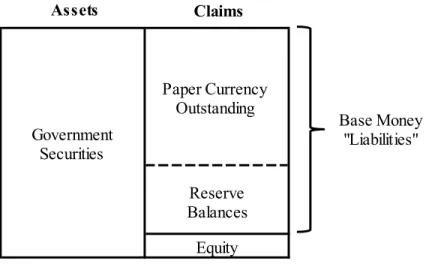
Figure 1 presents a stylized balance sheet of a modern central bank. Like any balance sheet, it consists of assets (left side) and claims (right side). Under normal conditions, the central bank’s asset portfolio consists exclusively, or nearly exclusively, of government securities. It is a safe, liquid, unexciting portfolio. The right side of the central bank’s balance sheet is what makes it unique. It consists mostly of
base money: outstanding paper currency plus “reserve balances,” which are unconditional promises to deliver paper currency on demand. While anyone can hold paper currency, reserve balances may be held only by banks (and select other governmental or government-sponsored institutions—a nuance that will become important below).47 Ordinary citizens
and nonbank businesses are not permitted to own reserve balances. Reserve balances are, in effect, transaction accounts for commercial banks.48 They are the primary medium
through which banks make payments to one another.
47 In addition to U.S. depository institutions, see 12 U.S.C. § 342 (2012),
the Federal Reserve is authorized to maintain accounts for the U.S. Treasury, see id. § 391, certain government-sponsored enterprises in the residential mortgage area, see id. §§ 1435, 1452(d), 1723a(g), foreign governments, banks, and central banks, see id. §§ 347d, 358, certain international organizations, such as the International Monetary Fund and the World Bank, see 22 U.S.C. § 286d (2012), and certain designated financial market utilities, see 12 U.S.C. § 5465 (2012), as well as assorted other governmental and government-sponsored entities omitted here.
48 “Banks use these accounts to make and receive payments in much the same way that a customer would use his or her checking account at a commercial bank.” FED.RESERVE,THE FEDERAL RESERVE SYSTEM:PURPOSES AND FUNCTIONS 40 (10th ed. 2016).
Figure 1: Stylized Central Bank Balance Sheet
While base money appears as a “liability” on the central bank’s balance sheet, it is not a liability in any meaningful
economic sense.49 Paper currency holders are not entitled to
any kind of contractual performance from the central bank.50
Paper currency cannot default in any ordinary legal sense, because paper currency does not represent any actionable legal obligation.51 Reserve balances are no different. True, they are promises to deliver paper currency on demand, but 49 Assume a modern “fiat” money system in which currency lacks
intrinsic value and is not redeemable for anything else.
50 Compare 12 U.S.C. § 411 (2012) (mandating that Federal Reserve notes “shall be redeemed in lawful money on demand[.]”), with 31 U.S.C. § 5103 (2012) (making Federal Reserve notes legal tender). Here I am echoing Joseph H. Sommer, Where is a Bank Account?,57 MD.L.REV. 1, 13 n.30
(1998).
51 In this regard, Federal Reserve liabilities differ from, say, U.S. Treasury bills. See Robin Greenwood, Samuel G. Hanson & Jeremy C. Stein, The Federal Reserve’s Balance Sheet as a Financial-Stability Tool, 2016 ECON.POL’Y SYMP.PROC. 335, 338 (“[T]he Fed has a comparative advantage
[over the Treasury Department] in providing very short-term government liabilities, because as the sole provider of the final means of payment, it does not face the same kind of ‘auction risk’ that the Treasury does.”).
Figure 1. Stylized Central Bank Balance Sheet
Government Securities Paper Currency Outstanding Reserve Balances Equity Base Money "Liabilities" Assets Claims
this is a “liability” without substance because the central bank simply printsthe paper currency it delivers. The obligation is therefore trivial—there is no possibility of default. Base money is unique among financial assets inasmuch as it imposes no legally cognizable obligation on its issuer.
Central banks typically increase or decrease the quantity of base money outstanding by buying or selling assets—most commonly, government securities—in the open market. These transactions are called “open market operations.” When it buys a security, a central bank pays for it by crediting the selling bank’s reserve balance.52 Base money is thereby
created “out of thin air,” by a stroke on a computer keyboard. This is sometimes loosely called “printing” money, but this is figurative language; obviously no literal printing is involved when a reserve balance is credited. The central bank’s balance sheet has grown, and more base money is outstanding. All else equal, the macroeconomic effect should be stimulative. Open market purchases put downward pressure on market interest rates and upward pressure on prices in the economy (i.e., they are inflationary). This is known as monetary “easing” or “accommodation.”
Open market sales work the other way around. When the central bank sells a security out of its portfolio, the purchasing bank pays for it through a reduction in its reserve balance. The central bank’s balance sheet shrinks; it has extinguished a reserve balance, which means less base money is in circulation. Open market sales put upward pressure on market interest rates and downward pressure on prices, discouraging economic activity at the margin. This is monetary “tightening” or “contractionary” monetary policy.
52 If the central bank buys the security from a nonbank entity, it credits the reserve balance of the commercial bank where the seller maintains its deposit account, whereupon that commercial bank credits the seller’s deposit account. This is the standard practice in the United States; the Federal Reserve transacts with a designated set of about two dozen securities firms known as primary dealers. The main text omits this nuance to simplify the exposition; nothing turns on it here.
Like any balance sheet, the central bank’s balance sheet has an equity entry on its lower right side. Economically, the equity belongs to the government as residual claimant.53 The
government receives a revenue stream by virtue of this equity ownership. Specifically, the central bank earns interest on its asset portfolio and transfers the interest to the government after deducting its own expenses (discussed more below). This payment stream is what central bankers and monetary economists call “seigniorage”—government revenue from money creation. The amounts are large. The Fed transferred $98 billion, $92 billion, and $80 billion in earnings to the Treasury Department in 2015, 2016, and 2017, respectively.54
Now, add the chartered banking system to the picture. Unlike central banks, which issue base money, ordinary commercial banks must hold reserves of base money to enable them to meet withdrawals by depositors and other claimants. Commercial banks hold base money reserves amounting to only a fraction of their outstanding deposit liabilities. Figure 2 presents a stylized commercial bank balance sheet. Note that base money is an asset on the commercial bank’s balance sheet whereas it was a liability on the central bank’s balance sheet. The central bank issues base money; commercial banks hold base money (consisting of reserve balances plus vault cash) as reserves.
53 In the United States, stock ownership of the twelve regional Federal Reserve Banks is formally vested in “member banks” of the Federal Reserve System; however, this stock is inalienable and carries a maximum dividend of six percent. See Federal Reserve Act § 7(a), 12 U.S.C. § 289(a) (2012). The U.S. federal government is the de facto residual claimant and receives the vast majority of the Fed’s distributions.
54 See Press Release, Bd. of Governors of the Fed. Reserve Sys., Federal
Reserve Board Announces Reserve Bank Income and Expense Data and Transfers to the Treasury for 2017 (Jan. 10, 2018), https://www.federalreserve.gov/newsevents/pressreleases/other20180110a. htm [https://perma.cc/2RSV-3UJ7].
Figure 2: Stylized Commercial Bank Balance Sheet
Two additional features of the institutional setting are important to the analysis below. The first is reserve requirements (not to be confused with capital requirements55).
Reserve requirements mandate that commercial banks hold reserves of base money against certain categories of deposit liabilities—for simplicity, “transaction accounts.”56 For
example, under a flat 10% reserve requirement, a bank with $1 billion in outstanding transaction account liabilities would be required to hold base money reserves of at least $100 million. This is the amount of “required reserves.” Any base money the bank held in excess of this amount would be “excess reserves.” Reserve requirements are a source of demand for base money. It follows that, under reserve requirements, the quantity of reserves in the banking system constrains the total quantity of transaction accounts outstanding. For example, if the banking system as a whole has $100 billion in total reserves and the reserve requirement is set at a flat 10%, 55 Capital requirements obligate banks to maintain equity financing in proportion to their assets and other (off-balance-sheet) risk exposures. See, e.g., 12 C.F.R. pt. 3 (2018) (capital requirements for national banks).
56 See Federal Reserve Act § 19(b), 12 U.S.C. § 461(b) (2012); 12 C.F.R.
pt. 204 (2018).
Figure 2. Stylized Commercial Bank Balance Sheet
Loans and Bonds
Deposit Liabilities
Equity
Assets Claims
then the banking system’s total transaction account liabilities could be no higher than $1 trillion ($100 billion divided by 10%). If the reserve requirement were 5%, then the same $100 billion in total reserves could support transaction accounts of up to $2 trillion ($100 billion divided by 5%).
Finally, commercial banks participate in an active lending market for reserve balances, which in the United States is called the federal funds market. A federal funds transaction consists of a short-term (typically overnight) unsecured loan of reserve balances by one authorized reserve balance holder to another. The interest rate on such loans—the federal funds rate—has for decades played a central role in the Federal Reserve’s monetary policy framework.57 Under normal
conditions, the Fed conducts monetary policy by announcing, and seeking to achieve, a target federal funds rate. The next two Sections describe the mechanics and execution of this process.
B. Scarce Reserves
With this institutional setting as a backdrop, we can now examine the two principal frameworks that modern central banks use to manage short-term interest rates: reserve scarcity and administered rates. We begin with reserve scarcity.
Under scarce-reserves frameworks, reserve requirements (described above) normally play an important role in monetary policy.58 Recall that reserve requirements obligate
57 The Federal Reserve has employed a federal funds target rate since
roughly 1984. See U.S. GOV’T ACCOUNTABILITY OFFICE, GAO-17-117,
FEDERAL RESERVE: OBSERVATIONS ON REGULATION D AND THE USE OF
RESERVE REQUIREMENTS 49 (2016),
https://www.gao.gov/products/GAO-17-117 [https://perma.cc/9GH3-BEBG].
58 Strictly speaking, scarce-reserves frameworks can function with or
without reserve requirements. Canada, Australia, New Zealand, and Sweden have maintained scarce-reserves frameworks without reserve requirements. See Ulrich Bindseil, Evaluating Monetary Policy Operational Frameworks, 2016 ECON.POL’Y SYMP.PROC.179, 185 (2016). Commercial
commercial banks to maintain base money reserves in proportion to their transaction account liabilities. Reserves are “scarce” when the banking system’s total reserves only slightly exceed required reserves—in other words, when excess reserves are very small. Commercial banks then have very little headroom to expand their balance sheets by increasing transaction account liabilities (an attractive funding source). Under these conditions, small adjustments to the base money supply can have a big impact on the federal funds rate.
Specifically, under reserve scarcity, a modest base money injection by the central bank—typically accomplished by purchasing government securities on the open market, resulting in credits to the selling banks’ reserve balances— will reduce the federal funds rate materially. Other market interest rates will usually follow, resulting in macroeconomic stimulus. Conversely, a small base money drainage by the central bank—typically accomplished by selling portfolio securities, resulting in debits to the purchasing banks’ reserve balances—will increase the federal funds rate materially. Other market interest rates tend to follow, and the macroeconomic effect is contractionary.
In this way, scarce reserves create a powerful fulcrum for monetary policy transmission. And, by and large, this is how the Federal Reserve conducted monetary policy until late 2008, when the global financial crisis reached its acute phase. To see the scarce-reserves approach in action, it is useful to examine the monetary easing cycle that the Federal Reserve commenced in September 2007, about a year earlier. Immediately prior to the easing cycle, the federal funds target stood at a cyclical peak of 5.25%.59 The banking system’s
overdrafts. Demand for reserves therefore exists even without reserve requirements.
59 The historical federal funds target rate can be found at the Federal
Reserve Economic Database. SeeFederal Reserve Economic Data (“FRED”),
Federal Funds Target Rate (Discontinued) (“DFEDTAR”), FED.RES.BANK
required reserves were $40 billion and excess reserves were only $1.4 billion.60 The Federal Reserve’s total assets at the
time were $890 billion.61 The economy was starting to show
signs of weakness in the face of housing market problems and related financial sector issues. In response, over the ensuing eight months the Federal Reserve reduced the federal funds target from 5.25% to 2.00%—a very substantial reduction over a short period. Because reserves were scarce, the Fed was able to accomplish this monetary easing via small open market operations with only trivial changes to its balance sheet. Thus, in early May of 2008, with the federal funds rate at 2.00%, the banking system’s required reserves were $42 billion and excess reserves were $2.0 billion.62 The Federal Reserve’s
total assets were still $890 billion.63 Despite the very large
reduction in the federal funds rate, the Fed’s balance sheet had barely changed.
The Federal Reserve abandoned the scarce-reserves approach to managing short-term interest rates in late 2008. It did so because reserves had suddenly become (and remain today) anything but scarce. In response to the onset of the acute phase of the crisis in September 2008, the Federal Reserve extended massive loans to financial institutions to enable them to meet their liquidity needs. A central bank loan, like a central bank purchase of securities, expands its balance sheet: the central bank books a loan receivable (asset) and simultaneously credits a reserve balance (liability). The
[https://perma.cc/7
VR5-K6J3] (last updated May 4, 2015).
60 FED. RESERVE, STATISTICAL RELEASE: AGGREGATE RESERVES OF
DEPOSITORY INSTITUTIONS AND THE MONETARY BASE H.3 tbl.1 (Sept. 13,
2007).
61 FED.RESERVE,STATISTICAL RELEASE:FACTORS AFFECTING RESERVE
BALANCES OF DEPOSITORY INSTITUTIONS AND CONDITION STATEMENT OF
FEDERAL RESERVE BANKS H.4.1 tbl.2 (Sept. 13, 2007).
62 FED. RESERVE, STATISTICAL RELEASE: AGGREGATE RESERVES OF
DEPOSITORY INSTITUTIONS AND THE MONETARY BASE H.3 tbl.1 (May 8, 2008). 63 FED.RESERVE,STATISTICAL RELEASE:FACTORS AFFECTING RESERVE
BALANCES OF DEPOSITORY INSTITUTIONS AND CONDITION STATEMENT OF
reserve balance, created by a stroke on a computer keyboard,
is the borrowed money. As a result of this emergency support to the financial system, the Fed’s balance sheet ballooned more than twofold in a matter of months, from $909 billion in early September 2008 to over $2 trillion by year end.64 Excess reserves in the banking system rose exponentially, from about $2 billion to about $800 billion.65
Figure 3: Federal Reserve Assets66
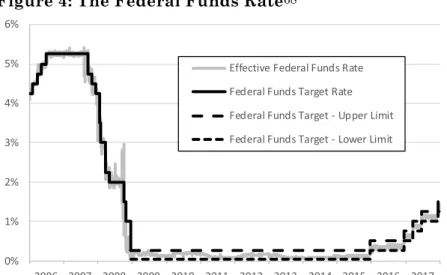
As one might expect, the federal funds rate collapsed.67 In fact, the Federal Reserve briefly lost control of the federal funds rate, which began to fall significantly below its target. In particular, on October 8, 2008, the Fed reduced its federal funds target rate from 2.00% to 1.50%. The 1.50% target
64 See infra Figure 3.
65 FED. RESERVE, STATISTICAL RELEASE: AGGREGATE RESERVES OF
DEPOSITORY INSTITUTIONS AND THE MONETARY BASE H.3 tbl.1 (Jan. 2, 2009). 66 Federal Reserve Economic Data (“FRED”), FED.RES.BANK OF ST.
LOUIS, https://fred.stlouisfed.org/ [https://perma.cc/V6V7-LJMJ]. “Securities” consists of series WSECOUT; “Liquidity Facilities” consists of the sum of series WTERAUC, WPC, WSC, WSB, WPDF, WTERMFAC,
WABCMMF, WCPFF, WLIQSWP, WMAIDEN1, WMAIDEN2,
WMAIDEN3, WALICO, and WAIG; “Other Assets” consists of series WALCL less the sum of Securities and Liquidity Facilities.
67 See infra Figure 4.
$0.0 $0.5 $1.0 $1.5 $2.0 $2.5 $3.0 $3.5 $4.0 $4.5 $5.0 2007 2008 2009 2010 2011 2012 2013 2014 2015 2016 2017 Tr il lio ns Other Assets Liquidity Facilities Securities
remained in effect for fifteen business days. The average
effective federal funds rate during those fifteen days was only 0.96%, however, well short of the target. On October 29, the Fed again lowered its federal funds target, this time to 1.00%. The new target remained in effect for the next 34 business days. Yet the average effective federal funds rate during this period was only 0.33%—again, far short of the target. Finally, on December 16, the Federal Reserve dropped its federal funds target rate to a rangeof 0.00% to 0.25%. It had reached the so-called zero lower bound; it was now pursuing “zero interest rate policy,” known as ZIRP. This policy would continue for seven years.
Figure 4: The Federal Funds Rate68
68 Federal Reserve Economic Data (“FRED”), Effective Federal Funds
Rate (“DFF”) (2008), FED.RES.BANK OF ST.LOUIS, https://fred.stlouisfed.
org/series/DFF [https://perma.cc/PKT3-Z9J4]; Federal Reserve Economic Data (“FRED”), Federal Funds Target Range – Lower Limit (“DFEDTARL”)
(2008), FED. RES. BANK OF ST. LOUIS,
https://fred.stlouisfed.org/series/DFEDTARL [https://perma.cc/SN8U-KUZJ]; Federal Reserve Economic Data (“FRED”), Federal Funds Target Range – Upper Limit (“DFEDTARU”)(2008), FED.RES.BANK OF ST.LOUIS,
https://fred.stlouisfed.org/series/DFEDTARU [https://perma.cc/ L7QB-ZHL9]; Federal Reserve Economic Data (“FRED”), Federal Funds
0% 1% 2% 3% 4% 5% 6% 2006 2007 2008 2009 2010 2011 2012 2013 2014 2015 2016 2017 Effective Federal Funds Rate
Federal Funds Target Rate Federal Funds Target - Upper Limit Federal Funds Target - Lower Limit
Over the course of 2009, the stress on the financial system subsided, and the Federal Reserve substantially retracted the liquidity facilities it had created to combat the crisis. Nevertheless, the Fed did not allow its balance sheet to shrink back to a more “normal” size. As shown in Figure 3, reductions in the Fed’s liquidity facilities were offset by vast purchases of securities—so-called large-scale asset purchases (“LSAPs”) — as part of a policy generally known as quantitative easing (“QE”). These purchases came in three waves, which are visible in Figure 3. The first wave of LSAPs, known as QE1, started in early 2009 and ended in March 2010. The second wave, QE2, lasted from November 2010 to June 2011. The third and largest wave, QE3, lasted from September 2012 to October 2014. By the end of QE3, the Fed’s balance sheet stood at about $4.5 trillion,69 and excess reserves were $2.6
trillion.70 Far from being scarce, reserves were (and still are)
“superabundant”71: the banking system is “awash in
reserves.”72
The LSAPs’ stated purpose was to provide extraordinary monetary stimulus in the face of the worst U.S.
Target Rate (Discontinued) (“DFEDTAR”) (2008), FED.RES.BANK OF ST.
LOUIS, https://fred.stlouisfed.org/series/DFEDTAR
[https://perma.cc/56RS-XM95].
69 FED.RESERVE,STATISTICAL RELEASE:FACTORS AFFECTING RESERVE
BALANCES OF DEPOSITORY INSTITUTIONS AND CONDITION STATEMENT OF
FEDERAL RESERVE BANKS H.4.1 tbl.6 (Oct. 30, 2014).
70 FED. RESERVE, STATISTICAL RELEASE: AGGREGATE RESERVES OF
DEPOSITORY INSTITUTIONS AND THE MONETARY BASEH.3 tbl.1 (Oct. 30, 2014). 71 Jane E. Ihrig, Ellen E. Meade & Gretchen C. Weinbach, Monetary
Policy 101: A Primer on the Fed’s Changing Approach to Policy
Implementation 10–11 (Fin. & Econ. Discussion Series, Working Paper No.
2015-047, 2015).
72 Morten L. Bech, Antoine Martin & James McAndrews, Settlement Liquidity and Monetary Policy Implementation—Lessons from the Financial Crisis, 18 FRBNYECON.POL’Y REV.1, 13 n.21 (2012); see also Ben R. Craig
& Matthew Koepke, Excess Reserves: Oceans of Cash, FRBC ECON.
macroeconomic conditions since the Great Depression.73 With
short-term interest rates at or near the zero lower bound, traditional monetary policy had run out of ammunition. Whereas traditional monetary easing relies largely on purchases of short-term government securities, the LSAPs consisted mostly of longer-maturity bonds. These purchases were designed to put direct downward pressure on long-term interest rates.74 In addition, the LSAPs were not limited to
Treasury securities; they included large quantities of mortgage-backed securities guaranteed by, as well as securities directly issued by, the housing-finance giants Fannie Mae and Freddie Mac. By expanding into these securities, the Federal Reserve sought to support the flow of credit to the struggling housing sector while also limiting its own dominant presence in the Treasury market.
The Federal Reserve’s balance sheet was thus transformed. And this unprecedented expansion raised a critical question: In a world with superabundant reserves, how might the Federal Reserve reverse course and raise interest rates if the economy showed signs of overheating? The seemingly obvious answer would be to start by reversing the LSAPs—that is, sell securities. A gradual sell-off of its enormous securities portfolio should increase long-term interest rates and dampen inflation. Eventually, the Fed’s balance sheet would renormalize. Reserves would again be scarce, at which point the Fed could resume its traditional scarce-reserves approach to managing short-term interest rates.
73 See, e.g.,Press Release, Bd. of Governors of the Fed. Reserve Sys.,
Federal Reserve Issues FOMC Statement (Sept. 13, 2012), https://www.federalreserve.gov/newsevents/pressreleases/monetary201209 13a.htm [https://perma.cc/MLB3-3RPJ].
74 See Stephen D. Williamson, Quantitative Easing: How Well Does
This Tool Work?, FED. RES. BANK OF ST. LOUIS (2017),
https://www.stlouisfed.org/publications/regional-economist/third-quarter-2017/quantitative-easing-how-well-does-this-tool-work