Heading Here
Development of an Arts and Culture Trail
Goldfields Esperance Development Commission
March 2015
Prepared by Tracker Development:
Tim Acker
Nicolle Jenkins
Carly Davenport
0 | P a g e
Contents
EXECUTIVE SUMMARY ... 1
KEY FINDINGS AND RECOMMENDATIONS ... 2
Key Findings ... 2
Recommendations ... 3
MARKETING ... 6
Branding and Positioning ... 6
Marketing Communications Plan ... 6
Website: map and access point ... 15
Website design mock ups ... 18
Barriers to Success ... 33
BACKGROUND AND CONTEXT ... 34
Local and regional arts and cultural trails ... 34
METHODS ... 36
FINDINGS ... 37
Art and Cultural Sites ... 37
Survey Results ... 37
NEXT STAGES – PROJECT DEVELOPMENT ... 40
FUNDING STRATEGY and BUDGET ... 42
Funding ... Error! Bookmark not defined. Budget ... 42
APPENDICES... 44
Consultations ... 44
Art and Cultural Sites ... 47
Photographs ... Error! Bookmark not defined. DISCLAIMER ... 53
1 | P a g e
EXECUTIVE SUMMARY
There is a strong and growing body of evidence showing that access to art and cultural activities is an important contributor to the social cohesion and wellbeing of communities, whether urban or remote. Over 90% of Australians participate in the arts and the arts are seen as having a big impact on our development and wellbeing. Arts are also an important connector, building relationships and strengthening communities. For example, half of all international visitors take part in the arts and cultural activities1. Economically, the
creative industries make an important – and growing – contribution, in areas ranging from digital and new media, through to music, performance and festivals.
The Goldfields Esperance Development Commission (GEDC) has itself recognised the importance of the arts and cultural sector and its potential to contribute to the quality of life in the region. They have assisted the Department of Culture and the Arts in developing an Arts and Culture Action Plan, are investigating this proposed arts and culture trail (the Trail) and support major initiatives such as the recent Regional Arts Australia Summit.
The GEDC covers an area of more than three-quarters of a million square kilometres – almost one-third of the area of Western Australia. This area contains an extraordinary diversity of landscapes, people, histories and creativity. The diversity found within the Goldfields-Esperance area is matched by the range of artistic and cultural opportunities in the region. There are a number of world-class destinations and events in place, and there is a dynamic and varied program of local arts and cultural events, organisations and opportunities. The arts and cultural sector is also characterised by change and development. While some features of the arts and cultural landscape are fixed (performing arts infrastructure, for example), there is also considerable mobility and evolution as new artists emerge, galleries open, festival programming adapts and new
opportunities arise.
A potential means to weave together the dispersed, diverse art and cultural threads that run through the Goldfields-Esperance region is via an arts and culture trail. Such trails feature in numerous places around Australia and also throughout the world. They share some basic principles, but each trail varies enormously in scale and scope and is reflective of its setting. As such, they are very much a celebration of the art and cultural possibilities of their region. These trails can also do other ‘work’, beyond providing a visitor experience or enhancing tourism. These trails can contribute to the social cohesion of a community or region and be an inspiration and incubator for creative enterprises. It is these rich possibilities for an arts and cultural trail in the Goldfields Esperance Development Commission region that this report investigates.
1 For a summary of this information, see: www.artfacts.australiacouncil.gov.au/overview. For more detailed, and a more local perspective, see: McHenry JA. 2011. Art will save the city, but what about country towns? The role of the arts in rural towns of Western Australia's Mid-West region. In The Sustainability of Australia’s Country Towns: renewal, renaissance, resilience. Eds. J Martin and T Budge. VURRN Press Inc. Ballarat, Victoria.
2 | P a g e
KEY FINDINGS AND RECOMMENDATIONS
Key Findings
There are a small number of high-quality art and cultural sites and events that are ready to contribute to and benefit from the Trail. .
There are a larger number of art and cultural destinations and events that need additional capacity, time or resources in order to be able to contribute to or benefit from the Trail. .
There is overwhelming support for the Trail from stakeholders throughout the Goldfields Esperance area. While a small number of agencies (primarily local government groups) had logistical and financial questions about the operations of a trail, no negative responses were recorded.
There is a strong, existing network of tourism infrastructure, both hard and soft, in the region. This network includes existing historical sites, tourism peak bodies, visitor centres, visitor facilities and marketing.
The variety and scale of the Goldfields-Esperance region, and the art and cultural sector within it, presents both opportunities and challenges:
The opportunities lie with presenting a compelling range of art and culture, from the deep desert to the southern ocean, capitalising on the existing profile of Aboriginal art, the Goldfields region and the growing possibilities of niche tourism.
The challenges lie with managing an art and cultural network across such a large area, with a relatively small number of art and cultural sites of significance.
Resourcing an arts and cultural trail for the long term is a further challenge.
The GEC will work with the identified Trail Management organisation and stakeholders to ensure a transition occurs. The GEDC will need to work with the Trail’s management and stakeholders to ensure a transition, when ready. No stakeholder wished to see the GEDC manage the Trail in the medium to long term.
There is little interest in the establishment of an independent enterprise or association to own and manage the Trail.
The Goldfields Tourism Network Association (GTNA) is the best placed existing organisation to host and manage the Trail in the medium to long term. Some possibilities exist in ‘sub-contracting’ part of the Trail’s work out to a regional arts body. In particular, Esperance Community Arts is well placed to communicate with and create content for the south coast’s art and culture network.
The Trail needs to be a dynamic network rather than a fixed trail with specific infrastructure. In this, it is significantly different to existing trails such as the Golden Quest trail which has static sites. The Trail can be multi-dimensional and have:
3 | P a g e an access and information point for greater engagement with residents, visitors and tourists
alike (regional, national and international);
an industry resource for both users within the region and for external agencies;
a tool that encourages emerging artists, reduces isolation, fosters professional development and strengthens the artistic practice (and excellence) across the region; and
a means to enhance social cohesion by enabling exchange, communication and the reinforcing principles of ‘community’.
Recommendations
These recommendations are based on research and consultation feedback.
The Arts and Cultural Trail
The proposed Trail is to be a predominately online resource. Little, if any physical signage is required and almost all content can be managed, accessed, marketed and distributed via a website and online database.
The Trail should encompass the full Goldfields-Esperance region, from the WA/NT border, through the Ngaanyatjarra Lands and northern goldfields, to Kalgoorlie, Esperance, Ravensthorpe and finishing at Hopetoun. However, within that region, the Trail and the features along it, should be ‘curated’ to provide a range of experiences and options to users.
The Trail should not replicate the activities of existing trails (the Golden Quest Trail in particular) or organisations. While there are obvious overlaps with some sites, the primary purpose for the Trail is to:
Identify and aggregate the arts and cultural sites from around the Goldfields-Esperance region.
Promote and market these destinations in ways that individual people/organisations cannot. Complement and extend the existing marketing of visitor experiences and tourism services
operating in the region.
Attract visitors and encourage longer visits to and within the region. Contribute to better professional networks in the arts and culture sector.
4 | P a g e
Organisational structure and management
A range of organisational options are available to the Trail and these options are likely to change as the Trail develops. Initially, the recommendation is for the Trail to:
be a member-based project. Membership to be gained by a simple application process, with three membership criteria:
Listed members (two categories) community-based arts and cultural individuals, groups and businesses; and, government and corporate groups. Listed members have a dedicated listing on all Trail marketing materials and activities and are included in all promotional activities.
Network members: for interested arts and cultural practitioners and groups (who do not have a listing or aren’t offering a specific service) that want to participate in a regional arts and cultural network through communication, information sharing and access to resources collated by the Trail.
Free public subscription (membership): to encourage wide information sharing and engagement.
require an annual fee of $100 for listed community and individual members and a fee of $250 for government and corporate members Network membership is free; and
build and maintain relationships with key community-based arts and culture organisations. Members of these community-based agencies receive a 50% discount on their listing fee for the Trail. Likely community-based partners include Ravensthorpe Regional Arts Council, Esperance Community Arts, Art Gold and Western Desert Mob.
The GEDC to:
facilitate the transition of the Arts and Culture Trail project to an appropriate management organisation and assist to identify suitable funding;
assist the identified management organisation (possibly the GTNA) by providing background information and data already gathered; and,
continue the communication with stakeholders, including the arts and cultural and local government networks. These responsibilities are to be transitioned to the Manager as soon as practicable.
5 | P a g e The GTNA to:
host the Trail Manager and provide office and limited professional support; and identify ways to collaborate with and co-promote the Trail.
To be listed as an arts and culture destination on the Trail, individuals or organisations must apply to the Manager and meet minimum criteria that include:
Being identifiably ‘in business’ with opening hours, contact information and marketing material organised.
Provision of good quality images.
Marketing
The success of the Trail is directly connected to an effective marketing approach. The marketing plan will have a number of inter-related components:
Website: as an online resource, a high quality digital resource needs to be created and maintained. App: a second digital 'pull through' resource.
Marketing Communications Plan: a marketing ‘map’ to guide the project, staff and stakeholders. As these marketing components are substantial, full details are provided in the following sections.
6 | P a g e
MARKETING
The following section includes the key marketing elements that are considered important to the success of the Trail.
a) Branding and position: its importance to ensure successful long-term promotion.
b) Marketing Communications Plan: key objectives / targets and a sample of related tactics and plan
structure.
c) Website: sample design examples and structure, inclusions, considerations and purpose.
d) App: design, development and timing considerations.
e) Barriers to success: important to understand to be addressed in the marketing plan.
A 12-month Marketing Communications Plan is required and should be developed in line with the direction, vision, objectives and targets of the Trail. The Plan highlights a mix of tactics and resources to achieve a significant return on investment and meet the Trail’s marketing and communications objectives.
Branding and Positioning
It is important the Trail determines its positioning and brand strategy upfront in the development of the Trail; this will ensure significant traction is gained with the key potential visitor markets.
This positioning is then crucial when planning marketing communication strategies. How the Trail is going to communicate to key audiences, members, stakeholders and key influential groups should be informed by these positioning factors.
Determining the logo, look and feel of the Trail (branding) and its uniqueness (value propositions per audience segment) is an platform for the Marketing Communications Plan development.
Marketing Communications Plan
The aim of a marketing communications strategy is to provide actionable, long-term marketing tactics that are achievable within resources, staffing and intended performance indicators. The Marketing
Communications Plan should utilise a fully integrated mix of tools to address challenges and capitalise on opportunities.
The following diagram highlights some key tactical areas to be included as part of the marketing communications plan.
7 | P a g e Trail Marketing Communications Plan Awareness management Internal Communication Value (core values) USP positioning Measurement and feedback processes Brand development and management External communicatio n Stakeholder relationship management
Diagram: marketing communications tactical mix
While the plan should encompass many of the above tactics, the structure is focused on what tactics will be required when addressing the key marketing communications strategic goals.
With this in mind, the following are some draft goals for consideration based on the current research and feedback.
Primary marketing communication strategic goals
1. Increase the profile and brand awareness of the Trail and its activities.
2. Clearly define target audience segments and their needs and link with marketing communication activities and materials.
3. Maintain consistent branding, through flexibility and uniformity. 4. Develop an appropriate brand that has synergies with all stakeholders.
5. Develop effective value proposition and positioning strategy for each segment.
6. Build strong relationships and engagement with key stakeholders based on annual needs assessment.
8 | P a g e In addition to the above primary marketing communications goals, we have also included some secondary goals for further consideration.
Secondary marketing communications strategic goals
1. Secure attractive markets – higher yield (spend) for surrounding businesses and communities. 2. Become a key player in tourism and community development.
3. Improve the quality of tourism products in the area. 4. Increase tourism investment.
5. Improve the understanding and value of tourism in the area.
Central to the Trail's success is effective engagement and communication with a range of audiences. The marketing approach needs to recognise the different value propositions and approaches for each audience segment to maximise engagement and results. The identified audiences are:
Visitor segments (based on visitor data provided by Tourism WA) Funding bodies
Partner organisations
Sub-regional tourism group/s
Local businesses (regional Chamber of Commerce and Industry) Local Government
Local community Aboriginal art centres
Members
Subscribers
There may be some overlap in the value propositions for each audience and some of the strategies recommended will serve to communicate with and engage multiple target groups.
The Marketing Communications Plan should utilise a range of marketing tactics to effectively connect with and engage each identified stakeholder group. Potential tactics are detailed below.
9 | P a g e Objective One: Increase the profile and brand awareness of the Trail and its activities
Strategy Marketing Tactic Responsibility Deadline Budget
Marketing Communications Plan
Create a Marketing Communications Plan.
Review-based ongoing measurements and review plan every 12 months. Media Communications
Plan
Create a 12 month media awareness schedule of planned PR activities.
Review-based ongoing measurements and review plan every 12 months.
Create media pack that is distributed and updated every six months.
Include a fact sheet on the Trail in the media pack.
Create media profiles on key spokespeople (one for each key Trail location) and include in media pack.
Logo development Design a consumer based (tourism) Trail logo and possible brand symbols for different locations of the Trail. Could relate to any cultural activities, stories or key country features at each location.
Secure tourism accreditation for additional branding and credibility. Brand elements
development
Design and develop the key brand icons for different sections of the Trail.
Select specific photos ('hero shots') for promotional use.
Promote area icons at various promotion locations (opportunities) for the local Trail feature (1 hour radius) to attract visitors to the Trail to further explore the region.
Understand visitor expectations, measurements and opinions of the Trail as a tourist experience.
10 | P a g e Objective One: Increase the profile and brand awareness of the Trail and its activities
Strategy Marketing Tactic Responsibility Deadline Budget
Communicate to visitors upcoming events to strengthen the visitor experience and attract certain target markets.
Develop a 24 hour information and event notice board for visitors via the website.
Create a 12 month calendar (updated every two months) to be posted in visitor bays/supermarkets/Visitor Centres and other visitor locations.
Create a member newsletter and e-alert notice on special deals/events and offers to database. Educate stakeholders of the
Trail and its activities.
Host education sessions, for all stakeholders, on all aspects of the Trail so uniform information and promotion can be provided to the media and visitors, ensuring the Trail receives the maximum exposure possible.
Objective Two: Clearly define target audience segments and their needs and link with marketing communication activities and materials
Strategy Marketing Tactic Responsibility Deadline Budget
Trail Champions team. Create a team of Trail champions to manage localised destination requirements. This team will also assist in identifying potential promotional opportunities and will ensure brand consistency is managed across the Trail.
Deliver a annual marketing strategic workshop for the Trail Champions in creative strategic planning and resolutions.
Establish potential visitor communication sites to promote the Trail.
Promote in local visitor bays in surrounding locations re the Trail
Communication opportunities via the local visitor centres.
Communication opportunities via local businesses and tourism operators.
Local media partnership promotional opportunities.
12 | P a g e Objective Three: Maintain consistent branding, through flexibility and uniformity.
Strategy Marketing Tactic Responsibility Deadline Budget
Style Guide Create a style guide to cover the following information:
Use of brand.
Key messages.
Stationery use.
Publications, marketing materials design and functional need.
Website management and design. Brand Positioning Review the brand positioning of the Trail.
Create a paragraph explaining the brand and its emotive meaning.
Determine unique positioning – what is really unique about this Trail from a visitor perspective (different segments)?
Provide a training accreditation program based on the crucial services with the most significant impact on the visitor experience.
Create a training program on the following subjects:
Customer service (one one-off and one ongoing).
Business planning.
Marketing.
13 | P a g e Objective Four: Develop effective value proposition and positioning strategy for each segment
Strategy Marketing Tactic Responsibility Deadline Budget
Key Messages Create key messages in line with the core values of the Trail and each visitor segment.
Ensure publications and other marketing materials reflect the key messages of the Trail. Strapline development Develop a strapline to accompany the logo to help uniquely position the Trail with key
audiences.
Testimonials Collect a series of testimonials from the following key audiences:
Partner organisations.
Visitors (different segments/demographics).
Local community.
14 | P a g e Objective Five: Build strong relationships and engagement with key stakeholders based on annual needs assessment
Strategy Marketing Tactic Responsibility Deadline Budget
Establish strong partnerships with key stakeholders through regular communication to: Tourism WA and
EventsCorp. Tourism region
representative. The Mayors and
Councillors of local areas.
Tourism reps at Local Government. GEDC.
Tourism Council of WA. Tourism Minister. Key stakeholders
researched during the establishment of the Trail.
Regional CCIs.
Meet with one of these representatives at least once every couple of months to communicate the progress of the Trail and other key issues.
Assist in placing the Trail ‘on the map’ for future considerations and funding.
Establish potential joint funding programs for special tourism related projects.
Add these key stakeholders on the media release distribution list and the e-newsletter database.
Communicate each promotion: its objectives, targets and strategies to highlight the work the Trail is doing.
Provide all new collateral and branding developments to each stakeholder with a letter from the key point of contact (CEO or Economic Development Manager).
15 | P a g e
Website: map and access point
The Trail is to be a web-based resource. At its core is a database of arts and culture destinations that are continually updated by the Manager. This data can then be presented to audiences in a number of ways:
Visitors and tourists: a searchable, customisable (and printable) ‘planner’ that people can use to create an itinerary or to generate information that is of direct interest. Other pages of the website list all sites, sorted by theme, region or alphabetically.
Artists and arts organisations: a ‘members-only’ section of the website, where communication and information can be posted and exchanged.
The Trail website should:
have crisp, spacious and contemporary design that will not 'date' quickly;
be self-administrable to ensure ease of updating, keeping the content fresh (to be updated weekly); include a ‘search’ area to allow for easy, searchable key phrases. The search function will offer a
criteria range, including user interest, location, timing or theme;
develop an itinerary section where visitors can create their own journey / experience; have the general listing page no more than two clicks into key areas of information for easy
navigation;
be rich in imagery reflecting the Trail and its activities. It is critical to have professional quality images showing people interacting on the Trail to show areas are accessible for visitors;
provide a calendar of events that is easy to access via a calendar with a visual notification (allowing for different search methods);
have quick access downloads and other resources that users can print out for free. These downloads could include user-generated maps and itineraries as well as more fixed information/activities that could replace or complement traditional printed brochures;
have a review and visitor comments/ratings section via TripAdvisor. The site would also include its own comment/rating section to encourage further interaction and engagement (this section will require the Manager to be a moderator);
link to key popular social media platforms including Facebook, YouTube, Twitter, TripAdvisor and Instagram. This will allow for each page to be shared via these mediums. Feature a 'more' button allowing for sharing to other social platforms. It is also recommended that the Trail establish its own social media pages via Twitter, Facebook, YouTube and Instagram;
be built in open source technology such as Drupal for ease of content management; maximise search engine optimisation (SEO) and use Google analytics;
16 | P a g e
be responsive, allowing for easy mobile viewing across a variety of portable devices; and
collect, curate and distribute resources of interest to the region’s arts and culture network through the members-page. This section of the website will benefit from relationships with other arts and culture organisations, such as Country Arts WA and artsource, who offer training and professional development information and programs.
A website for the Trail should aim to achieve the following:
Content, structure and visual display of the entire website designed from a customer's perspective
to attract more visitors to the site, for them to stay longer online AND to encourage them to return.
Ensure the website contains dynamic information so visitors can see the website is maintained and
updated with new information regularly. (This encourages visitors to return regularly to the website.)
Be one of Australia’s leading tourism websites in the provision of innovative, dynamic and accurate
Trail information and activities.
Provide the necessary resources to maintain the site to ensure the marketing tool is used efficiently
and effectively. That is, this should be considered an ongoing investment. Websites are a ‘live’ marketing tool that needs constant attention to ensure the true marketing and branding success of the tool.
Website to be the key marketing tool for the Trail because it is the most cost effective, most
dynamic and most immediate communication tool available.
Ensure the website is considered ‘the face’ of the Trail to the online world. Visitors’ perception of
the Trail will largely come from how the website is branded and used as a communication tool. This perception will transfer across to a visitors understanding of the value of the Trail and its overall success.
Build the website as a vital resource to communicate consistent key messages and branding
therefore reducing the need for staff to reinvent information on an ad hoc basis.
Create the website as an interactive tool for visitors rather than a one-dimensional online brochure.
Utilise the website as a tool to gather a database of visitors to understand customer’s needs
further for future cost effective targeted communications and marketing.
Provide communication, education, information and resources to the regions art and cultural
17 | P a g e
Other important considerations for inclusion in the website include the following:
Increase visitor interactivity on the website by including webcasts, video, slideshows, polls and podcasts;
Establish an online newsletter / magazine for the Trail. This needs to be maintained and promoted throughout the website and in offline mediums (a very cost effective way of communicating what the Trail does and its overall achievements to a targeted interested audience);
Include emotive, people-centred content rather than just inanimate objects and information (people relate to people);
Create more emotional appeal via the website through the inclusion of stories about how visitors have enjoyed the Trail and its various elements;
Include all key marketing collateral such as brochures, newsletters, fact sheets, downloadable activities etc. via the website as downloadable materials;
Increase appeal and interaction for visitors through the provision of e-tourism cards,
testimonials, screensavers and desktops. A good way of communicating the Trail and its brand beyond the existing target audience is to have social media sharing options (building database capacity);
Promote the website in offline marketing mediums to draw more people to the site e.g. social media links, advertising opportunities, editorial articles etc.;
Use the website as a vital tool to capture accurate, up-to-date data from customers (should be used as a key tool to understand the Trail visitors, also an excellent measurement tool for campaigns or events etc.);
Potential to use subtle banner type advertisements as links for the promotion of events or projects – this could be a future revenue source;
Segment information on the website based on stakeholder needs to facilitate easy navigation; and
Titles and content in the website to relate firstly to external stakeholders (use their language not the language used internally or by professionals in the industry).
18 | P a g e
Website design mock ups
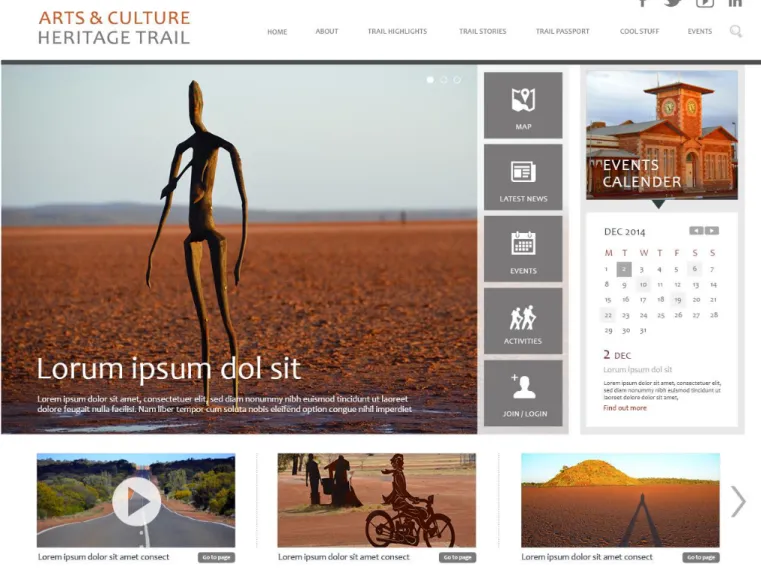
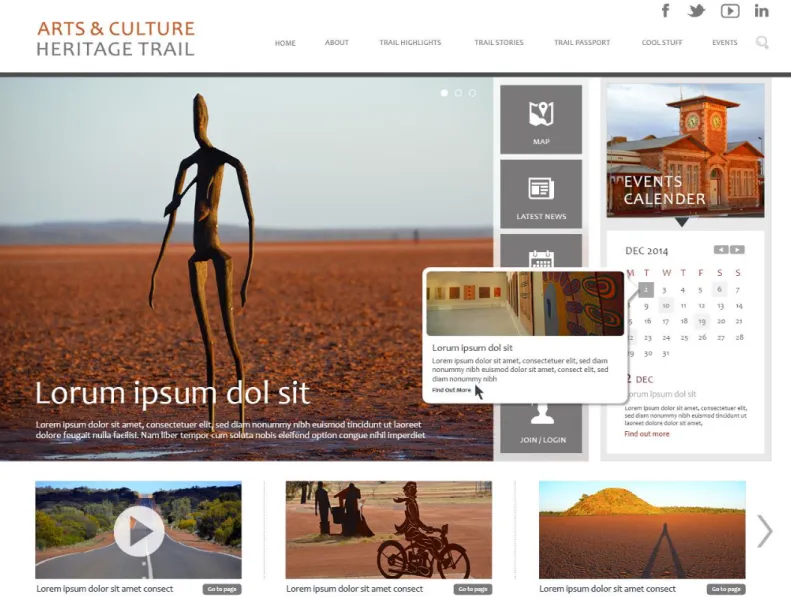
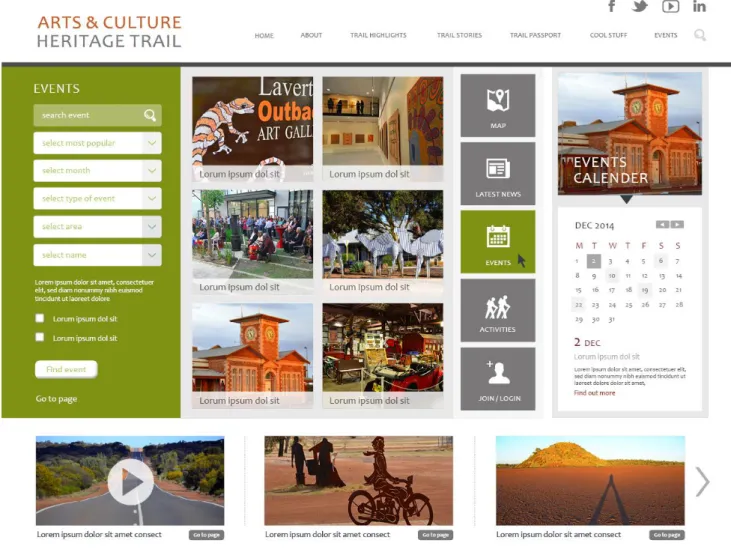
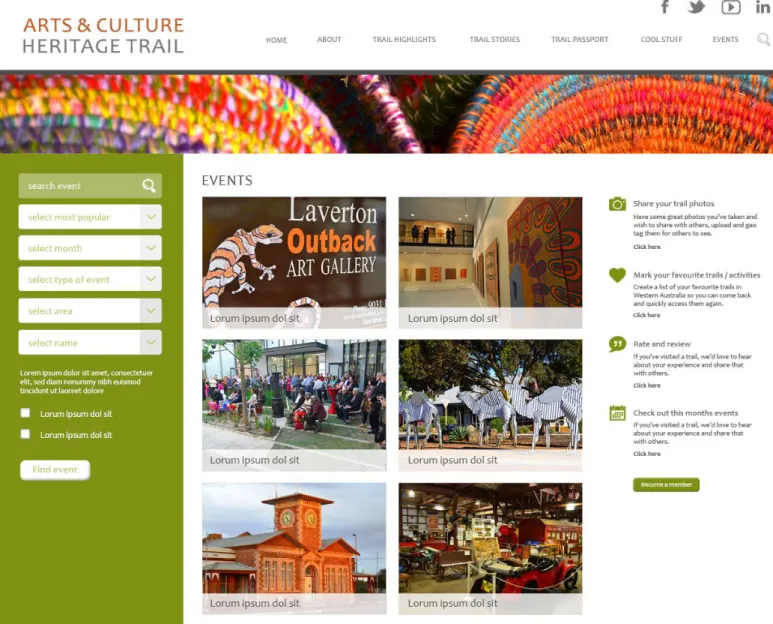
The following screen shots depict a draft design of how the Trail website could look and be structured. Each screen shot depicts a different page or click through action (on a static design) as per the caption description at the base of each image. This aims to help explain the click action and show what the action could look like on the screen.
Website colour pallet
The following depicts the colour pallet range utilised in the following website designs mocked up for the initial website visuals. These colours were chosen to represent the different areas within the region/Trail. These colours could also be used throughout the different Trail locations and the marketing
materials/branding and logo.
Diagram: website colour pallet
Please note: the following website designs use placeholder text (made up text) to depict where text would be positioned on each screen.
19 | P a g e Home page
Diagram explanations:
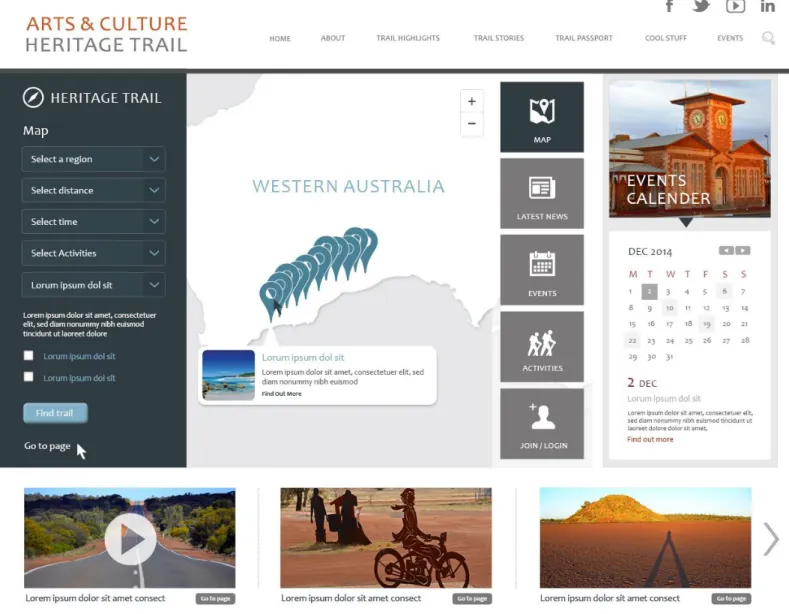
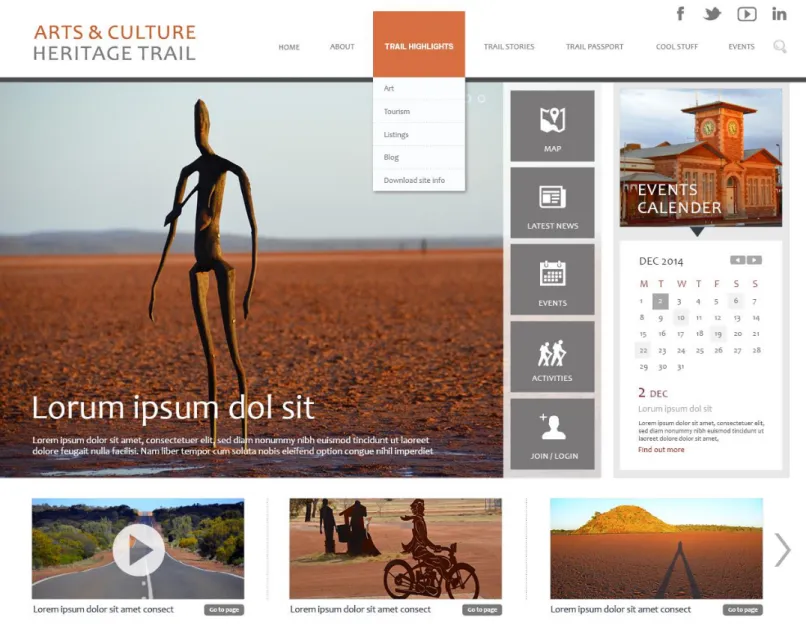
The logo is not considered the final logo, rather a font based visual to show where the logo will go. The main image will rotate with three main images and key messages.
There are five key actions including map, latest news, events, activities and join/login. These are considered important features for the online communication tool, which is why a series of subtle web icons have been designs to attract attention.
The events calendar is also featured to the right via a picture and calendar for ease of searching via a date based calendar.
The base three images are on a rotating bar (refer to the arrow to the right) which will feature key activities and promotions occurring on the Trail at that particular time.
The site has the standard navigation bar at the top of the page which remains consistent throughout the site for ease of functionality.
20 | P a g e Home page
Diagram explanations:
This is the home page and shows when someone hovers over a calendar date. A pop up notice will feature a photo and short blurb on the event.
The visitor can then click on the find out more element of the box to open a full page of information. The design is focused on the Trail imagery being the 'hero' of the site.
21 | P a g e Events page
Diagram explanations:
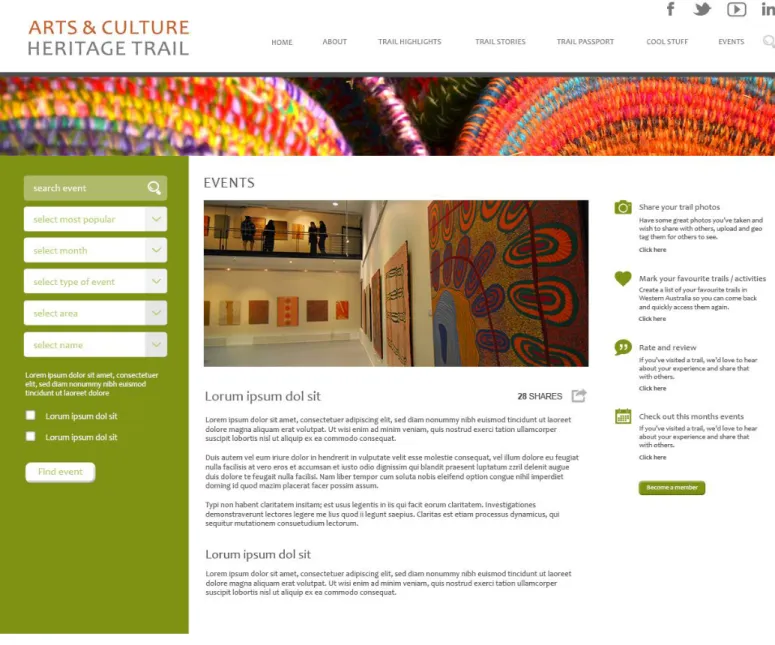
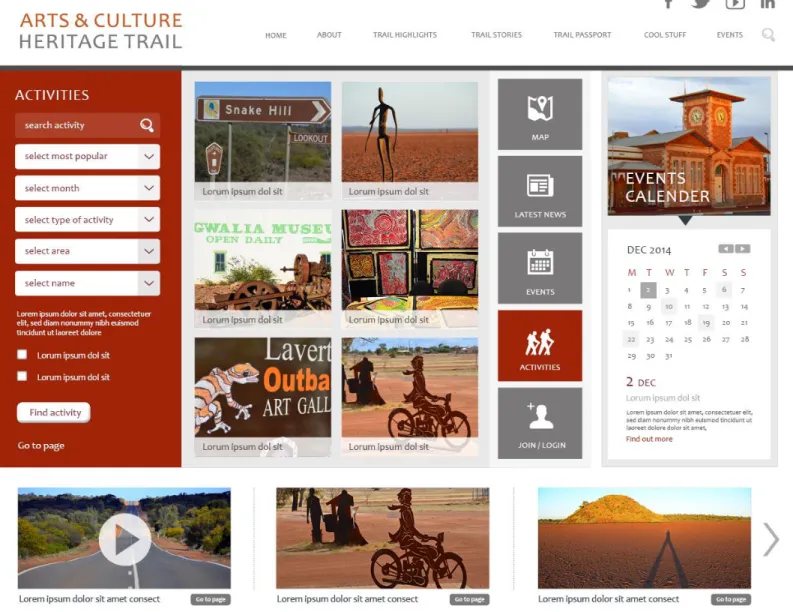
This is the events page. Each main subpage will feature a different colour for ease of navigation (to know the section you are in visually).
22 | P a g e Events page
Diagram explanations:
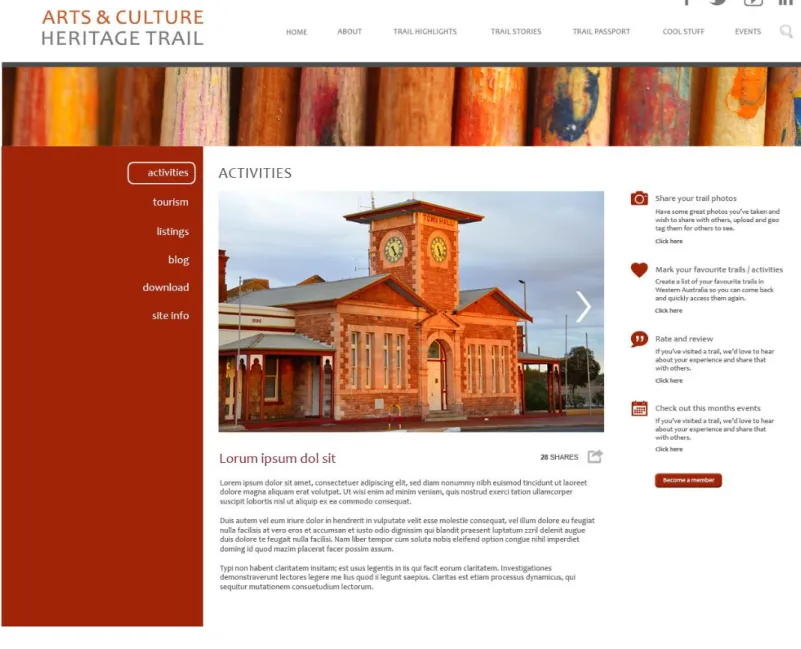
This visual shows what the events page looks like when you click on the latest events. The page shows most recent events first.
The right hand side of the page features visitor interactive features including share your photos, mark your favourite trail site or activities, rate and review, check out this month's events and become a member.
23 | P a g e Events page
Diagram explanations:
This visual shows what the events page looks like when you click on a single event. Allowing for maximum clean white space for easy reading.
24 | P a g e Map page
Diagram explanations:
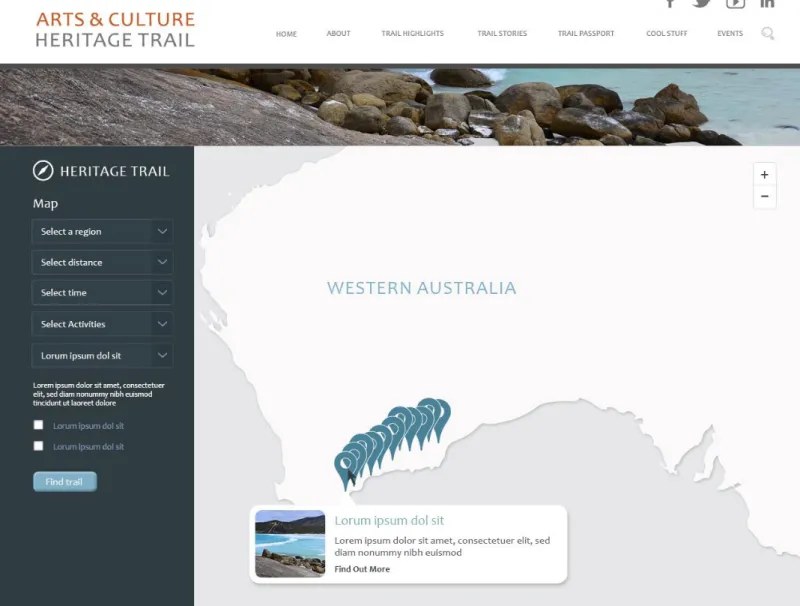
This visual shows what the map page looks like when the icon is clicked. A full interactive map with locator icons along the Trail will show. Each icon highlights a point along the Trail of interest to the visitor.
When you hover over the icon a pop up box will feature a photo and show blurb. The visitor can then click on the find out more element of the box to open a full page of information.
25 | P a g e Map page
Diagram explanations:
26 | P a g e Activities page
Diagram explanations:
27 | P a g e Activities page
Diagram explanations:
28 | P a g e Trail highlights page
Diagram explanations:
29 | P a g e Trail highlights page
Diagram explanations:
30 | P a g e Trail stories page
Diagram explanations:
31 | P a g e Member login page
Diagram explanations:
32 | P a g e Member login page
Diagram explanations:
33 | P a g e Phone/mobile app
Due to the interactive nature of the Trail, it is recommended that an Application (App) be designed and developed to provide engaging activities throughout the different Trail locations. Some options to consider regarding App development:
App to be built for online and offline environments (which requires different work to be completed). The offline environment requires a downloadable version where internet connection is not available. A functional App requires internet connection.
An App to be developed for iTunes and Google Play stores (Android and iPhone apps). Consider using Aboriginal language/ words to describe locations or Trail features.
The Apps are to be intuitive in location. If a person who has subscribed or downloaded the App they receive a notification when they are in close proximity to a Trail feature (with internet connection). This could also be programmed if people were heading in the direction of a Trail feature (and we knew there was no internet connection). The App would instinctively direct visitors to the website resources for downloadable materials
It is important in App development to 'get it right' at first launch, as bad reviews stay online for the life of the project even if bugs are fixed after launch.
With this in mind, it is recommended that App development is considered a year two strategy as part of the Trail marketing plan.
Barriers to Success
It is recognised that to achieve the identified four strategic marketing goals, an appropriate level of resources are required. The following are considered possible ‘barriers to success’:
Lack of resources to adequately complete the strategic plan and its objectives. Lack of financial support from industry to complete necessary goals.
Competing organisations (local and State) vying for tourism funding. Lack of key influential stakeholder support.
Recognition that this is a long term investment and while there can be some ‘quick wins’, to build a brand requires a long term strategy built on understanding key markets.
With this in mind, many of the above barriers should be addressed within the Marketing Communications Plan.
34 | P a g e
BACKGROUND AND CONTEXT
Art and cultural trails are a prominent attraction for visitors in many regions. There are innumerable such trails throughout Australia and globally. The experiences they offer vary enormously; some only operate for a particular period, some have a specific theme, still others are small, local trails that require a short walk, while others span an entire region. The content of these trails is equally varied, reflecting the many activities, events and sites that can fit under the banner of ‘art and culture’.
Most art and culture trails are an extension of the wish to attract and retain visitors, essentially as a tourism activity. The consultants could find little evidence to either support or undermine the assumptions about the value that an art and culture trail generates and the contributions it might make to the success of tourism in an area. Offsetting this lack of direct evidence for art and culture trails is wide ranging research confirming that visitors of all sorts (local, national and international) seek new experiences when they travel and among their top priorities is accessing art and cultural experiences (see for example:
www.tra.gov.au/documents/Snapshots_2009_Cultural_FINAL.pdf or other visitor statistics compiled by
Tourism Research Australia at www.tra.gov.au/). This is reinforced further by the highly competitive nature of the tourism sector, where regions that are aiming to attract and retain visitors need to ‘have an edge’ and offer activities and opportunities that are enticing and unique.
Local and regional arts and cultural trails
There are a number of arts and cultural trails in the region. These include several with a historical focus, where the experience tells the stories of settlement and gold mining:
Golden Quest Discovery Trail: a 965km, 25-site self-drive historical trail in the Northern Goldfields, managed by the Goldfields Tourism Network Association and well-resourced with a website, publications and promotion. The Trail also promotes a secondary, nature-focussed Green Trail, south of Kalgoorlie.
Golden Pipeline Heritage Trail: a 600km, one-way self-drive trail into the region, following the water pipeline from Perth to Kalgoorlie.
Leonora Loop Trails: two different two-day self-drive loops north-west and north-east of Leonora, each with 15 interpretive sites with a historical focus.
Historical walk-trails: several towns (e.g. Menzies, Kalgoorlie, Ravensthorpe) have self-guided trails that highlight historical or physical features.
Only the Art Trail, brokered by Esperance Community Arts and launched in 2007, is specifically focused on arts and creativity. This trail promoted the artist studios and galleries in Esperance. While limited (and somewhat out of date) material is available online, the trail is not promoted and has fallen into disuse. There are a small number of art and craft trails outside of the Perth area including:
The Southern Art Trail: an annual event organised by Artsouthwa Inc. The trail promotes the work of around 250 visual artists, galleries and related activities over a two-week period. The event is sponsored by Bendigo Bank. See: www.southernartcrafttrail.com.au
35 | P a g e
Margaret River Region Open Studios: an annual event that showcases visual arts throughout the Margaret River region. This event begins on 11th April and runs until 27th April 2015. See:
www.mrros.com.au
There are also a number of other, self-drive tourism-focussed experiences that are available in the Goldfields-Esperance region:
Outback Way: a 2,750km trail from Laverton to Winton (Qld). The Outback Way provides very limited arts and cultural information, but does provide general travel and visitor information. About half of the Outback Way is in the Goldfields-Esperance region.
The Granite and Woodlands Discovery Trail, a 300km trail linking Norseman and Hyden. Wildflower trails: a number of trails and suggested itineraries in the Goldfields, Esperance and
36 | P a g e
METHODS
The methods used to research and assemble the material that underpins the findings and recommendations in this report encompassed a number of approaches. The Goldfields Esperance Development Commission (GEDC) provided a range of background and existing material; this material included the results of early consultations and related tourism, arts, cultural and heritage information. In addition, the GEDC provided a range of contacts and other orientation support to assist this planning stage to take place.
Initiated by the GEDC, and promoted further by the consultants to gain anonymous feedback. In total, there were 38 respondents; full details of the survey results are given below.
Following the appointment of the consultants, a second stage communication and consultation strategy was implemented. All art, cultural and heritage-related stakeholders were contacted. The first round was to introduce this next project stage and to further promote the survey. A second round of targeted
communications was then undertaken to establish the schedules and best contacts for the three field visits. The three field visits were undertaken as follows:
Field trip #1: 18 – 22 August to the Northern Goldfields, including: Kalgoorlie, Menzies, Laverton and Leonora.
Field trip #2: 8-16 October to the Esperance and southern Goldfields, including:
Ravensthorpe, Hopetoun, Esperance, Norseman, Kambalda, Coolgardie and Kalgoorlie.
Field trip #3: 3-7 November to the Ngaanyatjarra Lands, including: Papulankutja/Blackstone, Warburton, Warakurna and Tjukurla
In each region, key arts and cultural individuals and organisation were consulted in a series of face-to-face meetings. The information collected during these consultations was collated and contextualised with the existing information and other research. The feedback, comments and suggestions made during these consultations inform the majority of the findings and recommendations made in this report.
The broadest possible definition of ‘art’ and ‘culture’ was used in stakeholder consultations and in the mapping of possible sites. ‘Art’ included visual and performing arts, while ‘culture’ included events, festivals, historical and heritage sites, natural history and Aboriginal sites.
37 | P a g e
FINDINGS
Art and Cultural Sites
As stated earlier, the arts and cultural landscape of the Goldfields, south coast and Ngaanyatjarra regions is characterised by extraordinary diversity, reflecting the variety of the physical landscape itself. In fact, many arts and cultural experiences are directly tied to the landscape, with artists drawing inspiration from the land or visitors with artistic interests themselves wanting to spend time in areas of scenic and natural interest. The Appendix lists 42 sites that were mapped as part of this report. The list includes a wide range of sites, reflecting both the variety of art and culture in the Goldfields-Esperance region and the different stages these sites, projects, people and organisations have reached in being part of an arts and cultural trail. There are a small number of high quality sites likely to interest a significant number of people and that are ready for professional and sustained engagement with visitors. These sites are:
Inside Australia, Lake Ballard (near Menzies).
Aboriginal Art Centres, Ngaanyatjarra Lands: Warakurna Artists, Tjarlirli Art, Papulankutja Artists. Museums: Gwalia Museum, Western Australian Museum — Kalgoorlie-Boulder, Coolgardie Museum,
Eastern Goldfields Historical Society, Esperance Museum and Ravensthorpe Museum. Artists and Galleries: individual artists’ studios/galleries.
Regional arts organisations/facilities such as the Cannery and the Goldfields Arts Centre. Natural/historical sites: national parks and existing historical locations.
The majority of the sites mapped are likely to be of interest only to specific visitors and niche tourism. Heritage and historical sites dominate and all of these are already listed or promoted by other organisations, such as the GTNA, the Ravensthorpe Historical Society etc. While cross-promotion is useful, care needs to be taken to minimise duplication.
During the consultations, numerous sites were visited which are potential participants in the Trail but require some extra development or additional support/resources. Many of these sites reflect the
grassroots-origins of arts/cultural activities and could benefit from the enhanced capacity and professional networks created by the Trail. These ‘developing sites’ are on a spectrum; some are likely to be ready in coming months as projects or funding is secured, others are emerging sites only. Monitoring the evolution of different sites, and ensuring the Trail resources are up to date will be central to the work of the Manager.
Survey Results
The Goldfields Esperance Development Commission designed and distributed a short, eight-question online survey (using the Survey Monkey website) as part of its first round of consultations in late 2013 and early 2014. Additional responses were recorded in mid-2014; in total, 38 people completed the survey. The following summarises the survey responses collected:
38 | P a g e
Esperance, Ravensthorpe and Kalgoorlie each attracted 25% of respondents; the final 25% was made up of responses from all other local government areas in the Goldfields-Esperance region, except for Laverton and Leonora, which recorded no responses.
100% of respondents supported an arts and cultural trail.
Respondents saw the value of an arts and cultural trail in two broad streams:
Tourism and visitation potential: raising awareness, attracting new visitors and extending their visits.
Building professional opportunities: expanding and strengthening arts and cultural networks, fostering innovation and developing new businesses.
All six criteria were strongly supported: between 75% and 95% of respondents selected these options.
The majority of the survey asked respondents to make comments to a number of attitudinal and perception-based questions; for example, views on the advantages and challenges of an arts and cultural trail. A small selection of comments is provided here:
The Goldfields is far more than the money and mining it's generally known for, it has a rich and diverse range of people working on many varied arts and culture projects and activities. The environment is unique, beautiful and ever changing and the people have come from all over. A community is about people and an arts and culture trail would be a means by which to display, promote, unite and sustain the people and heritage that make the Goldfields-Esperance region home.
It would be a good way to develop the region's reputation for having a strong arts culture, would extend opportunities for regional artists and would help to build regional arts networks and collaborations.
It is important to balance the usually well-developed regional sports culture with one dealing with Art.
Bring communities together. Rediscovery of their own cultures for each region and pass it on to future generations
I think it would be fantastic for local artists, local residents and tourism - so many opportunities to showcase work and fit in places for people to go, to eat, to entertain etc etc.
There is huge potential but it would come down to time, cost and management.
Definitely would like to see local visitors - an arts and culture trail would also be promoting to locals what is in our region and right on their doorstep that they may otherwise not know about or have explored.
39 | P a g e Raising awareness within local government of the importance of Arts and Culture. Promotion of heritage through visual and written information. Lift the profile of our region.
Build and foster sense of community Develop art networks which could further enhance existing skill bases as well as develop new ones. Create greater tourist interest, therefore have longer staying visitors Encourage better communication with overseas and interstate groups. Upkeep and maintenance, who would take responsibility for it and pay for it?
Since it is such a vast area, cooperation & collaboration between different sites and groups. The problem of access, but if all venues work together this could be overcome.
The product is there, it may need to be refined and PD in how to bring art products, culture to sellable level. Money needs to be spent in helping artists, art organisations and cultural groups with business plans, grant writing and how to promote their products etc. PD workshops as a whole region. What are we trying to sell?
No disadvantages! The difficulty is lack of funding: apathy within governing bodies and breaking down old outdated thought patterns.
40 | P a g e
NEXT STAGES
–
PROJECT DEVELOPMENT
The following activities and timing are recommended for the establishment and start-up of the Trail.
Timing Activity
Month 1 Negotiate and sign a Memorandum of Understanding with GTNA on
the hosting of the Trail manager.
Ongoing negotiations (and relevant submissions) on funding: confirm an overall financial strategy for the trail.
Develop the job description for the Trail Manager’s position. Develop brand brief for the development of a unique Trail logo
reflecting the location and points of difference.
Develop terms of reference for the website hosting, design and build.
Register website domain name.
Determine how marketing/promotions/design to be managed for the Trail.
Once determined begin the Marketing Communications Plan begins based on resources and available budget.
Month 2 Advertise and recruitment for the Trail Manager.
Office equipment arranged.
Design a logo and brand elements for the development of other marketing materials.
Website hosting, design and build commences. Website copy to be written
Photography taken
Month 3 Appointment and commencement of Manager.
Develop some printed marketing collateral Stakeholder communication.
Logo development confirmed and finalised
Marketing Communications Plan finalised (for first 12 months) Marketing materials designed
Launch plan and invitation list including PR opportunities
Month 4 Website designed and built in offline location
41 | P a g e
Timing Activity
Month 5 Website launch including PR opportunities and small localised event (good opportunity for stakeholder engagement)
Month 6 TBC…in discussion.
42 | P a g e
FUNDING STRATEGY and BUDGET
Essential to the establishment and operations of the Trail is a coherent and viable financial management strategy incorporating funding partnerships, income and expenditure. As the primary focus of this report is the Trail’s start-up stages, a range of early funding and financial approaches are suggested; however, additional and ongoing financial strategies will be required as the Trail matures and, in particular, as it transitions from GEDC’s stewardship to independence.
Budget
The following budget sets out the anticipated costs and potential income sources for the Trail for its start-up, establishment and initial running costs.
It is important to note that costs for the marketing activities are indicative only. Depending on resources and expectations a wide scope is possible.
2015/16 2016/17 2017/18
Income
Goldfields Esperance Development Commission TBC TBC TBC
Lotterywest TBC TBC TBC
Other TBC TBC TBC
Local Government contribution TBC TBC TBC
Advertising, sponsorship $1,500 $2,500 $4,000 Membership fees $4,500 $5,500 $6,000 Total Income $6,000 $8,000 $10,000 Expenditure Staff Manager @ $85,000p/a $85,000 $87,550 $90,177 Staff oncosts @ 24% $20,400 $21,012 $21,642
Recruitment and appointment $4,500 $5,000
Total Staff $109,900 $108,562 $116,819
43 | P a g e
Management and hosting fee to GTNA @ $200 p/w $10,400 $10,712 $11,033
Travel: regional $18,000 $18,540 $19,096
Office and administration @ $150 p/w $7,800 $8,034 $8,275
Telecommunications $3,499 $3,604 $3,712
Evaluation + Review $30,000
Total Operations $39,699 $40,890 $72,117
Marketing
Website design - initial $16,500 $- $-
Domain registration and hosting (annual) $ 660 $ 680 $ 700
Website updates and maintenance (annual) $1,000 $3,500 $3,605
Marketing Plan development $19,800 $20,394 $21,006
Marketing materials design(+maintain/refresh) $4,400 $2,500 $2,575
Logo + brand elements development (+maintain/refresh) $6,500 $1,500 $1,545
Total Marketing $48,860 $28,574 $29,431
44 | P a g e
APPENDICES
Consultations
The following individuals and organisations were consulted in the course of this project:
Jessica Machin Country Arts WA
Carol Mann Regional Development Australia Goldfields Esperance Amanda Dent Spinifex Arts Project
Pip McCahon Goldfields Esperance Development Commission Janice Kendall Goldfields Esperance Development Commission Michelle Campbell Goldfields Esperance Development Commission Mandy Reidy Goldfields Tourism Network Association
Amanda Warry Goldfields Tourism Network Association
Karina Tairua Artgold
Daphne Crawford Shire of Menzies
Justin Lee Shire of Menzies
Joan Tucker Menzies Aboriginal Corporation Alana Cameron Menzies Aboriginal Corporation
Gregg Stubbs Morapoi Station
Donna Malec Goldfields Art Centre Laurinda Hill Great Beyond Visitors Ctr
Bede Jacobsen Old Laverton Police Station and Gaol Site Johanna McGuire Laverton CRC
Elaine Labuschagne Shire of Leonora
Jim Epis Shire of Leonora
Chris Caldwell MEEDAC
Glenda Ross Gwalia Museum
Kado Muir Walkatjurra
Deeva Muir Walkatjurra
Bernie Pozzi MEEDAC
Peter Twigg Ilkurlka Roadhouse
Roz Lipscombe Department of Culture and the Arts Jenny Lloyd Ravensthorpe Historical Society Ian Goldfinch Ravensthorpe Shire Council
45 | P a g e
Jodie Williams Hopetoun Progress Association
Sandra Koehn Hopetoun CRC
Brenda Tillbrook Hopetoun Chamber of Industry and Commerce Ian Fitzgerald Shire of Ravensthorpe
Melissa Daw Ravensthorpe Regional Arts Council Inc
Ann Williams Ravensthorpe Historical Society, Ravensthorpe Wildflower Show Committee Enid Tink Ravensthorpe Historical Society and Wildflower Show Committee
Ken Norman Shire of Ravensthorpe Councillor
Derek Williams Ravensthorpe Historical Society, Ravensthorpe Wildflower Show Committee Madeline Norman Ravensthorpe Wildflower Show Committee, Ravensthorpe Historical Society Shirl Sutherland Ravensthorpe District Art Group, Ravensthorpe Progress Association
Catherine Tink Ravensthorpe District Art Group Jayne Arnold Shire of Esperance
Donna Hutcheson Skillhire
Rose Riley Goldfields Esperance Development Commission Karen McLurkin The Cannery Arts Centre
Tammy Andrews baxter and maree gallery
Cindy Poole Section Glass
Jacqui Best Dundas Shire Council
Lynn Webb Dundas Shire Council
Douglas Stead Shire of Dundas
Evelyn Reid Norseman Visitors Centre
John Scott Kambalda Arts and Cultural Centre Sandy Donkin Shire of Coolgardie
Trevor Donaldson Goldfields Land and Sea Council Linden Brownley Goldfields Land and Sea Council Scott Wilson Eastern Goldfields Historical Society
Fred Twine Ngaanyatjarra Council
Mark Williams Ngaanyatjarra Council Geoff Handy Shire of Ngaanytjarraku Chris Paget Shire of Ngaanytjarraku David Brooks Ngaanyatjarra Council
46 | P a g e
Emilia Galatis Warakurna Artists
Jane Avery Papulankutja Artists
47 | P a g e
Art and Cultural Sites
The following table sets out the art and cultural sites mapped as part of this project that are considered to have current or pending potential to include in the arts and cultural trail:
Name of Site Type of Site Site Description Shire Facilities/Amenities Opening
hours Contact Person Contact Details Website
Ravensthorpe Museum Museum and visitor information Includes Dance Cottage and old gaol.
Ravensthorpe Full range of visitors facilities (no food)
T > Sa: 12 > 4 Ann Williams Enid Tink 0429 281 583 9838 1044 www.ravensthorpehistory.org.au Ravensthorpe townsite Range of historical sites
Old mining and settler stories, guided walk, self-drive tours including 4WD
Ravensthorpe
Wildflower Festival Event (free and some $)
Varied Ravensthorpe Mid Sept www.wildflowersravensthorpe.org.au
Fitzgerald River National Park
National Park, Natural history – world class
Ravensthorpe Wide range of visitor facilities
parks.dpaw.wa.gov.au/park/fitzgerald-river
Farmgate Art Sculpture and public art
Sculpture ‘by the farm gate’
Ravensthorpe and Hopetoun
Jazz Festival Event (free) Grounds of
Hopetoun Chalets
Hopetoun Event facilities 2 January
every year
Brenda Tillbrook
Esperance Museum Museum Esperance Full range of visitors
facilities (no food)
7 days: 1.30 – 4.30
www.esperancemuseum.com.au
Great Ocean Drive Scenic, natural history
32km self-drive look Esperance Viewing areas, parking, beach access Cape Le Grand Nat
Park
Scenic, natural history
National park Esperance Camping, walking, beach access etc.
parks.dpaw.wa.gov.au/ park/cape-le-grand
The Cannery Art centre,
gallery
Studios, programs etc.
Esperance Gallery, shop, studios etc. M > F: 8:30 – 4:30 + 1-4 Sa, Su + PH Karen McClurkin Karen@Canneryartscentre .com.au
48 | P a g e Esperance Community Arts Gallery, resource agency Esperance Museum Village
Esperance Shopfront M > F: 1>5 Jane Mulcock admin@
esperancecommunityarts .org.au
www.esperancecommunityarts .org.au
Section Glass Glass studio (private business): Cindy Poole
Lot 5, Longbottom Lane, Esperance
Esperance Studio, café, shop, workshop
M > F: 10-5 + 1-5 summer Sa +Su
Cindy Poole cindypoole@ westnet.com.au
cindypoole.com.au/
Baxter + Maree Gallery and studio (private business): Tammy Andrews
125 Dempster St, Esperance
Esperance Studio, shop, workshop M > F: 12-5 Tammy Andrews tandwandrews@ bigpond.com www.tammyandrews.com.au
Stephanie’s Studio Gallery and studio (private business)
87 Lalor Drive Esperance
Esperance Studio, shop, workshop W > S: 10-1 Stephanie Stacey Stephaniesstudio @bigpond.com www.stephaniesstudio.com.au
Bruce Mallock Gallery Gallery and studio (private business)
Lot 85, Lalor Drive, Esperance
Esperance Studio, shop, workshop
? Bruce Mallock bruce@
brucemallochgallery .com.au
www.brucemallochgallery.com.au
Esperance Museum Historical museum and archive
Museum Village Esperance M > S:
1:30-4:30
info@
esperancemuseum .com.au
www.esperancemuseum.com.au
Norseman Museum Historical museum and archive
Norseman Norseman 7 days: 10-1 Evelyn Reid norsemanhistorical
Kambalda Cultural and Arts Group
Studio, visitor information, gallery
Kambalda West Kambalda West Sat: 10-2 John Scott [email protected]
Eastern Goldfields Historical Society
History, research Hamilton Street, Boulder
Boulder M+W: 9-12 Scott Wilson [email protected] www.kalgoorliehistory.org.au
Coolgardie Museum Historical museum and archive
49 | P a g e
Inside Australia Visual art (sculpture) by Antony Gormley
Outdoor artwork, salt lake, information and facilities Lake Ballard – salt lake
Menzies Camping and picnic facilities. RV dump, bins. GQT trail site (Snake Hill Lookout) 1km west.
24/7 Menzies Visitors Ctr www.lakeballard.com
Niagara Dam Site for artists, historical
Old dam, freshwater, camping, scenic
Menzies
Kookynie Hotel Historical site Heritage pub Menzies Food and
accommodation Morapoi Station Aboriginal art,
culture.
Cattle station Menzies Accommodation and
tours, cultural experiences
Greg Stubbs [email protected] www.morapoi.com.au
Goldfields Cyclassic Event: sporting and cultural
Kal > Menzies > Leonora cycle race
CKB, Menzies, Leonora
May - annual
Menzies Walk Trail Historical site Interpretive signs and information, self-guided walking trail
Menzies In Menzies town
(limited facilities)
24/7 Menzies Visitors Ctr
Ilkurlka Roadhouse Visual art, Aboriginal art, gallery Roadhouse selling Spinifex Artwork Leonora Laverton Outback Gallery Visual art, Aboriginal art
Gallery Laverton Gallery, EFTPOS 8 > 4: M-F
On request other times
Julie Taliulu 0407 474 344 or (08) 9031-1395 or [email protected] Great Beyond Visitors
Ctr and Explorers Hall of Fame
Visitors and Interpretive Ctr
Laverton Café, toilets 7 days
4.30 and 9-1
Laurinda Hill 9031 1361 or gbcoordinator @laverton.wa.gov.au
www.laverton.wa.gov.au/great-beyond-visitors-centre
Old Police Stn and Gaol
Historical Site Original police station and gaol
Laverton nil 11 > 1: M-F Bede Via Laurinda Hill
Laverton History Walks
Historical commemoration
Brochure for self-guided town walk
Laverton
50 | P a g e
Gwalia Cottages and normal),
accomm, scenic, historic site
café thru Shire)
Leonora Loop Trails Self-drive tours Two themed drives Leonora Varied 24/7 Shire
www.leonora.wa.gov.au/the-leonora-loop-trails.aspx
Golden Gift Community
festival
Leonora Various Long
weekend in June
Various www.leonoragoldengift.com
The Terraces Natural location Scenic location, camping, nature
Leonora Nil 24/7 Visitors Ctr
Walkatjurra Aboriginal art and culture
Gallery/studio (Katampul)
Leonora Working studio, planned art trail
M > F: 9-12 Kado Muir www.walkatjurra.org
MEEDAC Gallery Gallery, coffee, gift shop
Shopfront Leonora Café, gallery M > F: 8-4.30 Bernie Pozzi
Warakurna Artists Aboriginal Art Centre
Ngaanyatjarra Artists studio By
appointment
08 8955 8099 or art@ warakurnaartists.com.au
www.warakurnaartists.com.au
Yurliya Gallery Art gallery, Aboriginal art Part of the Warakurna Roadhouse Ngaanyatjarra M > F: 8:30-5 Sa + Su: 9-3 08 8956 7344 or warakurnaroadhouse @bigpond.com www.warakurnaroadhouse.com.au
Papulankutja Artists Aboriginal Art Centre
Ngaanyatjarra Artists studio By
appointment
08 8956 7586 or artists. [email protected]
www.papulankutja.com.au
Tjarlirli Art Aboriginal Art Centre
Ngaanyatjarra Artists studio By
appointment
08 8956 7777 or [email protected]
www.tjarlirliart.com
Tjulyuru Gallery Art gallery and shop, Aboriginal art
Part of the Shire complex
Ngaanyatjarra Gallery, shop, information
M > F: 8.30-5 Shire 08 8956 7966
Kalgoorlie Town Hall City of
Kalgoorlie-Boulder
Boulder Town Hall City of
Kalgoorlie-Boulder WA Museum- Kalgoorlie-Boulder City of
Kalgoorlie-51 | P a g e
Boulder
Racing Museum City of
Kalgoorlie-Boulder
M>F: 9-3.30 9091 2303
Goldfields War Museum
RFDS Museum Meldrum Avenue
Kalgoorlie City of Kalgoorlie-Boulder M>F : 10-3 9093 7595 Mt Charlotte Reservoir CY O’Connor and history of pipeline Loop Line Railway
Museum and Information Centre Loopline Park Cnr Hamilton and Burt Street Boulder City of Kalgoorlie-Boulder
M>S: 9-4 Mike Lucas [email protected] www.loopline.com.au
Eastern Goldfields Historical Society
History, research Hamilton Street, Boulder
City of Kalgoorlie-Boulder
M+W: 9-12 Scott Wilson [email protected] www.kalgoorliehistory.org.au
Hannans North Tourist Mine
S>F : 9-4 9022 1664
Questa Casa Hay Street ?
Goldfields Arts Centre Cnr Cassidy and
Cheetham St Kalgoorlie
City of Kalgoorlie-Boulder
Donna Malec 9088 6900 www.goldfieldsartscentre.com.au
Bush Blossom Gallery Aboriginal art 105 Hannan Street Kalgoorlie City of Kalgoorlie-Boulder Monika Dvorakova 0417 979 901 Spectrum Picture Framing Local art on display 78 Boulder Road Kalgoorlie City of Kalgoorlie-Boulder 08 9021 7288
52 | P a g e
photography Kalgoorlie
Kalgoorlie-Boulder
0431099440
Blackcrowstudios @yahoo.com.au Golden Mile Art
Group?
Local art group Exhibitions Cnr Lionel and Wittenoom St Boulder City of Kalgoorlie-Boulder Len Harmalin President Michelle Warren’s studio? Goldfields Aboriginal Arts Gallery
Aboriginal art 22 Dugan Street Kalgoorlie
City of Kalgoorlie-Boulder
Don Green [email protected] 9021 1710
Fossick 93 Egan Street
Kalgoorlie City of Kalgoorlie-Boulder W>F 10-5 S>S10-3 Tina Bryce 9022 3472 Art’n’Soul Ceramics Café and Supplies
20 Burt Street Boulder City of Kalgoorlie-Boulder 9093 2892
Chunky Timbers 397 Hannan St
Kalgoorlie
City of Kalgoorlie-Boulder
53 | P a g e
DISCLAIMER
This report has been prepared at the request of the Goldfields Esperance Development Commission (GEDC). Recommendations made in the report are largely based on judgement and opinion after extensive
consultation with key stakeholders in the arts and cultural community and with other relevant stakeholders. The GEDC may choose not to implement the recommendations or local or national circumstances may change; accordingly, Tracker Development does not express an opinion as to whether the outcomes projected will be realised.
As Tracker Development has relied entirely upon information provided to them, they do not assume any responsibility or liability for losses occasioned to the GEDC, or to any other party as a result of the
circulation, publication, reproduction or use of this Report. In particular, Tracker Development reserves the right, but will be under no obligation, to review all calculations, assumptions or information included or referred to in this Report.
Tracker Development takes no responsibility for the way in which the GEDC chooses to use or implement the findings and recommendations made in the Report.
54 | P a g e