Modeling Concurrent Systems
with Shared Resources
´Angel Herranz1, Julio Mari˜no1, Manuel Carro1, and Juan Jos´e Moreno Navarro2 1 Universidad Polit´ecnica de Madrid
2 Spanish Ministry of Science and Innovation
Abstract. Testing is the more widely used approach to (partial) system valida-tion in industry. The introducvalida-tion of concurrency makes exhaustive testing ex-tremely costly or just impossible, requiring shifting to formal verification tech-niques. We propose a methodology to design and verify a concurrent system that splits the verification problem in two independent tasks: internal verification of shared resources, where some concurrency aspects like mutual exclusion and con-ditional synchronisation are isolated, and external verification of processes, where synchronisation mechanisms are not relevant. Our method is language indepen-dent, non-intrusive for the development process, and improves the portability of the resulting system. We demonstrate it by actually checking several properties of an example application using the TLC model checker.
Keywords:Validation, Verification, Shared resource, Concurrency.
1
Introduction
Concurrency is a key aspect in many software systems and often a reason for their failure as well, as programming concurrent systems is notoriously more difficult and error-prone than programming sequential systems. Almost every aspect the program-ming gets worse when several processes have to be considered at once: language con-structs, library availability (and multi-thread safeness), debugging, runtime exceptions and their semantics, specification and verification, etc.
Although it is common for industrial software to restrict features that can be a po-tential source of hazards (e.g. by enforcing adherence to certain coding rule sets), many applications show some degree of implicit concurrency that cannot be ignored, or which brings about advantages which make them highly interesting. A recent example is the trend towards multi-task web browsers where every web page, or even every compo-nent in a web page, is handed out to a different thread in order to improve security and stability by sandboxing these threads.
Unfortunately, there is still much room for improvement in terms of methods, tools and language support for the development of concurrent software in industrial environ-ments. To make things worse, software developers are in general insufficiently trained. The following paragraphs outline what we think are some of the most salient issues. Good Language Support. While some languages deploy good support for concur-rency, with some of them providing developers with platform-independent constructs (e.g. Ada, Java, C#. . . ), there are still application niches where the use of languages less suited for concurrency, like C or C++, is mandatory. In these cases, concurrency is
only possible through the use of certain mechanisms with not so clear semantics and, sometimes, subject to change. Even when support is good, clear design guidelines / patterns are not in widespread use.
Methodology. There are no standard notations or tools to model concurrent systems which at the same time help developers in clearly documenting this aspect of software in isolation from other requirements — the concurrency equivalent for UML/OCL is not yet here. As a result, concurrency is often poorly documented and the chances that some concurrency requirements are lost are considerable.
Validation and verification. The inherent nondeterminism introduced by concurrency and the execution conditions often specific to the application itself (specially in an in-dustrial environment) make standard testing techniques unreliable, more expensive, or directly inapplicable. This is one of the reasons to emphasise the use of formal tech-niques for the verification of this kind of software. Unfortunately, support for concur-rency is still scarce in existing verification tools, which only deal with language subsets which do not include synchronisation and communication primitives. An ongoing Eu-ropean COST action on verification of O.O. software [2] places concurrency among one of the three major challenges of verification technology for O.O. languages, along with genericity and components.
Portability. Given the dependability often associated with industrial software, the risks (and costs) associated with making an upgrade or porting a running system are huge. Very often, systems of this kind become legacy code fossils that nobody dares to touch. The risk, then, is that any seemingly innocent change in the execution environment (hardware, operating system, running conditions. . . ) may affect its behaviour in unpre-dictable ways.3
There probably no single solution for these problems. But it seems that promoting the separation of concerns when designing, providing developers with (graphical) no-tations that address concurrency at the same level as other aspects, isolating the code which depends on synchronisation and communication primitives from the rest, and giving hints for the practical verification of concurrent software are steps in the right direction.
Here, we are proposing an approach to the development of concurrent systems based on a sharp distinction betweenactive(processes, clients) andpassive(interactions, re-sources) entities. This admittedly simplistic view of concurrency will help us, however, in achieving some of the aforementioned goals. For example, synchronisation and com-munication primitives (often language-dependent) will appear only inside the imple-mentation of the shared resources, not in the process code. This separation will make possible to work on the verification of the processes on relatively standard grounds. On the other hand, the implementation of the shared resources will be ensured to be correctby construction, using template-based code generation schemes both for shared 3And, in fact, it is the case that whole lines of hardware and tools (e.g., compilers) have been
memory and message-passing schemes [1], rather than verifieda posteriori. This enor-mously simplifies portability. Also, the method is supported by a graphical notation intended to be reminiscent of UML class and collaboration diagrams.
The rest of the paper is organised as follows: Section 2 gives an informal overview of the method and the notation by means of an example. Section 3 presents a translation of shared resources into TLA. This serves two purposes: on one hand, it provides an interlinguasemantics, and, secondly, the translation is used as the basis for a practical method to check properties of a concurrent system using the TLC model checker (Sec-tion 4). Sec(Sec-tion 5 summarises our results, discusses related approaches, and points out to future improvements.
2
Specifying Shared Resources by Example
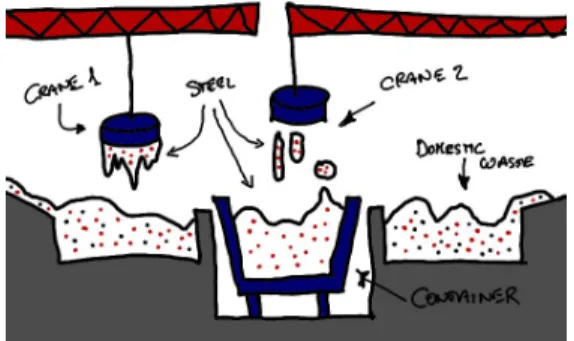
Fig. 1.Recycling plant.
In this section we will introduce an example which will be used throughout the rest of the paper and we will use this example to present our resource-oriented no-tation [1]. We will present the in-tended semantics of the specifica-tion language without formal ap-paratus but, hopefully, with clar-ity enough to justify its translation into TLA+and to grasp the more relevant points of our notation.
2.1 The Recycling Plant Example
In a recycling plant (Fig. 1), steel is recovered from unsorted domestic waste with au-tomatically controlled cranes equipped with electromagnets: cranes collect steel and deposit it in a container until the container is (nearly) full. The crane controller is ac-cessed using a library with a public API, part of which appears next.
package Cranes is
MAX_CRANES : constant Positive := 5;
subtype Crane_Id is Positive range 1 .. MAX_CRANES ; MIN_W_CRANE : constant Positive := 1000;
MAX_W_CRANE : constant Positive := 1500;
subtype Weight is Positive range MIN_W_CRANE .. MAX_W_CRANE ;
-- Grab the steel and report its weight
procedure Collect (N : in Crane_Id ; W : out Weight );
-- Move the crane to a dropping point and -- deactivate the electromagnet .
procedure Drop (I : Crane_Id ); end Cranes ;
package Container is
MAX_W_CONTAINER : constant Natural := 20000;
-- Replace the current container with an empty one
procedure Replace ; end Container ;
Our aim is to specify and verify a concurrent system which controls the cranes and the container so that the cranes simultaneously collect steel and fill in the container without exceeding its maximum capacity, and replace full containers with empty ones, making sure that cranes do not try to deposit debris when containers are being replaced. We assume space enough for several cranes to deposit steel in the container without interacting with each other.
Fig. 2.System Design.
We assume that the system can be expressed as a collection of processes interacting through a shared resource (see Fig. 2), an instance of what we term a CADT (Concurrent Abstract DataType). Using a generaliza-tion of data abstracgeneraliza-tions as the base for concurrency puts the emphasis on the interaction with the environment instead of on internal organization and algo-rithms, and also separates the functionality and implementation (i.e., message passing vs. shared memory).
Unlike other proposals, our specification language does not capture process behav-ior, which is instead written directly in a very simple programming language (Sec-tion 2.3). In what follows we will give a brief account of the main characteristics of the specification language using the crane example.
2.2 Design of a Resource-Based Solution
We are not aiming at describing the design process itself here, as to some extent, this relies on experience and common sense.4We will instead present a finished design and describe how it is assumed to work.
A process is assigned to every crane and to the container. A shared resource will be used as central point for synchronization. The state of the shared resource is rich enough to to determine when a container change is needed and when it has been changed. In particular, it contains thereplacement state, which can take the following values: ready(there is room for more waste),to replace(a crane carries more steel than what the container can hold, and the crane has decided to order an empty container), and replacing(the container is being replaced). Even if theto replacestate is entered, a 4Although there are, of course, guidelines which help in removing from an early stage many
crane carrying an amount of steel which still fits into the container can unload it as long as thereplacingstate has not been entered yet.
This approach does not maximize the container load, as the replacement process can start when some crane still carries a load which fits in the container. The alternative solution of storing the weight on every crane in the resource and making a central decision on which crane leaves its load was not chosen since it reduces concurrency.
Updates to the state need to be performed atomically. We define the resource as providing this atomicity for every operation, as well as more complex, data-dependent synchronization operations (Section 2.4).
2.3 Processes
Our starting point is to express the behavior of the system in terms of processes and then decide how they have to synchronize. As this is done exclusively by means of the shared resource, processes drive the design of the shared resource. As an less desirable but unavoidable side effect, this can result in resources with little reusability. We will see later how to detect the lack of certain reusability properties.
A crane process controller follow. VariableRecycling_Crepresents the shared re-source and variableI(withIdifferent for every process) identifies the crane managed by that process. The shared resource is represented by the object Recyclingand all operations prefixed by it belong to the resource.
loop -- Controller for the I - th crane
Cranes . Collect (I , W );
Recycling . Notify_Weight ( Recycling_C , W ); Recycling . Increment_Weight ( Recycling_C , W ); Cranes . Drop (I );
Recycling . Notify_Drop ( Recycling_C ); end loop;
Notify_Weightdecides if the container has to be replaced.Increment_Weight sus-pends if the load cannot be unloaded because there is no space in the container or it is being replaced. Otherwise, it increments the container weight before actually dropping the steel. A counter of the cranes which have committed to unload but have not done it yet is kept to avoid the container to be replaced when some cranes are not yet through.
The container controllerwaitsfor the container to be replaceable, changes its state toreplacing, replaces the container, and, atomically, changes the state toreadyagain.
loop -- Container controller main loop
Recycling . Prepare_Replacement ( Recycling_C ); Container . Replace ;
Recycling . Notify_Replacement ( Recycling_C ); end loop;
2.4 Anatomy of a Specification
Our specification language is based on first-order logic, which is sufficiently known not to need but a quick brush-up in most cases. Its core ideas are inspired on a simplifica-tion of well-known formal methods (notably VDM [5]) with addisimplifica-tional construcsimplifica-tions to
CADTRecycling Control OPERATIONS
ACTIONPrepare Replacement:Recycling Control [io] ACTIONNotify Replacement:Recycling Control [io] ACTIONNotify Weight:Recycling Control [io]×Weight[i] ACTIONIncrement Weight:Recycling Control [io]×Weight[i] ACTIONNotify Drop:Recycling Control [io]
SEMANTICS DOMAIN:
TYPE:Recycling Control=(weight:N×state: State Ty×accessing:N) State Ty=ready|to replace|replacing
Weight=MIN W CRANE .. MAX W CRANE
INVARIANT:∀r ∈Recycling Control•r.weight≤MAX W CONTAINER∧
r.accessing≤MAX CRANES
CPRE:r=( ,to replace,0) Prepare Replacement(r)
POST:rout=(rin.weight,replacing,0) PRE:w≤MAX W CRANE
CPRE:r.weight+w≤MAX W ∧r.state,replacing
Increment Weight(r, w)
POST:rin=(cw,e,a)∧rout=(cw+w,e,a+1)
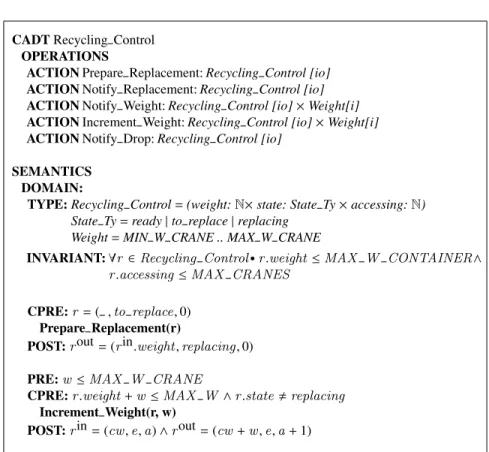
Fig. 3.Partial CADT for the central crane controller.
address concurrency. Following [11], our specifications are state-based, with the state accessible only through a set of public operations. Fig. 3 shows a partial specification of the resource at hand, which we will explain in this section.
Public Interface: Actions and Their Signatures. TheOPERATIONSsection defines the names and signatures of the public operations and (optionally) tags arguments as input and/or output. The state of the resource itself is currently not directly available to the body of the specification; it must instead be a formal parameter (by convention, the first one) of every operation.5
Domain: Types. TheDomainsection contains type definitions for the resource and, optionally, aninvariantwhich restricts the values of the resource state to those which are admissible in the problem.
In this example, the resource state contains the weight in the container, its replace-ment state (of enumerated typeState Ty), and how many cranes remain to deposit their load.Weightrepresents valid crane loads.
Basic types include Booleans, naturals, integers, and reals, and complex types are built on them by means of algebraic types (free types). A series of predefined non-basic types, such as we also provide sequences (indexable flexible-length arrays), sets, and finite mappings, with a complete set of operations on them, are also provided.
Domain: Invariants. The invariant is a formula which constrains the range of values in the resource (maybe relating different state components). This allows restricting the admissible states to those which are legal, and, therefore, it also specifies which states the resource mustnotevolve into. It is defined on thecurrent state and has no direct means to refer to past or future states. It is the responsibility of the resource specification to ensure that forbidden states are not reached. In our case, the container cannot carry more weight than the maximum allowed, and the number of cranes waiting to unload cannot exceed the total number of cranes.
Specifying the Effect of Operations. Preconditions and postconditions describe when operations can proceed (i.e., they express synchronization) and how these operations change the resource state. Both are first-order formulas which involve the resource and the arguments of the operation.
Synchronization. The resource semantics assumes mutual exclusion between opera-tions, and ensuring this is left to the final implementation. More involved operation synchronization is taken care of by means of concurrency preconditions (CPRE), which are evaluated against the resource state, and which are aimed at expressingsafety condi-tions. A call whoseCPREis evaluated tofalsewill block until a change in the resource (done by some other process) makes it true. Only one operation among those whose CPREevaluates to true is allowed to proceed. We do not assume any fixed selection procedure — not even fairness.
Sequential preconditions (PRE) can be added to the operations to express condi-tions which have to hold for the operacondi-tions to be safely executed. While aCPREstates synchronization, aPREdeals mainly with data structure coherence.
Updating Resources and Arguments. Changes in the resource and in the operation ar-guments are specified using a postcondition (POST) for every operation which relates the state of the resource and of the parameters before and after the call. ThePREand CPREof the operation and the invariant have to hold after a POSTs isexecuted, as-suming they held before. Values before and after the operation are decorated with the superscripts “in” and “out”, respectively.
In our case study, preparing the replacement keeps the number of cranes accessing the container (to zero, as was necessary to make theCPREtrue) and theweightin the container, and sets the container state toreplacing.
3
Translating Shared Resources into TLA
In this section we present an interlingua-based semantics for our notation. The interlin-gua is the specification laninterlin-guage TLA+[7, 9], a combination of a linear-time temporal logic (The Temporal Logic of Actions [8]) and Zermelo-Fr¨ankel set theory. We will
present the semantics in an informal way, introducing some general information about the translation process and using the system specified in Section 2 to illustrate it.
3.1 Anatomy of a translation
Roughly speaking, a TLA+specification is a formulaS written as a conjunction of a TLA predicateI that states the initial value of TLA variablesx,y, . . . representing the state of the system and a next-state relationN (TLA action) that specifies valid value changes of the variables:S =∆ I∧[N]hx,y, ...i.
Resource state Each component of the domain of the specification in our notation will be translated into a TLA variable.
Example:TLA variables that represent the resource domain: weight,state,accessing
Types and predicates Types are translated into sets and predicates (initial state predi-cate, invariant, preconditions, and concurrency preconditions) into TLA predicates. Example:TLA set that represents typeWeight:
Weight =∆ (MIN W CRANE. .MAX W CRANE)
Example:TLA predicate that represents the initial state:
Init =∆ ∧weight=0∧state=“ready”∧accessing=0
Postconditions are translated into TLAactions(a TLA action is a predicate which relates input and output states). The value of a variable before an action is represented using the variable name, and its value after the action is represented with the same name primed; so we replacexin byxandxout byx0.
Example:Type information, PRE, CPRE, POST ofIncrement Weightin TLA:
TYPE Increment Weight(w) =∆ w ∈Weight
PRE Increment Weight(w) =∆ w≤MAX W CRANE
CPRE Increment Weight(w) =∆
∧weight+w ≤MAX W CONTAINER∧state,“replacing”
POST Increment Weight(w) =∆
weight0=weight+w∧
state∧accessing0=accessing+1
We will not present in detail the translation of types, predicates and expressions, as it is a non difficult compilation exercise made easier by the richness and expressiveness of the mathematical toolkit of TLA+.
Operations Every operation is translated into a TLA action which is the conjunction of the predicates collecting type information, precondition, concurrency precondition, and postcondition of the operation. This action will represent an atomic, valid transition of the system.
Example:TLA action that represents operationIncrement Weight:
Increment Weight(w) =∆
∧TYPE Increment Weight(w)∧PRE Increment Weight(w)
∧CPRE Increment Weight(w)∧POST Increment Weight(w)
Putting It All Together The TLA formula that gives semantics to the resource spec-ification as a dynamic system is given by the definition of thenext-steprelation as the disjunction of all actions resulting from the translation of operations. Informally, every transition (step) the resource may experience is triggered by the execution of some of its operations. We are deliberately ignoring the restrictions that the processes impose on the possible operation interleavings.
Example:A TLA action that represent the execution of any operation:
Next =∆
Prepare Replacement∨ Notify Replacement
∨ ∃w ∈Weight:Notify Weight(w)∨ ∃w ∈Weight:Increment Weight(w)
∨Notify Drop
The formulaSpec which specifies that the system starts in a valid state and every transition it takes is one of these defined by theNextformula, maybe leaving variables
weight,state, oraccessingunchanged, is then
Spec =∆ Init∧[Next]hweight,state,accessingi
3.2 Translation explained
Let us summarise some of the most relevant points in the previous translation:
– The TLA specification syntactically reflects most of the components of our nota-tion.
– Type information has been explicitly introduced in (the untyped) TLA by represent-ing types as sets. Variable typrepresent-ing is therefore translated into set membership and type declarations have been translated as guarded TLA formulae — for example,
Weight, which is used in the definition of predicateTYPE Increment Weight,
itself part of the action Increment Weight, and the in the bounded existential quantification in the definition ofNext.
– The invariant will be also eventually translated into the TLA resulting specification. It will be used during the checking stage (Section 4).
– Output parameters of operations which are private to processes are represented by new TLA variables visible by all operations but conceptually not part of the re-source. They are however necessary to faithfully represent the operation behaviour and, since all operations are continuously available, the interleavings this specifica-tion can represent are a superset of the ones the processes can perform.
4
Verifying System Properties Using TLC
In this section we will see how some execution properties of our example can be studied thanks to the translation of shared resources into TLA and, eventually, the use of the TLC model checker. Being able to use such a tool does not guarantee, in general, the correctness of the system, but it helps to find possible inconsistencies or holes in the specifications.
Some of the properties to check are generic (i.e., the invariant always holds) and some of them depend on the system at hand. We will use in fact two variants of the specification. The first one is what we described in Section 3.1, which leaves complete freedom to the interleaving of the operations, and is adequate to verify safety proper-ties which are connected with resource reuse. The second one includes the necessary machinery to enact interleaving constraints which model the behaviour of the process. 4.1 Checking the resource integrity
With no information about the context in which the specified resource will be used, only the integrity of the invariant and type information of variables can be checked.
Example:Checking the invariant
The invariant has been translated into the following TLA specification:
Types =∆ weight ∈Nat∧state∈State Ty∧accessing ∈Nat
Invariant =∆
∧weight≤MAX W CONTAINER∧accessing≤MAX CRANES
The input to the model checker TLC (Fig. 4) consists of the TLA specification plus the definition of values for constants and the properties (invariants in this case) to be checked. The model checker found two violations of the invariant. The first one is a type error:
Error: Invariant Types is violated. The behavior up to this point is: STATE 1: <Initial predicate>
/\ state = "ready" /\ weight = 0 /\ accessing = 0 STATE 2: <Action Notify_Drop>
/\ state = "ready" /\ weight = 0 /\ accessing = -1
CONSTANTS MAX_CRANES = 5 MIN_W_CRANE = 1000 MAX_W_CRANE = 1010 MAX_W_CONTAINER = 20000 SPECIFICATION Spec INVARIANT Types INVARIANT Invariant Fig. 4. TLC definition of the system to check.
The second one is the violation of the property
weight≤MAX W CONTAINER. We have
mod-ified the specification by introducing a CPRE in the operationsIncrement Weight andNotify Drop
(accessing<MAX W CRANEandaccessing>0,
respectively). After this, it seems that our resource specification has reached a better degree of integrity. The model checker did not find more errors during the checking of the specified resource invariant. Note that, since we did not impose any restriction to the inter-leavings of the operations due to the way processes are defined, the properties we are checking here will be valid in any context of the resource, guaranteeing the reusability of the shared resource.
4.2 Cookingthe processes
Studying properties which take wholly into account how processes and resources are defined as needs some additionalcookingin order to encode their behaviour in TLA. We have followed this systematic method:
1. Introducing per-process program counters and local variables to represent the in-ternal state of every process.
2. Establishing relevant program points for every type of process. 3. Introducing next-step relations in the specification for every process.
4. Mixing next-step relations of processes with next-step relations of the resource. 5. Writing the whole system specification with the initial state, the disjunction of all
cookedTLA actions, and weak fairness conditions on every TLA action. Example:CookingCrane_Controllers
1. VariablesCrane Controller PCandCrane Controller wrepresent the internal state of the every crane controller:
Crane Controller PC,Crane Controller w 2. Crane_Controllerprogram points:
Crane Controller Points =∆
{“toNotify Weight”,“toIncrement Weight”,“dropping”,“toNotify Drop”}
The following fragment captures the type of program counters, local variables and initial state of the processes:
Processes Types =∆
∧Crane Controller PC ∈[Crane Id →Crane Controller Points]
∧Crane Controller w ∈[Crane Id →Weight]
Processes Init =∆
∧Crane Controller PC =[i ∈Crane Id 7→“toNotify Weight”]
∧Crane Controller w =[i ∈Crane Id 7→w ∈Weight :]
3. The next-step relations for the process Crane_Controller are the invocation of shared resource operation and the invocation of theCranesAPI. Actually, just one new next-step relation is relevant: the transition from the invocation ofIncrement_Weight to the invocation ofCranes.Drop:
Dropping =∆
∃i ∈Crane Id :
∧Crane Controller PC[i]=“dropping”
∧Crane Controller PC0=
[Crane Controller PC ![i]=“toNotify Drop”]
∧Container Controller PC
∧Crane Controller w
4. We extend the next-step relations of the resource with the valid state changes in the processes:
Cooked Notify Weight(w) =∆
∃i ∈Crane Id :
∧Crane Controller PC[i]=“toNotify Weight”
∧Crane Controller w[i]=w
∧Notify Weight(w)
∧Crane Controller PC0=
[Crane Controller PC ![i]=“toIncrement Weight”]
∧Container Controller PC
∧Crane Controller w
Cooked Increment Weight(w) =∆
∃i ∈Crane Id :
∧Crane Controller PC[i]=“toIncrement Weight”
∧Crane Controller w[i]=w
∧Increment Weight(w)
∧Crane Controller PC0=
[Crane Controller PC ![i]=“dropping”]
∧Container Controller PC
∧Crane Controller w
Cooked Notify Drop =∆
∃i ∈Crane Id :∃w ∈Weight:
∧Crane Controller PC[i]=“toNotify Drop”
∧Notify Drop
∧Crane Controller PC0=
[Crane Controller PC ![i]=“toNotify Weight”]
∧Container Controller PC
∧Crane Controller w0=[Crane Controller w
![i]=w] 5. Putting it all together:
Cooked Next =∆
∨Cooked Prepare Replacement∨Cooked Notify Replacement
∨ ∃w ∈Weight:Cooked Notify Weight(w)
∨ ∃w ∈Weight:Cooked Increment Weight(w)
∨Cooked Notify Drop
∨Dropping∨Replacing
Cooked Spec =∆ Cooked Init∧[Cooked Next]Cooked State
4.3 Checking system properties
With thiscookedspecification we can check the following system properties: 1. Absence of deadlock (this is automatically provided by TLC).
2. That no cranes drop any material while the container is being replaced:
No Dropping While Replacing =∆
(¬(∧ ∃i ∈Crane Id :Crane Controller PC[i]=“dropping”
∧Container Controller PC =“replacing”))
3. Componentstatein the resource has a cyclic behaviour (ready →to replace→
replacing→ready. . . ):
State Is Cyclic =∆
[∨state=“ready”∧state0=“to replace”
∨state=“to replace”∧state0=“replacing”
∨state=“replacing”∧state=“ready”]state
TLC then detects the violation of one of the properties:
Error: Action property State_Is_Cyclic is violated. The behavior up to this point is: ...
STATE 76: <Action Notify_Weight>
/\ state = "to_replace" /\ weight = 19000 /\ accessing = 1
/\ Crane_Controller_PC = <<"toNotify_Weight", "toIncrement_Weight", "dropping">> /\ Crane_Controller_w = <<1000, 1001, 1000>>
/\ Container_Controller_PC = "toPrepare_Replacement" STATE 77: <Action Notify_Weight>
/\ state = "ready" /\ weight = 19000 /\ accessing = 1
/\ Crane_Controller_PC = <<"toIncrement_Weight", "toIncrement_Weight", "dropping">> /\ Crane_Controller_w = <<1000, 1001, 1000>>
/\ Container_Controller_PC = "toPrepare_Replacement"
273320 states generated, 77163 distinct states found, 3008 states left on queue. The depth of the complete state graph search is 77.
4.4 Analysis of the Error Detected
During the design process, the specifier decided to write the following specification for
Notify Weight(already translated into TLA):
Notify Weight(w) =∆
CPRE
∧state,“replacing”
POST
∧weight∧accessing
∧weight+w >MAX W CONTAINER⇒state0=“to replace”
∧weight+w ≤MAX W CONTAINER⇒state0=“ready”
The motivation to write such specification is that just because one crane asks for a replacement (state0=to replaceif the weight of its load exceeds the limit) no other crane with a valid load weight should wait to drop (resulting in changing the value of
statetoreadyand avoiding the container to be replaced).
Is the formalised system a right system? IsState Is Cyclica desirable property of the system to be built? At least, the violation of the property revealed a liveness issue in the formalisation: if a crane controlleri asks for a replacement (state0=to replace)
and another crane controllerj invalidates that request (state0=ready), then the crane iwill have to wait (conditional synchronisation of operationIncrement Weight) until another cranek(probablyj) reactivates a new request.
5
Conclusion
We have presented a method for structuring and analysing concurrent software that allows developers to focus on concurrency in isolation from other aspects. Although conceptually simple, it enables the use of formal methods in order to verify nontrivial properties of realistic systems.
We sketched a semantics for our shared resource specifications based on a translation of CADTs into Temporal Logic of Actions. This translation has two practical advantages that can be relevant for a wider industrial adoption of similar approaches. On one hand, we think that a CADT is much easier to write and understand than the corresponding TLA specification; although it forces a more rigid architecture, in many cases it is ar-guably more advantageous to have a series of tools /mechanisms which are easy to apply to different scenarios instead of a generic, more complex, one. Our CADT is an example of such a perhaps more specific approach.
On the other hand, the availability of tools such as TLC gives system designers the abil-ity to pinpoint mistakes/misconceptions at an early stage. The automatic translation from a more “focused” formalism to a general, powerful tool helps their adoption. Ad-ditionally, from a formal standpoint, providing an interlingua semantics can be easier to follow than introducing a new calculus, specially considering a formalism in evolution. The process structure presented here is a very simple one. More sophisticated schemes have been proposed in the literature, all of them with the common goals of providing language and platform independence when designing and reasoning about concurrent applications. Models such asCreol [4], that proposes a formal model of distributed concurrent objects based on asynchronous message passing, orCoBoxes [10] which unifies active objects with structured heaps, are relatively recent proposals that elaborate on previous ones such as theactorsmodel.
In the service-oriented computing paradigm, which is attracting much attention in the last years and which is inherently concurrent, languages like BPEL [6] have been used to implement business processes. While BPEL is very powerful and can express plex service networks, their full verification is challenging, partly because of its com-plex semantics.
Although it can be argued that these alternatives allow to express more complex process structures, the absence of a clear separation between active and passive entities does not favour a simple analysis of the behaviour of systems. On the other hand, it is usually a requirement of many industrial software system to avoid complexity as much as possi-ble. In other words, some models can befar more expressivethan needed or wanted in practise.
Several relatives to our resources can also be found in the literature. It is worth men-tioning the concurrency features in VDM++[3], similar in spirit, although our CADT’s relax some of their restrictions as can be seen in [1]. Moreover, the CADT formalism permits some extensions for improving the expressiveness of CPREs that still allow semi-automatic code generation. We have not used these extensions in this paper for the sake of simplicity.
One of the shortcomings of our method, in its current state, is that system properties, unlike shared resources, must be specified directly in TLA. One possible way to
over-come this would be to enrich CADTs with trace-dependent conditions which could, in turn, simplify the way in which liveness properties are specified.
Our original CADT notation included a construct similar to the history countersin VDM [3]: number of times each operation has been requested, activated and completed with information about process identifiers and actual parameters. Formulae on history counters can be very expressive (path expressions or UML protocol state machines can be easily encoded with them) and protocol order between operations or certain liveness conditions can be formalised.
As some programming languages come equipped with constructs that allow to check the lock state of processes at run time, automatic code generation from these specifications seems feasible. These extensions, and a more formal specification of the translation into TLA, are subject of future work.
References
1. Manuel Carro, Julio Mari˜no, ´Angel Herranz, and Juan Jos´e Moreno-Navarro. Teaching how to derive correct concurrent programs (from state-based specifications and code patterns). In C.N. Dean and R.T. Boute, editors,Teaching Formal Methods, CoLogNET/FME Symposium, TFM 2004, Ghent, Belgium, volume 3294 ofLNCS, pages 85–106. Springer, 2004. ISBN 3-540-23611-2.
2. COST Action IC 0701 on Verification of Object Oriented Software. http:// www.cost-ic0701.org.
3. John Fitzgerald, Peter Gorm Larsen, Paul Mukherjee, Nico Plat, and Marcel Verhoef. Vali-dated Designs for Object-oriented Systems. Springer, 2004.
4. Einar Broch Johnsen, Olaf Owe, and Ingrid Chieh Yu. Creol: A type-safe object-oriented model for distributed concurrent systems. Theoretical Computer Science, 2006.
5. CliffB. Jones. Systematic Software Development Using VDM. Prentice-Hall, Upper Saddle River, NJ 07458, USA, 1995.
6. Diane Jordan, John Evdemon, Alexandre Alves, Assaf Arkin, Sid Askary, Charlton Barreto, Ben Bloch, Francisco Curbera, Mark Ford, Yaron Goland, Alejandro Gu´ızar, Neelakantan Kartha, Canyang Kevin Liu, Rania Khalaf, Dieter K¨onig, Mike Marin, Vinkesh Mehta, Satish Thatte, Danny van der Rijn, Prasad Yendluri, and Alex Yiu. Web Services Business Process Execution Language Version 2.0. Technical report, IBM, Microsoft, BEA, Intalio, Individ-ual, Adobe Systems, Systinet, Active Endpoints, JBoss, Sterling Commerce, SAP, Deloitte, TIBCO Software, webMethods, Oracle, 2007.
7. Leslie Lamport. The TLA home page.
http://www.research.microsoft.com/users/lamport/tla/tla.html.
8. Leslie Lamport. The temporal logic of actions.ACM Trans. Program. Lang. Syst., 16(3):872– 923, 1994.
9. Leslie Lamport. Specifying Systems: The TLA+Language and Tools for Hardware and Software Engineers. Pearson Education, Inc, 2002.
10. Jan Sch¨afer and Arnd Poetzsch-Heffter. Coboxes: Unifying active objects and structured heaps. In G. Barthe and F. de Boer, editors,FMOODS 2008, volume 5051 ofLNCS, pages 201–219, 2008.
11. Axel van Lamsweerde. Formal Specification: a Roadmap. In A. Finkelstein, editor,The Future of Software Engineering, pages 147–159. ACM Press, 2000.