C L O U D
vom fachbereich informatik (fb20)
an der technischen universität darmstadt (d17)
zur erlangung des akademischen grades eines doktor-ingenieur (dr.-ing.)
genehmigte dissertation von:
m
.
sc
.
ahmed taha
aus kairo, ägyptendatum der einreichung: 07.02.2018 datum der mündlichen prüfung: 25.04.2018
referenten:
prof. neeraj suri, ph.d prof. dr. joachim posegga
Jahr der Veröffentlichung der Dissertation auf TUprints: 2018
URN: urn:nbn:de:tuda-tuprints-74488
Tag der mündlichen Prüfung: 25.04.2018
Veröffentlicht unter CC-BY-NC 4.0 International - Creative Commons Attribution
Non-commercial 4.0.
Hiermit versichere ich, Ahmed Taha, die vorliegende Dissertation ohne Hilfe Dritter und nur mit den angegebenen Quellen und Hilfsmitteln angefertigt zu haben. Alle Stellen, die Quellen entnommen wurden, sind als solche kenntlich gemacht worden. Diese Arbeit hat in gleicher oder ähnlicher Form noch keiner Prüfungsbehörde vorgelegen.
Darmstadt,7. Februar2018
Ahmed Taha
First and foremost, I would like to thank my advisor Neeraj Suri for building and leading a research group, in which each member can pursue and develop his own research interests individually. Thank you for providing us this freedom and for guiding me through the time of my PhD endeavor. I am also very grateful to Joachim Posegga for accepting to be my external reviewer, and to Stefan Katzenbeisser, Sebastian Faust, and Thomas Schneider for being on my committee. I would like to thank Jesus Luna and Ruben Trapero for their guidance and intensive discussions that we had throughout the years. I would like to thank Daniel, Habib, Hatem, Heng, Kubilay, Nicolas, Oliver, Patrick, Sabine, Salman, Stefan, Thorsten, Tsvetoslava, Ute, Yiqun, and Zhazira for being part of and contributing to our group.
I consider myself very lucky for having worked with some very talented students and I am very grateful for their input and support, especially Ahmed, Ataus, and Soha. I would also like to thank Jolanda and Spyrous for providing the opportunity to work on joint papers in the areas assessment techniques and privacy preserving computation technique. Also, thanks to Saied for the many interesting discussions during our joint proposal. Last but not least, I would like to thank my family and friends for their support during this exciting time.
Cloud computing offers a model where resources (storage, applications, etc.) are ab-stracted and provided "as-a-service" in a remotely accessible manner. In such a service-based environment, the Cloud provisioning relies on stipulated Service Level Agreements (SLAs). Such an agreement is a contract between the Cloud Service Provider (CSP) and the Cloud Service Customer (CSC) regarding the offered services. These SLAs specify the Cloud services requested by the customers and are required to be achieved by the CSPs. A variety of parameters for different aspects of a service can be included in the SLA, such as but not limited to: availability, performance, downtime and location of the data.
Although there are numerous claimed benefits of the Cloud to ensure confidentiality, integrity, and availability of the stored data, the number of security breaches is still on the rise. The lack of security assurance and transparency prevented customers/enterprises from trusting the CSPs, and hence not using their services. Unless the customer’s security requirements are identified and documented by the CSPs, customers can not be assured that the CSPs will satisfy their requirements. Although the recent efforts on specification of security services using SLAs, also known as security SLAs or secSLAs, is a positive development, multiple technical and usability issues limit the adoption of Cloud secSLAs in practice. For example, multiple CSPs offer similar security services (e.g., "encryption key management") albeit with different capabilities and prices. The customers need to comparatively assess the offered security services in order to select the best CSP matching their security requirements. However, the presence of both explicit and implicit depen-dencies across security related services add further challenges for Cloud customers to: (i) specify their security requirements taking service dependencies into consideration, (ii) determine which CSP can satisfy these requirements in a qualitative way, and (iii) identify threats that can compromise their data ownership requirements of security, functionality and performance.
Although secSLA provides specifications for the security level to be provided, assurance mechanisms are required to validate the compliance of the enforced security mechanisms to the secSLA. The lack of security transparency on the security controls implemented in the Cloud and the diversity of the security specifications covered in the secSLA make validating the service to the secSLA a challenging task. Furthermore, the customer’s compensation upon a violation is a manual time intensive process.
Finally, despite the benefits of enclosing security-related information in the secSLAs, CSPs are hesitant to release detailed information regarding their security posture for se-curity and proprietary reasons. This lack of sese-curity transparency makes assessing and validating the offered security level and finding the best CSP matching the customer’s security requirements a challenging task.
In this dissertation we address the aforementioned challenges. For challenges (i) and (ii), two evaluation techniques for conducting the quantitative assessment and analysis of the secSLA-based security level provided by CSPs with respect to a set of Cloud cus-tomer security requirements are presented. The proposed techniques help to improve the security requirements’ specifications by introducing a flexible and simple methodology that allows customers to identify and represent their specific, imprecise and inconsistent security needs. The techniques automatically detect conflicts resulting from inconsistent
threats that can compromise the customer’s data ownership requirements, a threat analy-sis process is presented which establishes the viability of identifying threats based on the CSPs’ offered services and customers’ requirements.
To validate the compliance of CSPs to the contracted services in the secSLA(s), a de-centralized customer-based monitoring approach is proposed. The monitoring approach detects secSLA’s violations and autonomously compensates customers according to the violation severity. The approach relies on the Ethereum blockchain to securely store moni-toring logs and incorporate secSLAs as smart contracts. The compliance validation frame-work is implemented and its functionality is evaluated on Amazon EC2.
Finally, a system that enables (a) CSPs to disclose detailed information about their of-fered security services in an encrypted form to ensure data confidentiality, and (b) cus-tomers to assess the CSPs’ offered security services and find those satisfying their security requirements is presented. The system preserves each party’s privacy by leveraging an evaluation method based on secure two-party computation and searchable encryption techniques. The system is implemented and evaluated by applying it to existing stan-dardized secSLAs. We show that the system’s performance is practical for the presented use-case. The system is formally proved against a strong realistic adversarial model, using an automated cryptographic protocol verifier.
Obwohl es zahlreiche Vorteile der Cloud gibt, um Vertraulichkeit, Intigrität und Verfüg-barkeit der gespeicherten Daten zu gewährleisten, steigt die Anzahl an Verstößen weit-erhin. Fehlende Sicherheit und Durchsichtigkeit halten Kunden/Unternehmen davon ab, Cloud Service Anbietern (CSPs) zu vertrauen und ihren Dienst zu nutzen. Solange die Sicherheitsanforderungen der Kunden von den CSPs nicht bekannt und dokumentiert sind, kann den Kunden nicht versichert werden, dass die CSPs ihre Anforderungen er-füllen können. Obwohl die jüngsten Anstrengungen die Sicherheit, mit Hilfe von Service Level Agreements (SLAs), auch bekannt als Sicherheit SLAs oder secSLAS , zu präzisieren eine positive Entwicklung darstellen, begrenzen viele technische und benutzerfreundliche Punkte die Annahme von Cloud secSLAs in der Praxis. Obwohl secSLA Spezifizierun-gen für das Sicherheitsniveau zur Verfügung stellt, sind "assurance mechanisms" erforder-lich, um die Einhaltung der durchgesetzten Sicherheitsmechanismen der secSLA zu vali-dieren. Mangel von Transparenz der Sicherheit der implementieren Sicherheitskontrollen der Cloud und die Vielfalt der Sicherheitsspezifikationen, die in secSLA enthalten sind, macht die Überprüfung der secSLA Dienste zu einer herausfordernden Aufgabe. Weiter-hin ist die Kundenentschädigung bei Verletzung (des Vertrages) ein manuell zeitintensiver Vorgang. Diese Dissertation beschäftigt sich mit den oben genannten Herausforderungen. Zwei Formen der Evaluierung für die quantitative Bewertung und Analyse des auf sec-SLA basierten Sicherheitslevels, bereitgestellt von CSPs mit Bezug auf eine Reihe von Sicherungsanforderungen von Cloud Kunden, sind vorhanden. Die Techniken erkennen Konflikte, die aus inkonsistenten Kundenanforderungen resultieren und stellen eine Erk-lärung für diese zur Verfügung, was wiederum den Kunden erlaubt, diese Konflikte zu lösen. Um die Übereinstimmung der CSPs mit den Vertragsservice der secSLA(s) zu va-lidieren, wird eine dezentrale kundenbasierte "monitoring approach" vorgeschlagen. Das "monitoring approach" erkennt secSLA Verletzungen und entschädigt automatisch Kun-den gemäß der Schwere der Verletzung. Die Annäherung verlässt sich auf "Ethereum blockchain". Die Annäherung der Überwachung wird durchgeführt und seine Funktion-alität wird auf Amazons EC2bewertet.
[AWT+17] Soha Alboghdady, Stefan Winter, Ahmed Taha, et al. “C’Mon: Monitoring the Compliance of Cloud Services to Contracted Properties.” In: Proc. of ARES.2017, p.36.
[LTTS17] Jesus Luna, Ahmed Taha, Ruben Trapero, and Neeraj Suri. “Quantitative Reasoning about Cloud Security Using Service Level Agreements.” In:IEEE Transactions on Cloud Computing 5.3(2017), pp.457–471.
[TBL+18] Ahmed Taha, Spyros Boukoros, Jesus Luna, et al. “QRES: Quantitative Rea-soning on Encrypted Security SLAs.” In:Privacy Enhancing Technologies(2018). [Submitted].
[TMT+16] Ahmed Taha, Patrick Metzler, Ruben Trapero, et al. “Identifying and Uti-lizing Dependencies Across Cloud Security Services.” In: Proc. of AsiaCCS. 2016, pp.329–340.
[TTLS14] Ahmed Taha, Ruben Trapero, Jesus Luna, and Neeraj Suri. “Ahp-based quantitative approach for assessing and comparing cloud security.” In:Proc. of TrustCom.2014, pp.284–291.
[TTLS17] Ahmed Taha, Ruben Trapero, Jesus Luna, and Neeraj Suri. “A Framework for Ranking Cloud Security Services.” In: Proc. of IEEE Services Computing. 2017, pp.322–329.
The following publications are related to different aspects covered in this dissertation, but have not been included.
[MTS16] Salman Manzoor, Ahmed Taha, and Neeraj Suri. “Trust Validation of Cloud IaaS: A Customer-centric Approach.” In:Proc. of TrustCom.2016, pp.97–104. [MTT+16] Jolanda Modic, Ruben Trapero, Ahmed Taha, et al. “Novel efficient tech-niques for real-time cloud security assessment.” In: Computers & Security62 (2016), pp.1–18.
[TMS+17] Ruben Trapero, Jolanda Modic, Miha Stopar, et al. “A novel approach to manage cloud security SLA incidents.” In: Future Generation Computer Sys-tems72(2017), pp.193–205.
[TMS17] Ahmed Taha, Salman Manzoor, and Neeraj Suri. “SLA-Based Service Se-lection for Multi-Cloud Environments.” In: Proc. of Edge Computing. 2017, pp.65–72.
1 introduction 1
1.1 Research Questions and Scientific Contributions . . . 2
1.2 Dissertation Outline . . . 5
i quantitative reasoning on security slas 7 2 quantitative framework for assessing cloud security 9 2.1 Motivation and Contribution . . . 9
2.2 Background . . . 10
2.2.1 Security Service Level Agreements . . . 10
2.2.2 Service Dependencies . . . 11
2.3 Quantitative Reasoning System Architecture . . . 13
2.3.1 Trust Model . . . 14
2.3.2 Stage (A): Security Requirements Definition . . . 14
2.3.3 Stage (B): Requirements Quantification . . . 15
2.3.4 Stage (C): Dependency Management Approach . . . 16
2.3.5 Stage (D): Structuring SecSLA Services . . . 18
2.3.6 Stage (E): CSPs Evaluation . . . 21
2.4 Case Study: Security evaluation of CSP’s secSLAs . . . 31
2.4.1 The Customer Perspective: Security Comparison of CSPs . . . 33
2.4.2 The CSP Perspective: Maximising Offered Security Levels . . . 44
2.5 Related Work . . . 44
2.6 Summary . . . 45
ii threat analysis 47 3 requirement based threat analysis 49 3.1 Motivation and Contribution . . . 49
3.2 Requirement Based Threat Analysis (RBTA) Process . . . 50
3.3 Requirements Analysis . . . 50
3.3.1 Requirements Analysis from ESCUDO Use-Case . . . 50
3.3.2 Adapted Requirements Catalogue . . . 51
3.3.3 Risk Assessment . . . 51
3.4 Dependency Analysis Across Requirements . . . 55
3.4.1 Stage (A): Dependency Model Creation . . . 55
3.4.2 Stage (B): Use-Case Requirements Validation . . . 56
3.4.3 Stage (C): Structuring Use-Case Requirements Using DSM . . . 56
3.5 Identifying Violations . . . 59
3.6 Related Work . . . 59
3.7 Summary . . . 60
iii quantitative secsla validation and enforcement 61 4 monitoring the compliance of cloud services 63 4.1 Motivation and Contribution . . . 63
4.2 Background . . . 64
4.2.1 Consensus Algorithms . . . 65
4.2.2 Types of Blockchains . . . 65
4.2.3 Ethereum Blockchain . . . 66
4.3 SecSLA Compliance Monitoring Framework . . . 67
4.3.1 Monitoring Approach Architecture . . . 67
4.3.2 Stage (1): Measurement Definitions . . . 69
4.3.3 Stage (2): Monitoring Approach . . . 70
4.3.4 Stage (3): Monitoring System Processes . . . 72
4.3.5 Distributed Customer’s Data Oracles . . . 73
4.4 Security Vulnerabilities of Ethereum Smart Contracts . . . 73
4.5 Implementation and Evaluation . . . 74
4.5.1 Setting-up Ethereum blockchain . . . 75
4.5.2 Cloud Customer Data Oracle . . . 75
4.5.3 Experiment1: Evaluating the Functionality of the Approach on Ama-zon EC2 . . . 76
4.5.4 Experiment 2: Consumed Gas (Cost) Evaluation . . . 77
4.6 Related Work . . . 78
4.7 Summary . . . 79
iv use-case 81 5 qres: quantitative reasoning on encrypted security slas 83 5.1 Motivation and Contribution . . . 83
5.2 Background . . . 84
5.2.1 Format of secSLAs . . . 84
5.2.2 Searching Over Encrypted Data . . . 84
5.2.3 Privacy Preserving Computations . . . 85
5.3 Requirements Analysis . . . 86 5.3.1 System Overview . . . 86 5.3.2 Threat Model . . . 87 5.3.3 Trust Model . . . 87 5.3.4 System Requirements . . . 88 5.4 QRES Architecture . . . 89
5.5 Implementation and Evaluation . . . 92
5.6 Security Analysis . . . 94
5.6.1 Formal Analysis . . . 94
5.6.2 Further Security Considerations . . . 97
5.7 Related Work . . . 99
5.8 Summary . . . 99
6 conclusion 101 v appendix 103 a fuzzy notations 105 a.1 Crisp and Fuzzy Sets . . . .105
a.2 Triangular Fuzzy Number . . . .106
a.3 Operations of TFN - Approximation of Division . . . .106
b operational semantics 109 b.1 Protocol modelling and properties verification . . . .110
Figure1.1 Structure of the dissertation and scientific contributions (SC). . . 6
Figure2.1 Cloud secSLA hierarchy based on security posture provided by the STAR repository. . . 11
Figure2.2 SecSLA hierarchy showing dependencies . . . 12
Figure2.3 Proposed system stages . . . 14
Figure2.4 Dependency based secSLA validation stages . . . 19
Figure2.5 CSPs evaluation process . . . 22
Figure2.6 Dependent secSLA Hierarchy . . . 23
Figure2.7 Triangular fuzzy number. . . 26
Figure2.8 Linguistic terms for criterion importance. . . 27
Figure2.9 CSPs comparison with respect to Customer Case I requirements using QHP. . . 36
Figure2.10 CSPs comparison with respect to customer Case I requirements us-ing fuzzy-QHP. . . 39
Figure2.11 The total aggregated secSLA level with respect to customer require-ments using QHP & fuzzy-QHP. . . 40
Figure2.12 Sensitivity analysis: CSP1 SLOs that maximise the overall security level. . . 44
Figure3.1 Dependency management approach stages . . . 55
Figure3.2 Use-case requirements arranged in a hierarchy structure showing the dependencies between requirements . . . 56
Figure4.1 Monitoring system architecture . . . 68
Figure4.2 System workflow phases - sequence diagram . . . 71
Figure4.3 Distributed oracles scheme workflow - single point of failure avoid-ance . . . 74
Figure5.1 QRESSystem Model . . . 87
Figure5.2 QRESSystem Architecture . . . 89
Figure5.3 Secure computation protocol between a CSP and the broker (QeSe). 91 Figure5.4 Illustration of the secure computation protocol between the CSP and the broker (QeSe). . . 92
Figure5.5 Time used by a customer to search for her/his different keywords over varied number of SLOs offered by one CSP. . . 93
Figure5.6 Time used by the customers to search for their different keywords over150SLOs offered by varied CSPs. . . 94
Figure A.1 Membership functions for domestic and foreign cars, based on the percentage of parts in the car made in Germany [Men95] . . . .105
Figure A.2 Membership functions forT(height). . . .106
Figure A.3 Approximation of TFN division example. . . .107
Figure B.1 Constructors and destructors . . . .109
L I S T O F TA B L E S
Table2.1 Dependency importance level . . . 13 Table2.2 DSM mapping of the secSLA shown in Figure2.2 . . . 21 Table2.3 Final DSM mapping of the secSLA shown in Figure2.2after
parti-tioning and scheduling . . . 22 Table2.4 QHP terms . . . 24 Table2.5 Linguistic terms and values of ratings. . . 27 Table2.6 Case Study: Excerpt of secSLA from CSPs and customer
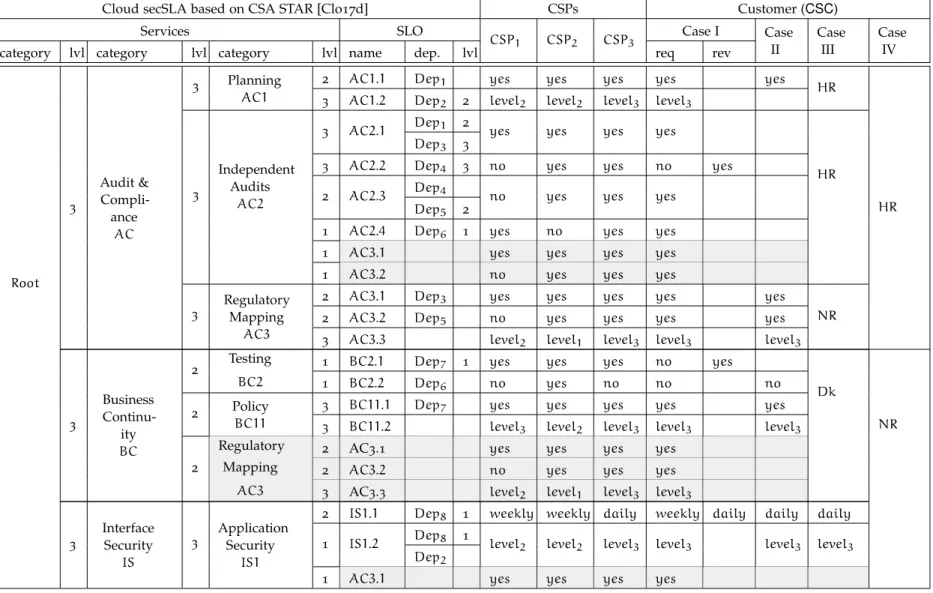
require-ments. . . 32 Table3.1 Relationship between use-case requirements and confidentiality,
in-tegrity, availability, performance and functionality attributes with regards to data ownership. . . 52 Table3.2 Use-case requirements and their direct and indirect assumptions
as well as an estimated likelihood of direct assumptions being vio-lated, assumed impact and threat severity. . . 54 Table3.3 DSM mapping of UC requirements shown in Figure3.2 . . . 57 Table3.4 Final DSM of UC requirements depicted in Table3.3after
partition-ing and schedulpartition-ing . . . 58 Table4.1 Instances configurations . . . 76 Table4.2 Amazon EC2instances results . . . 77 Table4.3 Total gas consumed by the validation and compensation processes
based on one month logs with different batch sizes . . . 78 Table4.4 The consumed Gas of the validation and compensation processes
per SLO . . . 78 Table5.1 Excerpt of a secSLA XML structure with the calculation of pre-fields 85 Table5.2 The semi-honest threat model of our system . . . 88 Table5.3 Every participating entity’s initial knowledge . . . 88
L I S T I N G S
Listing2.1 Excerpt of dependency model of a secSLA . . . 18 Listing5.1 Excerpt of the SLA depicted in Figure2.1 . . . 84
CSC Cloud Service Customer CSP Cloud Service Provider
SecSLA Security Service Level Agreement SLA Service Level Agreement
SLO Service Level Objective PV Priority Vector
NW Normalized Weight CM Comparison Matrix
AHP Analytic Hierarchy Process DSM Design Structure Matrix TFN Triangle Fuzzy Number
MCDM Multiple Criteria Decision Making QHP Quantitative Hierarchy Process
ENISA European Union Agency for Network and Information Security CSA Cloud Security Alliance
CSA STAR CSA Security, Trust and Assurance Registry
CSA CAIQ CSA Consensus Assessments Initiative Questionnaire CSA OCF CSA Open Certification Framework
ISO International Organization for Standardization RBTA Requirement Based Threat Analysis
QRES Quantitative Reasoning on Encrypted Security SLAs QeSe Query Search Protocol
A B B R E V I AT I O N S
S Set of services a secSLA consists of such thatS=s1,. . .,sn.
K Set of SLOs
k An SLO wherek2K
V The set of all values of eachkinK vi,k kvalue provided byCSPi
vCSC,k CSCrequired value fork ˜
vi TFN valuekprovided byCSPisuch that ˜vi is represented as(li,mi,ui)
B Broker
m Plaintext
c Ciphertext
k Symmetric encryption/decryption key pkX Public key of partyX
skX Private key of partyX
certX X.509certificate of partyX kauth
X Authentication secret generated and sent to partyX
NX2{0,1} Random number generated by party Xfrom the set of all binary strings of length
y $A(x) On inputx, algorithmAbinds the output to variabley
m1||m2 Concatenation ofm1 andm2 KGen key generation
Enc Encryption algorithm Dec Decryption algorithm
Enc(pk,m) Takes as input a public keypk, a plaintextm, and outputs a ciphertextc
Dec(sk,c) Takes as input a secret keysk, a ciphertextc, and outputs a plaintextm
Sig(sk,m) Signsmwith a secret keysk, and outputs a signed messagesm
Verify(pk,sm) Verifies the signature using the public keypkand returns1if the signature is valid for the given message and0if not
H(x) Hash function which takes as inputx, and responds with a random out-puts y. Ideally, a hash function is defined as a random oracle that re-sponds with a random outputy2Yto each given input forx2X. Where Xis the set of possible messages,Yis a finite set of possible digests t1,. . .,tn The SLA XML file can be split intonsubstrings.
t1CSP1,. . .,tnCSP1Substrings generated by CSP1 and are named tokens, where n is the number of tokens
w1CSC,. . .,wnCSCSubstrings generated by the customer CSC and are named keywords, wherenis the number of keywords
1
I N T R O D U C T I O NCloud computing drives the vast spectrum of both current and emerging applications, products, and services, and is also a key technology enabler for the future Internet. In such a service-based environment, service provisioning relies on a Service Level Agree-ment (SLA) which represents a formal contract established between the Cloud Service Customer (CSC) and the Cloud Service Provider (CSP). The SLA specifies how provision-ing takes place as well as the respective rights and duties of the customer as well as the CSP. Furthermore, the SLA includes the list of Service Level Objectives (SLOs) which are the measurable elements of an SLA that specify the Cloud services’ levels requested by the customers, and required to be achieved by the CSP.
Although Cloud computing direct economic value is unambiguously substantial, tak-ing full advantage of Cloud computtak-ing requires considerable acceptance of off-the-shelf services. Specifically, both security assurance and transparency remain as two of the main requirements to enable customer’s trust in CSPs. The lack of assurance and transparency, along with the current paucity of techniques to quantify security, often results in Cloud customers being unable to assess the security of the CSP(s) they are paying for. Despite the advocated economic and performance related advantages of the Cloud, two issues arise: (i) how can a (non-security expert) customer meaningfully assess if the CSP ful-fills his/her security requirements?, and (ii) how can a CSP provide security assurance to customer organizations during the full Cloud service life-cycle?
In this context, a number of Cloud community stakeholders (e.g., ISO 27002 [Sta13], the European Union Agency for Network and Information Security (ENISA) [Nat13], and Cloud Security Alliance (CSA) [Clo17a]) are pushing towards the inclusion of security parameters and CSP’s security implementation in Service Level Agreements (named se-curity SLAs or secSLAs [LGLS12]). Examples of sese-curity-related information are ciphers used to encrypt data, vulnerability management/assessment procedures, minimum/aver-age incident response times, security controls’ and configuration elements such as metrics for measuring cybersecurity performance, etc.
Consequently, secSLA can be a useful mean not only to disclose information about each CSP offered security services, but also to define the services’ key measurable parameters. For example, how a CSP recovers from incidents is typically defined using two measurable parameters which are the incident severity and the time to recovery [HD12]. Customers can employ these measurable parameters to continuously assess and monitor (even with a realistic level of automation) the CSP’s implementation of the acquired service level. Using these assessments, customers aquire better information to compare different ser-vice offerings provided by various CSPs, and thus, can select the CSP that satisfies their requirements.
Despite the benefits of disclosing the security related information in secSLAs, Cloud cus-tomers still face major problems that need to be addressed. In the next section, we define these problems using four research questions. Furthermore, we highlight our scientific contributions and specify the references where each contribution has been published.
1.1 research questions and scientific contributions
Research Question1: How can customers (a) specify their security requirements without introduc-ing conflicts resultintroduc-ing from the dependency relations across services, and (b) evaluate and assess the security level of CSPs according to the their precise/imprecise requirements?
Dependency relations across services, or simply service dependencies, are the direct re-lations between one or more services, where a service can depend on data or resources provided by another service. Mainly, these dependency relations increase the difficulties for the customers in finding a single CSP that satisfies their requirements, since these rela-tions can easily introduce conflicts. For instance, a customer may require an unachievable level of a dependent security service which causes these requirements to be impossible to satisfy. Whereas, the unachievable service level exists when a service depends on re-sources which are not provided by the corresponding dependent service. Moreover, a cus-tomer requirement may influence or be influenced by other requirements. Consequently, a CSP being unaware of related dependencies can erroneously agree on providing an un-achievable level of security service according to the customer requirement. Consequently, the CSP will not be able to fulfill this requirement, which results in a secSLA violation.
For example, the "encryption key management" service in the Cloud depends on several factors such as: (a) the techniques used to store the encryption keys, (b) the processes specifying how keys are accessed, (c) the possibility of the key recovery, and finally (d) the control and management of each key. Each of these factors contains different levels of services (e.g., different techniques to store and distribute the keys), which the customer can require and the CSP agrees to fulfill. Note that most factors also depend on each other.
As the number of Cloud security services grows, the number of dependencies across the security services also increases, making it more likely for customers to introduce conflicts. Also, it becomes harder to manually detect and identify the causes of these conflicts, es-pecially when multiple types of dependency relations are involved. Therefore, customers need to first consider the dependencies between security services that span across their security requirements’ specifications, and then assess the security services offered by dif-ferent CSPs to rank difdif-ferent CSPs based on the customer’s security requirements and priorities.
Consequently, customers need techniques to quantitatively compare the security offer-ings across the different CSPs according. However, most of the presented evaluation tech-niques [LGLS12; GVB13] require customers to: (a) provide detailed values specifying their requirements and (b) submit static weights to model their priorities. In fact, both of the aforementioned requirements depend upon expert knowledge and are time consuming. In addition, the lack of Cloud customer awareness about detailed security requirements hinders them from specifying security requirements in accurate values.
To allow customers to smoothly adopt Cloud services, it is desirable to let them express their "general" requirements or imprecise preferences in natural language phrases. By using approximate linguistic descriptors, customers are able to define their requirement exactly as desired. Therefore, it is becoming an important issue for the customers to be able to make decisions regarding how to assess and rank CSPs with respect to their secSLAs and according to the customers’ precise/imprecise requirements.
Scientific Contribution1: Proposing a secSLA based dependency representation model and a quanti-tative reasoning framework that allow customers to specify their requirements using precise values, linguistic descriptors and natural language phrases.
To assess the CSPs according to the customer security requirements, an analysis of the security service dependencies with the handling of all conflicts that occur due to differ-ent dependency relations across services is presdiffer-ented. We develop a dependency model which ascertains direct and indirect dependencies across services to highlight conflicts preventing the CSPs from satisfying customer requirements.
Furthermore, two secSLA assessment techniques are proposed which are based on Ana-lytic Hierarchy Process (AHP) [Saa90] and fuzzy-AHP [Cha96]. The proposed techniques allow customers to:
• Specify their requirements using natural language phrases and linguistic descrip-tors as well as precise values. Thus, enabling both novice and expert customers to provide their security requirements according to their expertise
• Assess, compare and rank various security services provided by different CSPs. We employ membership functions to capture customers’ subjective requirements and then use a hierarchical fuzzy inference system to derive precise security levels for these requirements.
The proposed dependency analysis and validation framework has been presented at AsiaCCS 2016 [TMT+16]. The proposed assessment techniques have been presented at TrustCom2014[TTLS14], SCC2017[TTLS17], and TCC2017[LTTS17]. The first contribu-tion is explained in Chapter2.
Research Question2: How can customers identify threats that can potentially violate their data ownership requirements?
Cloud infrastructures are subject to multiple threats, which may target the technological foundation of the Cloud infrastructure (e.g., virtualized environment) or architectural as-pects of the next generation of Cloud storage system (e.g., availability). Virtualization is the enabling technology for the different Cloud computing models and is expected to offer secure logical isolation between virtual machines. Recently, researchers have demonstrated that the isolation property may be violated by extracting the private key of co-located users or by exchanging secrets between colluding users [PBSL13]. Different factors affect the exploitability of these threats, such as the noise level of side-channels, or deployed mechanisms. Similarly, the perceived lack of trust and control over outsourced data raises major concerns about its security and privacy. To alleviate these concerns, a systematic approach is required in order to estimate the feasibility of exploitation of these threats in a specific operational context and under the stipulated assumptions. Addition-ally, these threats need to be analyzed with regards to the requirements of the customer in terms of functionality, performance and security, with the aim to properly identifying which data to be outsourced is critical so that threat-modeling activities can be prioritized.
Scientific Contribution2: Developing a requirement based threat analysis for estimating the risks based on requirements analysis.
We developed a requirements-driven methodological process that ascertains direct and indirect dependencies across the security requirements to highlight inconsistent
specifica-tions or assumpspecifica-tions that can lead to security breaches. Each Cloud service is presented as a tree (Boolean or X-tree as relevant) that outlines the hierarchy of requirements pro-viding the Cloud service. As multiple services are elaborated, the methodology explores the linkages and dependencies across all the service requirements to ascertain either their compatibility or incompatibility - the latter identifying the vulnerabilities. This linked services model is a new contribution to the area of threat modeling and has resulted in a systematic 3-step methodology (initial design of the dependency model, validation of the model, use-case requirements reorganization). The presented threat analysis scheme is explained in Chapter3.
Research Question3: How can customers ensure that the required security level is enforced by the CSP?
In theory, by signing the secSLA, a CSP commits to providing the specified security level throughout the full life-cycle of the service. However, in practice, the service may not comply with the security level contracted in the secSLA during its full operation time. Accordingly, the compensations to be paid to the customer upon any detected violations are specified in the secSLA. However, most of the existing security compliance approaches are proposed to help the CSP to manage security compliance of their services, whereas none of the approaches addresses compliance management from the customer side.
Hence, how can customers (i) verify if the contracted security level is actually delivered, and (ii) detect and prove any violations to the contracted service levels in the secSLA at any time during the service life-cycle? At the same time, how to prevent customers from misreporting for financial gain? Finally, how can customers get compensated au-tonomously in case of security breaches? The current compensation process involves: (a) the customer opening a case with the support team, (b) waiting for someone to analyze the validity of the case, and finally (c) a payment or a refund is initiated in terms of credit for future usage.
Scientific Contribution3: Proposing an approach to continuously monitor the compliance of Cloud services to secSLAs that autonomously compensates the customer if a secSLA violation is detected.
We present a framework for secSLA compliance validation which enables Cloud cus-tomers to validate the compliance of the provided Cloud service to the contracted security level in a secSLA. The framework relies on a proposed decentralized runtime monitoring approach which builds upon the Ethereum blockchain infrastructure.
Firstly, we analyze and select the SLOs that can be measured from the customer side. The analyzed SLOs are proposed by different frameworks and standards for security con-trols. Secondly, measurement procedures to determine the measurable SLO values are defined. Next, a decentralized customer side monitoring scheme for validating the com-pliance of the service is established. Further, enforcement of the secSLA using a smart contract deployed over the Ethereum blockchain. Finally, implementing an autonomous compensation process for customers if a violation is detected.
We evaluate the functionality and performance of the monitoring scheme on Amazon EC2 [Ama17]. The proposed monitoring approach has been presented at QRES 2017 [AWT+17] and is specified in Chapter4.
Research Question 4: Is the inclusion of security implementations information in the secSLAs risky?, and will CSPs disclose detailed security related information in their secSLAs or only general and abstract information about their security posture?
Despite the benefits of detailing the security-related information, CSPs still do not disclose this kind of information in their secSLAs for security and/or commercial reasons [HD12]. The risks of including security-related information in the secSLA where pointed out by ENISA [HD12]:
- Publicly disclosing security parameters may assist attackers in penetrating the sys-tem using a hole in the publicized data. Accordingly, the rate of malicious security breaches increases, which can be much harder to detect. This can also lead to a significant financial loss as a result of the customers’ compensations.
- Publicly detailing commercially sensitive information (i.e., financial terms, service levels, cost information, or/and vulnerability descriptions which may include pro-prietary information, etc.) can be used by other competitors to improve their ser-vices.
Scientific Contribution 4: Proposing a formally proved system which enables CSPs to publicly disclose detailed information about their offered services in encrypted secSLAs while allowing cus-tomers to assess the CSPs’ offered security services and subsequently find those satisfying their requirements.
We design and implement a system called QRES (Quantitative Reasoning on Encrypted SLAs). Our system simultaneously allows:
- CSPs to specify their services along with the key measurable parameters in secSLAs, without revealing information about the offered security parameters or commer-cially sensitive information.
- Customers to assess and evaluate the CSP’s offered security services and to choose the best CSP matching their needs.
QRESis built around a two-party privacy preserving query over encrypted data scheme (named QeSe). QeSe allows customers to search for their requirements over encrypted secSLA blindly without neither the CSPs learning these requirements, nor the customers knowing the CPSs’ secret keys.
The proposed framework has been submitted to PETS2018[TBL+18] and is explained in Chapter5.
1.2 dissertation outline
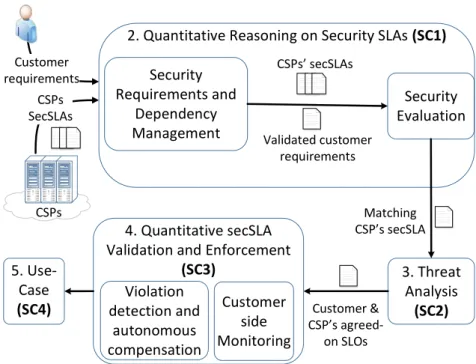
The outline of the dissertation is structured according to the depiction in Figure1.1, which shows the relationship between the chapters and the scientific contributions discussed. The remainder of this dissertation is organized as follows:
• Chapter 2 presents two different techniques to conduct security assessment based on the quantitative and qualitative analysis of security information. Both techniques were empirically validated through case studies using real-world CSP data obtained from the Cloud Security Alliance. Furthermore, we introduce a novel dependency
2. Quantitative Reasoning on Security SLAs (SC1) CSPs SecSLAs Security Requirements and Dependency Management CSPs Validated customer requirements Customer requirements Security Evaluation 3. Threat Analysis (SC2) Matching CSP’s secSLA CSPs’ secSLAs Customer & CSP’s agreed-on SLOs 4. Quantitative secSLA Validation and Enforcement
(SC3) Customer side Monitoring Violation detection and autonomous compensation 5. Use-Case (SC4)
Figure1.1.: Structure of the dissertation and scientific contributions (SC).
model and show its capability for validating each customer and CSP requirement by checking the existence of conflicts that occur due to to different dependency relations between service/SLOs.
• Chapter 3 develop a dependency model and highlights its capability for identify-ing threats by ascertainidentify-ing and visualizidentify-ing the dependencies across services. By assessing the degree of dependencies across the services, the potential threats are identified and the critical areas where services should be protected are specified. • Chapter4presents the compliance validation framework. The framework validates
the compliance of the service throughout the Cloud’s full life-cycle by continuously testing the SLO values.
• Chapter5presents a novel system which enables CSPs to create secSLAs and publish them encrypted. At the same time, customers can find the CSP matching their security needs by contrasting their requirements against the encrypted secSLAs. • Chapter6summarizes the contributions of the dissertation.
2
Q U A N T I TAT I V E F R A M E W O R K F O R A S S E S S I N G C L O U D S E C U R I T YThe quantitative security level assessment of CSPs is the primary objective of the pro-posed framework described in this chapter. Using this assessment approach, the CSPs are ranked (as per their secSLA’s) as to how well they match Cloud Service Customer (CSC) requirements.
To achieve this, we first analyze the customer requirements according to the customer security expertise. Second, we create a dependency model to capture information about secSLAs’ services and the dependencies that occur between them. Using this model, both the CSP’s offered services and customers requirements are validated by checking service conflicts and different SLO’s compatibility issues. Next, the validated services are struc-tured in a precise order to easily assess these services and rank the CSPs according to customer requirements. We propose two different evaluation and assessment techniques to assess and rank the CSPs according to the customer requirements. Finally, we validate the framework by applying it to real-world data that leverages the standardized Cloud SLA’s structure proposed in the ISO/IEC19086standard [Int14].
2.1 motivation and contribution
In the Cloud area, security parameters and mechanisms are typically specified in the form of secSLAs to model security among both CSPs and customers. As the primary interfaces between the CSP and the customer are these secSLAs (which are primarily textual legal contracts of a mixed qualitative and quantitative nature), the need exists to be able to: (a) quantitatively specify and assess customer/CSP security requirements, (b) consider the dependencies between security services that span across customer/CSP security specifications, and (c) compare the security services offered by the different CSPs based on the customer’s both certain and uncertain security requirements.
Although the state-of-the-art predominantly focuses on the methodologies to build and represent Cloud secSLAs, there is still a conspicuous lack of techniques that: (a) quantita-tively evaluate Cloud secSLAs to provide security assurance and (b) validate the secSLAs by checking the existence of conflicts that occur due to different dependency relations between services. This lack of techniques that quantitatively evaluate and validate Cloud secSLAs to provide security assurance along with the existence of multiple CSPs offering similar security services, often results in Cloud customers being unable to trust and assess the security of the CSP’s provided services they are paying for.
Contributions. To tackle the aforementioned problems, we make the following contribu-tions:
1. Developing two evaluation techniques (QHP [TTLS14] and fuzzy-QHP [TTLS17]) for conducting the quantitative assessment and analysis of the secSLA-based se-curity level provided by CSPs’ with respect to a set of Cloud customer sese-curity requirements. These proposed techniques improve the specification of security re-quirements by introducing a flexible and simple methodology that allows customers to identify and represent their "specific" and "vague/uncertain" security needs. To
capture customers’ subjective requirements, we deploy membership functions and then use a hierarchical fuzzy inference system to derive precise security levels for these requirements.
2. Proposing a dependency representation model for validating the secSLAs by check-ing the existence of conflicts that occur due to different dependency relations be-tween services. The process of analyzing conflicts is both iterative and interactive. Furthermore, representing the security requirements in an easy dependent ordered structure using Design Structure Matrix (DSM) [Ste81]. In this structure, the security services are ordered according to their level of dependency. This makes the secSLA services and dependencies explicit and traceable regardless the number of security services. This structure assists customers who could not resolve the conflicts and thus could not specify their requirements.
3. The developed techniques along with the developed dependency model are val-idated using four use-case scenarios, leveraging actual real-world CSP SLA data derived from the publicly available Cloud Security Alliance’s Security, Trust and Assurance Registry [Clo17d], which is compliant with the relevant ISO/IEC 19086 standard [Int14].
2.2 background
In this section we provide background information, which is necessary for better compre-hension of the other sections. Practically, we define the concepts of security Service Level Agreement (secSLA) which are used in all the dissertation chapters. Furthermore, we give a short introduction on the dependency relations pertinent to the Cloud secSLA, on which our proposed assessment and validation approaches in Chapters2and3are based. 2.2.1 Security Service Level Agreements
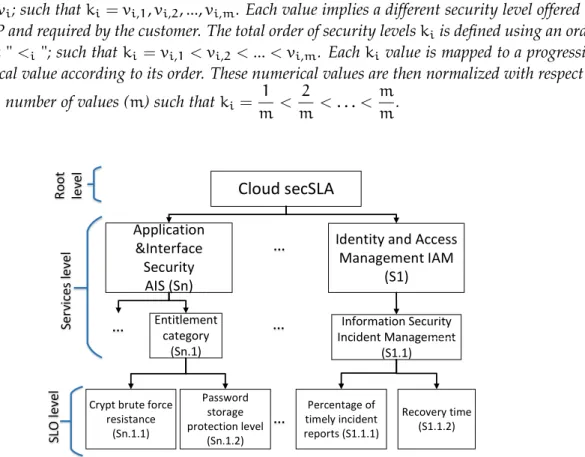
A Cloud secSLA describes the provided security services, and represents the binding commitment between a CSP and a customer. Basically, this outlines the desired security services, each of which contains a list of SLOs. Each SLO is composed of one or more metric values that help in the measurement of the Cloud SLOs by defining parameters and measurement rules that facilitate assessment and decision making. Based on the analysis of the state of practice presented in [LTTS17], Cloud secSLAs are graphically modeled using a hierarchical structure, as shown in Figure2.1. The root of the structure defines the main container for the secSLA. The intermediate levels (second and third levels in Figure 2.1) are the services which form the main link to the security framework used by the CSP. The lowest level (SLO level) represents the actual SLOs committed by the CSP which are consequently offered to the Cloud customer. These SLOs are the threshold values which are specified in terms of security metrics.
It is worth noting that the process of modeling values to a quantitative metric is not straightforward, as SLOs can have varied types/ranges of composite qualitative and quan-titative values. Hence, we introduce the notion of a "security level" associated to each SLO of the secSLA. To formalize this concept, we introduce the following definition:
Definition1 A secSLA consists of a set of servicesS=s1, ...,sn. Each servicesconsists of finite
valuesvi; such thatki=vi,1,vi,2, ...,vi,m. Each value implies a different security level offered by
the CSP and required by the customer. The total order of security levelskiis defined using an order
relation"<i"; such thatki=vi,1 < vi,2<...< vi,m. Eachki value is mapped to a progressive
numerical value according to its order. These numerical values are then normalized with respect to theki’s number of values (m) such thatki=
1 m < 2 m < . . . < m m. Entitlement category (Sn.1) Percentage of timely incident reports (S1.1.1) Recovery time (S1.1.2) Crypt brute force
resistance (Sn.1.1) Password storage protection level (Sn.1.2)
…
…
…
…
Ro ot lev el SLO leve l Ser vi ces leve lCloud secSLA
Identity and Access Management IAM (S1) Information Security Incident Management (S1.1) Application &Interface Security AIS (Sn)
Figure2.1.: Cloud secSLA hierarchy based on security posture provided by the STAR repository.
An example of an SLO, as shown in Figure2.1, is "Percentage of timely incident reports" SLO which is composed of {yearly < half-yearly < monthly < weekly} values which are defined using security levels as level1 < level2 < . . . < level4 respectively. These security levels correspond to {1
4 < 2
4 < . . . < 4
4 }. Let us consider a CSP committing "Percentage of timely incident reports" such that the CSP’s secSLA specify: Percentage of timely incident report= level2 such that vi=
2
4. A CSP commits other SLOs in a similar manner such that the overall CSP’s secSLA contains a list of SLOs with different values that the CSP is committed to fulfill. If any of these committed values are not fulfilled by the CSP, then the secSLA is violated.
We illustrate the secSLA’s structure and functionality better with an example. We con-sider a customer processing financial transactions using Software-as-a-Service (SaaS). The customer looks for a secSLA which specifies a recovery time objective of less than 1 minute and a monthly report offered by the selected CSP specifying the mean recovery times [HD12]. Using this example, we specify two SLOs ("Percentage of timely incident re-portsS1.1.1" and "Recovery timeS1.1.2") as shown in Figure2.1. The "Percentage of timely
incident reports" SLO is composed of {yearly,half-yearly,monthly,weekly} values which are defined using service levels aslevel1,level2,. . .,level4 respectively. If a CSP is committing a "Percentage of timely incident reports" ofmonthly, thenvS1.1.1 =level3. 2.2.2 Service Dependencies
A service dependency is a directed relation between the services offered in Cloud sce-narios. It is expressed as a1 : n relationship where one service (termed as dependent)
depends on one or multiple services (termed as antecedent). A service can depend on data or resources provided by another service. A services1 is dependent on services2 if the provisioning ofs1 is conditional to the provisioning ofs2. Explicit knowledge about dependencies is needed to support the management of secSLA by both CSPs and cus-tomers. Several types of dependencies are used in literature such as Quality of Service (QoS), price, resource and time dependencies [WSS10]. We only consider resource de-pendencies which are validated by matching the security values of the dependent and antecedent SLOs specified in their secSLAs.
For example, let us consider "Authentication & Authorization" Control (which defines the available authentication and user-credentials protection mechanisms) [Csi] that is com-posed of three different SLOs, namely "CSP authentication"1, "User authentication and
identity assurance level"2 and "Third-party authentication support"3. If we consider that
a CSP offering an authentication mechanism is performed by third-party (specified using "Third party authentication support" SLO in the secSLA), then the CSP does not need to specify the "User authentication and identity assurance level", as the other authentication SLOs become less relevant as authentication is performed by a third-party. This means the "Third party authentication support" SLO complements the other authentication SLOs.
Root
service 1
s1
k1
s1.2
k2
k5
k3
k4
k6
k7
k8
k9
service 2
s
2s2.1
s2.2
…
Horizontal dependency Vertical dependencys1.1
Unidirectional Bidirectionals1.3
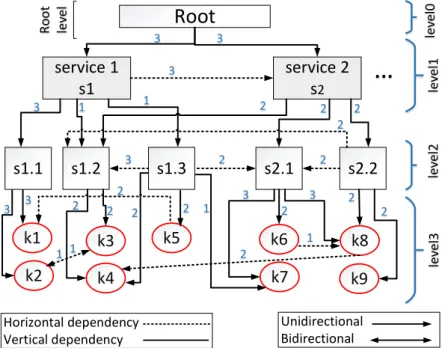
3 3 3 3 1 1 2 2 2 3 3 2 2 2 2 1 2 3 2 3 3 2 2 2 2 2 1 1 1 lev el 1 lev el 3 lev el 2 lev el 0 2 Ro ot lev elFigure2.2.: SecSLA hierarchy showing dependencies
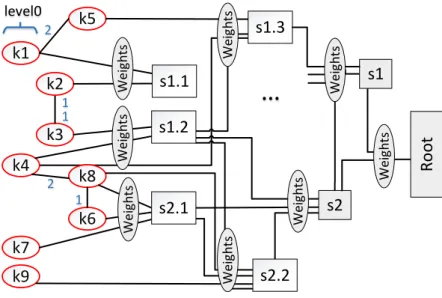
We classify dependencies based on their occurrence between services and/or SLOs at the same hierarchical level (horizontal dependencies), as well as between different lev-els in the hierarchical structure (vertical dependencies) [WS09] as shown in Figure 2.2. Dependencies can be further classified into direct and indirect dependencies. Direct de-pendencies occur between two interacting services. Indirect dede-pendencies occur between services which do not directly interact with each other, but where a transitive relation-ship exists via an intermediate service. Figure2.2 illustrates different dependencies such as, services2.2 depends on service s2.1 in the same hierarchical level, which represents a 1 Specifies the available authentication mechanisms supported by a CSP on its offered Cloud services.
2 Specifies the level of assurance of the CSP supported mechanisms used to authenticate a user.
direct horizontal dependency. Furthermore, s2.1 depends on k6 and k7, which specifies direct vertical dependencies. As a result, s2.2 depends on k6 andk7 indirectly through s2.1(i.e., Transitivity property). In many cases horizontal and vertical dependencies occur at the same time and both dependencies affect the whole composition hierarchy. We also consider different level of dependencies importance presented using a three level scale as shown in Table2.1and Figure2.2.
All the dependencies explained so far are considered unidirectional dependencies. Other dependencies as bidirectional (interdependent relations between services) may occur as well. Bidirectional dependency occurs between services s1 and s2 if the provisioning of s1 is conditional to the provisioning ofs2 and at the same time the provisioning ofs2 is conditional to the provisioning ofs1.
We assume that dependencies between services and SLOs in the secSLA are predefined and described by relevant standards working groups. In these groups, usually industry and academia, the secSLAs’ contents are defined along with the type of dependencies and associated dependency importance levels. These sets of dependencies are categorized in the secSLA template. This template is later used in the creation of the dependency model and for the SLOs validation (cf., Section2.3.4).
Numeric scale Meaning 1 Weak dependency 2 Medium dependency 3 Strong dependency
Table2.1.: Dependency importance level
2.3 quantitative reasoning system architecture
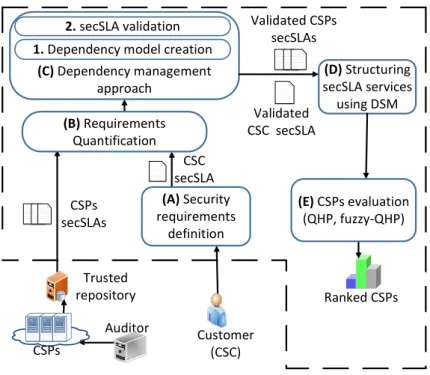
The system involves five progressive stages as depicted in Figure 2.3. In Stage (A), we express in a common way both the customer’s security requirements and the CSP’s com-mitted SLOs using a standardised secSLA template (e.g., based on ISO/IEC19086[Int14]). The customer and CSPs’ secSLAs from the preceding stage feeds into (B) to evaluate the rules and computes quantitative values of the customers’ security requirements and CSPs’ secSLA. A dependency model is created in Stage (C) to capture information about sec-SLAs’ services and the dependencies that occur between them. This model is specified using a machine-readable format in order to allow automated validation for checking service conflicts and different SLOs’ compatibility issues. After that in (D), the validated secSLAs are structured using the Dependency Structure Matrix (DSM). The structured sec-SLA shows the level of dependencies between services in a precise order that makes the secSLA clear. The structured secSLAs are utilized in Stage (E) to assess and rank the CSPs according to the customer requirements. We propose two assessment techniques which evaluate different security levels committed by various CSPs and rank them according to their secSLAs; namely, the Quantitative Hierarchical Process (QHP) [TTLS14] and the Fuzzy Quantitative Hierarchical Process (fuzzy-QHP) [TTLS17].
(C) Dependency management approach 1 3 2 Ranked CSPs (A) Security requirements definition Auditor CSPs secSLAs (D) Structuring secSLA services using DSM CSC secSLA
1. Dependency model creation
2. secSLA validation Validated CSPs
secSLAs Validated CSC secSLA Trusted repository (E) CSPs evaluation (QHP, fuzzy-QHP) CSPs Customer (CSC) (B) Requirements Quantification
Figure2.3.: Proposed system stages
2.3.1 Trust Model
Before detailing the proposed framework stages, we note that customers are only able to trust the result of the proposed assessment as long as the information taken as input is re-liable. In order to guarantee the validity of the proposed system, the secSLAs provided by the participating CSPs are required to come from a trusted source. In a real-world setup, the trust relationships can be given by an Auditorperforming a third-party attestation of the CSP secSLA (e.g., through a scheme such as the CSA Open Certification Framework (OCF) [Clo17c]). The audited secSLAs are then stored by the CSPs in a trusted repository of SLAs (e.g., the CSA STAR repository [Clo17d]), as shown in Figure 2.3. This trust as-sumption relies on the fact that the certifications and the repository are trusted, and that the published secSLAs were valid at the time of issuing the corresponding certification or publishing the information in the repository. Stronger assurance levels can be provided by mechanisms such as continuous monitoring (e.g., the CSA STAR continuous monitoring defined at the level3 of the OCF). The described trust model is able to mitigate the risk of having malicious CSPs publishing false secSLA information with the goal of achieving higher scores in the proposed evaluation system. Other minor risks (e.g., tampered evalu-ation systems’ software) can be mitigated through traditional security controls and secure software development techniques.
2.3.2 Stage (A): Security Requirements Definition
Customers can assess the CSPs and choose the CSP that best satisfies their security re-quirements only if the CSPs shared security information are relevant to customers’ con-cerns (i.e., stemmed from customers’ requirements) and are of an equal value [Mes06]. To achieve this, customer creates his/her set of security requirements using the same secSLA hierarchical structure used by the CSP to specify the offered security services (as depicted
in Figure 2.1)4. Accordingly, the Cloud secSLA hierarchy is used in two different ways.
On the one hand, it is used to represent the CSP’s secSLA by defining SLOs at the lowest level of the hierarchy. Each CSP’s secSLA define the set of security services and their corresponding values that each CSP undertakes to fulfill. On the other hand, the sec-SLA hierarchy can also be used to define the customers’ requirements and specify their preferences at different levels of granularity (which is at different levels of the hierarchy structure) according to their expertise.
Three different types of requirements specification, according to the customer expertise, are specified in this stage:
1. Precise values: Expert customers can specify their requirements at the SLO level by defining the required value for each SLO. Mainly, CSPs specify their offered levels at the SLO level.
2. Linguistic terms: Used by novice customers who could not specify precise values at the SLO level. In order to let these customers adopt Cloud services, it would be desirable to allow them to express their general requirements in a descriptive manner. Thus, customers specify qualitative requirements using terms such as (Not-Required (NR), Less-(Not-Required (LR), (Not-Required (R), Highly- (Not-Required (HR), and Do-not-know (Dk)) to reflect their requirements.
Highly-Required denotes that all security SLOs are mandatory requirements for the customers. Not-Required (NR) indicates that the security SLOs are not required by the customers. Required and Less-Requiredspecify the customers’ different degrees of requirements importance where the customers can accept varied values specifying several degrees of importance that depend on the considered scale. Do-not-know
specifies the customers’ unknown requirements.
3. Natural language statements: Since humans are accustomed to using descriptive phrases to make rough estimations, they can easily submit meaningful requirements in the form of natural language statements. To achieve this, (i) such a language must be based upon information that customers find cognitively easy to reflect upon and express, and (ii) the information communicated in such language should be reasonably easy to interpret.
Considering this list of requirements, it appears unavoidable that such a language would be based on linguistic terms or qualitative information. For example “Ihighly requirea provider encrypting data in transit and at rest".
Blended submissions of different types of requirements for the same secSLA are also supported in our proposed approaches. Chapter 2.4 illustrates, using a real-world case study, how different types of requirements help customers to define their requirements. The output of this stage is a customer secSLA which is then used along with one or more CSP’s secSLAs, as an input to the next stage.
2.3.3 Stage (B): Requirements Quantification
To assess and compare the security levels provided by different CSPs according to the dif-ferent customers’ expertise, a measurement model for difdif-ferent security SLOs is defined. 4 Cloud Security Alliance (CSA) has created a consensus assessments initiative questionnaire (CAIQ) [Clo17b],
However, the process of modeling SLO values to a quantitative metric is not straight-forward, as SLOs can have varied types/ranges of qualitative and quantitative values. Considering the different nature of SLOs (i.e., qualitative and/or quantitative), two as-sessment techniques are proposed in this chapter (QHP and fuzzy-QHP). Each asas-sessment technique introduces a different approach to quantification.
For example, the QHP [TTLS14] defines security levels for each SLO separately, depend-ing on the type of the SLO. QHP allows customers to specify precise values and/or ldepend-inguis- linguis-tic terms to detail their requirements. Unlike QHP, fuzzy-QHP aims to solve the problem of "accurately" evaluating the security level of a CSP when qualitative requirements are defined by the customers. Fuzzy-QHP allows customers to specify their requirements us-ing natural language statements as well as precise values and lus-inguistic descriptors. These statements are defined usingif-thenrules which are used to capture the imprecision of cus-tomers’ requirements according to their security expertise by using the triangular fuzzy numbers (TFNs) [Men95].
We detail the standalone operations of each technique from the secSLA perspective in Section2.3.6.
2.3.4 Stage (C): Dependency Management Approach
A dependency model is created in this stage to capture information about secSLAs’ ser-vices and the dependencies that occur between them. This model is specified using a machine-readable format to allow automated validation for checking service conflicts and different SLOs’ compatibility issues. The approach for managing service dependencies builds on a dependency model, which is used to capture information about security ser-vices and the dependencies that occur between them. In order to model service dependen-cies, it is important to first derive the expected requirements that the dependency model should support.
1. Support of different dependency types. The dependency model should support different types of dependencies as well as various dependency classifications (e.g., horizontal, vertical, unidirectional, and bidirectional dependencies).
2. Support of multiple dependencies. One security service can have dependencies with sev-eral other security services. These dependencies could be of the same or of different types.
3. Dependency model validation. It should be possible to validate the dependency model to avoid inconsistencies and conflicts.
This dependency management approach is performed in two steps as shown in Figure 2.3.
Step1: Dependency Model Creation
Handling all the dependencies in the secSLA is a very time consuming and complex task. Therefore, a dependency model is created for each secSLA to cover all identified dependencies within the secSLA. This model is used to capture information about services (each composed of a set of SLOs) and the dependencies that occur between them. We model a secSLA by a tuplesecSLA= (S,l,!S,K,!K,v)where:
• S is a set of services s with associated hierarchy levels l(s) 2 {0,1,. . .,n-1}. As shown in Figure 2.2, a secSLA is composed of four hierarchical levels. A secSLA contains exactly one serviceswithl(s) =0, which is the root service. Levelnis the SLO level.
• !S✓ S⇥(S[K)⇥{1,2,3} models service dependencies where {1,2,3} shows the dependency importance level w(cf., Table2.1).
• We write s1 w!S s2 if s1 (dependent service) depends on s2 (antecedent service) with dependency importance level w, where w 2 {1,2,3}. We write s !S o to express that s w!Sofor somew2{1,2,3}(whereois either a service or an SLO). • Kis a set of SLOs with associated hierarchy levell(k) =nfor allk2K.
• !K✓ K⇥K⇥{1,2,3} models SLO dependencies. We havek1 w!K k2 if k1 (depen-dent SLO) depends on k2 (antecedent SLO) with importance levelw.
• v :K 7!V is an assignment of values inV to SLOs, whereV is the set of all metric values of each SLO inK.
• Constraints on the SLO dependency relation are specified using a constraint set
C!K
v ✓ K⇥K⇥{=,6=,<,6,>,>}. A constraint(k1,k2,⌘) 2 C!v K is satisfied if the values of k1 andk2 are related by the given comparison, i.e., v(k1) ⌘v(k2). A de-pendency relationk1 !Kk2 is called valid, writtenvalidCv!K(k1,k2), if the relation satisfies all its constraints, i.e.,8(k10,k20,⌘)2C!K
v .(k1 =k10 andk2 =k20))v(k1)⌘ v(k2)k.
• We write the transitive closure of !S as !+S, i.e., s1 !+S s2 if s1 !S s2 or 9s3 2 S.s1 !S s3 ands3 !+S s2. A dependency o1 ! o2, where!2 {!S,!K}, between two objectso1,o2 2 S[K is called symmetric if alsoo2 !o1. Otherwise,o1 ! o2 is called non-symmetric. In other words,o1 ando2 are symmetrically dependent if o1!o2 ando2 !o1.
Note that it is possible that o1 ! o2 is symmetric while the relation ! is non-symmetric. We explain this using an example, let us consider!={(o1,o2,w),(o2,o1, w),(o1,o3,w)} which is a non-symmetric relation and where we have thato1 ! o2 is symmetric.
• A secSLA has to satisfy the following constraints:
1. Services do only depend on services of the same or the next lower hierarchy level: 8s1,s2 2S.s1 !S s2 )l(s1) =l(s2)orl(s1) +1=l(s2)
2. Only services of hierarchy leveln-1depend on SLOs: 8s2S8k2K.s!Sk) l(s) =n-1
3. Services do not depend on themselves: 8s2S.¬s!Ss
4. All services depend directly or indirectly on an SLO:8s2S9k2K.s!+ S k
Step2: SecSLA Validation
A meta-model is developed based on the dependency definitions. This meta-model allows the description of SLOs along with information on the secSLA drafted for it. The meta-model is specified using a machine readable format (allowing an automaated validation)
such as an XML data structure using an XML Schema. In this Schema, dependency rela-tions between services are modeled by including the involved service SLOs and their roles as dependent or antecedent as well as their values. Moreover, the constraint comparison is extracted and modeled in the Schema. A brief excerpt from the secSLA dependency model is shown in Listing2.1, where an example of two SLOs named "User authentication and identity assurance level" (kUsauth) and "CSP Authentication" (kCSauth) and the depen-dent relation between them are shown, so thatkUsauth!KkCSauth. Their security levels are modeled asv(kUsauth) andv(kCSauth), respectively.
The requirement is that the security level ofEnc is higher than or equal to the security level ofkUsauth, i.e.,v(kCSauth)>v(kUsauth). This requirement is modeled as(kUsauth,kCSauth,6
)2C!K v .
Note that all service levels (e.g.,level2,level3,. . .) are modeled as numerical values. These numerical values are the security SLOs’ values in the XML schema shown in Listing2.1.
Listing2.1: Excerpt of dependency model of a secSLA
<secSLA slaid=" sla1">
<dependencyModel Depmodelid="depmod_1">
<sloDependency Depid="dep-1" type=‘‘unidirectional"> <dependent depSLOid="AA1.1_sla1" value ="2"/> <antecedent antSLOid="AA1.2_sla1" value="3"/> <constraint> leq </constraint>
</sloDependency> </dependencyModel> </secSLA>
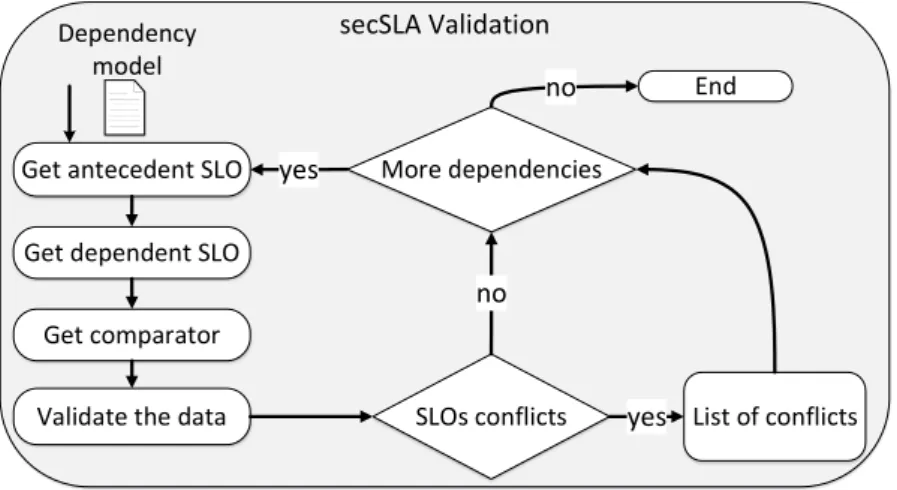
Following the development of the dependency model, the secSLA SLOs are validated, as shown in Figure2.4. The validation is done by first extracting the secSLA ID, dependency model ID, and dependency ID of two dependent SLOs (each dependency relation in the same dependency model has a unique ID) defined in the XML Schema. Furthermore, for each dependent relation, the antecedent and dependent SLO’s values are extracted. This entails extracting the constraint comparative (i.e.,=,6=,6,>) and checking if the two dependent SLO values satisfy the constraint. If the constraint between dependent SLOs is not satisfied, the validation scheme shows a conflict between these two SLOs. The dependency ID and dependent SLO ID of the affected SLOs are saved in a list, while the evaluation is continued to determine further conflicts. At the end of this phase, a list of all conflicts found in the CSP’s secSLA with the conflicts explanation is sent to the CSP in order to resolve these conflicts and resubmit his/her secSLA again to be validated. Similarly, a list of all conflicts found in the customer requirements (specified using the customer secSLA) are resolved by the customer and validated again. If no problems are detected, both the validated CSPs’ secSLAs along with the customer’s secSLA are used as an input to Stage (D).
Algorithm1 details the necessary steps for extracting the values of validating a depen-dency relation between SLOs in pseudocode notation.
2.3.5 Stage (D): Structuring SecSLA Services
In a secSLA, as the number of offered services and SLOs along with the dependencies between them increases, the secSLA hierarchical structure (shown in Figure2.2) quickly becomes cluttered and becomes a disorderly network of tangled arcs. This makes it hard
secSLA Validation
Get antecedent SLO Get dependent SLO Get comparator
Validate the data SLOs conflicts List of conflicts no More dependencies yes yes no End Dependency model
Figure2.4.: Dependency based secSLA validation stages
for (i) the customers to specify their requirements and resolve the conflicts (which requires an expert customer and is time consuming) and (ii) the CSPs to check the dependency re-lations between their offered services to avoid any violation. Consequently, the objective of this stage is to embody the secSLA hierarchical structure by mapping the dependencies in a precise order where services and SLOs are ordered according to their level of depen-dency. This ordering makes the dependency relations explicit and more traceable regard-less of the size which allows customers to (a) easily define their security requirements and (b) assess and rank the CSPs according to their security requirements. Furthermore, this provides CSPs with the guidance on the security improvements that should be performed in order to achieve the customer requested security level.
A variety of techniques exist for the analysis, management, and ordering of the secSLA services and SLOs other than the graphs used in building the secSLA hierarchical struc-ture. One of these techniques is the program evaluation and review technique [WL77]. Although this technique incorporates more information than the directed graphs, it is still inadequate for representing the vast majority of design procedures where iteration5
task relationships are involved. Another technique which has been widely used in docu-menting design procedures is the structured analysis and design technique [Ros77]. This technique attempts to overcome the size limitations by restricting the amount of infor-mation that can be placed on each document. Unfortunately, loops remain an unsolved problem [MM87].
A representation which overcomes the size and the iteration tasks limitations of those discussed above is the Design Structure Matrix (DSM) (also known as "Dependency Struc-ture Matrix") [Ste81]. There are two main categories of DSMs: static and time-based [Bro01]. The DSM embodies the structure of the underlying design activity by mapping the relations between services in a precise order which makes the secSLA clear and easy to read, regardless of the size. To clarify, a secSLA ofnservices is represented as ann⇥n matrix with identical row and column labels. The matrix elementaij is empty if the ith column is independent on thejth row, and not empty if they are dependent. This means, services and SLOs with empty rows have all required information and do not depend
5 A loop of information which occurs if there are bidirectional relations between services, which means each service is waiting for information from the other one.
Algorithm1: Validation
Input: String slaID, String depmodelID, String depID
Output: List affectedSLOs= NIL List dependencyList = NIL Value dependentValue = NIL Value antecedentValue = NIL
List dependencyModels = getModels(depmodelID, slaID)
formodel2dependencyModelsdo
dependencyList = getDependencies(depID, model)
fordepend2dependencyListdo
dependentValue=getValue(depend.depSLOvalue, depID) antecedentValue=getValue(depend.antSLOvalue, depID) dependentConst=getConst(depend.constraint, depID)
ifvalidate(dependentValue, antecedentValue, dependentConst)6=truethen affectedSLOs.add(depend.depSLO)
end if end for end for
on others. Furthermore, the empty columns provide no information required by other services and SLOs.
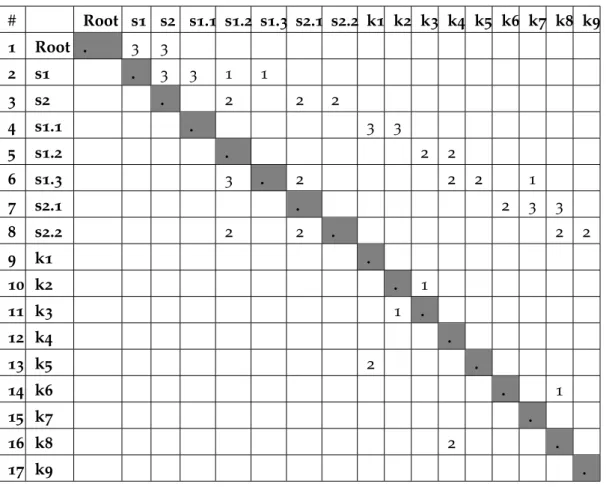
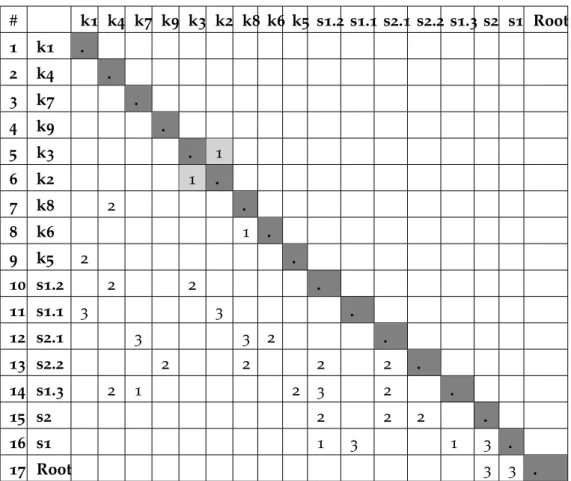
To demonstrate the idea of DSM, the mapping of the secSLA shown in Figure2.2into a DSM is presented