Implementing a General Real-Time Scheduling Framework
in the RED-Linux Real-Time Kernel
Yu-Chung Wang and Kwei-Jay Lin
Department of Electrical and Computer Engineering
University of California, Irvine
Irvine, CA 92697-2625
{wangy, klin}@ece.uci.edu
Abstract
Many scheduling paradigms have been studied for real-time applications and real-real-time communication network. Among them, the most commonly used paradigms include priority-driven, time-driven and share-driven paradigms. In this paper, we present a general scheduling framework which is designed to integrate these paradigms in one
frame-work. The framework is implemented in our real-time
extension of the Linux kernel, RED-Linux. Two sched-uler components are used in the framework: Allocator and
Dispatcher. For each job, the framework identifies four
scheduling attributes: priority, start_time, finish_time and
budget. We show that the framework can be used to
effi-ciently implement many well-known scheduling algorithms. We also measure and analyze the performance of the frame-work implemented in RED-Linux.
1
Introduction
After more than 20 years of active and rigorous research on real-time computing, the real-time community is now ready and eager to transfer many excellent research results to the industry. However, we need a practical yet open operating system upon which many theoretical real-time work can be prototyped, demonstrated, and implemented so that they can be easily transferred to practical system builders. It is gen-erally agreed that most commercial embedded OS products do not have the right architecture. They cannot facilitate so-phisticated schedulers and adaptive resource management. On the other hand, general purpose OS’s (such as Windows, Unix, Mach etc.) are not designed to support real-time tasks with hard timing constraints. Several projects and products have tried to enhance general purpose OS products so that they can provide some better support to real-time tasks.
We have recently initiated a real-time kernel [23] project based on the popular and open Linux kernel. One of the
This research was supported in part by UC/MICRO 98-085, 99-073 and 99-074, Raytheon and GeoSpatial Techonolgy, and by NSF CCR-9901697.
most important reasons for us to choose Linux as the ba-sis of our project is the large user population Linux enjoys. Linux has become one of the most popular OS’s in the short time since its creation. Many users are attracted to Linux because of its capability and flexibility. The open source policy behind Linux allows it to grow constantly and to be-come more robust and efficient from the collected effort of many enthusiastic users. By expanding the Linux capabil-ity to the real-time domain, we hope to attract many Linux users to the real-time community so that they may help us transfer new real-time technologies to the real world. This will also create the opportunity for us to learn from the ex-perience of practical system builders.
Our real-time kernel project is called RED-Linux
(Real-time and Embedded Linux). To be used by embedded
ap-plications, two important properties for the kernel are the efficiency and the flexibility. For efficiency, we have im-plemented a mechanism that provides a short task dispatch
time (<100s) [23], and also ported a high resolution timer
and the software interrupt emulation mechanism from RT-Linux [2]. To enhance the flexibility, we would like to provide a better scheduling support in RED-Linux. Linux, like many Unix variants, provides only POSIX-compliant priority-driven scheduling. However, we would also like to support driven scheduling in RED-Linux since time-driven scheduling is a proven technology used in many real-time applications. There are also some recent results on time-driven scheduling (such as TTP [14], pinwheel scheduling [8, 9, 10] and the Rialto system [12]). Finally, we believe that the share-driven paradigm (such as the pro-portional sharing [18] and approximations [3, 21, 22]) are very desirable for real-time applications and network with end-to-end delay constraints, due to its capability to pro-vide bandwidth isolation. So we think RED-Linux should support all three paradigms since different applications may use different ones.
In this paper, we present the general scheduling frame-work used in RED-Linux to allow these three scheduling paradigms to be supported efficiently. Instead of building each paradigm as a separate and independent scheduling server and let each real-time application choose one of the
three, our framework integrates these paradigms in a general framework. We identify the basic set of orthogonal schedul-ing attributes for each job and directly support (or enforce) them in the framework. By adjusting attribute values and selection criteria based on these attributes, it is possible to implement many scheduling algorithms in our framework easily. Moreover, by modeling algorithms from different paradigms in one common framework, we can better un-derstand the similarities and differences among them. One may also investigate integrations of these basic scheduling attributes to design new scheduling algorithms.
The contribution of this work is that we have designed a general scheduling framework to efficiently support dif-ferent real-time schedulers in one operating system. Since most embedded applications need a predictable yet flex-ible scheduler, it is highly likely that embedded system builders will design their own schedulers. Our proposed framework allows RED-Linux to be easily reconfigured with application-dependent schedulers without modifying the complex low-level kernel scheduler. The framework also makes many sophisticated scheduling schemes easier to understand. Using the framework, different scheduling paradigms can be deployed at different time by the same ap-plication. This is useful for systems in which mode changes are necessary; different modes can use different scheduling paradigms to guarantee different QOS requirements.
The rest of this paper is organized as follows. Section 2 reviews popular scheduling paradigms used in real-time systems. Section 3 presents the proposed general schedul-ing framework. The framework components are discussed in detail in Section 4. This is followed by a discussion in Section 5 on how existing scheduling algorithms can be im-plemented in the framework efficiently. Section 6 shows the performance overheads of our framework implementation in RED-Linux. Finally, we compare our work with other related work in Section 7.
2
Scheduling Paradigms
In real-time systems, all real-time tasks are defined by their timing specifications, such as periodic or sporadic, deadline, rate, etc. It is the responsibility of the system builder to choose an operating system that may schedule and execute these tasks, as well as meet their communication requests, according to the timing specifications as precisely as possi-ble. To date, three main scheduling paradigms have been used to schedule real-time tasks, namely, priority-driven, share-driven and time-driven. Before we present the gen-eral scheduling framework, let us first review the different scheduling paradigms it tries to support.
2.1
Priority-driven scheduling
The most common approach to implement real-time sys-tems is to adopt a periodic process model and use the
priority-driven scheduling paradigm. Priority-driven (PD) scheduling is implemented by assigning priorities to tasks. At any scheduling decision time, the task with the highest priority is selected and executed. PD scheduling includes two types of algorithms, fixed priority and dynamic
prior-ity scheduling. A well-known fixed priorprior-ity algorithm for
periodic tasks is the Rate-Monotonic (RM) algorithm [15]. The most popular dynamic priority scheduling algorithms is Earliest Deadline First (EDF). The EDF algorithm assigns priorities to tasks according to their absolute deadlines.
However, the PD paradigm allows a misbehaving high priority task to overrun and reduce the available CPU band-width to tasks at all lower priority levels. When the system becomes overloaded, the scheduler needs some extra mech-anism to control misbehaving tasks. Thus in a PD scheduler, it is critical to have a good admission control mechanism. In addition, the priority attribute is defined by the timing con-straints such as the period length (in RM) or the deadline (in EDF), not the importance of the task. It is difficult to sched-ule tasks with a long period (or a late deadline) but need a fast response time.
2.2
Share-driven scheduling
Although the PD paradigm can be quite effective, most PD scheduling algorithms assume a rigid distinction between time and non-time tasks and always handle real-time tasks first. There are situations where such solutions may not be appropriate. For example, in a real-time video-conferencing system, no hard guarantees of real-time per-formance are required.
For such applications, a proportional share resource al-location paradigm, which we will call share-driven (SD) in this paper, may be more desirable. The SD scheduling paradigm is based on the GPS (General Processor
Shar-ing [18]) algorithm. In the context of network packet
scheduling, GPS serves packets as if they are in separate logical queues, visiting each nonempty queue in turn and serving an infinitesimally small amount of data from each
queue. Using the SD approach for OS scheduling,
ev-ery real-time task is requested with a certain CPU share (or weight). All tasks in the system share the computing resources according to the ratio based on their requested shares. Some well-known SD scheduling mechanisms in-clude the Weighted Fair Queueing (WFQ) [5], also known as Packet Generalized Processor Sharing (PGPS) [18], WF2Q [3], Fair Service Curves [22], etc.. Similar ideas have been used in CPU scheduling such as the Total Band-width Server [19], the Constant BandBand-width Server [1], and the Constant Utilization Server [6]. An implementation of the SD scheduler has been reported using the FreeBSD ker-nel [21, 11].
One problem of SD is that it may not guarantee a timely completion of hard real-time jobs when the system is over-loaded. Another problem is that no concept of priority is de-fined in the SD paradigm; all channels are to be treated fairly
according to their shares. When the system is overloaded, all channels will receive larger delays proportionally.
2.3
Time-driven scheduling
For systems with steady and well-known input data streams, time-driven (TD) (or clock-driven) schedulers have been used to provide a very predictable processing power for each data stream [14, 8]. In this scheduling paradigm, the time instants when each task starts, preempts, resumes and fin-ishes are pre-calculated and enforced by the scheduler. It is therefore easy to predict and to control task behaviors. Applications such as small embedded systems, automated process control, sensors etc. can be implemented efficiently using this scheduling paradigm.
In TD, decisions on which tasks execute at what times are made at specific time instants. These instants such as start time or finish time of a task are usually computed a priori before the system begins execution. That means, a system schedule is usually computed off-line and stored for use at run-time. This provides a good predictability and allows for off-line schedule optimization. Although efficient on-line algorithms have been proposed for some special cases [12, 10], TD schedulers are usually less flexible and they are not designed to be work conserving, i.e. jobs may not be able to use the spare time not used by other jobs.
2.4
Comparing scheduling paradigms
Table 1 shows a comparison of the three scheduling
paradigms. Note that our comparison is based on the
basic scheduling scheme in each paradigm. There have been many advanced algorithms that are based on the ba-sic scheduling schemes in several paradigms. They do not fit cleanly into any one paradigm in our general discussion. The purpose of our comparisons presented here is simply to motivate the design of our proposed general framework.
We first compare how each paradigm handles task over-run. In the TD paradigm, a task will be suspended at its predefined finish time. For PD, a high priority task will con-tinue to execute and take resources away from lower priority tasks. In SD, other tasks will not be affected by an overrun task since each task has its own budget.
As for the task importance or criticality, no concept of priority is used in the TD and SD paradigms. The RM al-gorithm defines task priorities based on their period lengths rather than task importance. Therefore, all paradigms do not distinguish the different levels of criticality among tasks.
In terms of scheduling flexibility, PD is the easiest to ac-commodate new task arrivals by simple adding another pri-ority level. It is also quite easy to add a new task in SD but all task shares must be modified. TD schedules usually need to be regenerated for any new task arrival so it is the lest flexible.
3
A General Scheduling Framework
We can see from the last section that each scheduling paradigm has its merits and weaknesses. It would be ideal if there is a scheduling scheme which can combine the de-sirable capabilities of all three. It is the goal of our research to pursue such a scheme. Our proposed general schedul-ing framework is one step toward this goal. In this section, we introduce a general scheduling framework for real-time systems. Two issues will be discussed: the scheduling at-tributes used in the framework and the scheduler compo-nents used to make scheduling decisions.
3.1
Scheduling attributes
In our model, the smallest schedulable unit is called a job. For systems with periodic activities, we call a job stream as a periodic task. There are also aperiodic tasks that consist of many small jobs that do not arrive at regular intervals. In our implementation, all jobs from the same task use the same address space and share the same state information. In other words, jobs are defined for scheduling purposes only. Any unfinished work in one job will be continued by the next job from the same task unless the task decides to abort it.
As we have discussed in the last section, different scheduling paradigms use different attributes to make scheduling decisions. In order for all paradigms to be sup-ported in our framework, it is important for all useful timing information to be included in the framework so that they can be used by the scheduler. However, we want to define only a minimum set of basic timing attributes. Therefore the basic attributes should be orthogonal to each other.
In our earlier work on the programming language
Flex [13], we have identified four timing attributes: start time, finish time, interval, and duration. The first two are
used to represent absolute timing constraints for a job ex-ecution, while the latter two define the relative timing con-straints. We decide to use only the absolute timing attributes in our new framework. We also include the notion of job im-portance so that the system can decide which job to skip dur-ing system overloads or how to improve the performance of critical system events. Finally, we need some budget mech-anism to constrain the total execution time used by a job. We therefore decide to denote the following four scheduling attributes for each job in our framework:
1. priority: A job’s priority defines the scheduling prefer-ence of the job relative to other jobs in the system. 2. start_time: The start_time defines when a job may be
executed. No job can be executed before its start time. 3. finish_time: The finish_time of a job is its deadline. At a job’s finish_time, even if the job has not finished, it may be stopped.
Table 1. Comparisons of Scheduling Paradigms
Time-Driven Priority-Driven Share-Driven task overrun terminate the task continue (if high priority) isolated delay
task importance not defined period length(RM) not defined
new task entry need a new schedule adjust task priority adjust shares
4. budget: Budget is the allowed execution time of a job. A job will be terminated when its execution has used up its budgeted time.
Among the four, the start_time and the finish_time to-gether define the eligible interval of a job execution. The priority specifies the relative order for job execution. The budget specifies the total execution time assigned to a job. These attributes thus can be used as constraints. However, these timing attributes can also be used as the selection fac-tors when a scheduler needs to select a job to be executed next.
3.2
Scheduler components
A scheduler is responsible to assign system resources to each job in the system according to its QOS requirement. However, the high level QOS specification defined by the user application usually cannot be directly enforced by the scheduler. These QOS parameters must be mapped into low level attributes to be handled by the scheduling mechanism. For example, a CPU scheduler may be designed to sched-ule jobs within its eligible interval, and select a job with the highest priority. Therefore, the scheduler needs to know the start and finish times of the eligible interval and the prior-ity of jobs. However, using the Rate Monotonic scheduling, an application specifies only the period and the execution time of each task. Therefore, some middle-layer scheduling server between the low level scheduler and the user appli-cation must map those high level QOS parameters into low level attributes. For RMS, it must translate the period and execution time into the start time, the finish time and the priority.
In most real-time kernels, this middle-layer server is com-bined with the low level scheduler and implemented as the "kernel scheduler". However, there are some benefits to separate these two modules inside the traditional scheduler. Firstly, it’s much more difficult to write a low level sched-uler than the QOS parameter translator since the low level scheduler is intensively coupled with the structure and func-tionality of the kernel. If we separate these two modules, it will be easier to design a new QOS parameter translator since the low level scheduler does not need to be changed. This makes the task of implementing and experimenting new scheduling algorithms much easier. Moreover, if the QOS parameter translator is separated from the low level scheduler, it is possible to let the application provide the mapping itself. An application can even produce a sched-uler using dynamic runtime conditions.
We propose a two-component scheduling framework for real-time OS. The framework (Figure 1) separates the low level scheduler, or dispatcher, from the QOS parameter translator, or allocator. We also design a simple interface to exchange information between these two components. It is the allocator’s responsibility to set up the four scheduling at-tributes (priority, start_time, finish_time, budget) associated with each real-time job according to the current scheduling policy. The dispatcher inspects each job’s scheduling at-tribute values, chooses one job from the ready queue and dispatches it to execution.
In addition to assigning attribute values, the allocator also determines the evaluation function of scheduling attributes, since each job has multiple scheduling attributes. This is done by producing an effective priority for each job. The al-locator uses one or more attributes to produce the effective priority so that the dispatcher will follow a specific
schedul-ing discipline. For example, if thepriority attribute is
desig-nated as the effective priority, the dispatcher would become a simple PD scheduler. If the finish_time attribute is used as the effective priority, the dispatcher acts as an Earliest Dead-line First scheduler. The effective priority may use two or more scheduling attributes, e.g. the start_time as the pri-mary attribute and the priority as the secondary attribute.
The way in which the allocator sets up the attributes and the dispatcher chooses a job reflects the current scheduling policy. In this framework, the allocator defines the policy and the dispatcher provides the mechanism. In this way, we are able to separate the scheduling policy from the schedul-ing mechanism. It is the responsibility of the OS kernel to provide a flexible mechanism but not to define the pol-icy. On the other hand, the real-time application should de-fine the scheduling policy most appropriate for its mission, and use the allocator to implement the policy. This gen-eral scheduling framework provides a flexible means so that real-time system developers may choose different schedul-ing policies tailored to their specific needs. The scheduler may even switch between different scheduling paradigms at run time.
4
The Implementation of Dispatcher
and Allocator
To show the feasibility and the flexibility of the framework, we have implemented a dispatcher and an allocator in RED-Linux. In this section, we discuss the implementation de-tails. In the discussion, we simply refer to the two
Schedule Allocator Time Driven Scheduler Priority Driven Scheduler Share Driven Scheduler deadline priority start_time
Task 1 Task2 ... Task N
other attribute combinations
New Schedulers JOB priority start_time fiinish_time budget Schedule Dispatcher
Figure 1: Structure of Scheduling Framework
reach finish time or exit
ready
active sleep
reach start time
sleep
wakeup end
Figure 3: State diagram of job
nents as Dispatcher and Allocator.
4.1
Dispatcher
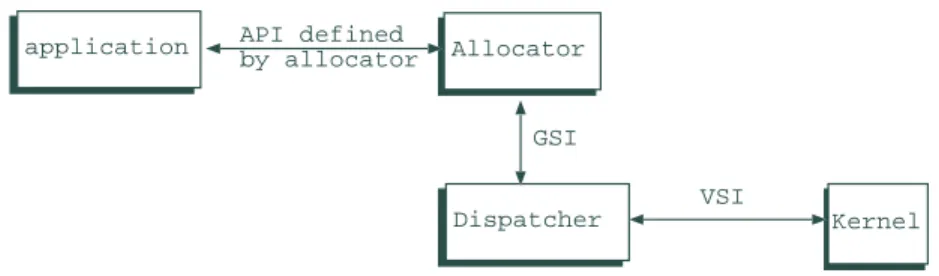
Dispatcher is implemented as a kernel module in RED-Linux. A kernel module in Linux can be linked to the kernel dynamically and has all kernel privileges. Dispatcher uses functions defined in our Virtual Scheduler Interface (VSI) to communicate with the RED-Linux kernel (Figure 2). Dis-patcher is responsible for scheduling real-time jobs that have been registered in Allocator. All non-real-time tasks will be scheduled by the original (non-real-time) Linux scheduler if no real-time job is ready for execution or during the time reserved for non-real-time jobs.
Dispatcher is used to determine the execution order as any traditional kernel scheduler. The basic unit of scheduling is job instead of task. Dispatcher moves jobs between several states as follows:
Ready This is the initial state of a job. Dispatcher will not
select a job is in the ready state for execution. A job in
the ready state will be moved to the active state at its start time.
Active Dispatcher will select one of the jobs in the active
state to run next. A running job will be moved into the sleep state if Dispatcher receives a sleep event (waiting for some resources).
Sleep A job in the sleep state is waiting for some resources
and can not be selected for execution by Dispatcher. It waits for the wakeup event to return to the active state.
End Jobs have reached its deadline or terminated.
The state diagram is shown in Fig. 3. The system has a job queue for all jobs in each of the states except the end state. For each job, we need three timers to control its execution. A startup timer is used to move a job into the active queue. A finish timer is used to move a job to the end state when a job reaches its finish time. A budget timer is used to move a job to the end state when the job’s budget is used up. The budget timer is decided dynamically at run time. Whenever a job is selected by Dispatcher as the next running job, its budget timer is reset to the current time plus its remaining budget. Dispatcher is invoked whenever any timer expires. When Allocator creates a new job, Dispatcher will be invoked to see if the new job should be scheduled immediately. Finally, when a job terminates Dispatcher will be invoked to select the next running job.
Dispatcher is implemented by the following algorithm:
Step 1 Test the next event:
- for new job event, add the job to the ready queue. - for start timer event, move the job to active queue.
API defined by allocator application Allocator Dispatcher Kernel VSI GSI
Figure 2: API’s in the framework
- for finish or budget timer event, remove the job. - for "wait for resources" event, move job to sleep queue.
- for "get resources" event, move job to active queue.
Step 2 If the event queue is not empty, return to (1). Step 3 If the active queue is not empty, select a job with the
highest effective priority from the active queue.
4.2
Allocator
Allocator is responsible for setting up the scheduling at-tributes for new jobs. In most implementations, Allocator will be a process running in the user space. It could be part of an application program or a server in the middle-ware. The advantage of implementing Allocator in the user mode is that system developers have more flexibility to modify the scheduling policy in order to meet the application’s needs, without making any change to the kernel. In our design, the interactions between Allocator and Dispatcher are kept very simple. We have designed an API between Allocator and Dispatcher, and implemented two versions of library of this API. If Allocator does not need to use any application specific information which cannot be collected in the ker-nel space, Allocator may be run in either mode. Otherwise, Allocator must be run in the user mode.
Before any real-time task can be executed, it must register itself to Allocator. Allocator itself must also be scheduled as a real-time task to create new jobs and to process the infor-mation received from Dispatcher. Allocator must make sure it has assigned itself enough CPU time to make schedul-ing decisions at run time. Usually, Allocator will assign it-self the highest priority in the system so that it will not be blocked by any other task. Allocator may also use any spare time from the system to make scheduling decision. In this respect, the behavior of Allocator is very much like a task with dual priorities. It runs under the lower priority if there is spare time in the system. If not, it will be executed at a later time using the highest priority.
4.3
Feedback and overheads between
dis-patcher and allocator
The QOS status of applications, job execution events and the actual time already used by a job can all be used to make
run-time scheduling decisions. For some scheduling pol-icy, there is no need to monitor the actual execution status of tasks. But many algorithms need this information. For example, many tasks cannot decide their execution time off-line precisely. Or we may want to adjust the execution bud-get for a job at runtime adaptively. If a job always terminates before it uses up its budget, we can reduce the reserved bud-get for its next job and give the spare time to other tasks. If a job is always terminated before its completion, we should give it more resources so that it has a chance to complete its work on time. For implementing such schedulers, we need to know the exact execution behavior of jobs.
These run-time events are collected by Dispatcher but may be used by Allocator. Since the scheduler is now di-vided into two components, there are overheads for data exchanges between them. The overhead of interaction be-tween Allocator and Dispatcher could be very high if Al-locator is not designed properly. Two types of overheads exist in this framework. The major one is the context switch between Dispatcher (in kernel space) and Allocator (in user space). Whenever Dispatcher needs to call Allocator, a con-text switch will occur to switch to Allocator and then switch back when Allocator finishes its work. If we need to per-form this call whenever transferring the CPU control from one task to another, the overhead could be very large.
In our implementation, Dispatcher may send feedbacks
to Allocator. For most scheduling algorithms including
RM and EDF, feedback is not necessary. However, many scheduling algorithms are designed to be adaptive to run-time conditions. For these algorithms, a feedback mecha-nism from Dispatcher to Allocator is necessary. For exam-ple, in the proportional share scheduler, we need the actual execution time to update the virtual time of tasks.
To reduce overheads, we could render a bulk mode to ex-change information. In this mode, Allocator reads the exe-cution results of several jobs in a single system call and send several jobs to Dispatcher at a time to reduce the overhead. Moreover, if Allocator makes itself a real-time process and guarantees that the job queue in Dispatcher will never be empty, Dispatcher will never need to call Allocator.
5
Implementing
Scheduling
Algo-rithms using the Framework
One of our goals on designing the framework is to facilitate existing popular scheduling algorithms. Different ing algorithms require the allocator to update the schedul-ing attributes in different ways. On the other hand, when the dispatcher uses the attributes and makes scheduling de-cisions, it may use attributes in a different order. In this section, we show how different scheduling algorithms can be implemented in our framework.
5.1
Implementing basic algorithms in each
paradigm
We first show how to implement the basic scheduling al-gorithm in each paradigm (Table 2). For each scheduling algorithm, we show the actual value assigned to each job at-tribute and also the effective priority used by the dispatcher. The smaller the effective priority value, the higher the pri-ority. For example, in RM, the smaller the period value, the higher the effective priority. No other algorithm in Ta-ble 2 except RM has the concept of priority. Their effective priorities are defined by other attributes. RM and EDF are designed for periodic tasks. The period when a job is cre-ated defines its eligible interval. The eligible interval for TD jobs are defined by the TD scheduler used. For SD jobs, their virtual deadline (computed by their shares and execu-tion budget) defines the end of the eligible interval. In all schedulers, we assign the budget to be the estimated job ex-ecution time which we assume is available to the allocator.
5.2
Integrating scheduling paradigms using
the framework
In addition to implementing the basic scheduling paradigms as shown above, our framework can also be used to imple-ment more advanced schedulers easily. In the framework, since the allocator updates the scheduling attributes dynam-ically, we can easily implement many dynamic schedulers in this framework. In the following, we discuss the imple-mentations of two well-known scheduling schemes to show the flexibility of the framework.
5.2.1 Dual Priority Scheme
The aim of the Dual Priority scheduling scheme [4] is to provide a more responsive execution for soft real-time tasks by running all hard real-time tasks immediately only when there is no best-effort task to execute. Otherwise, hard real-time tasks are executed as late as possible but without violat-ing real-time tasks’ deadlines if there are soft tasks waitviolat-ing. Under the Dual Priority scheduling, hard real-time tasks ex-ecute at either an upper or lower band priority level. Upon release, each real-time task assumes its lower band priority.
At a fixed time offset from release, or the promotion time, the priority of the task is promoted to the upper band. At run-time, other soft tasks are assigned priorities in the mid-dle band.
Using our framework, if a job may stop execution by itself when its codes are completely executed, the allocator simply adds two job entries into the scheduling attribute table when a real-time task arrives. One job is given the lower band priority with the period start time as the start_time attribute value, and the finish_time set to the promotion time. The other job is given the higher band priority with the start_time set to the promotion time and the finish_time set to the end of the period. The two jobs collectively can be executed to the given share as defined by the task execution. In this way, the dual priority scheme can be easily implemented.
If a job will not stop execution by itself even its codes are completely executed (or the codes never terminate), the high priority job must update its budget attribute according to the actual execution time used by the low priority job. For example, if the low priority job spends one third of budget, the budget of the high priority job must be reduced by one third because the total budget used by these two jobs must be equal to the original budget.
5.2.2 Imprecise Computation
In some applications, part of the execution must be guaran-teed but the rest can be skipped if there is not enough CPU time for them. This model of imprecise computation [16] is especially useful for multimedia applications where cer-tain QOS requirements are not as critical as the timeliness of results produced.
Using the imprecise computation model, the mandatory part of a task must be completed by a specific deadline, while the optional parts of the task are executed only if there is sufficient CPU time and other resources for all other mandatory parts. If not, these optional parts will be skipped. Using our framework, again we can divide a regular job into several (sub-)jobs. We set the priority of all mandatory parts in all jobs to be higher than any optional job in the system. When the system finishes the mandatory job, and if there is no eligible mandatory job, an optional job is executed with a low priority.
6
Performance of RED-Linux
Gen-eral Scheduler
In this section, we present the measured execution time of the dispatcher and the allocator in RED-Linux implement-ing a RM scheduler. We also measure the performance of a RM scheduler implementation (as a kernel module) without using the general framework to compare the performance. All data are collected on a Pentium-II 400 processor with 128MB RAM running version 0.5 of RED-Linux (imple-mented as a patch for Linux 2.0.35). The task set used in
Table 2. Implementing Different Scheduling Paradigms
Paradigm Priority Start Time Finish Time Budget Effective priority
Priority Driven(RM) period period start time period end time e (priority)
Priority Driven (EDF) n/a period start time period end time e (finish time)
Time Driven n/a by TD algorithm by TD algorithm e (start time)
Share Driven n/a arrival time virtual deadline e (finish time)
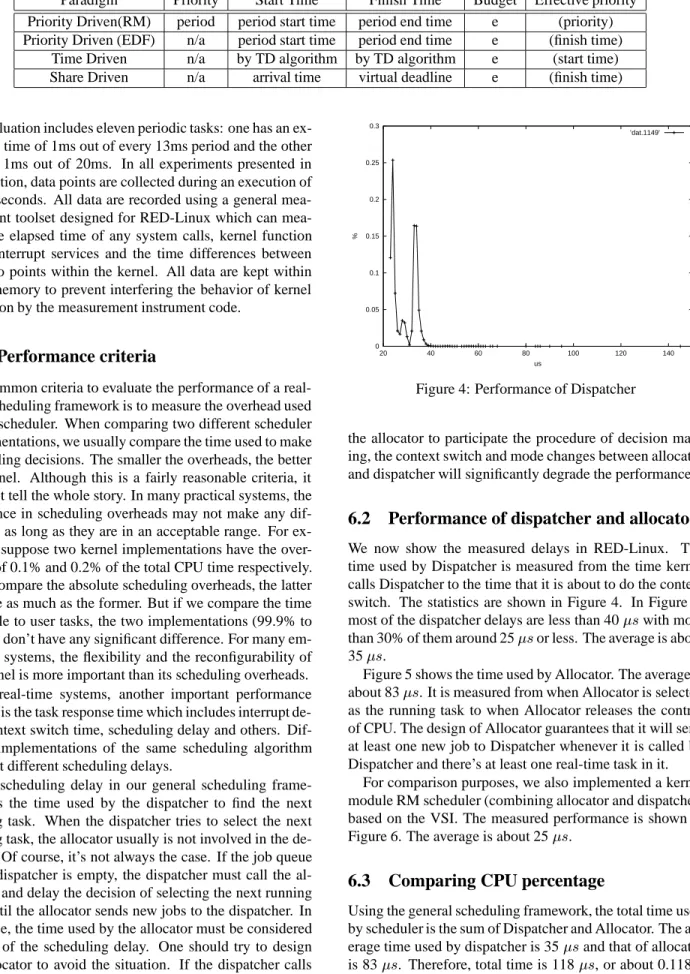
our evaluation includes eleven periodic tasks: one has an ex-ecution time of 1ms out of every 13ms period and the other ten are 1ms out of 20ms. In all experiments presented in this section, data points are collected during an execution of 78-80 seconds. All data are recorded using a general surement toolset designed for RED-Linux which can mea-sure the elapsed time of any system calls, kernel function calls, interrupt services and the time differences between any two points within the kernel. All data are kept within main memory to prevent interfering the behavior of kernel execution by the measurement instrument code.
6.1
Performance criteria
One common criteria to evaluate the performance of a real-time scheduling framework is to measure the overhead used by the scheduler. When comparing two different scheduler implementations, we usually compare the time used to make scheduling decisions. The smaller the overheads, the better the kernel. Although this is a fairly reasonable criteria, it may not tell the whole story. In many practical systems, the difference in scheduling overheads may not make any dif-ference as long as they are in an acceptable range. For ex-ample, suppose two kernel implementations have the over-heads of 0.1% and 0.2% of the total CPU time respectively. If we compare the absolute scheduling overheads, the latter is twice as much as the former. But if we compare the time available to user tasks, the two implementations (99.9% to 99.8%) don’t have any significant difference. For many em-bedded systems, the flexibility and the reconfigurability of the kernel is more important than its scheduling overheads.
For real-time systems, another important performance criteria is the task response time which includes interrupt de-lay, context switch time, scheduling delay and others. Dif-ferent implementations of the same scheduling algorithm may get different scheduling delays.
The scheduling delay in our general scheduling frame-work is the time used by the dispatcher to find the next running task. When the dispatcher tries to select the next running task, the allocator usually is not involved in the de-cision. Of course, it’s not always the case. If the job queue in the dispatcher is empty, the dispatcher must call the al-locator and delay the decision of selecting the next running task until the allocator sends new jobs to the dispatcher. In this case, the time used by the allocator must be considered as part of the scheduling delay. One should try to design the allocator to avoid the situation. If the dispatcher calls
0 0.05 0.1 0.15 0.2 0.25 0.3 20 40 60 80 100 120 140 % us ’dat.1149’
Figure 4: Performance of Dispatcher
the allocator to participate the procedure of decision mak-ing, the context switch and mode changes between allocator and dispatcher will significantly degrade the performance.
6.2
Performance of dispatcher and allocator
We now show the measured delays in RED-Linux. The time used by Dispatcher is measured from the time kernel calls Dispatcher to the time that it is about to do the context switch. The statistics are shown in Figure 4. In Figure 4,
most of the dispatcher delays are less than 40swith more
than 30% of them around 25sor less. The average is about
35s.
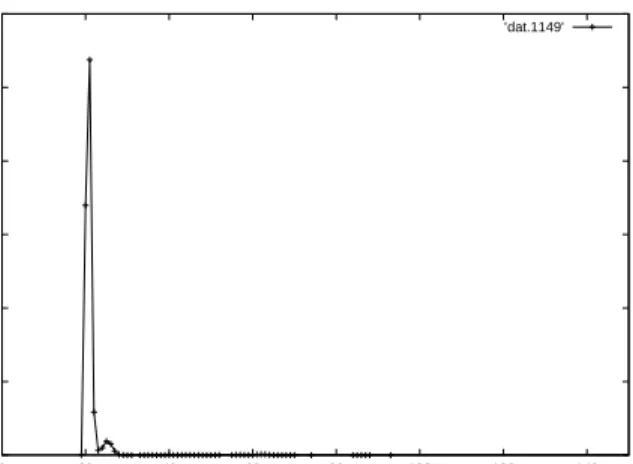
Figure 5 shows the time used by Allocator. The average is
about 83s. It is measured from when Allocator is selected
as the running task to when Allocator releases the control of CPU. The design of Allocator guarantees that it will send at least one new job to Dispatcher whenever it is called by Dispatcher and there’s at least one real-time task in it.
For comparison purposes, we also implemented a kernel module RM scheduler (combining allocator and dispatcher) based on the VSI. The measured performance is shown in
Figure 6. The average is about 25s.
6.3
Comparing CPU percentage
Using the general scheduling framework, the total time used by scheduler is the sum of Dispatcher and Allocator. The
av-erage time used by dispatcher is 35sand that of allocator
0 0.05 0.1 0.15 0.2 0.25 50 60 70 80 90 100 110 120 130 140 150 % us ’dat.1149’
Figure 5: Performance of Allocator
CPU time. In the single-module scheduler, the average time
is 25s, or 0.025% CPU time. Although the overhead of
our general scheduling framework is about 5 times as large as the conventional scheduler, the actual usable CPU time comparison is 99.88% to 99.97%.
6.4
Comparing scheduling delay
If we consider the scheduling delay of dispatcher, the
scheduling delay is 35 sin our framework comparing to
25sin the conventional scheduler. The scheduling delay
is independent of the scheduling algorithms used if the allo-cator can guarantee that the job queue in the dispatcher will never be empty as long as there are real-time tasks waiting to be executed.
7
Related Work
Many experimental real-time OS projects have been
re-ported. Most of the RTOS projects have chosen one
scheduling paradigm and implement the kernel support
based on that paradigm. For example, RT-Mach [17]
provides the support for rate-monotonic scheduling; the FreeBSD project [21, 11] at the Univ. North Carolina pro-vides the support for proportional share scheduling; Ri-alto [12] provides the support for time-driven scheduling. Extension mechanisms have been implemented in some
kernels. For example, a processor capacity reservation
scheme [17] has been implemented in RT-Mach for admis-sion control and task isolation.
Several projects have tried to enhance the real-time ca-pability of Linux. One of the first efforts is RT-Linux [2], which implements a small real-time kernel underneath but outside of the original Linux kernel. As a result, RT-Linux kernel cannot use any of the Linux kernel services. Strictly speaking, this is not a Linux kernel version since RT-Linux is designed from scratch to support real-time tasks. It pro-vides the connection to Linux using lock-free queues so that
0 0.1 0.2 0.3 0.4 0.5 0.6 0 20 40 60 80 100 120 140 % us ’dat.1149’
Figure 6: Performance of single module scheduler
real-time tasks can run on RT-Linux without any Linux in-terference. The approach is similar to some real-time sub-system products for Windows NT (such as RTX) that inter-cept real-time requests from real-time tasks and devices.
Another real-time Linux project is KURT [20] which uses different kernel modes to control the scheduling of system resources for real-time processes. When the kernel is in the "normal" mode, no real-time support is given and it runs like the normal Linux kernel. When it is in the "focused real-time" mode, only real-time processes are scheduled. KURT also has the "mixed real-time" mode, when both real-time and non-real-time processes are served. However, KURT provides limited scheduling support and works best if pro-cesses are scheduled under cyclic schedule files.
The closest work to our scheduling framework is the two-level hierarchical scheduler [6] designed for open system environment at the University of Illinois. The project is to study the global scheduling support for complex applica-tions that are developed and validated independently. Their work is able to provide schedulability guarantees to differ-ent applications using differdiffer-ent schedulers. Their low level scheduler always uses EDF to integrate jobs from all appli-cations. Our work, in comparison, does not try to support complex applications using different schedulers simultane-ously. Rather, we try to provide an efficient, reconfigurable scheduling framework for real-time and embedded systems. Using our design, if an application wants to use the priority-driven scheme, we will be able to provide an efficient PD scheduler in the dispatcher directly.
8
Conclusions
In this paper, we present a general scheduling frame-work which is able to accommodate a variety of
schedul-ing paradigms used in real-time applications. The
gen-eral scheduling framework is designed for embedded system kernels that may need to support different real-time sched-ulers efficiently. Since most embedded applications need
a predictable yet flexible scheduler, our framework allows embedded system builders to implement their own sched-ulers easily. Our proposed framework allows RED-Linux to be easily reconfigured with a new application-dependent scheduler without having to deal with all low-level ker-nel scheduling issues. By studying this general scheduling framework, we hope to have a better understanding on many new scheduling algorithms, and to deploy them meaning-fully and flexibly.
References
[1] L. Abeni and G.C. Buttazzo. Integrating multimedia ap-plications in hard real-time systems. In Proc. IEEE
Real-Time Systems Symposium, Dec 1998.
[2] M. Barabanov and V. Yodaiken, Introducing Real-Time Unix. Linux Journal, No. 34, Feb 1997.
[3] J.C.R. Bennett and H. Zhang. WF2Q: Worst-case fair weighted fair queueing. In Proc. of IEEE
INFO-COMM’96, San Francisco, CA, pp. 120-128, March
1996.
[4] R. Davis and A. Wellings. Dual Priority Scheduling. In
Proc. of IEEE Real-Time Systems Symposium, pp.
100-109, 1995.
[5] A. Demers, S. Keshav, and S. Shenker. Analysis and Simulation of a Fair Queueing Algorithm. In Journal of
Internetworking Research and Experience, pp.3-26,
Oc-tober 1990.
[6] Z. Deng and J.W.-S. Liu. Scheduling Real-Time Ap-plications in Open System Environment. In Proc. IEEE
Real-Time Systems Symposium, San Francisco, CA, Dec
1997.
[7] P. Goyal, X. Guo and H. M. Vin. A Hierarchical CPU Scheduler for Multimedia Operating Systems. In Proc. of
2nd OSDI Symposium, October 1996
[8] Ching-Chih Han, Kwei-Jay Lin and Chao-Ju Hou. Distance-constrained scheduling and its applications to real-time systems. In IEEE Trans. Computers, Vol. 45, No. 7, pp. 814-826, December 1996.
[9] Chih-wen Hsueh and Kwei-Jay Lin. An optimal Pin-wheel Scheduler Using the Single-Number Reduction Techniques. In Proc. of IEEE Real-Time Systems
Sym-posium, December 1996, pp.196-205.
[10] Chih-wen Hsueh and Kwei-Jay Lin. On-line Sched-ulers for Pinwheel Tasks Using the Time-Driven Ap-proach. In Proc. of the 10th Euromicro Workshop on
Real-Time Systems, Berlin, Germany, June 1998, pp.
180-187.
[11] K. Jeffay et al. Proportional Share Scheduling of Operating System Service for Real-Time Applications. In Proc. IEEE Real-Time Systems Symposium, Madrid, Spain, pp. 480-491, Dec 1998.
[12] M.B. Jones, D. Rosu and M-C. Rosu. CPU
Reser-vation and Time Constraints: Efficient, Predictable
Scheduling of Independent Activities. In Proc. of 16th
ACM Symposium on Operating Systems Principles, pp.
198-211, October 1997.
[13] K.B. Kenny and K.J. Lin. Building flexbile real-time systems using the Flex language. In IEEE Computer May 1991.
[14] H. Kopetz. The Time-Triggered Model of Compu-tation. In Proc. IEEE Real-Time Systems Symposium, Madrid, Spain, pp. 168-177, Dec 1998.
[15] C.L. Liu and J. Layland. Scheduling Algorithms for Multiprogramming in a Hard Real-Time Environment.
Journal of the ACM, 20(1):46-61, 1973.
[16] J.W.-S. Liu, K.J. Lin, W.-K. Shih, A.C. Yu, J.Y. Chung and W. Zhao. Imprecise Computation. In Proc. of IEEE 82:83-94, 1994
[17] C. Mercer, S. Savage and H. Tokuda. Processor Ca-pacity Reserves: operating system support for multime-dia applications, IEEE Conf. Multimemultime-dia Computing and Systems, pp. 90-00, May 1994.
[18] A. K. Parekh and R. G. Gallager. A Generalized Processor Sharing Approach to Flow Control in Inte-grated Services Networks: The Single-Node Case. In
IEEE/ACM Trans. Networking, Vol. 1, No. 3, pp.
344-357, June 1993.
[19] M. Spuri and G.C. Buttazzo. Efficient aperiodic ser-vice under the earliest deadline scheduling. In Proc.
IEEE Real-Time Systems Symposium, Dec 1994.
[20] B. Srinivasan et al. A firm real-time system imple-mentation using commercial off-the shelf hardware and free software. In Proc. IEEE Real-Time Technology and
Application Symposium, pp. 112–119, June 1998.
[21] I. Stoica, H. Abdel-Wahab, K. Jeffay, S. Baruah, J. Gehrke, and G. Plaxton. A Proportional Share Resource Allocation Algorithm for Real-Time, Time-shared Sys-tems. In Proc. of IEEE Real-Time Systems Symposium, pp.288-299, December 1996.
[22] I. Stoica, H. Zhang, and T.S.E. Ng. A Hierarchical Fair Service Curve Algorithm for Link-Sharing, Real-Time and Priority Services. In Proc. of ACM SIGCOMM’97, Cannes, France, 1997.
[23] Y.C. Wang and K.J. Lin. Enhancing the real-time ca-pability of the Linux kernel. In Proc. of 5th RTCSA’98, Hiroshima, Japan, Oct 1998.