FACIAL EXPRESSION RECOGNITION BASED ON CLOUD MODEL
Hehua Chi a, Lianhua Chi b *, Meng Fang a, Juebo Wu c a
International School of Software, Wuhan University, Wuhan 430079, China - [email protected]
b
School of Computer Science and Technology, Huazhong University of Science and Technology, Wuhan 430074,
China - [email protected]
c
State Key Laboratory of Information Engineering in Surveying, Mapping and Remote Sensing, Wuhan University,
Wuhan 430079, China - [email protected]
KEY WORDS: Cloud Model, Facial Expression Recognition, Backward Cloud Generator
ABSTRACT:
Facial expression is one of the major features of facial recognition in recent years, and it has become a hotspot. In this paper, we present a novel method of facial recognition based on cloud model, in combination with the traditional Facial expression system. Firstly, we carry out the transformation from images into grids with M by N, where M and N denote the actual image positioning of the grid. Each grid is a gray value (0-255) and the grids stand for the data from data points to data sets based on cloud model. Secondly, we do data pre-processing for the original facial expressions of input images. Cloud droplets image can be obtained as the input of backward cloud generator in order to extract the three numerical characteristics, that is, Ex, En and He. With these three characteristics, facial expression can be realized. Finally, in order to demonstrate the feasibility of the presented method, we conduct a case study of facial expression recognition based on cloud model. The results show that the method is feasible and effective in facial expression recognition.
* Corresponding author. [email protected].
1. INTRODUCTION
Expression is a basic way to express mankind’s feelings and is one kind of effective communication. The facial expressions have corresponding change before people expressing their emotions. The facial expression can not only express their thoughts and feelings accurately and subtly, but also describe the others’ cognitive attitudes and inner world. Facial expression contains rich human behaviours and is a kind of information resources in human-computer interaction with more effective, natural and direct way. If computers and robots have the ability to understand and express feelings as men’s adapting to the environment, it will change the relationship between the computer and human fundamentally. If that, the computer can better service to mankind. It is the research meaning of this topic on facial recognition with emotion understanding and emotion expression [1-3]. Therefore, the facial expression recognition can be achieved through the observation and analysis of face images. The facial recognition is a identification task with a non-contact way, which is so vital to realize the interaction between nature and man-machine [4]. Facial expression recognition is a hot research topic in computer vision, emotion and image processing, which can be widely applied in human-computer interaction, multi-media, security, medical assistance, and behavioural science, etc. Many scholars have launched a lot of studies on facial expression recognition and the main research results are as follows: M. Pantic et al. presented a method of emotional expression classification based on an expert system [5]. Y. L. Tian et al. introduced recognizing action units for facial expression analysis based on the behaviour identifying [6]. X. X. Yuan et al. gave a way for face recognition based on the wavelet analysis and support vector machine [7].
In this paper, we proposed a novel approach of facial expression recognition based on cloud model, aiming to mine the hidden knowledge of facial expression and the facial features with cloud model.
2. BASIC PRINCIPLE
2.1 Cloud model
Definition: Suppose U is a quantitative universe of discourse with precise numerical value: X ⊆U and T is qualitative concept of space U. If the certainty of x (x ∈X) belonging with T is a random number with stable tendency, that is, CT(x) ∈[0, 1], then the distribution of concept T from U mapping to [0, 1] in data space is called cloud [8], where meets:
CT(x):U → [0,1] ∀x ∈ X (X⊆U) x → CT(x) Cloud model has three characteristics:
Expectation (Ex) is the prototype value (centre or standard value) of concept, and is the most representative value of the qualitative concept. Entropy (En) is the measurement of concept uncertainty while Hyper-entropy (He) is the measurement of entropy uncertainty, that is, the entropy of entropy.
Cloud model has the characteristics with macro accurate, micro fuzzy, macro controllable and micro uncontrollable. Its essential unit is concept cloud composed of cloud droplets, including randomness and fuzziness. It is the organic synthesis of fuzziness and randomness in nature language, and contains the mapping between quantitative and qualitative data. The theory is a breakthrough for limitations of hard computation in
probability and statistics, but also solves the inherent defect of membership functions. It is a new method and new technology for solving problems in data mining, and breaks the limitation of boundary sets. As a general mathematics theory, the cloud model cleverly realizes the analysis between qualitative and quantitative data. With the mathematical conversion method and technology development, it has been widely and successfully applied in the knowledge discovery, the spatial data mining system, intelligent control, efficiency evaluation, solution or explain natural, social problems or phenomenon, and have achieved remarkable results.
2.2 Backward cloud generator
Backward cloud generator is the model of uncertainty transformation between numerical value and language value mapping from the qualitative to quantitative data [9-10]. It turns a certain amount of accurate data to corresponding qualitative value {Ex, En, He} effectively, and reflects the whole cloud droplets according to these accurate data. The more the amount of cloud droplets are, the more accuracy the concepts will be. Backward cloud generator is a process of cloud generator indirectly and reversely, which regards a group of cloud droplets Drop(xi, CT(xi)) with a certain distribution as samples, and generates the three numerical characteristics {Ex, En, He} corresponding to the concepts (shown as figure 1). Through the forward and the backward generator, the cloud model makes the establishment between the qualitative and quantitative relationship.
Figure 1. The input and output of backward cloud generator Input: The sample points and their certainty degrees
) ( i
T x
C
(i=1, 2..., N)
Output: The numerical characteristics of qualitative concept, Ex, En and He.
The details are as follows:
(1) According the sample
x
i, calculate the sample mean:∑
= = n i i x n X 1 1, the first-order absolute centre distance:
∑
= Ι= − n i i X x n M 1 1, and the variance
∑
=− − = n i i X x n S 1 2 2 ) ( 1 1 . (2) Compute Ex,Ex=X. (3)Compute En, = × Ι M En 2 π . (4)Compute He, He= S2−En2
3. FACIAL EXPRESSION RECOGNITION
As a challenging cross-subject between the biological feature recognition and the affective computing field, the facial expression recognition technology driven by a variety of applications has the rapid development [11]. The facial
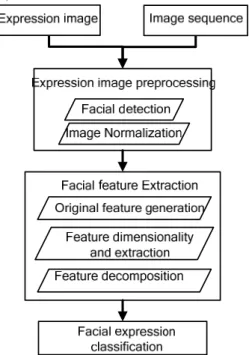
expression recognition system mainly includes the following steps: the acquisition of the facial expression images, the face detection, the facial expression feature extraction and the facial expression recognition. Its structure is shown in Figure 2. For an automated facial expression recognition system, first, we should obtain static images or facial image sequences; The second step is the facial image pre-processing, including the face detection and the image normalization ; The third step is the facial image feature extraction, including the original feature acquisition, the feature dimensionality and extraction, the feature separation; The fourth step is the facial expression recognition, that is, according to the extracted features and some criteria, we realize the classification.
Figure 2: The model of facial expression recognition
3.1 Facial image pre-processing
In the process of pre-treatment, the facial detection and localization are applied firstly, namely, to find the position and existing face to face segmentation from the background from the input. Then the facial images are done data normalization, such as gray normalization, etc.
3.2 Face detection and localization
Face detection and localization is the primary problem to solve in the automatic identification system of facial expression, including the face detection in simple background and complex background. At the beginning of the study, the face images in database are all simple background, which means the difference between face and background is big and most of them are positive images. The research value of the latter is more practical and theoretical. In detecting and locating face image, the image must be normalized in order to facilitate subsequent processing.
3.3 Image normalization
Image normalization includes geometry normalization and gray normalization. The former means converting the face results to the same position and size. The latter is to stretch the image gray and improve the image contrast. It also includes light compensation and to overcome of the light changes. After that,
we can get more suitable images in the process by image pre-processing and edge extraction.
3.4 Facial Feature Extraction
After the pre-processing, we can make the feature extraction and selection on the facial images, that is, extracting the facial expression feature information. The purpose is to obtain a set of category features, that is to say, we obtain the feature vectors that the number of features and the classification error rate are fewer. It is a very important part. The effect will directly affect the correct recognition rate of the facial expression.
3.4.1 The original feature acquisition: We use some information to obtain the original features of the expressions, such as features of shape, geometric relations, local texture, optical flow and so on. This step is called as the original features acquisition. However, these primitive characteristics generally exists the redundancy and other issues. In order to more effectively characterize the nature of the facial expression, we need to make the process on the original feature data.
3.4.2 Feature dimensionality and extraction: Because the dimensions of the original features are usually very large, we should convert them into the low-dimensional subspace. That not only make the dimension of the original features significantly reduced, but also the validity of these low-dimensional space will be increased. In recent years, we make some new research on the methods of the feature dimensionality and extraction.
3.4.3 Feature separation: Facial images contain a wealth of information. For different recognition tasks, the information also varies. The facial detection is to find the consistency of the facial images. The facial recognition need to present the individual differences among the facial expressions. Recently, a new solution is to separate the different factors of the human facial expression, such as the expression factors and individual factors, avoiding the interference of other factors.
3.5 Facial expression classification
Expression classification refers to the definition of a group of categories, and to design appropriate mechanisms for the expression recognition. If the expressions are classified according to the facial movements (FACS), facial actions are classified into 44 AUs (action units). In accordance with the emotion classification, the expressions are classified into seven kinds of basic emotions (crying, surprise, happiness, ecstasy, unwilling, frustration, fear).
4. FACIAL RECOGNITION BASED ON CLOUD
MODEL
4.1 The process of facial recognition based on cloud model
Cloud theory portrays the distance relationship between each element in the domain and its core concept using the membership. The greater degree of the membership, the elements are much closer to the core concept. This feature is the same as the facial expression recognition’s feature that we obtain the facial expression feature and make the classification. So we can use the cloud theory to obtain the facial expression feature, using the numerical characteristics of the cloud to express the facial expression features. Making use of the cloud
model algorithm to extract facial expression features, we propose a new facial expression recognition method - facial expression recognition based on cloud model.
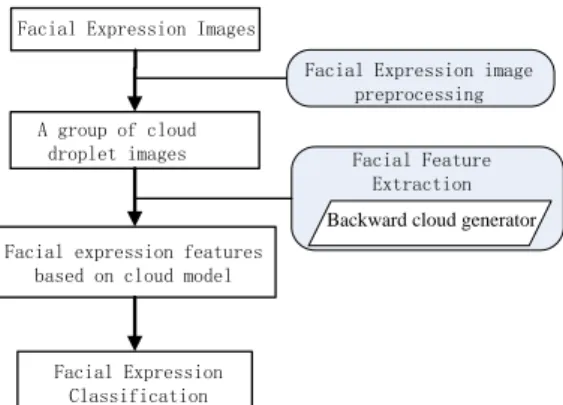
First, input a group of primitive facial images; Second, pre-process the input images to get a set of standard cloud droplet images; Third, make use of backward cloud generator to realize the image feature extraction and output the numerical characteristics (Ex, En, He) of this cloud droplet images; Fourth, make the numerical characteristics (Ex, En, He) as the facial expression features; At last, use the numerical characteristics (Ex, En, He) to realize the facial expression classification. The chart of facial expression recognition based on Cloud Model is shown in Figure 3.
A group of cloud
droplet images Facial Feature Extraction
Backward cloud generator
Facial Expression Images
Facial Expression image preprocessing
Facial expression features based on cloud model
Facial Expression Classification
Figure 3: The structure of facial recognition based on cloud model
4.2 A group of images of cloud droplets
Macro accuracy and micro fuzziness are the features of cloud model, with macro controllable and micro uncontrollable. Its essential unit is cloud droplets, which can form cloud with such cloud droplets and realize the transformation between qualitative and quantitative data. It reflects the uncertainty of knowledge representation.
After image pre-processing,a group of cloud droplets images can be obtained for the original face expressions. Such images are considered as the standard input images for the following processing.
4.3 The characteristics of facial expression based on cloud model
The numerical characteristics of cloud reflects quantitative feature of qualitative concept with Ex, En and He. It is the numerical basis for describing cloud model and mining knowledge from uncertainty data. The facial expression is a kind of uncertainty data.
This paper uses cloud generator to find knowledge from facial expressions, that is {Ex, En, He}, and to achieve facial expression recognition upon such characteristics.
5. THE EXPERIMENT OF FACIAL EXPRESSION RECOGNITION BASED ON CLOUD MODEL 5.1 The experiment of facial recognition
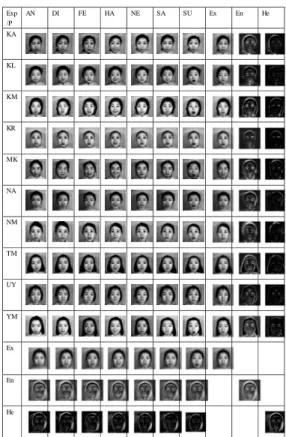
The data source comes from Japanese Female Facial Expression (JAFFE) database, which is an open face image database (http://www.kasrl.org/jaffe_download.html). It contains 10 women's expressions, including the people KA, KL, KM, KR, MK, NA, NM, TM, UY and YM. Each person has 7 different expression as AN, DI, FE, HA, NE, SA and SU. Each expression has 3 or 4 samples and the total number is 216. In this experiment, we conduct knowledge mining by cloud model for facial expression images, aiming to find the numerical characteristics and realize the facial expression recognition.
5.2 Sample sets training
5.2.1 The experiment of different expressions for one person: In JAFFE database, the attribute KA is selected at the beginning, while the original images are chosen from the ten Japanese women's KAs, including AN, DI, FE, HA, NE, SA and SU. By backward cloud generator, the KAs of the same expression from different Japanese women can transform to the three numerical characteristics {Ex, En, He} of cloud, as shown in line 1, table 1.
By using the same method as KA processing, the corresponding numerical characteristics can be obtained for KL, KM, KR, MK, NA, NM, TM, UY, YM and the results are shown in table 1 from column 2 to column 10.
5.2.2 The same expressions of different people: In JAFFE database, the attribute AN is selected at the beginning, while the original images are chosen from the ten Japanese women's ANs, including KA, KL, KM, KR, MK, NA, NM, TM, UY and YM. By backward cloud generator, the ANs of the same expression from different Japanese women can transform to the three numerical characteristics {Ex, En, He} of cloud, as shown in column 1, table 1.
By using the same method as AN processing, the corresponding numerical characteristics can be obtained for DI, FE, HA, NE, SA, SU and the results are shown in table 1 from column 2 to column 7.
5.3 Sample sets training
(1) Every line in table 1 means the input is the different expressions of the same person, and the output is the numerical characteristics of cloud of such input images {Ex, En, He}. (2) Each column in table 1 means the input is the same facial expression of ten persons, and the output is the numerical characteristics of cloud of such input images {Ex, En, He}. (3) The problem is that how to identify the facial image belong to whose expression if existing a face image for recognition? The method is as follows: Firstly, generate the numerical characteristics {Ex, En, He} of cloud for the original face expressions. Secondly, compute the numerical characteristics {Ex, En, He} of cloud by backward cloud generator by adding the image to be identified to such original face expressions. Finally, compare two groups of numerical characteristics {Ex, En, He} of cloud to find the differences. According to such
differences, we can get the image category and achieve facial expression recognition. Exp /P AN DI FE HA NE SA SU Ex En He KA KL KM KR MK NA NM TM UY YM Ex En He
Table 1: The training samples of facial expression
5.4 Facial recognition based on the samples
After the training of samples, we choose two groups as the original facial image for person, as shown in table 2.
Person AN DI FE HA NE SA SU KA
KL
Table 2 two groups of original facial expression images
The face image for identification
The experimental steps are:
Step 1: Choose the first line in table 2 as the original image with backward cloud generator and calculate the {Ex, En, He} of the image. The results are shown in line 1 in table 1.
Step 2: Add the facial expression images into line 1 in table 2 for identification. By backward cloud generator, compute the {Ex, En, He} of the image as shown in line 1 in table 3. Step 3: Select line 2 in table 2 as the original facial expression image. Based on backward cloud generator, generate the {Ex, En, He} of image as shown in line 2 in table 1.
Step 4: Add the facial expression images into line 2 in table 2 for identification. By backward cloud generator, compute the {Ex, En, He} of the image as shown in line 2 in table 3.
[2] X. M. Liu, H. C. Tan, Y. J. Zhang. New Research Advances in Facial Expression Recognition. Journal of Image and Graphics, 11(10), 2006.
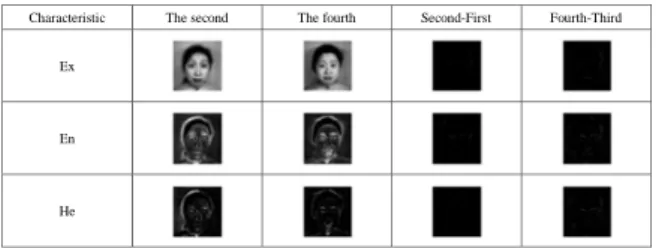
The line 3 in table 3 shows the difference value of {Ex, En, He} for images in the second to first steps while the line 4 in table 3
gives the fourth to third steps. [3] K. MaSe, A. Pentland. Recognition of Facial Expression From Optical flow [J]. IEICE Trans, 74(10), 1991, pp.3474-3484.
[4] M. Pantic, L. J. M. Rothkrantz, Automatic Analysis of Facial Expressions:the State of the Art. IEEE trans. Pattern Analysis and Machine Intelligence, 22(12), 2000, pp.1424-1445. Characteristic The second The fourth Second-First Fourth-Third
Ex
En
He
[5] M. Pantic, L. J. M. Rothkrantz. An Expert System for Multiple Emotional Classification of Facial Expressions. Pro.11th IEEE Int. Conf.on Tools with Artificial Intelligence, 1999, pp.113-120.
[6]Y. L. Tian, T. Kanade, J. f. Cohn. Recognizing Action Units for Facial Expression Analysis. IEEE Trans. Pattern Analysis and Machine Intelligence, 23(2), 2001, pp.97-115.
Table 3 The results and comparative results
[7] X. X. Yuan, W. Jiang, L. Zhang. Facial expression recognition method based on wavelet energy feature and Support Vector Machines. Optical Technology, 34(2), 2008. Observing from line 3 and 4 in table 3, it can be obviously seen
that the {Ex, En, He} of the former different image is not clearer than the latter's. We can know that the facial expression of the image for identification is more close to A, which is correct. Therefore, it is feasible of that cloud model can achieve face facial image recognition. The research develops the cognition of cloud model theory and further expands the application fields of cloud model.
[8] K. C. Di, D. Y. Li, D. R. Li. Cloud Theory and Its Applications in Spatial Data Mining and Knowledge Discovery. Journal of Image and Graphics, 4(11), 1999.
[9] H. J. Lv, Y. Wang, D. Y. Li. The Application of Backward Cloud in Qualitative Evaluation. Chinese Journal of Computers, 26(8), 2003.
[10] D. R. Li, S. L. Wang, D. Y. Li. Spatial Data Mining Theories and Applications. Science Press, 2006.
6. CONCLUSIONS
[11] M. Qiao, Y. J. Chen. Feature Extraction Methods on Facial Expression Recognition. Journal of Chongqing Institute of Technology, 22(6), 2008.
As a mathematical transformation model with knowledge uncertainty, the cloud model integrates the fuzziness with the randomness and forms the qualitative and the quantitative mapping between them. This paper put forward a new method of facial expression recognition based on cloud model. By using cloud model, the facial expression recognition can be carried out effectively, and it expressed the uncertainty of facial expression. The quantitative numerical characteristics {Ex, En, He} of facial expressions were mined by the backward generator of cloud model. In this paper, the hidden knowledge in facial expression images were obtained with the numerical characteristics {Ex, En, He} of cloud model. Ex is the characteristics of the facial image in common, En is the personality deviation of general common knowledge, and He is the discrete level of knowledge. In analyses of facial image knowledge, by the numerical characteristics {Ex, En, He}, the facial expression can be realized. The experimental results showed that this method can effectively achieve facial recognition. Furthermore, the facial expression recognition and its application based on cloud model should be further study in next step.
7. ACKNOWLEDGEMENTS
This paper is supported by National 973 (2006CB701305, 2007CB310804), National Natural Science Fund of China (60743001), Best National Thesis Fund (2005047), and National New Century Excellent Talent Fund (NCET-06-0618).
8. REFERENCES
[1] N. Zhang. Summarization for the facial expression recognition. Journal of Shandong Institute of Light Industry(Natural Science Edition), 21(4), 2007.