On Secure Network Coding With Nonuniform
or Restricted Wiretap Sets
Tao Cui
, Student Member, IEEE
, Tracey Ho
, Senior Member, IEEE
, and Jörg Kliewer
, Senior Member, IEEE
Abstract—The secrecy capacity of a network, for a given collec-tion of permissible wiretap sets, is the maximum rate of commu-nication such that observing links in any permissible wiretap set reveal no information about the message. This paper considers se-cure network coding with nonuniform or restricted wiretap sets, for example, networks with unequal link capacities where a wire-tapper can wiretap any subset of links, or networks where only a subset of links can be wiretapped. Existing results show that for the case of uniform wiretap sets (networks with equal capacity links/packets where any can be wiretapped), the secrecy capacity is given by a cut-set bound if random keys are injected at the source (and decoded at the sink), whether or not the communicating users have information about the choice of wiretap set. In contrast, we show that for the nonuniform case, this secrecy rate is achievable for the case of known but not unknown wiretap set. We give achiev-able linear optimization-based strategies where random keys are canceled at intermediate nonsink nodes or injected at intermediate nonsource nodes. Finally, we show that determining the secrecy ca-pacity is an NP-hard problem.
Index Terms—Information-theoretic security, network coding, network interdiction, NP-hard, secrecy capacity.
I. INTRODUCTION
I
NFORMATION-THEORETICALLY securecommunica-tion uses coding to ensure that an adversary that wiretaps a subset of network links obtains no information about the se-cure message. The secrecy capacity of a network, for a given collection of permissible wiretap sets, is defined as the max-imum rate of communication such that any one of the permis-sible wiretap sets reveals no information about the message. In
Manuscript received October 29, 2009; revised September 06, 2011; ac-cepted April 28, 2012. Date of publication August 31, 2012; date of current version December 19, 2012. This work was supported in part by subcontract #069144 issued by BAE Systems National Security Solutions, Inc.; in part by the Defense Advanced Research Projects Agency and the Space and Naval Warfare System Center, San Diego, CA, under Contracts N66001-08-C-2013 and W911NF-07-1-0029; in part by the National Science Foundation under Grants CNS 0905615, CCF 0830666, and CCF 1017632; and in part by Caltech’s Lee Center for Advanced Networking. The material in this paper was presented in part at the 2010 Information Theory and Applications Workshop, La Jolla, CA, and in part at the 2010 IEEE Information Theory Workshop, Dublin, Ireland.
T. Cui and T. Ho are with the Department of Electrical Engineering, Cali-fornia Institute of Technology, Pasadena, CA 91125 USA (e-mail: [email protected]; [email protected]).
J. Kliewer is with the Klipsch School of Electrical and Computer Engi-neering, New Mexico State University, Las Cruces, NM 88003 USA (e-mail: [email protected]).
Communicated by S. Ulukus, Associate Editor for Communication Net-works.
Color versions of one or more of thefigures in this paper are available online at http://ieeexplore.ieee.org.
Digital Object Identifier 10.1109/TIT.2012.2216936
general, the choice of wiretap set is unknown to the communi-cating users, though we also discuss the case of known wiretap set where the encoding and decoding functions are allowed to depend on the choice of wiretap set, in which case the secrecy capacity is the maximum rate achievable under the worst case wiretap set.
A theoretical basis for information-theoretic security was given in the seminal paper by Wyner [1] using Shannon’s notion of perfect secrecy [2], where a coset coding scheme based on a linear maximum distance separable code was used to achieve security for a wiretap channel. More recently, in-formation-theoretic security has been studied in networks with general topologies. The secure network coding problem, where a wiretapper observes an unknown set of links, was introduced by Cai and Yeung [3], [4]. They proposed a coding strategy, which we refer to as the global key strategy, in which the source injects random key symbols that are decoded at the sink along with the message. They showed achievability of this strategy in the nonuniform case where a wiretapper can observe one of an arbitrary given collection of wiretap link sets, and optimality of this strategy for multicast in the uniform case, where each link has equal capacity and a wiretapper can observe up to links, and randomness is generated only at the source. For this case, various constructions of secure linear network codes have been proposed in, e.g., [5]–[7]. In [8], Cai and Yeung showed by an example that allowing nonsource nodes to generate randomness also can be advantageous. Other related work on secure network communication includes weakly secure codes [9] and wireless erasure networks [10].
In this paper, we consider secure communication over wire-line networks in the nonuniform case. In the case of throughput optimization without security requirements, the assumption that all links have unit capacity is made without loss of gener-ality, since links of larger capacity can be modeled as multiple unit capacity links in parallel. However, in the secure commu-nication problem, such an assumption cannot be made without loss of generality. For the case of uniform wiretap sets, the global key strategy achieves a multicast secrecy rate given by the minimum, over source–sink cuts and wiretap sets, of the capacity of the cut minus the wiretapped links, whether or not the wiretap set is known [3], [4]. In contrast, in the nonuniform case, this secrecy rate is achievable for known but not unknown wiretap sets, even for a single source and sink. We give new linear optimization-based achievable strategies where random keys are canceled at intermediate nonsink nodes or injected at intermediate nonsource nodes, and show ways in which they can outperform the global key strategy. Finally,
we show that determining the secrecy capacity is an NP-hard problem.1
II. NETWORKMODEL ANDPROBLEMFORMULATION
In this paper, we focus on acyclic graphs for simplicity; we expect that our results can be generalized to cyclic networks using the approach in [13] and [14] of working overfields of rational functions in an indeterminate delay variable.
We model a wireline network by a directed acyclic graph
, where is the vertex set and is the directed link set.
Each link is a noise-free bit-pipe with a given capacity
. We denote the set of incoming links of a node by
and the set of outgoing links of by .
A source node wishes to communicate a message
securely to a sink node . An eavesdropper can wiretap a
set of links chosen from a known collection of possible
wiretap sets. Without loss of generality, we can restrict our at-tention to maximal wiretap sets, i.e., no set in is a subset of
another. The choice of wiretap set is unknown to the
commu-nicating nodes, except where otherwise specified in this paper. In the case of a known wiretap set, the wiretapper can choose
an arbitrary wiretap set in which is then revealed to the
communicating nodes.
Let denote a source–sink secure communication rate
(where the precise meaning of “security” is defined below)
and a rate of local randomness generated at node ,
which is independent across different nodes . A block code of
blocklength is defined by a mapping
from the message and randomness
gener-ated at the source to the vector transmitted on each outgoing link of the source, a mapping
from the vectors received by a nonsource node and local ran-domness generated at to the vectors transmitted on each out-going link of , and a mapping
from the vectors received by the sink to the decoded output.
Node mappings are applied in topological order; each node re-ceives input vectors from all its incoming links before applying the mappings corresponding to its outgoing links.
1While this paper shows NP-hardness of determining secrecy capacity for
unequal link capacities or restricted wiretap sets, after submitting the paper, we found that the problem may be hard even when all links have equal capacity and any single link can be wiretapped. Specifically, we show a reduction from the multiple unicast network coding problem, which is not currently known to be in P, NP or undecidable [11]. This result will be presented formally in an up-coming paper. In disseminating this new result, we also learned of related work [12] showing a reduction from the multiple unicast network coding problem to the secure network coding problem with unequal link capacities and restricted wiretap sets.
The secrecy capacity is defined as the highest possible
source–sink communication rate for which there exists a
sequence of block codes such that the sink decodes message
reliably and, for any choice of , the message
com-municated is kept information theoretically secret from the
eavesdropper who observes . As we will
see, our results in Sections III–V are not affected by whether we impose a zero or asymptotically negligible decoding error requirement at the sink, or by whether we impose a weak
secrecy requirement where for any there exists such
that , a strong secrecy requirement where
for any there exists such that , or a
perfect secrecy requirement for all .
We provide achievable strategies in Section III for this gen-eral problem; in Sections IV and V, we show unachievability and NP-hardness results in that hold even for the following spe-cial cases:
1) Scenario 1 is a wireline network withequallink capacities, where the wiretapper can wiretap an unknown subset of links from a known collection of vulnerable network links. 2) Scenario 2 is a wireline network withunequallink capaci-ties, where the wiretapper can wiretap an unknown subset
of links from the entire network.
It is convenient to show these results for Scenario 1first, and then show the corresponding results for Scenario 2, by con-verting the Scenario 1 networks considered into corresponding Scenario 2 networks for which the same result holds.
Although, for the sake of simplicity, we focus on single-source single-sink networks, Strategy 2 in Section III can be easily extended to multicast networks, whereas the un-achievability and NP-hardness results discussed in Sections IV and V directly apply to both multicast and nonmulticast cases since the single-source single-sink case represents a special case for both.
III. CUT-SETBOUND ANDACHIEVABLESTRATEGIES
In this section, we consider the general wireline problem with unequal link capacities where the eavesdropper can wiretap an
unknown set of links chosen from a known collection
of possible wiretap sets. We consider a simple cut-set bound and give two linear optimization-based achievable strategies and show cases in which they outperform the existing global key strategy. The intuition and results in this section are subse-quently used in showing the results in Sections IV and V.
A. Simple Cut-Set Bound
Let denote the set complement of a set . A cut for
is a partition of into two sets and such that
and . For the cut given by , the cut-set
is the set of links going from to , i.e.,
(1)
The set comprises the
Theorem 1: Consider a network of point-to-point links,
where link has capacity . The secrecy capacity is
upper bounded by
(2)
if randomness is generated only at the source, or if there are no reverse links on the minimizing cut. This holds whether or not the communicating nodes have knowledge of the chosen
wiretap set .
Proof: Consider any source–sink cut and any wiretap
set . Denote by the transmitted signals from nodes in
over links in and denote by and the observed
signals from links in and in , respectively.
We consider block coding with blocklength and secret
mes-sage rate . By the weak secrecy requirement
, we have
(3)
where as and
(a) is due to Fano’s inequality;
(b) is due to the data processing inequality and the fact that forms a Markov chain.
Note that the proof addresses the case of asymptotically neg-ligible decoding error but clearly also applies to the zero error case (where the capacity can be no greater) since it is a converse result. For the same reason, it also includes the strong secrecy
case and the perfect secrecy case
. Further, the bound in (2) is always achiev-able in the uniform link-capacity case (by the global key strategy [3], [4]), or when the wiretap set is known (by not transmitting on the wiretapped links, where achievability follows from the Ford–Fulkerson theorem [15]).
B. Achievable Strategies for Unknown Wiretap Set
In the global key strategy, the source transmits secret
in-formation symbols and random key symbols, where
is equal to the min-cut of the network. This scheme does not achieve capacity in general. One reason is that a node with connections to two other nodes can generate common random-ness between them as in [8]. We show in the following that in the nonuniform case, there is another advantage of local random keys in improving utilization of cuts that have larger capacity links and larger overall cut capacity compared to other cuts in the network.
In particular, we show that capacity can be improved not only by local key generation but also by key cancellation at inter-mediate nodes. We consider combinations of local and global random keys, where a local key is injected at a nonsource node and/or canceled at a nonsink node. However, it is complicated to optimize over all possible combinations of nodes at which keys are injected and canceled. Thus, we propose the following more tractable constructions, which we will use to develop fur-ther results in subsequent sections.
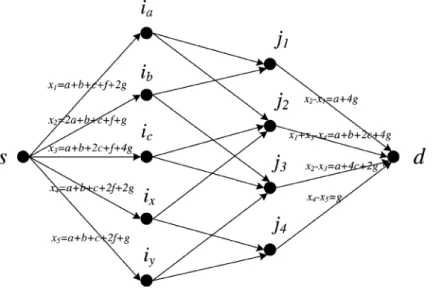
Strategy 1: Random Keys Injected by Source and Pos-sibly Canceled at Intermediate Nodes: Our first construction achieves secrecy with random keys injected only at the source. The source carries out precoding so that random keys are can-celed at intermediate nodes and the sink receives the intended message without interference from the random keys. As such, it applies in the single-source, single-sink case and is useful in networks where the incoming capacity of the sink is too small to accommodate the message plus all the keys needed in the network. An example is given in Fig. 1, where each link has
unit capacity, the number of wiretapped links is , and
only thefirst layer of the three layer network is allowed to be
wiretapped. The secret message rate is achievable by
using the strategy in Fig. 1, where the operation is on afinite
field . In Fig. 1, are secret messages and are
keys. The message on the th link in thefirst layer is denoted as
, . The key is canceled at the second layer
and the key cancelation scheme is labeled on the last layer
links. It is easy to see that , which
means perfect secrecy is achieved. At the same time, the sink
can decode and the key . When key cancelation is
not applied, let and be the secrecy rate and the random
key rate at the source, respectively. Let be the total rate of
transmission on the first layer. To achieve secrecy, we must
have , where the cut-set condition on thefirst layer
requires . Since the sink needs to decode both
message and random key symbols from the source, the cut-set
condition on the last layer requires . Combining
these we obtain , which is
strictly less than 3.
To formally develop the Strategy 1 construction, we will use the following result:
Claim 1 [16, Corollary 19.21]: Given an acyclic network, there exists, for a sufficiently largefinitefield, a linear network code in which the dimension of the received subspace at each
nonsource node is , where is the
dimen-sion of the message subspace.
Let denote the secret message rate and the
transmis-sion rate on each network link , whose values we will
discuss how to choose below. Consider the graph with the
ca-pacity of each link set as . As illustrated in
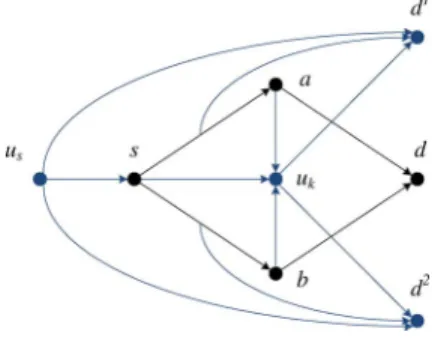
Fig. 2, augment the graph as follows.
1) Connect each subset of links to a virtual node
: more precisely, for each directed link in
the network, create a node and replace by
two links and of capacity , and for
each create a link of capacity .
Let be the maxflow/min cut capacity between
Fig. 1. Example of Strategy 1, where any two of thefive links in thefirst layer can be wiretapped. Secrecy rate 3 is achieved by canceling at the second layer one of the two random keys injected by the source. The operation is on afinitefield .
Fig. 2. Illustration of Strategy 1, an achievable construction where random keys are injected by the source and possibly canceled at intermediate nodes. In this
figure, and only thefive links in thefirst layer can be wiretapped.
2) Add a virtual sink node and join the actual sink to
by a link of capacity of .
3) Connect both and the virtual sink to a virtual sink
by adding a link of capacity and a link
of capacity , respectively.
The source sends a secret message along
with random key symbols .2 The
values of , , and are chosen such that each virtual sink
can decode linear combinations of message and
random key symbols, and the sink can decode the message
symbols. Specifically, if for each , the rate equals
the min-cut capacity between the source and the virtual sink
and , by using Claim 1, there exists a network
code such that each receives linearly
indepen-dent combinations of and when thefinitefield size is suffi
-ciently large ( ). Let the signals received at a particular
2We assume that and are integers, which can be approximated
arbitrarily closely by scaling the capacity of all links by the same factor.
virtual sink be denoted as , where is an
received coding matrix with full
row rank. We can add rows to to get a full rank
square matrix . We then precode
the secret message and keys using , i.e., the source
trans-mits , so that link carries .
Claim 2: Strategy 1 allows the sink to decode the message and achieves perfect secrecy.
Proof: Since is the only incoming link of ,
and both links have capacity which is equal to the rate of
the message , link carries exactly . This implies that
sink receives . Furthermore, for any virtual sink , the
received coding matrix with precoding is , which is
a full row rank matrix. As is a full row rank matrix,
the coding vectors of the received signals from the set of
wiretapping links span a rank subspace that is linearly
independent of the set of coding vectors corresponding to
on are independent of the message , and perfect secrecy is achieved.
Note that applying causes the random keys injected by
the source to be either canceled at intermediate nodes or de-coded by the sink.
It remains to optimize over values of , , and
such that for each , the rate equals the min-cut
capacity between and and . Since computing
(the min-cut capacity between and ) for arbitrary
involves a separate max flow computation, to simplify
the optimization, we can constrain to be equal to some
upper bound on and thereby obtain an achievable
secrecy rate using Strategy 1. For instance, we can take to
be , or alternatively take to be the min-cut
capacity between and on the graph with the original link
capacities . We can write a linear program (LP) for this key
cancelation strategy as follows:
if if otherwise
(4)
where represents the rate of flow on link that
is intended for the virtual sink . By defining and
im-posing flow conservation conditions on the virtual flow
, we ensure that the min cut
between the source and is at least . Since the
only incoming links of are of capacity
and of capacity , this implies that equals
the upper bound . Thus, the optimal value of (4) gives an
achievable secrecy rate.
Strategy 2: Random Keys Injected by Source And/Or Interme-diate Nodes and Decoded at Sink: In Strategy 2, any node in the network can inject random keys. The sink is required to decode both the secret message and the random keys from all nodes, i.e., keys are not canceled within the network, while the random key rates must be sufficient to “fill” each wiretap set (in a sense that is made precise below). Although for simplicity of notation the algorithm description below is for the single-source, single-sink case, this strategy applies directly to multiple-source multicast case. If random keys are injected only at the source, the strategy reduces to the global key strategy in [3]. Note that under the as-sumption that only the source knows the message and different nodes do not have common randomness a priori, here we cannot apply the key cancelation and precoding idea from Strategy 1, since after applying the precoding matrix, each node may po-tentially be required to transmit a mixture of the source message and other nodes’ random keys.
Let be the random key injection rate at node . As
be-fore, denotes the secret message rate at the source and
the transmission rate on link . We will address the choice
Fig. 3. Example of the augmented network construction for the proof of cor-rectness of Strategy 2, where are nodes of the original graph, and only one of the two links and can be wiretapped.
of these rates below. Consider the graph with the capacity of
each link set as . Connect each subset of links
to a virtual node : more precisely, for each directed
link in the network, create a node and replace
by two links and of capacity , and for
each create a link of capacity .
Intu-itively, we want the maxflow/min cut capacity from the message
and random key sources to to be equal to that in the absence
of the message. Similarly to Strategy 1, we can simplify the op-timization by constraining this maxflow/min cut capacity to be
equal to an upper bound, . Specifically, we have
the following LP: if otherwise if if otherwise (5) where thefirst set of equations corresponds to the requirement
that the network accommodates aflow
of size from the random key sources to , the
second set of equations corresponds to the requirement that the
network accommodates aflow , of size
equal to the sum of the message and random key rates, from the message and random key sources to the sink , and the third set of inequalities corresponds to the link capacity constraints.
Claim 3: Strategy 2 allows the sink to decode the message , and achieves perfect secrecy.
Proof: As illustrated in the example of Fig. 3, consider an augmented network with
1) a virtual source node connected to the source node
Fig. 4. Example of the usefulness of Strategy 2.
each virtual sink by a directed link of capacity
, and
2) a virtual node connected to each node by a directed
link of capacity , and connected to each virtual
sink by a directed link of capacity
.
The source information enters the network at the virtual
source node and is transmitted to each virtual sink .
Consider a multisource multicast problem on this network,
where the actual sink node and the virtual sinks each
demand the source message and all the random keys. By the first constraint of the LP, the max flow from the random key
sources to in the original network equals ;
together with the additional capacity in the augmented network
( from the random key sources and
from ), the maxflow from the message and random key
sources to each virtual sink is sufficient to ensure that the multicast problem is feasible [17]. A capacity-achieving code for this multicast problem in the transformed graph corresponds to a code for the original secrecy problem, since the information
received by each virtual sink from the set of original
network links must be independent of information received from the additional links, which includes the entire source message.
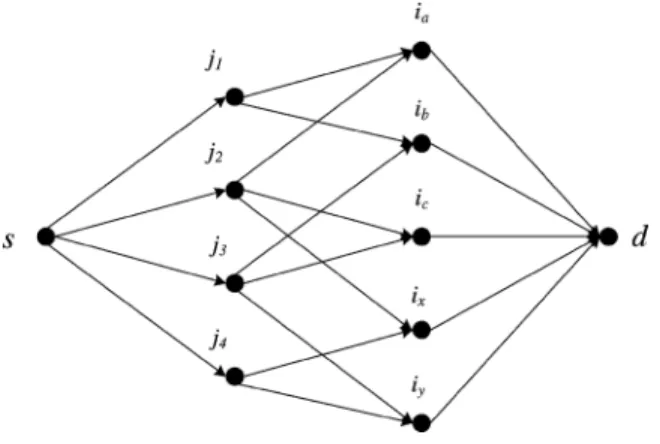
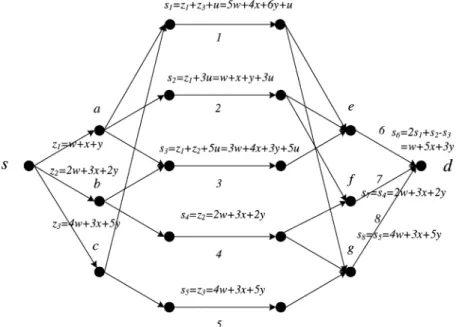
An example where this strategy is useful is given in Fig. 4, which is obtained by interchanging the source and the sink as well as reversing all the links in Fig. 2. At most three links in the last layer can be wiretapped. By injecting one local key at node and two global keys at the source, Strategy 2 can achieve se-crecy rate 2. On the other hand, if random keys are only injected
at the source, the secrecy rate is at most . Let and be
the secrecy rate and the random key rate at the source, respec-tively. Let be the total rate of transmission on the last layer.
To achieve secrecy, we must have , where the min-cut
condition on the last layer requires . Since the
source injects all the random keys, the min-cut condition on the
first layer requires . Combining these we obtain
, which is strictly less than 2.
From the examples, we see that Strategies 1 and 2 are useful in complementary cases. In general, these two strategies can be
combined to obtain a higher secrecy rate. We use these strategies in the following sections to develop theoretical results. How-ever, for numerical computation of achievable rates in scenarios 1 and 2, we note that the number of possible wiretapping sets, and thus the size of the LPs, are exponential in the size of each wiretap set, so they are most useful for small .
IV. UNACHIEVABILITY IN THENONUNIFORMCASE
In the case of unrestricted wiretapping sets, unit link capaci-ties, and all random keys injected at the source, the secrecy ca-pacity is equal to the simple cut-set bound in (2) [3]. The rate in (2) is always achievable in the uniform case, or in the nonuni-form case when the wiretap set is known. In contrast, when the wiretap set is unknown, we show that if the set of wiretappable links is restricted (Scenario 1), the rate (2) is not achievable in general even with local random keys, by considering the ex-ample in Fig. 5. We give an analytical proof that the rate in (2) is not achievable and further use the program Information-The-oretic Inequalities Prover (Xitip) [18] to show that the secrecy capacity is bounded away from the rate in (2). We then convert the example into one with unequal link capacities (Scenario 2) and show unachievability for this case also.
A. Restricted Wiretap Set (Scenario 1)
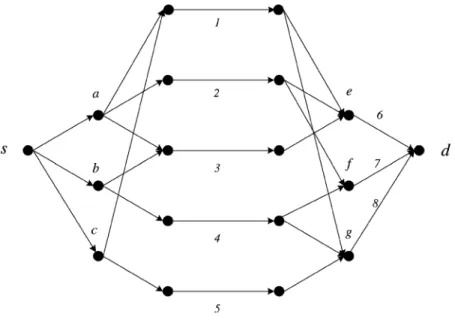
Consider the example in Fig. 5, where all links have unit ca-pacity and any three of thefive middle layer links can be wire-tapped. Let the middle layer links be 1–5 (from top to bottom) and the last layer links be 6–8 (from top to bottom). Let the signal carried by link be called signal , or , and let the source
information be denoted . We can easily observe that the rate
in (2) equals 2.
To provide intuition for the case when the wiretap set is
un-known, wefirst show that secrecy rate 2 cannot be achieved
by using scalar linear coding. Then, the argument is converted to an information-theoretic proof that secrecy rate 2 cannot be achieved by any coding scheme.
Suppose secrecy rate 2 is achievable with a scalar linear net-work code. First note that the source cannot inject more than
unit amount of random key; otherwise, the first layer cannot
carry two units of source data. Let the random key injected by
the source be denoted . For the case when the source injects
a unit amount of random key, wefirst have the following obser-vations. Signal 6 must be a function of signal 1; otherwise, if the adversary sees the signals 2–4, then he knows signals 6–7. Also, signal 8 must be a function of signal 5; otherwise, if the adversary sees signals 1, 2, and 4, then he knows signals 7–8. Similarly, we can show that signal 8 must be a function of signal 1, and signal 7 must be a function of signal 2. We consider the following two cases.
Case 1: signal 5 is a linear combination of signals present at the source node. To achieve the full key rank condition on links 1, 2, and 5, nodeamust put two independent local
keys and on links 1 and 2, respectively. Link 7, whose
other input is independent of , is then a function of .
Similarly, Link 8 is a function of . This means that the
Fig. 5. Example to show that the secrecy rate without knowledge of wiretapping set is smaller than that with such knowledge. The wiretapper can wiretap any three of thefive links in the middle layer.
Case 2: signal 5 is a linear combination of signals present at the source node as well as a local key injected by nodec. Case 2a: is also present in signal 1. Then, is present in signal 6 and is independent of the key present in signal 7.
Case 2b: is not present in signal 1. Then, is present in
signal 8 and is independent of the key present in signal 7. In all three cases 1, 2a, and 2b, there is a pair of last layer links which are functions of two independent random keys, leaving capacity for only one unit of secret message. Thus, we conclude that the secrecy rate without knowledge of the wiretapping set by using only linear network coding is less than 2.
We can extend the above argument to analytically show this result for any coding scheme in the case of zero decoding error and perfect secrecy.
Theorem 2: For the wireline network in Fig. 5, a secrecy rate of 2 is not achievable if any three out of thefive links (1–5) in the middle layer are wiretapped and the location of those links is unknown.
Proof: See the Appendix.
We can also show that the secrecy rate is bounded away from 2, by using the framework in [19], where linear optimization is used to check whether an information inequality is implied by set of linear information inequalities together with Shannon-type information inequalities. The derived bound holds for ei-ther zero or asymptotically negligible decoding error, and for perfect, strong, or weak secrecy, since it is derived by linear op-timization over a set of linear constraints whose constant terms can be scaled by the code blocklength with a corresponding scaling in the objective function3and by the continuity of the optimal value of a linear program with respect to its constraints (see, e.g., [20]). Let be the message sent from the source and
3The linear optimization maximizes over the constraints in (6), which
correspond to the zero decoding error and perfect secrecy case, and the closure of the set of Shannon-type inequalities, which forms a convex cone.
, , be the signals on the links adjacent to the source.
Wefind an upper bound on that is implied by
(6)
where thefirst inequality is the capacity constraint, the second
constraint shows that the sink can decode , constraints 3–5
mean that the signals in the last layer are independent of other signals given the incoming signals from the middle layer, con-straints 6–10 represent the secrecy concon-straints when any three links in the middle layer are wiretapped, and constraints 11–16 represent the conditional independence between the signals in thefirst layer and those in the middle layer. In particular,
Fig. 6. Coding scheme achieving secrecy rate 1 without knowledge of the wiretap set for the network in Fig. 5, where any three of thefive middle layer links can be wiretapped. is the secret message, and are keys injected at the source, and is a key injected at node and canceled at node . The operations are over afinitefield .
a Markov chain. Note that constraints 3–5 and 11–16 implic-itly allow some randomness to be injected at the corresponding nodes. We use the Xitip program [18], which relies on the
frame-work in [19], to show that is implied by the set
of equalities (6). Therefore, 5/3 is an upper bound on the se-crecy rate when the location of wiretapper is unknown, which is less than the secrecy rate 2 achievable when such information is known. Therefore, there is a strict gap between the secrecy capacity and the achievable rate in (2).
On the other hand, the secrecy rate for the wireline network in Fig. 5 is at least 1 which is shown by the example in Fig. 6, where
afinitefield is used. In this example, a combination of
Strategies 1 and 2 is used, where keys are injected inside the network and are also canceled at intermediate nodes.
B. Unequal Link Capacities (Scenario 2)
We have restricted the wiretapped links to be in the middle layer in Fig. 5. We next show that the rate in (2) also holds for the secure network coding problem with unequal link capacities (Scenario 2). We convert the example of Fig. 5 by partitioning
each nonmiddle layer link into parallel small links each of
which has capacity . Any three links can be wiretapped in the transformed graph. We prove the unachievability of the rate in (2) in the transformed network.
First, we show a lower bound on the min-cut between the source and the sink in the transformed network when three links
are deleted. Note that deleting any ( ) nonmiddle layer
links reduces the min-cut by at most . When , the
min-cut is 2. When or at most two middle layer links are
deleted, the min-cut is at least 2 after deleting these middle layer
links, and the min-cut is at least after further
deleting the nonmiddle layer link. When or at
most one middle layer link is deleted, the min-cut between the source and the sink is 3 after deleting this middle layer link, and
the min-cut is at least after further deleting
the nonmiddle layer links. Therefore, the cut-set bound is at
least .
For the case where the location of the wiretap links is un-known, we prove the unachievability of the rate in (2) in the transformed network. First, consider the transformed network with the restriction that the wiretapper can only wiretap any three links in the middle layer. The optimal solution is exactly the same as for the original network of the previous section
and achieves secrecy rate at most . Now, consider the
trans-formed network without the restriction on wiretapping set, i.e., the wiretapper can wiretap any three links in the entire network. As wiretapping only the middle layer links is a subset of all pos-sible strategies that the wiretapper can have, the secrecy rate in the transformed network is less than or equal to that in the former case, which is strictly smaller than the rate in (2) for strictly smaller than . Therefore, this rate is still unachiev-able when the wiretap links are unrestricted in the transformed graph.
V. NP-HARDNESS
We show in the following that determining the secrecy ca-pacity is NP-hard by reduction from the clique problem, which determines whether a graph contains a clique4of a given size . The network interdiction problem, which is to minimize the
maximumflow of the network when a given number of links
in the network are removed, is shown in [21] to be NP-hard,
by showing that for any clique problem on a given graph ,
there exists a corresponding network whose interdiction
ca-pacity is if and only if contains a clique of size . We use
a similar construction and show that for this family of networks , the secrecy capacity is equal to the interdiction capacity.
4A clique of size in a graph is a set of pairwise adjacent vertices, or in
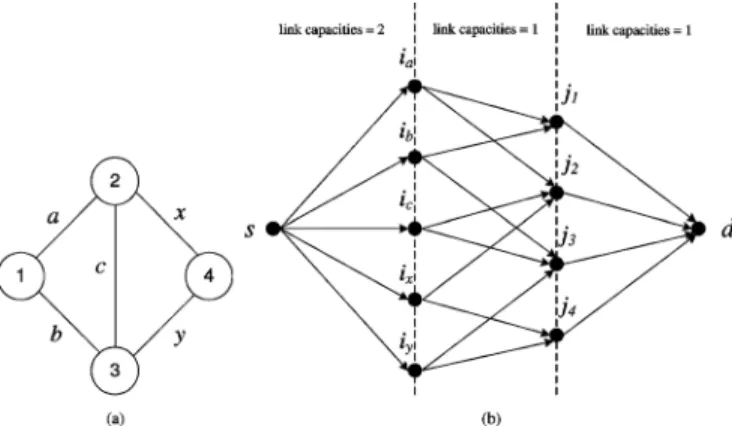
Fig. 7. Example of NP-hardness proof for the case with knowledge of the wire-tapping set. (a) Original Graph . (b) Transformed Graph .
Since the upper and lower bounds used to establish the secrecy capacity are the same regardless of whether the wiretap set is known or unknown, and whether capacity is defined with either zero or asymptotically negligible decoding error and either per-fect, strong, or weak secrecy, it follows that determining secrecy capacity under these different definitions is NP-hard.
We briefly describe the approach in [21] in the following.
Given an undirected graph , we will define a
ca-pacitated directed network such that there exists a set of
links in containing less than or equal to links
such that has a maximumflow of if and only if
contains a clique of size . For a given undirected graph without parallel links and self loops, we create a
capac-itated, directed graph as follows: For each link
, create a node in a node set , and for each vertex
, create a node in a node set . In addition, create source
node and destination node . For each link , direct a link
in from to with capacity 2 and call this set of links .
For each link , direct two links in from to
and with capacity 1, respectively, and call this set of links
. For each vertex , direct a link with capacity 1 from
to . Let this be the set of links . This completes the
construc-tion of . In
Fig. 7, we give an example of the graph transformation, where . We use the following result from [21].
Lemma 1 [21, Lemma 2]: Let be constructed from as
above. Then, there exists a set of links with
such that the maximumflow from to in
is if and only if contains a clique of size .
After obtaining , we generate by replacing each link
with parallel links each with capacity and
call this link set . We carry out the same procedure for links and call this link set . Then,
. It is shown in [21] that the
worst case set is a subset of ; therefore, by Lemma 1 and
the NP-hardness of the clique problem,finding the interdiction capacity is NP-hard.
Now, we consider the secrecy capacity when
. From Lemma 1, the condition that contains a clique of
size is equivalent to the condition that the max-flow to the
sink in after removing a set of links from is . We
now show that the latter condition is equivalent to the condition
that the secrecy capacity of when the wiretapper accesses
any unknown subset of links from (Scenario 1) is . By
Theorem 1, the secrecy capacity is upper bounded by whether or not the wiretap set is known. To show achievability, for each
subset of links from , we create nodes and with
their corresponding incident links as described in Strategy 1. As the wiretapped links each have capacity 2 and are connected to the source directly, the min-cut between the source and each
virtual sink is at least . Then, by using Strategy 1, the
secrecy rate is achievable even if the wiretap set is unknown. Finally, we show that the same condition is also equivalent
to the condition that the secrecy capacity of when any
links are wiretapped (Scenario 2) is . By the same arguments as in the previous scenario, the secrecy capacity is upper
bounded by , and when onlyfirst layer links are wiretapped,
the min-cut between the source and each virtual sink is at
least . Since each second layer link has a singlefirst layer link as its only input, wiretapping a second layer link yields no more information to the wiretapper than wiretapping afirst layer link. When some links in the third layer are wiretapped,
let the wiretap set be where and
. Thus, contains at least links.
We create nodes and with their corresponding incident
links as described in Strategy 1. Since removing links in
corresponds to removing links in , after removing links in
corresponding to , contains a subgraph containing
links plus at least one link .
Case 1: is a clique of size . In this case, the number of
vertices with degree greater than 0 in is .
Case 2: is not a clique. contains at least vertices
with degree greater than 0.
According to [21, Lemma 1], the max-flow in is equal to
the number of vertices in with degree greater than 0. In both
cases, the max-flow of after removing links in is at least
. Let be the max-flow capacity from the source to
in .
We can use a variant of the Ford–Fulkerson (augmenting paths) algorithm, e.g., [22], as follows to construct a max-flow
subgraph from to in satisfying the property
that after removing from , the min-cut between
and is at least
(7)
where we have used . Considering the
net-work with all link directions reversed, we construct
augmenting paths via depth first search from to , starting
first by constructing augmenting paths via links in , until we obtain a set of paths corresponding to a maxflow of capacity
between and . We add further augmenting paths
until we obtain a maxflow (of capacity at least ) between
and , which may cause some of the paths traversing links in to be redefined but without changing their total capacity.
The subgraph consists of the final set of paths traversing
links in . Thus, the paths remaining after removing have
a total capacity lower bounded by (7). Therefore, the min-cut
between the source and in is at least ,
and the min-cut between the source and in is at least
. By using Strategy 1, a se-cure rate of is achievable. We have thus proved the following theorem.
Theorem 3: For a single-source single-sink network con-sisting of point-to-point links, computing the secrecy capacity is NP-hard.
VI. CONCLUSION
In this paper, we have addressed the secrecy capacity of wire-line networks where different links have different capacities and restricted wiretapping sets. For the case of networks with equal
capacity links where any links can be wiretapped, the
se-crecy capacity is given by a cut-set bound if random keys are injected at the source, whether or not the communicating users have information about the choice of the wiretap set. In contrast, we have shown that this rate is unachievable in general in the case of unknown wiretap sets or unequal capacity links, even if nonsource nodes can generate randomness. Further, we have proposed achievable linear optimization-based strategies where random keys are canceled at intermediate nonsink nodes or in-jected at intermediate nonsource nodes. Finally, we have shown that determining the secrecy capacity is an NP-hard problem.
APPENDIX
PROOF OFTHEOREM2
We prove Theorem 2 by contradiction. Suppose that a secrecy rate of 2 is achievable for the network in Fig. 5. As before, let
and denote, respectively, the secret message and random
key injected by the source node, and the signal on link .
Then, each triple of links in the middle layer has zero mutual information with the source data, and each pair of links in the middle layer has joint conditional entropy 2 given the other three links.
Since the message is decodable from information
on the last layer, we have . Since
, by the data processing inequality
, therefore, and
. Then,
. This implies that does not
depend on random keys injected by node or which
would be independent of . Similarly, ,
im-plying and .
Thus, does not depend on random keys injected by node
which would be independent of and . In a
similar manner, we can show that and also do not
depend on any random keys injected after the middle layer.
Also, since and
, therefore .
Let denote the adversary’s observations. By the
se-crecy requirement, , which implies
.
Then, the mutual information ; otherwise,
if the adversary sees signals 2–4, his mutual information with signals 6–7 is greater than 1. The mutual information ; otherwise, if the adversary sees signals 1, 2, and 4, his mutual information with signals 7–8 is greater
than 1. The mutual information ; otherwise,
if the adversary sees signals 2, 4, and 5, his mutual information with signals 7–8 is greater than 1. The mutual information ; otherwise, if the adversary sees signals 1, 4, and 5, his mutual information with signals 7–8 is greater than 1. Case 1: signal 5 is a function of only signals present
at the source node, i.e., . By the
zero mutual information condition for links 1, 2, and 5, , so
(8)
Since is conditionally independent of , given
and , we have ,
and . Now
(9)
Since is conditionally independent of given
, we have
(10) Then, by the nonnegativity of conditional mutual informa-tion
(11)
Next, note that and are conditionally
inde-pendent given and , since
. Therefore, and are
conditionally independent given and , i.e.,
. Since , it follows that . Then, we have (12) So, , and therefore,
, which contradicts the re-quirement that there is at most 1 unit of random key on the last layer.
Case 2: signal 5 is not a function only of signals present at the source
Case 2a: signal 1 has nonzero mutual information
. For brevity, let
and . Since and
, we have . Since , we have and so . Then, from , we have . Since and , from (13)
we have . Then, since
, we have . Also,
since , we have .
Case 2b: signal 1 has zero mutual information with any random key injected at node c. Then, . Similar reasoning as
for case 2a applies with , ,
in place of , and in place of .
From Cases 1, 2a, and 2b, we conclude that the secrecy rate without knowledge of the wiretapping set by using any non-linear or non-linear coding strategy is smaller than 2, obtained for the case where such knowledge is present at the source.
REFERENCES
[1] L. H. Ozarow and A. D. Wyner, “Wire-tap channel II,” inProc. Euro-crypt, Apr. 1984, pp. 33–50.
[2] C. E. Shannon, “Communication theory of secrecy systems,”Bell Syst. Tech. J., vol. 28, pp. 656–715, 1948.
[3] N. Cai and R. Yeung, “Secure network coding,” inProc. IEEE Int. Symp. Inf. Theory, Jun. 2002, p. 323.
[4] R. W. Yeung and N. Cai, “On the optimality of a construction of secure network codes,” inProc. IEEE Int. Symp. Inf. Theory, Toronto, ON, Canada, Jul. 2008, pp. 166–170.
[5] J. Feldman, T. Malkin, R. Servedio, and C. Stein, “On the capacity of secure network coding,” presented at the Allerton Conf. Commun., Control, Comput., Sep. 2004.
[6] S. Y. El Rouayheb and E. Soljanin, “On wiretap networks II,” inProc. IEEE Int. Symp. Inf. Theory, Nice, France, Jun. 2007, pp. 551–555. [7] D. Silva and F. Kschischang, “Universal secure network coding
via rank-metric codes,”IEEE Trans. Inf. Theory, vol. 57, no. 2, pp. 1124–1135, Feb. 2011.
[8] N. Cai and R. W. Yeung, “A security condition for multi-source linear network coding,” inProc. IEEE Int. Symp. Inf. Theory, Nice, France, Jun. 2007, pp. 561–565.
[9] K. Bhattad and K. R. Nayayanan, “Weakly secure network coding,” presented at the presented at the WINMEE, RAWNET, NETCOD Workshops, Riva del Garda, Italy, 2005.
[10] A. Mills, B. Smith, T. Clancy, E. Soljanin, and S. Vishwanath, “On secure communication over wireless erasure networks,” inProc. IEEE Int. Symp. Inf. Theory, Jul. 2008, pp. 161–165.
[11] M. Langberg and M. Médard, “On the multiple unicast network coding conjecture,” inProc. 47th Annu. Allerton Conf. Commun., Control, Comput., Monticello, IL, Sep. 2009, pp. 222–227.
[12] T. Chan and A. Grant, “Mission impossible: Computing the network coding capacity region,” inProc. IEEE Int. Symp. Inf. Theory, Toronto, ON, Canada, Jul. 2008, pp. 320–324.
[13] R. Koetter and M. Médard, “An algebraic approach to network coding,”
IEEE/ACM Trans. Netw., vol. 11, no. 5, pp. 782–795, Oct. 2003. [14] T. Ho, M. Médard, J. Shi, M. Effros, and D. R. Karger, “On randomized
network coding,” presented at the Allerton Conf. Commun., Control, Comput., Sep. 2003.
[15] L. R. Ford and D. R. Fulkerson, Flows in Networks. Princeton, NJ: Princeton Univ. Press, 1962.
[16] R. W. Yeung, Information Theory and Network Coding. New York: Springer, Aug. 2008.
[17] R. Ahlswede, N. Cai, S. Y. R. Li, and R. W. Yeung, “Network infor-mationflow,”IEEE Trans. Inf. Theory, vol. 46, no. 4, pp. 1204–1216, Jul. 2000.
[18] Xitip – Information-Theoretic Inequalities Prover [Online]. Available: http://xitip.epfl.ch/
[19] R. W. Yeung, “A framework for linear information inequalities,”IEEE Trans. Inf. Theory, vol. 43, no. 6, pp. 1924–1934, Nov. 1997. [20] V. Bohm, “On the continuity of the optimal policy set for linear
pro-grams,”SIAM J. Appl. Math., vol. 28, no. 2, pp. 303–306, 1975. [21] R. K. Wood, “Deterministic network interdiction,”Math. Comput.
Model., vol. 17, no. 2, pp. 1–18, 1993.
[22] B. C. Dean, M. X. Goemans, and N. Immorlica, “Finite termination of “augmenting path” algorithms in the presence of irrational problem data,”Lecture Notes Comput. Sci., vol. 4168, pp. 268–279, 2006.
Tao Cui(S’04) received the M.Sc. degree in the Department of Electrical and Computer Engineering, University of Alberta, Edmonton, AB, Canada, in 2005, and the M.S. degree and Ph.D. degree from the Department of Electrical Engi-neering, California Institute of Technology, Pasadena, USA, in 2006 and 2009, respectively. His research interests are in the interactions between networking theory, communication theory, and information theory.
Tracey Ho(M’06–SM’11) is an assistant professor of electrical engineering and computer science at the California Institute of Technology. She received the B.S., M.Eng., and Ph.D. degrees in electrical engineering and computer sci-ence from the Massachusetts Institute of Technology in 1999, 1999, and 2004 respectively. She was a co-recipient of the IEEE Communications Society and Information Theory Society Joint Paper Award in 2009 for “A Random Linear Network Coding Approach to Multicast.” Her primary research interests are in information theory, network coding, and communication networks.
Jörg KliewerS’97–M’99–SM’04) received the Dipl.-Ing. (M.Sc.) degree in Electrical Engineering from Hamburg University of Technology, Germany, in 1993 and the Dr.-Ing. degree (Ph.D.) in Electrical Engineering from the Univer-sity of Kiel, Germany, in 1999, respectively.
From 1993 to 1998, he was a Research Assistant at the University of Kiel, and from 1999 to 2004, he was a Senior Researcher and Lecturer with the same institution. In 2004, he visited the University of Southampton, Southampton, U.K., for one year, and from 2005 until 2007, he was with the University of Notre Dame, Notre Dame, IN, as a Visiting Assistant Professor. In August 2007, he joined New Mexico State University, Las Cruces, NM, as an Assistant Pro-fessor. His research interests include information theory, error correcting codes, network coding, and communication networks.
Dr. Kliewer was the recipient of a Leverhulme Trust Award and a German Research Foundation Fellowship Award in 2003 and 2004, respectively. He was a Member of the Editorial Board of the EURASIPJournal on Advances in Signal Processingfrom 2005–2009 and is Associate Editor of the IEEE TRANSACTIONS ONCOMMUNICATIONSsince 2008.