A Security Analysis of the Helios Voting
Protocol and Application to the
Norwegian County Election
Kristine Salamonsen
Master of Science in Physics and Mathematics
Supervisor: Kristian Gjøsteen, MATH Co-supervisor: Anders Smedstuen Lund, IMF
Department of Mathematical Sciences Submission date: June 2014
i
Preface
This paper represents my Master’s thesis and last work at NTNU. I would like to thank my supervisor Anders Smedstuen Lund. Without your help this thesis would not have been written. Thank you for teaching me the theory in an un-derstandable way and encouraging me to do my best. I would also like to thank Kristian Gjøsteen for guiding me at my project last fall and for inspiring me to study cryptography. At last I will say thanks to Thomas for reading through my thesis, correcting errors and discussing the paper (even though you probably did not understand the half of it).
Kristine Salamonsen Trondheim, June 2014
Abstract
We present Helios, an end-to-end verifiable internet voting system. We describe the existing protocol, the encryption and decryption process with corresponding proofs, and analyse an attack against ballot secrecy.
Further we do some changes to the existing voting protocol. In the original protocol we are not able to prove soundness and extract the witness in the proof of correct encryption. Hence, we are not able to make a formal proof of ballot secrecy. We solve this problem by adding a different proof of correct encryption. In the second change we combine the ElGamal encryption with a generalisation of the Paillier encryption and analyse whether it can be used as an efficient voting protocol for the Norwegian county election.
iii
Sammendrag
Vi presenterer Helios, et ende-til-ende verifiserbart internett valgsystem. Vi beskriver protokollen, krypteringen og dekrypteringen med tilhørende bevis for korrekthet. Vi analyserer ogs˚a et angrep mot protokollen og ser p˚a hvilke forbedringer som er gjort i denne sammenheng.
Videre utfører vi to endringer i den eksisterende valgprotokollen. I den originale protokollen klarer vi ikke ˚a lage et formelt sikkerhetsbevis som viser at det man stemmer er hemmelig. Vi løser dette ved ˚a legge til et ekstra krypteringsbevis i tillegg til det vi kaller et proof of knowledge. Til slutt kombinerer vi ElGa-malkrypteringen med en generalisering av Pailliers kryptering og analyserer om det er en effektiv valgprotokoll for det norske fylkestingsvalget.
Contents
1 Introduction 1
2 Theory 3
2.1 The Decision Diffie-Hellman Problem . . . 3
2.2 Encryption and Decryption . . . 4
2.3 Correct Encryption . . . 5
2.3.1 Zero-Knowledge, Σ-Protocols and Proofs of Knowledge . . . 5
2.4 Correct Decryption . . . 9
2.5 More on Soundness . . . 11
2.6 The Fiat-Shamir Heuristic . . . 11
2.7 The Probability of Faking Decryption Proofs . . . 12
3 The Voting Protocol 15 3.1 The Different Players . . . 15
3.2 Setup Phase . . . 16
3.3 Voting Phase . . . 16
3.4 Counting Phase . . . 18
3.5 Development . . . 18
4 An Attack Against Ballot Secrecy 19 4.1 Description of the Attack . . . 19
4.2 Variants of the Attack . . . 20
4.2.1 Integer Representation Attack . . . 21
4.2.2 Permutation Attack . . . 21
4.2.3 Malformed Ciphertext Attack . . . 21
4.2.4 Homomorphic Attack . . . 22
4.2.5 Another Malleability Attack . . . 23
4.3 Solving the Problem . . . 23
5 Changing the Protocol 25 5.1 The New Protocol . . . 25
5.2 Security Analysis . . . 26
5.2.1 Defining Verifiability . . . 26
5.2.2 Defining Ballot Secrecy . . . 27
5.2.3 Verifiability in the New Protocol . . . 28
5.2.4 Ballot Secrecy in the New Protocol . . . 29
6 Applying Helios to the Norwegian County Election 35 6.1 The New Encryption Scheme . . . 35
6.2 Correct Encryption . . . 37
6.3 Applying Helios to the Norwegian County Election . . . 38
6.4 Security Analysis . . . 40
6.5 Numerical Example . . . 40
6.6 Costs of the Calculations . . . 41
Chapter 1
Introduction
Electronic voting is upcoming and increases the flexibility of voting. It gives the opportunity of either remote voting where voters may submit their votes from home or voting electronically via computers in a voting booth at polling stations. In this thesis I have studied an example of a protocol for use in remote voting, namely Helios.
Along with the opportunity of remote voting over the internet follows a lot of challenges. In traditional paper elections voters do their choices secretly in a voting booth, making sure no one is looking. They submit their ballots into a locked ballot box, and make sure no one else is able to tamper with their ballots. Turning this into a digital process makes it all more complicated, introducing the need for techniques to guarantee privacy and integrity. The computations in the encryption and decryption process might also be tedious.
As mentioned, my work is based upon Helios, a publicly available internet voting system from 2008. This thesis is a continuation of my project the last fall, in which I introduced the existing Helios voting protocol. Now I dig a bit deeper and I make some changes to the protocol. These changes enable us to prove that any vote given in an election is kept secret, given some reasonable assumptions.
Helios supports homomorphic encryption allowing us to jointly decrypt the ciphertexts to reveal the sum of the votes. This could be very efficient, especially for simple elections, but for Helios where we use the exponential version of ElGamal this becomes hard when the exponent tends to grow large, since we have to compute the discrete logarithm.
We want to find a reasonably efficient voting protocol with homomorphic en-cryption for the Norwegian county election, and as Helios is today, it will not be efficient. ElGamal has some nice properties which we want to keep. Hence, we combine the ElGamal encryption with a generalisation of Paillier’s public key system.
Overview of the Paper
Chapter 2 gives the theoretical background for this thesis. We discuss zero knowl-edge, Σ-protocols and proofs of knowledge.
Chapter 3 describes the voting protocol and the different players in it. We describe the voting phase with encryption and the counting phase with decryption, where we apply theory from the previous chapter.
Chapter 4 analyses an attack against the voting protocol. We will see how this effected the voter privacy and explain how the problem was solved. We will also propose another possible solution with unique identifiers.
In Chapter 5 we introduce a change to the voting protocol. We make a security analysis to make sure the new protocol still fulfills verifiability and we are now able to prove ballot secrecy.
In the last chapter we combine the exponential ElGamal cryptosystem with a generalisation of Paillier’s public key system. The last thing we do is to apply Helios with the new encryption on the Norwegian county election and analyse the efficiency.
Chapter 2
Theory
This chapter will introduce the theory behind this thesis and will be useful in the work we do. We will first present the Decision Diffie-Hellman problem on which the security of the Helios voting protocol relies. Secondly we introduce the ElGamal Cryptosystem, which we use to encrypt and decrypt ballots. Then we look at zero-knowledge, Σ-protocols and proofs of knowledge, which we will use to show correct encryption and decryption in Helios. Lastly we present the Fiat-Shamir heuristic which makes our interactive proofs non-interactive.
2.1
The Decision Diffie-Hellman Problem
The security of our protocol relies on the complexity of the Decision Diffie-Hellman (DDH) problem. Consider a cyclic group G of prime order q and let g be a generator of the group. Generally speaking the DDH assumption claims that there exists no algorithm which efficiently distinguishes the distribution {g, ga, gb, gab}
from the distribution{g, ga, gb, gc}for randoma, b, c∈G. More formally, we have: Decision Diffie-Hellman Problem. Given (g0, g1)∈ G×G (where at least g1
is sampled at random), decide if (u0, u1)∈G×G was sampled uniformly from the
set {(gt0, g1t)|0≤t < q} or uniformly from G×G.
It can be proven (e.g [13], [10]) that the DDH problem is equivalent to the following problem:
L-DDH. Given (g0, g1, . . . , gL) ∈ GL+1 (where at least g1, g2, . . . , gL are sampled
at random), decide if (u0, u1, . . . , uL)∈ GL+1 was sampled uniformly from the set
{(g0t, gt1, . . . , gtL)|0≤t < q} or uniformly from GL+1.
2.2
Encryption and Decryption
The encryption of ballots in Helios is based on the ElGamal encryption system. This section will specify the key generation, encryption and decryption for the exponential ElGamal Cryptosystem. We will also see some of the advantages of the additive homomorphic properties of this version of ElGamal.
Let p and q be primes such that q | p−1. Let G be a finite cyclic subgroup of Z∗p with order q, and let g be a generator for the group, G = hgi. The key generation is as follows:
• Selecta at random, a∈RZq∗, and compute y←ga(mod p). The private key
isa while the public key is y,p and q.
Let m∈Zq, then we have the encryption ofm:
• Selectr at random,r ∈RZ∗q.
• A ciphertext is computed asc= (α, β) = (gr (mod p),yrgm(mod p)). The ciphertext is decrypted using the secret key, and we obtain
• gm =βy−r =β(ga)−r =βα−a(mod p).
We choose the exponential version of ElGamal such that we get the plaintext
m in the exponent, then we achieve an additive homomorphic cryptosystem, and we will exploit this further.
There is two common ways to anonymise the ballots; by homomorphic encryp-tion or by a mix-net. By the homomorphic property of ElGamal we have that
Enc(m1)·Enc(m2) =Enc(m1 +m2).
This allows us to multiply all the ballots together and then jointly decrypt them, revealing no single ballot. This explains why the exponential version of ElGamal is desirable. We obtain:
Y ci =
Y
gri,Yyrigmi=gPri (mod p), yPrigPmi (mod p).
Remark that we have to compute the discrete logarithm to obtain the final resultP
mi, a problem assumed to be hard in our groupG. This is indeed possible
for small values of P
mi, by raising g to higher and higher powers until it equals
βα−a(mod p). But for large exponents this will be tricky.
The other way the ballots are made anonymous is by a mix-net. The mix-net shuffles and re-encrypts the encrypted votes and thus destroys the link between a voter and the corresponding vote. The shuffling is based on the Sako-Kilian protocol [14], a provable mix-net based on ElGamal re-encryption. The mix-net
2.3. CORRECT ENCRYPTION 5
was used in some previous versions of Helios, but this thesis will consider the homomorphic encryption and we will not describe the mix-net any further.
We remark that all calculations further in the chapter are done modulo p, we just omit the notation for simplicity and to save space.
2.3
Correct Encryption
Given a ciphertext (α, β) we want to prove that it contains a value between 0 and
q−1 without revealing the value. This is done by a disjunctive proof of equality between two discrete logarithms. We prove that (loggα = logyβ) ∨ (loggα =
logyβg)∨. . .∨(loggα=logy(gqβ−1)).
We will use a Σ-protocol, so we will first introduce zero-knowledge proofs, Σ-protocols and proofs of knowledge.
2.3.1
Zero-Knowledge,
Σ-Protocols and Proofs of
Knowl-edge
We consider a protocol between two parties, which we call prover and verifier. The goal is for the prover to show knowledge of some secret or convince the verifier of the validity of a statement without revealing the secret or anything beyond the validity of the statement. The idea is that the verifier should gain no (zero) additional knowledge than what he had before the execution of the protocol. We will now introduce a Σ-protocol, which is a zero-knowledge protocol.
A Σ-protocol is a 3-round protocol defined for a relation R. In a 3 round protocol the prover makes the first move and sends a message/commitment to the verifier. The verifier replies with a challenge and the last move is the prover’s response.
Let R = (v;w) ⊆ V ×W be a binary relation. v ∈ V is the common input for the prover and the verifier, and w ∈ W is the private input for the prover. We call w the witness. We define a language for the relation R: LR = {v ∈ V :
∃w∈W(v, w) ∈ R}. The definition of a Σ-protocol is given in [4], and we give it
here:
Definition 1. A protocol is said to be a Σ-protocol for a relation R if it satisfies the following properties:
• Completeness. In a conversation between an honest prover and an honest verifier and if (v, w)∈R, the verifier will always accept.
• Special soundness. Given the common input v and two accepting con-versations (A, e, t) and (A, e0, t0) (with the same commitment but different
challenges), a probabilistic polynomial time algorithm should be able to com-pute a witness w such that (v, w)∈R.
• Special honest-verifier zero-knowledge. There exists a probabilistic polynomial time algorithm which, on common input (any given v and any challenge e), simulates an accepting conversation indistinguishable from a real conversation between an honest prover and an honest verifier.
The proof of equality between two discrete logarithms which we use to prove correct encryption is a proof of knowledge, demonstrating knowledge of the ran-domness r used to create the ciphertext. Generally speaking, the protocol is a proof of knowledge if the prover convinces the verifier that he knows some infor-mation which is related to the common input v. In our case the prover knows the discrete logarithmr.
Technically a Σ-protocol is a proof of knowledge if there exists a probabilistic polynomial time algorithm that is able to extract the witness by interacting with a prover, with the same success probability as a prover convincing a real verifier. We call this algorithm a knowledge extractor. The extractor may rewind the prover to the point after the prover sent it commitments, send it different messages and play it several times, until it get two accepting conversation. From the requirement of special soundness there exists an algorithm which now is able to compute the witness.
2.3.1.1 OR-Protocol with n Options
Let us go back to what we wanted to prove, namely that (α, β) contains a value between 0 and q−1 without revealing the value. We use an OR-protocol which is a Σ-protocol for the relation R1 ∨R2 = {(v1, v2;w1, w2) : (v1;w1) ∈ R1 ∨
(v2;w2)∈R2}. We extend this to an OR-protocol withn options and prove that
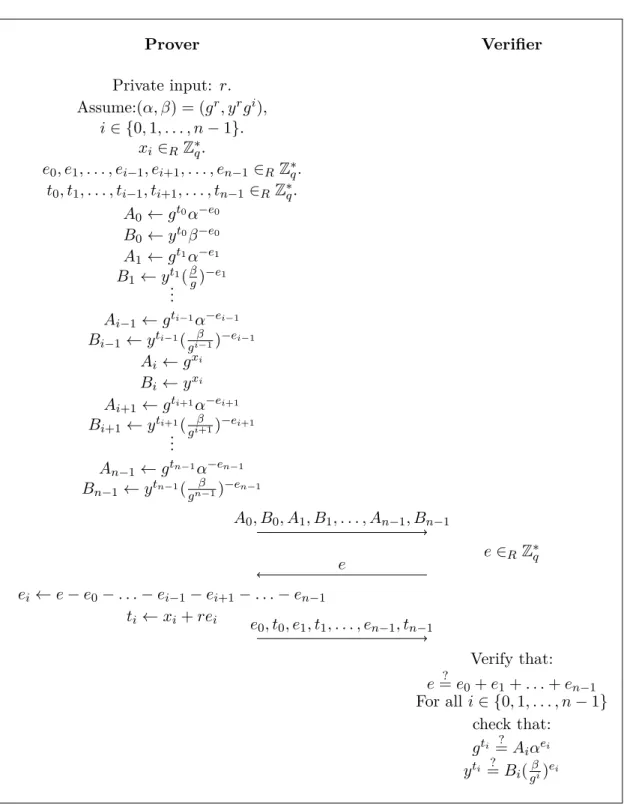
(loggα =logyβ)∨(loggα =logyβg)∨. . .∨(loggα=logygnβ−1). We call this protocol an-OR-protocol and it is presented in Figure 2.1.
The common input is g, y, αand gβm, while the private input to the prover isr.
We show that the n-OR-protocol is a Σ-protocol.
Claim 1. Then-OR-protocol is a Σ-protocol for the relation {((α, β); 0,1, . . . , n−
1) : (loggα=logyβ)∨(loggα=logygβ)∨. . .∨(loggα=logygnβ−1)}.
Proof. • Completeness: Consider the case where (α, β) = (gr, yrgi), 0 < i < n−1, then:
gti =gxi+rei =A
iαei,
yti =yxi+rei =B
i(gβi)ei.
Clearly for j 6= i we have gtj = Aαej, ytj = B
j(gβj)ej by construction, and
2.3. CORRECT ENCRYPTION 7 Prover Verifier Private input: r. Assume:(α, β) = (gr, yrgi), i∈ {0,1, . . . , n−1}. xi∈RZ∗q. e0, e1, . . . , ei−1, ei+1, . . . , en−1 ∈RZ∗q. t0, t1, . . . , ti−1, ti+1, . . . , tn−1∈RZ∗q. A0 ←gt0α−e0 B0 ←yt0β−e0 A1 ←gt1α−e1 B1←yt1(βg)−e1 Ai−1←gti−1α−ei−1 Bi−1 ←yti−1(giβ−1)−ei−1 Ai ←gxi Bi ←yxi Ai+1 ←gti+1α−ei+1 Bi+1←yti+1(giβ+1)−ei+1 An−1←gtn−1α−en−1 Bn−1←ytn−1(gnβ−1)−en−1 e∈RZ∗ q ei ←e−e0−. . .−ei−1−ei+1−. . .−en−1 ti ←xi+rei Verify that: e=? e0+e1+. . .+en−1 For alli∈ {0,1, . . . , n−1} check that: gti =? A iαei yti =? B i(gβi)ei .. . .. . A0, B0, A1, B1, . . . , An−1, Bn−1 e e0, t0, e1, t1, . . . , en−1, tn−1
• Special soundness: Given two accepting conversations (A0, B0, A1, B1, . . . , An−1, Bn−1, e;e0, e1, . . . , en−1, t0, t1, . . . , tn−1), (A0, B0, A1, B1, . . . , An−1, Bn−1, e0;e00, e01, . . . , e0n−1, t00, t 0 1, . . . , t 0 n−1),
where the commitments are the same and the challenges are different. We should now be able to compute the witness to prove special soundness. Sincee=e0+e1+. . .+en−1 6=e00+e01+. . .+e0n−1 =e0, we havee0 6=e00 or
e1 6=e01 or. . . en−1 6=e0n−1. We also have the following:
gt0=A 0αe0, gt 0 0=A0αe 0 0, yt0=B 0βe0, yt 0 0=B0βe 0 0, gt1=A 1αe1, gt 0 1=A1αe 0 1, yt1=B 1 βg e1 , yt01=B1 βg e01 , .. . gtn−1=An−1αen−1, gt0n−1=An−1αe0n−1, ytn−1=Bn−1 β gn−1 en−1 , yt 0 n−1=Bn−1 β gn−1 e0n−1 .
From this follows:
gt0−t00 =αe0−e00, yt0−t00 =βe0−e00 gt1−t01 =αe1−e01, yt1−t01 = β g e1−e01 .. . gtn−1−t0n−1 =αen−1−e0n−1, ytn−1−t0n−1 = β gn−1 en−1−e0n−1 ,
and we can extract the witness. Let i ∈ {0,1, . . . , n−1} such that ei 6= e0i.
Then we obtain the witness ri = ti−t0i
ei−e0i, and we see that ri =loggα=logy
β gi.
• Special honest-verifier zero-knowledge: We will again consider the case where (α, β) = (gr, yrgi), i ∈ {0,1. . . n−1}. We have the distribution from the honest-verifier for any given challengee:
{(A0, B0, A1, B1, . . . , An−1, Bn−1, e;e0, e1, . . . , en−1, t0, t1, . . . , tn−1) : xi, e0, e1, . . . , ei−1, ei+1, . . . , en−1, t0, t1, . . . , ti−1, ti+1, . . . , tn−1 ∈R Z∗q, ei ←e−e1−. . .−ei−1−ei+1−. . .−en−1, ti ←xi+rei, A0 ←gt0α−e0, B0 ←yt0β−e0, A1 ←gt1α−e1, B1 ←yt1 β g −e1 , .. . Ai ←gxi, Bi ←yxi, .. . An−1 ←gtn−1α−en−1, Bn−1 ←ytn−1 β gn−1 −en−1 },
2.4. CORRECT DECRYPTION 9
and the simulated distribution:
{(A0, B0, A1, B1, . . . , An−1, Bn−1, e;e0, e1, . . . , en−1, t0, t1, . . . , tn−1) : e0, e1, . . . , ei−1, ei+1, . . . , en−1, t0, t1, . . . , tn−1 ∈RZ∗q, ei ←e−e1−. . .−ei−1−ei+1−. . .−en−1, A0 ←gt0α−e0, B0 ←yt0β−e0, A1 ←gt1α−e1, B1 ←yt1 β g −e1 , .. . Ai ←gtiα−ei, Bi ←yti β gi −ei , .. . An−1 ←gtn−1α−en−1, Bn−1 ←ytn−1 β gn−1 −en−1 }.
It can be verified that these distributions are identical, and hence, we have special honest-verifier zero-knowledge, and then-OR-protocol is a Σ-protocol.
2.4
Correct Decryption
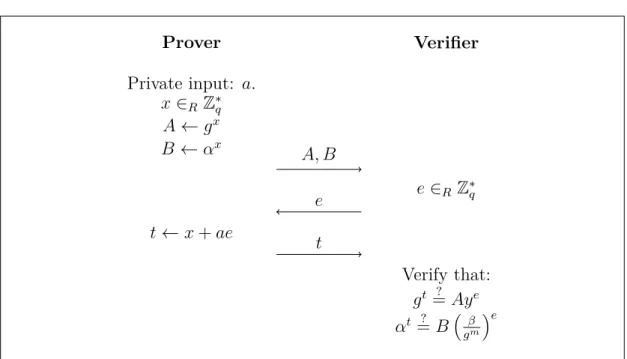
Proving the decryption correct is almost the same as proving correct encryption. But instead of proving knowledge of the randomnessrused to create the ciphertext, we now want to prove knowledge of the secret keya. For integrity we prove equality between two discrete logarithms, namely loggy=logαgβm. Hence, we see that this
protocol is simpler than the OR-protcol used for encryption. The equality protocol is given in Figure 2.2.
The common input is g, y, α and gβm, while the private input to the prover isa.
We show that this equality protocol is a Σ-protocol as well.
Claim 1. The equality protocol is a Σ-protocol for the relation {(g, y, α,gβm) :
loggy=logαgβm}.
Proof. • Completeness: Completeness follows from:
gt=gx+ae=Aye,
αt=αx+ae =B β gm
e .
• Special soundness: Let (A, B, e, t) and (A, B, e0, t0) be two accepting tran-scripts with the same commitmentsAandB, and different challengese6=e0. We have gt=Aye, gt0 =Aye0 αt=B β gm e , αt0 =B β gm e0 .
Prover Verifier Private input: a. x∈RZ∗q A←gx B ←αx e∈RZ∗q t←x+ae Verify that: gt=? Aye αt =? B β gm e A, B e t
Figure 2.2: Equality Protocol.
From this follows:
gt−t0 =ye−e0
αt−t0 = β gm
e−e0 ,
and we can extract the witnessa= et−−te00. We havea=loggyand a=logαgβm
and it follows thatloggy=logαgβm.
• Special verifier zero-knowledge: The distribution from the honest-verifier for any given challenge e:
{(A, B, e, t) :x∈RZ∗q, A←gx, B ←αx;t ←x+ae},
and the simulated distribution:
{(A, B, e, t) :t ∈RZ∗q, A←g
ty−e, B ←αt β
gm
!−e
}.
It can be checked that these distributions are identical, and we have special honest-verifier zero-knowledge, and the equality protocol is a Σ-protocol.
Remark that we only are able to prove zero-knowledge against an honest veri-fier, but that suffices for our purpose.
2.5. MORE ON SOUNDNESS 11
2.5
More on Soundness
We now argue that the relationloggy=logαgβm holds in the equality protocol given
one accepting conversation, though we are not able to extract the witness. Let (A, B, e, t) be a conversation such that gt = Aye and αt = B( β
gm)e. g is
a generator for the group, so we can write gt = gρ(gν)e for some ρ and ν ∈
Z∗q.
Similarly, α = gr is a generator and we have that αt = αρ+δ(αν+∆)e. From this
follows that t =ρ+νe and t =ρ+δ+ (ν+ ∆)e. Subtracting the first one from the second one gives 0 = δ+ ∆e. Since e is sampled after δ and ∆ are chosen we have that δ = ∆ = 0. This means that loggA = logαB and loggy = logαgβm.
Hence, given one accepting conversation the relation loggy =logαgβi always holds
except with probability (q−1)−1.
The same holds for the n-OR-protocol. Since Ai, Bi are defined before we
know e, at least one ei must be undefined. This gives us the same argument for
loggα = logygβi. Looking at one specific i in the n-OR-protocol is just the same
as one equality protocol. Hence we have that the relation loggα =logygβm always
holds with just one accepting conversation except with probability (q−1)−1.
2.6
The Fiat-Shamir Heuristic
We use the Fiat-Shamir heuristic [7] to obtain a non-interactive zero knowledge proof. This is done by replacing the response of the verifier by a hash function H
modelled as a random oracle. A random oracle could be viewed as a theoretical black box returning completely random answers for every query. It is also consis-tent, always returning the same answer on a given input. Consider every player to have access to this oracle. For more information about random oracles see [2].
As an example we look at the equality protocol in Figure 2.2. From the 3-round communication flow in the Σ-protocol, we now get a 1-round protocol. It works as follows for the decryption proof:
• The prover does the same as before, but instead of sending the commitments
A, B to the verifier, he computes e←H(g, α, y, β, A, B).
• The prover continues as before and computest ←x+ae, and sends A, B, e, t
to the verifier.
• At last the verifier checks if e = H(g, α, y, β, A, B) and if gt = Aye and
αt =B(gβm)
e.
The protocol is still complete and special honest-verifier zero-knowledge. The simulator works just as before; for any e choose t uniformly at random, and
com-pute A ← gty−e and B ← αt( β gm)
−e. Then we can just reprogram the random
oracle such that
H(g, α, y, β, A, B)←e.
We will further in this thesis use that H1i is a hash function for an i-OR
proof, that is H1i : G2i+4 → Z∗q by e ← H1i(g, y, α, β, A0, B0, A1, B1, . . . , Ai, Bi).
Further we will use that H2 is a hash function for the equality protocol, that is
H2 :G6 →Zq∗ bye←H2(g, α, y, β, A, B).
The soundness on the other hand is more difficult to prove. In the non-interactive case we are no longer able to extract the witness. We can not longer rewind and obtain two accepting conversations with the same commitment but different challenges, since a random oracle will always return the same challenge on the same commitment query. There is no known attack against it, we just do not know how to prove it. In Chapter 5 we will add an extra proof to the knowledge proof and thus fix this problem, because we no longer need to extract the witness.
2.7
The Probability of Faking Decryption Proofs
In this section we take a look at the probability of faking the decryption proofs. We will need a bound for this event when we prove ballot secrecy later. We prove the following theorem.
Theorem 2.1. Take any algorithm that outputs integers ν, e, and group elements
g, α, y and gβm such that loggy 6= logαgβm. If the algorithm uses at most η queries
to the random oracle H2, then we have that the probability that
A=gty−e, B =αt β gm
!−e
and e=H(g, α, y, β, A, B) is at most (η+ 1)(q−1)−1.
We use the following lemma from [9] to prove the theorem.
Lemma 2.2. Let G be a group of prime order q, and let g be a generator for the group. Let ν and ∆ be integers, and A, B, x1, x2 are group elements such that
x1 =gν and x2 =αν+∆.
Then if ∆6= 0 and e is an integer chosen uniformly at random from a set with
q−1 elements, the probability that there exists an integer t such that
Axe1 =gt and Bxe2 =αt
2.7. THE PROBABILITY OF FAKING DECRYPTION PROOFS 13
Proof. We have x1 =gν and x2 =αν+∆. Suppose ∆ 6= 0, that is loggy6=logαgβm.
Let e be chosen at random fromZ∗q.
Since both g and α are generators of the group we have that A = gρ and
B = αρ+δ for some ρ and δ ∈
Z∗q . We want to find the probability that there
exists a t, givenA, B, g, α, x1, x2, such that
Axe1 =gt and Bxe2 =αt.
We getgρgνe =gt andαρ+δα(ν+∆)e =αt. This givest=ρ+νeand t=ρ+δ+ (ν+
∆)e. Subtracting the first one from the second givesδ+ ∆e= 0. Since ∆6= 0 and since δ and ∆ was fixed before we choosee, there is only onee which satisfies this equation. eis chosen randomly from Z∗q, and from this follows that the probability of finding t such that the above holds is (q−1)−1.
Proof. (Proof of Theorem 2.1). If H2 has not been queried at the relevant point,
we have that A = gty−e, B = αt β gm
−e
and e = H2(g, α, y, β, A, B) holds with
probability (q −1)−1. From Lemma 2.2 we have that every time the algorithm queries H2 with some input for which he cannot already create a forged proof, the
probability that the random oracle replies with something that the adversary is able to use to forge a proof is (q−1)−1. This is doneη times.
This adds up to (1 +η) times where each event has probability (q−1)−1. Let
δ = (q−1)−1. Now we have that the probability that at least one of them happens is bounded by 1−(1−δ)1+η ≤2(η+ 1)δ.
Chapter 3
The Voting Protocol
The voting protocol consists of several cryptographic operations and different en-tities which we call players. In this chapter we will present the players and their interaction with each other. We will divide the election into three phases: Setup phase, voting phase and counting phase, and we describe the roles of the players in the different phases.
Helios has developed through four versions, and some of the improvements are done due to attacks discovered against the voting system. We will briefly mention some of these changes in this chapter, but the important improvements done to the protocol are discussed further in Chapter 4.
3.1
The Different Players
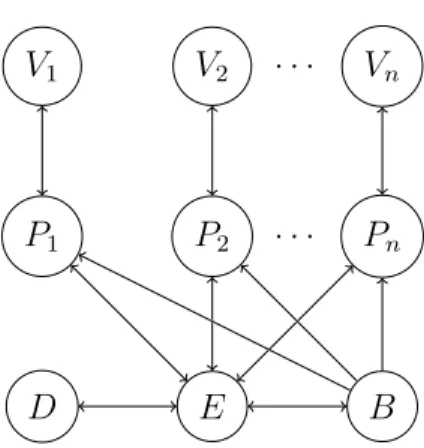
The voting protocol consists of several players interacting with one or several other players. The players we will consider in this protocol are the voter V, the voter’s computer P, the election officer E, the bulletin board B and the decryptor D. Figure 3.1 presents the players and the communication channels between them.
The protocol works as follows: V submits a vote toP, which encrypts the vote and sends it further to E along with proofs of correct encryption. E verifies the proofs and if they are correct he publishes the encrypted vote and corresponding proofs on B. B is a publicly available website. When the election is done, E
can compute the encrypted tally. All the ciphertexts are then homomorphically combined, and E sends the combination to D. D decrypts the ciphertexts, sends the result back to E along with a proof of correct decryption, and if the proof are correct, E publishes the final result on B with corresponding correction proofs.
V1 V2 Vn P1 P2 Pn E B D . . . . . .
Figure 3.1: Overview of the Protocol Players.
3.2
Setup Phase
Anyone is able to create an election with Helios and invite people to vote. The person creating the election is considered as the administrator. He specifies the eligible voters, the questions or the candidates for the election, the opening and closing time (the voting phase), and controls E.
Helios generates a pair of keys, one public and one private. A set of n trustees are also selected. Helios supports threshold decryption, which means that the private key is shared among several trustees. Each trustee gets its own private key share ai which is randomly chosen, ai ∈R Z∗q. The private key is then the sum of
all the key shares, a=a0+a1+. . .+an−1.
Each trustee computes yi ← gai. Then y ← y0 ·y1·. . .·yn is the public key
that is used for encryption and is publicly available at the bulletin board. This way, each trustee is committed to their key share by the value yi. By a proof of
knowledge as in Figure 2.2 (without showing equality) withai as the private input
and only one commitmentgx, each trustee shows thatyiwas correctly constructed.
As we will see all the trustees are required for the decryption process.
The administrator can choose to have only one trustee as well, the Helios server itself.
When it is time, the administrator freezes the election. The voter list is now finished and the questions/candidates are unchangeable and ready for download-ing.
3.3
Voting Phase
When the administrator freezes the election, the eligible voters receive an e-mail with information that the election is open and the questions/candidates are
avail-3.3. VOTING PHASE 17
able for download. The mail also includes an individual username, a randomly generated password, a hash of the election parameters and the URL for the voting booth.
A voter V is first met by the ballot preparation. At this step anyone, not only eligible voters, is able to look and choose alternatives. Once every choice is made, they are immediately encrypted. A ballot contains a list of encrypted answers, where each encrypted answer represents one election question. Each encrypted answer has again a list of n ciphertexts ((α1, β1),(α2, β2), . . . ,(αn, βn)), where n
is the number of possible choices or candidates for that question. Each encrypted answer contains also the product of the nciphertexts (α, β) = (α1·α2·. . .·αn, β1·
β2·. . .·βn).
The ciphertexts are constructed as described in Section 2.2. Letm∈ {0,1}and let (α, β) = (gr, yrgm) represents a ciphertext for some candidate. Then m = 1
means that the voter voted for the candidate, and m = 0 means that V did not vote for the candidate.
The product of ciphertexts (α, β) for each question will contain a value between 0 and n−1. In some cases the voter may be restricted to vote for at most one candidate, then the product of ciphertexts will contain a 0 or a 1.
When every plaintext is encrypted, a hash of the encryption appears andV can choose to audit or cast the ballot. The auditing reveals the ciphertexts for each possible answer along with proofs of correct encryption as described in Section 2.3.1.1. The proofs include individual proofs that each ciphertext contains a 0 or a 1 and overall proofs that the product of ciphertexts for each question contains a value between 0 and n−1.
The auditing allows every voter to verify the encryption, though, some mathe-matical knowledge is required to do so. V should not be able to know the random-ness used to encrypt the ballot, so he is asked to reconstruct the ballot. A new
r is randomly generated, and hence, a new encryption is made. He can choose to audit as many times as he wants.
The voter is not asked to authenticate before he chooses to cast his ballot. This way, anyone is able to check the ballot preparation, audit the encryption and check that a ballot is well formed. This feature, separating the ballot preparation and casting, is based upon Benaloh’s principle of ballot casting assurance [3], and it is important for the end-to-end verifiability Helios offers.
The voter authenticates by typing the username and the password received in the e-mail. The ciphertext is cast and the records of it are then deleted from the voter’s computer. The encrypted ballot is published on the bulletin board along withV’s ID or some alias, and proofs of correct encryption. Hence,V and everyone else can verify that V’s ballot is included and that he cast a valid vote. V also receives a confirmation on e-mail, with the encrypted vote and the hash.
3.4
Counting Phase
When the election is closed and the voters have cast their votes, the cast votes are stored at the bulletin board. It is time for decryption and counting. To preserve anonymity, a ballot should never be decrypted alone. By the homomorphic prop-erties of ElGamal described in Section 2.2, the ballots are multiplied together and then jointly decrypted.
In the case of several trustees, they are all required for decryption, where they use their private key share for a partial decryption. The partial decryption factor iski =αai, given (α, β). We stress that we use the inverse of the decryption factors
in the decryption. Let k denote the product of all decryption factors. Then we havegm =βk−1.
The trusteees also need to show that the decryption is correct. This is done by proving equality between two discrete logarithms. Since every trustee gener-ates their own proof, they prove that loggyi =logαki by using the Σ-protocol for
equality from Section 2.4.
When the homomorphic tallying is done the final result is made public at the bulletin board, along with proofs of correctness.
3.5
Development
The first version of Helios was published in 2008 and has by now developed to the fourth version. In 2010 Helios was attacked and major improvements were made due to this attack. The proofs were made more robust after the attack by including more parameters in the hash which generates the challenge in the knowledge proof for correct encryption. We will discuss the attack and the improvements further in Chapter 4.
Among other changes was the transition from mix-nets in the first version to homomorphic encryption in the second version. In the third version it became possible to authenticate in several new ways, e.g. Google, Facebook and Twitter.
We remark that the documentation of the fourth version is still in progress, as it has been since August 2012 [1].
Chapter 4
An Attack Against Ballot Secrecy
Helios has suffered from three known attacks. We will focus on the second one, an attack against voter privacy. The attack was first described and discussed in [18]. The attack is done by an adversary replaying another voter’s ballot or a variant of it. Due to this attack, privacy has been taken care of and the improvements done are the greatest change in the voting protocol.
The attack exploits the lack of ballot independence. That is, an adversary is able to create a relating ballot by observing another voter’s interaction with the system. This chapter will describe the attack, different variants of it and the improvements done to prevent similar future attacks.
4.1
Description of the Attack
In this section we will give a general description of the attack and in the next section we will give different variants of it. We remark that in the following attacks, the only parameters included in the hash functions generating the challenges, are the commitments. Otherwise, many of the attacks would be avoided.
For simplicity we consider an election with only three voters, V1, V2 and V3,
which makes it easy to see the impact of the attack. Assume that each voter is allowed to vote for at most one candidate, but the attack may be generalized to
n candidates. We will illustrate that an adversary replaying another voter’s ballot will destroy ballot secrecy in this particular election.
Consider two of the voters to be honest, say V1 and V2. The adversary V3 is
able to recast the same vote as one of the others. Let us say that V3 recasts the
same vote as V1. We define a ballot for voter Vi, where i ∈ {1,2}, in an election
with n candidates as:
Vi, ci,1, . . . , ci,n, poki,1, . . . , poki,n, poki0,
where for all i∈ {1,2} and j ∈ {1, . . . , n}:
ci,j = (αi,j, βi,j)
poki,j = (Ai,j, Bi,j, ei,j, ti,j, A0i,j, B
0 i,j, e 0 i,j, t 0 i,j) poki0 = (Ai, Bi, ei, ti, A0i, B 0 i, e 0 i, t 0 i)
where poki,j represents the proof of knowledge which demonstrates that each
ci-phertextci,j contains a 0 or a 1, andpoki0 represents the overall proof which
demon-strates that voteri has voted for at most one candidate.
When the voting phase is over and the election result is published, the adversary will immediately recognize whatV1 voted by observing the only candidate with at
least two votes, which immediately destroys privacy. He will obviously also notice what V2 voted, since this is the only remaining vote.
This attack can violate ballot secrecy in an election with more than three voters as well. An adversary observing an honest voter’s ballot and ID at the bulletin board may interfere with other dishonest voters, making them all recast the same vote. This will result in a major contribution to the vote of the honest voter, which again will result in violated privacy.
Throughout this chapter we will assume that:
• There are three votersV1,V2 and V3.
• VotersV1 and V2 are honest.
• There are n candidates.
• The adversary is using the ballot of voter k to violate privacy. The ballot is given as:
Vk, ck,1, . . . , ck,n, pokk,1, . . . , pokk,n, pok0k.
• It is only possible to vote for zero or one candidate.
4.2
Variants of the Attack
An adversary may not necessarily recast a ballot, he can cast a variant of it. In this section we give several variants of the attack and we will see how the adversary, by exploiting ballot malleability, can construct new ballots depending on already existing ballots. These constructions prove the lack of ballot independence in Helios.
4.2. VARIANTS OF THE ATTACK 21
4.2.1
Integer Representation Attack
The first variant of the attack uses the possibility to change the response value in the encryption proof. The adversary constructs a new ballot without changing the vote. He can do so by adding a multiple of q to the response component in the knowledge proof. Let γ1, γ10, . . . , γn, γn0, γ, γ
0 ∈
N. The adversary constructs the
ballot:
ck,1, . . . , ck,n, pokk,1, . . . , pokk,n, pok
0
k,
where for all j ∈ {1, . . . , n}
pokk,j = (Ak,j, Bk,j, ek,j, tk,j+γjq, A0k,j, B 0 k,j, e 0 k,j, t 0 k,j+γ 0 jq) and pok0k= (Ak, Bk, ek, tk+γq, A0k, B 0 k, e 0 k, t 0 k+γ 0 q).
Hence, the ballot is different, while the vote remains unchanged. The proofs are still valid.
4.2.2
Permutation Attack
The second variant of the attack is done by a permutation of the ciphertexts in the ballot. Letπ be a permutation on the set{1,2, . . . , n}(not the identity map). The adversary constructs the ballot:
ck,π(1), . . . , ck,π(n), pokk,π(1), . . . , pokk,π(n), pokk0.
Since we just have a permutation the proofs are still valid.
4.2.3
Malformed Ciphertext Attack
We will once again see how the adversary, by observing the bulletin board and the other ballots, may construct a new ballot which is related to an already existing ballot.
Let v ∈ {1, . . . , n}, then the adversary can construct the following ballot: (1,1), . . . ,(1,1) | {z } v-1 times ,(αk,v, βk,v),(1,1), . . . ,(1,1) | {z } n-v times , pok1, . . . , pokv−1, pokk,v, pokv+1, . . . , pokn, pokk,v,
which represents a vote for candidate number v. pokk,v is the knowledge proof
demonstrating that (αk,v, βk,v) contains a 0 or a 1, described in Section 2.3.1.1.
For all j ∈ {1, . . . , v−1, v+ 1, . . . , n}we have that the proof of knowledge for ciphertext j is given by pokj = (Aj, Bj, ej, tj, A0j, Bj0, e0j, t0j), where e0j, t0j, tj ∈R Z∗q
and Aj ←gtj A0j ←gt0j Bj ←ytj Bj0 ←yt0jge 0 j ej ←H(Aj, Bj, A0j, B 0 j)−e 0 j
We have the ciphertext (α, β) = (1,1). Then,αej = 1 andαe0j = 1, and from this it
follows thatAjαej =Aj =gtj and A0jα e0j =A0j =gt0j. Similarly, we have (β g0) ej = 1 and (gβ1) e0j =g−e0j. Hence, B j(gβ0) ej =B j = ytj and B0j( β g1) e0j = Bj0g−e0j = yt 0 j, and
it follows that pokj is a valid proof for the ciphertext (1,1).
If the honest Vk, voted for candidate number v, the adversary will cast the
same vote. If Vk casts a vote of abstention, the adversary will also cast a vote of
abstention. In any other case the adversary will cast a vote of abstention, which will be different fromVkwho voted for any other candidate in{1, . . . , v−1, v+1, . . . , n}.
We illustrate that this form of the attack will also violate ballot secrecy. Con-sider the outcome of the election to be two votes for one candidate and one vote for another candidate (no abstention vote), then the adversary knows that Vk voted
for the candidate with two votes, and privacy is again violated.
4.2.4
Homomorphic Attack
Another variant of the attack exploits the homomorphic properties of ElGamal. If Vk casts a vote of abstention, the adversary is able to cast the same vote. The
adversary constructs the ballot
(αk,1·. . .·αk,n, βk,1·. . .·βk,n),(1,1), . . . ,(1,1)
| {z }
n-1 times
, pok0k, pok2, . . . , pokn, pokk0
As long asVk does not cast a vote of abstention, we see that this ballot represents
a vote for the first candidate.
poki for 2≤i≤n is a valid proof for the ciphertext (1,1). This can be shown in the same way as we did in the malformed ciphertext attack. pok0k is a valid proof for (αk,1·. . .·αk,n, βk,1·. . .·βk,n) as it is a valid overall proof forVk’s ballot.
As before this type of attack violates privacy. Consider the outcome of the election to be at least two votes of abstention, then it is clear for the adversary thatVk cast a vote of abstention, and if there are two votes for the same candidate
and at least one vote for the first candidate, the adversary also knows what Vk
4.3. SOLVING THE PROBLEM 23
4.2.5
Another Malleability Attack
The last variant we will present is another malleability attack. The adversary chooses γ1, . . . γn∈N. Let γ =γ1+. . .+γn. He constructs the ballot:
ck,1, . . . , ck,n, pokk,1, . . . , pokk,n, pokk0,
such that for all j ∈ {1, . . . n} we have
ck,j = (αgγj, βyγj)
pokk,j = (Ak,j, Bk,j, ek,j, tk,j+γjek,j, A0k,j, Bk,j0 , e0k,j, t0k,j+γje0k,j)
pok0k = (Ak, Bk, ek, tk+γek, A0k, Bk0, e0k, t0k+γe0k).
The adversary will in this case cast a vote for the same candidate asVk. The ballot
will obviously be accepted by the election officier, we have just added some new randomness in the exponent and likewise we added γjek,j in the proof.
Once again privacy is broken. If the outcome of the election is two votes for one candidate and one vote for another (or a vote of abstention), the adversary will learn what Vk voted.
4.3
Solving the Problem
After these attacks were discovered, improvements were made to the scheme to ensure voter privacy. We present the improvements here.
First of all the proofs were made more robust by including more parameters in the hash generating the challenge. Here we also have the option to bind any ballot to its respective voter, by including the identity in the hash. This was not done in Helios, but we will still present the option. First we will discuss several changes made in the protocol to prevent the different variants of the attack described in the previous sections.
To prevent the first type of attack, the integer representation attack, we want to prevent the adversary from tamper with the response value in the proof. We solve this by a simple modification in the protocol of the knowledge proof such that the response components are unchangeable. We explain how below. Another possible solution is to let the election officer reject all the ballots which contains a ciphertext that already exists on the bulletin board. This last method will also prevent the homomorphic attack.
The malformed ciphertext attack could also be avoided by rejecting already existing ciphertexts. Another alternative is to force the decryptor to only decrypt ciphertexts (α, β) where α, β 6= 1, that isr 6= 0. This method will also be sufficient to avoid the homomorphic attack, which includes a lot of ciphertexts on the form (1,1).
The last attack described, another malleability attack, can be avoided the same way as the first attack, by making it impossible to change the response value.
Overall a lot more contexts were included in the hash generating the chal-lenge. Especially, α, β were included. In the previous versions of Helios, the hash generating the challenge only used the commitments as input. Including more parameters will make it more difficult to fake the proofs for an adversary. This way the response components are unchangeable. Note that when we presented the non-interactive version in Section 2.6 we took the changes into account and included (g, y, α, β) in the hash.
In addition we can also bind the ballots to voters by including the voter identity in the hash. This technique uses unique identifiers, first proposed by [8], and in-clude the voter’s identity within in the hash that generatese. In the non-interactive proof we have that e ←H12(g, y, α, β, A0, B0, A1, B1). To make the ballot unique
to every voter we include their identity e ← H12(g, y, α, β, A0, B0, A1, B1, ID).
Then, we have for i∈ {0,1}
ei ←H12(g, y, α, β, A0, B0, A1, B1, ID)−ej6=i,
wherej ∈ {0,1}.
This method prevents an adversary from recasting a ballot or a variant of it, because he is not able to include his ID in an already existing ballot. Despite this, unique identifiers were not implemented in Helios due to Benaloh’s principle of ballot casting assurance. Use of the unique identifiers will require the voters to sign in before preparing their ballots, since their ID will be included in the proof. Then there is no longer possible for people not eligible to vote, to audit the ballot preparation and encryption. Hence, this change would have weakened the auditability and verifiability in the protocol. The creators of Helios consider Benaloh’s principle of ballot casting assurance and verifiability as more important, and recommend other systems if voter privacy is of great importance.
Chapter 5
Changing the Protocol
This chapter will introduce some changes we have done to the protocol. The main changes is done in the proof of correct encryption, where we introduce a new generator and add one more proof of correction. In Section 2.6 we mentioned that we are not able to prove soundness in the non-interactive proof. Because of this we are not able to give a formal proof of ballot secrecy. We will solve this problem by adding a new correction proof to the knowledge proof, then we no longer need to extract the witness.
We will further make a security analysis to make sure that the new protocol satisfies verifiability as the old protocol did, and then make a formal proof of ballot secrecy.
5.1
The New Protocol
This section will present the new encryption proof. The encryption remains the same, so an encrypted vote is still given as (α, β) = (gr, yrgm). The Σ-protocol
in Figure 2.1 proving that each ciphertext contains a 0 or a 1 and the Σ-protocol proving that the product contains a value between 0 and n−1 are still included. We will further only point out the changes, what is not mentioned remains the same as before.
We introduce a new generatorg which is chosen randomly fromZ∗q and must be generated during key generation. During encryption we add the element α ← gr
to the ciphertext. We use a Σ-protocol for equality for loggα =loggα, defined in
Section 2.4, and add it in the proof of correctness, in addition to the Σ-protocols used in the previous version. Let H2 be the hash function in this proof. Hence,
we add the following to the proof Let x∈Z∗
q,
A←gx, A←gx,
e←H2(g, g, α, α, A, A), t←x+re,
and verify that
gt=? Aαeand gt=? Aαe.
There is no known way to prove that the non-interactive proof is a proof of knowledge. As described in Section 2.3.1 proving the encryption proof to be a proof of knowledge is done by rewinding. In order to extract the witness, the extractor needs to rewind the prover to the point after the prover has sent his commitments, send the prover different challenges and play it several times, until the extractor gets two accepting conversations. This works fine in the interactive case, but with a hash function it will never work. The hash function will never find two different challenges and hence not two accepting conversations, corresponding to the same commitments.
Remember that, as mentioned in Section 2.5, we are still able to prove the equality between two logarithms with just one accepting conversation in the non-interactive proof, though we are not able to rewind and extract the witness.
In the security analysis in the following section we introduce a trick based upon ideas from [17], which enables us to cheat in a way so that we avoid extracting the witness.
5.2
Security Analysis
The original version of Helios offers end-to-end verifiability and ballot secrecy (though we are not able to formally prove the last one). To avoid lack of security it is important that our new protocol fulfills these requirements as well. The following sections will give an analysis of the security requirements in the new protocol. First will we give some formal definitions.
5.2.1
Defining Verifiability
Helios offers end-to-end verifiability meaning that the voter and anyone else can audit every step from ballot preparation to the final tally.
Verifiability gives the opportunity to verify that every ballot is included in the tally and counted correctly. It is a part of the integrity in the system making sure that no one tampers with the ballots. The votes coming into the system, being encrypted, combined and decrypted, should be consistent with the final result.
5.2. SECURITY ANALYSIS 27
What we really want when a voter is submitting a vote is that the vote is cast as intended. Then the vote is stored at the bulletin board, and we want it to be
stored as cast. At last the the ballot should be counted as stored.
The original version of Helios fulfills these requirements. With the ballot cast-ing assurance everyone is able to audit the encryption process. When voters have cast their votes, the encrypted ballots appear on the bulletin board along with proofs and ID’s or aliases of the voters. This way anyone can check that the vote is included and that the proofs are correct.
The final tally is published on the bulletin board along with proofs of correct-ness, available for anyone to verify. Hence, Helios offers end-to-end verifiability.
5.2.2
Defining Ballot Secrecy
We will in this section discuss the notion of ballot secrecy. Briefly speaking, ballot secrecy means that no one should be able to see your vote.
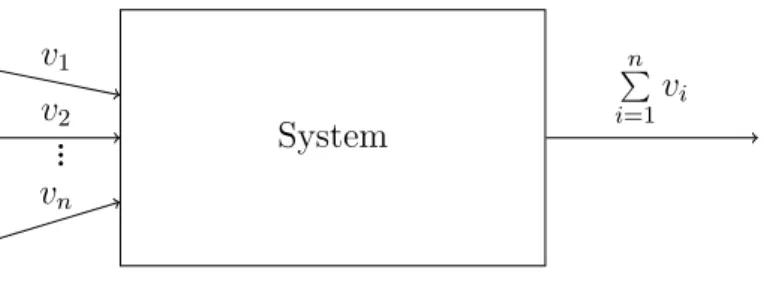
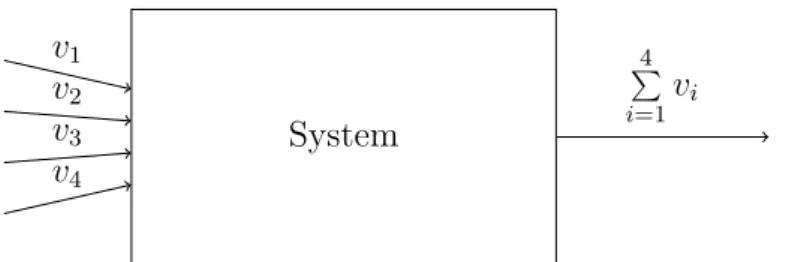
Consider the system in Figure 5.1, representing a voting system. The final output is known to everyone, that is, the sum of all the votes. Then, no one should be able to tell what you voted from this output, and this is the meaning of a secret ballot. System v1 v2 vn n P i=1 vi
Figure 5.1: Voting system.
Now, assume that some of the input is known. Say, there are n votes in total and m of these are known. As long as n−m ≥ 2, we should still not be able to say anything about the remaining votes.
Consider a smaller scenario, an election with four votersV1,V2,V3 andV4, and
their corresponding votes v1,v2, v3 and v4. This scenario is represented in Figure
5.2. After the election is done and the final result is counted and published, we have the sum of the four votes P4
i=1vi. Assume that we know v1 and v2, that is,
the input toV1 andV2. Then, the only remaining information is the sum ofv3 and
v4, and we are still not able to say anything about whatV3 and V4 voted.
Now, consider two voters V0 and V1, both honest, and two possible candidates
d0 and d1. We claim that it should be impossible to distinguish the scenario where
System v1 v2 v3 v4 4 P i=1 vi
Figure 5.2: Ballot secrecy.
d1 and V1 is voting ford0. We generalize it, and give a formal definition of ballot
secrecy. We play the following game between a simulator and an adversary. Ballot Secrecy. The simulator chooses a bitb∈R{0,1}, generatesg, g ∈RZ∗q and
the keypair (a, y), and sends g, g and y to the adversary. The adversary queries the encryption oracle for encryptions of m1, m2, . . . , mn where mi =mi0 or mi1 ∀
i∈ {1,2, . . . , n}. The simulator computes
cij ←((gri0, gri0, yri0gπb(mi0)),(gri1, gri1, yri1gπb(mi1)))
∀ i ∈ {1,2, . . . , n} and sends cij to the adversary along with the proof of correct
encryption. That is, he encrypts m1, m2, . . . , mn or a permutation of them.
The adversary may at all times query a decryption oracle for decryptions of arbitrary ciphertexts c∗, as long as c∗ 6= cij ∀ i ∈ {1,2, . . . , n}. The simulator
verifies the proofs included in the ciphertexts and if they are valid, he responds with the decryption, otherwise he outputs ⊥.
At last the adversary outputs b0 and wins if b = b0. Then the advantage of the adversary is given as
=|P r[E0]−
1 2|.
The reason why we subtract the half is that an adversary may always guess with success probability 1
2, but we want to find the advantage which is better than
just guessing.
Note that since the proofs are checked, the adversary will not be able to create ciphertexts related to theci’s.
5.2.3
Verifiability in the New Protocol
The changes we have made to the protocol will not affect the end-to-end verifia-bility. As before the voter and anyone else are able to run the ballot preparation as many times as they want and verify that the encryption is correct. The public bulletin board enables a voter to see that his vote is included and anyone else is also able to follow the votes appearing on the bulletin board and verify the proofs.
5.2. SECURITY ANALYSIS 29
When the election is ended, the ballots are jointly decrypted and the result is published at the bulletin board along with proofs of correctness. Hence, anyone is able to verify that the decryption was correct.
So, the new system still offers end-to-end verifiability.
5.2.4
Ballot Secrecy in the New Protocol
In this section we will prove that our new system offers ballot secrecy. We prove the following theorem.
Theorem 5.1. If Decision Diffie-Hellman is (DDH, T)-hard, then any adversary
against ballot secrecy has advantage at most DDH + q5−1nnq+ 2(qη−1+1), where nq is
the number of hash queries made by the adversary and η is the number of queries to H2.
The proof of Theorem 5.1 is a sequence of games between a simulator and an adversary. We start with the initial game described in the definition in section 5.2.2. In the end we want to make sure that no information about b leaks to the adversary, so we start to change the initial game and make small modifications through several games.
The first change made is just some bookkeeping to remember the ciphertexts for later use, and then we forge the encryption proofs of honestly generated ciphertexts by using the honest verifier simulation.
Further we remove the secret key, so that the adversary has no chance to learn it. Before we remove it, we introduce a little trick based upon ideas from [17]. This in addition to the new encryption proof give us another way to decrypt ciphertexts. At last we modify the encryption process, first by encrypting using DDH tuples, then by encrypting using random tuples. This way no information about b is available to the adversary.
Let σ be the set of all the proofs with commitments, challenges and responses. In the following proof let a ciphertext be given as cij = (αij, αij, βij, σij) and let
Ei denote the event that the adversary outputs b=b0 in game i.
Proof. Game 0 The initial game is exactly the same as described in the definition of ballot secrecy, in Section 5.2.2.
Assume that the adversary sendsnmessages, uses time at mostT and queries
nq times to the hash oracle.
The advantage of the adversary is
=|P r[E0]−
1 2|.
Game 1 This game proceeds exactly as the previous one, we just add a little bookkeeping. We will later remove the secret key and change the decryption process, and we will need to remember the content of any hon-estly generated ciphertext. So in this game, every time an honest computer encrypts a valid ballot, we store the content of the ciphertext for later use. It is not possible to observe this additional bookkeeping and the game is indistinguishable from Game 0. Hence
P r[E0] =P r[E1].
Game 2 This game is exactly as Game 1, but now we are forging the proofs for every honestly generated ciphertext. This is done the same way as the honest verifier simulation in Section 2.3.1.1. We simulate the individual proofs, the overall proof and the new equality proof. Then, for challenges
e1i, e2 and e3i, where i∈ {1,2, . . . , n}, we reprogram the random hash
func-tions such thatH12(g, yi, αi, βi, A0i, B0i, A1i, B1i)←