SPREADING LEAN
THINKING
The national VA Lean Practitioners Network (VALPN) is a virtual collaborative for VA healthcare practitioners who are applying Lean and Six Sigma strategies to Systems Redesign in order to improve patient-centered care.
The VA Lean
Practitioners
Network
Carlos M. Garcia, MBA, CM, CLGB Professional Development Team
VISN 11 VA Center for Applied Systems Engineering (VA-CASE) [email protected]
Introduction
The VA Lean Practitioners Network (VALPN) is a national virtual collaborative for VA healthcare staff and practitioners who are applying Lean strategies to Systems Redesign to improve
patient-centered care. The group is informal and its purpose is to collaborate and learn from each other to strengthen our combined Lean knowledge-base and to help educate those who are new to Lean strategy. During monthly network conference calls and Live Meetings, members share Lean application ideas and successes.
The network was formed in 2009 to fill a communication gap and to improve a former lack of community that existed between VA Systems Redesign staff and others who were attempting to use Lean Thinking strategy in their healthcare operations. To build a community of practitioners, commonly known as Lean Thinkers, monthly conference calls are scheduled and the call
agenda, presentation slides and other materials are distributed one or two days before each call. The mail group is listed in VA Outlook, on the Global Address List or under All Groups as
VA LEAN PROACTITIONERS NETWORK. Most calls discuss a Lean method or strategy, a successful project, or a best practice. The call format is informal, and presenters are
encouraged to have team members share their personal experience with the intricate nature of process and performance improvement. When feasible, guest presenters are invited from organizations like the VA Office of Systems Redesign, IHI, ASQ, and private sector healthcare organizations like Sharp HealthCare.
Membership continues on a positive growth trend (Figure 1). Members are from all levels of VA hospital and clinic operations in most regions of the country. Many have experience with Lean strategy application and others want to learn how to apply it in their local organizations.
Creating a healthcare Lean enterprise is not a simple task; it requires operational and cultural changes, and a new way to view and
do our work.As a network of practitioners and students of Lean, we support each other through a free and productive exchange of ideas and best practices. All are welcome to share and learn. The only membership requirements are an open and inquisitive mind, and a desire to use Lean Thinking to help make the healthcare services that we provide to our deserving Veterans the best anywhere.
Any VA healthcare staff member who wishes to share their Lean or Six Sigma implementation ideas and successes and help others to begin their Lean journey is welcome to join.
Building the Lean Thinkers Community
Locating and bringing together Lean Thinkers from many VA healthcare organizations around the nation to form a community of practitioners was an interesting and challenging process in the beginning, and has now become a very satisfying undertaking. With no similar blueprint to follow, and having only a vision of what it could be, our initial approach was to gauge the need for a community of practitioners and define its purpose.
The Need for Sharing and Collaboration
By the end of 2009, many VISN organizations and VA medical centers were beginning to establish Systems Redesign (SR) infrastructures to help create a culture of problem solving using the VA-TAMMCS improvement model introduced in the VA Improvement Framework Guidebook [1]. The national SR motto became: Improving our work is our work. However, this was only an evolutionary step for a healthcare culture that always believed in providing the best care for our Veterans, and that was guided by organizations such as the Institute for Healthcare Improvement (IHI). The new improvement framework gave the existing quality assurance and management culture a new platform from which to operate. Yet precisely at this time, when new SR practitioners could have benefited from a steady dialogue to share ideas and best practices, no such dialogue existed. We were working within our own organizations, but not sharing our successes with neighboring others.
While participating in national collaboratives and other conferences to improve clinical systems, processes, and outcomes, we learned the following through observation and discussions with colleagues:
• Facilities were expanding Systems Redesign capacity and capability in response to the VA directive to establish the SR function.
• Many facilities attempting to incorporate Lean into SR were not successful at that time because there were few staff members who had any training or experience in applying Lean principles to healthcare.
• There existed no dialogue or forum in place, and as a result, there was no way to share Lean experience and best practices.
• There was little understanding of Lean Thinking. The principles and approaches originated by the Toyota Production System (TPS) were foreign to most VA healthcare professionals and administrators.
• Few Lean training resources existed inside VA. Formal Lean training and orientation was only available through external sources.
• Lean was mentioned at national collaboratives (FIX, PACT), but little or no sharing took place and there existed no simple means of maintaining a dialogue once the
• There was little or no mention of healthcare Lean at other local and national conferences.
• Many VA organizations interested in applying Lean principles resorted to contracting external consultants at great expense.
Idea to Create a Lean Thinkers Forum
In 2009, we presented the idea to create a forum for learning and discussing Lean principles and practices at a VISN 22 process improvement conference, where SR and Quality
Management staff came together. Conference participants welcomed the idea and gave much encouragement to develop it. Later that year, we formed a small group of interested staff from VISN 21 and 22 and planned the next step to create a forum. The key plan elements were:
• The Vision: To help accelerate the VA’s Lean cultural transformation through communication and collaboration between Lean Thinkers from all VA healthcare operations.
• The Purpose: To support and share Lean application learning, experiences, and best practices.
• Monthly Conference Call Format: To create a forum that functions as a national “virtual” collaborative, where communication and collaboration take place through frequent conference calls. Forum participants will belong to a new mail group. • Participants: The forum will be available to staff at all VA healthcare operations
nationwide and to all organization levels.
• Growth: The forum will grow by word-of-mouth.
• Official Forum Name: “VA Lean Practitioners Network”
Building the Forum
A search for information on how to build a community of interest yielded a few examples and sources of the how-to process. Noteworthy sources included the IHI User Communities and Improvement Blogs [2] and The Community Manager: The Home of Community Builders [3]. The latter offered a three-step model for building an online community of interest. In designing the VALPN, we made use of the following model:
Step 1 – Build:
a) Platform: How will the community connect with each other via virtual means (e.g. telephone conferencing, Facebook, Yammer)?
b) People: What group(s) will make up the community and benefit from it?
c) Participation: How the community will interact? What will people like to talk about? What value will they look for when interacting with others? Will there be sharing and learning involved? How will we attract community members and how will the
Step 2 – Measure: How will we know that the community is forming, growing and benefiting its members?
Step 3 – Learn: What lessons will we learn from the interaction of members within the community? How will we spread beneficial lessons to others interested in creating similar communities of interest within the work environment?
The Monthly Conference Call Format
The basic purpose of the scheduled VALPN monthly call is to teach and learn by sharing, and to collaborate virtually to promote healthcare Lean strategy and principles that advance cultural transformation. Experts agree that in many industries, the transformation of organizations into Lean-thinking enterprises many times begins with grassroots efforts conducted by empowered staff.
The monthly network calls that began in 2009 have had an empowering effect on the
membership and have helped to mobilize process improvement efforts. Many callers expressed how these informal and frequent exchanges of ideas and experiences helped them to better understand Lean and to apply its approaches. We believe that the monthly call’s simple format contributes to this productive sharing. Between 2010 and 2012, the average number of callers connecting to each call was 37. In 2013, the average rose to 59 callers per call.
The following call format has been very successful since the start of the forum: One hour per month
VANTS call or LiveMeeting
Presenters from inside the network as well as outside sources (VHA Office of Systems Redesign, IHI, ASQ, Sharp HealthCare)
Discussion of a Lean method or strategy, a successful project, or a best practice Call agenda and materials (slide sets, articles, etc.) distributed three days in advance Team presentations encouraged and personal experiences shared
Interesting Topic for Every Monthly Call
The main question after choosing the monthly conference call format was deciding what to discuss. We wished to plan and moderate interesting call topics that would inform, educate and generate stimulating discussions. As we planned, there was some level of uncertainty about how to attract interesting speakers and presenters every single month.
We decided to try first inviting our own network members to be presenters on the calls, as we had planned to do when creating the call format. Since the number of network members rose quickly, we had no problem attracting presenters for each monthly call. Suddenly, and to our surprise, network members volunteered to speak or present on the calls. It was then that we realized that indeed there was a need to provide a forum for discussion and learning, and that people were eager to share their experiences with Systems Redesign and the practice of Lean. Beginning in 2010, we attracted presenters from organizations outside the VA, such as
Planetree and the Sharp Healthcare System in San Diego, California. Internally, we invited presenters from the Office of Systems Redesign and Improvement. However, the majority of
speakers and presenters continue to come from the membership ranks, representing VA healthcare organizations nationwide. For 2014-15, we have begun discussions with potential presenters from the Virginia Mason Institute and the ThedaCare Healthcare System, which are two healthcare institutions that have become benchmarks for the implementation of the Lean Management System.
The network’s monthly call history (shown in the Appendix) lists all the presentations made since the first call in November 2009. An archive that stores all the slide presentations and related materials exists on the VISN 11 VA-CASE web site to allow easy access to all network members. All presentations include an element of education in addition to the sharing of an application experience (i.e. completion of a process improvement project, the development of a training program, etc.).
Initially, the monthly call presentations dealt with the definition of Lean problem solving approaches. Slowly, however, the calls became sharing opportunities for Systems Redesign staff and other practitioners who were involved in improvement projects that utilized those approaches. This mix of learning and sharing of personal experiences continues today, and members find it constructive and empowering. The most popular call topics have remained: the application of 5S, process cycle time reduction, and A3 Thinking, which has produced two complete educational presentations to orient new users of this approach.
Much communication throughout the network happens between monthly calls, and is normally initiated by the network coordinator. For example, VA job announcements for Systems
Redesign positions are distributed frequently and many times the jobs have been filled by network members who heard about it from the distribution. Frequent announcements about Lean topic webinars are circulated by internal and external sources. In early 2014, the program manager of the popular EES series, One Team Toward One Dream, approached the network with the idea of including the network mail group on the distribution of announcements for the frequent series programs. The VA Lean Alliance Yammer group, with its 474 members, has agreed to hold joint monthly calls with the VALPN to benefit their growing membership. The scheduled monthly network calls are eagerly anticipated. The members have found that dedicating one hour per month to this activity returns knowledge, how-to information, and valuable sharing from those who are experiencing the benefits of Lean Thinking. They see it as productive time. Furthermore, participation in the network as either listeners or presenters on the monthly calls continues to grow by word-of-mouth, as originally designed. We use no other means to advertise who we are and why we exist. This pure form of spread and growth is appreciated by all who seek new knowledge and the opportunity to learn from those who have experienced its application. This makes our network’s purpose a real and exciting one—as evident in the results section below.
VALPN Participation Results
The current membership growth trend is steady, with approximately one hundred new VA staff joining the network in 2013. We expect this trend to continue in 2014 and beyond. The following set of graphics describes in more detail the VALPN’s extraordinary growth.
There has been remarkable annual membership growth since the beginning in 2009 (Figure 2).
During the four calendar quarters of 2013, the membership growth rate was approximately equal from one quarter to the
next; seventeen new members joined the network in the first two months of 2014 (Figure 3). 17 163 212 295 398 0 100 200 300 400 500 2009 2010 2011 2012 2013 M emb ers hi p Calendar Year
VALPN Membership Growth by Year
332 351 376 398 415 200 250 300 350 400 450 2013Q1 2013Q2 2013Q3 2013Q4 2014Q1 M emb ers hi p
VALPN Membership by Calendar
Quarter
Figure 2: Annual Membership Growth
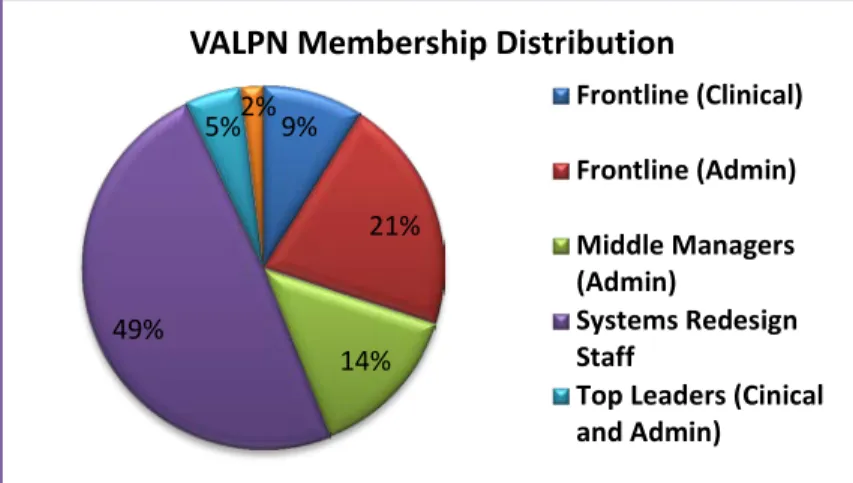
There has been a clear increase in member categories. Initially, as expected, those who joined the network were experienced in quality improvement and came from
administrative areas of VA organizations. Beginning in mid 2010, however, the network experienced accelerated growth through an increasing number of members from the leadership ranks and clinical areas (Figure 4). This was unexpected, but welcome.
The Future of the VALPN
The future is bright for the VALPN. Interest in the principles and practice of Lean Thinking continues to grow in VA healthcare organizations. More training programs and opportunities are available each year, mainly through the efforts of the regional Veterans Engineering Resource Centers (VERC), in particular the VISN 11 VERC/VA-CASE, but also because greater numbers of staff are receiving “train-the-trainer” orientation. As VA develops increasing numbers of Lean Thinkers, there will be a need—even a hunger—for sharing and discussion opportunities like those provided by this network. An investment by staff of one hour per month will continue to make a difference.
The first principle of Lean refers to the need of any organization to respect its people because they are the most valued resource. The principle of “respect for people” includes the need of an organization to provide knowledge and skill enrichment opportunities to their employees, including ways to share the experiences that come from applying that knowledge. We see the VALPN, and similar groups that surely will emerge, as vehicles that help VA respond to this most important principle.
To continue the expansion of its purpose and the spread of Lean Thinking, the VALPN will: • Continue to grow by word-of-mouth.
• Remain informal to facilitate candid and productive discussion and collaboration. • Share Lean knowledge and information with anyone asking.
• Schedule joint calls with emerging Lean-thinking groups like the new VA Lean Alliance. • Continue to attract fine speakers and presenters with interesting and useful topics.
9%
21%
14% 49%
5% 2%
VALPN Membership Distribution
Frontline (Clinical) Frontline (Admin) Middle Managers (Admin) Systems Redesign Staff
Top Leaders (Cinical and Admin)
Bibliography
[1] Veterans Health Administration, Improvement Framework Guidebook, VHA Office of Systems Redesign, Version 2: May 2011.
[2] IHI User Communities and Improvement Blogs. http://www.ihi.org/communities/Pages/default.aspx
[3] The Community Manager: The Home of Community Builders. Three-Step Model for building an online community of practitioners. Retrieved from:
Appendix
VALPN Monthly Call History
Call Date
Topic
Presenter
November 12, 2009 What is Lean Six Sigma? Carlos M. Garcia, VA San Diego A Successful Application of Lean Strategies
at VA Western New York
Vince Dragone, MSSBB, VAWNYHS
January 14, 2010 Why Do Lean Project Teams Fail? Carlos M. Garcia, VA San Diego Basics of Leading a Lean Kaizen Event Vince Dragone, MSSBB,
VAWNYHS
February 11, 2010 Lean Project Selection Gus Krauss & Tina Green, VISN 22 Office, Long Beach, CA The Systems Redesign Coordinator’s Role Angela Howard, RLR VA MC,
Indianapolis, IN
Systems Redesign at VA Illiana HCS Jonathan Hall, VA Illiana HCS, Danville, IL
March 11, 2010 Lean Six Sigma in Healthcare Heather Woodward-Hagg, Chief, Systems Redesign, Indianapolis VAMC
April 8, 2010 Confused About Improvement Models? -- You’re Not Alone
Carlos M. Garcia, VA San Diego May 13, 2010 Cycle Time Reduction Technique for Lean
Operations
Carlos M. Garcia, VA San Diego June 10, 2010 Motivational Interviewing Technique Tina Finet, SR Sr. Analyst, VA
Marion, IN
Engaging Physicians in Systems Redesign Carlos M. Garcia, VA San Diego October 14, 2010 RPIW Overview – Incorporating Lean Tactics
in Accelerated Improvement
Carlos M. Garcia, VA San Diego December 9, 2010 Use of the RPIW Model to Improve C&P
Performance
Angel L.Colon-Molero,
ACOS/Hospital Operations, Miami CAMC
January 13, 2011 The 5S Method – Principles of Waste and Delays Elimination
Carlos M. Garcia, VA San Diego 5S Evolution at VA Pittsburgh HCS Adam Critchlow, Program Analyst,
VA Pittsburgh HCS February 10, 2011 Panel discussion about organization Lean
training – Ideas, Best Practices and Lessons Learned
Panel:
Brian Kvapil, SRC, Middleton Memorial Veterans Hospital, Madison, WI.
Kimberly Brown, SRC, VA Maryland HCS, Baltimore, MD. Francesco Veltri, Management Analyst, VA Detroit MC, Detroit, MI. Adam Critchlow, Program Analyst, Pittsburgh VA MC, Pittsburgh, PA
Moderator:
March 10, 2011 Developing Model Service Lines to Help Spread Lean in the VA
Carlos M. Garcia, VA San Diego April 14, 2011 Patient-Centered Care – Integrating VHA
PCC Principles Into the Lean Value Stream
Dan Otero, Planetree Consultation Services Specialist
May 12, 2011 Lean in the ED – A Best Practice Brian Kvapil, SRC, Middleton Memorial Veterans Hospital, Madison, WI
June 9, 2011 A3 Thinking for Planning, Executing and Reporting
Carlos M. Garcia, VA San Diego A3 Thinking Experience at Tomah VAMC,
Tomah, WI
Tracey Lane-Belcher and RPIW Team
July 14, 2011 No call this month. Summer break.
August 11, 2011 Process Improvement Return on Investment (ROI) – Definition and Tool
Deanna Suskovich, Master Black Belt in Six Sigma and Lean
Management, and faculty member in the VA Center for Applied Systems Engineering (VA-CASE), VISN 11.
September 8, 2011 Sharp HealthCare’s Lean Experience Cheri Graham-Clark, LSSBB Kurt Hanft, LSSMBB
San Diego, CA, Sharp HealthCare System
October 13, 2011 Provider coding accuracy in the ED Dr. Salima Mithani
Chief, Dept. of Emergency
Medicine at the Minneapolis VAMC Assistant Professor in the
University of Minnesota Medical School
November 10, 2011 Shop Talk – End-Of-Year Open Forum to Share 2011 Experiences
Carlos M. Garcia, VA San Diego - Moderator
December 8, 2011 No call this month. Holidays break.
January 12, 2012 Patient-Centered Lean Model Service Line
Project at San Diego VA
Dirk Evans, Director Patient-Centered Care, VA San Diego Healthcare System, San Diego, CA February 9, 2012 Have You Considered This? Moderators:
Carlos M. Garcia, VISN 11 VERC/VA-CASE
Karyn M. Golliher, SRC Marion, IL VAMC March 8, 2012 Reducing Waste Through An Interdisciplinary
Team Approach – Blood Culture Contamination Improvement
Meghann Schaitel, RN, CEN, TNCC
William S. Middleton Memorial VA Hospital, Madison, Wisconsin
April 12, 2012 No call this month.
May 10, 2012 “5S Success” presentations Minneapolis VA and Las Vegas VA June 14, 2012 No call this month. Summer break.
July 12, 2012 5S of ED Decontamination Room and Safe Patient Handling Equipment
With Standardized Work Application
Kris Drager, BSN RN CEN William S. Middleton Memorial Veterans Hospital
Madison, WI August 9, 2012 No call this month.
September 13,
2012 YB, GB, BB Certification by VA-CASE and Purdue University Debi Griffith and Heather Woodward-Hagg, VISN 11 VA-CASE
October 11, 2012 No call this month.
November 8, 2012 FY12 Surgical Flow Improvement Initiative Results – RPIWs, Surgery Flow Tool, and Return on Investment.
Dr. Balmatee Bidassie, National Project Manager
February 14, 2013 Vertical Value Stream Mapping Brian Poynor, VISN 11 VA-CASE Lean Faculty
March 14, 2013 Continuous Daily Improvement (CDI) – The Huddle Team and CDI Board
Deanna J. Suskovich, VISN 11 VA-CASE Lean Faculty
Jonathan E. Quicke, San Francisco VAMC CDI Team
April 11, 2013 Continuous Daily Improvement (CDI) Part 2 – The Leader’s Role
Brian Poynor, VISN 11 VA-CASE Lean Faculty
May 9, 2013 Orientation to the national Systems Redesign Community of Practice site
David Vass, Site Development Co-Leader, Office of Systems
Redesign and Improvement, Washington, DC
June 13, 2013 No call this month. Summer break. July 11, 2013 Lean at Michael E. DeBakey VAMC,
Houston, TX
Systems Redesign Coordination Team, Houston, TX (Dr. Kimberly Floyd, DeCarla Gardner, Timothy Harris, Cheryl Gayden Hicks, Donna Richardson)
August 8, 2013 Dermatology Lean Process Improved Access and Flow at Columbus VAACC
Doug Dusenberry and Craig Dickson
September 12,
2013 Improving Access in Orthopedics Through an RPIW Stacey L. Schneider New Mexico VAHS October 10, 2013 VA Erie Lean Management System
Development Journey
Richard Moore, Michael Ricci and Jennifer Melewski
November 14, 2013 Oncology SRD Systems Redesign Project Ian Francis, VA Loma Linda, CA December 12, 2013 No call this month. Merry Christmas!
January 9, 2014 No call this month. Happy New Year! February 13, 2014 5S Program at VA Caribbean Healthcare
System, San Juan, Puerto Rico
Carlos Tirado, Systems Redesign Coordinator
March 13, 2014 A3 Thinking For Planning, Executing and Reporting
Carlos M. Garcia, VISN 11 VA-CASE Lean Faculty