A Skilled and Educated Workforce
2013 Update
A Joint Agency Report:
Washington Student Achievement Council
Daryl Monear, Ph.D., Associate Director, Academic Affairs and Policy Randy Spaulding, Ph.D., Director of Academic Affairs and Policy Mark Lundgren, Associate Director for Research
Mark Berreth, Assistant Director for Research
State Board for Community and Technical Colleges
Tina Bloomer, Policy Research Associate Kendra Hodgson, Policy Associate
Workforce Training and Education Coordinating Board
Bryan Wilson, Ph.D., Deputy Director David Pavelchek, Research Manager
Table of Contents
Summary ... 4
Key Results: ... 4
Background ... 5
Purpose of the Report ... 5
Context: ... 5
Overview of State Workforce Trends ... 5
Washington Employer Survey ... 6
Washington Roundtable: Washington State’s Growing Job Skills Gap ... 6
Association of Washington Business: Washington State Centers of Excellence Addressing Skill Gaps, Creating Careers ... 7
Overview of National Workforce Trends ... 7
Key Indicators of Demand: Wage, Unemployment, and In-Migration Rates ... 11
Supply-Demand Gaps by Education Level ... 13
Entry Education Levels and Competitive Education Levels ... 14
Measuring the Gaps in High Demand Programs of Study ... 15
Mid-level ... 16
Health Occupations ... 17
Baccalaureate and Graduate Levels ... 19
High Employer Demand Fields ... 19
Computer Science and Engineering ... 19
Research, Science, and Technical... 20
Health Professions ... 20
Other Demand Occupations ... 22
Business, Management, and Sales ... 23
Human and Protective Services ... 23
Education ... 23
Editors, Writers, and Performers ... 24
Administrative and Clerical, Service Occupations, and Production and Trades ... 24
Closing the Gaps ... 25
Conclusion ... 28
Appendix A: Notes on the Analysis ... 30
Employer Demand ... 31
Limitations of the Analysis ... 31
Appendix B: Openings by Occupational and Education Level ... 32
Appendix C: Gap Occupations at the Baccalaureate Level ... 33
Summary
This report provides an overview of the current status of workforce preparation in Washington. It identifies high employer demand occupations, describes fields in which there are gaps
between academic degree production and employer demand, and highlights occupation fields in which students may find expanding employment opportunities. The analysis is an update to the biennial report on the status of workforce education and training in the state, which is prepared jointly by the Washington Student Achievement Council, the State Board for Community and Technical Colleges, and the Workforce Training and Education Coordinating Board, as required under RCW 28B.77.080.
Key Results:
At the mid-education level, despite improved degree production in some key health fields, demand significantly exceeds supply in several occupations, including emergency medical technicians and paramedics, respiratory therapists, and opticians (dispensing). In addition, the current analysis shows widening supply-demand gaps in the fields of manufacturing and production; and installation, maintenance, and repair. Persistent gaps also remain, with some narrowing, in the areas of protective services and science and technology.
At the baccalaureate level, degree production in the health, computer science, engineering, and other STEM fields has increased steadily over the last several years. Health sciences degree completions grew consistently, increasing by nearly 35 percent from 2007 to 2012. Degree production in the fields of engineering and related
technology (27.4 percent), science and mathematics (28.4 percent), and computer science and information technology (13 percent) also grew substantially during this same time period.
Despite progress in recent years, the largest gaps between degree production and employer demand at the baccalaureate and graduate levels are in the fields of computer science and engineering. In computer science, demand exceeds the current rate of degree production by 146%. In engineering, demand also greatly exceeds the current rate of degree production.
In the health professions, significant gaps still exist between workforce supply and demand at the mid- and professional levels. Current data also shows a substantial narrowing of the gap at the baccalaureate level. But demand for trained healthcare personnel will likely increase dramatically in the near future due to the combined impact of 1) the advancing implementation of the Affordable Care Act and 2) pressures arising from an aging population coupled with an aging workforce nearing retirement. We can expect these factors to lead to a substantial increase in demand for trained healthcare personnel at all levels.
Background
Purpose of the ReportThe purpose of this report is to provide an overview of the current status of workforce preparation in Washington, identify high employer demand occupations as well as fields in which academic degree production is failing to keep pace with demand, and highlight
occupation fields in which students may find expanding employment opportunities. This report focuses on projected workforce needs for the period of 2016 – 2021.
This is the first report the Council has prepared on this topic in joint collaboration with the State Board for Community and Technical Colleges (SBCTC) and the Workforce Training and
Education Coordinating Board (Workforce Board), in accordance with statutory responsibilities specified in RCW 28B.77.080. This 2012 statute directs these agencies, as part of a broader educational needs assessment process, to analyze “the number of forecasted net job openings at each level of higher education and training, and the number of credentials needed to match the forecast of net job openings.” Three prior reports on this topic were issued by the
Washington Higher Education Coordinating Board, which previously carried the joint statutory responsibility in cooperation with the other two agencies, (RCW 28B.76.230).
The report will also be used in the state’s broader educational planning. In December, 2012, the Washington Student Achievement Council issued a Strategic Action Plan – Critical Crossroads: A Call for Action – to guide the development of a coordinated, long-term strategy to increase educational attainment in the state. The end result will be a Ten-Year Roadmap to be delivered to the Governor and Legislature by December 1, 2013. The Strategic Action Plan identified key challenges and priorities the state must address in the development of the plan. Among these key challenges were closing existing workforce skills gaps and meeting the demand for an educated workforce to complement Washington’s modern, dynamic economy.
Context:
Overview of State Workforce Trends
Past reports on A Skilled and Educated Workforce in Washington have consistently highlighted five fields showing significant gaps between employer demand and the supply of workers with the required education and training. At the baccalaureate and graduate levels, these fields are computer science, engineering and health at the professional level. At the mid-level, these fields are manufacturing/production, installation/maintenance/repair, and certain health occupations. Despite progress in these areas, the reports concluded that to meet projected employer demand in these fields, a significant increase in the number of annual degree completions is still needed.
Washington Employer Survey1
This survey is conducted every two years by the Workforce Training and Education Coordinating Board in cooperation with the Association of Washington Business and the Washington
Chamber of Commerce Executives. Results of the most recent survey concluded that worker skill gaps continue to affect the state’s employers and impact workers’ ability to take advantage of high-paying employment opportunities.
Among approximately 60,000 employers who hired in the previous year, approximately 21 percent, or one in five, experienced difficulties finding qualified applicants.
o Viewing this from an optimistic standpoint, more than three quarters of Washington employers were able to fill open positions with candidates possessing the right education and training.
The credentials most frequently reported as difficult to find in applicants included vocational diplomas or certificates (59 percent), vocational associate’s degrees (54 percent), and bachelor’s degrees (52 percent).
The skill categories listed most frequently by employers as lacking in applicants included occupation-specific skills (85 percent), positive work habits and attitudes (63 percent), and communication skills (62 percent).
Washington Roundtable: Washington State’s Growing Job Skills Gap2
A recent report issued by the Washington Roundtable in collaboration with the Boston
Consulting Group highlighted the state’s growing job skills gap. Employers expressed increasing concern over difficulties finding employees here in Washington with the requisite skills they need to fill job openings. Most of the affected openings are in high-skill STEM and health care fields. The report concludes that if this gap persists, companies could decide to relocate out of state in order to find qualified employees. This could have a dampening effect on the state’s economic vitality and reduce employment opportunities for workers.
The report recommends a range of actions to address this problem: 1) increase capacity and productivity of key programs in higher education, 2) improve alignment of community college and technical school degree and certification programs with employer needs, and 3) encourage student interest and performance in STEM subjects in K12 education. Without improvement in these areas, the authors suggest that employers will have no recourse but to expand the recruitment of skilled workers from other states or from other countries through international immigration.
1
Workforce Training and Education Coordinating Board. (2012) Washington Employer Survey: A Survey of Employer Needs and Practices. Retrieved Sept. 16, 2013 from
http://www.wtb.wa.gov/Documents/Employersurvey2012-Summary.pdf.
2
Washington Roundtable and the Boston Consulting Group. (2013) Great Jobs within Our Reach : solving the problem of Washington State’s growing job skills gap.
Association of Washington Business: Washington State Centers of Excellence Addressing Skill Gaps, Creating Careers
This report, a joint effort of the Association of Washington Business and the State Board for Community and Technical Colleges, also focused on assessing the state’s workforce pipeline and found that, even in the midst of an ongoing economic slump and significant unemployment levels, employers are facing challenges locating skilled applicants to fill vacancies. The findings are based on a series of skills gap forums with employers that were hosted through the
community and technical college system’s ten Centers of Excellence.
The industries in this study included aerospace and advanced manufacturing, allied health, clean energy, construction, and information and computing technology. Among its
recommendations for improving workforce preparedness were 1) an increased emphasis on developing students’ leadership and management skills in postsecondary coursework; and 2) promotion of vital incumbent worker training through expanded avenues for continuing education and flexible training programs leading to stackable credentials.
Overview of National Workforce Trends
Several recent reports have commented on national trends associated with the preparedness of college graduates for the workplace.
Recovery: Job Growth and Education Requirements through 2020,3 a report by Anthony Carnevale and associate researchers at the Georgetown Center on Education and the
Workforce, traces the path of national recovery from the Great Recession of 2007. It highlights emerging trends in educational requirements that workers need in order to meet the changing demands of an evolving economy. The authors cite indicators that point to a continued slow economic recovery, with productivity increasing in two key sectors: healthcare and
manufacturing.
The report casts this revival in manufacturing as one of the salient surprises of the study. For several decades, jobs have diminished in this sector due to increased worker productivity and the offshoring of goods production and services. But the authors focus attention on a recent resurgence of manufacturing jobs, particularly in the areas of high-technology and durable consumer goods.
Their projections predict that by 2020, 65 percent of jobs will require postsecondary education and training beyond high school. Among the major occupational groups, the fastest growing sectors will require more workers with postsecondary education. Education, healthcare
3
Carnevale, Anthony P., Smith, Nicole, and Jeff Strohl. (2013) Recovery: Job Growth and Education Requirements Through 2020, Georgetown Public Policy Institute, Center on Education and the Workforce.
professional and technical, management, and STEM occupations will all grow by 24 percent or more through 2020.
Moreover, in addition to a general need for postsecondary education, the report highlights the range of specific skills and competencies that workers will need to meet the demands of employment in an innovative and rapidly-changing 21st-century economy. Specific content knowledge may continue to be important within given fields, but general skills that foster learning, adaptability, and problem-solving will be increasingly valued. Skills identified as requirements for success in this environment are in the areas of communications, writing, critical thinking, and complex problem-solving.
The College Advantage: Weathering the Economic Storm4another report from the Georgetown Center on Education and the Workforce, outlines some revealing trends on how layoffs affected different segments of the working population and how those segments have been faring during subsequent waves of rehiring. During the onset of the recession, the less educated were
hardest hit. Many of those who lost jobs during this period were working in the fields of construction, housing, and manufacturing. The report points out that this tended to disproportionately affect the male working population, as others have observed. But the authors note that the focus on this aspect of the recession has obscured what is
perhaps a more significant feature: the fact that workers currently being rehired after a wave of layoffs that targeted the least educated have tended to have higher educational attainment levels relative to their predecessors. Moreover, many of these better-educated new hires are earning higher wages than the workers they have replaced. This report provides further evidence for the historical value that society and employers have placed on education.
Despite an economy limping through a painfully slow recovery, many employers are still willing to pay more for a college degree, which still generally represents an applicant’s attainment of the knowledge, skills and abilities that promote productivity. Long-standing trends have shown that regardless of economic conditions – whether they are booming or sluggish, whether unemployment is rising or falling – workers with postsecondary education tend to earn 74 – 82 percent more than those with only a high school education or less.
Hard Times 2013: College Majors, Unemployment and Earnings,5also published by the Georgetown Center, reports that while a college degree may confer an advantage to an
applicant, the strength of the advantage also depends on the graduate’s major. Unemployment rates and earning levels tend to differ according to college majors.
4
Carnevale, Anthony P., Jayasundera, Tamara, and Ban Cheah. (2012) The College Advantage: Weathering the Economic Storm. Georgetown Public Policy Institute, Center on Education and the Workforce.
5
Carnevale, Anthony P., and Ban Cheah. (2013) Hard Times: College Majors, Unemployment and Earnings.
The study shows that unemployment tends to be higher for non-technical majors, such as the arts (9.8 percent) or law and public policy (9.2 percent). STEM – Science, Technology,
engineering, and Mathematics – majors typically offer better opportunities for employment and higher wages. Unemployment rates for recent graduates in information systems, which tend to be concentrated in clerical functions, were 14.7 percent, compared with mathematics (5.9 percent) and computer science (8.7 percent).
The Center also found that work experience had a significant effect on employment rates. Unemployment rates for college graduates with work experience were 4.6-4.7 percent, substantially lower than the rate for those without experience (7.9 percent). However, even work experience does not change the employment outlook in some sectors. The housing slump shows signs of a recovery,but unemployment rates for recent architecture graduates remain relatively high (12.8 percent). Even graduate degrees and work experience have not protected graduates from a difficult job market. Graduates with experience in the field had the same jobless rates as the economy overall at 9.3 percent.
Graduates in fields tied to stable or growing industry sectors and occupations tend to fare better. Unemployment rates are relatively low for recent graduates in education (5.7 percent), engineering (7.4 percent), and health (6.1 percent). Median earnings among recent college graduates range from $54,000 for engineering majors, to $30,000 for arts, psychology and social work, as well as life and physical sciences.
The overall unemployment rate for those with graduate degrees is 3.3 percent. Workers with graduate degrees average between $60,000 and $100,000 per year, except in the arts and education fields. The Center notes, however, that not all graduate degrees outperform
bachelor's degrees on employment. For example, experienced college graduates in healthcare have lower unemployment rates than people with graduate degrees in almost every other field except life and physical sciences.
STEM6 is a 2011 study that focuses on trends associated with occupations in Science
Technology, Engineering, and Mathematics fields. These occupations are critical to economic vitality because of their direct impact on innovation and productivity. As a result, high and rising wage premiums are being paid to STEM workers in spite of an increasing global supply. This suggests that the demand for these workers is not being met. Indeed, with the exception of some PhD-level researchers in academia, the demand for workers in STEM occupations is increasing at every education level. The STEM supply problem goes beyond the need for more
6 Carnevale, Anthony P., Smith, Nicole, and Michelle Melton. (2011) STEM. Georgetown Public Policy Institute,
professional scientists, engineers, and mathematicians. There is also a need for more qualified technicians and skilled STEM workers in Advanced Manufacturing, Utilities and Transportation, Mining, and other technology-driven industries.
Innovation and technology change have led to demand for STEM competencies beyond traditional STEM occupations. Previously, STEM work had been concentrated among an elite few workers. Today, competencies necessary for innovation are scattered across a wider swath of the economy. STEM competencies are needed in a broader reach of occupations, and their use is growing outside of STEM. What’s more, people within these occupations that use STEM competencies most intensely are earning significantly more than those who are not.
The study projects that demand for traditional STEM workers will continue to grow. STEM is second only to healthcare as the fastest growing occupational category in the economy. But it also finds that occupations competing for STEM workers are growing rapidly, too. In fact, the occupations that poach top STEM talent are also among the fastest-growing and highest-paid in the economy.
Going forward, the authors of this study conclude that more workers with STEM competencies will be needed but they will not all be employed in traditional STEM jobs. As the nature of innovation changes, the cognitive competencies traditionally associated with STEM are intensifying in a host of non-STEM occupations. In school and in the labor market, the pull of wages, personal interests, work interests and work values has diverted STEM talent away from the core STEM fields and into other occupations, such as healthcare professional, managerial, and professional. These occupations demand similar cognitive competencies. The study concludes that this diversionary trend is placing a significant strain on the STEM workforce at the most elite levels.
The Hidden STEM Economy,7a recent report from the Metropolitan Policy Program at the Brookings Institution, provides another take on employment trends in STEM fields. The study points out that workers in STEM fields have rightly been identified as playing an important role in driving economic growth. But the authors contend that policymakers have tended to focus on supporting STEM workers with at least a bachelor’s (BA) degree, while overlooking a strong potential workforce of those with less than a BA.
According to the author’s analysis, roughly half of all STEM jobs are available to workers
without a four-year college degree, and these jobs pay $53,000 on average—a wage 10 percent higher than jobs with similar educational requirements. Half of all STEM jobs are in
7
Rothwell, Jonathan. (2013) The Hidden STEM Economy. Metropolitan Policy Program at the Brookings Institution. Retrieved June 27, 2013 from
http://www.brookings.edu/~/media/research/files/reports/2013/06/10%20stem%20economy%20rothwell/thehid denstemeconomy610.pdf.
manufacturing, health care, or construction industries. Installation, maintenance, and repair occupations constitute 12 percent of all STEM jobs, one of the largest occupational categories. Other blue-collar or technical jobs in fields such as construction and production also frequently demand STEM knowledge.
The study points out that STEM jobs requiring at least a bachelor’s degree tend to be highly clustered in certain concentrated high-technology regions, while sub-bachelor’s STEM jobs paying relatively high wages are prevalent in virtually every large metropolitan area. More STEM-oriented metropolitan economies perform strongly on a wide variety of economic indicators, from innovation to employment. Job growth, employment rates, patenting, wages, and exports are all higher in STEM-based economies. Areas with concentrations of
sub-bachelor’s STEM jobs are associated with less income inequality as well. For all of these reasons the authors suggest that policy-makers ought to pay more attention to the broader spectrum of STEM education.
Key Indicators of Demand: Wage, Unemployment, and
In-Migration Rates
Two important indicators of the demand for educated workers are 1) the effect of educational attainment levels on wages and unemployment rates and 2) the rate of in-migration of
educated workers to Washington from other states and nations. In Washington, mirroring national trends, we see a stable and consistent relationship between these indicators and education level. On average, earnings tend to rise and unemployment rates decline with
additional years of formal training and education. With that said, on both of these indicators we also find significant variation by occupation and major field of study.
Figure 1: 2009 - 2011 Wages and Unemployment by Education Level
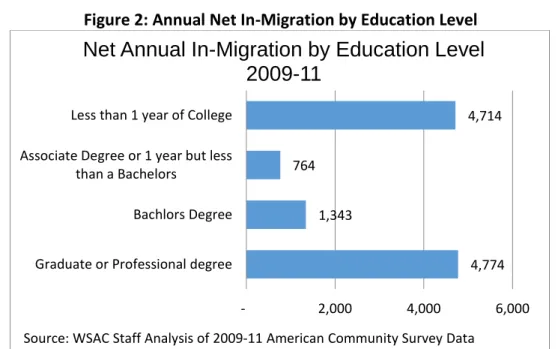
Washington is a growing state, so we expect in-migration generally. However, Washington appears to rely heavily on workers trained in other states and nations to meet the needs of the economy, particularly at the higher educational levels. Between 2009 and 2011, Washington annually attracted a net of almost 1,350 workers each year at the bachelor’s level and nearly 4,800 at the graduate level from other states. In addition, nearly 800 migrated from other states at the mid-level.
The results of a recent Washington State population survey showed that nearly two thirds of working adults who moved to Washington did so for job related reasons.8 Moreover, analysis by the Workforce Board of H1-B visa petitions shows that in 2010, Washington employed
8
Staff analysis of the 2010 Washington State Population Survey. Higher Education Coordinating Board, State Board for Community and Technical Colleges, and Workforce Training and Education Coordinating Board. (2011) A Skilled and Educated Workforce, 2011 Update. Retrieved Sept. 9, 2013 from
http://www.wsac.wa.gov/sites/default/files/SkilledEducatedWorkforce2011.pdf. 18,864 30,393 33,602 34,111 40,424 54,257 71,277 Unemployment 0% 2% 4% 6% 8% 10% 12% 14% 16% 18% 20,000 40,000 60,000 80,000 100,000 120,000 Less than High School High School Graduate Less than 1 Year College 1+ years college, no degree Associate Degree Bachelor's Degree Graduate Degree
2009 - 2011 Wages and Unemployment by
Education Level
Un emplo ymen t Rate W ag e s (25 th P erce n tile , Me d ian , 75t h P erce n tile )Source: 2011 American Community Survey. Wages Include civilian employed WA residents age 25-64. Unemployed rate reflects civilian labor force for WA residents age 25-64.
17,800 H1-B visa holders. The majority of new visa activity (approximately 75 percent) was to meet demand for computer and mathematical occupations.
Figure 2: Annual Net In-Migration by Education Level
These trends help set the context for the analysis of supply and demand of educated and trained workers in Washington. It should be noted, however, that although in-migration has been a key source of talent in Washington over the last two decades, in-migration was not included in the supply analysis for this report. This aligns the analysis with two key goals stressed by the Council in its 2012 Strategic Action Plan for Educational Attainment, Critical Crossroads: A Call to Action. This document emphasized the importance of reducing the need for Washington’s employers to “rely heavily on workers trained in other states or nations” and ensuring robust “access to good paying jobs and stable employment” for Washington
residents.9
Supply-Demand Gaps by Education Level
To assess how well the state’s higher education system is responding to employer needs and how well it is preparing residents to compete for employment opportunities, we compare total supply at three levels of education to the projected demand for workers trained at those levels. Table 1 below shows the current annual supply and forecast annual demand by education level for the years 2016 - 2021.
9
Washington Student Achievement Council. (2012) Critical Crossroads: A Call for Action. Retrieved Sept. 7, 2013 from http://www.wsac.wa.gov/sites/default/files/Critical_Crossroads-Revised4-13.pdf. 4,774 1,343 764 4,714 - 2,000 4,000 6,000
Graduate or Professional degree Bachlors Degree Associate Degree or 1 year but less
than a Bachelors
Less than 1 year of College
Net Annual In-Migration by Education Level
2009-11
Table 1: Annual Completions and Projected Demand for Workers by Education Level, 2016-2021 Current Completions Total Annual Completions Needed 2016-21 Entry Education Level Competitive Education Level Mid-Level 59,472 55,532 66,049 Baccalaureate 32,376 37,614 45,259 Graduate 12,155 7,710 18,218
Note: Mid-Level includes postsecondary education leading to an apprenticeship, one-year or more of postsecondary education, or Associate Degree.
Source: WSAC, WTECB, SBCTC joint analysis of 2013 Washington ESD long-term employment forecast; Bureau of Labor Statistics Training levels; 2012 Census PUMS data.
Entry Education Levels and Competitive Education Levels
The supply figures are based on in-state production of degrees, certificates, and apprenticeship completions at each of the three levels. The ranges indicated in the Total Annual Completions Needed column reflect two distinct methods for determining the educational and training levels required for various occupations. The lower figures correspond to entry training levels as defined by the Bureau of Labor Statistics. Generally, these represent minimum levels of training required to work in particular occupations. The upper figures correspond to what we are calling competitive training levels. They are based on the actual levels of education held by employed workers in Washington as reported on the American Community Survey conducted by the U.S. Census Bureau. These numbers include the additional demand for workers who have more advanced skill levels than those required for entry-level workers, such as nurses who hold a bachelor’s degree, K-12 teachers with a master’s degree, or sales managers with an MBA. The entry and competitive demand numbers, taken together, recognize that workers with the same occupational title often exhibit varying levels of responsibility and skills. These figures include workers who obtained their degrees in Washington, as well as those who migrated here with a degree or certificate from another state and entered Washington’s labor force.
This distinction between entry and competitive educational levels introduces a measure of complexity to the analysis. In some occupational fields, it is difficult to determine which level is necessary. One consideration that should be noted is that some workers, at any given time,
may be in occupations that do not require the level of education or training they have attained. This phenomenon tends to be more prevalent during times of high unemployment. A recent national survey, reflecting the depressed labor market during the Great Recession, found that 40 percent of the employed respondents, who graduated from a four-year college or university between 2006 and 2011, were working in jobs that did not require a four-year degree.10 However, in many cases, workers gain additional credentials as part of their professional development while employed in the field. In certain occupations, it may be common for workers to seek additional training in order to compete more successfully as applicants or for promotions. Thus for some fields, the competitive educational level, derived from the American Community Survey data, may more accurately reflect the level needed for workers to remain viable in Washington labor markets.
It should be acknowledged that, in some fields, employers do not tend to hire employees with only the minimum skills identified by the Bureau of Labor Statistics. An important trend to keep in mind is that many employers are requiring higher levels of education and experience as they increasingly demand a more skilled workforce. A full accounting of this phenomenon is beyond the scope of this report. But it is important to note that there is a strong tendency for
increasing technical skill requirements throughout the labor market. There are many workers currently holding positions, who would most likely not be rehired for the same job with the same skills they had when they were originally employed.
Measuring the Gaps in High Demand Programs of Study
To identify high demand programs of study, it is essential to look beyond the need for additional degrees and certificates by education level and consider the number of workers prepared to enter specific occupations. Consistent with previous reports, this update provides evidence of an insufficient supply of degree and certificate program graduates to meet
employer demand in a broad range of occupation fields critical to the health of Washington’s dynamic economy. The updated analysis uses 2011-12 as the base supply year, and average annual forecast demand is for the period 2016-2021.
10 Stone, C., Van Horn, C., C. Zukin. (2012) Chasing the American Dream: Recent College Graduates and the Great
Recession, John J. Heldrich Center for Workforce Development, Rutgers University Press. Retrieved Sept. 24, 2013 from http://www.heldrich.rutgers.edu/sites/default/files/content/Chasing_American_Dream_Report.pdf.
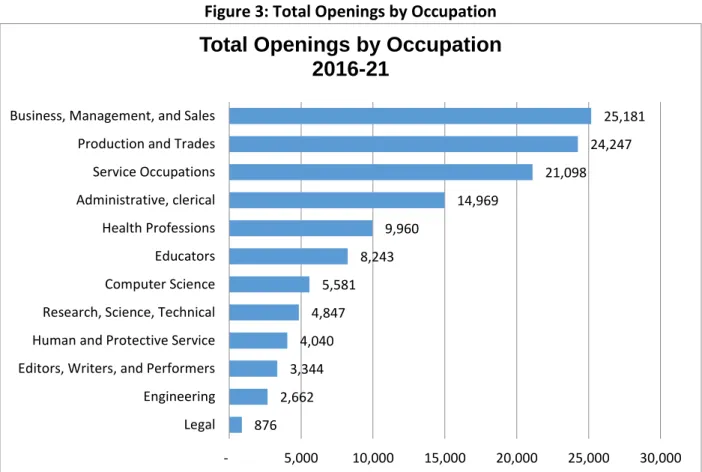
Figure 3: Total Openings by Occupation
The 2016-21 employment forecast projects nearly 123,000 annual openings to accommodate economic growth and replacement of workers leaving their occupation. These openings are grouped into twelve occupational clusters for the purposes of this analysis. The largest clusters are Business, Production, and Service. Most openings in service occupations require less than a year of postsecondary education or training. The vast majority of production and trades
occupations require some postsecondary education or training and many are mid-level occupations. The majority of Business, Management, and Sales occupations require mid-level training or higher, with many requiring at least a bachelor’s degree. More detail on the distribution of training requirements by occupation is available in Appendix B.
Mid-level
The mid-level supply includes two-year degree graduates. It also includes completers of long-term certificates and apprenticeships from the community and technical colleges and private career schools, as well as students who attempted at least 45 credits with a 2.0 GPA at a public four-year college but did not complete a degree.
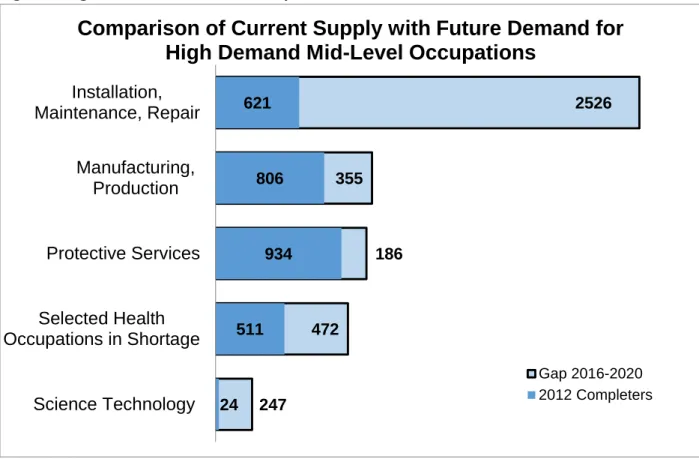
Most of the groupings with high employer demand are the same as those reported in the 2011 update, though the magnitude of many of the gaps have shifted, due more to shifting demand projections rather than reduced supply.
876 2,662 3,344 4,040 4,847 5,581 8,243 9,960 14,969 21,098 24,247 25,181 - 5,000 10,000 15,000 20,000 25,000 30,000 Legal Engineering Editors, Writers, and Performers Human and Protective Service Research, Science, Technical Computer Science Educators Health Professions Administrative, clerical Service Occupations Production and Trades Business, Management, and Sales
Total Openings by Occupation
2016-21
Figure 4 High Demand Mid-Level Occupations
The only group not reappearing on the high employer demand list this year is Accounting and Bookkeeping. Gaps widened substantially in Installation, Maintenance and Repair and in Science and Technology. For Installation, Maintenance and Repair, this was primarily the result of a large increase in projected future demand. Reductions in projected demand in
Manufacturing and Production and in Protective Services were major factors in a substantial shrinkage of those gaps. The size of the combined gaps in certain health fields remained unchanged, though the occupational composition changed considerably, as discussed below. Health Occupations
Since there are specific qualifications for most health occupations, analysis of supply and demand in most cases can be carried out at the individual occupation level, rather than at the group level. Compared to the previous report, some changes have occurred in the list of occupations identified as in potential shortage. The good news is that the education and training system has been successful in narrowing or closing some of the supply and demand gaps for some specific occupations. During the same time period, however, gaps have appeared in others. Overall, the healthcare field remains a focus of high demand at the mid-level.
2526 355 186 472 247 621 806 934 511 24 Installation, Maintenance, Repair Manufacturing, Production Protective Services Selected Health Occupations in Shortage Science Technology
Comparison of Current Supply with Future Demand for
High Demand Mid-Level Occupations
Gap 2016-2020 2012 Completers
Figure 4: High Demand Mid-Level Health Occupations
*Health Technologists and Technicians, All Other includes occupations such as Polysomnography and Dialysis, and Radiologic
Technician.
Occupations removed this year from the prior high demand list include nursing, medical records, and dietetic technicians and assistants. On the other hand, a number of other occupations have been added to the high demand list for this report. Demand is newly projected to significantly exceed supply for emergency medical technicians and paramedics, opticians (dispensing), cardiovascular technologists and technicians, ophthalmic medical technicians, and some of the smaller specialized technical occupations.
Due to the likelihood of substantial changes in demand for a wide range of healthcare
occupations as a result of the Affordable Care Act, it would be premature to initiate structural reductions in program capacity for occupations in which estimated supply-demand gaps have recently closed. The full impacts of health care reform on employment will not be known for a few years. In particular, Registered Nursing has consistently appeared on the high employer demand list in recent years and there is considerable uncertainty whether the apparent supply/demand balance measured this year represents a permanent change or is due to
38 114 102 30 54 52 41 23 7 11 229 79 24 68 36 12 10 21 27 5 Dental Hygienists Emergency Medical Technicians and Paramedics
Health Technologists and Technicians, All Other* Medical Transcriptionists Respiratory Therapists Opticians, Dispensing Dental Laboratory Technicians Cardiovascular Technologists and Technicians Ophthalmic Medical Technicians Nuclear Medicine Technologists
Comparison of Current Supply with Future Demand for
selected High Demand Mid-Level Health Occupations
Gap 2016-2020
temporary factors affecting projections of future demand, such as unexpectedly weak demand during the great recession.
Baccalaureate and Graduate Levels
Significant gaps are seen at the baccalaureate and graduate levels in several occupational clusters that are consistent with those identified in previous reports. However, this year’s workforce education analysis also reveals some important changes.
High Employer Demand Fields
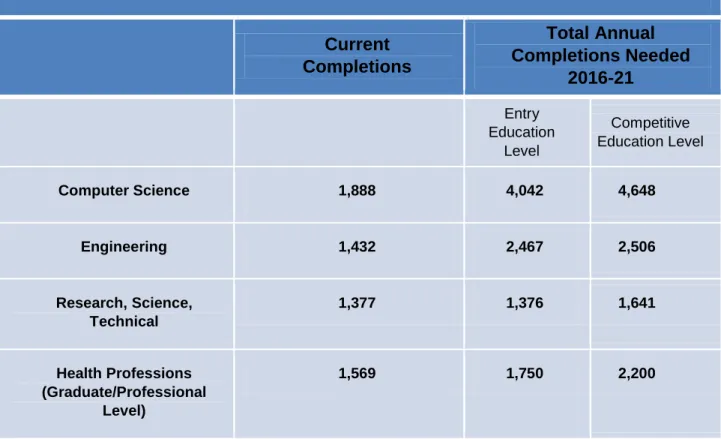
As in previous reports since 2006, this year’s analysis shows substantial gaps at the baccalaureate and graduate levels in the fields of computer science and engineering.
Table 2: High Employer Demand Fields at Baccalaureate Level and Above
High Employer Demand Fields at Baccalaureate Level and Above
Current Completions Total Annual Completions Needed 2016-21 Entry Education Level Competitive Education Level Computer Science 1,888 4,042 4,648 Engineering 1,432 2,467 2,506 Research, Science, Technical 1,377 1,376 1,641 Health Professions (Graduate/Professional Level) 1,569 1,750 2,200
Computer Science and Engineering
The largest gaps at the baccalaureate and graduate levels, as a percentage of supply, occur in the fields of computer science and engineering. The disparity in these fields is true whether one compares the supply of educated workers with demand at the entry educational level or at the
competitive level. In computer science, the supply gap at the competitive education level exceeds the current rate of degree production by 146%. In engineering, demand also far exceeds supply.
The analysis shows an annual need for an additional 1,840 baccalaureate graduates and an additional 921 graduate degree completers in computer science at the competitive education level. A similar disparity is shown between supply and demand for engineering graduates. An additional 896 bachelor’s degree graduates and an additional 178 graduate degree completers in engineering would be needed to meet annual demand at the competitive level.
When considering these gaps it is important to note that graduates from every field of study enter a range of occupations, and graduates with strong technical skills are in particular
demand. As noted above, the pace of innovation and technology change in national trends has led to increasing demand for STEM competencies beyond the traditional STEM occupations.11 This broader trend is also borne out by the state data. Approximately 54 percent of computer science graduates are employed in computer science occupations and 37 percent of
engineering graduates work in specific occupations within that field. This leaves substantial percentages of graduates who may choose to accept positions in other fields for a variety of reasons. For example, they may choose to take positions in business, management or other fields because they may offer attractive financial incentives.
Research, Science, and Technical
Another occupational cluster in high employer demand is research, science, and technical. This cluster includes occupations in the life, physical, and social sciences, as well as those in farming, fishing, and forestry. Typically, an individual employed in one of the scientific fields possesses a high degree of technical expertise, as well as a relevant bachelor’s or graduate degree.
Employer demand for workers with appropriate bachelor’s or graduate education at the
competitive level exceeds supply by 24 percent. The majority of openings at the bachelor’s level in this occupational cluster are in life sciences and materials sciences. Other openings are distributed among the social sciences, with a number for political scientists and economists. Smaller numbers of openings are distributed in the fields of forestry and agricultural inspection. Health Professions
The outlook for the health professions is complicated. At the professional level, significant gaps still exist between workforce supply and demand, consistent with prior analyses over the last
11 See Carnevale, Anthony P., Smith, Nicole, and Michelle Melton. (2011) STEM. Georgetown Public Policy Institute,
decade. Occupations in this category typically require graduate education and include physicians, surgeons, nurse practitioners, and occupational and physical therapists, among others. But at the baccalaureate level, current data reveal a significant change from past reports.
The data show a substantial narrowing of the supply-demand gap for the health professions at the baccalaureate level. Prior versions of this report showed consistent gaps in this area. But focused attention on increasing degree production in nursing and other health-related programs over the course of the last decade has led to substantial progress.12
However, the impending impact of the Affordable Care Act is likely to put new pressures on the system. Demand in the health care sector may increase sharply as implementation of major provisions of the Affordable Care Act moves forward over the course of the next few years. Demand for health care services and workers may increase dramatically with the enlargement of health insurance coverage through Medicaid expansion and creation of new health insurance exchanges. This development may create shortages in positions requiring bachelor’s level education as well as add to shortages at the professional level.
Nationally, it is estimated that by 2022 an additional 21.3 million individuals will have medical insurance, and the healthcare workforce will need to expand to meet the surging demand.13 There is likely to be increased demand for workers in a broad range of health care services, including registered nurses, physician assistants, nurse practitioners, social workers, and psychologists, in addition to physicians. Despite broad recognition of this impending impact, many states are finding that there is insufficient data to make reliable workforce projections in this area. Washington is among this group, currently in need of a detailed analysis of the Affordable Care Act’s impact on the state’s need for trained health care professionals. However, some employment analysts have offered general comments about what we might expect. For example, John Rossheim,14 a senior contributing writer for Monster.com, concludes that because Medicare currently covers virtually the entire population age 65 and older, most of those who will become covered under the Affordable Care Act during 2014 will be younger
12
See A Skilled and Educated Workforce, 2011 Update. Retrieved Sept. 15, 2013 from
http://www.wsac.wa.gov/sites/default/files/SkilledEducatedWorkforce2011.pdf and Workforce Training and Education Coordinating Board. (2012) Health Care Personnel Shortage Task Force, 2012 Annual Report. Retrieved Sept. 15, 2013 from http://www.wtb.wa.gov/Documents/HealthCareReport2012.pdf.
13 See carrier, Emily R., Yee, Tracy, and Lucy Stark. (2011) “Matching Supply to Demand: Addressing the U.S.
Primary Care Workforce Shortage.” National Institute for Health Care Reform Policy Analysis, No. 7, December 2011. Retrieved Sept. 16, 2013 from http://www.nihcr.org/PCP_Workforce.
14
Rossheim, J. (2012) Healthcare Staffing: How Healthcare Reform Will Likely Impact Hiring. Retrieved from
http://hiring.monster.com/hr/hr-best-practices/recruiting-hiring-advice/strategic-workforce-planning/healthcare-staffing-and-reform.aspx
and will likely require less medical care. As a result, much of the increased need for health care may involve ambulatory and outpatient services.
In addition, Rossheim observes that the Act’s emphasis on primary care is likely to have cascading effects on several clinical occupations. Since there will not be enough physicians at least initially, healthcare employees’ roles may change and many will be tasked to the highest levels of their education to meet the new demands. There will likely be an increased demand for nurse practitioners and physician assistants.
Another factor that is likely to increase the need for trained healthcare personnel is the impact of a generally aging population and an aging healthcare workforce with many workers nearing retirement. As of 2010, national surveys showed that the average age of registered nurses was nearly 45, with a growing percentage between the ages of 50 and 54. Over the next 10 to 15 years, the U.S. Dept. of Health and Human Services has estimated that about one-third of the current workforce will reach retirement age.15
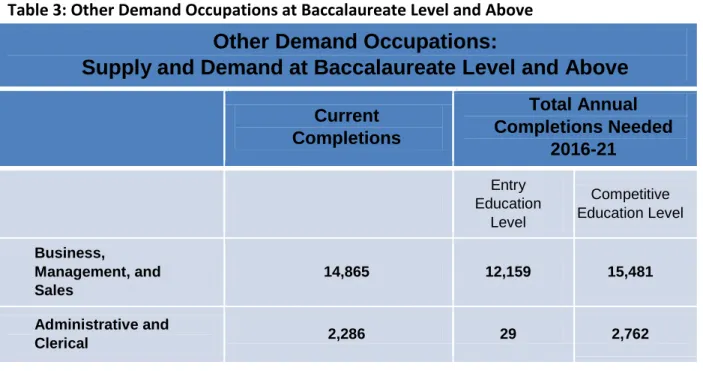
This aging trend is not limited to nursing. It is paralleled in a wide range of health professions. This trend raises concerns that future retirements could substantially reduce the size of the healthcare workforce at the same time the general population is growing and the population of elderly increases.
Other Demand Occupations
Table 3: Other Demand Occupations at Baccalaureate Level and Above
Other Demand Occupations:
Supply and Demand at Baccalaureate Level and Above
Current Completions Total Annual Completions Needed 2016-21 Entry Education Level Competitive Education Level Business, Management, and Sales 14,865 12,159 15,481 Administrative and Clerical 2,286 29 2,76215 Health Resources and Services Administration, U.S. Department of Health and Human Services. (2013) The U.S.
Nursing Workforce: Trends in Supply and Education, April 2013. Retrieved from http://bhpr.hrsa.gov/healthworkforce/rnsurveys/rnsurveyinitial2008.pdf.
Service Occupations 1,829 444 2,321
Editors, Writers, &
Performers 1,721 1,564 2,196
Production and Trades 1,832 356 2,199
Business, Management, and Sales
Business, management and sales occupations show strong demand, particularly at the
bachelor’s level. One key factor may play an important role in driving these results. The Great Recession officially started in December of 2007, but did not affect Washington until the start of 2009. As job losses began to mount, many of the first jobs lost were in management and sales. These occupations fell by approximately 6 percent from 2008 to 2010 (U.S. Census Bureau, Current Employment Statistics). Recovery in the management and sales fields, however, is indicated by current employment projections. However, many of these jobs will merely represent replacement of positions lost during the recession and, therefore, may not reflect sustainable growth over the long term.
In considering the supply-demand gap in this field, it is important to note that workers may acquire the skills for work in these occupations through a variety of degree programs. So it is likely that abundant supply, or over-supply, in some other fields may mitigate demand here. According to the Bureau of Labor Statistics categorization, the minimum training for all management occupations is at the bachelor’s level or below. However, the typical level of training for the majority of these openings is at least a bachelor’s and most require years of experience as well. Moreover, many workers in these fields pursue graduate education as part of their professional development. This trend adds a degree of complexity to the analysis, because there is a tendency to assume that the completion of a new degree represents a worker available to fill a job opening. But if the degree completion is the result of professional development, the worker is not really available to take an opening in the labor force.
Human and Protective Services
As an occupational cluster, human and protective services also continues to show a persistent gap at the graduate level. The key occupations driving demand at the bachelor’s level are in the areas of social work, law enforcement, and firefighting.
Education
Education is also a field in which gaps were apparent in previous analyses. However, close inspection reveals features of complexity. The data show a clear gap at the bachelor’s level
(entry training level) but supply exceeding demand at the graduate level. Several factors make this analysis complicated. First, the educators cluster includes occupations at all levels, from pre-school through higher education. At each level, there is a range of training trajectories. For example, certified teachers may receive initial preparatory training at the bachelor’s, post-bachelor’s certificate, or Master’s level.
Second, subsequent to initial preparation, additional training is frequently required for
educators. Moreover, in the K-12 sector, explicit financial incentives commonly exist for training beyond mandated professional development requirements.
Finally, within the education field, there may be gaps for particular disciplines - for example, for math and science teachers at the secondary level, or for English Language Learner or special education teachers at all levels. For these reasons further analysis would be required to more fully understand the impact of these various factors.
Demand for educators appears to be roughly in balance with supply. However, it is difficult to distinguish whether degree awards are for newly prepared workers entering the labor market (or occupation) and appropriately considered as part of the supply, or for professional
development for workers who do not intend to change occupations after completion of the degree. In the latter case, these workers would not be available to fill open positions and, therefore, if counted as part of the supply, would result in overestimations. Further analysis would be required to more fully understand the impact of these various factors.
Editors, Writers, and Performers
Demand in the editors, writers and performers cluster is distributed across a variety of occupations. At the bachelor’s level, it is driven primarily by demand for designers and public relations specialists. Overall, approximately 13 percent of workers in these occupations hold a graduate degree. However, there is no clear pattern of training requirements for specific occupations.
Administrative and Clerical, Service Occupations, and Production and Trades Several large occupational clusters attract a significant number of workers with bachelor’s degrees or higher. However, the bachelor’s- and graduate-educated portion of the workforce in these occupations, considered as a percent of total employment, remains relatively small. Many of these occupations do not have a specific training requirement that would indicate a need to develop baccalaureate programs or increase production at the bachelor’s level to meet needs in these fields. This is true generally for occupations in the services, production and trades, and administrative/clerical sectors.
Within these fields there are a few occupations that may need some attention, however. For example, there may be demand for additional training for first-line supervisors in a number of
fields. Such fields may be appropriate targets for the development of applied baccalaureate programs.
Closing the Gaps
Washington is home to many fine educational institutions that have laid the groundwork for postgraduate success for many students and prepared them for the opportunities and challenges of the state’s dynamic economy and innovative employers. But the gaps between supply and demand in key occupational fields demonstrate that there is still room for
improvement at all levels. Fortunately, our institutions provide a solid foundation on which further progress can be built.
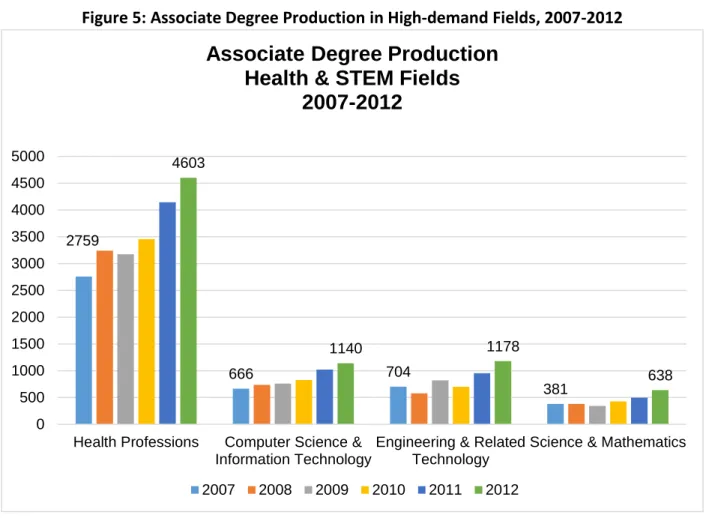
Over the course of recent years, data indicate that continuous progress has been made in increasing degree and certificate production in high employer demand fields of study. Depending on the field and the educational level, progress in some areas has been more dramatic than others. But in all of these key fields degree production has moved in a positive direction during this time.
Figure 5: Associate Degree Production in High-demand Fields, 2007-2012
2759 666 704 381 4603 1140 1178 638 0 500 1000 1500 2000 2500 3000 3500 4000 4500 5000
Health Professions Computer Science & Information Technology
Engineering & Related Technology
Science & Mathematics
Associate Degree Production
Health & STEM Fields
2007-2012
At the mid-level, degree and certificate production in the health, computer science,
engineering, and science and mathematics fields has increased steadily from 2007 – 2012. In the health occupations, production grew by 66.8 percent. Progress in degrees and certificates granted has also been achieved in the fields of computer science and information technology, growing by 71.2 percent in this same time period. Completions in the fields of engineering and related technology (67.3 percent) and science and mathematics (67.5 percent) also experienced impressive growth.
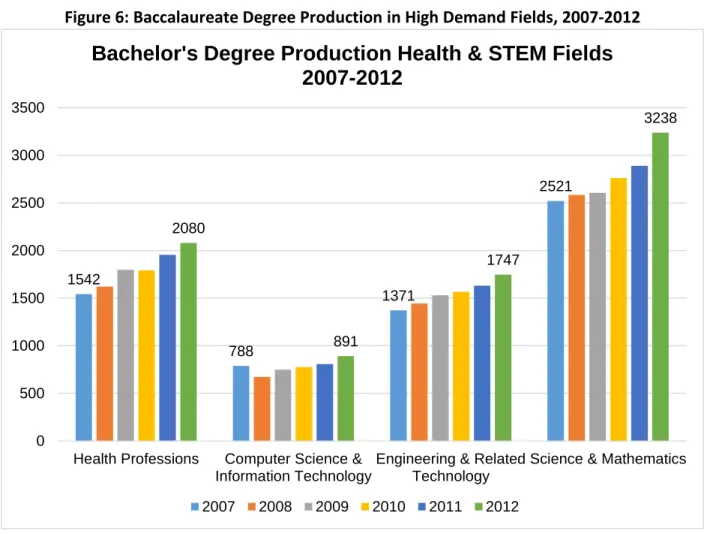
Figure 6: Baccalaureate Degree Production in High Demand Fields, 2007-2012
Source: Integrated Postsecondary Education Data System (IPEDS).
At the baccalaureate level, degree production in the health, computer science, engineering, and other science and mathematics fields has also increased steadily over the last several years. In health professions, there has been consistent growth in degree completions, increasing by 34.8 percent from 2007 to 2012. Degree production in the fields of engineering and related
technology also grew by 27.4 percent during this same time period. Completions also increased in computer and information science programs (by 13 percent) and in the science and
mathematics fields as a group (28.4 percent).
1542 788 1371 2521 2080 891 1747 3238 0 500 1000 1500 2000 2500 3000 3500
Health Professions Computer Science & Information Technology
Engineering & Related Technology
Science & Mathematics
Bachelor's Degree Production Health & STEM Fields
2007-2012
It should be noted that, in order to increase degree production in the STEM fields generally, the Legislature’s 2012 budget (HB 2127) reallocated over $9 million in targeted funding to the state’s public universities and colleges. These funds were dedicated to expanding enrollments in engineering at the research universities and to expanding enrollments in science, technology, engineering, and mathematics fields at the regional institutions and The Evergreen State
College.
This expansion, however, will take time to develop. The University of Washington and
Washington State University each plan to add 425 new enrollments in engineering. Enrollments are anticipated to expand gradually over the course of about three years. Increases in degree production can be expected to follow in later years, as students move toward completion of program coursework.
Adding considerably to this targeted reallocation was a substantial increase in funding that was included in the 2013 – 2015 operating appropriations (SB 5034), for the express purpose of expanding enrollments in computer science and engineering. These funds, for fiscal years 2014 and 2015, were allocated to the University of Washington ($4,459,000 per year), Washington State University (2,856,000 per year), and Western Washington University ($1,497,000 per year).
Figure 7: Graduate Degree Production in High Demand Fields, 2007-2012
Source: Integrated Postsecondary Education Data System (IPEDS).
In high demand fields at the graduate level, the fastest growth in degree production occurred in the health sciences, which increased by over 26 percent from 2007 to 2012. Steady growth occurred in computer and information science as well, with degree completions increasing by over 22 percent. Progress in engineering and related technology (21.7 percent) was also substantial, while the science and mathematics fields (11.3 percent) experienced positive but more modest levels of expansion during this time period.
Conclusion
Some key observations can be drawn from this analysis:
Over the last several years, we have successfully increased degree production in the health care professions, largely due to a coordinated system-wide effort to invest in this field. However, substantial shortages still exist, particularly at the professional level. Without expanded efforts to close the gaps, these shortages are likely to be exacerbated with the implementation of the Affordable Care Act in Washington, which will greatly increase the numbers of state residents accessing the healthcare system.
1571 164 505 545 1982 201 615 607 0 500 1000 1500 2000 2500
Health Professions Computer Science & Information Technology
Engineering & Related Technology
Science & Mathematics
Graduate Degree Production
Health & STEM Fields
2007-2012
Current data show some progress in increased degree production in the computer science and engineering fields. Growth is seen at both the baccalaureate and graduate level. However, overall, the rate of progress in these fields is still lagging behind surging demand. Much faster progress will be required to meet the needs of our state’s
dynamic economy and provide more Washington residents with vital opportunities to compete for these high skill, high wage jobs.
Going forward, more detailed information from Washington’s employers on the specific training and education levels they are actually seeking in applicants for various
occupations could allow for more refined supply and demand gap analyses. Improved and expanded employer feedback mechanisms, through surveys and other available resources, could provide more in depth understanding of precise employer needs in particular fields.
Appendix A: Notes on the Analysis
The conclusions contained in this report were based on two primary measures: 1) workforce supply, estimates of the annual number of graduates entering the workforce by degree level and major field of study; and 2) employer demand, projections of the number of net annual job openings by sector and education level.
Workforce Supply
The analysis of workforce supply was grounded on degree production data from the Integrated Postsecondary Education Data System (IPEDS), which was adjusted to estimate the number of graduates actually entering the workforce. IPEDS compiles results from annual institutional surveys conducted by the National Center for Education Statistics (NCES). These surveys include data on enrollments and degree completions from every college, university, and technical and vocational institution that participates in federal student financial aid programs.Since not all graduates immediately enter the workforce,however,these completion figures must be adjusted to account for graduates who opt to continue their postsecondary education or postpone work for other reasons. These modified figures are necessary in order to arrive at realistic estimates of the number of graduates available to meet employer demand in a given period.
Data for mid-level supply was pulled from the SBCTC Data Warehouse. It is derived primarily from the data collected by the 2-year Public Community and Technical College Management Information System. The Data Warehouse includes student, course, personnel, facilities and equipment, financial aid, transcript and completion data collected since 1986. Related data is also collected from GED testing centers, universities, community based organizations and other state agencies. The SBCTC Data Warehouse is a SQL Server production database that is used for executive policymaking and decision support in the areas of funding and enrollment allocation, enrollment forecasting, research, performance and outcomes and mandated studies by statute. Workforce supply was adjusted using data from the 2009-2011 American Community Survey, conducted by the U.S. Census Bureau, which includes the percentages of degree holders in this survey reporting that they were 1) enrolled and either unemployed or employed part-time; 2) enlisted in the military; or 3) not in the labor force. The data were used to estimate the percentage of degree completers that would not immediately be available to enter the work force. For each degree level, the total number of completions was adjusted downward by the corresponding aggregate percentage.
Supply of Workers Available to Meet Employer Demand
Calculation of Workforce SupplyDegree Completion Enrolled & unemployed/ employed part-time Enlisted in military Not in labor force Workforce Supply Mid-Level Degree Completers 100% 13.5% 3.8% 13.8% 68.8% Bachelor’s Degree Completers 100% 10.9% 1.9% 11.9% 75.2% Graduate Degree Completers 100% 9.8% 1.2% 9.6% 79.3%
Source: 2009-11 American Community Survey, U.S. Census Bureau. Washington residents age 25-34.
Employer Demand
Employer demand was estimated using projected job openings from the Employment Security Department’s long-term occupational projections. These employment outlook projections were matched against two separate estimates of the training and education levels required for various occupational types. One estimate was based on the minimum requirements for occupational categories specified in the Bureau of Labor Statistics training codes. A second estimate was based on Washington Student Achievement Council staff analysis of U.S. Census Bureau data, reflecting actual education and training levels of survey respondents in various occupations.
Limitations of the Analysis
A few limitations of this analysis should be noted that could affect the gaps reported at each level. First, the report is not able to fully address the impact of new and emerging industries and occupations, due to restrictions in the methods of the Employment Security Department’s long-range forecast. In addition, because of difficulties in obtaining accurate information in this area, the numbers do not reflect any adjustments to account for workers in jobs that may require more or less education than they currently possess.
Finally, the analysis is not intended to explain the current employment market for recent graduates, which may be experiencing lingering effects of the recent Great Recession that began in 2007 – 2008. Instead, it is based on a forward-looking perspective, with demand assessed upon future openings compared to current degree production and labor force participation rates.
Appendix B: Openings by Occupational and Education Level
0% 10% 20% 30% 40% 50% 60% 70% 80% 90% 100%
Legal Research, Science, Technical Editors, Writers, and Performers Engineering Human and Protective Service Computer Science Educators Health Professions Administrative, clerical Service Occupations Production and Trades Business, Management, and Sales
Openings by Occupation and Education Level
2016-2021
(BLS Distribution)
HS or Less < 1 year PSE Mid-Level Bachelors Graduate
0% 10% 20% 30% 40% 50% 60% 70% 80% 90% 100%
Legal Research, Science, Technical Editors, Writers, and Performers Engineering Human and Protective Service Computer Science Educators Health Professions Administrative, clerical Service Occupations Production and Trades Business, Management, and Sales
Openings by Occupation and Education Level
2016-2021
(Census Distribution)
Appendix C: Gap Occupations at the Baccalaureate Level
- 2,000 4,000 6,000 8,000 10,000 12,000 14,000 Legal
Administrative, clerical Production and Trades Health Professions Service Occupations Research, Science, Technical Human and Protective Service Editors, Writers, and Performers Engineering Computer Science Educators Business, Management, and Sales
2012 Baccalaureate Supply and 2016-21 Demand
Appendix D: Gap Occupations at the Graduate Level
- 500 1,000 1,500 2,000 2,500 3,000 3,500 Production and Trades
Service Occupations Editors, Writers, and Performers Administrative, clerical Legal Engineering Research, Science, Technical Computer Science Human and Protective Service Health Professions Educators Business, Management, and Sales