THE UNIVERSITY OF TEXAS AT EL PASO
COMPUTER SCIENCE DEPARTMENT
Ph.D. Program
Handbook
Created by*:
Natalia Villanueva Rosales, Olac Fuentes, Ann Gates, Shahriar
Hossain, and Christopher Kiekintveld.
2014 - 2015
Draft Version 5.0* with contributions from CS Faculty members
Chemistry & Computer Science Building, Room 3.1024 500 West University Avenue El Paso, TX 79968-0518
p. +1 915 -747-5480 f. +1 915 -747-5480
Table of Contents
Notation ... 3
Introduction ... 4
Mission of Computer Science Graduate Program ... 4
Program Educational Objectives (PEOs) ... 4
New students ... 5
Conditionally admitted students ... 5
Transfers ... 5 International Students ... 5 Financial Aid ... 5 Assistantships ... 5 Travel... 6 Other support ... 6 Academic Advising ... 6
The Dissertation Advisor... 7
Dissertation Supervising Committee ... 7
Program Requirements ... 7
Research Expectations ... 7
Student Expectations ... 8
Dissertation Advisor Expectations ... 8
Course Requirements ... 9 Qualifying Process ... 9 Purpose ... 9 Requirements... 9 Deadline ... 10 Evaluation ... 10 The Dissertation ... 11 Dissertation Proposal ... 11
Dissertation Defense ... 12
Time Limits and Graduate Catalog Changes ... 12
Milestones... 12
Useful Links ... 14
Appendix A ... 15
Appendix B ... 16
Research Proposal Outline ... 16
Notation
Tips, warning and general information notes are provided in the textboxes listed below:
TIP
Tips and suggestions for a successful completion of the program are described in textboxes with this symbol.
Warnings are described in textboxes with this symbol.
Introduction
The Ph.D. program in Computer Science offers courses in a variety of core and applied areas of computing that provide students with a strong foundation to build their individual research interests. The program offers numerous opportunities to be involved in interdisciplinary research that includes researchers from health, biological, geological, and environmental sciences, education, and engineering. The Computer Science Graduate Program Committee consists of the Graduate Program Director, who serves as the chair, and a number of graduate faculty members of the Computer Science Department. The committee is in charge of overseeing the graduate program; managing admission procedures and practices; monitoring graduate course offerings, independent study courses and their appropriate use in the program; improving the quality of students services, including advising and mentoring; reviewing conflicts among the graduate advisor, faculty members, or students involving degree program compliance; and ensuring the continuous improvement of the program.
A current list of graduate faculty members is available at:
http://www.cs.utep.edu/DeptCS/people/facultyList.html, under the Faculty section.
For information and questions about graduate programs, please email [email protected] or call the CS main desk at +1 915 -747-5480.
Mission of Computer Science Graduate Program
The mission of the Computer Science Ph.D. program is to serve as the focal point for graduate computer science education in our bi-national region by:
supporting excellence in computer science research with special attention to the needs of the region;
attracting qualified students from the U.S., Mexico, and other countries who will benefit from studying in a diverse community;
preparing students to meet the needs of our industrial, academic, and governmental constituencies through a balanced approach to education and research; and
providing an environment for students that will keep them informed of funding, educational, and other opportunities that will enhance their graduate experience.
Program Educational Objectives (PEOs)
The Computer Science Ph.D. PEOs address the university’s and college’s mission to serve the region, nation, and the world by graduating highly competent students with the potential to become leaders in their profession. By successfully completing the doctoral program in Computer Science, a student will:
have a thorough grounding in the fundamental principles and practices of computer science;
possess the skills to become researchers and educators who can excel in both the academic and professional spheres of computer science;
have a clear understanding of the professional, ethical, and societal implications of computer science research; and
have the ability to work across disciplinary boundaries, both within and beyond computer science. Prospective students can find information about our graduate programs and how to apply at the Graduate School’s website available at: http://graduate.utep.edu/.
New students
All newly admitted doctoral students are required to meet with the Graduate Program Director and sign a New Doctoral Student Milestones Agreement during the first semester of enrollment in the program. New students should attend the orientation session, typically held in the fall semester.
Conditionally admitted students
Leveling courses cannot be applied toward the degree requirements. It is the student’s responsibility to complete all necessary leveling courses within one year of entering the program.
Transfers
Ordinarily the majority of the coursework for a graduate degree must be done at UTEP. All coursework transferred from other accredited institutions requires both the approval of the Graduate Program Committee and the Dean of the Graduate School. Courses for which a grade of "C" or lower was earned may not be transferred to UTEP.
International Students
The Office of International Programs primarily assists UTEP international students, scholars, and dependent family members to maintain their non-immigrant statuses. OIP also administers the PASE tuition discount program for Mexican nationals, supplies innovative programming to enhance the university’s cross-cultural engagement, and provides international education opportunities for the UTEP and El Paso communities.
More information about the Office of International Programs is available at: http://sa.utep.edu/oip.
Financial Aid
Assistantships
Financial aid is available in the form of teaching assistantships, research assistantships, and fellowships. All applications for full-time admission to the Ph.D. program that are received by the financial aid application deadline will be automatically considered for financial aid. Applications for new or continued
teaching assistantships must be submitted every semester to the Graduate Program Director. The College of Engineering limits TA support to a maximum of two years. Exceptions must be approved by the Dean of the College of Engineering.
Travel
Travel funding for students presenting their work in national and international venues can be requested from the College of Engineering and the Graduate School. In addition, students are encouraged to apply for scholarships typically available through the conference at which students will present their work.
Other support
A limited number of tuition fellowships are offered by the College of Engineering. Students receiving teaching or research assistantships qualify for in-state tuition.
Information about funding opportunities and application forms will be found at the Department of Computer Science website soon. : http://www.cs.utep.edu/grad_funding, including the application forms.
Academic Advising
The Graduate Program Director will serve as academic advisor for all doctoral students for the duration of their studies. In addition, the student should complete a plan of study in coordination with his or her Dissertation Advisor.
Academic advising includes the following elements that are designed to ensure that students remain in good academic standing and make satisfactory progress through the program:
check the student’s coursework with the Computer Science Ph.D. Degree Plan to determine if the student is making progress toward the requirements of the program and the milestones (results are documented in the doctoral progress report and discussed with the student and supervising committee);
discuss recommendations on course selection that align with the student’s plan of study;
work with the student and Dissertation Advisor to determine if modifications are necessary in the Degree Plan and ensure that the appropriate paperwork for approval of exceptions is filed;
discuss the composition of the Dissertation Supervising Committee and the requirements for successful completion of the dissertation; and
promote opportunities that can provide the student with experiences that will enhance his or her career prospects and success.
The Dissertation Advisor
A student formally requests that a graduate faculty member serve as his or her Dissertation Advisor by filing the appropriate College paperwork. Students should select a Dissertation Advisor as soon as possible after entering the program, within the first year of study. The Dissertation Advisor will:
supervise and guide the student’s dissertation research and course selection; and
work with the student to form a Dissertation Supervising Committee subject to the approval by the Graduate School.
Dissertation Supervising Committee
After completion of the Qualifying Examination, a doctoral candidate will work with his or her Dissertation Advisor to form a Dissertation Supervising Committee. This committee will consist of the Dissertation Advisor, at least one additional member from the departmental graduate faculty, and at least one faculty member from outside the major program of study. The members of the committee should have expertise in areas related to the student’s research. The Graduate Program Committee and the Graduate School must approve the selections. The Dissertation Supervising Committee will:
provide guidance and advice on the student’s research, and
approve or disapprove the final dissertation defense.
The list of members of the Computer Science Faculty and their research interests can be found at: http://www.cs.utep.edu/DeptCS/people/facultyList.html. Members of the Computer Science Faculty can act as Dissertation Advisors and members of a Dissertation Supervising Committee. A list of current research groups is available at: http://www.cs.utep.edu/DeptCS/research/
TIP
Choosing Your Dissertation Advisor.critical first step before choosing an advisor. Your advisor will provide the guidance needed to The articulation of your career and research goals is a meet your goals. It is essential that you and your advisor are compatible with respect to personality and goals. There are several ways in which you can evaluate a faculty member as a potential advisor: take a course or independent study to learn about the individual’s working style; read papers written by the faculty member; ask other student advisees about their experiences, in particular availability, responsiveness, quality of feedback, and willingness to advocate for his or her students; and meet with the potential advisor to understand his or her availability and expectations regarding standards and quality.Program Requirements
Research Expectations
The primary purpose of a doctoral degree is to prepare students to conduct novel, independent research in their field of study. Students in the doctoral program should immediately begin working to develop their research agenda, starting by identifying a dissertation advisor and topic. Most research
activities depend on a successful student-dissertation advisor relationship, which is based on mutual respect and professional integrity. A list of the research expectations of the student and dissertation advisor is presented below, as a guideline to create and maintain a solid relationship.
Student Expectations
1. The student should spend a minimum of 20 hours per week on research, in addition to the time spent on projects for which the student is hired as a Research Assistant. During the summer and in later stages of the doctoral program, students should focus on research full time.
2. The student will conduct research on the agreed topic and pursue activities directed by the dissertation advisor, including: reading research papers, defining research questions and methodologies, conducting research studies to obtain theoretical-based or empirical-based results, and disseminating results through written publication and oral presentations.
3. The student will publish research results in proceedings of relevant workshops, conferences, and in journals. In addition, students are expected to actively participate in departmental research seminars/colloquia and research group meetings.
4. The student will submit to his/her advisor research outcomes and draft versions of reports, papers, and his or her dissertation document for feedback at the agreed deadlines.
5. The student will work within the deadlines established between the student and the dissertation advisor, and those specified by the regulations of the program and the Graduate School.
6. The student will explicitly acknowledge the dissertation advisor, researchers, and other scholars who contribute to his or her research work in presentations, publications, and the dissertation. 7. The student will produce a dissertation that meets the specifications and standards of the
Graduate School and the Department of Computer Science.
Dissertation Advisor Expectations
1. The dissertation advisor will be familiar with the regulations of the Graduate School and the department, in particular those related to producing a dissertation and conducting research. 2. The dissertation advisor will assist the student in identifying an appropriate research topic and
determine if the dissertation contributes significantly to the computer science body of knowledge.
3. The dissertation advisor will identify mechanisms needed to develop depth in the student’s research area.
4. The dissertation advisor will mentor the student regularly on the practice of scholarly research, i.e., scientific method, articulation of relevant research questions/hypotheses, publication processes, and standards of professional behavior.
5. The dissertation advisor will provide a timely and constructive critique of the student’s research progress, publications and dissertation drafts, as well as of the development of research-related skills, such as oral and written communication.
6. The dissertation advisor will assist the student in seeking financial support and opportunities that will enhance research and career-building experiences of the student, in particular by writing high-quality letters in support of applications.
7. The dissertation advisor will provide the means for continuous supervision of the student, including periods when the advisor is on leave of absence.
8. The dissertation advisor will provide guidance on career options and make recommendations on how the advisee can reach his or her aspirations.
9. The dissertation advisor will provide his or her advisee with opportunities to teach, e.g., as a guest lecturer, and will provide constructive feedback.
Course Requirements
The Ph.D. program requires a minimum of 48 semester credit hours of coursework beyond a Bachelor's degree and 24 semester credit hours of research and dissertation. Coursework includes a set of core courses and general, technical, and interdisciplinary electives. The student must complete the Qualifying Process, pass a Dissertation Proposal Defense, and successfully defend his or her dissertation.
Degree course requirements must be satisfied in a period of at most eight years. Typically, full-time students will complete all coursework other than dissertation research credits within the first three years.
The University catalog provides a current description of degree requirements, including courses and their descriptions. It is available at http://catalog.utep.edu/grad/college-of-engineering/computer-science/computer-science-phd/
Qualifying Process
Purpose
The purpose of the Ph.D. Qualifying Process is to: (1) assess a student’s preparedness to succeed in the Ph.D. program, (2) determine whether the student has sufficient background and capabilities to continue in the program, and (3) if necessary, outline the additional coursework or activities needed to prepare the student for Ph.D.-level work.
Requirements
Students are required to complete five 6000-level courses with a 3.5 average or better and submit a portfolio as described below.
The required courses include:
CS 6350 Advanced Algorithms
CS 6392 Research Methods
Theoretical Foundations: CS 6303 Logical Foundations of Computer Science or CS 6315 Theory of Computation
Systems: CS 6340 Advanced Operating Systems or CS 6341 Advanced Computer Architecture
Software Systems and Applications: CS6314 Artificial Intelligence or CS 6317 Human-Computer Interaction or CS6382 Topics in Software Engineering
Students who have completed graduate-level work prior to starting the Ph.D. program should consult
with the Graduate Program Director to identify which course requirements have been met and determine the courses that must be taken to meet the requirements.
The student must compile a portfolio that provides evidence of his or her ability to succeed in the program. The portfolio should include the following:
Transcript(s) to show performance on coursework that demonstrates breadth of knowledge;
Documents that show written and oral communication proficiency and ability to conduct research. This could include reports, essays, technical papers, and evaluation of oral presentations from coursework or independent work; and
Documentation of projects or work experience to demonstrate software development experiences.
Deadline
Students who enter the program with an M.S. degree in Computer Science must submit their portfolios no later than the beginning of the third semester. If a student enters the program with a Bachelor’s degree or with a Master’s degree in another area, the Graduate Program Committee may modify the Qualifying Process deadlines. At the time of submission, the student must have completed the required courses and filed the appropriate paperwork to declare their research advisor.
Evaluation
Student portfolios will be placed in a secure area that is accessible exclusively by all members of the graduate faculty. The graduate faculty will have a two-week window (or longer depending on the number of portfolios) in which they can review and submit their assessment of the portfolios. A Qualifying Evaluation Committee comprised of at least two members of the graduate faculty and at least one member of the Graduate Program Committee will be selected by the Graduate Program Committee to evaluate portfolios. The responsibility of the Qualifying Evaluation Committee is to review each portfolio and graduate faculty assessments, discuss the strengths and weaknesses of the portfolio, and make a recommendation. The committee may ask the student to make an oral presentation of their portfolio if they consider it necessary. The result of the evaluation can be one of the following:
The student is deemed prepared for the Ph.D. program.
The student is deemed deficient in one or more areas. The student may be required to take additional courses or work on specific research, technical, or communication skills. The student will be given a timeline to complete the additional requirements; upon completion of the
requirements, the student will be required to resubmit the portfolio to the committee. The committee will then decide whether the student will be allowed to continue or be dismissed from the program.
The student is dismissed from the program. In this case, the student may request to be transferred to the MS program.
The Dissertation
Dissertation Proposal
Upon completion of all coursework and after passing the qualifying process, a Ph.D. candidate will take an oral Dissertation Proposal defense administered by the Dissertation Supervising Committee. Typically, this will occur within one year of passing the qualifying process. Prior to the oral examination, the student will prepare a written dissertation proposal describing the research problem, the significance and broader impact of its solution, a review of current related literature, and a research plan that includes a timeline. See Appendix B for an outline and description of the proposal content.
The purpose of the Dissertation Proposal is to ensure that the student has identified a research topic and has acquired a sufficient depth of knowledge in the topic area to perform new and significant research and that this research is feasible. Upon successful completion of the Dissertation Proposal, the chair of the student’s Dissertation Supervising Committee will inform the Graduate School that the student is ready to begin work on his/her final dissertation.
Appendix B provides an outline for the research proposal and evaluation guidelines.
Preparing the Dissertation
The dissertation must demonstrate both the student’s ability to conduct independent research and his or her competence in scholarly exposition. It should present original investigations at an advanced level of a significant problem in computer science and should provide the basis for a publishable contribution to the research literature in the field.
For the deadlines and process for submitting the dissertation, please refer to the Dissertation Requirements in the catalog: http://catalog.utep.edu/grad/the-graduate-school/general-degree-requirements/.
TIP
The dissertation must be prepared according to the Graduate School’s dissertation manuscript guidelines, which are available at the Graduate School Web site. The student will receive email confirmation from the Graduate School upon approval of the dissertation format.
Failure to submit draft copies of the dissertation to the Dissertation Supervisory Committee at least three weeks before the defense date may result in postponing the dissertation defense.
Dissertation Defense
Candidates for the doctoral degree must write a dissertation under the direction of the student’s Dissertation Supervising Committee. The student's dissertation must exhibit originality in research, scholarly ability, independent thinking, technical mastery of a field of study, and competence in scholarly exposition. The Dissertation Supervising Committee will conduct the Final Dissertation Defense.
TIP
Gather the paperwork needed for the Dissertation Supervising Committee at the defense. Review your dissertation carefully, refresh your memory on the issues that you faced in conducting the research, and recall how you solved the problems. Know the amount of time that you have to present and the amount of time reserved for questions. Typically it will be 40 minutes of presentation and 15-20 minutes for questions. A general rule of thumb is to allow two-minutes per slide that has content. Your presentation should include the research motivation, related work, research goals and objectives (hypothesis, research questions), research methods and results, significance of the work, and future work. Review your presentation with your Dissertation Advisor and consider questions that may arise from your presentation. Relax!Time Limits and Graduate Catalog Changes
All requirements for the degree must be completed within one eight-year period preceding the awarding of the doctoral degree. Work more than eight years old is lost and can be reinstated only by special permission of the Graduate School upon recommendation of the Graduate Program Committee. Furthermore, all requirements for the doctorate must be completed within five years after passing the Dissertation Proposal defense. General and specific requirements for degrees in the Graduate School may be altered in successive Graduate Catalogs. Provided that the requisite courses continue to be offered, the student is bound only by the course requirements of the catalog in force at the time of admission or readmission within an eight-year limit. With the approval of the Associate Vice President for Research and Graduate Studies, the student may elect to be bound by the course requirements of a subsequent catalog. This regulation applies to course requirements only.
Milestones
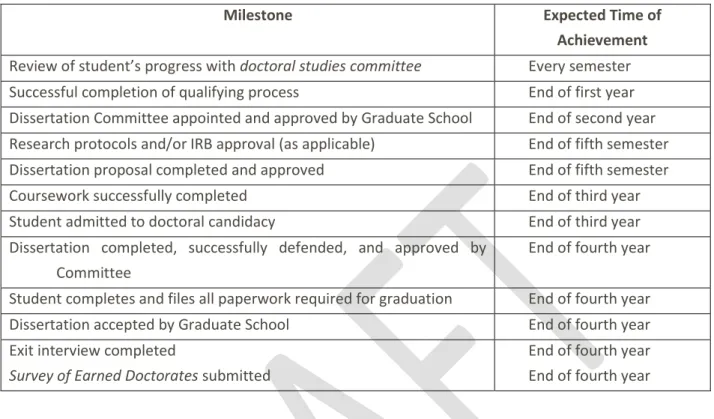
Table IV lists the Ph.D. degree milestones and expected times of achievement for students who enter the program with an M.S. degree in Computer Science. Students entering the program with only a bachelor’s degree or with a Master’s degree in another area typically take one additional year to achieve these milestones.
Table IV: Degree Milestones and Expected Times of Achievement
Milestone Expected Time of
Achievement Review of student’s progress with doctoral studies committee Every semester
Successful completion of qualifying process End of first year
Dissertation Committee appointed and approved by Graduate School End of second year
Research protocols and/or IRB approval (asapplicable) End of fifth semester
Dissertation proposal completed and approved End of fifth semester
Coursework successfully completed End of third year
Student admitted to doctoral candidacy End of third year
Dissertation completed, successfully defended, and approved by Committee
End of fourth year Student completes and files all paperwork required for graduation End of fourth year
Dissertation accepted by Graduate School End of fourth year
Exit interview completed
Survey of Earned Doctorates submitted
End of fourth year End of fourth year
It is important to satisfy the program requirements in the specified time-frame. Failure to do so may affect the successful completion of the program.
The Degree Completion Checklist is provided below:
Maintain active student status by registering for courses every fall and spring semester.
Complete Milestones Agreement Form with the academic advisor no later than the last class day of the first semester.
Create and seek approval of your degree plan and complete all required coursework.
Schedule and successfully complete required qualifying process.
Form your Dissertation Supervising Committee in consultation with your Dissertation Advisor.
Have your committee approved by the Graduate Program Committee and Graduate School.
Prepare and successfully present your dissertation proposal.
Apply for Advancement to Candidacy.
Enroll in required dissertation hours and complete your dissertation.
Publish your work in conferences and journals that are established in your area of studies.
Successfully complete the defense of your dissertation.
Submit required documentation to the Graduate School for review of graduation requirements and final approval for graduation.
Useful Links
Department of Computer Science: http://www.cs.utep.edu
Graduate faculty members: http://www.cs.utep.edu/DeptCS/people/facultyList.html Research groups: http://www.cs.utep.edu/DeptCS/research
Graduate School’s website: http://graduate.utep.edu
Office of International Programs is available at: http://sa.utep.edu/oip Funding opportunities: http://www.cs.utep.edu/grad_funding
University catalog: http://catalog.utep.edu/grad/college-of-engineering/computer-science/computer-science-phd/
Degree Requirements: http://catalog.utep.edu/grad/the-graduate-school/general-degree-requirements/
COURSEWORK Breadth of knowledge in Computer Science
Course title Sem. Grade
CS 6350 Advanced Algorithms CS 6392 Graduate Research Methods Theoretical Foundations: CS 6303 Logical Foundations of Computer Science OR CS 6315 Theory of Computation
Systems: CS 6340 Advanced Operating Systems OR
CS 6341 Advanced Computer Arch. Software Systems and Applications: CS 6314 Artificial Intelligence OR
CS 6317 Human-Computer Interaction OR CS 6382 Topics in Software Engineering
Breadth (General Electives): (12 hours)
______________________________________ ______________________________________ ______________________________________ ______________________________________ Non-CS (Interdisciplinary Electives):
(6 hours) _____________________________________ _______________________________________ Depth (Technical Electives):
(15 hours) __________________________________________ __________________________________________ __________________________________________ __________________________________________
Appendix A
DEPARTMENT OF COMPUTER SCIENCE Ph.D. in Computer Science - Degree Plan
Name: __________________________________ Student ID: _________________________________
Email: __________________________________
Semester of Entry: ________________________ Conditions: ______________________________
QUALIFYING
Performance in core coursework: _________ Written and oral communication: ________ Software dev. experience: ______________ Portfolio presentation date: _____________
DISSERTATION
Dissertation Advisor: _____________________ (Declaration of Advisor form on file?) _______
Committee: ____________________________ ____________________________ _____________________________ _____________________________ Comprehensive Date: ____________________ Dissertation Title: _______________________ ______________________________________ ______________________________________ Defense Date: _________________________ Publications __________________________ Teaching _____________________________ Seminar/Presentations__________________
Appendix B
Research Proposal Outline
Title Page
Abstract
Include a brief description of the proposed work. The abstract should be approximately 200-400 words.
Introduction
This section should briefly and directly state the problem to be addressed and the objectives to be achieved or hypothesis to be studied. The problem or challenge to be addresed must be succinctly and clearly articulated in language approchable by non-experts in the problem area. You should assume that the readers are literate, competent computer scientists, but not necessiarily well versed in this specific area. The objective or hypothesis should succinctly state what you plan to prove or achieve.
Background
This section should present a motivation for the work by detailing the problem and the conditions under which it is manifested. This section must provide sufficient background that a knowledgeable computer scientist can appreciate the problem and understand the historical context in which the proposed work is to be conducted. Prior works directly related to the problem should be described, along with a discussion of the need for new work in this area. The scope of the research and the peripheral areas that are excluded from the investigation should be outlined.
Other Related Work
Work that is indirectly related to the problem statement should be described. This may include approaches or solutions to other problems which may be applied to the given problem. The combination of Sections 2 and 3 should describe and reference the state-of-the-art in this area. This section should describe the steps taken to ensure that the proposed research is unique.
Significance
Describe the significance and contribution of the work.
Research Plan
This section presents the proposed plan of work. Briefly describe techniques, approaches, and/or methods that will be used to complete the work. Include the metrics that will be used to measure the progress and success of the research. Note milestones and include a timeline. This section should convince the reader that the approaches are feasible under the time constraints given in the timeline.
References
Use IEEE citation format or another acceptable format from your area of study. See IEEE Transactions, Journals and Letters: Information for Authors. Another source is: Publication Manual of the American Psychological Association (Fifth Edition), 2001.
Research Proposal Evaluation Guidelines
Merit of Proposed Work and Broader Impact
Does the proposal convincingly state that the proposed work will produce significant results with broader impact?
Does the proposal provide substantial evidence that the work is unique?
Depth of Knowledge and Soundness of Methodology
Does the proposal present sufficient background at an appropriate depth to provide the basis for the proposed research?
Is there evidence of sufficient understanding of the topic area to select a research method? Is a research method described in the proposal?
Will the research method described address the premise of the work?
Clarity of Presentation
Are the research problem, objectives, and premise of the work clearly and succinctly articulated? Is the research method clearly articulated?
Does the overall quality of writing indicate that the student will be able to produce publication quality articles?
Feasibility of Work
Is a timeline presented?
Does the proposal convince the reader that the work can be completed within the time constraints listed in the timeline?