Risk Management Strategy
2012 - 2015
Date:
June 2012
Version Number:
4
Author:
Catriona Oxley, Safety and Risk Manager
Review Date:
June 2015
If you would like this document in an alternative language or format, please
contact Corporate Services on 01595 743069
Page ii
Page iii
Risk Management Strategy – Version 4 – June 2012 (Refreshed August 2013)
NHS SHETLAND DOCUMENT DEVELOPMENT COVERSHEET
Name of document Risk Management Strategy 2012 - 2015 Registration Reference Number HRSSSTR002 New Review
Author Catriona Oxley, Safety & Risk Manager
Executive Lead Lorraine Hall, Director of HR & Support Services Proposed groups to present document to:
Risk Management Group Board
Clinical Governance Co-ordinating Group Group
Strategy and Redesign Committee
DATE VERSION GROUP REASON OUTCOME
November
2011 3 Controls Assurance Group
Guidance in initiating review and PO SC and AC&R January 2012 4 (First
draft) Controls Assurance Group PI AC&R March
2012
4
(Second draft)
Controls Assurance Group C/S PRO
March 2012
ToR for GCGC
Clinical Governance
Co-ordinating Group PI and C/S AC&R May 2012 4 (Final
Draft)
Strategy and Redesign
Committee Approval
MR - Approved
June 2012 4 Board Noting Noted
August 2013
4
(Refresh) Risk Management Group C/S PRO
September 2013
4
(Refresh)
Strategy and Redesign
Committee Noting Noted
December 2013
4
(Refresh) Board Noting Noted
Examples of reasons for presenting
to the group Examples of outcomes following meeting
Professional input required re: content (PI)
Significant changes to content required – refer to Executive Lead for guidance (SC)
Professional opinion on content (PO) To amend content & re-submit to group (AC&R) General comments/suggestions (C/S) For minor revisions (e.g. format/layout) – no need
to re-submit to group (MR)
Page iv
Risk Management Strategy – Version 4 – June 2012 (Refreshed August 2013)
DATE CHANGES MADE TO DOCUMENT
January 2012
Key parts of the document updated including: Aims of the Strategy
Corporate objectives
Risk management definitions Risk management objectives Roles and responsibilities 21 March
2012 Change of title for CAG to „Risk Management Group‟ [RMG] agreed 28 March
2012
Appendix A (CGCG Terms of Reference) considered by CGCG and amendments proposed included in document
8 May 2012
More generic wording required in „Level of Action‟ column in table on Page 12 to reflect the position that action on „Amber‟ risks could be co-ordinated by a non-clinical committee/group
Description of the Control of Infection Committee [CoIC] to be removed on the basis of consistency i.e. the functions of other committees operating at this level are not described. (The description of the role of the Health and Safety Committee to
remain given the statutory nature of this group and its pivotal role in risk management.)
It was noted that changes to the Terms of Reference of the Clinical Governance Co-ordinating Group [CGCG] have still to be formally approved by the Group
16 May 2012
Risk Management Action Plan 2012/13 approved by RMG and incorporated into document as Appendix E
22 August
2012 Revised ToR for CGCG approved and incorporated
August 2013
Update of Corporate Objectives for 2013-14 (Section 1)
Update of Risk Management Objectives for 2013-14 (Section 5) Update re CHCPMT (Section 6)
Update on the progress of arrangements for the integration of health and social care services (Section 6)
Update on Scottish Patient Safety Programme (Section 6) Update of CGCG Terms of Reference (Appendix A)
Risk Management Action Plan 2013/15 approved by RMG and incorporated into document as Appendix E
Updated Terms of Reference for the Health and Safety Committee (Appendix H)
Page v
Risk Management Strategy – Version 4 – June 2012 (Refreshed August 2013)
February
Page vi
Risk Management Strategy – Version 4 – June 2012 (Refreshed August 2013) Table of Contents
EXECUTIVE SUMMARY ...1
1. INTRODUCTION ...2
2. VALUES AND PRINCIPLES UNDERPINNING RISK MANAGEMENT ...2
3. RISK MANAGEMENT DEFINITIONS ...3
4. RESPONSIBILITY OF EMPLOYEES ...5
5. RISK MANAGEMENT STRATEGIC OBJECTIVES ...5
THE RISK MANAGEMENT OBJECTIVES FOR 2014-15 ... 5
6. ROLES AND RESPONSIBILITIES ...6
NHSSHETLAND ... 6
THE CHIEF EXECUTIVE ... 6
THE RISK MANAGEMENT GROUP [RMG] ... 7
THE DIRECTOR OF HUMAN RESOURCES AND SUPPORT SERVICES [DHR&SS]... 7
THE STRATEGY AND REDESIGN COMMITTEE [SRC] ... 7
THE CLINICAL GOVERNANCE COMMITTEE [CGC] ... 7
THE AUDIT COMMITTEE ... 7
THE CLINICAL GOVERNANCE CO-ORDINATING GROUP [CGCG] ... 8
THE COMMUNITY HEALTH AND CARE PARTNERSHIP MANAGEMENT TEAM [CHCPMT] ... 8
THE CLINICAL RISK ADVISORY TEAM [CRAT] ... 9
THE HEALTH AND SAFETY COMMITTEE ... 9
THE SCOTTISH PATIENT SAFETY PROGRAMME [SPSP] ... 10
7. RISK MANAGEMENT APPROACH ... 10
RISK IDENTIFICATION ... 11
RISK ANALYSIS AND EVALUATION ... 11
CONTROL,ACTION AND REVIEW GUIDANCE ... 12
RISK REGISTER ... 12
RISK MANAGEMENT PLAN ... 12
RISK ESCALATION ... 13
8. EMERGENCY SERVICE CONTINUITY PLANNING ... 13
9. WORKING ARRANGEMENTS WITH PARTNERS ... 13
10. TRAINING ... 14
11. STRATEGY DISSEMINATION AND COMMUNICATION ... 14
12. MONITORING AND REVIEW ... 15
13. APPENDICES ... 16
APPENDIX A-CLINICAL GOVERNANCE COORDINATING GROUP REMIT AND TERMS OF REFERENCE ... 16
UPDATED IN AUGUST 2013 ... 16
APPENDIX B ... 23
APPENDIX C-ORGANISATIONAL RISK MANAGEMENT REPORTING MECHANISMS ... 25
APPENDIX D-RISK ASSESSMENT TOOL ... 26
APPENDIX E-RISK MANAGEMENT ACTION PLAN 2013/15 ... 29
APPENDIX F-RISK MANAGEMENT PROCESS ... 44
APPENDIX G-SHETLAND NHSBOARD RISK MANAGEMENT GROUP ROLE,REMIT AND TERMS OF REFERENCE ... 45
APPENDIX H-SHETLAND NHSBOARD HEALTH AND SAFETY COMMITTEE ... 46
APPENDIX I-STRATEGY AND REDESIGN COMMITTEE ... 49
APPENDIX J-FURTHER READING,REFERENCES AND GLOSSARY OF TERMS ... 52
Page vii
Page 1
Risk Management Strategy – Version 4 – June 2012 (Refreshed August 2013) Executive Summary
‟Risk‟ is ever present in relation to people, the environment and systems of work. The management of risk plays a pivotal role in developing the effectiveness of the organisation and has a critical impact on the delivery of Shetland NHS Board‟s (the Board‟s) strategic objectives.
Risk Management is a process for managing exposure to risk that enables us to recognise the situations and events that may result in unfortunate or damaging consequences, their severity, and how they can be controlled.
This process has four stages:
Identification of hazard or risk
Analysis and prioritisation of the risk
Management of risk by elimination, substitution, reduction or transfer Audit and review of chosen risk management options.
This is a three-year strategy, building on previous work, to continue to develop and strengthen the Board‟s risk management capability, in order that the risks to which the Board, its staff and service users are exposed can be actively and systematically managed. This includes both clinical and non-clinical risks.
The Board acknowledges that commitment from senior managers is necessary if this strategy is to achieve its objectives, and in so doing have endorsed an approach which aims to promote responsible risk-taking within “a fair and just system where people are held to account for their behaviour, without being unduly blamed”1.
The Board retains responsibility for the management of risk in its entirety. The Board delegates the development and detailed work associated with its implementation to the following groups (Appendix B):
Risk Management Group [RMG] – reporting to the Strategy and Redesign Committee [SRC]
Clinical Governance Co-ordinating Group [CGCG] - reporting to the Clinical Governance Committee [CGC]
Health and Safety Committee [HSC] – reporting to the Staff Governance Committee [SGC]
The Board‟s safety and risk management system is operated on a day-to-day basis by the Safety and Risk Support Team, part of the Directorate of Human Resources and Support Services. The team‟s reporting lines are illustrated in Appendix C.
The Risk Management Strategy is reviewed triennially by the RMG before being submitted to the SRC and Board for approval. Additionally, on behalf of the Board, the RMG monitors an annual Risk Management Action Plan, which includes Key Performance Indicators [KPIs]. The current plan is attached at Appendix E.
1
Page 2
Risk Management Strategy – Version 4 – June 2012 (Refreshed August 2013) 1. Introduction
Risk Management is an essential feature of a modern healthcare organisation. Although a risk free environment is impossible, much can be done to minimise risk by having
comprehensive policies and procedures that cover and permeate all areas of Board activities.
The aim of this strategy is:
To minimise risk and, in particular, the risk of harm to patients To create a culture of continuous improvement
To enable a positive approach to risk management
To develop and promote policies and procedures that support practitioners and managers in risk decisions
To provide an educational framework that encourages the sharing of knowledge relating to both risk assessment and risk management.
The Board is committed to ensuring that Risk Management forms an integral part of its philosophy, practices and business plans and that the responsibility for implementation is accepted at all levels within the organisation. This strategy encompasses both clinical and non-clinical risks to ensure a streamlined and systemic approach to risk.
Occasionally, despite our best efforts, things can go wrong. It is important to remember, however, that risk management is not about apportioning blame, but about promoting a just, fair and responsible culture, which fosters learning and improvements when mistakes
happen.
The underpinning principle of this strategy is that a positive risk management culture is developed within the Board that empowers all staff to make sound judgements and decisions concerning the management of risk and risk taking.
The principles and strategy for action are consistent with and integral to the following corporate objectives:
To improve and protect the health of the people of Shetland
To provide quality, effective and safe services, delivered in the most appropriate setting for the patient
To redesign services where appropriate, in partnership, to ensure a modern sustainable local health service
To provide best value for resources and deliver financial balance To ensure sufficient organisational capacity and resilience. 2. Values and Principles Underpinning Risk Management
The Board seeks to develop an open, just and non-punitive culture where all staff feel able to report adverse incidents, near misses and hazards in the knowledge that incidents/errors are not normally investigated through the disciplinary procedure. The Board‟s disciplinary procedure promotes an approach where action will only be taken when it is felt that staff deliberately attempt to disguise errors and/or dangerous practice or when an incident involves negligence or poor standards of care. The Board‟s approach to identifying the immediate, underlying and root causes of adverse events is designed to allow system
Page 3
Risk Management Strategy – Version 4 – June 2012 (Refreshed August 2013)
failures to be corrected rather than laying blame on one or more individuals, thereby giving staff the confidence to be open and honest when participating in an investigation.
This strategy is underpinned by the principles of openness and transparency, which, in practice, means acknowledging, apologising and explaining when things go wrong. Patients and staff appreciate an apology for distress caused, if appropriate, and expressions of sympathy and concern. Apologising does not necessarily mean acceptance of responsibility but rather it creates a basis for improving stakeholder confidence and trust.
3. Risk Management Definitions
Risk is the chance of something happening that will have an impact on objectives. A risk is often specified in terms of an event or circumstance and the consequences that may flow from it. Risk is measured in terms of the combination of the consequences of an event and their likelihood. Risk may have a positive or negative impact2.
Risk Management is the culture, processes and structures that are directed towards realising potential opportunities whilst managing adverse effects3 and incorporates all the
activities required to identify and control exposure to risk. Risk Management involves the following:
Identification of hazards
A hazard is anything with the inherent ability to cause harm to:
People
The organisation (finance and reputation)
The environment (pollution and inefficient use of resources)
Deciding who could be harmed and how
Identifying which personnel are involved in the activity or circumstances under consideration and what their roles are – giving special consideration to the following groups:
New and expectant mothers Young people (under 18) Night workers
Lone workers
Workers with disabilities
Additionally, considering anyone else who could potentially be affected by the activity or circumstances e.g.
Patients
Visitors/Members of the Public Contractors Delivery Personnel Volunteers 2 AZ/NZS 4360: 2004; 1.3.13 3 ibid. 1.3.20
Page 4
Risk Management Strategy – Version 4 – June 2012 (Refreshed August 2013)
Evaluation of risks
Determining the level and priority of risks using a quantitative method of risk assessment. This looks at the severity rating of the hazard and the probability of exposure using a Risk Matrix and assigns a value to the outcome (Appendix D) Following local policy on risk management to ensure that risks are appropriately managed and monitored (Appendix F)
Treatment of the risk
Recording findings, deciding on precautions and
implementing them i.e. systematically working out how the risk can be eliminated, transferred, controlled or accepted Communication about
risks
Informing staff, clients and other stakeholders what measures are being taken to reduce risk
Incident reporting and investigation
Reporting adverse events and carrying out investigations provides a deeper understanding of the risks associated with work activities
Monitoring of risks Determining the risk level will help to identify how the risk should be monitored and audited
In order to succeed, risk management must be embedded at all levels within the organisation. To this end, the following components are important:
Clear and effective governance arrangements Sound leadership with accountability
Explicit strategic objectives Appropriate resource allocation Integrated planning arrangements Effective stakeholder involvement Education and training strategies
Learning from others within and outwith the organisation Promotion of a fair and open culture
Recognising the value of innovation and creative thinking
Appreciating the contribution that all staff make to the overall management of risk Integration of risk management at all levels
Page 5
Risk Management Strategy – Version 4 – June 2012 (Refreshed August 2013) 4. Responsibility of Employees
The management of risk is the responsibility of all managers and staff throughout the organisation and they have a responsibility to be risk aware at all times. Every effort should be made to maintain a safe environment and safe systems of work thereby reducing the potential to cause harm to patients, staff and others and negatively affect the reputation and assets of the organisation. The Board aims to achieve this within a progressive, honest and open environment, where risks, adverse events and near misses are identified quickly and acted upon in a positive and constructive way. Staff are provided with education, training and support to enable them to meet this responsibility.
All employees have a personal responsibility to: Comply with policies and procedures
Be aware of risks at all times and take reasonable action to identify and eliminate (where possible) or control them
Notify line managers of risks they have identified which cannot be adequately managed
Participate in risk management education and training.
All managers across the Board have a responsibility to encourage staff to identify risks and ensure that they are familiar with the latest risk management guidance and controls. Risk registers capture formally the assessment and management of each risk identified. These duties are enshrined in the Health and Safety at Work Act 1974 (and subordinate legislation) and outlined in Core Dimension 3 of the NHS Knowledge and Skills Framework [KSF].
5. Risk Management Strategic Objectives The Risk Management Objectives for 2014-15
Comply with all relevant statutory requirements
Meet requirements of Internal and External Audit with respect to the Statement on Internal Control
Meet the requirements of the risk management components of the NHS HIS Clinical Governance and Risk Management standards
Continue to monitor and refine the system of control by ensuring that all strategic groups and services have processes in place to identify and manage risks and that the Risk Management Group is kept informed of relevant actions and treatments Continue to monitor and refine the education and training programme which meets
the needs of staff across the organisation with a particular emphasis on embedding the Datix electronic risk management system
Ensure that risk registers are further developed at a departmental level, recorded and managed using the Datix Risk module and routinely reviewed across the organisation focusing on quality and ensuring identification and treatment of all relevant physical and psychosocial hazards
Page 6
Risk Management Strategy – Version 4 – June 2012 (Refreshed August 2013)
Ensure that the centrally maintained Corporate Risk Register is kept up to date and the history of corporate risks recorded on Datix
Monitor and review key risk management policies and procedures to ensure that risks are effectively managed (e.g. Incident Reporting, Investigation and
Management Policy)
Continue to develop more formal mechanisms for sharing and learning from incidents and near misses
Review and evaluate the management of major service change ensuring that appropriate risks and control measures are incorporated into service change plans Contribute to the development of a Community Risk Register
To further develop adverse event management and reporting arrangements taking into account national guidance
To develop understanding of improved outcomes from the Board‟s Risk
Management Strategy and work programme, and, therefore, our measurement of the effectiveness of the Risk Strategy
Develop joint risk and incident/adverse event management procedures for teams working in the integrated community health and social care directorate.
The objectives set within this strategy are revised annually via the RMG to ensure that they remain valid and up-to-date. They also form the basis of the annual Risk Management Action Plan (Appendix E), which is drawn up by the Safety and Risk Support Team and monitored by the RMG on behalf of the Board.
6. Roles and Responsibilities NHS Shetland
The Board is ultimately responsible for managing risk. Board members have a corporate responsibility for the management of risk and each member must be aware of their
obligations to promote this and protect the public from risk in the normal course of events within local NHS provision. The RMG receives a report detailing corporate risks and controls at every meeting. An updated Corporate Risk Register Summary Report is presented to each meeting of the Strategy and Redesign Committee and the Board receives an annual report on corporate risks.
Standing Committees of the Board are expected to understand the corporate risks assigned to them within the overall risk management process overseen by the Strategy and
Redesign Committee. The Chief Executive
The Chief Executive, as Accountable Officer, has, on behalf of the Board, responsibility for maintaining a sound system of internal control. This requires the organisation to have in place the necessary controls to manage its risk exposure. The Chief Executive, the Board and the Strategy and Redesign Committee require evidence that the Risk Management Strategy is being actively implemented, that systems/procedures are being regularly
reviewed and that, where required, developments and improvements are being made. The reporting process that enables this to happen is illustrated in Appendix C.
Page 7
Risk Management Strategy – Version 4 – June 2012 (Refreshed August 2013) The Risk Management Group [RMG]
The RMG is a senior management group, chaired by the Director of Human Resources and Support Services. It has overall responsibility for the integration, co-ordination and
standardisation of risk management throughout the Board. It provides assurance to the Board, through the Strategy and Redesign Committee on the establishment and
implementation of risk management processes and systems. It oversees the identification and monitoring of corporate risks, including maintenance of the Corporate Risk Register, and deals with significant and escalating risks, reporting formally to the Strategy and Redesign Committee and to the Board.
The role, remit and terms of reference of the Risk Management Group are set out in Appendix G.
The Director of Human Resources and Support Services [DHR&SS]
The Director of Human Resources and Support Services (who chairs RMG) has the lead responsibility for risk management at Senior Management Team level. The DHR&SS leads the development, agreement and maintenance of the risk management reporting system including incident reporting, risk register review and performance against corporate objectives.
The Strategy and Redesign Committee [SRC]
The Strategy and Redesign Committee was established as a standing committee by the Board to oversee policy and strategy development, to have strategic oversight of the redesign of the Board‟s services and to provide oversight of the Board‟s Corporate Risk Register and risk management process.
The remit and terms of reference for the SRC can be found in Appendix I. The Clinical Governance Committee [CGC]
The CGC is a standing committee of the Board with delegated responsibility for ensuring that quality assurance systems are in place. CGC is responsible for ensuring that
monitoring arrangements are developed to ensure that quality improvement systems are working well across the organisation. CGC is required to ensure that an appropriate
approach is in place to deal with clinical risk management (including patient safety) across the system, working within the overall NHS Shetland Risk Management Strategy. In order to review performance in the management of clinical risk, CGC receives a quarterly Incident and Risk Management Report (including an Incident Reporting Summary) outlining the ongoing work and progress made in the incident and risk management aspect of clinical governance.
CGC works with the Board‟s Audit Committee where appropriate in relation to risk including preparation of the annual Statement on Internal Control.
The Audit Committee
The Audit Committee is a standing committee of the Board with delegated responsibility for ensuring that quality assurance systems are in place. The Committee also agrees the internal audit programme and as such plays a key role in the assurance process. It also
Page 8
Risk Management Strategy – Version 4 – June 2012 (Refreshed August 2013)
receives and passes comment on the annual Statement on Internal Control jointly with the Clinical Governance Committee.
The Clinical Governance Co-ordinating Group [CGCG]
The CGCG acts as the Board‟s integrated incident and risk monitoring group through conducting regular reviews of incident and risk data as it applies to clinical governance and clinical risk and oversight of relevant business.
The CGCG receives reports from an established network of groups and individuals dealing with risk management as part of their remit. The main groups/individuals providing reports are:
Hospital Transfusion Committee Resuscitation Committee
Control of Infection Committee
Area Drug and Therapeutic Committee Radiation Safety Committee
Medical Gas Committee
CGCG is the Board‟s main operational risk management group for all clinical risks. It is the lead group on identifying, monitoring and mitigating clinical risk within the Board and liaises with the Risk Management Group. CGCG also monitors incident reporting, investigation and management. It highlights any risk management issues that should be brought to the attention of the Risk Management Group and Board standing committees (Clinical
Governance Committee, Audit Committee) through the RMG, and provides assurance through the Chief Executive to the Board, that these are being adequately managed. There is a key link, through cross membership, between the CGCG and the RMG.
The remit and terms of reference for the CGCG can be found in Appendix A. The document includes a chart denoting the reporting and accountability lines for clinical governance and strategic risk management across the organisation as well as a governance organisational chart.
The Community Health and Care Partnership Management Team [CHCPMT]
The CHCPMT also has responsibility for monitoring risks and incident trends, in this case, across community and primary care services. The CHCPMT has a proactive role directing resources and interventions towards areas where they are most required.
The CHCP Risk Register is a joint document between the NHS and Shetland Islands Council [SIC]. The register records appropriate sector-level risks and sits with the SIC‟s Director of Community Care. The CHCPMT regularly reviews the CHCP Risk Register and each meeting also receives a copy of the Board‟s Corporate Risk Register (with risks relevant to the CHCP highlighted).
The RMG, which is the high-level risk management group for the Board takes an overseeing role to ensure that there is harmonisation of the corporate/joint risk areas identified by the CHCPMT and the Board‟s Clinical Services Management Team.
Page 9
Risk Management Strategy – Version 4 – June 2012 (Refreshed August 2013)
The Public Bodies (Joint Working) (Scotland) Bill was introduced by the Scottish
Government on 28 May 2013 and sets out a number of proposals to enable local authorities and health boards to integrate the planning and delivery of health and social care. The Bill includes provision for:
The establishment of integration joint boards and monitoring committees as the partnership arrangements for the governance and oversight of health and social care services. The Bill will remove Community Health Partnerships from statute
A requirement for NHS Board and local authority partners to enter into arrangements to delegate functions and appropriate resources to ensure the effective delivery of those functions
The appointment of a chief officer, who will be jointly accountable, through the board, to the constituent Health Board and local authorities, and responsible for the
management of the integrated budget and the delivery of services for the area of the integration plan.
The Clinical Risk Advisory Team [CRAT]
The CRAT is a tactical team which is established to carry operational responsibility for managing clinical risk and poor performance (moderate/high risk rating), which includes instigating and overseeing the appropriate course of action for suspected poor performance and for significant or potentially significant clinical incidents, including co-ordinating incident management and organisational learning. A more detailed description of the core functions of the CRAT can be found in the Incident Reporting, Investigation and Management Policy. The policy can be found at the following link:
http://shb-extranet/documents/pphandbook/documents/IncidentReportingAndInvestigation.pdf The Health and Safety Committee
Health and Safety is a significant part of Risk Management. Managing Health and Safety is a legal requirement and involves preventing people from being harmed or becoming ill as a result of work activities. Given the statutory nature of the Health and Safety Committee and its pivotal role in the Board‟s Risk Management Strategy, a detailed description of the role of the committee is included below.
The Health and Safety Committee is made up of both management and staff side
representatives. (Appendix H). The roles of the Trades Union safety representatives (as laid down in the Safety Representatives and Safety Committee Regulations [SR&SCR] 1977) are as follows:
To investigate possible dangers at work, the causes of accidents, complaints by employees on health and safety and welfare issues and to take these matters up with the employer
To carry out inspections of the workplace particularly following accidents, diseases or other events
To represent employees in discussions with health and safety inspectors and to receive information from those inspectors
Page 10
Risk Management Strategy – Version 4 – June 2012 (Refreshed August 2013) To go to meetings of safety committees4.
The role of the Health and Safety Committee is, therefore, to help the employer develop, promote, monitor and amend their health and safety management system. The
committee‟s role is primarily to advise and review, identifying areas where health and safety advice is needed as well as non-conformances in working conditions or practices.
The committee also has a role in actively monitoring the delivery of the organisation‟s Health and Safety Action Plan. The current plan and latest update can be found via the following link: http://intranet/committees/healthandsafety/index.html
The governance chart (Appendix B) shows a number of other committees and groups that play a key role in contributing to effective risk management across the Board. Further information about these can be found on the intranet.
The Scottish Patient Safety Programme [SPSP]
The Board is part of the Scottish Patient Safety Programme initiative which, in partnership with Healthcare Improvement Scotland, is implementing a systematic approach to
improving the safety and reliability of patient care.
The Adult Programme, which was the original workstream, comprises various areas, for example Critical Care, General Ward, Leadership, Paediatric, Medicines Management and Peri-operative care. In these work streams there are a number of process and outcome measures that are pivotal to the overall improvement of long-term quality and service improvement. The measures are used as tools to achieve an overall reduction in patient harm, adverse events and inpatient mortality.
Additional workstreams that have now been incorporated into the SPSP Programme include Primary Care, Maternity, Mental Health and DVT/Sepsis reduction. These new workstreams are delivered with the existing patient safety methodology and include their own process and outcome measures.
At local level, Patient Safety Leadership Walk Rounds continue, with every clinical department being visited annually to review patient safety issues and concerns.
7. Risk Management Approach
There is a need to ensure a common approach for the management of risk across NHS Shetland that supports the assurance and business requirements of the Board.
Risk management is a systematic process of: 1. Identification
2. Analysis and evaluation 3. Control
4. Review
4
Page 11
Risk Management Strategy – Version 4 – June 2012 (Refreshed August 2013)
Full details of the risk management system and how the practicalities of risk management are approached in NHS Shetland are detailed in the local policies and procedures that underpin this strategy (Appendix J). The risk management approach is taken from the 2004 Australia/New Zealand Standards (currently licensed by HIS for use by Scottish Health Boards until June 2012) and is described in more detail in the following sections.5
Risk Identification
The aim of risk identification is to develop a comprehensive list of sources of risks and events that might have an impact on the achievement of objectives and the continuity of service delivery.
The identification of risk is an ongoing and proactive process and is the responsibility of staff at all levels within the organisation. Risks may be identified in a number of ways. For example through health and safety inspection visits, team based discussions, workshops, risk profiling, SWOT analysis, audits, analysis of incidents (including near misses) and public feedback, including complaints. Risks can also be identified through information received from a number of external sources (e.g. Health and Safety Executive, Confidential Enquiry Reports, Medicines and Healthcare products Regulatory Agency [MHRA], Health Facilities Scotland, National Patient Safety Agency and via NHS Healthcare Improvement Scotland and the Scottish Government Health Department) and via Audit Reports and Audit Scotland results.
At a strategic level the focus is on identifying the key risks to the successful achievement of the corporate objectives and delivery of local delivery plan. At an operational level the focus is on looking in detail at the risks affecting operational services and projects.
Risk Analysis and Evaluation
Once identified, an analysis of the risks is undertaken using the Risk Assessment
Tool/Scoring Matrix (Appendix D). This involves making an estimate of the probability and frequency of the risk occurring, its impact and a consideration of action required. The overarching risk management process is detailed in the form of a flow chart and can be found in Appendix F. All assessed risks are recorded on either the corporate or a
departmental risk register using the Datix electronic risk management system. Some risks are assessed as having applicability wider than an individual department and these are recorded (also via Datix) on a directorate risk register (e.g. Nursing, CHCP).
Page 12
Risk Management Strategy – Version 4 – June 2012 (Refreshed August 2013) Control, Action and Review Guidance
The assessed level (grade) of the risk determines what action is to be taken. This is detailed in the Risk Assessment Procedure and Risk Register Guidelines. In summary:
RISK RATING PRIORITY RESPONSE LEVEL OF ACTION
Green
Low Low None/ long term No further action or records required
Yellow Medium
Low/Medium Medium term
Departmental management action required to reduce risk as low as reasonably practicable
Amber
High
Medium/High Short term
Action required from clinical/non-clinical committees/groups (as deemed
appropriate) to reduce risk as low as reasonably practicable
Red Very High
High Immediate Strategic (SMT/RMG) action/ Board level awareness required
Risk Register
Each Department is responsible for maintaining its own Risk Register via the Datix electronic risk management system. The Clinical Manager/Head of Department is
responsible for ensuring that risk assessments are recorded on the register. This is used by their Management Team to inform priorities for the local implementation and monitoring of agreed controls. Each risk is allocated a risk owner(s) who is responsible for taking appropriate action to minimise its impact. Review of departmental risk registers is a standing Clinical Services/CHCP Management Team agenda item, that helps inform planning, management decisions and priorities. Management Teams are expected to regularly review and update their risk registers. A Departmental Risk Register Status Update Report is presented to each meeting of the RMG.
The Safety and Risk Support Team are responsible for maintaining a Corporate Risk Register, on behalf of the Senior Management Team, which records and reports on action being taken to manage the strategic risks facing the Board. The risks included on the Corporate Risk Register are informed by the escalation procedures noted below, as well as the collective input of the Senior Management Team, the Board and its Standing
Committees. Public input into the development of risk registers is achieved through engagement via Shetland‟s Public Partnership Forum. The RMG reviews the Corporate Risk Register at every meeting and a summary report is presented to each meeting of the Strategy and Redesign Committee and annually to the Board.
Risk Management Plan
All significant risks (high or very high) identified within the Departmental/Directorate registers and the Corporate Risk Register require a supporting action plan to be put in place, which ensures that the risk is managed to an acceptable level. It is the responsibility of the Management Teams and Senior Management Team to determine the most
Page 13
Risk Management Strategy – Version 4 – June 2012 (Refreshed August 2013)
appropriate individual(s). More detail around the process of managing significant risks and incidents is contained in the Risk Assessment Procedure and Risk Register Guidance and the Incident Reporting, Investigation and Management Policy (
http://shb-extranet/documents/pphandbook/documents/RiskAssessmentProcedureAndRiskRegisterG uidance.pdf and
http://shb-extranet/documents/pphandbook/documents/IncidentReportingAndInvestigation.pdf). Risk Escalation
If high or very high risks have been identified that are deemed impossible or impractical to manage at a Departmental or Directorate/Clinical Services/CHCP Management Team level, then they are submitted to the Senior Management Team to be considered for inclusion in the Corporate Risk Register. In the absence of such escalation, the responsibility for the management of risks remains with the Management Teams. In addition, any risk that could adversely affect achievement of the Board‟s objectives or present a large loss to the
organisation must also be submitted to the RMG and Senior Management Team to be considered for inclusion in the Corporate Risk Register. Within Clinical Services/CHCP Management Teams, similar escalation arrangements are implemented to ensure that low and medium level risks are highlighted as departmental level risks where appropriate. 8. Emergency Service Continuity Planning
The Board has in place a Major Emergency Procedure, supported by a number of specific Emergency Plans which cover responses to particular threats. These are published on the Board‟s web-site and staff are familiarised with them through a regular testing and training plan which includes annual exercising and regular review and updating. These plans include national and local policies and procedures to manage major adverse incidents and disasters impacting on Board services. In addition the Board has in place a Strategy for Resilience and Business Continuity, and service continuity plans for clinical and non-clinical services.
The Director of Public Health has Executive Lead responsibility for Emergency Planning and Resilience, reporting annually to the Board, and the Senior Management Team has overall responsibility for the management of risks associated with these plans, monitored regularly via the Board‟s Risk Management Group.
The NHS plans and procedures are linked to Shetland‟s multi-agency response and planning through the local Emergency Planning Forum, and key risks are shared and published via the Shetland Community Risk Register.
9. Working Arrangements with Partners
As the Board develops in accordance with national and local initiatives, such as the replacement of Community Health and Care Partnerships with Health and Social Care Partnerships, therisks emerging from joint working require joint solutions. The Board commits to minimise any risk by ensuring:
All Departments manage risk in partnership with partner agencies and contractors, where appropriate
Page 14
Risk Management Strategy – Version 4 – June 2012 (Refreshed August 2013)
An adequate risk management framework is incorporated as part of the governance arrangements for joint management and partnership agreements
Common objectives are agreed with partner agencies, contractors and the voluntary sector
The CHCP report risk management issues through the CHCP management team and to the CHCP Committee
Development of the public‟s understanding of risk by working with stakeholders via Shetland‟s Public Partnership Forum
10. Training
Effective risk management depends on all staff having a clear understanding of the subject and the contribution they can make to risk control. Appropriate and targeted Risk
Management training ensures that staff are sufficiently aware and competent to identify hazards and to assess and manage risk within their working environment. A programme of learning opportunities has been established in conjunction with the Staff Development Department. This includes updates provided as part of the Board‟s compulsory training, management training programmes and specific risk management and incident reporting training events to provide a more detailed insight into risk management issues for Heads of Department and individual teams. Datix training is also provided.
Managers are responsible for ensuring that their staff are able to access and attend training appropriate to their needs including compulsory training. Individual members of staff also have a responsibility, through their Personal Development Plans [PDPs], to identify and participate in risk management training. New staff receive information on risk management as part of the organisation‟s corporate induction arrangements.
11. Strategy Dissemination and Communication The Risk Management Strategy is accessible to:
All Departments (including Community Health and Care Partnership services) All staff
Patients and members of the public Area Partnership Forum
User groups
Scottish Ambulance Service Inter-organisational groups
The strategy is made available via the intranet and internet to ensure ease of access. Through the usual information cascade process, managers are responsible for
communicating this strategy to all staff, in a manner appropriate to their area. Notification to all staff of changes to the strategy is through inclusion in Team Brief and/or via an intranet Message of the Day.
Page 15
Risk Management Strategy – Version 4 – June 2012 (Refreshed August 2013)
Further information has been developed for staff and can be found on the Risk Management and Health and Safety pages of the intranet.
12. Monitoring and Review
In the context of this strategy the Board uses a variety of internal and external mechanisms to monitor, audit and review its risk management arrangements. These include:
External assessment reports from bodies such as NHS HIS, Audit Scotland and the Health and Safety Executive
Internal and external audit reports
Reports of Health and Safety inspection visits
Monitoring reports from teams, departments and the CHCP, which includes the clinical governance and risk management reports presented to the CGCG, RMG and CGC, annual reports and corporate level monitoring of risk action plans
Regular review of the level of risks on the departmental risk register by the relevant group, and corporate level risks by the SMT and RMG. Three monthly reviews of the corporate level risks on the risk register by the Strategy and Redesign Committee. Risk Management Action Plan update reports to every RMG meeting including of the
risk management key performance indicators identified in Appendix E Regular review by the RMG of the Risk Management Strategy and related
documents and monitoring of the Risk Management Action Plan
Reports on the Corporate Risk Register to each meeting of the Strategy and Redesign Committee
Corporate Risk Register report annually to the Board from the RMG
Compliance against the NHS HIS Clinical Governance and Risk Management Standards.
Page 16
Risk Management Strategy – Version 4 – June 2012 (Refreshed August 2013) 13. Appendices
Appendix A - Clinical Governance Coordinating Group Remit and Terms of Reference Updated in August 2013
1. Remit
The Clinical Governance Co-ordinating Group (CGCG) has been established to oversee and support the implementation of Clinical Governance throughout Shetland NHS Board area. The group reports to the Clinical Governance Committee, which, as a standing committee of the Board, has the official responsibility to oversee and monitor all clinical governance activity within the Board. CGCG works closely with the Risk Management Group (RMG) on risk management.
Appendix 1 is an organisational chart showing the main reporting and accountability lines for clinical governance and strategic risk management and Appendix 2 shows the
organisation‟s governance structure.
Whilst the group will co-ordinate clinical governance activity, Heads of Departments along with their staff are responsible for the implementation and delivery of the clinical
governance agenda within their own area.
The Clinical Governance Support Team provides advice and assistance to all Board staff in relation to all aspects of clinical governance activity.
To deliver this remit the CGCG will:
Lead the implementation of the Clinical Governance Strategy by providing support and advice to all staff on implementation of the clinical governance agenda within their area of practice/responsibility.
Oversee and ensure the delivery of the range of Clinical Governance activity (see section 8 for definition of clinical governance) by liaising with all professional groups and staff groups from hospital-based services and the community health partnership in Shetland.
Ensure the implementation and monitoring of SIGN Guidelines, NHS Healthcare Improvement Scotland Standards and Best Practice Statements locally as
appropriate to services provided by the Board through allocating responsibilities to appropriate individuals or groups.
Contribute to the Board‟s Risk Management Strategy by acting as the Board‟s Integrated Risk and Incident Management monitoring group through conducting regular reviews of incident and risk data as it applies to clinical governance and clinical risk and oversight of relevant business (see organisational chart Appendix 1). Support the RMG in developing the Board‟s Risk Management Strategy.
Page 17
Risk Management Strategy – Version 4 – June 2012 (Refreshed August 2013)
Liaise with/ensure close working relationship with the Clinical Risk Advisory Team, which is established to carry operational responsibility for managing clinical risk and poor performance, which includes instigating and overseeing the appropriate course of action for suspected/poor performance, and for significant or potentially significant clinical incidents, including co-ordinating incident management and organisational learning.
Note: The process of Risk and Incident Management is the subject of further development in the context of national guidance and may need further clarification of detail. Separate guidance on the procedure for managing a significant incident is contained within the Board‟s Incident Reporting, Investigation and Management Policy.
Facilitate and support appropriate clinical audit programmes in place across the Board, which reflect local and national priorities.
Provide advice and support to staff and promote best practice in relation to audit activity whilst monitoring, promoting and reporting on clinical audit, patient survey and service improvement work throughout the Board thus ensuring evaluation is taking place.
Support the development and procurement of educational packages relevant to clinical governance, liaising with the Staff Development Department, so that Board staff are aware of, and can deliver, all the components of Clinical Governance. Develop appropriate culture, policy and practice on Clinical Governance within NHS
Shetland.
The CGCG will ensure that due process is followed for all relevant policies and that all relevant stakeholders have been consulted and that a programme of review is in place before advising the Clinical Governance Committee and the Board to approve the policies.
Clinical guidelines and procedures will be developed and managed within the relevant area of service, as the responsibility of the relevant manager. CGCG may be asked to advise and participate in the process of approval if they affect a range of services or professional groups, or have some other wider organisational
significance, or where they differ from national guidance due to local circumstances, in which case the advice and support of the Clinical Governance Support Team, and/or the Chair of CGCG should be sought.
Keep abreast of national policy initiatives, ensuring implementation of those that require action locally. Maintain an overview of current local issues that may impact on effective Clinical Governance throughout the Board.
Page 18
Risk Management Strategy – Version 4 – June 2012 (Refreshed August 2013)
Prepare a quarterly report on clinical governance activity for the Board‟s Clinical Governance Committee, and develop the Clinical Governance Strategy for the Board with an associated action plan, which will be reviewed annually, and which will be published on the Internet.
Promote the Board‟s commitment to a Fair and Open Culture acting as an exemplary role model by, for example, holding open meetings from time to time on specific topics of general interest, publishing the agenda in advance on the Intranet,
publishing the approved minutes on the Internet ensuring that local policy complies with the diversity standards and that all relevant policies have been evaluated using the EQIA tool. CGCG will invite relevant members of staff or others to meetings for specific items. Members of staff can attend by arrangement with the Chair.
2. Membership
Designation of member Status for Quorum
Medical Director (Chair) Clinical
Assistant Director of Clinical Services Non-clinical 2 Nursing representatives - the Nurse Director (joint Chair)
and a Senior Charge Nurse Clinical
CHP 3 places including CHP Clinical Lead or his/her Deputy, Assistant
Director of Nursing (Community) and 1 other representative Clinical
Supervisor of Midwives Clinical
Staff Governance Representative Dependent on attendee
Consultant Representative Clinical
Allied Health Professionals Representative Clinical
Lead Clinical Pharmacist Clinical
Dental Director or nominated Dental Representative Clinical
Public Health Representative Clinical
Healthcare Scientists Representative Clinical
Mental Health Representative Dependent on attendee
Safety and Risk Manager Non-clinical
Clinical Governance Representative Non-clinical
Page 19
Risk Management Strategy – Version 4 – June 2012 (Refreshed August 2013)
3. Chair of CGCG
The Medical Director and the Nurse Director will share the duties of the Chair.
The role of the chair is to act as lead on clinical governance within the organisation as well as to chair meetings.
4. Responsibilities of Members
The members of the CGCG should: Attend meetings.
Give a range of opinions that reflects the breadth of services within the organisation (Members are not there to represent their professional group)
Play a part in the co-ordination of Clinical Governance throughout the Board, by taking responsibility for the actions of the Group as described in its remit
Act as an effective conduit between the Clinical Governance Coordinating Group and the rest of the organisation
Send apologies and any comments in advance to the Secretary or Chair of the CGCG if unable to attend
Members are asked to make every effort to attend meetings and to be actively involved in them
Quorum:
The group shall be quorate with 5 members of whom at least 3 should be clinical.
5. Terms of Reference – Meetings
The group will meet 6-8 weekly. The Clinical Governance Administrator will arrange the dates annually.
The Clinical Governance Administrator will provide secretarial support to the group including minute taking, and agenda setting in consultation with the Chair.
Meetings will be structured around standing agenda items so that all aspects of Governance can be covered. The agenda will be arranged as follows:
Welcome and Apologies Minutes from last meeting
Page 20
Risk Management Strategy – Version 4 – June 2012 (Refreshed August 2013) Matters arising not covered by agenda
Quality Improvement (including outstanding actions, audit and research review) Risk Management (including quarterly review of incident data, complaints and
outcomes/learning) Patient Safety
National standards & clinical practice guidance
Healthcare Improvement Scotland peer review preparation, findings and feedback on progress of action plans from previous peer reviews
General Clinical Governance items and development issues covering the range of Clinical Governance concerns
CGCG will co-ordinate the business of the Clinical Governance Committee, ensuring that the range of Clinical Governance matters are presented to and discussed at Committee over the course of the year.
6. Disseminating Information to Staff
The CGCG recognises the importance of ensuring staff are fully apprised of its activities and the subsequent development of clinical governance throughout the
Board. All staff will therefore be able to:
Attend meetings of CGCG as observers by arrangement with the Chair
Raise issues relating to Clinical Governance (and represent them as appropriate) at the CGCG, through one of the members of the group or the Clinical Governance Administrator
View approved minutes of the meetings on the Intranet
There may, on occasions, be matters discussed that require a greater degree of confidentiality and which would be excluded from disclosure within the terms of Data Protection or Caldicott guidance. These may be discussed in a private session and minuted separately.
Page 21
Risk Management Strategy – Version 4 – June 2012 (Refreshed August 2013)
7. Reporting Arrangements
i) CGCG
The Chair of the Clinical Governance Co-ordinating Group will report directly to the Board‟s Clinical Governance Committee, as well as reporting directly on Clinical Governance
matters to the Chief Executive. Additional reporting arrangements will be via the Clinical Governance Co-ordinating Group members present at the Board‟s Clinical Governance Committee meetings and via the submission of a quarterly report on Clinical Governance activity. This report will be split into three parts: Clinical Effectiveness, Incident & Risk Management and Patient Involvement. The Assistant Director of Clinical Services will be responsible for writing the Clinical Effectiveness report, the Incident & Risk Management report will be compiled by the Health & Safety Manager and the report on Patient
Involvement will be the responsibility of the Director of Nursing. ii) Governance sub committees
The following committees report into the CGCG to ensure that there is appropriate communication of key actions around governance issues across the organisation (both vertically and horizontally):
Area Drugs and Therapeutic Committee Cancer Lead Team
Control of Infection Committee Dental Audit Group
Falls Group
Gases Committee
Health & Safety Committee Hospital Transfusion Committee Medical Gases Committee
Managed Clinical Network Groups (CHD, Stroke, Diabetes, Eye Care, Respiratory Care, Neurology)
Radiation Safety Committee Resuscitation Committee Theatre Users Group
Additionally, working groups such as the Nutritional Care Steering Group and Quality & Safety Group report into the CGCG as appropriate.
8. Pillars of Clinical Governance
For the purposes of the work of the CGCG and the development of clinical governance within NHS Shetland, the following definition from NHS Healthcare Improvement Scotland is used to describe the elements of clinical governance:
Page 22
Risk Management Strategy – Version 4 – June 2012 (Refreshed August 2013)
“The NHS Healthcare Improvement Scotland (NHS HIS) standards for clinical governance and risk management have been developed to support all NHS Boards to put in place the necessary systems and processes to ensure that safe, effective, patient-focused care and services are being delivered across Scotland.”
The standards are the conclusion of a two year process of development and consultation by a multidisciplinary project group, whose members have been drawn from a range of
backgrounds, reflecting the many dimensions of healthcare governance.
The scope of the standards covers all aspects of clinical governance and risk management from the perspective of patient outcomes, and incorporates the following elements:
Standard 1 - Safe and effective care and services Risk management
Emergency and continuity planning
Clinical effectiveness and quality improvement Standard 2 - The health, wellbeing and care experience Access, referral, treatment and discharge
Equality and diversity Communication
Standard 3 - Assurance and accountability Clinical governance and quality assurance Fitness to practice
External communication Performance management Information governance
Page 23
Risk Management Strategy – Version 4 – June 2012 (Refreshed August 2013) APPENDIX 1 - CGCG Terms of Reference
Appendix B - Risk Management Strategy NHS SHETLAND Clinical Governance Committee Information Support Group Clinical Governance Co-ordinating Group Control of Infection Committee Infection Control Team Hospital Transfusion Committee Resuscitation Committee
Area Drugs and Therapeutics Committee Antimicrobial Management Team Non Medical Prescribing NHS Protection Groups Radiation Safety
Committee Governance Groups Departmental and MCNs Medical, Surgical,
Dental Strategy & Redesign
Committee
Risk Management Group Patient Focus Public
Involvement Group
Public Partnership Forum
Community Health & Care Partnership
Committee
Joint Governance Arrangements for key service areas e.g. Palliative Care,
End of Life Care, Health Improvement
Staff Governance Committee
Health & Safety Committee Fire Safety Committee Manual Handling Committee Area Partnership Forum Audit Committee
Appendix 1 – CGCG Terms of Reference Appendix B – Risk Management Strategy
Organisational chart denoting the reporting and accountability lines for clinical governance and strategic risk management updated in August 2013
Dotted Lines: Functional links with shared accountability and assurance roles
Page 24
Risk Management Strategy – Version 4 – June 2012 (Refreshed August 2013)
NHS SHETLAND
GOVERNANCE ORGANISATIONAL CHART
NHS SHETLAND Governance Standing Committees ** Chief Executive Medical Director
(Joint lead for Clinical Governance & Quality)
Director of Nursing, Midwifery and AHPs*
Staff Governance, Risk & eHealth Lead -Director of HR & Support Services
Financial & Information Governance Lead –
Director of Finance
IM & T Health & Safety CPD Training
Clinical Governance
Quality & Care Standards Patient Involvement Research Governance Information Governance Functional Link
* Strategic lead for clinical governance
** Standing committees are responsible for assuring the Board that appropriate governance arrangements are in place
Service Improvement Risk & Incident
Management
APPENDIX 2 (Revised 2013)
Page 25
Risk Management Strategy – Version 4 – June 2012 (Refreshed August 2013)
Safety & Risk (Reporting
Structure)
H&S
• Incident Reporting Summary • H&S Action Plan
Update
• H&S Annual Report
SGC
• H&S Report (Quarterly) • H&S Action Plan
Update
• H&S Annual Report
CoIC • Corporate Risk Register • CoIC Incident Reporting Summary SRC • Corporate Risk Register Update • Risk Management Strategy RMG • Corporate Risk Register • Departmental Risk Register • Risk Managment
Action Plan Update
CGC • Risk Management Report (Quarterly) CGCG • Incident Reporting Summary • Safety Notice Summary
Page 26
Risk Management Strategy – Version 4 – June 2012 (Refreshed August 2013) Appendix D - Risk Assessment Tool
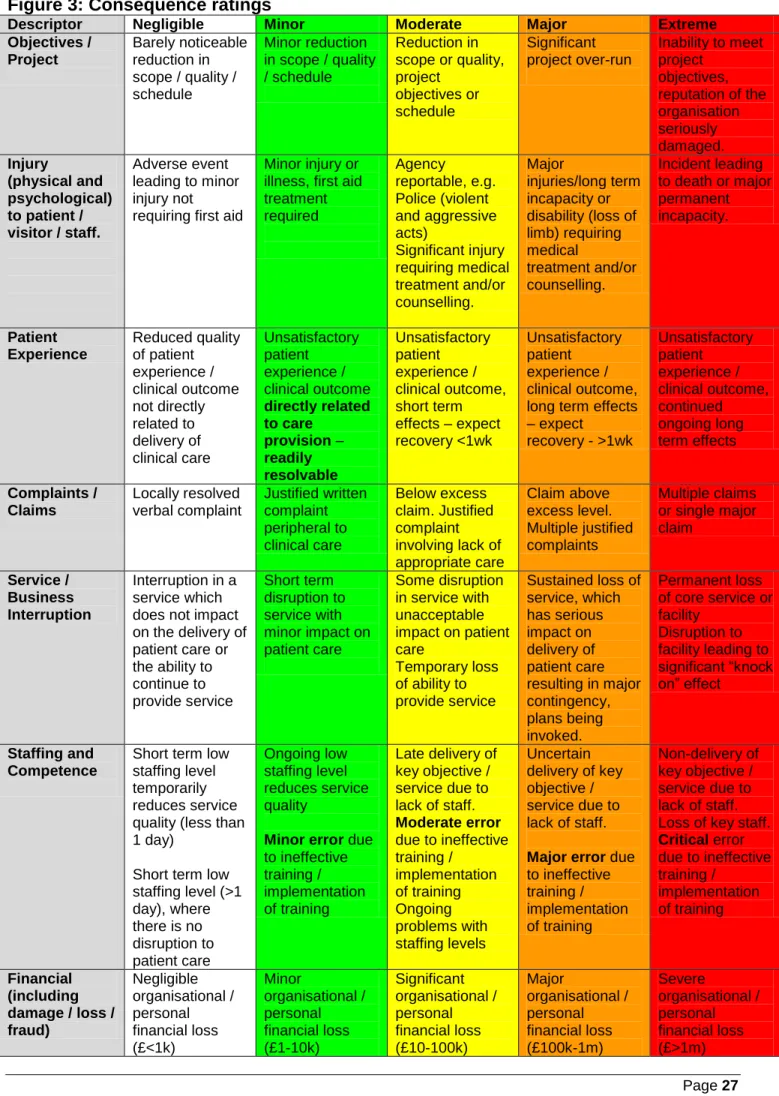
This risk assessment tool is taken from the Australian/New Zealand Standards, which is the recommended framework for risk management by NHS Healthcare Improvement Scotland. An assessment of the risks attached to a particular practice or activity may be undertaken using the Risk Assessment Matrix (see Figure 1 below) by mapping the likelihood (the probability or frequency of a consequence occurring) (Figure 2) against the consequence (the outcome or impact component Figure 3) to determine the risk grading/score. This can be used as the basis of identifying acceptable and unacceptable risk
Figure 1: Risk Assessment Matrix
In terms of grading risks, the following grades have been assigned within the matrix. Low (L)
Medium (M) High (H)
Very High (VH)
Figure 2: Likelihood of Recurrence Ratings
Descriptor Remote Unlikely Possible Likely Almost Certain
Likelihood Can‟t believe
this event would happen – will only happen in exceptional circumstances (5-10 years) Not expected to happen, but definite potential exists – unlikely to occur (2-5 years) May occur occasionally, has happened before on occasions – reasonable chance of occurring (annually) Strong possibility that this could occur – likely to occur (quarterly) This is expected to occur frequently / in most circumstances – more likely to occur than not (daily / weekly / monthly) Consequence
Likelihood Negligible Minor Moderate Major Extreme
Almost certain M H H VH VH
Likely M M H H VH
Possible L M M H H
Unlikely L M M M H
Page 27
Risk Management Strategy – Version 4 – June 2012 (Refreshed August 2013) Figure 3: Consequence ratings
Descriptor Negligible Minor Moderate Major Extreme
Objectives / Project Barely noticeable reduction in scope / quality / schedule Minor reduction in scope / quality / schedule Reduction in scope or quality, project objectives or schedule Significant project over-run Inability to meet project objectives, reputation of the organisation seriously damaged. Injury (physical and psychological) to patient / visitor / staff. Adverse event leading to minor injury not requiring first aid
Minor injury or illness, first aid treatment required Agency reportable, e.g. Police (violent and aggressive acts) Significant injury requiring medical treatment and/or counselling. Major injuries/long term incapacity or disability (loss of limb) requiring medical treatment and/or counselling. Incident leading to death or major permanent incapacity. Patient Experience Reduced quality of patient experience / clinical outcome not directly related to delivery of clinical care Unsatisfactory patient experience / clinical outcome directly related to care provision – readily resolvable Unsatisfactory patient experience / clinical outcome, short term effects – expect recovery <1wk Unsatisfactory patient experience / clinical outcome, long term effects – expect recovery - >1wk Unsatisfactory patient experience / clinical outcome, continued ongoing long term effects Complaints / Claims Locally resolved verbal complaint Justified written complaint peripheral to clinical care Below excess claim. Justified complaint involving lack of appropriate care Claim above excess level. Multiple justified complaints Multiple claims or single major claim Service / Business Interruption Interruption in a service which does not impact on the delivery of patient care or the ability to continue to provide service Short term disruption to service with minor impact on patient care Some disruption in service with unacceptable impact on patient care Temporary loss of ability to provide service Sustained loss of service, which has serious impact on delivery of patient care resulting in major contingency, plans being invoked. Permanent loss of core service or facility Disruption to facility leading to significant “knock on” effect Staffing and Competence
Short term low staffing level temporarily reduces service quality (less than 1 day)
Short term low staffing level (>1 day), where there is no disruption to patient care Ongoing low staffing level reduces service quality
Minor error due to ineffective training / implementation of training Late delivery of key objective / service due to lack of staff. Moderate error due to ineffective training / implementation of training Ongoing problems with staffing levels Uncertain delivery of key objective / service due to lack of staff.
Major error due to ineffective training / implementation of training Non-delivery of key objective / service due to lack of staff. Loss of key staff.
Critical error due to ineffective training / implementation of training Financial (including damage / loss / fraud) Negligible organisational / personal financial loss (£<1k) Minor organisational / personal financial loss (£1-10k) Significant organisational / personal financial loss (£10-100k) Major organisational / personal financial loss (£100k-1m) Severe organisational / personal financial loss (£>1m)
Page 28
Risk Management Strategy – Version 4 – June 2012 (Refreshed August 2013)
Descriptor Negligible Minor Moderate Major Extreme
Inspection / Audit Small number of recommendation s which focus on minor quality improvement issues Recommendatio ns made which can be addressed by low level of management action. Challenging recommendation s that can be addressed with appropriate action plan. Enforcement action. Low rating Critical report. Prosecution. Zero rating Severely critical report. Adverse Publicity / Reputation Rumours, no media coverage Little effect on staff morale Local media coverage – short term. Some public embarrassment. Minor effect on staff morale / public attitudes. Local media – long-term adverse publicity. Significant effect on staff morale and public perception of the organisation National media / adverse publicity, less than 3 days. Public confidence in the organisation undermined Use of services affected National / International media / adverse publicity, more than 3 days. MSP / MP concern (Questions in Parliament). Court Enforcement Public Enquiry