PHOTOVOLTAIC
POWER SYSTEMS PROGRAMME
P
V
P
S
Summary of Models for the
Implementation of Photovoltaic
Solar Home Systems in
Developing Countries
Part 1: Summary
IEA PVPS
International Energy Agency
Implementing Agreement on Photovoltaic Power Systems
Task 9
Deployment of Photovoltaic Technologies: Co-operation with
Developing Countries
Report IEA PVPS T9-02:2003
Summary of Models for the
Implementation of
Solar Home Systems in
Developing Countries
Part 1
March 2003
IEA PVPS Task 9 Implementation Models for PV Part 1: Summary
ii Report IEA PVPS T9-02: 2003
Contents
Foreword ... iv
Scope and Objective ... v
Keywords ... v
Acknowledgements... vi
Abbreviations and Acronyms... vii
Summary ... viii
PART I Summary of Models for the Implementation of Photovoltic Solar Home Systems in Developing Countries Introduction ... 1
1 Implementation Model 1: Cash Sales ... 3
1.1 Short description... 3
1.2 Applicability... 4
1.3 Main stakeholders ... 4
1.4 Advantages, disadvantages, and risks ... 5
1.5 Success / failure factors ... 5
2 Implementation Models 2: Credit Sales ... 7
2.1 Model 2A: Dealer Credit / Instalments ... 7
2.1.1 Short description ... 7
Applicability ... 8
2.1.3 Main stakeholders ... 8
2.1.4 Advantages, disadvantages, and risks ... 8
2.1.5 Success / failure factors ... I 2.2 Model 2B: End-user Credit ... 11
2.2.1 Short description ... 11
2.2.2 Applicability ... 12
2.2.3 Main stakeholders ... 12
Advantages, disadvantages, and risks... 12
2.2.5 Success / failure factors ... 13
2.3 Model 2C: Lease / Hire purchase ... 15
2.3.1 Short description ... 15
2.3.2 Applicability ... 16
2.3.3 Main stakeholders ... 16
2.3.4 Advantages, disadvantages, and risks ... 16
2.3.5 Success / failure factors ... 17
3 Implementation Model 3: Fee for service... 18
3.1 Short description... 18
3.2 Applicability... 19
3.3 Main stakeholders ... 19
3.4 Advantages, disadvantages and risks ... 19
Success / failure factors... 21
4 Considerations in selecting a implementation model ... 22
4.2 Who are the clients for PV? ... 22
4.3 How can the clients be reached? ... 23
4.4 What is the most suitable model to use? ... 24
5 Summary of Success Factors for each model ... 26
6 References ... 27
Examples
Box 1. Cash sales in Kenya ... 3Box 2. Exchanging PV systems in China ... 4
Box 3. Credit in Gambia ... 8
Box 4. High inflation in Indonesia ... 10
Box 5. Flexible credit in Bolivia... 12
Box 6. Home Power! in Namibia... 13
Box 7. Hyper-inflation in Peru... 14
Box 8. Hire Purchase in the Philippines ... 16
Box 9. Fee-for-service in Bolivia... 19
Box 10. Fee collection in Zimbabwe... 19
IEA PVPS Task 9 Implementation Models for PV Part 1: Summary
iv Report IEA PVPS T9-02: 2003
Foreword
The International Energy Agency (IEA), founded in November 1974, is an autonomous body within the framework of the Organisation for Economic Co-operation and Development (OECD),which carries out a comprehensive programme of energy co-operation among its 23 member countries. The European Commission also participates in the work of the Agency. The IEA Photovoltaic Power Systems Programme is one of the collaborative R&D agreements established within the IEA and, since 1993, its participants have been conducting a variety of joint projects in the applications of photovoltaic (PV) conversion of solar energy into electricity. The overall programme is headed by an Executive Committee composed of one representative from each participating country, while the management of individual research projects (Tasks) is the responsibility of Operating Agents. Currently activities are underway in five Tasks.
The 21 members of IEA PVPS are Australia (AUS), Austria (AUT), Canada (CAN), Denmark (DNK), European Commission, Finland (FIN), France (FRA), Germany (DEU), Israel (ISR), Italy (ITA), Japan (JPN), Korea (KOR), Mexico (MEX), The Netherlands (NLD), Norway (NOR), Portugal (PRT), Spain (ESP), Sweden (SWE), Switzerland (CHE), the United Kingdom (GBR), and the United States (USA).
The objective of Task 9, which started in late 1999, is to increase the overall rate of successful deployment of PV systems in developing countries, through increased co-operation and information exchange with developing countries and the bilateral and multilateral donors.
Twelve countries1 participate in the work of Task 9, which is an international collaboration of experts appointed by national governments and also includes representatives of the World Bank and United Nations Development Programme. Developing country representatives are invited to participate.
The main report is based on a study prepared for Novem by B. Schulte, BH van Hermert, and Q Sluijsc of Ecofys.
Part 2: Practical Experience is based on work prepared for the RESUM2 project. The examination and preparation of the practical experience with regard to this guide was financed by GTZ. The practical experience examples were elaborated with the support of the German Federal Ministry for the Environment.
D. Reinmuller of ISES and D. Adib of the Fraunhofer Institute.
The study was edited and updated, incorporating comments of Task 9 experts, by R. Gunning and K. Syngellakis.
The statements in this report have been discussed and agreed upon by Task 9.
1 Australia, Canada, Denmark, Finland, France, Germany, Italy, Japan, the Netherlands, Switzerland, the United Kingdom, the
United States of America.
Scope and Objective
This summary outlines various models for the implementation of small domestic photovoltaic (PV) systems (Solar Home Systems, or SHS) in developing countries. Photovoltaics have considerable potential to contribute to meeting certain electricity needs of rural and remote communities in developing countries. However, the high capital cost of PV systems has created the need to develop new and innovative implementation models in order to encourage widespread affordability and acceptance of the technology.
A range of different implementation approaches has been used in the past, from direct sales to a fee-for-service model. The typical characteristics of the different models are outlined in this guide with the intention of assisting policy makers, rural banks, Non-Governmental Organisations (NGOs), co-operatives and the private sector, to choose, adapt or develop appropriate models for specific situations. The report should be read in conjunction with the guide: Financing Mechanisms for Solar Home Systems in Developing Countries - The Role of Financing in the Dissemination Process. The role of public authorities is covered in more detail in the PV for Rural Electrification in Developing Countries: Institutional and Infrastructure Frameworks, also developed by Task 9 and published by the IEA PVPS. Although this document focuses on PV systems, many of the issues are equally applicable for other technologies.
When developing a new market for SHS, it is vital that an informed choice on the most appropriate implementation model is made. Part 1 of this document discusses three generic models. It is important to recognise that local conditions will demand tailored solutions and approaches, or perhaps combinations of the models described here. Furthermore, the descriptions in this document should not be applied rigidly. However, the typical characteristics of the different models, their advantages and disadvantages, are presented. Part 2 of the document provides a number of examples demonstrating the models described.
This report focuses on the implementation of SHSs. However, a considerable amount of the PV market in developing countries consists of larger systems providing electricity for social services, such as light for schools, mosques, churches, communal centres, refrigeration for health centres and drinking water for communities. There are considerable differences between the ‘social market’ and the private market for SHS. The ‘social market’ generally consists of larger sized systems but fewer in number. In most cases, donor organisations are involved and the clients are not individuals but social entities (schools, health clinics, etc) that have different legal status and organisational characteristics.
It should also be noted that in a number of developing countries, the bulk of the PV market comes from “professional” applications – relatively large scale applications such as telecom relays, remote army and marine applications. PV is also used in diesel hybrid applications that are not covered by this document.
This guide does not cover the detailed technical aspects of a solar home system or the issue of recycling old batteries.
Keywords
Keywords: developing countries, PV, solar home systems, implementation, deployment, cash sales, energy service company (ESCO), lease, hire-purchase.
IEA PVPS Task 9 Implementation Models for PV Part 1: Summary
vi Report IEA PVPS T9-02: 2003
Acknowledgements
The authors would like to thank the experts from the participating countries for their contribution to this report.
This document is an output from contracts awarded by Novem.
Every effort has been made to ensure the accuracy of the information within this report. However, mistakes with regard to the contents cannot be precluded. Neither Novem, the authors, nor the IEA PVPS shall be liable for any claim, loss, or damage directly or indirectly resulting from the use of or reliance upon the information in this study, or directly or indirectly resulting from errors, inaccuracies or omissions in the information in this study.
Abbreviations and Acronyms
BEP Break even point
BOS Balance of system
Dealer credit Credit between dealer and end-user
Dealer re-finance Credit between a financing source and a dealer
Deposit Down payment
End-user finance Credit between a credit provider and an end-user
EC Electric Cooperatives (Philippines)
ESCO Energy Service Company
GTZ Deutsche Gesellschaft für Technische Zusammenarbeit
kWh kilowatt hour
LCC Life Cycle Cost
NEA National Energy Administration (Philippines)
NGO Non-Governmental Organisation
O&M Operation and maintenance
PV Photovoltaic
SHS Solar Home System
W Watt
IEA PVPS Task 9 Implementation Models for PV Part 1: Summary
viii Report IEA PVPS T9-02: 2003
Executive Summary
PV has considerable potential to contribute to meeting the energy needs of rural and remote communities in developing countries. However, the high capital cost of photovoltaic (PV) systems means that new and innovative implementation models are needed in order to encourage widespread use of the technology. This guide gives an overview of the options and describes various models for the implementation of small domestic PV systems (Solar Home Systems or SHS) in developing countries.
Three different approaches are considered, from direct sales, credit sales and hire purchase to a fee-for-service model. The typical characteristics of the models are described, including the mechanisms, advantages, disadvantages, and associated risks. The following three typical models are detailed in Part I of the guide:
Model 1, Cash Sales: A PV system is sold directly or via a dealer to the user. The end-user immediately becomes owner of the system.
Model 2, Credit Sales: The end-user acquires the PV system on credit. Credit sales are divided into three categories:
• 2A Dealer Credit, the PV supplier/dealer sells the PV system to the end-user, who enters into a credit arrangement with the PV dealer. Depending on the arrangements, the end-user immediately becomes the owner of the system, or becomes the owner when all payments are made.
• 2B End-user Credit, the PV supplier/dealer sells the PV system to the end-user, who obtains consumer credit from a third party credit institution. Usually the end-user becomes the owner of the system immediately, but this can be delayed until all payments are made. The PV system can be used as collateral against the loan.
• 2C Lease / Hire purchase, the PV supplier/dealer or a financial intermediary leases the PV system to the end-user: At the end of the lease period, ownership may or may not be transferred to the end-user, depending on the arrangements. During the lease period, the lessor remains owner of the system and is responsible for its maintenance and repair.
Model 3,Fee for service: An energy service company (ESCO) owns the system, and provides an energy service to the end-user, who pays a periodic fee (e.g., monthly) to the ESCO. The end-user is not responsible for the maintenance of the system and never becomes the owner. Examples of each implementation model are described in Part 2 of the guide.
When developing a new market for solar home systems (SHS), it is vital that an informed choice on the implementation model is made. An inappropriate approach to the deployment of solar home systems will result in a failure to develop a sustainable market for PV. It is important to recognise that local conditions will demand tailored solutions and approaches, or combinations of the models described. To understand the country and its energy market, the following questions should be answered:
1. What is the status of the energy sector in the country, and what are the policies relating to non-electrified areas and to electrification and development?
2. Who are the end-users? What are their electricity (and energy service) needs and expectations? What is their economic activity and source of income (farming, livestock, services, craft)?
3. What are the competing/conventional practices to cover domestic energy needs and what is the household expenditure for it?
4. How can the end-users be reached? Who are the stakeholders? 5. What is the potential for productive use of electricity?
6. Which is the most suitable model or combination of implementation models to use?
Through answering these questions, the most suitable implementation model can be identified or designed. It cannot be stressed enough that flexibility and pragmatism are crucial in developing a successful implementation strategy. The models presented are generalised and must be adapted or combined to suit the local circumstances. Changes in approach may also be required as the scale of the project expands and the target area is widened. Therefore continual monitoring and evaluation is necessary.
PART 1
Summary of Models for the Implementation of Solar Home Systems in
Developing Countries
Introduction
Only 30% of rural households world-wide are connected to the public electricity grid, therefore there are an estimated 1.64 billion people without access to electricity1. Continued population growth rates in many developing countries mean that this number is increasing. The extension of the electricity grids in many countries is not a realistic option due to the high costs involved, the low energy demands of many rural communities and the dispersed nature of these communities
.
Renewable energy, and PV in particular, is a viable option for electrification and has considerable potential to meet the needs of rural populations. The decentralised nature of PV means that it requires local installation, operation and maintenance capabilities, thereby implying the creation of local activities and employment. Local entrepreneurs can play a vital role in the development of a PV market. In addition the modular nature of the technology means the initial investments can be sized to meet the initial needs of the end-users, and as these needs grow, the investments can, if necessary, be increased. This modularity means that it is not necessary to invest in major infrastructure (i.e. grid-extension) which has been designed to meet the predicted energy needs of the next 20 or even 50 years.
Solar Home Systems (SHS) can meet some of the electricity needs of the rural population now, generating electricity for a household to provide home lighting and entertainment whilst displacing poor quality kerosene lighting and dry cell battery powered devices.
SHS have been implemented both in donor supported programmes and projects as well as through market initiatives world-wide. However, in many cases a sustainable PV market has not developed. This is due to a number of factors including the high capital cost of PV and lack of financing resulting in a small market for any entrepreneur. Other factors include the lack of clear ownership of the technology, lack of maintenance and the ultimate failure of the PV system with consequent rejection of the technology. There are a number of innovative PV implementation models that have been developed and used in order to encourage the widespread affordability and acceptance of PV. These range from direct sales of SHSs through to charging a fee for the electricity service from a solar home system.
The following models are described in this document:
Model 1,Cash Sales: a PV supplier sells the PV system directly or via a dealer to the end-user. The end-user immediately becomes owner of the system.
Model 2,Credit sales: the end-user acquires the PV system on credit. Credit sales are divided into three categories:
• Dealer Credit, the PV supplier/dealer sells the PV system to the end-user, who enters into a credit arrangement with the PV supplier/dealer. Depending on the arrangements, the end-user immediately becomes the owner of the system, or when all payments are made.
• End-user Credit, the PV supplier/dealer sells the PV system to the end-user, who obtains consumer credit from a third party credit institution. The end-user usually
IEA PVPS Task 9 Implementation Models for PV Part 1: Summary
2 Report IEA PVPS T9-02: 2003
becomes the owner of the system immediately, but this can be delayed until all payments are made.
• Lease/Hire purchase, the PV supplier/dealer or a financial intermediary leases the PV system to the end-user: At the end of the lease period, ownership may or may not be transferred to the end-user, depending on the arrangements. During the lease period, the lessor remains owner of the system and is responsible for its maintenance and repair.
Model 3, Fee for service: an ESCO owns the system, and provides an energy service to the end-user, who pays a periodic fee (e.g., monthly) to the ESCO. The end-user is not responsible for the maintenance of the SHS system and never becomes the owner, although the end-user may own the battery and lamps/radio.
1 Implementation Model 1: Cash Sales
end-user
dealer
Transfer of PV system
Transfer of cash (single tranche) Ultimate owner of the PV system
Figure 1-1: Illustration of transfer of cash and ownership for cash sales model
1.1 Short description
This is the simplest implementation model: a PV supplier distributes PV systems directly or through a dealer network to the end-users, who usually, but not necessarily, do the installation themselves. The end-users pay in cash for their system and either take it away or arrange delivery. No other actors are directly involved, although, of course, a conducive environment can be created through government policies. The operation and maintenance of the system is the responsibility of the end-user.
In some cases the installation can be carried out by the dealers, who would then require a network of installers. In practice, installation and maintenance or after-sales service usually form no part of the deal; however, for the long-term sustainability and a reliable image of the supplier, it should be a matter for consideration – as it is in the case of household appliances such as refrigerators. Where the equipment has a warranty on its technical performance, the dealer should honour the warranty, separate from any after-sales agreement, but enforcement
of this can be difficult.
This model is most prone to the ‘initial investment barrier’, resulting in a small market for the wealthiest of the “rural poor”. It also tends to encourage the sale of smaller products such as solar lanterns or cheaper, low-quality SHS.
Box 1. Cash sales in Kenya
In Kenya, some 20 000 small systems are sold annually. The system sizes are typically 10 Wp - 20 Wp, mostly amorphous silicon modules using car batteries or locally made solar batteries without a charge controller. Some five suppliers distribute through a retailer network of local shops selling domestic electronics. Very few local enterprises sell higher quality systems or provide installation services.
IEA PVPS Task 9 Implementation Models for PV Part 1: Summary
4 Report IEA PVPS T9-02: 2003
Figure 1-2:Cash flows for the PV supplier/dealer and end-user (cash sales)
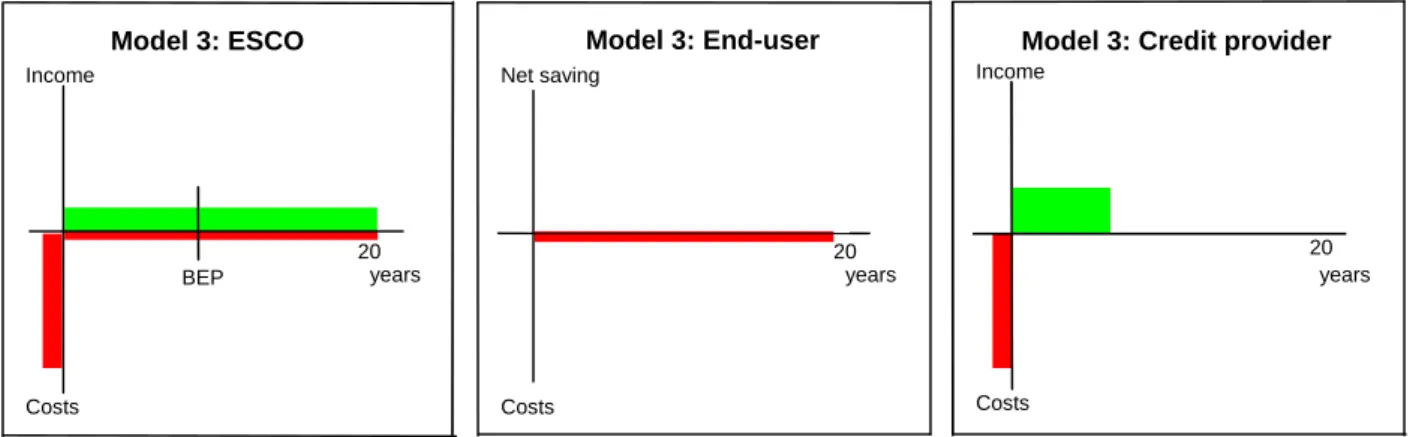
Legend to the graphs:
• The left graph shows the cash flow for the PV supplier/dealer/dealer, the right graph shows the cash flow for the individual end-user.
• The scales are only indicative and not linear. The main use of these graphs is to visualise the different models and to compare them in terms of investment needs (amount and duration).
• It is important to note that during the whole life of the system, expenditures for maintenance and replacement of components are needed: these are discounted in the income/net saving bar. These costs are charged to the client or to the PV supplier/dealer, depending on the model.
• BEP stands for Break Even Point or Pay Back Period, the time after which the end-user or the PV supplier/dealer has gained back their investment. The total costs (red) equal that of the income / net savings (green) at BEP.
1.2 Applicability
The cash sales model requires the fewest preconditions to set up, although the viability of a rural PV business obviously depends largely on the economic situation. The major limiting factor is the purchasing power of the end-user. This is often limited and strongly influenced by seasonal fluctuations: for instance, post-harvest periods in agricultural societies and pre-festival periods in more industrialised settings.
There are many experiences with this implementation model; however, as most
initiatives are not related to any donor-driven initiative, they are poorly documented. Nonetheless, increasing experience shows that there is a self-sustaining market in this sector.
1.3 Main stakeholders
The only stakeholders, apart from the end-user / client, are the supplier and the dealer.
• The end-users must have enough purchasing power to afford the initial capital cost of the PV system. This will apply to only a few percent of the off-grid population.
Box 2. Exchanging PV systems in China
The Gansu PV Company operates in the Gansu province of China. Since 1994 they have manufactured, installed, and serviced 1 000 PV systems a year. The systems range from 6 Wp to 120 Wp and are sold on a cash basis.
Initially, a credit model was used but was unsuccessful because the customers did not understand the concept of credit and so did not feel obliged to pay back. To increase affordability, customers can start with a small system and exchange it for a larger one when their energy demand increases and they have saved up the money.
Model 1: PV supplier/dealer Model 1: End-User
Income Net saving
years years
20 20
BEP
Cash sales in Tibet (Source: IT Power)
• The PV supplier develops / links to a dealer network, sometimes including installation and service capacity.
• Support from government, through conducive policies, is helpful. The government can contribute to a conducive environment through raising awareness, promotion campaigns, standards, training, certification and quality control, tax and fiscal incentives, enforcement of guarantee claims, reduced import duties, subsidies and support to R&D.
1.4 Advantages, disadvantages, and risks
The main advantages are clear:
• Minimal number of stakeholders and lowest transaction cost;
• Out of all the models, this one has potentially the lowest demand for capital for the PV company;
• Local infrastructure for installation, maintenance, and after-sales services can be built as sales increase, thus initial implementation can be fast;
• No need for explicit government or programme support, although this can be of great help and can considerably increase market penetration.
The major disadvantages are
• Limited market as a result of the high up-front investment needed, coverage of only 1 % – 10 % of the off-grid population is likely;
• Often no control on how the systems are installed by the end-users themselves or by local technicians (e.g. solar home systems are installed without a charge controller);
• Low quality components and
installation standards;
• Often minimal end-user training and therefore lack of on-going maintenance;
• Competition with cheap, low quality-products is a problem, especially if no government regulations / quality systems exist. If the market is just starting, there is no common knowledge within the market yet about good and poor quality brands;
• The market may be geographically limited by the installer infrastructure if the dealer installs the system.
There are no risks for the PV company and dealers beyond the warranty and this is frequently difficult to enforce. The risk lies with the end-user if their fully paid system does not work. There is usually a short warranty for the whole system, excluding the electrical appliances. The supplier / dealer may be able to pass on the manufacturers’ warranties for single components, although enforcing these in remote areas often proves difficult.
1.5 Success / failure factors
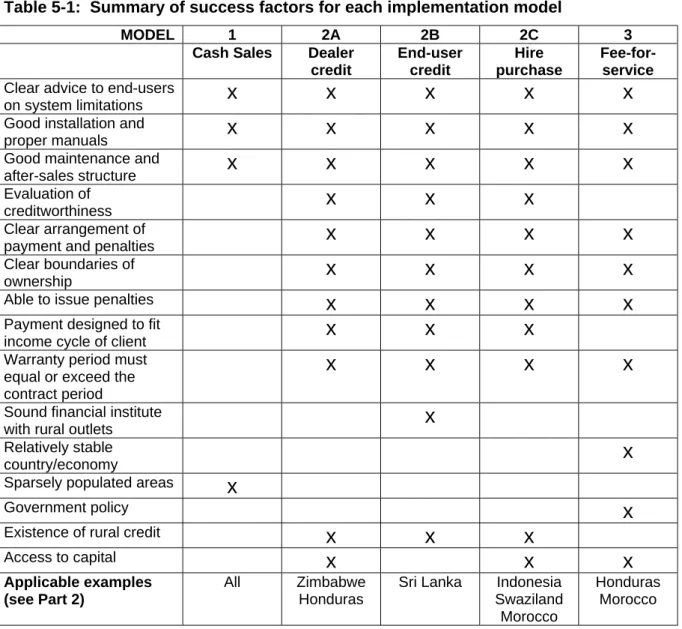
The main factors ensuring that the cash sales model is a success are:
• Good maintenance structure and after-sales services for long-term sustainability;
• Clear advice to the end-users regarding the limitations of the system;
IEA PVPS Task 9 Implementation Models for PV Part 1: Summary
6 Report IEA PVPS T9-02: 2003
Main failure factors:
• Lack of end-user training and manuals;
• Low quality goods;
• Distorting effects of subsidies on fuels (eg. diesel, kerosene), grid extension, etc.;
• Low market volume due to high system costs;
2 Implementation Models 2: Credit Sales
2.1 Model 2A: Dealer Credit / Instalments
end-user
dealer
credit provider / funding source
Transfer of PV system
Transfer of cash (single tranche) Transfer of cash (instalments) Ultimate owner of the PV system
Figure 2-1: Illustration of transfer of cash and ownership for dealer credit model
2.1.1 Short description
To reduce the high initial investment barrier for the end-user - the main disadvantage of the cash sales model - a company selling PV systems may consider starting a consumer credit or instalment payment facility. The PV company still supplies hardware to the rural clients, via a dealer network or directly, but the client is able to pay in instalments. The payments can be monthly or adapted to income cycles. Usually these kinds of end-user credit are characterised by relatively short terms (mostly between 6 months and one year), high down payments (up to 50 %) and high interest rates (rates of 20 % to 25 % are not uncommon). However, these credit systems can be popular because the extra amount spent on the credit facility is relatively low3. Generally the PV supplier / dealer does not have the working capital required to offer credit to the end-user. Therefore, they must approach a funding source or credit provider to access credit (dealer re-finance). This results in the high interest rates common with the dealer credit model.
The ownership of the system is transferred either when the down payment is paid or when the credit is repaid. Normally, the end-user is responsible for the maintenance of the system, although in some cases it can be carried out by the dealer. The PV module(s) acts as collateral during the credit / instalment period as the balance-of-system (BOS) components are usually covered by the down payment.
IEA PVPS Task 9 Implementation Models for PV Part 1: Summary
8 Report IEA PVPS T9-02: 2003
Figure 2-2: Cash flows for the PV company, end-user and credit provider (dealer credit)
2.1.2 Applicability
This model is widely applicable, and in almost every country there is experience with consumer credit systems, which are used to sell / buy luxury products like cars, televisions, hi-fi, etc. To minimise risks and misuse, a strict credit policy is usually followed by the dealer (the client must, for instance, have a fixed salary, a house or a warranty, or be well known to the local dealer, hence the importance of very localised sales persons).
In many cases, the credit is handled between the local
dealer and the client, and becomes a semi-informal transaction based on mutual trust and can be qualified as an instalment payment facility. Legally, companies are not always allowed to start a credit scheme, as in some countries credit activities are reserved for recognised credit institutions only. Working with a professional credit institution is described in Section 2.2.
2.1.3 Main stakeholders
• End-users - purchase of PV products on an instalment or credit basis, the end-user is owner of the system and responsible for maintenance and repair, although some companies will state in their terms that they remain owner until the final payment is made.
• PV suppliers / dealers - sales of PV equipment on an instalment / credit basis.
• Credit institution – Dealer re-finance - the PV companies or dealer network may have to access credit from credit institutions / funding sources to provide credit to the end-users.
• Government - creating the right boundary conditions for the sale of PV systems but also regulation for credit systems. This could include end-user protection through standards, certification and quality issues, information campaigns and demonstrations, taxes and subsidies, and clear policy on rural electrification.
2.1.4 Advantages, disadvantages, and risks
Main advantages:
• For the end-user, the main barrier of the high initial investment is lowered;
• In most cases, one institution handles both the financial and the technical work: the credit / instalments recovery as well as the maintenance, training, and other after-sales services;
Box 3. Credit in Gambia
In Gambia a small private company sells PV systems directly to customers or intermediaries on a credit basis. The experience is that the market volume increases but the risks (debts are not repaid in time) and financing costs are too high. Therefore credit sales are restricted to a limited number of well-known intermediary organisations or through local dealers that know their customers.
Model 2A: PV supplier/dealer
Income
years
1 20
BEP
Costs
Model 2A: End-user
Net saving
years
1 20
BEP
Costs
Model 2A: Credit Provider
Income
years
1 20
• In many countries formal or informal credits are widespread and understood;
• Little government or other external involvement is required. Main disadvantages:
• The payment facility scheme absorbs working capital for the PV supplier / dealer;
• High interest rates due to expensive capital through dealer re-finance;
• Lack of knowledge of consumer credit with the end-users in some countries;
• Excludes the poorest households due to high down payments and instalments, and a credit track record is often required;
• PV companies are usually not experienced / equipped / capable of administering a credit scheme, as this requires extra skills and is time consuming;
• Depending on the credit provider, this model may be geographically restricted because of the extensive infrastructure needed for the collection of the payments and possible retrieval of the collateral.
Risks:
• The main risk lies with the PV company / dealer from non-payment of the credit from the end-user. This can be mitigated by using the PV module as collateral, with retrieval of the module on non-payment;
• The dealer re-finance funding source / credit institution carries the risk of non-payment of credit from the dealer. The credit institutions will mitigate their risk by requiring detailed business plans and personal warranties from the dealers;
• The risk to the end-user is the loss of the PV system and down payment, if they are unable to keep up credit repayments.
2.1.5 Success / failure factors
The main factors ensuring that the dealer credit model is a success are:
• The company that runs a credit scheme must thoroughly evaluate the creditworthiness of its clients and must be able to issue penalties or to retrieve the system in case of bad debts;
• The boundaries of ownership must be clear in case of the need to issue penalties;
• Clear arrangement for payments and penalties in case of non-payment, for example the retrieval of the system;
• The payment schedule must be designed to fit the income cycle of the client; PV on dealer credit in India. (Source: IT Power)
IEA PVPS Task 9 Implementation Models for PV Part 1: Summary
10 Report IEA PVPS T9-02: 2003
• The warranty period must exceed the payment facility period;
• Clear advice to the end-users regarding the limitations of the system;
• Good maintenance structure and after-sales services for long-term sustainability;
• PV company / dealer requires a
convincing business plan to access dealer re-finance.
Main failure factors:
• Unexpected high inflation rate / change of exchange rate;
• Late or non-payment of the credit;
• Theft / replacement of unpaid systems;
• Inadequate financial administration leading to high administration costs.
• Poor maintenance and after-sales service.
Box 4. High inflation in Indonesia
In Indonesia, a commercial company sold large numbers of PV systems on credit. The company itself, through a dealer network that also sold and installed the systems, managed the credit. The system worked well until the Rupiah (IDR) lost its value in the Asia financial crises. Due to the high outstanding debts that lost their USD value, the company went bankrupt.
2.2 Model 2B: End-user Credit
end-user
dealer
credit provider
Transfer of PV system
Transfer of cash (single tranche) Transfer of cash (instalments) Ultimate owner of the PV system
Figure 2-3: Illustration of transfer of cash and ownership for end-user credit model
2.2.1 Short description
In general terms, this model is the same as the dealer credit model; only the division of roles between the stakeholders is different. In this case, the credit scheme is implemented by a separate credit organisation preferably one with rural outlets and experience with rural credit -that lends directly to the end-users. This means -that the PV company / dealer is not directly involved in the credit scheme and that valuable working capital remains available for the company / dealer.
The PV company remains responsible for the sales, distribution and installation of the PV system. The end-user usually pays a down-payment (either directly to the company or to the credit institution), and the remaining payments are collected by the credit institution. The credit institution usually takes responsibility for the loan and pays the complete price to the PV company (for the company it is like a cash sale). The end-user is the owner of the system and responsible for maintenance and repair, although most credit institutes will state in their credit terms that they remain owner till the last payment is made.
Figure 2-4: Credit institution, end-user and PV supplier cash flows (end-user credit)
Model 2B: Credit institution
Income years 3 20 BEP Costs Model 2B: End-user Net saving years 3 20 BEP Costs Model 2B: PV supplier/dealer Income years 20 Costs
IEA PVPS Task 9 Implementation Models for PV Part 1: Summary
12 Report IEA PVPS T9-02: 2003
The PV module is usually used as collateral because it is easy to remove and reuse. This collateral system is more suited to larger systems of 50 Wp or more.
The credit institution may also be involved in promotion and extension work to increase sales, mostly rewarded through a commission for every system sold.
2.2.2 Applicability
The main factor that makes this model applicable is the existence of credit institutions that have experience with rural credit and have local outlets in the rural areas. In most countries there are credit institutions such as rural development banks, savings and credit co-operatives, or other rural development organisations that are already supplying small credits to the rural population. However, PV systems are usually considered as a consumer product and as such do not always fit within the policy of the credit institutes that focus on credit for income generating purposes. There are, for instance, many agricultural credit facilities that are designed to purchase agricultural inputs (seeds, tools) that directly result in an income. However, rural development banks, such as the Development Banks of the Philippines and Namibia, have made SHS eligible for their development credit facilities.
2.2.3 Main stakeholders
• End-users - purchase of PV products on a credit basis.
• PV suppliers / dealers - sales, distribution, installation, and servicing of PV products.
• Credit institutions - implementation of a credit line for PV systems, sometimes also sales (on a commission basis) and promotion/extension work.
• Government - creating the right boundary
conditions for the sale of PV systems but also regulation for credit systems. This includes warranty funds for financial service providers, end-user protection through standards, certification and quality issues, information campaigns and demonstrations, reduced taxes and subsidies, and clear policy on rural electrification.
2.2.4 Advantages, disadvantages and risks
Main advantages:
• The main barrier of the high initial investment is lowered or removed;
• The PV company does not need to allocate budget to run the credit scheme, thereby avoiding financial risks and allowing it to concentrate on sales and after-sales services;
• The credit institutions - if available - are much better equipped to manage a credit scheme; they have the infrastructure, they know their clients, and they are able to collect their outstanding debts;
• The rural network of the credit institution may also be used for promotion and extension work;
• Little government or other external involvement required (apart from creating the right environment for PV).
Box 5. Flexible credit in Bolivia
Energética, a Bolivian NGO implemented the first phase of a Dutch-sponsored SHS project selling 500 SHS systems of 20 Wp and 50 Wp through private entrepreneurs. 16 % of the clients bought their systems with cash; the remaining 84 % got a loan through a local credit organisation, FADES, that designed a special credit scheme for this project. After two years of operation, 44 % of the debtors had no arrears: the other 56 % rescheduled their loan to fit with the agricultural reality. In the rural, agricultural setting of this project, it was not the calendar dates that counted for the farmers, but rather the agricultural calendar. It was only when the credit scheme built in this flexibility that the end-users complied with their obligations.[2]
End-user credit is offered in West Bengal, India. (Source: PVMTI)
Main disadvantages:
• This model is geographically restricted because of the infrastructure needed for the collection of the payments and possible retrieval of the collateral;
• Two separate structures may be needed to handle the financial and the technical work, resulting in additional costs, although it is possible for one structure to handle both financial and technical work;
• High interest rates and down-payments. In some cases the credit institutions have been supported by donors or government programmes to keep interest rates low. These credit schemes are characterised by more favourable terms than commercial consumer credits (longer terms of 1 year to 3 years compared to 6 to12 months, lower interest rates of 10 % to 15 % compared to over 25 %, and lower down-payments of 20 % to 40 % compared to over 50 %);
• The market is restricted to customers that the credit institution deems creditworthy – generally those with salaried incomes, those with a guarantor or those who have the required collateral.
Risks:
• The majority of the risk is carried by the credit organisation from the non-payment of the credit repayments. This is mitigated through the use of the PV module as collateral;
• The PV company / dealer risks are passed to the credit institution;
• The end-user risks losing their PV system and their down payment if they are unable to keep up their repayments;
• Payment schedules can be either monthly or in line with income profiles.
2.2.5 Success / failure factors
The main factors ensuring that the end-user credit model is a success are:
• A sound financial institute with rural outlets and interest in financing PV credits. Such strong rural credit institutions are scarce. Some have economic development as their main objective and focus on income generating credits; others focus on social aspects (collection of the debts is not always a high priority); but for all, overhead costs for rural loans are high;
• The boundaries of ownership must be clear between the end-user, dealer and credit organisation;
• Clear arrangement for payments and
Box 6. Home Power! in Namibia
The Peri-Urban and Rural Solar Electrification Revolving fund in Namibia provides information brochures and loan application forms to potential SHS customers who have been identified by technicians. Eligibility conditions include a minimum regular income and a positive record with previous loans.
After approval of credit from the fund, the end-users make a down-payment of 10 % of the purchase price. The remaining 90 % is given as a credit, with 5 % annual interest rate to be paid back over 5 years. Initially the down payment was 20 %, but this was found to be too high for most customers.
IEA PVPS Task 9 Implementation Models for PV Part 1: Summary
14 Report IEA PVPS T9-02: 2003
example, the retrieval of the system;
• The credit system must be designed to fit the income cycle of the client, especially in predominantly agricultural communities;
• Good maintenance structure and after-sales services for long-term sustainability. As the credit institutions take the long-term financial risk, the PV companies may be tempted to neglect after-sales service provision.
Main failure factors:
• Difference of interests between PV company and credit institute (short-term profit for the company, long-term risk for the credit institution);
• Non-sustainability of the credit organisation because of low repayment rates or high running costs;
• Theft / replacement / mismanagement of systems;
• Unexpected high inflation;
• Poor maintenance leads to arrears in debt repayment.
Box 7. Hyper-inflation in Peru
The first important PV project in Peru was a pre-commercial SHS project of GTZ (in the Puno region). Since 1985, this project has installed about 500 SHS. Originally, the SHS were sold on credit to the end-users, with some fixed subsidy and payments in Peruvian currency over three years. The high inflation rate in Peru at that time resulted in the end-users only paying about 20 % of the real costs.
2.3 Model 2C: Lease / Hire purchase
end-user
/ lessee
dealer /
lessor
credit provider / leasing company
Transfer and ownership of PV system at the end of the hire-purchase term
Transfer of cash (single tranche) Transfer of cash (instalments) Ultimate owner of the PV system
Figure 2-5: Illustration of transfer of cash and ownership for lease/hire purchase model
2.3.1 Short description
This model can be referred to as either lease or hire-purchase. Although there is a legal distinction between the two options, there are no real differences in their implementation. In this section, the term hire-purchase is used.
Again, this model shows many similarities with the user credit model. In this case, either the PV company or an intermediate financial institution offers the PV system on a hire-purchase basis. In both cases, the client (lessee) pays a regular fee for a limited period (typically 2 or 3 years). The company (lessor) remains owner of the system during the rental or lease term, and at the end of the term, the ownership is transferred to the lessee (with leasing, this is not obligatory; with hire-purchase it is). The installation and after-sales service is carried out by the PV company.
Figure 2-6: Hire-purchase company, end-user and PV supplier cash flows (lease / hire-purchase)
Model 2C: Hire-purchase company
Income years 5 20 BEP Costs Model 2C: End-user Net saving years 5 20 BEP Costs Model 2C: PV supplier/dealer Income years 20 Costs
IEA PVPS Task 9 Implementation Models for PV Part 1: Summary
16 Report IEA PVPS T9-02: 2003
2.3.2 Applicability
There are very few cases where an existing hire-purchase company in a developing country has been involved in the hire-purchase of SHS. This model would only apply for PV companies that have the financial resources and the administrative and technical infrastructure to set up a hire-purchase model.
2.3.3 Main stakeholders
• End-users - purchase of PV products on a hire-purchase basis.
• PV suppliers / dealers - sales, operation, and maintenance of PV equipment on a hire-purchase basis.
• Government - creating the right boundary conditions for the sales of PV systems but also regulations for hire-purchase and leasing (taxes, etc.). In addition, in view of the long-term investment, a clear government ‘commitment’ not to extend the grid to the operating area is important to the investor.
2.3.4 Advantages, disadvantages, and risks
Main advantages:
• The main barrier of the high initial investment is removed, more so than with the other credit models, as the initial down payment is further reduced and the repayment period is prolonged. In general, the payment system can also be designed to fit the income cycle of the client;
• One single structure can handle both the financial and the technical work: the fee collection as well as the maintenance, training, and other after-sales services;
• Maintenance can be kept at a high standard because of the professional care for the system;
• Good-quality products are selected because of the long repayment period. Main disadvantages:
• Leasing is not a well-known concept in most countries although hire / purchase is known in some;
• End-users may not treat the systems with care, as initially the maintenance and ownership do not lie with them;
• The hire-purchase model absorbs a lot of working capital;
• PV companies are usually not equipped / capable to run a hire-purchase programme as it requires additional financial administration skills and can be time consuming;
• This model can be geographically restrictive because of the extensive infrastructure needed for the collection of the payments and the maintenance and repair of the systems.
Risks:
• The hire-purchase provider takes the majority of the risk. However, if the end-user stops repayments, the hire-purchase provider owns the system and can retrieve it.
Box 8. Hire Purchase in the Philippines
The responsibility for electrification in the Philippines lies with the Electric Cooperatives (EC). The National Energy Administration (NEA) serves as a lender to the ECs, providing credit and subsidies. The ECs then offer the end-users the PV module to rent or to buy on credit whilst the user must buy at his own expense the BOS components.
2.3.5 Success / failure factors
The success / failure factors are difficult to assess because there is very little experience to date. However, the following factors are likely to be important.
Main success factors:
• Clear design of the ownership structure and responsibility for the replacement of components that have a limited life time, such as the batteries and lamps;
• Clear arrangement for payments and penalties in case of non-payment, for example the retrieval of the system;
• Good and fast maintenance and repair infrastructure. Main failure factors:
• Unexpected high inflation rates;
• Late or non-payment of credit;
• Theft / replacement / mismanagement of systems;
• Inadequate financial administration;
IEA PVPS Task 9 Implementation Models for PV Part 1: Summary
18 Report IEA PVPS T9-02: 2003
3 Implementation Model 3: Fee for service
end-user
ESCO
PV supplier
credit provider
Transfer of ownership
Transfer of cash (single tranche) Transfer of cash (instalments) Ultimate owner of the PV system
Figure 3-1: Illustration of transfer of cash and ownership for fee for service model
3.1 Short description
In the feeforservice or feeforenergy model, an energy company invests in PV hardware -usually decentralised individual systems on individual houses (solar home systems) - and starts selling an energy service for a fee. The energy service company (ESCO) remains the owner of the hardware and is responsible for installation, maintenance, repair, and replacement of the PV system and, in some cases, its components (controllers, batteries) at the end of their lifetime. The end-user pays a connection fee and a regular fee - usually monthly, though a fee per kWh is also possible. The end-user pays as long as the energy service is delivered and never becomes the owner of the system. However, the end-user usually owns the wiring, lamps, and appliances, which are covered by the connection fee. In some cases the end-user will also own the battery and charge controller.
Financing requirements to establish such a model are substantial. By selling energy for a reasonable price, it takes between 5 years and 10 years before the initial investment is recovered by the ESCO. This means that the ESCO must be creditworthy and willing to take such investment risks. A financial institution (bank, credit provider) can be involved to share the risk.
Figure 3-2: ESCO, end-user and credit provider cash flows (fee for service) for one system
Model 3: Credit provider
Income years 20 Costs Model 3: ESCO Income years 20 BEP Costs Model 3: End-user Net saving years 20 Costs
3.2 Applicability
The fee-for-service model is characterised by its long-term investments. It is therefore only applicable if the ESCO and its partners are able and willing to stay involved in the business for at least a decade. This requires long-term planning, a relatively stable economy, a stable political situation, and a clear long-term energy policy, sufficient long-term financing in addition to the general boundary conditions necessary to create the required rural infrastructure. For the ESCO to take such a risk, the power sector must be clearly organised, with a transparent regulatory framework.
Particularly if public subsidies are part of the scheme, it is essential to target areas where no grid extension is planned: if asked to chose, end-users will prefer to wait a few years for grid electricity rather than a PV service today. It must be very clear to the end-users that there is no grid extension planned and therefore PV is the only option.
3.3 Main stakeholders
• End-user - buys an energy service for a regular fee.
• ESCO - invests in energy service infrastructure and sells energy. A utility can assume the role of ESCO. The ESCO owns the PV system.
• PV company - installation and maintenance of PV systems (can also be done by the ESCO itself, but can be subcontracted).
• Credit institutions/funding sources - supply of long-term capital to the ESCO.
• Government - to issue licences to sell energy or to electrify an area (through a combination of PV with other energy sources). A clear government commitment to rural electrification with PV is needed. The issue of concessions will make the operation of an ESCO more attractive but is not a pre-condition. In addition the government should issue general boundary conditions to the sale of PV; for instance, clear quality regulations, information campaigns, clear tax and subsidy rules, etc.
3.4 Advantages, disadvantages and risks
Main advantages:
• End-user does not have to invest in a solar system (only connection fee), thereby facilitating access to electricity to more people ;
• End-user is not responsible for maintenance and repair. By organising this centrally, the costs for maintenance and repair are lowered while high quality maintenance can be provided;
• High-quality systems, components and installation are encouraged because of the inevitable long-term agreements;
• Proper collection and recycling of components (e.g. batteries) is possible because of the centralised responsibility;
Main disadvantages:
• High risks and high transaction costs result in high monthly fees and reduce affordability for poor households;
•
Box 9. Fee-for-service in Bolivia
From 1997 to 2001, Shell Solar sold 5 000 SHS to the Bolivian utility CRE. The clients pay a monthly fee of 12.50 USD for a 100 Wp system and 7.50 USD for a 50 Wp system. In addition, the client has to pay the installation costs (60 USD) and the PL-lamps (70 USD), which is spread out over 3 years.
CRE, as owner of the system, is responsible for all the maintenance including replacement of the batteries. The large geographical area has very low population density figures, and CRE has little rural infrastructure. Fee collection is done through local savings and credit co-operatives, which have few means and incentives to minimise defaulters.
The situation by the end of 2001 was that less than half of the end-users were paying their quarterly instalments. The CRE concluded that it was more expensive to set up a strong fee collection system than to cover the losses.2
Box 10. Fee collection in Zimbabwe
In a JICA-funded project in Zimbabwe, the evaluation showed that salary earners could be charged monthly while farming families were better served if charged annually.
IEA PVPS Task 9 Implementation Models for PV Part 1: Summary
20 Report IEA PVPS T9-02: 2003
financial risks;
• The end-user is not the owner of the system and may therefore not treat the system as carefully as they would otherwise. The PV system should be theft and tamper proof;
• As ‘serious’ companies like ESCOs or utilities provide the service, end-user expectations are often high, while the system may run out of energy under certain circumstances, even though the client paid a monthly fee. This may cause disappointment;
• The client is usually not allowed to miss a monthly payment (as is possible with the alternatives like kerosene and batteries);
• Monthly collection of the fees is time consuming and expensive. Prepayment systems are an alternative. Also successful examples of sub-contracting fee collection to the local community exist;
• This model is geographically restricted because of the extensive infrastructure needed for the collection of the payments and the maintenance and repair of the systems.
Risks:
• The ESCO carries all the risk as owners of the systems and for collecting the fees;
• The credit institution providing the finance to the ESCO takes the risk on the success of the ESCO.
Box 11. Fee-for-Service Approaches in Morocco
The Global Rural Electrification Programme (PERG) was launched by the Office National d'Electricité (ONE, the national utility) in 1995 in Morocco. The programme tried four different approaches to the implementation of SHS. The first was direct action where the first households supplied with SHS were ONE customers, and ONE procured, installed, and maintained the SHSs. ONE also handled billing of the monthly fees. The financial arrangement comprised an advance payment of 1,440 MAD (130 USD) by the beneficiary household, and monthly payments of 60 MAD (5.5 USD) over a period of 7 years.
The second approach was a variant of the first approach, in which the installation, after-sales services, and billing were contracted to a private company, which was selected by competitive bidding and paid by ONE for its services.
The third approach divided tasks between ONE and a private company selected through competitive bidding. - ONE provided the module and battery, and verified that the project was properly executed and that
customers received satisfactory service.
- The contractor provided the rest of the SHS, equipment installation, maintenance and after-sales service for a renewable period of 5 years.
The financial arrangements stemmed from the following distribution of tasks. The ONE subsidy covered the price of the panel and the battery. The beneficiary household paid an advance and monthly payments (set by the terms of the tender) directly to the contractor.
The lessons learnt from these three approaches were:
- Technical: customer satisfaction with the after-sales service
- Financial: low and irregular bill recovery rate, the need to find payment modalities better suited to villagers' incomes
- Organisational: the long delay between the customer's application and actual installation of the SHS was a handicap for the scheme. Stock management of equipment supplied by ONE was also a source of possible failure in the process.
In light of this experience, ONE has developed a new fee for service approach. Under this scheme, the contractor is chosen by competitive bidding on the basis of the lowest cost for services provided to households. The contractor provides all services, including supply and installation of all equipment, after-sales service, and payment collection. Needless to say, high quality of hardware and services is one of the requirements of the terms of reference. ONE pays receipts from end-users to the contractor. The period of the contract is set at 10 years.
- Financial: The subsidy is paid directly to the contractor upon presentation of supporting documentation. The beneficiary household, customer of ONE, pays to ONE the advance and monthly payments set by the contractor with the lowest bid.
- Ownership of equipment: ONE retains ownership of the PV system and the household owns the interior installation.
3.5 Success / failure factors
The success / failure factors are difficult to assess because there is little documented experience to date; many ongoing projects have not been evaluated in depth.
Main success factors ensuring that the fee-for-service model is a success are:
• Government should consider issuing a clear long term licence, or time-limited exclusivity agreement, to an ESCO to start selling electricity services in a certain region;
• Legislation is often required to permit electricity sale by parties other than the utility;
• Relatively stable country / economy in order to encourage long-term investment;
• Clear definition of system ownership and acceptable loads. For example, who owns the lamps, fittings, wiring? Which loads are allowed, which not (e.g., B/W TV)?
• Clear arrangement for payments and penalties in case of non-payment, for example the retrieval of the system.
Main failure factors:
• Late or non-payment of the energy fee;
IEA PVPS Task 9 Implementation Models for PV Part 1: Summary
22 Report IEA PVPS T9-02: 2003
4 Considerations in selecting a implementation model
To identify the most suitable implementation model, or a mix of elements from various models, it is important to understand the country and its energy market, the end-users’ willingness-to-pay for electricity and the current energy expenditure. Whichever model is selected, it is important to realise that implementing PV in a rural development context is a matter of selling products and services in order to meet the energy needs of the end-users. It is important to have the necessary background information on the market by asking the following questions:
• What is the status of the energy sector in the country, and what are the policies relating to non-electrified areas and to electrification and development?
• Who are the end-users? What are their electricity (and energy service) needs and expectations? What is the economic activity and source of income (farming, livestock, services, crafts)?
• What are the competing / conventional practices to cover domestic energy needs and what is the household expenditure for it?
• Who are the stakeholders and how can they be reached?
• What are the possibilities for productive use of electricity?
In the next sections, various aspects are considered that may play a role in helping to decide which is the best implementation model to use. The lists of questions may not be complete, but are meant to give a direction to policy makers to assist in identifying critical factors.
4.1 The energy sector
To get a good idea of the potential for the use of PV, an analysis of the energy sector has to be made, keeping the preconditions of the various implementation models in mind:
• What is the government energy policy: are renewables supported?
• What is the government policy towards rural electrification:
! Does an electrification plan exist? Which areas are / will be covered by the grid, are there areas with other options? Is there a potential / role for PV? How to co-ordinate grid versus off-grid electrification?
! Can private entities provide electricity under current regulations?
! Is rural development stimulated through rural electrification programmes? Is it supported by the government?
! Are the utilities involved in rural electrification? What is their role, attitude, approach, image, relation with the customers? Is the utility a potential PV company?
• What is the cost of grid connection? What are the current electricity fees for customers?
• Are there any subsidies within the energy and electricity sector and how would these impact a PV company?
• Are there plans for privatisation or sector in the energy sector? How will this impact off-grid electricity services?
• Does a level playing field exist for the different technology options? (Subsidies on fuel / PV component / grid extension, exemption of import duties etc.)
• Are there existing renewable energy companies? What are the experiences with PV or other renewables to date? What have been the success and failure factors?
• What are the existing / on-going electrification or renewable energy programmes and initiatives?
4.2 Stakeholders
In the development of an implementation strategy, it is essential to identify the potential users of PV systems and their circumstances / needs. To get an initial idea of the target market, the following questions should be answered regarding the potential end-users:
• Are there areas expected to be covered by the grid within the near future? Is grid extension a realistic alternative? Any long term implementation strategies may not be sustainable if the grid is due to reach the area soon.
• Who lives in the areas where there is no grid electricity? Are there also potential end-users in places with the grid?
• What are the energy needs of the potential end-users, and how are they currently fulfilled? What infrastructure is there for the current energy supply? How much do the clients pay for their energy services? What is the willingness to pay for electricity? The lower the willingness to pay the more likely the model will be credit based or a fee-for-service model.
• How dispersed is the population? Are they clustered in small communities? Is there any transport / communication infrastructure? Where are the commercial centres? How often do people go there? The more dispersed the clients, the greater the cost of setting up and operating technical and financial infrastructures.
• How can the population be characterised and grouped?
! What is the income and willingness to pay for electricity services?
! What are the seasonal influences on income? This will affect the fee / credit regimes appropriate for the area;
! Are there existing experiences with (informal and formal) credit? Experience with credit will ease the introduction of credit for PV services.
• Depending on the cost of PV how many potential end-users for PV are there? There is a minimum size of client base to sustain the additional costs of both the credit and fee-for-service models.
4.3 How to reach the clients
Once potential customers have been identified and located, ways of reaching the potential market should be investigated. The required infrastructure has two main functions:
1) Technical: distribution, installation, and servicing of hardware;
2) Financial: collection of payments from the end-users for credit and fee-for-service models. These functions can be performed by one organisation, but can also be divided. Either the technical or the financial infrastructure can carry out marketing and sales activities. Where possible, existing infrastructure should be used, but if there is insufficient or unsuitable infrastructure, it may be necessary to create new networks.
Some of the questions that need to be answered are:
• Which commercial practices and mechanisms are suitable for one of the PV implementation approaches? A newly designed implementation strategy should be harmonised with prevailing practices and not disturb the often-fragile existing economies;
• Identify and assess the possible stakeholders. In addition to the organisations with an infrastructure, there may be other relevant organisations. What role do they play, which tasks can they perform and are they capable? (For example agricultural co-operatives)
• Identify existing infrastructure / networks. For example rural outlets / networks of:
! development organisations, NGOs, co-operatives, associations;
! utilities, government programmes / bodies;
! banks, credit institutions;
! PV dealers / companies;
! other retail networks, not related to energy but which may be suitable (for instance rural retail shops for agricultural tools).
Note that the outcome of this inventory will strongly depend on the region, and will probably apply only to an initial pilot area. As soon as further expansion takes place, an assessment should be carried out to establish how far the initial findings apply to the whole target area.
IEA PVPS Task 9 Implementation Models for PV Part 1: Summary
24 Report IEA PVPS T9-02: 2003
4.4 Which is the most suitable model to use?
With the information gathered through the previous steps and questions, the most suitable implementation model can be identified or composed. A complicating factor in deciding on the most suitable strategy is that usually not all the required information can be acquired and, if available, it is not always reliable. In designing an implementation strategy, it is therefore best to carry out a sensitivity analysis to determine and assess the most critical factors in a model (for instance the threshold of willingness to pay for PV electricity; the number of potential customers for different implementation approaches; the impact as customer density changes).
Different implementation models can coexist or will develop within the market. The practical experiences in Part 2 demonstrate experiences with the different models.
The following questionnaire and table may be of further help in selecting a model. Be aware that this table is very general and should not be used rigidly.
It cannot be over emphasised that flexibility and pragmatism are crucial in developing a successful implementation strategy. The models presented here are very generalised and must be adapted or combined to suit the local circumstances. Changes in approach may be required as the scale of the project expands and the target area is widened.
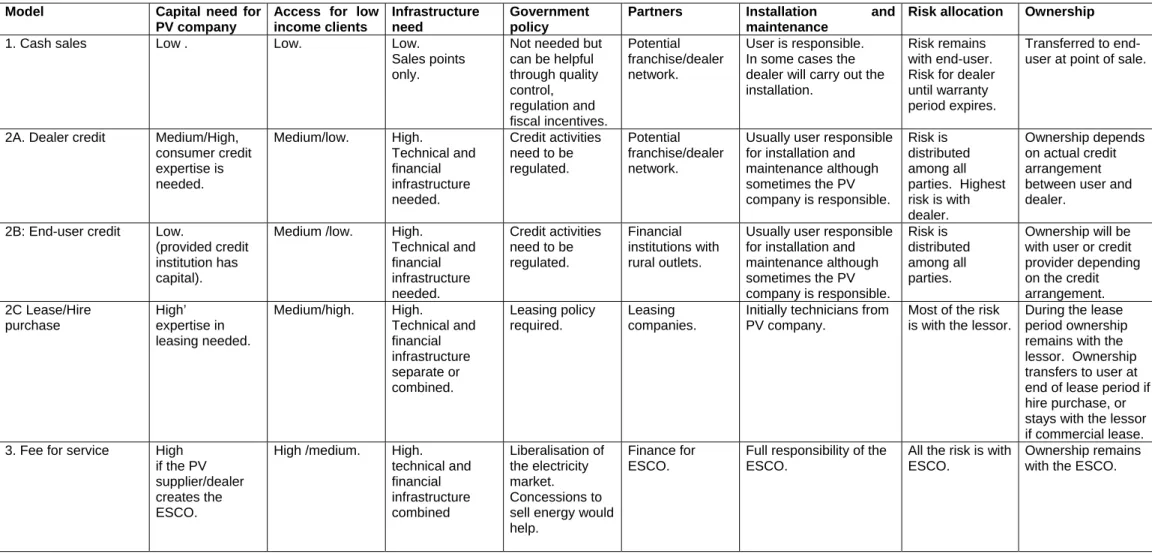
In the following table, the main characteristics of each of the models are summarised.
Is the target area sparsely populated in difficult terrain with poor communication and transport infrastructure?
If this is the case, infrastructure for a credit, or fee collection system will be extremely costly, if feasible at all, and cash sales might be the only viable alternative. A pre-payment system may be another alternative.
What is the purchasing power of the target population?
The lower the purchasing power, the more important it is to opt for models 2 and 3 (hire-purchase, credit or fee for service).
Does the government policy for rural electrification allow private entities to sell energy services and / or is a local utility interested in rural electrification through SHS?
Without these preconditions, a fee for service model is impossible without government legislation.
Is there any sound financial institution with outlets in the target area interested in participating in the initiative?
If such an institution exists and is interested, it is worthwhile making use of its expertise and infrastructure, thus making a credit or hire-purchase model more viable.
Is the target population used to credit schemes and are the schemes successful?
This is an important indicator of the feasibility and ease of setting up a credit scheme of any kind (dealer credit, credit institution, or hire-purchase construction) and to ensure end-users pay readily.
Does the PV company have a strong local (dealer) network, or is it prepared to build one?
If this is not the case, co-operation with a local credit organisation, an ESCO, or a utility is unavoidable.
Does the PV company have easy access to relatively cheap capital?