An Approach to Optimize Data Processing in Business
Processes
Marko Vrhovnik
1, Holger Schwarz
1, Oliver Suhre
2, Bernhard Mitschang
1, Volker Markl
3Albert Maier
2, Tobias Kraft
11University of Stuttgart Universitätsstrasse 38 70569 Stuttgart Germany firstname.lastname@ ipvs.uni-stuttgart.de 2IBM Deutschland Entwicklung GmbH Schönaicher Str. 220 71032 Böblingen Germany {suhre,amaier}@de.ibm.com 3IBM Almaden Research Center 650 Harry Road San Jose, CA 94120-6099 USA [email protected]
ABSTRACT
In order to optimize their revenues and profits, an increas-ing number of businesses organize their business activities in terms of business processes. Typically, they automate important business tasks by orchestrating a number of ap-plications and data stores. Obviously, the performance of a business process is directly dependent on the efficiency of data access, data processing, and data management.
In this paper, we propose a framework for the optimiza-tion of data processing in business processes. We introduce a set of rewrite rules that transform a business process in such a way that an improved execution with respect to data man-agement can be achieved without changing the semantics of the original process. These rewrite rules are based on a semi-procedural process graph model that externalizes data dependencies as well as control flow dependencies of a busi-ness process. Furthermore, we present a multi-stage control strategy for the optimization process. We illustrate the ben-efits and opportunities of our approach through a prototype implementation. Our experimental results demonstrate that independent of the underlying database system performance gains of orders of magnitude are achievable by reasoning about data and control in a unified framework.
1.
INTRODUCTION
Enterprises use a multitude of heterogeneous applications and data stores. In a typical enterprise, the customer rela-tionship management of a Siebel system will interact with a SAP sales and distribution system, as well as with busi-ness data warehouses and production planning systems from possibly different vendors. The grand challenge of informa-tion management nowadays is the integrainforma-tion and concerted operation of these different systems.
Permission to copy without fee all or part of this material is granted provided that the copies are not made or distributed for direct commercial advantage, the VLDB copyright notice and the title of the publication and its date appear, and notice is given that copying is by permission of the Very Large Data Base Endowment. To copy otherwise, or to republish, to post on servers or to redistribute to lists, requires a fee and/or special permission from the publisher, ACM.
VLDB ‘07, September 23-28, 2007, Vienna, Austria.
Copyright 2007 VLDB Endowment, ACM 978-1-59593-649-3/07/09.
Business process execution languages (also called work-flow languages) like BPEL [14] together with service-oriented architectures and Web services integrate complex systems, and create a single execution framework for all the activi-ties of an enterprise. Information integration systems unify the heterogeneous persistent storage systems (databases, file systems, content management systems) used by these appli-cations.
As discussed in [4], the integration of databases and pro-gramming languages is one of the major challenges for re-search in the coming decade. We address this problem in the context of information integration and business wide work-flows, by proposing a framework that makes data process-ing operations, e.g., SQL statements, first class citizens in a workflow language, and consequently in its optimization and execution. In analogy and as extension to QGM-like ap-proaches [16], we define a Process Graph Model (PGM) to reason about workflows and their data flow and control flow issues. Furthermore, we show opportunities that arise for the rule-based optimization of data processing in business processes.
The main contributions of this paper are:
• We show how to exploit knowledge on the data flow as well as on the control flow of a business process for reasoning upon optimization decisions.
• We extend query optimization to the level of complex business tasks expressed as business processes.
• We develop a multi-step control strategy for compre-hensive treatment of the optimization task.
• We demonstrate the opportunities, benefits and gen-erality of our approach by means of a case study.
The remainder of this paper is organized as follows: Af-ter detailing on workflow languages in Section 2, we discuss related work in Section 3. In Section 4, we introduce our approach for rule-based optimization of business processes. We comment on the rewrite rules and the control strategy used in this approach in Section 5 and Section 6, respec-tively. In Section 7, we present our experimental results. Section 8 concludes and lists future work.
2.
WORKFLOW LANGUAGES AND DATA
MANAGEMENT
We focus on the business process execution language BPEL [14] that is broadly adopted by industry and, hence, can be seen as the de facto standard. BPEL exemplifies capabilities of typical workflow languages to express busi-ness processes1. Similar to other process specification ap-proaches, BPEL fosters a two-level programming model. Thefunction layer consists of executable software compo-nents in form of Web services that carry out the basic activi-ties. Thechoreography layerspecifies a process model defin-ing the execution order of activities. By means of the Web service approach, BPEL achieves independence from the im-plementation level of activities and the execution platform. BPEL offers various language constructs to express ac-tivities as well as control flow patterns. In the following, we describe the usage patterns of some activities that are relevant for the further discussion: (i)invoke activities call Web services during process execution, (ii)assign activities
create the appropriate input for activities based on results from earlier service invocations, (iii)sequence activities se-quentially execute activities, (iv) ForEach activities allow to iterate over datasets, and (v)flow activitiesconcurrently execute activities.
In most workflow languages, users define process models in a graph-like fashion, supported by corresponding graphical design tools. From a modeling point of view, process design tools favor the description of control flow over data flow. This is also true for BPEL, where control flow is explicitly modeled, whereas data flow is only implicitly defined by specifying BPEL variables used as input and output data of activities. These variables are also used at the choreography layer, e.g., as part of conditions in the BPEL loop constructs. The BPEL specification [14] comprises additional activity types. Furthermore, it supports elaborated compensation and error handling concepts. So far, the language speci-fication is not finished. Proposed extensions comprise the support for human interaction, sub processes and the abil-ity to embed Java code into the business process.
2.1
Data Management at the Choreography
Level
In most business processes, accessing and processing data in enterprise data stores is a central task. Hence, the follow-ing primitive data usage patterns have to be supported for a comprehensive data provisioning: (i) Use business data to decide on the control flow. For example, one could use an inventory service to decide whether to call a supplier or not. (ii) Update business data. For example, the delivery time for an item may change based on information received from the supplier of the item. (iii) Retrieve business data and send it to partners, i.e., clients, services and humans. (iv) Store business data that was changed by partners.
The service-oriented approach allows to hide enterprise data stores behind Web services. This is achieved by so-called adapters that encapsulate SQL-specific functionality in Web services. They provide a well-documented, interop-erable method for data access. Adapters represent proven and well-established technology and are provided by differ-ent vendors in a similar way. Nevertheless, database vendors
1In compliance to the BPEL specification, we use the term business processto denote processes specified by BPEL.
pursue various additional approaches to support data man-agement at the choreography level:
• The Oracler BPEL Process Manager provides XPath extension functions that are embedded into assign ac-tivities [15]. The statement to be executed on a remote database is provided as parameter to the function. The functions support any valid SQL query, update oper-ations, DDL statements as well as stored procedure calls. Data retrieved by an extension function is stored in a set-oriented process variable expressed in XML.
• The Microsoft Windowsr Workflow Foundation [13] uses SQL activities to provide database processing as part of business processes. These activities are orga-nized in so-called activity libraries and executed by a runtime engine. The workflow as well as its variables, activities, and parameters are for example described by XOML, an extensible object markup language.
• IBM’s WebSpherer Process Server follows another approach to bring set-orientation to BPEL and its choreography layer [7, 8]. It introduces information service activities that for example allow to process data in a set-oriented manner expressed via SQL. Further-more, it allows to pass data sets between activities by reference rather than by value. In this paper, we call such a direct integration approach BPEL/SQL.
The main common property of all three approaches is that data management tasks are explicitly modeled at the chore-ography layer. Hence, the basic concepts we present here, are applicable to all three approaches. In this paper, we focus on BPEL/SQL to explain these concepts. We will further discuss generality issues in Section 4 and Section 7. So-calledSQL activities reflect the mentioned data usage patterns in BPEL/SQL. They provide read and write access to BPEL variables. Variables that refer to tables stored in a database system are called set reference variables. A lifecycle management facility is responsible for creating and removing these tables as needed. Variables of a set-oriented data structure representing a table that is materialized in the process space are calledset variables. Furthermore, SQL activities may embed an SQL statement including several input parameters as host variables. An input parameter may be a scalar value or a set reference variable, i.e., a table reference. Input parameters are valid at any position in the SQL statement where in case of a scalar value a host variable or in case of a set reference variable a table name is allowed. Set reference variables as well as set variables may store the result set of SQL activities. Aretrieve set activity
is a specific SQL activity that allows to load data from a database system into the process space.
2.2
Sample Scenario
Our example is based on an order handling scenario. The process takes a set of orders and decides whether to process them directly or not. In the latter case, an employee has to approve an order according to some business policy. After this approval, the process sends notifications for all rejected orders. In parallel, it processes the remaining orders. This
r
Oracle BPM is a trademark of Oracle Corporation.
Win-dows Server 2003 is a trademark of Microsoft Corporation. WebSphere and DB2 are trademarks of IBM Corporation.
INVOKE OrderFromSupplier
IN: #CurrentItem.ItemID#, #CurrentItem.ItemQuantity#, OUT: #OrderConfirmation#
FOREACH #CurrentItem# IN #SV_ItemList# SELECT ItemID, SUM(Quantity) ASItemQuantity FROM #SR_Orders# WHERE Approved=1 GROUP BYItemID →#SR_ItemList# Order Confirmations Orders
INSERT INTO #SR_ OrderConfirmations# VALUES (#CurrentItem.ItemID#, #CurrentItem.ItemQuantity#, #OrderConfirmation# ) GroupOrdersByItemID OrderFromSupplier ForEachItemOrder InsertOrderConfirmation
(a) BPEL Business Process 'Order Processing' and its Control Flow
(b) SQL Statements behind SQL Activities; Data Dependencies and Data Stores
SQL SQL
RetrieveItemList RETRIEVE #SR_ItemList# INTO #SV_ItemList#
SQL
Figure 1: Sample Process
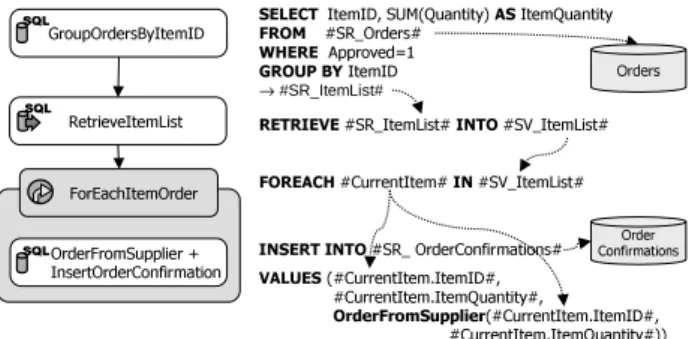
part of the overall scenario, i.e., the automatic processing of approved orders, is depicted in Figure 1(a). Modeling this process in BPEL/SQL is quite straightforward. Activ-ityGroupOrdersByItemIDscreates a set of orders each con-taining an itemID and the required quantity. ForEachIte-mOrder now iterates over these orders. A Web service call (OrderFromSupplier) submits the orders to suppliers, which return confirmation information whether they can supply the requested items or not. Activity InsertOrderConfirma-tionmakes this confirmation persistent.
We show SQL statements and additional information for the sample process in Figure 1(b). For clarity we mark BPEL variables by surrounding hash marks (#). Set reference variable SR Orders refers to table Orders con-taining all orders. Activity GroupOrdersByItemID con-tains a SELECT statement that extracts items from ap-proved orders and writes them to set reference variable
SR ItemList. RetrieveItemList reads these orders into set variable SV ItemList. The succeeding ForEachItemOrder
activity iterates overSV ItemList and binds a tuple of this set to the variable CurrentItem in each iteration. The at-tributesItemID andItemQuantity ofCurrentItem serve as input for theOrderFromSupplierand InsertOrderConfirma-tion activities. The latter specifies an INSERT statement, which writes the result of the Web service call into an Or-derConfirmationstable that is referenced by a set reference variableSR OrderConfirmations.
This sample business process contains potential for op-timization. Figure 2 shows the processes resulting from three subsequent optimization steps. In a first step, it is possible to merge the Web service invocation OrderFrom-Supplier into the SQL statement of activity InsertOrder-Confirmation. This is achieved by the user-defined function
OrderFromSupplier (Figure 2(a)). Based on the resulting process, we are further able to rewrite the tuple-oriented cursor loop into a single set-oriented SQL activity. Hence, the entire processing of theForEachItemOrder activity can be replaced by one SQL activity (Figure 2(b)). In a last step, we could merge this activity with the GroupOrders-ByItemIDactivity (Figure 2(c)). In Section 4, we elaborate on the set of rewrite rules for such optimizations. Logically, the resulting process combines in a single SQL activity the same processing as the original process. The important
dif-INSERT INTO#SR_ OrderConfirmations#
VALUES(#CurrentItem.ItemID#, #CurrentItem.ItemQuantity#,
OrderFromSupplier(#CurrentItem.ItemID#, #CurrentItem.ItemQuantity#))
FOREACH #CurrentItem# IN #SV_ItemList#
SELECT ItemID, SUM(Quantity) ASItemQuantity
FROM #SR_Orders# WHEREApproved=1 GROUP BYItemID →#SR_ItemList# Order Confirmations Orders GroupOrdersByItemID ForEachItemOrder OrderFromSupplier + InsertOrderConfirmation
INSERT INTO#SR_ OrderConfirmations#
SELECTItemID, ItemQuantity, OrderFromSupplier(ItemID, ItemQuantity)
FROM#SR_ItemList#
SELECT ItemID, SUM(Quantity) ASItemQuantity
FROM #SR_Orders# WHEREApproved=1 GROUP BYItemID →#SR_ItemList# Order Confirmations Orders GroupOrdersByItemID ForEachItemOrder
(a) Process 'Order Processing' After First Optimization Step
(b) Process 'Order Processing' After Second Optimization Step
INSERT INTO#SR_ OrderConfirmations#
SELECTItemID, ItemQuantity,
OrderFromSupplier(ItemID, ItemQuantity)
FROM( SELECT ItemID, SUM(Quantity) AS ItemQuantity
FROM #SR_Orders# WHEREApproved=1 GROUP BYItemID ) Order Confirmations Orders OrderProcessing
(c) Process 'Order Processing' After All Optimization Steps
SQL SQL
SQL
SQL
SQL
RetrieveItemList RETRIEVE #SR_ItemList# INTO #SV_ItemList# SQL
Figure 2: Optimization of Sample Process
ference is that all set-oriented data management activities are performed by the underlying database system in a single SQL statement. In Section 7, we show that this results in a remarkable performance improvement independent from the underlying DBMS. The main reasons are:
• Compared to the original process, there are more op-timization opportunities for the database system.
• The optimization leads to a reduction of data volume transferred between the database level and the work-flow processing level.
• Overhead that is associated with the processing of each SQL statement is saved because only a single state-ment is left.
Although the optimization of the sample process seems to be straightforward, several conditions on control flow de-pendencies and data dede-pendencies have to hold in order to preserve the workflow semantics. Here are some examples for slight modifications of the process shown in Figure 1 (a) and how they affect or inhibit the optimization process shown in Figure 2 (more details are given in Section 5.1):
• Assume a process where SQL activity InsertOrderCon-firmationdoes not access the result of the Web service call. In this case, there is no data dependency between both activities in the ForEach loop. Hence, the Web service invocation cannot be merged into the SQL ac-tivity and no further optimizations of the ForEach loop are possible.
• Assume an additional SQL activitySQL1 in between the activitiesGroupOrderByItemIDand ForEachItem-Order. Further assume thatSQL1 does neither access table Orders nor tableOrderConfirmation, i.e., there is no data dependency. The optimization would basi-cally work as shown in Figure 2. The final workflow would contain activitySQL1 followed by activity Or-derProcessing shown in Figure 2 (c).
• Now, assume the same additional activity SQL1 as before. This time it is placed before the OrderFrom-Supplier activity in the loop. Then, the Web service call of activityOrderFromSupplier can still be merged into SQL activity InsertOrderConfirmation as shown in Figure 2 (a). But further optimization steps are in-hibited because two separate SQL activities remain in the ForEach loop. Hence, it is not possible to rewrite the cursor loop into a single set-oriented SQL activity. Similar considerations apply if the ForEach loop would be replaced by other control flow constructs, e.g., the flow activity in BPEL that allows to define concurrent execution. For efficient reasoning upon such optimization decisions, we need an appropriate internal representation of processes that explicitly models control flow dependencies as well as data dependencies in a single graph structure (see Section 4).
3.
RELATED WORK
Optimization of data management and data processing in business processes covers several optimization levels as well as optimization subjects. Obviously, there is process optimization at the level of the business model and there is query optimization at the data and database level.
With a business-oriented perspective, optimization on the process level is often termed business process re-engineering [12]. At this level, the business model and the involved processes are analyzed from a business point of view and the control flow is exploited for optimization. We do not address optimization on this level. We rather assume that process designers conduct process re-engineering activities before the rule-based transformation of business processes is accomplished.
At the data level, the database community has focused on optimizing data flow based on graph models, e.g., the query graph model (QGM) [16]. This comprises the con-struction of optimized query execution plans for individual queries as well as multi-query optimization. Multi-query optimization detects common inter- and intra-query subex-pressions and avoids redundant computation [10, 3, 18, 19]. Our work builds on this paradigm. Moreover, our approach borrows well-known concepts for rule-based optimization, all grounded on graph-transformations [16, 17]. In contrast to QGM, our process graph model refers to control flow issues as well as to data dependencies.
Federated database systems integrate data sources and provide a homogeneous database schema for heterogeneous sources. In analogy to federated database systems [9], our framework contains an optimizer, complementing the query optimizers of the database management systems that are responsible for executing the data management activities of a process.
In contrast to pure data flow and control flow optimiza-tion, there are several approaches that exploit in addition to data flow knowledge some kind of control flow knowledge.
Coarse-grained optimization (CGO) [11] is an approach for optimizing sequences of data processing tasks. Similar to CGO, our optimization approach is based on rewrite rules. However, our work is more general in two aspects: First, we do not restrict the optimization to data processing activities, e.g., we also consider Web service calls. Secondly, we do not restrict the flow definition to sequences.
An interesting piece of work is shown in [22], where DBMS-like capabilities are expressed as Select-Project-Join queries over one or more Web services. The query concept introduced implicitly reflects a notion of set-orientation and it further enables optimization towards an optimal pipelined query processing over the involved Web services. The capa-bilities at the choreography layer are far from BPEL ex-pressiveness and the capabilities for data processing are re-stricted to retrieval only. A similar approach is described in [21]. There, a language for modeling workflows is sketched that is tightly integrated with SQL. The concept of an active table/view is used to represent the workflow and to provide its data. It is a proprietary and restricted approach that does not reflect available standards like BPEL.
ACTIVE XML [1] is an approach where XML documents allow for embedded Web service calls. Optimization work in Active XML refers to deciding which of the embedded Web service calls need to be processed for efficiently answering a query posed over the XML document. This interesting work is related to [22], and similarly restricted with respect to control flow issues and data management operations.
The microprocessor, compiler and programming language community considers optimization of control flow [2]. Well-known optimization approaches cover keyhole optimization, instruction reordering, speculative execution, and branch prediction. They are usually studied in a context where ba-sic operations are very simple, e.g., assignments. We apply these ideas to a workflow scenario where basic operations are as complex as SQL statements and Web services.
A first approach to unify data and control flow is presented in [20]. However, they only consider database-internal pro-cessing and address the optimization of loops and sequences containing database commands. We extend this work as we want to support the whole range of control flow constructs provided by workflow languages. Furthermore, we focus on an integrated execution framework that covers the database and the choreography level.
The seamless integration of operations on business data into the workflow languages opens the space for considering control flow as well as data flow issues together. New opti-mization potential could be exploited. Hence, a comprehen-sive approach that enables data-level optimization of busi-ness processes has to cover data flow as well as control flow issues. Therefore, we propose a graph model that explic-itly exposes activities, control flow, and data flow. Further-more, it is independent from the workflow language. Exist-ing process-related models like Petri nets and Event-Driven Process Chains are based on graphs or automatons as well. In contrast to our graph model, they focus on control flow and are used to investigate properties of a process and its ac-tivities [6]. Our work is the first to combine several concepts from the programming language and database communities, and that presents an integrated approach.
PGM Optimizer Optimizer Engine Control Strategy Condition Action Rule rewritten BPEL/SQL PGM to BPEL/SQL rewritten PGM BPEL/SQL BPEL/SQL to PGM PGM
Figure 3: Processing Model
4.
RULE-BASED OPTIMIZATION OF
BUSI-NESS PROCESSES
The main idea behind our optimization approach is to apply rewrite rules to BPEL/SQL processes. While these rules keep the semantics of the original process, they change its structure as well as its constituent parts in such a way that the resulting process shows improved performance.
Figure 3 presents the processing model behind our op-timization approach. The core component is anoptimizer enginethat operates on the internal representation of a pro-cess. This engine is configured by a set ofrewrite rules and a control strategy for rule application. Each rewrite rule consists of two parts: acondition and anaction part. The condition part defines what conditions have to hold for a rule application in order to preserve the process semantics. It refers to the control flow dependencies as well as to the data dependencies of a process. Additionally, it considers detailed information of process activities. The type of SQL statements is a good example, as the condition part of some rewrite rules states that they are applicable to certain com-binations of INSERT and DELETE statements only. The action part of a rewrite rule defines the transformations ap-plied to a process provided that the corresponding condition part is fulfilled. In Section 5, we further elaborate on an ap-propriate ruleset and give examples for the condition and action part of a rewrite rule.
So far, we described that rewrite rules come along with a set of conditions that allow to identify rules being appli-cable to a given process. In addition to that, the optimizer has to decide where on the process structure and in which order rewrite rules are applied. This is the main task of thecontrol strategy. One of its functions is to identify so-called optimization spheres, i.e., parts of a process for which applicable rewrite rules should be identified. Determining such spheres is necessary, because if one applies rewrite rules across spheres, the semantics of a process may change. An-other function of the control strategy is to define the order in which rule conditions are checked for applicability and the order in which rules are finally applied. In Section 6, we provide more details on these issues.
4.1
Process Graph Model
As already mentioned, the optimizer engine works on an internal representation of processes. We developed a Pro-cess Graph Model(PGM) for this purpose. Formally, PGM defines a process as a tuple (A, Ec, Ed, V, P) where A
rep-resents the set of process activities, Ec represents directed
control flow edges,Edis a set of directed data flow edges,V
is a set of typed variables used in the process, andP covers partners, i.e., external systems the process interacts with. This model is similar to well-known query graph models like QGM [16]. QGM defines a query as a tuple (B, Ed, Q, Ep),
where B (called boxes) is a set of operations,Qrepresents the set of quantified tuple variables, called quantifiers, Ed
is a set of data flow edges between quantifiers and boxes, and Ep is a set of predicate edges connecting quantifiers.
PGM extends the scope of such models by adding control flow edges and links to external systems. Like QGM, our process graph model allows to reason about an optimization approach, e.g., to show that a lossless mapping from and to the internal representation is possible and that the termina-tion of the optimizatermina-tion process is guaranteed. In favor of a concise presentation we do not elaborate on these aspects here and present the set of rewrite rules on the BPEL/SQL level in Section 5.
PGM turns out to be the appropriate basis for rule-based transformations as the condition part as well as the action part of rewrite rules can directly be expressed as graph con-ditions and graph transformations, respectively. PGM sup-ports this by explicitly modeling control flow dependencies as well as data dependencies in a single graph structure. In workflow languages like BPEL/SQL, only the control flow part is explicitly modeled whereas the data dependencies are implicitly covered by variables and variable references. Remember that the conditions of our rewrite rules refer to both, control flow and data dependencies. Hence, phrasing these conditions directly on BPEL/SQL would make them more complex and thus more error-prone.
4.2
Generality Issues
For the discussion of generality, we first want to empha-size two important preconditions for our optimization ap-proach: (i) The optimizer engine needs to know the exact statements that are used in data management tasks. This is important because several rewrite rules transform these statements. (ii) The optimizer engine needs to know control flow dependencies as well as data dependencies in order to check rule conditions. Control flow dependencies are pro-vided by the workflow language. Data dependencies have to be extracted from variables and variable references. Control flow dependencies as well as data dependencies are external-ized by the PGM representation of a business process.
These preconditions are fulfilled by all approaches men-tioned in Section 2.1 as they all explicitly define data man-agement tasks at the choreography layer. Microsoft’s Work-flow Foundation and IBM’s WebSphere Process Server pro-vide specific SQL activities. The definition of such activi-ties comprises the SQL statement to be executed. Oracle provides XPath extension functions that receive the SQL statements as parameters.
A key advantage of PGM is that it makes the optimiza-tion process depicted in Figure 3 independent from a specific workflow language. PGM comprises a set of basic activity types that are common to major workflow languages. Hence, for a particular language, only a mapping to PGM and vice versa has to be provided. This is achievable for the three ap-proaches mentioned in Section 2.1. Furthermore, PGM can easily be extended which provides the flexibility to adjust it to future extensions of BPEL as well as to the constructs of other workflow languages. For BPEL extensions, a
mod-Insert-Insert Merging Delete-Delete Merging Delete-Insert Merging Insert-Delete Merging Update-Update Merging Update Merging Rules
Assign Pushdown Web Service Pushdown
Eliminate Temporary Table
Activity Merging Rules Tuple-to-Set Rules
Delete Tuple-to-Set Insert Tuple-to-Set
Update Tuple-to-Set Rewrite Rules
Figure 4: Classification of Rewrite Rules
ification of the mapping componentsBPEL/SQL to PGM
andPGM to BPEL/SQL is necessary. For other workflow languages, individual mapping components have to be pro-vided. If a certain workflow language allows for additional optimization rules, they can easily be added to the ruleset of the PGM Optimizer, and, based on the optimization sphere concept, be latched into the control strategy.
Our optimization approach supports different database languages as well as different underlying DBMSs. A lan-guage dialect is reflected in the condition and action part of a rule. Thus, new dialects can be incorporated simply by adding the corresponding rules and, if necessary, by adapt-ing the control strategy. In Section 7, we show that the performance improvements are independent from the un-derlying DBMS.
In this paper, we assume that all data management activ-ities of a process are issued against a single database system. However, in a practical setting, heterogeneity with respect to data sources is the normalcy. We can use existing fed-erated database technology [5] that homogenizes heteroge-neous data source to extend our optimization approach to this general case and to carry all findings and results over.
5.
REWRITE RULES
In this section, we introduce rewrite rules for the rule-based optimization of processes. Figure 4 shows the set of rules we focus on in this paper. Rule classes are shown in rectangles whereas their instances are given as plain text. Based on the similarity of rules, we distinguish two major classes of rewrite rules: Activity Merging Rules and Tuple-to-Set Rules.
Remark that according to our processing model, we apply these rules to PGM processes. In favor of a concise presen-tation in this section, we introduce the rules based on the set of BPEL/SQL activities and omit details at PGM level. The purpose ofActivity Merging Rules is to resolve data dependencies by merging a source activity and a consecutive destination activity that depends on data delivered by the source activity. The destination activity is always an SQL activity while the source activity may be an assign activity, an invoke activity or an SQL activity. In the following, we explain someActivity Merging Rules in more detail.
TheWeb Service Pushdown rule pushes an invoke activ-ity into the SQL activactiv-ity that depends on the Web service invocation. As a result, the Web service becomes part of the SQL statement. This pushdown is only applicable if
the underlying DBMS supports Web service calls, e.g., as user-defined function calls.
TheAssign Pushdown rule directly integrates an assign activity into an SQL activity. It requires an assign activ-ity writing a variable that serves as input for a consecutive SQL activity. We push the assign operation into the SQL statement replacing the considered variable through its def-inition. This allows to omit the assign activity.
TheEliminate Temporary Tablerule removes the usage of temporary tables within SQL statements of SQL activities. BPEL/SQL allows to load a query result set into a table that is referenced by a result set reference [8]. If such a table is created for each single process instance at process start up time, and if it is dropped as soon as the process instance has finished, we call it a temporary table. Within an SQL activ-ity, this rule replaces the usage of a result set reference that refers to a temporary table directly by its definition state-ment. This reduces the costs for the lifecycle management of temporary tables as well as for SQL processing.
Update Merging Rules merge two consecutive SQL activ-ities executing updates on the same database tables into a single SQL activity. As an example, consider two successive INSERT statements both updating the same database table. By using the SQL UNION ALL operation, theInsert-Insert Mergingrule merges these INSERT statements, thereby re-ducing the number of SQL activities in the BPEL/SQL pro-cess. As Figure 4 shows, there are similar rewrite rules for other combinations of updates.
The class ofTuple-to-Set Rules addresses loops iterating over a given set and executing an SQL activity for each tu-ple of the set. These rules replace such a loop and the SQL activity in the loop body by a single SQL activity, which covers the semantics of the entire loop. By transforming the tuple-oriented SQL statement into a set-oriented SQL state-ment, the iterative execution of the SQL activitiy becomes needless. Thus, we can remove the ForEach activity from the process logic. In the following section, we discuss the
Insert Tuple-to-Set rule in more details.
5.1
The Insert Tuple-to-Set Rule
TheInsert Tuple-to-Set rule requires a situation as shown on the left hand side of Figure 5. A ForEach activity iterates over a set of rows that is provided by a preceding SQL activ-ity. The body of the ForEach loop consists of a single SQL activity containing an INSERT statement. By applying the
Insert Tuple-to-Set rule, we replace the ForEach activity by a single SQL activity covering a set-oriented INSERT state-ment and the SQL statestate-ment that produced the set (shown in Figure 5 right hand side).
The rational behind this rule is to avoid calling a database system in each loop iteration because this causes overhead for transmitting and processing SQL statements. Another motivation is that the set-oriented SQL statement resulting from this rewrite rule offers additional optimization opportu-nities at the database level. This rewrite rule is an example for optimizations that are not achievable by the underlying DBMS alone. The DBMS receives only one INSERT state-ment per iteration of the ForEach activity. Hence, it has no means to combine these statements into a single one as done by theTuple-to-Set rule.
In the following, we show how to apply this rule to a BPEL/SQL process. The motiviation for going into details here is twofold. First, we want to show that it is not
straight-expri(…) →vset
over: vset
current row: vrow
INSERT INTO vsr
exprk(vrow.c1, …, vrow.cn)
INSERT INTO vsr SELECT T2.c1, …, T2.cn FROM TABLE(expri(…)) AS T1(c1, …, cn), TABLE(exprk(T1.c1, …, T1.cn)) AS T2(c1, …, cn) Action ak: SQL process P process P* ai: SQL aj: ForEach ak*: SQL
Figure 5: Insert Tuple-to-Set Rule
forward to define rule conditions in such a way that the pro-cess semantics is preserved when applying a rewrite rule. Secondly, the example demonstrates that for the efficient evaluation of rule conditions, a process representation that explicitly defines control flow dependencies as well as data dependencies is mandatory.
In analogy to conventional optimization, we consider ac-tivities that have no side effects and that are defined on a single data source. To exclude non-determinism at the choreography level, we assume processes without parallel ac-tivities referencing the same variable. We call processes that comply with these assumptionswell-formed processes.
5.1.1
The Rule Conditions
As shown in Figure 5, the Insert Tuple-to-Set rule consid-ers a BPEL/SQL processP that is transformed into process P∗. V ={vset, vrow, vsr}is the set of variables,vset being
a set variable,vrowproviding a row of a materialization set,
and vsr being a set reference variable referring to a table.
A= {a1, a2, ..., an} is the set of activities ofP, where the
index uniquely numbers all activities inA.
A first set of conditions characterizes the activities the
Insert Tuple-to-Setrule builds on:
• Activity Condition A1: Activityaiis of type SQL
pro-viding the results of query expression expri in a set
variablevset.
• Activity Condition A2: ForEach activity aj iterates
overvsetand provides the current row in variablevrow.
The value of columncis denoted byvrow.cl withl=
1...n.
• Activity Condition A3: Activity ak is of type SQL
being the only activity within the loop body of aj.
Activityakexecutes an INSERT statementexprkthat
is either a query expression or aVALUES expression
taking the tuple values provided byvrow as input.
Before we discuss further conditions based on data depen-dencies and interfering control flow dependepen-dencies in Section 5.1.3, we demonstrate the rule’s action part.
5.1.2
The Rule Action
The following transformation steps convertP intoP∗:
• Transform ak toak∗by rewriting the SQL statement
ofakas it is shown in Figure 5. Intuitively speaking,
we “pull up” the INSERT statement by joiningexpri
with a correlated table reference containing the results of expression exprk for each row. Due to the
cor-relation between the joined tables within the FROM clause, we add the keyword TABLE to the table ref-erence. Remark that this is the generalized version of theTuple-to-Set rule. In Figure 2, we applied a sim-plified rule that is appropriate for INSERT statements with a VALUES clause.
• Replaceajincludingakbyak∗.
• Removeaiand adapt the control flow accordingly, i.e.,
connect all direct preceding activities with all direct succeeding activities ofai.
This transformation converts the former correlation be-tween the ForEach activity and the SQL activity in its body into a correlation between two tables inak∗. This opens up
optimization at the database level and thus leads to perfor-mance improvements.
5.1.3
Further Data and Control Flow Dependencies
Now, we extend the set of conditions by adding further conditions based on data dependencies and interfering con-trol flow dependencies:
• Data Dependency Condition D1: Asingle write-read data dependency based onvset does exist betweenai
andaj, such thataiwritesvsetbeforeajreadsvset.
• Data Dependency Condition D2: There is a single
write-read data dependency based onvrowbetweenaj
andak, such thatajwritesvrowbeforeak reads it.
• Value Stability Condition S1:vsetis stable, i.e., it does
not change between its definition and its usage.
• Value Stability Condition S2: In each iteration ofaj,
ak reads that value ofvrow that is provided byaj.
In the following discussion, we demonstrate that it is not sufficient to consider only data dependencies. Rather, we also have to take into account control flow dependencies that interfer with data dependencies.
The focus of Condition D1 is on activities providing a materialization set that is afterwards iteratively read by a ForEach activity. Remark that the existence of a write-read data dependency does not only depend on the fact that two activities access the same variable. We also have to take into account control flow dependencies. Consider the situation depicted in Figure 6(a) whereaiandajare executed on
al-ternative paths. In BPEL, this is modeled by switch or pick activities. Although both activities process the same vari-able, there is no write-read data dependency since at most one of the activities is executed. As a consequence, we can not apply theInsert Tuple-to-Setrule. Remark that Figure 6 shows several variations in the control flow of process P from Figure 5. Hence, activitiesai and aj are exactly the
same as in Figure 5. Especially, the ForEach activity aj
containsakas before.
The same problem arises, if only one of the two activities is executed on an alternative path. Assume, as shown in Figure 6(b), thataj is part of an alternative path, butai is
not. Since we can not determine, whetherajwill execute at
all, we can not guarantee that a write-read data dependency between both activities exists at runtime.
(a) SWITCH ai: SQL write vset aj: ForEach read vset SWITCH ai: SQL write vset aj: ForEach read vset ... (b) (c) (d) (e) ai: SQL write vset aj: ForEach read vset ax: … read vset FLOW ai: SQL write vset ax: write vset possible execution orders: ai, ax ax, ai SWITCH ai: SQL write vset ax: write vset … aj: ForEach read vset
Figure 6: Critical interferences among data flow and control flow dependencies
Condition D1 also requires that there is asinglewrite-read data dependency betweenai and aj based onvset. Hence,
there must not be another activity that reads vset and is
executed afterai. In Figure 6(c), we assume that such an
activityaxdoes exist, i.e., there is a write-read data
depen-dency based onvsetbetweenaiandajas well as a write-read
data dependency based onvsetbetweenaiand any activity
ax that is executed afterai. Thus,ajas well asax depend
on the value of vset written by ai. If we would apply the
Tuple-to-Set rule, we would removeai, and thereby destroy
the write-read data dependency between ai and ax. As a
result, the runtime behavior ofP∗andP may differ, since, inP∗,ax reads a different value ofvsetthan in P. Hence,
we only can apply this rule, if there is no activity other than ajrelying on the value ofvset written byai.
Condition D2 claims the existence of a single write-read data dependency between aj and ak based on vrow.
Dif-ferent to D1, the ForEach activity and the SQL activityak
express a well-defined control flow dependency, because the definition of ForEach activities ensures that a row ofvsetis
provided byaj before it is processed byak. Hence, there
is a write-read dependency between both activities. Finally, from condition A3 follows thatakis the only reader ofvrow,
since it is the only activity executed in the loop body. According toCondition S1, the rule’s action can only be applied if vset does not change during its usage. Hence,
we have to ensure that there is no other activity than ai
writing variablevset. In other words, there is no write-write
data dependency based onvsetbetweenaiand any activity
ax ∈ A. Such data dependencies exist, if ax writes vset
between the execution ofaiandakand one of the following
control flow dependencies holds:
1. Activityaiandaxare executed in parallel (see Figure
6(d)). As discussed above, our assumption on well-formed processes prohibits this situation. The same argument holds if activityajand the enclosed activity
akare executed in parallel toax.
2. Activityax is defined on an alternative path between
aiandak(see Figure 6(e)). Ifax writesvsetthere is a
write-write dependency betweenaiandax. Condition
S1 ensures that theInsert Tuple-to-Set is not applied in this situation.
The purpose ofcondition S2 is to make sure that in each iteration ofaj,akreads the value ofvrowthat was previously
written by aj. Therefore, we have to avoid activities that
changevrowand run in parallel to the ForEach activity. This
is excluded because we assume well-formed processes.
5.2
Properties of the Ruleset
The rewrite rules presented in the previous sections show the following properties: They preserve the semantics of the original process and they likely improve its performance.
TheSemantics Preserving Property is individually guar-anteed for each rule by its composition. Each rule consists of a condition and an action part. A rule action may only be executed if the corresponding condition evaluates to true. A condition identifies data dependencies as well as control flow dependencies between activities such that the proposed action keeps the process semantics.
For thePerformance Improvement Propertythe following observations are important:
• All rewrite rules reduce the number of activities which in turn reduces the processing overhead. A reduced number of SQL activities in the choreography layer leads to fewer database calls. This reduces the over-head for translating, optimizing and processing SQL statements. Furthermore, this may reduce the size of intermediate result and thus the amount of data trans-ferred between the database level and the choreogra-phy layer.
• By merging SQL statements in the choreography layer, we create more sophisticated SQL statements, that provide a higher potential for optimization on the database level than a single SQL statement. This will most likely enable further opportunities at the database level, e.g., detecting common subexpressions.
• The application of a rewrite rule may enable the appli-cation of further rewrite rules, possibly enforcing the two positive effects mentioned above.
As our experimental results in Section 7 show, perfor-mance improvements of several orders of magnitude are achievable. In the following section, we discuss dependencies between rewrite rules and show that typically the applica-tion of a rule enables the applicaapplica-tion of further rules.
6.
CONTROL STRATEGY
In this section, we explain the control strategy for rule-based optimization of business processes. It divides the overall process in several optimization spheres and applies rewrite rules considering their dependencies.
6.1
Enabling Relationships
Our control strategy exploits dependencies among rewrite rules, i.e., the application of one rule may enable the appli-cation of another rule. The dependencies depicted in Fig-ure 7 are as follows: The application of anyActivity Merging
Insert Tuple-to-Set Update Tuple-to-Set
Delete Tuple-to-Set Tuple-to-Set Rules Web Service Pushdown
Assign Pushdown
Eliminate Temp. Table
Activity Merging Rules
Update-Update Delete-Delete
Delete-Insert Update Merging Rules
Insert-Delete Insert-Insert
Figure 7: Enabling Relationships
rule to the activities inside a ForEach activity may reduce the number of these activities to one, and, in turn, may enable the application of theTuple-to-Set rule. The appli-cation of aTuple-to-Set rule constructs a new SQL activity that might further be merged via application of an Activ-ity Merging rule. If an assign activity cuts the data flow between two activities, pushing the assign activity into the succeeding activity may result in a direct data dependency between the two activities and thereby enable the appli-cation of Activity Merging Rules. The same holds for the
Web Service Pushdownrule enabling furtherActivity Merg-ing Rules. The application of anUpdate Merging rule may reduce the number of updates on a table to a single one. If such a single update is executed on a temporary table, theEliminate Temporary Table rule might become applica-ble. Among theUpdate Merging Rules, there is no specific order except for theInsert-Insert,Delete-Insertand Insert-Deleterule. The application of the latter two results in an INSERT statement that uses an EXCEPT to combine an insert as well as a delete operation. This may enable the application of theInsert-Insert rule. Among the Tuple-to-Set Rules, there is no specific order. Each of these rules addresses a different update statement in the loop body.
Merging activities produces more sophisticated SQL state-ments. Besides the enabling relationships on the choreogra-phy level, this may also enable optimization at the database level, that would not be possible otherwise. The perfor-mance gain depends on the optimization potential of the SQL statements as well as on the capabilities of the query optimizer of the database management system that pro-cesses these statements.
6.2
Optimization Spheres
Due to the structure of a process, we have to consider boundaries that must not be crossed during the optimization procedure. This is necessary to avoid changes to the original process semantics when applying rewrite rules.
Such a boundary is given in BPEL by scope activities that define the execution context of activities. A BPEL process defines a global processing scope for all its embedded activities. Scopes can be nested to create global and local execution environments for activities.
Condition Action
Rule
Sphere
Determine Rewrite Rule
Load Rewrite Rule 3
Apply Rewrite Rule 1
2 Sphere Hierarchy
Figure 8: Optimization Procedure
A scope can declare fault- and compensation handlers defining undo steps of arbitrary complexity that reverse the effects of partially completed processing steps. Removing or inserting an activity from or into a scope causes an adap-tation of these handlers in order to preserve the original process semantics. But determining and adapting affected handlers is a sophisticated task. Thus, in order to preserve the original semantics and to reduce complexity, we defined transformations that do not cross scope boundaries. We consider a scope as a closed optimization space, that we call Scope Optimization Sphere (SOS). The effects of a rewrite rule are always local to a SOS.
We consider Loop Optimization Spheres (LOS) as another type of optimization sphere. They comprise a ForEach ac-tivity with its nested activities and all surrounding activities that are necessary for applying aTuple-to-Setrule. In anal-ogy to SOSs, all effects of a rule’s action are local to a LOS.
6.3
Overall Control Strategy
As shown in Figure 3, our optimizer engine gets the PGM representation of a process as input. In a first step, the optimizer identifies all optimization spheres within this rep-resentation. The nesting character of a process defines a tree that represents a hierarchical ordering on all optimiza-tion spheres. The global processing scope defines the root and the most nested optimization spheres define the leaves of this tree. We traverse this tree in a depth-first manner (in post-order) to guarantee that all nested spheres are pro-cessed prior to an enclosing sphere. When optimizing an enclosing sphere, we treat all nested SOSs as black boxes. However, we consider their data dependencies to activities within the enclosing optimization sphere, in order to prove a rule’s condition. Unlike nested SOSs, we do not treat nested LOSs as black boxes, since we want to exploit the enabling relationships provided by the LOS’s optimization taking place before.
For each optimization sphere, we apply our ruleset ac-cording to the control strategy that we discuss below. For each sphere type, we use a different control strategy that comprises the associated ruleset and the order in which the rules are applied. This way, a sphere is optimized in an iterative way, until we have processed all rules.
Figure 8 illustrates the optimization procedure. In a first step, the next rule to be considered is determined by the ap-propriate control strategy. Within the sphere, we search for a group of activities that fulfills a rule’s condition. If found,
we apply the rule’s action to these activities. When this rule is not applicable any more, we proceed with the next rule according to the control strategy. This proceeds until we have applied the full ruleset. This way, we optimize all spheres within the hierarchy, until we reach the root sphere that is optimized in a final step.
Algorithm 1optimizeSphereHierarchy
Require: sphere-hierarchysh
Ensure: optimized sphere-hierarchysh
whileshis not fully traverseddo
s←getN extSphere(sh) optimizeSphere(s)
end while
Algorithm 2optimizeSphere
Require: spheres
Ensure: optimized spheres
cs←getControlStrategy(s)
whilecsis not finisheddo
r←getN extRule(cs)
whilesis not fully traverseddo
a←getN extActivity(s) m←f indM atch(a, s, r) if m=∅then applyRule(m, r) end if end while end while
Algorithms 1 and 2 illustrate this procedure. Method
optimizeSphereHierarchy (Algorithm 1) traverses a given sphere hierarchysh, and calls methodoptimizeSphere (Al-gorithm 2) for each optimization sphere insh. This method is responsible for the rule-based optimization of a sphere. Function getNextSphere implements the depth-first traver-sal strategy. MethodoptimizeSpherefirst calls function get-ControlStrategy that either returns a LOS or SOS control strategy cs depending on the given sphere type of s (see Section 6.4). getNextRule delivers the next rewrite rule r, until we have processedcs. In a next step, we try to find all matches forrin sphere s. Therefore, function getNext-Activity implements a depth-first traversal strategy in this sphere returning all activities insexactly once and ignoring activities that are part of a nested LOS or SOS. For each delivered activitya, functionfindMatchchecks, whetherr’s condition matches to a subprocess ins starting witha. It returns matchm. The rule conditions guarantee that there is at most one match for each activitya. Matchmserves as input for methodapplyRule that transformss by applying r’s action. Otherwise, we skip this method and consider the next rewrite rule in the following iteration. The separation of the two algorithms allows to adapt the control strategy on both levels towards given constraints.
6.4
Control Strategy for Optimization Spheres
As shown in Figure 9, there are different control strategies for the sphere types, a LOS control strategy and a SOS con-trol strategy. Both are based on the enabling relationships discussed in Section 6.1 and shown in Figure 7.
When optimizing a LOS, the objective is to remove the whole loop by applying aTuple-to-Set rule. Due to their
Assign Pushdown
Web Service Pushdown
LOS Control Strategy
Update Update Delete Delete
Delete Insert Update Merging Rules
Insert Delete Insert Insert SOS Control Strategy
Eliminate Temp. Table
Tuple-to-Set Rules Insert Tuple-to-Set Update Tuple-to-Set
Delete Tuple-to-Set
Figure 9: Control Strategy for Optimization Spheres
enabling relationships, we first apply the class of Activity Merging Rules to the activities that are part of the LOS. Since they may have enabling relationships on other rules, we start with the two Pushdown rules. Due to their mu-tual enabling relationships we alternate between both rules as long as they are applicable. Afterwards, we apply all
Update Merging Rules before theEliminate Temporary Ta-ble rule. The order among the Update Merging Rules is as follows: we start with the Update-Update and Delete-Deleterule. Due to their enabling relationships, we execute theDelete-InsertandInsert-Deleterule before executing the
Insert-Insert rule. After having executed allActivity Merg-ing Rules, we finally apply the remainingTuple-to-Set Rules
according to the ordering shown in Figure 9. In the best case, we have succeeded in replacing the loop by a single SQL activity, otherwise the loop will be retained.
Since we consider nested loops within a SOS as a single optimization sphere, all rewrite rules except theTuple-to-Set Rules take also part in the SOS control strategy.
6.5
Termination
For the set of rewrite rules and the presented control strat-egy, we can guarantee, that the optimization process termi-nates after a finite number of steps for the following reasons. The sphere hierarchy is traversed from bottom to top, i.e., when the optimization process leaves an optimization sphere and ascends to its enclosing parent sphere, the optimization process will never re-descend to it. Hence, the traversal finally ends in the optimization sphere at top-level.
The traversal strategy within an optimization sphere guar-antees, that each activity of an optimization sphere is con-sidered exactly once, when searching for a rule match. This ensures, that the process of match finding will terminate within an optimization sphere in a finite number of steps.
With the current set of rules, each rule application reduces the number of activities. So, oscillating rule applications are impossible, i.e., there can not be a cycle among rules, where some rules undo the transformations of other rules.
Our ruleset consists of a finite number of rules and there is a finite number of activities in each optimization sphere. Furthermore, if for a certain source activity a merging rule
0 20 40 60 80 100 120 Web Ser vice Pus hdow n Assi gn P ush down Inse rt-Ins ert M ergi ng Elim inat e T em pora ry T able Inse rt T uple -t o-Set Optimization Rules R untim e in % of Or iginal P rocesss 10k 100k 1000k
Figure 10: Effectiveness of Rewrite Rules
has resolved all its data dependencies to other activities that enable a rule’s application, then the rule can not be applied to this activity any more. EachTuple-to-Set rule can only be applied once to the activities within a LOS because it always eliminates some of the pattern matching activities. Therefore, we conclude, that each rule can only be applied a finite number of times to the same activity.
7.
EXPERIMENTS
As part of a proof of concept, we analyzed the effective-ness of rewrite rules in two scenarios. The first one comprises small business processes to which only a single rewrite rule is applicable. This allows to evaluate rewrite rules in isola-tion. The second scenario is more complex and allows the application of several rewrite rules according to the control strategy explained in the previous section.
7.1
Experimental Setup
The experimental setup consists of three components: the runtime environment for business processes and for Web ser-vices as well as the database management system. All com-ponents run on a Windows Server 2003 system with two 3.2 GHz processors and 8 GB main memory. We used Web-Sphere Process Server version 6.0.1 [7] as the runtime en-vironment for business processes. The business processes access data managed by DB2 version 8.1. The table that is accessed by data management activities in the processes was provided in varying size, ranging from 10,000 up to 1 Million rows. For the experiments presented in Figure 11, we additionally used Oracle 10g Release 2.
7.2
Results
In a first set of experiments, we focused on individual rewrite rules. We designed various processes that (i) allow the application of exactly one rewrite rule, and (ii) consist of a minimum set of activities. In Figure 10 we show results for processes that allow the application of theWeb Service Pushdown, theAssign Pushdown, theInsert-Insert Merging, theEliminate Temporary Table, and theInsert Tupel-to-Set
rule, respectively. These results allow to evaluate the iso-lated effects of each rewrite rule. Any business process and the corresponding optimized process were executed more than 100 times. The average runtime of the original
pro-0,00 20,00 40,00 60,00 80,00 100,00 1k 2k 5k 10k 100k Data Volume R u n tim e in % o f O rig in al Pr ocess
Sample Process Optimized Process DBMS1
0,00 20,00 40,00 60,00 80,00 100,00 1k 2k 5k 10k 100k Data Volume R u n tim e in % o f O rig in al Pr ocess
Sample Process Optimized Process DBMS2
Figure 11: Performance Improvement for Sample Scenario (see Figure 1) on different DBMSs
Table 1: Effectiveness of Insert Tuple-to-Set rule: Factor by which runtime is reduced when applying Insert Tuple-to-Set rule
Data Volume 10k 100k 1000k Factor 245 2090 ≈15000
cess is taken as 100%. The corresponding average runtime of the optimized version is reported in Figure 10. In order to identify scalability effects, we repeated all experiments with varying data volume (10k, 100k, 1000k).
Figure 10 shows two groups of rewrite rules. The Push-down and Update Merging Rules belong to a first group of rules that do not substantially influence process perfor-mance. Performance improvement and performance degra-dation are both within a 5% range to the 100% margin. These rules are nevertheless indispensable due to their en-abling property as discussed in Section 6.1.
A more detailed analysis reveals why these rules did not improve process performance. TheWeb Service Pushdown
rule had no effect because calling a Web service in a SQL statement causes approximately the same overhead than calling it on the process level. The Insert-Insert Merging
rule combines two INSERT statements into a single one. As the optimizer of the database system was not able to identify a more efficient query plan for the combined SQL statement, the process performance was not affected. The same argu-ment also applies to the remainingUpdate Merging Rules.
The other group consists of theEliminate Temporary Ta-ble rule and the Tuple-to-Set Rules. They lead to signif-icant performance improvements. Applying the Eliminate Temporary Tablerule always cuts the process runtime by at least a factor of two. A detailed analysis reveals the main influencing factors: (i) There is no overhead for the lifecycle management concerning the temporary table. (ii) The rule replaces a set reference that refers to a temporary table di-rectly by the SQL statement providing the content of this temporary table. Hence, two SQL statements are merged into a single one, which, in this case, allows the underlying database system to identify a more efficient query plan.
TheTuple-to-Set Rule cuts the runtime of a process by several orders of magnitude. Table 1 shows this effect in more detail. Tuple-to-Set Rulescombine the iterated execu-tion of SQL statements into one data management activity. In the 10k case for example, 10,000 tuple-oriented INSERT statements are merged into one set-oriented INSERT state-ment that is processed much more efficiently and that causes less processing overhead.
rules to a more complex scenario, i.e., the sample process shown in Figure 1. The number of executions of the SQL activity inside the ForEach activity is proportional to the table cardinality. Hence, the execution time of the origi-nal process, denoted asSample Process, grows linear to the table cardinality. In Figure 11, we show the average run-time of the original process as 100%. As already shown in Section 2.2, theOptimized Processis the result of applying three rewrite rules to theSample Process: TheWeb Service Pushdown rule, a Tuple-to-Set Rule and finally, the Elim-inate Temporary Table rule. The only difference between the two optimized processes in Figure 11 is that the SQL statements of the process are executed by different database systems from different vendors. The figure shows that (i) performance improvements of an order of magnitude are also achievable in such complex scenarios, (ii) that they are largely independent of the table cardinality, and (iii) that they are independent of the underlying database system. A more detailed analysis reveals that the performance im-provement is mainly caused by theTuple-to-Set rule and the
Eliminate Temporary Table rule. This finding is consistent with the results presented in Figure 10. Nevertheless, the application of additional rewrite rules was necessary to ex-ploit enabling effects, i.e., Web Service Pushdown enables theTuple-to-Set Rule, which in turn enables theEliminate Temporary Tablerule (as described in Section 6).
8.
CONCLUSION
In this paper, we have shown a promising approach to extend the optimization of business processes to data pro-cessing affairs. Our approach adds another level of optimiza-tion in between well-known process-level optimizaoptimiza-tion and database-level optimization. As a result, and for the first time, business process specifications can be optimized over the whole spectrum from the process level to the data level. We introduced an optimization framework that is built on a rule-based rewrite approach combined with a sophisti-cated multi-stage control strategy to guide the optimization process. The distinctive property of our approach is that the rewrite rules are based on a process graph model that externalizes data dependencies as well as control flow de-pendencies of the business process. We have shown that these two kinds of dependencies are indispensable in order to guarantee for sound rewrite rules that keep the semantics of the original business process. Based on a prototype and a case study, we have shown that independent of the un-derlying DBMS, there is a huge optimization potential that induces significant performance improvements.
In future work, we will extend the scope of applicability with respect to the supported subset of BPEL, additional workflow languages as well as support for non-SQL data management, e.g., based on XQuery.
9.
REFERENCES
[1] S. Abiteboul, O. Benjelloun, B. Cautis, I. Manolescu, T. Milo, and N. Preda. Lazy Query Evaluation for Active XML. InProc. SIGMOD Conference, 2004. [2] A. V. Aho, R. Sethi, and J. D. Ullman.Compilers: Principles, Techniques and Tools. Addison Wesley, 1985.
[3] N. Dalvi, S. Sanghai, P. Roy, and S. Sudarshan. Pipelining in Multi-Query Optimization. InProc. PODS Conference, May 2001.
[4] J. Gray, D. T. Liu, M. A. Nieto-Santisteban, A. S. Szalay, D. J. DeWitt, and G. Heber. Scientific data management in the coming decade.SIGMOD Record, 34(4):34–41, 2005.
[5] K. Hergula and T. H¨arder. Coupling of FDBS and WfMS for Integrating Database and Application Systems: Architecture, Complexity, Performance. In
Proc. EDBT Conference, 2002.
[6] S. Hinz, K. Schmidt, and C. Stahl. Transforming BPEL to Petri Nets. InProc. of 3rd International Conference on Business Process Management, 2005. [7] IBM.Information Integration for BPEL on
WebSphere Process Server.
http://www.alphaworks.ibm.com/tech/ii4bpel. [8] IBM. WebSphere Business Integration Server
Foundation v5.1.
http://www-306.ibm.com/software/integration/wbisf. [9] V. Josifovski, P. Schwarz, L. M. Haas, and E. T. Lin. Garlic: a new flavor of federated query processing for DB2. InProc. SIGMOD Conference, 2002.
[10] D. Kossmann. The State of the art in distributed query processing.ACM Comput. Surv., 32(4):422–469, 2000.
[11] T. Kraft, H. Schwarz, R. Rantzau, and B. Mitschang. Coarse-Grained Optimization: Techniques for Rewriting SQL Statement Sequences. InProc. VLDB Conference, 2003.
[12] F. Leymann, D. Roller, and M.-T. Schmidt.Web services and business process management. IBM Systems Journal, 41(2), 2002.
[13] Microsoft. Windows Workflow Foundation.
http://msdn.microsoft.com/windowsvista/building/ workflow.
[14] OASIS. Web Services Business Process Execution Language Version 2.0. Committee Draft, Sept. 2005.
http://www.oasis- open.org/committees/download.php/14616/wsbpel-specification-draft.htm.
[15] Oracle. Oracle BPEL Process Manager.
http://www.oracle.com/technology/products/ias/bpel/ index.html.
[16] H. Pirahesh, J. M. Hellerstein, and W. Hasan. Extensible Rule-Based Query Rewrite Optimization in Starburst. InProc. SIGMOD Conference, 1992. [17] A. Rosenthal and U. S. Chakravarthy. Anatomy of a
Modular Multiple Query Optimizer. In Proc. VLDB Conference, 1988.
[18] P. Roy, S. Seshadri, S. Sudarshan, and S. Bhobe. Efficient and Extensible Algorithms for Multi Query Optimization. InProc. SIGMOD Conference, 2000. [19] T. Sellis. Multiple-Query Optimization.TODS,
13(1):23–52, 1988.
[20] T. K. Sellis and L. D. Shapiro. Query Optimization for Nontraditional Database Applications.IEEE Trans. Software Eng., 17(1):77–86, 1991.
[21] S. Shankar, A. Kini, D. DeWitt, and J. Naughton. Integrating databases and workflow systems.
SIGMOD Record, 34(3):5–11, 2005.
[22] U. Srivastava, K. Munagala, J. Widom, and
R. Motwani. Query Optimization over Web Services. InProc. VLDB Conference, 2006.