M.A. in Higher Education Leadership: Action
Research Projects School of Leadership and Education Sciences
Spring 5-12-2019
Support Services for Formerly Incarcerated
Students
Janelle Brown-Peters [email protected]
Follow this and additional works at:https://digital.sandiego.edu/soles-mahel-action
Part of theEducational Leadership Commons,Higher Education Commons,Leadership Studies Commons, and thePrison Education and Reentry Commons
This Action research project: Open access is brought to you for free and open access by the School of Leadership and Education Sciences at Digital USD. It has been accepted for inclusion in M.A. in Higher Education Leadership: Action Research Projects by an authorized administrator of Digital USD. For more information, please [email protected].
Digital USD Citation
Brown-Peters, Janelle, "Support Services for Formerly Incarcerated Students" (2019).M.A. in Higher Education Leadership: Action Research Projects. 25.
Support Services for Formerly Incarcerated Students
Janelle Brown-Peters
Abstract
The purpose of my study was to improve and/or create support services for formerly incarcerated students at the University of San Diego. I sought to discover first if there were any existing support services available for these students at USD. I also sought to discover what kinds of support services existed at other local colleges and universities in order to compare and contrast with USD. Through 1:1 interviews, surveys, focus groups, and community restorative justice organizations, I learned that USD was one of the only higher education campuses in San Diego not currently providing support services for this population of students. My participants included formerly incarcerated students and faculty/staff across various higher education
institutions throughout San Diego. I joined with USD representatives to help develop a program for these students to enhance their experience at USD. The goal for this study was to help with the reduction of recidivism and give formerly incarcerated students equal access to education through support and services.
Table of Contents Purpose of Study Introduction………..5 Research Questions/Terminology………5 Background/Literature Review………....6 Context………...10 Methodology………11 Participants………12 Need Assessment………..14
Implementation/Cycles & Findings Pre-Cycle: Meetings & Recruitment Observation………16
Reflection………...18
Plan/Action………20
Cycle 1: Student Voice (Interviews) Observation/Findings……….20
Reflection………...34
Plan………35
Action……….35
Cycle 2: Faculty/Staff Voice (Survey) Observation/Findings……….35
Reflection………...46
Plan………47
Action……….47
Cycle 3: United Voice (Focus Group) Observation/Findings……….47 Reflection………...…51 Plan………52 Action……….…53 Limitations………53 Recommendations/Future Research Recommendations for USD………...…54
Recommendations for Future Research……….54
Additional Insights………...55
Personal Reflection………..56
Appendices
A-1:1 Interview Questions……….…59
B-Faculty/Staff Survey………..60
C-Focus Group Questions………..62
D-Recruitment Email……….63
E-Recruitment Flyer………...64
F-Consent Form……….65
G-IRB Faculty Approval Letter……… 67
H-O’Leary’s Cycles of Research Diagram………68
Purpose of Study
Introduction
Being of service and being passionate are part of my core values. My Action Research is in alignment with my passion to help others and to be of service. More particularly, my passion is to help underrepresented students who need guidance and support throughout their higher education experience. There has not been a great deal of research done on the topic of formerly incarcerated students in higher education, at least at the University of San Diego (USD). Prison reform is lacking and there is not much support for inmates that get released. Recidivism is high because formerly incarcerated people are many times unable to get sustainable jobs. Education could help with this. In the future, I hope to see equal resources and support for formerly incarcerated students in higher education. Striving to reach equity, inclusivity and diversity in higher education is one of my goals. The purpose of this study was to identify the current support and services available for formerly incarcerated students in higher education. Then, see how they were created and if they could be improved, and finally see how to mirror that at USD.
Ultimately, my hope was for this study to help with the reduction of recidivism.
Research Questions & Terminology
I was led to the following research question. How can I understand what might help formerly incarcerated students transition into higher education so that we at USD can help create additional support and/or services for them? From this, the following sub-questions arose. How can these services, at the career development center in particular, help reduce recidivism? Does taking college courses while in prison help ease the transition into higher education? The following Operational Definitions formed from those questions:
• Formerly incarcerated students (FIS) consist of students who were previously incarcerated in a prison, jail, or juvenile detention facility before entering higher education
• Higher education is post-secondary education such as colleges and universities
• Recidivism is the rate of prisoners released who return to prison
• Support and services in higher education consist of help for different groups of students academically, personally, mentally, and/or financially in colleges and universities
Background/Literature Review
The purpose of my study was to identify the current support services for formerly incarcerated students in higher education institutions, see how they could be improved, and/or create additional support and services for these students. It was also to address the impact of prison education programs on these students as they enter into higher education upon their release from incarceration. Ultimately, the goal was the reduction of recidivism and to give formerly incarcerated students equal access to education through support and services. Recidivism is extremely high as 76% of those incarcerated who are released and then end up back in prison within 5 years. America currently has the highest population of incarceration in the world (Williams, 2018). According to the Lumina Foundation, “two-thirds of job postings will require some level of college education by 2020” (Smith, 2018, para. 10). The following paragraphs explore what the scholars say about addressing the need for higher education to help aid prison reform. They also speak to the necessity of support and services for formerly
Copenhaver, Edwards, and Byers (2007) discussed the struggles and stigma former prisoners face when going into college after being released. Many staff, faculty, and students in higher education are not even aware of who this population is on their campuses which makes it very difficult to provide support for them. As formerly incarcerated students now in higher education, there was a chance my participants may not have wanted to associate themselves with having been in prison. Thus, I was worried they may not actually want to participate in a
research study that pertained to their time in prison. However, that was not the case for this research. Seeing this population of students positively contribute to the campus community could help break down the stigma surrounding them and ultimately help reduce recidivism.
Copenhaver, et al. also addressed how little research has been done on the impact prison education programs have on the success in higher education.
Escobar, Jordan, and Lohrasbi (2013) also addressed recidivism and stigma. They
discussed the benefits of post-secondary education, availability and access to it, and implications for Student Affairs Professionals. “While opportunities such as college sponsored prison
education programs, correspondence courses, and post-prison rehabilitation programs currently exist they are limited at best” (p. 34). As higher education professionals, we have an opportunity to volunteer our time and financially support post-secondary education for this population. We can also hold a community forum with different stakeholders in addition to writing local and/or state officials expressing this need for support. They mentioned student affairs professionals need to be leading the charge for formerly incarcerated students to get the support they need to be successful in higher education. Evans, Pelletier, and Szkola (2018) also discussed self-stigma and barriers to reentry.“Research has addressed the stigma that individuals with a criminal conviction experience, but not enough research has considered approaches for attenuating this
stigma” (p. 256). This particular study dove into how higher education can be one of these approaches that attenuates this stigma.
Owens (2009) talked about the college experience having a positive effect on prisoner reentry.However, he did point out that more research is needed to better address why recidivism is still high despite student success in higher education. Many of these students are low income, undereducated, and racial minorities. Political strategy is needed to help address the overarching problem of mass reentry and recidivism. Pryor and Thompkins (2012) addressed barriers to reentry for former prisoners in regards to social and educational opportunity. The goal of their research was “to investigate correctional education’s role in the outcomes of reentry experiences of former prisoners with emphasis on employment and educational opportunities, including the effects of race on prisoner and staff attitudes toward correctional education” (Pryor &
Thompkins, 2012, p. 2). Similarly, Middlemass (2017) also discussed the role of education. Even though some prisoners obtain an education, they still may not necessarily have a better shot at obtaining employment.
Kim (2016) addressed the importance of providing formerly incarcerated adults the opportunity to pursue higher education. He discussed our responsibilities as non-incarcerated Americans and the changes that should be made on reintegration policies. He talked about how Americans have fallen short of treating incarcerated persons with human decency and equal citizenship upon their reintegration to society. We should be helping to improve their lives as they attempt to reform theirs. He recommended that higher education institutions partner with nearby correctional facilities to help create academic programs for incarcerated students. Field (2017) goes into the creation of a pilot prison education program with 60 colleges and 70,000 inmates participating. One of these academic programs is discussed at State Correctional
Institution Muncy in Pennsylvania. This prison education program was designed to test whether or not it could improve the prisoner’s behavior in addition to helping them find work upon release, ultimately leading to the reduction of recidivism. Lagemann (2011) also discussed prison education programs focusing on the success of the Bard Prison Initiative in particular. Only 1 or 2 of its graduates have actually returned to prison. What made this particular program so
successful is “the admissions process, the approach to skill development, and a blurring of the lines between liberal and vocational education” (Lagemann, 2011, p. 15).
Einat, T. and Einat, A. (2015) focused on the prison population of adults with learning disabilities. Their research consisted of qualitative and quantitative methods. The quantitative part addressed the correlation of learning disabilities, age, education, and criminal behavior. The qualitative part consisted of interviews with this population focusing on their perceptions,
experiences, and past scholastic experiences. In analyzing the data, they found that people with a low level of education and early age of criminal onset were more likely to have a learning
disability. They also discussed the difficulty with their small sample size of participants. This ties into my research by addressing an under represented group of prisoners and the support needed to ultimately help them be successful upon their release from prison.
Ehnow (2018) mentioned the lack of accessibility prisoners have to prison education programs. He stated that many correctional facilities struggle with funding for these programs. He also talked about how correctional officers, staff, and program administrators need to do a better job at incentivizing prisoners to enroll into prison education programs for the facilities that have them. Two of the existing prison education programs in New York and San Quentin have already contributed to the successful reduction of recidivism. According to Smith (2018), multiple studies have found that inmates who receive an education are 43 to 72 percent less
likely to reoffend. More recently, many colleges and universities have been seeking awareness of their prison education programs and calling for more funding to help prisoners earn degrees. As bipartisan support starts to increase in Washington, those efforts appear to be working. “In a widely cited 2013 study, RAND found that by reducing recidivism, taxpayers save $5 for every $1 spent on prison education” (Smith, 2018, para. 15). One thing that has helped aid in the support for incarcerated students isthe launching of the Second Chance Pell Grant by the Obama administration. The program gives colleges and the U.S. Department of Education flexibility to award federal aid to incarcerated students. There are now roughly 65 higher education
institutions that are participating in the Second Chance Pell Grant program (Smith, 2018).
Most of the research I found used similar data collection methods. They commonly used questionnaires and assessments as well as conducting interviews with participants. These are good methods but it would be interesting and possibly more beneficial to have more of a variety of data collection methods. What seems to be missing in these articles is the feedback from this population and whether or not there are current support and services in higher education already in place to support this population. I also think more research should be done on how prison education programs impact higher education as these students transition into higher education upon release. These critiques are what I learned a bit more about as I developed my own research around them.
Context
The organizational setting for my research was USD in general and the various student support services on campus. More specifically, I looked at the Career Development Center at the University of San Diego (USD) where I was previously working. I was a Graduate Assistant who helped coordinate the School of Business Professional Development Program called Passport. In
addition, I also observed the Outreach and Extend Opportunities Programs and Services (EOPS) departments at San Diego Mesa College where I currently work with current and former foster youth.
My personal connection to this topic comes from my family and the environment I grew up in. I grew up in a community where many of my peers were in and out of jail. The many people of color in my neighborhood from low socioeconomic backgrounds were continuously picked up by the police. I have had different family members and friends incarcerated who had to struggle to re-enter society upon their release. I also have a loved one currently incarcerated who is going to need that educational support when he gets out of prison as his goal is to continue pursuing his education. This research is important to me because I do not want what happened to the older generation of my family with recidivism happening to the younger generation of my family upon their release from incarceration. More generally, this research is important to me because I want all formerly incarcerated students to have equal access to education to be able to strive for more success in their lives.
Methodology
For my action research project, I used O’Leary’s cycles of research (Appendix H). It was imperative that I take time to reflect on my observations and findings and their effectiveness before moving into the plan and action I would be implementing in the next cycle for data collection. It allowed for adjustments to be made in my next cycles based on the reflection and findings of the previous cycle’s action. My epistemological assumption about research in general was that it is a great way to find understanding or build knowledge around a topic that you either had little knowledge about or thought about in a different way. So, taking the time to learn and reflect on my action is how I gained this knowledge. This influenced my action research as I did
not know enough about support services for formerly incarcerated students when I began my research. I assumed there were hardly any available here at USD which I was right about and it just means a change needs to be implemented. Doing this research gave me a better
understanding of the fact that there were no support services for these students at USD but there was support across many other higher education campuses throughout San Diego. This pushed me in my approach to find out what the other institutions were offering and how effective they were. Also, to see what others knew or wanted to know about support services for formerly incarcerated students at USD.
My epistemological assumptions also addressed why I picked O’Leary’s cycles of
research (2004) because of every step in the cycles. His entire framework was around facilitating change through research. Action research is extremely relevant to support services for formerly incarcerated students. Based on the literature I spoke about previously in the background, there is not much in the way of support services available nor is there much research on this population in many higher education institutions. It was and is important that students, faculty, and staff become familiar with these students and contribute to helping create a safe and inclusive place for them. Through action research, it allows others to be involved in the process and help implement change.
Participants
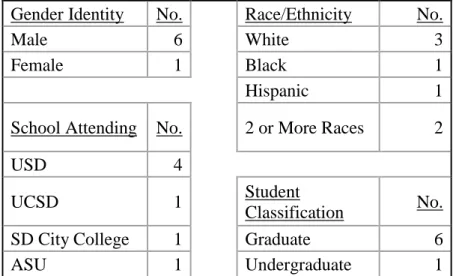
My participants included formerly incarcerated students and faculty/staff at various local colleges and universities with the exception of one student from out of state. There were seven student participants in total. My student participant demographics, as shown in the table below, had diversity in race/ethnicity. However, only one identified as a black male. This was an interesting discovery as the majority of incarcerated people in this country happen to be black
men, more specifically 1 in 3 black men.Almost half of the prison population is made up of black men even though only 14% make up the United States population (Williams, 2018). My participants were also very diverse in their backgrounds/upbringing, what type of facility they were incarcerated in, and their length of time incarcerated. Two of them were actually in the military prior to enrolling in college for their current programs. One of which was incarcerated actually prior to his military service. As for the variety of incarceration facilities, two were in a juvenile detention facility, one was in federal prison, and four were in state prisons. Their time served ranged from 2 ½ years to almost 20 years on and off.
Table 1: Participant Demographics - Students
Gender Identity No. Race/Ethnicity No.
Male 6 White 3
Female 1 Black 1
Hispanic 1
School Attending No. 2 or More Races 2
USD 4
UCSD 1 Student
Classification No.
SD City College 1 Graduate 6
ASU 1 Undergraduate 1
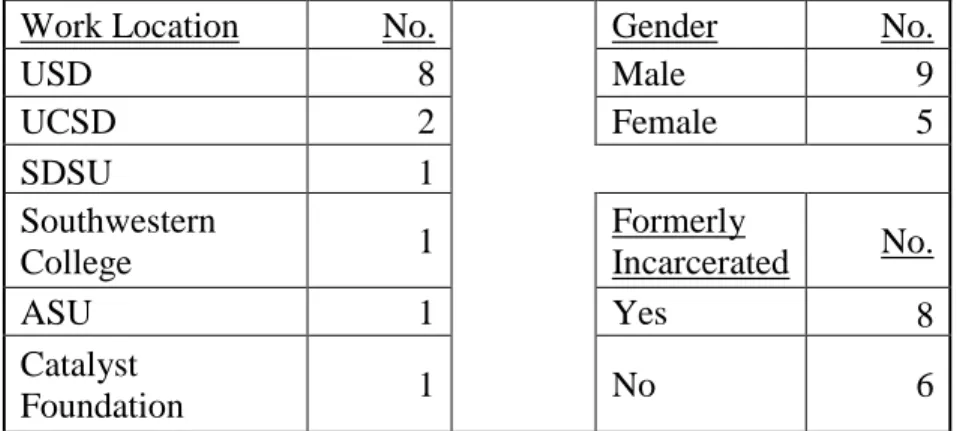
As for my faculty and staff participants, I wanted to get a mixture of those that worked with formerly incarcerated students already and those who are interested in working with them. As shown in the below table, majority of these participants work at USD. This was intentional to have the bulk of representation from USD because it is the main focus of this research in there being a need to create a support service program there for these students. Out of the eight faculty and staff from USD, five were from the Career Development Center, one was from the
Mulvaney Center, one was a Faculty member from the Sociology Department in the College of Arts and Sciences, and one was a staff member from the Department of Leadership Studies in SOLES. As for the other six participants, I had one who works in Restorative Justice at the Catholic Diocese as well as an adjunct faculty member at SDSU. I had two staff members from UCSD, one staff member from Southwestern College who was previously at SDSU Project Rebound at the start of this study, one faculty member from ASU, and one staff member from the Catalyst Foundation. All 14 of these faculty/staff participants were also very diverse in terms of race and age.
Table 2: Participant Demographics – Faculty/Staff
Work Location No. Gender No.
USD 8 Male 9 UCSD 2 Female 5 SDSU 1 Southwestern College 1 Formerly Incarcerated No. ASU 1 Yes 8 Catalyst Foundation 1 No 6 Needs Assessment
From the time that I was in my previous Graduate Assistantship at USD in the Career Development Center up until now in my final semester of graduate school, I recognize that we at USD serve many underrepresented students. At the Career Development center in particular, there was a Career Counselor who was dedicated to serving the “special populations” which consisted of military/veterans, international students, graduate students, students with
of that population. In fact, there was no work being done to provide services for these students. There definitely should be though, as these students often have an extremely difficult time finding employment. This could be as simple as them just connecting with employers who are looking to hire formerly incarcerated people so that when they interact with these students. They can provide them with some employer contacts or those employers can start coming to campus for information sessions and career fairs where they can specifically market to formerly
incarcerated students.
I was given some of this information on the Career Development Center by my former supervisor there and some of it I just observed and witnessed by speaking to other employees in that department. My former supervisor is also the one who gave me permission to start doing this research in the Career Development Center. However, this work should definitely not just be on the Career Development Center at USD. There are many other departments, clubs, organizations, and services under student affairs and academic affairs that could be providing support as well. There again is a great deal of support on campus for a variety of underrepresented students but for some reason, just not formerly incarcerated students.
Copenhaver, Edwards, and Byers (2007) as discussed earlier in my background, helped contribute to my knowledge base for this topic. They specifically talked about the role higher education administers, staff, faculty, and students need to play in helping these students and ultimately leading to a reduction in recidivism. Middlemass (2017) and Kim (2016) also
contributed to my knowledge base in pointing out the need for universities to partner with prison education programs to help them prepare these students before getting released.
Utilizing O’Leary’s cycles of research, I conducted 3 cycles in addition to a pre-cycle. I collected data through field notes from meetings and events, a survey, a focus group, and 1:1 interviews. My cycles were laid out as follows.
Pre-Cycle: Meetings & Recruitment
Observation
I started my pre-cycle off knowing that I might have a difficult time recruiting formerly incarcerated students for my research because many of them do not self-identify. So, I wanted to go out into the community and to other campuses to be visible and attempt to recruit in person. Thankfully, I had already gotten a few contacts from fellow graduate students, staff, and faculty who knew the topic of my research and how I may need help finding formerly incarcerated students for it. Those few contacts that were given to me informed me about local community restorative justice groups that I could try to recruit participants from. They also put me in contact with some of the formerly incarcerated student support service programs that were in place at various higher education institutions throughout San Diego. After I made some of the contacts that were sent to me, those contacts connected me with more people who they thought would be interested in participating in my research. My initial participants essentially helped me continue recruiting by forwarding my recruitment flyers and emails.
Upon connecting with the local restorative justice groups, they informed me of their next meeting times and invited me to attend. I went to these meetings and was able to take good field notes. Going to these meetings also allowed me to hand out flyers, speak about my research, and make connections with members interested in participating. I first went to the San Diego Reentry Roundtable meeting in Southeast San Diego. It is a community organization that meets once a
month to discuss resources for incarcerated persons upon their release. There were representatives from the Sheriff’s Department, Center for Employment Opportunities, Department of Industrial Relations, the National Conflict Resolution Center, Probations, and different schools that attended the meeting. They had everyone go around and introduce themselves in the beginning before diving into briefings and presentations from the various representatives in attendance. The Reentry organization also has committees to address issues of employment, education, housing & transportation, policy & procedures, outreach, and an executive committee. These committees gave updates towards the end of the meeting right before they opened it up for guests and or any other member announcements. This was when I had the chance to discuss my research and try to recruit.
Second, I went to a Project Rebound meeting at San Diego State University (SDSU). They, like the Reentry Roundtable, had us go around and introduce ourselves first. They actually had an item they would pass around to the speaker to signify it was that person’s time to speak. At this meeting there were representatives from various local colleges. There were representatives from San Diego Mesa College Continuing Education, Cuyamaca College, Grossmont College, Southwestern College, and of course SDSU. There was also a representative from Corrections to College, an initiative designed for building a network of bridges from incarceration to colleges throughout California. This representative spoke about how California Community Colleges Board of Governors recently awarded $20 million for the Chancellor’s Higher Education Innovation Awards which recognize innovations that improve student success which in this case, had a particular focus on programs that support currently and formerly incarcerated students. She also spoke about a professional development opportunity for people working with these students. It is the 2019 Leadership Institute for California Community Colleges serving formerly
incarcerated students. Lastly, she provided us with a course catalog of what classes are being offered from various schools within various prisons/jails which was very useful in seeing how many are out there and what is still needed. Surprisingly, there were over 250 courses offered face to face in fall of 2018.
Reflection
Having the opportunity to go to the Reentry Roundtable meeting and the Project Rebound meeting truly helped me gather initial data and make connections for not only my current research but future research I may want to do. It gave me a base of knowledge to start from in terms of what is happening locally to help support students wanting to enter higher education from being incarcerated. The Reentry Roundtable helped me to understand more generally what other services besides just education are out there for these students, such as housing and employment. There were apprenticeship programs in addition to the standard educational programs offered at community colleges and universities. There were literally about 50 people in this meeting which was shocking to me. I did not know there was this much support in San Diego for people who are transitioning out of incarceration. I was pleasantly surprised.
The Project Rebound meeting was much smaller with only about 10 of us. However, because there were representatives from such a variety of colleges, it was very beneficial to my particular research. I was able to hear what other campuses are doing to support formerly incarcerated students which I could then compare to what USD is doing or not doing. I learned a great deal from this particular meeting. This is where I really found out that USD was practically the only college/university in the area not offering any type of support service program for formerly incarcerated students. I learned that Southwestern College had partnered with Donovan Correctional Facility to offer classes for prisoner education. I learned that there are also
representatives from a variety of community colleges that go to Donovan for a transition program once a month. I also learned at this meeting that Grossmont College offers prison education classes at Las Colinas Detention Facility.
An interesting statement by the Corrections to College representative about the benefits of prison education programs directly addressed one of the questions of my study. She stated how earning a degree in a prison education program can lead to reduced sentences for the incarcerated. This also in turn leads many formerly incarcerated students into higher education which will prepare them for obtaining employment and ultimately help reduce recidivism. The SDSU representative spoke about Project Rebound briefly as well. Project Rebound is a support service program at SDSU and many other universities within California. The representative stated that they already at that time had 13-15 potential admissions into their program for next year and this meeting was in December. He also spoke about how people can apply for the program while they are still incarcerated by having a significant other or loved one help them apply online.
All in all, my recruitment process was staggered and lasted 3-4 months. I was still recruiting participants even through my first 2 cycles. Using snowball sampling, the majority of my participants came from word of mouth. It was slightly difficult because I recruited not only formerly incarcerated students but also faculty and staff. The faculty and staff I wanted in my study were either formerly incarcerated themselves, currently work with these students or are interested in working with them. Throughout this Pre-Cycle, I was able to recruit eight student participants and 13 faculty/staff not including the students who also fit into the staff category as well.
This Pre-Cycle helped me confirm and formulate my plan for Cycle 1. I knew I was going to continue to recruit through the cycle but wanted to start getting interviews completed. Doing interviews, I thought would be best for my first cycle as they would allow me to personally connect with the formerly incarcerated students and get the most out of their story and experiences. I knew I wanted to begin with this cycle as it would shape the rest of my research. Hearing from the students directly as to their idea of support services, what kind of support services they are looking for, and whether or not they would actually utilize them, helped guide my research. I scheduled an hour of time with each participant to meet with me at USD to conduct the interview. I wanted to make sure I recorded them but also take notes as they were talking. I knew I would be able to go back later and add to my notes but did not want to have to spend much time doing that after the fact. One by one I got everyone scheduled for the 1:1 interviews which lasted a couple of months just because it was the most tedious and time consuming of the cycles.
Cycle 1: Student Voice (Interviews)
Observation/Findings
This first cycle focused on collecting data from formerly incarcerated students allowed for their voices to shine through. I focused on what influenced their decision to pursue higher education, how long it took them to enroll in school after being released from incarceration, whether or not they took classes while in prison and if so, whether or not it prepared them for civilian higher education. I also focused on their experiences with other formerly incarcerated students on campus, if they felt like they were currently getting the support they need on campus, and whether or not they were utilizing any services on campus even if not directly related to being formerly incarcerated. I had initially recruited eight formerly incarcerated students for this cycle but only seven were able to interview. The eighth participant became unresponsive. The
actual interviews lasted about 30 minutes each. The various themes that emerged from the interviews are discussed in the following sections. The themes are: graduate education, moving straight into higher education from incarceration, their decision to pursue higher education stemming from wanting better for their lives, education while incarcerated, the need and want for interaction with other formerly incarcerated students on campus, lack of fulfillment of campus support, and the non-use of other campus support services.
Continued Education
When asked how long the participants have been in school, the responses were very similar. They ranged from 3-5 years at their current school with the exception of 2 who just started their doctoral programs last year. So, all of them have been working hard in school for a few years now. Andy stated he has been at USD since Fall of 2014. He transferred here right after getting out of the military where he also took classes and earned his first Bachelor’s degree. He graduated USD with his Bachelor’s in December 2016 before rolling right into his Master’s program at USD in Fall 2017. Flaco stated he started his Associate’s degree program at City College in September 2015 and is graduating this May 2019. He is planning to transfer to USD for his Bachelor’s degree where he was recently accepted on a full-ride scholarship. Mike Dre started at City College back in March 2014. He then transferred to the University of California San Diego (UCSD) to earn his Bachelor’s before coming to USD this past fall 2018 to start his Master’s program. Cleo started his Doctoral program in 2015 and is looking to graduate this summer 2019 from ASU. Ben started his Doctoral program in 2012 but then went to prison within his first year of the program. He was able to come back into the program in 2015 and just recently graduated in May 2018 from USD. Finally, participants Libby & Abe started their Doctoral programs this past Fall of 2018 at USD and UCSD.
Immediate Education after Incarceration
One similarity between all of the student participants I found interesting was that they all almost immediately went into higher education upon release from incarceration. It was less than a year for all of them from the time they got out of incarceration to the time they got enrolled into school with the exception of Andy and Cleo. Andy was incarcerated from 2003 to 2009 and then went into the military. However, he did transition into higher education almost immediately upon release from the military. Cleo’s story was a bit different. It took him about 6 years after release from incarceration before going into a traditional higher education setting. He was initially in a juvenile long-term facility which is like prison for juveniles with violent offenses or juveniles who were likely to end up in prison. He was there from age 13 to 16. Once released, he did two inter-state compacts and ultimately completed parole in Georgia. Cleo stated, “I ended up dropping out of high school after I was released so it took some time for me to get acclimated back into the traditional school setting.”
Decision to Pursue Education
I wanted to know why they decided to enroll in higher education in the first place. This was important because I thought it would inform their motivation to stick with education which would in turn illustrate how education can lead to the reduction of recidivism. Andy talked about how he was already pursing a Bachelor’s degree in the military. So, when he got out, he wanted to continue school. He wasstationed in South Carolina at the time, and his wife was from the west coast. Because she moved around for him during his military time, he felt it fitting that they move home to California for her. Flaco discussed his decision to enter college being a couple of different reasons. He talked about being homeless when he first got out of prison. Initially, he thought he was going to come home and “go on the run.” He was concerned about having to go
back to selling drugs to survive. He was then put into drug rehab by the parole board to provide him a bed to sleep in. He said, “I felt like I was taking up a space from someone that may actually need it because I no longer had a drug addiction problem.” Not long after Flaco was there, a representative from City College came to talk to them about going to college. Despite the rehab facility wanting him to work versus going to school, the City College representative
inspired Flaco to enroll into City College from this conversation.
Mike Dre was already enrolled in community college before he was incarcerated. He talked about wanting to go to college to be better for his niece, to essentially be a good role model and get social mobility. He stated that he read an article which mentioned that by 2020, 65% of jobs will require a bachelor’s degree. He came from a single parent household from a low socio-economic environment. School was his way out. He also spoke about being bored in prison and his mental health became very overwhelming. He felt he had to put on the rough exterior of not smiling and making sure he gave off the “don’t mess with me attitude.” He then started reading after a couple of months to pass time. He read Ghandi’s autobiography and Mandella’s autobiography which both changed his life. The fact that they were both incarcerated for long periods of time and then were so successful was inspirational to him.
Ben’s decision to enroll in higher education was a bit different. He already had a few Masters degrees and his company was in bankruptcy at the time he decided to enroll in a PhD program. He was also retired from the military. He decided to take a class at USD which led to him applying at USD for the doctoral program. He was in the program for a year while being under investigation and then later indicted. After his trial, he was found guilty and had to drop out of school on a leave of absence at that point. During his time incarcerated, he maintained a
good relationship with his faculty advisor who advocated for him along with other faculty in the Department of Leadership Studies at USD.
Ben’s Faculty Advisor pushed him to stick with the program and reapply upon release. He did and had to write a 6-7-page essay detailing his situation as they asked him for more information about his conviction. All tenured faculty in the Department of Leadership Studies voted unanimously to bring him back. He also had to go through a student conduct review because he was indicted while attending school. This resulted in him getting expelled three weeks later and was told he could reapply in 3 years once off probation. The Assistant Dean for SOLES at the time encouraged him to appeal the decision and he was told by someone else at USD to get an attorney to fight the decision. So, he retained an attorney who had experience suing USD for Title IX violations. He won the appeal but was on 3 years of probation in the program and after his first year, had to write a 5-page reflection on his experience post
incarceration. The process was not restorative even though he succeeded. He had to get attorney to fight this for $1200. He talked about how that may not have been the case for someone from a low socioeconomic status and/or without legal connections. Since then, Ben has been part of several student conduct cases of others. He is very happy though for the faculty support which continues now.
Cleo talked about his decision to enroll in school being influenced by others. He
explained that he was working at a fast food restaurant and could not get a decent job after being released from incarceration that would pay over the $5.25 minimum wage at that time. In
addition, all of his friends were attending college right after high school. So, he would hang around them on their campus. It was through their influence that he decided to get into college because he loved seeing what they were doing. Plus, he was the only one in the group who did
not have a high school diploma. Libby’s decision stemmed from her getting pregnant a month after her release from incarceration. She decided to enroll in community college after giving birth because she wanted something more for her son. Lastly, Abe talked about making the decision to go to school because he heard he could get paid to go to school, he wanted to stay out of trouble, and he wanted to “meet the ladies.” All in all, though, every one of my participants seemed to have made the decision to go to college because they wanted something better for themselves and saw the importance education would play in their lives.
Education while Incarcerated
There was definitely a correlation I found with my participants all having some sort of education while incarcerated. All but one were either enrolled in an official prison education program, took mandatory grade school classes in a juvenile detention facility, or just took some college courses during their time incarcerated. However, their response to whether or not those programs helped them prepare for higher education in the civilian world, were varied. Andy spoke about not really being focused on school at that time but was taking GED classes. He mentioned the stigma attached to male masculinity and where he was from, there was an
association between intelligence and being effeminate. School was frowned upon and took away from your “tough” status. Not many people took advantage of prison education programs where he was because of the stigma. Andy stated that he did not put in as much as he could at that time and actually learned more on his own through reading secretly. However, the classes did prepare him a bit. Once he got out of juvenile detention and got a fresh start away from his community at 19 years old, he felt like he could indulge in education more without being looked at differently.
Flaco mentioned a prison education program being started after a riot in 2011 in his prison which was pretty big and televised. So, the prison brought in a community college to do
this prison education program and that is when Flaco got into the program. He stated the prison was going to be on lockdown for two years following the riot and he did not want to get caught up in the same old routine of watching television and such, not really doing anything to pass the time. He did not realize at the time that the prison education program would actually change his life. He said the program did not prepare him directly for college, but indirectly it definitely did. He talked about how he was not given an education plan. He felt like he was part of an
experiment in this new program but the classes were good and helped him. He did classes
through the mail because there was no instructor. He had to self-teach. Having been locked up on and off since he was twelve. The program actually helped, but by not helping him - because he had to learn on his own. He took classes on drug rehab which helped him hang up his drug use. It helped him change the trajectory of his life. A college success class helped him become a better student as a whole and that is when he “fell in love with education.” He took general education types of classes and the prisoners helped support one another’s education. The recreation yard went from stories about fights, gangs, and drugs to algebraic expression, and papers, and research. The program changed the landscape of the recreation yard time in prison for these students.
Mike Dre discussed how he took correspondent community college courses while incarcerated. He said it was like taking an online course but on paper. There was no formal instruction, just a book with assignments. He did that for two out of three years. He said when he read and did schoolwork his mind was blank on everything else. It helped transport him out of prison thinking. Thoughts of not feeling like a citizen anymore and just feeling like a horrible person. However, he knows he made a mistake and owns that. He mentioned the fact that society deems school as acceptable and normal which helped diffuse the negativity for him. The classes
he took helped more with mental preparedness but not so much the actual classes. They helped him get ready for school on more of a mental and emotional level. He talked about the promoting of school being very important. It is promoted currently to the middle and upper class but needs to be promoted to the lower class as well. He stated, “if you get a graduate degree, you’re in the top 10%, which gives better odds for people with education.”
Ben spoke to being in a federal prison camp which is a minimum-security facility. So, education was a bit different there. He worked and taught inmate led classes while in there. He also took some community college level classes. He tried to stay as busy as possible. He also worked as a mechanic in auto shop. Later, he became a dispatcher and admin. Between working, teaching, and a reading program where you read a book a week, it prepped him mentally for his release and return into college. Cleo was in a mandatory education program because of his age. He said it was horrible. He was given packets to complete and that was his education. He actually received his 8th grade diploma while incarcerated. After which, they tried to get him to obtain his GED but he opted to go to high school. Unfortunately, he ended up dropping out once he was released from juvenile detention. Libby’s experience was somewhat similar in that she did take some classes while incarcerated but did not take it very seriously and did not feel like it prepared her for civilian higher education at all.
Interaction with other formerly incarcerated students
When asked about whether my participants knew any other formerly incarcerated students (FIS) on campus, the answers were mixed. Libby said she does not really know of any other formerly incarcerated students on campus at USD but would like to. She also mentioned that there are tiers to being incarcerated which is important to understanding the differences in experiences. Mike Dre mentioned he had heard of another formerly incarcerated student on
campus at USD but did not know him. He definitely is interested in meeting more. He really wants to help other formerly incarcerated students as he feels like he is being pulled in that direction in his life. The other two USD participants, Andy and Ben mentioned knowing a few other graduate students who are formerly incarcerated but wanted to know more, especially undergraduates.
Andy stated that the undergraduate students he knows have family who are incarcerated but they are not themselves. He also knows undergraduates with conduct cases such as DUIs. However, he stated we at USD do not have a space for people to come forward and talk about their experience and to self-identify as formerly incarcerated. He would like to meet more formerly incarcerated students on campus but USD should be presenting itself as welcoming to this population. There are currently no support groups like there are at other neighboring public institutions. There are no resources online even to say we have support networks for folks like him. He stated that about 35,000 out of 700,000 people who get out of prison go into higher education. However, he thinks they would decide to go to a public university or two-year school without even really thinking about USD because we do not have the support those schools do.
Ben mentioned he would like to meet more formerly incarcerated students as well. He believes more students at USD are justice impacted than he is aware of. He referred to justice impacted students as students that have been impacted by the justice system which could mean they were incarcerated themselves in a variety of different types of facilities or they could have loved ones who are currently or formerly incarcerated. Ben is currently an Adjunct Professor at San Diego State University (SDSU) and they are more welcoming to these students. They have a support service program called Project Rebound which he is involved with. Similar to Andy’s comments, Ben stated USD’s lack of programs deters formerly incarcerated students from
coming to USD. Project Rebound is a statewide program that started in 1968 at San Francisco State University. Most of their undergraduate and graduate students are adult learners because they have been in the system so long. Project Rebound picked eight universities to have the program at various California State Universities. In 2016, Project Rebound came to SDSU. Ben was one of the first volunteers of the program.
Abe, Flaco, and Cleo spoke to the fact that they do know other FIS on campus due to the work they do or the groups they are a part of. Abe mentioned that he does stay pretty well connected and apprised of students entering and developing resources on campuses locally and regionally. As a result of his experience, he has been pretty active in developing student support programs and events for currently and formerly incarcerated individuals at UCSD. Flaco talked about how he knows other formerly incarcerated students at City College because he is a part of the Urban Scholars Union (USU) which is a support program for formerly incarcerated students. He said he was nervous and not sure how he was going fit in when he first got to campus. He was full of tattoos and had lots of insecurity and anxiety about fitting in. He drew other formerly incarcerated students together as he was like a magnet for them. They would come up to him assuming he had just gotten out of prison. So, they all wound up coming together and he was instrumental in them creating USU. It is similar to a student organization/club with leadership roles. They are now pushing academics and job preparedness. They have been building
curriculum vitaes and empowering each other. They are giving these students opportunities they did not have before.
Flaco wants to change the narrative and share their stories, similar to a “cohort of formerly incarcerated.” They are working on getting a center but are getting pushback from the school to provide actual services. They have been on the news and have done publications. USU
has been opening up new opportunities for these students despite the setbacks and pushback on campus partnerships. They are in a conversations phase with campus partners who seem to be on board until it comes time to act and then they get nowhere. He is hopeful that will soon change. Cleo also said he knew other formerly incarcerated students on his campus at ASU. He does want to meet more as they understand what it is like having a criminal record and dealing with the uncertainties higher education brings.
Fulfillment of Campus Support
Many of my participants noted they do not feel like they are currently getting the support they need on campus. However, most of them found ways around it or chose not to even try seeking support because they were fairly positive that they were not going to get it. Ben said he was able to get support elsewhere, at SDSUs Project Rebound. However, he did get a good amount of support from faculty at SOLES at USD but again, had a unique situation. Cleo stated that he has tried to go to counseling on campus at ASU and was referred off campus because they could not help him with his specific needs. It actually would have cost him additional money because it was out of network. So, he stopped going. He explained ASU does not offer support in terms of housing, on or off campus employment, or degree preparation. Mike Dre discussed this being a difficult question because he is a very independent person. He never sought out any resources after being released. He never asked for help after being released and never used any resources at other colleges or around the community for formerly incarcerated or otherwise.
Libby and Abe mentioned not seeking support on campus. Libby said, “I don’t look for services of that is the question because I am almost sure there none.” Abe stated, “no more than other groups from other disproportionately impacted communities. However, I think it’s
important to say that the support now being offered through law enforcement now is a little better than before.”
Andy mentioned he goes back to old support networks at neighboring schools where his formerly incarcerated student status is not as stigmatized because it is becoming common at those schools to have support for them. I asked him what he thinks is holding USDs campus back from this. He mentioned the catholic component being paradoxical. He stated:
The pope is big on giving prisoners second chances. The pope actually stopped at a prison on his visit to United States.This should align with values of the catholic church. It is politics that hold us back and create divisiveness. Much of the student population is in the upper socioeconomic class and probably has never had interactions with those incarcerated. Thoughts about prison are likely based on second hand knowledge. However, the formerly incarcerated are no more of a threat than combat veterans with post-traumatic stress disorder (PTSD). USD has other support services and/or clubs for military/veterans, the LGBTQIA+ community, and other people from various racial identities but not formerly incarcerated.
Flaco discussed not feeling supported on his campus (City College) in relation to a job he applied to. He had a job on campus but human resources had not put him in the system. So, he has not gotten paid. It was a struggle just to get a job and now to be heard. He officially got denied the job after 9 months from the time he applied because of his criminal background. He even wound up starting the job (worked for a month) before getting clearance but then had to stop working once his official human resources denial came through. So, he has been speaking up using social media. He has said “City College is supposed to be a campus focused on social justice and changemaking, but they won’t employ me. Yet, they have me stand up and speak in the news as
a formerly incarcerated student to show diversity and inclusion.” He is currently fighting for this job so that the next person with a criminal record who tries to get a job on campus, does not have to fight the same battles. He talked about it not being about him at this point. “I show up and fight for the next person” he stated.
Use of any Campus Services
I asked the participants if they used any resources on campus, not necessarily those specifically set aside for formerly incarcerated students. Flaco said no because he does not feel comfortable using the services. He cannot relate and the services are not designed correctly. He has even had a battle with financial aid to get money because he already completed 49 credits in prison. He realized the different aspects of privileges at institutions when he went to Mesa College for a math class that was not offered at City College. He said the teacher there did not even make them buy the book because it was so expensive at $240. She just had them follow along with her teacher’s book. Conversely, City College’s teachers for math are generally very hard to communicate with. Being over at Mesa College briefly, he heard of Restart Scholars over there but did not get a chance to affiliate with them yet as he is mainly on City’s campus.
Mike Dre talked again about it being difficult for him to ask for help. Not many of these students are willing to “out” themselves, he said. Mental health issues are a huge obstacle in this. He mentioned many of these students consistently doubting themselves and having imposter syndrome. He still has negative thoughts at times. He mentioned USD needing to build a community for these students so they can feel like they have a place and are welcome. Talking with others like them would help mental health tremendously. He also mentioned knowing that USD does not have any services currently to support formerly incarcerated students. He stated “I don’t even hear about any services on campus for low socio-economic status or first-generation
students. USD misses the mark in many areas.” He mentioned how this makes him super upset for the price of admission. “Where is our money going” he asked, “because it should be going to the students.” He talked about USD catering to the predominant population of students.
Cleo stated he currently does not use any services on campus. Libby stated she does not either. However, she is a formerly incarcerated PhD student so it is a bit different. She said when she was an undergraduate student, this was much more important. She went to SDSU for
undergraduate school where the only support she was looking for at that point was with people who understood where she had come from without being judged or tokenized. Abe’s comment was similar to Libby in that he is also a PhD student which means he is in a different stage of his educational journey. However, he did say he is constantly working with folks to raise awareness, build collaborations and generate resources to address some of the challenges faced by formerly incarcerated students, undergrads in particular. Ben stated that he was a student ambassador and is now an alumni ambassador. He mentioned he did use the veteran center slightly. He stated that there is a need at USD to create support services for formerly incarcerated students similar to Project Rebound at SDSU.
Andy mentioned he did not use many services as an undergraduate student but now does as a graduate student and staff. He is involved in the Torero Renaissance Scholars program at USD for former foster youth and homeless students. He explained that this program, Student Support Services, and Summer Bridge programs should be groups that help incarcerated
students. He did not use services as an undergraduate student because of the stigma of both being a combat veteran and formerly incarcerated. He did not want to put himself out there. Although there were things like his tattoos that made him stand out as someone who may have been incarcerated, he thought if he used the programs, it would signal to people that this is a part of
his story. He was not sure he wanted people to know that because there was not a place for people just like him at USD. He mentioned USD being designated as a changemaker campus and should set that precedent for basic needs. A program like Project Rebound has been around for 50 years and California is a progressive state. The same way we at USD strive to provide support for other underrepresented groups on campus is the same way we should strive for this. He mentioned reading that no other private catholic institutions in the United States have a Project Rebound type of program as of now and USD could lead this charge.
Reflection
This cycle was truly impactful as it informed my research on so many levels. Having this understanding of what formerly incarcerated students need in terms of services, what obstacles they face, what services they are getting on other campuses, and how prison education programs impacted their higher education experience set the precedent for my research moving forward. It was so important to have that personal one on one connection and interaction not only for my research but for the participants as well. I believe it made them feel more comfortable in initially breaking their silence for some of them about their experiences. Having had family members and loved ones currently and previously incarcerated also helped me in making connections with my participants. These interviews laid the ground work of where USD can start in providing
resources for these students. In talking with Ben and Andy, I learned that they were trying to come together with any other justice impacted students to help create a Project Rebound type of program at USD. They invited me to join in on that preparation and work. I did and will be going more into how that process is unfolding through the next few cycles.
After completing the interviews, I knew that I wanted to focus my next cycle on hearing from the faculty and staff who either work with formerly incarcerated students already or who want to. Interestingly enough, some of my student participants are also staff and were also interested in being a part of the next cycle for faculty/staff participants. Based on the large amount of faculty and staff I was able to recruit in my pre-cycle, I had to figure out a more productive way according to scheduling, to get everyone’s participation. So, I decided that a survey would be the best way to gather the data from this group of participants.
Action
As my first cycle was wrapping up, I started sending out the surveys (appendix B). I reached out to my 18 participants via email to collect their consent forms before sending them over the survey. A few of my participants were unresponsive. But I did receive 14 consent forms to be able to move forward with the surveys. The 14 participants completed their surveys very quickly, and I noticed that this was a much faster cycle then the first one, but it lacked the personal connection of sitting face to face with my participants.
Cycle 2: Faculty/Staff Voice (Survey)
Observation/Findings
This cycle gave voice to the faculty and staff who are currently working with formerly incarcerated students or who are interested in working with them. I surveyed faculty and staff from a variety of higher education institutions throughout San Diego in addition to one
institution in Los Angeles and one in Arizona. I collected data on whether or not faculty and staff knew about any available support services for FIS on their campuses and if they were even aware of this population of students. I was also interested in hearing from faculty and staff that
currently work with formerly incarcerated students, on what support services their campuses currently have and how they can be improved or expanded upon. In addition, I wanted to create awareness for the faculty and staff that do not currently work with these students on the types of support they might need and see how they respond to what they think their needs are. Lastly, I asked about some of the challenges for formerly incarcerated students and if they thought prison education programs help prepare students for higher education in the civilian world.
The survey consisted of 11 questions including one indicating which higher education institution the participant works at. It took participants roughly between 10 and 15 minutes to complete. This cycle was also very informative as some of my student participants from Cycle 1 are also staff, so, they were able to participate in both cycles which gave an interesting
perspective from both the lens of student and staff. The themes that emerged from the survey included a lack of awareness of existing support services, an overwhelming response of support service ideas, the echoing of the challenges FIS face, and the effectiveness of prison education programs. In the next sections I discuss the themes and provide quotes from participants as well as charts of some of the quantitative data collected on these surveys.
Awareness
The initial survey question asked if they were aware of any support or services on their campus for formerly incarcerated students. Only one out of the 14 participants said yes. This response was interesting to me as two out of the five schools that my participants work at have a program for formerly incarcerated students. The second part to this question asked them to list what those support services were if they answered yes to the previous question. 12 of the 14 did not answer but 1 participant stated SDSU’s Project Rebound. The last participant said that at Southwestern College they have a few. She stated that,
Under the Office of Student Equity Programs and Services, there are a couple of
organizations/programs that have been established specifically for formerly incarcerated students. One particular organization the office supports is the Urban Scholars Union (USU), a student organization led by formerly incarcerated students. USU comprises of ‘student advocates with lived experiences committed to empowering all cultures
transitioning from incarceration to education.
This participant also stated:
Another program supported by the Office of Student Equity Programs at Southwestern College is the Restorative Justice (RJ) Program. The RJ Program provides ‘onsite academic programming (Associate Degree for Transfer in Business Administration) for the currently incarcerated with a focus on college readiness, computer literacy and the development of soft skills to promote the successful transition into the community college and the local community.’ Once the student is released from our jail or prison degree program, the goal is to further assist the student in their transition to a community college or transfer into a four-year university.
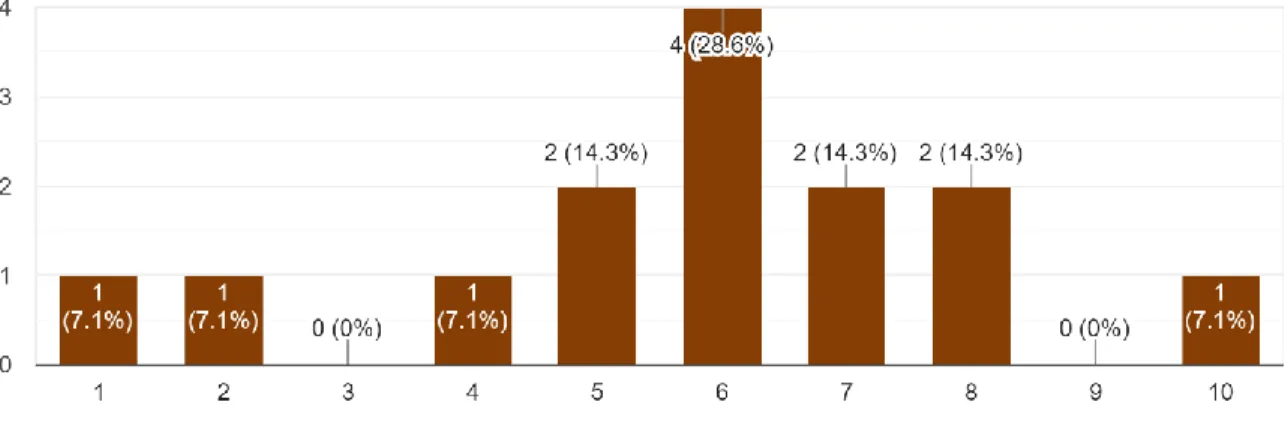
Another question asked was if the participants were aware of the formerly incarcerated student population on their campus. The response was an even 50/50 split, with seven yes and seven no.
This result was interesting as depicted above because five participants were not aware if their department or office had direct interaction with formerly incarcerated students. This spoke to the lack of awareness faculty and staff have of this specific student population.
Support for FIS
My next few questions dove a bit deeper. I asked participants to write out some ways their department or office does or could support formerly incarcerated students (FIS). Two participants stated that UCSD could support these students by “advocacy and development of programming.” In addition to:
helping formerly incarcerated students learn about research as the focus of this particular department is undergraduate research. Programs such as the McNair Program could be an opportunity to get formerly incarcerated students on a path toward a PhD. There are other opportunities that could also benefit the populations university experience by building research skills and practical experience. This could be used to bolster resumes but also when applying to graduate school. The issue is that there is no promotion of these opportunities to that specific population as well as no central office, organization or program to know these students are even on campus.
Another participant stated that at SDSU there is already support for these students through Project Rebound which provides financial aid and student support services for formerly incarcerated students. The ASU participant stated his school could support these students by “providing support, acknowledging their presence, providing specialized resources and tools, providing mentorship with outside employment agencies, do a better job with connecting to students, and finding ways to fund or provide housing solutions.” The participant from Southwestern College stated that the RJ Program, housed under the Office of Student Equity Programs and Services, oversees the activities and structure of the Urban Scholars Unions (USU). This participant stated:
we work with USU students to further improve how to bring awareness of this particular community of students on our campus. Having events such as an open house and panel discussions of formerly incarcerated students discussing their successes and challenges of reentry are two main events that occur on our campus. I believe this helps faculty/staff and students become more cognizant of the diversity of students attending their college and how anyone can support the academic success of formerly incarcerated students. The office advocates for formerly incarcerated students to gain quality employment on and/or off-campus. We understand that lacking employment is a strong factor that can lead a transitioning student to recidivate. Thanks to the support we receive on campus, we are able to work toward eliminating the challenges and barriers this community of students may encounter.
Another participant from the Catalyst Foundation, who is formerly incarcerated stated that if he was working in a school, he thinks the best assistance would be to hire formerly incarcerated people to work as navigators for other formerly incarcerated people.
I received several helpful responses from USD faculty and staff participants on how their department or campus as a whole could support these students. One wrote,
our office, the Career Development Center, offers counseling and other resources for students to develop their career. Incarcerated students have unique obstacles to overcome in that process, and our department could have explicit resources that address a strategy for those students. I do believe our counselors are able to work individually with these students, but ongoing training for these team members may be beneficial to better support these students.
Another participant from USD Career Development stated, “workshops and targeted coaching” could help in addition to, “working with our special populations counselor to design intentional workshops about job search resources and techniques, and tips for application materials.” Finally, another participant from Career Development added, “we could bring in a speaker, or offer outside assistance to students who have questions about filling out job applications and sharing their potential record with employers.”
In addition to the above USD responses, there was one participant from the USD Mulvaney Center who responded,
I am aware of several justice impacted student employees of mine, both current and former. To date, we do not have any institutionalized / streamlined way of supporting these students nor their experiences. Being aware of their stories, however, to include how this impacts them day-to-day, does inform the ways in which I engage with them. Knowing this information allows me to be a better supervisor and overall system of