Improving Web Security by Automated Extraction of
Web Application Intent
BY
PRITHVI PAL SINGH BISHT
M.Tech., Indian Institute of Technology, Kanpur, India, 2002 B.E., Govind Ballabh Pant Engineering College, Pauri, India, 2000
THESIS
Submitted in partial fulfillment of the requirements for the degree of Doctor of Philosophy in Computer Science
in the Graduate College of the University of Illinois at Chicago, 2011
Chicago, Illinois
Defense Committee:
Arvind Prasad Sistla Jon Solworth
Mark Grechanik, Accenture Labs Chicago Ugo Buy
Prithvi Pal Singh Bisht 2011
For my Eja and Babu
Completion of this dissertation has been made possible by support, advice, encouragement and love of many people. I take this opportunity to express my sincere gratitude to all of them.
My babu (father), Shri Nandan Singh Bisht, and my late eja (mother), Smt Malati Devi, instilled love for engineering from early days of my childhood. They nurtured and facilitated different aspects of my life and career through thick and thin. To them I dedicate this work.
I am indebted to my wife, Bhavana, who provided unrelenting support, guidance and uncondi-tional love during the last leg of this thesis. My brothers, sisters and their spouses always provided encouragement that helped me in staying focused and grounded. All my friends, Ayeshwarya Mahajan in specific, guided me through tough times.
Professor V.N. Venkatakrishnan, my Ph.D. advisor, played a pivotal role throughout my stint as a doctoral candidate. Starting from early e-mail exchanges when I was exploring graduate studies at UIC from India, to the toast after my defense, he has been a true mentor, keen researcher, resourceful facilitator and a friend. He has helped me hone my skills not only in the research front but also in various practical aspects of life.
Working with Professor Arvind Prasad Sistla has been a real treat for me. He not only helped shape some key aspects of this work but, in doing so, also taught ways to reason about difficult problems in a systematic and rigorous fashion. The other members of my dissertation committee, Professor Ugo Buy, Professor Mark Grechanik and Professor Jon Solworth, provided extremely valuable and timely feedback that helped shape contents and style of this thesis.
I also had the good fortune to collaborate with the following intelligent and resourceful re-searchers during this thesis: Tim Hinrichs, Professor Madhusudan Parthasarthy, Mike Ter Louw, Sruthi Bandhakavi, Kalpana Gondi, Nazari Skrupsky, Radoslaw Bobrowicz, Michelle Zhou, Megha
ACKNOWLEDGMENTS (Continued)
Chauhan, Tanushree Varshaneya. Through insightful feedback and discussions these researchers have left a long lasting impression on various aspects of my research skills.
During the first year of my Ph.D. studies, I worked with Professor Ugo Buy and Professor Tanya Berger-Wolf as a teaching assistant. I have constantly been in touch with them since then and it greatly helped me in settling down in the graduate life.
Phillip Porras and Vinod Yegneswaran mentored my internship at SRI International Lab and enabled expansion of my research skills as well as helped me gain a broader perspective of security research.
Last but not the least, the UIC computer science department provided support in various ways that I am grateful for.
My research experience has been enriched and sweetened by involvement of all the above indi-viduals. Thank you, everyone!
The author gratefully acknowledges financial support received from the following funding agen-cies during various phases of this dissertation research: National Science Foundation grants CNS-0845894, CNS-1065537, CNS-0917229, CNS-0716584, and University of Illinois at Chicago Campus Research Board grant UIC-CRB-2-200250-699000-699012. The equipment used for this research was funded in part by National Science Foundation grant CRI-0551660.
PPSB
CHAPTER PAGE
1 INTRODUCTION. . . 1
1.1 Security Problems in Legacy Applications . . . 8
1.2 Thesis Goals . . . 11
1.2.1 Summary of Implementation and Results . . . 14
2 BACKGROUND . . . 17
2.1 Running Example: Shopping Cart . . . 17
2.2 SQL Injection Attacks . . . 20
2.2.1 SQL Injection Attack Example . . . 21
2.2.2 SQL Injection Attack Vulnerability . . . 22
2.2.3 In Scope . . . 23
2.3 Parameter Tampering Attacks . . . 23
2.3.1 Parameter Tampering Attack Example . . . 24
2.3.2 Parameter Tampering Attack Vulnerability . . . 25
2.3.3 In Scope . . . 25
2.4 Common Attributes of Vulnerable Applications . . . 26
2.4.1 Revisiting SQL Injection Attack . . . 26
2.4.2 Revisiting Parameter Tampering Attack . . . 27
3 APPROACH OVERVIEW . . . 29
3.1 Intentions . . . 29
3.1.1 Observations . . . 30
3.2 High Level Approach . . . 33
3.3 Challenges . . . 35
4 DETECTION OF PARAMETER TAMPERING VULNERABILI-TIES . . . 40 4.1 Motivation . . . 40 4.2 Contributions . . . 43 4.3 Problem Formulation . . . 44 4.3.1 Problem Description . . . 44 4.4 NoTamper . . . 46 4.4.1 Overview . . . 46
4.4.2 Architecture and Challenges . . . 48
4.4.3 Algorithms and Implementation . . . 55
4.5 WAPTEC . . . 68
4.5.1 Overview . . . 68
4.5.2 Architecture and Challenges . . . 76
4.5.3 Algorithms and Implementation . . . 84
4.6 Evaluation . . . 91
4.6.1 NoTamper . . . 91
4.6.2 WAPTEC . . . 99 v
TABLE OF CONTENTS (Continued)
CHAPTER PAGE
4.7 Summary . . . 107
5 PREVENTION OF SQL INJECTION VULNERABILITIES . . . 111
5.1 Motivation . . . 111
5.2 Contributions . . . 113
5.3 Running Example . . . 114
5.4 Approach Overview . . . 116
5.4.1 The Transformation Problem . . . 116
5.4.2 Main Assumption . . . 117
5.4.3 Intuitions Behind Our Approach . . . 119
5.5 Algorithms and Implementation . . . 121
5.5.1 Handling Straight Line Programs . . . 122
5.5.2 Handling of Conditionals and Procedures . . . 127
5.5.3 Loop Handling . . . 128 5.5.4 Implementation . . . 130 5.6 Evaluation . . . 132 5.6.1 Effectiveness . . . 132 5.6.2 Performance Experiment . . . 136 5.7 Summary . . . 138 6 DISCUSSION . . . 140 6.1 Goal . . . 140
6.2 Intuition for Patching . . . 141
6.3 Challenges . . . 143
6.3.1 Patching the Vulnerable Path . . . 143
6.3.2 Incorporating Server-side Changes to Inputs . . . 145
6.3.3 Factoring in Dynamism in Form Generation . . . 146
7 RELATED WORK . . . 148
7.1 Vulnerability Detection Techniques . . . 148
7.1.1 Static Analysis Based Techniques . . . 148
7.1.2 Dynamic Analysis Based Techniques . . . 149
7.1.3 Test Input Generation . . . 150
7.1.4 Discussion . . . 151
7.2 Vulnerability Prevention Techniques . . . 152
7.2.1 Learning Based Whitebox Defenses . . . 152
7.2.2 Learning Based Blackbox Defenses . . . 154
7.2.3 Discussion . . . 155
7.3 Specification Extraction for Security . . . 156
7.3.1 Discussion . . . 158
7.4 New Paradigms . . . 159 vi
CHAPTER PAGE
7.4.1 Developing Secure Applications . . . 159
7.4.2 New Browser Platforms . . . 160
7.4.3 Prevention Architectures . . . 161 7.4.4 Discussion . . . 161 8 CONCLUSION . . . 164 CITED LITERATURE . . . 167 VITA . . . 181 vii
LIST OF TABLES
TABLE PAGE
I Evolution of “points of attacks” in the last 30 years (Source: Trustwave
SpiderLabs). . . 2
II Underground economy: Top five goods and services available for sale and requested (Source: Symantec Corporation). . . 6
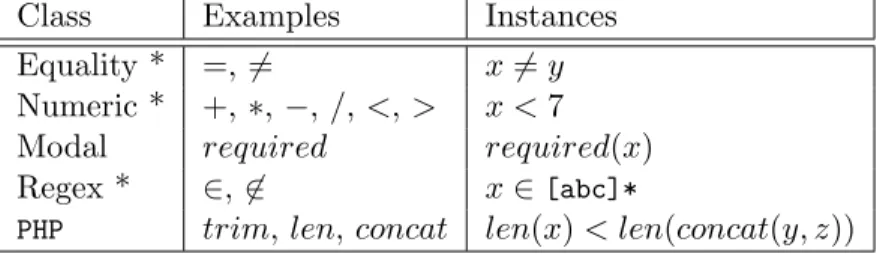
III NoTamper: Language of generated formulas . . . 56
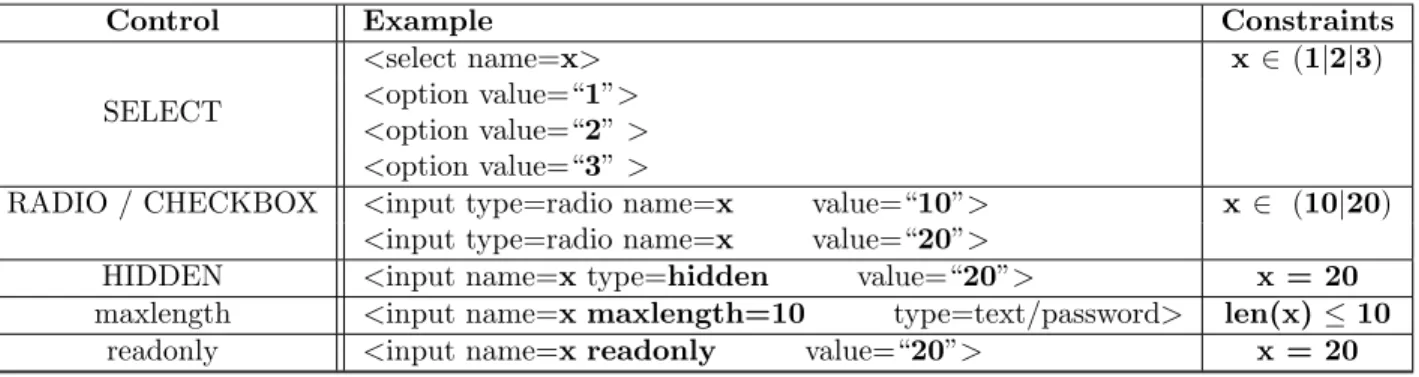
IV NoTamper: Constraints imposed by HTML form controls. . . 57
V NoTamper: The reduced constraint language: ∧ and ∨ over the above atoms. ⊗is one of <, >,≤,≥. ⊕is either ∈ or6∈. . . 63
VI WAPTEC constraint language . . . 77
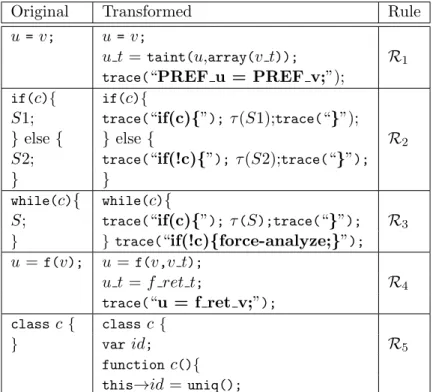
VII WAPTEC: Trace generation transformation . . . 87
VIII NoTamperanalyzed 8 open source applications and 5 live websites . . . . 92
IX Summary of NoTamperresults (Opportunities:169, Examined: 50, Con-firmed exploits: 9, False Positives: 43). . . 93
X Details of NoTamperresults. . . 97
XI Summary of WAPTEC results . . . 100
XII Comparing WAPTEC and NoTamperresults . . . 104
XIII Additional WAPTECresults . . . 106
XIV TAPS: Effectiveness suite applications . . . 133
XV Effectiveness suite applications, transformed SQL sinks and control flows: TAPStransformed over 93% and 99% of the analyzed control flows for the two largest applications. . . 134
XVI TAPS: Transformation altered less than 5% lines for large applications. . . 135
XVII TAPS: The largest application was transformed in approximately two hours and the rest in less than an hour. . . 137
FIGURE PAGE 1 Running example of a shopping application. . . 18 2 High level approach: step 1) extract intentions encoded in the source code,
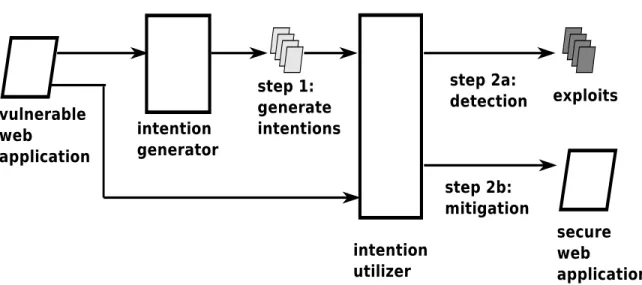
step 2a) use intentions to construct concrete exploits or step 2b) enforce them
to prevent vulnerabilities. . . 34 3 NoTamperend-to-end architecture and application. . . 48 4 WAPTEC end-to-end architecture and application. . . 69 5 NoTamper: Graph illustrating the importance of hostile input ranking,
with bold triangles denoting thresholds used. . . 98 6 TAPS: step (1) generates symbolic queries, steps (2-3) separate data
reaching the queries, step (4) removes data from symbolic queries, and step (5) generates the transformed program. ($n in this figure represents $
-POST[’name’]). . . 121 7 TAPS: Labeled derivation tree for symbolic values ofqafter execution of
statement 6. . . 124
LIST OF ABBREVIATIONS
WWW World Wide Web
Web World Wide Web
SQL Structured Query Language SQLIA SQL Injection Attacks
CVE Common Vulnerabilities and Exposures SaaS Software as a Service
WASC Web Application Security Consortium SDLC Software Development Life Cycle
TAPS Tool for Automatically Preparing SQL queries WAPTEC Whitebox Analysis for Parameter Tampering Exploit
Construction
SDGs System Dependency Graphs SSA Static Single Assignment
LOC Lines Of Code
JS JavaScript
DOM Document Object Model XML Extensible Markup Language AJAX Asynchronous JavaScript and XML
DNF Disjunctive Normal Form
BNF Backus Naur Form
APIs Application Programming Interfaces PHP PHP Hypertext Preprocessor
PHC PHP Compiler
HTML Hypertext Markup Language HTTP Hypertext Transfer Protocol UIC University of Illinois at Chicago
CAPTCHA Completely Automated Public Turing test to tell Com-puters and Humans Apart
XSS Cross-Site Scripting
OWASP Open Web Application Security Project IIS Internet Information Services
URL Universal Resource Locator WAF Web Application Firewall
SUMMARY
Over the past decade, the Web has been transformed from a collection of static HTML pages to a complex, distributed computing platform, as evidenced by the success of sites such as Facebook and YouTube. This transformation has been enabled primarily by web applications. The goal of this thesis is to investigate fundamental ways to improve the security of existing (legacy) web applications. To do so, we pursue research efforts in two complementary directions: a) techniques to uncover security flaws and b) techniques to automatically fix security flaws.
Finding and fixing security flaws in a legacy web application typically requires detailed knowl-edge of its behavior. This knowlknowl-edge is a result of understanding high-level design artifacts combined with an analysis of the source code of the web application. However, it is well known that manual effort spent towards analysis of the source code is labor and cost-intensive and is often error-prone. Additionally, design level artifacts are often unavailable for legacy web applications and the only available resource is the source code. While source code is the most accurate description of the behavior of a web application, this description is expressed in low-level program statements. Due to its inherent low-level nature, source code does not readily offer a high-level understanding of an application’s intended behavior which is necessary to identify and fix security flaws.
This thesis develops techniques to compute the high-level intended behavior of a legacy web application directly from its low-level source code description. The philosophy of discovering intent in order to detect vulnerabilities and prevent attacks rests on two simple observations: (a) web applications are written implicitly assuming benign inputs, and encode programmer intentions to achieve a certain behavior on these inputs, and (b) maliciously crafted inputs subvert the program into straying away from intended behaviors, leading to successful attacks. Leveraging on these
observations we develop techniques for inferring intentions in the realms of uncovering security flaws as well as fixing them. Through two practical results, we demonstrate that this philosophy of inferring intent is a powerful one, and is broadly applicable to addressing challenges in web application security.
The first result in this thesis presents a systematic approach for detection of parameter tam-pering vulnerabilities. These vulnerabilities arise in form processing code when the server-side fails to re-validate inputs that were rejected by the corresponding client-side validation. To de-tect vulnerabilities, our approach systematically explores the space of inputs that violate intended restrictions to find those that the server-side code fails to enforce. Evaluation of several open source and commercial web applications reveals serious security problems such as unauthorized monetary transactions at a bank and unauthorized discounts added in a shopping session. These results provide a strong evidence that extracting and checking intended behaviors, offers an effective mechanism for reasoning about vulnerabilities in web applications.
The second result in this thesis offers a sound approach to prevent SQL injection vulnerabilities. These vulnerabilities arise when an application fails to restrict the influence of untrusted inputs on SQL queries. This approach first extracts web application intended SQL queries by analyzing its source code. Our strategy for fixing vulnerable web applications involves rewriting the source code to employ PREPARE statements, one of the well known robust defenses for SQL injection attacks. Experimental evaluation demonstrates effectiveness and scalability of our approach by successfully transforming large open source applications. Our approach presents a robust solution to the long standing problem of incorporatingPREPARE statements in legacy web applications.
SUMMARY (Continued)
The philosophy of extracting and using intentions offers a systematic and scalable way to combat security problems in legacy web applications. By presenting extensive results on both detection and prevention fronts, this thesis offers convincing evidence that reasoning of application intent enables development of principled approaches for improving security of web applications.
INTRODUCTION
The World Wide Web (WWW) has become an important day-to-day resource for the people of this planet. According to the Internet usage statistics trends, as of Jun 2010, the number of Web users has raised to 1.9 billion, roughly a fourth of the world population (1). In addition to being the primary source of information for a majority of these users, the Web is being increasingly used for providing everyday services such as health care, education, banking and electronic commerce. Due to the importance of these services, the Web has attracted participation from a diverse populace, regardless of barriers of age, gender, or geography.
This growth that has fueled the Web has already enabled a trend of using customized web applications to offer these services. Driven by customized web applications, highly popular social networking sites such as MySpace and Facebook, with exciting and interactive user driven content (such as blog, wiki entries and YouTube videos), are becoming the norm for web content rather than the exception. The growth of these sites has been fueled by highly attractive revenue models and business opportunities from advertising. As a result, we are moving away from a Web that mainly had static HTML pages to a Web which contains customized and feature rich pages laden with end-user supplied content. Web application platforms such as PHPand JSPhave enabled this transition by facilitating application developers with rapid prototyping facilities that have eased the creation of new web applications, thus leading to the trend of widespread deployment of web applications.
2
Decade Points of Attacks Top Vulnerability (Potential for Damage) 1980s Physical Access Sensitive data left in plain view
1990s Network Access Weak passwords
2000s E-mail, Applications, Wireless SQL injection attacks
TABLE I
Evolution of “points of attacks” in the last 30 years (Source: Trustwave SpiderLabs).
Several recent studies (2, 3) indicate that this popularity of web applications has unfortunately also attracted attention of attackers. The web security firm Trustwave reviewed (2) vulnerabilities of the last 30 years to illustrate how “points of attack” have evolved, and the scope of the security problems we face today. We summarize findings of this report in Table I. For each decade shown in column 1, column 2 lists the key points of attacks. For each point of attack, the last column shows the top vulnerability. As suggested by this table, SQL injection attacks (SQLIA) – one of the top threats to web applications – was ranked as one of the most potent vulnerabilities for the last 10 years. Similarly, the web security firm Symantec reported (3) a 93% increase in the volume of Web-based attacks in 2010 over the volume observed in 2009. In summary, these reports suggest that web applications are one of the most attractive targets for attackers today.
The above studies are strongly supported by several widely publicized attacks on web applica-tions that include: the 2011 LulzSec SQLIA (4) on Sony website that compromised over 1 million user accounts, the 2011 Lizamoon SQLIA (5) that has infected over 1 million websites and is still active, the 2010 mass SQLIA (6) that compromised hundreds of thousands of web applications
running on Microsoft Internet Information Services (IIS) severs, the SQLIA based 2009 Heart-land (7) and 2006 CardSystems (8) data breaches that compromised hundreds of millions of debit / credit card records and the 2005 cross-site scripting based MySpace Samy worm (9) that infected more than a million accounts within the first 20 hours of infecting the MySpace social networking website. In summary, these well known attacks firmly establish the risks posed by vulnerable web applications.
The rise in attacks on web applications can be attributed to the following key reasons.
• Users as Exploit Propagators. Several reports suggest that the lack of security awareness among web application users is being exploited to propagate attacks on popular websites (3,10, 11). As web applications are attracting a diverse populace, not all users of these applications are security-savvy. As a result, attackers are inventing social engineering based attacks that trick such users into divulging sensitive information or propagating malicious code (10, 11). Symantec reported (3) that such social engineering attacks are on the rise and often utilize information available online to make such attempts resemble legitimate requests. In summary, security unawareness of users is contributing towards faster propagation of attacks.
• Stepping Stones. Attacks on web applications are being used as “stepping stones” i.e., they are being used to enable further attacks (12, 13, 14). A common property of vastly successful attacks is that they use SQL injection attack as an injection mechanism in multi-staged attacks (12, 13). Specifically SQLIA are used to inject malicious JavaScript or HTML payloads in databases of legitimate websites. As compromised databases are used in gener-ating HTML pages, these malicious payloads are rendered in a user’s browser. Subsequently, these pages redirect the user’s browser to malicious servers that serve attacks relevant to
4 the user’s browser. The two well studied mass SQLIA, namely the robint.us (12) and the Lizamoon mass SQLIA (13) plant malicious JavaScript URLs in legitimate databases of popu-lar websites. These malicious JavaScript URLs are subsequently embedded in legitimate web pages generated by these websites. When rendered in browsers, the robint.us JavaScript URL launched a zero-day exploit to execute shell code in the flash plugin whereas the Lizamoon JavaScript URL tricks the user into installing a scareware that disables legitimate Windows defender software on PCs. In both these cases, SQL injection attacks are being primarily used to facilitate further exploitation. Similarly, attacks on web applications have been used as the starting points to setup phishing web sites or to launch and control a botnet (14). By serving as potent starting points for multi-staged attacks on software installed on users’ machines, attacks on web applications provide convenient stepping stones for attackers. • Evolution of Attack Toolkits. Attack toolkits are becoming the primary means of
attacking web applications (3, 15, 16, 17, 18). Some of the most popular attack toolkits often feature easy-to-use interfaces and do not require any technical abilities to create an actual exploit (15). Further, these toolkits provide capabilities such as conducting Denial-of-Service attacks, spamming and phishing campaigns, and finding exploitable web applications (16). Thus these toolkits are reducing efforts and skills required on the part of attackers. Symantec reported (16) that toolkits are being sold on certain forums and recently researchers at the web security firm Seculert found that such toolkits are now being offered in the form of Software as a Service (SaaS) (17). Furthermore, these toolkits are evolving and offer features such as upgrades, patches, online support and warranties (18). Symantec attributes 93% increase in volume of attacks on web applications in 2010 over the volume in 2009 to the use of attack
toolkits (3). In summary, the attack toolkits are automating the entire hacking process thus providing a potent means of attacking web applications.
• Inadequate Web Application Development Process.
The web application development process fails to incorporate security measures at various levels (19, 20). The security firm Veracode studied (19) security practices involved in devel-oping more than 5000 applications over the last 18 months and the security firm Ponemon surveyed (20) more than 600 developers with an average of 11 years of experience in their profession. These two surveys report widespread problems in the web application develop-ment process. First, insignificant budgets are allotted to incorporate security measures into applications thus showing a lack of consideration at the highest level e.g., 88% of respondents suggested that their web application security budget was less than the organization’s coffee budget (20). The lack of considerations in the initial phases such as budgeting then trickles down to all subsequent phases of software development e.g., the same study reported that 20% of surveyed developers do not test and 40% test only 5% of their web applications. The extrapolated average for all web applications that are being tested by organizations in that study was estimated to be 13%. One of the main reasons sighted for not testing their web applications is the lack of budget (20). Second, the provisions for security training seem inadequate e.g., the Veracode study (19) found 80% of applications to be suffering from well documented top vulnerabilities in the OWASP top 10 list (21). The OWASP top 10 list not only describes these vulnerabilities but also suggests preventive measures that developers can take to avoid them. Failing to prevent widely publicized known vulnerabilities shows a lack of awareness. Further, developers lack proper background to develop secure web applications.
6
Goods and Services Range of Prices Rank Rank
for Sale Requested
Bank account credentials $10 -$1,000 1 1
Credit cards with CVV2 numbers $0.50 -$12 2 2
Credit cards $0.10 -$25 3 5
Email addresses $0.30/MB -$40/MB 4 6
Email passwords $4 -$30 5 14
TABLE II
Underground economy: Top five goods and services available for sale and requested (Source: Symantec Corporation).
Over 50% of developers taking an application security fundamentals exam received a grade of C or lower (less than 79 marks) whereas over 30% received a failing grade of D (60 to 69 marks) or F (less than 60 marks) (19). The exam covers knowledge of broad security concepts, including common threats. In summary, widespread failure to incorporate security measures into web application development process leads to web applications with “ripe and low hanging” vulnerabilities.
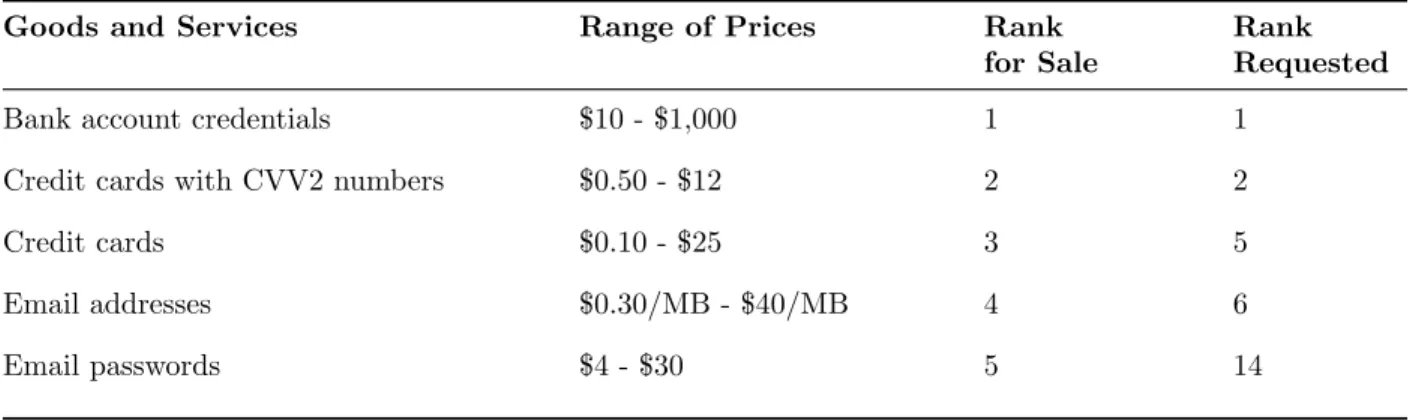
• Underground Economy of Attacks. Several recent studies suggest that attacks on web applications are fueling a profit driven system (16, 22, 23, 24, 25, 26). This system, termed as underground economy, offers commodities such as attack toolkits, exploits and vulnerabilities, stolen information, and bandwidth in bots. Each of these commodities offers variety of ways for attackers to make profit. Most popular attack toolkits such as the Neon, the Luckysploit Pack, the Phoenix exploit kit and the Sploit 25 Pro are being sold for prices ranging from
hundreds of dollars to a few thousand dollars (22). Attack toolkits in turn enable buyers to find exploits in web applications. An attacker can resort to selling exploits or could actually exercise these exploits to steal information from web applications. Selling exploits has been found to fetch anywhere from hundreds of dollars to thousands of dollars, legally (25) or illegally (26) whereas selling information can fetch anywhere from tens of dollars to thou-sands of dollars (16). Symantec analyzed (16) prices offered for stolen information in certain forums and Table II provides the summary of their findings. The first column shows avail-able information which includes bank account details and credit cards with CVV numbers, the second column shows offered prices and the last two columns show ranks of supply and demand for the stolen information. Bots offer several avenues for making profit: computers on a bot can be rented out for under 6 pounds per hour (23), or can be used in conducting large scale Denial-of-Service attacks to extort money from online businesses. The latter has been reported to be specially profitable as reports suggest that it has been used to extort tens of thousands of dollars from online gambling and other websites (24). In summary, these reports suggest that exploiting web applications is highly profitable.
The above stated reasons are inter-related and help explain the rise in attacks on web appli-cations. First, the underground economy offers a variety of ways for making profit from attacking web applications. Further, as attacks on web applications are providing potent starting points for multi-staged attacks, they are helping attackers in finding new ways for making profit. These profit making opportunities offer attackers strong incentives to exploit web applications. Unfortunately, the existing web application development process employs inadequate means to incorporate security measures and thus produces applications which offer little resistance to attackers. Second, attack
8 toolkits offer automated ways to exploit such insecure applications thus lowering the technical bar for attackers. Finally, the lack of security awareness on the part of end-users is further facilitating exploitation of web applications.
1.1 Security Problems in Legacy Applications
The already deployed applications, we call legacy applications, have serious security problems. The security firm Whitehat analyzed (27) over 3000 websites that included reputed financial insti-tutions, banks, healthcare services, etc. This study concluded that each one of these applications contained one or more serious vulnerabilities. Similarly the Web Application Security Consortium (WASC) analyzed (28, 29) tens of thousands of web applications and found that over 95% of the studied web applications were vulnerable to one or more serious attacks. These applications are often written with insufficient knowledge of the possible security threats or employ insufficient means to prevent them. In summary, these studies suggest that a significant majority of legacy web applications are exploitable.
The web statistics firm Netcraft suggests (30) that the Web contains over 100 million active web applications. As a significant majority of legacy web applications are exploitable and the Web contains millions of such applications, securing these applications is essential to improving security of the Web.
Securing legacy web applications poses several challenges. First, any manual analysis / fixing attempt requires extensive effort. Specifically, such an analysis needs to identify vulnerable portions of an application and then rewrite them to make the application secure. This entails extensive analysis of the source code which requires specialized knowledge of the application’s source code and efforts in terms of time. Such efforts must ensure that fixes do not alter the desired functionality
of the application. The difficulty in fixing legacy applications manually is reflected in the fact that most reported vulnerabilities remain unresolved for an average of 116 days in 50% of vulnerable applications (27). Given that a significant majority of legacy web applications are exploitable and there are a large number of such applications, manual analysis may not provide a scalable solution. In summary, manual analysis is error-prone, time consuming and expensive.
Second, for legacy web applications, source code is the only available resource for automated security analysis. Software development life cycle (SDLC) artifacts such as design and requirement documents could assist a manual analysis but are often unavailable. Also, source code of an application is often themostupdated artifact in a product and may not be in sync with other SDLC artifacts. As no SDLC artifacts other than the source code assist automated analysis techniques, source code is the only relevant resource for automated analysis.
The research community has responded to this crisis with mainly the following three types of solutions: a) new paradigms for developing secure web applications and b) vulnerability detection approaches and c) vulnerability prevention approaches.
New paradigms focus on developing fundamentally secure web applications. In general, these paradigms offer certain features that if used consistently during the development process, ensure security by construction. Unfortunately, these paradigms do not provide any assistance in safe-guarding legacy applications thus do not address the problem posed by insecure legacy web ap-plications. In summary, new paradigms facilitate secure web application development but do not offer assistance in mitigating security issues in legacy web applications.
Detection based approaches employ source code analysis to find potential vulnerabilities in web applications. Specifically, these techniques try to identify vulnerable flows in the source code. These
10 efforts are essential to build a better understanding of the current state of security in web applica-tions. However, these efforts lack in the following two aspects: a) most detection techniques focus on well publicized vulnerabilities thus failing to provide a comprehensive picture of vulnerabilities in web applications and b) each detection technique proposes an ad-hoc approach that may not be applicable to a wider range of vulnerabilities. In summary, detection based approaches provide the necessary first step towards securing web applications but more research is needed to improve our understanding of vulnerabilities in web applications through development of principled detection approaches.
Automated prevention solutions are the most desired as they can safeguard legacy and newly developed web applications alike. Unfortunately, the existing prevention techniques have several limitations. A widely deployed solution is filtering that analyzes user inputs to identify malicious patterns in them. Although effective as a first layer of defense, it is shown to be ineffective against subtle attacks (31, 32). Another prevalent type of solution in this category employs a reference monitor to analyze execution of a web application and forbid exploits from succeeding. In order to identify and forbid malicious behavior, these solutions typically need guidance in the form of a specification. Typically this specification enables monitors to forbid runs of a web application that may lead to attacks while allowing the application to perform benign computations. Given the large number of legacy web applications, an approach to manually construct such specifications is not scalable and is error-prone. Automated techniques to infer and enforce such specifications have been proposed but have several precision issues (refer to chapter 7 for detailed treatment of related work).
In summary, the Web contains a large number of legacy web applications and studies suggest that a significant majority of such applications is exploitable. Further, the growing number of attacks suggest that security features implemented in these applications are inadequate. Only automated techniques to find and fix problems in legacy applications provide a scalable recourse to make the large number of legacy web application safe. Finally, the current state-of-the-art work in this area does not address some of the most pressing issues, thus warranting further research. 1.2 Thesis Goals
As legacy web applications constitute majority of the Web and are often exploitable, our key goal is to invent ways to secure them. Given the large volume of legacy web applications, au-tomated techniques that require minimal human intervention offer the only scalable solution to improving security of these applications. Further, such techniques provide “stop gap” solutions to safeguard newly developed vulnerable web applications as well. This may be necessary until the web application development community embraces fundamentally secure practices and applies them consistently to develop secure web applications.
In this thesis we explore techniques that make progress on the front of improving security of legacy web applications. To this end we set out to answer the following two questions:
• Do less studied vulnerabilities pose threat to legacy web applications? Are they pervasive? If so, can we find them automatically?
• Is it possible to safeguard legacy web applications fundamentally by leveraging recent robust defenses? If so, can we devise systematic and automated techniques to do so?
To answer the first question, we chose to study parameter tampering vulnerabilities which have received less attention from the research community. Our goal was to quantify existence of
12 these vulnerabilities by studying web applications. To this end, we developed techniques to uncover these vulnerabilities systematically. These techniques build understanding of the intended behavior with respect to input validation and then find vulnerabilities by identifying successful violations of intended behavior. By evaluating these approaches on a large number of open source and commercial web applications, we offer strong evidences that parameter tampering vulnerabilities are widespread in contemporary web applications.
To answer the second question, we investigate automated ways to prevent SQL injection vul-nerabilities which are one of the top threats to legacy web applications. As PREPARE statements offer a robust defense for SQLIA for freshly written applications, we investigated a possibility to automatically extend this robust defense to legacy web applications. To this end, we offer a novel source code analysis technique that builds an understanding of the SQL query generation process encoded by the source code. This provides an insight into the application intent with respect to SQL queries. Our technique then enforces this intent by altering the SQL query generation process to employPREPAREstatements. By evaluating this solution on several open source applications, we offer compelling results on effectiveness of this technique. By retrofitting legacy web applications with a “text-book” defense provided byPREPAREstatements, we offer a strong evidence that legacy web applications can be retrofitted to reap benefits provided by new robust defenses.
The common link across the above efforts is the notion of program intent. The program intent broadly refers to the benign behavior as intended by developers of the program. To answer the above two questions, we essentially developed techniques to extract and use these intentions. To answer the first question, we chose to find instances that successfully violated program intent whereas we chose to enforce program intent through robust new defenses in the latter. The ability to extract
and use program intent to improve security, offers a powerful mechanism to tackle security problems in legacy web applications.
This thesis makes the following contributions:
• We provide strong evidences that by analyzing source code of an application, a precise speci-fication of its intent can be inferred. For a legacy web application, most often, its source code is the only available resource for inferring its behavior.
• We study parameter tampering vulnerabilities, a relatively less explored class of vulnerabil-ities, and demonstrate that they are pervasive in today’s web applications. By developing systematic techniques to discover these vulnerabilities we offer an evidence that the specifi-cation of program intent can help uncover vulnerabilities.
• We provide a strong evidence that it is possible to fundamentally secure legacy web tions by retrofitting them with newly developed robust defenses. Often legacy web applica-tions are manually retrofitted with such defenses resulting in effort-intensive and error-prone exercises.
• Based on the above techniques this thesis also contributes tools to discover parameter tam-pering attacks on web applications and to eliminate serious threats such as SQL injection. To demonstrate effectiveness of the proposed techniques, we provide extensive evaluation of these tools on several commercial as well as open source web applications.
This thesis demonstrates that legacy web applications can be fundamentally secured by system-atically inferring and enforcing specifications of safe behavior from their source code and that such specifications can also be used in a systematic fashion to find vulnerabilities.
14 1.2.1 Summary of Implementation and Results
In this section we provide highlights of techniques developed in this thesis and summarize key results. The following two sections summarize efforts made to answer the two questions posed above. Section 1.2.1.1 summarizes our approach for automated discovery of parameter tamper-ing vulnerabilities followed by Section 1.2.1.2 that summarizes our approach for SQL injection prevention.
1.2.1.1 Detection of Parameter Tampering Vulnerabilities
We present the first systematic approach for detecting parameter tampering attacks on legacy web applications as well as the first approach to generate parameter tampering attacks by con-struction.
We implemented these approaches in two toolsNoTamperandWAPTEC(Whitebox Analysis for Parameter Tampering Exploit Construction). These tools systematically analyze the client-side code of a web application to learn restrictions imposed on user supplied inputs. These restrictions act as a specification of program intent and must be enforced at the server-side code. NoTamper employs a blackbox approach to infer missing checks in the server-side code whereas WAPTEC employs a more precise whitebox analysis of the server-side code to generate parameter tampering attacks by construction.
We empirically demonstrate that parameter tampering vulnerabilities are widespread in legacy web applications and these vulnerabilities could be exploited through severe attacks. By evaluating these tools on 17 open source and commercial web applications we identify a total of 52 confirmed parameter tampering vulnerabilities. Further, starting with the vulnerabilities identified by these tools we construct exploits that demonstrate serious security problems: unauthorized monetary
transactions at a bank, unauthorized discounts added to a shopping cart, and so on. These experi-ments strongly suggest that parameter tampering vulnerabilities are widespread in open source as well as commercial web applications and can be exploited through severe attacks.
The supplementary websites for WAPTEC (33) andNoTamper(34) provide detailed exploit reports and demos of the prototype implementation.
In summary, results obtained by NoTamper and WAPTEC strongly highlight a significant gap between the server-side parameter validation that should occur and the server-side validation that doesoccur in today’s web applications. Further, these techniques provide an evidence that it is possible to extract specifications of intended behavior to automatically find these gaps.
1.2.1.2 Prevention of SQL Injection Vulnerabilities
We develop an automated technique for preventing SQL injection vulnerabilities in legacy web applications. In specific, we propose the first sound program transformation approach for auto-matically transforming the code of a legacy web application to employPREPAREstatements in place of unsafe SQL queries. By making use of PREPARE statements our technique extends “textbook defense” offered byPREPARE statements to legacy web applications.
We implemented this approach in a tool called TAPS(Tool for Automatically Preparing SQL queries). TAPS first employs program analysis techniques to determine the web application in-tended SQL queries which act as a specification of the desired behavior. TAPSthen employs a novel program transformation technique to enforce this specification by introducingPREPAREstatements. TAPS’s effectiveness was evaluated by transforming several real world applications, including one with over 22,000 lines of code. It automatically transforms over 90% of SQL queries in large web applications. As TAPS automates a majority of tasks involved in transitioning legacy web
16 applications to make use of PREPARE statements, it offers an effective tool to combat serious threat posed by legacy web applications.
The supplementary website (35) forTAPStool provides a demo of our prototype implementa-tion.
In summary,TAPSprovides a strong evidence that it is possible to successfully design retrofitting techniques that guarantee security (by construction) in legacy applications, and eliminate well known attacks.
The rest of this thesis is organized as follows. Chapter 2 discusses SQL injection and param-eter tampering attacks on web applications and presents insights on vulnerable applications that showcase common attributes. Chapter 3 then proposes a high level approach to detect and prevent vulnerabilities in web applications and discusses challenges in realizing it. Chapter 4 and Chap-ter 5 present applications of the high level approach to automatically discover parameChap-ter tampering vulnerabilities and to prevent SQL injection attacks in web applications, respectively. Chapter 6 provides guidance to future efforts in preventing parameter tampering attacks by identifying open research challenges. Chapter 7 compares contemporary work with the contributions of this thesis. Chapter 8 concludes this thesis.
BACKGROUND
In this chapter, we first introduce a shopping cart application that showcases typical features of a web application (Section 2.1). This application is used as a running example in the rest of this thesis. We then provide details of SQL injection and parameter tampering vulnerabilities and discuss concrete attacks in the running example (Section 2.2 and Section 2.3, respectively) and finally offer a deeper analysis of SQL injection and parameter tampering vulnerabilities in the context of running example (Section 2.4).
2.1 Running Example: Shopping Cart
Typically web applications are comprised of a client-side codebase that executes in a browser and a server-side codebase that executes in a web server. The client-side code executing in browsers interacts with users and supplies user inputs to the server-side code. The server-side code performs computations based on these inputs to provide services.
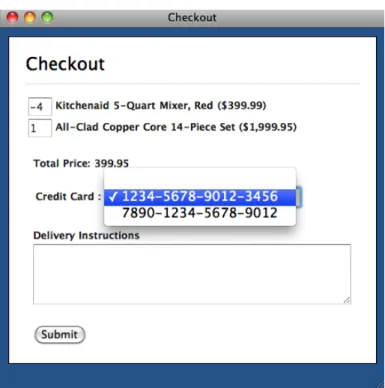
Figure 1 shows the checkout form of a shopping cart application in which a user has already selected two products for purchase. The checkout form asks the user to specify the quantity of each product, the credit-card to be charged (displayed in a drop-down list of previously used cards), the recipient’s name and the shipping address along with any special delivery instructions. We outline the end to end processing of this form below.
The first step in processing this form is validation of user supplied inputs. As user inputs are untrusted, web applications are required to validate them. Traditionally, this validation took place
18
Figure 1. Running example of a shopping application.
at the server-side. However, a popular contemporary trend is to use JavaScript to validate inputs at the client. The ability to validate inputs at the client allows an application to avoid round-trips to the server to identify invalid inputs thus resulting in faster and more responsive applications. Further, localized validation at the client reduces overall network traffic and load on the server. Listing 2.1 shows the client-side JavaScript code for the running example. This code checks if user inputs possess certain properties and if so, submits them to the server-side code for further processing; otherwise it forces users to correct invalid inputs. In specific, the JavaScript code forces submission of positive quantities for the selected products (lines 8 to 11) and use of 30 or less characters in specifying the recipient’s name (lines 13 to 16).
Listing 2.1. client.js 1 f u n c t i o n v a l i d a t e F o r m ( ){
2
3 v a r q1 = document . getElementById ( ”quantity1” ) ; 4 v a r q2 = document . getElementById ( ”quantity2” ) ;
5 v a r n = document . getElementById ( ” name ” ) ; 6 7 // d i s a l l o w s u b m i s s i o n i f n e g a t i v e q u a n t i t i e s a r e s p e c i f i e d . 8 i f ( q1 < 0 | | q2 < 0 ){ 9 a l e r t ( ” P l e a s e s p e c i f y p o s i t i v e q u a n t i t i e s f o r i t e m s . ” ) ; 10 r e t u r n f a l s e ; 11 } 12 13 i f ( n . l e n g t h ( ) > 3 0 ) { 14 a l e r t ( ” P l e a s e u s e 30 o r l e s s c h a r a c t e r s t o s p e c i f y name . ” ) ; 15 r e t u r n f a l s e ; // show e r r o r , don ’ t submit
16 }
17
18 r e t u r n t r u e ; // submit form 19 }
Once the client-side validation is successful, user inputs are sent to the server-side for further processing. Listing 2.2 shows the server-side code for our running example. The server-side code first checks value of thecard parameter and generates HTML to highlight the selected credit card (lines 2 to 6). It then sanitizes value of thenameparameter by truncating it to the first 30 characters (line 8). It then checks if theopparameter is set to “purchase”, and if so, computes the total cost of requested products (line 12). If a special parameterdiscountis set, the server-side code accordingly applies a discount (lines 15 to 16), computes a SQL INSERT query to store the order details and finally executes this query (lines 18 to 22).
20 Listing 2.2. server.php 1 $c a = $ POST [ ’ card ’ ] ; 2 i f ($c a matches ’1234−5678−9012−3456 ’ | | 3 $c a matches ’7890−1234−5678−9012 ’){ 4 // g e n e r a t e HTML t o show a 5 // s e l e c t e d c a r d i n t h e form 6 } 7 8 $n = s u b s t r ($ POST [ ’ name ’ ] , 3 0 ) ; 9 10 i f ($ GET [ ’ op ’ ] == ” p u r c h a s e ” ){ 11 12 $c o s t = $ POST [ ’quantity1’ ] * $p r i c e 1 + 13 $ POST [ ’quantity2’ ] * $p r i c e 2 ; 14 15 i f ( i s s e t ($ POST [ ’ d i s c o u n t ’ ] ) ) 16 $c o s t = $c o s t − $ POST [ ’ d i s c o u n t ’ ] * $c o s t / 1 0 0 ; 17 18 $q = ”INSERT INTO o r d e r s ( ‘ na ‘ , ‘ co , ‘ ca ‘ , ‘ ad ‘ , ‘ de ‘ ) ” ; 19 $q .= ” VALUES ( ’$n ’ , $c o s t , ’{$ POST [ ’ card ’ ]} ’ , ” ;
20 $q .= ” ’{$ POST [ ’ a d d r e s s ’ ]} ’ , ’{$ POST [ ’ d e l i v e r y ’ ]} ’ ) ; ” ; 21
22 m y s q l q u e r y ($q ) ;
The following section describes SQL injection attacks and presents a concrete attack on the above running example.
2.2 SQL Injection Attacks
SQL injection attacks are extremely prevalent and ranked as one of the most potent vulnera-bilities of the last decade (2). Further, the mass injection attacks discussed in the previous chapter exemplify how these attacks can victimize an organization and members of the general public. By using Google code search, analysts have found several applications whose sources exhibit these vulnerabilities (36). Several reports suggest that a large number of applications on the Web are
indeed vulnerable to SQL injection attacks (37), that the number of attacks are on the increase, and is on the list of most prevalent forms of attack (37).
2.2.1 SQL Injection Attack Example
Web applications that employ backend databases for storage, often parameterize backend database queries with user inputs. Malicious inputs could influence these queries thus causing SQL injection attacks (SQLIA). The running example web application constructs anINSERT query by appending user provided inputs with literal strings. Consider the run of this application with the following user inputs:
quantity1 = 1, quantity2 = 1, card = "1234-5678-9012-3456", name = "Alice", address = "wonderland", delivery = "none", op="purchase"
Let us also assume that prices of the selected products are $400 and $2000, respectively. For these inputs the following SQL query is issued.
INSERT INTO ORDERS(‘na‘, ‘co‘, ‘ca‘, ‘ad‘, ‘de‘)
VALUES(’Alice’, 2400, ’1234-5678-9012-3456’, ’wonderland’, ’none’)
When the above query is executed a record for this purchase is created in theORDERStable. Now suppose a malicious user supplies crafted delivery instructions as delivery=" ’); DROP TABLES; -- ". Further, assuming that all other parameters have the same values as above, the following query is issued.
INSERT INTO ORDERS(‘na‘, ‘co‘, ‘ca‘, ‘ad‘, ‘de‘)
VALUES(’Alice’, 2400, ’1234-5678-9012-3456’, ’wonderland’, ’’); DROP TABLES; –’)
22 Notice that value of the delivery parameter (shown above in bold fonts) balances the string delimiter (single quote) opened by the application, completes theINSERTquery and then adds aDROP query after a query separator (semi-colon). Further, it makes use of the SQL comment operator (two hyphens - -) to comment out the application generated part of the INSERT query to ensure that the resulting queries are well formed. When this query is executed, it deletes all database tables instead of adding a new entry in theORDERStable. This is a typical example of SQL injection attack, wherein malicious user inputs altersemanticsof the query application intended to generate. These attacks enable attackers to manipulate queries and compromise confidentiality and integrity of backend databases.
2.2.2 SQL Injection Attack Vulnerability
The running example code embodies the key problem of web applications that enables SQLIA. Specifically those applications that combine trusted code (literal strings present in the web applica-tion codebase) with untrusted data (user supplied inputs) through low level string operaapplica-tions and fail to confine untrusted data are vulnerable to SQL injection attack. In our running example, the application concatenates literal SQL keywords with inputs name, card,address and delivery. By enclosing these inputs within string delimiters (single quotes), itexpectsthese inputs to remain con-fined within these string delimiters. However, as it fails toenforce this restriction, it is exploitable through SQL injection in any one of these parameters.
Researchers have categorized these attacks based on injection mechanisms as well as based on different types of attack strings. These attack strings are embedded in user inputs but can be injected through cookies, Hypertext Transfer Protocol (HTTP) headers or body of an HTTP request. Further, the time when malicious inputs are actually used is also used as a categorizing
factor. For example, in a first-order attack (also called reflected attack) malicious inputs are used immediately in constructing SQL queries whereas in a second-order attack malicious payloads are stored in the database and used subsequently. We refer the interested reader to (31) for a detailed classification of SQLIA.
2.2.3 In Scope
As the number of first-order attacks dominate the total number of reported SQL injection at-tacks (38), the rest of this thesis focuses on reflected SQLIA. Second-order injection is an important class of attacks and is not explored further in this thesis. Further, those applications that expect users to supply partial SQL queries (e.g., BugZilla user interface allows users to combine partial queries) are out of the scope of this thesis as SQLIA is not well defined in such cases.
2.3 Parameter Tampering Attacks
In this section we describe another important class of attacks that involves user inputs supplied through forms. Such forms are a widely deployed means of capturing user inputs and thus interac-tive form processing is pervasive in today’s web applications. Interacinterac-tive form processing is crucial for electronic commerce and banking sites, which rely heavily on web forms for billing and account management. Originally, form processing took place only on the server, but in recent years the task has migrated to the web browser and been implemented in JavaScript. Processing user-supplied inputs to a web form using browser-side JavaScript eliminates the latency of communicating with the server, and therefore results in a more interactive and responsive experience for the end user. Furthermore, browser-side form processing reduces network traffic and server loads.
The form processing performed by the browser mostly involves checking user-provided inputs for errors. For instance, an e-commerce application accepting credit card payments requires the credit
24 card expiry date to be valid (e.g., be a date in future and be a valid month / day combination). Once user inputs have been validated, they are sent to the server as part of an HTTP request, with inputs appearing as parameters to the request.
A server accepting such a request may be vulnerable to attack if it assumes that the supplied parameters are valid (e.g., the credit card has not yet expired). This assumption is indeed enforced by the browser-side JavaScript; however, malicious users can circumvent client-side validation by disabling JavaScript, changing the code itself, or simply crafting an HTTP request by hand with any parameter values of the user’s choice. Servers with parameter tampering vulnerabilities are open to a variety of attacks (e.g., enabling unauthorized access, SQL injection, cross-site scripting). 2.3.1 Parameter Tampering Attack Example
In the running example a malicious user can bypass the validation check on the quantity of each product (parametersquantity1andquantity2) and submit a negative number for one or both products. It is possible that submitting a negative number for both products would result in the user’s account being credited; however, that attack will likely be thwarted because of differences in credit card transactions on the server involving debit and credit. However, if a negative quantity is submitted for one product and a positive quantity is submitted for the other product so that the resulting total is positive, the negative quantity acts as a rebate on the total price. Suppose the malicious user supplies the following inputs.
quantity1 = -4, quantity2 = 1, card = "1234-5678-9012-3456", name = "Alice", address = "wonderland", delivery = "none"
For these inputs, the running example computes a total cost of $400 and is tricked into offering a ‘discount’ of $1600. We note that unlike SQLIA, this attack did not attempt to inject any code
but altered the logic to compute the total cost of the shopping cart. Such attacks are termed as logic attacks and can be hard to detect (39, 40).
2.3.2 Parameter Tampering Attack Vulnerability
This vulnerability arises from differences in implementation of input validation done by the client- and the server-side code. Specifically the server-side code must replicate validation done at the client. If the server-side code performs weaker validation than the client-side code, it contains a parameter tampering vulnerability. The server-side code may fail to replicate checks for several reasons. First, the client and the server codebases are implemented in different languages and may be developed independently. Second, any changes to one codebase must be reflected in another and mistakes in doing so may result in differences. Intuitively, the client-side validationimposescertain restrictions on values of user inputs that the server-side code is willing to process. However, in the event of tampering, these restrictions can be violated and must be enforced by the server-side code. Parameter tampering vulnerability arises if the server-side code fails to do so. In summary, an application whose client-side validation is more restrictive than the corresponding server-side validation, is vulnerable to parameter tampering.
In our running example, the client-side JavaScript code ensures that only positive values are submitted for the parametersquantity1andquantity2. However, the server-side code fails to check the same and hence performsweakervalidation than the client. As a result, it is exploitable through tampering of the parametersquantity1 and quantity2.
2.3.3 In Scope
Parameter tampering attacks can be specialized to yield code injection attacks such as SQLIA or logic attacks (39) as exemplified in the running example. Intuitively, a tampering vulnerability of
26 an application represents failure to reject undesired inputs and depending on how the application uses tampered parameter, tampering attempt can be specialized to conduct specific attacks. In this thesis, we are concerned with finding tamperability of parameters and leave specialization of attacks as a future work.
The previous two sections discussed SQL injection and parameter tampering vulnerabilities in detail. We also presented concrete exploits of these vulnerabilities in the context of our running example. The following section takes a closer look at these attacks and identifies attributes of the running example that allowed these attacks to succeed.
2.4 Common Attributes of Vulnerable Applications
Interestingly, the vulnerable running example shows common attributes that led to exploitation through the above two attacks. In both the attacks, vulnerabilities were exploited by malicious user inputs. These inputs are processed by the application and then used at sensitive operations (e.g., SQL query execution). Our key observation is that the way in which an application processes inputs encodes certain restrictions on inputs, and violation of these restrictions leads to successful attacks. We call these restrictions,intentionsof the original application. Intuitively, attacks violate an application’s intentions to perform unintended operations.
2.4.1 Revisiting SQL Injection Attack
Lets revisit construction of theINSERTquery in our running example. Notice that the application enclosed value of the user supplied input delivery in string delimiters (single quotes). By doing so, it encoded a restriction that this value should remain confined within the string delimiters. In the SQL grammar, these delimiters are used to enclose data items and define thestring literal data context. Hence, the application wants value of the delivery parameter to remain confined to a
string literal data context that represents data in the INSERT query. Intuitively, most applications expect user inputs to supply data that is then used to parameterize queries and they encode this expectation by enclosing user inputs with string delimiters while generating SQL queries. The malicious value ’); DROP TABLES; -- of the delivery parameter, contained a string delimiter (single quote) that prematurely closed the application initiated string literal data context thus allowing it to specify malicious DROP query. In doing so, this attack violated a restriction encoded by the application that value of thedelivery parameter should remain confined to a string literal data context.
2.4.2 Revisiting Parameter Tampering Attack
Lets revisit the form processing in our running example. When a user submits values to this form, the JavaScript client-side code checks values of the parameters quantity1, quantity2 and name. Specifically it rejects user inputs that specify negative values for the parameters quantity1 and quantity2and strings longer than 30 characters for the nameparameter and forces the user to correct these values. As the JavaScript client-side code is part of the web application codebase, these rejections encode application’s intent to accept a limited set of values for these parameters. Specifically the conditions evaluated by the client-side code encode certain restrictions on user inputs. The JavaScript client-side code only submits inputs to the server when these restrictions are satisfied. Intuitively, the server-side code expects to only encounter user inputs that satisfy these restrictions. However, the attack payload violated this restriction by specifying a negative value for thequantity1parameter. As the server-side code did not re-enforce the above restriction, it yielded the attacker controlled pricing of the order.
28 In this chapter we provided in-depth details of two vulnerabilities: parameter tampering and SQL injection, and identified common attributes of vulnerable programs that led to exploitation of these vulnerabilities. The next chapter provides a high level overview of our approach to detect and prevent vulnerabilities in web applications.
APPROACH OVERVIEW
This chapter first develops a notion of intention which, as discussed before, are restrictions on user inputs encoded by an application’s source code (Section 3.1). It then presents a high level approach to detect and prevent vulnerabilities by systematically extracting and using intentions (Section 3.2) and finally discusses challenges in realizing the high level approach (Section 3.3). 3.1 Intentions
Web applications can be viewed as functions that take user inputs and produce outputs. Let functionF represent a web application that takes a set of inputsI1, I2, . . . , Inand produces outputs O1, O2, . . . , On, respectively. Each input set, Ii consists of several name-value pairs where name represents a parameter and associated value represents user provided data. Each output Oj is an operation that either queries or alters some sensitive web application state. Some of the most interesting outputs are executable code fragments that are executed subsequently e.g., SQL queries, HTML / JavaScript. We note that the function F, is purely defined by source code of the web application i.e., source code dictates how outputs are produced from inputs.
For our running example, F is a function that computes and executes an INSERT query by concatenating fixed strings with user provided data. Let I1 and O1 represent the input set and
computed output for the benign run of the running example as discussed in Section 2.2.1.
30 I1 ={ (name, "Alice"), (card, "1234-5678-9012-3456"), (address, "wonderland"),
(quantity1, 1), (quantity2, 1), (op, "purchase"), (delivery, "none") }
O1 =mysql query(" INSERT INTO ORDERS(‘na‘, ‘co‘, ‘ca‘, ‘ad‘, ‘de‘)
VALUES(’Alice’, 2400, ’1234-5678-9123-4567’, ’wonderland’, ’none’) ")
3.1.1 Observations
We first notice that the generated output O1 is a SQL query that is subsequently executed
by the database engine. The output O1 is computed with user supplied name-value pairs e.g.,
name-value pair (delivery, "none")is used to compute the output.
We are interested in understanding how the application wantedto utilize value of thedelivery parameter. In the generated output O1, value of the deliveryparameter appears enclosed within
two single quotes. The generated outputO1 is a SQL query and in the SQL grammar single quotes
are used as string delimiters and enclose literal data strings. As the application enclosed value of the deliveryparameter within single quotes, itexpected user to supply a value that remained confined within the string delimiters it added. Intuitively, the application has encoded its expectation that the user would supply a datavalue for theINSERT query.
Having gained this insight, we revisit the SQL injection example discussed in Section 2.2.1. Let I2 andO2, shown below, represent the input set and computed output for the SQL injection attack
through the delivery parameter. Note that the input sets I1 and I2 only differ in the value of
I2 ={ (name, "Alice"), (card, "1234-5678-9012-3456"), (address, "wonderland"),
(quantity1, 1), (quantity2, 1), (op, "purchase") (delivery, "’ ); DROP tables ; – "), }
O2 =mysql query(" INSERT INTO ORDERS(‘na‘, ‘co‘, ‘ca‘, ‘ad‘, ‘de‘)
VALUES(’Alice’, 2400, ’1234-5678-9012-3456’, ’wonderland’, ’’ ); DROP tables; – ’) ")
Notice that in the output O2, the application initiated a string literal data context for the
deliveryparameter by adding a string delimiter to the query (single quote). However, the malicious deliveryvalue closed this prematurely by specifying a string delimiter as the first character. Having closed the data context, the malicious delivery value is able to specify code to be executed thus resulting in a SQL injection attack. Clearly, in this instance the malicious delivery instructions violated expectation of the application that it will be used only as data in the generated SQL query. Intuitively, the application code was written implicitly assuming delivery value to be a data string (no unescaped SQL meta characters e.g., single quotes). The application encoded this as-sumption by enclosing user supplied delivery value within single quotes without factoring in the possibility of delivery instructions pre-maturely closing these quotes. Further, the application then used single quotes enclosed delivery instruction to generate an INSERT query i.e., achieve specific behavior. However, the maliciousdelivery value contained single quotes that violated the application’s assumption and tricked the application into also issuing aDROP query thus causing it to stray away from the specific behavior it intended to achieve. In summary, the application im-plicitly assumed benign value for delivery instruction and was subsequently tricked into straying away from its intended behavior.
32 The above discussion is consistent with key insights reported by several researchers that success-ful SQL injection attacks alter SQL parse tree structures of the program generated queries (41, 42). Our running example intended to generate anINSERTquery. To trick it to generate a different query e.g., DROPquery, malicious inputs must break out of the application specified string data contexts. The main requirement of SQL injection attacks i.e., injection of malicious SQL code, necessitates altering structure of the program generated queries.
We summarize the above discussion in the following key observation.
Observation1 : The application source code encodes syntactic restrictions on user inputs and successful attacks manifest as deviations from these restrictions.
Parameter tampering attack presented in Section 2.3.1 subverts a different form of intended behavior. In this attack, a negative value for the parameter quantity1 = -4 led to a discount of $1600. However, the resulting query did not violate any syntactic restrictions encoded by the application. In specific, all user supplied data remained confined in the application specified data contexts. We take a closer look at the shopping cart cost computation below.
For quantity1 = 1, quantity2 = 1 cost =1 * 400 + 1 * 2000 =$2400 For quantity1 = -4, quantity2 = 1
cost =-4* 400 + 1 * 2000 = $400
The above attack, changed an “addition” operation in cost computation into a “negation” thus affecting the sensitive SQL query operation. The client JavaScript code (Listing 2.1), forbids negative values forquantity1andquantity2and hence encodes restrictions on values (semantics) of user inputs. However, as the attack bypassed client side validation, it could violate these restrictions thus conducting a successful parameter tampering attack.
Intuitively, the application code was written implicitly assuming positive values of quantity parameters received by the server-side. The client-side validation encoded checks that ensured that this assumption was satisfied in normal runs of the application. These quantities were then used by the server-side code to increase cost of the shopping cart i.e., achieve specific behavior. However, negatives values of quantities that bypassed client-side checks, violated the implicit assumption of the server-side code. Subsequently, these values tricked the application to reduce cost of the shopping cart thus causing it to stray away from the specific behavior it wanted to achieve.
This discussion yields the following key observation:
Observation2 : The application source code encodes semantic restrictions on user inputs and successful attacks manifest as deviations from these restrictions.
These observations lead us to the following definition of intentions.
Intentions: The source code of a web application specifies syntactic as well as semantic re-strictions on user inputs. These rere-strictions define intended use of user inputs and we call them intentions.
3.2 High Level Approach
The key intuition for our high level approach is derived from intentions. Recall that intentions are restrictions on user inputs as encoded by the source code and hostile inputs that violate these restrictions succeed in controlling web application’s output. This notion enables us to reason about: a) finding vulnerabilities by generating inputs that violate restrictions and b) preventing vulnerabilities by enforcing restrictions.
Figure 2 provides a blueprint of our high level approach. The two key components are a) intention generator and b) intention utilizer. In the first step, intention generator extracts program