Development Studies –
Development Research:
Germany's Position in
International Perspective
Development studies – development research:
Germany's position in international perspective
Andreas Stamm
Stamm, Andreas: Development studies – development research : Germany's position in international perspective / Andreas Stamm. − Bonn : DIE, 2008. − (Discussion Paper / Deutsches Institut für Entwicklungspolitik ; 17)
ISBN 978-3-88985-410-0
Andreas Stamm, Senior Research Fellow, Deutsches Institut für Entwicklungspolitik (DIE)
E-Mail: [email protected]
© Deutsches Institut für Entwicklungspolitik gGmbH Tulpenfeld 6, 53113 Bonn
℡ +49 (0)228 94927-0 +49 (0)228 94927-130 E-Mail: [email protected] http://www.die-gdi.de
Abbreviations
Summary 1
1 Introduction 7
2 Development Research in Germany 8
2.1 Research as an element of German Development Cooperation (DC):
Political framework conditions and governance aspects 9 2.2 Development Research as an element of German research promotion:
Political framework conditions, governance aspects and actors 12
3 United Kingdom 14
3.1 Research as an element of British DC: Political framework conditions and
governance aspects 14
3.2 Development Research as an element of British research promotion:
Political framework conditions and governance aspects 18 3.3 Strengths and weaknesses as assessed by British actors 21
4 Netherlands 22
4.1 Development Research as part of Dutch ODA 23 4.2 Development-related research in the national system of research promotion 24 4.3 Development Research organizations in the Netherlands 27 4.4 Strengths and weaknesses as assessed by Dutch actors 28
5 Sweden 28
5.1 Structures of political governance and implementation 28
5.2 Programs and activities 30
6 Where does German Development Research stand by international
comparison? A preliminary assessment 35
6.1 Specificities of the German case 35
6.2 New opportunities for strengthening Development Research in Germany 37 7 The four benchmark countries: Some common challenges, open
questions and first recommendations 40
Bibliography 45
Box 1: The Medical Research Council (MRC) 19 Figure
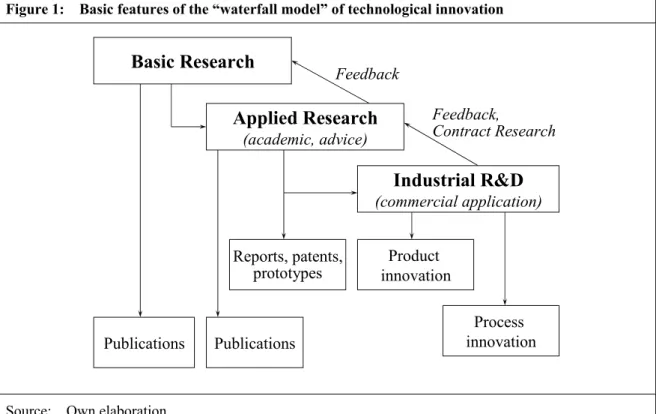
Figure 1: Basic features of the “waterfall model” of technological innovation 41 Tables
Table 1: The German BMZ’s funding of Development Research, 2006 11 Table 2: DfID Central Research Department, budget 2006/07 16 Table 3: MinBuZa/DGIS budget for Development Research 2005 23 Table 4: Budget lines of the Swedish Foreign Ministry, 2006 (in thousands SEK) 29 Table 5: Swedish spending on Development Research 2001–2005, total and
budget lines (in million SEK) 30
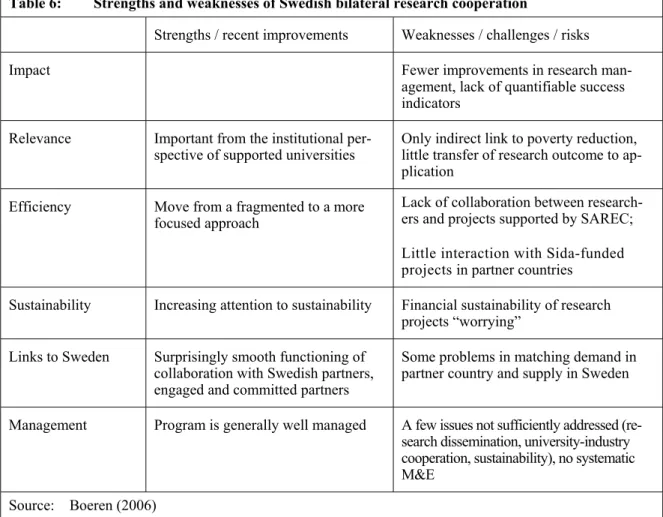
Table 6: Strengths and weaknesses of Swedish bilateral research cooperation 31 Table 7: Strengths and weaknesses of Swedish support to international or regional
thematic research programs 33
Table 8: Distribution of U-FORSK contributions to different scientific disciplines
ADLAF Arbeitsgemeinschaft Deutscher Lateinamerikaforschung AvH Alexander von Humboldt Foundation
AERC African Economic Research Council ASC African Studies Centre
BBSRC Biotechnology and Biological Sciences Research Council BIGS Bonn International Graduate School
BMBF Bundesministerium für Bildung und Forschung (Federal Ministry of Education and Research)
BMELV Bundesministerium Ernährung, Landwirtschaft und Verbraucherschutz (Federal Ministry of Food, Agriculture and Consumer Protection)
BMU Bundesministerium für Umwelt, Naturschutz und Reaktorsicherheit (Federal Ministry for the Environment, Nature Conservation and Nuclear Safety) BMWi Bundesministerium für Wirtschaft und Technologie (Federal Ministry of
Economics and Technology)
BMZ Bundesministerium für wirtschaftliche Zusammenarbeit und Entwicklung (Federal Ministry of International Cooperation and Development)
BNPP Bank Netherlands Partnership Program
CERES Research School for Resource Studies for Development CGIAR Consultative Group of International Agricultural Research CRD Central Research Department
CSA Chief Scientific Advisor
CSC Commonwealth Scholarship Commission
DAAD Deutscher Akademischer Austausch Dienst (German Academic Exchange Service)
DC Development Cooperation
DCO/OC Department of Cultural Cooperation, Education and Research/Research and Communications Division (Dutch Ministry of Foreign Affairs)
DEFRA Department for Environment, Food and Rural Affairs DELPHE Development Partnerships in Higher Education Programmes DFG Deutsche Forschungsgemeinschaft (German Research Foundation) DfID Department for International Development
DGIS Directorate-General for International Cooperation
DIE Deutsches Institut für Entwicklungspolitik (German Development Institute) DIUS Department for Innovation, Universities and Skills
DPRN Development Policy Review Network DRC Development Research Centre DSA Development Studies Association DR Development Research EGDI Expert Group on Development Issues ESRC Economic and Social Research Council FCO Foreign and Commonwealth Office
GBP Great Britain Pound
GIGA German Institute of Global and Area Studies GTZ Gesellschaft für Technische Zusammenarbeit HEFCE Higher Education Funding Council for England HIV/Aids Human Immunodeficiency Virus
HUMAN Division for Human Sciences for Social Development ICT Information and Communications Technologies IDS Institute for Development Studies
ISS International Institute of Social Sciences
KIT Koninklijk Instituut voor de Tropen (Royal Tropical Institute) KTH Kungliga Tekniska högskolan (Royal Institute of Technology) LDCs Least Developed Countries
M&E Monitoring and Evaluation MENA Middle East and North Africa
MDGs Millennium Development Goals
MinBuZa Nederlands Ministerie van Buitenlandse Zaken (Dutch Ministry of Foreign Affairs)
MRC Medical Research Council
NAV Division for Natural Sciences for Sustainable Development NERC Natural Environment Research Council
NFP Netherlands Fellowship Programmes NGOs Nongovernmental Organizations
NL Netherlands
NPT Netherlands Programme for the Institutional Strengthening of Post-secondary Education and Training Capacity
Nuffic Netherlands Organization for International Cooperation in Higher Education NWO Nederlandse Organisatie voor Wetenschappelijk Onderzoek (Netherlands
Organization for Scientific Research)
OCW Dutch Ministry for Education, Culture and Science ODA Official Development Assistance
ODI Overseas Development Institute
OECD/DAC Organisation for Economic Cooperation and Development / Development Assistance Committee
OSI Office of Science and Innovation PDP Product development PPPs
PGU Politik for global utveckling (Policy for global development) PPP Public Private Partnership
R&D Research and Development RAE Research Assessment Exercise RAPID Research and Policy in Development
RAWOO Raad voor het Wetenschappelijk Onderzoek in het kader van Ontwikkelssamen werking (Netherlands Development Assistance Research Council)
RPC Research Program Consortia
SADEV Swedish Agency for Development Evaluation
SAREC Swedish Agency for Research Cooperation with Developing Countries SEK Swedish Krona
Sida Swedish International Development Agency UK United Kingdom
UNI Division for University Support and National Research Development WHO World Health Organization
WOTRO Foundation for the Advancement of Tropical Research (science division within NWO)
ZEF Zentrum für Entwicklungsforschung (Center for Development Research, Bonn University)
Summary
The comparative study on Development Research (DR) in Germany and three other Euro-pean countries was commissioned by the German Ministry of Economic Cooperation and Development (BMZ). It gives an overview of the available resources, the institutional set-ting and the governance of DR in the four countries. The paper will neither provide an in-depth evaluation of the DR realized by the four countries nor is it embedded in a more general discussion of the growing role of research for development cooperation.
The understanding of the term DR varies largely in the four countries. In the most common and broadest definition DR is any kind of research with relevance for develop-ment and developing countries. Thus, a large number of disciplines may contribute to DR. A more restricted understanding defines DR as mainly social science based research on global and local processes of cultural, demographic, economic, environmental, political, technological and social change in low and middle income parts of the world. DR covers a wide array of applications, from feeding the academic search for new or improved knowl-edge to resolving immediate problems formulated by policy makers. In three of the countries, strengthening of research capabilities in the South is considered as a constitutive element of the promotion of DR.
DR in Germany
In Germany, DR (most often understood in the narrow sense of social sciences working on development issues) is funded within the overall context of Development Cooperation (DC) and as a segment of general research promotion.
BMZ as Germany’s lead ministry for Development Cooperation channels significant re-sources for DR and support to research capacities in partner countries, however, the visi-bility of this line of activity remains rather low. This is mainly due to a pronounced insti-tutional fragmentation. Within BMZ four divisions belonging to the Ministry’s three de-partments within BMZ are in charge of cooperation directly related to DR. Within the po-litical discourse on development, strengthening of research capabilities is not high on the agenda. Many actors perceive as quite long the impact chain between supporting science and technology in the partner countries and attaining the MDGs. Others fear that resources invested in the strengthening of knowledge systems in developing countries might tend to reach more privileged elites and less the target group of the poor.
For the year 2006, overall BMZ expenditure for the promotion of DR was estimated to be around 60 million €. Most BMZ support to DR is provided as core funding to national and international organizations, such as the German Academic Exchange Service (DAAD), the Alexander von Humboldt Foundation (AvH) and the German Research Foundation (DFG). Agrarian research is the most significant area receiving BMZ support most resources going to the Consultative Group of International Agricultural Research (CGIAR). Since 2007, BMZ support to DR has been increased significantly in terms of financial resources provided.
The German Federal Ministry for Education and Research (BMBF) is the lead minis-try for promotion of research in Germany and international research cooperation. Coopera-tion with developing countries is mainly supported in areas where
− the German science system necessarily has to cooperate with countries in the South (e.g. global environmental problems, ecology of tropical forests etc.),
− new technologies are developed for application in developing countries,
− mature processes or technologies need to be adapted to conditions in partner countries. Many university faculties are traditionally engaged in research relevant for developing countries, e.g. in the field of tropical agriculture and forestry or spatial planning. In the field of social sciences there are a few specialized centers. In recent years, development studies at Germany’s universities have lost ground. Many research centers with a former focus on development or area studies have been closed down or given a completely differ-ent oridiffer-entation.
The German Development Institute (DIE) is Germany’s think tank for development pol-icy and cooperation. In its applied research it covers a broad range of topics related to economic, social and political dimensions of development and its institutional and the-matic environment.
Bonn University hosts the Center for Development Research (ZEF) with three units working on A) political and cultural change, B) economic and technological change and C) ecology and natural resources management.
The German Institute of Global and Area Studies (GIGA), is funded by the German Foreign Office and the city of Hamburg, and has institutional ties to the University of Hamburg.
United Kingdom
DR in the United Kingdom (UK) is on the one hand funded as an integral part of British Official Development Assistance (ODA), and thus under responsibility of the Department for International Development (DfID). On the other hand, it is part of the public support to research, on the government level coordinated by the Department for Innovation, Univer-sities and Skills (DIUS). The British government stresses the importance of evidence-based policy making. This gives research high relevance as a tool for informed decision-making.
DfID defines DR financed by British ODA as research with a long-term perspective that generates new knowledge and contributes to the global pool of knowledge and technolo-gies conducive to development. Building research capacities in the South is an explicit goal of DR. Since the approval of the International Development Act (2002) all DfID ac-tivities (including DR) have to comply with the overall mandate of reducing poverty and achieving the MDGs.
The DfID Research Strategy 2008-2013 sets priorities in applying newly created and exist-ing knowledge, influencexist-ing policy to make sure research makes an impact, usexist-ing different methods of funding to join up research efforts at different scales (national, regional, global), strengthening developing countries’ capability to do and use research and finally, helping partners predict and respond to development challenges and opportunities beyond the 2015 target date for achieving the MDGs.
DfID invests around 4 % of its budget in support for DR. A white paper published in July 2006 projects a doubling of spending for DR by 2010. Two thirds of DfID's research budget is earmarked for research on sustainable agriculture, mortal diseases, state failure with respect to poverty and global climate change.
DfID puts emphasis on the application of research results. To ensure an adequate transfer of research outcomes to the potential users, a special Communication Team was estab-lished within DfIDs Central Research Department (CRD). DfID highlights the build-up of research capacities in the countries of the South as an important task of CRD and of the DR budget.
Research promotion in the UK is realized in two ways: The DIUS is politically responsi-ble for the institutional support to universities and for financing of research projects. On the more operational level, institutional support to universities is the task of Higher Educa-tion Funding OrganizaEduca-tions. Eight Research Councils (RCs) are responsible for the com-petitive allocation of financial resources for research. The RCs are organized along aca-demic disciplines and work as autonomous organizations.
Many British universities are engaged in research projects with relevance for developing countries. At some universities, development relevant centers have been established. Sev-eral universities offer Development Studies as an interdisciplinary and mostly social sci-ence oriented career. Recently, six independent London-based universities engaged in DR have jointly established the Bloomsbury International Development Centre. The largest organizations specialized in DR are the Overseas Development Institute (ODI) and the Institute for Development Studies (IDS).
Netherlands
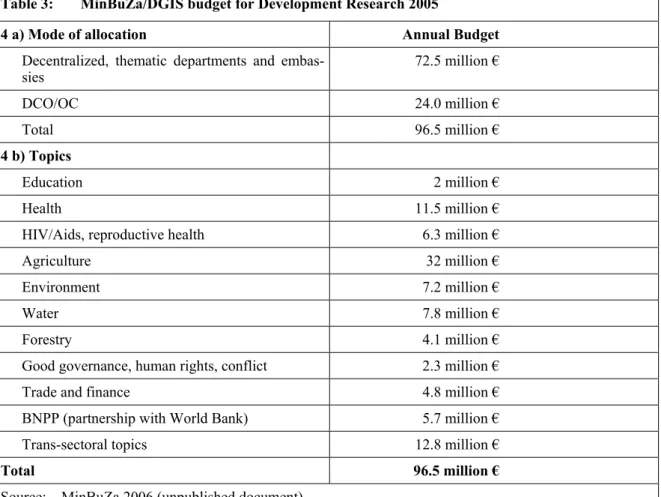
In the Netherlands, DR is understood in its broadest sense, embracing concrete re-search projects and consultancies, promotion of rere-search in the specific thematic field and linking up with research capacities and networks in the South. It is necessary to distin-guish between the budget lines within the MinBuZa (Foreign Office) ODA spending and DR financed by the Netherlands Organization for Scientific Research (NWO).
Dutch development policy assigns great importance to DR. Research is seen as an in-strument of DC and integrated into the policy cycle. MinBuZA is defined as a learning organization with external actors – Dutch and from the South – integrated into learning processes. The topics of DR are derived from the needs of sectoral and regional politics. In 2005 MinBuZa invested 2.3 % of the ODA budget for DR.
Since 1992, a clear “South Agenda” largely decided on promotion of DR in the Nether-lands. The primary objective of the DR promotion in the context of DC was to support a research agenda defined and implemented in the countries of the South. Demand tion and promotion of scientific capabilities in the South were the most important orienta-tion points of this agenda. In 2005, MinBuZa approved a new strategy for DR, largely re-placing the “South-Agenda”. It places special emphasis on the application and the impact of research outcomes for poverty reduction and sustainable development. In order to re-ceive support, research and research capacities must be embedded in the action fields and knowledge needs of politics, economy and society.
NWO’s role is to promote high quality and innovative Dutch research. A recent strat-egy paper puts emphasis on an increased effectiveness of investment in research, stressing the need to create critical masses in specific areas. Research promotion is now to be real-ized within larger contexts instead of a large number of isolated smaller projects. A closer link between science and society is intended to assure that demand from society is met by supply from science and that research outcomes are applied in practice. The Foundation
for the Advancement of Tropical Research (WOTRO) is the foundation within NWO in charge of DR.
Nuffic is the Dutch organization for international cooperation in tertiary education and re-search, financed by the Ministry for Education and the MinBuZa. It supports tertiary edu-cation and research organizations in partner countries and provides individual support to mid-career professionals from countries in the South.
At a number of Dutch universities, scientists work on aspects of DR, either in the context of multi-disciplinary research with social or spatial orientation or in disciplinary research, e.g. in agricultural sciences or medicine. The International Institute of Social Sciences (ISS) and the African Studies Centre (ASC) are exclusively dedicated to DR. Many fac-ulties engaged in multidisciplinary DR are interlinked under the umbrella of the Research School for Resource Studies for Development (CERES).
Sweden
Sweden follows a comprehensive approach to DR and invests a significant proportion of its ODA in this policy field, focusing on the strengthening of research capabilities of part-ner countries and of regional and international organizations. Promotion of Development Studies in the sense of creating knowledge on development processes and developing countries plays a more limited role.
Within the Swedish government the political responsibility for DC lies with the Ministry of Foreign Affairs. Regarding the central government budget, DC is the largest of the Ministry’s six policy fields. The Swedish International Development Agency (Sida) is the central implementing agency, working with around 120 partner countries. Sweden invests around 6 % of its ODA in DR. SAREC is the Sida department in charge of DR. SAREC combines elements of a classic public administration allocating financial resources for re-search with functions of a rere-search council. The aim of Swedish cooperation is to strengthen the research capacities of partner countries and at the same time to pro-mote development-oriented
research.
Since 1975, Sweden has been engaged in bilateral cooperation to strengthen partner countries’ capabilities to conduct own research. In the first years, cooperation was mainly geared to strengthening national research councils. In the next period, focus was shifted towards training of researchers, later on complemented with investment in infrastructure, equipment, libraries, archives and ICT equipment. Since the 1990s the program focuses on comprehensive support with the aim of establishing research cultures at national public universities. Assistance was reduced to a limited number of partner countries in order to provide more effective support.
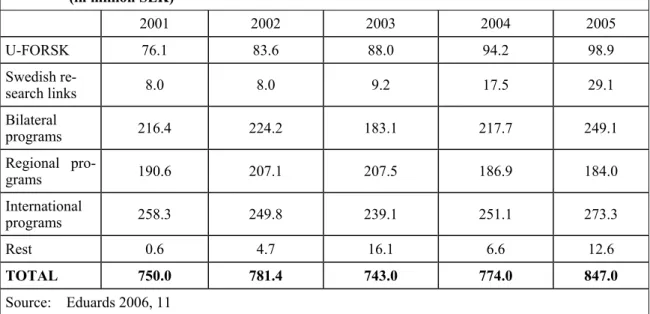
More than half of SAREC’s total budget goes to international and regional thematic research programs. Important international organizations that receive SAREC funding are the World Health Organization (WHO) and the Consultative Group on International Agricultural Research (CGIAR), among others.
There are two lines of activities financed by Sida/SAREC with the objective of support-ing DR in Sweden. The first and largest line is “U-FORSK”, administered by Sida/SAREC in its function as Sida’s Research Council for DR. The second line is called
Swedish Research Links and is earmarked to promote research cooperation between re-searchers in Sweden as well as and in (advanced) developing countries. It is administered by the Swedish Science Council (Vetenskapsrådet).
Where does German DR stand by international comparison?
In a way, it is a German specificity that here the term DR is mainly reserved for interdisci-plinary, social science-based research on development processes and developing countries. Germany’s position regarding applied development studies can be assessed as rather strong while the position of DR at Germany’s universitiesis a matter of concern.
Research in other disciplines relevant for developing countries and for solving global problems (water engineering, agriculture, health sciences) is to a large extent de-linked from the “development community” in politics and international cooperation. The situa-tion is rather similar with respect to the goal of strengthening research capacities in the South. Considerable resources are channeled to knowledge centers in the South. However, programs that systematically link these with research institutes in Germany are largely non-existent. Institutional fragmentation lowers the visibility of German DR. However, there is also some doubt as to whether Germany’s contributions and the personal resources available in this field of activity are adequate in quantitative terms.
In order to achieve a more adequate position in the international donor community, Ger-many should, within the framework of the 0.7 % ODA goal, increase, its spending on DR above average. Increasing financial investment in DR should be accompanied by measures to ensure adequate political governance and conceptual work in this field of activity, e.g. by bundling responsibilities within BMZ.
A rather strict division of functions within the German government in general does not facilitate joint action between BMZ and other Ministries in charge of relevant research areas (BMBF, BMWi, BMELV). However, recent political developments open up win-dows of opportunity for enhanced coherence within the German government in the field of support to DR. In January 2008, an agreementbetween BMZ and BMBF was signed with the objective of “harmonizing the scientific and technological cooperation of BMBF and the development cooperation of BMZ in joint projects and identifying ways to achieve closer cooperation”. In February 2008, the German cabinet approved the “Internationali-zation Strategy for Science and Research”. The four objectives of this strategy bridge the interests of the German innovation system and the goals of international development. Thus, the political conditions for improved policy coordination between the two ministries most relevant for DR have improved. This opens a window of opportunity that should be taken ad-vantage of by designing and implementing inter-ministerial projects in the field of DR.
Common challenges for DR in the four countries
The UK has the most complete and coherent system of DR of the four countries under consideration. The other countries considered have clear-cut flaws in at least one element of the knowledge system: Germany clearly in the generation of new fundamental knowl-edge at university level, the Netherlands and Sweden more in applied research.
In all four cases, problems were reported regarding the position of a research that is in line with the needs of policy makers and is at the same time consistent with criteria of high academic
quality. This difficult sandwich position of applied research will probably be further aggravated by two different agendas difficult to reconcile: the Lisbon Agenda pushing forward academic excellence, and the MDG Agenda calling for research to deliver tangible outcomes within a rather short time-frame.
In order to maintain an adequate level of applied DR efforts should be made to maintain and increase financial resources for applied DR and to increase its visibility and image. The transparency regarding available resources in DR should be enhanced and today de-centralized activities could be clustered. Career opportunities for applied researchers should be improved, first by maintaining, within the academic system, high-level aca-demic positions and second by fostering the mobility of staff between research organiza-tions on the one hand and high-level public administration and possibly the private sector on the other.
While these measures have to be taken on the national level it should also be discussed how cooperation and coordination among European countries and with the EU itself can be enhanced. Most bilateral donors are set to significantly increase their resources ear-marked for DR promotion. Pooling at least some of these resources could give rise to very substantial DR funding on a European or international level.
Options to strengthen the European level of DR can reach from increasing transparency concerning the research done at the different institutes, through establishing exchange platforms such as a “European Summer School for Development Research” to the estab-lishment of a European Institutefor DR. Creating new opportunities for scientific publish-ing could also contribute to makpublish-ing applied DR more attractive for future generations of researchers.
A further point related to the promotion of development studies that should be discussed among interested stakeholders is the most promising way to involve stakeholders from the South in the definition of agendas and the governance of DR.
Strengthening research capabilities in the South is part of the agenda of all four countries, and has been for quite some time. Since the outcome in most partner countries is still un-satisfactory, a more in-depth analysis and exchange of experience is required.
The country case studies have identified no clear and urgent reform needs regarding donor commitments to strengthening research for development in areas like agriculture, health etc. With regard to some very cost intensive research fields it should be discussed, how-ever, how the ODA-financed support relates to the activities of new actors endowed with large financial resources (e.g. the Gates Foundation).
1 Introduction
The following paper was commissioned by the German Ministry of Economic Coopera-tion and Development (BMZ) in order to provide the ministry itself and other interested stakeholders with a first knowledge base that may help to assess Germany's Development Research, benchmarking it with three other European countries. The aim of the paper is to give an overview of how the available resources, the institutional setting and the govern-ance of Development Research in Germany compare to the situation in selected bench-mark countries. For this reason, the paper will neither provide an in-depth evaluation of the Development Research realized by the four countries nor is it embedded in a more general discussion of the growing importance of support to science and research for de-velopment in the context of globalization and increasingly multilateral dede-velopment coop-eration.
The chapters on Development Research in the United Kingdom (UK) and the Netherlands (NL) as well as parts of chapter 4 are based on reports written by Andrea Goetzke from Newthinking communication, the information regarding Development Research in Swe-den was provided by representatives from SweSwe-den’s Foreign Office and Sida-SAREC. Our thanks go to all the interviewees who contributed to this study by sharing information and laying the groundwork for deeper insights into the functioning of Development Re-search in their respective countries. As will be shown below, the institutional setting of Development Research in all the countries analyzed is complex and to some degree in flux. This implies a certain risk of imprecision in the paper’s more descriptive parts, but it should not affect the overall usefulness of the respective chapters for the further analy-sis.
What we are talking about: Trying to define “Development Research”
In order to compare and assess Development Research in different countries, the first step will be to clarify what we are talking about. One thing that will become clear in the coun-try reports in chapters 2 to 5 is that what is actually meant by the term Development Re-search varies greatly. The different approaches clearly go beyond pure semantics and rather affect the overall philosophy and the objectives associated with Development Re-search. This makes it difficult to analyze strengths and weaknesses of different approaches and policies, what might be the basis for mutual learning processes. Nevertheless, a com-parison between the different approaches and policies may prove conducive to the reflec-tion about the role and objectives of Development Research in Germany in general and about the institutional context in which Development Research is embedded in particular. Also, a benchmarking of the financial resources that different donors invest in Develop-ment Research proved to be more difficult than expected, not only (but especially) in Ger-many:
The most common and broadest definition links Development Research to the geographi-cal relevance of its outcomes. Development Research in this sense is any kind of research with relevance for development or for overcoming obstacles to it in the countries of the South. Thus, a large number of disciplines may contribute to Development Research, be it agronomy, medicine, economy or biotechnology etc., if they bear a benefit for developing countries.
There is also a much more restricted understanding of the concept that corresponds largely with the definition of “Development Studies” by the UK Research Assessment Exercise
(RAE) as “issue-driven research concerning the analysis of global and local processes of cultural, demographic, economic, environmental, political, technological and social change in low and middle income parts of the world, with particular reference to struc-tures and institutions; the changing relationships between developed and developing countries; and the critical interrogation of theories of these processes and relationships, and of development policy” (cited by Jones / Young 2007, 2).
A second division line is marked by the target groups of research. Development Research (even applied and problem oriented) can be strongly influenced by academic interests and then generally follows a medium to long-term agenda. The target group of this kind of re-search is mainly the academic community, the rere-search outcome is most often published, and thus the knowledge generated constitutes a public good. Development Research can also be oriented to giving answers to more day-to-day questions or to resolving immediate problems formulated by policy makers. This kind of activity at the border between re-search and short-term consultancy is not always categorized as Development Rere-search and may instead e.g. be classified as policy advice, as in the case of the UK. Evaluation of de-velopment cooperation is gaining importance in the context of a stronger impact orienta-tion, but it may also be taken out of the general understanding of Development Research in the different countries concerned.
Finally, in all countries of the sample but Germany, strengthening of research capabilities in the South is directly considered part of promotion of Development Research. This does not imply that Germany is not investing in this task; actually, quite large sums are in-vested. However, the activities are rather de-linked from the support of Development Re-search in Germany, on the level of political governance as well as on the more operational levels. Therefore exchange and cross-fertilization between support measures and research tends to be limited.
In the following chapters we will outline the development research systems in the four countries, focusing on aspects of governance and institutional setting, budget and objec-tives, organizations and activities. Wherever possible, we will add information about how actors from the four countries assess strengths and weaknesses of the respective system. In the case of Sweden, this can be done in a rather detailed way, due to the fact that in 2006 Swedish Development Research was evaluated in a series of comprehensive studies. In the case of Germany, a preliminary assessment will be given in chapter 7.
2 Development Research in Germany
In Germany, the common understanding of Development Research (“Entwicklungsfor-schung”) is very close to the definition given above of development studies by the UK Research Assessment Exercise (RAE). German Development Research is, thus, basically interdisciplinary, mainly social science-based research on development processes and de-veloping countries and not so much natural, technical or health sciences-based research designed to facilitate development.
This does not imply, of course, that no Development Research in the sense of provision of solutions for specific problems that affect developing countries is conducted in Germany. Important health research relevant to developing countries is actually carried at interna-tionally renowned German organizations such as the Robert Koch Institute in Berlin, but it is in no way linked to the development community in the stricter sense. Research on
tropi-cal agriculture or forestry, including natural science-based research, is done by traditional universities, e.g. in Göttingen, Hohenheim and Stuttgart; here there are some connections and matching events with the broader research community, such as the annual “Tropen-tag”, an interdisciplinary conference organized by five important universities doing re-search in tropical agriculture and forestry. Aspects of natural resources management are dealt with e.g. by physical geographers or in the field of hydraulic engineering. Here, ex-change among researchers is most often carried out within the relevant scientific disci-plines, and systematic contact or cross-fertilization with the interdisciplinary field of de-velopment studies is still more the exception than the rule. This seems to be changing, e.g. in the context of research on climate and environmental change, which calls for inter-disciplinary approaches, including the involvement of natural scientists.
2.1 Research as an element of German Development Cooperation: Political framework conditions and governance aspects
Research does not have a prominent position within Germany’s development cooperation. Even though considerable resources are channeled for this purpose, the visibility of this field of action remains quite low. This is mainly due to a pronounced institutional frag-mentation of political governance when it comes to Development Research and related activities. First of all, due to agreements within the German government from the early 1970’s onwards, the lead ministry for international research cooperation is the then Minis-try for Education and Science (today’s MinisMinis-try for Education and Research, BMBF), while BMZ remains in charge of generic support to research capacities or universities in the South, research directly supporting the proper functioning of its own policy field (“Ressortforschung”) and of international agricultural research. In February 2008, how-ever, a new strategy for the internationalization of science and research was submitted by BMBF and approved by the German cabinet. One aspect of this new strategy is stronger cooperation between BMBF and BMZ concerning the scientific and technological coop-eration specifically with anchor countries (BMBF 2008).
Within BMZ, political responsibilities are not concentrated in one unit. No less than four divisions within BMZ are in charge of cooperation lines related to Development Research, and they belong to the three different departments of the Ministry:
− Division 111 is politically responsible for the programs related to the promotion of universities in partner countries as well as scientific cooperation,
− Division 210 hosts the BMZ officer in charge of development studies in the stricter sense,
− Division 311 governs programs of tertiary education (within the overall context of promotion of education),
− Division 314 allocates funds for international agricultural research.
Additional divisions within the ministry are in charge of activities that have a more or less direct relation to Development Research, e.g. Division 305, in charge of international technology transfer and intellectual property rights, and Division 315, hosting activities related to the application of information and communication technologies to development processes.
Comprehensive strategy papers that might define overarching goals and the roles of the different lines of action within the Ministry are not sufficient to compensate for this insti-tutional fragmentation. The most recent paper on cooperation with universities in the con-text of German development cooperation dates from 1992, a new position paper under the heading “Knowledge for Development” has been drafted and discussed within the minis-try and with the relevant development actors.
Relevant discussions about future cooperation in science and research are carried out in a decentralized way, often by the German development agencies or in informal meetings. However, the stakeholder group that pushes forward these debates is rather limited. Strengthening of research capabilities in the South is not prominent on the political agenda. Many DC actors perceive as quite long the impact chain between the support to universities and research centers on the one hand and poverty reduction and the other MDGs on the other. Others fear that resources invested in the strengthening of knowledge systems in developing countries might tend more to reach more privileged elites and less the target group of the poor.
Research as an element of German DC: Budget and objectives
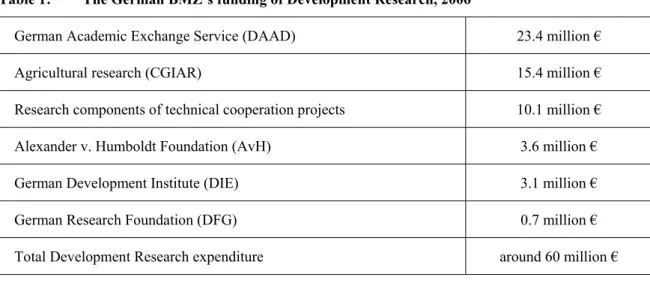
For the year 2006, overall BMZ expenditure for the promotion of Development Research was estimated to be around 60 million €. In Table 1 we can see, however, that the support to Development Research channeled through BMZ is divided among various lines of ac-tion and instituac-tions, due to the instituac-tional fragmentaac-tion of the political governance of Development Research in Germany, as noted above.
In 2006, BMZ spending on activities related to research concentrated on agrarian research, with around 15.4 million €. The Consultative Group of International Agricultural Research (CGIAR) centers is the main recipient of these funds. 75 % is provided as targeted fund-ing, i.e. for defined projects, and only 25 % is given as institutional support to the centers. Furthermore, BMZ funded the German Development Institute (DIE) with 3.1 million € and spend 10.1 million € for research components of technical cooperation projects. Addi-tionally, BMZ annually commissions mostly small and short-term studies, responding to specific knowledge needs of its divisions and departments, with 400,000 € per year up to 2006. In 2007, however, an additional 2 million € was allocated yearly for (program-based) financing to Development Research at the DIE, universities and other organiza-tions. This significant increase reveals the growing relevance of Development Research for BMZ.
Most support to Development Research is nevertheless provided as core funding to na-tional and internana-tional organizations. Examples would include the 23.4 million € BMZ funding for the German Academic Exchange Service (DAAD) in 2006, the 3.6 million € funding for the Alexander von Humboldt Foundation (AvH) and the 0.7 million € BMZ funding for the German Research Foundation (DFG), also in 2006.
Calculating the participation of Development Research in Germany in ODA is a very complex task. Firstly, there are the expenditures of BMZ for the promotion of Develop-ment Research, data which – due to the organizational fragDevelop-mentation within the Ministry – are difficult to collect. Secondly, spending by the BMBF, for example around 44 million € in 2006, is also reported to the OECD/DAC as ODA. It is therefore difficult to calculate a concrete figure. Nevertheless, it can be said that participation of Development Research in
ODA in Germany appears to be lower than in the case of the Netherlands, the UK or Swe-den, independently of the basis used for the respective calculation.
Table 1: The German BMZ’s funding of Development Research, 2006
German Academic Exchange Service (DAAD) 23.4 million €
Agricultural research (CGIAR) 15.4 million €
Research components of technical cooperation projects 10.1 million €
Alexander v. Humboldt Foundation (AvH) 3.6 million € German Development Institute (DIE) 3.1 million €
German Research Foundation (DFG) 0.7 million €
Total Development Research expenditure around 60 million €
Source: BMZ 2007, unpublished document
Research as an element of German DC: Organizations
The most important German contribution – at least in terms of financial resources – to the strengthening of knowledge-based development in the South is the institutional funding provided to the German Academic Exchange Service (DAAD). BMZ funding for DAAD has increased significantly in the last two decades, from 5.7 million € in 1990, 9.8 million € in 1995, 20.4 million € in 2002 to around 23.4 million € in 2006.
BMZ funding for DAAD serves to promote young and junior academics and researchers and to provide in-service training for experts and professionals from developing countries. Emphasis is put on the “sur-place” third country scholarship program, the postgraduate courses for professionals relating to developing countries offered at German universities, support for subject-specific university partnerships, the alumni programs and the alumni summer school program offered by German universities for their graduates from develop-ing countries, as well as country-specific support for young and junior academics and re-searchers run together with advanced developing countries. DAAD receives the major part of its funding from the German Foreign Office (around 125.5 million € in 2006) and the BMBF (64.1 million €).
A large proportion of German investment in Development Research is the funding of agrarian research carried out by the institutes of the Consultative Group of International Agricultural Research (CGIAR). BMZ was a co-founder of CGIAR and Germany is among its ten largest donors. However, in 2000 the budget earmarked for CGIAR support was reduced from an annual 31 million € to 18 million €, leading to a concentration of support on only 9 Centers of a total of 16.
Many projects of German DC include research and development (R&D) components. In 2006 the financial resources of these components added up to around 10 million €. The German Development Institute (DIE) is Germany’s think tank for development pol-icy and cooperation. Founded in 1964, it is engaged in applied research, polpol-icy advice and
training in the context of development cooperation and global governance. In its research, the DIE seeks to reconcile an orientation toward academic quality with practical relevance for policy and development cooperation. It covers a broad range of topics related to eco-nomic, social and political dimensions of development and its institutional and thematic environment. In 2006, DIE was evaluated by a team commissioned by the “Wissen-schaftsrat” (German Science Council). The assessment regarding the quality of research and the bridging function between research and policy was very positive.
2.2 Development Research as an element of German research promotion: Political framework conditions, governance aspects and actors
In 2006, around 44 million € was spent by the BMBF for scientific and technological co-operation with developing countries, excluding coco-operation in the field of energy provi-sion.1 BMBF cooperation with developing countries follows the overall objective of ex-panding national research programs and ensuring the international qualification of re-search on the basis of cooperation with developing countries in areas where
− the German science system necessarily has to cooperate with countries in the South (e.g. global environmental problems, ecology of tropical forests etc.),
− new technologies are developed for application in developing countries,
− mature processes or technologies need to be adapted to conditions in partner countries. One of the objectives is to transfer scientific and technological knowledge in order to strengthen R&D capacities and economic performance in developing countries. The focus of R&D cooperation with developing countries is on
− investigations on tropical ecosystems, biodiversity and their sustainable utilization,
− development of technologies with low emission levels, environmentally friendly pro-duction processes, waste water and waste treatment and management,
− research on contamination of soils and air,
− combating tropical diseases,
− plant breeding, bio-chemical production processes,
− sustainable management of marine resources and combating environmental problems in coastal areas.
As far as the actors are concerned, many university faculties are traditionally engaged in research relevant for developing countries, e.g. in the field of tropical agriculture (Hohen-heim, Göttingen), forestry (Freiburg), spatial planning (Dortmund) etc. In the field of so-cial sciences there are a few speso-cialized centers, e.g. at Bayreuth University (Africa) or Bielefeld (Development Sociology). In the context of the reforms of Germany’s university sector, new master’s courses are in the process of being implemented, e.g. International Development Studies in Marburg, Development Management in Bochum or International
1 Since 1999 international cooperation in the field of energy has been part of the mandate of the Federal Ministry of Economics and Technology.
Relations and Development Policy in Duisburg/Essen, or other, often small but specialized programs.
Bonn University hosts the Center for Development Research (Zentrum für Entwick-lungsforschung, ZEF) with its three units:
− Political and Cultural Change (ZEF A),
− Economic and Technological Change (ZEF B),
− Ecology and Natural Resources Management (ZEF C).
Since 1999, the ZEF has offered a PhD program in the English language, the “Bonn Inter-national Graduate School for Development Research (BIGS – Development Research)” which accepts around 40 PhD students a year.
The German Institute of Global and Area Studies (GIGA), founded in 1964, is funded by the German Foreign Office and the city of Hamburg, but with institutional ties to the University of Hamburg. Its research is focused on political, economic, and social devel-opments in sub-Saharan Africa, Asia, Latin America as well as North Africa and Middle East. The area studies are furthermore concerned with developments in North-South and South-South relations.
In recent years, Development Research at Germany’s universities has definitively lost ground. Many research centers with a former focus on development or specially area stud-ies or related fields have been closed down or given a completely different orientation (Tetzlaff 2005). This trend can probably be traced back to the fact that, for many years and under conditions of insufficient economic performance in Germany, the general discourse on reforms in the university system has centered on strengthening the German innovation system, and it has therefore focused on the contribution of universities to economic devel-opment and international competitiveness. Dealing with develdevel-opment issues has not been considered crucial in this context, not even intensified research on more general aspects of globalization.
The considerable improvement experienced by Germany’s economy in recent years could serve to modify this discourse. On the other hand, the continuing implementation of the Lisbon strategy in the years to come could act as an additional catalyst in marginalizing Development Research. The present “High Tech Strategy” – essentially a national imple-mentation of the Lisbon process – focuses on research that strengthens Germany’s interna-tional competitiveness, stressing the need to foster university-industry linkages.
The “Initiative for Excellence” – Germany’s most significant program designed to strengthen universities in this context – aims to
− establish research schools for young scientists,
− establish internationally visible research beacons in Germany and
− build cluster areas of expertise in order to mobilize synergies.
In the context of this initiative, 17 “Excellence Clusters” were approved by the German Research Foundation (Deutsche Forschungsgemeinschaft) and the Wissenschaftsrat in Oc-tober 2006, only one of them with a social science orientation (Cultural Foundations of Social Integration), seven in “Biology and Medicine”, six in “Natural Sciences” and three in Engineering. None of them is explicitly or at least indirectly related to research on de-velopment, developing countries or globalization. In 2007, an additional 19 “Excellence
Clusters” were approved, this time with four of them in social sciences; one cluster in Heidelberg, with the title “Asia and Europe in a Global Context Shifting Asymmetries and Cultural Flows”, relates at least indirectly to developing countries, as do two graduate schools funded as well within the context of the “Initiative for Excellence”. These are the School of African Studies in Bayreuth and the Graduate School for Muslim Societies and Cultures in Berlin. Despite these recent developments, it can readily be confirmed that Development Research is not a line of research that lends itself to helping a university or a faculty to gain ground under conditions of increasing competition. Thus, it is very likely that the field will be further marginalized in the years to come.
3 United Kingdom
Funding and governance of Development Research in the UK are organized along two main lines:
− on the one hand, Development Research is an integral part of British Official Devel-opment Assistance (ODA) and as such is funded and guided by the Department for In-ternational Development (DfID);
− on the other hand, Development Research is part of the public support to research, on the government level coordinated by the Department for Innovation, Universities and Skills (DIUS).
Additionally, Development Research is shaped or influenced by a number of private foun-dations, independent research organizations and other government departments besides DfID.
The UK invests a high proportion of its ODA in Development Research; the resources available are set to increase significantly over the coming years. Beyond DfID funding, a number of other actors, such as Research Councils and foundations, are set to increase their budgets in relevant research fields. The role of non-governmental actors, such as the Wellcome Trust, will also grow. Development Research in the British system involves the strengthening of research capacities in the South as an essential task, and its relative im-portance will continue to grow in the future, with upcoming strategy papers emphasizing this goal.
International cooperation is also gaining importance; this refers on the one hand to coop-eration with stakeholders in developing countries, on the other hand to coordination and cooperation with actors from other donor countries.
3.1 Research as an element of British DC: Political framework conditions and governance aspects
The British government stresses the importance of evidence-based policy making, e.g. in the 1999 White Paper “Modernizing Government”. The idea is that all government de-partments should be able to ground their political decision-making on sound knowledge and information. This gives research high relevance as a tool for informed decision-making. Consequently, since 1998 overall research expenditures have steadily risen.
In recent years, Development Research – especially with a focus on Africa – has received increased attention and appreciation – mainly in the context of the UK's G8 presidency and commitment in the Commission for Africa. Development Research is defined as re-search with a long-term perspective that generates new knowledge and contributes to the global pool of knowledge and technologies conducive to development. Development Re-search is understood as generating global public goods. Building reRe-search capacities in the South is an explicit goal of Development Research.
In 2002, the International Development Act was approved, confirming poverty reduction as the central goal of British DC. All DfID activities have to comply with the overall man-date of reducing poverty and achieving the MDGs. This act also sets the thematic frame of reference for Development Research financed by DfID.
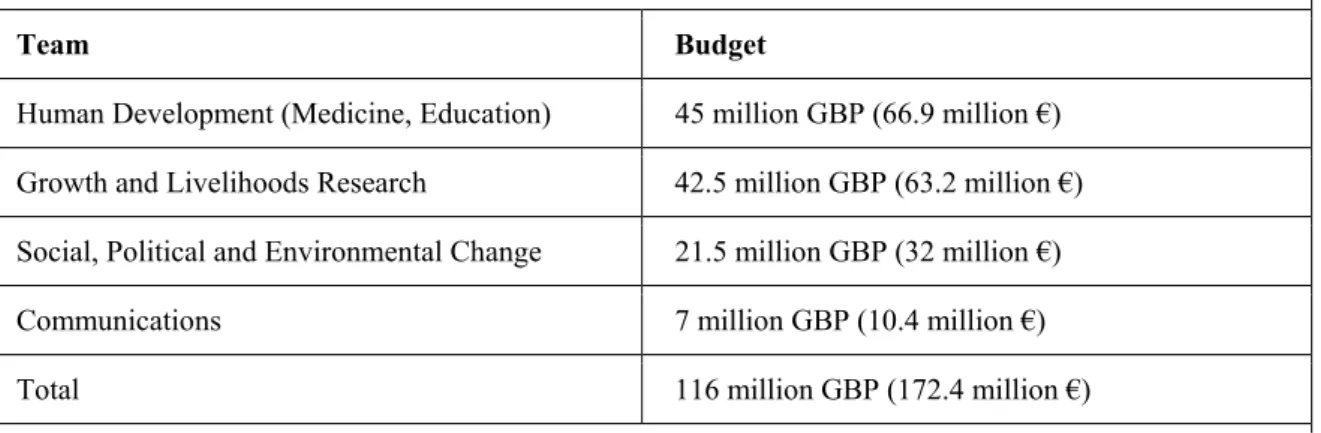
Also in 2002, the report commissioned by DfID, “Research for Poverty Reduction: DfID Research Policy Paper” (or in short the “Surr-Report”, after one of the authors) was pub-lished, analyzing the state of DfID financed Development Research at that point in time and giving decisive recommendations for its re-organization. The DfID research mandate was confirmed, the recommendations made led to the establishment of DfID's Central Re-search Department (CRD), bundling the formerly decentralized responsibilities for re-search. CRD worked out a strategy paper defining all major directions of CRD activities; it was approved in 2004 as the “DfID Research Funding Framework 2005–2007”. In 2006, CRD had a staff of 30, assigned to four thematic teams (see Table 2). DfID-CRD does not itself conduct research, instead supporting external research organizations. However, CRD claims the role of an “intelligent client”, hosting significant scientific capacities within the organization.
Another influential paper was presented in 2004: the report of the House of Commons Se-lect Committee on Science and Technology on “The Use of Science in UK International Development Policy”. It analyzed British Development Research as a whole, its applica-tion in development policy and its effects in the countries of the South. The overall as-sessment is rather critical, expressing criticism e.g. of an insufficient level of coordination among funding organizations and researchers.
As a rule, Development Research is competitively organized, and with few exceptions DfID funds are channeled through open tendering, leaving the relevant research organiza-tions without core funding. Since 2001 the UK's ODA has been provided untied, which also applies for Development Research funded through DfID. This implies that interna-tional research organizations are also eligible to participate in tenders for research pro-grams.
The DfID Research Strategy 2008–2013 sets priorities in applying newly created and ex-isting knowledge, influencing policy to make sure research makes an impact, using differ-ent methods of funding to join up research efforts at differdiffer-ent scales (national, regional, global), strengthening developing countries’ capability to do and use research and finally, helping partners predict and respond to development challenges and opportunities beyond the 2015 target date for achieving the MDGs.2
Research as an element of British DC: Budget and objectives
DfID invests around 4 % of its budget in support for Development Research, it is thus among the three Departments of the British government with the highest spending on R&D, and also among the donors with the highest proportion of research spending in the overall ODA budget. In July 2006, a White Paper was published (“Making Governance Work for the Poor”) that, while reaffirming the 0.7 % ODA goal set for 2013, projects a doubling of spending for Development Research by 2010. Table 2 indicates how the budget of DfID-CRD is distributed among its four teams.
Table 2: DfID Central Research Department, budget 2006/07
Team Budget
Human Development (Medicine, Education) 45 million GBP (66.9 million €) Growth and Livelihoods Research 42.5 million GBP (63.2 million €) Social, Political and Environmental Change 21.5 million GBP (32 million €) Communications 7 million GBP (10.4 million €) Total 116 million GBP (172.4 million €) Source: DfiD (unpublished document)
Approximately 35 % of the CRD budget is spent multilaterally. The numbers given in Ta-ble 2 do not include resources spent in a decentralized way by the DfID's policy-departments or country offices and that serve first of all to guide short-term decision-making. These studies are classified not as Development Research but as policy advice, and no data was available regarding the resources spent for this purpose.
Research financed by DfID targets global development problems, thus its organization does not correspond to the sectoral structures of British development policy. The problem-oriented approach is intended to foster multi-disciplinarity in research. Two thirds of DfID's research budget is earmarked for the following four topics:
− sustainable agriculture, especially in Africa
− mortal diseases
− state failure with respect to poverty (“where states do not work for the poor”)
− global climate change
The remaining third of the budget is spent on an ample spectrum of topics, responding to commitments made in past years and providing a certain level of flexibility to take up new and alternative topics.
The DfID Research Funding Framework 2005–2007 puts emphasis on the application of research results (“Getting research into use”). To ensure an adequate transfer of research outcomes to the potential users, a special Communication Team within CRD was estab-lished, with a staff of six persons managing around 6 % of the overall research budget. Its task is to communicate research outcomes to politicians, civil society, private sector, sci-ence and – mostly indirectly – to poor people in partner countries. Target groups may be
located in Great Britain or in developing countries. Communication thus includes both traditional publications in scientific journals and in media with target groups beyond aca-demia. On the one hand, the Communication Team is in charge of communication aspects of DfID financed research projects: 10 % of the budgets are especially earmarked for this purpose. On the other hand, it provides support to multilateral programs for the communi-cation of research, such as the PANOS Research Communicommuni-cation Program (RELAY), the Global Development Network or the AGORA initiative.3
In order to increase the effectiveness of Development Research, the involvement of po-tential users in the processes of designing, implementing and analyzing research projects is an important criterion for the allocation of research grants. The “Getting Research into Use” program has been up and running since 2006, the overall objective being to bring 30 research results of the former Renewable Resource Research Strategy (RNRRS) into ap-plication. The program RAPID (Research and Policy in Development) program at the Overseas Development Institute (ODI) investigates ways suited to achieving an efficient application of research results in development policy.
DfID highlights the build-up of research capacities in the countries of the South as an important task of CRD and of the Development Research budget. This task is mainly op-erationalized through inclusion of cooperation commitments as a criterion for the alloca-tion of research funding, e.g. in the context of the Development Research Consortia (see below).
DfID intends to use cooperation with other public funding agencies, private foundations and the private enterprise sector, to significantly raise the resources available for Devel-opment Research in the UK. Today a series of joint programs with several Research Councils and foundations are underway. Most Public Private Partnerships (PPP) are found in the field of health product development.
Programs and activities
DfID’s promotion of Development Research is carried out through competitive bidding processes in the directive mode. The department defines research topics or programs in the form of open tenders and invitations for application by the research community. As British ODA is untied, these tenders are in principle open for institutes all over the world. The new instrument of resource allocation introduced with the Research Funding Frame-work 2005–2007 is the so-called Research Program Consortia (RPC). These are asso-ciations of scientific organizations working jointly on specific development-oriented top-ics. The idea is to use the RPCs to reconcile and put into practice the various elements of the DfID research strategy.
The organizations filing applications are required to state
− how research outcomes will be applied, communicated and made effective,
− how research capacities in the partner organizations will be strengthened,
− what relevance the research has for poverty reduction and development,
− that the scientific research will meet standards of academic excellence.
Generally, RPC are funded over five years, usually with 750,000 GBP per annum. As a rule, a RPC consist of four to six organizations, with one defined as the lead organization. At least three of the organizations have to be located in developing countries. Despite the untied mode of funding, the majority of the RPC are led by British organizations, some by US universities and one by a university based in South Africa.
Beyond the RPCs, DfID supports projects that have been applied for in the context of spe-cific research programs, such as the Research into Use Program or regional agricultural research programs. In the area of social sciences, funding is allocated using the instrument of research centers, also common in the context of public research funding. Further sup-port is channeled through collaborative programs, together with additional partners and in the context of multilateral support. The most important partners in Great Britain are sev-eral Research Councils and private foundations.
3.2 Development Research as an element of British research promotion: Political framework conditions and governance aspects
In the context of British research promotion emphasis is placed on support for excellent knowledge creation at British universities and institutes. However, a number of projects with development relevance are being financed in this context as well. Research promo-tion in the UK is realized in two ways:
The Department for Innovation, Universities and Skills is politically responsible for the institutional support to universities and for financing of research projects. On the more operational level, institutional support to universities is the task of Higher Education Funding Organizations. HEFCE (Higher Education Funding Council for England) is the most prominent of the organizations funding higher education; it finances personnel and infrastructure expenditures. The volume of resources is based on the RAE that classifies universities according to a number of criteria related to the quality of their research. The RAE promotes the establishment of academic centers of excellence: Organizations that are already well positioned regarding the quality of their academic work receive higher basic funding. Some research organizations, mainly those with a limited educational mandate or none at all – such as the ODI or the Institute for Development Studies (IDS) – do not re-ceive any institutional funding.
Eight Research Councils (RCs) are responsible for the competitive allocation of financial resources for research. Universities and research organizations acquire the resources they receive beyond their institutional support through competitive procedures. Due to the low level of institutional support, the rule is that applications for research projects are filed in the mode of full economic costing, i.e. the offers submitted by British scholars are re-quired to calculate all relevant costs, including overhead. The RCs are organized along academic disciplines and work as autonomous organizations. Regarding Development Re-search, the four most important RCs are
− the Economic and Social Research Council (ESRC),
− the Medical Research Council (MRC),
− the Natural Environment Research Council (NERC) and the
The RCs finance research in the responsive and in the directive mode. The responsive mode leaves the definition of topics and priorities to the research community, partly within pre-defined areas.4 The overarching goal is to support academic excellence; the offers to be funded are assessed based on corresponding criteria. Funding goes only to British re-search organizations. The volume and duration of funded projects may be very diverse, extending from individual fellowships and programs with a duration of one to five years to rather large centers.
Numerous research projects with relevance for developing countries are funded in the con-text of responsive funding. It is very difficult to quantify the volume of this kind of Devel-opment Research, because it is difficult to distinguish cleanly between DevelDevel-opment Re-search and more general reRe-search with international relevance. For instance, medical re-search is in many cases relevant for developing countries; when the diseases investigated occur in developing countries, however, the research is not always carried out with an ex-plicit developing-country perspective. Involving a partner from the South is not manda-tory, and this increases the probability of success only if it contributes to scientific quality. Some RCs, however, have special programs for cooperation with developing countries, most often in cooperation with DfID.
Box 1: The Medical Research Council (MRC)
The MRC defines around 6 % of its portfolio as global research with direct relevance for developing countries. The major part of this global research portfolio is research on infectious diseases, such as malaria, HIV/Aids etc. Medical research to support the development in the South, mainly in Africa, is an explicit goal of MRC. Beyond the competitive funding of research projects, the MRC maintains several research organizations (MRC Units), two of them in Africa (in Gambia since 1949, in Uganda since 1988), absorbing around 75 % of the global research portfolio. MRC Units receive institutional support, their performance is evaluated every five years. Building scientific capacities in Africa is de-fined as an explicit MRC task. It is part of the mandate of the two African MRC Units. Additionally, MRC grants fellowships to African researchers. Since 1993, DfID and MRC have worked in a concor-dat, with DfID contributions of 4 million GBP annually. DfID and MRC jointly take decisions regard-ing the allocation of the resources allocated in the responsive mode.
Source: DfID 2006 (unpublished document)
Additional British actors funding Development Research
Each British government department has its own research budget. Of special relevance for Development Research is the Darwin Initiative of the Department for Environment, Food and Rural Affairs (DEFRA). In the context of this initiative, DEFRA allocates small grants (150,000 to 200,000 GBP for three years) for research cooperation projects between British scientists and scientists from the South jointly working on biodiversity-related topics.
Of growing importance for the financing of Development Research are the contributions of foundations. In the UK, the Wellcome Trust is of special importance for Development Research in the field of health, mainly due to its high resource endowment. The Wellcome Trust is co-founder of the newly established UK Collaborative on Development Science, together with DfID, OSI and the RCs, and hosts its secretariat. Other significant founda-tions are not British by character (e.g. the Gates Foundation).
Cooperation with the private sector is of relevance especially in the field of medical De-velopment Research. Product deDe-velopment PPPs (PDP) function as virtual pharmaceutical companies to which private and public donors, research organizations and ministries con-tribute on a multi-stakeholder and multilateral basis. The main task of the PDP is to de-velop new health products with special relevance for the countries of the South.
Of the British academic societies, the British Council is of special relevance. It adminis-ters the DELPHE initiative (Development Partnerships in Higher Education Programmes) financed by DfID, supporting cooperation between British researchers and researchers from the South, mainly in the form of mobility resources. The Royal Africa Society has its own program for the financing of research cooperation between Great Britain and Africa, in the context of its INVEST-Program.
In the Commonwealth context, Great Britain maintains special relations with developing countries that are members of this association. The Foreign and Commonwealth Office (FCO) and DfID jointly finance the Commonwealth Scholarship Commission (CSC), granting scholarships to researchers mainly from Commonwealth developing countries. While traditionally financing scholarships for studies at British universities, it recently in-troduced Split-Site and Distance Learning Awards. The overarching goal is to support re-searchers in the South, wherever possible embedded in further institutional support, with a view to contributing to building research capacities in developing countries.
Development research organization in the UK
Many British universities are engaged in research projects with relevance for developing countries. Most of them tend to specialize in certain disciplines in order to receive a good RAE assessment. At some universities, development relevant centers have been estab-lished as well as – more recently – RPCs. Several universities offer Development Studies as an interdisciplinary and mostly social science oriented career.
The largest organizations specialized in Development Research are the ODI and the IDS at the University of Sussex. Recently, six independent London-based universities engaged in Development Research have jointly established the Bloomsbury International Develop-ment Centre.
Coordination and division of tasks
The most important coordination mechanism among actors in British Development Re-search is the UK Collaborative on Development Science, established in 2006 as a response to the rather critical assessment by the 2004 report of the “Select Committee”. The main task of the Collaborative is thus coordination among the major funding organizations of Development Research. A small secretariat has recently been established at the Wellcome Trust.
At the level of publicly sponsored British research in general, coordination among the dif-ferent Government departments is the task of the Chief Scientific Advisor (CSA) of the government and the CSAs of the different departments.
In the context of the rather generously funded health related Development Research, a loose coordination mechanism has been in existence for quite a long time, the Funders Fo-rum on Health Research in Developing Countries. Participants of this foFo-rum, which meets