MICROSTRUCTURE EVOLUTION IN AZ61 ALLOY PROCESSED BY EQUAL CHANNEL ANGULAR PRESSING
Muralidhar Avvari *1, Narendranath S2, Mashamba Able1
1Department of Mechanical and Industrial Engineering, University of Johannesburg, Johannesburg-2006, South Africa.
2Department of Mechanical Engineering, National Institute of Technology Karnataka, Surathkal-575025, Karnataka, India.
Abstract
Magnesium and its alloys have play an strategic role in many applications like aerospace, automobile, nuclear, electrical and structural engineering due to its strength to weight ratio is very low when compared to aluminum, Titanium and steel. In the present work, AZ61 wrought magnesium alloy was processed by using Equal Channel Angular Pressing (ECAP) at three different temperatures of 483 K, 523 K and 573 K using up to four ECAP passes.A microstructural study was conducted by measuring the average grain size after each pass, for the three different processing temperatures. The mechanical properties of the processed samples were noted to improve due to the reduction in the grain size after each ECAP pass. After four ECAP passes, the average grain size of the AZ61 samples was found to be reduced to 85%, 81%, and 70% for the pressing temperatures of 483 K, 523 K and 573 K respectively. The tensile strength of the AZ61 alloy increased with increase in number of ECAP passes for each of the temperatures when compared to as-received alloy. For instances,
for the processing temperature of 483 K, 523 K and 573 K, the tensile strength increased to 24%, 10%, and 12% respectively at four ECAP pass. Also, the percentage elongation of the alloy was increased with increase in processing temperatures. Moreover, fracture topographies of the tensile surfaces are illustrated through scanning electron microcopy and reveal ductile fracture than as received alloy for four passes at each ECAP processing temperature.
Keywords: ECAP, AZ61 alloy, Grain refinement, Microstructures, Mechanical properties, XRD, and Fracture topography
*Corresponding author address: Department of Mechanical and Industrial Engineering, University of Johannesburg, Johannesburg-2006, South Africa. Tel.: +27- 610136100; E.mail: [email protected]
1. Introduction
Conventional metal-working processes such as drilling, milling, turning, casting, forging, rolling and extruding are the main industrial processes used in the manufacture of metal components. These conventional metal-working processes rely on localized plastic deformation of metals during material removal and forming. The final metal components from such conventional processes tend to have very similar mechanical properties as those of the parent unprocessed work-pieces. When superior mechanical properties are desired in the final metal component, non-conventional techniques that rely on severe plastic deformation during processing are used.
Severe plastic deformation (SPD) techniques are a group of metal forming processes that induce large strains, complex states of stress and high shear during processing to produce
components that have high-density defects, ultra-fine grain sizes and
nano-crystalline structures [1]. Mainly, Equal channel angular pressing (ECAP), Accumulative roll bonding (ARB), High pressure torsion (HPT), Mechanical Alloying (MA), and Asymmetric Rolling (ASR) are few techniques using in manufacturing industries so far among other SPD techniques.
In this paper, the ECAP metal-working technique is used to evaluate its effects on the mechanical properties of the AZ61 (Al-6.5%, Zn-1%) alloy at different processing temperatures. The ECAP technique is a new process that is capable of making uniform plastic deformation in a multiple materials without affecting any significant changes in their shape or cross sections in materials [2]. ECAP will allows the severe plastic deformation in bulk materials through its multiple extrusions. Also, complex microstructures and textures can be developed by changing the orientation of the billet between successive extrusions passes in ECAP [3]. Venkatachalam et al [4] produced desirable mechanical properties in test
samples of 2014Al by using different processing routes. Author has been concluded that the maximum deformation obtained in route Bc, where the specimen was rotated 90º counterclockwise after each pass. Valiev and Langdon [5] reported on aluminum using different die angles to study the mechanical improvements in material. Molnar and Jager [6] studied material behavior at different temperatures using die angle 90º and arc of curvature 45º. Valive et al (2006), concluded that the two and four ECAP passes provides maximum mechanical properties and then after 32 pass only could observe the slight improvements in properties [5]. Hence, in the present work, results were concluded up to four ECAP passes to reduce the cost of the product.
In this paper, AZ61 magnesium alloy was used as a material because of its high strength-to-weight ratio, and good formability [7]. The AZ61 alloy has been used in many industrial applications as structural parts in aero-space, automobile, nuclear industries [8]. However, magnesium and its alloys cannot be easily processed at ambient temperatures like face-centred cubic (FCC) and body-centred cubic (BCC) structured materials. Magnesium and its alloys have a hexagonal close packing (HCP) structure such that their slip systems activation at room temperature is insufficient to accommodate uniform plastic deformation of magnesium alloys, which can be considered as a major limitation [9]. Many authors conducted their SPD metal-working experiments on magnesium alloys using a single selected high temperature [10,11]. However, very few papers has been found that use and compare the effect of different ECAP processing temperatures on the mechanical properties and micro-structure of magnesium alloys [6]. Mechanical properties of the material can be improved by changing the size of the grains by varying the heat treatment processes. Hence, the main objective in the present work is to enhance the mechanical properties of the AZ61 alloy at different temperatures as suggested by R Z Valiev.
The outline of the ECAP process was planned with two equal channels, traversing at particular angles called the die angle ( ) and the arc angle (
) subtended at the channels intersection as shown in fig.1 [10]. In the present work, ECAP die is designed with a die angle of 120º and arc angle of 30º to reduce the dead zone of material. Here, the extrusion speed was taken as 2 mm/sec throughout the experimental work.Fig. 1. Working principle of Equal Channel angular Pressing [10]
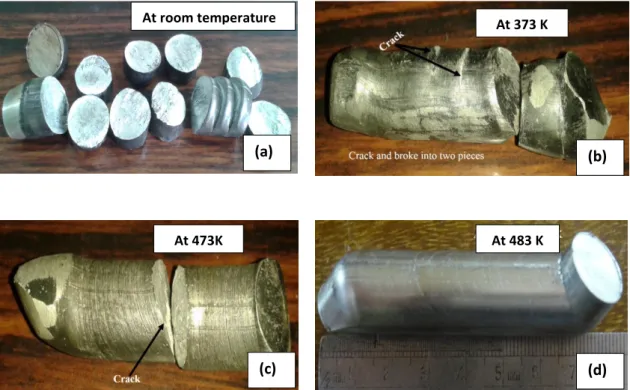
A commercial AZ61 alloy rod was machined into experimental samples having a diameter of 16 mm and a length of 80 mm. Machined experimental magnesium sample rods were homogenized at 673 K for 24h to remove the intermetallic heterogeneities that were present in the alloy [11]. Experiments were carried out using four ECAP extruding passes at three different temperatures of 483 K, 523 K and 573 K for route Bc (where, the specimen rotates 90º counter clock-wise direction at each successive pass). Among all fundamental routes, route Bc proves that the better deformation could be achieved which intern to increase in mechanical properties [4]. In this work, experiments were tried to perform at below recrystallization temperature (around 473 K) of magnesium and its alloys. But, as shown in
the fig. 2, the results were found to be many broke pieces at room temperature, broke and cracked surface at 373 K, and cracked surfaces at 423 K without using any external pressures.
Fig. 2. ECAP processed AZ61 alloys after first pass at different temperatures. (a) At Room temperature (b) 373 K (c) 473 K and (d) 483 K
For each ECAP pass, heating plates were arranged around the die to provide designated temperatures. Specimens were held in the channel for the same temperature in order to reach stabilization between the die and specimen. Graphite was used as a lubricant to reduce the friction between die and specimen. The preparation of sample for testing involves mechanical polishing using different SiC papers. In addition, the colloidal Al2O3 and diamond paste were used to achieve mirror surface finish. Picral reagent was used to etch the polished surface of the sample to observe the microstructure [11]. Microstructure study was carried out by linear interception method to know the grain size of AZ61 alloy using an image analyzer (BIOVIS Software). Hardness test was done using Vickers micro-hardness test rig by applying load of 100g with a significant time 13 seconds. On an average, 10 hardness tests were performed on each sample to obtain accurate hardness of AZ61 alloy. Tensile test specimens were prepared
(a) (c) (b) (d) At room temperature At 483 K At 373 K At 473K
as per ASTM E-8 standard following the gauge length of 15mm and a diameter of 5mm. The three average tensile tests were carried out using a Hounsfield Tensometer to analyze the tensile properties of AZ61 alloy.
3. Results & Discussion
3.1Effect of ECAP at different processing temperatures
In the results and discussion, Optical Microscope (OM) characterization, and mechanical properties have been evaluated for AZ61 alloy at three different processing temperatures of 483 K, 523 K and 573 K for the four ECAP passes. Also, fractured surfaces of AZ61 alloy have been analyzed and explained its behavior before and after four ECAP processes.
3.1.1 Microstructure analysis (i) OM Images
Fig.3 OM images of (a) As received AZ61 alloy at room temperature; (b) Homogenized at 673 K; (c) and (d) After two and four ECAP passes at 483 K; (e) and (f) After two and
four ECAP passes at 523 K; (g) and (h) After two and four passes at 573 K.
Fig. 3(a)-(h) shows the optical images of AZ61 alloy as received, homogenized at 673 K, and after two passes and four passes ECAP processed specimen structures at different processing temperatures of 483 K, 523 K and 573 K for route Bc. All microstructural images have been taken from the cross sectioned surface. The average grain sizes of the alloy was measured at different temperatures up to four passes. In the as received material, a large number of coarse grains were visible along with grain twins as shown in Fig. 3(a). These are expected to increase the twinning stress, and these twinning stresses get accommodated on the grain boundaries, thus supporting plastic deformation in the alloy. In addition, the shear deformation occurs in only one direction due to grain twinning [12]. After homogenization, the grain size was reduced while the grain count increased at the higher temperature of 673 K, for a soaking time of 24h as shown in fig. 3(b). In Fig. 3(c)-(h) the grain size was greatly reduced after shear deformation in the second and fourth ECAP passes at 483 K and 523 K for route Bc. The grain size reduction in the ECAP processed samples depends upon the
dynamic recrystallization [13]. But in the higher processing temperature at 573 K the reduction in grain size is minimum as compared to other processing temperatures. Fig. 3(g)-(h) shows clear bimodal structure because of increasing the number of passes at higher processing temperatures.
3.1.2 Variation of grain size with different processing temperature
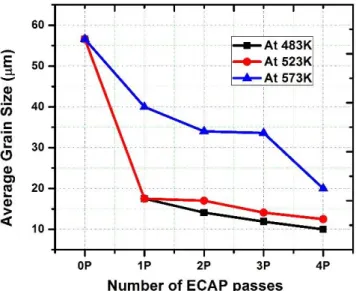
Fig. 4 shows the variation of average grain size against number of ECAP passes with respect to the different processing temperatures of 483 K, 523 K and 573 K. The average grain size for before and after ECAP processed AZ61 alloys were calculated using the BIOVIS software’s linear intercept method [14].
Fig. 4 Average grain size vs. number of passes at different temperature
It can be observed from Fig. 4, that the average grain size of the material decreased with increase in number of ECAP passes. It is well established that grain refinement in ECAP is enhanced when the recovery rates are reduced. The rate of recovery increases at the higher pressing temperatures and this provides a greater opportunity for the dislocations to annihilate within the grain boundaries rather than impinging upon, and becoming absorbed in, the sub-grain walls. This suggests that the evolution of microstructure into an array of high angle
grain boundaries is more difficult at the higher pressing temperatures, thereby favoring the retention of the sub-grain structure to higher total strains in AZ61 alloy, when ECAP temperature is increased. Similarly, Kang et al [15], showed that the average grain size of the AZ31 alloy increased with increase in processing ECAP temperatures causing poor mechanical properties were developed.
3.2Mechanical Properties
3.2.1Variation of micro-hardness for the four passes at three processing temperatures
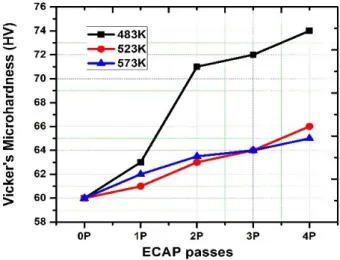
Fig. 5 Micro-hardness vs. ECAP passes.
Fig. 5 shows the Vickers micro-hardness of the AZ61 alloy for three different ECAP processing temperatures of 483 K, 523 K and 573 K for the four passes for route Bc. It can be observed from Fig. 5 that the micro-hardness increased with increase in ECAP passes. Also, the micro-hardness of the AZ61 alloy increased with decrease in ECAP processing temperature. The micro-hardness of the AZ61 alloy increased by 19%, 9% and 8% for the
processing temperature of 483 K, 523 K and 573 K respectively. The variation of micro-hardness with different processing temperatures is because of the strain hardening effect. The strain hardening effect makes the alloy strong at a processing temperature of 483 K. But, at higher temperatures, the strain hardening was observed to be minimum which cause to obtained low micro hardness values. Khakbaz and Kazeminezhad [16], attained the similar results on AA3003 alloy by processing the constrained groove pressing.
3.2.2 Variation of tensile properties with different processing temperatures
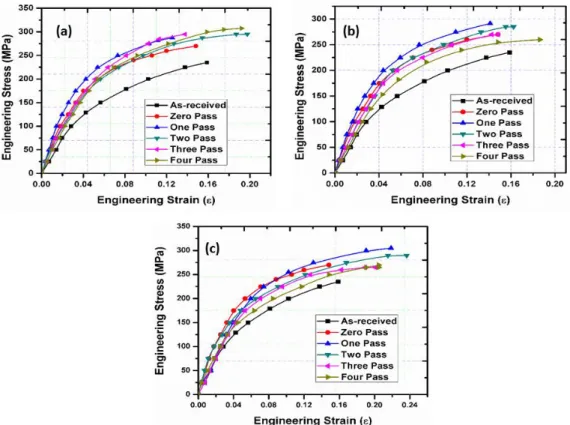
Room temperature tensile tests were performed on three identical samples corresponding to each ECAP pass. The yield strength (YS), ultimate tensile strength (UTS) and fracture elongation of samples were tested before and after ECAP processing of the AZ61 alloys samples using a tensile test rig. The test results for the different temperatures of 483 K, 523 K and 573 K for route Bc are shown in Fig. 6(a)-(c). The tensile tests show the effect of microstructural refinement on the mechanical properties of ECAP processed samples.
Fig. 6 Engineering Stress vs. Engineering Strain Curves for (a) 483 K (b) 523 K (c) 573 K The YS and UTS increased with decreasing AZ61 alloy average grain size. Also, when the cumulative strain is increased, the YS and UTS increased greatly. Overall the percentage elongation is greatly increased after the two and four ECAP passes. The increase in YS is related to decreasing average grain size as explained by the Hall-Petch relation given in Equation 1. Here, the strength always inversely proportional to the grain size diameter [17].
σ0 = σi + kD-1/2 (1) Where, σ0 is the yield stress, σi is the friction stress, D is the grain diameter (µm) and k is
parameter constant.
Chao et al [18], noted that the improvement in the YS and UTS is due to work hardening, which provides strong resistance to dislocation slip. This is because the dislocation density is rearranged with different processing temperatures and hence increases in ductility. On the other hand, the reason for the improved tensile strength is the increases of grain twins in the
material. Twinning boundaries are beneficial for dislocation pile-up and hence result in stress concentration and increased strength [18]. Metals, processed by ECAP techniques have a common desired property of enhanced strength. In the present work, with increase in number of ECAP passes, large number of sub-grains is formed at lower processing temperatures. Thus, the mechanical properties of the AZ61 alloy was influenced by grain refinement, ECAP processing temperature, number of passes and dislocation density and grain twinning.
3.3X-Ray Diffraction (XRD) Analysis
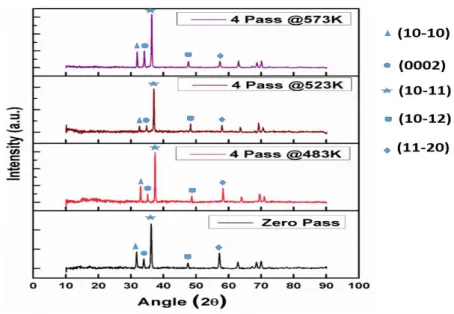
Fig. 7 shows the X-ray diffraction patterns of AZ61 alloy specimens, before and after ECAP processing. In the present work, maximum possible grain refinement of the AZ61 alloy was obtained after four ECAP passes. Hence, Fig. 7 shows XRD results AZ61 alloy after four passes, at three different processing temperatures. The XRD results were compared with unprocessed specimens to understand the variation of texture in the AZ61 alloy. There were no changes observed in the intensity of the peaks after ECAP processing at the temperature of 483K. The results for this paper are close to the XRD results obtained by Hung et al. (2006).
Fig. 7 XRD Pattern of AZ61 alloy
At a processing temperature of 523 K and after four ECAP passes, the AZ61 specimens had lower intensities of the peaks when compared to zero pass control values. Generally, the basal
plane (0002) and the <10-10> direction of a material aligns to the extrusion direction. A similar trend was observed in AZ61 alloy processed samples, which showed that the maximum grains were distributed parallel to the extrusion direction.
From the previous work, authors were reported that the peak intensities of magnesium alloys samples decreased with increase in number of ECAP passes (Cojocaru et al. 2013, Kim et al. 2002). However, the intensities of the peaks were observed to increase for AZ61 alloy with increasing temperature.
Haitao et al. (2009) performed the XRD analysis on AZ61 alloy after sub-rapid solidification method. The peak intensity of the <10-11> direction doubled after four passes of ECAP processing. Consequently, the strength of the alloy was increased as shown in the Fig. 6. The tensile results, which show an increase in strength after processing at 573 K, when compared with zero pass strength values.
3.4 Fracture topography
Tensile fracture surfaces provide useful information for understanding the effects of micro-structures on the strength and ductility of ECAP-processed samples. Fig. 8 shows the scanning electron microscopy fracture surfaces of AZ61 alloy (a) as received, (b) homogenized at 673 K, and after four ECAP passes at route Bc for processing temperature of (c) 483 K, (d) 523 K and (e) 573 K. All the specimens were tested along the extrusion direction. The SEM images reveal dimples of different sizes and shapes. These dimples show that the failure was predominantly ductile and that the micro-mechanism of failure was through void nucleation, growth and coalescence.
Fig. 8(a) shows the fractured surface of as received sample. The surface reveals a few dimples of various sizes of with heterogeneous grain size distribution. Also, Fig. 8(a) shows that there are bright tearing ridges along the grain boundaries and few quasi-cleavage fractures [19]. It can be seen in Fig. 8(b) that before deformation the samples are
homogenized and the dimples are rather shallow, with large variation in size. The grain orientation of the AZ61 alloy was improved with ECAP processes after homogenization at 673 K for 24h. The AZ61 alloy sample was deformed uniformly in the equiaxed structure and had fewer grain boundaries. This led to the higher tensile elongation observed for the ECAP processed samples at 483K.
Figure 8(d) and 8(e) show an increase in the number of well-developed dimples with increase in temperature. The average dimple sizes generally depend on the initiation site and the number of voids nucleated at the grain boundaries. Dimple sizes decrease with increase in ECAP passes, which is attributed to grain refinement as well as strain hardening [20].
Fig.8 SEM fractured images of tensile specimens of AZ61 alloy (a) As received (b) After homogenization; after four ECAP passes at (c) 483 K (d) 523 K and (e) 573 K Conclusions
The ECAP processing experiments were carried out on AZ61 wrought magnesium alloy to enhance the mechanical properties of the alloy by refining the grains. Based on the results of the present investigation some important conclusions were drawn as follows:
Microstructural characterization of ECAP processed AZ61 alloy and quantitative measurements revealed better grain refinement in the alloy which was processed through route Bc.
AZ61 alloy hardness increased with the increase in number of passes for the three processing temperatures for route Bc. However, it was decreased with increase in processing temperature. Also, The AZ61 alloys’ YS, and UTS were higher after processing at lower ECAP processing temperatures. On the other hand, the percentage elongation of the AZ61 alloy increased with higher ECAP processing temperatures. Hence, moderate die angles gives better deformation and in evidence mechanical properties can be improved at lower processing temperatures effectively.
SEM tensile fracture surfaces shows that the AZ61 alloy is ductile after ECAP processing and the ductility increases with increase in processing temperature.
Acknowledgements
Authors would like to thank Dr. K Venkateswarulu, Scientist works in NAL at Bangalore, and Dr. Gowtham Das, Scientist works in NML at Jamshedpur, India. Their encouragement and suggestions are helping me to analyze the results throughout my work.
References
[1] A. Azushima, R. Kopp, a. Korhonen, D. Y. Yang, F. Micari, G. D. Lahoti, P. Groche, J. Yanagimoto, N. Tsuji, a. Rosochowski, and a. Yanagida, Severe plastic deformation (SPD) processes for metals, CIRP Ann. - Manuf. Technol. 57 (2008) 716–735.
[2] C. F. Gu, L.S. Toth, D. P. Field, J. J. Fundenberger, Y. D. Zhang, Room temperature equal-channel angular pressing of a magnesium alloy, Acta Materialia 61 (2013) 3027–3036. [3] F. Z. Hassani, M. Ketabchi, M. T. Hassani, Effect of twins and non-basal planes activated by equal channel angular rolling process on properties of AZ31 magnesium alloy, J. Mate. Sci. 46 (2011) 7689–7695.
[4] P. Venkatachalam, S. Ramesh Kumar, B. Ravisankar, V. Thomas Paul, M. Vijayalakshmi, Effect of processing routes on microstructure and mechanical properties of 2014 Al alloy processed by equal channel angular pressing, Trans. Nonferr. Metals Soci. China 20 (2010) 1822–1828.
[5] R. Z. Valiev, T. G. Langdon, Principles of equal-channel angular pressing as a processing tool for grain refinement, Prog. In Mate. Sci. 51 (2006), 881–981.
[6] P. Molnar, A. Jager, Multi-temperature equal channel angular pressing of Mg-3 wt%Al-1 wt%Zn alloy, Phil. Magazine 8 (2013) 1–15.
[7] T. S. Srivatsan, S. Vasudevan, and M. Petraroli, The tensile deformation and fracture behavior of a magnesium alloy, J. Alloys Compd. 461 (2008) 154–159.
[8] M. K. Kulekci, Magnesium and its alloys applications in automotive industry, Int. J. Adv. Manuf. Technol. 39 (2008) 851–865.
[9] G. Faraji, M. M. Mashhadi, H. S. Kim, Microstructural Evolution of UFG Magnesium Alloy Produced by Accumulative Back Extrusion (ABE), Mate. And Manuf. Proc. 27 (2012) 267–272.
[10] M. Avvari, S. Narendranath, and H. S. Nayaka, Effect of equal channel angular pressing on AZ31 wrought magnesium alloy, J. Magnesium Alloy 1 (2013) 336-340.
[11] S. M. Masoudpanah and R. Mahmudi, The microstructure, tensile, and shear deformation behavior of an AZ31 magnesium alloy after extrusion and equal channel angular pressing, Mater. Des. 31 (2010) 3512–3517.
[12] S. M. Yin, C. H. Wang, Y. D. Diao, S. D. Wu, and S. X. Li, Influence of Grain Size and Texture on the Yield Asymmetry of Mg-3Al-1Zn Alloy, J. Mater. Sci. Technol. 27 (2011) 29–34.
[13] Y. Liu and T. Liu, Microstructure evolution of AZ31 Mg alloy during change channel angular extrusion, J. Wuhan Univ. Technol. Sci. Ed. 26 (2011) 654–657.
[14] M. Avvari, S. Narendranath, Effect of Route-R on wrought magnesium AZ61 alloy mechanical properties through equal channel angular pressing, Journal of Magnesium and Alloys. 2 (2014) 159-164.
[15] S. H. Kang, Y. S. Lee, and J. H. Lee, Effect of grain refinement of magnesium alloy AZ31 by severe plastic deformation on material characteristics, J. Mater. Process. Technol. 201 (2008) 436–440.
[16] F. Khakbaz and M. Kazeminezhad, Work hardening and mechanical properties of severely deformed AA3003 by constrained groove pressing, J. Manuf. Process. 14 (2012) 20– 25.
[17] M. Avvari, S. Narendranath, and H. S. Nayaka, A review on wrought magnesium alloys processed by equal channel angular pressing, Int. J. Materials and Product Technology. 51 (2015) 139–164.
[18] H.Y. Chao, H.F. Sun, W.Z. Chen, and E.D. Wang, Static recrystallization kinetics of a heavily cold drawn AZ31 magnesium alloy under annealing treatment, Mater. Charac. 62 (2011) 312-320.
[19] W. Hongxia, L. Wei, X. Jinbo, Z. Xingguo, B. Liping, Z. Jinshan, Microstructure and Mechanical Properties of ultrafine Grained Mg15Al alloy processed by Equal channel angular pressing, J. Wuhan Uni. of Techno.-Mater. Sci. 4 (2010) 238-242.
[20] D. R. Fang, Q. Q. Duan, N. Q. Zhao, J. J. Li, S. D. Wu, and Z. F. Zhang, Tensile properties and fracture mechanism of Al–Mg alloy subjected to equal channel angular pressing, Mater. Sci. Eng. A, 459 (2007) 137–144.
![Fig. 1. Working principle of Equal Channel angular Pressing [10]](https://thumb-us.123doks.com/thumbv2/123dok_us/909562.2617267/4.892.282.667.339.655/fig-working-principle-equal-channel-angular-pressing.webp)