The 2nd International Conference on Design Creativity (ICDC2012) Glasgow, UK, 18th-20th September 2012
LEARNING FROM DESIGN CREATIVITY;
TRANSLATING PROCESSES FROM PRACTICE TO
EDUCATION
A. Holder
1and G. Lovett
21
School of Architecture, University of Sheffield, Sheffield, UK & Integrated Workshop.
2
School of Art & Design, University of Bedfordshire, Luton, UK & Integrated Workshop.
Abstract:
This paper develops reflections on design creativity as a cross-curriculum tool in
mainstream formal education at primary/elementary level. Evidence comes from a
contemporary UK case study of a series of workshops whereby architectural design
professionals introduced design creativity into mainstream primary teaching and learning
situations, developed through the UK ‗Creative Partnerships‘ programme. This programme,
which until recently was funded through central government, introduced principles of
collaborative creativity through targeted programmes of change and enquiry involving pupils,
teachers and creative practitioners. Following the processes of designing and delivering a
programme to embed creative exploration through design tasks which focus on the learning
environment, the authors, both architectural practitioners and educators, undertake further
reflection back to the architectural profession and the societal role of collaborative creative
design. We propose a hybrid practice in which architects might swap skills with teachers,
pupils, teaching assistants and school management. This process reveals new creative
concepts to pupils and staff, and unearths latent abilities within pupils as they work
collaboratively to develop and provide design services for the built fabric or spatial use of
school spaces.
Keywords:
collaboration, architecture, education
1. Introduction
The ‗Integrated‘ schools projects, the case studies within this paper, explore a hybrid practice in which architects swap skills with teachers, pupils, teaching assistants and school management. The processes trialled aimed to reveal new creative concepts to pupils and staff, and unearth latent abilities within pupils, as they worked collaboratively to develop and provide design services for the built fabric, or spatial uses of school space. The collaborative experiment was initiated by an appointment to explore an unusual brief in early 2010. Working with and for a primary school funded by Creative Partnerships the authors, in our role as architectural practitioners, were asked to explore how the school could ―integrate creativity into their learning and the way they use their building in a sustainable way‖; an emphasis on both the uses of space and the processes of delivering learning programmes. With the skills, enthusiasm and connections from this project, a new mode of practice has emerged, taking shape in on-going commissions working with students from 4-14 years old, each addressing different spatial problems and with a distinct learning outcome factored into the brief.
Our motivation as both design practitioners and researchers came from an interest to engage with school communities, integrating design and education, as part of professional architectural practice. Notions of ‗the artist‘s ways of working‘, ‗research as practice‘ and ‗the value of process‘ are paramount within the work ethic which it has been possible to translate into professional operations as a practice of resisting the constraints of commercial operations. Moreover this experimentation with dialogue strategies enabled aspects of participatory practice to directly inform the teaching environment.
One of the prime aims of the UK Creative Partnerships programme was to bring more creative people into classroom environments who could act with an alternative practice to that of a teacher and who could bring a freedom to their operations not tied to the curriculum. As architectural practitioners and educators, this ‗creative agent as catalyst‘ model reminded us of the unconventional nanny in the film Mary Poppins. The role of the designer in this educational model is to arrive, stir things up, and leave. We asked ourselves the question: ‗What if Mary Poppins was an architect?‘
Both the project and this paper, are simultaneously exploring practices of education, design creativity & models of architectural practice, with the following aims:
To explore the possibilities for practice and theory of design creativity in a skills swap between designers, pupils and teachers in learning environments
To test design creativity as a cross-curricular tool
To establish an alternative approach to the practice of learning environment design
2. Project process: design creativity in exploring learning environments
Within this paper we will focus specifically on the first of the ‗Integrated‘ projects as a case study. This project was done with St Matthew‘s Primary School, Luton. Drawing from the initial school enquiry question, ―How can we integrate creativity…?‖, the project explored ways to embed creativity across the curriculum with Year 3 pupils and teachers. The theme of the project ‗Re-imagining the Classroom‘ was a starting point for getting pupils and teachers to explore their learning space and to experiment with different ways of learning and teaching to develop creativity. An architectural design process with each of three classes ran through the project integrating creative design practices across the curriculum progressing through stages of briefing & design concept development, drawing & model-making design workshops and the inclusive making of component parts for architectural solutions within the Y3 learning spaces.
The ‗Re-imagining the Classroom‘ project responded to National Curriculum Key Stage 2 guidance for promoting creativity including:
Setting challenging but achievable goals with stimulating starting points Giving pupils a real-life challenge with constraints of resources and time Asking open-ended questions of ‗What-if?‘ And ‗How might you…?‘
Making the most of unexpected events and being willing to let pupils take the lead
These elements were tailored to an architectural practice understanding of design creativity as a process of exploration.
2.1. Design creativity: Imagination and inspiration within a process of exploration
With an emphasis on imagination and inspiration as keys to creative learning, a series of workshops was devised to cover different aspects of creative working. The project was consciously flexible in its conception to allow the teachers‘ and pupils‘ reactions to each workshop to influence the trajectory of the process. Key themes running through the series of workshops were:
Iterative approaches to problem solving – ‗no wrong answers‘ Teachers, practitioners and pupils as co-learners
The importance of teamwork, group communication and individual reflection as methods of giving feedback on attempts/ideas
Imagination and inspiration as tools for creative exploration
‗Re-Imagining the Classroom‘ began as part of a school visioning process with the creative team: school management creative representatives, a creative agent and the creative partners. Key to the project were ideas of sustainability and a pupil-led, participative and collaborative creative project. For this reason, the creative partners envisaged an open-ended exploration, providing ‗jumping-off‘ points for teachers and pupils to try out different activities and shape both the process and project outputs. The project was framed with the idea of the creative design brief, with pupils and teachers being invited to come up with ways to re-imagine and use their classroom area differently, addressing existing problems or responding to changes in learning styles, whilst testing a variety of ways to work creatively. Over the course of a number of workshops looking at drawing, calculating, building and using spaces creatively, the teachers and pupils came up with a brief for a computer table and space divider, and for a window shading and storage system. These practical, real-life needs, were then explored. Both learning, and design ideas developed through our searches for inspiration and our uses of imagination.
2.2 Methodology
This educational project was conceived and structured as a practice-based studio project responding to real clients and constraints. We embedded reflection within the project as both a key component of design practice and as an evaluation tool drawing on the work of Schön, a leading exponent of reflective practice, who developed theory based on empirical work, initially through observing the design processes of architects (Schön 1983): ―The design process opens up possibilities for surprise that can trigger new ways of seeing things, and it demands visible commitments to choices that can be interrogated to reveal underlying values, assumptions, and models of phenomena.‖ (Schön, 1992) Reflections were brought about primarily through a reflective sketch journal which each child maintained throughout the 6-month project. These were built on through open discussions and the peer learning opportunities fostered throughout.
Schön takes an approach which attempts to break down the separation between thought and action, instead seeing inquiry in practice as a transactional interaction between inquirer and environment into problematic aspects. (Schön 1992). Perhaps because of the ease of understanding and application of his case studies and examples, the approach of reflective practice has gained considerable traction in planning education and research (Forester 1999) and in architectural research (Lawson 2004).
Here we were keen to incorporate Gibbs‘ reflective cycle (Gibbs 1988) as we were not simply asking children to reflect on their proceeses in order to describe what they were doing, or how they could find an answer but critically we were also asking them to engage with their feelings about each act or output and in this way develop an emotional intelliegence (Goleman 1995) within their design work. The cyclical models of reflection defined by Gibbs and Kolb (Kolb 1984) suggest incremental change. This ethos of perpetual modification, was expounded by architect and theorist Cedric Price (Price, 1999). The inspiration of this and the ‗slow‘ movement notions of taking time to get things right and appreciate them, when translated into an architectural context knit well, resulting in possibilities to test-drive, reflect-on and revise the way a building might unfold, or a teaching programme might change course in response to the needs and desires of students.
The challenge laid down by Griffiths and Tan was to integrate reflective practice: ―'Personal' and 'public' theories need to be viewed as living, intertwining tendrils of knowledge which grow from and feed into practice.‖ (Griffiths and Tan, 1992). For us as architects integrating education within our practice, their proposition affirms the mode of operation that is in development here. It is a model that sits within a context of power devolved to educators in which the possibility to procure capital projects (schools buildings) might return not only to school management but evolve to incorporate the empowered child.
3. Outcomes, reflection and evaluation within the School
3.1. Pupil learning
Key outcomes on young people‘s learning from the project included:
Pupils gaining confidence discussing and using key concepts such as imagination and inspiration and learning ways of applying these concepts in creative tasks.
―One thing that I have learned is that imagination can be used for everything‖ Child A. Pupils building up a repertoire of experiences where they took risks and solved problems,
learning from mistakes rather than being discouraged by them, and opening up to multiple ways of approaching problems.
―I felt strange because I don‘t normally scribble when I draw…‖ Child B; ―I felt strange and confident.‖ Child C
Pupils developing skills in reflective thinking and documenting creative processes through presenting their ideas and work to others, and developing written evaluative accounts of the project.
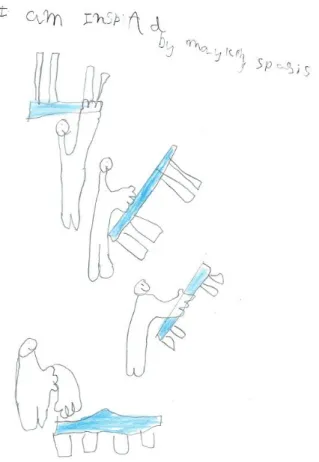
―I am inspired by making spaces.‖ Child D (Figure 1) Quotes from children‘s reflective sketch journals)
Figure 1: Can reluctant writers be inspired by a landscape design process? It would appear so… (Drawing from a child‘s reflective sketch journal)
Reflection and evaluation were included informally at the end of each session, either with groups of pupils presenting their work to the class as a whole, describing process, outcomes and their own feelings about it, or by making reflective annotations for work in sketchbooks. A more formal reflective session was undertaken towards the end of the project, using reflective story telling and written accounts to think back over the processes explored, and to future creative explorations. An important element of all the schools‘ projects was encouraging peer learning, which is a vital part
of helping one another being equated with ‗copying‘. In practical tasks such as sketch-book making, pupils were encouraged to help one another and ‗teach‘ techniques they had recently learned to their peers. In more complicated tasks, pupils were encouraged to present their work to the class, reflecting on what had gone well, and what they had struggled with. This open, and collaborative approach to learning and working is a key component of successful creative work.
Another impact of the project on young people‘s learning was the experience of working in groups of different sizes. In collaborating on producing a piece of land art during a woodland walk, pupils experimented with negotiation skills, working in small groups and then sending ‗representatives‘ to work in a larger group. This activity came about as an unplanned response to a process suggested by one of the pupils, and proved quite challenging for them, but also an important learning activity. A final, but important impact of the project was to encourage young people‘s confidence and self-esteem when working with uncertainty. Design creativity and creative processes require risk-taking and this necessitates a certain amount of confidence on the part of participants. As creative partners we worked hard to build confidence, stressing that there were no wrong answers, as mistakes can also be learning opportunities.
We also worked to ensure that celebration was a key part of every workshop, with pupils and teachers acknowledging their achievements together.
3.2. Teacher learning
Key outcomes on teachers‘ learning from the project included:
Teachers gaining skills and experience working with a range of new ‗hands-on‘ projects Teachers observing and evaluating different creative teaching and learning techniques
together with creative partners
Teachers developing confidence in risk-taking and problem-solving activities in collaboration with pupils
A major impact on teacher learning was the emphasis in the project as a whole on collaborative learning. Often teachers are somewhat isolated in the classroom and do not have the opportunity to discuss and critically reflect on new techniques they might try. An important part of developing the process in the ‗Re-imagining the Classroom‘ project, was introducing informal reflective sessions at the end of each workshop, where teachers and creative partners could discuss what worked and what didn‘t, and how similar activities might be implemented in the future. A staff training day was also important in encouraging the teachers to work as a team and come up with a creative strategy for using the school and developing learning and teaching activities.
Teachers and classroom assistants were invited to join in where possible as co-learners with the students. The different results produced by the staff teams helped to validate for the pupils and staff that there was no ‗shame‘ in getting an ‗imperfect‘ result in a creative problem-solving process, but rather that it was a necessary stage in working towards a satisfactory solution to the problem.
3.3. Creative partner learning
The key learning outcomes for creative partners included:
Gaining skills and experience working with pupils and teachers, and learning to rethink and communicate creative skills previously taken for granted, to a range of audiences
Learning to plan and simplify complex concepts and to modify activities based on pupil feedback
Developing understanding of the range of literacy, numeracy and social skills bound up in various design and problem-solving processes – this has helped us to better understand our own working processes.
A significant benefit of working as a pair of creative practitioners was the process of co-reflecting and evaluating throughout the project. ―Our positon is that a true collaboration is a process of creative
cyclical development where participants input into specific projects but also benefit from the way processes feedback into their own praxis.‖ (Holder & Lovett 2009)
The teacher training day provided a turning point in working towards a dynamic of school change. Brainstorming, model-making, strategy planning and discussion provided a space for staff to question key ideas in the project and to embed new shared beliefs and values concerning creative learning. An important process was challenging negative preconceptions of what ‗being creative‘ meant and building confidence in personal abilities to work creatively both individually and in teams. This seems vital if staff are to be able to pass on positive beliefs and attitudes about creative working to young people.
In terms of the ‗Re-Imagining the Classroom‘ project, there were difficulties in disseminating the process beyond the classroom; attempts at inter-team learning were stymied by a limited apparatus of co-learning among staff within the school. Installing the fabricated interventions that resulted from the learning process was more successful in disseminating understandings of design creativity further in the school: the built form of a piece of classroom furniture, co-designed and made with pupils and staff, provided a ‗talking point‘ and catalyst for discussions on creative learning at the wider school level.
4. Management and institutional context
A major challenge in interacting with schools as creative practitioners was managing an open-ended process with teachers who are accustomed to fixed and pre-planned activities. Our desire to reflect the school management and Creative Partnerships desires for a collaborative and exploratory project meant that we worked hard to deliver a process which was flexible to reflect the enthusiasms and competencies of the staff and pupils and open to change. However, this caused some conflict with staff, who wanted to know exactly what the outcome and end point of the project would be. This was a cultural conflict between different ways of working, but we feel that though it may have been working beyond ‗comfort zones‘ at times, an open-ended approach is vital to many, if not all, creative professions and so is important to try to embed in creative teaching and learning.
5. Learning from creative partnerships: looking back to design creativity and the
architect‟s role
In our work as creative practitioners we have tried to maintain a reflexive critique within both the design and education practices we have engaged with.
The projects have:
formed a framework for conversations: educational, aspirational, design problems… which are not facilitated in the daily life of the teacher nor the architect.
aided in a shift to child-led learning, and child-led spatial use
been symbiotic. The practice of both the design and education professionals become honed through processes of experimentation, discovery and mutual understanding.
encouraged a ‗just do something…‘ response.
Reflecting on possibilities for financing, replication & maintaining the emphatic localism in future projects it is important to note that most of these projects have been supported by Creative Partnerships funding and management. However through the development of working relationships with both schools management teams and ‗creative agents‘ the model has proven itself to have a sustainable basis with continued commissions through both avenues. Establishing a working relationship between the two parties is the critical starting point. In each community the motivation may come from a different player and the creative professional‘s adaptability to working with each, and understanding the respective roles will be key. Such networks, naturally local, result in often more meaningful and sustained involvements with school communities and it is hoped that in this way the value (both financial and intangible) of the projects may grow in a way that they couldn‘t in recent models of anonymous and enormous public procurement. ―It is at the local level that civic entrepreneurs and intrapreneurs, whether a school leader, a local GP or a development planner, can
meaningfully engage with the opportunities and the risks involved in doing things differently‖ (NESTA, 2011).
The end of Creative Partnerships was mirrored in the axing of the Building Schools for the Future UK-wide school building programme and the question marks hanging over the Primary Capital Programme have left many school communities needing to find affordable solutions to problems of imminent expansion, aging building stock and perhaps most damaging – dashed aspirations. The model of working we are piloting represents an opportunity to work spatially within education environments in new ways, offering a hands-on encounter for children and teachers in which they can shape and improve their learning spaces as they develop knowledge and skills.
References
00://. (2011). Compendium for the Civic Economy. London: National Endowment for Science Technology and the Arts (NESTA).
Akin, Ö. (1990). Necessary conditions for design expertise and creativity. Design Studies, 11(2), 107–113. Forester, J. (1999). The Deliberative Practitioner: Encouraging Participatory Planning Processes. Cambridge, Mass.: MIT Press.
Gibbs G (1988) Learning by Doing: A guide to teaching and learning methods. Further Education Unit. Oxford Polytechnic: Oxford.
Goleman, D. (1995) Emotional Intelligence. London: Bloomsbury
Griffiths, M., & Tann, S. (1992). Using Reflective Practice to Link Personal and Public Theories, Journal of Education for Teaching. International research and pedagogy, 18(1), 69-84.
Hall, C., & Thomson, P. (2007). Creative partnerships? Cultural policy and inclusive arts practice in one primary school. British Educational Research Journal, 33(3), 315–329.
Holder, A & Lovett, G (2009) Working Collaboratively: A Coversation about Contemporary Practice, Architecture &. Edinburgh, Ampersand, 16-18.
Kolb D.A. (1984) 'Experiential Learning experience as a source of learning and development', New Jersey: Prentice Hall
Lawson, B. (2004) What Designers Know. Oxford: Architectural Press.
Maddock, M., et al. (2007). Doing school differently: creative practitioners at work. Education 3-13: International Journal of Primary, Elementary and Early Years Education, 35(1), 47–58.
Price, C. (1999). Re: CP. Basel: Birkhäuser.
Reich, Y., et al. (1996). Varieties and issues of participation and design. Design Studies, 17(2), 165–180. Schön, D. A. (1983). The Reflective Practitioner: How Professionals Think in Action. London : Temple Smith Schön, D. A. (1992). The Theory of Inquiry: Dewey's Legacy to Education. Curriculum Inquiry, 22(2), 119-139.
Thomson, P. (2007). Whole school change : a review of the literature : a report for Creative Partnerships. London: Creative Partnerships, Arts Council England.
Zeisel, J. (1984). Inquiry by Design: Tools for Environment-Behaviour Research. Cambridge: Cambridge University Press.