CSCE 2014 General Conference - Congrès général 2014 de la SCGC
Halifax, NS
May 28 to 31, 2014 / 28 au 31 mai 2014
Image-Based Modeling Approaches for Projects Status Comparison
Sara Rankohi and Lloyd WaughDepartment of Civil Engineering, University of New Brunswick
Abstract: Project professionals frequently compare as-planned models with the as-built status to re-plan and coordinate site work, control project quality, monitor progress, detect defects, and inspect building health. During the last few years significant research has been undertaken on image-based modeling (IBM) techniques for construction projects. This paper investigates current IBM tools and techniques for project status comparison to identify gaps and overlaps in this area. To provide a state-of-the-art study on this topic, this research reviews 93 articles published in 16 civil engineering journals and conference databases between 2005 and the summer 2013. Based on reviewing these 93 articles, authors developed a process framework for image-based project monitoring systems. Moreover, among those 93 articles, ten articles have been selected based on their comparison technique and purposes. These ten articles are further investigated from the following perspectives: (a) image-based modeling approaches (collection, analysis, and representation); (b) process followed, product produced, and resource used in each image-based modeling phase (as-planned modeling, as-built modeling, and status comparison). In summary, literature shows that the majority of articles have focused on using off-the-shelf image-based modeling hardware (digital camera, 3D range camera, and laser scanner) and software (BIM, AutoCAD and AutoDesk products) available for as-built and as-planned data modeling to automatically monitor project progress or detect defections. Moreover, literature shows lack of research in some areas including image-based modeling of interior construction; as-built verification and plan updating procedures; and validation of success for the developed image-based monitoring systems.
1 Introduction
The use of image modeling techniques in the construction engineering practices has tremendously increased in recent years. Photography which is referred as “writing with light,” is considered an efficient visualization technique to capture real-time construction information. Recent advances in electro-optical technologies have enabled off-the-shelf digital cameras to capture high quality images while preserving the portability and convenience of taking pictures (Dai 2011). Construction participants take daily photographs on construction sites for documentary purposes, while these photographs could also have other essential applications such as monitoring progress, resolving disputes and training for similar projects (Rankohi 2013).
This paper discusses how digital photographs have been and could be applied in the construction engineering industry for comparison between the as-planned and as-built status, to monitor the project progress and to control discrepancies. The work presented in this paper provides a state-of-the-art review of research efforts undertaken in this area of knowledge, and outlines the research voids and opportunities for future applications of construction photographs to monitor and control projects.
2 Background
Research efforts in using photographs for construction progress monitoring goes back before the year 1989, when photography enabled analysts to conduct studies on time-lapse site photographs for productivity enhancement (Oglesby 1989). Visualization of project progress through comparison of site images and building model information has been recognized by many researchers as an effective way to monitor progress and control performance (Abeid 2003, Kerzner 2005, Song 2005, Lee 2006, Poku 2006, Waugh 2006, Golparvar-Fard 2009, Dai 2011, Zhu 2012, Yang 2013).
In this industry sector, researchers have developed various image-based applications for documenting and monitoring construction projects in recent years. Waugh (VR Doc. 2013) developed a web-based panoramic project monitoring system, which enables project managers to remotely monitor and compare construction site status on specific dates and at specific locations. Bae (2013) developed an image-based mobile augmented reality system for context-aware construction applications, which allows site personnel to access a large volume of information in real-time. The ENMAX Corporation (2013) developed an image-based construction monitoring system at Alberta's largest natural gas-fired generation facility project which allows viewers to follow the construction progress on a regular basis.
3 Research Method
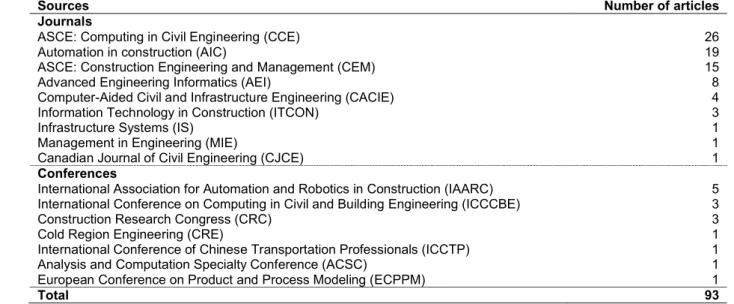
The research methodology used in this paper consists of: (a) selecting the leading journals and conferences in the area of IT and construction engineering, (b) identifying the articles in the field of image-based modeling techniques, (c) reviewing the identified articles and selecting ten articles with a focus on comparing as-planned and as-built status, (d) reviewing the ten selected articles and defining their dimensions and categories (e) classifying the articles in the defined dimensions and categories. Each paper was reviewed to determine its level of relevance to our research domain. To focus on recent work, only articles published from the spring 2005 to the summer 2013 were considered. The criteria for identifying papers was image-based modeling work in the areas of construction engineering and management. Those articles that concentrated solely on image-based modeling rather than their applications in construction management were excluded. Considering that image-based modeling for the construction industry is an emerging area and there are not a significant number of journal articles, we also searched the leading construction engineering research conferences. Unfortunately, we were limited to databases that were electronically accessible and as a result we were unable to search ConVR conference proceedings. Table 1 shows the number of articles from each journal and conference.
Table 1: The number of selected articles from each journal and conference
Sources Number of articles
Journals
ASCE: Computing in Civil Engineering (CCE) 26
Automation in construction (AIC) 19
ASCE: Construction Engineering and Management (CEM) 15
Advanced Engineering Informatics (AEI) 8
Computer-Aided Civil and Infrastructure Engineering (CACIE) 4
Information Technology in Construction (ITCON) 3
Infrastructure Systems (IS) 1
Management in Engineering (MIE) 1
Canadian Journal of Civil Engineering (CJCE) 1
Conferences
International Association for Automation and Robotics in Construction (IAARC) 5 International Conference on Computing in Civil and Building Engineering (ICCCBE) 3
Construction Research Congress (CRC) 3
Cold Region Engineering (CRE) 1
International Conference of Chinese Transportation Professionals (ICCTP) 1
Analysis and Computation Specialty Conference (ACSC) 1
European Conference on Product and Process Modeling (ECPPM) 1
4 Literature Analysis
The distribution of articles by year of publication and first author’s country of residence is shown in Figure 1. The maximum number of articles in a calendar year were published in 2011 (19 articles or 20%), while 16 articles (17%) are published in 2013 (by the end of summer). With 53 articles (57%), first authors residing in the USA has the highest number of the articles.
Figure 1: Number of articles by year of publication and first author’s country of residence
Figure 2 shows 64 articles (69%) and 25 articles (27%) respectively focus on image-based modeling techniques in the construction and maintenance phases of the projects. From a comparison-purpose perspective, 28%, 20% and 17% of articles use image-based modeling techniques for progress monitoring, defect detection and spatial data collection respectively.
Figure 2: Number of article by project phase and comparison purpose
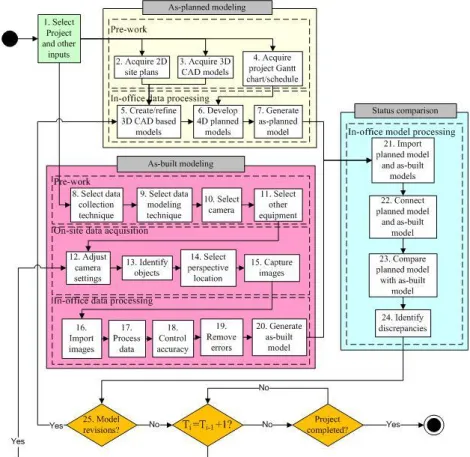
Figure 3 shows a process overview of image-based project monitoring systems. This flowchart was initially generated based on review of a limited number of articles and the authors’ personal experience. It was refined as the authors reviewed all 93 articles and then further refined based on the ten selected articles.
The flowchart indicates image-based modeling techniques for the construction industry consist of three major phases: (a) as-planned modeling, (b) as-built modeling, and (c) status comparison. Each of these phases has steps, and the process will loop if the model is revised or the schedule is updated.
Figure 3: Generate image-based construction monitoring process 5 The Ten Selected Articles
5.1 Selection Methodology
From the 93 identified articles, ten articles were selected that focus on comparing as-planned and as-built models. The following criteria were used to select these ten articles: comparison of planned and as-built models, diversity of research method, diversity of the first author’s country of residence, and year of publication (since 2008). It worth mentioning that we selected these ten articles based on our interpretation, however, we acknowledge that other people might interpret them differently.
Table 2 lists the ten selected papers with their comparison approach and purpose. As shown, seven of the ten selected articles focus on automatic comparison for project monitoring while two articles develop manual comparison approach.
Table 2: Comparison approach and purpose of the ten selected articles
Paper Comparison technique
Comparison purpose
1. Kim et al. 2008 Manual To develop a system for performing comparison between construction images and the corresponding VR images and to validate the proposed system
2. Rebolj et al. 2008
Automatic To develop a system for automating data collection, automating construction activity monitoring, and updating the activity plan.
3. Son et al. 2010 Automatic To develop an automated 3D structural steel component recognition and modeling method which employs color and 3D data from a stereo vision system for monitoring project
progress.
4. Roh et al. 2011 Automatic To develop a walk-through model to visualize and compare 3D BIMs and as-built photographs for monitoring detailed interior construction progress.
5. Dai et al. 2011 NA To propose an analytical approach to incorporate virtual photos of invisible underground infrastructure into site photos.
2012 compare them to the actual as-built model (developed using 2D drawings), and check the accuracy of the modeling process.
7. Golparvar-Fard et al. 2012
Automatic To develop an automated approach for recognition of project progress based on daily construction photo collection, and IFC-based BIMs.
8. Kim et al. 2013 a
Automatic To develop an automated method for construction progress measurement using a 4D BIM in concert with 3D data obtained by remote-sensing technology.
9. Kim et al. 2013 b Automatic To develop an image processing-based methodology for the automatic updating of a 4D CAD model.
10. Turkan et al. 2013
Automatic To propose a 4D automated progress tracking system for construction monitoring that transforms from objects to their earned values.
Within the selected articles the automatic image-based modeling techniques (through batch processing techniques) are the most frequent. Moreover, image-based modeling techniques have been used for various purposes e.g., progress monitoring, defect detection, spatial data collection, as-built documentation, tracking project entities, energy performance modeling, quality analysis, productivity analysis. Among these, progress monitoring and defect detection have received the highest attention. 5.2 Image-based Modeling Approaches
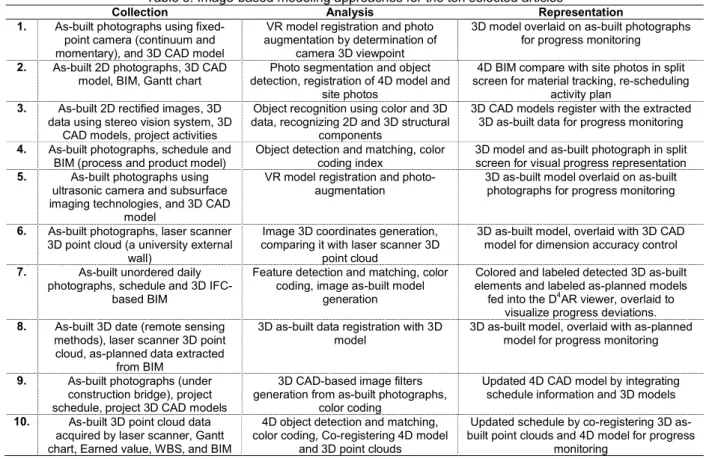
In this section, image-based modeling approaches are divided in three categories: collection, analysis, and representation. Table 3 indicates the collection, analysis, and representation processes for the ten selected articles that are listed in Table 2. From a collection perspective, most of the articles focus on digital imagery for collecting as-built information. Five of the ten selected articles focus on a combination of as-built images and 3D CAD models, while an overlapping five articles refer to the application of BIM in project monitoring. From an analysis perspective, the articles mainly focus on photo registration, object detection, 3D coordinate generation, and photo augmentation. From a representation perspective, the 3D models are mostly overlaid on 3D as-built point clouds and the discrepancies between as-planned and as-built status is automatically detected.
Table 3: Image-based modeling approaches for the ten selected articles
Collection Analysis Representation 1. As-built photographs using
fixed-point camera (continuum and momentary), and 3D CAD model
VR model registration and photo augmentation by determination of
camera 3D viewpoint
3D model overlaid on as-built photographs for progress monitoring
2. As-built 2D photographs, 3D CAD model, BIM, Gantt chart
Photo segmentation and object detection, registration of 4D model and
site photos
4D BIM compare with site photos in split screen for material tracking, re-scheduling
activity plan 3. As-built 2D rectified images, 3D
data using stereo vision system, 3D CAD models, project activities
Object recognition using color and 3D data, recognizing 2D and 3D structural
components
3D CAD models register with the extracted 3D as-built data for progress monitoring 4. As-built photographs, schedule and
BIM (process and product model)
Object detection and matching, color coding index
3D model and as-built photograph in split screen for visual progress representation 5. As-built photographs using
ultrasonic camera and subsurface imaging technologies, and 3D CAD
model
VR model registration and photo-augmentation
3D as-built model overlaid on as-built photographs for progress monitoring
6. As-built photographs, laser scanner 3D point cloud (a university external
wall)
Image 3D coordinates generation, comparing it with laser scanner 3D
point cloud
3D as-built model, overlaid with 3D CAD model for dimension accuracy control 7. As-built unordered daily
photographs, schedule and 3D IFC-based BIM
Feature detection and matching, color coding, image as-built model
generation
Colored and labeled detected 3D as-built elements and labeled as-planned models fed into the D4AR viewer, overlaid to
visualize progress deviations. 8. As-built 3D date (remote sensing
methods), laser scanner 3D point cloud, as-planned data extracted
from BIM
3D as-built data registration with 3D model
3D as-built model, overlaid with as-planned model for progress monitoring
9. As-built photographs (under construction bridge), project schedule, project 3D CAD models
3D CAD-based image filters generation from as-built photographs,
color coding
Updated 4D CAD model by integrating schedule information and 3D models 10. As-built 3D point cloud data
acquired by laser scanner, Gantt chart, Earned value, WBS, and BIM
4D object detection and matching, color coding, Co-registering 4D model
and 3D point clouds
Updated schedule by co-registering 3D as-built point clouds and 4D model for progress
The selected articles show that among other data collection techniques in the construction industry, digital photography stands in the first place in terms of accessibility, affordability, and accuracy. From an analysis perspective, researchers apply digital photogrammetry techniques e.g., 3D point cloud generation; model/image registration; photo-augmentation; object, feature, pattern, activity recognition; and as-built reconstruction to address project monitoring demands. From a representation perspective, 3D models/digital information are usually overlaid on as-built images in a common screen, and construction images are augmented which enables the user to track discrepancies and to control the project.
5.3 Image-based Modeling Phases
In this section the selected articles are reviewed from resource used, process followed, and product produced in each image-based modeling phases (as-planned modeling, as-built modeling, and status comparison) perspectives.
5.3.1 Resource used
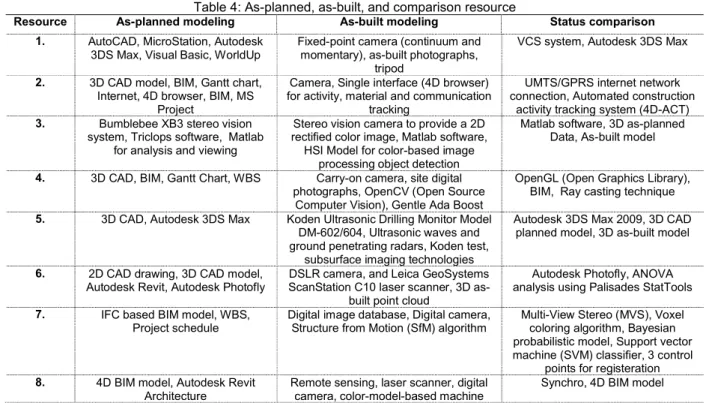
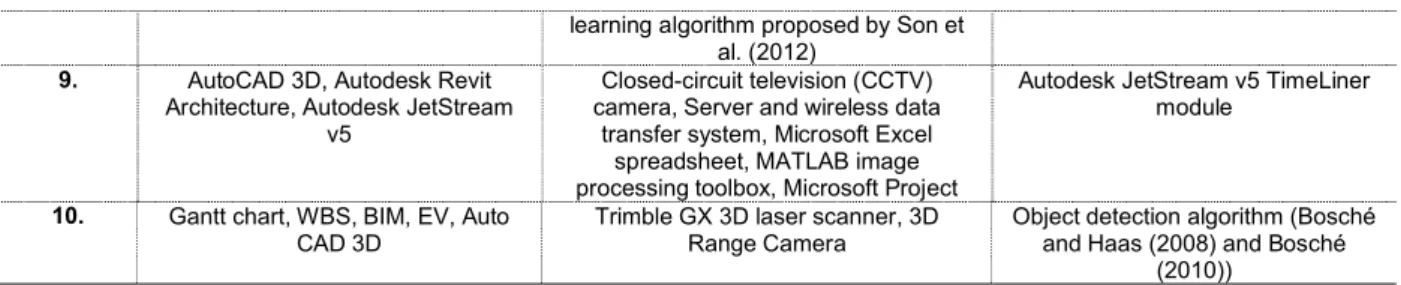
Table 6 shows resources used during the image-based modeling process for the ten selected articles. In this table we only focus on technology resources (i.e., software, hardware, and equipment). Other resources are not considered, i.e., human resources (site staff/workers, project managers, etc.), natural resources (location, weather, etc.), service and material resources.
AutoCAD and BIM models are used in at least seven of the ten articles during as-planned modeling. Gantt charts, and WBS are being used for developing 4D plans (3D + time) project schedule. In one of the articles EV analysis is connected to as-built and as-planned models to control project cost and budget. From an as-built modeling perspective, most researchers use off-the-shelf portable digital cameras, and the literature analysis show only two of the ten articles use fixed-point cameras. In three of the ten selected articles laser scanners are also used to generate site 3D point clouds. From a status comparison perspective, most of the articles use off-the-shelf modeling software, while some of them use or develop custom comparison algorithms. Four of the ten selected articles use various Autodesk productions (i.e., Autodesk 3DS Max, Autodesk Photofly, Autodesk Revit, and Autodesk JetStream).
Table 4: As-planned, as-built, and comparison resource
Resource As-planned modeling As-built modeling Status comparison 1. AutoCAD, MicroStation, Autodesk
3DS Max, Visual Basic, WorldUp
Fixed-point camera (continuum and momentary), as-built photographs,
tripod
VCS system, Autodesk 3DS Max
2. 3D CAD model, BIM, Gantt chart, Internet, 4D browser, BIM, MS
Project
Camera, Single interface (4D browser) for activity, material and communication
tracking
UMTS/GPRS internet network connection, Automated construction
activity tracking system (4D-ACT) 3. Bumblebee XB3 stereo vision
system, Triclops software, Matlab for analysis and viewing
Stereo vision camera to provide a 2D rectified color image, Matlab software, HSI Model for color-based image
processing object detection
Matlab software, 3D as-planned Data, As-built model
4. 3D CAD, BIM, Gantt Chart, WBS Carry-on camera, site digital photographs, OpenCV (Open Source
Computer Vision), Gentle Ada Boost
OpenGL (Open Graphics Library), BIM, Ray casting technique 5. 3D CAD, Autodesk 3DS Max Koden Ultrasonic Drilling Monitor Model
DM-602/604, Ultrasonic waves and ground penetrating radars, Koden test,
subsurface imaging technologies
Autodesk 3DS Max 2009, 3D CAD planned model, 3D as-built model
6. 2D CAD drawing, 3D CAD model, Autodesk Revit, Autodesk Photofly
DSLR camera, and Leica GeoSystems ScanStation C10 laser scanner, 3D
as-built point cloud
Autodesk Photofly, ANOVA analysis using Palisades StatTools 7. IFC based BIM model, WBS,
Project schedule
Digital image database, Digital camera, Structure from Motion (SfM) algorithm
Multi-View Stereo (MVS), Voxel coloring algorithm, Bayesian probabilistic model, Support vector machine (SVM) classifier, 3 control
points for registeration 8. 4D BIM model, Autodesk Revit Remote sensing, laser scanner, digital Synchro, 4D BIM model
learning algorithm proposed by Son et al. (2012)
9. AutoCAD 3D, Autodesk Revit Architecture, Autodesk JetStream
v5
Closed-circuit television (CCTV) camera, Server and wireless data
transfer system, Microsoft Excel spreadsheet, MATLAB image processing toolbox, Microsoft Project
Autodesk JetStream v5 TimeLiner module
10. Gantt chart, WBS, BIM, EV, Auto CAD 3D
Trimble GX 3D laser scanner, 3D Range Camera
Object detection algorithm (Bosché and Haas (2008) and Bosché
(2010))
The majority of articles follow a common process to generate as-planned and as-built models (Table 4). From a product perspective, the following are generated to monitor activities and control construction project at different stages: 3D and 4D (3D + time) planned models; 2D built photo-logs and 3D as-built models; and virtual image-based project monitoring systems e.g., VCS, 4D-ACT, HD4AR. From a resource perspective, the following have been used for states comparison depends on the type of product: AutoCAD, BIM, Gantt chart, WBS for as-planned modeling; 2D digital camera, 3D range camera, stereo vision camera, 3D laser scanners, and various image-processing software and algorithm (i.e., Matlab, Image modeler, SfM algorithm) for as-built modeling; and VR visualization software e.g., Autodesk Photofly, 3DS Max, and Synchro.
5.3.2 Process followed
Table 4 shows which image-based modeling process steps (based on the step numbers given in Figure 1) each of the ten selected articles (listed in Table 2) followed. All the articles follow at least 19 of the 25 defined steps. Moreover, five of the 25 process steps for as-built modeling are fully covered by all the ten selected articles. It is also shown that only three articles follow step 25 (revise model/update schedule).
Table 5: As-planned, as-built, and comparison process Process
As-planned modeling As-built modeling Status comparison Pre-work In-office
modeling
Pre-work On-site data acquisition
In-office modeling In-office model processing 1 2 3 4 5 6 7 8 9 10 11 12 13 14 15 16 17 18 19 20 21 22 23 24 25 1. 2. 3. 4. 5. 6. 7. 8. 9. 10. 5.3.3 Product produced
Table 5 shows the products (interim results) for the three phases during the image-based modeling process for the ten selected articles. As-planned modeling usually results in 4D planned models (half of the ten selected articles). During the as-built modeling phase, seven of the ten selected articles produced 3D as-built models. Finally during status comparison process most of researchers developed a system which automatically compares the as-planned and as-built status and reports the discrepancies.
Table 6: As-planned, as-built, and comparison product
Product As-planned modeling As-built modeling Status comparison 1. 3D CAD system, VR system and a
CG system
Construction site 2D as-built digital images, and videos captured on the
project foundation
Virtual construction site (VCS) system to control project progress, a
walk-through system 2. 4D as-planned model with virtual
camera view, 4D as-planned model connect to BIM to track activity
2D site as-built photos, Mobile computing system for communication,
image-based activity and material tracking system
An automated activity tracking system (4D-ACT), an automated
material tracking system, and a mobile communication system 3. 3D and 4D CAD as-planned models 2D site as-built images, RGB images,
3D data, Steel frame 2D and 3D
3D As-built model overlaid by 3D as-planned model for progress
extracted objects, and as-built model monitoring 4. 3D as-planned models integrated
with project schedule and BIM
3D As-built model, and as-built visualization of interior building in a
walk-through environment
3D Walk-through model to compare as-planned and as-built for progress
monitoring 5. 3D as-built virtual model of
underground structure
A 3D as-built model of the bored pile which is built based on the Koden test
As-built construction 2D images overlaid by 3D as-built model of
underground structure for visualization/progress monitoring 6. 3D CAD model generated by CAD
and Autodesk Revit
Accurate 3D as-built image-based model, 3D point cloud from laser
scanner, and site photographs
3D as-built model of under-construction bridge, overlaid by 3D
CAD model to control dimensions 7. 4D as-planned model generated by
BIM model and construction schedule, as-planned voxel coloring
and labeling algorithm
Dense 3D as-built model, as-built voxels, of RH (Residence Hall) and SD (Student Dining) projects, as-built voxel coloring
and labeling algorithm
D4AR model to automatically
measure progress deviations
8. 4D BIM model generated by Autodesk Revit
3D point cloud of a new four-floor concrete building under construction in South Korea, 3D as-built data integrated
with project schedule
An automatic construction progress measurement system using 4D BIM
and 3D as-built data 9. 3D model converted into the files
with the JetStream format, Planned schedule in MS Project format
HSV images, Gray scale images, Binary images, 3D CAD-based image masks
An updated 4D CAD model by combining the as-built schedule with
a 3D CAD model 10. 4D model include design and
schedule data for the Portland’s Energy Centre in Toronto and the Engineering V Building at University
of Waterloo
3D point cloud of the Portland’s Energy Centre in Toronto and the Engineering V
Building at University of Waterloo
An automated object-based construction progress tracking
system
6 Discussion and Recommendations
6.1 Our assumptions about the researchers' goals
The literature shows that researchers mainly seek to develop an automatic image-based monitoring system to connect the BIM and the project schedule to daily construction images. This would enable users to compare as-planned with as-built status and detect deviations and thereby monitor project progress. In addition to progress monitoring and defect detection, a few researchers pursued other image-based modeling applications on construction projects i.e., activity monitoring, as-built documentation, tracking project entities, energy performance modeling, productivity analysis, QC/QA analysis, and safety monitoring. These applications are also interesting areas of focus for future research. Moreover, the literature shows that many researchers aim to connect project as-built data bases to the BIMs and project schedule in order to improve construction process analysis, design coordination, team collaboration, information visualization, and project schedule organization.
6.2 Gaps in the research
The literature shows that image-based modeling techniques for project monitoring are still under development, and that there remain research gaps to be addressed for image-based modeling techniques to become standard practices. The following gaps have been identified in this study:
Construction project: there is a gap in the application of image-based modeling techniques in the maintenance and initiation/design phases of the construction projects. Moreover, most of current research applies these techniques on outdoor construction sites, and there is a gap in the application of IBM techniques on interior and indoor construction sites.
As-built verification and updating procedures: there is a gap in using image-based modeling techniques for updating the project plan or rescheduling/updating the project schedule to reflect project changes.
Validation of success: only a few studies show that the success of the developed systems has been tested and validated in practice. Therefore, there is a gap in evaluating and validating the success of image-based modeling approach for monitoring construction projects.
6.3 What practitioners actually want
Our perception is that project participants prefer automated approaches to fast-track project activities and rapidly detect defections. From a content perspective we assume construction industry practitioner would seek automated access to project real-time as-built information integrated with as-model information (e.g., BIM, EV, WBS, etc.). From a representation perspective, they would seek a portable (mobile) remotely accessible user friendly interface that can be integrated into their content workflow process and that facilitate the comparison of project statuses over time. From a value perspective, we further assume that they would seek an affordable cost (initial and ongoing) for which the payback period is short; a system which enables early detection of project failures to prevent schedule delay and cost overruns.
6.4 Recommendations for researchers
Based on this review, our recommendation for researchers in the area of image-based visualization techniques for the construction industry is that analyzing construction models requires more comprehensive systems to overcome limitations of existing stand-alone approaches. There is an opportunity for more research on the combination of different types of data acquisition sensors (e.g., 2D digital cameras, 3D range cameras, laser scanners) with high levels of accuracy and measurement range that will increase the reliability and accuracy of image-based modeling methods. From a monitoring perspective, we recommend development of current systems to enable more detailed interior project monitoring with fusion of different project management resource e.g., 3D/4D BIM, project schedule, WBS, and EV. BIM technology has to be used to its full extent in combination with the project schedule and budget to generate a comprehensive project as-planned model. Moreover, a method of consistent activity definition for BIM elements has to be developed. From an image-processing perspective, we recommend expansion of current systems to allow advanced object detection, pattern detection, material recognition (e.g., concrete, steel, masonry, and timber), and activity recognition. In addition, the assessment of success of developed systems should be validated by researcher and practitioner from academy and industry. From an application perspective, besides progress monitoring and defect detection, other comparison purposes which are mentioned in section 6.1 should be further investigated.
6.5 Recommendations for practitioners
The literature shows that the current image-based approaches are not yet extended to their full potential; however with future technological advancements, the construction industry will be able to reap full benefits of these emerging technologies. We believe that the construction industry greatly benefits from image-based monitoring systems from various perspectives mentioned in section 6.1. Current trial systems are in their development stage, and they have limitations due to expensive and fragile equipment, lack of accessibility, portability and trained operators. However, as the technology is swiftly evolving, recently developed systems offer valuable features and may provide competitive advantages to industry participants. Therefore, we recommend that practitioners interested in using these technologies as a competitive advantage, monitor new application developments and build up a partnership with a research team in order to get the latest updates on the newly developed systems. Moreover, the application of image-based modeling systems requires a good understanding of its concepts and components by all participants, therefore additional education and training for all project participants is essential.
7 Reference
Abeid J., Allouche E., Arditi D., and Hayman M. (2003), PHOTO-NET II: a Computer-based Monitoring System Applied to Project Management, Journal of Automation in Construction, Vol. 12, No.5, 603-616.
Bae H., Golparvar-Fard M., White J. (2013). High-precision vision-based mobile augmented reality system for context-aware architectural, engineering, construction and facility management (AEC/FM) applications,
Visualization in Engineering, Springer open Journal, 2013, 1:3.
Bhatla A., Choe S. Y., Fierro O., Leite F., (2012), Evaluation of accuracy of as-built 3D modeling from photos taken by handheld digital cameras, J. of Automation in Construction, Vol. 28, 116–127
Dai F., Lu M., Kamat V. R., (2011), Analytical Approach to Augmenting Site Photos with 3D Graphics of Underground Infrastructure in Construction Engineering Applications, ASCE Journal of Computer in Civil
Engineering, ASCE, Vol. 25, No. 1, 25:66-74
Golparvar-Fard M., Pena-Mora F., Arboleda C. A., Lee S., (2009), Visualization of Construction Progress Monitoring with 4D Simulation Model Overlaid on Time-Lapsed Photographs, ASCE Journal of Computer
in Civil Engineering, ASCE, Vol. 23, No. 6, 23:391-404
Golparvar-Fard M., Peña-Mora F., Savarese S., (2012), Automated progress monitoring using unordered daily construction photographs and IFC-based building information models, Journal of Computing in Civil Engineering (in press),http://dx.doi.org/10.1061/(ASCE)CP.1943-5487.0000205
Kerzner, H. (2005), Project management: A systems approach to planning, scheduling, and controlling, 7th Ed., Wiley, New York.
Kim Hyungeun, Kano N., (2008), Comparison of construction photograph and VR image in construction progress, , J. of Automation in Construction, Vol. 17, 137–143
Kim Changyoon, Kim Byoungil, Kim Hyoungkwan, (2013), 4D CAD model updating using image processing-based construction progress monitoring, J. of Automation in Construction, (in press), http://dx.doi.org/10.1016/j.autcon.2013.03.005
Kim Changmin, Son H., Kim Changwan, (2013), Automated construction progress measurement using a 4D building information model and 3D data, J. of Automation in Construction, Vol. 31, 75–82
Lee, S., and Peña-Mora, F. (2006), Visualization of construction progress monitoring, Proc., Joint Int. Conf. on
Computing and Decision Making in Civil and Building Engineering, ASCE, Reston, Va., 2527–2533.
Oglesby C., Parker H. and Howell G. (1989), Productivity improvement in construction, McGraw-Hill
Poku, S., and Arditi, D., (2006), Construction scheduling and progress control using geographical information systems, ASCE Journal of Computer in Civil Engineering, ASCE, Vol. 20, No. 5, 351–360.
Rankohi, S., Waugh, L.M., (2013), Review and Analysis of Augmented Reality for AEC Projects, Journal of
Visualization in Engineering, Vol. 1, 1:9.
D., Babic N. C., Magdic A., Podbreznik P., Pšunder M., (2008), Automated construction activity monitoring system, J. of Advanced Engineering Informatics, Vol. 22, 493–503
Roh S., Aziz Z., Peña-Mora F., (2011), An object-based 3D walk-through model for interior construction progress monitoring, J. of Automation in Construction, Vol. 20, 66–75
Son K., Kim Changwan, (2010), 3D structural component recognition and modeling method using color and 3D data for construction progress monitoring, J. of Automation in Construction, Vol. 19, 844–854
Song, K., Pollalis, S., and Peña-Mora, F., (2005), Project dashboard: Concurrent visual representation method of project metrics on 3D building models, Proc., Int. Conf. on Computing in Civil Engineering, ASCE, Reston, Va., 1–10.
Turkan Y., Bosché F., Haas C. T., Haas R., (2013), Toward Automated Earned Value Tracking Using 3D Imaging Tools, Journal of construction engineering and management, Vol. 139, No. 4, 423–433
Waugh, L. (2006). “Construction site photography: Virtual reality vs. the focus + context problem.”Proc., 2006
Annual CSCE Conf. of the Canadian Society for Civil Engineering, Canadian Society for Civil Engineers,
Montréal, Québec, 1–8.
Yang M., Chao C., Huang K., Lu L., Chen Y., (2013), Image-based 3D scene reconstruction and exploration in augmented reality, J. of Automation in Construction, Vol. 33, 48–60.
Zhu Z., German S., Brilakis I., (2012), Visual retrieval of concrete crack properties for automated post-earthquake structural safety evaluation, J. of Automation in Construction, Elsevier, Vol. 20, 874–883 http://vrdoc.ca/Projects/CoF/CoF_Interface.html