Research Paper doi: 10.17705/1pais.11302 Volume 11, Issue 3 (2019)
Length of Cloud Application Use on Functionality
Expectation, Usability, Privacy, and Security:
A Case of Google Docs
Makoto Nakayama1, Charlie C. Chen21DePaul University, USA, [email protected] 2Appalachian State University, USA, [email protected]
Abstract
Background: Newcomers to cloud applications typically have to overcome concerns of privacy (confidentiality control) and security (safekeeping). On the one hand, end-users may be accustomed to cloud applications’ privacy and security (habituation). On the other hand, these applications quickly adapt to end-user needs on those concerns (reciprocal habituation). Does the old proverb “Custom makes all things easy” apply to privacy and security concerns about cloud application use?
Method: This study focuses on Google Docs as an example of standardized, common cloud applications and collects data from 211 of its users.
Results: The results show that length of use has significant associations with better usability perception and increased functionality expectation. In turn, improved usability perception leads to decreased security risk concern, while increased functionality expectation increases privacy concerns. Interestingly, usefulness perception is not influenced by privacy concern.
Conclusions: Overall, the length of Google Docs use is associated with higher usefulness and increased adoption through greater usability and decreased security concern. Thus, when it comes to standardized, common cloud applications, the old proverb is valid with some exception. Also, “custom” is mutual between cloud applications and their users.
Keywords: Habituation, Reciprocal Habituation, Cloud Computing, Standardized Applications, Functionality Expectation.
Citation: Nakayama, M., & Chen, C. C. (2019). Length of Cloud Application Use on
Functionality Expectation, Usability, Privacy, and Security: A Case of Google Docs. Pacific Asia Journal of the Association for Information Systems, 11(3), 5-27.
https://doi.org/10.17705/1pais.11302
Introduction
Cloud computing is a great equalizer between small and large business organizations (Willcocks & Lacity, 2018). This is especially relevant for Pacific Asian nations. For example, a 2017 study (National University of Singapore & Microsoft, 2017) reports that cloud applications can break down the barriers on “a lack of awareness about the technology, data localization requirements, the cost and quality of broadband infrastructure, privacy and cybersecurity concerns, and the lack of common cloud standards across [the Association of Southeast Asian Nations (ASEAN)] countries” (p. 4).
However, cloud applications were initially met with doubts and skepticism, especially in terms of security and reliability concerns. This is understandable, given that online technology in general “can cause severe damages from privacy, security and reputation” (Issa, Kommers, & Isaias, 2015, p. i). Over time, information systems (IS) users found that cloud applications are not as unreliable and impracticable as previously thought. A recent survey (RightScale, 2016) shows that 95% of respondents are experimenting with cloud computing options. While cloud technologies themselves have advanced, one reason for such a high adoption level may be that users’ perceptions of cloud computing change over time as a result of seeing and hearing about cloud computing. Unknown, unfamiliar technologies have become known, familiar technologies. Does the old proverb “Custom makes all things easy” apply to the concerns of cloud application use?
The goal of security is to prevent unauthorized access (safekeeping) whereas that of privacy pertains to define what is regarded as “unauthorized” (confidentiality control) (Bambauer, 2013). Security and privacy risks are common concerns for cloud application users. For instance, a bug in Google Docs resulted in the disclosure of 0.05% of all documents (Stewart, 2018). On another occasion, a phishing scam was launched against Google Doc users (Larson, 2017). The scam exposed the personal information not only of the one million victims who fell into the trap, but also people associated with them. Also, Google Docs users often choose the convenience of sharing over the protection of information by selecting less restrictive options for access control (Dickson, 2018). Carefree users—including students and professionals—can easily make available a document (or a folder) that contains names, email addresses, or any private/sensitive information such as student ID numbers. Therefore, it is worth asking how end-user perceptions about the functionality and usability of cloud-based applications, which could affect privacy concerns and security risks of users, change over time. End-user perception change would be difficult to examine on different non-standard cloud applications, given that the details of each cloud application vary. Therefore, it is more feasible to assess a standardized, common cloud application than a non-standard, customized one. In this study, we focus on Google Docs as one example of a popular, end-user-oriented cloud application. Google Docs is “a cloud productivity suite and it is designed to make computer-mediated collaboration easy and natural so that users can access any document they own or that has been shared with them anywhere, any time and on any device” (Yunting Sun, Lambert, Uchida, & Remy, 2014, June, p. 234). Google Docs is easy to use for a wide range of students in different educational settings. One study (Moonen, 2015) even reports the successful incorporation of Google Docs into an elementary school curriculum.
At the university level, professors would reportedly consider integrating Google Applications into their instructional strategies, provided they were given appropriate professional development and training (Cahill, 2014). These professors agreed that collaborative technology was an effective teaching tool and assisted students when working on group and individual projects (Cahill, 2014). However, Google Docs is not limited to educational use. It is suited to facilitating collaboration between workers using word processing, spreadsheet, and presentation applications (Howell, 2012, September). A recent survey (BetterCloud, 2016) notes cost savings of over 40% at small to large firms that have adopted Google applications
including Google Docs. Finally, Google Docs might not be so incomparable to some of the recent cloud-based business applications; the lightweight accessibility of these business applications quickly boosted their customer base (Weinhardt et al., 2009).
Given the interest and possible business impacts, our main research questions are twofold. First, how are perceptions of the functionality and usability of Google Docs associated with end-users’ length of Google Docs use? Second, how are functionality and usability related to privacy and risk concerns? This question is important because security and privacy concerns do not appear abated.1
The plan of the paper is as follows: We first introduce the concepts of “habituation” (diminishing response to a stimulus after repeated exposure to it) and “reciprocal habituation” (mutual adaptation over time between people and technology). We portray how the aspects of “habituation” and “reciprocal habituation” have been overlooked in extant studies on the relation between new technologies and their users. Applying those concepts, we hypothesize how functionality expectation and usability perception of cloud applications will change over time. We also hypothesize that functionality expectation and usability perception influence the perception of privacy and security concerns of the cloud application. After describing our methods and results, we discuss the implications and future research agendas.
Theoretical Background and Hypotheses
Concept of Habituation
Recent studies (Anderson, Jenkins, Vance, Kirwan, & Eargle, 2016; Vance, Jenkins, Anderson, Bjornn, & Kirwan, 2018; Vance, Kirwan, Bjornn, Jenkins, & Anderson, 2017) used fMRI and eye-tracking data together to show a general decline of our attention to security warnings. Such a decline is caused by the attenuation of our responses to the same stimulation. This phenomenon is known as habituation. Rankin et al. (2009) define it as “a behavioral response decrement that results from repeated stimulation and that does not involve sensory adaptation/sensory fatigue or motor fatigue” (p. 136), and note that the most cited characteristics of habituation come from Thompson and Spencer (1966) and Groves and Thompson (1970). The dual-process theory (Groves & Thompson, 1970) posits that our nervous system has two processes interacting with each other: decremental stimulation response (habituation) and incremental response (sensitization). Studies using fMRI (Anderson et al., 2016; Vance et al., 2018; Vance et al., 2017) appear to confirm the dual-process theory by showing the varying effects over time regarding the impact of static and polymorphic secure warnings.
The issue of varying experience over time is also recognized in the field of user computing experience. For example, an ethnographic study (Karapanos, Zimmerman, Forlizzi, & Martens, 2009) reports how users’ iPhone adoption experience develops over time through three main factors: an increasing familiarity, functional dependency, and emotional attachment. While a study (Lam, Lam, Lam, & McNaught, 2009) cites temporal experience change varying at the individual level, another study (Mendoza & Novick, 2005) reports that users’ frustration concerning new technology generally drops over time. Interestingly, Jasperson et al. (2005) argue that the impact of routinization process (habituation) is discounted and dismissed in the theory of planned behavior (Ajzen, 2002) that predicts the behaviors of end-users from their intention, attitude, subjective norm and perceived control.
1 Recent statics on privacy and security concerns are found in
Reciprocal Habituation in Information Technology (IT) Use
In using IT, the object of learning (IT) and the learners (the users of IT) interact with each other over time because IT advances as its users learn to adapt to evolving IT. At the organizational level, this perspective is theorized as the structurational model of technology (Orlikowski, 1992) based on Giddens’ (1986) structuration theory. In it, technology is viewed as both product and medium of human action. Technology is created and updated by human action while humans use technology to accomplish their tasks. Orlikowski calls this interaction the duality of technology.
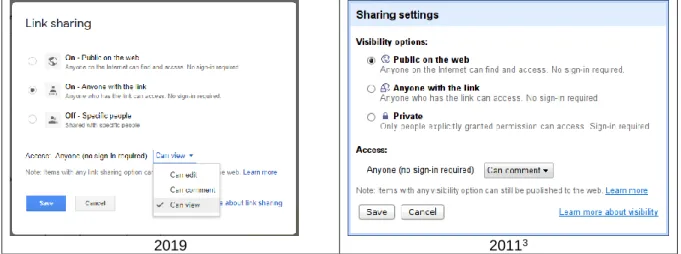
From this perspective, a more relevant way to view habituation for IT and its users is reciprocal habituation, which is defined as “a process in which people and technologies adapt to each other over time through design, appropriation, and interaction” (Nansen et al., 2014, p. 18:2). The habituation of IT for its users is particularly relevant for cloud-based applications. Cloud computing enables online software upgrades (applying software upgrades while sustaining service) and rolling upgrades (upgrading software and then rebooting each host in a wave rolling through the data center) (Neamtiu & Dumitras, 2011). As a result, updated software is deployed daily to hourly in the cloud model and once in a certain period with the waterfall model (Feitelson, Frachtenberg, & Beck, 2013; Gramoli, Bass, Fekete, & Sun, 2016). The client software of Google Docs, for instance, has 107 releases available between Google Docs 1.3.144 on October 2, 2014, and Google Docs 1.19.132.05 on April 11, 20192. The user interfaces also change as time passes (Figure 1). These facts indicate that cloud applications like Google Docs are continuously adapting to the needs and circumstances of its users. Another example of reciprocal habituation is seen in the results of a qualitative study (Nansen et al., 2014) on the relation between older IT users and communication technologies, such as phones, SMS, and email. As those users become accustomed to them, the technologies, too, continuously evolve and adapt to users and their changing needs.
2019 20113
Figure 1 - Example of “sharing” interface change in Google Docs
As information technology evolves rapidly, reciprocal habituation factors become more important when promoting the use of different information technologies over time. One study has found that, in generalizing the use of web-based exchange systems over time, system design features need to be considered (Nicolaou & McKnight, 2011). In this study, the authors found that the control transparency feature has a stronger influence on initial use than continued use, whereas outcome feedback only influences continued use. Social computing evolves based on the expansion of social networks in which users can share different user
2http://www.apkmirror.com/uploads/?q=docs, accessed on April 11, 2019.
3https://drive.googleblog.com/2011/09/comment-only-access-in-google-documents.html, , accessed on April 11,
experiences. As a result, reciprocal habituation mediated by peer influence can develop secondary system use that is different from the originally intended purpose (Syn & Sinn, 2015). Cloud computing combines both general and social computing features and could be heavily susceptible to the influence of reciprocal habituation. However, reciprocal habitation is relatively understudied for cloud-based applications (Amer & Maris, 2007). In fact, few studies examine the perception change of cloud-based systems over time. Therefore, the degree of influence of reciprocal habituation on cloud computing adoption over time warrants an in-depth investigation.
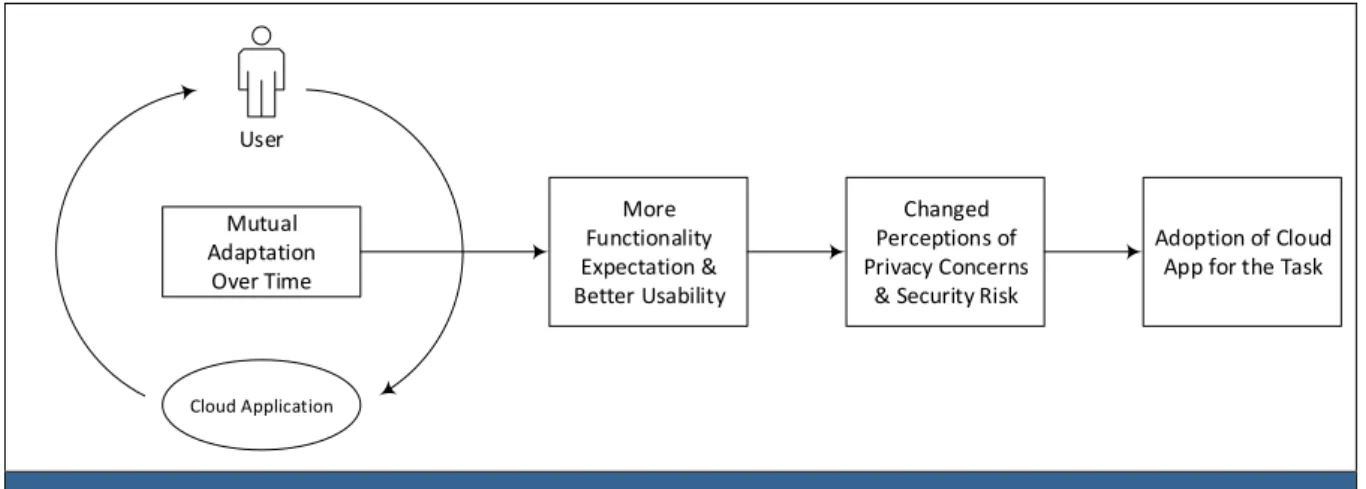
While ease of use and access are cited as key benefits, both the industry/practitioners (Bouchard, 2015; WIRED, 2012) and academics (Arpaci, 2016; Mohammed, 2011) have been noting a critical consideration of cloud computing adoption as the balance between motivation (access convenience and usability) and contingency (security and privacy concerns) at the individual user level. If mutual adaptation between a cloud application and its users occurs over time, users may have higher functionality expectations and experience better usability. The perception of privacy concerns and security risk then changes, leading to the intention to adopt the cloud application for the task at hand (Figure 2).
User Cloud Application Mutual Adaptation Over Time More Functionality Expectation & Better Usability Changed Perceptions of Privacy Concerns
& Security Risk
Adoption of Cloud App for the Task
Figure 2 - Impact of mutual adaptation between a cloud application and its users
Reciprocal Habituation and Functional Requirements
Past studies have identified effects of reciprocal habituation in human preferences for human-robot interactions (Koay, Syrdal, Walters, & Dautenhahn, 2007, August), voice control in the Home Network System (NHS) (Matsubara, Matsumoto, & Nakamura, 2011, December), and information quality perception for employee portal systems (Urbach, Smolnik, & Riempp, 2010). These effects are rooted in usability perception changes over time and sensitivity to the functionality provided by robotic and information systems. Here, we define functionality as what cloud applications do, whereas usability is defined as how they interact with the users (adopted from McNamara & Kirakowski, 2006). Similar to these examples, many prospective cloud application users felt the anxiety of dealing with unknowns. They had significant concerns about the risks and challenges of cloud applications such as security, confidentiality, compliance, and service reliability (Brender & Markov, 2013; Iyer & Henderson, 2010). However, the recent growth in adoption of cloud applications suggests that users have become more familiar with their functionality and usability over time as these applications incrementally improve themselves and their use becomes more common. In fact, a study (Sanchez & Sudharshan, 1993) suggests that the perception of product functionality changes significantly with changes in relatively few components and that customer preferences also change over time. Thus, we hypothesize:
H1a: The longer the duration of cloud application use, the higher the degree of perceived
The use of social media for B2B marketing has been considered irrelevant and ineffective. Lacka & Chong (2016) found that increasing the perceived usability of social media for B2B marketing could contribute to their adoption. A closer examination of perceived usability shows that habitual use attributes, such as a website’s learnability and memorability, have a direct influence on the adoption of social media for marketing purposes. In addition, the habitual behavior of users could encourage the use of mobile social network services (Nikou & Bouwman, 2014). Habitual use involves desired and undesired behaviors. Information systems equipped with self-monitoring feedback features can help correct undesired habits and promote desired ones, thereby increasing the perceived usability (Hermsen, Frost, Renes, & Kerkhof, 2016). Cloud computing is integrating with social network services to utilize its content and network relationships for online and mobile commerce. As the content shared by social media users explodes, much of this content will be stored and disseminated via cloud computing platforms for efficiency and accessibility. An increasing number of social and mobile applications are also built on cloud computing platforms. However, cloud computing systems pose too many uncertainties for users because they have little control of the intention, qualities, and actions of cloud providers’ security, privacy, and availability (Tchernykh, Schwiegelsohn, Alexandrov, & Talbi, 2015). As users learn how to interact with these cloud-based applications, their habitual use may play a significant role in reducing their degree of uncertainty about and increase their perceived usability of cloud computing. Therefore, we propose:
H1b: The longer the duration of cloud application use, the higher the degree of perceived
usability.
Impact of Functionality Expectation and Usability on Privacy and Risk
Concerns
Google Docs is “a free Web-based office suite that allows users to collaborate and facilitate conversations as they create and edit live documents” (Woodard & Babcock, 2014, p. 2). In using Google Docs, users may have concerns about issues such as the intentional or unintentional disclosure of personal information, and the inconveniences or costs due to the temporary or permanent unavailability of documents. In other words, there are concerns about privacy and security risks.
Merriam-Webster defines privacy as “the state of being alone” or “the state of away from public attention.”4 Pedersen (1997) regards privacy as “a boundary control process in which the individual regulates with whom contact will occur and how much and what type of interaction it will be” (p. 147). However, the meaning of privacy is contextual and varies among different academic disciplines (Paul A Pavlou, 2011; Smith, Dinev, & Xu, 2011). Definitions are generally categorized into value-based or cognate-based (Smith et al., 2011). The former definition views privacy as a right or commodity, whereas the latter views privacy as the state of limited information access. Given that our study focuses on the perception of individual cloud-application users, we frame privacy concerns as those regarding “opportunistic behavior related to the personal information submitted” through Google Docs (Dinev & Hart, 2006, p. 64).
Cloud computing has the flexibility of changing functionality and can do so at a potentially lower cost than dedicated infrastructure (O. Ali, Soar, & Yong, 2016). Thus, users have a higher functionality expectation for cloud computing. As the degree of functionality expected of a cloud application becomes greater, users are essentially expecting a wider range of functions and their use than before. A study (Henze et al., 2016) shows that cloud services with a transparent and adaptable interface can encourage users to spend effort and time in provisioning privacy requirements before uploading their sensitive data into the services. Using a cloud application, the user might have a perception of a privacy violation. If the user
keeps using the application, in the same way, more frequently, that same user would feel a higher chance of experiencing a privacy violation. Privacy concerns are driven by the experience and usage context of users (Culnan & Armstrong, 1999). The more the application delivers its functionality to the user through more interactions, the higher the perceived chances of privacy violations. We therefore hypothesize:
H2: The higher the degree of functionality expectation, the greater the extent of privacy
concerns.
Risk as a word is defined as “someone or something that may cause something bad or unpleasant to happen.”5 Like privacy, the specific definition of risk is contextual and depends on subjective perceptions. However, the key difference between privacy and risk relates to the fact that privacy is perceived as a state of seclusion, whereas risk hinges on the probability of outcomes. Many users have growing concerns about the security risks of unauthorized accesses and system failures in cloud computing (Masood & Aslam, 2016). Security concerns are a significant factor for the intention to adopt cloud applications at small and medium-sized firms (Kumar, Samalia, & Verma, 2017). Adapting from Gefen and Pavlou (2012, p. 924), we define security risk as “the belief in potential of suffering a tangible loss, while transacting with the community of” fellow Google Docs users (p. 924).
The level of usability perception, too, is influenced by reciprocal habituation. However, the perception of usability is based on how the user interacts with the application, as opposed to what functions to use or how much to use the application (McNamara & Kirakowski, 2006). In online banking, better website usability leads to higher trust in the website (Casalo, Flavián, & Guinalíu, 2007). Higher trust can ease risk concerns (Kim, Ferrin, & Rao, 2008). A study (Hart, Ridley, Taher, Sas, & Dix, 2008, October) on Facebook use notes the relation between better usability and increased Facebook use. Thus, we posit:
H3: The higher the degree of perceived usability, the lesser the extent of risk concerns.
Usefulness of Cloud Applications
A study comparing single-factor with two-factor authentication methods in automated telephone banking found that users have a higher degree of perceived security with the two-factor method (Gunson, Marshall, Morton, & Jack, 2011). However, the advanced security feature is harder to use and takes a long time for users to complete. Because of its lower perceived usability, users in the study expressed that they are less likely to use the system. This finding indicates that better usability has a direct impact on intended system use. In addition, better usability has a direct impact on satisfaction and trust (Flavián, Guinalíu, & Gurrea, 2006). Based on the popularity of e-commerce and Facebook, we can surmise that better usability has overall eased privacy concerns.
As Web 2.0 technologies grow more accepted, users realize how susceptible they could be to privacy and security threats. For instance, as users contribute and share more personal information on a Web 2.0 site (Facebook), they are more likely to have rich user experiences (e.g., an expanded personal network, relevant commercials, and the latest information about their friends). However, the success of these rich online socializing experiences depends on the sharing of personal information (e.g., where to visit, what to buy, how much to buy, whom to meet). Fortunately, a growing number of usable features are easing the process of using Web 2.0 sites. Testing password strength is now a prevalent feature in assisting users when creating a new account. Single sign-on (SSO) features enable users to access other unfamiliar Web 2.0 sites via their Facebook or Google accounts and passwords. All of the contact information on Facebook and Google could be automatically released to other applications
(e.g., instant messaging services). Phishing-detection applications with the built-in feature of blacklist-based and whitelist-based anti-phishing toolbars can increase perceived usability and reduce privacy and security concerns for users (Li, Berki, Helenius, & Ovaska, 2014). Scheduling of personal and business events can be synchronized across Google platforms. All of these features are integrated on a limited number of platforms with a more sophisticated SSO password. This evidence shows that an increase in perceived usability is negating the security risk concerns of users. Thus, we propose the following two related hypotheses: H4a: The higher the degree of perceived privacy concerns, the lesser the extent of perceived usefulness of the cloud application.
H4b: The higher the degree of perceived security risk, the lesser the extent of perceived usefulness of the cloud application.
Cloud Application Success via Increased Usability
Finally, how does the reciprocal habituation effect on increased usability impact the cloud application’s success, which we define as the adoption of the cloud application to the user’s current task? First, increased functionality expectation and usability can result in more application success through the enhanced usefulness of the cloud application. The reviews by Legris, Ingham, and Collerette (2003) and Venkatesh, Thong, and Xu (2016) on the studies applied TAM and UTAUT affirm the significant link between ease of use (or performance expectancy) and usefulness.
H5: The higher the degree of usability, the greater the level of perceived cloud application
usefulness.
Second, the link between perceived usefulness and intention to use the system has been found to be consistently strong in many studies, such as Legris et al. (2003) and Venkatesh et al. (2016), which summarize past studies using the technology acceptance model (TAM) and its predecessors, such as the integrated unified theory of acceptance and use of technology (UTAUT). Beyond those studies, the stronger the perceived usefulness, the more likely the intention of system use or adoption in a variety of system contexts, from biometric identification applications (Lancelot Miltgen, Popovič, & Oliveira, 2013) to online shopping websites (Wakefield, Wakefield, Baker, & Wang, 2011). In addition, the same link between usefulness and adoption is found in types of popular, publicly available online systems, such as online social network services (Hu, Poston, & Kettinger, 2011; Yuan Sun, Liu, Peng, Dong, & Barnes, 2014). Those online systems and Google Docs are easy-to-use web applications. Thus, we posit:
H6: The greater the level of perceived cloud application usefulness, the greater the adoption
of the cloud application for the current task.
Third, increased usability can directly augment the adoption of the cloud application for the user’s current task. Since ease of use is the degree to which using a system would be “free of effort” (Davis, 1989), we regard usability and ease of use as equivalent constructs (Venkatesh & Davis, 1996). A summary of past TAM/UTAUT studies (Legris et al., 2003; Venkatesh et al., 2016) describes usability (ease of use) indirectly impacting behavioral intention through attitude toward the system among business application systems. However, a direct link between usability and system adoption/use is found for online shopping websites (David Gefen & Straub, 2000), web-based learning systems (Lee, 2006; Motaghian, Hassanzadeh, & Moghadam, 2013), mobile banking (Saeed, 2013), and e-portfolios (Abdullah, Ward, & Ahmed, 2016). Such application systems are close to cloud applications like Google Docs in that they are web-based systems and relatively easy to use without training. Therefore, we add the final set of hypotheses as follows.
H7: The higher the degree of perceived usability, the greater the adoption of the cloud
application for the current task.
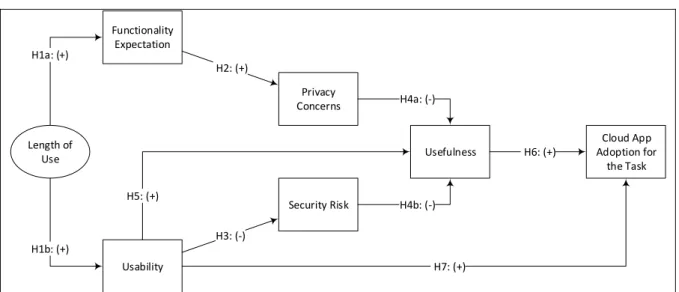
Thus, our theoretical model is shown in Figure 3 below.
Length of Use Functionality Expectation Privacy Concerns Security Risk Usability Usefulness Cloud App Adoption for the Task H1a: (+) H1b: (+) H2: (+) H3: (-) H4a: (-) H4b: (-) H6: (+) H5: (+) H7: (+)
Figure 3 - Theoretical model
Method and Results
The interest of this study is perceptual differences depending on the length of Google Docs use. Having perceptual measurements at two points of time from the same users might be most ideal. However, randomizing both beginning and duration of the app use would make such data collection costly and time-consuming. By following Dabholkar, Shepherd, and Thorpe (2000), our goal was to describe the varying perceptional levels of the focused variables across different users with different length of Google Docs use. We thus used a cross-sectional survey.
Participants and Procedure
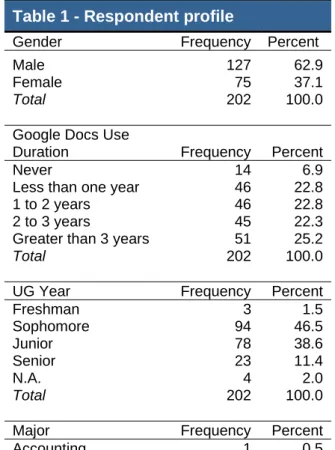
A total of 224 college students in the College of Business at a state university in the southeastern United States (US) participated in the study. These students were taking an introductory management information systems course. Participation was voluntary. However, students could earn extra credit (0.5% of their final grade) if they choose to participate. There were 22 cases in which either (a) respondents did not complete the questionnaire or (b) some of the answers were not recorded. By removing those responses, a final sample of 202 valid questionnaires was used in the present study. The profile of the respondents is summarized in Table 1.
Table 1 - Respondent profile
Gender Frequency Percent
Male 127 62.9
Female 75 37.1
Total 202 100.0
Google Docs Use
Duration Frequency Percent
Never 14 6.9
Less than one year 46 22.8
1 to 2 years 46 22.8
2 to 3 years 45 22.3
Greater than 3 years 51 25.2
Total 202 100.0
UG Year Frequency Percent
Freshman 3 1.5 Sophomore 94 46.5 Junior 78 38.6 Senior 23 11.4 N.A. 4 2.0 Total 202 100.0
Major Frequency Percent
Accounting 1 0.5 Computer Information Systems 2 1.0 Economics 1 0.5 Entrepreneurship 4 2.0 Healthcare Management 3 1.5
Hospitality & Tourism
Management 1 0.5 International Business 118 58.4 Management 4 2.0 Marketing 7 3.5 Other 61 30.2 Total 202 100.0
Survey Instrument
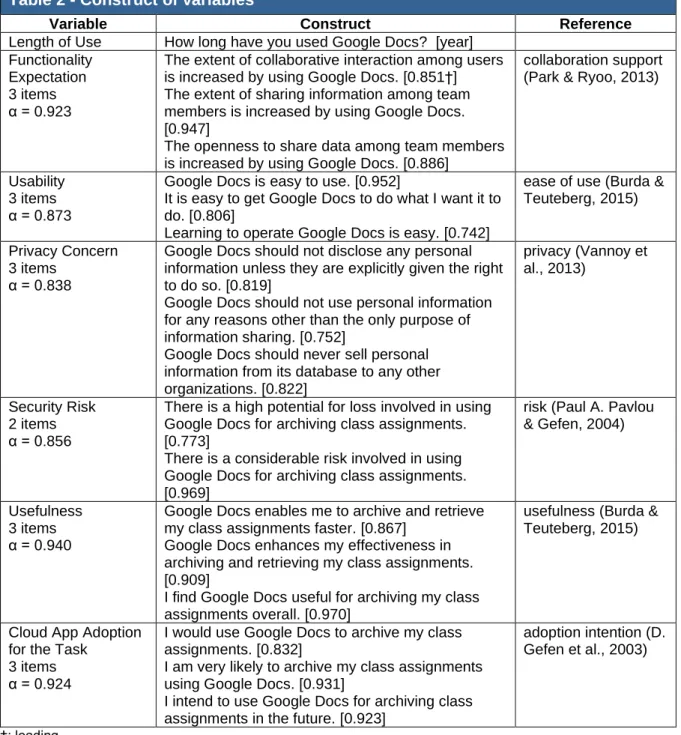
All items used to develop the questionnaire were adapted from existing scales (Table 2). We measured Google Docs users’ functionality expectation of collaboration support (Park & Ryoo, 2013) given the nature of Google Docs is a collaboration tool (Tan & Kim, 2015). Usability is based on ease of use (Burda & Teuteberg, 2015). Users’ perceived privacy when using Google Docs was measured using three items adapted from Vannoy et al. (2013). To measure the perceived risk construct, we modified the original questions from Pavlou and Gefen’s study (2004) into 2 items. We assessed usability through ease of use (Burda & Teuteberg, 2015) and assessed cloud application adoption for the task by applying adoption intention (D. Gefen, Karahanna, & Straub, 2003).
Table 2 - Construct of variables
Variable Construct Reference
Length of Use How long have you used Google Docs? [year] Functionality
Expectation 3 items α = 0.923
The extent of collaborative interaction among users is increased by using Google Docs. [0.851†] The extent of sharing information among team members is increased by using Google Docs. [0.947]
The openness to share data among team members is increased by using Google Docs. [0.886]
collaboration support (Park & Ryoo, 2013)
Usability 3 items α = 0.873
Google Docs is easy to use. [0.952]
It is easy to get Google Docs to do what I want it to do. [0.806]
Learning to operate Google Docs is easy. [0.742]
ease of use (Burda & Teuteberg, 2015)
Privacy Concern 3 items
α = 0.838
Google Docs should not disclose any personal information unless they are explicitly given the right to do so. [0.819]
Google Docs should not use personal information for any reasons other than the only purpose of information sharing. [0.752]
Google Docs should never sell personal information from its database to any other organizations. [0.822] privacy (Vannoy et al., 2013) Security Risk 2 items α = 0.856
There is a high potential for loss involved in using Google Docs for archiving class assignments. [0.773]
There is a considerable risk involved in using Google Docs for archiving class assignments. [0.969]
risk (Paul A. Pavlou & Gefen, 2004)
Usefulness 3 items α = 0.940
Google Docs enables me to archive and retrieve my class assignments faster. [0.867]
Google Docs enhances my effectiveness in archiving and retrieving my class assignments. [0.909]
I find Google Docs useful for archiving my class assignments overall. [0.970]
usefulness (Burda & Teuteberg, 2015)
Cloud App Adoption for the Task
3 items α = 0.924
I would use Google Docs to archive my class assignments. [0.832]
I am very likely to archive my class assignments using Google Docs. [0.931]
I intend to use Google Docs for archiving class assignments in the future. [0.923]
adoption intention (D. Gefen et al., 2003)
†: loading
SmartPLS 3 (Ringle, Wende, & Becker, 2015) was adopted to run a path analysis of constructs in our theoretical model. PLS-SEM is an accepted technique for examining complex causal relationships with multiple paths between two variables (Henseler, Ringle, & Sinkovics, 2009). The fit of the model was adequate since the standardized root mean square residual (SRMR) was 0.078, and the Bentler-Bonett index or normed fit index (NFI) was 0.905. Henseler, Hubona, and Ray (2016) note their cutoff values to be 0.080 and 0.900. After removing items with loadings less than 0.7, Table 2 shows that all constructs’ Cronbach’s alpha values exceed 0.7 and have high reliability (Petter, Straub, & Rai, 2007). Also, we conducted convergent, and discriminant validity tests based on the average variance extracted (AVE) value for each construct reported (Yoo & Alavi, 2001). Table 3 shows that the square root of these AVEs on the diagonal are larger than the correlations with other constructs. This test result indicates that all questions used to measure constructs in the model have high discriminant and convergent validities. In addition, the maximum Heterotrait-Monotrait (HTMT) ratio of the
correlations among the variables was 0.814, which is below 0.85 (Hair, Risher, Sarstedt, & Ringle, 2019).
Table 3 - Convergent and discriminant validity test results
Comp
Rel.† FE ADPT LEN PVCY SEC USBL USFL
Functional
Expectancy (FE) 0.924 0.896 Cloud App Adoption
(ADPT) 0.924 0.238 0.896
Length of Use (LEN) 1.000 0.289 0.320 NA
Privacy (PVCY) 0.840 0.511 0.105 0.155 0.798
Security Risk (SEC) 0.867 -0.145 -0.256 -0.179 0.026 0.876
Usability (USBL) 0.875 0.424 0.515 0.454 0.178 -0.263 0.838
Usefulness (USFL) 0.940 0.216 0.813 0.271 0.123 -0.263 0.454 0.916 †composite reliability
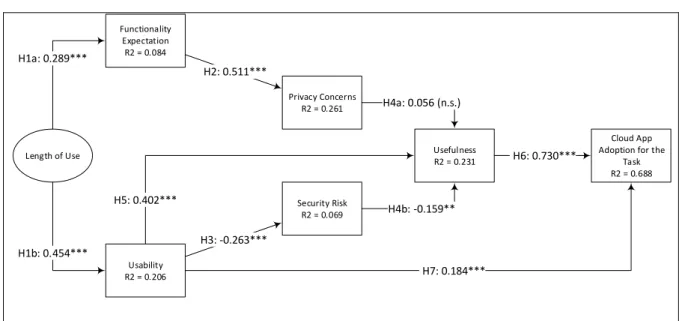
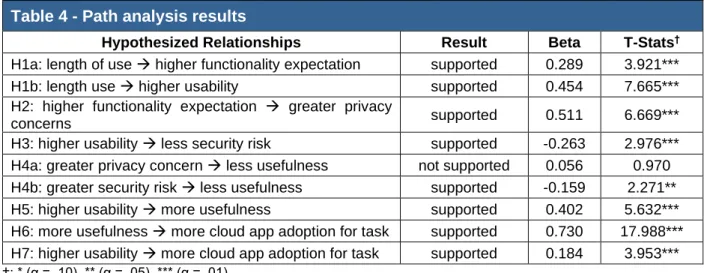
After confirming the acceptance of the reliability and validity of the survey instrument, we entered the data into the path analysis to test our hypothesized relationships. Figure 4 and Table 4 show the path analysis results, including path coefficients and their respective t-statistics. Hypothesis 1a (H1a) and H1b were supported, indicating that reciprocal habituation effects are seen on functionality expectation (β=0.289; p=0.000) and usability perception (β=0.454; p=0.000). Also, functionality expectation increases privacy concern (β=0.511; p=0.000), which supports H2. As hypothesized, the influence of enhanced usability is quite clear. It reduces risk perception (β=-0.263; p=0.003) and increases usefulness (β=0.402; p=0.000) and app adoption (β=0.184; p=0.000). These affirm H3, H5, and H7. Usefulness is influenced by security risk (β=-0.159; p=0.024), but not by privacy concerns (β=0.061; not significant). That is, H4a was not supported while H4b was affirmed. Finally, H6 was supported, indicating that usefulness has a strong influence on app adoption (β=0.730; p=0.000). This result is in agreement with the consistent support reported in previous studies as we can see in the summary of TAM and UTAUT studies (Legris et al., 2003; Venkatesh et al., 2016).
Length of Use Functionality Expectation R2 = 0.084 Privacy Concerns R2 = 0.261 Security Risk R2 = 0.069 Usability R2 = 0.206 Usefulness R2 = 0.231 Cloud App Adoption for the
Task R2 = 0.688 H1a: 0.289*** H1b: 0.454*** H2: 0.511*** H3: -0.263*** H4a: 0.056 (n.s.) H4b: -0.159** H6: 0.730*** H5: 0.402*** H7: 0.184***
Path-significance: * (α = .10), ** (α = .05), *** (α = .01), n.s. (not significant)
Table 4 - Path analysis results
Hypothesized Relationships Result Beta T-Stats†
H1a: length of use → higher functionality expectation supported 0.289 3.921***
H1b: length use → higher usability supported 0.454 7.665***
H2: higher functionality expectation → greater privacy
concerns supported 0.511 6.669***
H3: higher usability → less security risk supported -0.263 2.976*** H4a: greater privacy concern → less usefulness not supported 0.056 0.970 H4b: greater security risk → less usefulness supported -0.159 2.271**
H5: higher usability → more usefulness supported 0.402 5.632***
H6: more usefulness → more cloud app adoption for task supported 0.730 17.988*** H7: higher usability → more cloud app adoption for task supported 0.184 3.953*** †: * (α = .10), ** (α = .05), *** (α = .01)
Academic and Practical Implications
There are three major implications of this study. First, the results imply the possible reciprocal habituation effects in information systems (IS) research. Second, they imply a different manifestation of privacy and security concerns not only by reciprocal habituation effects but also to the success of cloud application systems. Third, small and medium-sized enterprises (SMEs) should still exercise proper security and privacy control of user data even though the users may feel less security concern through improved usability perception.
Significance of Reciprocal Habituation Effects
Duality highlights the interactive aspect of organizational and technological evolutions. Organizational (or social) structure and individuals’ autonomy are mutually influenced in the process of their evolution (Giddens, 1986). Similarly, technology and humans’ actions go through reciprocal processes of mutual influences in the organization (Orlikowski, 1992). In the dual-process theory, humans and their external stimuli go through two independent processes: one decremental (habituation) and one incremental (sensitization) (Thompson, 2009).
While recent studies (Amran, Zaaba, Singh, & Marashdih, 2017; Vance et al., 2018) on security warnings focus on the habituation aspect, this study has captured the reciprocal aspect of human-system interactions in the process of system evolutions. It is a timely focus because cloud application systems can be updated/upgraded more frequently than traditional on-premise systems. While there are many studies explaining well end-users’ system acceptance with variables like intention, attitude and norm, the results of this study highlight the needs to consider the impact of routinization and reciprocation processes similar to what Jasperson et al. (2005) point out.
The results of this study shed light on the duality of standardized, common cloud applications and their user perceptions. The users of Google Docs expect more functionality and perceive better usability as they use it more. Such results confirm the implications of reciprocal habituation theory (Nansen et al., 2014). In other words, “custom makes all things easy” on standardized cloud applications. To generalize, the more the user interacts with application systems, the more they feel comfortable with what (functionality) and how (usability) those systems do for them.
Different Manifestations of Privacy and Security Concerns
On the surface, risk and privacy concerns seem to closely interrelate with one another. As an example, one of the common online risks for youths is privacy issues. A 2014 Brookings Institution report (Farrukh, Sadwick, & Villasenor, 2014, p. 6) argues, “Many of the risks the Internet poses can be mitigated if youth more proactively preserve their privacy online” (p. 6). However, the results of this study (Figure 4) show intriguing differences between privacy and security concerns depending on the length of cloud app use.
First, improved usability perception is a strong driver for the ultimate success of the cloud application directly (H5 and H7) – and indirectly (H3 and H4b) through decreased security concern. While increased functionality expectation may raise privacy concerns (H2), privacy concern itself has no influence over usefulness perception (H4a). The contrast between expectation and usability is the difference between what the user desires/wants and what the user actually experiences with the cloud app. Expectation pertains to before starting to use the system, whereas experience is based on after having used the system (Alapetite, Andersen, & Hertzum, 2009). What matters appears what the cloud app actually delivers. At the same time, privacy concerns are likely to increase as cloud applications are used more— regardless of improvements in those applications. Fortunately, no major privacy incident involving Google Docs has been reported since private documents were inadvertently shared in March of 2009 (Chen & Zhao, 2012; Zhou, Zhang, Xie, Qian, & Zhou, 2010).
Second, the results imply users’ decreasing security concerns as they gain more experience with cloud apps. Combined with better usability perception, end-users of cloud applications are likely to appreciate more the utility of those applications. This should indicate the optimistic acceptance of cloud applications in the foreseeable future. In consumer purchase decisions, risk perception generally continues to decline from the beginning of product purchase intention to post-purchase product evaluation (Mitchell & Boustani, 1994). This is because consumers use risk reduction strategy in their purchase process to minimize two types of uncertainties: knowledge uncertainty and choice uncertainty (Mitchell & Boustani, 1994). Cloud application users go through a similar process of initial application evaluation to post-adoption evaluation, just as consumers go through pre-purchase research to post-purchase evaluation.
A survey of past studies shows that user experience affects trust (Beldad, de Jong, & Steehouder, 2010). Trust, in turn, lowers the degree of risk perception (Kim et al., 2008). That is, as Google Docs users continue to use the application, they develop more trust in Google Docs and, in turn, have lower risk perception. These are driven by user learning through continuous interaction with the cloud application over time. A growing number of regulators and system developers are collaborating to develop systems by using the concept of “privacy by design” or “build in” privacy (Rubinstein & Good, 2013). This emerging concept further affirms the importance and impact of increased perceived usability on reducing security concerns.
Nevertheless, however infrequent security breaches are, the extent of their consequences is appearing to become greater in recent years.6 We need to remind end-users of any cloud applications not to lower their guard completely just because of continuous improvements of those applications.
6 A summary of recent security breaches and consequences is seen in
Implications for SMEs in the Asia Pacific region
In the pre-cloud era, the evolution of systems was slower than that in the cloud era. The adoption of cloud-based systems probably enables continuous mutual adaptation between systems and their users. The finding is relevant for SMEs in the Asia Pacific region because they are embracing standardized technologies (e.g., cloud computing, virtualization, open source business intelligence tools) to capitalize on technological flexibility, low networking cost, reduction of increasing labor cost and speedy communication (M. S. Ali, Miah, & Khan, 2018). However, these cloud computing benefits could be achieved at the expense of proper security and privacy control of user data. In this regard, the perspective of the traditional theory of planned behavior might require some follow-up studies on cloud computing environments in which technologies and users could quickly adapt to each other in the face of security and privacy concerns.
For developers of cloud applications, these results highlight the importance of continuous usability improvements that not only give end-users a better application experience but also accelerate the adoption of cloud applications by pacifying privacy violation and security risk concerns. The developers should also be aware that end-users are likely to appreciate the functions of standardized cloud applications more, which leads to increased use of the system. This causes end-users to be more concerned about privacy issues. That is, the future of standardized cloud applications depends partly on minimizing possible privacy compromises. End-users should be cautious of the increased probabilities of encountering privacy issues as they rely more on standardized cloud applications.
Limitations and Future Research Directions
For researchers, the results of this study provide three major research opportunities. First, scholars of human-computer interactions should increase the study of the influence of reciprocal habituations on functionality expectation and usability of standardized and non-standardized cloud applications. Of particular interest is cloud-based enterprise resources planning (ERP), systems that are increasingly being adopted by firms. Second, scholars should empirically study the impact of reciprocal habituations of cloud applications on privacy and security beyond Google Docs. As we use more mobile devices for cloud and non-cloud applications (e.g. Internet of Things), minimizing concerns of privacy and security is paramount for both systems developers and end-users (Henze et al., 2016). Third, social media utilizes cloud computing platforms to connect people and is expanding rapidly. However, social cloud computing introduces increasing security and privacy concerns (Anshari, Alas, & Guan, 2015) as more content is produced and shared among users, most of whom have not received proper security training. Habitual use of social media can induce both positive and negative habitual behaviors (e.g. sharing personal schedule and home address on the cloud-based social sites). Future research might investigate factors that can effectively promote positive habitual behaviors but discourage negative ones.
One limitation is that this study is rooted in the US higher educational settings; the participants in the study were mostly adults. Future studies could use participants with broader profiles. Another limitation is rooted in the nature of Google Docs. It is a productivity suite as well as a collaboration tool (Yunting Sun et al., 2014, June). Nonetheless, current cloud applications such as the CRM system Salesforce.com are characterized by ease of use; without having to read manuals, users spend time quickly “figuring out” the applications (e.g., Kao, Wong, Kaufman, & Paz, 2016; Weinhardt et al., 2009). The user interface characteristics of Google Docs might not be as far-fetched as those of recent cloud business applications. Future studies need to focus on other types of business and consumer applications. They could also evaluate the validity of this study by considering such user characteristics as the extent of other cloud/non-cloud application use and collaboration needs.
Conclusion
This study describes the perceptual impact of reciprocal habituation effects on functional expectation, usability, privacy concerns, and security risks of standardized, common cloud applications. Cloud applications separate themselves from traditional applications in the speed and frequency of their updates. While a traditional application might be updated once a year, standardized cloud applications like Google Docs are updated much more frequently. This enables mutual adaptation between cloud applications and their users. With this in mind, we posed the following question: Does the old proverb “Custom makes all things easy” apply to the concerns in cloud application use? This study notes that extant studies on new technology adoption typically overlook the aspects of habituation (users accustomed to a stimulus) and reciprocal habituation (mutual adaptation between technology and users). Application of those concepts opens new research venues for today’s rapidly changing technology environment. The results show that, as Google Docs is used for a longer period, functionality expectation increases while the perception of its usability improves. Interestingly, improved usability perception eases security concern, while higher functionality expectation increases privacy concern. However, increased privacy concern has no impact on usefulness and adoption of Google Docs for the task at hand. Usefulness and adoption, on the other hand, are driven by improved usability and lowered security risk perceptions. Thus, the old proverb may be valid for functionality expectation, usability, and security risk but not for privacy concern. In addition, “custom” applies both ways: Users adapt to cloud applications, while cloud applications adjust themselves to their users’ changing needs. Tuunanen, Myers, and Cassab (2010) note the increased emphasis on the social nature of information system use. The results of this study appear to place cloud applications as a critical element of the socio-technical ecosystem. Standardized, common cloud applications are ideal platforms to assess how end-user perceptions regarding functionality expectation, usability, privacy, and security change over time across different organizations. This study aims to contribute to such an endeavor.
References
Abdullah, F., Ward, R., & Ahmed, E. (2016). Investigating the influence of the most commonly used external variables of TAM on students’ Perceived Ease of Use (PEOU) and Perceived Usefulness (PU) of e-portfolios. Computers in Human Behavior, 63, 75-90. Ajzen, I. (2002). Residual effects of past on later behavior: Habituation and reasoned action
perspectives. Personality and social psychology review, 6(2), 107-122.
Alapetite, A., Andersen, H. B., & Hertzum, M. (2009). Acceptance of speech recognition by physicians: A survey of expectations, experiences, and social influence. International Journal of Human-Computer Studies, 67(1), 36-49.
Ali, M. S., Miah, S. J., & Khan, S. (2018). Antecedents of Business Intelligence Implementation for Addressing Organizational Agility in Small Business Context. Pacific Asia Journal of the Association for Information Systems, 10(1), 89-108.
Ali, O., Soar, J., & Yong, J. (2016). An investigation of the challenges and issues influencing the adoption of cloud computing in Australian regional municipal governments. Journal of Information Security and Applications, 27–28, 19-34.
Amer, T., & Maris, J.-M. B. (2007). Signal words and signal icons in application control and information technology exception messages-hazard matching and habituation effects. Journal of Information Systems, 21(2), 1-25.
Amran, A., Zaaba, Z. F., Singh, M. M., & Marashdih, A. W. (2017). Usable security: Revealing end-users comprehensions on security warnings. Procedia Computer Science, 124, 624-631.
Anderson, B. B., Jenkins, J. L., Vance, A., Kirwan, C. B., & Eargle, D. (2016). Your memory is working against you: How eye tracking and memory explain habituation to security warnings. Decision Support Systems, 92, 3-13.
Anshari, M., Alas, Y., & Guan, L. S. (2015). Pervasive Knowledge, Social Networks, and Cloud Computing: E-Learning 2.0. Eurasia Journal of Mathematics, Science & Technology Education, 11(5), 909-921.
Arpaci, I. (2016). Understanding and predicting students' intention to use mobile cloud storage services. Computers in Human Behavior, 58, 150-157.
Bambauer, D. E. (2013). Privacy versus security. Journal of Criminal Law and Criminology, 103(3), 667-684.
Beldad, A., de Jong, M., & Steehouder, M. (2010). How shall I trust the faceless and the intangible? A literature review on the antecedents of online trust. Computers in Human Behavior, 26(5), 857-869.
BetterCloud. (2016). The 2016 State of Cloud IT Report. Retrieved from
http://blog.bettercloud.com/google-apps-vs-office-365/
Bouchard, S. (2015). The convenience of the cloud. Healthcare IT News. Retrieved from
https://www.healthcareitnews.com/news/convenience-cloud
Brender, N., & Markov, I. (2013). Risk perception and risk management in cloud computing: Results from a case study of Swiss companies. International Journal of Information Management, 33(5), 726-733.
Burda, D., & Teuteberg, F. (2015). Understanding service quality and system quality success factors in cloud archiving from an end-user perspective. Information Systems Management, 32(4), 266-284.
Cahill, J. L. (2014). University professors’ perceptions about the impact of integrating google applications on students’ communication and collaboration skills. Journal of Research Initiatives, 1(2), Article 7.
Casalo, L. V., Flavián, C., & Guinalíu, M. (2007). The role of security, privacy, usability and reputation in the development of online banking. Online Information Review, 31(5), 583-603.
Chen, D., & Zhao, H. (2012). Data security and privacy protection issues in cloud computing. Paper presented at the 2012 International Conference on Computer Science and Electronics Engineering (ICCSEE), Hangzhou, China.
Culnan, M. J., & Armstrong, P. K. (1999). Information privacy concerns, procedural fairness, and impersonal trust: An empirical investigation. ORGANIZATION SCIENCE, 10(1), 104-115.
Dabholkar, P. A., Shepherd, C. D., & Thorpe, D. I. (2000). A comprehensive framework for service quality: an investigation of critical conceptual and measurement issues through a longitudinal study. Journal of Retailing, 76(2), 139-173.
Davis, F. D. (1989). Perceived usefulness, perceived ease of use, and user acceptance of information technology. MIS Quarterly, 13(3), 319-340.
Dickson, B. (2018). Avoid this privacy folly when sharing on Google Docs. Retrieved from
https://bdtechtalks.com/2018/04/02/google-docs-sharing-privacy-concerns/
Dinev, T., & Hart, P. (2006). An extended privacy calculus model for e-commerce transactions. Information Systems Research, 17(1), 61-80.
Farrukh, A., Sadwick, R., & Villasenor, J. (2014). Youth Internet Safety: Risks, Responses, and Research Recommendations. Retrieved from https://www.brookings.edu/wp-content/uploads/2016/06/Youth-Internet-Safety_v07.pdf
Feitelson, D. G., Frachtenberg, E., & Beck, K. L. (2013). Development and deployment at Facebook. IEEE Internet Computing, 17(4), 8-17.
Flavián, C., Guinalíu, M., & Gurrea, R. (2006). The role played by perceived usability, satisfaction and consumer trust on website loyalty. Information & Management, 43(1), 1-14.
Gefen, D., Karahanna, E., & Straub, D. W. (2003). Trust and TAM in online shopping: An integrated model. MIS Quarterly, 27(1), 51-90.
Gefen, D., & Pavlou, P. A. (2012). The Boundaries of Trust and Risk: The Quadratic Moderating Role of Institutional Structures. Information Systems Research, 23(3-part-2), 940-959.
Gefen, D., & Straub, D. W. (2000). The relative importance of perceived ease of use in IS adoption: A study of e-commerce adoption. Journal of the Association for Information Systems, 1(1), 8.
Giddens, A. (1986). The constitution of society: Outline of the theory of structuration. Berkeley, CA: University of California Press.
Gramoli, V., Bass, L., Fekete, A., & Sun, D. W. (2016). Rollup: Non-disruptive rolling upgrade with fast consensus-based dynamic reconfigurations. IEEE Transactions on Parallel and Distributed Systems, 27(9), 2711-2724.
Groves, P. M., & Thompson, R. F. (1970). Habituation: a dual-process theory. Psychological Review, 77(5), 419-450.
Gunson, N., Marshall, D., Morton, H., & Jack, M. (2011). User perceptions of security and usability of single-factor and two-factor authentication in automated telephone banking. Computers & Security, 30(4), 208-220.
Hair, J. F., Risher, J. J., Sarstedt, M., & Ringle, C. M. (2019). When to use and how to report the results of PLS-SEM. European Business Review, 31(1), 2-24.
Hart, J., Ridley, C., Taher, F., Sas, C., & Dix, A. (2008, October). Exploring the facebook experience: a new approach to usability. Paper presented at the 5th Nordic conference on Human-computer interaction: building bridges, Lund, Sweden.
Henseler, J., Hubona, G., & Ray, P. A. (2016). Using PLS path modeling in new technology research: updated guidelines. Industrial Management & Data Systems, 116(1), 2-20. Henseler, J., Ringle, C. M., & Sinkovics, R. R. (2009). The use of partial least squares path
modeling in international marketing. In R. R. Sinkovics & P. N. Ghauri (Eds.), New Challenges to International Marketing (Advances in International Marketing, Volume 20) (pp. 277-319): Emerald Group Publishing Limited.
Henze, M., Hermerschmidt, L., Kerpen, D., Häuß ling, R., Rumpe, B., & Wehrle, K. (2016). A comprehensive approach to privacy in the cloud-based Internet of Things. Future Generation Computer Systems, 56, 701-718.
Hermsen, S., Frost, J., Renes, R. J., & Kerkhof, P. (2016). Using feedback through digital technology to disrupt and change habitual behavior: A critical review of current literature. Computers in Human Behavior, 57, 61-74.
Howell, D. (2012, September). How to use Google Docs in your business. Retrieved from
http://www.techradar.com/news/world-of-tech/roundup/how-to-use-google-docs-in-your-business-1080940
Hu, T., Poston, R. S., & Kettinger, W. J. (2011). Nonadopters of online social network services: Is it easy to have fun yet. Communications of the Association for Information Systems, 29(1), 441-458.
Issa, T., Kommers, P., & Isaias, P. (2015). Security and Privacy of Online Technologies. Pacific Asia Journal of the Association for Information Systems, 7(4), i-iii.
Iyer, B., & Henderson, J. C. (2010). Preparing for the future: Understanding the seven capabilities cloud computing. MIS Quarterly Executive, 9(2), 117-131.
Jasperson, J. S., Carter, P. E., & Zmud, R. W. (2005). A comprehensive conceptualization of post-adoptive behaviors associated with information technology enabled work systems. MIS Quarterly, 29(3), 525-557.
Kao, L., Wong, T., Kaufman, M., & Paz, J. (2016). Salesforce. com for Dummies: John Wiley & Sons.
Karapanos, E., Zimmerman, J., Forlizzi, J., & Martens, J.-B. (2009). User experience over time: an initial framework. Paper presented at the Proceedings of the SIGCHI conference on human factors in computing systems.
Kim, D. J., Ferrin, D. L., & Rao, H. R. (2008). A trust-based consumer decision-making model in electronic commerce: The role of trust, perceived risk, and their antecedents. Decision Support Systems, 44(2), 544-564.
Koay, K. L., Syrdal, D. S., Walters, M. L., & Dautenhahn, K. (2007, August). Living with robots: Investigating the habituation effect in participants' preferences during a longitudinal human-robot interaction study. Paper presented at the 16th IEEE International Symposium on Robot and Human Interactive Communication (RO-MAN 2007) Jeju Island, Korea.
Kumar, D., Samalia, H. V., & Verma, P. (2017). Factors Influencing Cloud Computing Adoption by Small and Medium-Sized Enterprises (SMEs) In India. Pacific Asia Journal of the Association for Information Systems, 9(3), 25-48.
Lacka, E., & Chong, A. (2016). Usability perspective on social media sites' adoption in the B2B context. Industrial Marketing Management, 54, 80-91.
Lam, P., Lam, S. L., Lam, J., & McNaught, C. (2009). Usability and usefulness of eBooks on PPCs: How students’ opinions vary over time. Australasian journal of educational technology, 25(1), 30-44.
Lancelot Miltgen, C., Popovič, A., & Oliveira, T. (2013). Determinants of end-user acceptance of biometrics: Integrating the “Big 3” of technology acceptance with privacy context. Decision Support Systems, 56, 103-114.
Larson, S. (2017). Major phishing attack targeted Google Docs users. Retrieved from
https://money.cnn.com/2017/05/03/technology/google-docs-phishing-attack/
Lee, Y.-C. (2006). An empirical investigation into factors influencing the adoption of an e-learning system. Online Information Review, 30(5), 517-541.
Legris, P., Ingham, J., & Collerette, P. (2003). Why do people use information technology? A critical review of the technology acceptance model. Information & Management, 40(3), 191-204.
Li, L., Berki, E., Helenius, M., & Ovaska, S. (2014). Towards a contingency approach with whitelist- and blacklist-based anti-phishing applications: what do usability tests indicate? Behaviour & Information Technology, 33(11), 1136-1147.
Masood, R., & Aslam, M. (2016). Innovative approach ensuring security and privacy in cloud computing. Pakistan Journal of Science, 68(1), 42-47.
Matsubara, N., Matsumoto, S., & Nakamura, M. (2011, December). Characterizing user habituation in interactive voice interface: experience study on home network system. Paper presented at the 13th International Conference on Information Integration and Web-based Applications and Services, Bali, Indonesia.
McNamara, N., & Kirakowski, J. (2006). Functionality, usability, and user experience: three areas of concern. ACM Interactions, 13(6), 26-28.
Mendoza, V., & Novick, D. G. (2005). Usability over time. Paper presented at the The 23rd Annual International Conference on Design of Communication: Documenting & Designing for Pervasive Information.
Mitchell, V. W., & Boustani, P. (1994). A preliminary investigation into pre‐ and post‐purchase risk perception and reduction. European Journal of Marketing, 28(1), 56-71.
Mohammed, D. (2011). Security in cloud computing: an analysis of key drivers and constraints. Information Security Journal: A Global Perspective, 20(3), 123-127.
Moonen, L. (2015). 'Come on guys, what are we really trying to say here?': Using Google Docs to develop Year 9 pupils' essay-writing skills. Teaching History(161), 8-14.
Motaghian, H., Hassanzadeh, A., & Moghadam, D. K. (2013). Factors affecting university instructors' adoption of web-based learning systems: Case study of Iran. Computers & Education, 61, 158-167.
Nansen, B., Vetere, F., Robertson, T., Downs, J., Brereton, M., & Durick, J. (2014). Reciprocal habituation: a study of older people and the Kinect. ACM Transactions on Computer-Human Interaction (TOCHI), 21(3), Article 18.
National University of Singapore, & Microsoft. (2017). A Cloud for Doing Good: A Technology
Revolution for All in ASEAN. Retrieved from
https://news.microsoft.com/uploads/2017/10/A-Cloud-for-Doing-Good-FINAL.pdf
Neamtiu, I., & Dumitras, T. (2011). Cloud software upgrades: Challenges and opportunities. Paper presented at the 2011 International Workshop on the Maintenance and Evolution of Service-Oriented and Cloud-Based Systems (MESOCA), Williamsburg, VA.
Nicolaou, A. I., & McKnight, D. H. (2011). System design features and repeated use of electronic data exchanges. Journal of Management Information Systems, 28(2), 269-304.
Nikou, S., & Bouwman, H. (2014). Ubiquitous use of mobile social network services. Telematics and Informatics, 31(3), 422-433.
Orlikowski, W. J. (1992). The duality of technology: Rethinking the concept of technology in organizations. ORGANIZATION SCIENCE, 3(3), 398-427.
Park, S. C., & Ryoo, S. Y. (2013). An empirical investigation of end-users’ switching toward cloud computing: A two factor theory perspective. Computers in Human Behavior, 29(1), 160-170.
Pavlou, P. A. (2011). State of the information privacy literature: where are we now and where should we go? MIS Quarterly, 35(4), 977-988.
Pavlou, P. A., & Gefen, D. (2004). Building effective online marketplaces with institution-based trust. Information Systems Research, 15(1), 37-59.
Pedersen, D. M. (1997). PSYCHOLOGICAL FUNCTIONS OF PRIVACY. Journal of Environmental Psychology, 17(2), 147-156.
Petter, S., Straub, D., & Rai, A. (2007). Specifying formative constructs in information systems research. MIS Quarterly, 31(4), 623-656.
Rankin, C. H., Abrams, T., Barry, R. J., Bhatnagar, S., Clayton, D. F., Colombo, J., . . . Thompson, R. F. (2009). Habituation revisited: An updated and revised description of the behavioral characteristics of habituation. Neurobiology of Learning and Memory, 92(2), 135-138.
RightScale. (2016). 2016 State of the Cloud Survey. Retrieved from
http://www.rightscale.com/blog/cloud-industry-insights/cloud-computing-trends-2016-state-cloud-survey
Ringle, C. M., Wende, S., & Becker, J.-M. (2015). SmartPLS 3. In. Boenningstedt: SmartPLS GmbH.
Rubinstein, I. S., & Good, N. (2013). Privacy by design: A counterfactual analysis of Google and Facebook privacy incidents. Berkeley Technology Law Journal, 28(2), 1333-1413. Saeed, K. A. (2013). Perceived financial control and acceptance of mobile banking services: An empirical assessment. Paper presented at the 19th Americas Conference on Information Systems (AMCIS).
Sanchez, R., & Sudharshan, D. (1993). Real-time market research. Marketing Intelligence & Planning, 11(7), 29-38.
Smith, H. J., Dinev, T., & Xu, H. (2011). Information privacy research: an interdisciplinary review. MIS Quarterly, 35(4), 989-1016.
Stewart, C. (2018). Data Privacy Concerns with Google. Retrieved from
https://hackernoon.com/data-privacy-concerns-with-google-b946f2b7afea
Sun, Y., Lambert, D., Uchida, M., & Remy, N. (2014, June). Collaboration in the cloud at Google. Paper presented at the 2014 ACM conference on Web science, Bloomington, Indiana.
Sun, Y., Liu, L., Peng, X., Dong, Y., & Barnes, S. J. (2014). Understanding Chinese users’ continuance intention toward online social networks: an integrative theoretical model. Electronic Markets, 24(1), 57-66.
Syn, S. Y., & Sinn, D. (2015). Repurposing Facebook for documenting personal history: How do people develop a secondary system use? Information Research, 20(4), 161-179. Tan, X., & Kim, Y. (2015). User acceptance of SaaS-based collaboration tools: a case of
Google Docs. Journal of Enterprise Information Management, 28(3), 423-442.
Tchernykh, A., Schwiegelsohn, U., Alexandrov, V., & Talbi, E.-g. (2015). Towards Understanding Uncertainty in Cloud Computing Resource Provisioning. Procedia Computer Science, 51, 1772-1781.
Thompson, R. F. (2009). Habituation: a history. Neurobiology of Learning and Memory, 92(2), 127–134.
Thompson, R. F., & Spencer, W. A. (1966). Habituation: a model phenomenon for the study of neuronal substrates of behavior. Psychological Review, 73(1), 16-43.
Tuunanen, T., Myers, M. D., & Cassab, H. (2010). A conceptual framework for consumer information systems development. Pacific Asia Journal of the Association for Information Systems, 2(1), 47-66.
Urbach, N., Smolnik, S., & Riempp, G. (2010). An empirical investigation of employee portal success. Journal of Strategic Information Systems, 19(3), 184-206.
Vance, A., Jenkins, J. L., Anderson, B. B., Bjornn, D. K., & Kirwan, C. B. (2018). Tuning Out Security Warnings: A Longitudinal Examination of Habituation Through fMRI, Eye Tracking, and Field Experiments. MIS Quarterly, 42(2), 355-380.