SFB 649 Discussion Paper 2006-085
Relational Contracts and
Inequity Aversion
Jenny Kragl*
Julia Schmid**
* School of Business and Economics, Humboldt-Universität zu Berlin, Germany ** Department of Economics and Management,
Technical University Berlin, Germany
This research was supported by the Deutsche
Forschungsgemeinschaft through the SFB 649 "Economic Risk". http://sfb649.wiwi.hu-berlin.de ISSN 1860-5664 SFB 649, Humboldt-Universität zu Berlin
S
FB
6
49
E
C
O
N
O
M
I
CR
I
SK
B
ER
L
I
N
Relational Contracts and Inequity Aversion
Jenny Kragly
Humboldt University at Berlin
Julia Schmidz Technical University Berlin December 6, 2006
Abstract
We study the e¤ects of envy on the feasibility of relational contracts in a standard moral hazard setup with two agents. Performance is evaluated via an observable, but non-contractible signal which re‡ects the agent’s individual contribution to …rm value. Both agents exhibit disadvantageous inequity aversion. In contrast to the literature, we …nd that inequity aversion may be bene…cial: In the presence of envy, for a certain range of interest rates relational contracts may be more pro…table. Furthermore, for some interest rates reputational equilibria exist only with inequity averse agents.
Keywords: principal-agent, relational contract, inequity aversion, envy JEL classi…cation: D63 , D82, M52, M54
We would like to thank Dominique Demougin, Oliver Fabel, Carsten Helm, Dorothea Kübler, and Anja Schöttner for helpful comments and discussions. Financial support by the Deutsche Forschungsgemeinschaft through the SFB 649 "Economic Risk" is gratefully acknowledged.
ySchool of Business and Economics, Spandauer Str. 1, D-10178 Berlin, Germany, phone: +49 30 2093-1344, fax: +49 30 2093-1343, e-mail: [email protected]
zDepartment of Economics and Management, Straße des 17. Juni 135, D-10623 Berlin, Germany, phone: +49 30 314-76665, fax: +49 30 314-24268, e-mail: [email protected]
"Implicit contracts can be e¤ ective only in a social atmosphere that incorporates a sense of mutual respect and a consensus on principles of fair play and good faith."
Arthur m. Okun1
1
Introduction
The present paper investigates how concerns for fairness among agents af-fect the optimal provision of incentives in a one-task framework with only subjective performance measures. In particular, we analyze the impact of horizontal inequity aversion on the principal’s credibility in a relational con-tract. We …nd that there are cases where the principal prefers to employ inequity averse rather than inequity neutral agents.
Frequently, if not typically, the agent’s true contribution to …rm value cannot be objectively assessed. In this case, the use of contractible but im-perfect performance measures creates distortions with respect to the agent’s e¤ort decision.2 In many cases, the agent’s true contribution to …rm value can, nonetheless, be observed by both contracting parties. The observed subjective performance may be used in implicit agreements (relational tracts). As subjective assessments are not veri…able by third parties, con-tracts are not court-enforceable and, thus, have to be self-enforcing. They may be implemented in long-term relationships as reputational equilibria.3
Furthermore, agents’ contributions are not necessarily perfectly corre-lated to their e¤orts. Thus, agents undertaking the same e¤ort could receive di¤erent rewards. This might provoke envy, empathy or spiteful behavior
1Okun (1980), p. 8.
2There is a vast literature on pay for performance. See e.g. Kerr (1975), Baker (1992),
Milgrom and Roberts (1992), and Holmström and Milgrom (1994). For congruency prob-lems see e.g. Holmström and Milgrom (1991) and Baker (2002).
3
Reputational equilibria may exist if one party cares about her reputation in future relationships. See e.g. Holmström (1981), Bull (1987), and Baker, Gibbons, and Murphy (1994).
among agents, especially if they work on similar tasks.4 Taking into account the presence of inequity averse preferences, we investigate the feasibility of relational contracts.
We consider a relationship between one principal and two risk-neutral, not …nancially constrained agents who exhibit disadvantageous inequity aversion. We have in mind employees working on similar tasks in small or medium-size …rms. Since workers tend to compare their payo¤s with those of their colleagues, we believe the assumption of inequity aversion to be reasonable. Speci…cally, we model preferences as "self-centered inequity aversion", as proposed by Fehr and Schmidt (1999), abstracting from em-pathy.5 Neither agent’s e¤ort is directly observable by the principal, albeit imperfectly correlated with individual performance. The principal seeks to mitigate the resulting moral hazard problem by o¤ering each agent an in-centive contract contingent on their respective performances.6 As observed
performance is not veri…able, the contract has to be self-enforcing. In mod-eling the game structure, we follow Bull (1987).
We replicate some results established in the literature. Grund and Sliwka (2005) and Demougin and Fluet (2006) show that more envious agents exert more e¤ort than less envious ones, when being o¤ered identical incentive contracts. However, to ensure participation, the principal has to pay the inequity averse agents a premium to compensate them for the faced risk of unequal payo¤s (inequity premium). In this kind of framework, agency costs increase in the presence of inequity aversion, as reported by e.g. Bartling and Siemens (2005) and Grund and Sliwka (2005).7 Hence, the principal would rather employ inequity neutral than inequity averse agents.
4See for experimental evidence of other-regarding preferences e.g. Goranson and
Berkowitz (1966), Fehr, Gächter, and Kirchsteiger (1997), Fehr, Kirchsteiger, and Riedl (1995), and Berg, Dickhaut, and McCabe (1995). For the importance of reference groups, see Loewenstein, Thompson, and Bazerman (1989), Falk and Fischbacher (2006), Bolton and Ockenfels (2000), and Bartling and Siemens (2006).
5For alternative approaches regarding the formalization of fairness concerns see e.g.
Rabin (1993), Bolton and Ockenfels (2000), and Falk and Fischbacher (2006).
6We consider agents’ tasks to be independent such that there is no inherent
advan-tage in team production. Therefore we focus on individual bonus payments as a natural compensation scheme.
7
This holds under unlimited liability what is the case we consider. Under limited liability, this might not be true; e¢ ciency may increase under inequity aversion as long as agents receive rents. See e.g. Demougin and Fluet (2003) and Demougin and Fluet (2006).
The present paper analyzes how this conclusion is a¤ected under a re-lational contract. The principal’s credibility constraint requires that her gains from reneging fall short of the discounted gains from continuing the relational contract.8 We …nd that this constraint is ambiguously a¤ected by the presence of envy: On the one hand, the incentive for the principal to deviate from the relational contract in order to save bonus expenses de-creases in the propensity for inequity aversion. Intuitively, this is due to the fact that envious agents work harder given the same incentive in order to avoid ending up with a lower payo¤ than their colleagues. This facilitates credible commitment on the principal’s side. On the other hand, as agents have to be compensated for their disutility incurred by envy, the principal’s long-run pro…ts out of the contract decrease as agents become more envious. Consequently, commitment to paying the o¤ered bonus is more di¢ cult.
The sum of these two counteracting e¤ects determines whether credibil-ity is either more or less easily obtained by the principal as agents become more envious. Whenever the savings due to lower bonus payments exceed the loss of pro…ts via the inequity premium payments, the principal prefers to employ more envious agents.
We identify a necessary and su¢ cient condition under which, for a certain range of the principal’s discount rate, relational contracts are less pro…table or even infeasible when agents do not exhibit inequity aversion. In that case, inequity aversion becomes an advantageous factor in principal-agent relationships in the sense that more reputational equilibria can be sustained with envious agents.
Before proceeding with the analysis a few caveat are in order. First, we limit attention to individual bonus schemes. Other contracts would be pos-sible. For example, to align incentives the principal could use tournaments. Here, the principal would not face any credibility problem. However, this reward scheme would exacerbate problems related to inequity aversion. The principal could also use a team bonus structure solely for the purpose of avoiding inequity. This would introduce an alternative trade-o¤. Speci…-cally, a team bonus implies a weaker relationship between individual e¤ort
8
We derive this rationality (credibility) constraint analogously to Baker, Gibbons, and Murphy (1994).
and the marginal likelihood of obtaining the bonus. This requires raising the bonus level, making the relational contract less likely.
Second, one has to be aware of the fact that for an individual’s perception of fairness and equity many determinants beside the colleague’s payo¤ may play a role; e.g. e¤ort, ability, education, gender, status etc. Cognition of inequity is presumably a¤ected by mutual comparisons regarding all the mentioned characteristics. In our model, due to the agents’ homogeneity in both preferences and characteristics, di¤erences in payo¤s are the sole source of inequity. Hence, payo¤ inequality accords with inequity.
The next section describes our basic framework. Subsection 2.1 addresses the agency problem in the single-period game. Subsection 2.2 develops the reputation game and thereby the relational contract. In section 3, we ex-amine the impact of the agent’s propensity for envy on the feasibility of the relational contract and derive our main result concerning the principal’s credibility problem. Section 4 discusses the implications and concludes.
2
The Model
We consider a repeated game between a principal (the …rm) and two agents homogeneous in preferences and characteristics. In each period, each agent chooses an unobservable e¤ort level ei that stochastically determines the
agent’s contribution to …rm value Yi. That contribution is either high or
low; for simplicity Yi 2 f0;1g. It is observable by all three contracting
parties, but not veri…able, and can therefore only be used as a performance measure in a self-enforcing relational contract.
By exerting e¤ort agenti(i= 1;2)a¤ects the probability ofYi = 1:
Pr[Yi = 1jei] =p(ei); (1)
wherep(ei) 2[0;1); p(0) = 0; p0(ei)>0;and p00(ei)<0. Agents’outputs
The principal o¤ers each agent an explicit compensation contract speci-fying a guaranteed …xed wagew:In addition, the principal announces to pay each agent a bonusb according to his respective contribution to …rm value. As the principal’s pro…t is assumed to be additive in the considered task, the principal prefers employing more agents over less. However, taking into account that there are other tasks that are not explicitely captured by the contract investigated, overall she employs just two agents.9 The principal o¤ers identical compensation contracts.
Provided that the principal keeps her promise, the bonus is paid when-ever she observesYi = 1. Thus, the agent’s net monetary payo¤ i c(ei)
is:
i c(ei) =w+bYi c(ei); (2)
where c(ei) denotes each agent’s costs of e¤ort with c(0) = 0; c0(0) = 0;
c0(ei)>0;and c00(ei) 0:
Following Fehr and Schmidt (1999), both agents exhibit inequity aver-sion. In particular, we assume them only to su¤er from disadvantageous inequity, i.e. they dislike outcomes where they are worse o¤ than the re-spective other agent. Each agent observes the other agent’s gross monetary payo¤. All parties are risk neutral and not …nancially constrained. For simplicity, the agents’utilities are assumed to be linear in money.
Agenti’s utility is given by
Ui( i; j) = i c(ei) maxf j i;0g; >0 (3)
where denotes his propensity for envy. The third term thus captures the disutility derived from being worse o¤ than agent j.10
9Alternatively, we could assume the principal to employ many agents and approach
the problem from the perspective of one agent, whereas all the others form his reference group.
1 0Abstracting from costs, Fehr and Schmidt (1999) propose the following utility
func-tion: Ui = i maxf j i;0g maxf i j;0g:Incorporating empathy via the
parameter would not signi…cantly a¤ect our results, as it is established to assume > . Moreover, Demougin and Fluet (2006) take costs into account when investigating inequity:
Ui= i c(ei) maxf j c(ej) i+c(ei);0g. This would not change our results.
However, an inconvenient discontinuity at the symmetric Nash-equilibrium would be in-troduced.
The timing of events within each period is as follows. At the beginning of the period, the principal o¤ers each agent the above speci…ed compensation contract. Second, the agents either accept the contract or reject it in favor of an alternative employment opportunity that provides utility U0. Third, if the agents accept the contract, agents choose simultaneously respective e¤ort levels ei. Fourth, Yi is realized and observed by all parties. Finally,
the agents receive the explicit …xed wage, and ifYi = 1the principal decides
whether to pay the implicit bonus or not.
2.1 The Single-Period Game
To derive the relational contract, we initially consider the single-period game where we assume performance to be objectively assessable, i.e. there is no credibility problem on the principal’s side.
Agent i su¤ers from disadvantageous inequity amounting to the di¤er-ence in payo¤s;whenever agent j receives the bonus, but agent i does not. Thus, given that agentj exerts e¤ortej agenti’s expected utility is
E[Uijei; ej] =w+p(ei)b c(ei) (1 p(ei))p(ej)b; i= 1;2 ^ i6=j (4)
We focus on the symmetric Nash-equilibrium, where agents exert identical e¤ort levels;ei=ej =e:The equilibrium is characterized by
e= arg max
b
e E[Uijbe; e]: (5)
The …rst-order condition yields
bp0(e) c0(e) + p0(e)p(e)b= 0: (IC) Thus, given that the agents exhibit inequity aversion and are faced with a contract with bonusb, they will undertake e¤orte, implicitely de…ned by
c0(e)
(1 + p(e))p0(e): (6)
To put it di¤erently, when agents are characterized by inequity aversion and the principal wants to induce e¤ort e, she has to o¤er a bonus
b(e; ) de…ned by (6). Holding e constant and implicitely di¤erentiating (6) with respect to yields the e¤ect of a variation of the degree of inequity aversion on the workers’ willingness to undertake e¤ort for a given bonus level.
Proposition 1 With an increasing propensity for envy, the agents exert more e¤ ort for any given bonus.
Proof. @b@(e; ) = pp0((ee))
c0(e) (p(e) +1)2 <0
Intuitively, as envious agents su¤er from being worse o¤ than their co-workers to a larger extent than standard agents, they exert relatively higher levels of e¤ort in order to decrease the probability of not getting the bonus. This incentive-strengthening e¤ect is in line with Demougin and Fluet (2006).11 In the remainder of the paper, we will refer to it as thebonus e¤ ect.
The principal’s pro…t per agent i is V (ei; ) = (1 b(ei; ))Yi w:
Hence, she solves
max
e (1 b(e; ))p(e) w (7)
s:t: E[Uije; e] U0; (PC)
bp0(e) c0(e) + p0(e)p(e)b= 0; (IC) where (PC) ensures participation. Since we assume unlimited liability, the participation constraint binds, leading to zero rent for the agents in the optimal contract. In equilibrium, for each agent holds
w+p(e)b=c(e) + (1 p(e))p(e)b+U0: (8)
The second term on the right-hand side in equation (8) is the inequity pre-mium. Hence, expected wage costs per agent are equal to the sum of his costs of e¤ort, his reservation utility, and the inequity premium.
1 1
In the context of tournaments, Grund and Sliwka (2005) and Demougin and Fluet (2003) report the same result.
Substituting w and b in the principal’s objective function by using (8) and (6), her problem simpli…es to
max
e p(e) c(e) p(e) (1 p(e))
c0(e)
(1 + p(e))p0(e) U0: (9)
Let the e¤ort level that maximizes the principal’s pro…t (9) be denotede . In the subsequent sections,e will serve as a benchmark.
Proposition 2 For any given e; with veri…able performance, total agency costs increase in the propensity for envy, .
Proof. The derivative of (9) w.r.t. is negative, as pc00((ee))p(e)(1 p(e)) (p(e) +1)2 <0:
Despite the bonus e¤ect the principal faces higher costs when agents are inequity averse. This result is due to the fact that the principal needs to compensate the agent for his expected disutility from inequity in order to ensure participation. We refer to this wage cost-augmenting e¤ect as
inequity premium e¤ ect. This result is in line with the agency literature, see e.g. Bartling and Siemens (2005) and Grund and Sliwka (2005).
2.2 The Repeated Game
To model the relational contract, we embed the foregoing stage game into an in…nitely repeated game, considering trigger strategy equilibria. Following Bull (1987), we assume that each agent has a …nite working life, whereas the …rm is assumed to be in…nitely-long lived. If the principal reneges on the promised bonus once, no agent will ever again believe the …rm to ful…ll the contract, as the information on the principal’s deviation from the relational contract is rapidly transmitted to the labor market.
As e¤ort is not contractible, agents will exert zero e¤ort if relational contracts are infeasible, corresponding to a closure of the …rm and resulting in a fallback pro…t of zero: VF = 0. If relational contracts are feasible, the principal realizes a continuation pro…t from the long-term relationship, denoted VC(e; );corresponding to expected pro…t de…ned in (9).
For the relational contract to be self-enforcing, the gains from reneging must fall short of the gains from continuing the relational contract. This is required to hold for all realizations of performance. If both agents perform successfully, Yi = Yj = 1, the principal’s incentive to renege on the
rela-tional contract is strongest, as her resulting one-time bene…t from deviation amounts to twice the bonus. Concerning her reputation, it does not make any di¤erence whether she refuses to pay just one or both bonuses. Thus,
b(e; ) V
C(e; )
r (RC)
constitutes the reneging constraint of the principal (RC). Whether condition (RC) can be satis…ed or not, depends on the …rm’s interest rater.
3
The Optimal Relational Contract
In the following, we investigate whether an increase in the propensity for envy facilitates the feasibility of relational contracts, i.e. whether the prin-cipal may commit herself for higher levels of r, provided that agents are envious, compared to the case of non-envious agents.
The di¤erent e¤ects of envy on the feasibility of relational contracts can be understood by closer examination of condition (RC). The impact of is twofold. On the one hand, as shown in Proposition 1, we observe thebonus e¤ ect; @@b < 0. Consequently, the incentive of a one-time-deviation from the relational contract in order to save bonus expenses decreases. On the other hand, the inequity premium e¤ ect lowers the principal’s pro…t from contract continuation; @V@C <0, as shown in Proposition 2. Thus, ful…lling the relational contract is less attractive to the principal.
Hence, depending on the overall e¤ect of on (RC) commitment power of the principal may either become stronger or weaker as agents become more envious. In the former case, more reputational equilibria can be sustained with envious agents. In the following, we analyze condition (RC) and the relative impact of the described e¤ects in greater detail.
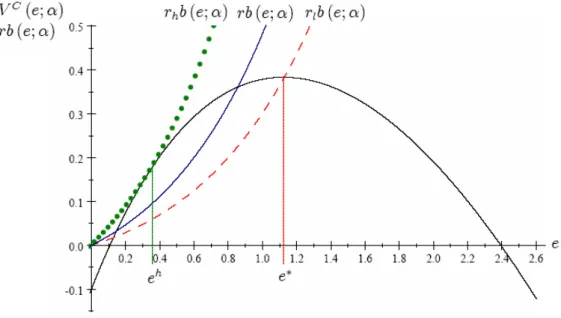
To illustrate the issue we use an example represented in Figure 1. Specif-ically, we assume = 0:2; p(e) = 1 exp ( e),c(e) = 18e2; and U0 = 0:1.
The …gure plots the principal’s expected pro…tVC(e; ). The convex curves depictrb(e; ) for various discount rates.
Figure 1: Reneging Constraint forp(e) = 1 exp ( e); = 0:2,c(e) = 18e2;
and U0= 0:1.
For a su¢ cientlylow interest rate the (RC) does not bind. The principal implements the pro…t-maximizing benchmark e¤ort level e (equivalent to the case of veri…able performance). We denote the threshold interest rate where the (RC) just becomes binding for any higher interest rate rl. The
dashed line illustratesrlb(e; ).
The solid curve depicts rb(e; ) for a medium interest rate where the (RC) binds. To ensure credibility on the one hand and to maximize prof-its on the other hand, the principal will always choose to implement the maximum e¤ort that just satis…es the (RC), i.e. the e¤ort where VC(e; )
and rb(e; ) intersect at the highest possible e. The …gure illustrates that the optimal e¤ort declines as the principal’s discount rate or the agents’ alternative utilities increase.12
For a su¢ ciently high interest rate condition (RC) cannot be satis…ed. The interest rate rh where the (RC) can just be ful…lled via adjustment
of e; is characterized by rhb(e; ) being tangent to VC(e; ). The e¤ort
level implemented at this threshold is denoted eh. Relational contracts are infeasible for any interest rate higher than the threshold interest rate rh.
The dotted line, rhb(e; ), represents this marginal case.
rh and eh are implicitely de…ned as the solution of the following 2
2 system consisting of the binding reneging constraint and the tangency condition:
r = VbC(e(; )e; )
r@b(@ee; ) = @VC@e(e; )
(10)
The higher the marginal interest rate rh is, the greater is the range of
interest rates the principal may credibly commit for. The value of rh is
determined by the agents’propensity for envy. By investigating the impact of on rh we derive the following result.
Proposition 3 An increasing propensity for envy enhances the feasibility of the relational contract, i¤ the following condition holds:
p eh > c e
h +U
0 p0 eh +c0 eh
p0(eh) +c0(eh) (11)
Proof. See Appendix.
The necessary and su¢ cient condition (11) assures that the bonus e¤ect outweighs the inequity premium e¤ect. The principal’s incentive to renege on the bonus payments is su¢ ciently low such that the negative impact of envy on the continuation pro…t is overcompensated. Whether condition (11) holds, depends on the particular way the performance measure is a¤ected by e¤ort in relation to the costs of e¤ort and the alternative utility. The condition can only be ful…lled, if the sum of e¤ort costs and alternative utility is smaller than unity. Further, if the marginal probability of generating a favorable outcome is high relative to the marginal costs of e¤ort, the condition is more easily ful…lled.
Thus, we …nd that in the reputation game a high propensity for envy may be advantageous for the principal regarding her commitment power. There exist cases, where the principal can build up a long-term contractual rela-tionship with inequity averse agents, whereas with inequity neutral agents she cannot. Hence, under the above condition (11) reputational equilibria can be sustained for a greater range of interest rates with inequity averse agents.
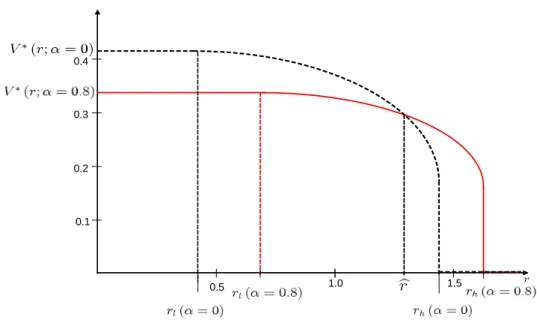
Figure 2 illustrates our result for the example functions introduced on page 11. It plots the principal’s pro…t under the optimal contract for any level ofr;V (r; ) = maxVC(e; );s.t. b VC=r:The solid curve depicts her pro…t under the relational contract, if takes a high value( = 0:8):The dashed curve depicts her pro…t, if agents do not exhibit any propensity for
envy ( = 0). The example function satis…es condition (11), i.e. rh(0:8)>
rh(0). 0.4 0.3 0.2 0.1 1.0 1.5 0.5
Figure 2: Pro…ts with inequity neutral and inequity averse agents forp(e) =
1 exp ( e); c(e) =18e2;and U
0 = 0:1:
For any functions satisfying condition (11), the following considerations hold. For su¢ ciently low interest rates r, i.e. interest rates below the re-spective lower interest thresholds,r rl( ), a relational contract is feasible
realized.
For any interest rater inbetween the respective lower and upper thresh-old levels, i.e. rl( ) < r rh( ), e¤ort e has to be adapted such that
(RC) is ful…lled. Pro…ts, V (e; ), decrease in this range as interest rates increase. However, depending on the value of , pro…ts decrease at di¤erent rates.
Whenr takes a value higher than the critical valuer;b continuation prof-its from employing envious agents exceed those from employing non-envious ones. Even more importantly, there exist somerinbetween the upper thresh-olds, i.e. rh( low)< r rh( high), for which relational contracts are
feasi-ble with more inequity averse agents, whereas the principal cannot credibly commit herself when dealing with less inequity averse agents. Reputational equilibria can be sustained for a greater range of interest rates in the pres-ence of inequity aversion on the agents’sides.
4
Concluding Remarks
We consider optimal individual incentive schemes in a principal-agent rela-tionship with two identical agents who exhibit horizontal disadvantageous inequity aversion. As there are only subjective performance measures avail-able to evaluate the agents’performances, the bonus contracts are enforced in a reputational equilibrium.
The analysis focuses on the impact of the agents’ propensity for envy on the principal’s commitment power that determines the feasibility of the relational contract. There are two countervailing e¤ects at work: As agency costs increase due to inequity aversion, the principal’s pro…ts from the con-tract decrease as agents become more envious. Thus, continuation of the relational contract becomes less attractive. On the other hand, inequity aversion serves as an incentive-strengthening device. This implies that the principal has to pay a lower bonus to implement the same e¤ort given that agents are envious, thereby reducing her bene…t from a one-time deviation. We identify a necessary and su¢ cient condition assuring that the principal’s ability to commit increases as agents become more envious.
This result has several implications. The implementation of a relational contract might not be possible with inequity neutral agents, when the re-turn on the principal’s alternative investment possibilities is relatively high. Thus, this could lead her to displace production to countries, where peo-ple generally exhibit a greater degree of inequity aversion due to cultural di¤erences.13
Further, one could expect a more frequent implementation of relational contracts in countries whose populations are more sensitive to inequity aver-sion. This hypothesis is in line with the …ndings of Moriguchi (2003), who explains di¤erences in institutional arrangements in the U.S. and Japan, pointing out that the U.S. was hit harder by the Great Depression com-pared to Japan. This goes along with lower continuation pro…ts and, thus results in the less frequent use of relational contracts in the U.S. According to our analysis, a depreciation of future pro…ts has a less severe impact on the feasibility of relational contracts if employees are inequity averse. Hence, these countries’di¤erences in the propensity for inequity aversion could also play a role for the explanation of di¤erences in institutional arrangements in this context.14
Appendix
Proof of Proposition 3. Di¤erentiation of rh yields
@rh @ = @VC @e e=ehb V C @b @e e=eh @@e + @V C @ e=ehb V C @b @ e=eh b2 : (12)
The system (10) implies
@VC @e e=eh b eh; VC(eh; ) @b @e e=eh = 0: (13) With (13), (12) simpli…es to
1 3Alesina, Di Tella, and MacCulloch (2004) and Corneo (2001) …nd Europeans to exhibit
a higher propensity for inequity aversion in comparison to U.S. Americans.
1 4Empirical evidence suggests that the Japanese exhibit stronger inequity aversion than
@rh @ = @VC @ e=ehb V C @b @ e=eh b2 : (14) To decide upon the e¤ect of on rh the sign of equation (14) is crucial:
sign @rh @ =sign @VC @ e=eh b VC @b @ e=eh (15) SubstitutingVC as given in (9) and with
@VC eh;
@ = b 1 p e
h p eh 1 p eh p eh @b
@ e=eh
equation (15) further simpli…es to
sign @rh @ =sign b 2 1 p eh p eh p eh c eh U 0 @b @ : (16) Withb eh; = c0(e h) (1+ p(eh))p0(eh) as given in (6) and @b eh; @ = c0 eh p eh p0 eh ((1 + p(eh))p0(eh))2 equation (16) results in sign @rh @ =sign c 0 eh 1 p eh + p eh c eh U 0 p0 eh : (17) Thus, @rh @ >0 i¤ p eh > (c(eh)+U 0)p0(eh)+c0(eh) p0(eh)+c0(eh) :
References
Alesina, A., R. Di Tella, and R. MacCulloch (2004). Inequality and hap-piness: are europeans and americans di¤erent? Journal of Public Eco-nomics 88(9-10), 2009–2042.
Jour-nal of Human Resources 37(4), 748–751.
Baker, G., R. Gibbons, and K. J. Murphy (1994). Subjective performance measures in optimal incentive contracts. The Quarterly Journal of Economics 109(4), 1125–56.
Baker, G. P. (1992). Incentive contracts and performance measurement.
Journal of Political Economy 100(3), 598–614.
Bartling, B. and F. v. Siemens (2005). Inequity aversion and moral hazard with multiple agents. Discussion paper, University of Munich, Depart-ment of Economics.
Bartling, B. and F. v. Siemens (2006). The intensity of incentives in …rms and markets: Moral hazard with envious agents. Discussion Papers in Economics 913, University of Munich, Department of Economics. Berg, J., J. Dickhaut, and K. McCabe (1995). Trust, reciprocity, and
social history.Games and Economic Behavior 10(1), 122–142. Bolton, G. E. and A. Ockenfels (2000). ERC: A theory of equity,
reci-procity, and competition.American Economic Review 90(1), 166–193. Bull, C. (1987). The existence of self-enforcing implicit contracts. The
Quarterly Journal of Economics 102(1), 147–59.
Corneo, G. (2001). Inequality and the state: Comparing u.s. and german preferences.Annales d’ Economie et de Statistique 63-64, 283–296. Demougin, D. and C. Fluet (2003). Inequity aversion in tournaments.
Cahier de recherche 03-22, CIRPÉE.
Demougin, D. and C. Fluet (2006). Group vs. individual performance pay when workers are envious. In D. Demougin and C. Schade (Eds.),
Contributions to Entrepreneurship and Economics - First Haniel-Kreis Meeting on Entrepreneurial Research, pp. 39–47. Duncker & Humblot Verlag.
Falk, A. and U. Fischbacher (2006). A theory of reciprocity. Games and Economic Behavior 54(2), 293–315.
Fehr, E., S. Gächter, and G. Kirchsteiger (1997). Reciprocity as a contract enforcement device: Experimental evidence. Econometrica 65(4), 833–860.
Fehr, E., G. Kirchsteiger, and A. Riedl (1995). Gift exchange and reci-procity in competitive experimental markets. Economics Series 14, In-stitute for Advanced Studies.
Fehr, E. and K. M. Schmidt (1999). A theory of fairness, competition and cooperation.Quarterly Journal of Economics 114(3), 817–868. Goranson, R. E. and L. Berkowitz (1966). Reciprocity and responsibility
reactions to prior help. Journal of Personality and Social Psychol-ogy 3(2), 227–232.
Grund, C. and D. Sliwka (2005). Envy and compassion in tournaments.
Journal of Economics & Management Strategy 14(1), 187–207. Holmström, B. (1981). Contractual models of the labor market.American
Economic Review 71(2), 308–13.
Holmström, B. and P. Milgrom (1991). Multitask principal-agent analyses: Incentive contracts, asset ownership, and job design.Journal of Law, Economics and Organization 7(0), 24–52.
Holmström, B. and P. Milgrom (1994). The …rm as an incentive system.
American Economic Review 84(4), 972–91.
Kerr, S. (1975). On the folly of rewarding a, while hoping for b. The Academy of Management Journal 18(4), 769–783.
Loewenstein, G. F., L. Thompson, and M. H. Bazerman (1989). Social utility and decision making in interpersonal contexts.Journal of Per-sonality and Social Psychology 57, 426–41.
Milgrom, P. R. and J. Roberts (1992). Economics, Organization, and Management. Englewood Cli¤s, NJ: Prentice-Hall.
Moriguchi, C. (2003). Implicit contracts, the great depression, and in-stitutional change: A comparative analysis of u.s. and japanese em-ployment relations, 1920-1940. NBER Working Papers 9559, National Bureau of Economic Research, Inc.
Okun, A. M. (1980). The invisible handshake and in‡ationary process.
Challenge 27, 5–12.
Rabin, M. (1993). Incorporating fairness into game theory and economics.
SFB 649 Discussion Paper Series 2006
For a complete list of Discussion Papers published by the SFB 649,
please visit http://sfb649.wiwi.hu-berlin.de.
001 "Calibration Risk for Exotic Options" by Kai Detlefsen and Wolfgang K. Härdle, January 2006.
002 "Calibration Design of Implied Volatility Surfaces" by Kai Detlefsen and Wolfgang K. Härdle, January 2006.
003 "On the Appropriateness of Inappropriate VaR Models" by Wolfgang Härdle, Zdeněk Hlávka and Gerhard Stahl, January 2006.
004 "Regional Labor Markets, Network Externalities and Migration: The Case of German Reunification" by Harald Uhlig, January/February 2006.
005 "British Interest Rate Convergence between the US and Europe: A Recursive Cointegration Analysis" by Enzo Weber, January 2006.
006 "A Combined Approach for Segment-Specific Analysis of Market Basket Data" by Yasemin Boztuğ and Thomas Reutterer, January 2006.
007 "Robust utility maximization in a stochastic factor model" by Daniel Hernández–Hernández and Alexander Schied, January 2006.
008 "Economic Growth of Agglomerations and Geographic Concentration of Industries - Evidence for Germany" by Kurt Geppert, Martin Gornig and Axel Werwatz, January 2006.
009 "Institutions, Bargaining Power and Labor Shares" by Benjamin Bental and Dominique Demougin, January 2006.
010 "Common Functional Principal Components" by Michal Benko, Wolfgang Härdle and Alois Kneip, Jauary 2006.
011 "VAR Modeling for Dynamic Semiparametric Factors of Volatility Strings" by Ralf Brüggemann, Wolfgang Härdle, Julius Mungo and Carsten Trenkler, February 2006.
012 "Bootstrapping Systems Cointegration Tests with a Prior Adjustment for Deterministic Terms" by Carsten Trenkler, February 2006.
013 "Penalties and Optimality in Financial Contracts: Taking Stock" by Michel A. Robe, Eva-Maria Steiger and Pierre-Armand Michel, February 2006.
014 "Core Labour Standards and FDI: Friends or Foes? The Case of Child Labour" by Sebastian Braun, February 2006.
015 "Graphical Data Representation in Bankruptcy Analysis" by Wolfgang Härdle, Rouslan Moro and Dorothea Schäfer, February 2006.
016 "Fiscal Policy Effects in the European Union" by Andreas Thams, February 2006.
017 "Estimation with the Nested Logit Model: Specifications and Software
Particularities" by Nadja Silberhorn, Yasemin Boztuğ and Lutz
Hildebrandt, March 2006.
018 "The Bologna Process: How student mobility affects multi-cultural skills and educational quality" by Lydia Mechtenberg and Roland Strausz, March 2006.
019 "Cheap Talk in the Classroom" by Lydia Mechtenberg, March 2006. 020 "Time Dependent Relative Risk Aversion" by Enzo Giacomini, Michael
Handel and Wolfgang Härdle, March 2006.
021 "Finite Sample Properties of Impulse Response Intervals in SVECMs with Long-Run Identifying Restrictions" by Ralf Brüggemann, March 2006. 022 "Barrier Option Hedging under Constraints: A Viscosity Approach" by
Imen Bentahar and Bruno Bouchard, March 2006.
SFB 649, Spandauer Straße 1, D-10178 Berlin http://sfb649.wiwi.hu-berlin.de
023 "How Far Are We From The Slippery Slope? The Laffer Curve Revisited" by Mathias Trabandt and Harald Uhlig, April 2006.
024 "e-Learning Statistics – A Selective Review" by Wolfgang Härdle, Sigbert Klinke and Uwe Ziegenhagen, April 2006.
025 "Macroeconomic Regime Switches and Speculative Attacks" by Bartosz Maćkowiak, April 2006.
026 "External Shocks, U.S. Monetary Policy and Macroeconomic Fluctuations in Emerging Markets" by Bartosz Maćkowiak, April 2006.
027 "Institutional Competition, Political Process and Holdup" by Bruno Deffains and Dominique Demougin, April 2006.
028 "Technological Choice under Organizational Diseconomies of Scale" by Dominique Demougin and Anja Schöttner, April 2006.
029 "Tail Conditional Expectation for vector-valued Risks" by Imen Bentahar, April 2006.
030 "Approximate Solutions to Dynamic Models – Linear Methods" by Harald Uhlig, April 2006.
031 "Exploratory Graphics of a Financial Dataset" by Antony Unwin, Martin Theus and Wolfgang Härdle, April 2006.
032 "When did the 2001 recession really start?" by Jörg Polzehl, Vladimir Spokoiny and Cătălin Stărică, April 2006.
033 "Varying coefficient GARCH versus local constant volatility modeling. Comparison of the predictive power" by Jörg Polzehl and Vladimir Spokoiny, April 2006.
034 "Spectral calibration of exponential Lévy Models [1]" by Denis Belomestny and Markus Reiß, April 2006.
035 "Spectral calibration of exponential Lévy Models [2]" by Denis Belomestny and Markus Reiß, April 2006.
036 "Spatial aggregation of local likelihood estimates with applications to classification" by Denis Belomestny and Vladimir Spokoiny, April 2006. 037 "A jump-diffusion Libor model and its robust calibration" by Denis
Belomestny and John Schoenmakers, April 2006.
038 "Adaptive Simulation Algorithms for Pricing American and Bermudan Options by Local Analysis of Financial Market" by Denis Belomestny and Grigori N. Milstein, April 2006.
039 "Macroeconomic Integration in Asia Pacific: Common Stochastic Trends and Business Cycle Coherence" by Enzo Weber, May 2006.
040 "In Search of Non-Gaussian Components of a High-Dimensional Distribution" by Gilles Blanchard, Motoaki Kawanabe, Masashi Sugiyama, Vladimir Spokoiny and Klaus-Robert Müller, May 2006.
041 "Forward and reverse representations for Markov chains" by Grigori N. Milstein, John G. M. Schoenmakers and Vladimir Spokoiny, May 2006. 042 "Discussion of 'The Source of Historical Economic Fluctuations: An
Analysis using Long-Run Restrictions' by Neville Francis and Valerie A. Ramey" by Harald Uhlig, May 2006.
043 "An Iteration Procedure for Solving Integral Equations Related to Optimal Stopping Problems" by Denis Belomestny and Pavel V. Gapeev, May 2006.
044 "East Germany’s Wage Gap: A non-parametric decomposition based on establishment characteristics" by Bernd Görzig, Martin Gornig and Axel Werwatz, May 2006.
045 "Firm Specific Wage Spread in Germany - Decomposition of regional differences in inter firm wage dispersion" by Bernd Görzig, Martin Gornig and Axel Werwatz, May 2006.
SFB 649, Spandauer Straße 1, D-10178 Berlin http://sfb649.wiwi.hu-berlin.de
046 "Produktdiversifizierung: Haben die ostdeutschen Unternehmen den Anschluss an den Westen geschafft? – Eine vergleichende Analyse mit Mikrodaten der amtlichen Statistik" by Bernd Görzig, Martin Gornig and Axel Werwatz, May 2006.
047 "The Division of Ownership in New Ventures" by Dominique Demougin and Oliver Fabel, June 2006.
048 "The Anglo-German Industrial Productivity Paradox, 1895-1938: A Restatement and a Possible Resolution" by Albrecht Ritschl, May 2006. 049 "The Influence of Information Costs on the Integration of Financial
Markets: Northern Europe, 1350-1560" by Oliver Volckart, May 2006. 050 "Robust Econometrics" by Pavel Čížek and Wolfgang Härdle, June 2006. 051 "Regression methods in pricing American and Bermudan options using
consumption processes" by Denis Belomestny, Grigori N. Milstein and Vladimir Spokoiny, July 2006.
052 "Forecasting the Term Structure of Variance Swaps" by Kai Detlefsen and Wolfgang Härdle, July 2006.
053 "Governance: Who Controls Matters" by Bruno Deffains and Dominique
Demougin, July 2006.
054 "On the Coexistence of Banks and Markets" by Hans Gersbach and Harald Uhlig, August 2006.
055 "Reassessing Intergenerational Mobility in Germany and the United States: The Impact of Differences in Lifecycle Earnings Patterns" by Thorsten Vogel, September 2006.
056 "The Euro and the Transatlantic Capital Market Leadership: A Recursive
Cointegration Analysis" by Enzo Weber, September 2006.
057 "Discounted Optimal Stopping for Maxima in Diffusion Models with Finite Horizon" by Pavel V. Gapeev, September 2006.
058 "Perpetual Barrier Options in Jump-Diffusion Models" by Pavel V. Gapeev, September 2006.
059 "Discounted Optimal Stopping for Maxima of some Jump-Diffusion Processes" by Pavel V. Gapeev, September 2006.
060 "On Maximal Inequalities for some Jump Processes" by Pavel V. Gapeev,
September 2006.
061 "A Control Approach to Robust Utility Maximization with Logarithmic Utility and Time-Consistent Penalties" by Daniel Hernández–Hernández and Alexander Schied, September 2006.
062 "On the Difficulty to Design Arabic E-learning System in Statistics" by Taleb Ahmad, Wolfgang Härdle and Julius Mungo, September 2006.
063 "Robust Optimization of Consumption with Random Endowment" by
Wiebke Wittmüß, September 2006.
064 "Common and Uncommon Sources of Growth in Asia Pacific" by Enzo Weber, September 2006.
065 "Forecasting Euro-Area Variables with German Pre-EMU Data" by Ralf Brüggemann, Helmut Lütkepohl and Massimiliano Marcellino, September 2006.
066 "Pension Systems and the Allocation of Macroeconomic Risk" by Lans Bovenberg and Harald Uhlig, September 2006.
067 "Testing for the Cointegrating Rank of a VAR Process with Level Shift and Trend Break" by Carsten Trenkler, Pentti Saikkonen and Helmut
Lütkepohl, September 2006.
068 "Integral Options in Models with Jumps" by Pavel V. Gapeev, September 2006.
069 "Constrained General Regression in Pseudo-Sobolev Spaces with
Application to Option Pricing" by Zdeněk Hlávka and Michal Pešta,
September 2006.
SFB 649, Spandauer Straße 1, D-10178 Berlin http://sfb649.wiwi.hu-berlin.de
070 "The Welfare Enhancing Effects of a Selfish Government in the Presence of Uninsurable, Idiosyncratic Risk" by R. Anton Braun and Harald Uhlig, September 2006.
071 "Color Harmonization in Car Manufacturing Process" by Anton Andriyashin, Michal Benko, Wolfgang Härdle, Roman Timofeev and Uwe
Ziegenhagen, October 2006.
072 "Optimal Interest Rate Stabilization in a Basic Sticky-Price Model" by
Matthias Paustian and Christian Stoltenberg, October 2006.
073 "Real Balance Effects, Timing and Equilibrium Determination" by Christian Stoltenberg, October 2006.
074 "Multiple Disorder Problems for Wiener and Compound Poisson Processes
With Exponential Jumps" by Pavel V. Gapeev, October 2006.
075 "Inhomogeneous Dependency Modelling with Time Varying Copulae" by Enzo Giacomini, Wolfgang K. Härdle, Ekaterina Ignatieva and Vladimir
Spokoiny, November 2006.
076 "Convenience Yields for CO2 Emission Allowance Futures Contracts" by
Szymon Borak, Wolfgang Härdle, Stefan Trück and Rafal Weron,
November 2006.
077 "Estimation of Default Probabilities with Support Vector Machines" by Shiyi Chen, Wolfgang Härdle and Rouslan Moro, November 2006.
078 "GHICA - Risk Analysis with GH Distributions and Independent Components" by Ying Chen, Wolfgang Härdle and Vladimir Spokoiny,
November 2006.
079 "Do Individuals Recognize Cascade Behavior of Others? - An Experimental Study –" by Tim Grebe, Julia Schmid and Andreas Stiehler,
November 2006.
080 "The Uniqueness of Extremum Estimation" by Volker Krätschmer,
December 2006.
081 "Compactness in Spaces of Inner Regular Measures and a General Portmanteau Lemma" by Volker Krätschmer, December 2006.
082 "Probleme der Validierung mit Strukturgleichungsmodellen" by Lutz Hildebrandt and Dirk Temme, December 2006.
083 "Formative Measurement Models in Covariance Structure Analysis: Specification and Identification" by Dirk Temme and Lutz Hildebrandt,
December 2006.
084 "PLS Path Modeling – A Software Review" by Dirk Temme, Henning Kreis and Lutz Hildebrandt, December 2006.
085 "Relational Contracts and Inequity Aversion" by Jenny Kragl and Julia Schmid, December 2006.
SFB 649, Spandauer Straße 1, D-10178 Berlin http://sfb649.wiwi.hu-berlin.de