Health Identity Programme
Architectural Decisions Document
Version 1.2 - Project Phase: Patient Index and NHI Synchronisation Release
SSR Gateway Retirement Options
Version 1.2
Date 22-Jun-12
Owner Pat Ryan
Table of contents
1. INTRODUCTION ... 3 1.1 PURPOSE ... 3 1.2 BACKGROUND ... 3 1.3 SOLUTION OVERVIEW ... 3 1.4 ARCHITECTURAL DECISIONS... 31.4.1 Transport Protocol Version ... 3
2 PROPOSED SOLUTION ... 4 2.1 CURRENT STATE ... 4 2.2 INTERMEDIATE STATE... 5 2.3 FINAL STATE ... 6 3 APPLICABLE STANDARDS ... 7 APPENDIX A: GLOSSARY ... 8
APPENDIX B: DOCUMENT CONTROL ... 8
B.1:VERSION HISTORY ... 8
B.2:RELATED DOCUMENTS ... 8
C.3:DOCUMENT DISTRIBUTION ... 8 Confidentiality:
The information contained in this document is proprietary to the Ministry of Health. This document must not be used, reproduced, or disclosed to others except employees of the recipient of this document who have the need to know for the purposes of this assignment. Prior to such disclosure, the recipient of this document must obtain the agreement of such employees or other parties to receive and use such information as proprietary and confidential and subject to non-disclosure on the same conditions as set out above.
The recipient by retaining and using this document agrees to the above restrictions and shall protect the document and information contained in it from loss, theft and misuse.
1. Introduction
1.1 Purpose
This document outlines a proposed approach to retiring the SSR Gateway.
1.2 Background
The SSR Gateway/ SSR Client provide RSA encryption and decryption of HL7 messages to the NHI system hosted by the Ministry. Encryption of request messages is performed by the SSR Client component using a client X509 certificate. The SSR Gateway performs decryption of the request and load-balancing across the NHI servers. The HL7 interface is due to be retired and replaced by web services as part of the HIP programme of work. A stage in this programme of work is to place an F5 between DHB consumers and the NHI servers. This creates an opportunity to retire the SSR Gateway/ SSR Client prior to the full retirement of the HL7 interface. Since the SSR has been operationally troublesome, early retirement is seen as beneficial.
The new National Health Index system will only be available on first release to those customers using a Connected Health compliant network. It is recommended that 128 bit encryption of network traffic is also implemented. This is in line with the Health Security Information Framework and recommended technical standards.
Note – the term SSL used in this document may refer to SSL 3.0 or a version of TLS, depending on the outcome of the architectural decision described in section 1.4.1 Transport Protocol Version
1.3 Solution Overview
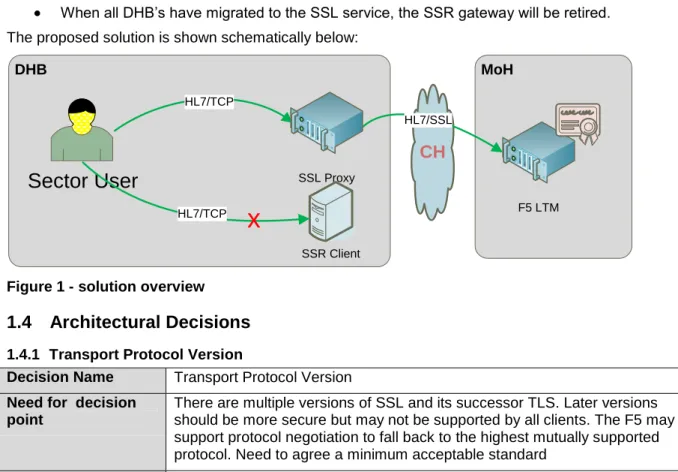
The Ministry exposes an SSL port for incoming HL7 messages in parallel with the current TCP port used by the SSR Client
DHB’s who wish to retire their SSR Client component redirect applications generating HL7 messages from the SSR Client to a proxy server which supports SSL and forwards the incoming HL7 messages over SSL to the Ministry’s SSL port
When all DHB’s have migrated to the SSL service, the SSR gateway will be retired. The proposed solution is shown schematically below:
DHB
Sector User
SSR Client HL7/TCP MoH F5 LTM HL7/TCPx
CH
HL7/SSL SSL ProxyFigure 1 - solution overview
1.4 Architectural Decisions
1.4.1 Transport Protocol VersionDecision Name Transport Protocol Version Need for decision
point
There are multiple versions of SSL and its successor TLS. Later versions should be more secure but may not be supported by all clients. The F5 may support protocol negotiation to fall back to the highest mutually supported protocol. Need to agree a minimum acceptable standard
Chosen option To be discussed with Ministry and sector architects
2 Proposed Solution
2.1 Current State
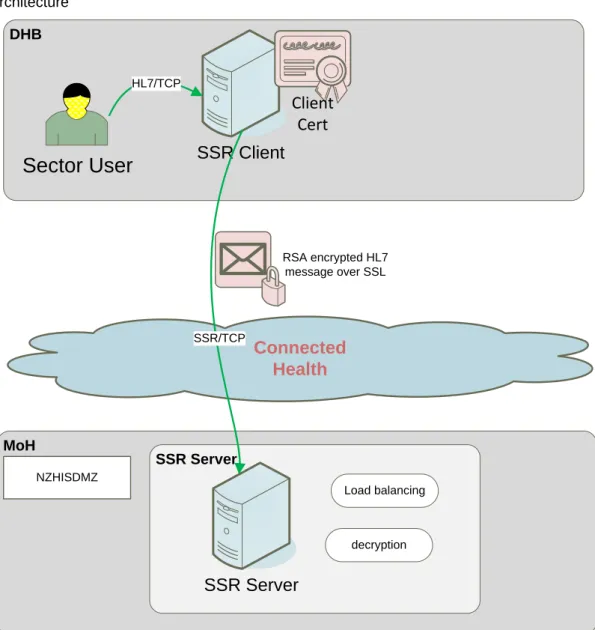
The diagram below provides a high-level overview of the relevant portions of the current SSR architecture
Connected
Health
MoH SSR ServerSSR Server
decryption NZHISDMZ DHBSector User
SSR Client
HL7/TCP
Client
Cert
SSR/TCP Load balancing RSA encrypted HL7 message over SSLFigure 2 - current SSR architecture
The request message processing steps are outlined below:
1. Sector users send HL7 messages over TCP to the SSR client component
2. Encryption of request messages is performed by the SSR Client component using a client X509 certificate
3. The SSR server decrypts the message using the client’s public key, and load balances the decrypted message to the NHI front end servers (not shown)
2.2 Intermediate State
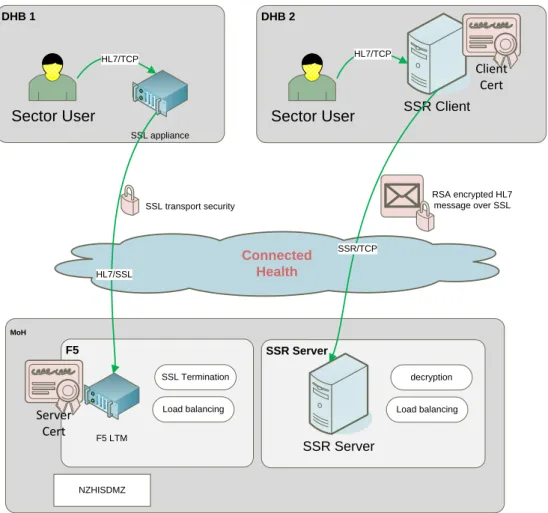
In the intermediary state the Ministry will operate both TCP and SSL interfaces to the NHI, allowing DHB’s to choose when to migrate to the new SSL interface
Connected Health MoH NZHISDMZ DHB 1 Sector User HL7/TCP SSL transport security SSL appliance SSR Server SSR Server decryption DHB 2
Sector User SSR Client HL7/TCP Client Cert SSR/TCP Load balancing RSA encrypted HL7 message over SSL F5 SSL Termination Load balancing F5 LTM HL7/SSL Server Cert
2.3 Final State
Connected
Health
MoH F5 SSL Termination NZHISDMZ DHBSector User
HL7/TCP HL7/SSL Load balancing SSL transport security F5 LTM SSL applianceServer
Cert
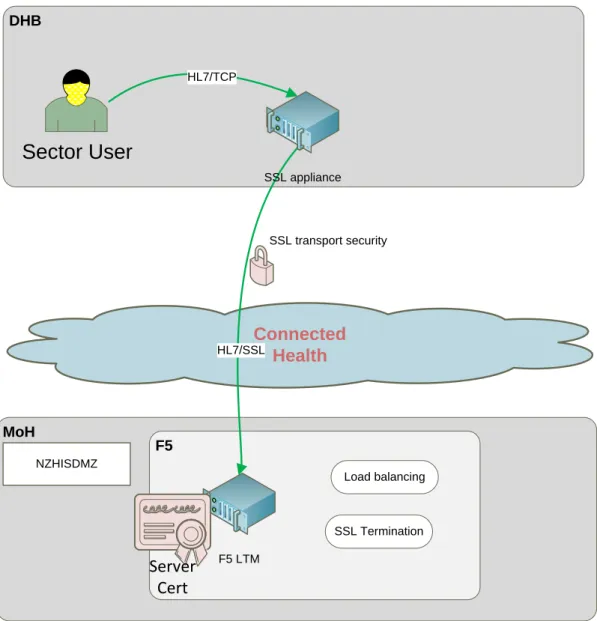
Figure 4 - final state
The request message processing steps are outlined below:
1. Sector users send HL7 messages over TCP to an SSL proxy
2. The SSL proxy negotiates a one-way SSL session with the Ministry’s F5 LTM
3. The F5 terminates the SSL connection and forwards unencrypted TCP traffic to the NHI servers
3 Applicable Standards
Standard Requirement Reference Section
NZISM
Agencies should not use versions of
SSL prior to version 3.0.
[NZISM] 16.4
NZS
8153:2002
Any identifiable patient data being
transmitted via external networks
shall be a minimum of 128 bit
encrypted
[NZS 8153] 15.1.6 (c)
HISO
10029.1
When personal health information is
exchanged over a network, it is
protected from interception, incorrect
routing and loss. When personal
health information is exchanged on
physical media, it is protected from
unauthorised access, misuse or
corruption.
Appendix A: Glossary
Item Description
SSL Secure Socket Layer TLS Transport Layer Security
X509 Cryptography standard for a public key infrastructure
HL7 Health Level Seven International - standards authority for interoperability of health information technology
F5 Network appliance vendor
LTM Local Traffic Manager – a load balancing appliance made by F5
RSA Cryptography algorithm for public-key encryption
Appendix B: Document Control
Document Location
Template Location Template Version
B.1: Version History
Date Ver. Description of Changes Author(s)
27-Mar-12 0.1 Initial Draft Pat Ryan
11-Apr-12 1.0 Updated following review Pat Ryan
13-April-12 1.1 Minor changes Pat Ryan
11-May-12 1.2 Mofified security statement following feedback from Tony
Pat Ryan
B.2: Related Documents
Ref Title Version Author Location
[NZISM] NEW ZEALAND INFORMATION SECURITY MANUAL
1.01 GCSB NZISM
[NZS 8153]
NZS 8153:2002 New Zealand Standard Health Records
MoH
[HISO 10029.1]
Health Information Security Framework
Essentials and Recommendations
HISO 10029.1
C.3: Document Distribution
BusinessUnit
Position Name Action
SDG Team Leader, Solution Architecture Pat Ryan Author
TSG Senior Systems Administrator Craig Hallam Review