Technology Spotlight
Hybrid Cloud in Canada
Sponsored by: TELUS
David Senf
October 2015
INTRODUCTION
Cloud computing has come a long way in Canada within a short period of time. Adoption of cloud was slow to pick up at first, but now Canadian organizations are catching up with countries such as the United States. As cloud becomes more than software as a service (SaaS) and extends into platform as a service (PaaS), infrastructure as a service (IaaS), hosted private cloud, and on-premises private cloud, the notion of hybrid cloud gains prominence. The term hybrid cloud can be confusing as it refers to many approaches and solutions in the marketplace today. For some, it means the use of a collection of, typically SaaS, cloud offerings.
IDC views hybrid cloud as a formalized approach — and in some cases architecture — to manage, secure, and otherwise orchestrate data and applications between multiple on-premises, hosted, and public clouds. The key element for hybrid cloud is orchestration. This IDC Technology Spotlight provides an overview of hybrid cloud in Canada and profiles TELUS' hybrid cloud offerings with its key partner Microsoft.
CLOUD IN CANADA
Cloud computing of all types has surpassed significant milestones in Canada, as organizations warm to extending IT capabilities into external datacentres and spinning up their own clouds. The impetus to do so comes first and foremost from demand for faster deployment speed to respond quickly to rapid business change and more requests. The economics of cloud is also a key driver of the move from traditional IT.
In 2015 alone, cloud spend will top $2.8 billion in Canada and reach $4.6 billion by 2018. Public cloud comprises the lion's share of spend at 77%, with the remaining 23% allocated to private cloud (including private hosted and private on-premises). IaaS is the leader in growth, far outpacing SaaS growth and more than tripling in size to $857 million by 2018.
Also, PaaS growth is strong but not enough to keep pace with IaaS. Private hosted cloud is growing rapidly too as Canadian organizations add another quarter of a billion dollars by 2018 to a market that is already over $400 million in 2015. Furthermore, organizations are contracting for professional services such as consulting, integration, and management to the sum of over $500 million in 2015, and this is expected to double to $1 billion by 2018.
In 2015 alone, cloud
spend will top $2.8
billion in Canada
and reach $4.6
billion by 2018. IaaS
is the leader in
growth, far
outpacing SaaS.
Given the breadth of cloud activity it is important that organizations make a plan in order to ensure user satisfaction, strong security, and appropriate costing among a number of other reasons. Particularly as adoption goes beyond SaaS and firms launch PaaS, IaaS, private hosted, and/or private on-premises clouds, IT needs to take a proactive and strategic role. Successful cloud strategies will depend on the extent to which your organization moves from the "just a bunch of clouds" (JBOC) tactical approach toward a mature cloud strategy.
Whatever cloud is being used, several elements should be thought out end to end, including security, monitoring, management, metering/billing, and recovery. Ideally, cloud is baked into your enterprise and information architecture — even if "architecture" is less formal at your organization.
Legacy IT will not go away as cloud deployments expand, so it is imperative that there is a plan to extend current capabilities into cloud. The term "hybrid IT" has become more commonly used to underscore the addition of cloud to and integration into traditional IT, rather than being a replacement. In Canada 33% of organizations now take a "cloud first" approach (when given the choice new
applications are deployed in the cloud first), while 54% continue to have a "cloud also" mindset, meaning that they layer cloud on top of what is currently installed. Here are some of the traditional IT considerations that extend into cloud — and particularly hybrid cloud:
Security (e.g., end-to-end encryption, identity management)
Availability management (e.g., reduce outages and improve recovery time)
Capacity management (e.g., burst as needed, smooth out peak versus average loads)
Data residency and information management (e.g., optimize data location, retention/archival)
Financial management (e.g., optimize costs over time, balance capex and opex)
Skills management (e.g., have the right people doing the right work, plan training and career paths)
Portfolio management (e.g., have applications deployed when needed based on business requirements)
Vendor/provider management (e.g., improve negotiation and relationships across deployment options)
WHEN CLOUD BECOMES HYBRID
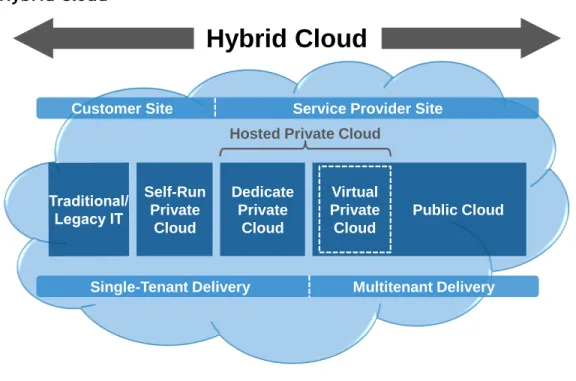
IDC views hybrid cloud as a formalized approach — and in some cases architecture — to manage, secure, and otherwise orchestrate data and applications between multiple on-premises, hosted, and public clouds.
FIGURE 1
Hybrid Cloud
Source: IDC, 2015
Applications and data are being deployed to and across a hybrid of traditional IT and cloud solutions. The reasons for choosing one deployment model over another or for architecting across a mix of these deployment options are outlined briefly here:
Traditional/legacy IT. Workloads that are tied to on-premises hardware (such as printers and storage area network hardware) and those that require extreme performance (typically found in capital markets for trading applications) are suited to traditional IT. In-house skills, finances, hardware resource capacity, and processes wrapped around legacy software have a bearing on the decision as well.
Private on-premises cloud. Workloads that benefit from self-service and scalability, but need a high degree of control/oversight for security/compliance tend to, at least initially, get deployed into a DIY on-premises cloud. This deployment model is typically used for storage and server capacity (e.g., IaaS on-premises) or for test/dev and web (e.g., PaaS on-premises).
Private hosted cloud. In between the control of on-premises and the scalability/usage-based model of public cloud, there is private hosted cloud. There are a number of workloads suited to this option. ERP, CRM, and some high-performance applications are run here, as are
backup/recovery, test/dev, and other scalable workloads. IDC has seen some Canadian organizations move away from their DIY on-premises cloud to one supported by greater economies of scale and, more importantly, available expertise to help with planning, troubleshooting, and maintenance.
Public cloud. Workloads that aren't core to the business (e.g., a differentiator) and those that may require rapid spin up/spin down are run in the public cloud. Typical workloads include email, some CRM applications, accounting applications, increasing amounts of human resource, applications, and test/dev and raw storage/server capacity.
Single-Tenant Delivery Multitenant Delivery Self-Run Private Cloud Dedicate Private Cloud Virtual Private Cloud Public Cloud Hosted Private Cloud
Customer Site Service Provider Site
Hybrid cloud. Being at the intersection of the other deployment models listed above, hybrid cloud tends to suit a wide range of workloads. Consider the architecture of applications — and how to pull out functionality "as a service." Database, recovery, and development are prime examples where most applications need these services. The extension of legacy applications from on-premises into the cloud through application modernization is a common hybrid cloud use case too.
WHAT TO LOOK FOR IN HYBRID CLOUD OFFERINGS
The top hybrid cloud selection criteria for Canadian organizations are aligned closely to a public cloud solution. Security, data residency, and ease of management are at the top of the list. Self-service capabilities and a well thought out roadmap are important criteria too. Farther down the list are criteria one might more readily associate with hybrid cloud, though. Bursting, workload portability,
management of many clouds, and automation/orchestration rate lower on Canadian organizations' list of critical hybrid cloud criteria.
IDC believes that this order will change quickly. Organizations will continue to concern themselves with security and data residency, but the importance assigned to workload portability, automation/orchestration, and managing across many clouds will rise higher on their list as they become more experienced with hybrid cloud deployments.
Customers are looking for different capabilities in a provider when expanding into hybrid cloud as opposed to solely a public cloud or private cloud or on-premises deployments. Over 40% of Canadian organizations want a provider that offers both private and public cloud. At the core of a hybrid offering is the balance between provider managed/operated services and customer self-service options. Customers look for:
Professional services. Quality and breadth of professional services offerings become more significant as hybrid cloud takes hold. Organizations want a trusted advisor to help plan for and assure predictable results from hybrid cloud. This is because although there is greater flexibility there are more deployment decisions, capacity balancing, migration, financial, and other options to plan for. Consequently, upfront consulting engagements for business/strategic planning, governance, architecture (e.g., enterprise and information), and design take on greater importance.
Managed services. IDC believes that as hybrid cloud evolves we'll see growth in managed services adoption as IT seeks to augment and offload performance, security, and other monitoring or management activities.
Underlying cloud service. Quality of the underlying cloud services themselves is "make or break" for any relationship. Initially, quality was associated mainly with performance metrics (e.g., how many 9s of availability), successful compliance audits (e.g., SAS 70, ISO 27002, PCI), and breadth of features. These factors remain baseline must-haves. Organizations are adding to this list and are also looking for simplicity/ease of use, ease of configuration, ease of integration with existing IT/other services, and orchestration capabilities.
Over 40% of
Canadian
organizations
want a provider
that offers both
private and
public cloud.
TELUS HYBRID CLOUD
TELUS has made significant investments to enhance its cloud services portfolio with hybrid in mind. Along with launching facilities and upgrading its existing datacentre assets, TELUS is making a long-term commitment in people, partners, processes, and tools around hybrid cloud. With TELUS Hybrid Cloud, clients are able to move virtual machines, operating systems, data, and
applications between TELUS' private and public clouds and Microsoft's Azure offerings. Clients are also provided with the choice between network
connectivity solutions, and managed and self-service options. As a leading network service provider and given its long history as a telecommunication company, TELUS boasts a vast and stable network to support cloud requirements. For hybrid cloud this means performance and
aspects of security are handled by the cloud provider, as opposed to an additional third party. Canadian customers are looking for as few partners to work with as possible — and are ultimately looking for a single trusted advisor in hybrid cloud.
TELUS is a top 10 Canadian IT services firm and Canada's largest managed hosting provider with one of the largest and widest datacentre footprints in the country. It operates a portfolio of eight facilities across Canada, including two "mega" datacentres. These two sites — one in Rimouski, Quebec, and the other in Kamloops, B.C. — are built to tier 3 specifications. This in-Canada portfolio of state-of-the-art datacentres is the foundation for its IT solutions which extend from managing on-premises technologies through to private, public, and hybrid solutions, packaged under the TELUS Cloud Services umbrella.
TELUS has demonstrated experience in deploying IaaS to the Canadian market, beginning with private IaaS in 2013. The initial offering was rated as a Leader in IDC MarketScape: Canadian Dedicated Private Infrastructure as a Service 2014 Vendor Assessment (IDC #CA1SSC14, March 2014). In addition, TELUS Public Cloud IaaS was ranked as a Major Player in IDC MarketScape: Canadian Public IaaS 2015 Vendor Assessment (IDC #CA1SSC15, February 2015).
TELUS offers cloud advisory and other professional services to help simplify planning, deploying, securing, and maintaining cloud services. TELUS also provides a choice of cloud services options based on workloads, business, and IT requirements.
TELUS' vision of hybrid cloud is a solution that provides an integrated approach to manage hybrid IT from a single point of access across multiple cloud deployment options. To that end, TELUS’ roadmap for hybrid cloud includes two types of hybrid cloud solutions, one based on the Microsoft platform and the other on VMware technology. TELUS Hybrid Cloud with Microsoft is currently available with plans to launch the VMware hybrid version in early 2016. This IDC Technology Spotlight covers TELUS
Hybrid Cloud with Microsoft.
TELUS HYBRID CLOUD WITH MICROSOFT
TELUS has partnered with Microsoft and Cisco to provide its hybrid cloud offering. With Cisco Cloud Architecture (CCA) for the Microsoft Cloud Platform, TELUS can now deliver an application-centric hybrid cloud service designed for scale-up enterprise workloads and applications using a single platform. Customers benefit from the ease of use of the integrated platform between Windows Azure Pack (WAP) and Cisco Application Centric Infrastructure (Cisco ACI). Familiar System Center tools
80% of IT
managers
believe that
simplified
management is
key for cloud
success.
from Microsoft underlie the offering for a simplified user experience. Customers have access to orchestration, management, monitoring of system health, and system provisioning through a single pane of glass. Simplified management is key for cloud success, as indicated by 80% of IT managers in Canada in a 2015 IDC Canada study on cloud.
TELUS is partnering with Microsoft because of the alignment of their hybrid cloud strategies. Both are taking a “management as a service” approach to infrastructure and platforms to enable simplified automation and orchestration wherever a workload resides. In the Microsoft context, this is accomplished through WAP, System Center and other tools Customers can create, monitor, set workflows, establish where services run and maintain resources (e.g., VMs, SQL database, Web, etc) in their on-premise, private cloud or public environments through either traditional scripting or a graphical interface. TELUS Hybrid Cloud with Microsoft uses NetApp Enterprise Grade storage for scalability of IOPS that enables enterprises to run traditional applications in a cloud environment.
FIGURE 2
TELUS Hybrid Cloud with Microsoft
Source: Designed based on information provided by TELUS, 2015
© IDC Visit us at IDC.com and follow us on Twitter: @IDC 1 Your IT team Cloud Management Portal Security Network Connectivity Customer Premise Data Centre
TELUS Data Centres in Canada PUBLIC PRIVATE
Managed Cloud
Microsoft Global Data Centres
Advisory Services
TELUS Hybrid Cloud with Microsoft — Deployment Options
TELUS Hybrid Cloud with Microsoft spans three primary offerings. Customers can choose any individual service or architect their environment across private and public cloud services hosted in TELUS' datacentres and Microsoft Azure offerings. Following are brief descriptions for each of the three.
TELUS Private Cloud
Built on the Microsoft Cloud OS Platform and hosted in TELUS datacentres, this option provides dedicated compute and shared storage infrastructure. Customers can provision logical cloud capacity on dedicated servers where each one is based on best-of-breed Cisco UCS Blades with 256GB of RAM and two physical CPUs. This enables customers to run their own infrastructure with self-serve virtual machine management and network capabilities or to have TELUS manage it for them as an additional package. In the private cloud option, customers have greater control over the virtual
machine deployment and ability to provide input around the operations and maintenance of the blades. TELUS has a number of datacentres located across Canada and customers can specify where they would like to store their data and run their services, subject to capacity availability.
TELUS Public Cloud
Built on Microsoft Cloud OS Platform and hosted in TELUS datacentres, this option provides shared compute and storage infrastructures. Bursting is available within TELUS-owned Canadian datacentres. With the public cloud option, customers can get self-serve capabilities to build, manage, and operate virtual machines and networks in an IaaS environment.
Customers can also enable PaaS services to manage web and database use cases from a self-serve portal. This service offers customers a predefined set of gallery items (such as Windows, SQL Server, IIS Web server and additional premium galleries) for easy deployment. Customers maintain full control of virtual network configurations and can extend beyond the cloud into on-premises by enabling VPNs across sites.
Using the provided Access Interface customers can select a TELUS datacentre based on available capacity.
TELUS Hybrid Cloud with Microsoft - Azure Enabled
Based on Microsoft Azure and hosted in Microsoft datacentres globally, this option provides shared compute and storage infrastructure. (Microsoft has announced availability of its Canadian datacenters for 2016.) This option allows customers to build and operate virtual machines and networks in Azure within the TELUS Hybrid Cloud as a Microsoft service.
TELUS provides the Access Interface so that customers can select the geography of server
deployments globally (which will include Canada in 2016). Billing is calculated by compute (CPU and RAM) and additional services of storage and public IP addresses used on a monthly basis. For convenience, customers receive a single bill for any combination of the TELUS and Microsoft Azure services.
TELUS Hybrid Cloud with Microsoft — Advisory Services
Many organizations want assistance throughout the life cycle of cloud planning, design, security, management, and maintenance. Particularly in the early stages, consultative services are important. TELUS offers advisory services for cloud readiness, strategy/design, and migration support for
applications, databases, operating systems, and hypervisors. Moreover, TELUS helps customers draw out a roadmap from basic cloud usage to full cloud transformation. Following a well thought out plan for cloud is essential given the number of assets, skills, costs, and other areas of IT that are involved. Of course, business requirements are key here too as IT extends a multiyear plan to ultimately respond quickly but securely.
TELUS Hybrid Cloud with Microsoft — Managed Services
TELUS gives customers the option of having cloud services managed by TELUS and/or to have self-service alternatives depending on how hands-on customers can and want to be.
Managed Platform. This is a co-managed offering and provided to all customers as a default option. TELUS implements and manages the underlying infrastructure while providing
customers with the flexibility to build and configure virtual machines, storage, and network, as well as manage their own operating systems and applications.
Managed Operations. Managed Operations is a fully managed solution that adds to the Managed Platform offering described above, including support for the operating system, backup, and recovery.
Network and security services are a foundation for hybrid cloud. Following are brief descriptions of each from TELUS:
Connectivity services. Successful hybrid cloud deployments start at the network. There are many layers to consider above the network as well, but strong security, ease of management, and good performance require solid network infrastructure. TELUS offers a complete suite and à la carte connectivity services to support cloud, including IP networking, VPN/MPLS
networking, and functionality such as DDoS detection within the network. As customers increasingly migrate workloads between clouds, they'll need simplified Layer 2 and Layer 3 solutions and consulting services. TELUS' advisory and managed services can help make the transition to cloud much more planned and predictable.
Security services. Cloud services such as those offered by Microsoft and TELUS have inherent security at physical and logical layers. Additionally, TELUS provides a full range of managed and professional and security services for cloud, hosted, and traditional on-premises protection.
Use Cases for TELUS Hybrid Cloud with Microsoft
TELUS has identified five major use cases to support workloads that customers can run across hybrid cloud. Of course, there are many more scenarios that customers will require that are on the TELUS roadmap and that TELUS has the professional services to set up as alternative use cases. The five primary use cases are:
Test/Dev. PaaS solutions such as test/dev are ideal for cloud as they have variable demands on hardware resources, but are frequently needed to be spun up or down. Working with Microsoft, TELUS Hybrid Cloud supports deployments of Microsoft Team Foundation Server and the use of Visual Studio for dedicated virtual server deployments. TELUS Hybrid Cloud also supports the use of MSDN licenses or customer-owned production licenses on virtual deployments of test/dev servers. The TELUS Hybrid Cloud platform could be used to host any third-party test/dev tools that run on a Microsoft Hyper-V.
and feeding activity, as well as securing the database. TELUS' DBaaS offering is based on Microsoft SQL Server.
Application modernization. There are innumerable legacy applications still embedded within the operations of organizations large and small. Considering the Microsoft spectrum of products alone, there are several widely deployed software packages that have been or are shortly being retired that organizations are considering moving to cloud. End of support (EOS) for Microsoft products includes Windows Server 2003/Internet Information Server 6.0 Web server (already EOS), SQL Server 2005 (EOS April 2016), Exchange Server 2007 (EOS April 2017), SharePoint Server 2007 (EOS October 2017), and Office Communications Server 2007 R2 (EOS January 2018).
Virtual machines. There are myriad custom and prepackaged applications that customers will want to spin up and spin down easily. TELUS provides a straightforward approach to
provisioning VMs for whichever workload customers need to run. The benefits are that VM sprawl is avoided, and VMs are up-to-date and patched and available on-demand in small or large numbers.
Disaster recovery as a service (DRaaS). Common to all applications is the need to back up data and (possibly) application state. Customers can replicate workloads between their own datacentre and TELUS' datacentres through a single interface with a single login. This is accomplished through a hybrid cloud interface developed by Microsoft called the Windows Azure Pack (WAP). TELUS customers can set up replication of workloads and have visibility across server pools, and can choose to deploy workloads on dedicated or shared servers across four TELUS datacentres. Each datacentre has its resource pools set up under "plans" and these plans are assigned to a customer's subscriptions allowing them to set up and manage virtual workloads, databases, and websites in any of the four TELUS datacentres.
CHALLENGES
TELUS has redesigned its cloud offerings to provide clients with a robust, secure infrastructure with more flexibility, transparency, and choice, but it is not without limitations. TELUS faces a number of challenges in this highly competitive hybrid market.
Market awareness. TELUS is well known in the Canadian market as a telecom provider. To establish itself as a leading provider of cloud services, it has to increase its brand awareness and service perception in cloud. TELUS' robust communication network and its extensive portfolio of datacentres are key enablers of its cloud offerings. Also, TELUS needs to promote the fact that it has been running datacentres for well over 20 years and that it has the expertise and solutions to support the cloud needs of Canadian businesses.
Competing definitions for what is hybrid. Many cloud providers are promoting the value proposition centred around low cost or simply managing everything in public clouds. Cloud computing, particularly private hosted and hybrid cloud solutions, is not turnkey (at least initially). Taking out the technicalities and complexity in managing these platforms will resonate with many IT and line-of-business decision makers. Yet the devil is in the detail and buyers will quickly get to the point of wanting to know how TELUS makes cloud simple, flexible, and less costly than doing it themselves or using another public cloud competitor. TELUS and other providers need to demonstrate through case studies how they have been able to help their clients meet their cloud computing goals.
Becoming a trusted advisor for hybrid IT. Professional services are critical in helping
has a strong services team with expertise across cloud, network, datacentre, and security domains, and does a good job in supporting its clients. TELUS will need to continue to invest in people and partners and build an even stronger body of best practices and tools as hybrid practices advance. TELUS' professional services will be critical in helping clients develop technology roadmaps that align with their strategy and further drive thought leadership in the cloud market.
CONCLUSIONS AND ESSENTIAL GUIDANCE
Hybrid cloud builds on the successes of multiple forms of cloud, while extending traditional IT. A core notion driving hybrid cloud is flexibility and choice — flexibility and choice across both technologies and processes, including financial, capacity management, and skills management.
Together, IT and business need to prioritize their applications, couple them with the most appropriate cloud model, and build a roadmap that fully leverages the advantages of hybrid cloud. Additional best practices include:
Planning. Planning starts with the needs of the business, how IT can support the business' goals, and what options are available for IT to do its job better and more cost effectively. Cloud changes how IT gets done, sometimes supplementing and in other situations replacing how services are delivered. Companies need to reassess their IT strategy and determine if and when traditional technologies and tasks such as test/dev and backup and recovery can be moved to the cloud. Planning should be a continuous process that aligns the use of internal and third-party services with the needs of the business.
Architecting for cloud. Consider cloud an extension of enterprise and information architectures. Even if your organization has an informal "architecture" that it follows, try to avoid cloud becoming another layer of your IT environment that doesn't integrate well.
Orchestrating and automating. Legacy IT (and business) was mainly manual with little automation and less orchestration. Use cloud as an opportunity to orchestrate workflow, capacity, performance, costs, time, and security within and between cloud deployments and/or on-premises. Consider connection points into mobility and other technologies to see where business workflows can likewise be automated or improved.
A B O U T T H I S P U B L I C A T I O N
This publication was produced by IDC Custom Solutions. The opinion, analysis, and research results presented herein are drawn from more detailed research and analysis independently conducted and published by IDC, unless specific vendor sponsorship is noted. IDC Custom Solutions makes IDC content available in a wide range of formats for distribution by various companies. A license to distribute IDC content does not imply endorsement of or opinion about the licensee.
C O P Y R I G H T A N D R E S T R I C T I O N S
Any IDC information or reference to IDC that is to be used in advertising, press releases, or promotional materials requires prior written approval from IDC. For permission requests contact the Custom Solutions information line at 508-988-7610 or [email protected]. Translation and/or localization of this document require an additional license from IDC.
For more information on IDC visit www.idc.com. For more information on IDC Custom Solutions visit http://www.idc.com/prodserv/custom_solutions/index.jsp.
Global Headquarters: 5 Speen Street Framingham, MA 01701 USA P.508.872.8200 F.508.935.4015 www.idc.com
IDC Canada
33 Yonge St., Suite 420
Toronto, Ontario Canada, M5E 1G4 Twitter: @IDC
idc-insights-community.com www.idc.com