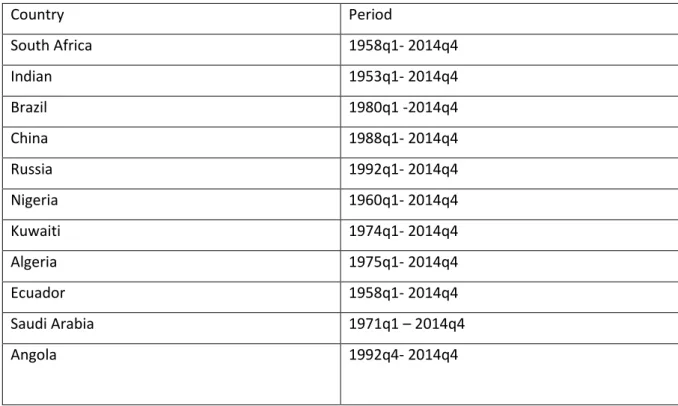
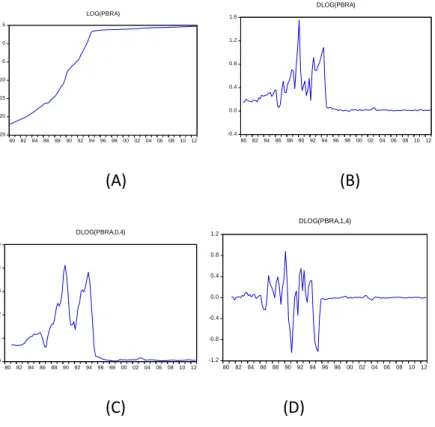
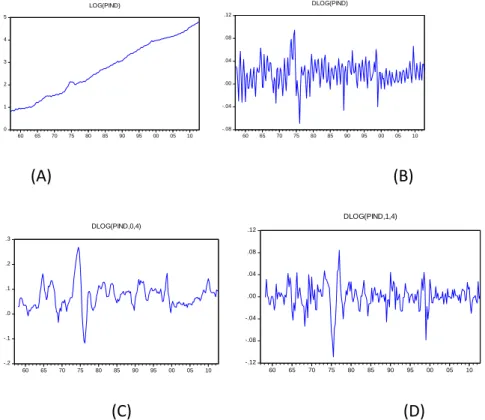
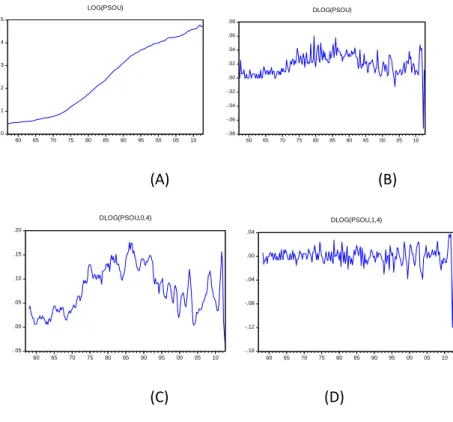
i
Comparison of Alternative Inflation
Forecasting Models in OPEC and BRICS
countries
Olaoluwa Vincent AJAYI
Thesis submitted for the degree of Doctor
of Philosophy at the Kingston University
Department of Economics.
February 2019.
ii
ABSTRACT
We compare the forecasting performance of univariate and multivariate models for BRICS and OPEC economies. For the univariate models, we produce forecasts using ARIMAX models that have a deterministic component to account for structural breaks over the full sample period and different ARIMA specifications over a reduced sample period that avoids the modelling structural breaks. The univariate ARIMA models that we develop over the reduced sample period are, first, a seasonal ARIMA specification identified using the Box-Jenkins method, second, a seasonal ARIMA model identified
using EView’s automatic model selection tool and third, a non-seasonal ARIMA model
identified using EView’s automatic model selection tool applied to seasonally adjusted
data. The other univariate model we considered include the regime shift threshold Autoregressive model (over the full sample and reduced sample) and the naïve model which added as a benchmark. Multivariate models are estimated over the reduced sample period to avoid modelling structural breaks and are based upon Vector Autoregression (VAR) models that utilise differencing and cointegrating restrictions to ensure the stationarity of the data. In particular, we consider the unrestricted VAR model with differenced (stationary) data, the (unrestricted) Vector Error Correction Model (VECM) that assumes cointegration without imposing cointegrating restrictions and the restricted VEC that imposes a single cointegrating equation on the VECM. Our study shows that the benchmark models (naïve) were never favoured over the best selected univariate and multivariate model. The univariate EView’s automatic non -seasonal ARIMA model is generally favoured for the BRICS countries (the exception is South Africa). However, the results are mixed between univariate and multivariate methods for OPEC countries. For OPEC countries that have a history of moderate inflation, for example, Saudi Arabia, the univariate automatic non-seasonal ARIMA model outperforms the multivariate model. In contrast, multivariate models generally outperform univariate automatically selected ARIMA models for countries with high inflation (e.g Angola and Algeria).
iii
DECLARATION
I, Olaoluwa Vincent Ajayi, hereby certify that this thesis, which is approximately 80,000 words in length without references, has been written by me, that it is the record of work carried out by me and that it has not been submitted in any previous application for a higher degree.
iv
DEDICATION
I dedicated this thesis to my late father Justine Safe Ajayi and my two daughters Tiwatope and Temilola Ajayi.
v
ACKNOWLEDGMENT
I thank God for my life and opportunity given to me to start my PhD and finish successfully. First and foremost, I am deeply indebted to my supervisor Dr Chris Stewart for agreeing to supervise this research work and making it a reality. If not because of his commitment, guidance and support throughout my research, this PhD journey would not have been possible. He is an outstanding supervisor because each time I submit a draft he always read from word to word and provide comprehensive feedback mostly within 72 hours. I gratefully acknowledge the contribution of my second supervisor professor Engelbert Stockhammer for his constructive contributions that I always receive each time I have the opportunity to meet him or discuss my research topic in the seminar.
I would like to thank all members of the academic and non-academic staffs of the Economic Department at the Kingston University London; it was a pleasure to work with a team that offers the best opportunities and education to the students with a clear vision.
I would like to acknowledge my wife, Lola Ajayi, thank you for your patience and the support during the four difficult years of my life. Thanks for sharing my dreams, you have been my strength and sustenance and, I would like to dedicate my PhD thesis to our two daughters Tiwa and Temi. You will always be in my heart. I love you all.
I would like to acknowledge the support and advice I received from my late father Chief J. S. Ajayi who died in the second year of my PhD. He was my hero and my mentor. Daddy thanks for being a good father and for guiding me on the right path. I promise you I will always make you proud.
I would also like to acknowledge my mother Mrs C.O. Ajayi and my parents in law Pharm and Mrs Ogunlusi who supported me financially throughout this programme. You have sacrificed your resources by given me the best education that you could only imagine. You are a blessing to me and, I promise I will always be thankful to you. I am grateful to the following people who have helped in one way or another: Ekundayo Taiwo and Sunday, Engr Dapo, Dr Tosin, Moyin, Aunt Bisi and Yemi, Bukola Oke, Ade Osewa, Holy Michael, Nifemi, Daniel, Dele, Deji and Tope Ajayi. I appreciate you and thank you all.
vi
TABLE OF CONTENTS
page
ABSTRACT ii DECLARATION iii DEDICATION iv ACKNOWLEDGEMENT v TABLE OF CONTENTS viCHAPTER 1
INTRODUCTION
1.1 Background and Motivation 1
1.2 Outline of chapters 3
1.3 Aims and Objectives 10
1.4 Overview of BRICS countries 12
1.5 BRICS Economies and Their Limitations 14
1.6 Overview of OPEC countries 18
1.7 The similarities and difference between OPEC and BRICS countries 20
1.8Research Contributions 20
CHAPTER 2
THEORIES OF INFLATION DETERMINATION AND CENTRAL BANK POLICIES
TO CONTROL INFLATION
2.0. Introduction 25
2.1 The theory of inflation (Phillips curve) 26
vii
2.3 Money Demand 32
2.4 Central Bank characteristics and its monetary policies 33
2.5 Central Bank and Inflation Targeting 33
2.6 Central Banks and Taylor rules 37
2.7 Central Bank and Exchange Rates 38
2.8 The fixed exchange rate system 38
2.9 The regulation of inflation under the fixed exchange rate regime 39
2.10 The exchange rate policy in Oil exporting countries 40
2.11 Central Bank and Fiscal Policy 42
2.12 Interest rates and monetary regulation in OPEC countries 43
2.13 Chapter summary 44
CHAPTER 3
EMPIRICAL LITERATURE REVIEW
3.0 Introduction 45
3.1 Empirical literature on determinants of inflation for developed and developing
inflation 46
3.2 Literature Review on determinants of inflation 47
3.3 Literature Review on the performance of inflation forecasting 51
3.4 The chapter summary and conclusion 59
CHAPTER 4
FEATURES OF CONSUMER PRICE DATA AND ITS TRANSFORMATIONS
4.0 Introduction 61
viii
4.2 Different transformation graphs for the consumer price 69
4.3 The Summary of the log of price transformations 73
4.4 ARIMA Modelling 76
CHAPTER 5
BOX- JENKINS BASED ARIMAX MODELLING OF ANNUAL INFLATION
5.0 Introduction 83
5.1 ARIMAX modelling of annual inflation for Brazil 85
5.1.2 Developing the ARIMAX model for Brazil 89
5.2.0 Box-Jenkins based ARIMA modelling of annual inflation on reduced samples
without structural breaks 101
5.2.1 Box-Jenkins ARIMA modelling of annual inflation for Brazil 102
5.3.0 Modelling annual inflation using Eviews 9’s automatic seasonal ARIMA model
selection tool on reduced samples without structural breaks 110
5.4.0 Modelling annual inflation using Eviews 9’s automatic non-seasonal ARIMA model
selection tool on reduced samples without structural breaks 115
5.5.0 Forecast performance and evaluation for Univariate model 122
5.6.1 Threshold Autoregressive model 131
5.7.3 The chapter summary and conclusion 151
CHAPTER 6
SELECTION OF VARIABLES FOR MULTIVARIATE ANALYSIS
6.0 Introduction 153
ix
6.2. Inflation forecasts based on measures of aggregate real activity and unemployment
rate 159
6.3. Multivariate Cointegration Forecast 160
6.4 Seasonal adjustment for selected macroeconomic variables 162
6.5. The graphical features of selected macroeconomic variables for Brazil 163
6.5.1. The graphs and table of equality test for consumer price in Brazil 164
6.5.2. The seasonality features of the money supply in Brazil 166
6.5.3. The seasonality features of the interest rate in Brazil 169
6.5.4. The seasonality features of the real effective exchange rate in Brazil 172
6.5.5. Seasonality and the Brazilian unemployment rate 175
6.5.6. The seasonality features of output gap in Brazil 178
6.6. Unit root tests 184
6.7 The chapter summary and conclusion 194
CHAPTER 7
MULTIVARIATE SPECIFICATIONS AND MODELLING
7.0 Introduction 195
7.1 Specification and Modelling of unrestricted VAR 196
7.1.2. Model Specification for Unrestricted VARs 198
7.1.3 Brazil Model Selection Criterion for Unrestricted VARs 199
7.2 Modelling Vector Error Correction Model (VECM) 205
7.2.1 Modelling Vector Error Correction Model (VECM) for Brazil 207
x
7.3.1. Brazilian Modelling Vector Error Correction (VEC) Model 220
7.4.0 Stability test for multivariate models 234
7.5.0 Forecast performance and evaluation 243
7.5.1 Brazil Forecast performance and evaluation 244
7.6 Summary and conclusions of the multivariate models’ forecasting performance
255
7.7 The chapter summary and conclusion 259
CHAPTER 8
COMPARISON OF THE BEST FORECASTING PERFORMANCE OF THE
MULTIVARIATE AND UNIVARIATE MODELS
8.0 Introduction 261
8.1 Naïve Model 261
8.2 The chapter summary and conclusion 267
CHAPTER 9
9.1 Summary and Conclusion 268
CHAPTER 10
10: Limitations and Future research 281
APPENDIX
2841
INTRODUCTION
1.1 Background and Motivation
There is no doubt that accurate forecasts of inflation have an important effect on achieving macroeconomic objectives (price stability, full employment, balance of payments equilibrium and economic growth). Any decision based on wrong inflation forecasts could result in poor allocation of resources and worse economic performance in achieving the goal of macroeconomic objectives. In avoidance of poor economic performance, many academics and policy makers have extensively researched the best inflation model to be used in forecasting inflation (De Brouwer and Ericsson 1998 and Stock and Watson 1999). The evidence remains that none of these researchers has agreed on any best model to forecast inflation. Carlson and Parkin (1975) and Mitra and Rashid (1996) observed that economic agents select different forecasting models in different inflationary environments. When inflation is high and volatile they use sophisticated models whereas simple models are employed during mild and stable inflation periods. Buelens (2012) and Stock and Watson (2008) stated that the accuracy of a forecasting model depends on the sample period in which they are estimated and evaluated. For example, the appropriate forecasting model to be used prior to the economic crisis may be different from that during the economic crisis. Further, some explanatory variables may be good predictors during an economic recession but not in expansion.
Stock and Watson (1999) argued that the Phillips curve model has been more accurate in forecasting US inflation than models involving other macroeconomic variables such as interest rates, money supply and commodity prices. They further revealed that the Phillips curve produced a better forecast when estimated with real economic variables (GDP) than when estimating the Phillips curve with unemployment. That is, the Phillips curve estimated with real economic activity can provide forecasts with smaller mean squared errors than those from unemployment based Phillips curve models. Atkeson and Ohanian (2001) found the Naive model as the most effective in forecasting US inflation for the past fifteen years, when compared with the Phillips curve. Thus, this thesis identifies the following as potential factors that influence the accuracy of inflation forecasts: (i) the type of model in use; (ii) the variables included in
2
the model; (iii) the transformations applied to the data for stationarity, seasonality and strutural breaks (iv) the economic environment (v) the sample period used to estimate the parameters of the model and (vi) the length of the forecasting horizon.
Many researchers have based their inflation forecasting analysis on the study of European countries and the United States. They have often compared inflation forecasting accuracy during periods when inflation targeting policies were adopted with periods when there were no inflation targeting policies in operation.1 As far as we know, no studies have compared the predictive performance of alternative inflation forecasting models for OPEC and BRICS countries, despite their growing importance in the global economy.2 This study extends the existing literature by forecasting inflation in these economies that cover sample periods of both high inflation and moderate inflation.3 In particular, we compare the forecasting performance of univariate and multivariate models for BRICS and OPEC countries with the aim of identifying the most accurate inflation forecasting model for the different economies. Our univariate models are based on ARIMAX, ARIMA specifications, regimes shift threshold autoregressive (TAR) models and Naïve model is added as a benchmark. While the multivariate models are based upon Vector Autoregression (VAR) models that utilise differencing and cointegrating restrictions to ensure the stationarity of the data. In particular, we consider the unrestricted VAR model with differenced (stationary) data, the (unrestricted) Vector Error Correction Model (VECM) that assumes cointegration without imposing cointegrating restrictions and the restricted VECM (or VEC) that imposes a single cointegrating equation on the VECM.
1 For instance, see Nadal-De Simone (2000), Alles and Horton (2000), Guncavadi et al (2000), Stock and
Watson (2007), Lee (2012) and Buelens (2012).
2 BRICS nations control 43 percent of global foreign exchange reserves and 25 percent of global GDP.
OPEC countries account for 81% of the world’s crude oil reserves and have a high dependence on oil revenues. See Antoine (2012), Rahman (2004) and World Oil outlook (2012).
3Lo and Granato (2008) argue that high inflation hurts growth over the long term. While, Narayan et al
(2009) documents that monetary authorities’ policies can often be misguided during periods of high inflation. The presence of high inflation has compelled us to examine whether high inflation affects inflation forecasting performance.
3
1.2 Outline of chapters
We organise the thesis into different inter-linked chapters. Chapter One outlines the background and motivation of the study, research objectives, an overview of BRICS and OPEC countries, that discusses the similarities and differences between OPEC and BRICS countries and contributions of this research. In this chapter, we are able to identify different characteristics of BRICS and OPEC economies that will be later considered when forecasting inflation. In particular, we categorised OPEC countries as an oil exporting economies and BRICS countries (excluding Russia) as an oil importing countries. For instance, all OPEC countries produce crude oil for exportation, and this has contributed to the higher percentage of their export earnings. For example, Nigeria earned 70 percent of its total export revenue from crude oil; Kuwait derived almost 60 percent of its gross domestic product and 93 percent of export revenue from crude oil; Libya acquired almost 95 percent of its government revenues.4 In contrast, all the BRICS countries except Russia are heavily dependent on oil imports to produce their manufactured products. For example, China is the second largest oil consuming nation in the world and second largest oil importing country from OPEC after the United States in 2010 (Economic Analysis Division, 2004). In addition, BRICS economies are ranked among the G-20 advanced industrial countries in the world whereas the OPEC economic system is classified as a traditional economy where goods and services produced are influenced by traditional beliefs, customs and religion.
Chapter Two discusses the various theoretical models that are commonly used to model and forecast inflation and considers the policies implemented by the central bank to control inflation for BRICS and OPEC countries. This chapter demonstrates that most of the policies implemented by the central bank to regulate inflation focus on the interest rate (for example, via Inflation targeting and Taylor rules as well as through the exchange rate). According to the Taylor rule, the central bank assumes inflation and the interest rate are directly related, especially in the short term. When inflation is above the target rate, the central bank will increase the interest rate to reduce inflation and if inflation is
4 See: Organization of petroleum exporting countries member, available at
4
below the target rate, the central bank will decrease the interest rate to raise the rate of inflation (Taylor 2008). For the exchange rate, the government may allow the value of the domestic currency to be fixed at the value of a selected foreign currency to control inflation. In particular, if the government experiences a balance of payments deficit the central bank may be tempted to reduce capital outflows to improve the balance of payments. In this case, the central bank may decide to increase the interest rate to technically increase the cost of borrowing to discourage people from borrowing and decrease consumer spending. However, the use of the interest rate to control inflation is limited in OPEC countries and most of the oil exporting nations. This is due to reasons of religion, social beliefs, the usury activities of financial institutions and the sovereignty of many of these countries that independently regulate their financial institutions. Chapter Three provides an empirical literature review. The literature is divided into two sections. The first section discusses the various factors that have been considered as determinants of inflation in developed and developing countries. While the second section analyses the empirical literature on inflation forecasting models. This literature suggests a growing consensus that economic relationships change in different inflation environments. The factors that determine inflation in developed countries may be different from the factors that determine inflation in developing countries. For example, the factors that determine inflation in low inflation economies may be different from those in higher inflation economies. In particular, inflation in many developing countries is mostly caused by the external influence of import prices, the foreign interest rate and the exchange rate (Frisch 1977, Dhakal and Kandil 1993, Boujelbene and Thouraya 2010). While the interest rate, money growth and financial assets determine the rate of inflation in developed countries (Tillmann, 2008 Cologni and Manera, 2008). The empirical literature on inflation forecasting suggests the following: (i) theoretical model most especially Phillips curve, are more accurate to forecast inflation when the economy is weak most especially during the economic crises when compared with the univariate ARIMA model (Pretorious and Rensburg 1996, Dotsey et al. 2011 and Buelens, 2012). (ii) ARIMA models outperform other multivariate models (Phillips curve and VAR) during periods of stable and low inflation (Pretorious and Rensburg,1996; Mitra and Rashed, 1996; Nadal – De Simone, 2000 and Dotsey et al. 2011). (iii) When comparing the forecast performance of three and five quarters ahead, the VAR and VECM specifications perform better than the naïve model (Onder, 2004). When comparing VAR models with
5
VEC models, the VEC models outperform the VAR models over the longer horizon (Fanchon and Wendel, 1999). (iv) The model that account for stochastic volatility and time-varying coefficients (e.g Markov switching models, Dynamic stochastic general equilibrium modelling, Self-exciting TAR models) provide more accurate forecast than
those models that do not (D’Agostino et al. (2013), Barnett et al. (2014), Bel and Paap, (2016), Cross and Poon (2016) and Mandalinci, (2017)).
Chapter Four consists of two sections. The first section analyses the graphical features of the quarterly price data and its transformations to assess issues of seasonality, stationarity and structural breaks for each country. While the second section outlines the Box Jenkins ARIMA and ARIMAX methods of univariate modelling employed in this thesis. From the first section, a mixture of visual inspection of the data, autocorrelation functions (ACFs) and unit root test showed that the log of the price is nonstationary in all the growing inflationary economies under consideration. The standard quarterly (one period) difference is generally insufficient to induce stationarity because of seasonal unit roots. Conversely, the annual (four period) difference is generally sufficient to induce stationarity, although only after structural breaks have been accounted for in modelling. For example, a downward shift in the intercept (seasonal indicator variables) coinciding with a move from high to low inflation eras may give a process that is only stationary around a shifting mean. As widely observed from the literature, for instance, Perron (1989), Lee and Chang (2005) and Fernandez and Fernandez (2008), a failure to account for seasonality and structural breaks can lead to model misspecification and make unit root tests biased towards non-rejection of the unit root null hypothesis.
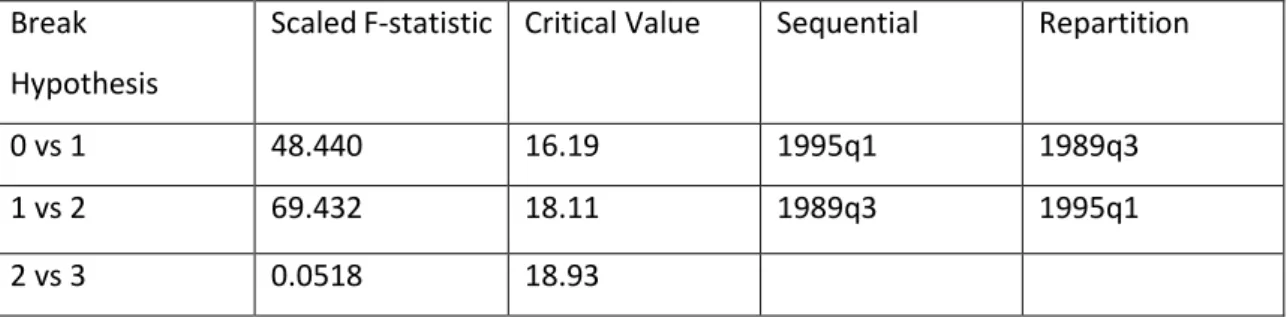
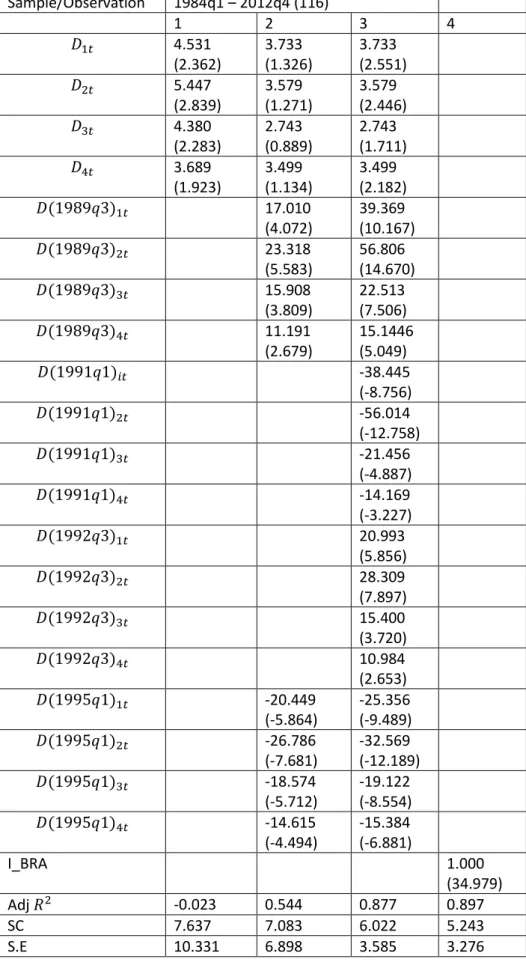
Chapter Five develops the analysis presented in Chapter four and builds ARIMAX models to the annual rate of inflation. We applied the Bai (1997) and Bai and Perron (1998, 2003) tests to a deterministic model of the annual difference of the log of prices to identify structural breaks for each country. Based upon these tests, we used shifting dummy variables to build the deterministic component of an ARIMAX model that accounts for any identified structural breaks in each country. This is achieved by applying the Box-Jenkins method to identify an ARIMA specification to the residuals of the identified deterministic component of the ARIMAX model that accounts for structural shifts. In addition, we develop ARIMA models to inflation using a reduced sample period
6
that avoids the modelling of structural breaks (with at least 39 observations). The following different procedures for developing ARIMA specifications on the reduced sample are employed. First, the Box Jenkins method using the modeller’s identification
of seasonal ARIMA specifications based upon ACFs and partial (PACFs) is employed. Second, EViews automatic seasonal ARIMA model identification method is used. Third, the data is seasonally adjusted using the Census X11 or X12 program that allows for time-varying seasonality and EViews automatic non-seasonal ARIMA model identification method is used. Forecasts based on the nonseasonal models are reseasonalised using the seasonal indices in 2012 identified by the seasonal adjustment process. The contribution of this chapter is to determine whether using the full sample that generally requires the modelling of structural breaks with an ARIMAX specification produces superior forecasting accuracy to ARIMA models built using a reduced sample with less data that avoids the modelling of structural shifts. Regarding the reduced sample modelling, we compare the forecasting accuracy of ARIMA specifications built
using the modeller’s judgement and those identified using EViews automatic model selection procedure. The reduced sample models also allow a comparison of ARIMA models built using seasonally adjusted data (with re-seasonalised forecasts) and those using unadjusted data. Further, we estimated the threshold autoregressive (TAR) models over the full sample and reduced sample and compared its forecast performance with the best forecasting model produced by the class of univariate ARIMA specifications. From our results, the TAR models indicate evidence of more than one regime in all selected economies (excluding China) which support the need to for modelling breaks. In terms of forecasting, the nonlinear TAR models (for both full sample and reduced sample) were not favoured over the best selected linear ARIMA models except for China (over all forecasting horizons), Nigeria (over 1 to 4-step ahead horizons) and Saudi Arabia (over 1 to 3 steps ahead horizons) where the TAR model estimated over a reduced sample produced the best forecast. The forecast performance of the TAR model over a few horizons is consistent with the previous study that documents the good performance of the TAR model over linear ARIMA models for the longer horizons (Montgomery et al. (1998)).
7
Chapter Six discusses the data used in multivariate modelling. We identify the variables that are most commonly employed to model and forecast inflation in the literature and identify the data availability of these series for each country under study. Whilst we give priority to variables available at the quarterly frequency, we also consider the addition of variables that are available only at the annual frequency to ameliorate omitted variable issues. We use frequency conversion tools to generate quarterly series from annual series. The main explanatory variables that we consider for each country are the money supply, real exchange rate, interest rate, output gap, unemployment rate and the oil price.
In Chapter Seven, we considered all variables identified in chapter six for each country and estimated multivariate models (VAR, VECM and VEC) over the reduced sample to avoid the modelling of structural breaks and to use seasonally adjusted data to preclude issues involving seasonal unit roots.5 The motivation for this chapter is guided by the following principle. Models involving series that are nonstationary may lead to problems of spurious regression that can adversely affect forecasting accuracy. We, therefore, use differencing and cointegration restrictions to transform nonstationary series into stationary variables. VARs estimated with cointegrated data will be misspecified if all of the data are differenced because long-run information will be omitted and will have omitted stationarity inducing constraints if all of the data are used in levels. Therefore, we test for the orders of integration of all variables considered as well as for cointegration. Based on this analysis, we compared the forecasting performance of the following multivariate models: unrestricted stationary VAR, VECM and VEC. Our result shows that including long-run information in the form of a specified cointegrating equation generally improves the forecasting performance compared with VARs and VECMs for BRICS countries. This is consistent with previous findings that stated that
5 For each of the multivariate model (VAR, VECM and VEC) in each country, we estimate four equations.
The first equation includes all available variables as endogenous except unemployment (which is excluded). The second equation includes all available variables as endogenous except for the output gap (which is excluded). The remaining two equations are the same as the first two equations except the oil price is treated as exogenous. The aim is to test whether inclusion of the oil price as exogenous or endogenous will have effect on performance of inflation forecast for oil exporting OPEC and oil importing BRICS countries.
8
forecasts are most likely to be improved by applying error-correction techniques if the data strongly supports the cointegration hypothesis (see, Timothy and Thomas, 1998).
Further, we investigate whether the multivariate models (VAR, VECM and VEC) are structurally stable in the sense that the regression coefficients are constant. If not, what are the implications of the instability for forecasting future inflation or what forecast methods work well in the face of instability? For instability tests, we perform two different parameter shifts tests that are available in EViews (the CUSUM and Bai and Perron (2003) tests). For the CUSUM test, we apply the CUSUM test that is based on the cumulative sum of the recursive residuals. The condition is that, if the line of the CUSUM test statistics fluctuates within the two 5% critical lines, the estimated models are said to be stable. In contrast, the models are said to be unstable if the line of the CUSUM goes outside the area between the 5% critical lines. For the BRICS countries, the CUSUM test and Bai and Perron (2003) test suggest evidence of instability for all models except all VECMs and VARs specification for India (the exception is the VAR estimated over the full sample that includes all variables as endogenous). The other exceptions are the VECM model that contains all variables as endogenous except unemployment for South Africa; the two valid VECM specifications for Brazil, all four VECMs and the VAR model that includes all variables as endogenous except output gap that excluded for Russia. For OPEC countries, all models also show evidence of instability except the VAR and VECM model that includes all variables as endogenous for Saudi Arabia, the VECM model that specified oil price as exogenous for Angola, the two valid VAR models and two valid VECM specifications for Algeria as well as the VAR model that include oil price as exogenous and other variables as endogenous excluding unemployment for Nigeria.
We also examine whether the instabilities in multivariate models (VAR, VECM and VEC) affects the performance of the inflation forecasting. In our study, the application of the two stability tests (the CUSUM and Bai Perron tests) provide evidence that the stability of the model can enhance the forecasting performance of inflation for few countries. For example, all the favoured forecasting model for the OPEC countries are stable (the exception is for Angola). In general, the VECM specification is stable and produce the best forecasting results over all horizons for Saudi Arabia and the unrestricted VAR model is stable and produce the best forecasting result over all horizon for Nigeria and Algeria. In contrast, all the favoured forecasting models are not stable for BRICS
9
countries according CUSUM and Bai Peron tests. The performance of the favoured forecasting models that are not stable are consistent with the study of (Stock and Watson, 2003, and Rossi 2012) who argued that instability of the theoretical model can be misleading for favoured out-of-sample forecasting.
Moreover, whether the inclusion of oil prices as exogenous or endogenous will improve forecasting performance differs substantially according to the form of the model employed and the country being considered. For BRICS and OPEC countries, the model that includes the oil price as endogenous generally appears to secure better forecasting performance than the model that includes the oil price as exogenous, except for Algeria.
In Chapter Eight, we estimate naïve model as a benchmark model and compare its performance with the best forecasting performance of the multivariate (VAR, VECM and VEC) and univariate models (TAR model, ARIMAX, ARIMAs and EViews automatic selection procedure) to identify the most accurate inflation forecasting model for BRICS and OPEC economies. In our study, naïve models were inferior to the best selected univariate model for all selected countries. The univariate model is generally favoured over the multivariate models for the BRICS countries (except South Africa). However, the results are mixed between univariate and multivariate methods for OPEC countries. For OPEC countries that have a history of moderate inflation, for example, Saudi Arabia, the univariate automatic non-seasonal ARIMA model generally outperforms the multivariate models over the longer horizons (4, 6, 7 and 8). While the TAR model outperforms other selected models over the shorter horizons (1 and 2-steps ahead). In contrast, multivariate models generally outperform univariate automatically selected ARIMA models for the countries with high inflation (e.g Angola and Algeria).
Chapter Nine is the summary and conclusion of this research and includes the discussion on the limitations of this study and identifies some possible areas for future research.
10
1.3 Aims and Objectives
The performance of inflation forecasting can vary in different economic environments. The factors that influence inflation forecasting in developed countries may be different from developing countries; and the factors that affect inflation forecasting in oil exporting OPEC economies may be different from predominantly oil importing countries such as the BRICS economies.6 The OPEC economic system can be classified as a traditional economy where goods and services produced are influenced by traditional beliefs, customs and religion whereas BRICS economies are ranked among the G-20 advanced industrial economies in the world. Developed countries have a history of low inflation, stable macroeconomic policies and have control over both monetary and fiscal policies while developing countries are known for higher inflation and unstable macroeconomic policies (Ghazanfar and Sevcik 2008). In our research, we consider the characteristics of oil importing and oil exporting economies when evaluating the forecasting performance of univariate and multivariate models of inflation for BRICS and selected OPEC countries. In our empirical analysis, we address the following issues:
(i) How can we make the price data stationary for each country? In particular, is seasonal differencing required, do structural breaks need to be accounted for and is the logarithmic approximation a valid measure of annual inflation (𝐼𝑁𝐹𝑡= 𝑃𝑡− 𝑃𝑡−4
𝑃𝑡−4 )?
(ii) Can ARIMAX models that pass diagnostic checks be obtained for each country? (iii) Do ARIMAX models built using the full sample of data (with the benefit of more information) produce superior forecasts to ARIMA models developed using a reduced sample that avoids the modelling of structural breaks (with the disadvantage of less data)?
(iv) Where we applied EViews 9’s automatic ARIMA model selection procedure using a reduced sample that avoids modelling breaks, can specifications that pass the diagnostic checks be obtained for all countries?
6 Ozkan and Yazgan (2015) suggest that the success of inflation forecasts is different in the different
11
(v) Does the more time-consuming Box-Jenkins ARIMA model building method that requires modelling skill produce superior forecasts to the quicker automatic ARIMA model selection procedure?
(vi) Do ARIMA specifications that explicitly model seasonality produce superior forecasts to those that apply non-seasonal models to seasonally adjusted data followed by re-seasonalising the forecasts?
(vii) Does regime shift threshold autoregressive model (TAR model) produce superior forecasts over univariate ARIMA model selection?
(viii) Can valid VARs, VECMs and VECs be obtained for each country? Which of these models produces the best forecasting performance for each country? Is there a generally best performing specification across countries and/or for different forecasting horizons?
(ix) When valid VEC models can be found are the coefficients of the long-run equation consistent with theoretical economic expectations?
(x) Is it better to treat the oil price as endogenous or exogenous in multivariate models? Are models that use unemployment to capture the Phillips Curve effect preferred to those that employ the output gap (when both variables are available)?
(xi) Has the multivariate model stable over time? If not, what are the implications of the instability of forecasting inflation?
(xii) Of all the models considered (both univariate and multivariate) which model produces the best forecasting performance over the benchmark model (naïve) across countries and/or for different forecasting horizons?
12
1.4
Overview of BRICS countries
In recent times, Brazil, Russia, India, China and South Africa (BRICS) have emerged to form an international organization body that will influence global financial trade and form a serious competitor to western economies. Accordingly, many common features exist among the BRICS nations. They share a common thread that they are fast developing nations and one of the largest economies in their regions. For example, China has the largest economy in Asia and is second only to America in the world. Russia is a member of the G8 advanced leading countries in the world, and India has the third-largest economy in Asia. South Africa has the third-largest economy in Africa, while Brazil has the largest economy in South America. Global Sherpa (2014) reported that BRICS countries ranked among the world’s largest and most influential economies in the 21st century. BRICS countries accounted for 25% of world GDP, over one-quarter of the world's land area and more than 40% of the global population.7 They control almost 43% of global foreign exchange reserves, and their share keeps rising (See Goldman Sachs, 2007, Antoine 2012 and Global Sherpa, 2014). Toloraya (2014) stated that BRICS economies have shown tremendous development in recent decades. The economy has increased by almost two times to reach $300 billion within five years and acquire 30 to 60 percent of the world’s most valuable mineral resources.
BRICS countries are heavily dependent on oil imports to produce their manufactured products, and many of these countries have diverse economies particularly about natural resources, higher inflation, as well as exporters of electronics goods. In areas of oil importing and oil consumption, BRICS countries have been playing a leading role in the world.8 For example, China is the second largest oil consuming nation in the world and second largest oil importing country from OPEC after the United States in 2010 (Economic Analysis Division, 2004). China's oil consumption growth accounted for one-third of the world's oil consumption growth in 2013, and its consumption is increasing by 0.37 million bbl/d 3.5% (EIA, 2014). South Africa has the highest energy consumption in Africa; accounting for about 30% of total primary energy
7 China and Indian have remarkable population of 1.351 billion and 1.244 billion respectively (World
Bank 2012).
8 Most of BRICS countries are heavily dependent on oil importing and they rank among the highest oil
consuming nations in the world apart from Russia. Russia has tremendous oil reserves and is the third largest producer of oil in the world after Saudi Arabia and United states, and most of oil consumption in
13
consumption in Africa in 2012. Central Intelligence Agency (2010) ranked India as the world's fourth-largest oil-importing and oil consuming nation in the world. India spent $ 15 billion, equivalent to 3% of its GDP on oil importing in 2003 that is 16% higher in 2001 (Economic Analysis Division, 2004). EIA projected that oil consumption in India would grow at an annual average of 1.5% for the next six years. In the case of Brazil, the country is ranked as the 8th largest energy consuming nation in the world. EIA ranked Russia as the second-largest producer of natural gas, second to the United States and the third-largest generator of nuclear power in the world.
In politics and finance, BRICS countries aim to convert their growing economic strength into political power.9 They believe that by working together, they could carve out the future economic order among themselves. They project that China will continue to dominate in areas of manufacturing goods; India will be providing services; Russia and Brazil will influence in areas of natural resources for the raw materials and providing agriculture inputs. In addition to this plan, they propose to achieve sustainable economic growth and establish an industrial development environment through the launch of the Development Bank. The bank will serve many emerging markets for the development of infrastructure projects and reduce numbers of many countries dependent on the World Bank and the International Monetary Fund (IMF). All the members will provide the total sum of $100bn. China is expected to contribute the highest amount of ($41bn), followed by Brazil, Russia and India contributing $18bn each, and South Africa adding at least $5bn (Wood, 2014). As a result, China won the bid for the bank headquarters which is set to be located in Shanghai and India will provide the New Development Bank’s first
president. Nataraj and Sekhani (2014) reported that the new BRICS bank would be based on equality and fairness where individual members will be able to vote and grant loans with fewer restrictions and shorter delays.
9 This action will bring new development for Russia and China to achieve their foreign and political
objectives; In particular, there is no sign that ties between Russia and the Western countries may improve any time soon. As a result, Russia and China would not be totally isolated and forcefully give away their political interest to the Western countries demands.
14
1.5 BRICS Economies and Their Limitations
Research by Goldman Sachs found that economic growth in South Africa’s will increase
from an average 3.3% over the last 20 years to 6.7% per annum in 2050 which will produce a region the size of $14tm (Coleman, 2013). The Economist Intelligence Unit
predicts that Brazil’s economy will be larger than any European country’s economy by 2020 and exceed Germany’s economy to become the world’s fifth biggest global economy (Daly 2013). China’s GDP growth is proposed to overtake the United States’
GDP before 2030, and the total GDP of the BRICS countries will be more than the combined GDP of the seven largest developed economies by 2050 (see Antoine, 2012 andKangarlou, 2013).
To achieve this economic plan, BRICS countries need to improve in technology, security, create more jobs, establish good financial institutions, invest in human development, stable political structures and improve on social and economic reforms that will establish sustainable growth. As a result, BRICS countries like India, Brazil, China and South Africa have announced their commitments to the reality of these objectives. For example, China is currently focusing on its 12th five-year plan for building many new airports and creating an additional 45 million new jobs (Jason, 2012). India’s is advancing
on its 12th five-year plan to invest $1 trillion in infrastructures, with the aim of funding half of it through private sector involvement in public-private partnerships (PPPs). Brazil launched a growth acceleration program in 2007 to provide tax incentives, reduce energy costs, strengthen its investment through foreign participation and restructure its oil royalty payments to increase revenue and provide more capital to the private sector. Moreover, South Africa has engaged in the construction of 56,000 new classrooms; construction of 1,700 new clinics across the country. The country found two million free housing units for low-income families, rehabilitation of 6,000 km of national roads and building of 15,000 km of provincial roads.
Despite these reforms, many studies have questioned the reality of this group becoming a leading economy in 2050. Western analysts and media have criticised the existence of the BRICS nations; they argued that BRICS countries were too different from each other to agree on a common goal (Stuenkel 2014). Consequently, BRICS economies witnessed economic setbacks during the 2007 financial crisis; although its impact varies from one country to another. For example, in the area of financial markets, the toxic
15
assets owned by domestic banks in Brazil and Russia during the 2007 financial crisis was greater than the toxic assets held by India and China. During this period, Brazil owned almost 25%, and Russia owned 12% of toxic assets compared to 0.4% owned by China and 4% belonging to India (Vashisht and Banerjee 2010).10 Vashisht and Banerjee (2010) also documented that non-performing loans experienced in Brazil and Russia showed the negative impact of the financial crisis in 1997 compared to non-performing loans in India and China. The Non-performing liquidity ratio increased in Russia and Brazil while it decreased in India and China from 4.4% to 2.4% and 8.6% to 1.2% respectively.11
World Bank (2014) documents that Russia’s GDP growth reduced to 1.3% in 2013 from 3.4 % in 2012 due to inadequate structural reforms. The recent Ukraine Crimea annexation by Russia has been drawing international condemnation and pushed down industrial and investment activities in Russia. The crisis has eroded domestic businesses
and consumers’ confidence. Russia was accused of supplying heavy weapons to pro-Russian forces in the eastern part of Ukraine. As a consequence, the past United States president (Barack Obama) instigated the G8 economic group to isolate Russia. The European Union and the United States imposed economic sanctions on various Russian financial institutions, imposed asset freezes and visa bans on many Russian politicians. The sanctions restricted access of Russian state-owned banks to obtain funds from Western capital markets, which Russia could turn to and access capital to finance its long-term investment. Consecutively, EU and U.S firms were barred from providing capital for more than 90 days to Russia's key state-owned banks. Recknagel (2014) disclosed that $75 billion of capital has been pulled out from Russia since the crisis started in February 2014 to August 2014. However, this sanction does not target Russian natural gas supplying to the European Union but aimed at the Russian financial industry, whose contribution has powered Russia's economy.
In South Africa, the influence of the previous apartheid political system is another important point to be considered. In the past, the South African population was divided by race; the act was passed to segregate the black race from the white race. As
10 The toxic asset is an indicator used to measure the soundness of the financial sector. The higher the
value of the toxic assets the higher the negative impact of financial crises in selected countries. The lower the value of toxic assets the lesser the impact of financial crises in the selected countries.
11 Non–performing liquidity ratio is used to determine the ability of financial institution to pay off its
short- terms debt obligations. Similarly, the higher the value of non-performing loan ratio, the higher the risk and less safe for the financial institution to cover short- term debts.
16
a result, many investors believe that the growing population of black races that ought to have provided a good economic market were excluded from the South African economy circuit (Coleman, 2013).
China’s economy has been criticised for currency manipulation, economics "dumping" and caters less for the immediate needs of its population. Aziz (2007) stated China's rapid growth may not be sustainable because many Chinese companies process high cost imported inputs resource into cheap consumer goods for exporting. As a result, when inputs become more expensive, this may undermine China’s economy and
investor confidence in achieving sustainable growth. For instance, the competition from other producing countries will make it more difficult for many Chinese companies to increase their market shares. In addition, the growing population of China is another issue to be considered. Overpopulation in China could impede both economic development and economic growth. For instance, an increase in population will increase government expenditure by allocating more resources to social welfare rather than a development of infrastructure. Patel (2013) documented that China’s growing population has increased its environmental pressures and makes the current economic situation in China unstable. For example, agriculture activities in coastal regions of the South China Sea, which should feed fewer people now, cater for more than 300 million persons. The year 2000, more than 11 million tons of fish were eaten in this area, even though, fish stocks in the North East have fallen drastically since the 1990s (Patel 2013). The introduction of the one-child policy in 1979, to curb the rapid growing population, could also reduce the long-run labour force. Currently, 16.6 percent of the total Chinese population is 14-year-old children, whilst 13 percent are over 65 years. If current conditions remain, China will face a shortage of 140 million workers in 2020, and over a quarter of the Chinese will be above 65 years old in 2050 (Patel 2013).
Consequently, corruption remains a threat to the economic growth of the BRICS countries. BRICS countries business environment may not be favourable for many legitimate multinational companies to function. Although the BRICS nations have the potential of being a leading economy, corruption can jeopardize their growth targets. The transparency International civil society organisation scored most of the countries in the world based on their level of corruption in 2014. The group constructed a corruption scale of 0-100, where 0 means that a country is perceived as highly corrupt, and 100
17
means a very decent country. The table below indicates the level of corruption in BRICS countries.
Table1.1 Corruption ranking table for BRICS countries
Rank Country Score
67 South Africa 44
69 Brazil 43
100 China 36
85 India 38
136 Russia 27
Source: Corruption perception index (2014).
From the above table, all the BRICS countries scored less than 50 out of 100 and were ranked above 65. This indicates a serious problem of corruption that exists among the BRICS nations. The Corruption activities in many of these countries include abuse of power, secret dealings, bribery, abuse of human rights and financial violations.
18
1.6 Overview of OPEC countries
In the late 1950s, the quantities of oil produced in many of the oil producing countries were greater than the global demand for oil. During this period, the oil production sector was dominated by a few individuals, companies and countries. Each of them produced oil and regulated prices independently in the international market until September 14, 1960, when the Organization of Petroleum Exporting Countries (OPEC) was established. This organisation was established in 1960 with five founding members: Iran, Iraq, Kuwait, Saudi Arabia and Venezuela. By the end of 1971, six other nations had joined the group: Qatar, Indonesia, Libya, United Arab Emirates, Algeria and Nigeria. OPEC has a rich diversity of cultures, languages, religions and united by their shared status as oil-producing developing countries. Many of these countries heavily depend on the exportation of petroleum, and this has contributed to the higher percentage of their export earnings. For example, Nigeria earned 70 percent of its total export revenue from crude oil; Kuwait derived almost 60 percent of its gross domestic product and 93 percent of export revenue from crude oil; Libya acquired almost 95 percent of its government
revenues. In Qatar, oil and natural gas accounted for 60 percent of the country’s gross
domestic product and around 85 per cent of export earnings. In Saudi Arabia, the oil and gas sector contributed to 50 percent of the gross domestic product and 90 percent of export earnings and, in Venezuela, oil revenues accounted for about 95 percent of export earnings and 25 percent of the gross domestic product.12 In total, the OPEC members produce almost 40% of the world's crude oil, which represents almost 60 percent of the total petroleum traded internationally, produces about a third of the
world’s daily consumption of 90m barrels of crude oil, and controls 78% of the world’s
crude oil reserves (Energy Inflation Administration, 2013). Apart from petroleum oil, the organization provides other natural resources that include natural gas, tin, iron ore, coal limestone, niobium, lead and zinc.13
12 See: Organization of petroleum exporting countries member, available at
http://www.opec.org/opec_web/en/index.htm.
13 Sala-i Martin and Subramanian (2003) documented that countries that depend heavily on the export
of natural resources are liable to various challenges, which include: authoritarian governance, political instabilities, civil wars, high corruption levels, high poverty rates.
19
The group has the responsibilities of coordinating and unifying petroleum policies, promoting stability and regulating the oil price in the international market. In 2005, the acting general secretary of the organisation (Adnan Shihab-Eldin) emphasised that OPEC is committed to market stability and supplying petroleum products at reasonable prices to both producers and investors.14 OPEC has responsibilites to safeguard the interests of its members and ensure the stability of the global oil price. For instance, in 1968, OPEC issued a declaratory statement of petroleum policy to protect its members and caution the United Nations on the right expressed by the United Nations that all countries should exercise permanent independent rights over their natural resources for the development of their economy. Accordingly, OPEC maintained that OPEC’s
resources should benefit the whole OPEC members rather than individual countries by setting a reasonable global oil price. OPEC often regulates the production of the crude oil to set the global oil price and improve the balance of payments. The organization will increases production to increase supply and keep prices low.15 In contrast, OPEC will decrease oil production to reduce supply of oil and increase oil prices. The first notable example was in October 1973 when the Arab nations in OPEC cut their oil production by 5% per month. The organisation put a supply oil embargo on the United States because of its support for Israel during the Yom Kippur war. The action of the Arab countries led to an increase in global oil prices that increased inflation across the world. A similar example was during the Gulf War, when former Iraqi President (Saddam Hussein) advocated that OPEC should increase the oil price to help Iraq and other member states to generate more revenue and service their debts. However, the aggression and invasion of Iraq on Kuwait did not allow all members of the organization to support the proposal of Saddam Hussein (Basil Ajith, 2011).
14 A speech delivered by Adnan Shihab-Eldin, Acting for the Secretary General, to the 31st Pio Manzù
Conference, Rimini, Italy, 28-30 October 2005. Available at:
http://www.opec.org/opec_web/en/883.htm. Accessed on 23 September 2013.
15An increase in oil production may leads to excess supply or oversupply and the quantity supply will be
greater than the quantity demanded in the equilibrium market. The effect of excess supply of the oil will
20
1.7
The similarities and difference between OPEC and BRICS countries
The BRICS and OPEC countries are made of both developed and developing countries. The BRICS economies are ranked among the G-20 advanced industrial countries in the world whereas the OPEC economic system is classified as a traditional economy where goods and services produced are influenced by traditional beliefs, customs and religion. There is evidence that developed countries experienced low inflation and stable macroeconomic policies while higher inflation, unstable macroeconomic policies are attributed to developing countries (Ghazanfar and Sevcik 2008). In developing countries, the analysis of monetary policy is hindered by the absence of a good monetary policy. The developed countries have control over their monetary and fiscal policies and good monetary experts manage their economies.
Many of the BRICS countries are oil importers and high oil consuming nations compared with OPEC countries that are major oil exporters in the world. The majority of OPEC countries are dependent on crude oil and natural resources to generate revenue and import many consumer goods. Therefore, they are more exposed to international trade with crude oil and increases or decreases in the oil price will directly affect their government expenditure. In contrast, incomes for many of the BRICS countries are not only from natural resources but taxes and the financial sector. In addition, BRICS countries are more advanced in technology, and many of them have the ability to process their natural resources for exports.
1.8 Research Contributions
This thesis makes the following contributions to the existing inflation forecasting literature, especially on the empirical front. The most recent literature focuses on developed countries, although some of them focus on developing countries, none of them focuses on BRICS and OPEC economies despite their growing contribution to the global economy. Therefore, this study contributes to the literature by offering evidence that leads to following conclusions in terms of modelling and forecasting inflation for BRICS and selected OPEC countries. We are not aware of any previous study of inflation that draws such conclusions for these countries.
21
(i) The annual (four periods) difference of the log of prices is a poor approximation of inflation during periods of high inflation. However, the annual (four periods) difference of the log of prices is a reasonable approximation of inflation during periods of low inflation. Given that many BRICS and OPEC countries exhibit periods of both relatively high and moderate inflation this suggests researchers should not automatically assume that the difference of the log of price data can be used as a valid approximation of inflation for modelling in these countries. Further, when using quarterly unadjusted data, it is most appropriate to use the growth rate of prices based on the annual difference rather than the quarterly (one period) difference to obtain stationary data.
(ii) When forecasting with univariate specifications, reducing the sample to avoid modelling large structural breaks improves forecasting performance compared to using the full sample and modelling structural breaks. This implies that the potential benefits of having more data from using the full sample are generally outweighed by being able to avoid modelling structural breaks (even at the cost of a reduced sample for estimation).
(iii) The quick EViews 9 automatic ARIMA model selection procedure is sometimes favoured over the time-consuming Box-Jenkins ARIMA model building method (that requires modelling skill). This is especially the case for the BRICS countries that have a history of moderate inflation. This suggests that automatic selection methods not only have the benefit of saving time they can also produce superior forecasts.
(iv) Utilising the Bai and Perron (2003a and 2003b) test to identify any structural breaks within the ARIMAX modelling context to model inflation is a novelty of our work.
(v) Building ARIMA models to seasonally adjusted data and re-seasonalising the forecasts often yields superior forecasting performance than constructing seasonal ARIMA models to unadjusted series.
22
(vi)The results from the threshold autoregressive models (TAR model) provides empirical evidence for multiple regimes for inflation in the selected economies. However, our studies revealed that the forecasts from the TAR models were considerably less accurate than the best selected ARIMA specification (EView automatic selection procedure) in all selected countries except in China (all forecasting horizons), Nigeria (over 1 to 4-step ahead horizons) and Saudi Arabia (over 1 to 3 steps ahead horizons). In general, our study provides evidence that modelling of breaks or incorporation of the model that accounts for two or more regimes shifts contributes to improved forecast performance of inflation in few countries.
(vii) Generally, the multivariate models that include the oil price as endogenous appears to secure better forecasting performance than those that include the oil price as exogenous for BRICS and OPEC countries, except for Algeria over all forecasting horizons, Brazil over 1 to steps, Russia over 5 to 6-steps ahead and over 1 to 2-step for South Africa and Nigeria. The exogenous impact of the oil price for few countries implies that inflation may not always be determined by the global effect of the oil price. This may be because of the recent impact of the oil price reductions on inflation.16 Further, new technology development may have helped many of these countries to reduce the cost of producing oil. This may also be because many of these countries have embarked on different economic policies to diversify their economies from predominantly oil producing states to manufacturing economies. We note that unemployment, money supply, exchange rate, oil price and the interest rate have the highest theoretical consistency rating at 100%, 85%, 75%, 33.3% and 16.6% respectively for OPEC and BRICS countries. For example, an increase in money supply will cause a significant increase in inflation in all countries except China.17 Further, a rise in unemployment decreases inflation in Brazil and an increase in the exchange rate will raise inflation in Russia, China, South Africa, Nigeria, and
16Since 2008, the oil price has traded below $120 per barrel and reached a 12-years low of $27 in
January 2016. There is a link between low oil price and economic growth. For instance, low oil prices reduce the cost of production and encourage producers to increase their output.
17 In general, our study concludes that money supply remains the most effective monetary policy to
23
Algeria (see Table 7.1.F2 and 7.1.H2). In contrast, the interest rate has the lowest consistency rating at 16.6% across the countries.18 This may be because the use of the interest rate to control inflation is limited in OPEC countries and most of the oil exporting nations. This is due to reasons of religion, social beliefs, the usury activities of financial institutions and the sovereignty of many of these countries that independently regulate their financial institutions. This result contrasts with the findings of Hendry (2001) who indicates that the short-long interest-rate spread is an important determinant of inflation in Uk but consistent with the findings of Al-Shammari and Al-Sabaey (2012) who suggest that the interest rate does not significantly affect the general price level for 59 developing countries.
(viii) The VEC specifications often outperform VECMs in terms of forecasting accuracy of the inflation and the oil price. This means that the incorporation of long-run information in the form of specifying a single cointegrating equation is generally beneficial in terms of securing superior forecasting performance. This result is consistent with Timothy and Thomas (1998) who claimed that forecasts are most likely to be improved by applying error-correction techniques if the data strongly supports the cointegration hypothesis.
(ix)The application of the two stability tests (the CUSUM and Bai Perron tests) show that stability of the model can enhance the forecasting performance of inflation. For OPEC countries, the VECM specifications are stable and produce the best forecasts results over all horizons for Saudi Arabia. The VAR model that includes all variables as endogenous except unemployment is stable and produces the best forecast results for Algeria, and the VAR models that specified oil price as exogenous and includes all other variables as endogenous except unemployment is stable and favoured for Nigeria. In contrast, all the favoured forecasting multivariate models for BRICS countries are not stable. The forecast performance of the favoured forecasting models that are not stable is consistent with the study of (Stock and Watson, 2003, and Rossi (2012)) who argued that
24
instability of the theoretical model can be misleading for out-of-sample forecasting. This may also be because our forecasting comparison is based on out-of-sample forecast instead of the in-sample comparison. Rossi (2012) documents that out-of-sample forecasts comparison are robust to model instabilities because their procedures can minimize the effect of structural breaks on forecasting model. In particular, they re-estimate their parameters over time by either rolling or recursive estimation process.
(x) When comparing forecast performance of the benchmark model (naïve) with the best selecting univariate model regime shift TAR model, (Eview automatic ARIMA selection) and multivariate models (VAR, VECM and VEC). Our study shows that the benchmark models (naïve) were never favoured over the best selected univariate and multivariate model. The univariate EView’s automatic non -seasonal ARIMA model is generally favoured for the BRICS countries. However, the results are mixed between univariate and multivariate methods for OPEC countries. For OPEC countries that have a history of moderate inflation, for example, Saudi Arabia, the univariate automatic non-seasonal ARIMA model generally performs better than the multivariate model. In contrast, multivariate models generally outperform univariate automatically selected ARIMA models for countries with high inflation (e.g Angola and Algeria).
25
CHAPTER 2
THEORIES OF INFLATION DETERMINATION AND CENTRAL BANK POLICIES
TO CONTROL INFLATION
2.0. Introduction.
This chapter discusses the various theoretical models that are commonly used to model and forecast inflation and considers the policies implemented by the central bank to control inflation for BRICS and OPEC countries. This chapter demonstrates that most of the policies implemented by the central bank to regulate inflation focus on the interest rate (for example, via Inflation targeting and Taylor rules as well as through the exchange rate). According to the Taylor rule, the central bank assumes inflation and the interest rate are directly related, especially in the short term. When inflation is above the target rate, the central bank will increase the interest rate to reduce inflation and if inflation is below the target rate, the central bank will decrease the interest rate to raise the rate of inflation (Taylor 2008). For the exchange rate, the government may allow the value of the domestic currency to be fixed at the value of a selected foreign currency to control inflation. In particular, if the government experiences a balance of payments deficit. The central bank may be tempted to reduce capital outflows to improve the balance of payments. In this case, the central bank may decide to increase the interest rate to technically increase the cost of borrowing to discourage people from borrowing and decrease consumer spending. However, the use of the interest rate to control inflation is limited in OPEC countries and most of the oil exporting nations. This is due to reasons of religion, social beliefs, the usury activities of financial institutions and the sovereignty of many of these countries that independently regulate their financial institutions.