Why change now?
Preparing for the
Preparing for the workplace of tomorrow 1
Executive Summary
In response to the realities of a changing workforce and external pressures to implement legislative mandates related to telework, federal agencies are making significant investments in new technologies that are driving up the cost to outfit the “modern worker” to an all-time high. Agencies need to explore opportunities to change “where” and “how” its workforce operates to help reduce the high cost of real estate and operational expenses to maintain its physical facilities (including the cost of rent, repairs & alternations, utilities, communications, etc.), and optimize investments in technology that is required to support business requirements and fulfill their mission.
How and where people work isn’t just about telework; that’s just one piece of the puzzle. Some agencies support a mobile workforce, others require flexible space that enables face-to-face collaboration, and still others need dynamic Web 2.0 technologies to allow employees to share information to better serve citizens. Effectively designing and implementing a new Workplace of Tomorrow should help improve an agency’s ability to respond to these changes in a more holistic, cost-effective manner by enabling them to:
Delink physical workspace consumption from headcount and in the process, improve workspace utilization and reduce fixed costs to operate and maintain physical workspace and facilities.
Align in-flight and planned technology investments with business demands and workforce patterns in a way that increases efficiencies and leverages economies of scale.
To be successful, this initiative must focus on transforming “where and how” work gets done rather than “what” type of work gets done. The initiative also requires close coordination with the HR, Real Estate, and IT organizations to align workspace and technology solutions with workforce patterns. With the impending wave of federal employee
retirements, many agencies are expected to bring on a more than normal compliment of a unique and urgent opportunity for to develop innovative workplace solutions that can improve workspace utilization, improve the ROI of technology investments, and accommodate the employees at a significantly lower cost. Additionally, as hire new employees at all levels, these employees can be introduced to a new, flexible, and mobile workplace that addresses the realities of today’s workforce in a cost-effective manner.
This concept is the value proposition of the Workplace of Tomorrow.
An approach to designing and implementing a new work environment with the objective of reducing real estate costs, optimizing investments in modern technologies, and improving organizational flexibility and agility to respond to current and future workforce demands.
Problem statement
The cost to outfit the modern federal worker is at an all time high and continues to increase. Growing business demands, external pressure to implement legislative mandates related to telework, and changes in employees’ expectations for the work environment due to external hiring and generational differences are driving increased investment in new technologies to outfit the modern worker. At the same time, the costs to maintain facilities and the physical workplace – from rent and utilities to maintenance and telecommunications – remain steady or are on the rise. Unfortunately, most agencies today are not equipped to respond to such changes in the work environment in a cost-effective manner.
This confluence of factors presents federal agencies with both a unique opportunity and an urgent need to rethink how and where their people work. To address these challenges, agencies must take a holistic view of their real estate, technology, and workforce needs to implement a new Workplace of Tomorrow.
The Workplace of Tomorrow: An Overview
The Workplace of Tomorrow (WPoT) is a modern work environment that supports an agency’s current and future business requirements and the realities of today’s evolving workforce in a cost-effective manner. At the same time, the WPoT should demonstrate the flexibility and agility to evolve in response to changing demands. More specifically, the WPoT should:
Improve overall employee productivity and mission performance by leveraging modern technologies to help address business demands and differences in generational expectations for the work environment.
Make effective in-flight and planned investments in technology by adopting a holistic approach to outfitting the modern worker, taking into consideration workforce patterns, enterprise-wide impacts on the supporting infrastructure, technology advances, and opportunities for efficiency/economies of scale.
Reduce costs to maintain the physical workplace by “delinking” space consumption from headcount. This can be achieved by enabling increased mobility and moving away from the concept of dedicated workspace as an entitlement.
Focus on creating a culture that encourages employees to work in shared workspace environments where physical workspace is always utilized and never empty.
Redirect resources from technology optimization and facilities cost reduction to improve core mission performance and fund innovation.
Support enterprise sustainability and compliance with legislative mandates by reducing the agency’s carbon footprint and enhancing “green” attributes of the workplace.
Guiding Principles of the WPoT
Improved employee morale, productivity Better alignment of technology investments
Lower physical and technology infrastructure costs
Reduced carbon footprint
Enhanced ability to meet business needs
It is important to note that mission objectives do not need to change as a result of the WPoT. Successful WPoT programs focus on transforming “where” work gets done rather than “what” type of work gets done.
Designing and Implementing the Workplace of Tomorrow
An agency’s ability to design and implement the WPoT hinges on how effectively it can restructure its cost profile, streamline business practices, interface with complementary in-flight initiatives, and more effectively utilize limited resources to manage the three pivotal components of the WPoT: Workforce (people); Technology (voice/data infrastructure and workplace management solutions), and Workspace (physical facilities).
Figure 1 provides a conceptual framework for designing the WPoT. The following sections discuss these three components in further detail.
Preparing for the workplace of tomorrow 3 Figure 1: WPoT – A conceptual framework
Adapting to Workforce Patterns. The federal workforce is changing as external hiring brings in new types and generations of workers with new expectations for the work environment. Employees expect that they will have access to technology at work that matches what they have at home. The workers that federal agencies are trying to attract and retain expect a different model of collaboration and flexibility, enabled by an increased use of technology, such as Web 2.0 for communication and productivity. As agencies compete with other commercial and federal organizations for the top talent in mission critical areas, they need to be cognizant of changing workforce expectations. In a compensation survey of 1,400 CFOs conducted by Robert Half International, 46% said telecommuting is second only to salary as the best way to attract top talent. The WPoT can help agencies provide flexibility for working parents, reduce commuting time, and improve collaboration, knowledge sharing and morale.
The technology-based WPoT will change the way that people interact with each other to accomplish core business objectives. It will require new skills to perform certain processes that are dependent on the new technologies. The WPoT will impact the organizational culture by promoting certain values and behavioral expectations such as
Telecommuting: The Next Big Thing? Recruiting and Retention
In a compensation survey of 1,400 CFOs, 46% said telecommuting is second only to salary as the best way to attract top talent. 33% said telecommuting was the top draw.
– Robert Half International Employee Productivity
In 2003, the US Patent and Trademark Office (U.S. PTO) reported a 10% higher productivity among examining attorneys enrolled in its telework program vs. attorneys not enrolled in the program. Attorneys enrolled in the telework program were also credited with producing an equal or better quality of work and consistently high customer
satisfaction ratings.
What? Why?
Design and Build the Workplace of Tomorrow
Support Business Performance • Redirect budgets from real
estate/facilities to core business
• Improve workforce
performance and productivity • Enhance employee
satisfaction
Realize Operational Benefits • Reduce costs to maintain
physical facilities • Optimize investments in
modern technologies • Improve workforce agility • Enhance “green” attribute of
the workplace
Major Determinants/Key Assessment Areas Workforce (demand) • Current and projected workforce
demographic Incl. work profiles • Alternative work policies and workforce
mobility
• Employee demands/expectations • Employee satisfaction metrics
• Workforce performance and productivity metrics
• Workforce culture
Workspace (supply) • Leased property information • Facility/Space metrics-cost per seat,
utilization rates, facility density
• Workplace layout and collaborative space allocation
• Rent, operating, and maintenance costs • Geographic dispersion and local real
estate requirements • Commutability guidelines • Greening guidelines Technology
(enabler)
• Virtual technologies and mobile communication/collaboration tools • Secure information sharing and application
interoperability
• In-process technology initiatives and current inventory
• Accessibility – availability and cost • IT security requirements/guidelines • Technical infrastructure strategic direction
collaboration, communication, distance management, trust, etc. In addition to the changes described above, the WPoT will require agencies to assess and revise existing processes, policies, and regulations that govern human resources, the use of workspace, and the use of technology. Employee labor unions and collective bargaining units will be key drivers of workforce demands, and need to be involved throughout the design and implementation process. The objective is to improve an agency’s ability to support different work groupings and agility to effectively respond to changing workforce trends and demands when necessary.
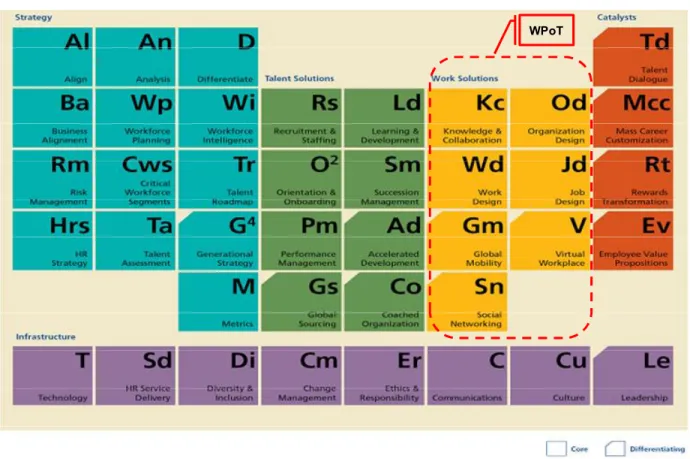
Deloitte’s Periodic Table of Talent depicted in Figure 2 below, highlights components of the WPoT including virtual workplace, global mobility, and social networking, as “differentiating” and “core” workplace solutions that must be considered in defining and implementing an agency’s overall workforce/talent strategy.
Figure 2: Deloitte’s Periodic Table of Talent and WPoT
Improving Return on Technology Investments. The penetration of mobile technologies and Web 2.0 tools is rapidly transforming the traditional work environment and is helping define a new model for workforce communications, stakeholder collaboration, and performance measurement. In response, government agencies are constantly seeking ways to improve employee productivity and efficiency through the roll-out of modern technologies such as improved laptops, personal digital assistants (PDAs), voice over internet protocol (VoIP), etc. In addition, agencies are increasing the use of Web 2.0 tools such as blogs, wikis, podcasts, instant messaging, social networks, social bookmarking, web conferencing, and syndication feeds, to provide unprecedented levels of collaboration among employees and with external stakeholders.
As a result of these activities, many agencies have in-flight or planned initiatives to modernize existing technologies, and these initiatives have dramatically increased the cost of outfitting a worker with technology — Gartner Research estimates that the average IT spend per employee rose from $7,756 in 2000 to $9,419 in 2008. In some cases, these initiatives are designed and implemented within discrete business units in response to specific business requirements, such as telecommuting, energy efficiency, and enterprise sustainability. This decentralized approach makes it difficult
Preparing for the workplace of tomorrow 5
for an agency to consider the full impact and cost of the modernization on its infrastructure or explore opportunities to achieve efficiencies and economies of scale.1
Web 2.0 and Telework
Loudoun County, Virginia has deployed a range of Web 2.0 technologies, including video conferencing, instant messaging, and virtual white boarding, to facilitate its telework program. This has enabled the county to minimize overall costs, provide flexibility in its operations, improve employee retention and recruiting, and increase employee productivity.2
According to Nemertes’ Unified Communications & Collaboration research, there is a higher correlation in the use of Web 2.0 applications by companies with telework policies. For example:
Wiki use increases when there is a telework policy - 57.1% vs. 43.5% for those without a telework policy
Blog adoption also increases — 40.7% vs. 39.1% for those without a telework policy
Shared workspace also increases — 64.3% vs. 57.4% for those without a telework policy
Considering the central importance of technology in enabling the modern workforce and the continued increase in the cost of adopting new technologies, the approach for designing the new WPoT must include a comprehensive
assessment of in-flight and planned technology initiatives. The goals of this assessment are to improve alignment with business demands and workforce patterns, increase efficiencies, better manage the impact on supporting
infrastructure, and leverage economies of scale. The assessment must also consider the security and privacy challenges associated with moving to a more mobile work environment.
Achieving Cost Savings by Reducing Physical Workspace. In a June 11, 2009 memo, OMB put federal agencies on notice that the White House will consider freezing FY2011 spending to FY2010 levels and possibly cut FY2011 spending by 5 percent below the levels outlined in the President’s FY2010 budget. The memo also directed all federal agencies to propose savings initiatives (five at a minimum) that will reduce costs below FY2010 budget levels. In the face of the ever increasing pressure to reduce costs, shrinking budgets, and increasing business demands, federal agencies must consider enterprise-wide initiatives to restructure their cost profiles and streamline business practices. We believe the WPoT presents agencies with a viable option for achieving a portion of the FY2011 spending
reductions required by OMB. The business case for the WPoT must balance the increasing cost of outfitting the modern worker with the potential for reduced costs from the optimization of the real estate and facilities portfolio. Enabling the WPoT with virtual and mobile technologies will require an agency to re-examine its real estate and workplace strategy with the objectives of improving space utilization and reducing facility maintenance costs.
In recent years, shifting demographics and HR policies related to telework and alternative work schedules (AWS) have been decreasing the utilization of existing space, creating significant unrealized opportunities for cost savings. By proliferating mobile technologies and migrating towards shared workspace environments, the WPoT will “de-link” physical space consumption from employee headcount. In other words, the addition of 100 new employees will not necessarily require 100 new workspaces. The facilities-related cost savings that can be generated by more
appropriately allocating physical workspaces can be redirected to fund innovation and other initiatives that will reduce mission and program costs.
1 “Improving Stakeholder Collaboration using Web 2.0”: A white paper on designing an enterprise-wide collaboration strategy to enhance internal and external stakeholder
interaction,” Deloitte, May 2009
Key Concept: “Delink” Space from Headcount
By implementing mobile technologies and migrating towards shared workspace environments, the WPoT will “de-link” physical space consumption from employee headcount. In other words, the addition of 100 new employees under the WPoT will not necessarily require 100 new workspaces.
Our industry research indicates that between 30%-40% of physical workspaces (seats) are vacant at any given
moment of a traditional business day. Using a more conservative analysis that counts seats that are vacant throughout the day presents a lower, but still significant number. For example, assuming that all employees work on location, and only 10% of them take advantage of a flexible work schedule arrangement, the current utilization of the agency’s workspace would be about 86%.3 This means that on any given day, nearly one 1 of 7 workspaces are vacant for the duration of the day.4 Daily and seasonal fluctuations impact workspace demands, making it unlikely that the full 14% of unutilized workspace could be re-purposed. However, as the example below illustrates, capturing just a portion of the unutilized space could help achieve substantial cost savings.
Below are a few examples of federal and commercial organizations that have realized cost savings through workspace reduction strategies.
3 This is a conservative calculation which takes the following factors into consideration: vacation days, sick days, flexible work schedules, and telecommuting.
4 The estimated vacancy of 1 in 7 workspaces is conservative and does not account for the 5-10% vacancy rate that is typically incorporated into facility planning estimates. 5 Based on a national cost per seat average of $12,000-$15,000. This includes real estate rental costs (60%) and supporting operations and services costs (40%). It does not
include the technology costs to outfit the end user or support day-to-day operations.
Key Concept: Space Reduction= Cost Savings
Assuming 10% of an agency’s workforce follows a 5/4/9 compressed work schedule, the current utilization of the agency’s workspace will be about 86%.
Leveraging unutilized workspace could result in significant cost savings for the agency, as illustrated below using a hypothetical 4,400-employee facility located in Washington DC.
Assuming an industry average per seat cost of $12,000 5 and a standard seat rate of 110 percent of employee headcount, the facility would cost approximately $58 million to maintain each year.
By eliminating 14% of the total space, the agency could realize a cost savings of $8.1M at the DC facility alone. What does this mean?
Preparing for the workplace of tomorrow 7 The Cost Savings from Space Reduction are REAL
Federal Agencies
The United States Patent and Trade Office (U.S. PTO) - with over 4,000 employees’ teleworking at least one day a week, the U.S. PTO relinquished about 47,000 square feet of office space, saving roughly $1.5 million in office rental costs.6
The Treasury Inspector General for Tax Administration (TIGTA) - saved over $750,000 at its DC headquarters office as a result of offering telework opportunities to its employees7
Commercial Organizations
Citigroup implemented an Alternative Workplace Strategies (AWS) program that generated real estate cost savings of $64 million in 2008 alone, primarily through the elimination of 21,700 seats (or 4.45million square feet) of space from its global real estate portfolio. Citigroup projects that the AWS program is on track to eliminate an additional 26,000 seats resulting in a $403 million run rate reduction in real estate costs by 20118.
With the passage of the 2009 American Economic Recovery and Reinvestment Act, many agencies anticipate hiring new professionals. Under the current workplace construct at most federal agencies, this hiring surge or a workforce reduction can result in either a significant increase in the real estate and facility costs required to provide a physical workspace for the new personnel, or a significant increase in vacant, unutilized space. However, the WPoT would enable an agency respond to the employee surge or reduction in a more cost-effective manner, by realigning appropriate workspace type and seat sharing ratio based on the work grouping and mobility attributes of each job function. The WPoT can provide workplace solutions that optimize space utilization and accommodate employees at a significantly lower cost to agencies.
Figure 3 below provides a graphical depiction of how the benefits of the new WPoT are distributed between the two primary components of technology and physical workspace.
6 Conference: Telework in a Box, February 26, 2009.
7 “Agency sees gains from telework imitative,” Government Executive, April 15, 2003.
Figure 3: Sources of WPoT Benefits
Agencies that adopt WPoT concepts achieve the majority of productivity and efficiency gains through the roll-out of modern technologies (e.g., improved laptops, PDAs, VoIP, etc.) across the enterprise. Alternatively, the majority of workplace cost savings and improved workforce agility are realized through the more effective use of space (e.g., reducing need for office space through the implementation of a shared workspace environment).
Critical Success Factors for Designing and Implementing the WPoT
An agency’s ability to successfully implement the WPoT hinges on a number of key factors including:
Cross-Functional Integration. Migrating to the WPoT will result in multiple dimensions of change across the Real Estate, HR, IT, and Finance functions. As a result, agencies must adopt a multi-disciplinary approach that takes a holistic view of the workplace and integrates these four enabling functions when designing and implementing the WPoT.
Strong Stakeholder Engagement. All stakeholders, including representatives from employee unions / collective bargaining units need to be identified and included in the processes from the outset.
Commitment to Invest in Mobile Technologies, Web 2.0 Tools, and Workspace ManagementSolutions. Shared workspace environments require a laptop-based workforce, and access to portable telecommunications (either VoIP or PDAs). Workers adopting telecommuting arrangements will benefit from Web 2.0 collaboration tools, and will also require the laptop/PDA equipment with remote connectivity and the appropriate software to allow secure access to the agency’s intranet. Implementing the WPoT will also require the use of workspace management
systems that enable personnel to identify their preferred worksite/workspace and make reservations in advance. Agencies must be willing to make these investments and embrace the technologies required to support a WPoT model. In addition, existing initiatives for these types of technology need to be optimized to support the WPoT effort.
Effective Workforce Analysis. Current and projected workforce data must be analyzed to develop workforce groupings based on job functions, job levels, and attributes of employee mobility. Under the WPoT, these workforce groupings will be used to define appropriate workspace solutions for the workforce, including designating space types (e.g., conventional, telecommute, hoteling, satellite office, etc.) and sharing ratios (employees per seat). Effective workforce analysis will also be useful in:
Optimizing in-flight technology initiatives – for instance, some agencies may already be considering outfitting all employees with laptops as a first step in the move towards a more virtual workforce. An assessment of workforce segments as part of designing the WPoT will help to evaluate and optimize the significant technology costs associated with this policy.
Optimize Technology Improved Desktop
Reduce Physical Workspace Virtual Office
Productivity Gains
Cost Savings Rationalization Efficiencies
Preparing for the workplace of tomorrow 9 Identifying highly mobile segments of the workforce that could be used for a pilot roll-out of the WPoT – for
instance, if one group of employees represents a highly mobile segment of the workforce, that group could be targeted as a pilot population for roll-out of the WPoT concept.
Designing a roll-out strategy for the implementation plan – for instance, new employees should be immediately assigned a workspace solution under the WPoT based on their work groupings. However, current employees whose work groupings fit non-conventional space designations (e.g., telecommute, hoteling) should be given the option to transition out of their existing workspaces to the new WPoT designated workspaces. The transition options presented to this group of employees should include incentives that will require employees to accept the new physical workspace sharing ratios for access to new mobile technologies that are designed to boost
productivity and performance.
Incorporation of Enterprise-wide Sustainability and Greening Initiatives. It is no longer a question of “if,” but rather “when” government agencies will need to begin adopting stricter green workplace standards. Private sector organizations are taking the lead, state and local jurisdictions are following suit, and federal agencies are increasingly being pressured to identify ways to reduce their overall carbon footprint. Government is quickly realizing that going green isn’t purely an altruistic effort; it can save an agency enormous amounts of money and lead to lower
operational risk, increased employee productivity, and enhanced public image.
Greening = Cost Savings + Reduced Carbon Footprint
Greening can significantly lower IT overhead costs, particularly the cost of energy use. As agencies become aware of the true cost of IT, CIOs will be expected to address and report on energy consumption.
Greening can also have a significant impact on the carbon footprint of agencies and individuals:
Buildings make up 39% of US carbon emissions each year.9 Even small efficiencies in workspace utilization can add up to major environmental benefits.
Initiatives like AWS and telecommuting can have big impacts on the carbon footprints of individuals. With commuting making up 10-20%10of an individual’s carbon footprint, a 5/4/9 schedule, and one day a week telecommuting can result in a 3-6%11reduction in carbon emissions.
The Workplace of the Future at Deloitte LLP resulted in a 30% reduction in square footage per employee and a 30% associated savings in energy costs — a savings of over $100 million per year within 2.5 years of implementation at Deloitte LLP.
Agencies have a number of opportunities to incorporate green initiatives into the WPoT. Reducing carbon footprint and making facilities more efficient are the biggest and most obvious efforts. Buildings alone are responsible for 39% of all greenhouse gases emitted in the U.S.12 and the WPoT can result in a reduction in the amount of work space per employee from an industry average 250 sq. ft. to 150 sq. ft. or less. This decrease in an agency’s leased and owned space means that fewer natural resources are consumed to construct, maintain, and operate buildings, and lower real estate and facility cost. The strategy can also offer workers more natural light, better quality, and improved acoustics.13 In addition, employees commuting to work make up between 10 and 20% of an individual’s carbon footprint, depending on the vehicle. A WPoT effort can provide flexible work arrangements and more efficient use of facilities, resulting in substantial reductions to both corporate and individual carbon emissions.
9 U.S. Green Building Council. http://www.usgbc.org/DisplayPage.aspx?CMSPageID=124.
10 The 2003 Bureau of Transportation Statistics Report found that the average U.S. commute was 32 miles round trip, producing 2.3 to 6.5 tons of carbon annually. EPA inventories
of U.S. greenhouse emissions estimate the average footprint to be 23 tons per capita annually.
11 “Green Building Costs and Financial Benefits” and “The Costs and Financial Benefits of Green Buildings: A Report to California’s Sustainable Building Task Force,” 2003, Gregory
H. Kats, Capital E (www.cap-e.com).
12 U.S. Green Building Council. http://www.usgbc.org/DisplayPage.aspx?CMSPageID=124.
Representative Case Studies
Case Study:
Designing and Implementing a Global
Alternative Workplace Strategy
Company:
Global Financial Services Company
A large global financial services company that experienced significant declines in its earnings as a result of the sub-prime mortgage collapse asked Deloitte to help them in their efforts to plan and develop their Alternative Workplace Strategy (AWS) program. The primary goals of the initiative were three-fold: (1) to reduce real estate occupancy costs; (2) to improve employee productivity, retention, and commitment; and (3) to enhance customer relations and business continuity.
Key project activities included conducting an employee profile analysis to identify target user groups that would embrace AWS, as well as performing analysis on the company’s global real estate portfolio to identify potential opportunities for cost savings. Additionally, we assisted with the development of the implementation approach and tools. Expected benefits of the project include cost reduction over the long term, improved levels of facility service, enhanced business continuity, and improvements in employee productivity, retention, and commitment.
Case Study:
Building an Opportunity Business Case
and Designing a Global Workplace
Strategy
Company:
Global Life Sciences Company
Driven by cost pressures and an overall cultural change, a global life sciences company asked Deloitte to help them in their efforts to build a cross-functional Advanced Workplace Management (AWM) team to: (1) develop a workplace strategy that would significantly reduce the
company’s cost structure; and (2) reinforce a culture of innovation and teamwork with a focus on results.
The project team worked closely with stakeholders from across the organization to develop an integrated flexibility, mobility, and workspace solution that included new HR, IT, and space guidelines. This solution was implemented initially across the company’s major U.S. campuses, encompassing approximately 20,000 U.S. employees. The
implementation of the new workplace strategy reinforced the company’s cultural direction and enabled a reduction in physical footprint with $130M in ongoing annual cost savings.
Case Study:
Designing a Workplace of the Future
Program
Company:
Global Professional Services Firm
Deloitte helped a Big 4 Firm occupying over 7M square feet of space across the U.S. with their efforts to significantly reduce their cost structure and reinforce a culture of collaboration, innovation, and teamwork. Deloitte provided support to three main activities: (1) developing a deep understanding of the company’s workplace
requirements; (2) detailing a set of components for a workplace strategy that could support the company’s efforts to refocus its culture; and (3) developing a change management plan that was supported by all levels across the organization.
This initiative resulted in the development of the Workplace of the Future (WOF), and its implementation in 6 United States locations yielded a cost avoidance of ~$30M in capital expenditure in the first year.
This publication contains general information only and is based on the experiences and research of Deloitte practitioners. Deloitte is not, by means of this publication, rendering business, financial, investment, or other professional advice or services. This publication is not a substitute for such professional advice or services, nor should it be used as a basis for any decision or action that may affect your business. Before making any decision or taking any action that may affect your business, you should consult a qualified professional advisor. Deloitte, its affiliates, and related entities shall not be responsible for any loss sustained by any person who relies on this publication.
As used in this document, “Deloitte” means Deloitte Consulting LLP. Please see www.deloitte.com/us about for a detailed description of the legal structure of Deloitte LLP and its subsidiaries.
Copyright © 2009 Deloitte Development LLC. All rights reserved. Member of Deloitte Touche Tohmatsu
Contact Information
For questions on the Workplace of Tomorrow please contact: Seth Siegel Director Deloitte Consulting LLP Tel: +1 (202) 758-1080 E-mail: [email protected] Naomi Leventhal Director Deloitte Consulting LLP Tel: +1 (202) 220-2739 E-mail: [email protected] Rob Danegger Senior Manager Deloitte Consulting LLP Tel: +1 (202) 378-5153 E-mail: [email protected] Francisco Acoba Senior Manager Deloitte Consulting LLP Tel: +1 (212) 618-4432 E-mail: [email protected] Uchenna Amaonwu Manager Deloitte Consulting LLP Tel: +1 (202) 220-2893 E-mail: [email protected]
For questions on Talent Strategies and Solutions please contact: Jeff Schwartz Principal Deloitte Consulting LLP Tel: +1 (703) 251-1501 E-mail: [email protected] Andy Liakopoulos Principal Deloitte Consulting LLP Tel: +1 (312) 486-2777 E-mail: [email protected]