An Application of Secure Data
Aggregation for Privacy-Preserving
Machine Learning on Mobile Devices
by
Chuyi Liu
A thesis
presented to the University of Waterloo in fulfillment of the
thesis requirement for the degree of Master of Applied Science
in
Electrical & Computer Engineering
Waterloo, Ontario, Canada, 2018
c
I hereby declare that I am the sole author of this thesis. This is a true copy of the thesis, including any required final revisions, as accepted by my examiners.
Abstract
Machine learning algorithms over big data have been widely used to make low-priced services better over the years, but they come with privacy as a major public concern. The European Union has made the General Data Protection Regulation (GDPR) enforceable recently, and the GDPR mainly focuses on giving citizens and residents more control over their personal data. On the other hand, with personal and collective data from users, companies can provide better experience for customers like customized news feeds and real time transportation systems. To solve this dilemma, many privacy-preserving schemes have been proposed such as homomorphic encryption and machine learning over encrypted data. However, many of them are not practical for the time being due to the high com-putational complexity. In 2017, Bonawitz et al. proposed a practical scheme for secure data aggregation from privacy-preserving machine learning, which comes with the afford-able calculation and communication complexity that considers practical users’ drop-out situations. However, the communication complexity of the scheme is not efficient enough because a mobile user needs to communicate with all the members in the network to es-tablish a secure mutual key with each other.
In this thesis, by combining the Harn-Gong key establishment protocol and the mobile data aggregation scheme, we propose an efficient mobile data aggregation protocol with privacy-preserving by introducing a non-interactive key establishment protocol which re-duces the communication complexity for pairwise key establishment ofnusers from O(n2) to a constant value. We correct the security proof of Harn-Gong key establishment protocol and provide a secure threshold of degree of polynomial according to Byzantine Problem. We implementKDC side Harn-Gong key establishment primitives and prepare a proof-of-concept Android mobile application to test our protocol’s running time in masking private data. The result shows that our private data masking time is 1.5 to 3 times faster than the original one.
Acknowledgements
I would like to thank Prof. Gong for her supervision of my thesis. She is a sharped, energetic and caring professor who always encourage me to explore different research area, from whom I learned a lot.
I would like then give many thanks to my thesis readers, Prof. Menezes and Prof. Tripunitara. Prof. Menezes is very keen to the mathematical proof of the thesis and pointed out the error of security proof from the Harn-Gong protocol. His comments make the thesis much more solid.
Also I would like to thank Dr. Kalikinkar Mandal who have given me a lot of advises for the clarity of my statement, and he also promoted my experiment results of the imple-mentation of the thesis.
Dedication
Table of Contents
List of Tables ix List of Figures x 1 Introduction 1 2 Literature Survey 4 2.1 Machine Learning . . . 42.2 Key Agreement Protocols . . . 5
2.3 Homomorphic Encryption . . . 7
3 Preliminaries 9 3.1 Stream Cipher . . . 9
3.2 Shamir’s (k, n) Secret Sharing Scheme . . . 10
3.2.1 Secret Share Generation . . . 11
3.2.2 Secret Reconstruction . . . 12 3.3 Horner’s Method . . . 12 3.4 Diffie-Hellman Protocol . . . 13 3.5 Notation . . . 14 3.5.1 Protocols . . . 14 3.5.2 Computation Complexity . . . 14 3.5.3 Finite Fields . . . 16
4 Harn-Gong Group Key Establishment Protocol and its Security Proof 17
4.1 Scheme Overview . . . 17
4.2 Conference Group Key Sharing Protocol . . . 19
4.2.1 Univariate Polynomial Generation . . . 19
4.2.2 Secret Share Polynomial Generation. . . 20
4.2.3 Conference Key Generation . . . 20
4.3 Security Analysis . . . 20
4.4 Complexity Analysis . . . 25
4.4.1 Complexity Analysis of User . . . 26
4.4.2 Complexity Analysis of KDC . . . 26
5 Mobile Data Aggregation for Privacy-Preserving Machine Learning 28 5.1 Scheme Overview . . . 28
5.2 Data Aggregation Protocol . . . 30
5.2.1 Diffie-Hellman Pairwise Key Generation . . . 31
5.2.2 Secret Share Generation . . . 31
5.2.3 Private Data Masking . . . 32
5.2.4 User Dropout Consistency Check . . . 32
5.2.5 Unmasking Aggregate Data . . . 33
5.2.6 Security Analysis . . . 33
5.3 Complexity Analysis . . . 35
5.3.1 Complexity Analysis of the User . . . 36
5.3.2 Complexity Analysis of the Server . . . 37
6 A New Communication Efficient Data Aggregation Protocol 40 6.1 Scheme Overview . . . 40
6.2 Methodology . . . 43
6.2.2 Secret Share Generation . . . 44
6.2.3 Private Data Masking . . . 44
6.2.4 Unmasking Aggregate Data . . . 45
6.3 Adversary Model and Security Analysis . . . 46
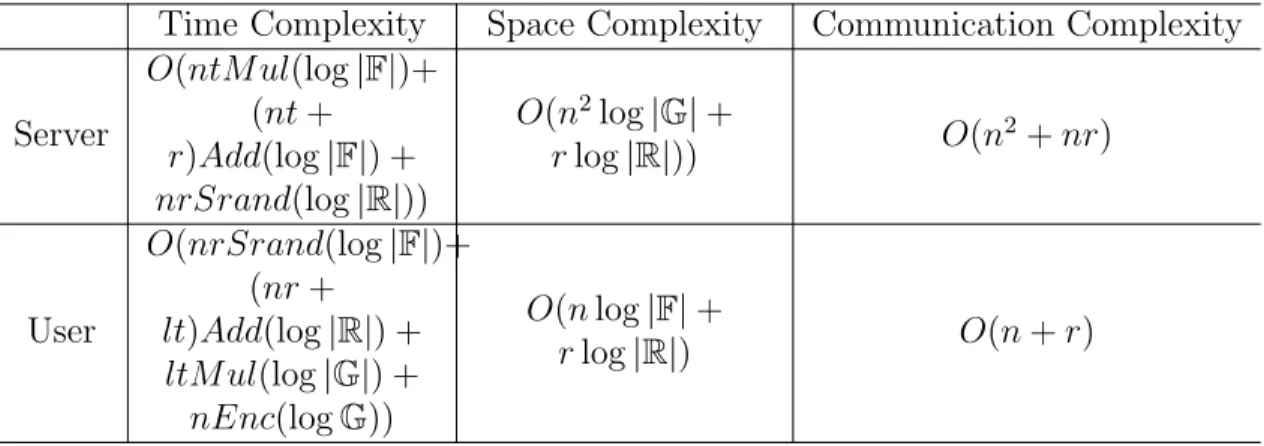
6.4 Complexity Analysis . . . 50
6.4.1 Complexity Analysis of the User . . . 50
6.4.2 Complexity Analysis of the Server . . . 51
7 Implementation of Mobile Data Aggregation 54 7.1 Python Lib for KDC Generating Secret Share . . . 54
7.1.1 Sample Usage . . . 55
7.1.2 API Description . . . 56
7.1.3 Secret Share Polynomial Generation Time . . . 56
7.2 Android App for Client Masking Private Data . . . 56
7.3 Execution Time . . . 58
7.3.1 Security Level Execution Time Comparison . . . 60
7.3.2 Masking Schemes Execution Time Comparison . . . 61
7.4 Power Consumption . . . 62
8 Conclusions and Future Work 63 8.1 Conclusions . . . 63
8.2 Future Work . . . 64
References 65
APPENDICES 71
List of Tables
3.1 Group Sizes for Different Security Levels . . . 14
3.2 Notation for Protocol Description . . . 15
3.3 Notation for Complexity Analysis . . . 16
3.4 Notation for Finite Field . . . 16
4.1 Complexity Analysis of Harn-Gong Key Establishment Protocol in Bit Op-eration . . . 27
5.1 Bit Complexity Analysis of Privacy-Preserving Mobile Data Aggregation Protocol . . . 39
6.1 Bit Complexity Analysis of Privacy-Preserving Mobile Data Aggregation Protocol . . . 53
List of Figures
3.1 AES Counter Mode . . . 11
3.2 Standard Diffie-Hellman Protocol Against a Passive Adversary . . . 13
4.1 6 Users Key Establishment Overhead Using 2 Party Key Agreement Protocol 18 4.2 6 Users Key Establishment Overhead Using Harn-Gong Protocol . . . 19
5.1 Workflow of Federated Learning . . . 29
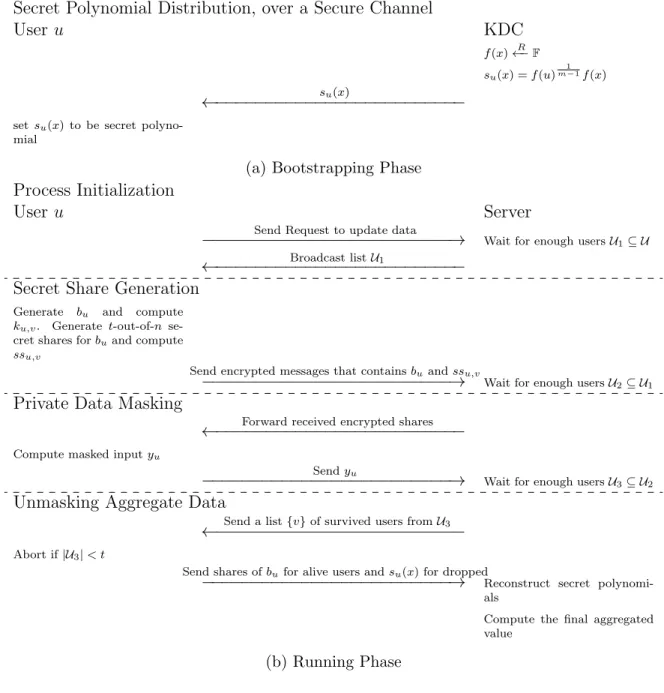
6.1 High-level view of the protocol . . . 42
7.1 Secret Share Polynomial Generation Time in 128 Security Level . . . 57
7.2 Android Application User Interface Using Java BigInteger Class . . . 58
7.3 Android Application User Interface Using OpenSSL Library . . . 59
7.4 Different Security Level Masking Time Using Java BigInteger Class . . . . 60
7.5 Masking Scheme Comparison Using C++ Native Lib . . . 61
Chapter 1
Introduction
In the last few years, the development and usage of smart phone applications have given much attention to data usage by cloud services. Since the computation and storage ability of a mobile device is limited, the data the user provides can be easily leaked. At the same time, cloud service providers can use their substantial resources to analyze users’ data to provide better performance on their application. It is reasonable for users to want to maintain privacy of the data (eg. health data and financial data) while enjoying the cloud service at the same time. However, as the Internet Trends 2016 report [42] suggests, more and more users choose to avoid online usage because of privacy concerns. It is important to provide a communication and computationally efficient privacy scheme for today’s big data usage.
There are numerous cloud services that a mobile user may need. For example, cloud storage, speech assistance, and recommendation systems. These technologies make use of users’ data and can predict users’ interests in order to make a profit. So it is with high probability that cloud service providers might be interested in probing users’ data at the same time they respond to users’ demands. This type of curious-but-honest threat model is a standard one for cloud service. Even when cloud service providers are not interested in probing users’ privacy, the data format it stores in its server may also be prone to attacks, such as Facebook data breaches [59], which not only contributes to a company’s loss, but also threatens users’ privacy in other related areas.
There are many technologies available to address the above issues, such as homomorphic encryption. Homomorphic encryption is a cryptographic scheme by which a cloud service
provider can use operates on ciphertexts of users’ data in the same way it operates on plaintext. When users get the operated data back, they can get the desired cloud compu-tation results without leaking their private information. It is fair to say that homomorphic encryption makes data malleable in a way that does not leak the important information of users. The confidentiality of users’ data is preserved while they enjoy cloud services. But there is still a long way for fully homomorphic encryption to be truly practical in daily use. The basic business model of ML-based data analysis is a closed circle: the more the data is accumulated, the more accurately the model can be trained, which means more useful services are provided and more users are attracted to the services, and the process finally leads to more data being collected [62]. People who use machine learning methods tend to believe that when you cannot figure something out, you just give more data to the model and let it find an answer. Ubiquity of sensors via mobile and IoT devices has caused a surge in personal data generation and use while users’ data collection can be important for the model’s training. Recently, Bonawitzet al. [7] proposed a privacy preserving strat-egy to update the machine learning model with a new federate learning method. However, it needs to establish a secret key for each pair of users in the network. For a large scale of users (say 105), it needs 1010 pairwise keys to be established since the number of keys increases quadratically for the two party key agreement protocol.
It is widely accepted that a key agreement protocol can establish a safe communica-tion channel for any two parties. However, when a group of members using two party key agreement protocols wants to start a secure communication, it is communication inefficient to use the standard protocol. It has been a big concern of how to establish a group key without communication overhead as the two party key agreement protocol does. In 1982, Blundo et al.[6] proposed an information theoretically secure one based on multivariate polynomials. Later in 2015, Harn and Gong proposed a storage efficient univariate poly-nomial product protocol [28] based on it. The Harn-Gong protocol is not only useful in establishing a secure key for a group communication, but also its non-communicative way to establish group keys helps to reduce communication overhead significantly in a scenario where a pairwise key for every pair of users in the network is needed.
Secure data aggregation is a process of securely collecting data from a group of users where each user has a private input, and the aggregation process does not reveal any pri-vate information about users’ inputs. The secure data aggregation problem, particularly aggregate sum, has been studied in the literature in different contexts such as wireless sensor networks [16] and cloud database services [44]. The mobility nature of mobile users
introduces a new property called robustness or failure-robust where a mobile user is either alive in the system or drops out from the system.
In this work, we consider the problem of aggregating the sum of mobile users’ data in a secure manner. Our contributions are as follows:
1) We propose an efficient mobile data aggregation protocol with privacy-preserving by introducing a non-interactive key establishment protocol that reduces pairwise key establishment of a group with O(n2) communication complexity to a constant value. 2) We correct the security proof of the Harn-Gong key establishment protocol and
pro-vide a secure threshold of degree of polynomial according to Byzantine Problem. 3) We implement KDC side Harn-Gong key establishment primitives and prepare a
proof-of-concept Android mobile application to test our protocol’s running time in masking private data. The result shows that our private data masking time is 1.5 to 3 times faster than the original one.
The rest of the thesis is organized as follows. In Chapter 2, we introduce some known methods for privacy issues related to machine learning algorithms, and introduce related key establishment protocols. We also discuss homomorphic encryption as a possible solu-tion for cloud service providers to provide privacy-preserving services. In Chapter 3, we present terminologies that are used in the key establishment protocol and private data masking protocols. In Chapter4, we present the detail of constructions of Harn-Gong key establishment protocol [28] and its security analysis as well as performance evaluation. In Chapter 5, we provide a detailed complexity analysis on complexity of privacy-preserving mobile data aggregation scheme in [7]. We present our new protocol in Chapter 6 and analyze its complexity. The implementation and analysis is in Chapter7and Chapter 8is comprised of conclusions and some future work.
Chapter 2
Literature Survey
We introduce some machine learning algorithms and their privacy issues in Section2.1. We then provide details of some key establishment protocols to build a secure communication channel in Section2.2. Finally, we present the concept of the homomorphic encryption as a tool for addressing privacy issues in machine learning in Section2.3, and state why it is not practical in current machine learning applications.
2.1
Machine Learning
Machine learning is a process that makes computer progressively improve performance on some specific tasks rather than being explicitly programmed. The term was first introduced by Samuel in 1959 [51] and it has become an essential method for problems of computer vision, speech detection, robotics, finances, etc. In general, machine learning algorithms can be divided into three paradigms:
1) Supervised learning 2) Unsupervised learning 3) Reinforcement learning
Supervised learning is a machine learning method by which labeled training data is given to the machine learning model, and the model maps input to output based on ex-ample pairs [43]. Many different forms of mappings exist, including decision trees [48],
decision forests [31], logistic regression [18], support vector machines [17], and neural net-works [41]. One high-impact area of progress in supervised learning in recent years involves deep networks [4], which has multiple hidden layers between the input and output layers. Such deep learning systems can be trained over vast collections of data and can contain billions of parameters. The large-scale deep learning systems have had a major effect in computer vision [37] and speech recognition [27] in recent years.
Unsupervised learning is a machine learning method by which the model learns from the unlabeled training data. The instinct of unsupervised learning is to derive the hid-den structure of the raw data [29]. Many different objectives of unsupervised learning have been proposed, such as discovering clusters in the input data [5], extracting features that characterize the input data more compactly [45], and uncovering non-accidental co-incidences within the input data [63]. Given that the goal is to exploit the particularly large data sets, the concern with computational complexity is paramount in those methods. Reinforcement learning is a machine learning method that explores training data be-tween supervised and unsupervised learning [56]. Instead of giving exact correct answers, the training data in reinforcement learning provides only an indication as to whether an action is correct or not. The applications of reinforcement learning have increased in op-erations research [15] and control theory in the field of Markov decision processes [32].
Machine learning algorithms have been used in many online service providers with rec-ommendation systems (Netflix, Spotify, Facebook, etc.), and those companies are prone to store and use a big number of user data. However, data breaches have been a big problem for those giant companies. The Facebook’s 87 million users’ data leakage is just one exam-ple of today’s various company’s data breaches [59]. With the introduction of the General Data Protection Regulation of European Union [60] enforceable in May 2018, data privacy of machine learning algorithms could be a big legal issue in the future.
2.2
Key Agreement Protocols
A key establishment protocol is a method to enable multiple users to share a secret key [28]. The key agreement protocol is a special type of key establishment protocols that enable all entities to influence the outcome collaboratively. The most widely-used key agreement
protocol is Diffie-Hellman key agreement protocol [20]. However, it can only allow two members to communicate efficiently. For a group of more than two members, O(n2) com-munication complexity is needed to establish a pairwise key for each pair of members in the group.
Many natural adaptations of the original Diffie-Hellman key agreement protocol [55,14,
34] have then been proposed for group key agreement protocols, but their time efficiency and confidentiality have become great concerns. For example, Steineret al. [55] proposed an adapted Diffie-Hellman protocol that needsO(n) rounds communication among n par-ticipants, which cannot be scaled up to a large network.
In 1995, Burmester and Desmedt [14] proposed a generalized Diffie-Hellman group key establishment protocol with a constant round of communication for each user. However, it lacks a full proof of security because it only provides a security proof for an even number of participants. In 2007, Katz et al. [34] provided the first constant round, fully scalable and provably-secure protocol compiler and proved the Burmester-Desmedt protocol to be secure. In [40], the authors provide elliptic curve version of Burmester-Desmedt protocol and its authenticated variant. However, the digital signature of each user in the group for authentication of Diffie-Hellman public keys may also restrict its usage since the generation and verification of digital signature may take substantial computational resources.
In 1992, Blundo et al. [6] proposed a non-interactive k-secure m-conference protocol based on multivariate polynomials, wherek-secure means anykusers cannot collude to get other member’s share information, andm-conference means that the protocol can establish a group key of up to m members. However, since the protocol requires each polynomial to have (k+ 1)m−1 coefficients, the space complexity of the protocol is exponential in the number of users, which makes it impossible to use in a large number of users’ network.
Based on the work of [6], in 2015, Harn and Gong [28] provide a protocol that uses con-stant time to achieve both authentication and confidentiality for the group communication in a public key network. The protocol uses a univariate polynomial product to reduce the space complexity of [6] and requires only (k+ 1) coefficients for the group key computation. The protocol has space complexity linear in the number of users in the network. Its non-interactive and efficient storage properties make it attractive for many real applications.
clear that Burmester-Desmedt protocol requires all parties to participate in the key estab-lishment process whereas the Harn-Gong protocol is non-interactive. At the same time, the Harn-Gong protocol can easily accommodate the addition and deletion of members or subsets, while there is a significant computation cost for the user updates in the Burmester-Desmedt protocol.
2.3
Homomorphic Encryption
Homomorphic encryption (HE) is a type of encryption that allows computations on en-crypted data. When the operated ciphertext is deen-crypted, the result matches operation as if the operation were performed on the plaintext. HE was first proposed in [49] in 1978 as a possible solution to the problem that most encrypted data needs to be decrypted if it needs complicated operation by a third party.
In order to perform homomorphic evaluation of an arbitrary function, it is sufficient for HE to allow only addition and multiplication operations because the two operations are functionally complete for any arithmetic operations over a field [49]. HE can be divided neatly into three categories, which are
1) Partially Homomorphic Encryption (PHE) 2) Somewhat Homomorphic Encryption (SWHE) 3) Fully Homomorphic Encryption (FHE)
PHE is a kind of HE that allows only one type of operation to be performed an un-limited number of times. For example, the basic RSA public key scheme [50] is a kind of PHE that achieves homomorphic multiplication. When given an RSA modulus N and public key e, since the encryption method for a message m is E(m) = me mod N, for any two different messages m1 and m2, E(m1)∗E(m2) = me1 ∗me2 (mod N) = (m1m2)e
(mod N) =E(m1m2) (mod N). Besides the RSA public key scheme, there are many other
useful PHE schemes such as Goldwasser and Micali [52], ElGamal [21], Benaloh [3] and Paillier [46]. Although PHE can only achieve one type of operation, these schemes were an important basis for subsequent HE research.
SWHE is a type of HE that allows a limited set of operations to be applied a limited number of times. An early attempt of computation over encrypted data is Yao’s study in 1986 [61] which solves the Millionaire’s problem by comparing the wealth of two rich people without revealing the exact amount to each other. However, the time and space complexity of Yao’s algorithm is exponential. It was not until 2005 that Boneh-Goh-Nissim (BGN) introduced one of the most significant SWHE schemes [11]. BGN enables an arbitrary number of additions and one multiplication while keeping the ciphertext size constant. Although BGN only allows small message space and a limited number of multiplications, it was an important step towards FHE.
FHE allows an unlimited number of operations to be applied an unlimited number of times, and it is the ultimate objective of HE research. It was not until 2009 that Gentry proposed the first plausible FHE scheme in [24]. Gentry’s scheme is based on ideal lattices and it led to other FHE designs [57, 13, 25]. One year after Gentry’s work, Van Dijk et al. [57] constructed an FHE scheme over the integers from a “bootstrappable” SWHE by Gentry’s method. Brakerski et al. [13] then proposed an FHE scheme based on learning with error (LWE) problem, which is considered as one of the hardest problems to solve even for even by quantum algorithms.
Homomorphic encryption is an ideal solution to data privacy problems as it allows cloud service providers to operate on encrypted data without decrypting it. After Gentry’s work [24], many different FHE schemes were proposed. FHE still needs to be improved substantially to be practical because the current schemes are too computationally expensive for real-life big data applications.
Chapter 3
Preliminaries
In this chapter, to provide the ingredients of our data aggregation scheme, we introduce stream ciphers in Section 3.1, Shamir’s secret sharing scheme in Section 3.2, and Diffie-Hellman key establishment protocol in Section3.4. Section 3.3 describes Horner’s method for evaluating polynomials. The notation we use in the protocol is presented in Section
3.5.
3.1
Stream Cipher
We first take a look at the One-time Pad (OTP) which has perfect secrecy [54] and simple encryption and decryption methods.
Definition 3.1.1(One-time Pad). A one-time pad is a cipher where keyk, messagemand ciphertextcare bit strings of the same length. The encryption method isE(k, m) =k⊕m and decryption method is D(k, c) =k⊕c, where ⊕denotes the exclusive-or operation.
The reason that the one-time pad can be encrypted/decrypted in such a way is that the exclusive-or of any message with itself is 0. The operations are as follows:
0⊕0 = 0 0⊕1 = 1 1⊕0 = 1 1⊕1 = 0
To achieve perfect secrecy, Shannon [54] proved that the key should be at least as long as the message. At the same time for a secure OTP scheme, the key cannot be used twice, which makes the OTP impractical in daily usage.
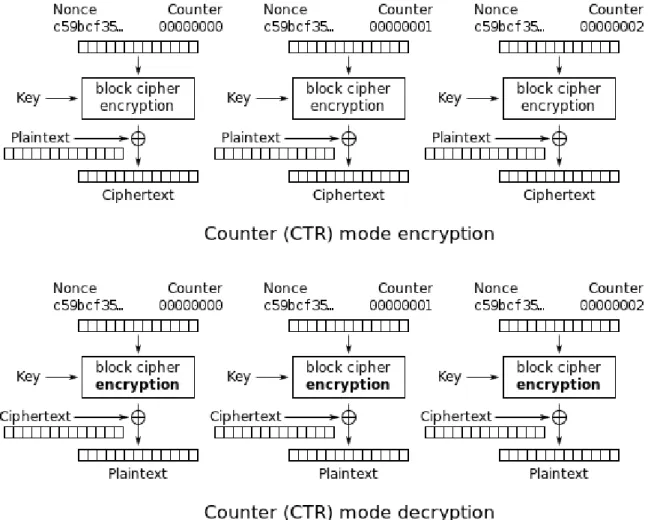
Stream ciphers overcome this problem by using a relatively short key to generate long keystream and then encrypt data in the OTP manner. The function to generate a long keystream from a short-length seed is called Pseudo-Random Number Generator (PRNG). Stream ciphers are widely used in modern technology because of their efficient encryption and decryption operations. AES Counter Mode, depicted in Figure 3.1, is a model for using the AES block cipher to construct a stream cipher.
3.2
Shamir’s
(
k, n
)
Secret Sharing Scheme
Shamir’s secret sharing scheme [53] is a method for distributing a secret over n members, each of whom is allocated a share of the secret, and the secret can only be reconstructed by up to k members. Shamir’s secret sharing scheme is based on Lagrange interpolation, and the secret is information theoretically secure if fewer than k shares are collected [47]. Suppose a secret s is to be shared by a group of n members, in such a way that at least k shares are required to reconstruct s. Let the secret share be a y value, and each member’s public identity be an x value. The shares and each member’s identity can be treated as a set of points (x1, y1),· · · ,(xn, yn) on a 2-dimensional plane.
According to polynomial interpolation, when providedk pairs of points (xi, yi),0≤i≤ k−1, there is one and only one polynomialp(x) of degree at mostk−1 such thatp(xi) =yi for all i. After the polynomial is reconstructed, the secret can be selected as p(0) which makes it reconstructable by all group members.
If we implement Shamir’s secret sharing scheme in a finite fieldZq, where q is of l bits, the advantage of an adversary to reconstruct the secret by knowing fewer that k shares is
1
2l. Generally, the usage of Shamir’s secret sharing scheme can be divided into two steps: 1) Secret Share Generation.
Figure 3.1: AES Counter Mode
3.2.1
Secret Share Generation
1. s is selected as a secret to be shared over fieldZq. 2. For 1≤i≤k−1, i∈N, generate pi
R ←−Zq.
3. Construct a polynomial p(x) = s+p1x+p2x2+· · ·+pk−1xk−1.
4. For 1 ≤ i ≤ n, evaluate yi = p(xi) over Zq, and distribute yi to member i with identity xi ∈Zq.
3.2.2
Secret Reconstruction
1. k shares and corresponding member identities are collected which is denoted as (x1, y1),· · ·,(xk, yk).
2. Construct a polynomial p(x) where p(x) = k X i=1 Y 1≤j≤k,j6=i x−xj xi−xj yi
3. The secrets is the value of p(0). s=p(0) = k X i=1 Y 1≤j≤k,j6=i −xj xi−xj yi
Lemma 3.2.1 (Shamir’s Secret Sharing Reconstruction). For a (k, n) Shamir’s secret sharing scheme with over k different shares, the secret polynomial p(x) and secret p(0) can be reconstructed as described above.
3.3
Horner’s Method
There are many algorithms to evaluate polynomials efficiently, among which Horner’s method uses k multiplications and k additions to evaluate a polynomial of degree k. The technique is as follows:
1) Given a polynomial p(x) = Pki=0−1aixi, where a0,· · · , ak ∈ Zq and p(x0) is the value
to be evaluated.
2) A new sequence of constants are defined as follows: bk =ak
bk−1 =ak−1+bkx0
.. .
Then b0 is the value of p(x0).
Note that the reason the scheme works is that the polynomial calculation can be written in the form
p(x0) = a0+x0(a1+x0(a2+· · ·+x0(ak−1+akx0))) =a0+x0(a1+x0(a2+· · ·+x0(bk−1))) .. . =a0+x0(b1) =b0
Clearly the complexity of the algorithm isk multiplications andk additions for calculation ofk constants of bi, where 0 ≤i≤k−1.
3.4
Diffie-Hellman Protocol
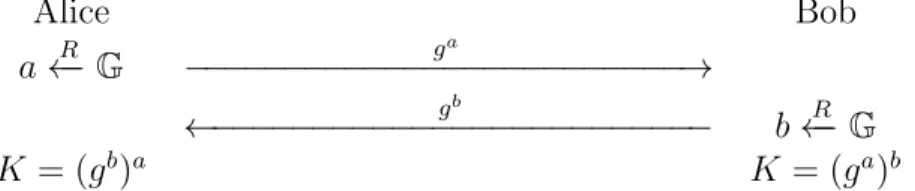
The Diffie-Hellman protocol is a cryptographic key agreement scheme proposed by White-field Diffie and Martin Hellman in 1976 [20]. The protocol is the earliest practical example of public key exchange and is widely used in information technology. Asides from the original version of Diffie-Hellman key agreement protocol, the elliptic curve version [1] is also widely used due to its efficiency at the same security level compared to the original one. The basic protocol works like this. Suppose Alice and Bob want to establish a shared key over a group G of order q, where q is prime. Let g be a generator of G, the Diffie-Hellman protocol against a passive adversary is in Figure3.2.
Alice Bob
a←R−G −−−−−−−−−−−−−−−−−−−−−−−−−→ga gb
←−−−−−−−−−−−−−−−−−−−−−−−−− b←R−G
K = (gb)a K = (ga)b
Since the key K = (gb)a = gab = (ga)b, Alice and Bob can successfully establish a shared key . The security of Diffie-Hellman protocol is based on the assumption of Decision Diffie-Hellman problem (DDH) [9], which makes a passive adversary unable to differentiate a shared key established by Alice and Bob from a random element of G.
Definition 3.4.1 (Decision Diffie-Hellman Assumption). The two tuples (ga, gb, gab) and (ga, gb, gc), wheregis a generator of group
Gof orderqanda, b, c←R−G, are computationally indistinguishable.
The security level of the size of group and elliptic curve is listed in Table 3.1 from [1]. Table 3.1: Group Sizes for Different Security Levels
Security level 80 112 128
Bit Length of p when G=Zp∗ 1024 2048 3072 Bit Length of pwhen G=E(Zp) 160 224 256
3.5
Notation
In this section, we introduce the notation for protocol specification and computation com-plexity which will be used throughout the thesis.
3.5.1
Protocols
The notation in Table3.2is for the key agreement protocols, the encryption protocols, and the cryptographic primitives used in the protocol description.
3.5.2
Computation Complexity
The notation in Table3.3 is for the complexity analysis using bit operations in a scheme under analysis.
Table 3.2: Notation for Protocol Description
Notation Description
KA.param(k)−→pp An algorithm that produces some public parameters over which the key agreement protocol is used
KA.gen(pp)−→(sSK
u , sP Ku ) An algorithm that allows any party u to generate a private-public key pair
KA.agree(sSK
u , sP Kv )−→su,v An algorithm that allows any user u to combine their private key sSK
u with the public keysP Kv for anyv (gen-erated using the same parameterpp), to obtain a private shared key su,v between u and v
SIG.sign(dSK, m)−→σ An algorithm that takes as input the secret keydSK and a message m and outputs a signatureσ
SIG.ver(dP K, m, σ)−→ {0,1} An algorithm that takes as input a public key dSK, a messagem and a signature σ, and returns a bit indicat-ing whether the signature should be considered valid or not
P RN G(b)−→v A pseudo-random number generater that generates a data vector v from a number b
SS.share(s, t,U)−→ {(u, su)}u∈U An algorithm that takes as input a secret s, a set U of
n field elements representing user IDs, and a threshold t ≤ |U |; it produces a set of shares su , each of which is associated with a different u∈ U
SS.recons({(u, su)}u∈V, t)−→s An algorithm that takes as input the threshold t and
the shares corresponding to a subset V ⊆ U such that |V| ≥ t, and outputs a field element s
SS.reconp({(u, su)}u∈V, t)−→p(x) An algorithm that takes as input the threshold t and
the shares corresponding to a subset V ⊆ U such that |V| ≥ t, and outputs a field polynomial p(x) of degree t−1
AE.enc(k, m)−→c An authenticated encryption algorithm that takes as in-put a key k and a message m and outputs a ciphertext c
AE.dec(k, c)−→ {m,⊥} An authenticated decryption algorithm that takes as in-put a ciphertext c and a key k and outputs either the original plaintext m, or a special error symbol ⊥
Table 3.3: Notation for Complexity Analysis Notation Description
Exp(l) The number of bit operations of the exponentiation of a number of bit-lengthl
Inv(l) The number of bit operations of the inversion of a num-ber of bit-lengthl
M ul(l) The number of bit operations of the multiplication of two numbers of bit-length l
Add(l) The number of bit operations of the addition of two numbers of bit-lengthl
Sign(l) The number of bit operations of signing a digital signa-ture of a message of bit-length l
Enc(l) The number of bit operations of the encryption of a message of bit-lengthl
Srand(l) The number of bit operations of a secure random number generation of bit-lengthl
3.5.3
Finite Fields
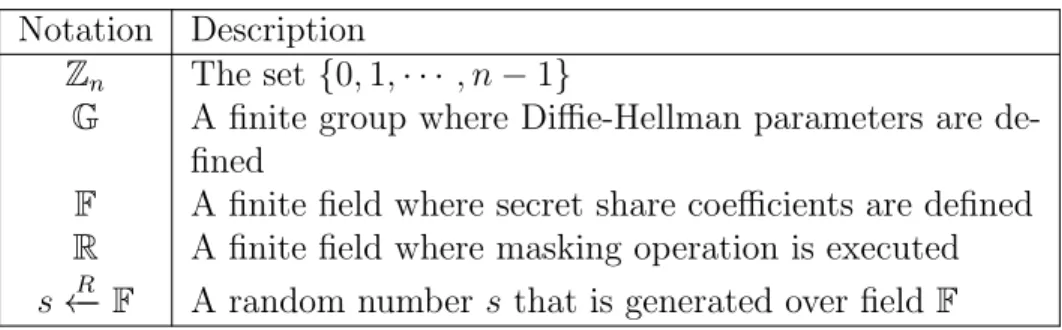
The notation in Table3.4 is for the finite field over which a polynomial evaluation and a secure random number generation are performed.
Table 3.4: Notation for Finite Field Notation Description
Zn The set {0,1,· · · , n−1}
G A finite group where Diffie-Hellman parameters are de-fined
F A finite field where secret share coefficients are defined R A finite field where masking operation is executed s←−R F A random number s that is generated over field F
Chapter 4
Harn-Gong Group Key
Establishment Protocol and its
Security Proof
In this chapter, we introduce a non-interactive protocol for establishing keys for each pair of users in a network. We present the protocol overview in Section 4.1. The details of the protocol description are presented in Section4.2 and a new security proof is demonstrated in Section4.3. Finally, we analyze the bit complexity of the protocol in Section4.4.
4.1
Scheme Overview
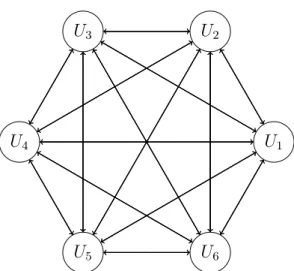
A conference key is a secret shared by a group of communication members, the number of which is usually greater than or equal to two. Since Diffie and Hellman [20] described a new concept in cryptography called the public key distribution, two-party key agreement protocols have been well researched. Plenty of efficient and secure schemes have been proposed over the years [39, 19, 23]; however, to successfully generate a shared secret over a group in the network, massive communication overhead remains if we want to inherit the security properties of two-party protocols. For example, if we want to establish a conference key for six users, the communication overhead is demonstrated in Figure4.1.
In 1992, Blundo et al. [6] proposed a non-interactive k-secure m-conference protocol based on multivariate polynomials, where k-secure meaning any k users cannot collude
U1
U2
U3
U4
U5 U6
Figure 4.1: 6 Users Key Establishment Overhead Using 2 Party Key Agreement Protocol to get other member’s share information, and m-conference means that the protocol can establish a conference key for up to m users. However, since the number of coefficients of the polynomial is exponential in the number of users in the group, the protocol requires a large storage space. In 2015, Harn and Gong proposed a conference key establishment protocol [28] that significantly reduces the storage space of the polynomial coefficients, based on which we proposed our communication efficient data aggregation scheme.
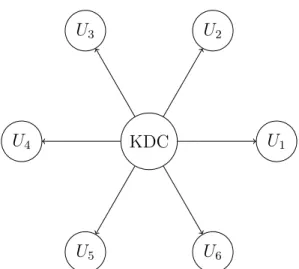
A Key Distribution Center (KDC) is a component of a cryptosystem to reduce risks inherent in key exchange. The Harn-Gong protocol needs a KDC to compute each mem-ber’s secret share polynomial first, and then sends it to each user secretly. The KDC can be offline once it successfully sends each user their secret share, which avoids the single point attack traditionally prevalent in a cryptosystem that employs a trusted third party. The use of KDC can significantly reduce communication overhead in the protocol. Also, the KDC can be implemented in a distributive way to avoid a single point trust problem, and the details of the approach are presented in [10]. For example, a group communication for 6 users employing KDC is presented in Figure 4.2.
Any group of up to m members can establish a group key by the following steps: 1) Univariate Polynomial Generation
U1 U2 U3 U4 U5 U6 KDC
Figure 4.2: 6 Users Key Establishment Overhead Using Harn-Gong Protocol 3) Conference Key Generation
4.2
Conference Group Key Sharing Protocol
We use the Harn-Gong protocol to establish ak-securem-members n-users conference key. Let k, m and n be some positive integers, where m is an even number and m ≤ n. U1
denotes the network where theKDC sends secret polynomial to users, andU2 denotes the
network where the group key is established. For a group consisting of n users, a k-secure m-members n-users conference key establishment protocol has the following properties:
1) The protocol can resist collusion by up to k users.
2) The protocol can establish a conference key for any r members where r≤m. The protocol is described in the following three subsections.
4.2.1
Univariate Polynomial Generation
KDC:
(a) Generate an RSA modulus N where N is a product of two large safe primes p and q. Keepp and q secret and broadcast N to the network U1.
(b) Select a suitable even number m such that m ≤ n where |U1| = n, and select a
security parameter k as the degree of the secret univariate polynomial, f(x).
(c) For 0 ≤ i ≤ k, securely generate a random number ai ←R− ZN as the coefficient of polynomial f(x) = akxk+· · ·+a1x+a0 mod N. We call f(x) the master secret
polynomial.
4.2.2
Secret Share Polynomial Generation
KDC:
(a) For each user u ∈ U1, compute su(x) = f(u)
1
m−1f(x) mod N, where u ∈ ZN is a
public information associated with the user, and m1−1 is the inverse ofm−1 inZφ(N)
where φ is Euler’s totient function.
(b) For each user u∈ U1, send the secret share polynomial su(x) to user u over a secure channel.
4.2.3
Conference Key Generation
Useru:
(a) A group of users U2 including u wants to establish a conference key for group
com-munication, where |U2|=r≤m.
(b) Generate a group key kU2 where
kU2 = Y v∈U2,v6=u su(v)×smu−r(0) mod N = Y v∈U2 f(v)×fm−r(0) mod N
4.3
Security Analysis
Lemma 4.3.1. The inverse of m−1 in φ(N) always exists when m is an even number in the protocol.
We first introduce the concept of a safe prime.
Definition 4.3.1 (Safe Prime). A safe prime is a prime number pof the form p= 2q+ 1, whereq is also a prime.
Proof of Lemma4.3.1. The Euler totient function of the modulusN isφ(N) = (p−1)(q− 1) = 4p0q0 where p0 and q0 are primes that makes p= 2p0+ 1 and q= 2q0 + 1. When m is even, the greatest common divisor (GCD) of m−1 and φ(N) is 1 since m−1 is an odd number,φ(N) is an even number, m < p0 and m < q0.
SinceGCD(m−1, φ(N)) = 1, from Euclidean algorithm there exists a numberz ∈Zφ(N)
that
z·(m−1)≡1 mod φ(N)
Thus the inverse of m −1 in φ(N) always exists when m is an even number in the protocol.
Lemma 4.3.2. The protocol can establish a secure conference key for any conference having r (r ≤m) members.
Proof. From Section 4.2.3, suppose U1 ={i1, i2,· · · , ir} and user u=ij. Then the confer-ence keykU1 of the network U1 is
kU1 = Y 1≤l≤r l6=j sij(il)×s m−r ij (0) modN = Y 1≤l≤r l6=j f(ij) 1 m−1f(i l)×f(ij) m−r m−1fm−r(0) mod N = Y 1≤l≤r l6=j f(il)×f(ij) r−1 m−1 ×f(i j) m−r m−1fm−r(0) mod N = Y 1≤l≤r f(il)×fm−r(0) mod N
Definition 4.3.2(RSA Assumption). It is computationally infeasible to computeM given only the ciphertext C =Me modN and RSA public key (N, e)
In the following, we first introduce the result on security analysis of the protocol from [28].
Lemma 4.3.3 ([28]). The proposed scheme is secure under the RSA assumption to resist the attack by a single user with one secret share polynomial to solve the master secret polynomial, f(x), used to generate shares.
We will present a proof of a different security claim, since the original proof has some flaws. In order to exhibit the flaw, in the following, we first present the security proof of Lemma 4.3.3 in [28].
Proof of Lemma 4.3.3 in [28]. Suppose there is an efficient algorithm,A, that could factor a secret share polynomial su(x) to gain KDC’s master secret polynomial f(x) such that su(x) =f(u)sf(x) where u and s are at his/her wish.
Then an attacker could use this algorithm to decrypt any ciphertextC =Me mod N efficiently by the following steps where (N, e) is useru’s RSA public key:
1. Let C = (ck, ck−1, . . . , c0)10∈ZN where C=ck10k+ck−110k−1+· · ·+c0 modN.
2. Let g(x) be a polynomial given byg(x) =ckxk+ck−1xk−1+· · ·+c0 mod N. Thus
the ciphertext can be represented through the polynomial g(x), i.e.,C =g(10). 3. Attacker models the RSA encryption in terms of the polynomial asg(x) =f(u)e−1f(x)
where u= 10, then the adversary use algorithm A to factor g(x) to getf(x).
4. Attacker will have g(10) = f(10)e (mod N) = C = Me (mod N), which implies M =f(10) (mod N). Thus attacker could decrypt ciphertext C.
This contradicts the RSA assumption. Thus [28] concludes that such algorithm A does not exist.
However, when using the contradiction to prove the lemma, there is a situation where there does not exist a polynomial f(x) such that g(x) =f(10)e−1∗f(x) mod N. For
ex-ample, whenN = 187 = 11∗17,e = 3, and the ciphertext is 11, then we getg(x) = 1 +x. Nevertheless, there is no polynomialf(x) = a+bx such thatg(x) =f(10)2∗f(x) mod N. The problem in this case is that ciphertext 11 is a factor of RSA modulus (187 = 11∗17). There is also no plaintext m such that makes me = 11 modN. Thus there is no way to
construct a polynomial that contradicts the RSA assumption.
In the original proof, knowing single share attack is an attack where the attacker is trying to acquire the master secret polynomial in the network. However, if the attacker can obtain other user’s secret polynomial at his/her wish, the attacker can obtain any con-ference key in the network to compromise the security. As a result we change the definition of knowing single share attack to that the attacker is trying to acquire other user’s secret polynomial but not necessarily the master secret polynomial.
Let (N, e) be an RSA public key where N is the RSA modulus ande is the public key. Let u, v be public information related to the users. Recall that su(x) = f(u)
1
ef(x) and sv(x) = f(v)
1
ef(x). Let KSSA denote a knowing single share attack problem where there is an algorithm A that takes input (su(x), N, e, u, v) and output sv(x). Hence A(su(x), N, e, u, v) = sv(x). Let RSAP denote the RSA problem, and suppose there is an algorithm A0 that takes input (N, e, Me) and output M respectively where M is a random value from ZN. Hence A0(N, e, Me) = M. The new lemma and proof are as follows:
Lemma 4.3.4. The proposed scheme is secure under the RSA assumption to resist the knowing single share attack by an attacker with one secret share polynomial su(x) to obtain
other user’s secret polynomial sv(x)where v, u are related to users’ public information and v 6=u.
Proof. Let KSSA denote a knowing single share attack problem where there is an algo-rithm A that takes input (su(x), N, e, u, v) and output sv(x) where su(x) = f(u)1ef(x), sv(x) = f(v)
1
ef(x), N is an RSA modulus and u, v are public information related to the users. Hence A(su(x), N, e, u, v) = sv(x). Let RSAP denote the RSA problem where there is an algorithm A0 that takes input (N, e, Me) and output M respectively. Hence A0(N, e, Me) = M.
We can reduce KSSA problem to RSAP problem by the following process: 1. Given su(x), N, e, u, v, let ρ = su(v)/su(u) = (f(u)
1
ef(v))/(f(u)
1
ef(u)) = f(v)/f(u) (mod N).
2. Query RSAP to calculateA0(N, e, ρ) =ρ1e (mod N) = f(v)1e/f(u)1e (mod N).
3. Obtain sv(x) by calculating sv(x) = ρ 1 esu(x) (mod N), since ρ 1 esu(x) = (f(v)/f(u))1ef(u) 1 ef(x) =f(v) 1 ef(x) (mod N).
Since we can use algorithm A0 to output s
v(x) from (su(x), N, e, u, v), we know that KSSA≤p RSAP.
Now we show how to reduce RSAP toKSSA by the following steps: 1. Given (N, e, C) whereC =Me (mod N), let m
0
R
←−ZN and c0 =me0 (mod N).
2. Let c1,· · · , ct−1
R
←−ZN, find ct such that Pti=0ci =C (mod N).
3. Let f(x) = Pti=0cixi (mod N) such that f(0) = c0 and f(1) = C. Let s0(x) =
m0f(x) (mod N).
4. Query KSSAto get A(s0(x), N, e,0,1) =s1(x) (mod N).
5. Since s1(x) = f(1) 1
ef(x) = C
1
ef(x) = M f(x) (mod N), from s0(x) and s1(x), by setting x= 0, sv(0) su(0) = M f(0) m0f(0) = M m0 (mod N), thenM =m0 sv(0) su(0) (mod N).
Since we can use algorithm A to output eth root of C from (N, e, Me), we know that RSAP ≤p KSSA.
From the two steps above, we conclude that KSSA ≈ RSAP, which means that knowing a single share polynomial (su(x), N, m, u, v), it is computationally infeasible to compute other user’s secret polynomialsv(x) as long asRSAP is a hard problem.
From Lemma 4.3.4, we know that by knowing single secret polynomial one cannot use other user’s secret polynomial to obtain any other conference keys. However, since the conference key is constructed by the production of the master secret polynomialf(x), one can also obtain other conference keys by learning f(x). We argue next that it is also computationally infeasible to determine f(x) from a single secret polynomial.
Claim 4.3.1. By knowing a single secret polynomials su(x) one cannot learn the master secret polynomialf(x) used to generate conference keys.
Justification. Let m − 1 denoted as e. Suppose the user knows f(u). Since su(x) = f(u)1ef(x), if one can determinef(x), then one can computef(u)
1
e mod N, which would be hard due to RSA assumption. Thus it is computationally infeasible to determine f(x) from a single secret polynomialsu(x).
Claim 4.3.2. By knowingt secret polynomialssui(x),1≤i≤t wheret < k+ 1, one cannot learn the conference key kU whereui 6∈ U for all 1≤i≤t.
Justification. The proof is based on the well-known Lagrange interpolation formula. Sup-pose U = {v1, v2,· · · , vr} and vj
R
←− U. Let g(x) = Q
1≤l≤r,l6=jf(vl)×fm−r(0)f(x), then the conference key kU =g(vj).
By knowing a single secret polynomialsui(x), we can obtain the value ofg(ui) by calcu-lating Q
1≤l≤r,l6=jsui(vl)×s m−r ui (0) =
Q
1≤l≤r,l6=jf(vl)×fm−r(0)f(ui) =g(ui) mod N. We can obtaint points (ui, g(ui)) by t secret polynomials sui(x),1≤i≤t.
Since g(x) is with degree k, according to the Lagrange interpolation formula, it needs at leastk+ 1 or more thank+ 1 points to constructg(vj). By knowingtsecret polynomials sui(x),1≤i ≤t where t < k+ 1, it is computationally infeasible reconstruct g(x). Hence one cannot learn the conference key kU where ∀ui 6∈ U,1≤i≤t.
Claim 4.3.3. It is computationally infeasible for an adversary to know other conference keys by knowing fewer than k+ 1 secret polynomials.
Justification. From Lemma4.3.4, we can conclude that it is computationally infeasible for an adversary to know other secret polynomials by knowing a single secret polynomial. From Claim 4.3.2, we also know that it is computationally infeasible to obtain other conference keys by knowing fewer than k+ 1 secret polynomials. Since one can neither obtain other conference keys by learning others’ secret polynomials nor reconstructing conference keys by knowing fewer than k + 1 secret polynomials, it is computationally infeasible for an adversary to know other conference keys by knowing less thank+1 secret polynomials.
4.4
Complexity Analysis
Cryptographic primitives are expensive both in storage and computation, for example, the operation of cryptographic primitives might involve integers of 128 bytes or more (consid-ering an RSA modulus of 1024 bits). To illustrate the time and space complexity in more detail, we analyze the bit complexity of computation and storage.
In the analysis, we use the notation from Tables 3.3 and 3.4. The l bits storage space can store a 2l number. Since the operation of finding an inverse a number is equal to do an Euclidean algorithm to find the greatest common divisor of the number and modulus, Inv(l) is proportional toM ul(l).
4.4.1
Complexity Analysis of User
Time Complexity :
(a) In Sections 4.2.1 and 4.2.2 there is no computation needed.
(b) In Section 4.2.3, for an k-secure m-members conference key establishment process, each user needs to evaluate the secret polynomial m times and multiply evaluated value m times. With the secret polynomial of degree k, from Horner’s method it takes k(M ul(logN) +Add(logN)) operations for evaluation. Thus the user needs m(k(M ul(logN) +Add(logN))) +mM ul(logN) operations to establish a m-users conference key.
Space Complexity:
(a) In Sections 4.2.1 and 4.2.2 there is no storage needed.
(b) In Section 4.2.3, the user needs (k+ 1) log(N) space to store secret polynomial coef-ficients.
Communication Complexity:
(a) In Sections 4.2.1 and 4.2.3, there is no communication needed.
(b) In Section 4.2.2, the user needs to receive one message of secret polynomial.
4.4.2
Complexity Analysis of
KDC
Time Complexity :
(a) In Section 4.2.1, KDC needs to generate (k+ 1) polynomial coefficients which needs (k+ 1)Srand(logN) operations to generate a univariate polynomial.
(b) In Section 4.2.2 KDC needs to do n evaluations, n modulo inverse and (k + 1) multiplications for each user inU1. From Horner’s Method we know thatKDC needs
n(k(M ul(logN) +Add(logN)) +Inv(logN)) + (k + 1)M ul(logN)) operations in time.
Table 4.1: Complexity Analysis of Harn-Gong Key Establishment Protocol in Bit Opera-tion
Time Complexity Space Complexity Communication Complexity
KDC
O(kSrand(logN)+ nkM ul(logN) +
nkAdd(logN))
O(klogN) O(n)
user O(mkM ul(logN)+
mkAdd(logN)) O(klogN) O(1) Space Complexity:
(a) In Section 4.2.1, the KDC needs (k + 1) log(N) space to store (k + 1) polynomial coefficients.
(b) In Section 4.2.2, the KDC needs (k + 1) log(N) space to store temporary secret polynomial for each user.
(c) In Section 4.2.3, there is no storage needed. Communication Complexity:
(a) In Sections 4.2.1 and 4.2.3, there is no communication needed.
(b) In Section 4.2.2, the KDC needs to send the secret polynomial to each user, which means KDC needs to sendn messages in total.
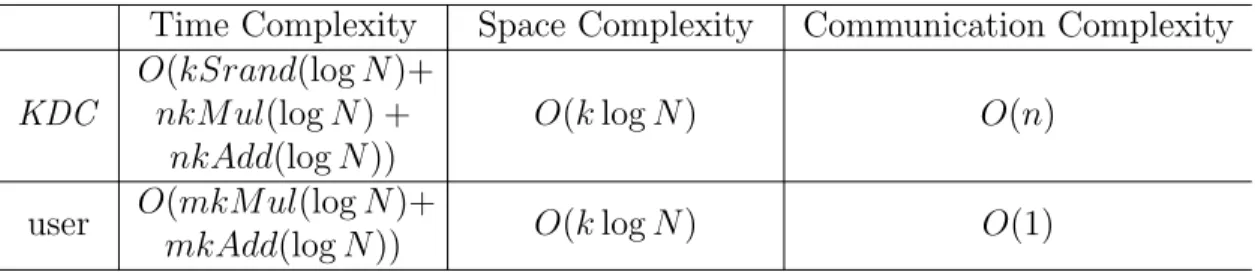
In conclusion, the time, space and communication complexity of theKDC and the user in bit operations are listed in Table 4.1.
Chapter 5
Mobile Data Aggregation for
Privacy-Preserving Machine Learning
In this chapter, we present a data aggregation scheme for privacy-preserving machine learning introduced in [7]. We present the scheme overview in Section 5.1. By revising the adversarial model, the details of the scheme and its privacy analysis are presented in Section5.2. We analyze the bit complexity in Section 5.3.5.1
Scheme Overview
Machine learning is a field of artificial intelligence that uses statistical techniques to give computers the ability to “learn” [51]. Since the 1990s, machine learning has flourished in tackling solvable problems of a practical nature, such as object detection in computer vision, natural language processing and bioinformatics. Standard machine learning ap-proaches require centralizing a significant amount of training data on one machine or in a data center. In 2017, Google described a new type of machine learning scheme, called Federated Learning [36], that distributes the training data across different mobile users.
The general idea of Federated Learning is that each user as a device holder downloads the current training model from the cloud machine learning provider, stores customized training data in his/her devices, improves the model by using the new individualized train-ing data, and then summarizes the changes as a small and focused update. Federated Learning enables better user experience from machine learning without compromising
users’ confidentiality, which is often a concern from the public generated by the standard centralized AI paradigm, where better algorithms always come at the cost of collecting more and more personal data [2].
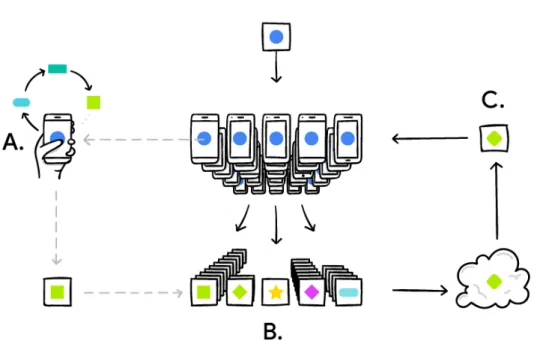
Figure 5.1: A user personalizes the model locally, based on customized usage (A). Many users’ updates are aggregated (B) to form a consensus change. A shared model is dis-tributed (C) after the consensus change. The procedure runs repeatedly.
A secure data aggregation protocol for Federated Learning has been proposed at the same time to reduce the risk of the cloud service provider learning the personal model update [7]. By the combination of cryptographic techniques and machine learning, the model enables the training algorithm update only by knowing the average data of 100s or 1000s users. With the evolution of other types of machine learning algorithms in the mobile device, this protocol can be applied to different situations as well.
For any mobile user who wants to send an update to the server, the process in [7] is as follows:
1) Diffie-Hellman Pairwise Key Generation 2) Secret Share Generation
3) Private Data Masking
4) User Drop-out Consistency Check 5) Unmasking Aggregate Data
5.2
Data Aggregation Protocol
The scheme provides an efficient way to calculate users’ sums of vectors under the malicious model of a curious-but-honest server, and robustness to failures, which enables a practical and secure aggregation in mobile usage. However, the communication cost is expensive since drop-outs are common in mobile networks.
Also, the protocol in [7] is only guaranteed to be secure when the server is curious-but-honest and the adversary is only active in the communication channels of the network; this does not include a situation where the server is also an active adversary. Hence, in this chapter we consider the protocol in [7] against an active adversary as a protocol against a curious-but-honest adversary server and active users.
The requirements of the protocol are listed below:
1) All parties are given the security parameterk, the number of usersnand a threshold value t, honestly generated pp ← KA.param(k), parameters m and R such that ZmR is the space from which inputs are sampled, and a field F to be used for secret sharing.
2) All users also have a private authenticated channel with the server.
3) All users u receive their signing key dSKu from the trusted third party, together with verification keys dP K
v bound to each user identity v.
If any of the below operations (assertion, signature verification, key agreement, encryption) fails, the protocol will abort. Ui,1≤i≤4 represents the set of online users in each round.
5.2.1
Diffie-Hellman Pairwise Key Generation
Useru:
(1) Generate key pairs (cP Ku , cSKu )← KA.gen(pp), (sP Ku , sSKu ) ←KA.gen(pp), and gen-erate σu ←SIG.sign(dSKu , cP Ku ||sP Ku ).
(2) Send (cP K
u ||sP Ku ||σu) to the server through the private authenticated channel.
(3) Receive server’s broadcast list (v, cP Kv , sP Kv , σv)v∈U1. Assert that |U1| ≥t, that all the
public key pairs are different, and that ∀v ∈ U1, SIG.ver(dP Kv , cP Kv ||sP Kv , σv) = 1. (4) For each other user v ∈ U1\{u}, compute ku,v ←KA.agree(cSKu , cP Kv )
(5) Store all messages received and values generated. Server:
(1) Collect at least t messages from individual users in the previous round (denote with U1 this set of users). Otherwise, abort.
(2) Broadcast to all users in U1 the list (v, cP Kv , sP Kv , σv)v∈U1.
5.2.2
Secret Share Generation
Useru:
(1) Sample a random element bu ←F to be used as a seed for a PRNG. (2) Generate t-out-of-|U1| shares of sSKu :{(v, sSKu,v)}v∈U1 ←SS.share(s
SK u , t,U1)
(3) Generate t-out-of-|U1| shares of bu: {(v, bu,v)}v∈U1 ←SS.share(bu, t,U1)
(4) For each other user v ∈ U1\{u}, compute eu,v ←AE.enc(ku,v, u||v||sSKu,v||bu,v)
(5) Send all the ciphertexts eu,v to the server (each implicitly containing addressing information u, v as metadata).
Server:
(1) Collect lists of ciphertexts from at least t users (denote with U2 ⊆ U1 this set of
users).
(2) Sends to each user u∈ U2 all ciphertexts encrypted for it: {eu,v}v∈U2.
5.2.3
Private Data Masking
User u:
(1) If the list of eu,v received from server is of size less than t, abort.
(2) For each other user v ∈ U2\{u}, expand ku,v using a PRNG into a random vector pu,v = ∆u,v ·P RN G(ku,v), where ∆u,v = 1 whenu > v, and ∆u,v =−1 when u < v. Additionally, define pu,u = 0.
(3) Compute the user’s own private mask vector bu =P RN G(bu). Then, compute the masked input vector yu ←xu+bu+
P
v∈U2pu,v (mod )R
(4) Send yu to the server. Server:
(1) Collectyu from at leastt users (denote withU3 ⊆ U2 this set of users). Send to each
user in U3 the list U3.
5.2.4
User Dropout Consistency Check
Useru:
(1) Receive from the server a list U3 ⊆ U2 consisting of at leastt users (including itself).
If U3 is smaller than t, abort.
(2) Send to the server σ0u ←SIG.sign(dSK u ,U3).
Server :
(1) Collect σ0 from at least t users (denote withU4 ⊆ U3 this set of users). Send to each
5.2.5
Unmasking Aggregate Data
Useru:
(1) Receive from the server a list{v, σ0
v}v∈U4. Verify thatU4 ⊆ U3, that|U4| ≥t and that
SIG.ver(dP K
u ,U3, σ0) = 1 for all v ∈ U4 (otherwise abort).
(2) For each other uservinU2\{u}, decrypt the ciphertextv0||u0||sSKv,u||bv,u ←AE.dec(kv,u, ev,u) and assert that u=u0∧v =v0.
(3) Send a list of shares to the server, which consists of sSK
v,u for usersv ∈ U2\U4 andbv,u for users in v ∈ U4.
Server:
(1) Collect from at least t users (denote with U5 this set of users).
(2) For each user in u ∈ U2\U3, reconstruct suSK ← SS.recons({sSKu,v}v∈U5, t) and use it
(together with the public keys received in Section 5.2.1) to recompute pv,u for all v ∈ U3 using the PRNG.
(3) For each user u∈ U3, reconstructbu ←SS.recons({bu,v}v∈U5, t) and then recompute
bu using the PRNG.
(4) Compute and output z=P
u∈U3xu as X u∈U3 xu = X u∈U3 yu− X u∈U3 bu+ X u∈U3,v∈U2\U3 pv,u
5.2.6
Security Analysis
The security proof of the protocol in [7] is based on the Decision Diffie-Hellman problem (Definition 3.4.1). We are going to illustrate why the privacy of the user is preserved in the curious-but-honest adversary model.
From Section5.2.3 the server can receive the masking data yu from every user u∈ U2,
however, it is impossible for the server to learn anything of user’s private data xu under a curious-but-honest adversary model. Since the server can collect information from at least t users in Section 5.2.5, we can select t users from U5 and denote those users as
Lemma 5.2.1. For any useru∈ U2\U3, the server can only getxu+bu fromyu it received.
Proof. From Section 5.2.5, the server can compute sSK
u for each user u ∈ U2\U3 by using
Lagrange Interpolation from Lemma 3.2.1
sSKu = t X i=1 Y 1≤j≤t,j6=i 0−uj ui−ujss SK ui,u
The server can then calculate ku,v for each user v ∈ U2 by:
ku,v ←KA.agree(sSKu , s P K v ) pu,v can be determined for each user v ∈ U2 by:
pu,v = P RN G(ku,v), u > v 0, u=v −P RN G(ku,v), u < v The sever can then calculatexu+bu fromyu by:
yu− X v∈U2 pu,v =xu+bu+X v∈U2 pu,v− X v∈U2 pu,v modR =xu+bu modR
However, since in Section5.2.5 the server will not receive information ofbu of any user u∈ U2\U3, the server can only getxu+bu fromyu it received under a curious-but-honest adversary model.
Lemma 5.2.2. For any user u ∈ U3, the server can only get xu+ P
v∈U3pu,v from yu it received.
Proof. From Section 5.2.5, the server can compute bu for each user u ∈ U4 by using
La-grange Interpolation from Lemma3.2.1
bu = t X i=1 Y 1≤j≤t,j6=i 0−uj ui−uj bui,u
pu can be determined by:
pu =P RN G(bu)
The sever can then calculatexu+Pv∈U4pu,v fromyu by:
yu−pu =xu+bu+X v∈U3 pu,v−pu (mod R) =xu+ X v∈U3 pu,v (mod R)
However, in Section 5.2.5 the server will not receive information of bu for any user u∈ U3, under a curious-but-honest adversary model, the server can only getxu+
P
v∈U3pu,v
from yu it received.
Lemma 5.2.3. For any user u∈ U2, the server cannot learn xu from yu it received.
Proof. From Decision Diffie-Hellman problem we can think ofP
v∈U3pu,v as a variable that
is computationally indistinguishable from random, thusP
v∈U3pu,v is a random vector over
field R. Since bu is a random variable, then the vector bu which is generated by bu and a pseudo-random generator function can also be computationally indistinguishable from a random vector.
Because the server can get either xu+bu for each useru∈ U2\U3 andxu+ P
v∈U3pu,v
fromyu for user u∈ U3, then for all yu, u∈ U2 which Sever get in Section 5.2.3, the value
the server received is the sum of users’ private data vector and a random vector. As a result, it is infeasible for the server to probe users’ private information, which means the server cannot learn xu from yu it received.
5.3
Complexity Analysis
We analyze the complexity of computation and storage in the same manner as Section
4.4 does. Given a random finite field F, logF is the bit length of the maximum value in F. Since decryption scheme is an inverse operation of encryption scheme, we consider the operation of the decryption scheme used in the protocol whose input length isl bits is also Enc(l). At the same time, since an operation of subtraction is the same as an operation of addition of the inverse number, the time of an operation of subtraction of l bits isAdd(l), too. We let the dimension of data vector to be r.
5.3.1
Complexity Analysis of the User
Time Complexity :
(a) In Section 5.2.1, the user needs to generate 2 Diffie-Hellman key pairs and 1 signa-ture, which is 2(Srand(log|G|) +Exp(log|G|)) +Sign(log|G|) operations in total. A user then needs to compute n different Diffie-Hellman pairwise key, the computa-tion time is nExp(log|G|).
(b) In Section 5.2.2, the user needs to generate a random number using Srand(log|F|) time. Then generate two (t+ 1) coefficients polynomial using 2(t+ 1)Srand(log|F|) time.
Then the user needs to evaluate n times for the two polynomials. According to Horner’s Method it needs 2nt(M ul(log|F|) +Add(log|F|)) operations to evaluate. In the end it needs to encrypt secret shares n times usingnEnc(log|F|) time. (c) In 5.2.3, the user needs rSrand(log|R|) operations to generate one pu,v, which in
total is rnSrand(log|R|) for n users.
Then rSrand(log|R|) operations is needed to generate bu. In the end rnAdd(log|R|) operations is needed to generate yu.
(d) In Section 5.2.4, the user needs to sign a message which takes Sign(log|G|) time. (e) In Section 5.2.5, the user needs to do at least t signature verification which takes
tSign(log|G|) time, and at most (n−t) decryption which take (n−t)Enc(log|F|) time.
Space Complexity:
(a) In Section5.2.1, the user needs 2(t+ 1) log|F|space to store coefficients, andnlog|G| space to store all the value received in this step.
(b) In Section 5.2.2, the user needs to storenlog|F| different messages for {eu,v}v∈U2.
(c) In Section 5.2.3, the user needs to store 4rlog|R| space foryu,xu,bu and P
v∈U2pu,v.
(d) In Section 5.2.4, the user needs at most (n−t) logn space to store the list.
(e) In Section 5.2.5, the user needs to spend at most (n−t) log|F| space to storebu,v. Communication Complexity:
(a) In Section5.2.1, the user needs to send 2 public keys and receive 2(n−1) public keys in communication.
(b) In Section 5.2.2, the user needs to sendn messages of ciphertexts to the server. (c) In Section 5.2.3, the user needs to send a message yu withr dimension to the server. (d) In Section 5.2.4, the user needs to receive at most n messages of signature and send
1 signature to the server.
(e) In Section 5.2.5, the user needs to send at most n−t messages of secret shares to the server.
5.3.2
Complexity Analysis of the Server
Time Complexity :
(a) In Sections 5.2.1, 5.2.2,5.2.3 and 5.2.4, there is no computation needed. (b) In Section 5.2.5, the server needs tM ul(log|F|) to reconstruct sSK
u , Exp(log|G|) to reconstruct secret key, and at most (n−t) times of operations to reconstruct users’ secret polynomials. It takes (n−t)(tM ul(log|F|) +Exp(log|G|)) in total.
Then, the server needstM ul(log|F|) andrSrand(log|R|) to reconstruct abu at most n−ttimes, which takes (n−t)(tM ul(log|F|)+rSrand(log|R|)) operations altogether. At last server needs to do 3r additions to get aggregate value in 3rAdd(log|R|) time. Space Complexity:
(a) In Section 5.2.1, server needs to store n messages from individual users which is nlog|G| space.
(b) In Section 5.2.2, server needs to store n2 messages for e
v,u which takes n2log|F|. (c) In Section 5.2.3, server needs to store at leasttrlog|R| foryu from at least t users. (d) In Section5.2.4, server needs to store at mostnmessages from individual users which
(e) In Section 5.2.5, server needs (t+ 1) log|F| to store secret share polynomial, and log|G| to store secret key, which in total takes (n−t)((t+ 1) log|F|+ log|G|) space. Then server needs (n−t)(tlog|F|+rlog|R|)) space to store values used in aggregat-ing sum.
Since server can only store a running sum to calculate yu, at last it needs rlog|R| space to store running value.
Communication Complexity:
(a) In Section 5.2.1, server needs to broadcast a message of a n users’ list to all user, which means server needs to send n2 messages in communication.
(b) In Section 5.2.2, server needs to collect ciphertexts at most n times and send them to all users with the cost of n times, which is n2 messages in total.
(c) In Section 5.2.3,server needs to send the list of users in U3 to all user in U3 at least
n2 times.
(d) In Section 5.2.4, server needs to send the list of users in U4 to all user in U4 at least
n2 times.
(e) In Section 5.2.5, server needs to receive at most n−t shares to reconstruct pu,v and bu, and at mostrn data vector to update running sum.
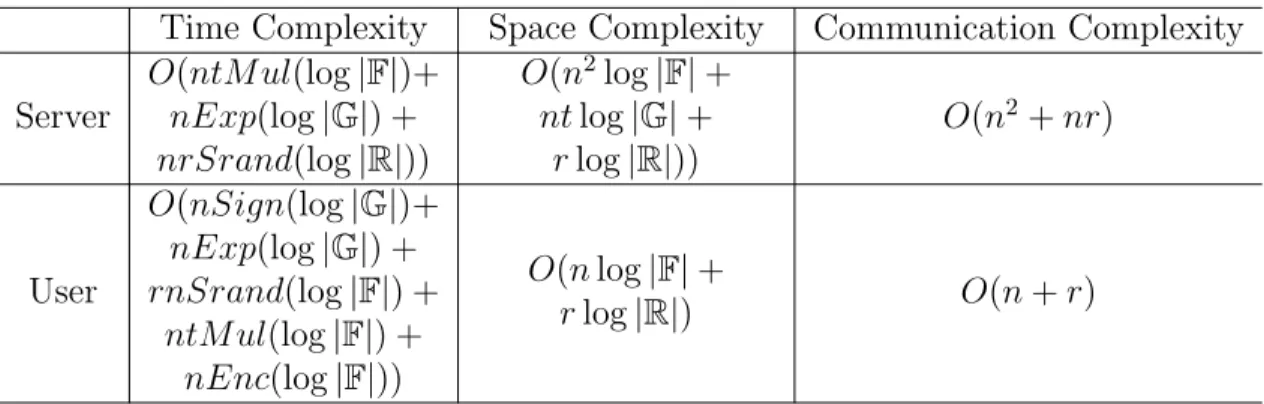
In conclusion, the time, space and communication bit complexity of the server and the user are given in Table 5.1.
Table 5.1: Bit Complexity Analysis of Privacy-Preserving Mobile Data Aggregation Pro-tocol
Time Complexity Space Complexity Communication Complexity Server O(ntM ul(log|F|)+ nExp(log|G|) + nrSrand(log|R|)) O(n2log| F|+ ntlog|G|+ rlog|R|)) O(n2+nr) User O(nSign(log|G|)+ nExp(log|G|) + rnSrand(log|F|) + ntM ul(log|F|) + nEnc(log|F|)) O(nlog|F|+ rlog|R|) O(n+r)
Chapter 6
A New Communication Efficient
Data Aggregation Protocol
In this chapter, we introduce our new communication efficient and privacy-preserving data aggregation protocol. We present an overview of the protocol in Section6.1. The details of the scheme are presented in Section6.2. We present the adversarial model and the security analysis in Section 6.3. Finally, we analyze the bit complexity of the protocol in Section
6.4.
6.1
Scheme Overview
In the complexity analysis in Section 5.3, one can see that each user needs to generate a temporary pair of Diffie-Hellman public/private keys to mask private data. The in-clusion of the mechanism ensures the private key reconstruction of drop-out users won’t compromise the confidentiality of the users’ private information. However, the pairwise keys’ construction also involvesn more times of Diffie-Hellman shared key exponentiation operations for the user andn2 more communication rounds for the server. The construc-tion is rather expensive considering that mobile device’s resource is always limited. The original scheme requires each user to have a pair of public/private keys and know others’ public keys, which would be rather expensive considering that as the number of mobile users scale, it is communication and space expensive to know every users’ public key in the network.